HOA Neighbors Took 10 Feet of My Land With a Fake Survey—Then the County Unrolled the 1978 Plat My Father Drew.
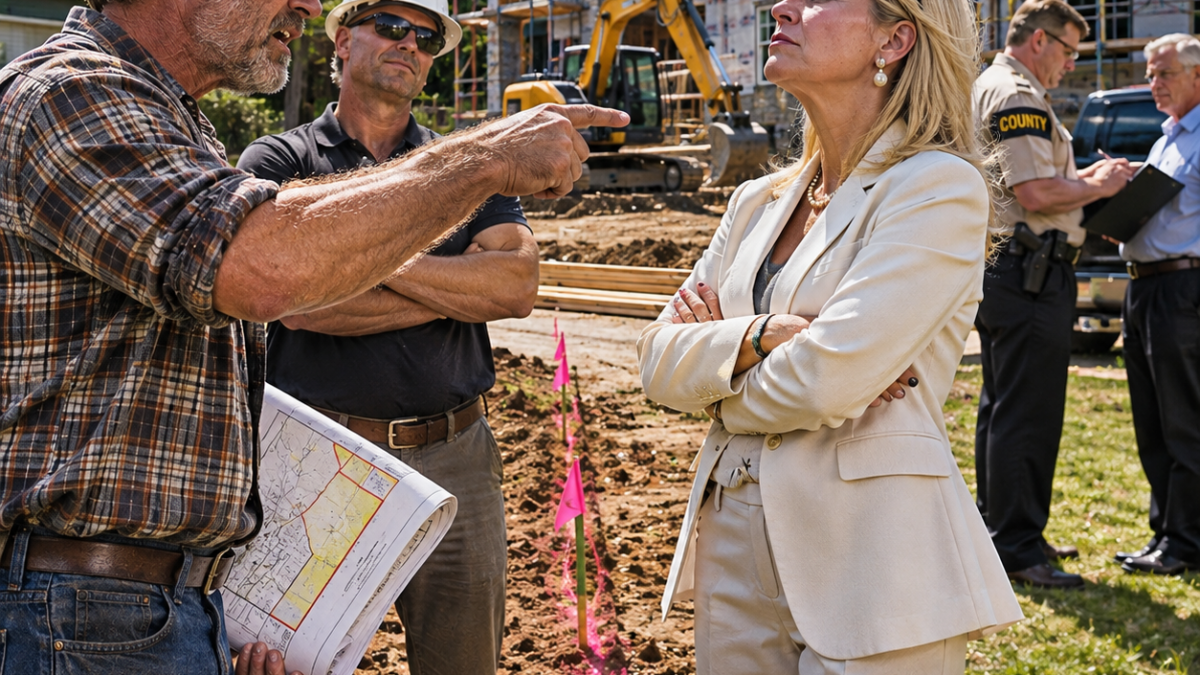
HOA Neighbors Took 10 Feet of My Land With a Fake Survey—Then the County Unrolled the 1978 Plat My Father Drew.
My HOA neighbors tore down the cedar fence my father and I had built forty years earlier, shifted their construction stakes 10.3 feet onto my property, and told me their new survey proved the land had always belonged to them.
Then I discovered they had filed a boundary agreement with the county carrying my forged signature—and the “licensed surveyor” they used wasn’t licensed at all.
What Tammy Hollister didn’t know when she called my father’s survey “outdated garbage” was that my father had been the professional surveyor who drew every original property line in Cedar Bluff Estates, and his 1978 plat was sitting twenty feet behind me in a gray steel filing cabinet.
My name is Garrett Shelton.
I’m fifty-two years old.
Semi-retired general contractor.
I’ve spent twenty-eight years building houses in North Carolina.
Foundations.
Framing.
Drywall.
Decks.
Roofing.
Trim.
I’ve poured concrete in August heat so thick your shirt stuck to your back before eight in the morning.
I’ve rebuilt houses after hurricanes.
I’ve corrected walls somebody swore were straight.
And I’ve learned one rule that applies to almost every expensive mistake I’ve ever seen.
Measure twice.
Cut once.
My father taught me that.
Walter J. Shelton.
Professional land surveyor.
License number 4281.
Dad didn’t just say that phrase when he was working.
He said it about everything.
Hanging a cabinet.
Buying lumber.
Choosing a wife.
I once asked what marriage had to do with measuring twice.
He looked at my mother across the kitchen and said:
“Everything.”
Mom threw a dish towel at him.
That was Dad.
He bought our property on Briarwood Lane in 1971.
Back then, Cedar Bluff Estates didn’t exist.
Mostly tobacco fields.
Pines.
Red clay.
A narrow county road.
PART2:
Dad bought 1.8 acres and built the house himself.
Oak trim.
Hardwood floors.
Brick fireplace.
Nothing fancy.
But solid.
The hallway still creaks in the same two places.
If the house is closed up for a few days, I swear I can still smell Dad’s cherry pipe tobacco.
He smoked the same blend for forty years.
Never apologized.
In 1978, developers began turning the surrounding farmland into Cedar Bluff Estates.
Dad got hired to survey it.
Every lot.
Every setback.
Every drainage easement.
Every road corner.
Every boundary monument.
He drew those lines with a Rapidograph pen and a 4H pencil.
No computers.
No satellite overlays.
PART3:
No phone app.
Transit.
Chain.
Field notes.
Math.
Patience.
If Dad put a line on a plat, he knew exactly why it was there.
He died five years before the trouble started.
Eighty-one.
Three years before that, I lost my wife Ellen.
Pancreatic cancer.
She was fifty-one.
We had thirty good years.
Then four terrible months.
Ellen could wallpaper a bathroom, quote Emily Dickinson, plant tomatoes straighter than any landscaping crew I’ve ever hired, and still have dinner ready by six.
She was the sort of person who made a house feel occupied even when she wasn’t in the room.
After she died, my own place became too quiet.
So I moved back into Dad’s house.
The house I grew up in.
I told myself it was temporary.
Two months.
Maybe three.
Then I found myself repairing the back steps.
Then replacing a gutter.
Then repainting Dad’s old workshop.
Somewhere along the way, temporary became home.
The lot beside mine—Lot 14—had been empty for years.
Then Craig and Tammy Hollister bought it.
Craig owned Hollister Custom Homes.
Tammy chaired the Cedar Bluff Architectural Review Committee.
She’d been on the HOA board in one role or another for seven years.
Together, they were building a 4,200-square-foot house on a street where most homes were closer to two thousand.
Three-car garage.
Pool.
Outdoor kitchen.
Two-story entry.
Everything oversized.
Their money wasn’t my concern.
Their taste wasn’t my concern.
Their house wasn’t my concern.
Until their survey stakes appeared ten feet inside my yard.
I was sitting on Dad’s porch one morning when I saw a man in a reflective vest pounding stakes.
The first one looked wrong.
The second one looked worse.
By the third, I stood.
I’d walked that property line since I was nine years old.
My father and I built the cedar fence along it in 1983.
I held the level while he set posts.
He would tap one side.
Check bubble.
Tap again.
Then say:
“Dead center.”
He taught me never to trust a fence just because it looked straight.
A fence marks a line.
The survey defines it.
Still, ours had stood almost forty years.
So when somebody drove a stake ten feet beyond it, I noticed.
I walked over.
“Morning.”
The survey helper looked at me.
“Morning.”
“That stake’s on my land.”
Before he answered, Craig appeared from behind his construction trailer.
Hard hat.
Oakley sunglasses.
Clean boots.
The kind of contractor who spent more time pointing than carrying.
“We had it surveyed.”
“Then your survey’s wrong.”
He smiled.
“Your old fence was wrong.”
“No.”
“It was.”
I looked at the stake.
Then at him.
“Who surveyed it?”
He pointed toward a rolled plan on his truck hood.
“Licensed guy.”
“Name?”
Craig’s smile tightened.
“Why?”
“Because he’s ten feet off.”
That’s when Tammy arrived.
White Escalade.
Linen blazer.
Sunglasses.
Clipboard.
Always the clipboard.
She stepped out.
“What is happening?”
Craig said:
“Garrett thinks the boundary’s wrong.”
Tammy looked at me.
Then at the old fence.
“Oh.”
One little syllable.
Like she’d been waiting for the conversation.
“Honey.”
She actually called me honey.
“You’ve been here a long time.”
“Yes.”
“Sometimes old fences aren’t accurate.”
“This one is.”
“Craig had professionals handle it.”
“So did I.”
She smiled.
“Your father?”
“Yes.”
She laughed softly.
“Things have changed since then.”
I looked at her.
“Property corners generally don’t.”
She turned toward Craig.
“Don’t waste time.”
Then to me:
“The Architectural Review Committee has already approved the plans.”
“Your committee doesn’t move property lines.”
“We approved based on the submitted survey.”
“Then the submitted survey is wrong.”
Tammy lifted her clipboard.
“This conversation is finished.”
It wasn’t.
Three days later, I came home from the hardware store.
My fence was gone.
Every post.
Every rail.
Every board.
Forty years of cedar stacked at the curb beside Craig’s construction debris.
For several seconds, I just stood there.
The broken wood smelled sharp and sweet.
Fresh cedar.
Normally one of my favorite smells.
That afternoon it smelled like a funeral.
I picked up one rail.
You could still see the old nail holes.
Dad’s work.
My work.
Craig stood near the trailer.
Arms crossed.
I walked over.
“Where’s my fence?”
“Removed.”
“I can see that.”
“It was over the line.”
“No.”
“Our survey says otherwise.”
“Your survey is wrong.”
Then Tammy pulled up.
I almost laughed when I saw the clipboard.
She stepped out.
“Mr. Shelton.”
She handed me a paper.
ARCHITECTURAL COMPLIANCE NOTICE
I read it.
My fence supposedly exceeded Cedar Bluff’s approved height by two inches.
The committee had allegedly voted three to zero to authorize removal.
I looked up.
“You voted to tear down my fence?”
“We voted to correct a violation.”
“On private property?”
“You’re part of Cedar Bluff.”
“That doesn’t give you authority to destroy my property.”
“You were noncompliant.”
“Who voted?”
“Myself.”
“Glenn Webb.”
“Delores Klein.”
I knew Glenn.
Craig’s golf buddy.
Delores was eighty years old and hadn’t attended an HOA meeting in months.
Later, I learned Tammy had driven to Delores’s house with a printed ballot and banana muffins.
Delores signed.
That’s how three people supposedly authorized demolition of property that wasn’t theirs.
Tammy smiled.
“If you’d maintained the property correctly, this wouldn’t have happened.”
I folded the notice.
Put it in my pocket.
Craig looked almost disappointed.
Maybe he expected yelling.
I wasn’t ready to yell.
Anger is fast.
Evidence is slow.
I’ve spent my career in construction.
Sequence matters.
You don’t hang drywall before electrical inspection.
You don’t pour footings before layout.
And you don’t start a property-line war until you know precisely where the line is.
That evening, I opened the survey Craig had given the HOA.
Something immediately looked wrong.
The seal was flat.
Printed.
Not embossed.
The license number looked blurry.
The signature:
Lonnie Pratt, PLS
I didn’t recognize the name.
That didn’t prove anything.
So I didn’t accuse anyone.
I hired Caldwell Surveying.
Thirty years in business.
Proper license.
Modern equipment.
Total station.
GPS.
Field verification.
Caldwell arrived Thursday morning.
He spent four hours working both ends of the property.
Located original monuments.
Cross-referenced recorded plats.
Checked bearings.
Friday afternoon he handed me the result.
“Garrett.”
“Yes?”
“Your fence was right.”
“How far are they over?”
“Ten point three feet.”
I stared.
“Ten feet?”
“Ten feet, four inches in places.”
He tapped the stamped survey.
“Matches the recorded 1978 subdivision plat almost exactly.”
I smiled.
“Who drew that?”
Caldwell looked at the title block.
“Walter Shelton.”
“My father.”
He looked at me.
Then back at the paper.
“Well.”
“Your old man knew what he was doing.”
“Yes.”
“He did.”
I walked next door with the survey.
Craig answered.
I held it up.
“Your house is ten feet onto my property.”
He read the first page.
Then closed the door.
Just closed it.
From inside, Tammy said loudly:
“Is that his little hobby survey?”
Craig said something I couldn’t hear.
Then Tammy:
“Tell him to put it in his scrapbook.”
Fine.
I filed a formal complaint with the HOA.
Certified.
Survey attached.
Photographs.
Request to stop construction.
Request to preserve records.
Tammy scheduled a committee meeting.
Then didn’t tell me.
I found out two hours after it started.
Drove to her house.
Meeting had already ended.
She opened the door.
Behind her:
Glenn Webb.
Delores Klein.
Cheese crackers.
Wine glasses.
A candle.
I’m not making that up.
The label said something like Autumn Fireside.
Tammy smiled.
“Meeting adjourned.”
“What meeting?”
“The Architectural Review Committee.”
“I wasn’t notified.”
“Your presence wasn’t required.”
“My complaint was the agenda.”
“The committee reviewed it.”
“And?”
“Three to zero.”
“What did you vote?”
“Your survey is noncompliant with community standards.”
I stared.
“A licensed survey is noncompliant?”
“Yes.”
“With what?”
“Community standards.”
That phrase.
I still remember it.
Not wrong.
Not inaccurate.
Noncompliant.
As though an HOA could vote geography into submission.
I said:
“How many members constitute a quorum?”
Tammy paused.
“What?”
“Your committee bylaws.”
She said:
“We had enough.”
“That’s not a number.”
She closed the door.
I went home.
Opened the bylaws.
Five members required for quorum.
Three had attended.
Even their own procedure wasn’t valid.
Meanwhile, Craig kept building.
Foundation.
Pool deck footings.
Retaining wall.
Every day farther onto my land.
One Thursday night at eleven, concrete trucks arrived.
Two.
Pumper boom swung across the line.
They poured until almost two in the morning.
I watched from the porch.
Didn’t interfere.
Recorded.
Timestamp.
Photographed.
Next morning I called county inspections.
“Six to eight weeks for field response.”
Craig could have had the roof on by then.
Then Tammy filed a code complaint against me.
Claimed I had constructed an illegal retaining wall.
I hadn’t built one.
County inspector came.
He walked my property.
Photographed Craig’s work.
Then said:
“I’m only assigned to your address.”
I pointed thirty feet away.
“That concrete is theirs.”
“I understand.”
“It’s over my property line.”
“I understand.”
“Can you inspect it?”
“Not under this complaint.”
Bureaucracy.
Perfect weapon if you understand which form to file.
Tammy did.
Then I found the document that changed everything.
I pulled the property file from the Wake County Register of Deeds.
Inside:
BOUNDARY LINE AGREEMENT
Between Garrett Shelton and Craig Hollister.
It said we had mutually agreed to move the boundary ten feet in Craig’s favor.
At the bottom:
My name.
My signature.
Except I had never signed it.
I stared at the page for a long time.
The G in Garrett was wrong.
My G loops left.
This one curled right.
Shelton looked shaky.
Someone had tried.
Not well.
But enough to get a document recorded.
That was no longer an HOA argument.
No longer a disagreement about an old fence.
Someone had filed a document claiming I voluntarily gave up ten feet of land.
I called Patty Edmonds.
Property attorney in Raleigh.
I said:
“I found a boundary agreement filed under my name.”
“Did you sign it?”
“No.”
Silence.
Then:
“Send me everything.”
I did.
Survey.
Fake agreement.
Craig’s survey.
HOA notices.
Photos.
Caldwell report.
Patty called twenty minutes later.
“This is not a normal boundary dispute anymore.”
“No.”
“Do not confront them.”
“Okay.”
“Do not sign anything.”
“Wasn’t planning to.”
“Preserve originals.”
“Already done.”
“Good.”
“Now let’s find out who Lonnie Pratt is.”
That turned out to be interesting.
The survey claimed Lonnie Pratt was a licensed professional surveyor.
We searched the state database.
No Lonnie Pratt.
The license number listed on his seal belonged to Gerald Futch.
Retired surveyor.
Moved to Sarasota, Florida years earlier.
I called him.
Seventy-four.
Answered on the third ring.
“Mr. Futch?”
“Yes?”
“My name is Garrett Shelton.”
“I believe somebody used your survey license number on a Wake County boundary survey.”
Long silence.
Then:
“They did what?”
I sent him a copy.
He called back twenty minutes later.
“That isn’t mine.”
“You know Lonnie Pratt?”
Another pause.
“I used to.”
Pratt had worked as a rodman years earlier.
Not a licensed surveyor.
He assisted field crews.
Gerald said Pratt had been fired after trying to sign off on work he wasn’t authorized to certify.
Gerald offered a sworn affidavit confirming:
He did not prepare Craig’s survey.
He did not authorize his license number.
He had not practiced in North Carolina for years.
That document landed in my inbox Friday morning.
I printed it.
Put it beside Dad’s 1978 plat.
And that’s when I remembered the gray filing cabinet.
Second drawer.
Masking-tape label:
CEDAR BLUFF
Dad’s handwriting.
I opened it.
Old folders.
Rubber bands so dry they crumbled.
Then there it was.
Original 1978 subdivision survey.
Linen vellum.
Raised county seal.
Recording stamp.
March 14, 1978.
Walter J. Shelton.
PLS 4281.
I ran my fingertip over the embossed seal.
You could feel it.
Dad had drawn every line.
Every measurement.
Every bearing.
Forty-six years later, his work sat under my hand.
I put Craig’s survey beside it.
Dad’s:
Clear.
Recorded.
Licensed.
Consistent with Caldwell’s modern survey.
Craig’s:
Fake surveyor.
Stolen license number.
Boundary moved 10.3 feet.
Then the forged agreement.
My fake signature.
Three documents.
One real.
Two manufactured.
I sat in the hallway.
Dad’s old clock ticked above me.
Same clock since I was a kid.
Tick.
Tick.
Tick.
He had been dead five years.
But somehow he was still protecting the property.
I made coffee.
Started calling people.
Patty filed complaints with the appropriate state surveying authorities and county officials.
We notified law enforcement about the recorded boundary agreement.
Requested the entire construction-permit file.
Mounted four high-definition cameras along my side.
Night vision.
Cloud backup.
Then Dale Bowen came over.
Sixty-seven.
Retired electrician.
Knew Dad.
Knew Ellen.
Brought a six-pack.
We sat on the porch.
“Garrett.”
“Yeah?”
“You’re number four.”
“Number four what?”
“Family Tammy’s tried to run out.”
He told me names.
Martins.
Okafors.
Petersons.
All had crossed Tammy.
All received waves of violations.
One family got forty-seven notices in six months.
Forty-seven.
One was for a garden gnome.
Red hat.
Fishing pole.
Official description:
“Inconsistent with approved aesthetic palette.”
I laughed.
Dale didn’t.
“They sold.”
“Why?”
“Got tired.”
Then:
“Craig did this before.”
“What?”
“Boundary fight.”
“Johnston County.”
“Built too close.”
“Bad survey.”
“Offered the owner money for a quitclaim.”
“Guy settled because he couldn’t afford the lawyer.”
I leaned back.
Same playbook.
Build first.
Create paperwork.
Pressure owner.
Offer cash.
Legalize the encroachment afterward.
A week later, Craig proved Dale right.
He stopped me after an HOA meeting.
Leaning against his truck.
“Fifteen thousand.”
“For?”
“The ten feet.”
“No.”
“Sign a quitclaim.”
“No.”
“Your HOA fines disappear.”
“I don’t owe HOA fines.”
“You will.”
I stared.
He stepped closer.
“Take the money, old man.”
“Or I’ll bury you in legal fees until you have to sell this house to pay them.”
There it was.
Not even disguised.
I said:
“My father surveyed this entire neighborhood.”
Craig smirked.
“Your father’s dead.”
I let the sentence sit.
Then went home.
I didn’t punch him.
Didn’t threaten him.
Didn’t raise my voice.
Because Dad was dead.
Craig was right about that.
But Dad’s survey wasn’t.
Tammy escalated.
Emergency board presentation.
Slides.
Photographs.
My lawn.
Cracked porch step.
Garden hose reel.
Yes.
Garden hose.
She created a PowerPoint presentation about my hose.
Transitions included.
Then she proposed $500-per-day fines.
Retroactive to the date they had removed my fence.
Think about that.
They destroyed my fence.
Then fined me because my property lacked an approved fence.
The motion passed four to three.
Tammy.
Glenn.
Cheryl Bains—her tennis partner.
Gary Voss—whose roofing company did business with Craig.
I saved the minutes.
Then the lien notice arrived.
Ninety-five days.
$500 per day.
$47,500.
Thirty days to pay.
Threat of foreclosure.
I sat at Dad’s kitchen table.
Rain approaching.
Thunder east.
The house smelled like wet soil through the screen door.
They weren’t just trying to take ten feet anymore.
They were threatening the entire property because I wouldn’t surrender ten feet quietly.
For the first time, I got angry.
Really angry.
I thought about Ellen.
Last Thanksgiving.
Already sick.
Still made turkey.
Set a table for eight even though only four people came.
She’d said:
“A big table makes a small group feel like family.”
I looked around that kitchen.
Dad’s trim.
Ellen’s old serving dishes.
My life reduced to rooms full of people who were gone.
No.
Craig wasn’t getting ten feet.
Tammy wasn’t getting the house.
My phone rang.
Wake County Building Inspections.
June Whitfield.
“Mr. Shelton?”
“Yes.”
“I’ve reviewed the documents you submitted.”
“All of them?”
“All of them.”
Pause.
“We’re scheduling an on-site inspection Tuesday morning.”
“Good.”
Then she said:
“The sheriff’s office will also be present.”
Tuesday.
8:47 a.m.
Hot already.
North Carolina humidity wrapping around everything.
I sat on my porch.
Coffee.
Craig’s crew working.
Mortar mixer.
Pool-shell reinforcement.
Tammy in the Escalade.
Phone.
Starbucks.
June arrived in a county truck.
Deputy Greer behind her.
She walked onto Craig’s site.
“Mr. Hollister.”
Craig looked up.
“Yes?”
“Stop all work.”
He frowned.
“What?”
She handed him a red-bordered order.
“Your permit is suspended pending investigation.”
Craig’s face changed.
“On what grounds?”
June opened her folder.
“The survey submitted with your permit lists Lonnie Pratt as the licensed surveyor.”
“Yes.”
“There is no licensed North Carolina surveyor by that name.”
Craig said nothing.
“The license number shown belongs to Gerald Futch.”
She held up affidavit.
“Mr. Futch retired years ago.”
“He has sworn that he did not prepare this survey, did not authorize use of his credentials, and did not authorize Mr. Pratt to seal any work under his license.”
Craig went completely still.
Tammy’s Escalade door flew open.
She marched across the site.
“You cannot stop this project.”
June barely looked at her.
“This is an active county inspection.”
“I chair the Architectural Review Committee.”
June turned.
“Then please remain outside the work area.”
Tammy looked insulted.
June walked to a sawhorse.
Placed two plans side-by-side.
Left:
Dad’s 1978 recorded subdivision plat.
Right:
Craig’s submitted survey.
She flattened both.
“This is the original Cedar Bluff Estates subdivision survey.”
She pointed.
“Walter J. Shelton.”
“Professional land surveyor.”
“Recorded March 14, 1978.”
Then the second.
“This survey shifts the shared boundary 10.3 feet east.”
She looked toward the foundation.
“Your footing.”
“Pool-deck area.”
“Retaining-wall section.”
“Concrete slab.”
“All extend beyond the legal lot line shown on the recorded subdivision plat and confirmed by a current licensed survey.”
Then she looked toward my porch.
“Lot 12 belongs to Garrett Shelton.”
Deputy Greer walked over.
Not fast.
Not dramatic.
Just slow enough that everyone noticed.
“Mr. Hollister.”
Craig turned.
“We’re also investigating a boundary-line agreement filed with the Register of Deeds.”
Tammy spoke quickly.
“That was signed.”
Deputy Greer looked at her.
“Mr. Shelton states under oath that he did not sign it.”
Tammy stopped.
Greer continued:
“The signature is under investigation.”
“Do not alter, destroy, or remove any records related to that filing.”
Craig’s face went gray.
Tammy grabbed his arm.
“Craig.”
Then:
“Tell them.”
He didn’t look at her.
“Craig, tell them about Lonnie.”
“Tammy.”
“Tell them.”
He finally turned.
“Shut up.”
Silence.
That was the moment.
Not the stop-work order.
Not the forged document.
That moment.
For seven years Tammy had been the loudest person in every room.
Clipboard.
Board chair.
Rules.
Votes.
Fines.
Now her husband looked at her and told her to stop talking because every word could make things worse.
Craig’s crew set down their tools.
One by one.
Trowel.
Drill.
Level.
Gloves.
The youngest laborer walked toward his truck.
Foreman watched Craig.
No instructions came.
Neighbors started gathering.
Dale stood four houses down.
Coffee mug.
He raised it toward me.
I raised mine.
Didn’t walk over.
Didn’t say anything.
Truth doesn’t need an HOA meeting.
The county had finally looked.
And once it did, ten feet became ten feet again.
The next orders came quickly.
Construction within the encroachment zone had to be removed.
Foundation sections.
Pool-deck footings.
Retaining wall.
Concrete.
All at Craig’s expense.
Demolition took nine days.
Craig’s original crew quit.
He hired a demolition contractor.
Expensive.
Very expensive.
The sound began at seven every morning.
Jackhammer.
Crack.
Crack.
Concrete breaking.
I watched from Dad’s porch.
I didn’t cheer.
Didn’t play music.
Didn’t invite neighbors.
Just watched.
People expected revenge to feel exciting.
It doesn’t always.
Sometimes it feels like watching somebody correct a measurement you already knew was wrong.
Total demolition and correction costs reached roughly $187,000.
Then redesign.
Pool eliminated.
Master suite reduced.
Three-car garage became two.
Additional architectural and engineering costs.
The McMansion still got built eventually.
But this time it fit inside Lot 14.
Amazing concept.
The criminal investigation continued separately.
Craig.
Fake boundary agreement.
False survey materials.
Lonnie Pratt.
Unauthorized use of professional credentials.
Tammy’s role.
I let Patty handle it.
That was important.
I wasn’t prosecutor.
Wasn’t judge.
Wasn’t sheriff.
I was the property owner.
My job was to tell the truth and preserve evidence.
The HOA situation collapsed almost as fast.
The Facebook group went silent.
Tammy deleted posts.
Too late.
Screenshots existed.
Homeowners called a real general meeting.
Proper notice.
Proper quorum.
Forty-nine homeowners present.
Motion to remove Tammy from the board.
Forty-seven yes.
Two no.
One of those votes was Tammy.
The other was Delores Klein.
Dale whispered:
“She brought muffins again.”
I almost laughed loud enough to get thrown out.
Glenn Webb resigned the next day.
Cheryl Bains shortly afterward.
Gary Voss lost business with Hollister Custom Homes once the company’s reputation started collapsing.
My fines?
Rescinded.
All of them.
$47,500 vanished.
Lien released.
The HOA sent a written acknowledgment.
I framed that?
No.
I’m not insane.
Patty handled the civil case.
Destroyed fence.
Encroachment.
Property damage.
Costs created by false filings.
Harassment.
Legal expenses.
We settled for $214,000.
A large number.
But it wasn’t a lottery ticket.
Lawyers were paid.
Property restored.
Survey work.
Fence.
Losses.
Time.
Years of life condensed into invoices.
I used part of the settlement for something Dad would’ve understood.
The Walter Shelton Property Rights Clinic.
Small legal-aid program in Raleigh.
Boundary disputes.
HOA overreach.
Construction fraud.
People who couldn’t afford to fight someone simply because the other side had more money.
Dale became the first volunteer.
Not because he had legal training.
He didn’t.
He answered phones.
Made coffee.
And told every caller:
“Don’t throw anything away.”
Good advice.
The local paper covered the case.
They interviewed old families.
Martins.
Okafors.
Petersons.
People Tammy had pressured before me.
The story wasn’t just ten feet anymore.
It was seven years of people believing resistance would cost too much.
That bothered me more than the concrete.
Craig and Tammy had selected people who looked tired.
Older.
Busy.
Financially stretched.
People who’d eventually decide:
Just sell.
Just sign.
Just leave.
I was supposed to be number four.
Widower.
Fifty-two.
Living alone in an old house.
Semi-retired.
Probably looked like easy pressure.
They didn’t know I had spent twenty-eight years reading construction plans.
They didn’t know my father had surveyed their neighborhood.
They definitely didn’t know Walter Shelton kept records like the federal government.
Second drawer.
Third folder.
Everything.
After the lawsuit ended, I rebuilt Dad’s fence.
Cedar.
Same height.
Same spacing.
Same line.
Dale helped.
Saturday morning.
Seven o’clock.
Cooler under the porch.
We pulled out several old rails that were salvageable.
Not many.
Most had been damaged during removal.
I kept one.
The rail I’d picked up the afternoon Craig destroyed it.
Dad’s nail holes still there.
It hangs in my workshop now.
We set posts.
Checked line.
Checked level.
At the last post, Dale held the level.
I adjusted.
He said:
“Good.”
I looked.
Bubble slightly left.
“No.”
He groaned.
“Garrett.”
“Dead center.”
“Your father isn’t here.”
“That’s exactly why we’re doing it right.”
He sighed.
I adjusted again.
Bubble centered.
“Now.”
We installed the last rail.
New cedar glowed gold in afternoon light.
Fresh smell.
Same as the day the old fence had been destroyed.
But different.
That first smell had been broken wood.
This smelled like beginning.
Dale handed me a beer.
“Your dad would’ve liked it.”
I looked down the line.
Straight.
“He would’ve measured it again.”
Dale laughed.
For the first time in a long time, so did I.
I framed Dad’s 1978 plat.
Walnut frame.
Hung it in the hallway.
His photograph beneath it.
Hard hat.
Transit.
Squinting into the Carolina sun.
Behind him, Cedar Bluff didn’t exist yet.
Just dirt.
Stakes.
Potential.
Sometimes I stop there.
Not intentionally.
Just walking past.
My eyes go to the line between Lot 12 and Lot 14.
One thin black line on old paper.
So small.
That line survived:
Forty-six years.
A demolished fence.
A fake survey.
Concrete.
An HOA vote.
A forged signature.
A lien threat.
A $15,000 quitclaim offer.
A contractor telling me he’d bury me in legal fees.
All of that.
And the line didn’t move.
That’s the part people misunderstand.
Property disputes often look emotional because land is emotional.
Home.
Family.
Memory.
Money.
But the strongest answer usually isn’t emotion.
It’s measurement.
Craig believed construction created reality.
Pour concrete fast enough.
Build enough.
Spend enough.
Eventually the other person will give up.
Tammy believed procedure created reality.
Hold a meeting.
Call a vote.
Issue a violation.
Record minutes.
Send a lien letter.
Eventually everybody obeys.
Dad believed something simpler.
Measure.
Record.
Do it right.
Forty-six years later, that philosophy beat both of them.
Tammy eventually started a blog.
I’m serious.
Know Your Rights, Know Your Neighborhood.
Dale reads it.
For entertainment.
He once called me at seven in the morning laughing so hard he couldn’t speak.
“What?”
He finally said:
“She posted about transparent HOA governance.”
I hung up.
Some things are too perfect to improve.
The Hollister house eventually sold.
Not immediately.
They lived there awhile.
We didn’t speak.
That suited me.
The new owners came over before closing.
Young couple.
Two kids.
The husband held a copy of the survey.
Smart.
He said:
“We want to make sure we understand the line.”
I almost hugged him.
Instead:
“Come on.”
We walked it.
Pin.
Fence.
Rear monument.
Ten-point-three feet had become legendary.
I showed him Dad’s plat.
Caldwell’s survey.
Current recorded boundary.
He said:
“We’re not touching your fence.”
“Good start.”
Their kids play outside.
Sometimes balls come over.
They ask before entering.
I throw them back.
Normal neighbors.
Turns out property boundaries are surprisingly peaceful when everyone agrees they exist.
I still live in Dad’s house.
Never moved.
The cracked porch step is fixed.
Tammy had been right about one thing.
It needed repair.
I just wasn’t going to repair it because she made a PowerPoint.
The hose reel is still visible from the road.
Nobody has suffered.
The cedar fence is aging.
Sun turning it gray.
Exactly what cedar does.
I like it more that way.
Ellen would’ve liked the new fence.
She hated vinyl.
Said it looked like houses had been wrapped in refrigerator plastic.
I keep some of her flowers near the porch.
Black-eyed Susans.
Hydrangeas.
Not enough.
But enough.
Sometimes at night I sit outside.
Frogs near retention pond.
Cicadas.
Porch light.
No construction noise.
I think about the day Tammy told me:
“Your father’s fence was from another time.”
She meant old.
Outdated.
Disposable.
She wasn’t completely wrong.
It was from another time.
A time when Dad and I spent an entire Saturday setting posts by hand.
When a nine-year-old boy believed holding a level made him part of something important.
When my father could still bend without making a sound.
When our neighborhood was half empty.
When nobody imagined a 4,200-square-foot house would someday rise beside us.
The fence belonged to another time.
But the boundary didn’t.
That’s what Tammy never understood.
Old doesn’t mean wrong.
New doesn’t mean correct.
A freshly printed survey can be fake.
A forty-six-year-old plat can still tell the truth.
And a man buried years ago can still protect his family through work he cared enough to do properly.
People ask me what moment felt best.
County inspector stopping the work?
No.
Tammy being removed?
No.
Craig’s concrete getting demolished?
Closer.
The settlement?
Definitely not.
The best moment came when June Whitfield laid those two surveys side by side on Craig’s sawhorse.
Dad’s 1978 plat on the left.
Craig’s fake survey on the right.
Then she put her finger on Dad’s boundary.
“This is the recorded line.”
Nothing dramatic.
No shouting.
No applause.
Just a county official looking at the evidence.
For months, Tammy had told me:
Your fence is wrong.
Your survey is wrong.
Your property is wrong.
Your father is dead.
Then somebody with no personal stake looked at the documents.
And ten feet became mine again.
Actually, that’s not right.
It had never stopped being mine.
That’s the deeper lesson.
Someone can trespass on your land.
Build on it.
File papers about it.
Lie about it.
Threaten you over it.
They can make you feel like reality itself has changed.
But a lie doesn’t become true just because concrete dries over it.
That’s why I waited.
Measured twice.
Moved once.
Dad taught me patience before I understood what patience was.
Craig poured concrete at midnight because he believed speed would save him.
Tammy held fake meetings because she believed procedure could be manufactured.
I opened a filing cabinet.
Found a forty-six-year-old survey.
Called a licensed professional.
Then waited for the county to look.
Their entire plan collapsed because eventually somebody compared the paper to the ground.
The fence is back now.
Straight cedar line.
Same place Dad put it.
Sometimes I stand beside the last post with a level.
Just habit.
Bubble centered.
Always.
And whenever I do, I can almost hear him:
“Measure twice, son.”
I know, Dad.
I did.








