HOA Karen’s Son Cut the Lock on My Private Cabin Gate and Walked Onto My Land—90 Seconds Later, Two Sheriff’s Deputies Had Him Surrounded
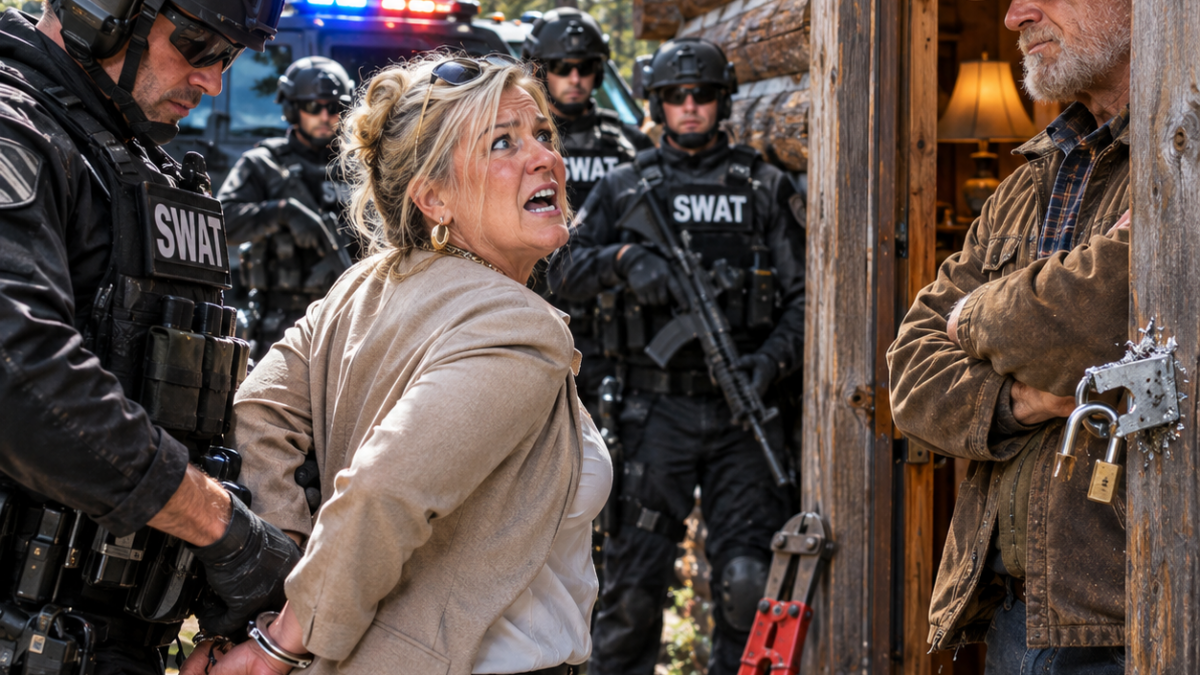
HOA Karen’s Son Cut the Lock on My Private Cabin Gate and Walked Onto My Land—90 Seconds Later, Two Sheriff’s Deputies Had Him Surrounded.
For eight months, Vivian Pratt used fake environmental reports, county complaints, private security patrols, and seventeen bogus HOA violations to convince me that eventually I would get tired enough to surrender a piece of land she had never owned.
Then one November morning, she arrived at my Montana cabin with bolt cutters, snapped the padlock off my gate, and marched inside looking for the documents she believed could destroy her before the HOA’s annual meeting.
What Vivian did not know was that the cabin was already under surveillance in an active fraud investigation—and less than ninety seconds after she crossed my threshold, a sheriff’s tactical team came out of the trees with rifles lowered and one command she had never learned how to obey: “Do not move.”
The sound of a padlock being cut is smaller than you imagine.
No explosion.
No dramatic crash.
Just a metallic crunch.
One second of resistance.
Then a sharp snap.
At 10:14 on a freezing Saturday morning in November, I watched from a monitor in the back room of the Flathead County Sheriff’s temporary command trailer as Vivian Pratt cut through the lock on my cabin gate.
She wore a cream-colored winter coat.
Black leather gloves.
Dark sunglasses despite a sky the color of wet concrete.
And she carried a pair of twenty-four-inch bolt cutters like she had every legal right in Montana to be standing there.
Deputy Briggs was beside me.
He leaned toward the screen.
“That’s her?”
“That’s her.”
Vivian dropped the broken lock into the snow.
She looked left.
Then right.
She couldn’t see Camera Three beneath the woodshed eave.
Couldn’t see Camera Four hidden inside a birdhouse Grandpa-style, though I had no grandfather involved in this one, just Felix Dunbar’s sense of humor.
Most importantly, she couldn’t see the six members of the Flathead County Sheriff’s tactical response unit positioned beyond the tree line.
They had been there forty-two minutes.
Quiet.
Cold.
Waiting.
Vivian opened my gate.
Stepped through.
Deputy Briggs checked his watch.
“Posted property.”
“Three signs.”
“Cease-and-desist served?”
PART2:
“September twenty-seventh.”
“Certified receipt?”
“In Sandra’s file.”
He nodded.
On the screen, Vivian walked toward the cabin.
Not quickly.
That bothered me more than if she’d been running.
She walked like an owner.
She paused at my porch.
Looked directly at one of the visible cameras.
Then smiled.
I felt something cold settle behind my ribs.
Briggs noticed.
“You okay?”
“I’m fine.”
“No hero stuff.”
“I’m fifty-eight.”
PART3:
“That wasn’t my question.”
I looked at him.
“I’m sitting here, aren’t I?”
“For now.”
The cabin door had another padlock on the exterior hasp.
Vivian reached into the canvas tote hanging from her shoulder.
Pulled out a second tool.
Smaller cutters.
Briggs exhaled.
“She’s really doing it.”
“She doesn’t know how not to.”
Vivian positioned the cutters.
Squeezed.
Once.
Twice.
The lock broke.
She caught it before it fell.
That detail mattered.
It meant she wasn’t simply forcing entry out of anger.
She didn’t want noise.
She set the lock carefully beside the door.
Then stepped inside my cabin.
Briggs touched his radio.
“Entry confirmed.”
A voice answered.
“Copy.”
He looked at me.
“We wait.”
“For what?”
“Your attorney wanted the intent.”
I knew.
Sandra Okafor had explained it the night before.
Entering posted property was one thing.
Breaking a lock was another.
Entering a dwelling after formal notice was worse.
But if Vivian actually searched for or removed evidence connected to the Ridgecrest Environmental Consulting investigation, the case changed completely.
We needed to know why she had come.
So for thirty-seven seconds, nobody moved.
Vivian appeared on the interior camera.
I hated having cameras inside my cabin.
Felix had installed them two days earlier under the sheriff’s evidence-preservation plan.
One faced the kitchen.
One faced my office.
One faced the locked metal file cabinet beside my desk.
Vivian entered the living room.
Stopped.
Listened.
The wood stove was cold.
No truck sat outside because mine was parked three-quarters of a mile away behind the command trailer.
She walked toward my desk.
Opened the top drawer.
Closed it.
Opened another.
Then she looked directly at the file cabinet.
My pulse changed.
Briggs whispered, “Come on.”
Vivian crouched.
She pulled a screwdriver from her tote.
That was enough.
Briggs keyed his radio.
“Go.”
Everything happened at once.
Black and tan tactical uniforms moved from the trees.
Two deputies approached the porch.
Two covered the side exit.
One moved to the rear window.
The team leader reached the door.
“FLATHEAD COUNTY SHERIFF’S OFFICE!”
Vivian froze.
“COME OUT WITH YOUR HANDS EMPTY!”
Her head snapped toward the entrance.
For a second she did nothing.
Then she grabbed my file cabinet handle.
I couldn’t believe it.
Briggs swore.
“Vivian,” I whispered at the monitor, “don’t.”
She pulled.
Locked.
The team leader shouted again.
“DO NOT MOVE!”
Vivian backed away from the cabinet.
Her face had lost all color.
She raised both hands.
Then the front window filled with uniforms.
She screamed.
Not because anyone touched her.
Because she finally understood how completely she had misread the morning.
Within seconds, she stood in my doorway.
Hands visible.
Bolt cutters still lying beside the broken lock.
Six deputies around her.
No rifles pointed at her face.
No chaos.
No television-style tackle.
Just control.
Professional.
Calm.
Absolute.
Vivian looked toward the woods.
Maybe she expected me to walk out.
I didn’t.
Not yet.
A deputy handcuffed her.
She started talking immediately.
“This is HOA business.”
Nobody answered.
“This property is subject to an emergency access easement.”
The team leader said, “Ma’am, stop talking.”
“You don’t understand. There are association documents inside that belong to Ridgecrest Pines.”
That sentence made Briggs look at me.
I stared back.
There it was.
Not a misunderstanding.
Not a welfare check.
Not confusion over a boundary.
She had come for documents.
The team leader read her rights.
Vivian’s voice rose.
“You cannot arrest me for enforcing community authority.”
Briggs muttered:
“Watch us.”
I almost laughed.
I didn’t.
Because for the first time in eight months, what I felt wasn’t satisfaction.
It was exhaustion.
Vivian Pratt had been given more chances to stop than I could count.
She had ignored every one.
And somehow, even standing handcuffed on my porch with the broken lock at her feet, she still believed the problem was that nobody understood her authority.
To understand how a retired pipefitter ended up watching a tactical team surround the president of an HOA I had never joined, you have to understand why I bought those fourteen acres in the first place.
My name is Decker Halverson.
I spent thirty-one years as an industrial pipefitter.
Refineries.
Food-processing plants.
Paper mills.
Power facilities.
Anywhere somebody needed pipe to carry steam, gas, water, chemicals, or pressure through a building never designed with human comfort in mind.
I worked in heat that made steel tools burn your palms.
Worked winter jobs where the inside of your respirator froze.
Crawled beneath equipment with six inches of clearance and spent twelve-hour shifts listening to pumps scream loud enough that you felt them through your bones.
The work paid well if you were willing to live where nobody wanted to live and work when nobody wanted to work.
I saved.
Slowly.
Every overtime check.
Every shutdown bonus.
Every per diem I didn’t spend.
My wife, Rebecca, died before we ever got to use the land together.
Breast cancer.
Four years from diagnosis to funeral.
We had been married twenty-seven years.
She used to keep a photograph of the Flathead Valley on our refrigerator.
Mountains.
Pines.
Snow.
A small cabin beside water.
“Someday,” she’d say.
Someday became my reason for working double shifts.
Then she died before someday arrived.
I nearly spent the money after that.
There didn’t seem much point.
My daughter Leah talked me out of it.
“You promised Mom.”
“I promised us.”
“Then finish it for both of you.”
So I did.
Fourteen acres in the Flathead Valley foothills of northwest Montana.
Not lakefront.
Not fancy.
Mostly pine, aspen, rock, and enough level land for a cabin.
A spring-fed stock pond sat near the southern boundary.
A seasonal creek crossed the northwest corner.
The place smelled like resin in summer and cold earth in winter.
The first morning after I bought it, frost covered the grass.
I stood outside with a thermos and listened.
No engines.
No radios.
No steel banging against steel.
Just creek water somewhere beyond the pines.
I thought:
This is it.
I built the cabin myself.
A-frame.
Modest.
One bedroom downstairs.
Sleeping loft.
Wood stove.
Small office.
Covered porch.
I put up the woodshed over one long August.
My shoulders hurt for two weeks afterward.
Best pain I’d felt in years.
The property bordered Ridgecrest Pines.
Ridgecrest was a planned recreational community full of second homes and retirement houses.
Good-looking place.
Stone signs.
Walking trails.
Lake access.
Community center.
Most owners came from Missoula, Bozeman, Spokane, or farther away.
Friday evening traffic in.
Sunday traffic out.
I bought before Ridgecrest’s HOA incorporated.
My parcel was outside the development.
Not borderline.
Not disputed.
Outside by hundreds of feet.
My deed did not contain Ridgecrest covenants.
I had never signed an HOA membership agreement.
Never paid dues.
Never voted in their elections.
My taxes went to Flathead County.
For the first five years, nobody cared.
Then Vivian Pratt became HOA president.
The first certified letter arrived in March.
Ridgecrest Pines Community Association.
FORMAL VIOLATION NOTICE.
AIR QUALITY COVENANT 4-2.
My wood stove was allegedly emitting particulate matter inconsistent with community standards.
I read it twice.
Then looked at my stove.
A Jøtul F 602.
Small cast-iron stove.
Legal.
Permitted.
Proper chimney.
Used mostly on cold evenings.
I called the number on the letter.
Vivian answered.
“Ridgecrest Pines, Vivian Pratt.”
“This is Decker Halverson.”
Pause.
“I received your notice.”
“Good.”
“Why?”
“Excuse me?”
“My property isn’t in Ridgecrest.”
“The smoke affects Ridgecrest.”
“So does wildfire smoke from Canada. You mailing Canada?”
She didn’t laugh.
“Mr. Halverson, surrounding parcels exist within our community sphere of influence.”
I stopped.
“What did you say?”
“Our sphere of influence.”
“That’s not a legal term.”
“It doesn’t have to be.”
“It actually does if you’re sending legal-looking violation notices.”
“We are asking neighboring properties to maintain standards compatible with the community.”
“I’m not maintaining your standards.”
“We prefer voluntary cooperation.”
“Then voluntarily stop mailing me.”
Her voice cooled.
“We’ll continue as necessary.”
I hung up.
Then I went outside.
Split firewood for forty-five minutes.
Some men meditate.
I use an eight-pound maul.
Afterward, I found an empty manila folder.
Wrote:
VIVIAN.
Put the notice inside.
Rebecca used to tease me because I saved everything.
Receipts.
Manuals.
Warranty cards.
Photographs of serial numbers.
Thirty-one years in industrial maintenance teaches you something.
If something goes wrong, everybody suddenly becomes very interested in who documented what.
Two weeks later, orange survey flags appeared on my land.
Eight.
Diagonal line.
Tree line to pond.
No surveyor’s markings.
No company name.
No notice.
I photographed each one.
GPS coordinates.
Timestamp.
Pulled them.
Drove to the Flathead County assessor.
Paid eleven dollars for a certified parcel map.
The clerk asked, “Boundary dispute?”
“Maybe.”
“You want current deed too?”
“Yes.”
She printed everything.
My southern line was exactly where I believed it was.
Ridgecrest boundary was 340 feet away.
I wrote Vivian a letter.
Polite.
Precise.
Unauthorized entry.
Unauthorized placement of markers.
My parcel was not subject to Ridgecrest covenants.
Further entry would be documented.
I hand-delivered it.
Vivian answered her door in pressed linen slacks and a sweater that looked too expensive to wear around actual humans.
She read the first paragraph.
“You’re overreacting.”
“I’m documenting.”
“Same thing.”
“No.”
I handed her the envelope.
“Have a good day.”
Ten days later, Flathead County sent an inspector.
Vivian had filed a complaint claiming my wood stove was a commercial incinerator.
The inspector walked inside.
Looked at the stove.
Looked at me.
Back at the stove.
“Commercial?”
“Apparently.”
He crouched.
Read the model plate.
“How many barrels of toxic waste are you processing through this thing?”
“Depends on Tuesday.”
He laughed.
Investigation closed.
No violation.
Three days after that, my trail camera showed Vivian’s white golf cart parked on the old logging road.
Custom VP emblem on the hood.
Vivian and another person crossed onto my land.
Photographed the cabin.
Walked around the pond.
Left.
I copied the footage.
Folder.
Two weeks later, environmental report.
Ridgecrest Environmental Consulting LLC.
Four pages.
Cream paper.
Logo.
Words like watershed risk, runoff migration, ecological liability.
My stock pond was supposedly threatening Ridgecrest common areas.
The report recommended “temporary cessation of all active pond use.”
I own no cattle.
The pond mostly served deer, ducks, and occasionally me sitting beside it with coffee.
I searched the Montana business registry.
Ridgecrest Environmental Consulting had existed four months.
Registered address:
Vivian Pratt’s home.
I called Sandra Okafor.
Sandra was a water-rights attorney in Missoula.
A friend from a former job gave me her name.
I emailed the report.
Twenty minutes later she called laughing.
“What?”
“Sorry.”
“Good laugh or bad laugh?”
“Good for you.”
“Why?”
“Because this document is nonsense.”
She explained.
My pond was tied to recorded appurtenant water rights.
The HOA had no regulatory authority.
The consulting firm had no visible state credentials.
Then she asked:
“Who owns the company?”
“Vivian’s address.”
“Look for officers.”
I did.
Vivian Pratt.
Bradley Pratt.
Bradley was her thirty-four-year-old son.
Manager of a self-storage business in Polson.
No environmental degree.
No engineering license.
No hydrology credential.
No relevant certification.
The company had issued one report.
Mine.
Sandra went quiet.
“Keep everything.”
“I do.”
“I can tell.”
She drafted a response.
Then advised me to file a complaint with the appropriate professional licensing board regarding the presentation of unlicensed technical conclusions as regulatory findings.
I filed it.
Didn’t tell Vivian.
No argument.
No warning.
Just paperwork.
Then I reviewed my trail camera.
That was when I realized the first trespass wasn’t the first.
Vivian’s people had crossed my property four times.
One visit showed two men photographing the pond.
Another showed a Ridgecrest landscaping truck.
The third showed Vivian.
The fourth showed someone walking onto my porch and testing the door handle.
That one changed me.
I watched it five times.
Man in a Ridgecrest-branded jacket.
Gloved hand.
My door handle.
Twice.
Then he walked away.
I drove to the hardware store.
Bought better locks.
Then cameras.
Felix Dunbar installed them.
Felix was a retired Montana state trooper.
Sixty-four.
Gray mustache.
Truck so clean I was afraid to put my boots inside.
He mounted four exterior cameras.
Two visible.
Two hidden.
Video only.
No audio.
“People behave differently when they see cameras.”
“That’s the point.”
“No.”
He tightened a bracket.
“The point is you need to know how they behave when they think the camera can’t see.”
He showed me Camera Three.
Hidden beneath the woodshed roof.
Camera Four near the gate.
“You’ll have everything.”
“Hope I don’t need it.”
Felix smiled.
“Everybody says that.”
Vivian changed tactics.
Mass HOA email.
“Community Security Update.”
It described an adjacent parcel operating an unauthorized short-term rental.
Transient guests.
Fire concerns.
Security risk.
No name.
Everyone knew it was me.
I had never rented the cabin.
Not once.
Three residents called the sheriff.
Deputy Aaron Briggs came out.
Compact guy.
Forties.
Quiet.
Looked around.
Drank coffee.
Asked:
“Where are the guests?”
“Maybe invisible.”
“Rental records?”
“None.”
“Booking site?”
“No.”
“Commercial activity?”
“No.”
He looked at the pond.
“Nice place.”
“Thanks.”
He closed the report.
Before leaving:
“Somebody really wants you to be doing something wrong.”
“Starting to notice.”
That sentence stayed with me.
Vivian didn’t have evidence.
She had a desired conclusion.
I hired Gwen Mercer, a paralegal in Missoula, to request Ridgecrest board records under applicable nonprofit governance rules.
Minutes.
Votes.
Authorizations.
Correspondence.
The box arrived three weeks later.
I spent one entire Sunday reading.
Nothing.
No vote authorizing the environmental report.
No vote authorizing the mass email.
No vote authorizing complaints against me.
No board discussion formally establishing jurisdiction over my parcel.
Vivian had been using HOA letterhead, email systems, and staff without recorded board approval.
Sandra loved that.
“Board presidents aren’t sovereign.”
“I’ve noticed.”
“Keep going.”
I did.
I checked county records on Vivian’s house.
Found a rear addition that looked suspiciously like an accessory dwelling unit.
Separate entrance.
Plumbing.
Kitchenette.
Permit listed as home office.
It looked like exactly the kind of land-use issue Vivian accused everyone else of.
I did nothing.
I told Sandra.
She smiled.
“Keep it in your pocket.”
“Leverage?”
“No.”
“Then why?”
“Because sometimes knowing you could be petty helps you choose not to be.”
I liked her.
Then Warren Geddes called.
Retired title officer.
Seventy-one.
Volunteered at a historical society.
He had heard the story.
Small towns.
You don’t need social media.
Give information forty-eight hours and a diner.
Warren told me to pull Ridgecrest’s original 1994 plat.
Not the current map.
Original.
At the recorder’s office, we found it.
My property outside the development.
No ambiguity.
Then a notation.
Emergency access easement.
Across the northeastern corner of my parcel.
Purpose:
EMERGENCY VEHICLE ACCESS ONLY.
Nothing else.
Not walking trail.
Not golf carts.
Not landscaping.
Not HOA inspections.
Not board presidents.
Emergency vehicles.
Ridgecrest had been using that corner for years as a shortcut to a walking trail.
I tolerated it.
Never cared.
Vivian assumed tolerance was permission.
Warren found another document.
Ridgecrest’s original covenants.
Article Nine.
Section Four.
Any attempt by the association to subject a non-member parcel to covenant enforcement without written consent created potential liability for documented damages.
I read it twice.
“How did everyone miss this?”
Warren shrugged.
“Nobody reads founding documents after the people who wrote them die.”
Sandra’s reaction:
“This is no longer annoying.”
“What is it?”
“A case.”
I told her:
“I don’t want to sue yet.”
“Why?”
“I want to be ready.”
She smiled.
“That’s why I like you.”
We built the record.
Cease-and-desist.
Certified.
Trespass.
Easement abuse.
Unauthorized enforcement.
Vivian signed for it.
I posted NO TRESPASSING signs.
County-compliant placement.
Visible.
Then came the phone call.
Sunday morning.
Vivian sounded friendly.
“Decker.”
“Vivian.”
“I think this has become unnecessarily adversarial.”
“Interesting.”
“We both want peace.”
“Do we?”
“I’d like to offer a solution.”
“What?”
“You sign a simple acknowledgment that Ridgecrest possesses advisory authority over adjacent parcels affecting community interests.”
I almost laughed.
“Advisory authority.”
“Yes.”
“And then?”
“We withdraw the complaints.”
“All of them?”
“Yes.”
“Environmental?”
“Resolved.”
“County complaints?”
“No further action.”
“Emails?”
“We consider the matter closed.”
I looked at the digital recorder beside my phone.
Montana permitted me to record a call I participated in.
Sandra had checked.
“Let me think.”
Vivian sounded relieved.
“Good.”
Afterward I emailed the recording to Sandra.
She called.
“Decker.”
“Yeah?”
“This is beautiful.”
“That’s a weird reaction.”
“She just offered to stop using organizational processes against you if you surrender legal rights.”
“That bad?”
“That useful.”
Another brick in the wall.
Then two other adjacent landowners came forward.
Both outside Ridgecrest.
Both had received “advisory compliance notices” from Vivian.
One concerning fence style.
Another concerning outdoor lighting.
Neither fought.
They threw the letters away.
Sandra got copies.
Now the pattern widened.
Then Constance Adler called.
Retired judge.
Sixty-seven.
Ridgecrest resident eleven years.
She had challenged Vivian internally for two years.
Asked for financial disclosures.
Asked about unilateral board actions.
Usually lost votes.
“Ms. Adler—”
“Constance.”
“Okay.”
“I want you to understand something.”
“What?”
“Most people in Ridgecrest have no idea she’s doing this.”
“I assumed.”
“Some know.”
“Okay.”
“Some approve because they believe she’s protecting property values.”
“I figured.”
“And some of us think she’s lost her mind.”
I laughed.
Constance continued.
“Annual meeting in six weeks.”
“I’m not a member.”
“I know.”
“I can’t attend.”
“Correct.”
“So?”
“I’m bringing a motion.”
“For what?”
“Independent review of every unilateral enforcement action Vivian has taken in eighteen months.”
I sat down.
“Why?”
“Because this isn’t about your cabin.”
That surprised me.
She continued.
“It’s about whether a board president can turn a nonprofit into her personal instrument.”
I liked Constance immediately.
Vivian kept pushing.
Another sheriff complaint.
Commercial woodcutting business.
Because I had firewood.
Deputy Briggs called before arriving.
“Decker.”
“Morning.”
“Guess what you do now.”
“Illegal moonshine?”
“Commercial logging.”
“Getting ambitious.”
He came out.
Photographed the woodpile.
Closed complaint.
His report noted the repeated pattern of unsupported complaints from the same source.
Sandra added it to the case.
Then the county commission became interested.
Commissioner Ruth McAllister reviewed Ridgecrest Environmental Consulting.
She discovered Bradley’s role.
No credentials.
One report.
Mine.
She referred it to the county attorney for potential fraudulent business practices.
The professional licensing complaint was already pending.
Sandra contacted a federal field office informally because the report had been sent through interstate mail and contained representations tied to a business entity.
Nothing dramatic.
No raid.
No black helicopters.
Just a conversation.
A file.
Potential evidence preservation.
Vivian knew none of it.
That mattered later.
October turned the aspens yellow.
Then wind stripped them.
Snow touched the ridgeline.
I walked my property every evening.
Checked cameras.
Checked signs.
Vivian had gone quiet.
Too quiet.
Felix noticed too.
“She’s planning something.”
“Or finally listening.”
He looked at me.
“You believe that?”
“No.”
Neither did Sandra.
The annual HOA meeting was scheduled for the second Saturday in November.
Constance had organized residents.
Tom Birchfield, a reporter Vivian had once tried to use against me, had started investigating Ridgecrest Environmental Consulting.
His article was scheduled to publish that morning.
Sandra planned to file the civil complaint the same day.
Trespass.
Easement abuse.
Unauthorized covenant enforcement.
Damages.
Two co-plaintiffs.
Vivian did not know the exact timing.
But she knew pressure was coming.
That Thursday, something happened.
Camera Four captured Bradley near my gate at 11:17 p.m.
He did not enter.
He stopped.
Looked at the sign.
Photographed my lock.
Then left.
I sent the footage to Sandra.
She called Briggs.
Briggs called the county attorney.
The county attorney looked at the ongoing fraud file.
Then at the timing.
An evidence concern emerged.
What evidence?
My documentation.
Vivian’s environmental report.
Company records she’d sent me.
Correspondence.
Trail-camera footage.
The original documents showing lack of authority.
Why would Vivian care about my copies?
Because her attorneys had demanded preservation of all communications, and investigators had begun tracing inconsistencies between documents in my possession and documents Ridgecrest later produced.
One particular file mattered.
The original environmental report.
Mine had four pages plus a cover sheet.
The copy Ridgecrest produced in response to the county inquiry had only three pages.
Missing was the signature certification page identifying Bradley Pratt as “Senior Environmental Compliance Consultant.”
Sandra noticed immediately.
That page linked him directly.
My original copy became evidence.
We had scanned it.
Backed it up.
Sent copies.
Vivian may not have known that.
If she believed the original existed only in my cabin file cabinet, she had motive to retrieve it.
Briggs asked:
“Where do you keep the original?”
“Cabin.”
“Locked?”
“Yes.”
“Does Vivian know?”
I thought.
Then remembered the phone conversation.
Months earlier she had said:
“You keep every piece of paper like it’s a federal archive.”
I had joked:
“Metal cabinet beside my desk.”
My stomach sank.
“She might.”
The sheriff’s office developed a plan.
I hated the phrase “tactical team.”
It sounded excessive.
Briggs explained.
“We’re not expecting a gunfight.”
“Then why tactical?”
“Because if this becomes evidence tampering connected to a fraud investigation and someone forces entry into an occupied dwelling, we don’t improvise.”
“I won’t be there.”
“Exactly.”
“Could she be armed?”
“No idea.”
“Vivian?”
“People act differently when desperate.”
That was true.
The annual meeting provided the window.
At 7:00 p.m. Friday, Tom’s article went live online early.
County attorney reviewing HOA-linked consulting firm.
Bradley named.
Vivian’s home address tied to company.
Professional credentials questioned.
At 7:12, Felix’s system alerted us.
Vivian’s golf cart entered the logging road.
She drove only halfway.
Turned around.
Scouting.
Briggs made the call.
Saturday morning, surveillance.
Not an arrest setup.
Not bait.
If nobody entered, nothing happened.
I drove away at 8:45.
Parked with the deputies.
At 9:32, tactical team staged.
At 10:09, Vivian’s SUV appeared.
She parked outside camera range.
Walked in carrying bolt cutters.
And at 10:14, she cut my lock.
By 10:16, she was handcuffed.
After the tactical team cleared the cabin, Briggs let me approach.
Vivian stood near the hood of a patrol SUV.
Her sunglasses were gone.
Hands cuffed in front now.
Cream coat dirty at one knee.
She saw me.
Something in her expression changed.
“You.”
“Morning, Vivian.”
“You set me up.”
“No.”
“You knew I was coming.”
“I knew somebody might.”
“You put police in the woods.”
“The sheriff did.”
“This is entrapment.”
Sandra, who had just arrived, heard that.
She walked up.
“Entrapment requires law enforcement inducing conduct you weren’t otherwise predisposed to commit.”
Vivian stared.
Sandra smiled politely.
“Nobody invited you.”
Vivian looked at me.
“Those records belong to Ridgecrest.”
“No.”
“The environmental assessment was commissioned for community protection.”
“It was mailed to me.”
“You stole proprietary materials.”
“I kept the letter you sent.”
She stepped forward.
Deputy stopped her.
“You don’t understand what’s happening.”
I did.
For once, I understood exactly.
A deputy carried out her canvas tote.
Inside:
Bolt cutters.
Screwdriver.
Pliers.
Flashlight.
Disposable gloves.
Three large envelopes.
And a handwritten list.
REPORT ORIGINAL.
WATER RIGHTS RESPONSE.
CAMERA STORAGE?
EASEMENT DOCUMENT.
Sandra looked at me.
Then Vivian.
“That’s unfortunate.”
Vivian said nothing.
The search warrant for her vehicle came later.
They found a small shredder in the back.
Portable.
New.
Still in the box.
And copies of internal Ridgecrest correspondence.
One email from Vivian to Bradley read:
IF HALVERSON HAS THE SIGNATURE PAGE WE NEED IT GONE BEFORE MONDAY.
That sentence ended any argument about misunderstanding.
The annual meeting that evening became something Ridgecrest Pines still talks about.
Eighty-three residents attended.
Highest turnout in seven years.
Vivian’s chair was empty.
Constance stood at the microphone.
Board vice president Martin Keller opened the meeting.
Confused.
Nervous.
“Vivian has been delayed.”
Someone in the back said:
“Arrested.”
The room exploded.
Martin raised his hands.
“I don’t have verified—”
Tom Birchfield stood.
Reporter.
Notebook.
“I can confirm the Flathead County Sheriff’s Office detained Vivian Pratt this morning following a forced entry at an adjacent private property.”
Silence.
Then everybody talked at once.
Constance took the microphone.
“Sit down.”
It was not her meeting to control.
Everyone sat anyway.
Retired judge voice.
She made a motion.
Independent counsel.
Full review.
All Vivian-directed enforcement activity for eighteen months.
All Ridgecrest Environmental Consulting payments.
All outside-property complaints.
All use of association email lists.
All expenditures authorized without board vote.
Seconded.
Vote:
Fifty-eight in favor.
Nine against.
Others abstained.
Then Martin Keller read a letter Sandra had delivered to the board.
Notice of civil action.
Three non-member property owners.
Trespass.
Improper enforcement.
Easement abuse.
Misuse of association resources.
He stopped halfway through.
“Did we authorize these?”
No one answered.
Board secretary checked minutes.
“No.”
“Any of them?”
“Not that I can find.”
The room shifted.
Residents who had defended Vivian began realizing something.
They had mistaken activity for authorization.
Because she used letterhead, they assumed the board voted.
Because she said “community standards,” they assumed standards applied.
Because she signed PRESIDENT, they assumed president meant unilateral authority.
It didn’t.
The fraud investigation accelerated after the cabin break-in.
Bradley panicked.
He hired an attorney.
Then cooperated.
He admitted Ridgecrest Environmental Consulting had been his mother’s idea.
Not originally as a fraud.
At first, she wanted a consulting entity to “formalize” complaints against adjacent properties.
Bradley registered the LLC.
Made a logo.
Used templates from online environmental reports.
Vivian wrote most of the language.
Bradley signed because she told him it was administrative.
Then she used the report against me.
When the licensing complaint appeared, Bradley realized they had a problem.
He wanted to dissolve the company.
Vivian refused.
“That makes us look guilty,” she told him.
Then my civil case surfaced.
Then the county inquiry.
Then the missing signature page.
Bradley told investigators his mother called Friday night.
“Decker keeps originals.”
“So?”
“We need to know what he has.”
“Call his lawyer.”
“Lawyers create records.”
Bradley said he refused to go.
Vivian went herself.
That mattered.
It made the break-in hers.
Not his.
No son to blame.
No contractor.
No confused employee.
Vivian Pratt bought bolt cutters.
Drove to my land.
Cut the posted gate.
Cut the cabin lock.
Entered.
Searched.
Carried a list of evidence she wanted.
Her attorney advised her not to give a statement.
For once, she listened.
She spent one night in county custody.
Released the next afternoon under conditions that included no contact with me and no presence within five hundred feet of my property.
By Monday morning, she resigned as HOA president.
One paragraph.
Effective immediately.
No apology.
Constance read it at the emergency meeting.
A resident asked:
“That’s it?”
Constance said:
“Apparently.”
Then the independent attorney presented preliminary findings.
Vivian had initiated thirteen outside-property actions without recorded board authorization.
Not seventeen.
Seventeen notices had reached me, but some duplicated complaints.
She used the official email list for personal communications.
She directed staff outside HOA boundaries.
She authorized payments to Ridgecrest Environmental Consulting.
Amount:
$8,400.
The company issued one formal report.
Mine.
Eight thousand four hundred dollars of HOA money paid to a company co-owned by Vivian and her son to write a fraudulent-looking assessment against a parcel the HOA did not govern.
The room erupted.
That was the moment residents turned.
Not the arrest.
Money.
People tolerate an astonishing amount of authoritarian behavior when they think it is free.
Then they see the invoice.
A man named Aaron Pike stood.
“You paid your own company?”
Vivian wasn’t there.
Martin Keller answered:
“According to the ledger, yes.”
“Did the board approve it?”
“No record.”
“Who signed the check?”
Vivian.
And the treasurer.
The treasurer said Vivian told him the board had approved it in executive session.
No executive session occurred.
Another lie.
My civil case became stronger.
But Sandra kept warning me:
“Don’t confuse a strong case with an easy outcome.”
“What does that mean?”
“Insurance.”
The HOA insurer argued some actions were intentional misconduct.
Vivian’s homeowner carrier denied business-related conduct.
The association argued she exceeded her authority, so Ridgecrest shouldn’t be fully responsible.
Vivian argued she acted as president, so Ridgecrest should indemnify her.
Everyone pointed.
Nobody wanted the bill.
Settlement negotiations lasted four months.
I attended one in Missoula.
Vivian sat across the conference table.
First time I’d seen her since the arrest.
No cuffs.
No sunglasses.
Gray suit.
Attorney beside her.
She did not look defeated.
Just diminished.
There is a difference.
Sandra opened with documents.
Trail camera.
Parcel map.
1994 plat.
Emergency easement.
Cease-and-desist receipt.
No-trespassing photographs.
Environmental report.
Licensing records.
Board minutes.
Recorded phone call.
County reports.
Cabin entry footage.
Vivian’s handwritten evidence list.
Vehicle search inventory.
Sandra stacked them in order.
Then said:
“We can try this.”
Vivian’s attorney asked for a number.
Sandra gave one.
Much higher than the eventual settlement.
The mediator separated us.
Hours.
Back and forth.
At one point Vivian asked to speak to me directly.
Sandra said no.
I said yes.
“Five minutes.”
We sat in a smaller room.
Attorneys present.
Vivian folded her hands.
“You’ve made your point.”
I stared.
“What point?”
“That your parcel isn’t subject to Ridgecrest.”
“That was established before we met.”
“I didn’t understand the plat.”
“I told you.”
“You were hostile.”
“I told you no.”
“You treated the community like an enemy.”
“I ignored you until you came onto my property.”
She looked down.
“Ridgecrest needs that emergency corner.”
“It’s emergency access.”
“Residents use it for the trail.”
“Not anymore.”
Her face tightened.
“So this is revenge.”
“No.”
“You’re closing the trail.”
“Your people abused the easement.”
“Because of me.”
“Yes.”
“Then punish me.”
I leaned forward.
“I am not punishing anyone.”
“What do you call this?”
“Reading the document.”
She looked at me.
“Those residents didn’t cut your lock.”
“Correct.”
“They’ll lose access because of me.”
“General access they never legally had.”
She hated that answer.
I continued.
“Emergency vehicles keep access.”
“Families have used that trail for twenty years.”
“I tolerated it.”
“Exactly.”
“What?”
“You let them.”
“Yes.”
“Then I assumed—”
“There it is.”
Silence.
“You assumed tolerance was surrender.”
She looked away.
That was the entire case in one sentence.
The settlement ended at $63,000.
Higher than the first discussions because the cabin break-in added criminal exposure and evidence-related claims.
The money covered:
My attorney fees.
Security installation.
Survey and title work.
Lost time.
Costs to the two co-plaintiffs.
Property damage.
Negotiated civil damages.
More important were the terms.
Ridgecrest issued a written acknowledgment:
My fourteen acres had never been subject to Ridgecrest Pines HOA jurisdiction.
Ever.
The 1994 easement was formally restated.
Emergency vehicles only.
No golf carts.
No HOA contractors.
No security patrols.
No recreational trail users.
The association installed a locked emergency gate.
County fire and sheriff services received keys and coded access.
The walking trail was rerouted entirely inside Ridgecrest.
Ridgecrest Environmental Consulting LLC dissolved.
HOA bylaws were amended.
Any enforcement outside recorded boundaries required written legal opinion and board vote.
Official email communications required approval.
Conflict-of-interest disclosures strengthened.
Vivian agreed never again to serve on the Ridgecrest board.
The criminal case was separate.
Burglary was debated.
Ultimately prosecutors accepted a plea involving criminal trespass, property damage, and attempted evidence interference.
No prison.
Probation.
Restitution.
Community service.
A permanent record.
People online were furious when Tom reported it.
“She should go to prison.”
Maybe.
I wasn’t the prosecutor.
I learned something during thirty-one years in industrial work.
The outcome you imagined while angry is rarely the outcome the system produces.
That doesn’t mean nothing happened.
Vivian lost the board.
The consulting company.
Her position.
Her credibility.
Thousands in legal expenses.
Freedom to come near my land.
And something she valued more than she admitted.
Certainty that nobody would tell her no.
Bradley received a lesser plea related to the fraudulent environmental document.
Fine.
Community service.
Company dissolution.
He moved away.
I never met him.
Constance became Ridgecrest board president.
Against her will.
She called me after the vote.
“I blame you.”
“For what?”
“They elected me.”
“You stood up.”
“Temporary lapse in judgment.”
“You were a judge.”
“Exactly. I should know better.”
She made Ridgecrest boring.
That’s a compliment.
Budgets published.
Minutes current.
Votes recorded.
Conflicts disclosed.
Security contract rewritten.
Rules enforced only where rules applied.
People complained.
Normal complaints.
Snow removal.
Pool hours.
Dogs.
Parking.
No fake environmental companies.
Progress.
Deputy Briggs stopped by one afternoon the following spring.
No uniform drama.
Just coffee.
He stood at the gate.
New county emergency lock.
“Looks better.”
“Expensive lock.”
“Don’t challenge Vivian.”
I laughed.
“Too soon.”
He walked toward the pond.
Snowmelt had filled it high.
Ducks floated near the reeds.
“You know, tactical guys were disappointed.”
“Why?”
“Nobody got to do anything.”
“That’s ideal.”
“Exactly what the lieutenant said.”
He looked at me.
“People hear ‘SWAT’ and imagine fireworks.”
“Mostly they stood in trees freezing.”
“That’s ninety percent of tactical work.”
I handed him coffee.
He nodded toward the cabin.
“How’d you know she’d go for the cabinet?”
“I didn’t.”
“She did.”
“Yeah.”
“That bother you?”
I thought.
“More than the lock.”
“Why?”
“Because she wasn’t angry.”
Briggs waited.
“She planned it.”
He nodded.
“That’s what bothered us too.”
Someone cutting a lock in rage is dangerous.
Someone bringing gloves, tools, envelopes, and a written list is different.
Vivian went to my cabin because she believed rules were obstacles other people had to respect.
That belief had been rewarded for years.
Nobody ran against her.
Nobody challenged every email.
Neighbors paid fines.
Board members signed.
Staff obeyed.
County agencies investigated complaints because that’s what agencies do.
Every time the system responded to her, she interpreted response as legitimacy.
When the zoning officer inspected my stove, she didn’t see her complaint fail.
She saw the county come when she called.
When deputies checked my cabin and found no rental, she didn’t see herself proven wrong.
She saw law enforcement appear at my property.
That was power to her.
Eventually she couldn’t distinguish the system processing an allegation from the system agreeing with her.
That’s dangerous.
Constance understood it better than I did.
At dinner one evening she said:
“Institutions are polite.”
“So?”
“People like Vivian confuse procedural politeness with deference.”
I thought about that.
County clerks accepted her paperwork.
Sheriff dispatch took reports.
Board members let her finish speaking.
Lawyers responded.
None of that meant she was right.
But nobody had forced her to learn the difference.
Until the cabin.
I used part of the settlement for something Vivian would have hated.
Eight thousand dollars went to the Flathead County 4-H Land Stewardship Program.
Deed reading.
Parcel maps.
Water rights.
Conservation.
Basic property law.
Not because I wanted teenagers turning into amateur attorneys.
Because land ownership without understanding is vulnerability.
Kids came to my place once for a field day.
Twenty-three high school students.
Most more interested in their phones than my pond.
I showed them the survey markers.
The easement corner.
The trail camera.
One boy asked:
“Did the HOA lady really break in?”
“Yes.”
“Did SWAT really come?”
“County tactical team.”
“So yes.”
“Basically.”
“Was she scared?”
I looked at him.
“Probably.”
“Was it awesome?”
“No.”
He looked disappointed.
I continued.
“The awesome part happened months earlier.”
“What?”
“Getting an eleven-dollar parcel map.”
They laughed.
I didn’t.
“Seriously.”
I showed them the 1994 plat.
“See this line?”
They leaned in.
“This kept fourteen acres out of an HOA.”
Then the easement.
“See these three words?”
Emergency vehicles only.
“Those three words stopped people from turning permission into ownership.”
A girl asked:
“So paperwork beat her?”
“Mostly.”
“That’s boring.”
“Exactly.”
She frowned.
“Why exactly?”
“Because boring rights are usually better than dramatic fights.”
That went over poorly.
They were teenagers.
Maybe they’ll remember later.
I also placed a conservation easement over the pond and riparian strip through the Flathead Land Trust.
Not because Vivian almost took it.
She couldn’t.
Because the whole fight reminded me why I’d bought the place.
Rebecca.
Someday.
The quiet.
The land.
I wanted part of it protected beyond me.
Leah came up after the papers were signed.
My daughter had not visited in two years.
Life.
Work.
Distance.
Grief made us bad at being close after Rebecca died.
We loved each other.
We just didn’t know how to exist without the person who connected us.
Leah stood beside the pond.
Snow on the mountains.
Aspen bare.
She looked at the cabin.
“This is exactly what Mom described.”
That hit harder than the settlement.
I looked away.
“Pretty close.”
“She would’ve loved it.”
“I know.”
“Do you ever feel guilty?”
“For what?”
“Living here without her.”
I stared at the pond.
“Every day at first.”
“And now?”
“Some days.”
She took my arm.
“She’d be mad.”
“Definitely.”
We laughed.
Then Leah noticed the new gate.
“That the famous lock?”
“Third replacement.”
“Can I see the video?”
“No.”
“Dad.”
“No.”
“Everybody else saw clips on the news.”
“You don’t need to see Vivian searching my desk.”
“Why?”
I thought.
“Because she was at her worst.”
“So?”
“People shouldn’t become entertainment because they failed.”
Leah looked at me.
“That’s generous.”
“No.”
I pointed at the cabin.
“I spent eight months angry at someone who didn’t know when to stop.”
I looked at her.
“I’m trying to know when to stop.”
That became the real ending for me.
Not Vivian’s arrest.
Not the tactical team.
Not the $63,000.
Not the guilty plea.
Stopping.
I could have filed the accessory dwelling complaint against her.
Never did.
Could have challenged every landscaping change at her house after the board records became public.
Didn’t.
Could have pushed the HOA to terminate the emergency easement entirely.
Sandra said we had a plausible argument after repeated misuse.
I chose not to.
Emergency vehicles still need access.
Fire doesn’t care about personal disputes.
Neither does cardiac arrest.
I restricted the easement to what it was always meant to be.
Nothing more.
Nothing less.
That’s the difference Vivian never understood.
A right doesn’t become stronger because you stretch it.
It becomes easier to lose.
A year after the settlement, Ridgecrest had a wildfire scare.
Lightning strike.
Dry August.
Fire started north of the development.
County crews used my emergency gate.
Two engines crossed the corner of my property.
Exactly as the 1994 easement intended.
I stood near the cabin.
Watched them pass.
No irritation.
No resentment.
That access mattered.
Fire was contained within ninety minutes.
Constance called later.
“Thank you.”
“For what?”
“The access.”
“You don’t thank somebody for obeying the deed.”
“I can.”
“Fine.”
She laughed.
Then:
“You know Vivian would’ve said this proved she was right.”
I smiled.
“Probably.”
“Does that bother you?”
“No.”
“Why?”
“Because she’s not here.”
Years passed.
The story became local folklore.
Usually inaccurately.
“HOA lady broke into survivalist’s compound and got raided by SWAT.”
I hate that version.
I’m not a survivalist.
It’s a cabin.
I own three months of canned food because winter roads in Montana are stupid, not because civilization is ending.
And nobody “raided” anything.
The tactical unit was there because law enforcement had a legitimate reason to believe evidence might be targeted.
Vivian made the decision.
They responded.
People embellish because reality often seems too simple.
A woman received seventeen notices she had no right to issue.
The property owner documented them.
She created a fake consulting company with her son.
He checked the registration.
She filed false complaints.
Agencies closed them.
She used HOA email.
He requested the minutes.
No authorization.
She misused an easement.
He read the original easement.
She offered to stop if he surrendered rights.
He recorded the legal call.
She kept escalating.
He kept documenting.
Finally, she cut a lock.
That’s it.
The dramatic ending only existed because she ignored dozens of ordinary exits.
She could have stopped after the first letter.
After my response.
After the zoning dismissal.
After Sandra’s water-rights letter.
After the licensing complaint.
After the cease-and-desist.
After the no-trespassing signs.
After her attorney warned her.
After the county began asking questions.
After the newspaper called.
After Bradley told her the company was a problem.
Every time, she chose forward.
Some people think persistence is always strength.
It’s not.
Sometimes persistence is just an inability to admit direction matters.
I still have the original cut lock.
Felix told me to throw it away after evidence released it.
I kept it.
It sits above my workbench.
The metal jaw has a clean notch from the bolt cutters.
Under it I keep the eleven-dollar parcel map.
People expect the lock to be the meaningful object.
It isn’t.
The map is.
The lock proves Vivian crossed a boundary.
The map proves the boundary existed before she did.
That’s more important.
Sandra still calls occasionally.
Usually when another adjacent owner gets an absurd letter.
“Got a live one.”
“I retired from this.”
“You were never employed.”
“Even more reason.”
Constance sends Christmas cards.
Her handwriting is terrible.
Deputy Briggs got promoted.
Felix finally retired for real, although he still installs cameras for “friends,” which appears to mean anybody who feeds him lunch.
Warren Geddes died at seventy-five.
His family donated his title records to the historical society.
I paid for a small plaque on one cabinet.
READ THE ORIGINAL.
He would have appreciated that.
Vivian sold her Ridgecrest house about eighteen months after the settlement.
Moved to Arizona, according to people who cared more than I did.
Before leaving, she sent one letter.
Not through attorneys.
Directly.
Sandra told me I could open it.
I did.
Decker,
I have been advised not to contact you, so I will not expect a response.
I spent a long time believing that because Ridgecrest depended on the surrounding land, the association had a right to influence it.
I also believed that if I stopped pushing, people would see weakness and everything I had built would become meaningless.
The day I entered your cabin, I was convinced the documents you had were being used unfairly against me.
I understand now how absurd that sounds.
I crossed a line long before I cut your lock.
The lock was simply the first line everyone else could see.
Vivian Pratt.
I read it twice.
Then put it in the file.
The file that started as a manila folder eventually filled two banker boxes.
Seventeen notices.
Four county investigations.
Environmental report.
Board records.
Maps.
Easement.
Photographs.
Letters.
Court papers.
Settlement.
Vivian’s apology.
I didn’t burn them.
Didn’t display them.
They’re in a storage cabinet.
Documentation did its job.
It doesn’t need to become a shrine.
One fall evening, Leah and I sat on the porch.
Wood stove going.
Cold air.
Pine smell.
The pond reflected the last light.
She looked at the NO TRESPASSING sign near the gate.
“You ever think about taking those down?”
“Sometimes.”
“Why don’t you?”
“Useful.”
“Or paranoid?”
“Useful.”
She smiled.
Then:
“Mom would’ve hated those signs.”
“Your mother hated all signs.”
“She stole a parking sign in college.”
“I know.”
“She told me.”
“She shouldn’t have.”
Leah laughed.
The cabin door was open behind us.
New lock on the hasp.
Stronger than the old one.
I looked at it.
For months after the break-in, I checked that lock compulsively.
Before bed.
Before leaving.
Sometimes twice.
Vivian had taken something small from me.
Not property.
Ease.
The assumption that a closed door would stay closed because decent people respect it.
That came back slowly.
That’s another thing stories leave out.
Winning doesn’t reset your nervous system.
You can be right.
Win the case.
Get damages.
See the other person punished.
And still hear a sound at night and wonder whether someone is standing at the gate.
Justice and healing are related.
They are not identical.
Leah helped with that.
So did the land.
Routine.
Wood.
Snow.
Spring thaw.
Ducks returning.
Pines moving in wind.
The ordinary world is good at reminding you that one person isn’t the center of it.
Vivian had spent eight months making herself the center of my attention.
Eventually I stopped giving her that space.
The first winter after the case, I woke before dawn during a snowstorm.
Everything outside was blue-white.
No tire tracks.
No golf cart.
No warning notices.
No cameras alerting.
Just snow.
I made coffee.
Lit the stove.
Sat near the window.
For the first time in nearly a year, I realized I hadn’t thought about Ridgecrest when I woke up.
That felt better than the settlement check.
People ask me whether the tactical-team moment was satisfying.
The honest answer?
For about three seconds.
Watching Vivian step out with her hands raised, I felt vindication.
Then I saw her face.
She looked old.
Scared.
Human.
That didn’t erase what she’d done.
It didn’t make me regret stopping her.
But the fantasy of defeating a villain is cleaner than reality.
Reality is usually one flawed person pushing too far until institutions finally force a stop.
Vivian wasn’t a monster.
Monsters are easier.
She was a person who liked control.
A person who convinced herself control meant responsibility.
Then responsibility became entitlement.
Entitlement became justification.
And justification allowed her to do things she would probably have condemned if someone else had done them.
That’s more frightening than a monster.
Because it’s ordinary.
The tactical team didn’t save my property.
Paperwork did.
The deputies just arrived at the final page.
The parcel map saved it.
The deed.
The 1994 plat.
The emergency-access language.
The meeting minutes.
The certified cease-and-desist.
The business registry.
The licensing records.
The videos.
The phone recording.
All boring.
All patient.
All stronger than Vivian’s confidence.
That is what I tell anyone dealing with an HOA or neighbor or developer who speaks as if authority comes from volume.
Don’t start by shouting.
Find the boundary.
Get the document.
Read the original.
Document the date.
Save the envelope.
Take the photograph.
Request the minutes.
Ask who authorized the action.
Ask what statute, covenant, easement, permit, or recorded instrument actually grants the power being claimed.
Sometimes the person threatening you is right.
If they are, you need to know.
Sometimes they’re wrong.
If they are, you need proof stronger than your anger.
Vivian had a logo.
Letterhead.
Board title.
Golf cart.
Official email list.
Consulting company.
Seventeen violation notices.
I had an eleven-dollar map.
The map won.
I still live on the fourteen acres.
Same A-frame.
Same pond.
Same Jøtul stove Vivian once called a commercial incinerator.
The stove has outlived her presidency.
I find that funny.
The pond is now protected under the conservation agreement.
Aspen have grown taller.
Woodshed leans slightly because I built it alone and apparently believed level was a suggestion.
I have no intention of fixing it.
Ridgecrest Pines is still next door.
Families hike the rerouted trail.
Sometimes kids wave.
I wave back.
No hostility.
The emergency gate remains locked.
Sheriff and fire services have access.
Once every year, county staff check it.
Paperwork signed.
Everything boring.
Exactly how I like it.
The old broken padlock remains above my bench.
People who visit ask about it.
I tell the short version.
“HOA president cut it.”
“Seriously?”
“Seriously.”
“Then SWAT came?”
“County tactical team.”
“Same thing.”
“Not really.”
“Did she know they were there?”
“No.”
They always smile at that part.
Everybody likes the reversal.
But if they stay long enough, I show them the parcel map.
“This is the important part.”
They usually look disappointed.
Good.
The truth is rarely as cinematic as the moment it produces.
Vivian cut my lock because she believed eight months of silence meant I was losing.
She thought every complaint exhausted me.
Every notice scared me.
Every fake report pushed me closer to signing.
She saw patience and assumed weakness.
What she couldn’t see was the folder.
Then the box.
Then the second box.
The attorney.
The title expert.
The cameras.
The county records.
The other property owners.
The residents inside her own HOA beginning to ask questions.
The investigator.
The sheriff’s file.
The fraud referral.
All the quiet things moving underneath her certainty.
By the time she walked toward my cabin carrying bolt cutters, there was almost nothing left for me to do.
That was the irony.
She thought she was making the decisive move.
The case had already been built.
All she did was step inside it.
And less than ninety seconds after she cut through the lock and crossed the threshold of a cabin she had spent eight months pretending she had authority over, the woods around her filled with deputies.
For the first time since I’d met Vivian Pratt, she couldn’t solve the problem with another letter.
Couldn’t delete a comment.
Couldn’t invent a committee.
Couldn’t create a consulting company.
Couldn’t call the county and make somebody investigate me.
Couldn’t say “community standards” and expect the conversation to end.
She had to stand still.
Listen.
And accept that there was a boundary in front of her that she did not control.
People remember the rifles.
I remember the broken lock.
But neither is really the point.
The point is that the boundary had always been there.
Three hundred forty feet outside Ridgecrest Pines.
Printed clearly on a county map.
Recorded years before Vivian ever became president.
She didn’t lose because I had better cameras.
She didn’t lose because Sandra was a better lawyer.
She didn’t lose because deputies happened to be waiting in the trees.
She lost because she spent eight months trying to turn confidence into jurisdiction.
And confidence, no matter how polished the letterhead or how official the title, cannot move a property line.
The law had drawn that line long before either of us arrived.
All I did was read it.
Vivian kept stepping across.
Until one Saturday morning, she finally stepped far enough that everyone else could see it too.








