HOA Karen’s Son Crashed Her Jeep Into My Retaining Wall—Then She Sued Me for the Damage and Discovered Where the Property Line Really Was.
PART3:
I pulled my property survey from the file cabinet in my home office.
Original plat.
Stamped.
Recorded.
Corner lot boundary.
Drainage easement line.
Retaining wall drawn six feet inside my property, outside the easement, not touching common land.
I made copies.
Then I wrote Delores a simple response.
The retaining wall is on my property, outside the drainage easement, and predates your presidency. No HOA approval is required for a structure installed before the current architectural guidelines and lawfully maintained within my boundary.
I included the survey.
She sent back a violation anyway.
Two hundred dollars.
Failure to obtain approval for structural improvement.
I did not pay it.
That was when Delores stopped pretending this was about rules.
She came to my door one Saturday morning wearing a white blazer and pearls, carrying one of those leather folders people carry when they want paper to feel like power.
“Garrett,” she said, “we need to resolve this.”
I leaned against the doorframe.
“There’s nothing to resolve.”
“You’re accumulating fines.”
“I’m collecting evidence.”
Her smile held for half a second.
Then weakened.
“You always have to be difficult.”
“No. I’m actually pretty easy when people stay inside their authority.”
Her eyes narrowed.
“The HOA has authority over exterior features.”
“Not retroactively. Not over preexisting structural retaining walls built inside private property lines.”
“That is your interpretation.”
“That is the survey.”
She opened the folder and pulled out a printout.
It was a Cedarbrook architectural guideline revised two months earlier.
RETAINING WALLS, BORDER WALLS, AND VISIBLE HARDSCAPE MUST BE APPROVED BY THE ARCHITECTURAL REVIEW COMMITTEE.
I read it, then handed it back.
“This applies to new work.”
“It applies to all visible structures.”
“No, it doesn’t.”
“We can litigate that if necessary.”
“You won’t like that.”
She laughed softly.
“Garrett, don’t be dramatic. I’m trying to protect the neighborhood.”
“From a wall holding up my yard?”
“From noncompliance.”
That word told me everything.
Noncompliance.
To Delores, the wall’s true offense was that I said no.
A few days later, I found chalk marks on the curb near my driveway.
Then orange paint near the storm drain.
Then two men in polos measuring from the road toward my wall.
I stepped outside with my coffee.
“Morning.”
The younger one flinched.
The older one gave me a polite smile.
“Good morning. We’re with Hartwell Property Management.”
I stared at him.
“Hartwell?”
“Yes, sir. Contracted by the association.”
Of course.
Delores had a property management company. She had mentioned it once in a board meeting like it was proof of her expertise, not a conflict of interest wrapped in business cards.
“What are you measuring?”
“Drainage setback.”
“On whose instruction?”
“The HOA president.”
“You’re standing in my driveway.”
He glanced down, as if the concrete had betrayed him.
“Sir, we’re just gathering preliminary compliance documentation.”
“Gather it from the sidewalk.”
Delores appeared ten minutes later in her silver Lexus.
She did not park at the curb.
She pulled half into my driveway like she had already decided part of it belonged to her.
“Garrett,” she called.
“No.”
She stopped.
“You don’t even know what I’m going to say.”
“I know the tone.”
She walked toward me, heels clicking on concrete.
“This is a community matter.”
“My driveway isn’t.”
“The wall affects drainage.”
“The wall has drainage.”
“It could affect runoff patterns during heavy storms.”
“It was built because of runoff patterns during heavy storms.”
Her lips tightened.
“You’re not an engineer.”
“No. Theo is.”
Theo, who had been watching from his porch with a mug in one hand, lifted the mug slightly.
Delores looked over.
Theo smiled.
It was not a friendly smile.
It was the kind of smile an old engineer gives when someone has wandered into math with confidence and no tools.
Delores turned back to me.
“This wall should never have been allowed.”
“It didn’t need your permission.”
“That attitude is the problem.”
“No, Delores. The problem is you think HOA president means county inspector, judge, engineer, and queen.”
Her face hardened.
“You will regret speaking to me like that.”
“I doubt it.”
She drove away.
Theo walked over after she left.
“You know she’s going to make trouble.”
“She already is.”
“No,” he said. “More.”
Theo was right.
Delores had a son named Preston.
Preston Hartwell was twenty-two, though he carried himself like a retired prince. He drove his mother’s black Jeep Grand Cherokee because his own sports car was apparently “not practical,” which was a sentence he delivered once in my driveway while wearing sunglasses on a cloudy day.
Preston did not work for the HOA officially.
Unofficially, he served as Delores’s messenger, errand boy, enforcer, and excuse.
He was the one who taped a notice to my wall one evening and smirked when my doorbell camera caught him.
He was the one who parked beside my driveway and revved the Jeep while I was on a ladder fixing my porch light.
He was the one who told a neighbor’s teenage daughter that my wall was “illegal” and would be “gone soon.”
I ignored him as much as possible.
That annoyed him more.
People like Preston feed on reaction.
Starve them and they start doing dumb things.
On the morning of the crash, I was in my garage sorting breaker panels for a job in Hendersonville.
It was a clear Saturday.
Late spring.
The tulips along the wall had just started opening, red and yellow against the gray block. I had coffee on the workbench, country music low on the radio, and a list of materials spread beside a coil of twelve-gauge wire.
Then I heard the engine.
Not normal driving.
Fast.
Too fast for Millbrook Lane.
Then tires.
Then a sound like a garage collapsing inside a dumpster.
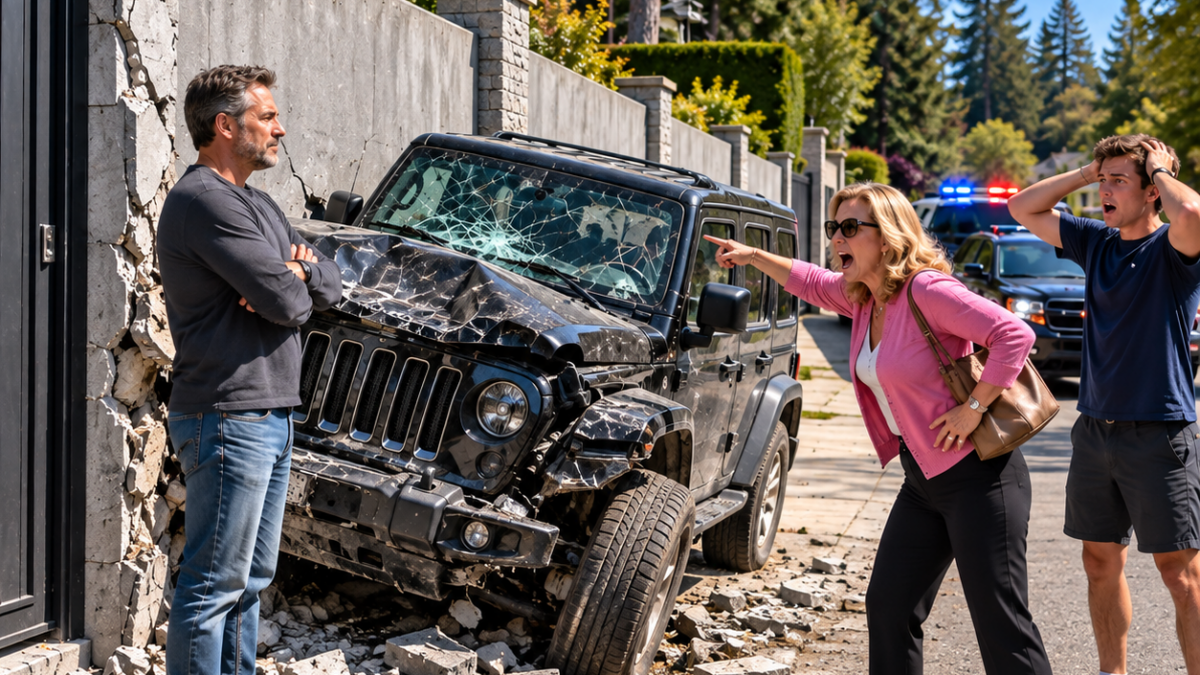
The Jeep hit my retaining wall so hard that brick dust rolled across my driveway like smoke after an explosion.
I dropped the box of breakers and ran outside.
The black Grand Cherokee was angled across my driveway with its front end buried in the wall. The hood had buckled. Steam hissed from the radiator. The left front tire had folded inward, and the bumper hung low enough to scrape concrete.
The wall had taken the hit.
Not fully.
No wall likes being punched by two tons of SUV.
But it had not collapsed completely.
The impact had shattered the outer block face, cracked two courses, and shoved a section inward. Behind it, the slope groaned in the only way dirt can. Soil pressed forward. Water seeped through disturbed gravel where the drainage line had shifted.
That wall was holding back forty tons of hillside, and Preston Hartwell had just turned it into a legal and structural emergency.
The driver’s door opened.
Preston stepped out.
No blood.
No limp.
No panic.
He looked at the Jeep.
Then at the wall.
Then at me.
“Dude,” he said, “your wall wrecked my mom’s Jeep.”
For a second, I thought I had misheard him.
“Are you hurt?”
He looked surprised that I asked.
“No.”
“You sure?”
“I’m fine.”
“Then step away from the vehicle.”
He did not apologize.
He did not ask if he had damaged my house.
He did not ask if anyone else had been nearby.
He pulled out his phone and called his mother.
“Mom? Yeah, I hit it.”
He listened.
“No, I’m fine.”
Another pause.
“His wall. Yeah. It’s in the way.”
My hands curled.
Theo came across the street faster than I had seen him move in years.
“Garrett.”
“I’m good.”
He looked at the wall.
His face changed.
“That needs shoring.”
“I know.”
Preston lowered the phone.
“My mom says don’t touch anything.”
I looked at him.
“That’s the first useful thing she’s said.”
He scowled.
Within six minutes, Delores arrived.
She did not run to her son.
She did not hug him.
She did not inspect him for injury.
She got out of her Lexus, looked at the Jeep, looked at the wall, and said, “I knew this would happen.”
Not “Are you okay?”
Not “I’m sorry.”
I knew this would happen.
Theo turned slowly toward me.
His face said, Please tell me she did not just say that.
She had.
Delores pointed at the wall.
“This is exactly why unauthorized structures are dangerous.”
I stared at her.
“Your son drove into my driveway and hit my wall.”
“He was forced to avoid an obstruction.”
“What obstruction?”
“The wall.”
“The wall was stationary.”
“It encroaches visually into the driveway corridor.”
“My driveway corridor?”
She ignored that.
“Preston, tell him what happened.”
Preston straightened.
“I was turning around and the wall came out of nowhere.”
Theo coughed.
It might have been a laugh.
Delores glared at him.
I walked to my garage, took out my phone, and called the police.
Delores’s head snapped toward me.
“That is unnecessary.”
“Your son crashed a vehicle into a structural retaining wall on my property.”
“We can handle this through insurance.”
“We will handle it through police, insurance, structural inspection, and attorneys if necessary.”
Her eyes narrowed.
“You always escalate.”
“No, Delores. I document.”
That word bothered her.
I saw it.
People who rely on performance hate documentation.
It stops them from rewriting scenes later.
While we waited for police, Theo and I photographed everything.
The tire marks.
The Jeep position.
The wall damage.
The driveway.
The road.
The corner.
The clear sight line.
Preston leaned against the undamaged side of the Jeep and texted.
Delores made phone calls.
I heard pieces.
Unsafe wall.
Prior warnings.
HOA violation record.
Liability exposure.
Not once did she mention that her son had been driving.
Officer Amanda Keene arrived first.
She was local police, not sheriff’s office, professional and calm. She got Preston’s license and insurance information. She asked whether he needed medical attention. He refused.
Then she asked what happened.
Preston said, “I lost control because the wall is too close to the driveway.”
Officer Keene looked at the wall.
Then at the driveway.
Then at the wide curve of Millbrook Lane.
“How fast were you going?”
“Like fifteen.”
Theo made another coughing sound.
Officer Keene looked at him.
“Sir?”
Theo said, “A vehicle doesn’t do that to a reinforced retaining wall at fifteen unless it’s dropped from a crane.”
I said, “Theo’s a retired civil engineer.”
Delores snapped, “He is a neighbor with bias.”
Officer Keene wrote that down.
I nearly smiled.
Delores did not realize officers write down the tone of a scene as much as the words.
Then Keene asked whether I had cameras.
“Yes.”
Delores’s face changed.
Again, just slightly.
I pointed to the garage camera.
“Covers the driveway.”
Then to the porch.
“That one catches the street.”
Then to the side of the house.
“That one catches the wall.”
Preston stopped texting.
Officer Keene asked if I would provide footage.
“Gladly.”
We reviewed it in my garage.
The porch camera showed the Jeep coming around the corner fast.
Not fifteen.
Not even close.
It drifted wide, corrected late, hopped the curb at the edge of my driveway, crossed the concrete, and slammed into the retaining wall at an angle.
There was no obstruction.
No child in the street.
No animal.
No oncoming car.
Just a young man driving too fast and too badly in his mother’s Jeep.
Keene watched it twice.
Then she asked Preston, “Is there anything you’d like to add to your statement?”
Preston swallowed.
Delores stepped forward.
“My son was startled by the wall’s proximity.”
Keene looked at her.
“Ma’am, I asked him.”
Preston stared at the floor.
“I guess I was going faster than I thought.”
That sentence would matter later.
Delores tried to control the scene anyway.
She told the tow driver not to touch the Jeep until her attorney arrived.
The tow driver looked at Officer Keene.
Keene said, “Move it when needed for safety.”
Theo warned everyone that the wall needed temporary support immediately. If the damaged section failed, the hillside could slump into the driveway and possibly undermine the garage corner.
Delores heard that and smiled.
Not openly.
But enough.
She thought Theo’s concern helped her.
“Exactly,” she said. “The wall is dangerous.”
Theo turned to her.
“Because your son hit it.”
“It was vulnerable.”
“All structures are vulnerable to impact from reckless drivers.”
She looked at me.
“I’m going to pursue this formally.”
“Good.”
She seemed surprised.
“Good?”
“Please put everything in writing.”
She did.
By Monday morning, I had a letter from an attorney representing Delores Hartwell and Preston Hartwell.
It alleged that my “unapproved, noncompliant retaining wall” created a hazard that contributed to the crash, damage to the Jeep, emotional distress, towing fees, loss of use, and potential medical monitoring.
Medical monitoring.
For Preston, who had refused treatment, texted through half the accident report, and complained mainly that his mother would “freak over the bumper.”
They demanded I preserve the wall.
That part was easy.
The wall was already preserved under tarps and temporary bracing because I was not letting forty tons of hillside follow Preston’s judgment downhill.
I hired an attorney named Nora Kessler.
Nora was compact, direct, and allergic to nonsense. Her office was above a bakery, which made serious legal conversations smell like cinnamon rolls.
She listened to me explain.
Then she read Delores’s attorney letter.
Then she watched the video.
Then she said, “Oh, this is going to be stupid.”
“Can we win stupid?”
“Usually. It just costs more.”
I handed her the survey, wall photos, construction receipts, drainage notes, and Theo’s original sketches.
She looked at the stack.
“You kept all this?”
“I’m an electrician. I keep receipts for wire nuts.”
“Excellent personality defect.”
Theo prepared a written statement.
He included the wall’s purpose, location, construction method, load function, and his opinion that the crash damage resulted from vehicular impact, not wall defect.
Delores responded by suing me.
The complaint alleged negligence, nuisance, improper construction, failure to comply with HOA guidelines, obstruction of driveway visibility, and intentional refusal to remove a known hazard.
She asked for damages related to the Jeep and Preston’s “emotional distress.”
Then she made her biggest mistake.
She attached years of HOA fines and violation notices as proof that I had been warned about the wall.
At first glance, that seemed bad.
A record of repeated warnings.
But Nora looked at the attachments and smiled.
“She just put the HOA’s conduct into evidence.”
“What does that mean?”
“It means we get to ask where these fines came from, who authorized them, whether the HOA had authority, whether your wall was grandfathered, whether this property management company benefited, and whether Delores used the HOA to manufacture a litigation record after you refused unpaid work.”
I stared at her.
“You can do that?”
“She sued you. She opened the door.”
That was the first time I began to understand something.
Delores thought court was a bigger HOA hearing.
She thought if she arrived with enough paper, enough confidence, and enough accusations, the room would bend around her.
Court does not work like that.
Court asks who made the paper.
Why.
Under what authority.
With what evidence.
That became Delores’s problem.
The first deposition was Preston’s.
Nora showed him the accident video.
“Mr. Hartwell, in your original statement to Officer Keene, you said you were traveling around fifteen miles per hour. Is that still your testimony?”
He shifted.
“I mean, that’s what it felt like.”
“Have you seen the video?”
“Yes.”
“Does that look like fifteen miles per hour?”
“I’m not an expert.”
“No. You’re the driver. Were you speeding?”
“I don’t know.”
Nora paused.
“You don’t know whether you were speeding?”
“It happened fast.”
“Yes,” Nora said. “That seems to be the issue.”
Preston’s attorney objected.
Nora smiled like she had expected it and moved on.
She asked about his phone.
He claimed he was not using it.
Then subpoenaed phone records showed a text sent sixteen seconds before impact.
Preston claimed voice-to-text.
Then the phone’s metadata suggested manual input.
That did not help him.
Then came Delores.
Her deposition lasted six hours.
By hour two, she was irritated.
By hour four, she was angry.
By hour six, she was dangerous to herself.
Nora asked whether the HOA had ever approved my retaining wall.
Delores said no.
Nora asked whether approval had been required when the wall was built.
Delores hesitated.
“I believe so.”
“Based on what rule?”
“The architectural guidelines.”
“Which version?”
“The current version.”
“The current version did not exist when Mr. Winslow built the wall, correct?”
“I don’t know.”
Nora placed the old Cedarbrook guidelines on the table.
Two pages.
No retaining wall restriction.
No hardscape approval requirement for existing structures.
“Do you see any rule here requiring Mr. Winslow to obtain approval?”
Delores’s mouth tightened.
“No.”
“Do you see any rule here authorizing the HOA to retroactively fine him for a preexisting wall?”
“No.”
“Yet you issued fines.”
“The board issued fines.”
“You were board president.”
“Yes.”
“You signed them.”
“Yes.”
“You also operated Hartwell Property Management?”
Delores went still.
“Yes.”
Nora placed invoices on the table.
“Did Hartwell Property Management bill Cedarbrook Estates for compliance documentation related to Mr. Winslow’s wall?”
Delores’s attorney shifted.
“Object to relevance.”
Nora said, “She attached the HOA compliance record to a civil negligence lawsuit as evidence. The origin of that record is relevant.”
The attorney said nothing else.
Delores answered, “My company provided administrative support.”
“How much did the HOA pay your company?”
“I would need records.”
“We have them.”
Nora slid a spreadsheet forward.
Delores looked down.
For the first time in the deposition, she did not speak quickly.
That was the thread.
Nora pulled it.
What began as a car crash case turned into a financial discovery nightmare for Delores.
Hartwell Property Management had billed the HOA for inspection coordination, compliance review, violation documentation, legal consultation preparation, emergency safety evaluations, and administrative processing.
Many charges were tied to homeowners Delores personally targeted.
Mine.
Theo’s.
Margaret Hooper’s wind chime.
Rebecca Lane’s porch bench.
A retired couple fined over mulch color.
A widow charged for a mailbox repaint she never requested.
The amounts were small individually.
Seventy-five dollars.
One hundred twenty-five.
Three hundred.
Administrative compliance fees.
People paid because fighting cost more.
Delores had turned petty authority into a revenue stream.
Not huge at first.
That made it easier to miss.
But over years, it added up.
Then Nora found the reserve fund transfers.
That was where everything changed.
Cedarbrook had a maintenance reserve account for common areas, drainage, sidewalks, and storm repairs.
Money collected from homeowners.
Money meant to protect the neighborhood.
Under Delores, payments had gone to Hartwell Property Management for “drainage assessment coordination.”
Those assessments had supposedly evaluated risks near Millbrook Lane.
Including my wall.
But the contractor named on one invoice did not exist.
The address belonged to a mailbox store.
The phone number disconnected.
Another invoice matched a company dissolved three years earlier.
Nora looked at me across her desk.
“Garrett, this is bigger than your wall.”
I thought about Delores smiling beside the wrecked Jeep.
“Good.”
The HOA did not know yet.
Delores had controlled meetings, minutes, invoices, and financial summaries for years. Most homeowners saw only clean reports with vague categories.
Maintenance support.
Administrative compliance.
Consulting.
Drainage review.
Legal preparation.
She used boring words because boring words make people stop reading.
Nora sent a subpoena for full HOA financial records.
Delores fought it.
She lost.
The court ordered production.
That was when homeowners began hearing rumors.
Theo heard first.
He came over holding a folder.
“You need to see this.”
“What is it?”
“HOA special assessment notice.”
I opened it.
Due to ongoing legal expenses and unexpected infrastructure review costs, Cedarbrook Estates anticipated a possible special assessment.
I read it twice.
“They’re making residents pay for her lawsuit?”
“Looks like they’re trying.”
“They don’t even know what’s in the books yet.”
“They’re about to.”
Theo was right.
At the next HOA meeting, residents packed the community center.
Not Delores’s living room.
The community center.
That alone irritated her.
She stood at the front in a navy blazer, pearls, and perfect composure.
“As you know,” she began, “Cedarbrook is facing aggressive legal resistance from a homeowner whose noncompliant structure has now caused substantial harm.”
I stood in the back with Nora.
Nora whispered, “Let her talk.”
So I did.
Delores continued.
“This association must defend its standards. If we allow one homeowner to ignore community safety, all homeowners suffer.”
Theo stood.
“I have a question.”
Delores’s smile tightened.
“Mr. Drummond, there will be a comment period.”
“This is a question about the budget.”
Several heads turned.
Delores’s eyes flicked toward him.
“Go ahead.”
Theo lifted the assessment notice.
“Why are homeowners being asked to prepare for a special assessment tied to litigation you initiated personally after your son crashed into Garrett’s wall?”
The room shifted.
Delores said, “The litigation relates to a community hazard.”
Theo said, “Your son drove into the wall.”
A few people murmured.
Delores held up one hand.
“That is an oversimplification.”
Nora leaned toward me.
“She should stop.”
She did not.
Delores said, “The wall had been cited repeatedly.”
A woman named Rebecca stood.
“By you.”
“The association.”
“You are the association, Delores. That’s the problem.”
Someone clapped once.
Then stopped.
Delores’s face flushed.
“This meeting will remain orderly.”
A man from the back called, “Then answer the question.”
Another resident stood.
“Why did Hartwell Property Management get paid for compliance inspections?”
Silence.
That was the first crack.
Delores looked toward the treasurer, a quiet man named Alan Fry.
Alan looked terrified.
He had been signing summaries Delores prepared, trusting her categories. He later admitted that he had not reviewed underlying invoices closely because Delores told him the management paperwork was routine.
Now the room was asking the question he should have asked years earlier.
Delores said, “My company provided approved administrative support.”
“Approved by who?” Rebecca asked.
“The board.”
Alan’s face went pale.
Theo turned to him.
“Did you vote on those contracts?”
Alan swallowed.
“I would need to review minutes.”
Delores snapped, “Alan.”
That single word did more damage than any accusation.
Everyone heard the command in it.
Everyone saw him flinch.
The meeting collapsed after that.
Residents demanded records.
Delores tried to adjourn.
No one left.
Nora and I slipped out before it turned into a shouting match.
In the parking lot, Theo caught up.
“This is going to explode.”
“It already has.”
“No,” he said. “That was steam. Explosion comes next.”
The explosion came through a forensic accountant named Simone Beal.
The newly alarmed HOA board hired her after residents demanded an independent review. Delores tried to block it, claiming the lawsuit required privileged handling of financial records. The board overruled her by one vote.
Simone was relentless.
She reconstructed payments for five years.
She found inflated management fees.
Duplicate consulting charges.
Payments to vendors tied to Delores or her family.
Reimbursement requests without receipts.
Legal preparation fees billed through Hartwell Property Management and then again through an outside attorney.
Then she found the reserve fund withdrawals.
Not one.
Not two.
Multiple.
Each justified by drainage or safety review language.
Much of it tied directly or indirectly to the campaign against my wall.
That mattered because Delores had used those same fake safety reviews to support the lawsuit.
She had built a lie with stolen money.
By then, my case had become two cases.
The civil suit Delores filed against me.
And the HOA financial fraud investigation.
Then a third appeared.
My counterclaim.
Nora filed for damages related to the crash, wall repair, structural engineering, driveway damage, temporary shoring, drainage reconstruction, attorney fees, and abuse of process.
Delores responded with fury.
Her attorney withdrew three weeks later.
That told me what I needed to know.
Lawyers do not like clients who lie to them.
Especially when discovery proves it.
The wall repair cost more than I expected.
Of course it did.
Damage never stays politely inside the visible crack.
Once the Jeep was removed and the engineer inspected the wall, we found displacement deeper than the outer block face. Drainage gravel had shifted. We had to remove a whole section, rebuild the footing edge, replace damaged pipe, recompact behind the wall, and reinforce a longer stretch than the impact zone.
The tulips were gone.
That bothered me more than the brick dust.
My mother had given me the first bulbs.
Every spring, they came up along that wall like the yard was proving winter wrong.
Preston’s Jeep buried them under block fragments and coolant.
When the repair crew asked if I wanted to replant, I said yes before they finished the question.
Theo helped again.
He was older now, slower, but still exacting.
He stood over the crew with a level in one hand like a retired general inspecting a battlefield.
One worker whispered, “Is he always like this?”
“Yes,” I said.
Theo heard me.
“You’re welcome.”
The judge dismissed Delores’s negligence claims before trial.
The evidence was too clean.
My wall was on my property.
The applicable HOA rules did not support retroactive violations.
The video showed Preston speeding and losing control.
Phone records showed he was likely texting.
The police report did not support Delores’s version.
The engineering report showed the wall was structurally sound before impact.
That should have been enough.
But Delores had demanded a fight, and now she got to experience what happens when a courtroom keeps asking questions after the performance ends.
My counterclaims proceeded.
The HOA, now controlled by an interim board after Delores was suspended, settled its portion with me. They acknowledged that citations against my wall had been improper and withdrew all fines.
They also agreed to a new policy: any structural or property-line enforcement had to be supported by recorded documents, applicable guidelines, and review by someone without a financial conflict.
That sentence was basically Delores’s obituary as HOA president.
She resigned the next day.
Not gracefully.
Her resignation letter blamed hostile residents, outside interference, and a “campaign of personal destruction.”
Nobody clapped when it was read.
They were too tired.
Preston pleaded guilty to reckless driving.
His license was restricted.
His insurance became a disaster.
For the first time in his life, consequences seemed to land on him without his mother catching them first.
He came to my house once after everything started falling apart.
I saw him on the camera and almost did not open the door.
But I did.
He stood on my porch wearing jeans and a hoodie, looking younger than twenty-two for once.
“I’m supposed to give you this.”
He handed me an envelope.
Restitution paperwork.
“Your lawyer could have mailed it.”
He nodded.
“My dad said I should bring it.”
I had never met his father. Delores was divorced, and from what I heard, Preston’s father had spent years trying to undo what money and indulgence had done badly.
Preston shifted his weight.
“I’m sorry about the wall.”
I waited.
He looked down.
“And the Jeep thing.”
“The Jeep thing?”
“The crash.”
“Try the whole sentence.”
He swallowed.
“I’m sorry I crashed into your wall.”
“Better.”
He looked embarrassed.
“I was texting.”
“I know.”
“I lied.”
“I know.”
“My mom told me to say the wall was too close.”
“I know that too.”
His face tightened.
For once, he did not look arrogant.
He looked like a young man realizing that lying badly still makes you a liar.
I said, “You could have hurt someone.”
“I know.”
“No. You got lucky. That is not the same as knowing.”
He nodded.
“Yeah.”
I looked past him toward the repaired wall.
“You ever built anything?”
He blinked.
“What?”
“Anything. Fence. Shelf. Engine. Wall. Anything that took time.”
“Not really.”
“That’s why you didn’t understand what you hit.”
He looked at the wall.
“I guess not.”
His apology did not fix anything.
But it was the first time a Hartwell had stood in my driveway and sounded human.
I accepted it.
Not warmly.
But honestly.
“Don’t text and drive again.”
“I won’t.”
“For your sake, not mine.”
He nodded and left.
Delores never apologized.
Instead, she fought.
She fought the financial audit.
She fought the HOA.
She fought the civil judgment.
She fought Simone’s report.
She fought the subpoena.
She fought residents who demanded repayment.
She fought until there was nothing left to fight with.
That is how some people lose everything.
Not all at once.
Decision by decision.
Refusal by refusal.
Lie by lie.
The fraud case did not send her to prison in some dramatic courtroom moment, though some residents wanted that. The final outcome was restitution, fines, probation, and permanent removal from any fiduciary role within the HOA.
But the money was gone.
Or enough of it was.
She had borrowed against her house to cover legal bills before the judgments landed. Then she borrowed more. Then the HOA’s civil recovery action attached what assets remained.
The big colonial on the cul-de-sac went up for sale in late fall.
At first, quietly.
Then not quietly.
People noticed moving boxes.
They noticed the lawn service stopped coming.
They noticed Delores herself outside pulling weeds in clothes that did not match the old version of her.
I did not celebrate.
I am telling the truth.
I did not feel sorry for her exactly, but I did not celebrate.
Losing a home is ugly even when pride helped build the road toward it.
One evening, I saw her standing in front of the house while a real estate photographer took pictures.
For once, she was not performing for the neighborhood.
She just looked tired.
Theo stood beside me at my repaired wall.
“You pity her?”
“No.”
“You look like you do.”
“I pity everybody who thinks a house makes them untouchable.”
Theo nodded.
“That’s different.”
“Yeah.”
Cedarbrook changed after Delores.
Painfully.
Messily.
But it changed.
The board moved meetings back to the community center.
Financial records became accessible to residents.
Contracts had to disclose conflicts.
Fines required a clear rule citation.
Appeals went to a committee that did not include the person issuing the violation.
And Hartwell Property Management was banned from ever doing business with the association again.
Margaret Hooper brought back her wind chime.
It was silver.
Soft.
Beautiful.
The first time I heard it from the sidewalk, I laughed.
She saw me and said, “Too loud?”
“Criminal.”
She smiled.
The new HOA president was a school principal named Isaac Patel. He was calm, patient, and allergic to drama. At his first meeting, he said, “The HOA is not a weapon. It is not a business opportunity. It is not a substitute for courtesy. If we remember that, we may survive ourselves.”
People applauded.
Theo whispered, “Best speech this room has ever heard.”
The wall became a neighborhood landmark after that.
Not officially.
Nobody put up a plaque.
But people slowed near it.
Some because they remembered the crash.
Some because they knew the lawsuit story.
Some because the tulips came back better than before.
I replanted red and yellow again.
Then added white.
My mother would have called it excessive.
She would have been right.
The repaired section was stronger than the original.
Better drainage.
Deeper reinforcement.
Cleaner cap rail.
Theo insisted on it.
“If we’re rebuilding,” he said, “we’re improving.”
That applied to more than the wall.
One year after the crash, I stood in the driveway drinking coffee when Theo walked over carrying a small paper bag.
“What’s that?”
“Bulbs.”
“I already planted bulbs.”
“These are better.”
“You have opinions about bulbs now?”
“I have opinions about everything.”
He handed me the bag.
Inside were deep purple tulip bulbs.
“For contrast,” he said.
I stared at him.
“You’ve become artistic in retirement.”
“I’ve always been artistic. Drainage is art with consequences.”
That was Theo.
We planted them along the wall.
The following spring, when the purple blooms came up between red, yellow, and white, half the neighborhood stopped to take pictures.
Rebecca posted one online with the caption:
The wall that held.
I did not ask her to take it down.
Maybe I should have.
But I liked it.
Because the wall had held more than soil.
It held back a lie.
It held up under impact.
It held while Delores tried to turn blame into leverage.
It held long enough for the truth to gather itself.
That is what good structures do.
They do not win arguments.
They simply remain what they were built to be.
Delores moved out in June.
No crowd.
No dramatic confrontation.
Just movers loading boxes into a truck while neighbors pretended not to watch through blinds.
I was replacing an outlet in my garage when her Lexus stopped at the end of my driveway.
For a moment, I thought she was going to get out.
She did not.
She rolled down the window.
She looked older.
Not softer.
Just worn.
“Garrett.”
“Delores.”
Her eyes moved to the wall.
“It looks nice.”
“Thanks.”
Silence.
“I suppose you’re satisfied.”
There it was.
Even at the end, she could not quite step outside herself.
I set the screwdriver down.
“No.”
She frowned.
“No?”
“People paid for what you did. People who trusted you. People who just wanted to live here. So no, Delores, I’m not satisfied. I’m relieved it stopped.”
Her mouth tightened.
“I made mistakes.”
“Yes.”
“You don’t have to make me sound like a criminal.”
“I didn’t write the audit.”
She looked away.
For a second, something like shame crossed her face.
Then she put her sunglasses on.
“I hope the wall lasts.”
“It will.”
She nodded once.
Then drove away.
That was the last time I saw her.
Preston came by again months later.
Not for me.
For Theo.
He had enrolled in a community college construction management program and wanted to ask Theo about drainage design.
That surprised me more than anything Delores ever did.
Theo made him bring a notebook.
“You want free knowledge,” Theo said, “you write things down.”
Preston did.
I watched from the garage while the kid who once blamed a wall for his own driving stood beside the retired engineer who had helped build it, learning why water pressure destroys bad work from the inside out.
There was a metaphor there.
Theo would have hated hearing it.
So I kept it to myself.
Years later, people still mention the lawsuit.
They usually get the story wrong.
They say Delores sued me because her son crashed into my wall.
That is true, but not complete.
She sued me because she had spent years believing authority could rewrite reality if she applied enough pressure.
Her son hit a wall.
She tried to turn the wall into a villain.
Then court asked a simple question.
Where is the evidence?
That question ruined her.
Not because evidence is dramatic.
Because it is patient.
It sat in my file cabinet.
It sat in the county plat.
It sat in receipts from four weekends of work.
It sat in Theo’s old sketches.
It sat in the camera footage.
It sat in the phone records.
It sat in HOA invoices with boring names.
It sat in bank transfers Delores thought nobody would read closely.
Evidence does not need to shout.
It waits.
And when somebody builds a lie big enough, evidence becomes the weight that brings it down.
My wall is still there.
The tulips still bloom.
The slope still drains correctly.
Theo still complains if my mulch is uneven, though he pretends he is joking.
Cedarbrook is quieter now.
Not perfect.
No neighborhood is.
But quieter.
Kinder.
More honest.
People still disagree.
They still complain.
Somebody still writes emails with too many capital letters when dog owners forget to pick up after their pets.
But the HOA no longer feels like a throne.
It feels like a committee.
Annoying sometimes.
Necessary sometimes.
Human.
That is a massive improvement.
Every spring, I stand by that wall and remember the crash.
The noise.
The dust.
Preston stepping out and calling his mother.
Delores arriving and saying, “I knew this would happen,” as if her son had just fulfilled a prophecy instead of destroying my property.
I remember being angry.
I remember Theo’s face when he saw the damage.
I remember Nora saying, “She just put the HOA’s conduct into evidence.”
I remember the first meeting where residents realized their money had been used against them.
I remember Margaret’s wind chime.
I remember Delores’s house for sale.
And then I look at the flowers.
That is where I choose to end the memory.
Not with the Jeep.
Not with the lawsuit.
Not with Delores driving away.
With tulips.
Red.
Yellow.
White.
Purple.
Growing beside a wall that did exactly what it was built to do.
It held.








