HOA Karen Welded Shut the Emergency Gate on My Land—Then the Fire Marshal Shut Down Her $46,000 Gala in Front of 200 Guests
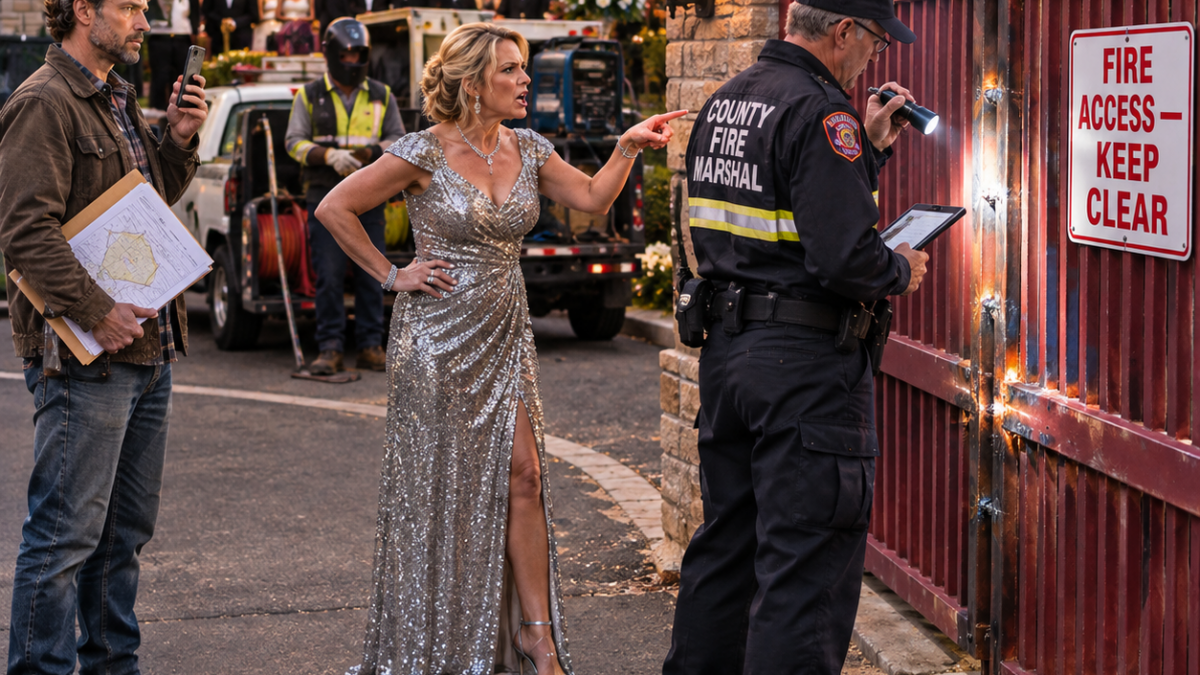
PART2:
It did not allow residents to use the road as a shortcut.
It did not allow delivery trucks.
It did not turn Emmett’s land into overflow parking.
It allowed fire, medical, and other authorized emergency crews to use the route when necessary.
Nothing more.
Emmett owned the gate.
He had paid for it.
He maintained it.
He had even installed the locking system required by the fire authority so approved crews could open it without waiting for him.
The system had been inspected.
Tested.
Documented.
There had never been a problem.
Until Darla Northcott stepped out of the first white truck.
She was fifty-one.
HOA president for six years.
Always perfectly dressed.
Always carrying a folder.
Always speaking as though any conversation in which she participated had already been decided before everyone else arrived.
Two HOA staff members got out behind her.
Darla did not say good morning.
She looked at the gate.
Then at Emmett.
“We need that lock removed.”
PART3:
Emmett glanced toward the trucks.
“Why?”
“For the gala.”
“What gala?”
Her expression shifted slightly.
Not because she expected him to know.
Because she expected him not to ask.
“The Cedar Bluff Golden Gala. Saturday evening.”
He knew about it vaguely.
Everyone near Cedar Bluff did.
Banners had gone up.
Luxury vehicles had begun visiting the clubhouse.
Vendors had been coming and going all week.
Darla had spent months promoting the gala as a celebration of the community’s growth and her new “Safety and Prestige Initiative.”
Two hundred guests were expected.
Business owners.
Sponsors.
Residents.
County figures.
People Darla considered useful.
She pointed through the gate.
“We’ll be using the rear corridor for event deliveries and VIP traffic.”
Emmett stared at her.
“No.”
The staff behind her looked at each other.
Darla’s smile did not disappear.
It hardened.
“This is HOA access.”
“No. It’s emergency access.”
“It connects directly to Cedar Bluff.”
“That doesn’t make it HOA property.”
“We control roads serving the association.”
“You control roads owned or lawfully operated by the association.”
He pointed to the ground.
“This is my land.”
Darla crossed her arms.
“We have an easement.”
“Emergency easement.”
“An easement is an easement.”
“No.”
Emmett walked to his truck.
Reached inside.
Pulled out a folder.
He kept property documents close because boundary problems had occurred before.
Not with Darla.
With contractors.
Survey crews.
Utility crews.
People who saw gravel and assumed public.
He opened the certified survey.
The property line was unmistakable.
Gate.
Posts.
Gravel.
Shoulder.
All inside Emmett’s parcel.
He held the map toward Darla.
She did not look.
That bothered him more than if she had looked and disagreed.
Her refusal meant facts were not part of the discussion.
Instead she stared at the reflective fire-access sign.
“Take a picture,” she said.
One staff member hesitated.
“Of what?”
“The gate.”
He pulled out his phone.
Darla continued.
“This is becoming a security issue.”
Emmett almost laughed.
“A gate installed under a county fire-access plan is a security issue?”
“It’s privately controlled by someone outside the association.”
“That someone owns it.”
“Nobody outside Cedar Bluff should be able to determine whether our roads are open or closed.”
Emmett pointed to the approved fire lock.
“I don’t determine emergency access. The fire department does.”
Darla turned toward him.
“You are obstructing HOA operations.”
“I’m refusing to let you use an emergency corridor as a party driveway.”
“Same thing.”
“No.”
That single word changed her expression.
Emmett noticed it immediately.
Darla did not mind disagreement as long as disagreement eventually became obedience.
What she hated was a calm refusal.
“You will remove the lock by Friday.”
“No.”
“If you don’t, we’ll modify it.”
“You touch that gate, I’ll report it.”
“To whom?”
“The people whose approval required it to remain functional.”
Darla stepped closer.
“You’re threatening me?”
“No. I’m explaining jurisdiction.”
One of the staff members looked down.
Darla noticed.
Being corrected in front of her own employees embarrassed her more than the property issue.
“Nobody tells me how to manage my community.”
Emmett folded the survey.
“This isn’t your community.”
He looked around.
“It’s my land.”
Darla’s face flushed.
She turned.
Walked back to the truck.
Before getting in, she looked toward the gate again.
“You’ll receive notice.”
“I’ll read it.”
She slammed the door.
The trucks left.
Emmett stood beside the gate for another minute.
Then took photographs.
License plates.
Vehicle logos.
Tire positions.
Staff.
Gate condition.
Timestamp.
He went home.
Wrote down the conversation while it was fresh.
Then sent an email.
Not angry.
Not threatening.
Precise.
He stated that he did not consent to Cedar Bluff Estates or any of its agents modifying, removing, welding, cutting, locking, blocking, or otherwise altering the emergency gate.
He attached the recorded easement.
Certified survey.
Photographs.
Fire-access documentation.
Then he sent copies to his attorney.
That evening, Cedar Bluff responded.
A formal notice arrived by email.
Association seal.
Legal-looking formatting.
Darla’s signature.
NOTICE OF MANDATORY GATE MODIFICATION.
Emmett read it twice.
The first paragraph claimed unauthorized access through the eastern corridor represented a “material security risk” during the upcoming Golden Gala.
The second paragraph stopped him cold.
It did not merely demand temporary event access.
It ordered the gate permanently disabled from opening on gala day.
Permanent weld reinforcement.
Secondary steel crossbars.
No emergency opening during event operations.
Emmett sat back.
“That’s insane.”
He read it again.
Then opened the original fire plan.
The condition was clear.
That gate was the secondary emergency access route for Cedar Bluff’s clubhouse district and upper residential section.
The only main road crossed the narrow bridge.
Block the bridge, and emergency traffic needed the eastern corridor.
The same corridor Darla intended to close.
The same evening, in Cedar Bluff’s clubhouse, Darla was explaining her vision to the board.
The Golden Gala had become more than a charity event.
It was her campaign.
Association elections were only weeks away.
Darla had served six years.
Some residents had begun questioning expenses.
Complaining about fees.
Talking about rotating leadership.
Darla intended the gala to end that conversation.
Two hundred guests.
Gold lighting.
Live jazz.
White roses.
Champagne.
Sponsor wall.
Community awards.
A presentation unveiling the next phase of Cedar Bluff’s “Safety Upgrade Program.”
She wanted photographs.
Applause.
Donors.
She wanted to stand beneath the chandeliers and look inevitable.
But the clubhouse had a logistical problem.
The main parking area could not handle gala traffic, catering deliveries, valet staging, security vehicles, and vendor trucks simultaneously.
Near the bridge, the primary road narrowed.
A backed-up valet line could choke everything.
Then Darla saw the eastern corridor on a site map.
Wide.
Level.
Conveniently close to the clubhouse’s rear entrance.
And mostly empty.
The emergency road became, in her mind, a solution.
She projected the gala map onto the boardroom wall.
The red fire route had disappeared.
In its place:
PRIVATE EVENT SERVICE AREA.
Covered VIP arrival.
Thirty-four premium parking spaces.
Valet staging.
Shuttle loading.
Red-carpet walkway.
Treasurer Sadie Brackett leaned forward.
Sadie was fifty-six, careful with money, and increasingly uncomfortable with how fast Darla approved spending.
“Why did the operating budget increase by forty-six thousand dollars?”
Darla clicked to the next slide.
“Security, transportation, premium guest experience.”
“Which vendors?”
“Event services.”
“Can I see the breakdown?”
“You already have the budget.”
“I have categories.”
“Then you have the budget.”
Sadie frowned.
Event director Willa Dorsey raised her hand.
Willa did not live in Cedar Bluff.
She ran large private events professionally.
Fifteen years.
Hotels.
Fundraisers.
Corporate dinners.
Political galas.
Weddings large enough to require traffic control.
She looked at the map.
“Isn’t that the emergency access route?”
Darla did not look at her.
“It’s being repurposed for one evening.”
“Has fire approved that?”
“We have safety approval.”
“Because if the main approach is congested and the rear corridor is occupied—”
Darla laughed.
“Fire trucks don’t come to charity galas.”
Several board members chuckled.
Willa did not.
“Fire access isn’t based on whether we expect a fire.”
Darla’s smile disappeared.
“Willa, I hired you to run the evening, not redesign Cedar Bluff.”
“I’m asking because if it’s a required lane—”
“It’s handled.”
Conversation over.
At least that was what Darla intended.
The next morning, Emmett mailed a formal objection to Cedar Bluff.
Certified.
Survey.
Recorded easement.
Fire map.
Gate specifications.
He stated plainly:
The HOA had no right to use his property for event parking.
No right to alter the gate.
No right to interfere with the emergency route.
Darla replied by email.
One sentence.
Your objections are rejected. This is an HOA security matter.
Emmett stared at the screen.
Then forwarded it to his attorney.
Three days later, his phone rang.
Unknown number.
“Mr. Vale?”
“Yes.”
“This is Owen from Crestline Valet. I’m coordinating Saturday’s VIP arrivals.”
Emmett looked out his office window.
“All right.”
“I need to verify the rear gate opening time.”
Silence.
“What rear gate?”
“The east access off Vale Road.”
“That is my gate.”
“Yes, sir. We were told you were the property contact.”
“Who told you that?”
“The association.”
“What exactly are you planning?”
There was a pause.
“Thirty-four VIP vehicles entering through the rear corridor. We’ll stage them behind the clubhouse.”
“You have no permission to enter my land.”
Longer pause.
“We have a contract.”
“Not with me.”
“The HOA said access was included.”
“It isn’t.”
Owen’s voice became cautious.
“Mr. Vale, the parking has already been sold.”
Emmett sat up.
“Sold?”
“Yes.”
“How much?”
“I don’t know.”
“Send me the package description.”
“I probably shouldn’t—”
“They are selling access across my land.”
Another pause.
“I’ll send the public sponsorship brochure.”
The brochure arrived five minutes later.
Golden Gala VIP Experience.
$650.
Reserved rear parking.
Private shuttle.
Covered arrival.
Priority entrance.
Thirty-four packages.
All sold.
$22,100 collected for access the HOA did not own.
Emmett printed it.
Added it to the file.
Then drove to Hiram Kraus.
Hiram had surveyed Emmett’s property years earlier.
Fifty-seven.
Gray beard.
No patience for legal improvisation.
He spread the plat across his workbench.
“Gate’s yours.”
“I know.”
“Both posts too.”
“I know.”
“Road shoulder.”
“I know.”
“Emergency easement doesn’t give HOA operational control.”
“I know.”
Hiram looked up.
“So why are you here?”
“They’re threatening to weld the gate shut.”
Hiram stared.
“What?”
Emmett handed him Darla’s notice.
Hiram read it.
Slowly.
Then looked back at the plan.
“That gate is required.”
“Exactly.”
“No fire authority approval changes?”
“None.”
Hiram tapped the red route.
“A welded gate does not satisfy an emergency-access condition.”
“That’s what I need documented.”
Hiram nodded.
“I’ll certify boundary and easement status.”
Emmett called the county fire marshal’s office.
He did not demand punishment.
He asked one question.
“If a privately owned gate on a recorded fire-access route is deliberately welded shut, would that trigger a safety review?”
The answer was immediate.
“Yes.”
He sent everything.
Survey.
Fire plan.
Darla’s written notice.
VIP brochure.
Gate photographs.
The fire authority confirmed a field review would be necessary if the gate were altered.
Meanwhile, Darla hired a welder.
Jared Caffrey owned a small fabrication company.
Thirty-six.
Good reputation.
Mostly fences, commercial railings, structural repairs.
The work order called the project:
SECURITY REINFORCEMENT – EAST SERVICE GATE.
Jared looked at the drawings.
Horizontal steel crossbar.
Additional welds at latch.
Reinforcement near hinges.
He looked at Darla.
“This sign says fire access.”
“Old sign.”
“Then why not remove it?”
“County bureaucracy.”
“Fire department still have a key?”
“Not anymore.”
That was false.
Jared did not know it.
Darla handed him another document.
TEMPORARY EVENT SAFETY APPROVAL.
Fire-safety consulting company logo.
Signature block.
Professional language.
Jared read it.
Looked legitimate.
Mostly.
He accepted the deposit.
Later that day, Willa saw the same document.
The date bothered her.
Approval: September 2.
The revised gala plan using the VIP corridor had not been created until September 9.
Willa knew because she had created it.
She walked into Darla’s office.
“Who is the consultant?”
Darla looked up.
“It’s in the file.”
“I need their contact information.”
“Why?”
“I want confirmation.”
“Of what?”
“The gate closure.”
Darla’s face hardened.
“You’re not auditing my safety consultant.”
“I’m responsible for event operations.”
“You’re responsible for dinner service and guest flow.”
“Fire access is guest safety.”
Darla reached across the desk.
Took the paper from Willa’s hand.
Placed it in a drawer.
“Everything is approved.”
“Then giving me the number shouldn’t be a problem.”
Darla stared.
“Do not delay this event.”
Willa left.
Unconvinced.
Emmett installed two more cameras.
Not aimed into Cedar Bluff.
Not at the clubhouse.
Only his boundary and gate.
He wanted evidence without creating a surveillance issue.
He sent Darla one final notice.
NO AUTHORIZATION TO MODIFY GATE.
BOUNDARY CERTIFIED.
EMERGENCY ACCESS MUST REMAIN FUNCTIONAL.
Any interference would be documented and reported.
No response.
Friday night, Jared received a text.
Darla:
Tomorrow. 6:30 p.m. Use permanent welds. I don’t want that gate opening for anyone.
He read it three times.
Permanent.
Fire access.
Anyone.
Something felt wrong.
But the deposit had cleared.
The drawings were signed.
The HOA president had handed him what appeared to be safety approval.
He convinced himself the paperwork must be legitimate.
Saturday morning, Darla arrived at Emmett’s property.
This time with security guards.
Emmett met them near the fence.
Darla wore sunglasses.
“The gate will be sealed at five.”
“Your work order says six-thirty.”
Her face changed.
“How do you know that?”
“Contractor asked questions.”
“Stay out of HOA vendor relations.”
“He’s working on my property.”
“The route serves Cedar Bluff.”
“That still doesn’t make it yours.”
“We have safety approval.”
“Show me.”
“You’re not the fire marshal.”
“Neither are you.”
One security guard looked away.
Darla stepped toward Emmett.
“If you interfere with the contractor, we’ll call law enforcement.”
“I’m not interfering.”
“Good.”
“I’ll document it.”
She smiled.
“That’s all you can do.”
Emmett nodded.
“For now.”
Darla misread the answer as surrender.
That afternoon, gala staff arrived carrying gold signs and portable barriers.
VIP ARRIVAL.
PRIVATE PARKING.
SPONSOR ENTRANCE.
They began unloading them on Emmett’s land.
He approached the transportation supervisor.
A tired man named Lewis.
“Who authorized this?”
Lewis showed an event map.
“HOA.”
“This is private property.”
“I was told it belonged to Cedar Bluff.”
Emmett handed him the certified survey.
Lewis read.
Looked toward the gate.
Looked back.
“This line is the boundary?”
“Yes.”
“All of this?”
“Yes.”
Lewis immediately called his crew.
“Load it back.”
Darla heard about it within twenty minutes.
She was furious.
Not because her plan had a legal problem.
Because outside vendors had seen it.
Authority depends partly on performance.
Darla needed everyone to believe she controlled every detail.
Emmett had made a contractor question her in public.
That became personal.
At 6:30 p.m., Jared’s welding truck appeared.
Emmett watched from the live camera feed inside his workshop.
Darla stood beside the gate.
Silver evening gown.
Heels on gravel.
Phone in one hand.
Jared unloaded the torch.
Put on gloves.
Dropped his mask.
Darla pointed.
“Seal it.”
Blue-white light flashed.
Sparks scattered.
Steel hissed.
Jared welded the first horizontal bar across the two gate leaves.
Then moved to the latch.
Then another joint.
Emmett recorded everything.
Timestamp.
License plate.
Company logo.
Darla.
Workers.
Gate.
At 6:47 p.m., the gate could no longer open.
Emmett walked out.
Stopped well back from the active torch.
“Jared.”
The welder lifted his mask.
“I’m notifying you that this gate is part of a county-approved emergency route.”
Darla laughed.
Jared looked between them.
“She said that’s outdated.”
“It isn’t.”
Emmett held up the fire plan.
“Recorded easement. Approved route.”
Jared took several steps closer.
Read.
His expression changed.
He looked at Darla.
“You told me fire doesn’t use this anymore.”
“They don’t.”
Emmett said, “Call them.”
Darla snapped, “Finish the job.”
Jared hesitated.
“You have current approval?”
“I showed you the certificate.”
“The certificate says temporary event modifications.”
“Yes.”
“This is permanent welding.”
“Finish it.”
Jared looked at the gate.
Then at the fire-access sign.
He set the torch down.
“I’m done.”
“You’re not paid in full.”
“Keep the balance.”
Darla’s face twisted.
“You signed a contract.”
“And you told me the fire designation was obsolete.”
“It is.”
“Then get the fire marshal to say that.”
Silence.
Jared started packing.
Emmett asked:
“Who signed your work order?”
Jared looked at Darla.
Then back.
“She did.”
“Can I photograph it?”
“No. My lawyer would kill me.”
“Can you preserve it?”
“Yes.”
“Preserve every text too.”
Darla stepped closer.
“You are not directing my contractor.”
Jared answered before Emmett could.
“I’m not your contractor anymore.”
That hurt.
Emmett watched Darla absorb it.
Then he called county dispatch.
No panic.
No 911 drama.
He explained there was no active fire.
No injury.
No immediate need for emergency response.
But an approved emergency gate had been welded shut.
Dispatch routed the report appropriately.
Emmett emailed the fire authority.
Original video.
Photos.
Coordinates.
Prior correspondence.
Darla watched.
Smiling.
“You think anyone is coming up here tonight?”
Emmett looked at her.
“I don’t know.”
“They’ll investigate next week.”
“Maybe.”
“My gala will be over.”
“Then you should hope the fire marshal agrees.”
Darla laughed.
Actually laughed.
Then walked away, silver gown trailing dust across the gravel.
Emmett did not cut the welds.
That mattered.
Evidence first.
He mounted a temporary sign.
EMERGENCY GATE DISABLED
FIRE AUTHORITY NOTIFIED
Someone from the clubhouse saw it.
Darla ordered staff to hang decorative curtains across ballroom windows facing the eastern route.
At 7:20, Emmett’s phone rang.
“Mr. Vale?”
“Yes.”
“County fire marshal’s office.”
Emmett stood.
“We reviewed the approved access plan.”
“And?”
“That gate is required.”
Emmett looked toward the dark ridge.
“What happens now?”
“We’re sending an inspector.”
Inside Cedar Bluff’s clubhouse, the Golden Gala was beginning.
Crystal lighting.
White roses.
Gold-rimmed china.
Jazz quartet.
Champagne.
Sponsor banners.
Valets.
Servers.
Two hundred guests.
Darla moved through them glowing.
Compliments followed.
“Beautiful.”
“Unbelievable.”
“You’ve outdone yourself.”
“This is Cedar Bluff at its best.”
Every compliment restored what Emmett’s resistance had threatened.
Willa watched from the edge of the room.
She had a tablet full of schedules.
Catering checkpoints.
Guest arrivals.
Exit counts.
Transportation routes.
And one unresolved safety document she no longer trusted.
Across the ballroom, Sadie opened the gala budget again.
Forty-six thousand dollars.
EVENT SECURITY / VIP LOGISTICS / HOSPITALITY.
Vendor:
Northcott Event Holdings.
Sadie froze.
Northcott.
She searched the state business registry.
The controlling member appeared immediately.
Darla Elise Northcott.
She looked across the ballroom.
Darla was laughing with sponsors.
Sadie’s stomach tightened.
She went to find her.
“Why did the association pay your company forty-six thousand dollars?”
Darla’s smile remained for the guests.
Her voice changed for Sadie.
“Not here.”
“Was this disclosed?”
“It’s a legitimate vendor.”
“That’s not what I asked.”
“Lower your voice.”
“Did the board know you owned it?”
“Sadie.”
“Did we vote knowing you had a financial interest?”
Darla leaned closer.
“This event is not the place for internal accounting disputes.”
“It’s forty-six thousand dollars.”
“You approved the budget.”
“I approved categories.”
“Then you approved it.”
Sadie stared.
“No.”
Darla’s expression chilled.
“You are treasurer because I supported you.”
Sadie stepped back.
There it was.
Not an answer.
A reminder of power.
Sadie went to her office.
Copied accounting records.
Downloaded approvals.
Preserved invoices.
Then sent a formal request for independent audit.
At almost the same moment, the fire authority contacted Willa.
They requested the event safety file.
Willa opened the questionable approval.
Then pulled a legitimate consultant report from the previous year.
Same signature block.
Same scanned signature.
Exactly.
She overlaid the two pages.
The new document used the old signature image.
Text above it had changed.
She did not accuse Darla.
She did something better.
She sent both original digital files to the fire marshal.
At 9:04, Darla stepped onto the terrace and called Emmett.
“You’re trying to destroy me.”
Emmett stood near his gate.
“No.”
“You filed a false complaint.”
“I sent your notice and my survey.”
“You told them the event is unsafe.”
“No. I told them the emergency gate was welded.”
“You’re sabotaging a charity event.”
“You welded it.”
“I have safety approval.”
“Show it to the fire marshal.”
Silence.
Music drifted through her phone.
Then she hung up.
Fire Marshal Rhett Danforth had already reviewed the file.
Forty-eight.
Precise.
Not impressed by social status.
The clubhouse occupancy approval depended on an emergency-access plan that included the eastern route.
That route now had a welded gate.
The VIP event layout also put commercial functions on the fire corridor.
The gala’s earlier safety filing promised the route would remain fully accessible.
The consultant document claimed closure was approved.
Both could not be true.
Then the consulting firm responded.
They had not issued Darla’s approval.
Rhett stood.
Put on his jacket.
Drove to Cedar Bluff.
He parked away from the main gala traffic.
Walked the eastern route with a flashlight.
Reached Emmett’s sign.
Then the gate.
He ran the beam across the welds.
Thick.
Fresh.
Deliberate.
A steel bar fused across both leaves.
He looked at the fire-access sign.
Then at the inspector beside him.
“This event cannot continue.”
Inside, Darla was preparing to speak.
The jazz quartet finished.
Applause.
She stepped onto the stage.
Silver gown catching chandelier light.
Microphone in hand.
“Tonight is more than a celebration.”
Guests quieted.
“Tonight represents what Cedar Bluff becomes when we refuse to settle for ordinary.”
Applause.
Darla smiled.
“Our community is stronger, safer, and more prestigious than at any point in its history.”
Willa stood near the back.
Her phone vibrated.
FIRE MARSHAL ON SITE. REQUESTING RESPONSIBLE EVENT OPERATOR.
She closed her eyes.
Then went to Darla.
Whispered as Darla stepped offstage.
Darla’s face hardened.
“Tell him tomorrow.”
“I can’t.”
“Willa.”
“He’s conducting a safety inspection.”
“This is a private event.”
“He has authority.”
Darla stared.
“I’ll handle him.”
Outside, Rhett had confirmed the route.
Confirmed the VIP layout.
Confirmed the obstruction.
He ordered commercial activity removed from the corridor.
Then told Willa to prepare for orderly evacuation.
No panic.
No rushing.
No waiting for smoke.
The safety conditions were already broken.
Emmett stood near the public entrance.
Rhett had asked him only to confirm property boundaries and gate ownership.
Emmett handed over Hiram’s certification.
Video drive.
Then stepped back.
This was not his shutdown.
That distinction mattered.
Darla stormed outside.
She saw Emmett.
“You came to watch?”
“No.”
“Enjoying yourself?”
“No.”
“You’ve been trying to ruin this all week.”
“You welded a fire gate.”
“It’s my community.”
“It’s my gate.”
“Not tonight.”
A voice came from beside the entrance.
“Actually, tonight especially.”
Darla turned.
Rhett stepped forward.
“Rhett Danforth. County fire marshal.”
Her expression flickered.
Then recovered.
“Whatever complaint he filed can wait until tomorrow.”
“No, ma’am.”
“We have two hundred invited guests.”
“I know.”
“Major sponsors.”
“I know.”
“This is a private event.”
“I know.”
“You’ll need a court order if you intend to interfere.”
“No.”
She blinked.
Rhett continued.
“The venue is operating without required fire-access conditions. I have administrative authority to suspend the event.”
Darla’s voice sharpened.
“My attorney will challenge that.”
“He may.”
“I know people at the county.”
“Call them after the building is cleared.”
She stared.
Rhett turned to Willa.
“Can your sound technician give me access to the microphone?”
“Yes.”
Darla stepped between them.
“No.”
Willa looked at her.
Then at Rhett.
“I’ll get it.”
That was the moment Willa chose.
Not Emmett.
Not Darla.
Safety.
Darla rushed back inside.
She reached the stage first.
Signaled the quartet.
Music resumed.
She lifted a champagne glass.
“Ladies and gentlemen—”
Music cut off mid-note.
Rhett appeared beside the stage.
Microphone.
The ballroom fell silent.
“Ladies and gentlemen, I am Fire Marshal Rhett Danforth.”
Darla smiled tightly.
“We have a minor administrative issue—”
“This event is being suspended because a required emergency access route has been deliberately disabled.”
Murmurs.
Darla’s smile disappeared.
“That is one gate.”
Rhett looked at her.
“One required emergency gate.”
Guests turned.
He continued.
“The venue’s current approval requires the eastern emergency corridor to remain operational. It is not.”
Darla grabbed another microphone.
“The gate was secured for the protection of this private event.”
“That action violated the approved fire-access condition.”
“It belongs to Cedar Bluff.”
“County land and easement records do not support that statement.”
The room changed.
Darla’s supporters stopped smiling.
Willa approached the technician.
Rhett nodded.
The giant projection screen behind the stage lit up.
A photograph.
Red steel gate.
Fresh welds.
Crossbar.
And beside it:
FIRE ACCESS
KEEP CLEAR
EMERGENCY USE ONLY
Two hundred people stared.
One woman whispered:
“Oh my God.”
Another guest recognized the area.
“That’s VIP parking.”
A man at a sponsor table stood.
“We parked back there.”
Rhett said:
“The route was also being used for event services inconsistent with the required emergency-access plan.”
Darla stepped toward him.
“This is completely unnecessary.”
“No, ma’am.”
“There is no fire.”
“Fire regulations do not require us to wait for one.”
That sentence ended the argument.
Staff moved.
Willa took control.
Doors checked.
Guests directed.
Coats retrieved.
No chaos.
No stampede.
The gala ended calmly.
That calm hurt Darla more than drama would have.
She could not say the fire marshal created panic.
Could not say guests were endangered by officials.
The exact opposite.
The shutdown was controlled.
Professional.
Embarrassing only because the facts were visible.
One major sponsor approached Darla.
“Did you authorize the gate closure?”
Darla tried to redirect.
“This is a property dispute.”
“That isn’t what I asked.”
Another woman held up her VIP confirmation.
“I paid six hundred fifty dollars for parking on an emergency route?”
Darla looked at Willa.
Willa answered.
“The VIP packages were approved through Darla’s office.”
The woman looked disgusted.
Darla pointed toward Emmett.
“This is his fault.”
Emmett did not move.
“You welded the gate.”
Every face turned.
“I made sure the people with jurisdiction saw it.”
Darla stepped toward him.
Two event staff blocked the pathway.
Rhett said:
“Ma’am, keep the exit clear.”
Darla stopped.
One by one, guests left.
Tables remained set.
Champagne half full.
White roses glowing beneath chandeliers.
Sponsor banners still hanging.
The great Golden Gala ended before its main program finished.
Then Sadie walked across the lobby.
Folder in hand.
She stopped beside Rhett and Emmett.
“The gate isn’t the only problem.”
Darla saw her.
“Sadie.”
Sadie ignored her.
She opened the accounting file.
“Forty-six thousand dollars in association funds went to Northcott Event Holdings.”
Rhett looked at the page.
Sadie continued.
“Darla owns the company.”
The room that had seemed nearly empty suddenly felt very still.
Two days later, Cedar Bluff’s board met again.
No orchestra.
No champagne.
No sponsors.
Only homeowners.
Sadie presented the records.
Northcott Event Holdings.
$46,000.
Security.
Event management.
VIP hospitality.
No conflict-of-interest disclosure.
No independent bid process documented.
Then Jared’s invoice.
Gate welding.
Booked under:
GALA SECURITY UPGRADES.
That detail changed how residents saw everything.
Darla had not merely made a reckless safety decision.
She had made a safety decision that helped execute an event plan connected to her own company.
The board suspended her contract authority.
Removed her ability to direct vendors.
Ordered an independent audit.
Darla called it a coup.
Nobody cared.
Emmett filed for emergency judicial relief.
His attorney submitted:
Deed.
Certified survey.
Recorded easement.
Fire plan.
Camera video.
Written objections.
HOA modification notice.
Photographs.
Jared’s information.
Repair estimates.
Fire marshal findings.
The court ordered the gate protected and restored under controlled conditions.
A qualified contractor removed the welded bars.
Then they discovered the damage.
The heat had warped critical gate components.
Operator mounts distorted.
Latch assembly damaged.
One hinge line pulled out of alignment.
Support structure required correction.
Replacing and restoring the gate assembly cost $46,800.
Support post and road repairs:
$8,900.
Engineering inspection, testing, and required professional fees:
$6,200.
Total proven damage:
$61,900.
Emmett did not claim gala losses.
Did not claim sponsor refunds.
Did not claim reputational damages.
Those belonged to Cedar Bluff.
His claim was simple.
You damaged my property.
Repair it.
The investigation into the safety approval continued.
Jared turned over texts.
Especially:
Use permanent welds. I don’t want that gate open for anyone.
Willa provided the suspicious consultant document.
Original email metadata.
Prior-year genuine document.
Authorities confirmed the consulting firm had not issued the new approval.
The question became who created it.
Civil trial came first.
Judge Judith Latham presided.
Fifty-nine.
Direct.
She looked at Darla.
“Who gave you permission to weld Mr. Vale’s gate?”
Darla began:
“As HOA president—”
Judge Latham raised a hand.
“That was not my question.”
Silence.
“Who gave you permission from the owner?”
“No one.”
“Who gave you fire-authority approval?”
“We believed—”
“Who?”
Darla had none.
Judge Latham looked at the easement.
“The association possessed an emergency-use easement.”
“Yes.”
“Not ownership.”
Darla said nothing.
“You were warned in writing?”
“Yes.”
“You received the survey?”
“Yes.”
“You directed permanent welding anyway?”
Darla’s attorney shifted.
She answered:
“Yes.”
The judgment came down.
Intentional property damage.
$61,900.
Personally liable.
Darla protested that she acted for the HOA.
The court examined the warnings.
Her private financial interest.
Her direct instructions.
Her actions beyond documented authority.
The judgment remained.
On the courthouse steps, Darla turned toward her attorney.
“At least they can’t remove me from office.”
Her attorney looked at his phone.
Did not speak.
Handed it to her.
Cedar Bluff members had just voted.
Darla Northcott was no longer president.
The gate was rebuilt.
Inspected.
Tested.
A new sign went up.
EMERGENCY ACCESS
DO NOT BLOCK
Rhett Danforth personally witnessed the operational test.
Fire crew approached.
Access mechanism engaged.
Gate opened.
Smoothly.
Exactly as designed.
Rhett looked toward the new board.
“This route is not a party asset.”
Nobody argued.
“It is not overflow parking.”
Silence.
“It exists because someday the primary entrance may be unavailable.”
He looked toward the bridge.
“If that day comes, nobody here will care how beautiful a gala was.”
That stayed with people.
Cedar Bluff changed afterward.
Sadie remained treasurer.
She redesigned financial controls.
Multiple approvals required.
Conflicts disclosed.
Vendor ownership checked.
Competitive quotes for major contracts.
Willa severed all business ties with Darla.
Jared changed his own company policy.
Anything marked emergency access required independent verification before modification.
Even if a client produced paperwork.
He later told Emmett:
“I should’ve stopped the second I saw the sign.”
Emmett answered:
“You stopped eventually.”
“Too late.”
“Late is better than never.”
Months after the judgment, Emmett found Darla beside the restored gate.
No HOA trucks.
No guards.
No staff.
No silver gown.
Just Darla.
She looked at the steel.
“You destroyed everything I spent six years building.”
Emmett stood several feet away.
“No.”
She turned.
“You called the fire marshal.”
“I reported a welded emergency gate.”
“You humiliated me in front of everybody.”
“I wasn’t on the stage.”
“You got me removed.”
“Homeowners voted.”
“You sued me.”
“You damaged my property.”
Her face tightened.
“You know what I mean.”
Emmett did.
She wanted him to accept responsibility for the consequences of her decisions.
He would not.
“You welded it shut, Darla.”
“That gala mattered.”
He looked at the sign.
“More than this?”
She followed his eyes.
Emergency Access.
Do Not Block.
“It was one night.”
“And an emergency only needs one night.”
She opened her mouth.
Closed it.
For once, no answer came.
Emmett did not ask for an apology.
He had the judgment.
The restored gate.
The public record.
That was enough.
Months later, Cedar Bluff held another safety meeting.
No gala.
No chandeliers.
Folding chairs.
Coffee.
Printed engineering plans.
The new board reviewed every emergency route.
Published the budget.
Explained the real safety requirements.
Then they invited Emmett.
Not as a member.
Not as an employee.
As the adjoining landowner.
They asked whether he would sign an updated cooperation agreement clarifying the emergency easement.
Emmett read every page.
Made two revisions.
Signed.
His land remained his.
The HOA did not gain ownership.
Emergency crews retained access.
No one argued.
That was what cooperation looked like when nobody needed domination.
On a clear morning several weeks later, the fire department conducted a scheduled test.
Engine approached the eastern corridor.
Gate opened.
Truck crossed.
No welding torches.
No barriers.
No VIP signs.
No waiting.
Emmett watched from the fence.
The engine passed toward Cedar Bluff.
Then the gate closed behind it.
Exactly what it had been designed to do.
The association eventually released the audit findings.
The $46,000 payment to Northcott Event Holdings had not been properly disclosed.
Additional transactions required review.
Some spending had been legitimate.
Some had been poorly documented.
Investigators did not treat every questionable decision as criminal.
That mattered.
Evidence determined consequences.
Not gossip.
Not anger.
Not Darla’s former title.
She remained responsible for the $61,900 judgment.
Her company lost Cedar Bluff business.
The questionable safety document remained under separate scrutiny.
Her name disappeared from the president’s line on every official communication.
For years, her identity had been tied to Cedar Bluff.
Darla Northcott, President.
Eventually, mail simply said:
Cedar Bluff Estates Board.
No crown.
No permanent ruler.
Just an office somebody else could hold.
Residents adapted faster than Darla expected.
That may have hurt most.
Communities survive leaders who think they are indispensable.
The sponsors who once praised Darla demanded disclosure rules.
Residents who had laughed when she said fire trucks do not come to charity galas stopped laughing.
The clubhouse adopted stricter occupancy procedures.
Event plans required fire-access verification before approval.
Emergency corridors could not be repurposed for parking.
The eastern gate became boring again.
That was the best possible ending.
A safety gate should be boring.
It should sit there for years.
Unused.
Maintained.
Clear.
Waiting for a day everyone hopes never comes.
It should not become a symbol.
But because Darla had tried to make it part of her gala, it became one anyway.
For some residents, it represented arrogance.
For others, accountability.
For Emmett, it remained what it had always been.
A gate.
Owned by him.
Serving a lawful emergency easement.
Nothing more.
Nothing less.
The most important detail in the entire story was not the $61,900 judgment.
Not the $46,000 contract.
Not the two hundred guests walking out.
Not the photograph filling the ballroom screen.
Not even Darla losing the presidency.
It was one sentence written years earlier on a fire-access plan.
Route shall remain operational.
Simple.
Technical.
Boring.
Exactly the kind of language ambitious people overlook when it interferes with what they want.
Darla had believed titles changed facts.
President.
HOA.
Security.
Gala chair.
She thought those words could stretch across a property line.
They could not.
She thought a private safety consultant’s logo could replace actual approval.
It could not.
She thought a fire-access easement gave her ownership.
It did not.
She thought the fire marshal would wait until Monday because wealthy guests were drinking champagne.
He did not.
And she thought Emmett’s refusal to physically stop the welding meant he was powerless.
That was perhaps her greatest mistake.
Emmett did not need to fight Jared.
Did not need to stand in front of a torch.
Did not need to scream.
Did not need to threaten Darla.
He needed evidence.
Boundary.
Easement.
Video.
Emails.
Fire plan.
Work order.
Photographs.
Timing.
Facts.
Darla had laughed when she told him:
Stand there and take pictures. That’s all you can do.
In the end, pictures were enough.
One of them filled an entire ballroom screen.
Darla’s silver gown was still visible when the image appeared.
Fresh welds.
Red gate.
Reflective sign.
FIRE ACCESS.
KEEP CLEAR.
Two hundred witnesses.
She had spent weeks building the perfect gala photograph.
That was the photograph everyone remembered instead.
Years later, when Cedar Bluff residents told the story, they often exaggerated.
Some said the fire marshal stormed into the ballroom.
He did not.
He walked.
Some said guests panicked.
They did not.
Some claimed police dragged Darla away.
That never happened.
Real consequences were quieter.
The music stopped.
An official gave an order.
Guests collected coats.
Accountants opened records.
A judge asked a question.
Homeowners cast votes.
A contractor repaired steel.
That was enough.
Consequences do not need spectacle to be permanent.
Emmett preferred the truth.
Darla welded shut a mandatory emergency gate on land she did not own after receiving written warnings not to touch it.
The fire marshal verified the condition.
The gala could not legally continue under its approved safety plan.
He shut it down.
Then financial records revealed Darla’s own company had received $46,000 connected to the event.
A court held her personally liable for $61,900 in property damage.
Cedar Bluff homeowners removed her.
The gate was restored.
Simple.
Everything else was ego.
One morning after the new board had been in place for nearly a year, Emmett walked the eastern fence line again.
Same route where the white HOA trucks had appeared.
Grass moved in the wind.
Gate stood red against the tree line.
He checked the hinges.
Locking system.
Sign.
Routine.
Behind him, a truck approached.
Not HOA.
Fire department.
Scheduled test.
Emmett stepped aside.
The emergency mechanism activated.
The gate opened.
Engine rolled across his land.
Up the corridor.
Toward Cedar Bluff.
No obstruction.
No debate.
No one asking who was important enough to control the road.
For a few seconds Emmett watched the truck disappear uphill.
Then the gate closed.
The steel leaves met.
Latch engaged.
Quiet.
He rested one hand against the post.
Not triumphantly.
Just checking it.
Still solid.
Still his.
Still available for the purpose it had always served.
Darla had welded that gate shut because she believed closing it would prove she controlled the land, the event, and everyone standing in her way.
Instead, the fire marshal closed her gala.
The board closed her access to association accounts.
The court closed the argument over who owned the gate.
And Cedar Bluff’s homeowners closed the chapter on the woman who had spent six years convincing herself the community belonged to her.
Emmett never joined the HOA.
Never wanted to.
Never paid it a dime.
His land remained outside its control.
The emergency easement remained exactly what it had always been.
Permission for emergency crews.
Not party guests.
Not VIP parking.
Not Darla.
And long after the chandeliers went dark, the sponsor wall came down, and the silver gown disappeared into the back of a closet, the gate was still standing.
Openable.
Inspected.
Clear.
Which was all Emmett had asked for from the beginning.
Because the real victory was never that Darla lost her gala.
It was that when the day finally came that someone genuinely needed that emergency road, nobody would have to waste a single second cutting through the steel she had welded there for vanity.








