HOA Karen Used My Old Signature to Clear 800 Maples for a Ski Slope—Then the State Ordered Every Tree Replanted
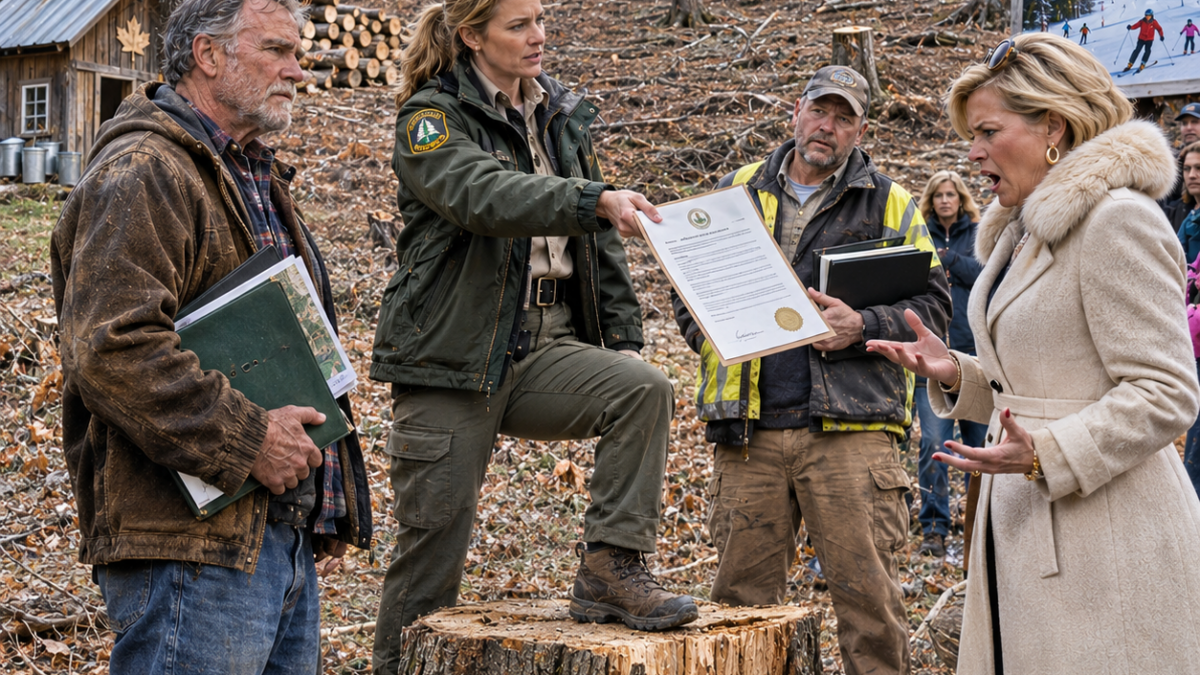
PART2:
Twenty-three days earlier, Brenda had blocked my gravel driveway with her white SUV while I was carrying empty syrup jugs from the sugar house.
She stepped out holding a rolled site plan.
“I need you to reconsider the hill.”
I kept walking.
“I already did.”
“You said no before we had the final design.”
“I said no to a ski slope on my land.”
She followed me toward the porch.
“This is different.”
“A prettier drawing won’t change who owns the ground.”
She unrolled the paper across the hood of her SUV.
I should have kept walking.
Instead, I stopped.
The drawing showed the HOA’s upper field dropping toward the clubhouse.
A beginner ski hill.
Short.
Gentle.
A rope tow on one side.
Lights.
Parking.
A little warming shed.
The kind of thing people could sell as wholesome winter recreation.
Most of the actual slope on the drawing was my maple grove.
Except whoever created the rendering had colored that section white.
No trees.
I put the syrup jugs on the porch.
Then walked back.
“Where are the maples?”
“We’d preserve trees along the edges.”
“Where are the ones in the middle?”
Brenda pressed the paper flat against a gust of wind.
“Frank, this could increase property values throughout the entire neighborhood.”
I stared at the blank white strip where my grove should have been.
“There’s more on that hill than property values.”
My name is Frank Dalton.
I was sixty-six years old that winter.
I had spent most of my working life maintaining road equipment for the county.
Graders.
Loaders.
Snowplows.
Dump trucks.
The kind of machines that can fix a road in an afternoon and destroy a landscape just as quickly if the wrong person tells the operator where to go.
After retirement, my wife Ruth and I stayed in the same house where I grew up.
My father had refused to sell our parcel when the old Miller farm around us was broken into residential lots.
The neighborhood eventually became Pine Ridge Estates.
Stone entrance.
Large homes.
Clubhouse.
Community water system.
HOA.
Our property sat against two sides of it.
But our house, sugar house, and maple grove were never incorporated into the association.
Brenda knew that.
Everybody on the board knew it.
We had been over the boundary more than once.
The HOA had one narrow access right across the northern edge of my land.
A service lane.
It existed so crews could reach their water tank and the lines serving it.
That was all.
No recreational right.
No construction right.
No right to turn twelve acres of maple trees into a neighborhood business venture.
Brenda rolled one hand over the ski plan.
“The clubhouse has been operating at a loss.”
“Then fix the clubhouse budget.”
“We need winter revenue.”
“Then earn it on HOA land.”
“The upper field alone isn’t long enough.”
“That sounds like your problem.”
Her mouth tightened.
“We have service access through your parcel.”
“For the water tank.”
“Access rights can support reasonable community infrastructure.”
“A ski hill isn’t water infrastructure.”
“It’s hardly Aspen, Frank.”
“Then you shouldn’t need my land.”
She straightened.
“Would you lease the hillside?”
“No.”
“Sell a strip?”
“No.”
“A seasonal agreement?”
“No.”
“Why?”
I looked at her.
“Because I said no.”
People like Brenda hated answers that couldn’t be negotiated into different answers.
She rolled up the drawing.
“You’re refusing to even discuss this.”
“I’m standing here discussing it.”
“You know what I mean.”
“Yes.”
Then I picked up the syrup jugs.
“And my answer is still no.”
She drove away angry.
That evening, I sent an email because I had learned that spoken conversations have a way of becoming vague the moment money enters the room.
I wrote that I did not authorize any ski trail, clearing, grading, lift equipment, recreational use, or project construction on my property.
I attached the boundary survey.
I described the service lane specifically.
Northern edge.
Existing route.
Water-tank maintenance only.
No public trail.
No ski access.
No clearing through the grove.
I copied the HOA property manager, Peter Cole.
He answered the following morning.
Received. I will place this with the project records.
I printed his reply.
At the time, that seemed like the end of it.
It wasn’t.
My maple grove covered a little over twelve acres.
Calling it a grove made it sound smaller than it felt when you were inside it.
Some trees were older than my father had been when he died.
Others Ruth and I had planted after storms opened gaps in the canopy.
The property wasn’t wilderness.
It was managed.
Every spring, I checked the sap lines.
Every summer, I cleared fallen limbs from the paths.
Every fall, my daughter Sarah brought Noah out to help.
Noah was seven.
His favorite tool was a rubber mallet.
Ruth always said he liked it because there was almost nothing important he could destroy with it.
The old sugar house sat near the bottom of the slope.
Nothing fancy.
Metal roof.
Wood siding.
Steam stains above the evaporator.
We made maple syrup each spring.
Not enough to call ourselves a serious commercial operation.
We sold some.
Gave away plenty.
My father had written the names of families who received free bottles on the inside of an old cupboard door.
We still followed his list.
Widows.
Neighbors.
A retired teacher.
Two families from his church.
People who had helped him when I was young.
Three years before Brenda showed up with her ski drawing, Ruth and I had signed a permanent conservation agreement with the state.
The land remained ours.
But the grove had to remain wooded.
We could manage it.
Tap trees.
Remove hazardous timber.
Maintain paths.
Plant replacements.
What we could not do was clear the hillside for buildings or recreational development.
That agreement was intentional.
My father had once been offered enough money to sell the property and move.
He refused.
I wanted that decision to last longer than my lifetime.
Leah Brooks was the state forester assigned to the property.
She had inspected the grove that summer.
Her updated inventory documented 800 living maples inside the protected area.
Not an estimate.
Not “roughly eight hundred.”
Eight hundred mapped living trees.
Two storm-damaged ones had been removed earlier under the approved management plan, and Leah had updated the records afterward.
I kept her inventory in a green binder beside our syrup records.
At the time, I had no idea I would soon use it to count what was gone.
Two days after Brenda’s driveway visit, I saw orange paint on one maple near the service lane.
Then ribbon tied to another farther uphill.
I stopped.
Looked around.
More marks.
A line.
I called Peter.
“Did the HOA send someone onto my property?”
“Not that I know of.”
“There’s orange marking paint on my trees.”
“I know a contractor was looking at the upper field.”
“This isn’t the upper field.”
“I’ll check.”
I photographed the paint.
Walked the boundary.
The old iron pins were still where they belonged.
At the corner near the water tank, a strip of blue ribbon I had tied years before was still faded around one marker.
The orange markings did something different.
They ran from that corner.
Downhill.
Through the maples.
I removed one loose ribbon.
But I left the orange paint untouched.
That turned out to be a good decision.
The following morning, a pickup stopped near the service lane.
Company name on the door.
A man stepped out.
“Mr. Dalton?”
“Yes.”
“I’m Doug. There seems to be some question about the project boundary.”
“There isn’t a question from me.”
I showed him my survey.
Doug studied it.
Then looked toward the hill.
“My office has a different drawing.”
“Does your office have permission from me?”
“No, sir.”
“Then don’t send anybody onto my property.”
He nodded.
“I’ll report it.”
He seemed reasonable.
I watched him drive away and assumed the message would reach whoever needed it.
That was my mistake.
I dealt with the man standing in front of me.
I didn’t ask for his office number.
Didn’t ask who hired him.
Didn’t demand written confirmation.
Friday morning, Ruth and I drove to our daughter’s house.
Sarah had undergone surgery on her foot.
Nothing life-threatening, but enough that she couldn’t manage stairs well.
She lived a little over two hours away.
We planned to stay through Monday morning.
Before leaving, I locked the sugar house.
Checked the house.
Made sure the tools were inside.
I did not block the service lane.
The HOA’s water crew still had legitimate access.
I was angry at Brenda.
I wasn’t going to interfere with somebody maintaining a water system.
Sunday afternoon, my neighbor Ellis called.
I was standing in Sarah’s kitchen rinsing a coffee mug.
“Frank?”
“Yeah?”
“Are you having the maple grove cut?”
The mug stopped under the faucet.
“What?”
“There’s a crew on the hill.”
I turned off the water.
“What kind of crew?”
“Big machines.”
Ruth came into the kitchen.
Ellis continued.
“I thought maybe you sold timber, but they’re going all the way across.”
The mug hit the sink harder than I intended.
A small chip broke from the rim.
“Call the sheriff.”
“What?”
“Tell them the landowner says nobody has permission to cut those trees.”
Ruth already had her coat.
We were in the truck within ten minutes.
I barely remember the drive.
Ruth made calls because she knew I couldn’t safely drive while arguing on the phone.
Peter did not answer.
Brenda did.
Ruth put her on speaker.
I said:
“The crew needs to stop.”
Brenda answered:
“The board approved the first phase.”
“The board does not own my hill.”
“We can discuss it when you arrive.”
“No. Stop them now.”
“There’s a contractor schedule, Frank.”
“Stop the machines.”
“You’re making this more dramatic than—”
I ended the call.
That was the only time I hung up on her.
We reached home before dark.
I knew how bad it was before I reached the driveway.
From the county road, I could see the water tank.
The whole thing.
Before that afternoon, trees had hidden most of it.
The hillside looked wrong.
Too wide.
Too bright.
I pulled into the driveway.
The narrow grove paths were gone beneath machine tracks.
Logs sat in long rows along the service lane.
Broken sap tubing hung from branches like wire after a storm.
The sugar house still stood.
Above it?
Nothing.
The grove was gone.
I left the engine running.
Ruth reached over.
Turned the key.
For a moment, we sat in silence.
A sheriff’s deputy met us near the gate.
Owen Price.
No relation to Brenda.
He told me he had stopped the machinery as soon as he arrived.
Most of the cutting had already been completed.
“They started Saturday.”
“How much?”
He looked uphill.
“Most of it.”
I asked for the foreman.
A man in a hard hat walked down carrying a tablet.
Travis.
He looked irritated until I introduced myself.
Then his expression changed.
“We were told the owner agreed.”
“I’m the owner.”
He looked toward Deputy Price.
“I told one of your people not to enter.”
“Doug?”
“Yes.”
Travis rubbed his forehead.
“I wasn’t here for that visit.”
I wanted to shout.
Wanted to ask how many people had to hear no before no became a real word.
Instead, I said:
“No trucks leave.”
Travis stiffened.
Deputy Price stepped in.
“Loaded vehicles stay until I document what happened.”
He photographed trucks.
Company names.
Equipment.
Paperwork.
I forced myself to stay out of the machinery path.
Every log looked like something I should stand in front of.
Ellis came down from his house carrying his phone.
“I took pictures this morning.”
He looked ashamed.
“I didn’t realize.”
Ruth said:
“You called us. Stay and help.”
So he did.
Ellis walked with me along the lower edge.
Then I saw the two stumps.
The trees where Noah’s seat had been.
The seat lay upside down in the branch pile.
One end trapped beneath a heavy limb.
Ellis reached toward it.
“Leave it.”
My voice came out sharper than I intended.
He stopped.
“I need a picture first.”
He handed me his phone because I couldn’t find mine.
That simple thing helped.
Photograph.
Move.
Document.
One step.
Then another.
I called Leah from the sugar house.
Her office was closed.
The recording gave an emergency conservation-damage number.
A woman answered.
I explained what happened.
“Do not disturb the stumps.”
“They’re already down.”
“I understand.”
“Most of the whole grove is down.”
“I understand.”
She stayed calm.
“No additional grading. No stump removal. No soil disturbance unless necessary for safety.”
I looked through the sugar-house window.
“The trees are already gone.”
“Yes, Mr. Dalton.”
Her voice softened slightly.
“But the ground still contains evidence. Protect what remains.”
I wrote her name on the back of a syrup label.
Then opened the green binder.
Leah’s summer map.
Eight hundred marks.
I looked out the window.
Bare slope.
I couldn’t count the anger.
Couldn’t count the years.
Couldn’t count how many spring mornings my father and I had stood among those trees.
But I could count what had been there.
Eight hundred.
Travis came to the doorway.
He had a printed plan.
“This is what we were given.”
Across the top:
PINE RIDGE WINTER RECREATION PROJECT.
The twelve-acre grove was outlined in red.
I pointed to the sugar house.
“This isn’t the tank lane.”
“No.”
“This is the whole grove.”
“I see that.”
At the bottom:
LANDOWNER APPROVAL ON FILE.
Checked.
I stared at it.
Before I could ask who checked the box, Peter called.
I put him on speaker.
“Frank, I opened the project file.”
Ruth came closer.
Peter sounded shaken.
“There’s something wrong.”
“Start talking.”
“The drawing used for the board package doesn’t show your name on the parcel.”
“Whose?”
“The association.”
I looked at Travis.
Then the checked box.
Peter continued:
“And the clearing company has already been paid from the HOA reserve account.”
“Send me the drawing.”
“I will.”
“Right now.”
“Yes.”
“And don’t change anything in the project folder.”
“I won’t.”
“Every version stays.”
“Understood.”
I asked Travis:
“Did your office verify ownership?”
“Our office handled the project paperwork.”
“That wasn’t my question.”
He looked at the plan.
“I don’t know.”
“Then I need somebody who does know here tomorrow.”
He nodded.
Arguing with Travis wasn’t going to restore a single tree.
I needed records.
Names.
Paper trails.
And the equipment stopped.
Deputy Price recorded the clearing company contact information.
Which trucks contained logs from my property.
Equipment positions.
Travis agreed to leave loaded log trucks overnight and keep all machinery off the cleared ground.
I asked him to put that in writing.
He texted it to me while we stood there.
Only then did I go inside.
Ruth turned on the kitchen light.
The window behind her looked wrong.
Nothing blocked the hill anymore.
She poured a glass of water.
“Drink that before you make another phone call.”
I did.
Peter’s email arrived.
The drawing showed my grove inside a bold boundary labeled:
ASSOCIATION RECREATION PARCEL.
The old service lane wasn’t drawn as a narrow strip.
Instead, a broad open area ran almost to the sugar house.
No surveyor’s stamp.
No reference to a deed.
No date showing when anyone supposedly confirmed ownership.
Ruth put my certified survey beside it.
“They moved the line.”
“On paper.”
She looked at me.
“That was enough to send machines.”
“Not enough to change who owns it.”
I needed to keep saying that.
A drawing could fool people.
It could send a contractor to the wrong place.
But it couldn’t rewrite a deed.
Peter called again after nine.
He had found the board minutes.
The directors had voted to approve clearing “on association-owned property within the proposed recreation area.”
I asked:
“What did they see before voting?”
“Brenda’s project summary. Cost sheet. The map.”
“My email?”
Pause.
“Your email is in the management folder.”
“Was it in their board packet?”
“No.”
“Why?”
“I didn’t prepare Brenda’s packet.”
“That’s not an answer.”
He exhaled.
“I should have made sure the board saw it.”
“Yes.”
No point making him feel better.
He promised to forward my refusal and survey to every director that night.
Late.
But useful.
The following morning, Leah arrived with another state employee named Ben.
She got out of her vehicle.
Looked uphill.
Stopped.
For several seconds, she didn’t speak.
Then:
“Show me where the equipment entered.”
We walked the service lane.
Travis met us.
Most of his crew had gone home.
Leah requested the clearing plan.
Compared it to her protected-area map.
Then pointed toward the water tank.
“The service access is here.”
“Yes.”
She traced the line.
“The protected grove begins here.”
“Yes.”
She looked at me.
“So the clearing was not along the access lane.”
“No.”
“I’m documenting it.”
Her calmness helped.
She wasn’t asking me to prove how upset I was.
She was turning what happened into facts.
Ben photographed the iron corner marker.
My old blue ribbon was still attached.
Dirty.
But visible.
They checked the other boundary points.
Something became obvious.
The cutting had stopped almost exactly at the protected-area edge shown on the contractor’s plan.
Leah asked Travis:
“Was your crew instructed to work beyond this boundary?”
“No.”
“This red line was the clearing limit?”
“Yes.”
She wrote that down.
That bothered me.
I had been hoping somebody in the field had made a terrible mistake.
Wrong marker.
Bad GPS.
Confusing ribbon.
But the machines went exactly where the paperwork told them to go.
The paperwork was the problem.
Leah issued a written stop notice.
No more clearing.
No grading.
No stump removal.
She explained that because the grove was protected under a permanent conservation agreement, the state could require restoration.
I asked the question I had been trying not to ask.
“How do you restore forty-year-old trees?”
She looked across the logs.
“You don’t recover those forty years.”
I appreciated that she didn’t offer comfort she couldn’t support.
“But we can require the protected land to be restored properly.”
She opened the inventory on her tablet.
“Eight hundred mapped maples.”
“That number is exact?”
“It was the verified living-tree count from the most recent inspection.”
Her team would compare the map.
Stumps.
Tags.
Photographs.
I offered to help count.
“You can show us the old paths.”
She shook her head slightly.
“Let us do the official inventory.”
We walked most of the morning.
At one stump, Leah found a small numbered metal tag in the dirt.
She picked it up.
Checked the map.
Placed the tag in an evidence bag.
I hated watching a tree I had known become a number inside plastic.
But that number mattered.
It existed before Brenda’s ski project.
It proved what stood there before anyone started arguing.
Near noon, Scott Mercer arrived.
Owner of the clearing company.
He wanted to speak beside his truck.
“We were hired under written authorization.”
“I told your employee no.”
“Doug told me about that.”
“Then why did your machines come?”
Scott shifted the folder.
“After his visit, the association told our office the property question had been resolved.”
“Resolved by who?”
“The client.”
“The HOA can’t resolve my answer for me.”
He nodded.
“I understand there’s a problem.”
“No.”
I pointed uphill.
“You understand there is damage.”
He stopped.
Fair.
I asked for the complete project file.
Scott said his insurer needed to review release of internal records.
He promised preservation and cooperation with law enforcement and the state.
Not the same as giving me everything.
I wrote down exactly what he said.
He asked if the equipment could leave.
Leah said machinery could exit through the existing service lane after documentation.
No new disturbance.
The loaded logs stayed.
I watched the machines roll slowly downhill.
I had maintained equipment like that for most of my adult life.
Machines aren’t malicious.
They do what operators make them do.
Operators usually do what the plan tells them.
Give a competent crew bad instructions and they can destroy something efficiently.
Tuesday brought rain in the forecast.
Without leaf litter and roots protecting the disturbed surface, runoff could move soil downhill toward the sugar house.
Leah marked places for temporary straw barriers.
She warned me not to reshape the slope.
No new trenches.
No moving stumps.
I hired a local crew.
Cost:
$1,400.
That money had been set aside for porch repairs.
Ruth wrote the check.
“We keep every receipt.”
“I know.”
“We’ll still get the porch.”
“Eventually.”
Ellis arrived in old boots carrying two shovels.
“They already have tools,” I said.
“I can carry stakes.”
I almost told him to go home.
Then noticed he still wouldn’t look directly at the clear-cut.
He felt guilty for not calling earlier.
I handed him a bundle.
“Stay along the lower path.”
He nodded.
Later, while resting by the sugar house, Ellis showed me more photographs.
Most were Sunday.
One was Friday evening.
A tracked machine going up the service lane.
Beside it:
Brenda.
I enlarged the image.
“She was here before they started.”
Ellis nodded.
“I thought she was showing them where to park.”
“Send me the original file.”
“I will.”
“Not a screenshot.”
“Got it.”
He had already started writing down dates and times.
Good.
Wednesday, Peter forwarded me an email Brenda sent to homeowners.
She described what happened as a “disputed maintenance project.”
She wrote that I had failed to cooperate over dangerous trees and was now blocking an improvement that benefited the neighborhood.
I read it twice.
Ruth read it once.
“Answer.”
I wanted to write six paragraphs.
Maybe twelve.
Instead:
I did not authorize clearing on my property.
The maple grove is privately owned and protected by a state conservation agreement.
The state has stopped further work.
Please do not enter my property without permission.
Attached:
My original refusal.
Peter’s acknowledgment.
Survey.
State stop order.
Nothing else.
By evening, two HOA board members contacted me.
Clare, a retired nurse.
Dennis, who had worked in construction.
Neither had seen my original refusal before voting.
Dennis asked to inspect the boundary.
I agreed.
We stayed on the path.
At the iron marker near the tank, he unfolded the HOA drawing.
Looked at it.
Looked at my survey.
Looked down the hill.
“There’s no way a licensed surveyor prepared this as a boundary map.”
“I know.”
“We were told Pine Ridge owned this strip.”
“Then ask for the deed.”
He looked embarrassed.
“We should have done that before voting.”
“Yes.”
“I’ll say that at the meeting.”
I didn’t forgive the entire board because one director finally looked at an iron pin.
But Brenda’s version was no longer the only version they had heard.
That afternoon, Sarah called.
Noah wanted to know when he could come collect sap.
Her foot was healing.
I stared at Dad’s old syrup list inside the cupboard.
“We have to tell him.”
“I know.”
“How much?”
“The truth.”
“He’s seven.”
“Tell him the trees were cut.”
I swallowed.
“Tell him we’re working on what happens next.”
“What about the new trees?”
“Don’t promise him they’ll be back by spring.”
After that call, Ellis helped me free Noah’s seat from the branch pile.
We photographed it first.
One leg broken.
His carved name still readable.
We carried it into the sugar house.
I couldn’t save the trees by being careful with a bench.
But I could save the bench.
Friday, Leah called.
Her team had completed the preliminary comparison.
No surviving maples remained inside the protected grove.
All 800 inventory trees were gone.
I sat down.
She continued explaining enforcement procedures.
I heard maybe half of it.
Eight hundred.
The number had existed on paper before.
Now it meant absence.
An hour later, Scott called.
His insurer had approved release of one piece of the authorization file.
Email from Brenda.
I opened it.
The first line acknowledged that I had refused permission.
I read it twice.
Then came the next sentence.
My refusal did not control the project because the association owned the land.
Proceed during the scheduled weekend work window.
At the bottom:
OWNER AUTHORIZATION ENCLOSED.
No attachment appeared beneath the copy Scott sent.
I called him.
“What was enclosed?”
“Our office is trying to locate the exact attachment.”
“Don’t tell me what somebody thinks it was.”
“I understand.”
“Find the original email.”
“We’re working on it.”
I printed Brenda’s message.
Ruth read it.
“She knew.”
“Yes.”
There was no misunderstanding left.
Brenda received my answer.
Then decided my answer didn’t matter.
I sent the email to Leah.
Deputy Price.
Peter.
Then I closed the computer.
Ruth touched my shoulder.
“Where are you going?”
“Outside.”
I stood near the straw barrier.
First rain had already carried a thin layer of soil into it.
For days, I had blamed myself in small ways.
Should have blocked the service lane.
Should have stayed home.
Should have called Doug’s company myself.
Should have called a lawyer before leaving town.
Some of those things might have helped.
But they did not change the central fact.
Brenda knew.
The contractor had been told there was a dispute.
They moved forward anyway.
The next morning, I hired an attorney.
Helen Ward.
I brought the green binder.
Survey.
Emails.
Conservation agreement.
Project drawings.
She spread everything across a table.
“What do you want?”
“The land restored.”
“What else?”
“I want them off it.”
“Money damages?”
“My costs covered.”
I paused.
“But the hill first.”
Helen nodded.
“The state handles enforcement of the conservation agreement.”
She tapped another folder.
“Your private property claim is separate.”
“Same trees.”
“Same facts.”
She nodded.
“Different legal jobs.”
That helped.
I didn’t need to personally force a restoration order if the state already had authority.
And the state’s action did not erase the money Ruth and I had already spent because of someone else’s decisions.
Helen asked for the original water-tank access papers.
I found them later behind our home insurance documents.
My father had signed the original service easement years earlier.
Narrow lane.
Water system only.
I also found a separate work authorization I had signed when the HOA replaced a section of water line.
That job required trimming branches and removing a few marked trees within the service corridor.
I remembered it.
The contractor had been careful.
Used plywood at the ditch crossing.
Worked around one maple when I asked.
I scanned the old authorization for Helen.
At the time, I didn’t think much about it.
Monday morning, Scott called.
“We found the attachment.”
“Send it.”
“I need to explain—”
“Send it first.”
The email arrived.
I opened the attachment.
My old waterline work authorization.
My real signature.
But something was wrong.
The original cover sheet was missing.
The page describing the old waterline project was gone.
Instead, the signed permission page appeared directly behind the ski-slope drawing.
For several seconds, I couldn’t speak.
Scott finally said:
“Our office saw the signed page with the current project plan.”
“The plan wasn’t attached when I signed that.”
“I understand.”
“The form is years old.”
“Yes.”
“Your employee came to my property and heard me say no.”
“Yes.”
I wanted him to stop saying he understood.
Understanding afterward did not save the grove.
So I asked a useful question.
“Did Brenda send the file in that form?”
“Yes.”
“Do you have the original email?”
“Yes.”
“Preserve it.”
“We have.”
I put my copy of the old waterline document beside Brenda’s version.
Mine:
Old project name.
Old date.
Narrow service plan.
Her file:
New ski plan.
Old signature page.
No old cover sheet.
She had not forged my signature with a pen.
She had done something more convenient.
She took a real signature given for a limited job and positioned it with completely different project papers.
Permission for one job became apparent permission for another.
I sent both versions to Helen and Leah.
Then called Peter.
“The board needs to see these side by side.”
“They will.”
By then, Brenda had stopped calling the clearing “maintenance.”
Her new neighborhood message called it a costly ski-project dispute.
She suggested the state might allow a compromise where trees were replanted around the edge while leaving the center open.
That evening, three neighbors came to my door.
One asked whether I would consider keeping part of the ski run.
Another said families had already been promised winter recreation.
A woman named Joan stood behind them.
Quiet.
I brought out the state map.
Then the survey.
“This is my property.”
I pointed to the protected area.
“This is covered by the conservation agreement.”
The first man shifted.
“We’re worried about what this could cost everyone.”
“So am I.”
I showed them the $1,400 erosion-control receipt.
Then Helen’s retainer.
“I’m already paying for decisions I didn’t make.”
Joan spoke.
“Did you really tell Brenda no before the work?”
I handed her the email.
She read the date.
Then Peter’s acknowledgment.
Passed it to the others.
Nobody mentioned compromise again.
As they turned to leave, Joan stayed.
“I helped prepare the winter-activity survey.”
“What survey?”
“The one asking whether residents would use a ski hill.”
“Do you still have it?”
“Yes.”
“Keep it.”
“It was only supposed to measure interest.”
“I believe you.”
She looked uphill.
“I don’t think most people knew the project had moved beyond that.”
“Then keep the records.”
The full project file eventually reached the HOA attorney.
Helen got access through the process.
The early documents showed exactly what Joan said.
Exploring options.
Testing interest.
No final ski development approval.
Later, Brenda began describing clearing as an authorized first phase on HOA property.
One section of the contractor agreement caught my attention.
Timber value.
Usable logs would be sold.
The proceeds credited against the contractor’s clearing price.
I read it twice.
They planned to use the value of my maples to make cutting my maples cheaper.
Helen immediately notified Scott’s company that I had not transferred ownership of any timber.
Logs stayed in place.
That also helped Leah’s investigation.
Some trunks still had numbered inventory tags.
Evidence connecting each tree on the summer map to a cut trunk lying beside the lane.
Wednesday, Leah returned with Ben and a restoration specialist named Andrew.
They didn’t show up with saplings and pretend the problem was simple.
They measured machine tracks.
Soil compaction.
Drainage.
Slope stability.
Andrew asked which areas stayed wet longest in spring.
I showed him a shallow fold uphill from the sugar house.
He marked it.
Then explained:
“Replanting alone won’t restore this.”
“What else?”
“Compacted soil needs careful treatment. Runoff needs control. Young trees need protection. Deer guards. Follow-up.”
“If one dies?”
“It gets documented.”
I looked at Leah.
“Does replacement mean eight hundred?”
“That is the verified loss.”
“Then eight hundred back?”
“The final order is still being completed.”
I wanted her to promise.
She wouldn’t.
By then, I had learned that people who refused to promise more than they could support were usually the people worth trusting.
Sarah brought Noah that afternoon.
First time since the grove was cut.
He got out holding his rubber mallet.
I had forgotten about it.
He looked uphill.
Then at me.
“All of them?”
“In the grove.”
“Yes.”
He didn’t cry.
Walked into the sugar house.
Saw his broken seat.
“One leg.”
“Can we fix it?”
“We can.”
We clamped it.
I measured a new piece of wood.
He handed me screws.
After several minutes:
“Will the new trees be tall when I’m grown?”
“Some should be getting there.”
“Will you see them tall?”
My hands stopped.
I kept looking at the wood.
“I’ll see them start.”
He thought about that.
Then sorted screws by size.
We repaired the seat.
A very small repair beneath a ruined hill.
But Noah went home knowing there was something we could do with our hands.
I needed that too.
The HOA board meeting happened two nights later.
Helen advised me not to turn it into a speech.
“Bring the records.”
So I did.
Ruth sat beside me.
Brenda stood at the front with the ski drawing.
She claimed the contractor had exceeded what was intended.
She said the state’s interpretation was being reviewed.
She said restoring the full hillside would waste the money already spent clearing it.
Then Dennis asked:
“Put the signed authorization on the screen.”
Brenda hesitated.
“Dennis—”
“Put it up.”
Peter displayed the file.
Dennis held my original waterline authorization.
“Why is this old signature page attached to the ski plan?”
Brenda said:
“It demonstrates Mr. Dalton’s history of permitting clearing for community infrastructure.”
Clare leaned toward her microphone.
“Did Frank permit this clearing?”
“He has been difficult throughout the planning process.”
“That wasn’t the question.”
People shifted in their chairs.
Brenda tried another angle.
“The association’s service access is broad enough to support improvements.”
Peter opened the actual access agreement.
Read it aloud.
Water tank.
Water-line maintenance.
Necessary service access.
Nothing about skiing.
Then he displayed my refusal email.
Then Brenda’s later message to the contractor.
Frank has refused permission.
His refusal does not control because the parcel is association property.
Proceed.
The room went quiet.
The board voted to remove Brenda from all ski-project spending and decision-making authority while the matter was reviewed.
They also voted to cooperate with the state investigation.
Progress.
Not the end.
Afterward, Brenda passed me near the door.
“You understand everybody here is going to pay for this now.”
I looked at the homeowners putting on coats.
“They should have been shown the truth before they paid for the clearing.”
She walked away.
The following Monday, Leah called.
“The state has finished its review.”
I sat down.
“What happens?”
“We’re serving the enforcement order.”
“When?”
“Tomorrow.”
“Who will be there?”
“Association representatives. Contractor. You. Your attorney if she wishes.”
“Brenda?”
“She has been notified.”
Scott called Helen that morning.
He wanted to bring the complete authorization file.
Helen told me while we waited near the driveway.
“He’s stopped treating this like a missing-document issue.”
“What is it now?”
“A record he needs to explain.”
State vehicles arrived near the sugar house.
Scott came carrying a thick folder.
Brenda arrived with the HOA attorney.
She looked toward the old project sign.
Still standing.
Families skiing through a grove that no longer existed.
Leah arrived with Ben, Andrew, and a sealed envelope.
We walked uphill.
Stopped at the place where Noah’s seat had been.
Leah opened the envelope.
Brenda asked immediately:
“How many trees are you requiring?”
Leah turned to the restoration section.
“All eight hundred.”
Brenda stared.
“Eight hundred?”
“Yes.”
“We can’t plant trees on the ski slope.”
Leah held out her hand for the paper.
“Then it won’t be a ski slope.”
That was where this story began.
Nobody spoke.
Brenda turned on Scott.
“You told us the owner signed.”
Scott opened his folder.
“I told you our office received a signed permission page.”
He removed Brenda’s email.
Then the altered packet.
“This is what your office sent us.”
Helen put my complete original beside it.
Original waterline project.
Old date.
Narrow corridor.
Real signature.
Then Brenda’s packet.
Ski drawing.
Same signature page.
Different purpose.
Leah studied both.
Brenda said:
“It proves Frank had previously authorized clearing.”
“For a different project,” I said.
I pointed toward the lane.
“That agreement let them work near the water line.”
Then toward the stumps.
“Those trees weren’t in the lane.”
The HOA attorney touched Brenda’s arm.
“Let me handle the questions.”
For once, she did.
Leah read the major terms.
Eight hundred maple trees replanted within the protected area.
State-approved restoration plan.
Soil stabilization.
Treatment of equipment tracks.
Drainage protection.
Appropriate native maple stock.
Tree guards.
Inspections.
Monitoring.
Replacement of failed plantings.
I asked:
“How long?”
“Five years.”
“Five years of inspections?”
“Yes.”
“And if some die?”
“They’re replaced.”
The attorney asked about appeal rights.
Leah showed him the procedure.
Deadline.
Administrative process.
I wasn’t angry.
He was doing what attorneys do.
I had spent a month asking everyone to follow rules.
I couldn’t demand the rules disappear because they were finally helping me.
Brenda asked Andrew:
“What size trees?”
“Young stock appropriate for successful establishment.”
She frowned.
“Why not mature trees?”
Andrew answered calmly.
“Because transplanting hundreds of large maples into disturbed soil would create a high failure rate.”
I understood.
I wanted my old grove back.
That option didn’t exist.
What I needed now was a new grove that could actually live.
Before Leah left, she handed me my copy of the order.
I kept the pages out of the wind.
It was a good day.
It was also the first day of a job that would take years.
After everyone left, Ruth and I sat inside the sugar house.
She read the order.
“They have to put them back.”
“Yes.”
“All eight hundred?”
“Yes.”
She took my hand.
I hadn’t noticed how cold it was.
The HOA eventually decided not to challenge the order.
Their lawyer reviewed the survey.
Conservation agreement.
Contractor records.
There was no realistic ski project left to save.
The question of who paid became more complicated.
Scott’s company argued it relied on HOA documents.
The HOA argued Scott’s employee had been personally warned before clearing.
For once, that fight didn’t belong to me.
Helen made one point repeatedly:
Their dispute could not delay restoration.
The state required a schedule.
Funding.
Approved restoration contractor.
Work began carefully.
First erosion.
Drainage.
Compacted soil.
Stability.
No giant machines charging across the hill.
Some stumps remained because the restoration plan said they helped stabilize the ground and return organic material.
Other debris moved only when approved.
Every action had a reason.
Nobody pointed at twelve acres and called the whole thing “the work area.”
The ski sign came down that week.
Dennis and Peter removed it.
Before driving the truck onto the lane, Peter came to the door.
“Can we use the service road to collect the sign?”
I almost smiled.
“Yes.”
Small thing.
Important thing.
He carried the sign with the image facing inward.
Smiling skiers hidden against his coat.
Near the sugar house he stopped.
“I should’ve put your refusal directly in front of the board.”
“Yes.”
“I won’t make that mistake again.”
I nodded.
Nothing else needed saying.
An apology means more when somebody changes what they do afterward.
At a properly noticed meeting, Brenda was removed as HOA president.
The association adopted a new approval process.
Any project touching land outside clearly owned HOA parcels required verified ownership records and written consent from the affected owner before contracts could be signed.
That would not restore my grove.
But maybe the next person wouldn’t have to go through what I did.
Helen handled the financial claim separately.
Emergency erosion controls.
Broken sap lines.
Damage to Noah’s seat.
Sugar-house-related costs.
Lost use.
Documented syrup income.
Legal expenses.
We used actual records.
No inflated fantasy about what the grove might have earned someday.
We had never run a large maple business.
I wasn’t going to invent one because I was angry.
We also made sure not to charge twice for anything already covered by state restoration.
Eventually, the association and the clearing company reached their own arrangement through insurers and lawyers.
My settlement covered documented losses and an agreed amount for damage and lost use.
No giant jury award.
No miraculous fortune.
Nothing could buy forty years of shade.
But Ruth and I did not have to pay to repair damage someone else caused.
The $1,400 erosion expense came back.
Legal costs were covered.
We put the money back into the household account.
The porch still needed work.
The felled timber remained mine.
Once the state finished documenting everything, a local sawmill handled usable logs.
Any money from that wood was properly accounted for in the overall settlement.
I kept several boards from the maple beside Noah’s old seat.
Didn’t know what I would make.
I simply needed to know where some of that tree went.
Winter came before planting.
Snow covered the machine tracks.
Made the hill look cleaner.
It still looked wrong.
From the kitchen, the water tank remained fully visible.
Some mornings I stood at the window too long.
Ruth never said:
Get over it.
One morning, she placed Dad’s syrup list on the table.
She had copied every name from the cupboard door.
“What’s this?”
“We won’t have our normal syrup next spring.”
“I know.”
“We should tell people.”
So we did.
A short note.
The grove had been lost.
Restoration was planned.
We hoped they would come see the new maples once planting began.
I didn’t mention Brenda.
My father’s old gift list didn’t need to become another battlefield.
People wrote back.
One mailed a photograph of Dad delivering syrup twenty years earlier.
Another brought us an unopened bottle they had been saving.
“Take it.”
“We gave that to you.”
“Now I’m giving it back.”
I put it on the kitchen shelf.
Couldn’t open it.
Not yet.
Planting began in spring.
When the soil was ready.
Trucks arrived with young maples.
Protective guards.
Stakes.
Root material.
Andrew walked the first planting row with me before work began.
He showed me the plan.
Eight hundred marked positions.
Not:
We’ll add some trees.
Not:
We’ll make it green.
Eight hundred.
Exact planting locations distributed across the restored grove.
The crew worked in sections.
Every completed section counted.
Recorded.
Leah visited.
Checked planting depth.
Root placement.
Requested corrections where necessary.
I stayed nearby.
Not directly over every worker.
That took discipline.
After what happened, trusting anyone with equipment on the hill was difficult.
But these people stopped when uncertain.
Asked questions.
Checked drawings.
Respected the land.
So I tried to respect their work.
On the final planting day, Sarah brought Noah.
He had outgrown the winter coat he wore the day we repaired the bench.
The rubber mallet still hung from his tool belt.
Andrew let him help with one of the final trees near the lower path.
Noah held the young maple upright.
A worker settled soil around the roots.
They fitted a guard.
Noah stepped back.
“Is this ours?”
“They’re all ours to care for.”
“I mean this one.”
I smiled.
“You can keep an eye on this one.”
It was only a little taller than he was.
Late that afternoon, Leah and Ben completed the count.
They met us beside the sugar house.
“Eight hundred planted.”
I looked uphill.
The young maples were small.
Their guards showed more clearly from a distance than their branches did.
It didn’t look like my old grove.
Not even close.
It looked like somewhere a grove might exist again.
For that day, that was enough.
The restoration period lasted five years.
Not perfectly.
The first dry summer killed several young trees.
They were replaced.
Storms knocked guards over.
Reset.
Deer found gaps in protection.
Repairs.
Every failure recorded.
Every required replacement made.
The state kept inspecting.
I started a new section in the green binder.
Planting dates.
Inspection reports.
Replacement trees.
Rainfall notes.
Noah’s tree.
Year one.
Year two.
Year three.
At first, the trees seemed to grow painfully slowly.
Then one autumn, I realized I had to tilt my head farther upward to look at Noah’s.
By the end of the five-year care period, every one of the 800 required planting positions contained a living maple.
Some were original plantings.
Some replacements.
But the count held.
Eight hundred.
The state formally accepted the restoration work.
The permanent conservation protection remained.
No ski hill was ever built.
I still couldn’t tap those young maples.
Most would need years before that made sense.
I might never draw meaningful sap from some of them myself.
That hurt if I let myself think about it too long.
But the hill was green again.
Different green.
Young.
Thin.
Light reached places the old canopy had kept shaded.
The wind sounded different.
Noah’s maple grew above his head.
Then above mine.
One autumn afternoon, he helped me carry the repaired wooden seat back to the lower path.
He wasn’t seven anymore.
The little rubber mallet had disappeared from his tool belt years earlier.
We set the seat where he could look uphill.
I had used one board milled from the old maple to reinforce the underside.
Noah ran his hand along it.
“This is from the tree that used to be here?”
“Yes.”
He looked uphill.
Then down at the board.
“So we kept some of it.”
“We did.”
Ruth called from the house.
Pancakes.
She had finally opened that old bottle of Dad’s syrup.
Noah ran downhill.
I stayed by the seat.
Leaves moved across the slope.
Eight hundred young maples.
They made a thinner sound than the old grove.
Not the deep rustle I remembered.
But it was a maple sound.
Familiar enough.
I thought about Brenda’s ski drawing.
The blank white strip where someone had erased every tree because the trees made the project inconvenient.
That had been the mistake at the center of everything.
Not just a wrong boundary line.
Not just a reused signature.
Not just a board failing to verify a deed.
It was the idea that something already existing could be treated as empty simply because someone had a more profitable idea for it.
To Brenda, the grove was unused slope.
To the contractor, it became a red clearing zone.
To the board, it became a winter-revenue opportunity.
To the project designer, it became white space.
To me, it had never been empty.
It was where my father taught me to tap trees.
Where Ruth and I worked every spring.
Where neighbors’ names lived inside a cupboard door.
Where Sarah grew up.
Where Noah carried a rubber mallet and believed he was helping.
Where two trees held his little wooden seat.
Where 800 living maples stood under a conservation agreement specifically created so that nobody—including me—could simply decide one day that the hill would be more useful without them.
Brenda believed one old signature could make that boundary disappear.
For a weekend, it almost did.
Machines followed the paperwork.
Trees fell.
Logs stacked up.
A ski slope appeared on paper before anyone bothered asking whether the person who owned the hill had agreed.
But paper cuts both ways.
My email was paper.
My survey was paper.
The conservation agreement was paper.
Leah’s summer inventory was paper.
The contractor’s original email was paper.
The old waterline authorization was paper.
And when those documents were finally laid beside Brenda’s project file, they told a story she could no longer rewrite.
My real signature had never given her my grove.
My service lane had never become recreational property.
My refusal had never disappeared.
And my land had never belonged to the HOA.
The hill would not become a ski slope simply because somebody had already cut the trees.
That was the part Brenda never understood.
Destroying the boundary did not transfer ownership.
Creating a mess did not create permission to finish the plan.
Spending money did not make the original decision legal.
And cutting 800 protected maples did not turn protected land into an open ski run.
It created an obligation.
Eight hundred trees in.
Five years of care.
Replacement for every required planting that failed.
No open corridor through the middle.
No rope tow.
No warming shed.
No families skiing where the grove had stood.
The state inspector had said it in one sentence on the day she delivered the order.
Brenda said:
“We can’t plant trees on a ski slope.”
Leah answered:
“Then it won’t be a ski slope.”
She was right.
Years later, there was no ski sign.
No lift.
No ticket window.
No parking lot at the top.
Only maples.
Eight hundred of them.
The grove I lost never came back.
I don’t tell people it did.
Those forty years were gone.
The trees my father touched were gone.
The shade I remembered was gone.
Some losses should not be softened just because the ending improves.
But something else grew in its place.
And the protection we had signed years before did exactly what my father had wanted our decisions to do.
It lasted longer than the people trying to change them.
I stood beside Noah’s repaired seat until Ruth called again.
Then I closed the green binder.
Tucked it under my arm.
And started down the path.
Behind me, leaves moved across the hill.
Not a ski slope.
Not HOA property.
Not a blank white strip on somebody’s development drawing.
A maple grove.
Mine to care for.
Protected after me.
And growing again.








