HOA Karen Used My Farm as Her Private Christmas Shortcut for Four Years—Then She Drove Through One Warning Too Man
PART2:
People who paid more for kitchen renovations than I had paid for my first tractor.
I had no problem with any of it.
People can live how they want.
That was the whole point.
Their property.
Their decisions.
My property.
Mine.
Unfortunately, Blair Whitlock understood only the first half of that principle.
She became HOA president nine years after the subdivision opened.
By the time I met her, she had already been reelected three times.
She was forty-five, tall, blonde, always dressed like weather had signed an agreement not to touch her.
Camel wool coats.
Leather gloves.
Clean boots even in slush.
A voice that stayed calm when she was furious because she had learned calm sounded more powerful.
The first Christmas she crossed my farm, her black SUV came through the side entrance near the county road and followed the dirt lane toward the barn.
I was replacing a hinge when I saw her.
She stopped.
Rolled down the window.
“Is this the service road to Whispering Pines?”
“No.”
She looked past me.
The back of the clubhouse was visible through bare trees.
“It comes out behind the clubhouse.”
PART3:
“It comes out at my back fence.”
She smiled.
“Same direction.”
“No.”
That should have been the end.
She backed up.
Left.
I forgot about it.
The following Christmas, she came through six times.
Six.
The first was December twenty-first.
Then twice on the twenty-second.
Once on the twenty-third.
Twice Christmas Eve.
By then I knew why.
Whispering Pines held something called the Winter Lights Gala.
I had never attended.
Obviously.
But it was apparently the social event of the year for anyone who considered a twelve-foot ice sculpture an essential part of Christmas.
Catering vans.
Florists.
Rental companies.
Musicians.
Valets.
Residents.
Guests.
Everything went through the subdivision’s main boulevard.
Every December, traffic backed up from the clubhouse all the way to the entrance.
My dirt lane created a shortcut.
Enter from Gravel Creek Road.
Cross my farm.
Exit near the rear of the clubhouse.
Three minutes.
Using the subdivision road?
Fifteen to twenty.
Blair had discovered efficiency.
Unfortunately, she had discovered it on somebody else’s property.
The second year, I waited beside the gate.
Her SUV came toward me at maybe twenty-five miles an hour.
She slowed.
Barely.
Window down.
“Morning, Mr. Maddox.”
“This road is private.”
“I know.”
“Then why are you on it?”
“Association business.”
“That doesn’t answer the question.”
“The front entrance is backed up.”
“Still doesn’t answer it.”
Her smile became thinner.
“We’ve used this access before.”
“You used it last year because I thought you were lost.”
“Then there’s established use.”
“No.”
She actually laughed.
Not loudly.
Just enough to show me she believed I didn’t understand something.
“The HOA has rights.”
Those four words.
The first time.
I stepped closer.
“What rights?”
“Access rights.”
“Show me.”
“I don’t have legal documents in the vehicle.”
“Then turn around.”
For one second, I thought she would.
Instead she looked at me.
Looked at the lane.
Then drove past.
I had to step sideways.
She did not hit me.
She never came close enough that I could honestly say she tried.
But she made the choice clear.
My no meant nothing.
That evening, I installed a chain.
Two mornings later, it was lying in the snow.
Cut.
Clean.
That was when I stopped treating Blair Whitlock like an annoying neighbor and started treating her like a property dispute.
I bought a notebook.
Green spiral binding.
Three dollars.
I wrote the date.
December 23.
Side gate chain cut sometime between 9:30 p.m. and 6:15 a.m.
Tire tracks consistent with large SUV.
I took photographs.
At first it felt excessive.
Then the next year came.
Blair called me in mid-December.
I was in the barn repairing a leaking water line when my phone rang.
“Mr. Maddox, this is Blair Whitlock with Whispering Pines.”
“I know.”
“I’m calling as a courtesy regarding holiday access.”
I put the wrench down.
“What holiday access?”
“We’ll need the west-side corridor open from December twentieth through New Year’s.”
“My lane?”
“The community access lane.”
“It isn’t a community access lane.”
A pause.
Small.
Controlled.
“Mr. Maddox, we’ve used it for several years.”
“You have used it after I told you not to.”
“The association has relied on that route.”
“That’s your mistake.”
“Our vendors are already being scheduled around it.”
“Then reschedule.”
Silence.
I could almost hear her deciding whether I was stupid or merely difficult.
Finally she said, “This goes much more smoothly when everyone cooperates.”
“That sounds like a threat.”
“It’s advice.”
“Here’s mine. Stay off my farm.”
She hung up.
That afternoon, I drove into town and bought two security cameras.
One pointed toward the side gate.
One toward the barn.
The third Christmas was when she cut the padlock.
Not the chain.
The lock itself.
Heavy bolt cutter marks.
I found it lying beside the post.
The camera caught a dark figure.
Same black SUV.
Plate partly visible.
I called the sheriff’s office.
A deputy came.
Took a report.
Asked if I wanted to pursue criminal trespass.
I said yes.
Three days later I was told Blair claimed the HOA possessed an easement.
The deputy said disputes over easements often became civil matters.
“Did she show you one?”
“No.”
“Then why is this civil?”
He sighed.
“Mr. Maddox, I’m not saying she’s right.”
“She cut my lock.”
“She denies cutting it.”
“My camera shows her vehicle.”
“Not her hand.”
That was fair.
I hated it.
But fair.
Nothing happened.
Blair learned the same lesson I did.
Evidence mattered.
The difference was that I began collecting more.
The fourth year, I had timestamps.
Motion alerts.
Photographs of tire tracks with a tape measure.
Receipts.
Fence invoices.
Copies of every email.
Copies of every HOA letter.
Voicemail recordings.
A cardboard records box in my office marked simply:
LANE.
That was also the year the HOA tried to fine me.
The envelope arrived December seventeenth.
Cream paper.
Embossed seal.
OFFICIAL NOTICE OF VIOLATION.
I read it standing at the kitchen counter.
According to the Whispering Pines Estates Architectural Standards Committee, my split-rail fence violated community aesthetic guidelines.
My PRIVATE PROPERTY signs were not approved signage.
Fine:
$250.
Continuing violation:
$50 per day.
I laughed.
Actually laughed.
My farm had never been part of Whispering Pines.
The subdivision had been built beside me.
I had never signed its covenants.
Never paid dues.
Never attended a meeting.
Never accepted association jurisdiction.
The HOA had the same authority over my fence that I had over the mayor of Chicago.
At the bottom, Blair had handwritten:
Rules are rules, Mr. Maddox.
That was the day I called Merritt Sloan.
Merritt was sixty-one.
Real-estate attorney.
County seat.
Thirty years dealing with deeds, easements, farm lines, mineral rights, road access, and people who suddenly developed strong opinions about land after buying a house near somebody else’s.
He had handled my purchase nineteen years earlier.
He read everything twice.
Never raised his voice.
Never rushed.
I trusted him because he did not speak confidently until he knew exactly why he was right.
I carried the cardboard box into his office.
He looked at it.
“Should I ask?”
“HOA.”
He sighed.
“Of course.”
I told him everything.
Then handed him the fine.
He read it.
Turned it over.
Read it again.
“Your land isn’t in Whispering Pines.”
“No.”
“You didn’t annex.”
“No.”
“You didn’t sign later covenants.”
“No.”
“Then this is nonsense.”
“That was my legal analysis too.”
He smiled.
“Bill will be considerably smaller if you continue doing my work for me.”
Then I showed him the thing that had bothered me for two years.
A photocopy Blair had mailed after the first dispute.
Old plat.
Grainy.
Dotted line across what looked like my western pasture.
At the top, typed:
ACCESS EASEMENT.
At the bottom, part of the text had been cut off.
A company name remained visible.
HARLAN RIDGE DEVELOPMENT COMPANY.
Blair had written across the margin in blue ink:
This confirms our historical right of use.
Merritt put on his glasses.
Read slowly.
Then looked at me.
“This proves almost nothing.”
“Almost?”
“There may be an easement.”
My stomach tightened.
“But?”
“But easements have purposes.”
He pointed at the fuzzy page.
“You can’t just photocopy the title and pretend every easement means every possible kind of access forever.”
“So we find the whole thing.”
“We find the whole thing.”
Four days later, Harlan County Recorder sent us eleven pages.
Clean copies.
Recording stamps.
Legal descriptions.
Original signatures.
We sat at Merritt’s oak conference table.
Page by page.
The history emerged.
Long before Whispering Pines existed, almost all the land had belonged to Ezra Pruitt.
Cattle ranch.
About two thousand acres.
When Ezra died, his heirs sold to Harlan Ridge Development Company.
The company divided the land.
Western portion—my present farm—sold as agricultural property.
Eastern portion retained for future development.
My lane had existed before any of it.
It was a ranch road.
County road to barns.
The easement Blair kept citing had been created when Harlan Ridge divided the parcels.
Merritt put his finger on the key paragraph.
“Read.”
I did.
The language was painfully formal.
Access across the western parcel was granted for installation, inspection, repair, and maintenance of underground water, electrical, and related utility infrastructure serving the eastern parcel.
I read it again.
“That’s it?”
“That’s it.”
“No traffic?”
“No.”
“Residents?”
“No.”
“HOA president trying to get to a Christmas party faster?”
Merritt leaned back.
“Shockingly absent.”
I felt four years of uncertainty leave my shoulders.
I had always believed I was right.
Believing and knowing are different.
“Then she has nothing.”
“She has a utility easement.”
“Which means?”
“If a water line fails beneath your lane, authorized crews can access it.”
“Blair?”
“Not unless she takes up emergency plumbing.”
I laughed.
Then Merritt became serious.
“Coulter.”
“Yeah?”
“Do not get cute.”
“What does that mean?”
“It means you now know she has no general right-of-way. That doesn’t mean you start retaliating. You document. You notify. You keep everything clean.”
“I want her off my land.”
“Then make every decision one you’d be comfortable explaining to a judge.”
That sentence shaped everything after.
Merritt sent a certified letter.
It included the full easement.
Survey.
Demand to cease unauthorized vehicular use.
Demand that HOA officers, members, employees, and vendors stay off my lane except for legitimate utility purposes authorized under the recorded instrument.
Blair replied personally.
One paragraph.
She wrote that the documents were “irrelevant to the association’s long-standing historical use” and accused us of “selectively interpreting” county records.
No deed.
No alternate easement.
No case law.
Nothing.
Then she made the conflict public.
At a December HOA meeting, according to two residents who later spoke with me, Blair told the neighborhood I was trying to destroy the Winter Lights Gala because I “resented community growth.”
That amused me.
My cattle had never expressed an opinion on suburban growth.
She said a hostile landowner was obstructing an access corridor residents had relied on “for decades.”
The subdivision had not existed for decades in the plural.
Nobody seemed to notice.
Residents began taking sides.
A note appeared in my mailbox.
Some of us just want a nice Christmas. Why are you being so difficult?
Another:
You knew there was an HOA when you chose to live here.
That one was particularly impressive.
I had bought the farm before the HOA existed.
At the feed store, Douglas Fenwick approached me.
I knew who he was because his picture appeared in HOA newsletters Blair had sent as evidence of “community support.”
Treasurer.
Silver hair.
Expensive quarter-zip.
He stopped beside my cart.
“Mr. Maddox?”
“Yes.”
“I’m Douglas Fenwick.”
“I know.”
His eyebrows lifted.
“I’ll be straightforward.”
“Please.”
“Nobody wants a war.”
“Then stop driving through my property.”
He sighed.
“Blair says the association has used that lane for decades.”
“Have you read the easement?”
He paused.
That told me everything.
“Blair handles legal matters.”
“Then read it yourself.”
“It’s more complicated than—”
“Eleven pages.”
He stopped.
I continued.
“Page three. Purpose clause. Might take five minutes.”
Douglas looked uncomfortable.
“Would a few cars at Christmas really hurt anything?”
“Yes.”
He seemed surprised.
I pointed toward the mineral blocks in my cart.
“I repair that road.”
“I understand.”
“No. You don’t.”
I kept my voice calm.
“It gets rutted. Fences get damaged. Gates get cut. Cattle can get out. I have insurance exposure. And more importantly, it’s mine.”
He nodded slowly.
“I see.”
“I don’t think you do yet.”
I pushed the cart toward the register.
“Read the document.”
He did.
I know because three days later his name disappeared from the board letter threatening me.
I started paying more attention.
People were not necessarily on Blair’s side.
Many simply believed the version they had been given.
That mattered.
So I stopped arguing emotionally.
I sent documents.
Nothing else.
On December eighteenth, Blair drove to my gate.
The new lock was heavier.
The chain was hardened steel.
I stood inside the fence.
She lowered the window.
“You’re making this harder than necessary.”
“No.”
“Yes.”
“I’m keeping my land closed.”
“You don’t understand what an HOA can do.”
That sentence almost made me smile.
She continued.
“We have legal counsel on retainer.”
“Good.”
“Three hundred twelve households.”
“Congratulations.”
“People who expect the gala to function.”
“Then use your roads.”
Her face tightened.
“You’re one man with a barn.”
I looked behind me.
Red siding.
Old roof.
Snow along the eaves.
“My barn’s never claimed to own your boulevard.”
She drove away.
The next morning, another envelope arrived.
This one was not from the HOA.
County Recorder.
Merritt had filed a broader historical request.
More documents.
Older deeds.
Plat maps.
Corporate filings.
He wanted every paper connected to Harlan Ridge Development’s original division.
I spread them across my kitchen table.
Eleven pages here.
Six there.
Old legal descriptions.
Names of corporations that no longer existed.
Nothing immediately dramatic.
Then December twentieth came.
At 10:47 p.m., my phone buzzed.
MOTION DETECTED: WEST GATE.
I opened the camera app.
Black SUV.
Headlights off initially.
Then on.
A figure in a long coat walked toward the gate carrying bolt cutters.
I sat upright in bed.
The video was too dark for a clean face.
But the vehicle was Blair’s.
Same plate.
Same chrome trim.
The figure cut the lock.
The SUV entered.
I saved the footage.
Uploaded a copy.
Emailed it to Merritt.
No text.
At six the next morning he replied.
Now we have something she can’t plausibly call accidental.
I went outside.
New snow.
Cut lock.
Tire tracks.
And something zip-tied to the gatepost.
Plastic sleeve.
HOA letterhead.
Red heading.
NOTICE OF REQUIRED REMOVAL.
The notice ordered me to remove the gate by December twenty-fourth because it obstructed “a community access corridor.”
Signed:
Blair Whitlock, President.
It had no legal force.
But that almost made it worse.
Because it showed how completely she had replaced authority with confidence.
I took photographs.
Scanned the notice.
Put it in the box.
Then sat at my kitchen table.
I was done.
Not angry done.
Those are dangerous.
Calm done.
The kind where something becomes a project.
I wrote at the top of a fresh notebook page:
GOAL: PREVENT UNAUTHORIZED VEHICLE ENTRY WITHOUT HURTING ANYONE.
That line mattered.
I did not want a confrontation.
Did not want firearms.
Did not want to block the county road.
Did not want anybody injured.
I wanted trespassing to stop.
Period.
The gate was reinforced first.
A local welder set larger posts.
Steel bracing.
New hardware.
Motion floodlights.
Then I hired a surveyor to flag the boundary clearly.
Orange markers.
Stamped caps.
Photographed.
I replaced the small NO TRESPASSING signs with large reflective ones.
One at the roadside.
One at the property line.
One at the gate.
One farther in.
Merritt inspected everything.
The last measure was a commercial vehicle-access deterrent system designed for private controlled entrances.
Before I even ordered anything, I called Merritt.
“I want your answer in writing.”
“That sounds ominous.”
I explained.
He checked local ordinances.
State law.
Property boundaries.
Signage requirements.
Then called back.
“If you use a lawful access-control device entirely on your own land, clearly visible, clearly marked, and you do not conceal it or deploy it on a public roadway, that is different from setting an ambush.”
“So?”
“So make it impossible for anyone to claim they did not know.”
That became the standard.
No hiding anything.
No snow camouflage.
No trick.
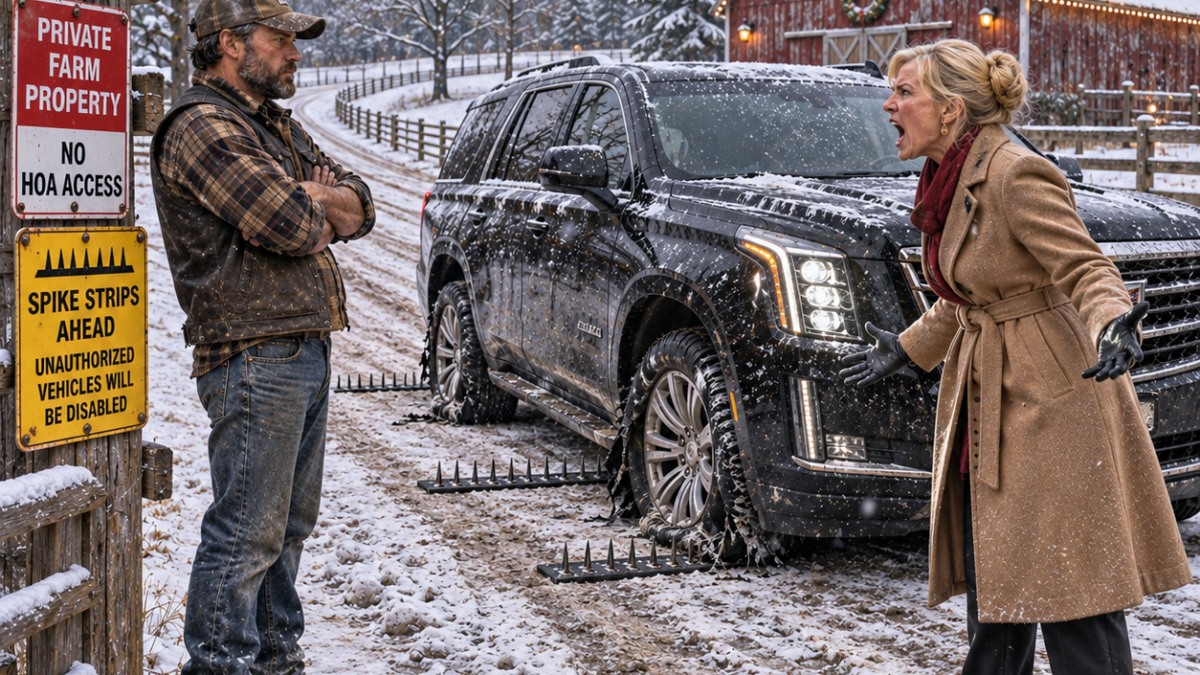
The device sat beyond the property boundary and gate area.
A large yellow warning sign stood before it.
Another warning at the boundary.
Reflective.
Large lettering.
I walked to the county road and looked at it from a driver’s perspective.
Private Property.
No Trespassing.
Gate Closed.
Unauthorized Vehicles Prohibited.
Warning: Tire Damage Beyond This Point.
There was no subtlety.
If somebody reached the device, they had ignored multiple opportunities to stop.
Merritt came out December twenty-third.
Checked the survey marker.
Measured distance from the county road.
Photographed the warnings.
Looked at the camera angle.
“If she enters, do not go down there.”
“I know.”
“Stay at the house.”
“I know.”
“Call law enforcement.”
“I know.”
“Don’t touch her vehicle.”
“Merritt.”
“I bill by repetition.”
I smiled.
He looked toward Whispering Pines, where Christmas lights covered the trees.
“You really think she’ll do it?”
My phone buzzed.
Unknown number.
I opened the message.
I will be using the lane tomorrow evening for gala deliveries. Do not obstruct access.
I showed him.
Merritt exhaled.
“I withdraw the question.”
Christmas Eve arrived with snow.
Real snow.
Not decorative Christmas-card snow.
Heavy.
Wind-driven.
By afternoon, fence lines began disappearing.
The cattle stayed close to the barn.
I fed early.
Checked heaters.
Cleared snow near the house.
Across the stone wall, Whispering Pines glowed gold.
Music drifted from the clubhouse.
The Winter Lights Gala.
I sat in my office with coffee and six camera feeds.
I did not feel victorious.
Mostly tired.
Four years of a ridiculous dispute over a dirt road.
I hoped Blair would see the signs.
Stop.
Reverse.
Take the new long route.
I would have considered that a perfect ending.
Seven o’clock.
Nothing.
Seven-thirty.
Nothing.
Eight.
Cars moved through the subdivision.
Then 8:10.
Floodlights came on at the gate.
Headlights appeared through snow.
Black SUV.
Fast.
I leaned closer to the screen.
The vehicle passed the first reflective sign.
No slowdown.
Second.
Nothing.
Third.
Brake lights did not flash.
The gate was locked.
For a moment, I thought she would finally stop.
Instead the SUV swung toward the shoulder.
Exactly where she had driven around the gate before.
Its bumper caught fence wire.
Pulled.
Wire snapped.
The camera microphone caught the sound.
The SUV pushed through.
Headlights washed directly over the yellow warning.
For a full second the words glowed white.
WARNING.
TIRE DAMAGE.
DO NOT ENTER.
The SUV kept moving.
I heard the first impact from inside my house.
A hard metallic crack.
Then the hiss.
Front end dipped.
Rear wheels followed.
Second crack.
More air escaping.
Blair hit the brakes.
The SUV slewed sideways.
Stopped thirty feet inside my property.
Four tires settling toward the rims.
For several seconds, I sat still.
No satisfaction.
Only a strange quiet.
Then Blair’s door flew open.
She stepped into the snow wearing a long black evening coat.
Silk scarf.
High-heeled boots.
She walked around the SUV.
Front tire.
Flat.
Rear.
Flat.
Other side.
Both flat.
She stared at them.
Then at the sign.
Then at my house.
My phone rang.
I answered.
“What did you do?”
Her voice was high.
Not polished now.
“I warned you.”
“You destroyed my vehicle.”
“You drove onto posted private property.”
“You put something in the road.”
“My road.”
“This is community access.”
“Not according to the county.”
“You are going to pay for every dollar of this.”
“You drove around a locked gate.”
“I had the right to enter.”
“Then show the right.”
She hung up.
I stepped onto my porch.
Stayed there.
Sixty feet away.
Hands visible.
She called someone.
Sheriff, I assumed.
Twenty-five minutes later, a cruiser arrived.
Deputy Brennan.
Gray mustache.
Heavy winter coat.
Flashlight.
He looked first at the SUV.
Then the damaged fence.
Then the signs.
Then the gate.
Blair began before he asked anything.
“He set a trap. He intentionally destroyed my vehicle. I want him arrested.”
Brennan listened.
No interruption.
Then looked toward me.
“Mr. Maddox?”
“Yes.”
“You own this property?”
“Yes.”
“Any video?”
“Yes.”
Blair’s face changed.
Small.
But I saw it.
Inside, I turned the laptop.
Played footage.
No narration.
First clip:
SUV approaches.
Passes sign one.
Two.
Three.
Second clip:
Locked gate.
Vehicle veers around.
Fence bends.
Snaps.
Yellow warning sign illuminated directly.
Vehicle continues.
Third:
Stop.
Four damaged tires.
Brennan replayed the second clip.
Paused.
Zoomed.
“You saw that sign?”
Blair folded her arms.
“It was snowing.”
He pointed.
“Your headlights are on it.”
Silence.
He looked at her.
“Do you have written permission to use this road?”
“The HOA has rights.”
The same four words.
But different now.
Small.
Brittle.
Brennan said, “I did not ask about the HOA generally.”
She stared.
“Do you have a recorded easement permitting ordinary vehicle travel across this land?”
“The association has historical use.”
“Document?”
“We’ve used the road for years.”
“Document?”
No answer.
Headlights entered the yard.
Merritt Sloan.
Accordion folder under one arm.
He came inside.
Removed his coat.
Set out the certified survey.
Full easement.
Cease-use letter.
HOA fine.
Removal notice.
Text message.
Photographs.
Deputy Brennan read slowly.
Then reached the purpose clause.
“This easement is for utilities.”
“Yes,” Merritt said.
Brennan looked at Blair.
“You know that?”
She didn’t answer.
Merritt removed one more sheet.
I had never seen it.
“What is that?”
“County record request.”
He turned it toward us.
Two years earlier.
Requesting party:
Whispering Pines Estates Homeowners Association.
Requested document:
Complete easement file, Maddox western parcel.
Authorized by:
Blair Whitlock.
Signature.
Her signature.
Merritt said, “The full eleven-page instrument was mailed to the HOA two years ago.”
The room changed.
Because now this was not misunderstanding.
Blair had known the easement was limited.
She had possessed the exact document.
Then mailed me a partial photocopy and called it proof of a general right-of-way.
Deputy Brennan closed his notebook.
“Ma’am, based on what I have here, you entered posted private property, went around a locked gate, damaged a fence, and continued beyond a clear tire-damage warning.”
Blair’s jaw tightened.
“He intentionally damaged my SUV.”
“Vehicle damage claims can be addressed civilly.”
“I want charges.”
“I’ll write the report.”
“That is not what I asked.”
“I know.”
He looked at her.
“And you should not reenter this property without written permission.”
For once, Blair had nothing prepared.
The SUV left at eleven on a flatbed.
Before she climbed into the tow truck, she looked at me.
“I’ll sue you.”
I nodded.
“You have that right.”
She seemed angrier because I did not argue.
Three days later, she did.
Technically, the HOA did.
December twenty-eighth.
Complaint.
Property damage.
Unsafe barrier.
Claimed right-of-way.
Demand for reimbursement of four tires, two damaged rims, tow bill, rental costs.
Just over $4,200.
And buried in the final section, the thing Merritt cared about.
They asked the court to order me to remove the gate and all barriers interfering with “community access.”
Merritt tapped the page.
“The tires are bait.”
“I figured.”
“They want a permanent road.”
“So they sue over $4,200 to get it?”
“They sue over $4,200 because it sounds smaller than saying they want part of your property.”
I retained him formally.
The HOA hired Preston Vale.
City firm.
Polished litigation attorney.
Expensive.
Good.
The first settlement offer arrived two weeks later.
Association drops tire claim.
I grant a seasonal license for HOA traffic from December twentieth through January second.
“Absolutely not.”
Merritt smiled.
“I assumed.”
“That makes four years of trespassing legal.”
“Yes.”
“No.”
“Good meeting.”
We built the defense.
Seven binders.
My green notebook.
Photographs.
Repair receipts.
Videos.
Manufacturer logs authenticating timestamps.
Survey.
Utility easement.
Emails.
Violation notice.
The cut locks.
The gate removal demand.
Blair’s text.
Everything.
Merritt made copies.
Then copies of copies.
“The paper fights for you,” he said.
January hearing.
Judge Eleanor Hastings.
Small courtroom.
Dark wood.
No patience for theatrics.
Preston Vale stood first.
He was good.
I’ll give him that.
He made Blair sound like a public servant trapped in a blizzard while trying to bring Christmas joy to three hundred families.
He described my access-control measure as reckless.
He emphasized long-standing community use.
Custom.
Reliance.
Expectation.
He said years of uninterrupted passage could create legal rights independent of the original easement.
Then Merritt stood.
Four minutes.
No speeches.
He handed Judge Hastings three documents.
Recorded easement.
Certified survey.
One still image.
Blair’s SUV headlights illuminating the warning sign immediately before entering.
“Your Honor, the association asks this court to compel ordinary vehicle use of a private ranch road. The only recorded access document before the court grants utility access. Nothing more.”
Judge Hastings read.
Looked at Vale.
“Do you have another recorded easement?”
Vale answered carefully.
“Not at this stage, Your Honor.”
“Then I’m not ordering this landowner to open his property before trial.”
Motion denied.
Blair sat behind Vale.
Perfect posture.
Expression blank.
But when we walked into the hallway, she did not look at me.
The biggest discovery came later.
Late January.
Merritt went back to the recorder’s basement.
Not the easement file.
He had already squeezed everything from that.
He pulled the original developer documents.
Transfer instruments.
Subdivision declarations.
Corporate restrictions.
Thirty-five-year-old binders.
Then he found something filed under the developer’s name rather than the HOA’s.
Nine pages.
DECLARATION OF RESTRICTIONS AND COVENANTS REGARDING WESTERN BOUNDARY ACCESS.
Recorded the same week Whispering Pines was formed.
Merritt drove straight to my farm.
He spread the pages across the workbench beneath the barn light.
“Read page four.”
I did.
Then again.
The clause said the future homeowners association, its officers, residents, contractors, and agents were prohibited from using the ranch road along the western boundary for ordinary, recurring, recreational, or convenience vehicle travel.
Then came the line that ended everything.
No such use, regardless of frequency or duration, shall establish an easement by prescription, custom, implied right, or community practice.
Any non-utility use was permissive only.
Revocable at the sole discretion of the western parcel owner.
I looked at Merritt.
“Who wrote this?”
He turned to the signature page.
Garrett Holloway.
Founder.
Harlan Ridge Development Company.
Original declarant.
The man who created Whispering Pines had specifically prevented the HOA from ever doing exactly what Blair was doing.
I laughed.
Couldn’t help it.
For four years she had said:
HOA rules.
HOA rights.
HOA authority.
Now the association’s own founding document said no.
Merritt tapped the paper.
“This is better than your deed.”
“How?”
“It’s their rule.”
That changed the politics more than the lawsuit.
The HOA annual meeting happened in February.
Nearly two hundred residents attended because litigation spending required member approval.
I went because Merritt said I should.
Didn’t want to.
The clubhouse ballroom looked exactly how I imagined.
Stone fireplace.
Massive chandelier.
Holiday decorations somehow still up in February.
Blair sat at the head table.
Vale beside her.
Four board members.
Douglas Fenwick was there but did not sit near Blair.
Interesting.
Blair spoke first.
She said the dispute threatened community access.
Said I had taken “aggressive unilateral action.”
Said the board was protecting residents from a hostile neighbor.
Then questions came.
An older woman in the second row stood.
“Mrs. Whitlock, what written document gives us the right to use Mr. Maddox’s road?”
Blair said, “The right exists through historic use.”
The woman asked, “Is that written anywhere?”
“Our legal counsel is handling—”
“That wasn’t my question.”
A murmur.
Then a man near the back asked what the legal bill was.
Vale did not answer.
The treasurer did.
The number made the room louder.
Then Merritt was invited forward.
I went with him.
No attack.
No name-calling.
No revenge.
Documents.
First, timeline.
Four years.
Second, full utility easement.
Highlighted purpose.
Third, Blair’s records request proving she had received all eleven pages.
Fourth, cease letter.
Fifth, HOA removal order.
Sixth, Christmas Eve footage.
The ballroom watched the SUV pass warning after warning.
Swing around the locked gate.
Break fence wire.
Drive under the illuminated sign.
The room became completely silent.
Then Merritt placed the final declaration on the projector.
Western Boundary Access.
Page four.
Highlighted.
You could hear somebody whisper:
“Oh my God.”
Blair stood.
“That document was never provided to the current board.”
Merritt said, “It was recorded with the original subdivision instruments.”
“I have never seen it.”
That might have been true.
Then a man stood from the fourth row.
Eighty-three.
Cane.
Walter Ames.
One of Whispering Pines’ earliest residents.
Former board member.
He stared at the screen.
“I’ve seen it.”
Blair turned.
“Walter?”
He pointed with his cane.
“That covenant. Garrett made the first board acknowledge it.”
The room shifted.
“Where?” someone asked.
Walter answered, “Founding binder. Office safe.”
Blair’s face changed.
Just enough.
Walter continued.
“Garrett didn’t want the association bothering the ranch parcel. Said the west road belonged to the farmer and would always belong to the farmer.”
Someone laughed bitterly.
The woman from the second row stood again.
“So why are we suing him?”
Nobody answered.
She continued.
“We don’t own the road.”
No answer.
“He told us to stop.”
Silence.
“Mrs. Whitlock kept using it.”
A board member shifted.
“She drove around a locked gate.”
Another resident spoke.
“And we’re paying a city law firm to make him let us keep doing it?”
That was the moment Blair lost the room.
Not when I argued.
Not when Merritt argued.
When her own residents understood the association’s money was being spent to defend something they had never had.
A motion was made to withdraw litigation.
Seconded immediately.
Vote.
Not close.
Lawsuit withdrawn.
Tire claim abandoned.
Demand for access abandoned.
Then another motion.
Reimburse me for the fence damaged Christmas Eve.
Passed.
I packed my papers.
No celebration.
No speech.
Blair remained at the head table after everyone began leaving.
Vale packed his briefcase and disappeared.
I walked over.
She did not look up.
“I never wanted you to lose money,” I said.
Her eyes rose.
“What do you want me to say?”
“Nothing.”
That surprised her.
“I wanted you to respect the line.”
I left.
Outside, Merritt stood beside his car.
Cold enough that both our breath showed.
He looked back at the clubhouse.
“Thirty-one years practicing property law.”
“And?”
“Most people destroy their own case before I get it.”
“How?”
“They get angry.”
“I got angry.”
“You stayed documentable.”
I laughed.
“That a legal term?”
“It is now.”
He put his folder into the car.
“You never did anything you couldn’t explain calmly later.”
“That was the idea.”
“That’s why you won.”
Blair resigned eight days later.
Two sentences.
No apology.
No explanation.
Douglas Fenwick became president.
His first letter to me came handwritten.
Plain white paper.
No embossed seal.
Mr. Maddox,
I read all eleven pages.
I am sorry it took us this long.
Douglas Fenwick.
I kept that letter.
Same box.
A week later, I was splitting firewood when a silver sedan pulled onto the county shoulder.
Not through the gate.
Stopped outside.
Blair got out.
Jeans.
Gray coat.
No polished HOA armor.
She walked to the warning sign and stopped on the public side.
“Mr. Maddox.”
I set down the axe.
Walked toward the gate.
Did not open it.
“We need to talk.”
“All right.”
For a moment she seemed unsure how to begin.
That was new.
“I was president nine years.”
“I know.”
“People usually backed down.”
“I know.”
“The letters worked.”
“I know.”
“If they didn’t, the fine notices did.”
I waited.
She looked at the farm.
“I thought you would get tired.”
“I did.”
That surprised her.
“I was tired for four years.”
She nodded.
“I didn’t think you’d keep everything.”
“The papers?”
“Yes.”
“I thought after enough time the road would effectively become ours.”
“You knew the easement didn’t say that.”
“Yes.”
There it was.
Plain.
No excuse.
She continued.
“I knew it was narrow. I convinced myself long-term use had changed things.”
“You could’ve asked a lawyer.”
“I did.”
“When?”
“After your attorney’s first letter.”
I stared.
“And?”
“He told me we might have a prescription argument if use had been open and uncontested long enough.”
“But it wasn’t uncontested.”
“No.”
She looked down.
“I didn’t tell him about the cut locks.”
I almost laughed.
Not because it was funny.
Because there it was.
The whole dispute.
Blair had not been fooled by bad legal advice.
She had edited reality until it supported the answer she wanted.
“I never saw the Holloway declaration,” she said.
“I believe you.”
“That doesn’t make this better.”
“No.”
She looked at me.
“I’m sorry.”
I studied her.
She seemed sincere.
People expected me later to say I forgave her.
I don’t know.
Forgiveness is too grand a word for some situations.
I accepted the apology.
That was enough.
“The traffic problem is real,” I said.
She nodded.
“The boulevard backs up.”
“I know.”
“The HOA owns land along the east side of the clubhouse.”
Her eyebrows lifted.
“There’s a strip connecting the service lot to County Route Eight.”
“Yes.”
“Build there.”
She considered.
“That would require drainage work.”
“Probably.”
“And county approval.”
“Probably.”
“Reserve funds.”
“Probably.”
I shrugged.
“But it would belong to you.”
Blair looked through the gate at my lane.
Then back toward the subdivision.
“I’ll mention it to Douglas.”
“One more thing.”
“What?”
“If there is ever a real emergency where you need my land—fire, medical access, utility repair—call me.”
She seemed surprised.
“I mean that.”
“After all this?”
“Emergency isn’t convenience.”
She nodded.
“And if you need recurring access, it gets negotiated in writing and recorded.”
“Understood.”
She almost smiled.
“After that meeting, I think the board will agree to anything that doesn’t involve Preston Vale.”
That was the closest thing to humor I ever heard from Blair Whitlock.
By March, Whispering Pines recorded a formal acknowledgment.
No vehicular right-of-way over Maddox Farm.
Utility easement limited to recorded purpose.
No claim of prescriptive access.
Signed by Douglas.
Board secretary.
County stamp.
I put it in the safe.
The association reimbursed the fence repair.
The welder rebuilt the gate heavier than before.
Cameras stayed.
Signs stayed.
The vehicle-control device did not.
I removed it once the recorded acknowledgment was filed.
Cleaned it.
Wrapped it.
Stored it on a shelf in the equipment building.
Not because I expected to use it again.
Because after four years, throwing anything away felt premature.
The new connector road broke ground in June.
Finished in October.
Two lanes.
Lights.
Drainage.
Legal access directly to the clubhouse service area.
The association paid for it from reserves.
The county approved it.
No farm involved.
Walter Ames cut the ceremonial ribbon.
I did not attend.
Hay needed baling.
Merritt came by that evening.
We sat on my porch with coffee.
Far beyond the stone wall, the new streetlights switched on one by one.
“Walter asked about you.”
“What’d he want?”
“Said Garrett Holloway would’ve liked you.”
I smiled.
“Never met him.”
“He liked boundaries.”
“Then I’d probably have liked him.”
Merritt took a drink.
“Funny.”
“What?”
“This whole thing happened because Blair kept saying rules are rules.”
“Yeah.”
“And the rule that finally beat her was written by her own developer thirty-five years ago.”
I looked across the pasture.
“Paper’s patient.”
Merritt smiled.
“That’s annoyingly good.”
“You can use it.”
“I’ll bill you.”
December returned.
Snow came early.
Whispering Pines put up lights.
The clubhouse glowed.
Christmas Eve, I stepped onto the porch with coffee.
For the first time in five years, I was not watching a security monitor.
I heard traffic.
Caterers.
Valet vans.
Residents.
Cars moved down the county road.
Every one reached the new intersection.
Turn signals flashed.
They turned onto the connector.
Not one vehicle slowed at my gate.
Not one tested the lock.
Not one cut through the pasture.
Near the end of the line, a silver sedan passed.
Blair.
She signaled.
Turned toward the connector.
Before she disappeared, her hand lifted briefly beside the window.
Small wave.
I raised my coffee.
That was all.
No friendship.
No dramatic reconciliation.
Respect was enough.
The county road emptied.
Snow drifted beneath the cottonwoods.
My gate remained closed.
Behind it, the old dirt lane stretched toward the barn exactly as it had before Whispering Pines existed.
For generations, Ezra Pruitt had moved cattle down that road.
Harlan Ridge had surveyed it.
I had repaired it.
Blair had tried to turn it into something else.
Eventually it became what it had always been.
Mine.
I stood there longer than necessary.
Thinking about four winters.
Cut chains.
Broken fence.
Fine notices.
Camera footage.
Seven binders.
A judge.
Two hundred angry homeowners.
An eighty-three-year-old man raising a cane toward a projector screen.
And yes.
Four flat tires.
People who heard the story later always focused on those tires.
They wanted that to be the satisfying part.
The arrogant HOA president ignored a farmer.
Then her expensive SUV stopped dead in the snow.
Simple.
Viral.
Neat.
But that was never the victory.
Tires can be replaced.
Blair replaced them within a week.
The victory was that the next Christmas, nobody tried the road.
The victory was the recorded acknowledgment in my safe.
The repaired fence.
The closed gate.
The legal connector on land that actually belonged to the association.
The fact that nobody got hurt.
The fact that I did not have to threaten anybody.
Did not have to scream louder.
Did not have to become more unreasonable than the person pushing me.
For four years Blair believed power came from persistence.
From titles.
Letterhead.
Budgets.
Lawyers.
From saying the same claim often enough that eventually the other person became too exhausted to resist.
I learned something different.
Power can also look like patience.
A photograph.
A timestamp.
A receipt.
A certified letter.
A survey marker.
A notebook where every crossing has a date.
A man saying no once and then spending four years making sure the evidence said the same thing.
I finished my coffee.
The Christmas music from Whispering Pines carried faintly over the wall.
I could hear laughter.
Cars on the new connector.
Normal things.
I looked at the property sign beside the gate.
Private Property.
Nothing hostile about those words.
People sometimes hear “boundary” and think anger.
Division.
Conflict.
But a good boundary does not exist because you hate the person on the other side.
It exists so both sides know where choice begins.
Blair could run her HOA.
Decorate every tree.
Host every gala.
Build every heated driveway her members wanted.
She could make rules for every resident who voluntarily belonged to her association.
What she could not do was cross the property line and make her authority mine.
That was the lesson.
Not only for her.
For me too.
Because for too long, I had treated keeping peace like avoiding conflict.
They are not the same.
Sometimes peace requires a gate.
Sometimes respect needs paperwork.
And sometimes the only way to stop somebody who refuses to hear “no” is to make sure the next consequence comes from the boundary itself, not from your temper.
Snow collected on the top rail.
I turned toward the house.
Then stopped.
Looked back once.
The gate stood exactly where it belonged.
Closed.
Locked.
Untouched.
For the first time in five Christmases, I knew it would still be that way in the morning.
And that was all I had ever wanted.








