HOA Karen Used My Dead Father’s Signature to Lease My 80 Acres for $5.5M—Then Deputies Shut Down Her Ribbon Cutting
PART2:
For twenty years, Ridge View Meadows and the Holloway farm existed beside each other in a state of uneasy tolerance.
They complained.
I ignored them.
Nobody crossed the fence.
That was the agreement.
Then my brother died.
His name was Daniel.
Older than me by four years.
He lived in Montana.
Heart attack.
Unexpected.
No wife.
No children.
Which meant settling his estate fell mostly to me.
I left home for almost six weeks.
Bills on autopay.
Neighbor feeding the dog.
Barn locked.
Nothing unusual.
I should have stopped at the mailbox when I came home.
That’s the part I replay.
If I’d looked at the certified letters before going inside, maybe the sight behind the ridge wouldn’t have hit me so hard.
But it was barely sunrise.
I was exhausted.
I wanted coffee.
I pulled into the driveway.
Got out.
PART3:
And heard a backup alarm.
Beep.
Beep.
Beep.
I froze.
Then came steel striking gravel.
Diesel engines.
A hydraulic hammer somewhere beyond the trees.
None of those sounds belonged on my farm.
I walked toward the ridge.
At first I thought maybe a utility crew had made a mistake.
Then I saw fresh tire tracks through the pasture.
My pace quickened.
The machinery grew louder.
I reached the oak line.
Looked down.
And stopped.
The back forty looked like a construction site.
Excavators.
Graders.
Survey flags.
Stacks of steel posts.
Trucks carrying solar-panel racks.
A temporary gravel road had been cut across the grass.
Several acres had already been scraped flat.
For a few seconds, I couldn’t process it.
Then a man in an orange safety vest approached.
Heavyset.
Beard.
Hard hat.
He raised one hand.
“Sir, you can’t be inside the active work zone.”
I looked at him.
“Active what?”
“Construction.”
“On whose land?”
His expression changed.
“This is HOA Common Area C.”
“No.”
He glanced at the laminated plan in his hand.
“Ridge View Meadows solar site.”
“This is the Holloway farm.”
He looked at me.
Then the map.
Then me again.
“What’s your name?”
“Ray Holloway.”
Now he looked worried.
Not panicked.
Professional worried.
The kind of expression construction people get when paperwork and reality stop agreeing.
He lowered the map.
“Mr. Holloway, I’m Jared Mercer. Site foreman.”
“Get these machines off my property.”
“I can’t do that without direction from the project manager.”
“Who told you this belongs to Ridge View?”
He showed me the map.
Parcel shading.
COMMON AREA C.
Forty acres.
My forty acres.
“The lease is signed,” he said.
“What lease?”
“Solar ground lease.”
“By who?”
“Ridge View Meadows HOA.”
I laughed.
It came out wrong.
Short.
Angry.
“They don’t own this.”
Jared looked at the equipment.
Then back at me.
“Mister, I’ve worked a lot of jobs.”
He lowered his voice.
“Sometimes paperwork is wrong.”
“That paperwork is wrong.”
“I believe you believe that.”
“No.”
I stepped closer.
“My father bought this land in 1987.”
Jared nodded slowly.
“Then you need legal counsel.”
“I need you to stop.”
“I need written direction.”
“From who?”
“Sunrest Renewables.”
That was the first time I heard the company’s name.
I pulled out my phone.
Started recording.
“Tell me again who owns this parcel according to your documents.”
Jared immediately became careful.
“I’m not authorized to speak for ownership.”
Smart man.
“Who contracted you?”
“Sunrest.”
“Who leased the land?”
“You’ll need to speak to project management.”
“Fine.”
I photographed everything.
Equipment.
Flags.
The temporary road.
Then I drove straight to Ridge View.
Celeste Whitmore was waiting in the clubhouse.
That bothered me almost as much as the construction.
She knew I’d come.
Celeste was fifty-one.
HOA president for three years.
Blue blazer.
Cream blouse.
Silver necklace.
Hair cut into a sharp blond bob.
She sat behind the conference table with a folder already open.
“Ray.”
“You put a solar farm on my property.”
She didn’t even pretend surprise.
“No.”
“Yes.”
“That’s community land.”
I stared at her.
“Since when?”
“Since the plat correction.”
“What plat correction?”
She pushed a map toward me.
My back forty was colored green.
RIDGE VIEW MEADOWS — COMMON AREA C.
“You’re looking at forty acres the association controls.”
“I’ve paid property tax on those forty acres for decades.”
“That doesn’t resolve boundary history.”
“My deed does.”
Celeste smiled.
“Your deed is outdated.”
I felt my hands tightening.
“How does a deed become outdated?”
“Through recorded amendments.”
“Show me.”
She opened the folder.
Then closed it again.
“You should talk to counsel.”
“I am talking to the person who signed a solar lease on my farm.”
She leaned back.
“Twenty-five years.”
“What?”
“The lease.”
Her expression brightened.
“$5.5 million in total payments over twenty-five years.”
I stared.
“Every Ridge View homeowner gets a dues freeze for the first five years.”
There it was.
Not confusion.
Not a surveying mistake.
A business plan.
“You leased my land.”
“Common land.”
“Mine.”
“Recorded documents disagree.”
“Then give me copies.”
“Your attorney can request them.”
I stood.
She pushed a business card toward me.
Harold Pierce.
HOA counsel.
Then she smiled.
“If you disagree, sue us.”
I looked at her.
She finished:
“If you can afford it.”
I wish I could tell you I stayed perfectly calm.
I didn’t.
I walked out shaking.
Not screaming.
Not threatening.
But shaking badly enough that I missed the truck door handle the first time.
Then I saw a folded piece of paper under the windshield wiper.
Cheap notebook paper.
Two words.
CHECK PLAT.
That was it.
I looked around.
Parking lot almost empty.
Clubhouse windows reflecting morning sun.
Then a curtain moved in a second-floor window.
Just slightly.
Someone was watching.
I drove home.
That evening, I spread every document I had across the kitchen table.
Tax records.
My deed.
Dad’s estate papers.
Old survey.
Nothing showed Ridge View owning anything.
At 8:40, I called Norah Feldman.
Norah had handled Dad’s probate after he died.
Sharpest real-estate attorney I knew.
She answered on the second ring.
“Ray?”
“I need help.”
“What’s wrong?”
“Somebody built a solar farm on my farm.”
Silence.
Then:
“Start again.”
I did.
Norah listened.
No interruptions.
When I finished, she said:
“Do not sign anything.”
“I’m not planning to.”
“Good.”
“Don’t cash anything.”
“Okay.”
“Don’t agree verbally to access.”
“Okay.”
“And bring me every land document you own tomorrow morning.”
“Why?”
“Because if Celeste says there is a recorded plat amendment, either she’s lying or something has been filed.”
“What if something was filed?”
“Then we find out how.”
Norah’s office smelled like old paper and strong coffee.
She logged into the county system.
Searched the parcel history.
Then stopped.
“There.”
Plat Amendment Number Three.
Recorded March 2023.
She opened it.
My stomach dropped.
The amendment reassigned the northern portion of the Holloway parcel to Ridge View Meadows.
Forty acres.
Common Area C.
There was a consent page.
Norah scrolled.
Then went completely still.
“What?”
She turned the monitor.
Signature:
Walter Holloway.
Date:
September 14, 2021.
My father died February 6, 2019.
I stared.
Norah said:
“Ray?”
“He was dead.”
“I know.”
“He’d been dead two and a half years.”
“I know.”
“Then that’s forged.”
“Yes.”
She printed everything.
“Now we need the recording file.”
County recorder’s office.
Same afternoon.
Elaine Brooks was behind the counter.
Late fifties.
Thin glasses.
She had worked there longer than I could remember.
Norah gave her the instrument number.
Elaine pulled the archive.
Saw the amendment.
Stopped.
Her eyes moved toward the back office.
Then back to us.
“What?”
I asked.
She lowered her voice.
“I remember this one.”
“Why?”
“Cash.”
Norah frowned.
“Cash recording fees?”
“Yes.”
“Unusual?”
“For something this size.”
“Who brought it?”
Elaine hesitated.
“I shouldn’t—”
Norah slid her business card across.
“My client is alleging a forged signature from a deceased property owner.”
Elaine looked at me.
Then said:
“A woman.”
“What woman?”
“Blond.”
My heart beat harder.
“Blue blazer?”
Elaine looked surprised.
“Yes.”
“When?”
“March 2023.”
“Celeste Whitmore?”
“I didn’t ask her name beyond the ID.”
“You saw ID?”
Elaine nodded.
“I photocopy identification when someone pays cash and requests expedited recording.”
Norah leaned forward.
“Do you still have it?”
Elaine looked toward the back.
Then:
“Probably.”
“Preserve it.”
That changed everything.
The next afternoon, a white pickup arrived at my gate.
SUNREST RENEWABLES.
Brandon Teague got out.
Project manager.
Late thirties.
Pressed vest.
Perfect teeth.
He approached like we were about to discuss landscaping.
“Mr. Holloway.”
“Mr. Teague.”
“We’d like to avoid conflict.”
“Then stop building.”
“I can’t do that based on an ownership allegation.”
“It’s not an allegation.”
He smiled.
“We have a recorded lease from the title holder.”
“The HOA isn’t the title holder.”
“Our attorneys disagree.”
“They’re wrong.”
Brandon held up both hands.
“Let’s find another solution.”
He handed me an envelope.
Inside:
$40,000 easement offer.
“What is this?”
“Temporary access and utility easement.”
“Across my land?”
“Yes.”
“Why do you need an easement if the HOA already owns it?”
His smile flickered.
Tiny.
But I caught it.
“Different corridor.”
“Which corridor?”
“Construction support.”
“No.”
“Ray—”
“No.”
He inhaled.
“Forty thousand dollars for a simple signature.”
“No.”
“You have until Friday.”
“For what?”
“After Friday, the HOA’s attorneys may pursue other theories.”
“What theories?”
He looked toward the ridge.
“Adverse possession.”
I laughed.
“Solar panels weren’t here six weeks ago.”
“I’m not the lawyer.”
“You keep using legal threats for someone who isn’t the lawyer.”
His expression cooled.
“Friday.”
That night at 2:03, my dog started barking.
Not his normal bark.
Deep.
Continuous.
I got out of bed.
Grabbed a flashlight.
Walked toward the back window.
Movement.
Pasture.
A person.
I went outside.
Didn’t approach directly.
Shined the light.
A man in a dark hoodie was kneeling beside one of my boundary markers.
He pulled the orange stake.
Then picked it up.
But he wasn’t tossing it aside.
He was carrying it toward my house.
I shouted:
“Hey!”
He ran.
Dropped the stake.
Climbed the fence.
Gone.
I called the sheriff.
Documented it.
Photographed the disturbed ground.
The next morning someone knocked.
Thin man.
Brown cardigan.
Folder held to his chest.
“I’m Gordon Pell.”
I knew the name.
Ridge View treasurer.
“I know.”
“Can I come in?”
He looked terrified.
I let him.
At my kitchen table he opened the folder.
Bank statements.
Wire transfers.
HOA ledger.
Sunrest had already paid Ridge View:
$1.2 million.
Signing deposit.
I looked at Gordon.
“They paid before title was clear?”
“Celeste certified it.”
“Where’s the money?”
“Mostly in association accounts.”
“Mostly?”
He pulled another statement.
$180,000.
Paid to:
Whitmore Land Consulting.
I looked at him.
“What is that?”
“Celeste’s cousin owns it.”
“For what?”
“Land acquisition consulting.”
“Did the board approve it?”
“Celeste says yes.”
“Did you?”
“No.”
“Minutes?”
“None that I can find.”
Gordon’s hands shook.
He continued.
“Friday another two million releases.”
“What triggers it?”
“Clear-title certification and construction milestone.”
The same Friday.
Of course.
He lowered his voice.
“There is something else.”
“What?”
“Celeste told me if anyone asks about Walter Holloway’s signature, I’m supposed to say I watched him sign the amendment.”
I stared.
“You knew my father?”
“Barely.”
“Did you watch him sign?”
“No.”
“When did she tell you this?”
“Yesterday.”
“Will you put that in writing?”
His face went pale.
“If she finds out—”
“She already may know.”
He looked toward the window.
“I think she does.”
Norah treated the case like a chessboard.
“Three pillars.”
She held up one finger.
“Forgery.”
Second.
“Money.”
Third.
“Original title.”
“We have the deed.”
“We need the best possible copy.”
Then she pointed at the notary stamp.
Arizona.
Name:
Rebecca Sloan.
Norah called.
Speakerphone.
A woman answered.
Norah explained.
Silence.
Then Rebecca said:
“I moved to Arizona in 2019.”
“Did you notarize a Walter Holloway signature in Colorado in September 2021?”
“No.”
“Do you remember Walter Holloway?”
“No.”
“Could your seal have been used?”
“My Colorado commission expired in 2019.”
Norah looked at me.
“Would you provide an affidavit?”
“Yes.”
Call ended.
Norah said:
“Forgery problem number one.”
That night I went to the barn loft.
Dad kept a rusted tin box beneath a loose board.
He’d told me about it once.
“Only open that when there’s no other option.”
I had always assumed it contained cash.
It didn’t.
Certified deed.
County recording stamp.
Original property description.
All eighty acres.
No Common Area C.
No transfer.
No HOA ownership.
And a letter.
Ray,
This land is the one thing nobody can take unless you let them.
People will offer money.
Some will threaten.
Some will show you papers.
Keep your originals.
Keep the ridge.
Keep the oaks.
The land remembers who cared for it.
Dad.
I sat in the hay dust reading it twice.
Next night, headlights swept across my porch.
Blue blazer.
Celeste.
She walked to my gate.
I did not open it.
“You’ve been busy.”
“So have you.”
“You can’t prove anything.”
“That’s an interesting thing to say before I accuse you of anything.”
Her face hardened.
“A dead man can’t testify that he didn’t sign.”
That sentence should have frightened her the moment she said it.
Instead she smiled.
“My attorneys will bury you.”
I kept my phone recording in my shirt pocket.
She turned.
Then stopped.
Without looking back, she said:
“Tell Gordon he talks too much.”
My skin went cold.
I had never told Celeste Gordon had visited me.
Not once.
At seven the next morning, Gordon called.
Whispering.
“She filed a police report.”
“For what?”
“The money.”
“What money?”
“One hundred eighty thousand.”
My stomach tightened.
“She says I stole it.”
“Did you?”
“No!”
“Gordon, calm down.”
“The board removed me at midnight.”
“What?”
“She called an emergency session.”
“Get a lawyer.”
“I have one.”
“Don’t talk to police without him.”
“Ray…”
His voice broke.
“She knows I’m talking.”
The HOA emergency meeting was that evening.
Packed.
Homeowners standing along walls.
Celeste at the podium.
She accused Gordon of embezzlement.
Called him unstable.
Claimed he had manipulated accounting records.
Then the doors opened.
Norah and I walked in.
Celeste stopped.
Norah carried one page.
The $180,000 wire.
She approached.
“Madam President.”
Celeste’s jaw tightened.
“Who owns Whitmore Land Consulting?”
Silence.
People turned.
Norah continued.
“Your cousin?”
Celeste said:
“This meeting is adjourned.”
Nobody moved.
A homeowner shouted:
“Answer her.”
Another:
“Where did the money go?”
Celeste hit the gavel.
“Meeting adjourned.”
Still nobody moved.
She left through the side door.
I thought pressure might slow her down.
It did the opposite.
By morning, flyers appeared throughout Ridge View.
SOLAR FUTURE RIBBON CUTTING
THURSDAY 10:00 A.M.
Mayor attending.
Local media.
Refreshments.
Community celebration.
Norah stared at the flyer.
“She wants the project publicly blessed before we get in front of a judge.”
“Why?”
“Optics.”
“Optics aren’t title.”
“No.”
She looked at me.
“But optics can buy time.”
She filed an emergency motion that night.
Hearing:
Thursday.
8:00 a.m.
The courtroom was almost empty.
Judge Elena Castellano presiding.
HOA attorney Harold Pierce argued first.
He claimed Ridge View had exercised common-area control for decades.
Norah stood.
“Over a working farm?”
Pierce said the 2023 plat amendment formalized historic use.
Norah submitted:
Certified 1987 deed.
Father’s death certificate.
2021 amendment bearing dead man’s signature.
Expired notary record.
Recorder ID retention notice.
Bank trail.
Gordon’s sworn statement.
Celeste’s recorded comment.
Then Elaine Brooks testified remotely.
Judge Castellano asked:
“Did you preserve identification from the person who submitted this amendment?”
“Yes.”
“Who?”
Elaine swallowed.
“Celeste Whitmore.”
Pierce stood.
“Objection—”
The judge overruled.
“What kind of identification?”
“Colorado driver’s license.”
“Copy?”
“Yes.”
Judge Castellano removed her glasses.
Looked at the amendment.
Then my father’s death certificate.
“This court is not determining final title today.”
My chest tightened.
She continued.
“But the applicant has shown a substantial likelihood that the recorded amendment underlying the HOA’s claim is invalid.”
Silence.
“Temporary restraining order granted.”
I exhaled.
“All construction activity on the disputed Holloway parcel is prohibited immediately.”
Norah looked at me.
The judge continued.
“Sheriff’s office will serve this today.”
She signed.
Then looked directly at Norah.
“Serve it now.”
Clock:
9:41.
Ribbon cutting:
10:00.
Two sheriff’s deputies met us outside.
Tom Haskell.
Luis Ortega.
Their SUV led.
Norah drove behind them.
I sat passenger side holding the order.
She said:
“Whatever Celeste says, stay calm.”
“I know.”
“Don’t argue.”
“I know.”
“Don’t touch anybody.”
“Norah.”
“I have represented you long enough to be specific.”
We crested the ridge.
White tents below.
Rows of chairs.
News van.
Mayor.
Homeowners.
Sunrest crew.
A giant ceremonial ribbon stretched across the gravel road.
Machinery running behind it.
9:49.
We drove through the gate.
Deputies first.
People started turning.
Celeste stood at the podium.
Blue blazer.
Same one.
She saw the sheriff’s vehicle.
Then Norah.
Then me.
Her smile collapsed.
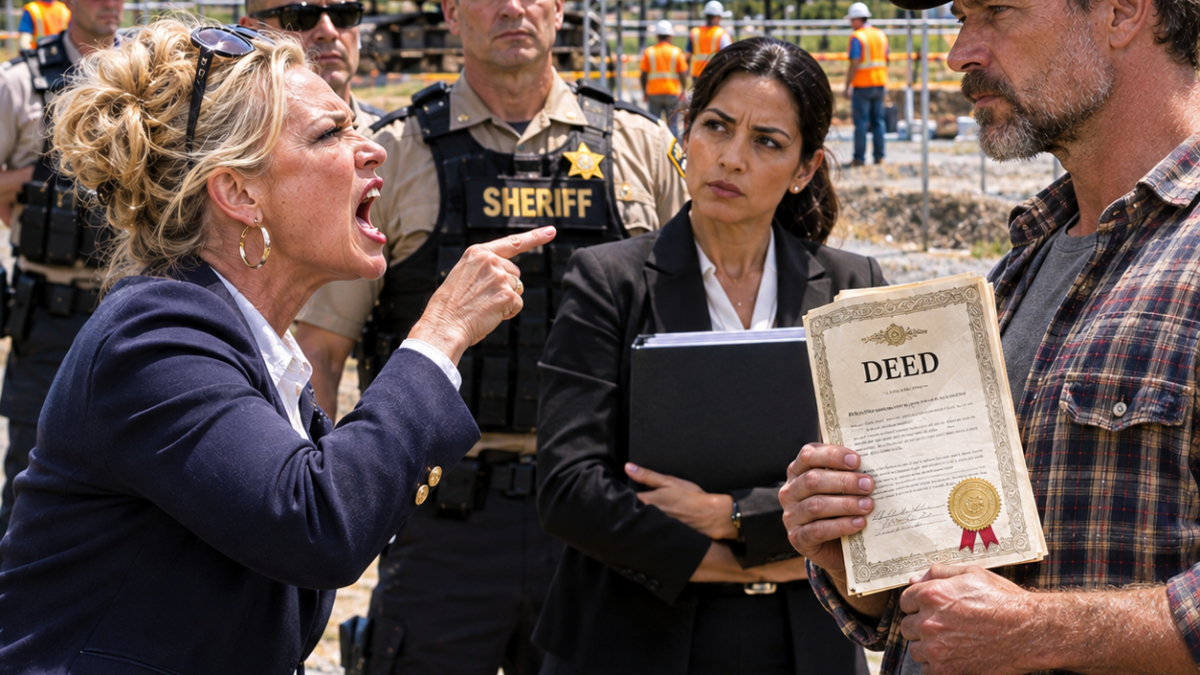
She came off the stage.
Fast.
“What is this?”
Deputy Haskell held up the order.
“Ma’am—”
Celeste pointed at me.
“We signed the deal!”
I stayed quiet.
“You can’t stop construction!”
Nothing.
“The HOA owns this land!”
I lifted Dad’s deed.
She moved closer.
“Do you hear me?”
I finally answered.
Three words.
“On my land.”
Haskell stepped between us.
Then read the restraining order aloud.
Construction supervisors started listening.
Sunrest attorneys moved closer.
The foreman Jared reached for his radio.
“Shut it down.”
One excavator stopped.
Then another.
Pile driver.
Generator.
Truck.
Engine after engine went silent.
Celeste spun.
“Keep working!”
Nobody moved.
“I said keep working!”
Haskell’s voice hardened.
“Ma’am.”
She turned.
“If anyone knowingly violates this order after service, the court can address contempt.”
“Arrest him!”
She pointed at me.
“For what?”
“Sabotage.”
Haskell looked at the deed.
Then at the order.
“No.”
The mayor had taken three steps away from the podium.
Then Brandon Teague appeared.
No smile now.
He walked directly to Celeste.
“You certified clear title.”
She looked at him.
“It’s a temporary order.”
“You certified it.”
“Our attorney—”
“You personally signed the certification.”
“Brandon.”
He pulled out his phone.
“Sunrest records material acquisition calls.”
Celeste’s face changed.
“What?”
“Every call involving property rights.”
He tapped the screen.
Her own voice played.
Clear.
Cold.
“Nobody can prove a dead man didn’t sign.”
The crowd went silent.
Then someone gasped.
Celeste lunged toward the phone.
Brandon stepped back.
“Don’t.”
The mayor walked off the stage.
One news camera pivoted toward Celeste.
Then another.
She looked at me.
“You set me up.”
I said:
“I wasn’t on your phone call.”
Within an hour, investigators from the county district attorney’s office arrived.
Not because of the ribbon cutting.
Because Elaine’s retained ID copy, the notary affidavit, Gordon’s records, and the financial trail had already been referred.
The public event simply put everyone in one place.
Celeste left with investigators.
Not dragged.
Not handcuffed in front of the crowd.
Escorted.
Questioned.
Her attorney beside her.
The distinction mattered.
Sunrest immediately suspended the project.
Then canceled the HOA lease after its title insurer refused to stand behind it.
The company demanded return of the $1.2 million deposit.
The next $2 million payment never released.
Within a week, prosecutors filed charges related to forged documents, false recording, and financial conduct connected to the transaction.
The exact criminal case would take months.
The damage to the HOA took days.
Board resignations.
Emergency elections.
Independent audit.
Outside counsel.
Every document connected to Common Area C reviewed.
Gordon was cleared of stealing the $180,000.
The payment trail led exactly where he’d said.
He became interim treasurer because apparently surviving a framing attempt qualifies you for volunteer accounting work.
He hated the joke.
I kept making it.
Two weeks later, Brandon returned.
No branded vest.
No polished pitch.
Just jeans and a windbreaker.
He stopped outside my gate.
“I owe you an apology.”
“You didn’t forge the deed.”
“No.”
“You should’ve checked title better.”
“Yes.”
That answer surprised me.
He continued.
“Sunrest relied on a title package the HOA supplied.”
“Still your project.”
“I know.”
He looked across the ridge.
“If you ever consider solar, we’d make you a direct offer.”
I almost told him never.
Then Dad’s letter came back to me.
Keep the land.
He had not written:
Never use it.
Just:
Don’t let somebody else decide for you.
“How much land?”
Brandon looked surprised.
“You’re interested?”
“I asked a question.”
“Whatever acreage you want to discuss.”
I walked the back forty for three days.
No lawyers.
No HOA.
Just me.
The oak ridge.
Grass.
Dad’s old fence.
I thought about what protecting land actually meant.
Was it refusing every change forever?
Or keeping the right to choose?
By the end of the week, I knew.
Twelve acres.
Southwest corner.
Already open.
Poor grazing.
No oaks.
No drainage corridor.
No family burial site.
No view from the farmhouse.
Norah negotiated.
Hard.
Direct lease.
No HOA control.
No transfer of ownership.
Clear restoration obligations.
Limited access.
Decommissioning bond.
Annual escalator.
And a rental rate almost three times what the HOA had accepted per acre.
Brandon looked across the table.
“That’s aggressive.”
Norah smiled.
“My client owns the land.”
He signed.
Then I added one condition.
Twenty percent of the project’s community power credits would go to Ridge View households for the first contract period.
Norah looked at me.
“You don’t owe them.”
“I know.”
“Some of those people supported Celeste.”
“I know.”
“Why?”
“Because Celeste cheated them too.”
Gordon heard about it.
Called.
“You don’t need to do that.”
“I know.”
“You’re impossible.”
“I hear that.”
Months later, twelve acres of panels came online.
Not forty.
Not eighty.
Twelve.
The oak ridge untouched.
Back pasture mostly open.
No ownership transfer.
No Common Area C.
No forged deed.
No dead man’s signature.
My agreement.
My terms.
My land.
I stood on the ridge the morning Sunrest energized the system.
No ribbon cutting.
I had declined.
Too many bad memories involving ribbons.
Gordon joined me.
He looked across the panels.
“Your dad would’ve hated those.”
I laughed.
“Probably.”
Then I unfolded Dad’s letter.
The land remembers who cared for it.
Gordon asked:
“Do you think you betrayed that?”
I looked at the solar array.
Then the seventy acres still unchanged around it.
“No.”
“Why?”
“Because I chose.”
That was the whole story.
Celeste’s greatest mistake had not been wanting a solar project.
Solar wasn’t the problem.
Money wasn’t even the problem.
The problem was believing a good outcome justified stealing somebody else’s choice.
She wanted lower HOA dues.
Fine.
She wanted renewable energy.
Fine.
She wanted millions in lease payments.
Also fine.
None of those things gave her ownership of my pasture.
People like Celeste often confuse what they believe should happen with what they have the authority to make happen.
That is where everything goes wrong.
The investigation eventually showed the $180,000 “consulting” payment was part of a much larger pattern of undisclosed transactions.
The criminal process took time.
Attorneys negotiated.
Auditors examined records.
Some charges changed.
Some financial claims became civil.
I learned quickly not to celebrate every headline.
Evidence matters more than rumor.
What mattered to me was settled much earlier.
The fraudulent plat amendment was invalidated.
The property record was corrected.
All eighty acres were restored clearly under the Holloway deed.
County recording office added additional identity-verification procedures for amendments involving individual landowners.
Ridge View adopted new financial controls.
Two signatures for major contracts.
Member disclosure.
Independent title verification before property transactions.
Gordon remained treasurer for one year.
Then quit.
“I’ve had enough democracy.”
That was how he put it.
Elaine retired six months later.
At her retirement party, I gave her a framed photocopy of her own ID-retention procedure.
She laughed so hard she cried.
“You know I wasn’t supposed to tell you about that copy.”
“I know.”
“You could’ve gotten me fired.”
“You were retiring.”
“Still.”
I hugged her.
“You saved my farm.”
She shook her head.
“No.”
She pointed at the deed tucked beneath my arm.
“Your father did.”
Maybe.
But Dad had only preserved the truth.
People like Elaine made sure truth could still be found.
One afternoon, almost a year later, I found the old folded note in my truck’s glove compartment.
CHECK PLAT.
I’d never learned who left it.
For months I suspected Gordon.
He denied it.
Elaine denied it.
Norah thought maybe it was a board member too scared to speak openly.
It could have been anyone.
I stopped trying to find out.
Some people help best from the shadows.
I kept the note.
Not because two words are evidence.
Because two words made me ask the right question.
The orchard story taught me that.
The solar project proved it again.
Whenever somebody’s paperwork doesn’t match the ground beneath your feet, check the records.
Keep originals.
Read dates.
Read signatures.
Read the notary stamp.
Ask who benefits.
Follow money.
And never assume a document is legitimate just because somebody paid a recording fee.
Paper can lie.
Land is harder.
The brass corner pins were still in the same places.
Dad’s fences were still where they belonged.
The oaks still followed the ridge.
The title somebody manufactured in 2023 didn’t change any of that.
It changed only what people believed temporarily.
Months after the twelve-acre solar system went online, Ridge View held its annual meeting.
The new president invited me.
I almost declined.
Then Gordon said:
“You should come.”
“Why?”
“You’re paying part of their electric credits now.”
“Technically Sunrest is.”
“Come.”
I went.
No podium theatrics.
No giant renderings.
No speeches about transformative development.
The board presented a normal budget.
Dues.
Road maintenance.
Pool repair.
Insurance.
Then a line:
SOLAR CREDIT DISTRIBUTION.
One elderly homeowner raised her hand.
“Is this from Mr. Holloway’s project?”
The president nodded.
She looked toward me.
“Thank you.”
I wasn’t prepared for that.
“You don’t have to thank me.”
“You didn’t have to include us.”
“No.”
She smiled.
“That’s why I’m thanking you.”
Afterward, people approached.
Some apologized.
Some didn’t.
That was fine.
One man said:
“I believed Celeste.”
“Most people did.”
“She said you were stopping clean energy.”
“I wasn’t.”
“I know that now.”
Another said:
“She told us your father had donated those forty acres.”
I actually laughed.
“My father didn’t donate used lawn furniture.”
The man smiled.
“Wish we’d known.”
“So do I.”
I drove home after dark.
Passed the solar array.
Low red safety lights blinking.
Then the oak ridge.
Then the farmhouse.
I parked.
Walked out back.
Dad’s rusted tin box sat on my kitchen table.
I’d cleaned it but never restored it.
The rust belonged there.
Inside:
Certified deed.
His letter.
The invalidated plat amendment.
A copy of Judge Castellano’s restraining order.
And the folded note.
CHECK PLAT.
I added one more item.
The final twelve-acre lease.
Signed by me.
Not Celeste.
Not Ridge View.
Not a dead Walter Holloway.
Ray Holloway.
My signature.
My date.
My terms.
That document meant more to me than the rental checks.
It represented the thing Celeste tried to take.
Choice.
People sometimes ask whether I regret turning down Brandon’s original $40,000 easement offer.
Not for a second.
That offer wasn’t payment for land.
It was payment for my silence.
Once Sunrest knew there was a title dispute, they needed me to smooth it over.
Forty thousand dollars would have been cheap insurance for them.
Instead I forced the question into daylight.
Who actually owns this?
Once that question was answered, everything else became possible.
A fair lease.
Real negotiations.
Correct acreage.
Real title.
Real consent.
That’s how it should have happened from the start.
The $5.5 million HOA lease never came back.
Neither did Silverbrook’s—or Ridge View’s—fictional forty-acre Common Area C.
The $99 million dreams people attach to land do not matter if they don’t own the land.
Neither does a $5.5 million contract.
Neither does a ribbon-cutting ceremony.
Neither does the mayor standing beside a podium.
Neither does a blue blazer.
At 9:49 that Thursday morning, Celeste had all of those things.
She had the stage.
The cameras.
The developer.
The mayor.
The machinery.
The signed lease.
The cheering homeowners.
And she believed all of it added up to power.
Then two sheriff’s deputies walked onto the hill holding one piece of paper.
A judge’s signature.
The engines stopped.
Not because I shouted louder.
Not because I had more money.
Not because I was stronger than the HOA.
Because her entire project had been built on a legal fact she could not manufacture.
The land was mine.
My father bought it.
He kept the deed.
I inherited it.
I never sold it.
Everything else was noise.
Today, when I stand on the ridge, I can see both versions of the future.
Twelve acres of solar panels turning sunlight into power.
And beyond them, the pasture Celeste tried to take.
Still grass.
Still trees.
Still mine.
Dad’s letter is framed now.
Not in the farmhouse.
In the barn.
Right beside the original deed.
The final line is the part I read most.
This land is the one thing nobody can take unless you let them.
For years, I thought that was just something an old farmer said because he loved his property.
Now I understand what he meant.
People can forge documents.
They can manipulate records.
They can threaten lawsuits.
They can promise money.
They can organize entire neighborhoods against you.
They can arrive with excavators and act like the argument is already over.
Sometimes they’ll even build first and count on you being too frightened to fight afterward.
But ownership is not decided by who arrives with the largest machine.
And consent is not something somebody can manufacture because their deadline is approaching.
That morning, Celeste thought she had twenty-five years and $5.5 million worth of rights to my farm.
Eleven minutes later, she had a stop-work order.
The difference was one thing.
She had a lease.
I had the land.








