HOA Karen Used a 12-Foot Trail Easement to Clear 800 Protected Maples for a Ski Slope—Then the State Ordered Every Tree Replanted
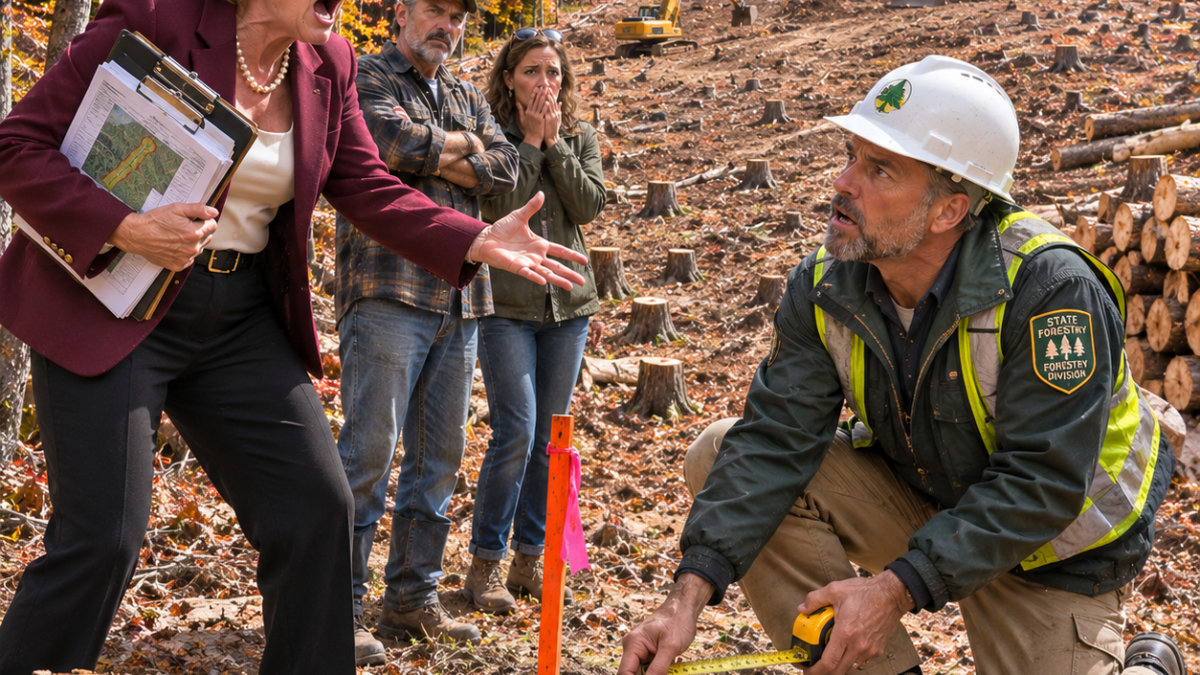
PART2:
And everything Beverly wanted somehow became “good for the community.”
I had been away for three days when she destroyed my grove.
I was hauling a trailer of amber syrup to a distributor in Massachusetts.
The entire drive home, I was thinking about winter inventory, whether the old vacuum pump would make it through another season, and whether I had enough replacement tubing ordered for spring.
Nothing dramatic.
Then I turned onto the farm road.
I heard machinery.
Heavy machinery.
At first I thought one of the neighboring properties was excavating.
Then I saw the tire tracks.
The dirt lane into my grove had been chewed apart by tracked equipment.
Deep impressions.
Fresh gravel.
Mud pushed into ridges.
I parked near the gate.
Killed the engine.
Then walked.
The farther I went, the louder it became.
Diesel.
Backup alarms.
Metal scraping against stone.
Then I came over the rise.
I stopped.
PART3:
For several seconds, I could not understand what I was looking at.
The forest was gone.
Not all of it.
Enough.
Enough that my brain refused to accept the shape of the hill.
Hundreds of maples had been cut.
Fresh stumps spread across the slope.
Pale wood exposed to November cold.
Sap darkening some of the cuts.
Branches piled in heaps.
Blue collection tubing crushed beneath gravel.
Main lines severed.
Vacuum lines pulled from anchors.
One pump station partly buried under fill.
Through the center of the destruction, a broad lane had been scraped downhill.
Not twelve feet.
Not twenty.
A wide graded strip.
A ski run.
At the bottom of it sat snowmaking equipment.
Near the upper edge, workers were hanging banners.
NORTH RIDGE WINTER EXPERIENCE.
I started walking downhill.
Then I saw the last maple.
One mature tree.
Still standing.
Red ribbon tied around the lowest branch.
Everything around it was stump and mud.
Beside the tree stood Beverly.
White parka.
Clipboard.
Two men from the construction crew.
A photographer.
And a brand-new snow machine.
She saw me.
Smiled.
“Fletcher.”
I stopped ten feet away.
“What did you do?”
Her smile remained.
“You’re back early.”
“What did you do?”
She looked toward the slope.
“You should be thanking us.”
I honestly thought I had misheard.
“Thanking you?”
“We turned an underused section of woodland into something the whole community can enjoy.”
I stared at the stumps.
“Those are my trees.”
Beverly sighed as if I were being difficult about landscaping.
“This area has always been subject to North Ridge recreational access.”
“Who authorized you to cut them?”
“The board approved the project.”
“That wasn’t the question.”
She opened her clipboard.
Pulled out a resolution.
North Ridge Community Amenity Expansion Plan.
Stamped.
Signed.
Approved by the HOA board.
She handed it to me.
I barely looked at it.
“This does not authorize you to remove trees from my land.”
Beverly’s expression tightened.
“Our legal counsel reviewed the community’s rights.”
“Shut the work down.”
“Excuse me?”
“Now.”
I pointed toward the excavator.
“Turn it off.”
Beverly raised two fingers.
Two private security guards who had been standing near a utility vehicle started walking toward us.
That was when the absurdity of the situation became complete.
My forest had been cut down.
On my land.
And I was the person being approached by security.
Beverly removed an envelope from her clipboard.
“I was hoping we could avoid this.”
She handed it to me.
I opened it.
INVOICE.
$4,800.
Reason:
Construction interference, contractor delay, unauthorized obstruction of approved improvement work.
I read it twice.
Then folded it.
Put it in my jacket.
Beverly smiled.
“You’ll have thirty days.”
I took out my phone.
Started recording.
Her smile changed.
“What are you doing?”
“Documenting.”
“There’s nothing to document.”
I turned slowly.
Trucks.
Excavators.
Snow machine.
Workers.
Stumps.
License plates.
I recorded everything.
Serial numbers.
Contractor logos.
Equipment positions.
The grading.
The red ribbon.
Beverly laughed.
“Our attorney has reviewed every detail, Fletcher.”
I ignored her.
Walked to one of the larger stumps.
Kneeled.
This particular tree had been there when I was a kid.
My father had taught me how to set a tap on it.
As I looked at the torn bark, something caught the light.
Small aluminum tag.
Stamped code.
MH-11-047.
I knew that format.
Not exactly why.
Then I remembered.
My father’s old forest ledgers.
Thick binders in the farmhouse office.
Tree measurements.
Health notes.
Coordinates.
Codes.
I photographed the tag from three angles.
Did not mention it.
Did not pull it off.
Did not touch anything else.
As daylight faded, a flatbed drove past.
Whole maple logs stacked on it.
Not chipped brush.
Not worthless hazard wood.
Straight logs.
Clean.
Carefully strapped.
Commercial timber.
I watched the truck disappear toward the county road.
Beverly had just called those trees ugly, declining woods.
Yet somebody was handling the logs like valuable cargo.
The next morning, I called Iris Gable.
Iris was an independent forest surveyor.
Fifteen years working timber lots, conservation parcels, easements, and boundary disputes around northern Vermont.
She arrived before nine.
GPS rover.
Clipboard.
Coffee.
No drama.
She walked the hill once before saying anything.
Then:
“How much tubing did you lose?”
“Most of it.”
“Pumps?”
“Two main stations damaged.”
“Trees?”
“I don’t know.”
“We count.”
We spent the morning mapping.
The destruction looked worse in daylight.
Gravel covered some stumps completely.
Others had been ground low.
The main sap lines were gone across the center of the grove.
There would be no meaningful syrup season next spring.
At noon, Iris opened her laptop at my kitchen table.
She had downloaded promotional documents from North Ridge.
One brochure included a map.
She turned the screen toward me.
My property was shaded green.
Same shade as HOA common land.
No clear boundary.
Across it ran a blue line.
SILVER CREST RUN.
I stared.
“They erased my property line.”
“From a marketing map.”
“Does that matter?”
“Legally, this map doesn’t transfer land.”
“So it’s meaningless?”
“No.”
She pointed.
“It shows what contractors, residents, and possibly investors were being told.”
Then she opened county records.
My parcel remained exactly where it had always been.
Ames Farm.
Twenty-three acres.
No transfer.
No HOA ownership.
I sent Beverly a formal written demand that afternoon.
Stop all work.
Preserve every project record.
Remove no more timber.
Do not alter additional sections of the property.
Her response went to the neighborhood before it came to me.
North Ridge homeowners received an email.
A lone adjacent landowner is attempting to sabotage a community winter project expected to create jobs, increase property values, and strengthen the seasonal economy.
By Thursday’s HOA meeting, half the room already disliked me.
One man near the entrance said:
“You’re stopping all this over a few trees?”
“A few?”
“You know what I mean.”
“No.”
Another resident said:
“We’ve already paid for the project.”
That mattered.
People had money invested.
Expectations invested.
Beverly knew exactly how to frame the dispute.
Not:
Did we cut Fletcher’s trees?
Instead:
Is Fletcher going to take something away from all of you?
The meeting began.
Beverly ran it like a product launch.
Slides.
Projected visitor numbers.
Tourism.
Season passes.
Property-value estimates.
Winter jobs.
One graphic compared North Ridge to destinations in New Hampshire and Quebec.
When public comments opened, I stood with photographs.
The first image showed the stumps.
Beverly interrupted.
“Mr. Ames is not an association member.”
“I own the land.”
“You do not have standing to participate in internal board business.”
“I’m not here to discuss your internal business.”
I held up the photo.
“I’m asking who authorized you to cut trees on my property.”
Murmurs.
Beverly smiled.
“The association’s access rights have existed for decades.”
“That wasn’t my question.”
“Those rights predate your current objections.”
“Who signed authorization for cutting?”
She did not answer.
Instead she said:
“Next agenda item.”
I sat down.
That was when I noticed Laurel Tindall.
HOA treasurer.
Front table.
She had been taking notes all evening.
Now her pen had stopped.
She was looking at Beverly.
Late that night, an email arrived from the HOA attorney.
Attached PDF.
WINTER ACCESS AGREEMENT.
Signed by my father.
Properly notarized.
Recorded decades earlier.
I forwarded it to Iris.
She called twenty minutes later.
Her voice sounded different.
“Fletcher.”
“What?”
“This is real.”
I felt my stomach drop.
The next morning she drove out with a certified copy from the county clerk.
My father had granted North Ridge’s predecessor a winter recreational easement.
Twelve feet wide.
Along the eastern margin.
Walking.
Snowshoeing.
Cross-country skiing.
It ran with the land.
Binding.
I could not pretend it did not exist.
Beverly had found a real document.
That mattered.
At a meeting between attorneys, she placed the original on the table like a winning card.
“The community has had winter recreation rights here for decades.”
My attorney, Owen Mercer, read it carefully.
Beverly continued.
“Silver Crest Run is simply a modern improvement to an existing amenity.”
“A groomed ski slope is not the same as a footpath,” I said.
Her attorney replied:
“That is the legal question.”
We filed for an emergency stop-work order.
The judge declined.
Not because Beverly had won.
Because the easement’s scope was disputed and we had not yet provided enough technical evidence to establish immediate irreparable harm within the narrow standard required at that stage.
Walking out, Owen told me:
“This is not final.”
“It feels final.”
“It isn’t.”
“The bulldozers go back tomorrow.”
“Yes.”
Beverly treated the ruling as total victory.
North Ridge email:
COURT SIDES WITH ASSOCIATION.
That was false.
But politically effective.
Contractor Preston Vale added overtime crews.
By Monday, crushed stone covered more of the hillside.
I stood at the boundary watching them bury stumps.
For one moment, I wanted to walk directly in front of the bulldozer.
Iris grabbed my sleeve.
“No.”
“They’re destroying evidence.”
“I know.”
“Then what am I supposed to do?”
She handed me a stapled packet.
“I read the appendix.”
“What appendix?”
“The part Beverly apparently hopes nobody else reads.”
The recorded winter easement included precise limitations.
Twelve feet.
Fixed survey line.
Non-motorized recreation.
No authority to widen.
No grading right.
No tree-clearing right.
No utilities.
No commercial development.
No snowmaking infrastructure.
I read it twice.
Then looked at the hillside.
Silver Crest Run was more than two hundred feet wide in sections.
“This isn’t an upgrade.”
“No.”
“It doesn’t even follow the trail.”
“No.”
Iris had overlaid the grading plans.
The new run veered downhill.
Toward a low hollow.
Toward the spring feeding my farm water system.
“Why?”
She shook her head.
“Don’t know yet.”
That night, I studied cross-section drawings.
One excavation near the spring was far deeper than anything required simply to make a smooth ski run.
I hired Harold Briggs.
Hydrologist from Montpelier.
He spent two days measuring slope, soil, runoff, and groundwater.
His conclusion was simple.
The grove had been stabilizing the mountain.
Hundreds of roots held thin soil.
Forest litter slowed rainfall and snowmelt.
Remove the trees.
Compact the earth.
Grade the slope.
Suddenly water moves faster.
Much faster.
The temporary drainage channels Preston’s crews installed directed runoff toward the public road below.
That gave me a different agency to call.
Vermont Agency of Natural Resources.
Two days later, Inspector Sloan Mercer arrived.
Canvas coat.
Steel-toed boots.
No interest in who I thought the villain was.
I showed her the hill.
She listened.
Then said:
“I’m not shutting down a project because you’re angry.”
“I didn’t ask you to.”
“You called.”
“I want you to look at the runoff.”
“I need measured acreage.”
“Iris has it.”
“Permit status.”
“We’re collecting it.”
“Documented water impact.”
“Briggs.”
She nodded.
“I’m not on your side, Mr. Ames.”
“Good.”
That surprised her.
“I want you on the evidence.”
Beverly arrived twenty minutes later with Preston.
Preston carried a binder.
Inside:
Arborist report.
The maples were described as old.
Declining.
Diseased.
Hazardous.
Removal necessary for public safety.
Preston explained that crews had only removed dangerous trees within a lawful recreation corridor.
Sloan took the report.
Said nothing.
For the first time, I understood how strong Beverly’s position could sound if you saw only her paper.
Old easement.
Hazard-tree report.
Board approval.
Construction plan.
Community project.
Everything had a document.
So I found my own forester.
Independent.
New Hampshire.
He cored more than forty accessible stumps.
Dense wood.
Healthy growth.
No widespread rot.
No disease pattern matching Beverly’s report.
Many of the trees had been in prime condition.
While we were doing that, Beverly sent me another demand.
Remove the old split-rail fence near the “winter corridor.”
Ten days.
I checked Iris’s survey.
Fence outside the twelve-foot easement.
Completely.
I refused.
Her attorney threatened litigation.
Again.
That evening I found new gravel spread over stumps Iris had not finished recording.
That was when I stopped thinking polite objection was enough.
We moved on several fronts.
Owen filed for evidence-preservation protection.
Requested every grading permit.
Stormwater plan.
Engineering drawing.
Project contract.
Iris overlaid historic aerials with sap-line coordinates and stump locations.
The clearing was not twelve feet.
It exceeded two hundred feet in places.
Almost the entire center of the grove.
Then I found the pump.
Industrial.
Near the spring.
Large intake.
Fresh pipe running uphill beneath the grade.
I asked Preston:
“What is that?”
“Snowmaking.”
“Show me the water withdrawal permit.”
“That belongs to the project owner.”
“Engineering drawings?”
“Not authorized.”
Beverly appeared with security.
“You need to leave the active construction area.”
I stepped backward.
Onto ground nobody disputed.
Kept recording.
Within days, the state demanded additional stormwater documentation and excavation records.
It was not a shutdown.
But it was the first official question Beverly could not answer with marketing language.
She went on television.
Local news.
North Ridge clubhouse.
White coat.
She accused me of weaponizing environmental law to destroy jobs.
Said if opening weekend was cancelled, the HOA would pursue damages against me personally.
Two regular customers stopped buying syrup.
Somebody taped a note to my mailbox.
SELL AND LEAVE.
I almost answered publicly.
Instead, I wrote one page.
Sent it to every North Ridge household.
Three points.
The recorded twelve-foot winter path would always be honored.
The path did not authorize destruction of an entire maple grove.
The current grading was directing runoff toward the public road everyone used.
Attached:
Harold’s flow map.
Nothing else.
That changed something.
Not everyone.
Enough.
Residents started asking questions.
Then Laurel called.
“Can we meet?”
We sat in a diner twenty minutes away.
She kept looking toward the door.
“I’m not supposed to share confidential association records.”
“Then don’t.”
“These are records I’m entitled to review as treasurer.”
She slid a sheet across.
HAZARD TREE REMOVAL
$180,000
I stared.
“The HOA paid one hundred eighty thousand to remove my trees?”
“Yes.”
“Where’s timber revenue?”
“That’s why I called.”
“There isn’t any?”
“Not in our books.”
I remembered the flatbed.
Whole logs.
Premium timber.
Owen traced the truck records lawfully through the dispute.
Hardwood mill in New Hampshire.
The buyer confirmed multiple loads of high-grade sugar maple.
“Some of the best maple we’ve seen in years.”
Beverly’s disease report collapsed under that statement.
Worthless hazard trees do not become premium veneer stock.
The purchase records showed approximately $310,000 worth of timber.
Some logs already cut into veneer for expensive cabinetry and furniture.
Think about that.
North Ridge homeowners paid $180,000 to remove my trees.
Someone else sold those same trees for roughly $310,000.
No sale revenue appeared in the HOA accounts.
The seller was listed as:
Ridgerest Recreation LLC.
Laurel had never heard of it.
Not in board resolutions.
Not in approved vendor summaries.
Not in the budget.
I wanted to accuse Beverly immediately.
Owen stopped me.
“Company records first.”
Beverly learned someone was looking.
She called an emergency board meeting.
Moved to remove Laurel as treasurer.
“Loss of confidence.”
“Disclosure of confidential information to an adversarial landowner.”
Laurel’s hands shook while Beverly attacked her.
Nobody defended her.
I wanted to stand up.
Owen had already warned me.
“Not yet.”
I hated him for being right.
We sent preservation notices.
HOA.
Ridgerest.
Preston Vale.
Mill.
Anyone holding contracts or accounting.
Then we handed Sloan the healthy-tree evidence and timber records.
Her tone changed.
She ordered a deeper review.
Then Iris called.
“Found something.”
We drove to Montpelier.
State natural-resources archive.
Old boxes.
Paper records not fully digitized.
Inside the second box:
MAPLE HOLLOW FOREST CONSERVATION AGREEMENT.
Signed by my father more than twenty years earlier.
Recorded.
Still effective.
I had never seen it.
The agreement did not take ownership away from us.
It placed conservation restrictions on the grove.
Mature canopy protection.
Limits on clearing.
Limits on grading.
Watershed erosion protection.
Then came the appendix.
Tree inventory.
Eight hundred mature sugar maples.
Individual survey positions.
Diameter.
Health classification.
Identification code.
I took out my phone.
Pulled up the photograph from that first evening.
MH-11-047.
Iris found it on page eleven.
Exact match.
I stared at the code.
Beverly thought the trees were gone.
The state had counted them.
Numbered them.
Mapped them.
Every tree she believed had vanished under gravel already existed in a government record.
For the next week, Iris matched inventory coordinates against surviving survey monuments.
Even where gravel buried stumps, old field points remained.
We could reconstruct nearly the whole grove.
Sloan received the file.
So did a state forester.
Then she told me something important.
“This is not just your private lawsuit anymore.”
“What does that mean?”
“The conservation agreement gives the state independent enforcement authority.”
“For the trees?”
“For the protected land.”
“What can the state do?”
“Require restoration.”
I had been expecting money.
Or fines.
Or an order to stop construction.
“Restore?”
“Native stock.”
“Soil decompaction.”
“Erosion controls.”
“Drainage.”
“Long-term survival monitoring.”
“How many trees?”
“That will depend on the approved plan.”
I looked at the inventory.
“Eight hundred were taken.”
Sloan nodded.
“I know.”
I did not ask for a check.
I said:
“Then make them put the forest back.”
Not because saplings can replace mature maples overnight.
They cannot.
Some trees Beverly cut had been standing longer than I had been alive.
Money could not buy those years.
But if the people responsible only paid damages and walked away, the hillside would remain a scar.
Restoration mattered.
Meanwhile, the financial story got worse.
Laurel found a contract summary involving Everett Pike, representative for a regional ski-resort company.
Huge payment.
Conditional on Silver Crest Run becoming operational by a fixed date.
The amount made no sense.
One little HOA ski slope could not support that economics.
Then I saw the phrase:
EXCLUSIVE SNOWMAKING INFRASTRUCTURE RIGHTS.
Everything shifted.
Ridgerest Recreation had been negotiating with the resort company for nearly two years.
The North Ridge slope was not the real project.
It was the visible beginning.
A pilot.
The actual plan involved commercial snowmaking infrastructure.
High-volume pumping.
Buried lines.
Technical corridor rights across the ridge.
And the spring on my property.
That explained the deep excavation.
That explained why the run curved away from the old recreational path.
That explained the industrial pump.
That explained why Beverly was willing to spend so much money on one little slope.
Then came the worst document.
Ridgerest ownership schedule.
Beverly held a personal financial interest.
Projected payout if the infrastructure transaction closed:
approximately $420,000.
I read it twice.
There it was.
The ski slope was never mainly about children sledding.
Never mainly about property values.
Never mainly about tourism.
Beverly had used a real twelve-foot winter easement as camouflage for a commercial corridor she had no right to build.
She told residents their dues were funding a community amenity.
She told contractors the land was available.
She told a resort company the necessary rights were secured.
They were not.
She had no right to commercialize the path.
No right to widen it.
No right to destroy the protected grove.
No right to run utility infrastructure through my spring.
We built the case in three sections.
First:
Ownership and easement limits.
Second:
Environmental damage and the eight hundred inventoried maples.
Third:
Money.
Timber.
Ridgerest.
Commercial infrastructure.
Beverly’s personal interest.
Then we warned Everett Pike formally.
Through counsel.
Recorded easement.
Conservation agreement.
Spring ownership.
He could never say nobody told him.
The resort company immediately started asking Beverly questions.
Beverly responded by accelerating the project.
Preston was ordered to conduct a full snowmaking test before the deal could freeze.
Opening weekend would proceed.
No matter what.
North Ridge residents received engraved invitations.
One line at the bottom:
NOTHING CAN STOP THE MOUNTAIN NOW.
I had eight hundred numbered dots spread across my kitchen table when Owen called.
“You see the invitation?”
“Yes.”
“What are you thinking?”
I looked at the inventory.
“Then we stop it with what she buried under it.”
Opening morning was bitterly cold.
Fresh snow.
Banners.
Folding chairs.
Stage at the base of Silver Crest Run.
Beverly arrived in white.
Of course.
Photographers.
Residents.
Everett Pike.
Contractors.
Snow machines.
She wanted spectacle.
I wanted inspectors.
Sloan arrived with two state engineers.
They walked the slope before speeches began.
Temporary erosion controls failed inspection.
Still, the test proceeded under monitored conditions long enough to evaluate the system.
Pump started.
Snow machines sprayed.
Water began moving across the compacted surface.
Fast.
Exactly as Harold predicted.
Within twenty minutes, muddy runoff entered the drainage channel.
One outer edge softened.
Slumped.
Then slid downslope toward the public road.
Preston ordered shutdown.
Immediate.
Machines went silent.
I had not touched anything.
Had not crossed a barricade.
Had not sabotaged a pipe.
I stood on my land with Harold’s map showing nearly the exact failure zone.
Beverly came toward me across the snow.
“You did this!”
“No.”
“You’ve been trying to destroy this project for months.”
“Your slope failed.”
“You interfered with the drainage.”
“I haven’t touched your equipment.”
Residents gathered.
Beverly kept shouting.
I waited.
Then spoke publicly for the first time.
Not a speech.
Documents.
I held up the recorded winter easement.
“Twelve feet.”
I pointed at Silver Crest Run.
“More than two hundred feet in places.”
I held up the state inventory.
“Eight hundred sugar maples.”
Iris displayed the overlay.
Inventory positions.
Stump locations.
I showed the timber-sale records.
“North Ridge homeowners paid $180,000 for hazard-tree removal.”
People murmured.
I held up another page.
“Those trees were sold as high-grade maple for roughly $310,000.”
The crowd changed.
Then Laurel stepped beside me.
She looked terrified.
But spoke.
“No timber revenue was reported to the association.”
Someone shouted:
“Where did it go?”
Beverly grabbed the microphone.
“This is incomplete financial information.”
Laurel continued.
“Ridgerest Recreation LLC was not presented to the full board in the way Mr. Ames’s documents show.”
I explained the commercial infrastructure deal.
Snowmaking rights.
Water corridor.
Spring.
Ridgerest.
Beverly’s projected personal payout.
Her attorney stared at the documents.
Everett Pike walked to the microphone.
“Our company is suspending the proposed transaction pending verification of land rights, permits, and representations made during negotiations.”
Beverly turned.
“Everett.”
He stepped away.
Then Sloan spoke.
Construction and operations within the affected area were suspended.
Emergency erosion control required.
Additional activity prohibited pending enforcement review.
Beverly stood on the stage.
Microphone in hand.
Nobody waiting for her to explain.
The court granted additional temporary protection later that week based on evidence that had not existed during the first emergency motion.
That distinction mattered.
The first denial had not meant Beverly was right.
It meant we had not yet proven enough.
Now we had.
Stopping the ski run felt good for about five minutes.
Then I looked at the hillside.
Eight hundred mature maples were still dead.
Sloan stood beside me after the crowd left.
“Stopping the slope was the easy part.”
“What’s the hard part?”
She looked at the stumps.
“Making them repair what they destroyed.”
The enforcement process lasted the rest of winter.
Technical review.
Responsibility.
Environmental damage.
Restoration design.
Financial assurance.
The state ultimately determined that the project violated the recorded conservation agreement and protections tied to the land.
The restoration order was not symbolic.
Eight hundred maples.
Replant them.
Not decorative trees at the HOA entrance.
Not fast-growing substitutes.
Native sugar maple stock appropriate to the site.
Soil had to be decompacted.
Grading corrected.
Natural drainage rebuilt.
Slope stabilized.
Planting locations tied back to the ecological survey wherever possible.
And the number was not:
Plant eight hundred once.
It was:
Maintain eight hundred surviving trees through the monitoring period.
Any that died had to be replaced.
Again.
And again if necessary.
Financial assurance was locked into the settlement and enforcement structure so nobody could stop halfway because the project became expensive.
I remember reading that section.
Owen asked:
“Happy?”
“No.”
“You got the restoration.”
“I know.”
“What would make you happy?”
I looked out the window.
“Trees that are sixty years old.”
He nodded.
There was no legal remedy for time.
The independent HOA audit continued separately.
Beverly was removed as president by homeowner vote.
Transactions involving Ridgerest remained under review for civil liability and potential legal violations.
I was careful about that.
Being removed as HOA president was one thing.
Criminal guilt was another.
Investigators and attorneys had to do their jobs.
Preston and other responsible parties could not simply dump the entire cost on residents and disappear.
Project deposits.
Timber proceeds that could be verified and recovered.
Restitution obligations.
Settlement funds.
Insurance where applicable.
Those resources were directed toward restoration according to the legal process.
I pursued my own damages separately.
Destroyed sap system.
Lost syrup seasons.
Infrastructure.
Business interruption.
I did not want those claims mixed with the forest recovery.
The forest needed trees.
My business needed compensation.
Different harms.
Different remedies.
By spring, trucks came up the same road the logging crews had used.
But this time they carried saplings.
No stage.
No photographer.
No white coat.
No ribbon.
State monitors.
Restoration crew.
Iris.
Clipboards.
Rows of young sugar maples.
The first one looked painfully small.
Maybe four feet.
Thin trunk.
Tiny crown.
I stood beside the stump position where one of my oldest producers had been.
The sapling looked almost ridiculous.
Then Iris said:
“Number one.”
Crew lowered it.
Soil around roots.
Stake.
Protection.
Next.
“Number two.”
Then three.
Ten.
Forty.
One hundred.
Laurel came on the third morning.
Thermos.
Work gloves.
Stayed until dark.
A few North Ridge residents started showing up.
At first I did not know what to do with them.
One man had told me months earlier I should be ashamed for holding the community hostage.
Now he carried a maple up the hill.
He stopped beside me.
“I was wrong.”
I looked at the sapling.
“Hole’s over there.”
That was enough.
By the end of the week, the hillside held eight hundred young maples.
Not a forest.
Not yet.
Possibility.
At the final HOA meeting of the season, several homeowners proposed closing the winter path permanently.
They said it was only fair.
Beverly had used it as an excuse.
The community had abused my father’s generosity.
I surprised them.
“No.”
Walt—wrong story; use Laurel? Let’s continue.
Laurel looked at me.
“You want to keep it?”
“My father granted it.”
“You don’t have to expand it.”
“I won’t.”
I held up the original agreement.
“Twelve feet.”
“Walking.”
“Snowshoeing.”
“Cross-country skiing.”
“No motorized vehicles.”
“No commercial use.”
“No widening.”
“No cutting.”
“When the state says the restoration can safely accommodate it, the path reopens exactly as recorded.”
A homeowner asked:
“After everything?”
“Beverly abused the right.”
“My father didn’t.”
That settled it.
Years later, I think that decision mattered almost as much as winning.
If I had closed every door because one person abused it, Beverly would have changed not only the forest but also what my father intended.
I was not giving her that.
The trail eventually reopened.
Quiet.
Narrow.
In winter, people skied through without lifts.
No speakers.
No ticket booth.
No snow machine.
Just tracks.
Some residents volunteered during restoration years.
Tree guards.
Invasive plant removal.
Erosion checks.
A strange thing happened.
The community connection Beverly tried to monetize became one reason the young grove survived.
People watched the trees.
Protected them.
Reported damage.
Children who had been promised a ski slope grew up knowing exactly why the little maples were there.
The red ribbon stayed on the last mature tree.
I never removed it.
Maybe I should have.
It faded.
Frayed.
Bleached in the sun.
But every time I walked past it, I remembered the first evening.
Beverly standing beside the snow machine.
“You should be thanking us.”
Eight hundred stumps.
$4,800 invoice in my pocket.
I kept that invoice too.
Framed it in the farmhouse office.
Owen saw it once.
“Why do clients always frame the stupidest exhibits?”
“Motivation.”
“You could frame the restoration order.”
“Too many pages.”
Fair.
The state conducted inspections.
Survival rates.
Soil.
Drainage.
Erosion.
Any sapling that failed during the required monitoring period was replaced.
The first winter killed more than I expected.
Second planting.
Some deer damage.
More replacement.
One section needed additional drainage work.
Another needed soil amendment.
Restoration is not a ceremony.
It is maintenance.
Years of it.
That was exactly why the financial assurance mattered.
Nobody could plant eight hundred sticks, take a photograph, and declare success.
The state kept counting.
I liked that.
North Ridge changed.
Laurel eventually became board president.
She resisted.
Residents insisted.
Her first budget included a line item called:
Recorded Easement Maintenance and Conservation Compliance.
Not glamorous.
Good.
The HOA stopped using glossy maps that blurred private boundaries.
Contracts required conflict disclosures.
Related-party transactions went through independent review.
Major capital projects required legal verification of land rights before anybody ordered machinery.
It is amazing how specific rules become after somebody proves they are necessary.
The timber money took longer to unravel.
Ridgerest.
Contractors.
Mill records.
Financial claims.
Some funds were recovered.
Some became part of civil proceedings.
I did not follow every hearing.
I cared more about the ridge.
My syrup business took several hard years.
You do not replace a mature sugar grove by planting saplings and waiting until Tuesday.
The new trees would need decades before meaningful tapping.
I had other areas of maple.
Smaller stands.
I bought sap from neighboring producers for some seasons.
Scaled production.
Made less.
Stayed alive.
People assume that because the state ordered replanting, everything went back to normal.
No.
Eight hundred young trees are not eight hundred mature trees.
A court can order repair.
It cannot manufacture forty years.
That was the part Beverly never had to understand while she was selling her project.
A forest is not simply a number of trees.
It is shade.
Roots.
Water retention.
Soil.
Fungi.
Wildlife.
Temperature.
Time.
The old grove had been doing work nobody billed for.
Holding the hillside.
Feeding the spring.
Slowing runoff.
Producing sap.
Creating habitat.
Beverly saw unused land.
That difference in perspective caused almost everything.
Years after the case, I ran into Everett Pike at a regional forestry meeting.
He approached carefully.
“Mr. Ames.”
“Mr. Pike.”
“I owe you an apology.”
“For what?”
“Our company relied too heavily on representations from Ridgerest.”
“You asked for documents?”
“Not enough of them.”
“That’s different from knowing.”
“Yes.”
He looked embarrassed.
“We wanted the corridor.”
“I know.”
“It looked like all rights were secured.”
“They weren’t.”
“No.”
He paused.
“The conservation file would have killed the deal immediately.”
“Probably.”
“We should have found it.”
“Yes.”
He nodded.
I respected that more than an excuse.
Beverly’s greatest advantage had been that every person in the chain assumed somebody else had checked.
The board assumed the attorney understood the easement.
Contractors assumed land rights were settled.
Residents assumed Beverly had authority.
The resort company assumed Ridgerest had secured the corridor.
The timber operation assumed the trees could be sold.
Everybody had a reason not to look too closely.
Then one aluminum tag forced everybody to start looking.
MH-11-047.
I still know the code.
That stump is gone now.
Restoration crews removed damaged remnants when the soil work began.
But I kept the photograph.
Sometimes school groups visit the farm.
I show them the tag.
Ask:
“What do you think this is?”
They guess.
Inventory number.
Tree age.
Map coordinate.
Eventually I explain.
One little piece of aluminum helped prove that eight hundred trees had existed exactly where somebody said they had not mattered.
Kids understand that faster than adults.
One boy asked:
“Why did they cut them if the state knew they were there?”
Because records do not physically stop chainsaws.
I did not say that.
I said:
“Because somebody thought nobody would check.”
That answer was better.
One winter morning, maybe six years after replanting, I walked the restored section after fresh snow.
The saplings were no longer waist-high.
Many were above my head.
Still young.
Still years from tapping.
But real trees now.
The original twelve-foot trail ran through them.
A family on cross-country skis came around the bend.
Mother.
Father.
Two children.
They slowed when they saw me.
“Morning.”
“Morning.”
One kid pointed at the young maples.
“Are these the trees?”
I knew what he meant.
“Yes.”
“All eight hundred?”
“Some have been replaced.”
“Because they died?”
“Some.”
He looked impressed.
“So they really count them?”
“Every inspection.”
His father laughed.
“He’s been telling his class about the ski-slope story.”
I looked at the boy.
“What do you tell them?”
“That the lady cut all the trees and then had to put them back.”
Simple.
Not quite complete.
But not wrong.
They skied on.
I stood in the snow listening until the sound faded.
My father had granted that path decades earlier because he believed land could be shared carefully.
Not surrendered.
Shared.
Beverly saw the same document and saw leverage.
Twelve feet became two hundred.
Walking became machinery.
Cross-country skiing became commercial snowmaking.
A path became infrastructure.
An easement became a business plan.
That was the core of it.
She did not fabricate every document.
That would have been easier.
She found one real right.
Then stretched it until it became something it had never been.
That is why the first court hearing went badly for me.
Reality was complicated.
Yes, North Ridge had a right.
No, the right was not what Beverly claimed.
Winning required respecting the part that was real.
Once I stopped saying:
“They have no right to be here,”
and started saying:
“They have exactly twelve feet and no more,”
the case became much stronger.
I think about that whenever somebody asks what saved the grove.
The conservation agreement?
Yes.
The inventory?
Yes.
The healthy stump cores?
Yes.
The timber records?
Absolutely.
The hydrology?
Yes.
Laurel?
Yes.
Sloan?
Yes.
Iris?
Without question.
But the real turning point was admitting something I did not like.
My father’s easement was valid.
Beverly had some rights.
Just not the rights she wanted.
Truth is strongest when you do not need to exaggerate it.
The state restoration order eventually reached the end of its formal monitoring period.
Final inspection.
Sloan had moved to another division by then, but she came anyway.
Not officially.
She stood with me near the surviving mature maple.
The red ribbon was almost white from weather.
The younger trees covered the slope.
Not the same forest.
Not yet.
But the shape was returning.
State forester finished measurements.
Checked survival.
Drainage stable.
Erosion controlled.
Restoration obligations satisfied for that phase.
I asked Sloan:
“So that’s it?”
“Legally?”
“Yes.”
“For the monitoring order, mostly.”
“And ecologically?”
She looked at the trees.
“Ask me in forty years.”
I laughed.
“Helpful.”
“You wanted honesty.”
“I did.”
She pointed toward the grove.
“Courts work in years.”
“Forests work in generations.”
That might have been the most accurate sentence anyone said during the entire fight.
Beverly wanted results before opening weekend.
That was her world.
Contracts.
Deadlines.
Payments.
Ceremonies.
The forest did not care.
It works slowly.
Roots first.
Then height.
Then shade.
Eventually a canopy.
Eventually sap.
Eventually someone who has not even been born yet may stand under those maples and think they have always been there.
That is the future I wanted.
Not a giant check.
Not a viral courtroom moment.
Not Beverly humiliated on a stage.
Trees.
The $4,800 “construction interference” invoice never got paid.
Obviously.
I still have it.
The association formally withdrew it after leadership changed.
Walt? No—Laurel signed that letter.
Laurel wrote at the bottom by hand:
Apparently objecting to destruction of your own property is not an HOA violation.
I framed that too.
My office became a strange museum.
Red ribbon photo.
Aluminum tag photo.
Old forest inventory.
Withdrawn invoice.
First restoration map.
Father’s original easement.
The documents tell the story better than I can.
One page says neighbors may cross.
One says the forest must remain protected.
One says the trees existed.
One shows somebody sold them.
One says the state required them back.
No single document is the whole truth.
Together they are.
The last time I saw Beverly was not in court.
Not at a board meeting.
Not during the restoration.
I saw her years later in a hardware store in Montpelier.
She was standing near paint supplies.
No white coat.
No entourage.
No clipboard.
She saw me.
For a moment, neither of us moved.
Then she said:
“Fletcher.”
“Beverly.”
She looked older.
So did I.
Her eyes shifted toward the cart I was pushing.
Tree guards.
“Still planting?”
“Always.”
She looked down.
“I heard the restoration passed inspection.”
“It did.”
“That’s good.”
I waited.
Then she said something I did not expect.
“I thought the project would save North Ridge.”
“From what?”
“Becoming irrelevant.”
I almost laughed.
Not because it was funny.
Because the answer explained so much.
She continued.
“Vacation communities were competing for visitors. Home values. Amenities. Resorts. Everyone wanted more.”
“So you cut eight hundred trees.”
Her face tightened.
“I thought the rights were broader.”
“You knew the winter path was twelve feet.”
She said nothing.
“You knew Ridgerest had a commercial deal.”
She looked away.
“That’s not why I came over.”
“You came over?”
She almost smiled.
“Figure of speech.”
I did not rescue her from the silence.
Finally she said:
“I made terrible decisions.”
“Yes.”
“I lost everything.”
“No.”
She looked at me.
“You lost a position.”
“A project.”
“Money.”
“Reputation.”
I pointed vaguely north.
“The grove lost decades.”
She nodded.
That was as close to understanding as I ever saw her come.
I left.
No speech.
No forgiveness scene.
No revenge.
Some things do not need a neat ending.
The grove does not have one.
It keeps growing.
That is enough.
Last fall, I tapped one of the younger maples for the first time.
Not one of the replanting saplings.
A survivor near the edge that had been too small to cut during Beverly’s project and had matured over the years.
I drilled carefully.
Set the tap.
Clear sap started slowly.
One drop.
Then another.
I stood there longer than necessary.
My father would have laughed at me.
“Tree’s doing what trees do.”
Yes.
But after everything, ordinary felt extraordinary.
The one mature maple with the red ribbon still stands.
The ribbon itself finally fell apart.
I kept a small piece.
The tree produces every spring.
Below it, the restored grove climbs the hill.
Eight hundred maples under state records.
Some original replacement trees.
Some replacements of replacements.
All accounted for.
The winter trail passes quietly along the east side.
Exactly twelve feet.
On snowy mornings, residents still use it.
No tickets.
No snow machines.
No buried commercial line.
Just skis.
Sometimes one of them stops at the farm stand.
Buys syrup.
Years ago, that would have made me angry.
Now it makes me smile.
Because Beverly wanted to turn the grove into a machine.
Money in.
Trees out.
Timber sold.
Dues spent.
Commercial rights secured.
Payout collected.
The state forced something very different.
Patience.
Monitoring.
Replacement.
Care.
Eight hundred obligations planted one root ball at a time.
People remember the number.
Eight hundred trees.
What I remember is the first one.
A thin young maple lowered into ground where a mature tree had stood.
It looked too small.
Almost insulting.
Then the second.
Then the third.
Eventually the whole hillside.
That is how repair works sometimes.
Not dramatic enough to match the damage.
At first.
But repeated long enough, carefully enough, it becomes a future.
Beverly tried to bury the evidence beneath a ski slope.
Instead, the state archive had every tree numbered.
Every position mapped.
Every code waiting.
And once the first aluminum tag matched the old inventory, the question stopped being whether a few trees had been removed.
The question became:
Where are the eight hundred trees the state says should be here?
There was no slideshow that could answer that.
No HOA resolution.
No white coat.
No ribbon cutting.
Only stumps.
Then evidence.
Then consequences.
And eventually—
eight hundred maples growing back where Beverly was certain nobody could prove they had ever stood.








