HOA Karen Turned My Private Garage Into Public Parking—So I Locked 32 Cars Inside and Went Fishing
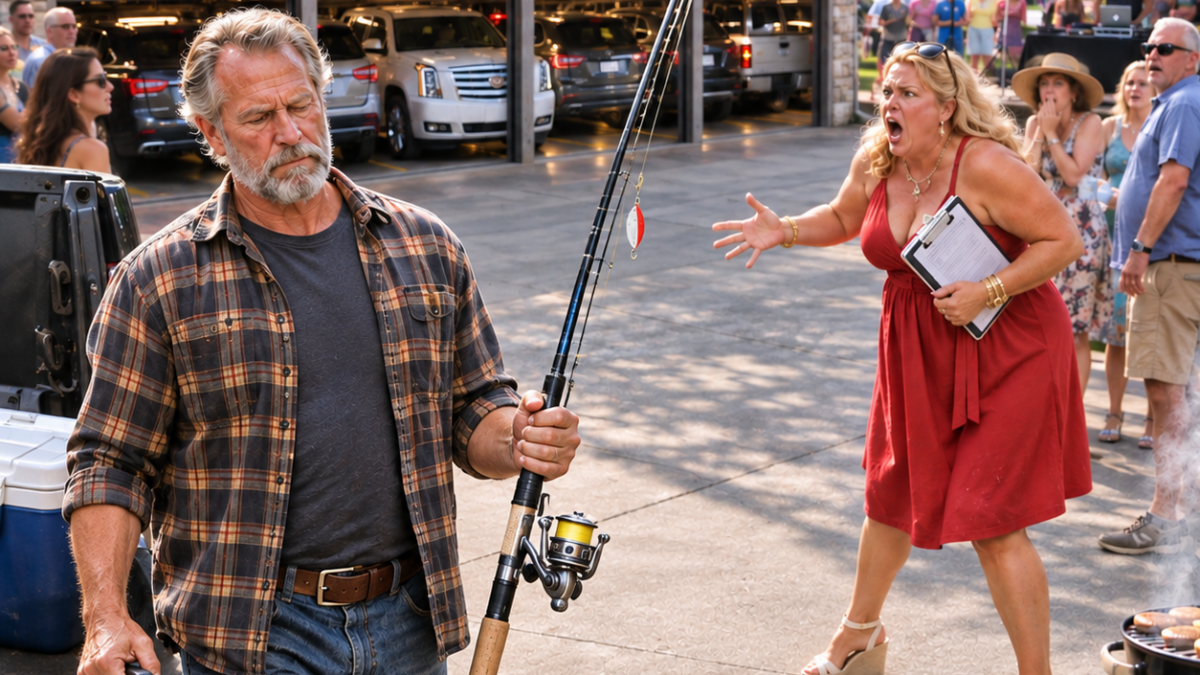
HOA Karen Turned My Private Garage Into Public Parking—So I Locked 32 Cars Inside and Went Fishing.
The HOA president had spent months fining me, trespassing through my four-bay garage, and calling my late wife’s half-restored 1967 Mustang “abandoned junk,” but the morning she had it dragged into the rain so six board members could park where Laura and I used to work together, I stopped treating her like an irritating neighbor and started treating every move she made like evidence.
Donna Kessler thought an invented “shared access” rule gave her the right to turn my private garage into overflow parking, and she had no idea I had already found fake proxy votes, altered meeting minutes, $47,000 in HOA money sent to her husband’s company, and a development proposal that explained exactly why she needed my property.
So when thirty-two cars rolled into my garage for the HOA’s summer block party and Donna stood outside directing traffic like she owned the place, I picked up my tackle box, tapped four buttons on my phone, and drove toward the mountains while four industrial steel doors began coming down behind me.
“Move that piece of garbage or I’ll have it crushed.”
Donna Kessler was standing in the middle of my garage when she said it.
Not at the threshold.
Not on the driveway.
Inside.
Ten feet inside.
She was wearing a cream linen blazer over black yoga pants, white wedge sandals and sunglasses large enough to make her look like she was trying to avoid photographers.
One hand held a Starbucks cup.
The other pointed toward my wife’s Mustang.
The car sat on jack stands in bay two.
1967 fastback.
No front bumper.
No hood trim.
Interior stripped.
Engine rebuilt but not yet installed.
Primer on the quarter panels.
One door still the original dark green.
It did not look finished.
It was not supposed to.
Laura and I had been restoring it.
Until Laura died.
Donna looked at the Mustang as if it were a broken refrigerator somebody had left beside a dumpster.
“Donna.”
“What?”
“Get out of my garage.”
She took a sip of coffee.
“You know what the problem with you is, Garrett?”
“No.”
“You think ownership makes you special.”
I stared at her.
“It makes this garage mine.”
She smiled.
PART2:
That particular smile had become familiar.
It was the smile she used whenever she believed somebody had misunderstood the amount of authority she possessed.
“Not anymore.”
I actually laughed.
“What?”
“The board designated this structure for community overflow parking.”
“No, it didn’t.”
“We passed the resolution.”
“You held an illegal vote.”
“The vote passed.”
“Not by the required margin.”
“It passed.”
“It did not.”
Donna walked closer to the Mustang.
Her sandals clicked on concrete Laura and I had poured ourselves.
Fourteen years earlier.
Laura had insisted on helping.
She was five-foot-four and maybe one hundred twenty pounds soaking wet, but she had spent an entire Saturday running a bull float across that slab while telling me my finishing technique looked like “something a drunk beaver would do.”
The concrete still had one shallow boot print near the back wall.
Laura’s.
She had stepped where I told her not to.
Then refused to let me smooth it out.
“Character,” she called it.
Donna’s heel passed within six inches of that print.
She pointed at the Mustang.
“That vehicle violates community standards.”
“It is registered.”
“It doesn’t run.”
“It’s under restoration.”
“It is abandoned junk.”
“It belonged to my wife.”
Donna rolled her eyes.
“Spare me.”
I went still.
She should have stopped.
She did not.
“You think I care about some dead woman’s rusty junk?”
I wish I could tell you I handled that sentence with grace.
I did not.
For about three seconds, I wanted to throw Donna Kessler out of my garage with both hands.
I was sixty-one years old.
Six-foot-two.
Two hundred pounds.
Twenty-five years as a structural engineer for the Colorado Department of Transportation had left my shoulders wider than most retired men’s and my patience narrower than it used to be.
But I had also spent twenty-five years inspecting things that failed when force was applied in the wrong place.
Bridges.
Retaining walls.
Expansion joints.
Steel connections.
Concrete decks.
You learn something from failed structures.
Stress rarely announces the exact second collapse is coming.
You watch.
Document.
Measure.
Then act before the wrong part gives way.
So I looked at Donna.
Then at the phone in my hand.
And pressed record.
“Would you repeat that?”
Her expression changed.
“Repeat what?”
“What you just said about my wife.”
“I said the vehicle is junk.”
“No.”
I held the phone where she could see it.
“You said you didn’t care about my dead wife’s rusty junk.”
Donna’s face tightened.
“Don’t be dramatic.”
“Please leave.”
She stepped closer.
“This garage is community property now, sweetheart.”
“No.”
“You need to accept that.”
“No.”
“Three families said no to me before you.”
She lowered her voice.
“They’re gone.”
I remember that sentence more clearly than the insult about Laura.
Three families said no.
They’re gone.
At the time, I did not know whether Donna meant she had annoyed them until they moved or simply liked making herself sound powerful.
Later, I would learn enough to know the distinction did not matter as much as it should have.
Donna believed resistance could be exhausted.
She had done it before.
She intended to do it again.
I stopped recording.
“Leave.”
She smiled.
“Enjoy your morning, Garrett.”
Then walked out.
That was the first day I understood I was not dealing with a misunderstanding.
To understand why the garage mattered, you need to understand Laura.
My wife’s name was Laura Shelton.
We met in 1989 at a community-college welding class I was taking because I wanted to become a better inspector.
She was there because a man at a body shop had told her women could not weld straight.
Laura took that personally.
She could hold a cleaner bead than half the men in the room by week four.
We married in 1992.
No children.
Not by choice at first.
Later by acceptance.
Cars became the thing we built together instead.
Old things.
Machines other people had given up on.
A 1972 Nova.
Then a ’69 Camaro SS.
A ’58 Chevy pickup we sold before finishing because somebody offered twice what we had in it.
Laura loved the beginning more than the ending.
Rust.
Boxes of parts.
Engines sitting on stands.
She liked seeing possibility before anybody else did.
That was why she loved the Ridgeline property.
When the subdivision was still mostly dirt roads, Laura saw the corner lot.
House.
Quarter-acre extra.
Detached garage.
Four bays.
Twelve hundred square feet.
Concrete floor.
Tall rafters.
She walked inside before we bought the place.
Ran one hand along the workbench.
“This.”
“What?”
“This is where we’re going to build something beautiful.”
We did.
Every Saturday for eleven years.
Radio on.
Coffee.
Doors open.
Colorado sun.
Fleetwood Mac if Laura controlled the station.
Classic rock if I got there first.
Then the Mustang.
1967 fastback.
Barn auction outside Pueblo.
$3,800.
Frame surface-rusted.
Interior gutted.
Engine seized.
Laura climbed into the driver’s seat even though the seat foam was torn down to springs.
Cranked the window down manually.
Looked at me.
“When it’s done, I want first ride.”
“You bought it.”
“No.”
She pointed at me.
“We bought it.”
“You bid.”
“You raised your hand.”
“You kicked me.”
“Teamwork.”
She never got the ride.
Ovarian cancer.
Fourteen months from diagnosis to the end.
That sentence is short.
Living it was not.
There were weeks when time stopped.
Oncology.
Surgery.
Chemotherapy.
Scans.
Numbers.
Hope.
More scans.
Less hope.
Laura lost her hair.
Then weight.
Then strength.
Never sarcasm.
Three weeks before she died, I wheeled her into the garage.
She insisted.
The Mustang was on stands.
One rear quarter stripped.
Laura touched the fender.
“You better finish this.”
“I will.”
“No.”
She looked at me.
“You’re lying because I’m sick.”
I could not answer.
She squeezed my hand.
“Garrett.”
“Yeah.”
“Finish the damn car.”
I said I would.
She died in August.
Hospital room.
Antiseptic.
Old flowers.
Monitors slowing.
Her hand in mine.
Then silence.
Afterward I retired early.
I told people it was because I had enough years.
Truth?
I could not inspect another bridge while everything in my own life felt collapsed.
For months, I moved through the house like somebody visiting.
The garage was the only place that felt familiar.
Laura’s gloves.
Her measuring tape.
A coffee cup with a crack at the handle.
The Mustang.
I started working again.
Slowly.
One bolt.
One bracket.
One sanding block.
Not because I cared about completing a car.
Because I could still hear her in that building.
That was when Donna Kessler decided the building belonged to everybody.
Ridgeline Estates had 140 homes.
Built around the early 2000s.
Douglas County.
Nice place.
Not luxury.
Comfortable.
Enough rules to keep somebody from putting a junkyard in the front yard.
Not supposed to be enough rules to turn the HOA president into a municipal government.
Donna had been president nine years.
People called her the Warden.
Never to her face.
She had fined one man because his doormat said COME BACK WITH A WARRANT.
She forced another family to repaint shutters three times because the gray was “too blue.”
She cited an eighty-year-old widow because her recycling bin remained visible Tuesday afternoon after Monday pickup.
Donna believed uniformity was morality.
She also believed inconvenience was authority.
The first notice concerning my garage came Wednesday.
COURTESY REQUEST.
Ridgeline Estates respectfully requests the Shelton detached garage be made available during community events for overflow parking.
Annual bazaar.
Block parties.
Board meetings.
Seasonal gatherings.
“For the good of the neighborhood.”
I wrote back.
Politely.
No.
Attached deed.
Plat.
Garage entirely inside my private lot.
No easement.
No shared-use provision.
Thank you.
Declined.
At the next board meeting, Donna held up my letter.
“Mr. Shelton apparently misunderstands community living.”
I sat in the back.
She smiled.
“When you live in a community, your things become everyone’s things.”
Then dropped my letter in the trash.
That night, Wade Tillman knocked on my door.
Wade was sixty-four.
Retired plumber.
Lived two houses down.
Weathered face.
Hands always in his coat pockets even in warm weather.
“Garrett.”
“Wade.”
“You planning to fight her?”
“I’m planning to keep my garage.”
He looked toward Donna’s house.
“Three families before you tried saying no.”
“She told me.”
“She did?”
“Bragged.”
Wade’s expression darkened.
“They moved.”
“Because of her?”
“One had a camper.”
“One ran a woodworking business from his garage.”
“One kept his work van.”
“Donna kept fines going until lawyers got expensive.”
I looked at him.
“Why didn’t anybody stop her?”
Wade gave me the answer communities always give after power goes unchecked too long.
“Everybody was busy.”
The next week, four board members parked in my driveway.
No call.
No knock.
They had a board meeting at Donna’s.
I stood at my kitchen window watching a Lexus drip oil onto concrete I had poured.
At 8:15, they left.
I took photographs.
Date.
Time.
License plates.
Then the violations began.
Monday one:
ABANDONED VEHICLE.
Mustang.
$200 daily until removed.
I responded certified mail.
Registration.
Insurance.
DMV restoration documentation.
Photographs.
Monday two:
OIL STAINS ON COMMUNITY-ADJACENT SURFACE.
The oil stain came from Phil Kessler’s white commercial real-estate truck.
Donna’s husband.
He had started parking on my driveway Thursdays.
I photographed it.
Monday three:
UNAUTHORIZED COMMERCIAL STRUCTURE.
My garage.
That one made me laugh.
Then I drove to Douglas County records.
Barb at the counter pulled everything.
Permit.
Plat.
Certificate of occupancy.
Inspection history.
Garage approved in 2001.
Predated Donna’s presidency.
Predated the rule she was pretending applied.
Barb slid the stack toward me.
“Honey.”
“Yes?”
“That garage is legal enough to run for office.”
I liked Barb.
I paid the copy fee.
Went home.
Started a folder.
INSURANCE.
That was what I labeled it.
Because engineering taught me something else.
Documentation is insurance against memory.
My memory.
Their memory.
Everybody’s.
Donna continued.
No hearing.
No opportunity to contest fines properly.
Just notices.
I read the governing documents.
Then Colorado HOA law.
I discovered due-process requirements they had skipped.
I did not tell Donna.
Not yet.
People make mistakes.
Sometimes you let them keep making the same one long enough to establish a pattern.
Phil started visiting more.
Thursday afternoons.
Truck.
Oil stains.
Twenty minutes in Donna’s Escalade.
Papers.
Tablet.
Then Phil would walk through my garage.
Not ask.
Walk through.
I kept notes.
Date.
Time.
Duration.
One Thursday, I was tracing the Mustang’s wiring harness.
Phil entered.
Looked around.
“You know, Garrett.”
I did not look up.
“What?”
“If you cleaned this place out, you could fit eight cars.”
“No.”
“Maybe ten.”
“No.”
“Donna’s right.”
“That happens rarely.”
He laughed.
“This is wasted space.”
I set down the wire.
“Phil.”
“Yeah?”
“It is my wasted space.”
He smiled.
“For now.”
Then left.
For now.
I wrote that down too.
Three weeks later, Donna called an emergency board meeting.
Notice arrived eleven days before.
Our bylaws required fourteen.
I noted it.
Attended.
Donna stood at the community-center podium in a navy blazer holding one page.
SHARED ACCESS RESOLUTION.
Any detached structure within fifteen feet of a community road could be designated temporary overflow parking during HOA-sanctioned events.
My garage sat twelve feet from the road.
Amazing coincidence.
Donna had eighty-nine proxy forms.
She claimed.
Vote:
89 yes.
4 no.
Resolution passed.
She struck a gavel.
Actual required supermajority under the declarations:
67 percent.
140 homes.
Minimum 94.
Even if all eighty-nine proxies were legitimate, she was short.
I wrote:
89 < 94.
Circled it.
Said nothing.
Two mornings later, a contractor planted a sign on my grass.
COMMUNITY PARKING — RIDGELINE ESTATES.
Blue letters.
HOA logo.
Steel post.
On my property.
I pulled it out.
Leaned it against the garage.
Next morning:
$500 fine.
DESTRUCTION OF COMMUNITY PROPERTY.
The sign on my land was community property.
My garage on my land was community property.
My land, apparently, was becoming philosophical.
That was when I started knocking on doors.
Not campaigning.
One question.
“Did you sign a proxy supporting the shared access resolution?”
First house.
No.
Second.
No.
Third.
Phil stopped by but they refused.
House eleven.
No.
House seventeen.
Never heard of it.
House twenty-three.
Phil said it was “neighborhood beautification.”
House forty.
Thirty-four people told me they had not signed.
Thirty-four.
Out of eighty-nine.
That left maybe fifty-five legitimate votes.
Required:
ninety-four.
The resolution was not merely insufficient.
Something else had happened.
I was sitting in my truck outside Helen Marlowe’s house when Cindy Novak texted.
Can we meet?
Not at the community center.
Cindy was HOA board secretary.
Mid-forties.
Quiet.
Always looked like she expected to be blamed for whatever room she entered.
We met at a diner off Highway 85.
She ordered coffee.
Never touched it.
“I’ve wanted to say something two years.”
“Okay.”
“The official minutes aren’t the minutes.”
I waited.
She swallowed.
“I write what happens.”
“Okay.”
“Then Donna changes them.”
“How?”
“If someone objects, she makes me write unanimous.”
“If somebody asks something she doesn’t want recorded, she removes it.”
“Why do you sign?”
Cindy’s face tightened.
“Because I’m a coward.”
I hated that answer.
Not because I agreed.
Because she did.
She reached into her purse.
Blue USB drive.
“These are my originals.”
“How far back?”
“Two years.”
“Why keep them?”
“In case I ever stopped being a coward.”
I picked up the drive.
“You just did.”
She looked down.
That night, I opened the files.
Meeting after meeting.
Real minutes versus published.
Objections missing.
Votes changed.
Questions erased.
Then I reviewed proxy requirements.
Signatures.
Dates.
Verification.
Witnessing.
Phil’s stack had none.
And I already had homeowners claiming signatures were fabricated.
My folder grew.
I told Laura:
“We’re getting somewhere.”
The garage was empty except for me.
I did not care.
Then they towed her Mustang.
That was the day this stopped being about my tolerance.
I had driven to Castle Rock for original taillight housings.
Three hours searching a salvage warehouse that smelled like rust.
When I returned, a yellow flatbed tow truck was idling in my driveway.
My Mustang sat outside.
In the rain.
Passenger mirror broken.
Hanging by a wire.
Dent in hood.
Scratch along the quarter.
Water running across primer.
Inside my garage:
six vehicles.
Donna’s Escalade.
Phil’s truck.
Four board members.
Parked on sheets of cardboard like somebody had decided trespassing became polite if you protected the floor.
Donna stood inside with Starbucks.
Phone in hand.
Did not look up.
“See?”
I stopped.
“Plenty of room when you cooperate.”
I walked past her.
Not toward Donna.
Toward the Mustang.
Put my hand on the wet hood.
Cold.
The left rear quarter was the panel Laura had sanded by hand four hours one Saturday while Fleetwood Mac played.
Now a long scratch crossed it.
The mirror.
Laura bought that at a swap meet.
Seller wanted forty.
Laura paid twenty-five.
She celebrated for thirty miles.
The tow driver approached.
Young.
Twenty-two maybe.
He looked sick.
“Sir.”
“Yeah.”
“I was told abandoned vehicle.”
“By who?”
“Property manager.”
I looked at Donna.
She smiled.
The driver held paperwork.
“Said HOA letter authorized removal from shared parking structure.”
“This is not shared.”
“I just go where they send me.”
“I know.”
I meant it.
He was not my fight.
“Keep every paper.”
He looked confused.
“You may need them.”
He left.
Donna remained.
“If you’d cooperate—”
“Get off my property.”
“This is community space.”
“No.”
“The board voted.”
“No.”
She shrugged.
Climbed into her Escalade.
Backed out.
Then Phil.
Then the others.
Six vehicles.
Exhaust.
Rain.
My garage smelled violated.
That sounds dramatic.
It is still accurate.
After everybody left, I photographed everything.
Broken mirror.
Dent.
Scratch.
Tire marks.
Cardboard.
Tow receipt.
Garage floor.
I said nothing in the video.
Just slow documentation.
That night, I sat on a five-gallon bucket.
Oil stain where the Mustang belonged.
Fleetwood Mac off.
Silence.
Called Tom Overstreet.
“I need a lawyer.”
“What kind?”
“Property.”
“I know one.”
“No.”
I looked around the garage.
“I need one who doesn’t mind getting loud.”
Tom was quieter than I expected.
Property attorney.
Littleton.
Brown jacket he apparently owned seventeen copies of.
I spread everything over his kitchen table.
Violations.
Deed.
Survey.
County records.
Fake resolution.
Proxy list.
Tow record.
Damage photographs.
Cindy’s USB.
He read for fifteen minutes.
No expression.
Then removed his glasses.
“Garrett.”
“Yeah?”
“This is not an HOA disagreement.”
“What is it?”
“Potentially several crimes wrapped inside an HOA disagreement.”
That was the first time anyone said it plainly.
He asked:
“What do you know about association finances?”
“Nothing.”
“Find out.”
Ridgeline’s governing documents gave owners inspection rights.
I requested financials.
Bank statements.
Vendor payments.
Board expenditures.
It took weeks.
Four hundred pages.
Most boring.
Landscaping.
Snow removal.
Insurance.
Holiday event.
Then three wire transfers.
Total:
$47,000.
Recipient:
Kessler Ridge Development LLC.
Description:
PARKING INFRASTRUCTURE CONSULTING.
Kessler.
I searched the Colorado business registry.
Registered agent:
Philip Kessler.
Donna’s husband.
Formed eighteen months earlier.
Business purpose:
residential acquisition and development.
I kept going.
County zoning records.
Phil had a development proposal.
Three vacant lots south of Ridgeline.
Twenty-four townhomes.
High-density.
Narrow lots.
Parking requirement.
Additional overflow spaces needed.
Forty.
Forty parking spaces Phil did not have.
His lots were too small.
Street capacity limited.
Then I looked at my garage.
Four bays.
Twelve hundred square feet.
Driveway.
Side pad.
Exactly twelve feet from community road.
Donna’s invented fifteen-foot rule.
I sat there at 2:00 in the morning.
Cold coffee.
Highlighter.
Laura’s Mustang visible through the window under a tarp.
Everything connected.
Courtesy request.
Violations.
Fake vote.
Shared parking resolution.
Tow.
The garage was not about the holiday bazaar.
Not really.
It was infrastructure for Phil’s development deal.
HOA money had gone to Phil’s company under a parking-consulting label.
Donna was using association authority to create parking access her husband’s project needed.
I called Tom at eight.
“I found the reason.”
He listened.
Then:
“Send it.”
I did.
An hour later:
“This is bigger.”
“I know.”
“What do you want?”
I looked toward the garage.
“I don’t want to argue with the HOA anymore.”
“Good.”
“I want this finished.”
Tom paused.
“With this evidence, we talk criminal referral.”
“Good.”
That was when I ordered the doors.
Front Range Steel.
Commercial installer in Englewood.
Four rolling steel doors.
Sixteen-gauge.
One-horsepower motors.
Electronic locks.
Smartphone control.
Salesman said:
“Sir, these are warehouse doors.”
“I know.”
“Residential garage?”
“Yes.”
“Why?”
“Privacy.”
He stopped asking.
Crew arrived Monday.
Two trucks.
Four men.
Old wood doors removed.
New steel installed.
Each rolled down with a deep mechanical hum.
Then:
Boom.
Steel met concrete.
Locks clicked.
Red LEDs.
Solid.
Donna drove by during installation.
Slowed.
Window down.
“What are you building, Shelton? A prison?”
I kept inspecting seals.
“Upgrading my private property.”
She stared.
Drove away hard enough to make the Escalade’s engine complain.
Then cameras.
Eight.
Four inside.
Four outside.
4K.
Infrared.
Cloud backup.
Motion detection.
I mounted them myself.
Sight lines.
Coverage angles.
No blind approach.
Then survey.
Dale from Castle Rock.
Licensed.
Dented Silverado.
Four hours with GPS equipment.
Orange-capped rebar at corners.
Recorded with county.
Donna hated them instantly.
She walked over the next morning.
“What are these?”
“Survey monuments.”
“You can’t put stakes here.”
“They’re marking my lot.”
“They look hostile.”
“They’re property corners.”
“I want them removed.”
“No.”
She pointed at one.
“I’ll pull them myself.”
“Don’t.”
“Why?”
“Tampering with survey markers is illegal.”
She froze.
I gave her the statute number.
She left.
Two days later, I received a cease-and-desist letter.
Phil’s real-estate letterhead.
Not law firm.
Phrases like:
HOSTILE FORTIFICATION.
COMMUNITY ENDANGERMENT.
UNREASONABLE SECURITY BARRIER.
I gave it to Tom.
He read twice.
“This is not a legal document.”
“No?”
“No.”
He folded it.
“This is a temper tantrum with letterhead.”
Then Phil spray-painted my garage.
Tuesday.
2:14 a.m.
Camera three.
Dark clothes.
Baseball cap.
Spray can.
MOVE OR ELSE.
Red letters across new gray steel.
Then he stepped backward.
Caught Dale’s survey marker.
Fell face-first into wet grass.
Hat came off.
Phil looked directly into infrared camera.
Perfect image.
Panic.
Mud.
Grass.
He stumbled to his truck.
The next morning, I watched footage with coffee.
I did smile.
A little.
Then I did not touch the evidence until copying it.
Cloud.
USB.
Tom.
Timestamp email.
Daylight photographs.
Twelve angles.
Then primed over the paint.
Donna scheduled “neighborhood watch.”
Called my garage fortification.
Called me unstable.
Said my survey stakes created danger.
Helen Marlowe attended with her phone recording.
Asked:
“What options are you considering?”
Donna answered:
“Whatever the board deems necessary.”
“Entering private property?”
“If required for community safety.”
Helen wrote it down.
The following Monday, Donna held another meeting.
This one properly noticed.
Somebody had apparently learned counting days.
Agenda:
Emergency authorization for protective action concerning fortified residential structures.
Translation:
my garage doors.
I did not attend.
Sat across parking lot in my truck.
Watched.
Twenty-eight people.
Cindy recorded.
Donna called my garage a bunker.
A compound.
A shared parking facility at 1847 Ridgeline Drive.
Shared.
Again.
Vote:
12 in favor.
8 against.
8 abstain.
Donna called it overwhelming support.
Tom called it legally meaningless.
Then came an actual lawyer.
Brent Shafer.
Golfed with Phil.
Occasional HOA counsel.
He threatened a lien if I did not remove my doors.
Cited provisions that did not exist.
Statutes applying to commercial property.
Tom laughed.
Then sent three single-spaced pages.
Actual law.
Actual deed.
Actual CC&Rs.
Survey.
Certificate of occupancy.
Ended:
Any attempt to lien, encumber, enter, alter, or restrict Mr. Shelton’s use of his property will result in immediate legal action including trespass, abuse of process and tortious interference claims.
Brent never replied.
Meanwhile, Tom submitted complaints.
Financial evidence to appropriate state investigators.
Proxy affidavits.
Altered minutes.
We were careful.
A referral is not a conviction.
Evidence is not judgment.
I had learned from engineering never to call a crack a collapse before measuring it.
Then I called Ellen Bryce.
Investigative reporter.
Suburban governance.
I gave documents.
She verified independently.
She agreed to hold publication until I said go.
Then Wade.
“Can I borrow your living room?”
“How many?”
“Maybe twenty.”
Forty-five came.
Over two nights.
Binders.
Transfers.
Proxy forms.
Zoning plan.
Townhome parking requirement.
Survey.
Minutes.
Cindy read originals.
Thirty-eight homeowners signed affidavits.
Seven more offered testimony.
The thing Donna had depended on for nine years finally began disappearing.
Silence.
People were no longer busy enough to look away.
Then I booked the cabin.
Eleven Mile Canyon.
Three days.
Friday afternoon through Sunday.
No reliable cell service.
Good trout.
Laura loved that canyon.
Called the mountain ridge “God’s backbone.”
I had not gone since she died.
I packed her flies.
Elk Hair Caddis she tied before getting sick.
Never used.
Then I tested the garage.
Phone app.
Door one.
Down.
Door two.
Door three.
Door four.
Boom.
Boom.
Boom.
Boom.
Red lights.
Locks.
Silence.
I had everything.
Deed.
Survey.
Cameras.
Affidavits.
Attorney.
Reporter.
Evidence.
What I needed next was simply Donna being Donna one more time.
I did not need to provoke her.
People who believe rules do not apply to them eventually create their own evidence.
Ridgeline’s annual summer block party was Friday.
Donna loved it.
Bounce house.
DJ.
Barbecue.
Inflatable slide.
Tables.
And parking.
Her favorite subject.
At 4:00, first car entered my driveway.
Silver Tahoe.
I watched from my kitchen.
Garage doors were open.
I had left them open deliberately because I was working earlier.
Not as invitation.
Donna interpreted availability as permission.
That was her entire philosophy.
She stood at the garage entrance in a red sundress.
Clipboard.
Wedge heels.
Traffic cones.
My traffic cones? No.
She had brought her own.
She waved the Tahoe inside.
Then minivan.
Acura.
Pickup.
SUV.
Sedan.
By 4:45:
seventeen cars.
At 5:15:
thirty-two.
Bumper to bumper.
Two rows.
Four bays.
Driveway space utilized deep inside.
Donna directing.
Phil assisting.
Not one person knocked on my door.
Not one.
Some drivers probably believed the garage was legitimately shared.
That mattered later.
I was angry at Donna.
Not every neighbor who followed directions.
At 5:30, party full.
Music.
Burgers.
Children running.
Donna took a microphone.
“Welcome, Ridgeline!”
Applause.
I loaded my truck.
Tackle box.
Cooler.
Two fly rods.
Waders.
Flannel.
Boots.
Walked within ten feet of Donna.
She stopped mid-speech.
“Garrett.”
I kept loading.
She lowered microphone.
“Finally learned to share?”
I set the cooler in the bed.
Closed tailgate.
Tackle box passenger seat.
Fly rods into rack.
Then took out my phone.
Four buttons.
Donna was watching.
I pressed them.
The hum began.
Every head near the garage turned.
Door one descended.
Then two.
Then three.
Then four.
Gray steel.
Slow.
Certain.
Donna’s mouth opened.
Boom.
First door hit concrete.
Boom.
Second.
Boom.
Third.
Boom.
Fourth.
Red LEDs.
Locks engaged.
Click.
Click.
Click.
Click.
The music kept playing for maybe five seconds before somebody turned it down.
A child dropped a hot dog.
Donna stared.
Thirty-two vehicles now sat inside my locked garage.
I lowered my truck window.
“Private property, Donna.”
Her face went red.
“Open those doors.”
“Always has been.”
“GARRETT.”
I put the truck in drive.
She ran toward me.
“You cannot imprison people’s vehicles!”
“I’m locking my garage.”
“You knew they were inside.”
“Yes.”
“This is illegal.”
“Call the sheriff.”
“I will.”
“Good.”
Then I drove away.
I did not speed.
Did not look back.
At the end of Ridgeline Drive, I turned toward Highway 24.
My hands shook for the first ten miles.
Not fear exactly.
Release.
Months of holding still.
Everything behind me had started moving.
What happened next came from Wade.
Cindy.
Deputy report.
Locksmith invoice.
Doorbell videos.
Donna attacked the doors first.
Pulled handle.
Kicked steel.
Sixteen-gauge does not care about wedge heels.
Phil called a locksmith.
Man arrived.
Looked at doors.
Survey.
House.
Donna.
“I need owner authorization.”
“I am the HOA president.”
“Ma’am, that isn’t ownership.”
“It’s community parking.”
“Deed?”
Donna did not have one.
He refused.
She threatened his license.
He left.
Donna called 911.
Deputy Craig Harmon arrived.
Walked the property.
Looked at recorded survey.
Saw cameras.
Asked:
“Who owns garage?”
Donna said:
“The association has shared-use authority.”
Harmon asked:
“Who owns garage?”
“Garrett Shelton.”
“Who owns vehicles?”
“Residents.”
“Did Mr. Shelton authorize parking?”
Donna said:
“The board did.”
Deputy looked at her.
“That wasn’t my question.”
Eventually:
No.
He had not authorized.
Harmon said:
“Then Mr. Shelton locked his own structure on his own land.”
“There are thirty-two cars inside!”
“Then thirty-two vehicles were parked on private property without permission.”
“That is theft!”
“No, ma’am.”
“False imprisonment!”
“They’re cars.”
“What am I supposed to do?”
“Contact the owner.”
“He left!”
“Then I suggest arranging alternate transportation.”
Donna’s Escalade was inside.
That still makes me laugh.
Not because trapping neighbors’ vehicles was ideal.
Because the woman insisting my garage belonged to everybody lost access to her own car when the actual owner exercised control.
The block party collapsed.
People called spouses.
Ubers.
Friends.
Some angry at me.
Some at Donna.
Many confused.
By then, I was seventy miles away.
Eleven Mile Canyon.
Water cold around my waders.
Laura’s fly on my line.
No phone.
Wind in pines.
I caught a rainbow trout around sunset.
Not large.
Maybe twelve inches.
Beautiful.
I held it in the water.
Watched gills move.
Then let go.
It disappeared.
For the first time in months, my chest felt quiet.
I spoke aloud.
“You should’ve had the first ride.”
Laura did not answer.
The creek did.
Saturday morning, while I fished, Tom delivered evidence packages.
District attorney.
State authorities.
Reporter.
Ellen Bryce published that afternoon.
Headline was more restrained than the internet versions that followed.
But the story spread.
HOA president.
Private garage.
Fake proxies.
Financial transfers.
Steel doors.
Thirty-two cars.
Owner went fishing.
By Sunday, hundreds of thousands of shares.
I did not know.
Phone still mostly off.
When I returned Sunday afternoon, Ridgeline Drive was quiet.
No bounce house.
No DJ.
No traffic cones.
Thirty-two homeowners waited near my property.
Some angry.
Some embarrassed.
Some holding keys.
Wade stood to the side.
Cindy too.
I parked.
One woman approached immediately.
“I am so sorry.”
“Did Donna tell you parking was authorized?”
“Yes.”
“Then you’re not who I’m angry at.”
She started crying.
That was uncomfortable.
“Please don’t.”
“I should’ve asked.”
“Next time, ask.”
I opened the app.
Pressed four buttons.
Locks clicked.
Doors rose.
Slow.
Sunlight entered the garage.
Thirty-two vehicles.
Dusty.
Warm.
I had made a decision during the drive home.
I was not going to ransom cars.
Not charge.
Not punish people who had believed the HOA.
But I wanted records.
Tom agreed.
I had printed acknowledgment statements.
I parked a folding table outside.
“One at a time.”
A man frowned.
“What are we signing?”
“That your vehicle was parked inside my private garage Friday without permission from me.”
“Are you suing us?”
“No.”
“Then why?”
“Because I don’t want anyone saying later they had permission.”
Most signed.
Some added:
Directed by HOA president.
Fine.
One woman refused first.
Called her husband.
Signed ten minutes later.
Donna arrived last.
Phil behind her.
She wore sunglasses though the sky had clouded over.
She looked smaller.
Not physically.
Authority changes posture.
“Sign.”
She stared.
“I’m not signing anything your lawyer wrote.”
“Then your Escalade stays until we sort it out through counsel.”
Phil whispered something.
Donna snatched the pen.
Signed.
Phil signed too.
He still had a faint scrape on his chin from the survey-marker fall.
Not green, despite Wade’s later exaggeration.
Just healing.
They drove away.
Monday morning moved fast.
Too fast for the neat ending people later told online.
Investigators contacted Phil.
He was eventually charged in connection with the spray-paint vandalism and financial matters.
The HOA’s accounts went under formal review.
Donna was removed as president.
Proper meeting.
Proper notice.
119 to 4.
Four supporting votes came from directors who were themselves being questioned about approvals.
The board did not disappear.
HOA did not dissolve.
Reality is less satisfying than fantasy.
People still needed landscaping contracts and snow removal.
New officers were appointed.
Cindy became interim secretary officially.
Wade refused every nomination.
“Retirement means retired.”
Tom filed civil claims over trespass, vehicle damage, unauthorized towing, improper fines and related conduct.
Settlement discussions lasted months.
Not days.
The number eventually reached $178,000 across insurance and responsible parties.
People online later said Donna personally wrote me a $178,000 check.
She did not.
That is not how settlements usually work.
The money covered legal fees.
Mustang repair.
Property damage.
Other losses.
And left enough for something I had not expected.
Laura Shelton Community Workshop.
That came later.
First, I finished the Mustang.
September.
Wimbledon Blue.
Laura had chosen the color years earlier.
She kept the paint chip clipped to the sun visor of her daily driver.
After she died, I found it in the glove compartment.
WIMBLEDON BLUE.
Handwritten beneath:
GARRETT BETTER NOT CHANGE THIS.
I did not.
Engine installation took three weekends.
Wiring another two.
Interior.
Glass.
Mirror.
Bodywork.
Paint.
The first time I turned the key, the V8 cranked once.
Twice.
Caught.
The sound filled all four bays.
Deep idle.
Alive.
Wade stood outside.
Clapped.
Cindy cried.
I sat behind the wheel.
Hands at ten and two.
For several seconds, I could not move.
Passenger seat empty.
Laura had wanted first ride.
I had spent years imagining that moment with her there.
I shut the engine off.
Wade stopped clapping.
“Garrett?”
“Give me a minute.”
He did.
I put one hand on the passenger seat.
“Okay.”
Nothing.
“Here we go.”
Started again.
Drove out.
No radio.
No dramatic speech.
Just me.
Empty passenger seat.
Colorado road.
The grief did not resolve.
Anybody who tells you finishing a dead person’s project “heals” everything has probably not done it.
It hurt.
Beautifully.
That is different.
The garage changed too.
For years it had been Laura and me.
Then grief.
Then battlefield.
Evidence.
Cameras.
Steel.
I did not want the building to stay a bunker.
That would have meant Donna won a different way.
So I opened it.
But on my terms.
Every Saturday.
Nine a.m.
Neighborhood kids.
Teenagers mostly.
A few younger with parents.
Oil changes.
Basic electrical.
How to use a torque wrench.
How to jack a vehicle safely.
Read wiring diagrams.
Difference between tightening and over-tightening.
Why you never trust a car supported only by a hydraulic jack.
Laura would have loved it.
At first I called it Saturday Shop.
Wade said that sounded like a hardware-store coupon.
Cindy suggested Laura’s name.
I resisted.
Then stopped resisting.
Laura Shelton Community Workshop.
Private property.
Invited community use.
That distinction mattered enough that I put it on the wall.
I kept Donna’s COMMUNITY PARKING sign.
Mounted it above the tool bench.
Beneath it, on a small steel plaque I made myself:
PRIVATE PROPERTY.
ALWAYS HAS BEEN.
People laughed.
I did too.
The annual Ridgeline block party changed.
Parking stayed on actual common areas and designated streets.
Imagine.
No need to seize a garage.
No townhome project ever used my property for overflow.
Phil’s development proposal stalled under scrutiny and financing problems.
I did not celebrate.
That project involved investors, contractors and potential buyers who were not all Phil.
Real consequences spread wider than targets.
I learned that too.
Donna remained in the neighborhood for another year.
We rarely spoke.
Once, she stopped outside the workshop while two teenagers were replacing brake pads.
Steel doors open.
Music on.
Kids laughing.
She looked at the old community parking sign.
Then at me.
“You opened it anyway.”
I wiped my hands.
“What?”
“The garage.”
“For people you choose.”
“Exactly.”
She said the word like it proved her point.
I looked at her.
“No.”
“What’s the difference?”
“Consent.”
She stared.
I continued.
“You thought community meant access.”
“It means agreement.”
Donna’s mouth tightened.
“Semantics.”
“No.”
I pointed at the steel doors.
“That’s the entire difference.”
She walked away.
Never brought it up again.
The cameras stayed.
The doors stayed.
Some neighbors thought industrial doors were ugly.
Fair.
I liked them.
Every time they came down, I heard something different than Donna did.
She heard exclusion.
I heard boundary.
There is nothing anti-community about a boundary.
Good communities need them.
Property lines.
Voting procedures.
Financial controls.
Minutes that reflect what happened.
Authority with limits.
Neighbors asking before entering.
Donna’s biggest mistake was not that she hated my Mustang.
Not even that she wanted parking.
Her mistake was believing a community could vote away an individual right simply because most people were tired, distracted or willing to let her.
And my biggest mistake?
Waiting as long as I did before treating her actions seriously.
I confused patience with endurance.
They are not the same.
Patience gathers facts.
Endurance lets damage continue.
The day the Mustang sat in the rain with Laura’s mirror hanging by a wire, I finally understood the difference.
I still have the first folder.
INSURANCE.
It outgrew the original binder.
Now three binders.
One USB archive.
Cloud copies.
I show parts of it when homeowners ask how I handled the dispute.
Not because I enjoy reliving it.
Because people usually want the dramatic answer.
Steel doors.
Lock thirty-two cars.
Go fishing.
That is the fun part.
It is not why I succeeded.
I succeeded because before the doors:
I kept the deed.
Got county records.
Photographed unauthorized parking.
Saved notices.
Tracked dates.
Counted votes.
Knocked on doors.
Verified proxies.
Preserved Cindy’s original minutes.
Followed money.
Obtained surveys.
Used lawyers.
Separated suspicion from evidence.
Did not vandalize anything.
Did not threaten Donna.
Did not rip out survey markers.
Did not touch anybody’s car.
Did not give her the confrontation she wanted.
I let paperwork become heavier than her voice.
That is less satisfying in a movie.
Much more useful in life.
The Mustang now sits in bay two.
Finished.
Wimbledon Blue.
Laura’s boot print is still visible in the concrete nearby.
Kids ask about it.
I tell them:
“Don’t step in wet concrete.”
They ask:
“Who did?”
“My wife.”
“Why didn’t you fix it?”
“Because she told me not to.”
They usually accept that.
One boy named Trevor asked:
“Was she your boss?”
I said:
“Yes.”
Accurate.
Sometimes on Saturdays, I catch myself turning because a laugh sounds enough like Laura.
Never is.
That still happens.
Grief becomes less sharp.
Not gone.
You stop bleeding every time you touch it.
That is different.
The garage helped.
Not because it remained exactly the same.
Because it became useful again.
Laura and I built things there.
Now other people do.
Not because Donna declared it community property.
Because I decided to share it.
Choice.
Again.
That word keeps returning.
A neighbor asked me once whether I regretted locking everybody’s cars inside.
I thought about it.
“Yes and no.”
He looked disappointed.
People prefer certainty.
“Yes because some drivers genuinely believed they had permission.”
“And no?”
“Because nothing else had made the point.”
“Would you do it again?”
I looked at the steel doors.
“Earlier, I would’ve prevented the parking instead.”
That surprised him.
“But then no viral story.”
“Exactly.”
A better outcome often makes a worse story.
I would rather have Laura’s Mustang never towed.
No mirror broken.
No thirty-two angry families.
No police call.
No newspaper article.
Just a locked garage and a boring legal letter.
But I did not have hindsight then.
I had what people have in real disputes.
Partial information.
Anger.
Grief.
Documents.
Choices.
I made mine.
Donna made hers.
Phil made his.
Eventually, consequences arrived.
Not instantly.
Not perfectly.
But enough.
Wade still comes by most Saturdays.
Does almost no teaching.
Mostly drinks coffee and tells teenagers modern plumbing is worse than old plumbing.
Cindy visits occasionally.
She left the HOA board after one full elected term.
Said she had enough minutes for a lifetime.
Barb from county records came to one car show.
I told her the garage had finally “run for office.”
She did not remember saying that.
I did.
Tom owns an older BMW he insists is not a project car.
It is.
He parks outside.
Always asks.
The Ridgeline Car Show now happens every other year.
Cars line legal parking areas.
Mustang usually sits outside the workshop.
People take pictures.
One year, somebody placed a small placard in front:
1967 FORD MUSTANG FASTBACK.
RESTORED BY GARRETT & LAURA SHELTON.
I almost removed Laura’s name because she did not finish it.
Then stopped.
She started it.
That counts.
A little girl at the show asked:
“Where’s Laura?”
I said:
“She died.”
Children accept direct answers better than adults.
“Oh.”
Then:
“Did she like blue?”
“Yes.”
She looked at the Mustang.
“Good.”
And walked away.
Laura would have liked her.
The garage doors are still gray.
One has a slightly different primer patch where Phil painted MOVE OR ELSE.
I could repaint the entire door.
I have not.
Not as revenge.
As memory.
Structures carry history.
Concrete boot prints.
Primer patches.
Weld scars.
Repair plates.
You can hide all of them.
Or let them show where something was tested and held.
I spent my career inspecting bridges.
People assume good engineering means preventing all damage.
It does not.
Everything experiences load.
Weather.
Movement.
Fatigue.
A good structure is one that carries expected loads safely, gets inspected, and is repaired before failure becomes collapse.
Communities are no different.
Rules carry load.
Trust carries load.
Leadership carries load.
Donna overloaded all three.
For years, nobody inspected the joints.
Then one homeowner finally did.
That was me.
Not because I was heroic.
Because she touched the one place I was no longer willing to surrender.
Laura’s garage.
Maybe if Donna had chosen my mailbox, I would have paid the fine.
Maybe if she had complained about landscaping, I would have shrugged.
She chose the building where my wife still existed most clearly to me.
Then dragged Laura’s unfinished car into the rain.
People like Donna often mistake grief for weakness.
Sometimes grief is the strongest boundary you can hit.
She learned.
So did I.
Today, if you drive past 1847 Ridgeline on a Saturday morning, you might see all four industrial doors open.
Kids inside.
Music.
Cars.
Tools.
Sometimes twelve people.
Sometimes three.
Nobody gets charged.
Nobody gets fined for parking.
Nobody enters without asking.
Above the workbench:
Laura laughing with a wrench.
Beside her:
the old COMMUNITY PARKING sign.
Under it:
PRIVATE PROPERTY.
ALWAYS HAS BEEN.
The words make people laugh.
They are also true.
Donna Kessler spent months trying to convince me community meant surrender.
It does not.
Community means people choosing to contribute something they still have the right to keep.
That right is what makes generosity generosity.
Without it, sharing becomes taking.
There is a difference.
I wish I had understood that sooner.
But I understand it now.
And every Friday evening, before I close the shop, I walk outside with my phone.
Bay one.
Button.
Steel rolls down.
Boom.
Bay two.
Boom.
Bay three.
Boom.
Bay four.
Boom.
Red lights.
Locks.
Then I stand for a second beside Laura’s Mustang.
Sometimes I touch the roof.
Not every night.
Enough.
Then I turn off the lights.
The garage goes dark.
Private.
Secure.
Mine.
And Saturday morning, when I choose, I open it again.








