HOA Karen Turned My Private Fishing Cove Into a Paid Dog Swim Club—So I Drained It Before Her Customers Arrived and Exposed the Ramp She’d Installed Underwater
HOA Karen Turned My Private Fishing Cove Into a Paid Dog Swim Club—So I Drained It Before Her Customers Arrived and Exposed the Ramp She’d Installed Underwater.
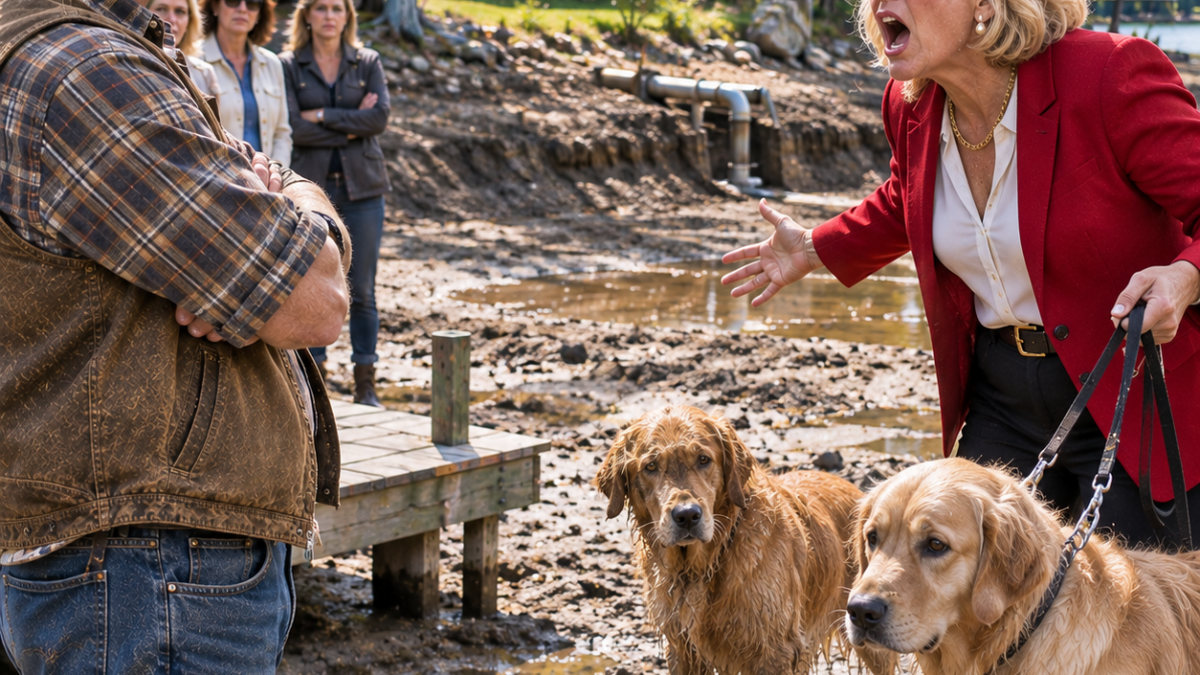
Karen’s two golden retrievers reached the end of my dock Saturday morning and stopped cold because the little fishing cove they had been swimming in for weeks was suddenly nothing but wet mud, exposed stones, and seven abandoned dog toys.
She demanded that I refill “our swimming spot” before her guests arrived—then a woman stepped out of a van holding a $40 receipt printed with a photograph of my dock and the words CEDAR COVE CANINE SWIM CLUB.
That was when I learned Karen hadn’t simply ignored my private-property signs; she had been charging strangers to use my lake, installing equipment on my shoreline, and telling customers that I personally approved every swim.
My name is Jack Mercer.
I was sixty-three when Karen Voss decided that my fishing cove belonged to everybody.
Not legally.
Not on paper.
Not according to any deed.
Just in the way certain people decide things belong to everybody once they personally want to use them.
My wife Susan and I lived on the south side of a small seven-acre lake.
The water itself, the lakebed, the shoreline around our house, and a shallow cove beside the dock were all part of our property.
My father had created the cove decades earlier.
It wasn’t simply a natural indentation in the shoreline.
He had built a low separating bank and a controlled opening connecting it to the deeper lake.
When the level was normal, it looked like a sheltered arm of the main water.
But it could be isolated and lowered for maintenance without draining the rest of the lake.
Dad had originally used it for raising young fish.
Bluegill.
Bass.
Occasionally catfish.
Later, I used it mostly for teaching children to fish.
My granddaughter Abby caught her first bluegill there.
Nine years old.
Pink tackle box.
Yellow life vest.
So excited she nearly dropped the rod into the water.
She painted a crooked yellow sun on the wooden rod holder beside my dock afterward.
I never fixed it.
That cove was where my family spent quiet afternoons.
Then Oak Hollow was built uphill from us.
Newer subdivision.
Large houses.
HOA-managed road.
Landscaped entrance.
PART2:
A grassy common area on the west side.
Their property stopped well short of the water.
My property was never part of their HOA.
Still, when Karen became president that spring, she asked whether residents could use a path through my north meadow to enjoy the lake view.
I said yes.
In writing.
Daylight walking only.
Dogs on leashes.
Stay on the marked path.
No fishing.
No swimming.
No access to the dock or cove unless somebody asked.
Simple.
I thought being reasonable would prevent trouble.
That’s often how trouble gets invited to stay longer.
The first problem happened while Abby was fishing.
She had been sitting quietly on the dock for twenty minutes.
Float barely moving.
Then Karen came down the path.
Two golden retrievers.
Neither leashed anymore.
PART3:
She held an orange throwing toy.
Before I could say anything, the first dog launched into the cove.
SPLASH.
The second followed.
Abby’s float disappeared under the waves.
She jerked backward.
“Grandpa, my hook!”
I grabbed the rod before the line wrapped around one of the dogs.
“Hold still.”
Karen laughed.
“They just need to cool off.”
“Don’t throw anything else.”
“I wasn’t going to.”
She absolutely was.
I reeled carefully.
Pulled the hook free.
Wrapped the line around the rod.
Then said:
“Call them out.”
Karen looked surprised.
“They’ll only be a few minutes.”
“This is a fishing area.”
“There’s plenty of lake.”
“Then use another part of it.”
She smiled.
“We all live here, Jack.”
“That doesn’t mean we all own the same things.”
The smile disappeared.
I pointed toward the path.
“This is private property.”
“They aren’t hurting anything.”
“They almost got caught on a hook.”
“They’re dogs.”
“Exactly.”
Abby whispered:
“Grandpa.”
I looked at her.
She looked worried.
Not angry.
She was staring at the dogs.
I lowered my voice.
“Karen, get them out.”
She finally called them.
Slowly.
As if leaving was a favor.
I walked with her to the path entrance.
Showed her the sign.
DOGS LEASHED.
WALKING PATH ONLY.
She said:
“I didn’t notice.”
Maybe.
I let it go.
Two days later, the dogs were back.
I heard splashing while repairing a chair on the porch.
By the time I reached the cove, one retriever was climbing onto the fishing platform.
Mud everywhere.
Karen waved.
“You aren’t fishing today.”
“That isn’t the rule.”
She looked across seven acres of water.
“There’s plenty of room.”
“There’s plenty of room in your yard too.”
She stared at me.
“I still wouldn’t walk into it because you weren’t using every square foot.”
She called the dogs.
Again slowly.
That evening, I emailed Karen.
Copied Linda Price, the HOA secretary.
Attached the original walking permission.
I wrote:
The permission is for daylight walking on the North Meadow Path only. Dogs must remain leashed. Swimming in the cove is not permitted. Please remind residents that the dock, cove, and shoreline are private.
Linda replied:
Received. I’ll remind everyone.
Karen didn’t reply.
For almost a week, nothing happened.
Then I found the blue plastic bin.
Bright blue.
Beside my dock.
Inside:
Three dog toys.
Dog shampoo.
Folded towels.
A rubber mat.
I photographed everything.
Texted Karen.
I found supplies at my dock. Please collect them by Friday. They can’t remain on private property.
Her answer came almost immediately.
Please leave the supplies where they are. They’re for the group.
What group?
People who use the lake.
I stared at the message.
I replied:
The bin will be in my open shed until Friday. After that, arrange another location.
Karen:
You’re making this unnecessarily unfriendly.
There was that word.
Unfriendly.
Over sixty years I’d learned that “unfriendly” often meant:
You stopped giving me what I wanted.
I’m not naturally good at saying no.
Susan will confirm that.
If somebody brings me a mower with a bad carburetor, I’ll spend three hours fixing a machine worth less than the parts.
If a neighbor asks for help with a trailer bearing, I’m under it before he finishes the sentence.
But Karen wasn’t bringing me something broken.
She was trying to wear down the word no.
The next visit happened while I was in town buying lumber.
Susan was home.
She saw Karen coming down the path with another woman.
Four dogs.
Susan stepped onto the porch.
“The cove is private.”
Karen waved a sheet of paper.
“Already discussed with the board.”
Susan knew enough not to argue.
She photographed them.
Then called me.
I came home to:
Wet paw prints.
Muddy dock boards.
Dog hair.
A broken wooden rod holder.
Abby’s rod holder.
The one with the crooked yellow sun.
I couldn’t prove which dog broke it.
Couldn’t prove a dog did.
Maybe a person stepped on it.
So I didn’t accuse anybody.
I photographed it.
Wrote down what Susan saw.
Then rebuilt it.
Abby watched me replace the cracked side.
“Can dogs get hurt on fishing hooks?”
“Yes.”
“That’s why they can’t swim here?”
“One reason.”
“Did you tell the lady?”
“Yes.”
She thought.
Then smiled.
“Put the sign lower.”
“Why?”
“So the dogs can read it.”
I laughed.
She painted another yellow sun.
By then, the cove already needed maintenance.
One dock support had shifted over winter.
Leaves and debris had collected near the shallow control opening.
I had planned to lower the cove later that month.
After the fourth dog visit, I moved the maintenance forward.
I won’t pretend otherwise.
I was tired of being ignored.
And yes—
I wanted Karen to arrive for her regular Saturday swim and discover there was no water there.
But wanting that satisfaction didn’t mean I was going to drain a pond irresponsibly.
I called Ray Holloway.
He’d maintained the control structure before.
Ray reviewed Dad’s old maintenance drawings.
Came out.
Inspected the cove.
I contacted the county office that had handled prior work.
I explained exactly what I planned:
Temporarily isolate the shallow cove.
Lower only that section.
Keep the main lake unchanged.
Move fish safely.
Repair dock support.
Clear accumulated debris.
They told me what documentation was needed.
I supplied it.
Wednesday, I sent written notice to Karen and Linda.
COVE CLOSED FOR MAINTENANCE BEGINNING FRIDAY.
KEEP PEOPLE AND ANIMALS AWAY FROM THE DOCK AND EXPOSED BOTTOM.
Linda:
Received.
Karen:
You cannot close a shared amenity without consulting residents.
I answered:
It is not a shared amenity. The walking permission does not authorize use of the cove.
Then I stopped arguing.
Friday morning, Ray arrived with his helper.
We worked slowly.
As the water dropped, they checked for fish.
Fish were moved into the main lake.
No mass of fish flopping in mud.
No dirty water dumped into somebody else’s creek.
No sudden flood.
The main lake stayed at its usual level.
The entire job cost me $780 before the dock repair itself.
Susan looked at the invoice.
“Expensive way to make a point.”
“Needed the maintenance.”
“And?”
I sighed.
“And make a point.”
She smiled.
“At least you’re admitting it.”
By Friday afternoon, the cove was empty.
Wet mud.
Stones.
Branches.
The old shallow shelf beneath the dock.
Seven dog toys.
Ray stopped counting after that.
Then he found something I hadn’t installed.
A ramp.
Two lengths of plastic track with rubber on top.
It ran from the shoreline toward what had been the waterline.
Mostly invisible when the cove was full.
Ray lifted one edge.
Screw holes.
Short timber underneath.
“This yours?”
“No.”
“You know whose?”
“No.”
We photographed it.
Left it alone.
I wasn’t about to rip out somebody else’s equipment before documenting it.
Temporary barrier went across the dock.
Soft mud is dangerous.
Especially for animals and children.
Saturday morning, I put a chair near the path.
At 9:00 sharp, Karen arrived.
Two dogs.
Orange toy.
The retrievers pulled toward the dock.
Stopped.
The water was gone.
Karen stared.
Below her:
Mud.
Tennis balls.
Old stones.
Fish-rearing shelf.
Plastic ramp.
“What did you do?”
“Maintenance.”
“To our swimming spot?”
I looked at her.
“Your swimming spot?”
“You know what I mean.”
“No. I don’t.”
She lowered her voice.
“You need to fill it.”
“No.”
“Now.”
“No.”
“People are coming.”
That got my attention.
“What people?”
A van rolled down the lane.
Woman stepped out.
Older black Labrador.
Towels under one arm.
Printed receipt in the other.
Karen’s face changed.
The woman looked at the empty cove.
Then at Karen.
“What’s going on?”
Karen said:
“Maintenance issue.”
The woman looked toward my posted notice.
“Didn’t you know?”
Karen didn’t answer.
I asked:
“Ma’am, what’s your name?”
“Beth.”
“You were expecting to swim your dog here?”
“Yes.”
“How much did you pay?”
Karen stepped between us.
“Jack.”
Beth answered anyway.
“Forty dollars.”
I thought I’d misheard.
“Forty?”
“For a supervised swim.”
Karen said:
“I’ll handle this.”
Beth held out her receipt.
“I booked online.”
At the top was a photograph.
My dock.
My cove.
Below:
CEDAR COVE CANINE SWIM CLUB.
My stomach went cold.
I asked:
“May I photograph that?”
Beth looked at Karen.
Then me.
“Sure.”
Booking time.
$40.
Karen’s personal payment account.
Private dog swim.
Quiet water.
Easy-entry ramp.
I pointed toward the exposed ramp.
“You installed that?”
Karen crossed her arms.
“It’s removable.”
“That’s not what I asked.”
“It helps older dogs.”
“On my land.”
“Jack, please don’t do this in front of customers.”
Customers.
First honest word she’d used.
Not neighbors.
Not residents.
Customers.
Another car pulled in.
Then another.
Beth’s black Lab sat quietly beside her.
Old dog.
Stiff back legs.
I felt bad for her.
And for Beth.
She had paid for something she believed was legitimate.
I brought the dog a bowl of water.
Beth thanked me.
“His hips aren’t good.”
“I can see.”
“The ad said this place was designed for older dogs.”
“Designed?”
She opened the booking page.
I read.
Approved HOA canine swimming facility.
Quiet private cove.
Managed water conditions.
Landowner-supported program.
Then my name.
JACK MERCER — SITE OWNER / WATER SAFETY SUPPORT.
I read it twice.
“Beth.”
“Yes?”
“Would you send this page to me?”
“Why?”
“Because I never approved any of it.”
Her expression changed.
Karen said:
“I can remove your name.”
I turned.
“You used my name to sell visits.”
“It was administrative.”
“After I told you to stop bringing dogs.”
“The board approved the program.”
“Then show me what they approved.”
Karen looked away.
By noon, the customers had left.
Karen collected her blue bin.
Linda called.
“I think we need to meet.”
“Good.”
“I saw the booking page.”
“Did the board approve a dog business?”
Pause.
“Yes.”
“On my land?”
“We were told there was an arrangement.”
“What arrangement?”
“Karen said you wanted the association handling visitors.”
I looked at the mud.
“Linda, I’ve been telling Karen to stop.”
“I know that now.”
“What exactly did you approve?”
She emailed the invoice.
Ramp.
Proposed permanent fence.
Gravel dog-washing area.
Gate.
Deposit.
The drawing shocked me.
The fence line would run around the cove.
Across the path between my house and dock.
My bench inside.
Abby’s fishing area inside.
Access-controlled gate at the entrance.
I zoomed.
Note:
CANINE AREA ACCESS CONTROL.
“They were going to fence me out of my own dock.”
Susan stood behind me.
Read it.
Then said:
“Someone measured this.”
She was right.
We walked outside.
Orange marks on two trees.
Hidden behind stacked boards.
A wooden stake near the shed.
Pink ribbon.
I thought Ray had installed it.
Called him.
“Not mine.”
“You sure?”
“I don’t use pink flagging.”
That small answer changed everything.
While I thought I was arguing with Karen about dogs—
Somebody had been planning construction on my property.
I called the contractor listed on the HOA invoice.
“Bill?”
“Yes?”
“My name’s Jack Mercer.”
Pause.
“Cedar Cove?”
“I own it.”
“Okay.”
“You’re scheduled to build a fence Tuesday?”
“Yes.”
“You do not have permission.”
Long silence.
“We were told you were the property partner.”
“No.”
“Karen said—”
“I’m sending you documents.”
I sent:
Walking agreement.
No-swimming emails.
Maintenance closure.
Fence drawing.
Twenty minutes later Bill called.
“Job stopped.”
“Thank you.”
“I’m not setting posts while the owner is disputing permission.”
“Did your crew install the ramp?”
“No.”
“Gravel?”
“No. That was already there when we measured.”
“Who installed it?”
“Karen said she handled the preliminary entry area.”
Beth later sent screenshots.
More photographs.
My cove.
Multiple days.
Different dogs.
Private sessions.
Group sessions.
Package pricing.
A woman standing in the water beside an old shepherd.
Three dogs lined up near the ramp.
My vegetable beds in the background.
Open door of my shed visible.
That bothered me more than I expected.
I had been home during some sessions.
I’d heard dogs.
Assumed Karen was ignoring me again.
I hadn’t realized strangers were paying money to stand yards from my house.
Then Linda sent the board proposal.
CEDAR COVE CANINE SWIM PROGRAM.
New source of HOA revenue.
Karen manages bookings.
Association receives portion.
HOA pays initial improvements.
One condition:
WRITTEN LANDOWNER PERMISSION AND APPROPRIATE INSURANCE REQUIRED BEFORE OPENING.
I called Linda.
“Where’s my permission?”
Silence.
“Linda.”
“Karen said the file was complete.”
“Did you see the permission?”
“No.”
“Then the file wasn’t complete.”
“I understand.”
“You spent HOA money anyway.”
“Yes.”
I didn’t yell.
Didn’t need to.
“What happens now?”
“We suspend the program.”
“Good.”
The suspension notice arrived.
Due to unexpected water-management circumstances, Cedar Cove activities are temporarily paused.
I wrote back:
The water level is not the reason you lack permission. Refilling the cove will not give you permission.
Susan read it.
“Keep that sentence.”
I did.
Monday morning, I met attorney Anne Porter.
I brought everything.
Walking permission.
Emails.
Booking screenshots.
Board proposal.
Construction invoice.
She started with the original written agreement.
“Walking.”
“Yes.”
“Daylight.”
“Yes.”
“Dogs leashed.”
“Yes.”
“No dock access?”
“No.”
“Swimming?”
“No.”
“Paid events?”
“No.”
“Construction?”
“No.”
“Any later verbal agreement?”
“No.”
“Any money paid to you?”
“No.”
She looked through Karen’s messages.
Stopped at:
THE SUPPLIES ARE FOR THE GROUP.
Anne tapped it.
“She had an opportunity to tell you this was a paid program.”
“She didn’t.”
“That matters.”
She sent cease-and-desist demands.
Stop advertising.
Stop using my name.
Stop entering the cove.
Preserve booking records.
Preserve customer communications.
Preserve financial records.
Meanwhile, more customers began calling.
Carol had purchased six swims.
Her dog Rusty had arthritis.
“Will the cove reopen?”
“Yes, eventually.”
“For the club?”
“No.”
“Even after maintenance?”
“I never approved the club.”
Silence.
“My husband thought something was strange.”
“What?”
“Karen told us never to approach your house.”
“Why?”
“She said you preferred to stay out of the daily operation.”
That explained a lot.
Customers had been told not knocking was respectful.
Karen had created a barrier between them and the person who could expose her story.
Carol said:
“I almost brought you a thank-you card.”
“For what?”
“Letting Rusty use the cove.”
I sat in my truck for several minutes after the call.
These weren’t trespassers knowingly invading my property.
Most thought I welcomed them.
That made me angrier at Karen.
And less angry at them.
Ray returned to inspect the dock.
He showed photographs taken before the drawdown.
Ramp already present beneath the water.
And pale gravel.
A manufactured entry bed.
Someone had altered the shoreline.
Anne received the photographs.
Then I got a call from the county.
Environmental officer.
Mr. Hayes.
“We received a complaint concerning improper drainage of a commercial dog swimming facility.”
I laughed once.
Not because it was funny.
“I’m not operating a dog swimming facility.”
“Our paperwork lists you as operator.”
“What paperwork?”
“Facility information sheet.”
Carol’s email arrived while we spoke.
Same document.
Cedar Cove Canine Swim Club.
Karen Voss — Booking Manager.
Jack Mercer — Site Owner and Water Safety Operator.
Then:
Owner approved dog-entry ramp.
Owner maintains swimming area.
Owner checks water before every session.
False.
Every word.
Mr. Hayes asked to inspect.
“Absolutely.”
Anne told me:
“Don’t treat him like the enemy.”
“I won’t.”
“Don’t say nothing is wrong before he looks.”
“Okay.”
“Separate what you did from what Karen did.”
That became the most useful advice of the entire fight.
I made a timeline.
Date.
Action.
Evidence.
Walking permission.
First dog incident.
Email refusal.
Bin.
Four-dog visit.
Maintenance notice.
Ray’s work.
Paid customers.
Ramp.
Fence invoice.
Then a separate list:
WORK I DID NOT AUTHORIZE.
Ramp.
Added gravel.
Fence.
Dog-wash area.
Business listing.
My name as operator.
Susan reviewed it.
“You wrote ramp installed Tuesday.”
“Yes.”
“You know that?”
I stopped.
No.
I knew it appeared in a photograph by Tuesday.
Different thing.
I changed the wording.
RAMP PRESENT BY TUESDAY.
Susan smiled.
“You’re learning.”
“I hate paperwork.”
“No. You hate other people’s paperwork.”
Fair.
Bill sent the contractor file.
One photograph showed the ramp and pale gravel before Ray’s maintenance.
Bill had written:
Spread remaining gravel?
Karen’s response:
NO. ENTRY AREA ALREADY COMPLETED. REMAINING MATERIAL FOR WASH STATION.
There it was.
County inspection Thursday.
Mr. Hayes arrived.
Ray came too.
We started inside.
Maintenance plan.
County correspondence.
Fish transfer photos.
Closure notice.
Why had I moved maintenance earlier?
I answered truthfully.
“Dock needed repair.”
“And?”
“And Karen kept bringing dogs after I told her not to.”
Mr. Hayes wrote it.
I added:
“I wanted the cove empty when she came Saturday.”
He looked up.
“Retaliation?”
“No. Maintenance I already needed, done sooner because I was tired of the swimming.”
He wrote that too.
No hiding.
Outside, Ray explained every step.
Main lake unchanged.
No off-property discharge.
Fish moved safely.
No dead fish.
No erosion plume.
No rushed emptying.
Then Hayes examined the gravel.
Ramp.
Added material.
Contractor photo.
Karen email.
He said:
“Leave this area alone until review.”
“Can I refill?”
“Not yet.”
That hurt.
My one-Saturday point had turned into a longer closure.
Abby’s fishing spot remained mud.
But if I wanted the county to distinguish my work from Karen’s, I had to let them inspect both.
Hayes examined the customer sheet.
Then my refusal emails.
“These came before the paid sessions?”
“Yes.”
“No later permission?”
“No.”
He copied them.
Anne later warned me:
“This wasn’t a complete clearance.”
“I know.”
“The maintenance evidence helped.”
“Yes.”
“The ramp and gravel still need resolution.”
“I know.”
Every answer seemed to create another task.
But each task was smaller.
Carol visited Friday.
Asked first.
No swim.
Rusty walked slowly beside her.
She showed me a photograph.
Karen beside the ramp.
Green hose from my outside faucet to a plastic tub.
“Dog washing?”
Carol nodded.
“Karen said you supplied the water.”
My hose.
My faucet.
Behind my shed.
I suddenly understood why the hose kept ending up somewhere other than where I left it.
Carol looked embarrassed.
“I should’ve knocked.”
“You were told not to.”
“I still feel foolish.”
“So do I.”
She handed me the original facility sheet.
Then said:
“Please don’t stop letting people be good to you because she wasn’t.”
That sentence stayed with me.
Monday, the county issued preliminary findings.
The planned cove maintenance was properly documented.
No evidence required immediate refilling.
The added dog-entry area required correction before normal use.
And most importantly:
The business-operator information was disputed and should not be treated as my admission that I operated Cedar Cove Canine Swim Club.
I read that line twice.
Then Susan read it.
Anne sent the letter to Oak Hollow.
Demanded immediate correction.
Special board meeting scheduled Wednesday.
Before the meeting, the gravel supplier’s records came through counsel.
Delivery ordered by Karen.
HOA project.
My address.
No order from me.
No signature from me.
The chain was complete.
Then Karen sent me an offer.
She would arrange removal of the ramp and gravel.
In exchange, I would sign a statement saying:
The canine swim program had originally been authorized by Jack Mercer and was now being terminated by mutual agreement.
I forwarded it to Anne.
Susan read over my shoulder.
“She wants you to make the lie true after the fact.”
“Yes.”
Wednesday night, the clubhouse was packed.
Residents.
Customers.
Board members.
Linda.
Treasurer Paul.
Board member Denise.
Karen sat with a notebook.
She began:
“This situation resulted from unfortunate communication failures.”
I waited.
Then placed the original walking agreement on the table.
Linda read aloud:
Daylight walking.
Dogs leashed.
No swimming.
No dock use without permission.
Karen said:
“That was written before the program.”
Denise asked:
“Then where is the program permission?”
Karen looked at me.
“Jack allowed neighborhood access for years.”
I said:
“The path.”
“Which led to the lake.”
“Not the same thing.”
“It was understood—”
“No.”
The room quieted.
“No paid dog business.”
Paul held up the facility sheet.
“Why is Jack listed as water safety operator?”
Karen said:
“Every site needed a responsible owner contact.”
Linda replied:
“This doesn’t say contact.”
She read:
Owner inspects swimming conditions before each session.
Karen said:
“Standard wording.”
I put the county letter beside it.
“That standard wording sent an environmental officer to my house asking about a business I didn’t know existed.”
Karen looked down.
Then construction records.
Ramp.
Gravel.
Fence.
Gate.
Wash area.
HOA money.
Written permission required.
Permission never received.
Denise asked Linda:
“Was there ever a signed authorization?”
“No.”
Karen finally said:
“I intended to formalize it once we knew the program worked.”
That sentence changed the room.
Paul leaned back.
“So you opened first.”
Karen frowned.
“It was a pilot.”
“On property you didn’t own.”
“No one was harmed.”
I took out her settlement proposal.
“Is that why you asked me Monday to sign a statement saying I had authorized it?”
Karen reached toward the paper.
Stopped.
“I was trying to resolve the dispute.”
“You were asking me to accept responsibility for something I refused.”
A customer stood.
“What about refunds?”
Karen answered:
“We can discuss that once the landowner dispute is settled.”
Paul closed his notebook.
“No.”
Karen turned.
“No?”
“Customer refunds are separate.”
He held up HOA invoices.
“The association paid deposits for improvements.”
Then pointed toward Karen.
“Customers paid your personal account.”
Karen’s face tightened.
“I’ve been covering expenses.”
“Which expenses?”
Silence.
Linda pulled out one final email.
The original volunteer who created the facility sheet had asked Karen:
Should Jack really be listed as water safety operator? He isn’t present for sessions.
Karen’s reply:
USE JACK. IT’S HIS POND, SO ANYTHING INVOLVING THE WATER BELONGS UNDER HIS NAME.
Linda read it twice.
Then looked at Karen.
“You didn’t forget to get permission.”
Karen said nothing.
“You put his name on the liability side while you kept the booking money.”
Karen finally said:
“That’s out of context.”
Linda slid the full email across.
“Then read the context.”
Karen didn’t touch it.
The old wall fan hummed.
Nobody spoke.
I’d imagined this moment.
In my imagination, I always had some great line.
Something sharp.
Instead I said:
“I didn’t check your customers’ water.”
Karen looked at me.
“I didn’t approve your ramp.”
Nothing.
“I didn’t build your swimming area.”
Still nothing.
“You knew that.”
Karen said:
“Somebody had to be responsible for the property.”
Denise answered:
“You were told not to use the property.”
That was it.
Every other argument collapsed against that sentence.
Maybe dogs benefited.
Maybe older animals enjoyed swimming.
Maybe neighbors liked it.
Maybe it raised money.
Maybe nobody intended physical harm.
None of that created permission.
Paul asked for booking records.
Karen refused.
“Personal account.”
Paul stared.
“You advertised an HOA program.”
“The bookings were my responsibility.”
“We paid for construction.”
“Initial expenses.”
“You promised HOA revenue.”
“Eventually.”
“So it’s association business when we pay bills and personal business when you receive money?”
No answer.
Linda moved to terminate the program.
Cancel bookings.
Require accounting.
Correct customer notices.
Three to one.
Karen voted against.
Then Denise moved to remove Karen as HOA president.
Not her elected board seat—that required member action.
But her officer position.
Three to one.
Karen’s hand remained raised alone.
She shut her notebook.
“You’ll find out how much work I did.”
Paul said:
“Right now we’re finding out what it cost.”
Karen left.
I stayed.
Because the cove still wasn’t fixed.
Linda became acting president.
She asked:
“What needs to happen?”
I showed the county letter.
Ramp removed under approved plan.
Added gravel corrected.
Dock repair separately.
My name removed from all business materials.
Customers told I had never authorized or operated the club.
Paul suggested volunteers remove the gravel.
“No.”
He looked surprised.
I explained:
“We’ve had enough people showing up with tools before checking.”
He nodded.
“Fair.”
Ray prepared the removal plan.
County reviewed it.
HOA paid.
Ramp came out in sections.
Loose screws collected.
Added gravel removed carefully without digging into the original bottom.
No buried secret.
No dramatic contamination.
Just my old cove—
Altered by people who hadn’t asked.
That was enough.
Follow-up inspection cleared the correction.
The county file distinguished:
My maintenance.
Karen’s additions.
My property ownership.
Her business.
No penalty against me.
Then the water could return.
Refunds took longer.
Beth received her $40.
Carol received unused package money.
Other customers worked through the HOA and insurer.
I stayed out of payment disputes except for one condition:
No refund could depend on me reopening the cove.
Anne put it in writing.
Karen’s attorney tried once more.
Draft settlement:
Program terminated by mutual consent.
Anne deleted it.
Replaced with:
Jack Mercer did not authorize the paid swim program, ramp, gravel entry area, proposed fencing, or use of his name as operator.
That was the truth.
We settled.
My legal bill:
$1,275 total.
Karen reimbursed it under the agreement.
I did not demand reimbursement for my $780 maintenance job.
I had planned that work anyway.
I moved it forward.
I wasn’t going to turn a real dispute into an excuse to bill somebody for everything in my life.
The HOA covered costs tied to unauthorized additions.
Karen resigned from the board before the next member meeting.
Linda presented the full record.
Not just Karen’s mistakes.
The board’s too.
They had approved spending before confirming the first required condition:
Written property-owner permission.
New policy passed.
If HOA money was used on property outside association ownership, actual written permission had to be in the file first.
Not:
Karen said it’s coming.
Not:
We think the owner agreed.
The document.
I changed things too.
The North Meadow Path stayed open.
I could have closed it.
Didn’t.
Walking was never the problem.
I added a clear boundary marker near the cove.
Small gate to the dock path.
Sign:
PRIVATE FISHING COVE
NO DOG SWIMMING
The HOA received the original walking agreement again.
Linda sent it to residents exactly as written.
No “shared amenity.”
No “community access facility.”
Just permission.
Limited.
Revocable.
Clear.
Several neighbors apologized.
One said:
“We heard you drained it just to punish Karen.”
I answered:
“The timing was partly because of Karen.”
He looked surprised.
I continued:
“I was angry.”
Then:
“I also used a contractor, moved the fish, kept the main lake stable, filed the paperwork, and warned everyone before the work.”
Susan later said:
“That’s the first time you told the story without trying to sound like a saint.”
“I never said I was a saint.”
“You implied excellent self-control.”
“I had excellent paperwork.”
“That I’ll give you.”
Once Ray repaired the support and county cleared everything, we refilled the cove under the maintenance plan.
I stood beside the dock.
Water crept slowly across the bottom.
First it covered the pale stone shelf.
Then the muddy section beneath the bench.
Then the place where the illegal ramp had been.
By late afternoon, reflections returned.
Dock posts in water.
Trees upside down in the surface.
I hadn’t realized how much I’d missed it.
Ray handed me the final paperwork.
“Keep this.”
“I will.”
I started a new folder.
COVE.
Susan saw the label.
“Next time you’ll know where everything is.”
“There won’t be another dog club.”
“There’ll be something.”
She was right.
The lesson wasn’t that I could prevent every foolish idea.
It was that I had confused patience with permission.
Karen tested one boundary.
Nothing happened.
Then another.
Then another.
One dog swim became four dogs.
Four dogs became supplies.
Supplies became equipment.
Equipment became customers.
Customers became construction plans.
Construction plans became a fence around my own dock.
Every step was small enough that arguing about it felt petty.
Until the steps became a business.
Carol came by one week later.
Rusty stayed home.
She brought me a photograph of him sleeping with his chin on the edge of his water bowl.
On the back she had written:
NO MEMBERSHIP REQUIRED.
I put it on the refrigerator.
I didn’t hate dogs.
Never did.
The dogs were never the problem.
Abby understood that better than most adults.
When she first saw the empty cove, she asked:
“Did the dogs do something bad?”
“No.”
“They just went where the lady took them?”
“Yes.”
She nodded.
Simple.
Karen brought them.
Karen brought customers.
Karen installed equipment.
Karen used my name.
Blame belonged with decisions.
Not animals.
Not customers who had been deceived.
The following Saturday, Abby came fishing.
Water back.
Rod holder repaired.
Yellow sun visible.
She ran one finger over the paint.
Then looked into the cove.
“Are the fish back?”
“Some will come in.”
“What about my bluegill?”
“I don’t know which one was yours.”
She frowned.
“It had stripes.”
“Most bluegill do.”
“I’d know him.”
“Of course you would.”
Susan brought sandwiches.
Sat on the green bench.
Abby and I lowered lines.
No towels on the dock.
No rubber ramp.
No customers.
No woman calling my cove an HOA amenity.
Just water.
Wind.
Fishing line.
After twenty minutes, Abby’s float dipped.
She yanked too fast.
Missed.
I laughed.
“Slow.”
“I was slow.”
“You tried to launch the fish into Tennessee.”
She grinned.
Reset.
We waited.
That’s what fishing teaches better than most things.
You don’t improve every situation by forcing it.
Sometimes you wait.
Sometimes you watch.
Sometimes you act.
But you should know which one you’re doing.
People later heard the story and focused on the draining.
“You drained the lake on her?”
No.
The cove.
Separate section.
“Because she swam dogs there?”
Partly.
“Just to get revenge?”
No.
I moved scheduled maintenance forward.
Properly.
“You knew she’d show up?”
Absolutely.
“Did you enjoy her face?”
I am not going to lie at sixty-three.
Yes.
For approximately five seconds.
Then Beth showed me that receipt.
And it stopped being funny.
Because I realized strangers had paid money based on my supposed approval.
If Rusty slipped on the ramp—
My name.
If a dog got hooked—
My property.
If someone fell off the dock—
My name.
If the added gravel affected water quality—
My name.
Karen had taken the profit and assigned the responsibility to me.
That was the part I couldn’t shrug off.
Her email eventually explained it perfectly.
USE JACK.
IT’S HIS POND, SO ANYTHING INVOLVING THE WATER BELONGS UNDER HIS NAME.
That sentence told me everything.
She understood ownership when ownership created liability.
She just refused to understand ownership when it limited her access.
That contradiction was the entire dispute.
When she wanted the water:
Shared amenity.
When something might go wrong:
Jack’s pond.
When customers paid:
Karen’s account.
When construction bills arrived:
HOA project.
Convenient definitions.
Changing depending on who benefited.
The new board learned from it.
So did I.
Permission needs boundaries.
And boundaries need enforcement before somebody turns your kindness into precedent.
I still let people walk the North Meadow Path.
Kids wave from the trail.
People stop and look at the lake.
Sometimes residents ask:
“Can my grandson fish?”
If I’m home and the timing works?
Usually yes.
Someone once asked:
“Can my dog swim?”
I looked at the Labrador.
Then at the fishing cove.
“No.”
The woman said:
“Okay.”
That was it.
No meeting.
No lawyer.
No drained pond.
No invoice.
She asked.
I answered.
That’s how most property disputes should end.
Years later, the little stone shelf where Abby caught her first bluegill is still beneath the water.
The dock support is solid.
The green bench is faded again.
I should repaint it.
Susan says I won’t because I like complaining about it.
She’s probably right.
The blue plastic supply bin is gone.
The ramp is gone.
The fence was never built.
Cedar Cove Canine Swim Club disappeared.
Karen’s booking page disappeared.
My name disappeared from every document connected to it.
That’s the part I’m proudest of.
Not draining the cove.
Not embarrassing Karen.
Not winning a board meeting.
Getting the record corrected.
Because once somebody uses your name to promise safety, responsibility, or consent—
You can’t leave that lie sitting there just because the argument is unpleasant.
That Saturday morning began with two golden retrievers standing at the end of my dock staring at mud where water had been the day before.
Karen looked at me and asked:
“What did you do to our swimming spot?”
The answer was simple.
I maintained my cove.
The harder question was what she had done while it was full.
She had taken a walking permission and stretched it into swimming.
Then stretched swimming into a group.
Then stretched the group into paying customers.
Then stretched customers into construction.
Then put my name on the paperwork when somebody needed to be responsible.
Draining the cove didn’t create that problem.
It exposed it.
Quite literally.
First the water disappeared.
Then the dog toys appeared.
Then the hidden ramp.
Then the added gravel.
Then the receipts.
Then the fence plan.
Then the customer sheet.
Then Karen’s email.
Every inch the water dropped revealed something else she had hoped I would never see.
By the time the cove filled again, there was nothing left underwater except mud, stone, fish habitat—
And my own property.
Exactly where it had always been.








