HOA Karen Tried to Tow My Boat After Its Tires Went Flat Every Tuesday for 9 Weeks—Then I Asked Her to Show the Inspector Her Hands
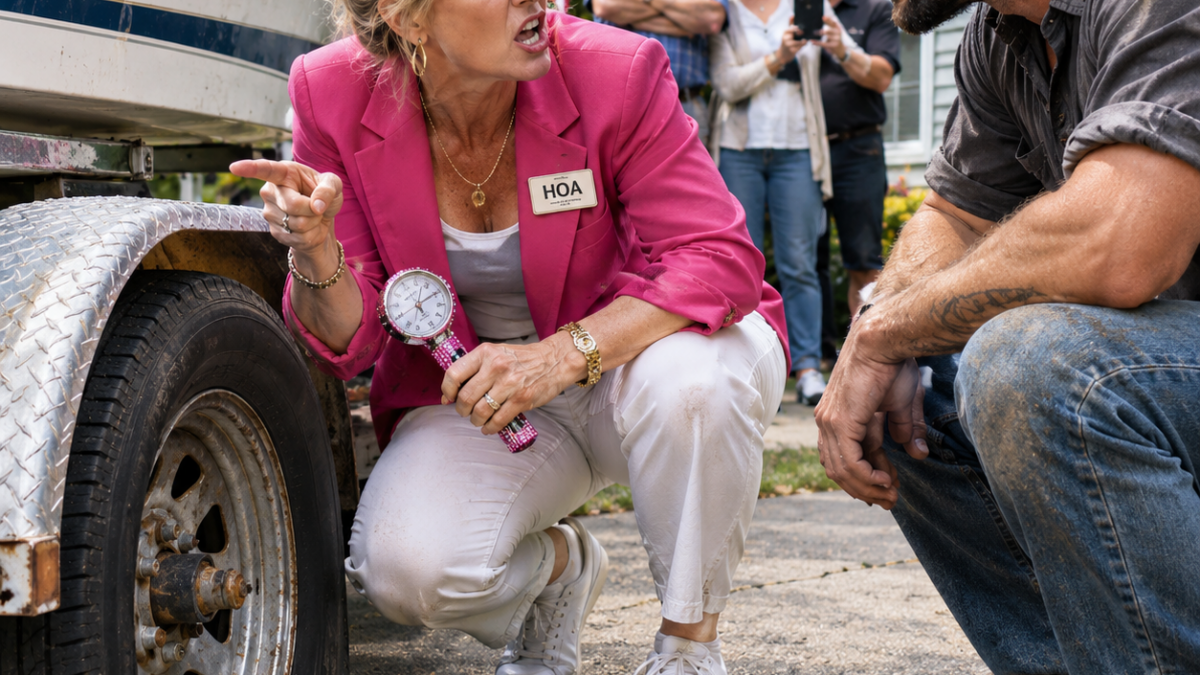
HOA Karen Tried to Tow My Boat After Its Tires Went Flat Every Tuesday for 9 Weeks—Then I Asked Her to Show the Inspector Her Hands.
For nine straight Wednesdays, I woke up to find all four tires on my registered boat trailer sitting flat against the concrete, and every single time HOA violations chair Sheila Thornbury somehow appeared at my driveway before breakfast with a fresh orange notice already printed.
On the tenth morning she called county code enforcement in front of half the cul-de-sac, laughed when I said somebody had been sabotaging the trailer, and demanded that my skiff be dragged away as “abandoned junk” before I could put air back in the tires.
Then I pulled a thumb-sized ultraviolet flashlight from my shirt pocket and quietly asked Sheila to hold out both hands—and the moment her smile disappeared, I knew the nine flat tires were only the first thing I was finally going to understand about what she had been doing in Bayberry Cove.
“FOUR FLAT TIRES MEANS IT’S ABANDONED JUNK, AND I WANT IT DRAGGED OUT TODAY!”
That was Sheila Thornbury at 7:03 on a Wednesday morning.
She was crouched beside the starboard wheel of my boat trailer wearing white sneakers, navy slacks and a pale pink windbreaker zipped all the way to her throat even though the Maryland humidity had already started climbing.
In one hand she held a tire-pressure gauge decorated with pink rhinestones.
In the other, an orange HOA violation notice.
My twenty-foot aluminum skiff sat exactly where it had sat for the previous eleven months.
On the concrete pad beside my garage.
Inside my deeded property line.
Trailer registration current.
Boat registration current.
Insurance current.
No sidewalk blocked.
No drainage ditch obstructed.
No neighbor’s sightline affected.
And all four trailer tires were sitting flat to the rims.
Again.
I stood at the edge of my garage holding a mug of coffee.
“Morning, Sheila.”
She looked up.
“Do not patronize me.”
“Did you bring a tow truck this time?”
Sheila straightened.
“Don’t get cute, Colton.”
I glanced at the tires.
“Trying not to.”
She held up the orange notice like a prosecutor presenting Exhibit A.
“Section fourteen.”
“What about it?”
“Inoperable vehicles.”
“It’s a boat trailer.”
“Inoperable.”
“It was operable yesterday.”
“Today it has four flat tires.”
“Funny how that keeps happening.”
Sheila smiled.
Not a friendly smile.
One of those smiles people use when they believe they have created a problem you cannot prove they created.
“Maybe you should maintain your property.”
“I do.”
“Clearly.”
She kicked the nearest tire.
The rubber compressed against the concrete.
“Registered junk is still junk.”
I set my coffee on the workbench just inside the garage.
“Take your foot off my trailer.”
“I’m inspecting.”
“You’re kicking.”
“I’m allowed to verify violations.”
PART2:
“No, you’re allowed to photograph visible conditions from common property if the covenants authorize it. You are standing three feet inside my lot.”
Her expression changed slightly.
That irritated her.
Not because I was wrong.
Because I knew enough to say it.
Sheila Thornbury had lived in Bayberry Cove longer than I had.
Eleven years.
I had been there four.
Bayberry Cove sat outside a small Chesapeake tributary community in Maryland where half the houses had crab pots stacked behind sheds and the other half had signs telling the first half where crab pots were allowed to be stacked.
Forty-eight detached homes.
No clubhouse.
No pool.
No gate.
No golf course.
The HOA’s actual responsibilities were landscaping at the entrance, stormwater swales, a short stretch of common fence and enforcement of architectural rules written sometime around 2006.
That should have made the association boring.
Sheila did not believe in boring.
She had served on the compliance committee for six years and chaired it for three.
She treated the covenants the way some people treat scripture.
Except she quoted only the passages useful to her.
PART3:
Trash can visible from street?
Notice.
Fence stain slightly too dark?
Notice.
Contractor van parked overnight?
Notice.
Holiday lights still up January fifteenth?
Notice.
A fourteen-year-old girl’s chalk drawing on her own driveway had once generated a two-page warning about “temporary exterior markings.”
Sheila called all of this protecting property values.
Her neighbors called it Sheila being Sheila.
I had mostly stayed out of her way.
Mostly.
I was thirty-six and worked as a structural welder and fabricator.
Railings.
Marine brackets.
Custom gates.
Repair work.
Commercial stairs.
Anything steel or aluminum somebody needed joined permanently.
I worked dirty.
I came home dirty.
My truck looked like a work truck.
My garage looked like a garage where actual work happened.
And my skiff looked like a skiff used by somebody who fished rather than photographed boats for a brochure.
Sheila disliked all three.
The skiff was a 2008 aluminum center-console with a seventy-five-horse outboard.
Ugly in a reliable way.
I had rebuilt the trailer bunks myself.
Replaced the bearings.
Rewired the lights.
Added galvanized brackets.
The entire trailer had been inspected the previous spring.
The tires were less than two years old.
And for nine consecutive weeks, the same impossible thing happened.
Tuesday evening:
Four tires inflated.
Wednesday morning:
Four tires flat.
Not punctured.
Not cut.
Flat.
Valve caps loosened.
Air gone.
The first week, I thought coincidence.
The second week, I blamed a bad valve.
I removed the wheels and took all four tires to a shop.
They submerged them.
Checked beads.
Valve stems.
Sidewalls.
No leaks.
I replaced all four valve cores anyway.
Wednesday number three:
Flat.
I began taking photographs.
Monday night.
Tuesday night.
Wednesday morning.
Time stamps.
Pressure readings.
Valve caps.
The fourth week, Sheila’s violation notice appeared before I had even pulled the compressor hose out.
That bothered me.
The fifth week, she emailed the HOA board at 6:41 a.m. with photographs of the flat tires.
I knew because the board copied me.
The sixth week, she threatened a nuisance hearing.
Seventh:
She sent a certified letter saying the association could begin daily fines.
Eighth:
She accused me in front of two neighbors of “running an illegal repair yard.”
I repaired nothing commercial at home.
Ninth:
I missed the start of a railing installation because I spent forty minutes reinflating and checking every tire before towing the skiff to a marine mechanic who found exactly nothing wrong.
That afternoon I called the county sheriff’s non-emergency number.
Deputy Lena Ortiz took the report.
She was maybe forty.
Dark hair tied back.
Calm voice.
The kind of deputy who seemed disappointed whenever people hoped she would turn neighborhood stupidity into a television arrest.
She looked through my photographs.
“Nine Tuesdays?”
“Nine.”
“Any camera?”
“My driveway camera sees the boat but not the valve stems.”
“Anyone visible?”
“People walking. Cars. Nothing clear.”
“Conflict with neighbors?”
“One.”
She looked at me.
“The HOA woman?”
“You’ve met her?”
“No.”
“But you made a face.”
“I’ve worked this county eleven years.”
That told me enough.
I asked what I could legally do.
She told me what not to do first.
No confronting anyone in the dark.
No trip wires.
No hidden spikes.
No electrified anything.
“No paint bombs?”
She stared.
“That was a joke.”
“Good.”
“Because you said that very quickly.”
Then she suggested better lighting, repositioning the camera if possible, keeping a pressure log, and using a harmless commercial ultraviolet property-marking powder around the outside of the valve-stem caps.
She stressed one thing twice.
“It does not prove who deflated the tires.”
“I understand.”
“It proves contact.”
“Right.”
“People touch things for innocent reasons.”
“Understood.”
“If somebody shows up with powder on them, call us. Don’t grab them. Don’t accuse them of committing a crime based on a glow.”
“I’m a welder, Deputy. I don’t arrest people.”
“You would be amazed how many citizens discover law enforcement careers at two in the morning.”
So Tuesday night, I checked every tire.
Forty-eight PSI.
Photographed the gauge.
Photographed the valve caps.
Applied a trace amount of ultraviolet powder where someone manipulating the caps would likely pick it up.
Then I went inside.
I did not watch the driveway all night.
That part mattered to me.
I was already allowing Sheila too much room inside my schedule.
Wednesday at 6:21 a.m., all four tires were flat.
At 6:36, I called Deputy Ortiz.
At 6:58, Sheila appeared.
At 7:03, she started yelling about abandoned junk.
And now she was standing in my driveway with an inspector on the way.
The Albrights next door had stepped onto their porch.
Mr. Albright held coffee.
His wife wore a robe over her pajamas.
Across the street, Neil Mercer pretended to check his mailbox while recording on his phone.
Sheila slapped the orange notice against the side of my skiff.
“Take that off my boat.”
“Make me.”
That was Sheila.
She enjoyed creating moments where any reaction became useful.
If I yelled, I was aggressive.
If I touched her, I was dangerous.
If I removed the paper, I was “destroying HOA records.”
Welding had taught me something useful.
When metal is already under stress, forcing it usually makes the break worse.
So I kept my hands at my sides.
“Why does this always happen after Tuesday night?” I asked.
Sheila gave me that smile again.
“Maybe you’re a terrible mechanic.”
“I’m a welder.”
Her eyes ran down my work pants and boots.
“That explains the grease.”
Mrs. Albright lowered her coffee.
I saw her expression.
That little line cost Sheila more than she realized.
People tolerated her enforcement.
They tolerated arrogance less.
Then Sheila pulled out her phone.
“County code enforcement? Sheila Thornbury, Bayberry Cove. I need the abatement truck for an abandoned trailer. Today.”
“You’re ordering a tow before anyone inspects it?”
She turned away from me.
“I’m doing my duty.”
She spoke loudly enough that everyone heard.
“Four flat tires. Repeated noncompliance. Nine notices. The owner refuses correction.”
I leaned against my pickup.
There was nothing useful to say.
Approximately thirty minutes later, Inspector Wes Dunphy arrived in a county vehicle.
He looked to be in his late fifties.
Khaki pants.
County polo.
Clipboard.
Reading glasses clipped to the neck of his shirt.
He took in the small audience before he took in the trailer.
That told me he had done neighborhood disputes before.
Sheila marched toward him.
“Thank God.”
He closed his vehicle door.
“Morning.”
“You need the abatement truck.”
“I need to inspect the complaint.”
“I’ve already inspected it.”
Dunphy looked at her.
“Then I guess one of us can go home.”
Mr. Albright coughed into his coffee to hide a laugh.
Sheila did not.
Dunphy examined the registration plate.
Walked the driveway boundary.
Looked beneath the trailer.
Checked the skiff.
Photographed all four tires.
“Mr. Ames?”
“Yes, sir.”
“Have you attempted repairs?”
“Repeatedly.”
Sheila cut in.
“He hasn’t.”
Dunphy looked at her.
“I asked him.”
That quieted her for maybe eleven seconds.
I explained the pattern.
Monday pressure.
Tuesday pressure.
Wednesday flats.
Nine weeks.
Tire shop.
New cores.
No leaks.
Sheila laughed.
“Now he thinks someone’s sabotaging him.”
Dunphy looked at me.
“Do you?”
“Yes.”
Sheila rubbed both palms down the front of her slacks.
I noticed.
So did Dunphy.
I reached into my shirt pocket.
Took out the ultraviolet flashlight.
Did not switch it on.
Sheila’s smile tightened.
I looked directly at her.
“Sheila, before he writes anything, would you hold out your hands?”
Silence.
Actual silence.
For the first time that morning.
Her eyes dropped to the flashlight.
“What are you doing?”
“Would you hold out your hands?”
“This is harassment.”
“You came onto my driveway.”
“I am a committee officer.”
“You called the inspector.”
“I’m asking in front of him.”
Dunphy lowered the clipboard.
“Mr. Ames, explain before you start testing people.”
So I did.
Nine incidents.
Sheriff’s report.
Deputy Ortiz.
UV property-marking powder.
Small amount applied to my own valve caps.
Sheila laughed.
“So now he’s poisoning people?”
“No.”
Dunphy asked:
“What exactly is the product?”
I showed him the container.
He read the label.
Looked at me.
“You understand this shows contact, not who released air?”
“Yes.”
Sheila folded her arms.
“Then this circus is over.”
I looked at her.
“You can say no.”
Something about that made her angrier.
Maybe because refusing would look suspicious.
Maybe because agreeing felt like surrendering control.
She lifted both hands high.
“Fine.”
Palms out.
“Look.”
She smiled.
“Clean.”
“May I turn on the light?”
Dunphy said:
“She can withdraw consent whenever she wants.”
Sheila rolled her eyes.
I switched it on.
Violet light crossed her right hand.
Blue-white fluorescence lit the pad of her thumb.
Then forefinger.
Then creases beside two fingernails.
Her left hand carried a smaller smear along the heel of the palm.
Sheila jerked both hands behind her back.
From the curb:
“Oh.”
Neil Mercer.
He did not mean to say it loudly.
He did.
Sheila spun toward him.
“Stop filming me.”
“You’re in the street.”
“I am an HOA official conducting business.”
Neil lowered the phone approximately one inch.
“No.”
Dunphy looked at me.
Then Sheila.
Then the tire-pressure gauge in her hand.
He asked:
“Did you handle Mr. Ames’s valve stems this morning?”
Sheila recovered quickly.
“I checked pressure.”
I said nothing.
Dunphy asked:
“You removed the caps?”
“Obviously.”
“Why?”
“How else would I know they were flat?”
All four tires were sitting visibly on their rims.
Dunphy looked down.
“You needed a gauge?”
“That’s how inspections work.”
“HOA inspections include physically manipulating a homeowner’s trailer?”
Sheila’s voice rose.
“Do you know anything about trailer compliance?”
Dunphy’s face stayed neutral.
“I know county code enforcement does not authorize HOA volunteers to enter private property and manipulate equipment.”
“It’s common area visible.”
“It’s a private driveway.”
“You don’t understand our documents.”
“Possibly.”
He capped his pen.
“But I understand your complaint is not a county order.”
That sentence landed.
Sheila hated institutional boundaries.
Her entire power depended on people confusing her authority with everyone else’s.
I explained that Deputy Ortiz was already on the way.
Sheila’s jaw tightened.
“He called the police on me?”
“I called a deputy about repeated tire deflation.”
“I checked the tires.”
“Then tell her that.”
“This is ridiculous.”
Maybe.
But for the first time in nine weeks, ridiculous was moving in the right direction.
Dunphy completed the inspection.
Registration valid.
Trailer on paved surface.
No obvious structural deterioration.
No debris.
No hazardous fluids.
No obstruction.
He asked for my documentation.
I showed him.
Photos.
Pressure readings.
Repair invoice.
Timestamps.
He studied three weeks closely.
Then four.
“This pattern is unusual.”
Sheila said:
“It proves neglect.”
He looked at her.
“No.”
“It proves there’s a recurring condition.”
“Exactly.”
“Not what causes it.”
Sheila stared.
The county inspector was being precise.
Precise language is poison to people who survive on implication.
A patrol vehicle entered the cul-de-sac.
Deputy Ortiz stepped out.
She carried a small evidence bag and the patient expression of someone arriving at a scene where nobody was bleeding but everybody believed history was being made.
“Morning, Mr. Ames.”
“Deputy.”
She looked at Sheila.
“Ms. Thornbury?”
Sheila stiffened.
“You know my name?”
“Dispatcher gave it to me.”
“Oh.”
I handed Ortiz the powder packaging and my written log.
She photographed them.
Photographed the valve caps.
Used her own gloves.
Dunphy described the hand illumination he had witnessed.
Ortiz asked Sheila:
“Did you touch the trailer this morning?”
“I inspected it.”
“What did that involve?”
“I checked tire pressure.”
“With this gauge?”
“Yes.”
“Did you remove valve caps?”
“I believe so.”
“You believe so?”
“I was doing an inspection.”
Ortiz nodded.
“Did you release air from any tire?”
“No.”
“Any time this morning?”
“No.”
“Any previous date?”
“No.”
“Would you allow me to photograph your hands under the UV light?”
“No.”
That came too fast.
Sheila folded her arms.
Ortiz did not react.
“All right.”
She wrote something.
“That’s it?” Sheila asked.
“For the request? Yes.”
“You’re not going to force me?”
“No.”
Sheila seemed almost disappointed.
Ortiz had denied her the opportunity to become a martyr.
She turned toward me.
“This proves nothing.”
“I know.”
That surprised her.
“You know?”
“Yes.”
“It proves you touched the caps.”
“I already told you that.”
“Okay.”
I picked up my compressor hose.
Sheila stared at me like I had violated the script.
She wanted accusation.
She wanted anger.
She wanted me to say:
Caught you.
Instead I connected the compressor.
Ortiz spoke to the Albrights.
Neil.
Another neighbor.
She asked whether anyone had cameras covering the street.
Mr. Albright did.
Doorbell camera.
Partial view of my driveway.
He offered footage.
Sheila heard.
Her posture changed.
Tiny.
But I saw it.
Deputy Ortiz saw more than I did.
That was her job.
Dunphy finished his report.
“No removal order today.”
Sheila stepped toward him.
“What?”
“I said no tow.”
“Four flat tires.”
“Mr. Ames is reinflating them.”
“That doesn’t undo nine weeks.”
“No.”
“It also doesn’t create an abandonment finding.”
“My committee has issued nine violations.”
“Your committee is not county code enforcement.”
Sheila’s face darkened.
“I know that.”
Dunphy looked at her for one extra second.
“I’m glad.”
He handed me his card.
“Send the repair invoice and the pressure log.”
“I will.”
“If there’s no other condition, I’ll close the abandoned-property complaint.”
Sheila followed him toward his vehicle.
“You can’t close it.”
“I can close county complaints I investigate.”
“You haven’t read our bylaws.”
“I don’t enforce your bylaws.”
“You’re being dismissive.”
“I’m being jurisdictional.”
He got into the vehicle.
Drove away.
I almost liked him.
Sheila remained.
Deputy Ortiz was still speaking to Mrs. Albright.
I inflated the first tire.
Then second.
The compressor hammered.
Sheila walked close enough that I could hear her over it.
“You think you won.”
I shut the compressor off.
“No.”
“You embarrassed me in front of the entire street.”
“I asked a question.”
“You put chemicals on my hands.”
“I put powder on my valve caps.”
“You knew I’d inspect them.”
“No.”
“You set me up.”
“I documented my property.”
She leaned closer.
“You’ll regret this.”
There it was.
Not evidence.
Not a crime.
Just Sheila being Sheila.
I said:
“Please get off my driveway.”
Her eyes narrowed.
“The committee will hold an emergency nuisance hearing.”
“Send the notice.”
“We’ll fine you one hundred dollars a day.”
“Follow the documents.”
“We can tow it.”
“Get legal advice first.”
“You think being a welder makes you a lawyer?”
“No.”
“That’s why I have one.”
That was partly bluff.
I had not retained an attorney.
Yet.
She left.
The emergency hearing notice arrived by email at 10:14 that morning.
Sheila had scheduled it for Friday at 6:00 p.m.
Forty-nine hours later.
NOTICE OF EMERGENCY COMPLIANCE REVIEW.
ALLEGED CONDITIONS:
INOPERABLE TRAILER.
REPEATED FAILURE TO MAINTAIN.
NUISANCE STORAGE.
POSSIBLE COMMERCIAL USE.
DETRIMENT TO COMMUNITY APPEARANCE.
I read it twice.
Then found the hearing provision in the HOA declaration.
Minimum ten days’ written notice before fines.
Board—not committee—had to authorize towing remedies.
Owner entitled to review evidence.
Emergency process applied only to conditions posing imminent threat to health or property.
Four tires I had already reinflated did not qualify.
Sheila knew that.
Or should have.
So I emailed the entire board.
Not angry.
Not long.
I attached registration.
Insurance.
Tire-shop invoice.
Photographs.
County inspector reference number.
Sheriff’s report number.
Then quoted the hearing provision.
I wrote:
Please confirm whether Friday’s meeting is a board-authorized hearing under Article 8 and whether the association intends to waive the ten-day notice requirement. If so, please identify the emergency condition supporting that waiver and provide all evidence the association intends to rely upon.
I copied Sheila.
Seven minutes later:
THIS IS NOT A COURT OF LAW, COLTON.
All caps.
From Sheila.
I replied only to the board:
Agreed. I am asking that the association follow its own documents.
Then I went to work.
At 2:11, HOA president Gregory Vale called.
Gregory was sixty-three.
Retired insurance adjuster.
Not a close friend.
Not Sheila’s enemy either.
He sounded tired.
“Colton.”
“Greg.”
“What the hell is happening?”
“Which part?”
“Start wherever Sheila is least likely to interrupt.”
I laughed.
He did not.
I explained.
Nine flats.
Sheriff.
UV powder.
County inspector.
Sheila’s hands.
Silence.
Then:
“She had the powder on her?”
“Yes.”
“That doesn’t prove she deflated them.”
“Correct.”
Another silence.
“You keep saying that.”
“Because it matters.”
Greg exhaled.
“Friday meeting is canceled.”
“Good.”
“I never authorized it.”
“That’s better.”
“She sent the notice under the compliance committee name.”
“She used the HOA letterhead.”
“I know.”
“Greg, did the board authorize the nine fines?”
“What fines?”
There it was.
I opened the online owner portal.
Nine violations.
Four now listed with pending penalties.
Total potential balance:
$1,175.
I read it.
Greg said nothing.
“Greg?”
“I’m looking at the system.”
More silence.
Then:
“Jesus.”
“What?”
“She’s been entering these as board-approved.”
“Were they?”
“No.”
That mattered more than glowing fingers.
By Thursday morning, the story had shifted.
The tire sabotage was still a sheriff’s investigation.
But Sheila had independently created an HOA governance problem.
Gregory asked the association’s management company to audit compliance entries Sheila had submitted over the previous twelve months.
I did not know that yet.
What I knew was Deputy Ortiz called around noon.
“We reviewed the Albrights’ camera.”
My stomach tightened.
“And?”
“Camera doesn’t show the valve stems.”
“Okay.”
“But it does show your driveway.”
“Yes.”
“Tuesday, 11:47 p.m., someone walks from the direction of Ms. Thornbury’s house onto your property.”
I stopped welding.
“Can you identify them?”
“Not from that image alone.”
“But?”
“Pink reflective strip on the shoe heel.”
I pictured Sheila’s white sneakers.
There was a thin reflective pink stripe around the back.
Ortiz continued.
“The person remains near the trailer approximately seven minutes.”
“Then?”
“Returns across the street.”
“Can you charge her?”
“Slow down.”
I closed my eyes.
“Right.”
“We’re requesting footage from two other houses.”
“Okay.”
“Don’t talk to her about this.”
“Wasn’t planning to.”
“Good.”
Then she asked:
“Any reason she would specifically want your trailer gone beyond aesthetics?”
“No.”
“Think.”
I did.
Sheila hated visible boats.
Complained about RVs.
Had pushed for stricter vehicle language the previous year.
But specifically mine?
I remembered something.
Six months earlier, an HOA meeting about street parking.
Sheila had proposed a rule banning all boat trailers visible from the road.
The attorney had advised the board that the existing declaration allowed properly registered recreational equipment on side drive pads subject to screening language that did not apply to my main concrete pad.
The amendment failed.
Twenty-nine to fourteen.
I had spoken against it.
Briefly.
I had said:
“If you want to change property rights, amend the covenants properly. Don’t reinterpret the old rule.”
Sheila had stared at me like I had insulted her family.
I told Ortiz.
“Anyone else with boat trailers?”
“Three.”
“Any problems?”
“I’ll ask.”
That evening, I did.
The answer made my stomach turn.
Tom Albright had a jet-ski trailer behind his fence.
No issue.
Neil Mercer had sold his small fishing boat four months earlier.
Why?
“Got tired of notices.”
I looked at him.
“What notices?”
“Tires.”
“What?”
He laughed without humor.
“Kept getting flats.”
My skin went cold.
“How many?”
“Three.”
“Did you find leaks?”
“No.”
“Did you report it?”
“Hell, no. Thought neighborhood kids were messing with me.”
“Why’d you sell?”
“Trailer sat visible from street. Sheila kept writing me.”
He went inside.
Returned with his phone.
Old photographs.
Flat trailer tire.
Orange notice.
Another.
Dates.
Tuesday night to Wednesday morning.
Same pattern.
Not four tires.
Usually one or two.
“Why didn’t you tell anyone?”
Neil shrugged.
“It was a fifteen-year-old boat, Colton. Wife wanted the driveway space. I sold it.”
That was what Sheila counted on.
Small burdens.
Not large enough individually to fight.
People comply because resistance costs more time than surrender.
My case was different only because she kept escalating.
Friday came.
No emergency hearing.
Instead Gregory scheduled a formal board meeting for the following Thursday.
Proper notice.
Open homeowner forum.
Agenda:
Compliance procedures.
Authority of committee officers.
Recreational equipment interpretation.
I received another email from Sheila.
Your smear campaign is becoming actionable.
I forwarded it to myself and did not reply.
Saturday morning, Deputy Ortiz called.
Second camera.
Across the cul-de-sac.
Better angle.
A figure leaving Sheila’s property at 11:44 Tuesday.
White sneakers.
Pink windbreaker.
Crossing toward mine.
Returning eight minutes later.
Face partially visible when passing under a streetlight.
Ortiz’s words were careful.
“We believe the video supports identifying Ms. Thornbury.”
“Believe?”
“I am not doing your courtroom scene over the phone.”
“Fair.”
“She has agreed to an interview Monday.”
“She agreed?”
“Her attorney contacted us.”
Attorney.
That meant she knew the matter had moved beyond HOA theater.
“What charge?”
“Potential malicious destruction or tampering, depending on evidence and state’s attorney review.”
“The tires weren’t damaged.”
“Interference can still matter.”
“Neil’s trailer?”
“We’re talking to him separately.”
“Did you tell him?”
“No. He contacted us after you suggested he might have relevant history.”
I had not suggested it to Ortiz.
Neil had apparently decided to do something himself.
Good.
Monday afternoon, Sheila’s attorney delivered a letter to the HOA demanding that the board postpone Thursday’s meeting because any discussion of her conduct could prejudice an active law-enforcement investigation.
Gregory did the opposite.
He revised the agenda.
No discussion of criminal allegations.
Only HOA governance.
Smart.
At 6:00 Thursday, Bayberry Cove’s little rented meeting room at the volunteer fire hall had thirty-seven homeowners inside.
I had never seen more than twelve.
Sheila arrived with a man I assumed was her attorney.
Gray suit.
Leather folder.
He sat behind her, not at the board table.
Gregory called the meeting.
Treasurer Beth Kincaid.
Secretary Omar Levin.
Two at-large directors.
All present.
Sheila sat at the compliance table rather than with the board.
That detail told everybody something.
Gregory began:
“This meeting is not to determine whether any crime occurred.”
Sheila crossed her arms.
“We are here to review association enforcement procedures, authority delegated to committees, and specific compliance records.”
Beth had documents.
Stacks.
She looked furious.
Not theatrical furious.
Accountant furious.
Dangerous kind.
Gregory continued.
“During review of recent notices, the management company identified multiple violations entered as board-authorized penalties without corresponding board votes.”
Murmurs.
Sheila’s attorney leaned forward.
Gregory raised a hand.
“We will not attribute motive. We are discussing records.”
Beth opened the first binder.
“Thirty-two.”
Silence.
“What?” someone asked.
“Thirty-two owner accounts contained at least one penalty entered as board-approved without minutes documenting approval.”
The room erupted.
Gregory banged the gavel.
Sheila stood.
“That is because the compliance committee has delegated authority.”
Omar spoke.
“No.”
“You signed the policy.”
“I signed a policy allowing the committee to issue notices.”
“Same thing.”
“No.”
Sheila looked toward me.
I did nothing.
This was not my show anymore.
Beth continued.
“Nine accounts had daily penalties initiated without required hearing notice.”
Mrs. Albright said:
“Mine?”
Beth looked down.
“Yes.”
Mrs. Albright stood.
“For the bird feeder?”
A few people laughed.
She did not.
“You charged us four hundred dollars over a bird feeder?”
Sheila said:
“It violated wildlife attractant standards.”
“There is no wildlife attractant standard.”
“There is a nuisance clause.”
Gregory struck the gavel again.
“Please.”
Then came Neil.
He stood.
“I sold my boat because this woman kept citing it after the tires went flat.”
Sheila snapped:
“You sold it because it was unsightly.”
Neil looked at her.
“There it is.”
The room quieted.
“That’s what this was about.”
Her attorney whispered to her.
Too late.
Neil continued.
“You never cared if it worked.”
“You wanted it gone.”
Sheila sat.
I had planned a speech.
I had written it twice.
Never used it.
When homeowner comment reached me, I stood and said only:
“My trailer is registered, insured and on my property. County code inspected it and did not order removal. I am asking the association to withdraw every unauthorized fine and follow the notice and hearing procedures we all agreed to when we bought here.”
Gregory nodded.
“Anything else?”
“Yes.”
I looked at the room.
“If someone dislikes my boat, we can vote on a legal amendment like neighbors.”
Then at Sheila.
“What we cannot do is manufacture violations until people give up.”
Her attorney said:
“Mr. Ames, you are implying criminal conduct.”
I looked at Gregory.
“I am referring to HOA records.”
That answer belonged to Deputy Ortiz.
Precision.
Always precision.
Gregory moved to the board’s recommendations.
Immediate suspension of Sheila’s authority to issue compliance notices pending review.
Unanimous.
Rescission of unauthorized penalties.
Unanimous.
Refund or account credit for improperly collected fines.
Unanimous.
Management company to review eighteen months of enforcement.
Unanimous.
Future compliance decisions requiring two-person verification before escalation.
Unanimous.
No physical entry onto owner lots by committee volunteers without permission except documented emergency conditions.
Unanimous.
Sheila sat motionless.
Then came the final motion.
Removal of Sheila as chair of the compliance committee.
She stood before the vote.
“This community used to have standards.”
Nobody answered.
She turned toward Gregory.
“You’re letting one greasy contractor turn this place into a trailer park.”
There it was.
The room changed.
Not because she insulted me.
Because everybody heard the contempt underneath the enforcement.
Gregory’s face hardened.
“Sit down, Sheila.”
“I will not.”
Mrs. Albright spoke from behind me.
“My husband is a retired electrician.”
Neil said:
“I ran charter boats for twenty-six years.”
Someone else:
“My son parks a plumbing van here.”
Another:
“My wife’s a mechanic.”
People had spent years believing Sheila’s notices were about rules.
Now she had accidentally said the quiet part.
Some people looked proper to her.
Some did not.
White sneakers.
Clean driveways.
Invisible labor.
She did not protect property values.
She protected an image of who deserved to look like they belonged.
The vote removing her as chair was four to zero.
Sheila walked out before adjournment.
Her attorney followed.
I thought that was the end.
It was not.
Two weeks later, Deputy Ortiz called.
The state’s attorney had approved charges related to tampering with my trailer and one related count tied to Neil’s prior complaint after reviewing camera footage, photographs, witness statements and Sheila’s admissions that she had repeatedly handled trailer valves during “inspections.”
No dramatic felony.
No handcuffs at an HOA meeting.
No squad cars surrounding her house.
A summons.
Court date.
That felt more appropriate.
Real consequences are often paperwork.
The bigger surprise came from discovery during the HOA audit.
Sheila had maintained a private spreadsheet.
Not criminal by itself.
But revealing.
Properties.
Owners.
Violation history.
Comments.
Beside my address:
BOAT / WORK TRUCK / GARAGE ACTIVITY — PERSIST UNTIL REMOVED.
Neil:
TRAILER — REPEAT UNTIL COMPLIANCE.
Mrs. Albright:
FEEDER / YARD CLUTTER — DO NOT CLOSE.
Other notes:
LIKELY TO FIGHT.
EASY FIX.
WATCH WEEKLY.
BOARD SOFT.
Photographs scheduled by day.
Tuesday night inspection.
Wednesday notice.
That phrase stopped me.
Tuesday night inspection.
Sheila’s lawyer argued it meant visual inspection.
Maybe.
But together with the camera footage, the pattern became hard to dismiss.
Then the management company found another problem.
Sheila had been reporting compliance statistics to justify expanding her committee’s authority.
Number of open violations.
Repeat offenders.
Noncompliance rate.
The more repeat violations existed, the more important her role appeared.
My nine notices were nine data points.
Neil’s repeated boat notices were separate data points.
Mrs. Albright’s bird feeder.
Trash cans.
Work vans.
Fence color.
She had not merely enforced rules.
She had created a system where unresolved cases increased her own apparent necessity.
Not money.
Power.
Sometimes that is the greed.
Not cash.
Authority.
Being the person everyone has to answer to.
The association’s attorney recommended a complete compliance-policy rewrite.
It cost us money.
Everybody hated that.
Including me.
Justice with organizations often comes with invoices.
The criminal case resolved six months later.
Sheila entered an agreement on misdemeanor property-interference charges.
Probation.
Restitution for my documented tire-service costs and two missed-work charges the prosecutor was willing to include.
No contact with my property.
Community service.
The charge involving Neil was not separately pursued after evidentiary issues about timing, though his history was part of the broader record.
She did not go to prison.
She did not get dragged screaming from the courthouse.
I know viral stories like that.
This was Maryland.
A woman let air out of trailer tires.
The world remained proportional.
The judge did say one thing I remember.
Sheila’s lawyer described the incidents as “overzealous neighborhood enforcement.”
The judge looked at Sheila.
“Homeowners’ association authority does not include sabotaging property to create the condition you wish to enforce.”
Simple.
Accurate.
Sheila said nothing.
For once.
Bayberry Cove changed afterward.
Not dramatically.
HOAs do not become utopias because one difficult person loses a title.
We still argued.
Fence height.
Parking.
Storm drains.
Someone painted a front door a shade of blue that generated forty-two emails.
Human civilization continued.
But enforcement changed.
Photographs required.
Actual section cited.
Notice period.
Opportunity to cure.
Hearing before penalties.
No committee member touching private property.
And one important new rule Gregory proposed at the next annual meeting:
No violation could be escalated solely by the same individual who first reported it.
Second set of eyes.
Approved overwhelmingly.
Sheila remained a homeowner.
That was awkward.
She lived three houses away.
For months, we did not speak.
Then one Saturday I was washing the skiff.
She walked past.
No white sneakers.
Running shoes.
Baseball cap.
She stopped at the sidewalk.
I waited.
She looked at the trailer.
All four tires fully inflated.
Then at me.
“I suppose you’re happy.”
I put the hose down.
“About what?”
“You got rid of me.”
“I didn’t.”
“Please.”
“You got rid of yourself.”
Her face tightened.
I regretted the line immediately.
Not because it was false.
Because it sounded like winning.
And by then I no longer wanted that.
Sheila looked older than she had six months earlier.
Less polished.
Maybe I was simply seeing her without the committee badge.
She said:
“My husband died in a neighborhood where nobody maintained anything.”
I said nothing.
That surprised me.
She continued.
“We lived near Baltimore.”
“House next door became a rental.”
“Cars on grass.”
“Trash.”
“Then another.”
“Property values dropped.”
“We couldn’t sell for what we needed when he got sick.”
There it was.
Not an excuse.
An origin.
People usually have one.
“I told myself I’d never live somewhere like that again.”
I nodded.
“You still let air out of my tires.”
“Yes.”
First time she had said it directly to me.
No attorney.
No deputy.
No audience.
“Yes,” she repeated.
“I did.”
I waited.
She looked toward the skiff.
“I thought if it kept being inoperable, the board would finally have to enforce the rule.”
“There wasn’t a rule banning it.”
“There should have been.”
“That’s different.”
“I know.”
Another silence.
Then:
“I hated that people didn’t listen.”
I almost laughed.
Instead:
“So you made them.”
She looked at me.
“Yes.”
That may have been the most honest thing Sheila Thornbury ever said.
I asked:
“Why all four?”
She looked embarrassed.
“One wasn’t enough.”
That was so absurd I laughed.
I could not help it.
For a second she almost did too.
Then she nodded toward the trailer.
“I am sorry.”
Not dramatic.
Not tears.
Just words.
I considered everything.
Nine mornings.
Missed work.
Humiliation.
The hearing.
The audit.
Then said:
“I appreciate you saying it.”
She waited, perhaps expecting forgiveness.
I did not offer more.
Forgiveness and access are different things.
I could stop carrying anger without pretending trust had returned.
Sheila nodded.
Walked home.
That was the longest conversation we had afterward.
A year later, Gregory stepped down as HOA president.
Nobody wanted the job.
Including me.
Especially me.
Mrs. Albright nominated Omar.
He won.
Compliance committee became three people with rotating terms.
Meetings posted publicly.
Boring.
Beautifully boring.
My skiff stayed in the driveway.
I still use it.
Mostly early mornings.
Striped bass sometimes.
Crabbing sometimes.
Sometimes I take it out just to get away from steel, sparks and people arguing about property lines.
The trailer has not had four unexplained flat tires since.
Not once.
I kept the UV flashlight.
It lives in the top drawer of my workbench.
Not as a trophy.
Mostly because it is useful.
Leak detection.
Dye inspection.
Occasionally finding whatever disgusting thing my nephew spilled on the garage floor.
The rhinestone tire gauge became a different kind of symbol.
Sheila left it behind the morning Deputy Ortiz arrived.
I found it near the curb after everyone left.
I did not keep it.
I put it in an envelope.
Mailed it back.
No note.
People ask why I did not embarrass Sheila harder that morning.
Why I did not announce:
Caught you.
Why I did not put the UV video online.
Why I did not scream.
Because humiliation was what Sheila understood.
Public pressure.
Power.
Making someone look small so they complied.
If I had turned the driveway into my own version of that, I would have won the moment and learned nothing.
The powder was evidence.
Not revenge.
The inspector was a witness.
Not an audience.
The deputy was there to investigate.
Not perform.
That distinction saved me.
It also saved the case.
Deputy Ortiz told me later that the best thing I did was keep saying:
“It proves contact, not guilt.”
I thought that sounded backwards.
She said:
“No.”
“It made everyone else trust the evidence more.”
She was right.
People oversell weak facts when they want a conclusion.
Strong cases can afford patience.
Welding taught me that too, in a way.
You do not fix a bad joint by piling heat into it until everything warps.
Clean it.
Understand the failure.
Control the heat.
Build the bead correctly.
Let it cool.
The HOA situation was the same.
For nine weeks, Sheila kept trying to increase pressure.
Notice.
Notice.
Fine.
Tow threat.
Public embarrassment.
She assumed eventually I would bend.
Instead I documented.
Photographed.
Called the right people.
Read the rules.
Waited.
The truth did not arrive as one dramatic flash of ultraviolet light.
That was only the first visible crack.
The real truth came afterward.
The unauthorized fines.
The private spreadsheet.
The repeated notices.
Neil’s trailer.
The false board approvals.
The way Sheila had confused personal preference with institutional authority until even she no longer seemed to know where one ended and the other began.
That was the danger.
Not one difficult neighbor.
Systems become dangerous when nobody checks whether the person saying “the rules” is actually quoting the rules.
Most of us are busy.
That is what people like Sheila rely on.
We see official letterhead.
Orange notice.
Fine amount.
Deadline.
We assume somebody checked.
Often nobody did.
Neil sold his boat.
Mrs. Albright paid a fine she never owed.
Other people changed fences, moved vans, removed decorations, not because the association had properly determined violations but because fighting cost time.
I was not braver than them.
I was more stubborn.
And Sheila happened to pick the one object on my property I knew mechanically better than she did.
Tires do not all lose forty-eight PSI overnight nine Tuesdays in a row without a reason.
Metal has evidence.
Rubber has evidence.
Pressure has evidence.
Patterns matter.
I knew something was wrong.
So I kept records.
That is probably the real reason the story ended the way it did.
Not the UV powder.
Not the deputy.
Not the crowd.
Records.
Boring photographs.
Dates.
Invoices.
Pressure readings.
Emails.
The things people skip because they want justice to happen through one perfect confrontation.
It usually does not.
Justice likes paperwork more than television suggests.
Months after everything ended, Mr. Albright came over while I was greasing the trailer bearings.
He carried two beers.
Handed me one.
Then looked at the boat.
“You know what my favorite part was?”
“What?”
“You asking her to hold out her hands.”
I laughed.
“Everybody says that.”
“No.”
He shook his head.
“Not the glowing part.”
“What then?”
“You asked.”
I looked at him.
He explained.
“She spent years telling everybody what they had to do.”
“Move this.”
“Paint that.”
“Pay this.”
“Take that down.”
“And the first time somebody asked her to do one simple thing, she looked terrified.”
I had never considered it that way.
He sipped his beer.
“Turns out people who love control hate choices.”
Then he went home.
I finished the bearing.
Put the wheel back.
Torqued every lug nut.
Checked every tire.
Forty-eight PSI.
Sometimes I still check Tuesday nights out of habit.
I do not need to.
But habits stay.
The strange thing is I am grateful for part of what happened.
Not the sabotage.
Not the stress.
But I know my neighbors now.
Before the flat tires, I knew names.
Now I know people.
Neil comes fishing sometimes.
The Albrights watch my place when I travel.
Omar calls me when the common fence needs welding.
Beth once asked whether I could fabricate a garden arbor.
I charged her full price.
Community.
Real community.
Not matching mailbox posts.
Not identical fence stain.
People.
There is a difference.
Sheila believed a neighborhood stayed valuable when nothing looked out of place.
I think differently now.
A neighborhood stays valuable when people trust that rules will be applied honestly, disagreements can happen without sabotage and nobody has to wonder whether the person carrying the clipboard is creating the violation she claims to be preventing.
My boat trailer is not pretty.
Never will be.
Galvanized steel.
Weld repairs visible if you know where to look.
A little surface discoloration.
Working equipment.
It carries a boat.
That is the job.
Sometimes Sheila walks by.
We nod.
That is all.
Her palms no longer matter to me.
The glow is long gone.
What stayed was the lesson.
Power rarely announces itself as power.
Sometimes it arrives at seven in the morning in white sneakers with a rhinestone tire gauge.
Sometimes it smiles.
Sometimes it says:
“I’m only enforcing the rules.”
And sometimes the smartest answer is not to yell.
Not to threaten.
Not to kick anything back.
Sometimes you document everything.
Call the people who actually have authority.
Then, when the right witnesses are standing there, you reach into your pocket, pull out a tiny ultraviolet flashlight and ask one calm question.
“Would you hold out your hands?”








