HOA Karen Tried to Foreclose on My Family Farmhouse—Then She Learned I Owned the Bank Holding Her Neighborhood’s $2.3 Million Loan.
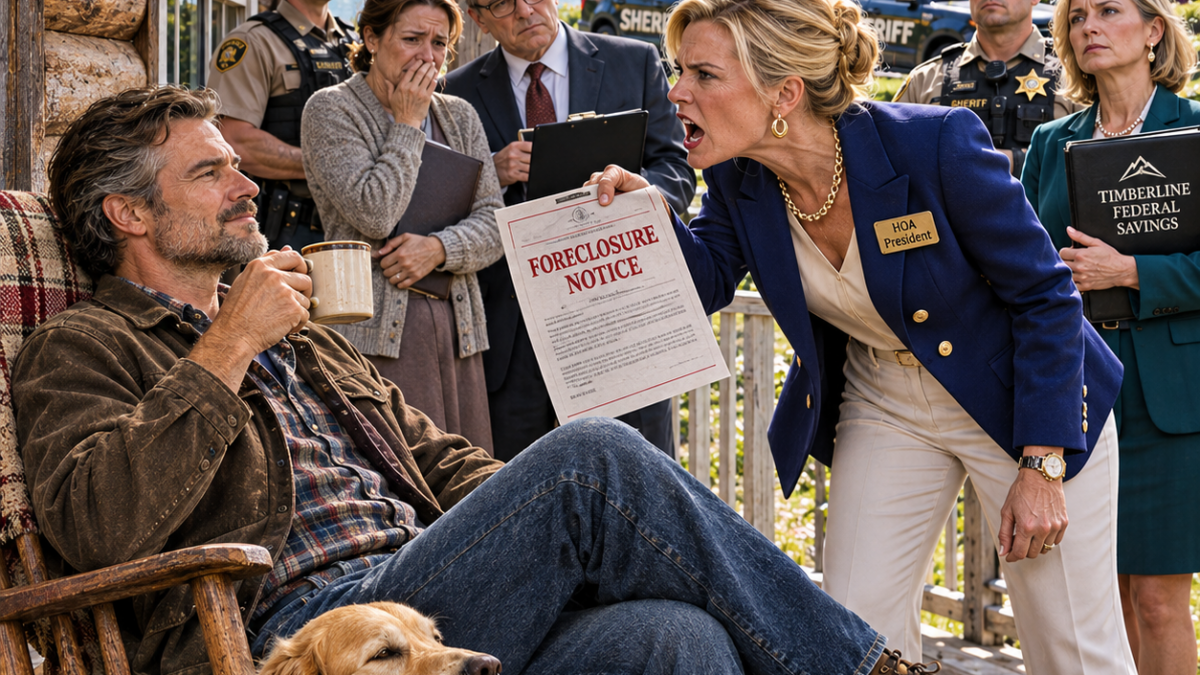
HOA Karen Tried to Foreclose on My Family Farmhouse—Then She Learned I Owned the Bank Holding Her Neighborhood’s $2.3 Million Loan.
The HOA president marched onto my porch with a fake foreclosure notice, two sheriff’s SUVs behind her, and enough confidence to tell me my grandfather’s farmhouse had already been seized.
I let her finish, took one slow sip of coffee, and asked her attorney to read the document again—because the leather folder beside my chair contained proof that her “foreclosure” had no court judgment, her HOA reserve account was missing $640,000, and the money had been routed to a land company she secretly owned with the developer trying to buy my property.
Then she demanded to know who I thought I was, so I slid one page across the porch and asked who held the $2.3 million loan on her clubhouse, roads, and lake dam—and for the first time in six months, Vanessa Hartwell stopped talking.
My name is Caleb Ror.
The farmhouse sits on forty acres beside a lake in western North Carolina.
My grandfather built it in 1952.
Not hired.
Built.
He cut most of the timber himself.
Set the first foundation stones with my great-uncle.
Hung the front door three times because the frame kept settling.
The porch was added later.
The rocking chairs came from my grandmother.
The fireplace came from stone pulled from the creek.
Nothing about the place was perfect.
That was the point.
My father inherited it.
Then I did.
For most of its life, the lake didn’t even have a formal name.
People simply called it the lower lake.
Fishermen used it.
Kids swam there.
Cattle watered near the western side.
Then development arrived.
About twenty years ago, a company bought hundreds of acres around us and built Pinerest Lakes.
Gated entrance.
Stone walls.
Clubhouse.
Private roads.
Landscape lighting.
Lakefront homes with enormous windows.
Eighty-four houses eventually.
PART2:
My farmhouse remained in the middle of it all like somebody had forgotten to erase an earlier drawing.
The developer approached my father several times.
He always said no.
Not dramatically.
Just no.
Our forty acres were never annexed.
Never added to the declaration.
Never voted into the HOA.
No dues.
No architectural committee.
No association authority.
The community simply grew around us.
By the time my father died, I hadn’t lived there full-time in almost twenty years.
I had built a logistics software company.
Started with four people in a rented office.
Sold it fifteen years later.
The newspapers called it a successful exit.
My father called it:
“That computer thing.”
He never understood exactly what I built.
I don’t think he cared.
The only thing he ever asked was:
“You still coming home?”
PART3:
I always said yes.
Then kept delaying.
Work.
Meetings.
Travel.
One more quarter.
One more acquisition.
One more excuse.
When he died, I came back.
Forty-eight years old.
One suitcase.
One golden retriever named Scout.
And more guilt than luggage.
The house smelled like cedar, dust, and coffee even though nobody had made coffee there in weeks.
I slept badly the first night.
Scout slept beside the bed.
The next morning, I sat on the porch in Dad’s chair.
Looked across the lake.
Made myself a promise.
I would keep the place alive.
Three days later, I found the first HOA letter taped to my door.
PINEREST LAKES HOMEOWNERS ASSOCIATION
I almost laughed.
The violation:
Exterior wood stain inconsistent with approved community palette.
Fine:
$250.
I put it on the kitchen table.
Two days later:
UNAPPROVED OUTDOOR FURNITURE
My grandmother’s rocking chairs.
$250.
Then:
ANIMAL STRUCTURE NONCOMPLIANCE
Scout’s doghouse.
That one made me laugh.
I called the association office.
Secretary answered.
Linda Prescott.
Soft voice.
“Pinerest Lakes HOA.”
“Linda, Caleb Ror.”
Pause.
“The farmhouse?”
“Yes.”
“I’ve received three violation notices.”
Another pause.
“Mr. Ror—”
“I’m not in the HOA.”
“I know.”
“Then why am I getting HOA fines?”
Long silence.
Then:
“You should speak with President Hartwell.”
I did not call her.
She came to me.
Royal-blue blazer.
Black slacks.
Silver necklace.
Tablet.
Vanessa Hartwell.
Mid-fifties.
Perfect posture.
Perfect smile.
She stood outside my gate.
“Mr. Ror.”
“Caleb.”
“We’re neighbors.”
“Apparently.”
She smiled.
“We’re just trying to maintain standards that protect everyone.”
“I’m sure.”
“Your farmhouse is highly visible from Pinerest.”
“So?”
“The stain tone doesn’t coordinate.”
I stared.
“You came all the way here because my logs aren’t coordinated?”
Her smile tightened.
“The property affects the character of the lake.”
“My grandfather built it before your neighborhood existed.”
“That doesn’t mean modernization is unreasonable.”
“I like old.”
She glanced toward the house.
Then down the driveway.
Then past me toward the lake.
Her eyes weren’t inspecting stain.
They were measuring.
Road width.
Shoreline.
Tree line.
Access.
I’ve sat across from enough investors to recognize when someone is evaluating an asset.
That’s when I knew.
This wasn’t about rocking chairs.
I said:
“What do you actually want?”
Her eyes returned to me.
“Cooperation.”
“With what?”
“Community planning.”
“My forty acres aren’t community property.”
“Not currently.”
That phrase.
Not currently.
I smiled.
“Good talk.”
Then closed the gate.
The fines increased.
$250.
$500.
$1,000.
Daily penalties.
Late fees.
Administrative fees.
Inspection fees.
All invented authority.
I paid nothing.
Kept everything.
Every envelope.
Every email.
Every certified receipt.
My father had a saying:
“Paper trails win quiet wars.”
I had once thought it was old-man paranoia.
Then I became an old man.
Not technically.
But emotionally.
About a month later, I discovered I wasn’t the only target.
Oliver Bennett lived down the road.
Seventy-eight.
Widower.
Army veteran.
Kind man.
Waved at everyone.
Brought tomatoes to my father every summer.
One evening, I drove past his place and saw him sitting on the porch.
Head in hands.
I stopped.
“Oliver?”
He looked up.
Eyes red.
“You okay?”
He laughed once.
No humor.
“They fined me out of my own house, Caleb.”
“What?”
“Roof.”
“Driveway.”
“Mailbox.”
“Landscaping.”
“Every month something.”
“How much?”
“Twenty-seven thousand by the end.”
My stomach tightened.
“Did you fight it?”
“Attorney wanted money I didn’t have.”
He looked toward the lake.
“Delaney Ridge bought the house last month.”
“How much?”
He told me.
Barely half market value.
I stared.
“Why would you sell that low?”
“They had a lien.”
“Who?”
“The HOA.”
“Then Grant Delaney offered to take the whole problem off my hands.”
Grant.
That name mattered later.
Oliver looked at me.
“I was tired.”
That hurt more than anger would have.
He wasn’t stupid.
He wasn’t weak.
He was exhausted.
That’s how some people steal things legally enough to survive the first glance.
They make fighting more expensive than surrendering.
Oliver wasn’t the first.
Two other lake-adjacent families had left Pinerest in the previous two years.
Different stories.
Same pattern.
Fines.
Liens.
Pressure.
Discounted sale.
And their properties?
Bought by entities connected to Delaney Ridge Holdings.
That wasn’t coincidence.
The next morning, Grant Delaney knocked on my door.
Gray suit.
Dark sunglasses.
Black SUV idling behind him.
“Mr. Ror.”
“Mr. Delaney.”
“You know me?”
“I pay attention.”
He smiled.
“I’d like to make an offer.”
“For?”
“Your forty acres.”
“No.”
“You haven’t heard the number.”
“Still no.”
“Four hundred thousand.”
I laughed.
Not politely.
Lakefront acreage alone was worth multiples of that.
The access road made it more valuable.
“Mr. Delaney.”
“Yes?”
“You either think I’m stupid or desperate.”
His smile disappeared for exactly one second.
Then returned.
“Everybody has a price.”
“Not everybody.”
He slipped his card onto the porch rail.
“Or a deadline.”
That was the first overt threat.
I watched him leave.
Then called my attorney.
Not because I was frightened.
Because I was finally interested.
Two days later, the certified letter arrived.
HOA counsel:
Marcus Webb.
Total alleged fines:
$48,200.
Notice of intent to file lien.
Demand for payment.
Threat of foreclosure proceedings.
Thirty days.
I read it twice.
Then smiled.
Scout looked at me.
“I know.”
He thumped his tail.
“This is what we needed.”
Because until then, Vanessa’s behavior was obnoxious.
Now it was actionable.
My property wasn’t in Pinerest.
No declaration.
No assessment authority.
No legitimate fines.
Trying to convert invented dues into a lien against excluded property was a different category of mistake.
I sent everything to counsel.
Then waited.
Three nights later, Scout started barking at 2:03 a.m.
Not normal barking.
Low.
Focused.
At the back door.
I grabbed a flashlight.
Nothing outside.
Then saw paper taped to the glass.
Folded note.
No envelope.
No name.
I opened it.
Three sentences.
CHECK THE RESERVE FUND.
SOMEONE IS STEALING FROM PINEREST.
I’M SORRY I STAYED QUIET.
I read it three times.
Scout sniffed the paper.
I sat at the kitchen table.
And finally admitted to myself that this had become bigger than my farmhouse.
Here’s the part Vanessa didn’t know.
Most of Pinerest didn’t either.
After I sold my software company, I didn’t retire immediately.
I invested.
Conservatively at first.
Then more strategically.
One of those investments was Timberline Federal Savings.
At the time, it was a small regional lender in trouble.
Bad technology.
Poor management.
Strong deposit base.
Good local relationships.
I bought in.
Then bought more.
Helped restructure it.
Recruited new management.
Eleven years later, I was chairman of the holding company and majority shareholder.
I did not run day-to-day banking.
That’s important.
Helen Marsh did.
President and CEO.
Smartest banker I know.
By pure coincidence—or maybe because Pinerest used the local lender long before I came home—Timberline held sixty-one of the eighty-four homeowner mortgages in the development.
More importantly:
Timberline held Pinerest HOA’s $2.3 million infrastructure loan.
Clubhouse.
Private roads.
Drainage.
Lake dam rehabilitation.
The HOA had borrowed against assessments and reserve requirements.
Vanessa had spent six months threatening a man whose bank financed most of the community.
She simply didn’t know it.
I could have called Helen and told her to freeze everything.
I didn’t.
That would’ve been abuse.
Banking covenants aren’t revenge weapons.
I had spent my whole business career telling people governance matters most when you personally want to ignore it.
So I called Helen.
“Need something.”
“What?”
“Pinerest Lakes.”
Pause.
“Our borrower?”
“Yes.”
“Why?”
“I may have a conflict.”
That got her attention.
“What kind?”
“I own property they’re disputing.”
“Okay.”
“And I received a tip about their reserve fund.”
Longer silence.
Then:
“Are you asking me to investigate?”
“I’m asking you to run whatever compliance review you’d run if I didn’t exist.”
“And?”
“I recuse myself completely.”
“Document that.”
“I will.”
“No loan committee discussion.”
“Agreed.”
“No direct file access.”
“Agreed.”
“No instructions after this call.”
“Agreed.”
Helen said:
“Good.”
Then:
“What did the tip say?”
“Check the reserve.”
Four days later, Helen called.
Her voice was different.
Bankers are trained not to sound surprised.
She sounded surprised.
“Caleb.”
“Yes?”
“Reserve requirement under their loan covenant is six hundred thousand.”
“And?”
“Current balance is eleven thousand four hundred.”
I sat down.
“How?”
“Transfers.”
“How much total?”
“Roughly six hundred forty thousand over fourteen months.”
“To where?”
Pause.
“Related external account.”
“Name?”
“I can’t discuss more with you.”
Right.
I had recused myself.
I almost laughed.
“Good.”
“What?”
“Nothing.”
She continued:
“Compliance and counsel are handling it.”
“Do that.”
“You should also get personal counsel.”
“Already have.”
Then she said:
“Caleb.”
“Yes?”
“This is serious.”
“I know.”
That afternoon, a gray sedan stopped at my gate.
Woman stepped out.
Late fifties.
Gray suit.
Folders pressed against her chest.
Linda Prescott.
HOA secretary.
I recognized her voice.
She looked terrified.
“Mr. Ror.”
“Caleb.”
“I wrote the note.”
I opened the gate.
She started crying before we reached the porch.
Inside, she spread records over my kitchen table.
Board minutes.
Bank statements.
Invoices.
Emails.
Signed resolutions.
Some signatures real.
Some questionable.
Some altered after meetings.
She pointed to one company appearing repeatedly.
RIDGELINE LAND PARTNERS LLC
“Who’s that?”
She looked at me.
“Vanessa.”
“What?”
“She owns part of it.”
“With whom?”
“Grant Delaney.”
Everything connected.
Delaney Ridge Holdings.
Ridgeline Land Partners.
Vanessa.
The reserve transfers.
The lake parcels.
The fines.
The forced sales.
I asked:
“Why my farm?”
Linda pulled out a development rendering.
Luxury lodge.
Private marina.
Event center.
Additional waterfront homes.
One access road.
Mine.
My forty acres sat across the only practical route linking the proposed lodge site to the county road without building a major bridge.
The farmhouse wasn’t an eyesore.
It was an obstacle.
Oliver Bennett’s property had been one piece.
The other two families another.
I was the last major holdout.
Linda wiped her face.
“She said once you got enough fines, you’d sell.”
“And if I didn’t?”
“She said foreclosure.”
“They can’t foreclose property outside the HOA.”
“I know.”
“Does she?”
“Yes.”
That surprised me.
Linda whispered:
“She said by the time you stopped it, you’d be buried in legal bills.”
There it was.
Not law.
Leverage.
I looked at the development map again.
“How long?”
“Two years.”
I thought about Oliver.
Tears on his porch.
Half-value sale.
The same machinery had already worked.
That night, I called my own attorney.
Then Helen separately.
Not sharing bank information.
Just coordinating through counsel where legally permissible.
Timberline’s compliance team already had enough to invoke reporting and covenant procedures independently.
Friday afternoon, Marcus Webb filed what Vanessa called a foreclosure notice.
It wasn’t a foreclosure judgment.
It wasn’t a writ of possession.
It wasn’t even a valid court authorization.
It was an HOA-generated notice claiming the association had voted to seize the property after default on fines.
My lawyer called it:
“Paper theater.”
I asked:
“Can they send deputies?”
“They can ask.”
“Will deputies act?”
“Not without a court order.”
“Good.”
“Do not antagonize them.”
“I won’t.”
“Caleb.”
“Yes?”
“I mean it.”
“I own a golden retriever and drink coffee on a porch.”
“You also own a bank.”
“Fair.”
Saturday.
8:55 a.m.
I was sitting in Dad’s rocking chair.
Coffee.
Scout at my feet.
Leather folder on the table.
Three documents inside.
One:
My deed and title exclusion from Pinerest.
Two:
Corporate ownership record showing my position with Timberline’s holding company.
Three:
Formal recusal acknowledgment from the bank’s compliance committee.
I had no bank findings.
That mattered.
Those belonged to Helen and counsel.
Gravel crunched.
Two sheriff’s SUVs.
Then Vanessa’s white Lexus.
Then Marcus Webb’s sedan.
Linda arrived separately.
Pale.
Nervous.
Vanessa walked up my steps.
Royal-blue blazer.
Heels striking wood.
She held a foreclosure notice.
“Mr. Ror.”
“Morning.”
“This house is seized.”
I took a sip.
Behind her, Deputy Alvarez shifted.
Didn’t look comfortable.
Vanessa shoved the paper toward me.
“Pack your belongings.”
I didn’t take it.
She continued:
“If you refuse, the sheriff’s department will remove you.”
Deputy Alvarez said:
“Ma’am—”
Vanessa raised one hand.
“I’ll handle this.”
Bad choice.
I looked at Marcus Webb.
“Mr. Webb.”
He looked exhausted.
“Yes?”
“Would you read that document carefully?”
Vanessa snapped:
“He drafted it.”
“I want him to read it now.”
Marcus took the paper.
His eyes moved.
Top.
Middle.
Bottom.
Then back up.
His face changed.
“Vanessa.”
“What?”
“Where’s the judgment?”
She frowned.
“What judgment?”
“Court judgment.”
“The board voted.”
Marcus looked at her.
“A board vote isn’t a foreclosure order.”
Silence.
“You told me this morning counsel had obtained judicial authorization.”
Vanessa’s face tightened.
“We don’t need it.”
Marcus said:
“Yes.”
“You do.”
She pointed at me.
“He owes forty-eight thousand dollars.”
I said:
“No.”
She ignored me.
Marcus looked toward Deputy Alvarez.
“Deputy, do you have a writ?”
Alvarez shook his head.
“No.”
“Order of possession?”
“No.”
“Judge’s signature?”
“No.”
Marcus took a breath.
“Then nobody touches that house.”
Vanessa stared.
“You work for me.”
Marcus said:
“I represent the association.”
“Same thing.”
“No.”
That was the first visible crack.
She turned to me.
“Who do you think you are?”
I placed my coffee down.
Opened the leather folder.
Pulled out one page.
“Question.”
“I don’t care about your questions.”
“You should.”
I held it up.
“Who holds Pinerest Lakes’ $2.3 million infrastructure loan?”
Her eyes narrowed.
“What?”
“Clubhouse.”
“Roads.”
“Dam.”
“Who is the lender?”
She hesitated.
“Timberline Federal.”
I slid the page toward Marcus first.
He read it.
Then looked at me.
Then read it again.
Vanessa snatched it.
Corporate ownership disclosure.
Chairman:
Caleb Ror.
Majority shareholder through Ror Holdings.
Her lips parted.
For once, no words.
I said:
“I chair the holding company that controls Timberline.”
She looked at the deputies.
Then me.
“That’s a conflict of interest.”
“Yes.”
That answer confused her.
I pulled out the second page.
“That’s why I formally recused myself when your name appeared in a compliance matter.”
She stared.
“I haven’t accessed the review.”
“I haven’t instructed loan staff.”
“I haven’t voted on anything related to Pinerest.”
“I haven’t used the bank against you.”
Her face shifted.
“So this means nothing.”
“Maybe.”
Then a silver sedan turned into the driveway.
Helen Marsh.
Teal blazer.
Briefcase.
Bank counsel beside her.
She walked up the porch steps.
“Mr. Ror.”
“Helen.”
Then immediately:
“For the record, Mr. Ror remains recused.”
She didn’t even look at me afterward.
Perfect.
She faced Vanessa.
“Ms. Hartwell?”
“Yes.”
Helen opened the briefcase.
“Timberline Federal is serving Pinerest Lakes Homeowners Association with formal notice of covenant default and demand for cure.”
Vanessa went still.
“On what basis?”
“Mandatory reserve deficiency.”
Helen pulled out a document.
“Your loan requires a minimum reserve balance of six hundred thousand dollars.”
“Current verified balance was approximately eleven thousand four hundred at review.”
Marcus’s head snapped toward Vanessa.
“What?”
Helen continued.
“Approximately six hundred forty thousand dollars was transferred out over fourteen months.”
Vanessa said:
“For approved expenses.”
Helen didn’t react.
“The receiving account is associated with Ridgeline Land Partners LLC.”
Linda stepped forward.
Hands shaking.
“I have the records.”
Vanessa turned.
“Linda.”
“I have the minutes.”
“Linda, stop.”
“And the bank statements.”
“Stop.”
“And the revised minutes you made me sign after the meetings.”
Marcus closed his eyes.
Vanessa said:
“She is lying.”
Linda’s voice broke.
“I’ve been lying.”
Then she looked at the deputies.
“And I’m done.”
She handed Marcus one folder.
Then Deputy Alvarez another.
Helen said nothing.
She didn’t need to.
Marcus read.
His face drained.
“Vanessa.”
She snapped:
“Not now.”
“No.”
He closed the folder.
“Now.”
She stared.
Marcus removed his glasses.
“I cannot continue representing you personally.”
“You don’t represent me personally.”
“Correct.”
“I represent the HOA.”
“And based on what I’m reading, your interests and the association’s interests are now directly adverse.”
Vanessa’s breathing changed.
Fast.
Angry.
Then tires on gravel.
Black SUV.
Grant Delaney.
He slowed when he saw:
Two sheriff’s SUVs.
Helen.
Marcus.
Linda.
Me.
Then reversed.
Not dramatically.
But immediately.
Deputy Alvarez noticed.
So did I.
He radioed the plate.
The other deputy walked toward the road.
Delaney stopped.
He wasn’t arrested on my lawn.
Real investigations don’t work that neatly.
But he was identified.
Questioned.
And his attempted retreat was preserved in reports.
Within the hour, state financial investigators arrived.
Not because I called in a favor.
Because Timberline’s compliance unit had made the required referrals once the transactions triggered reporting concerns.
Helen explained that clearly.
Every step documented.
Every transfer timestamped.
Every authorization logged.
Vanessa kept insisting:
“You can’t prove theft.”
Helen answered:
“I didn’t accuse you of theft.”
Pause.
“I said the transfers are documented.”
That was worse.
Facts don’t need to shout.
The farmhouse seizure ended that morning.
Deputies left without touching a chair.
Without opening a door.
Without ordering me off anything.
The sheriff’s office later issued guidance that civil HOA notices were not writs of possession and required proper judicial process before enforcement.
Marcus withdrew the association’s foreclosure filing.
Then the real fight began.
Pinerest homeowners learned about the reserve shortage.
Emergency meeting.
Eighty-four households notified.
Clubhouse packed.
People stood outside.
Oliver Bennett came.
I had called him.
He sat beside me.
Vanessa did not preside.
Independent counsel did.
Linda testified.
Board records were reviewed.
Ridgeline Land Partners ownership traced.
Grant Delaney’s financial relationship examined.
The proposed luxury lodge plan surfaced.
Then the parcel acquisitions.
Bennett.
Two other lakefront households.
Discounted sales following aggressive HOA enforcement.
The pattern was impossible to ignore.
Was every fine criminal?
No.
Some were ordinary HOA nonsense.
Was every sale legally coerced?
That required separate review.
But the connection was enough to tear Pinerest apart politically.
Homeowners voted the board out.
All of them.
Linda remained temporarily only because investigators needed continuity with financial records.
Later, residents elected an entirely new board.
First major act:
Void every fine issued against my farmhouse.
Second:
Review liens and enforcement actions from the prior four years.
Third:
Require outside counsel approval before any foreclosure filing.
Fourth:
Dual signatures for large reserve transfers.
Fifth:
Publish monthly financial statements.
Boring rules.
Excellent rules.
People expected me to use Timberline to crush Pinerest.
Raise rates.
Call loans.
Force refinancing.
I didn’t.
Couldn’t ethically.
Wouldn’t morally.
The loan had covenants.
The bank enforced them.
Reserve restoration plan.
Enhanced reporting.
Independent audit.
No revenge.
I stayed recused from every Pinerest-specific credit decision until the matter closed.
That was the part I cared about most.
Because power means very little if you only behave correctly when you’re not angry.
Vanessa had used authority personally.
I wasn’t going to answer by doing the same thing.
Oliver Bennett’s situation was harder.
His house had already been sold.
Delaney Ridge held it.
The title transfer wasn’t automatically reversible because the surrounding misconduct was under investigation.
So I did something simpler.
I bought the property.
Not through the bank.
Personally.
At negotiated value.
Then sold it back to Oliver under terms he could manage.
He cried when I told him.
That embarrassed him.
So I pretended not to notice.
He said:
“I can’t take charity.”
“Good.”
“Because this isn’t.”
“What is it?”
“A sale.”
“You’re giving me favorable terms.”
“Yes.”
“That’s charity.”
“No.”
“It’s me being annoying.”
He stared.
Then laughed.
First time I’d seen him laugh since the porch.
He moved back in.
His tomato garden returned the following spring.
Grant Delaney’s development plan collapsed.
No access road.
No farmhouse parcel.
No assembled lakefront strip.
Ridgeline became the subject of litigation and financial review.
Vanessa’s ownership interest became impossible to hide once corporate records and bank transfers were examined.
She eventually faced criminal and civil consequences tied to the financial misconduct and false documentation discovered during the investigation.
Not every charge people predicted online stuck.
Some did.
Some didn’t.
That’s normal.
The important part was simpler:
She lost the presidency.
Lost control of Pinerest.
Lost the development scheme.
And had to answer questions she had spent years preventing anyone else from asking.
She sold her house the following year.
Quietly.
No dramatic goodbye.
One morning, moving truck.
White Lexus.
Gone.
Scout watched from the porch.
Didn’t care.
Dogs have excellent priorities.
My farmhouse stayed.
The rocking chairs stayed.
The log stain remained exactly the wrong shade.
Scout’s doghouse remained aesthetically offensive.
Nobody fined it.
The lake looked exactly as it had before.
That’s what always amazes me.
People will spend years plotting over property while the property remains indifferent.
The water doesn’t know who is HOA president.
The oak trees don’t read liens.
The porch doesn’t care who owns the bank.
One evening, Linda came by.
She had resigned from all association roles.
She looked lighter.
Still guilty.
“I should’ve spoken sooner.”
“Yes.”
I didn’t lie to comfort her.
She nodded.
“I kept telling myself Vanessa knew what she was doing.”
“She did.”
“That makes it worse.”
“Yes.”
Linda looked toward the lake.
“I signed minutes that weren’t accurate.”
“Why?”
“She’d bring me revisions afterward.”
“Say we’d forgotten something.”
“At first small things.”
“Then bigger.”
“And every time I signed, the next one became easier.”
That’s how these things grow.
Not with one giant lie.
One little surrender.
Then another.
Eventually you’re protecting the fact that you’ve already stayed quiet.
Linda said:
“I wrote that note because I saw the foreclosure posting.”
“I knew you were next.”
“Why not sign your name?”
“I was afraid.”
“Of Vanessa?”
“Of everything.”
Then she laughed bitterly.
“She made me feel like she owned the neighborhood.”
I looked at her.
“She didn’t.”
“I know now.”
That was Pinerest’s real problem.
Not that Vanessa had magical power.
That enough people behaved as if she did.
Authority grows when people stop asking where it comes from.
HOA president.
Board vote.
Fine.
Lien.
Foreclosure.
Official-looking words.
But every one of those has boundaries.
Procedures.
Documents.
Law.
Vanessa’s power survived because most people heard the title and stopped at the title.
Oliver couldn’t afford to keep fighting.
Others were tired.
Linda was afraid.
Marcus trusted his client too long.
Board members signed things.
Then one day Vanessa walked onto my porch expecting everyone to repeat the pattern.
She presented paper.
Deputies would obey.
Attorney would obey.
I would panic.
Farmhouse gone.
Except somebody finally asked:
Where’s the court order?
That’s all it took to stop the morning.
One question.
Where is the legal authority?
She didn’t have it.
The rest followed.
People love the line:
“I own your bank.”
It sounds dramatic.
I admit it was satisfying.
But that wasn’t actually what saved my house.
My deed saved it.
Due process saved it.
A lawyer reading the document carefully saved it.
A deputy refusing to act without a writ saved it.
Linda finally telling the truth helped expose the larger scheme.
Helen following banking rules exposed the reserve problem.
If I had owned nothing more than a pickup truck and Scout, Vanessa’s foreclosure notice still would have been invalid.
That’s important.
Money gave me resources.
It didn’t create my rights.
I never want that confused.
Months after the audit ended, the new HOA president came to my gate.
Her name was Karen Liu.
Accountant.
Early sixties.
No blazer.
No tablet.
She stayed outside.
“Mr. Ror?”
“Caleb.”
“I wanted to formally acknowledge that your property is excluded from Pinerest jurisdiction.”
I smiled.
“Good start.”
She handed me a letter.
Actual letter.
Clear.
No fake authority.
The association also wanted permission to maintain a short drainage culvert where Pinerest’s road crossed near my boundary.
She asked.
Not demanded.
I reviewed it.
Had my lawyer review it.
Signed.
That’s how neighbors work.
Ask.
Agree.
Document.
Move on.
Karen said:
“Can I ask something?”
“Sure.”
“Did you really own Timberline the whole time?”
“I owned controlling interest in the holding company.”
She laughed.
“Vanessa must’ve nearly fainted.”
“She got quieter.”
“That’s saying something.”
Then Karen looked at the farmhouse.
“For what it’s worth, I like the stain.”
“Careful.”
“That’s how regimes begin.”
She laughed.
The reserve fund was slowly rebuilt.
Timberline did not call the loan.
Why would it?
The new board cured the defaults.
Reduced unnecessary spending.
Raised transparency.
The community became healthier.
Mortgage borrowers continued making payments.
The bank continued lending.
That’s what good systems do.
They correct problems without destroying everyone connected to them.
Vanessa had treated power as a weapon.
I tried to treat it as infrastructure.
Not exciting.
Better.
Scout got older.
Golden retrievers do that too fast.
Gray muzzle.
Slower stairs.
Still followed me to the porch.
One autumn evening, I sat in Dad’s rocking chair.
Scout’s head on my boot.
Oliver waved from down the road.
Kids rode bicycles past the gate.
The clubhouse lights came on across the lake.
Everything looked normal.
I thought about Dad.
Quiet people win the longest games.
He used to say that.
I had always interpreted it as patience.
Now I think he meant something else.
Quiet isn’t weakness.
Quiet means you don’t show every card because somebody provokes you.
Vanessa sent fines.
I filed them.
She sent threats.
I documented them.
Grant offered four hundred thousand.
I said no.
They threatened foreclosure.
I waited for legal process.
The anonymous note came.
I didn’t call Vanessa.
I called compliance.
When I learned I owned the bank holding their loan, I didn’t weaponize it.
I recused myself.
That’s the part Dad would’ve liked.
Be quiet until it’s time to be loud.
Being loud didn’t mean shouting from the porch.
It meant opening the correct folder at the correct moment.
The farmhouse became slightly famous locally.
People called it:
“The house the HOA tried to steal.”
I hate that.
The HOA didn’t try.
Vanessa and a small group did.
Pinerest is eighty-four families.
Teachers.
Retirees.
Nurses.
Contractors.
Young couples.
Kids.
Most of them had no clue.
Many lost money too.
Reserve funds belong to everybody.
When someone steals from an HOA, they’re stealing small pieces from dozens of ordinary households.
That’s why I refused to punish the neighborhood through the bank.
Imagine discovering your board mishandled money and then your lender retaliates by making your mortgage harder.
That would have made me another Vanessa.
No.
The honest residents deserved stability.
Some refinanced later.
Some didn’t.
I never personally changed anybody’s mortgage rate as a favor.
Banking doesn’t work that way.
But Timberline did review hardship options and offered standard programs where borrowers qualified.
Fairness.
Not favoritism.
That’s less cinematic.
Also more ethical.
Oliver still jokes that his tomatoes taste better because they survived foreclosure.
They don’t.
They’re tomatoes.
But I take them anyway.
Linda moved away eventually.
Sent a Christmas card.
One line:
Thank you for making me tell the truth before I forgot how.
I keep that card.
Not because I’m the reason.
She made the choice.
But it reminds me that people can come back from cowardice.
Marcus Webb stayed in practice.
He sent me a letter after the matter ended.
Short.
Professional.
He acknowledged he should have demanded stronger documentation before sending the lien notices.
I appreciated that.
Lawyers aren’t magicians.
They rely on clients.
But they also have obligations.
He learned.
So did I.
The leather folder from that Saturday morning remains in my desk.
The corporate page.
Recusal notice.
Title documents.
I rarely open it.
Visitors sometimes ask:
“Is that the folder?”
“Yes.”
“Can I see it?”
“No.”
The story has grown enough.
One version claims I foreclosed on the HOA clubhouse.
Never happened.
Another says I canceled sixty-one mortgages.
Ridiculous.
Another says Vanessa fainted when I said I owned her bank.
She didn’t.
She just turned white.
Reality was better because it required restraint.
Power isn’t impressive when you use all of it.
Sometimes the strongest thing you can do is prove you could interfere—and choose not to.
Helen told me that later.
She said:
“The recusal saved everybody trouble.”
“Especially you.”
I laughed.
“You enjoyed telling Vanessa about the reserve deficiency.”
Helen smiled.
“I’m a banker.”
“We experience joy differently.”
Fair.
Three years later, Pinerest is boring.
That is the highest compliment I can give an HOA.
Meetings about landscaping.
Pool schedules.
Road resurfacing.
Annual budget.
People argue about holiday lights.
Nobody invents liens.
Nobody secretly develops lakefront parcels.
Nobody empties reserve accounts into land companies.
Boring means systems are working.
My forty acres remain outside the association.
That never changed.
Pinerest finally installed a permanent marker near the access road making the boundary clear.
I helped pay for the survey.
Not because I had to.
Because I never wanted another family arguing over it fifty years from now.
The farmhouse still has Dad’s rocking chairs.
Scout’s old doghouse too.
Scout died last winter.
Sixteen years old.
I buried him beneath an oak near the porch.
For weeks afterward, I kept looking toward the door around sunset expecting him to scratch once to come inside.
Loss creates habits that outlive the thing you lost.
Dad.
Scout.
The old version of Pinerest.
Life keeps changing around the same porch.
Some mornings, I sit there with coffee and think about that Saturday.
8:55.
Sheriff’s SUVs.
Vanessa’s heels on wood.
Foreclosure notice in her hand.
“This house is seized.”
She believed the sentence itself created reality.
That’s what power had taught her.
Say something firmly enough.
Put it on letterhead.
Attach a fine.
Call a deputy.
People move.
Usually they did.
Then Marcus read the page.
No judgment.
No writ.
No legal seizure.
Suddenly her words became what they had always been.
Paper.
Then she asked:
“Who do you think you are?”
I could have answered with my money.
Chairman.
Majority owner.
Founder.
Investor.
All titles.
But titles weren’t why she was wrong.
My name could’ve been nobody.
The house still wasn’t hers.
That’s the lesson I remember most.
Real power isn’t making people afraid of what you can take.
Vanessa had mastered that.
Fine.
Lien.
Deadline.
Sale.
She made older homeowners feel like resistance was impossible.
Real power is having the ability to act and knowing where your authority ends.
The bank had authority under its loan.
Not over residents’ dignity.
The HOA had authority over actual member properties.
Not mine.
The sheriff had authority under lawful process.
Not a board-created notice.
I had authority over my land.
Not over everybody who lived around it.
Boundaries.
Everything came back to boundaries.
Dad understood those better than anyone.
The last written note I ever found in his desk was on an old property-tax envelope.
He had written:
KEEP THE PLACE. DON’T LET ANYBODY RUSH YOU OFF YOUR OWN GROUND.
Maybe he was talking about developers.
Maybe life.
I framed it.
It hangs inside the mudroom.
Vanessa tried to rush me.
Thirty days.
Pay.
Sell.
Leave.
Grant tried too.
Everyone has a deadline.
They thought pressure would create fear.
Instead it created paperwork.
And paperwork, handled correctly, became evidence.
Six months after the first ridiculous stain violation, Vanessa Hartwell stood on my porch holding a foreclosure notice that could not legally remove me.
Behind her were deputies who refused to act without judicial authority.
Beside her was an attorney realizing his client had misrepresented the process.
Coming up the driveway was the bank president carrying proof that Pinerest’s reserve account had been gutted.
And inside my house sat documents tying the money to the same land company trying to buy the properties Vanessa had been fining into submission.
She thought she had come to take my farmhouse.
Instead she brought everyone I needed to witness the moment her story stopped working.
I never had to raise my voice.
Dad would’ve liked that.
The farmhouse still stands.
Same logs.
Same wrong stain.
Same rocking chairs.
Across the lake, Pinerest lights come on every evening.
Oliver is home again.
The reserve fund is healthy.
The roads are maintained.
The dam is inspected.
The neighborhood didn’t collapse because Vanessa lost power.
It improved.
And every now and then, a new resident will stop near my gate and ask:
“Are you the guy who owns the HOA’s bank?”
I tell them:
“No.”
Because that’s not quite right.
I own shares in a company.
The bank belongs to its depositors, employees, borrowers, shareholders, and regulators in all the ways that matter.
Then they ask:
“So what really happened?”
I look at the farmhouse.
The porch.
The lake.
Dad’s rocking chair.
And I tell them the simplest version.
A woman tried to use power she didn’t have.
I happened to have more power than she expected.
The only reason the story ended well is that I chose not to use mine the way she used hers.
That’s what my father meant.
Quiet people don’t win because they’re secretly stronger.
They win because they can wait long enough for the truth to become louder than the threat.
Vanessa came to my porch expecting me to pack.
Instead, her lawyer asked for a court order she didn’t have.
Her secretary produced records she couldn’t explain.
Her bank enforced covenants she had violated.
And the farmhouse she thought would become the final piece of her development plan stayed exactly where my grandfather put it in 1952.
Log by log.
Stone by stone.
Still mine.
Still standing.








