HOA Karen Tried to Fine Me $800 for Buying Too Many Groceries—Then the Store Manager Revealed Who Had Been Paying for Hers
PART2:
By Monday afternoon, Maple Ridge Estates was still dark.
By Tuesday, sixty homes remained without power.
By Wednesday, refrigerators were warming.
Freezers had thawed.
Milk went bad.
Meat spoiled.
People started throwing food away.
The utility company kept updating the restoration estimate.
Six hours.
Then twelve.
Then “pending assessment.”
My HOA responded Tuesday morning with an email.
The subject line was:
COMMUNITY REMINDER DURING POWER INTERRUPTION
I opened it expecting information about emergency assistance.
Maybe generators at the clubhouse.
Ice distribution.
Something.
Instead:
Residents are reminded that trash containers must remain concealed from street view except during approved collection periods. Temporary power outages do not suspend community appearance standards.
I read it twice.
Then showed Lily.
She frowned.
“People don’t have power and they’re worried about trash cans?”
“Apparently.”
“That’s stupid.”
“Language.”
“You said apparently.”
“That’s not the language I meant.”
The HOA president was Diane Whitaker.
Fifty-seven.
Maroon blazers.
Perfect hair.
Tablet always in one hand.
She had been president for almost four years.
She liked rules.
More accurately, she liked being the person who decided which rules mattered.
Maple Ridge wasn’t a terrible neighborhood.
Most people were decent.
Families.
Retirees.
Teachers.
Nurses.
Small-business owners.
Diane simply had a way of turning every minor issue into proof that civilization was collapsing.
Basketball hoop six inches too close to the sidewalk?
Emergency.
Grass one inch too high?
Notice.
Trash can visible twelve hours early?
Warning.
Someone painting a mailbox without submitting a color form?
You’d think the Pentagon needed to be notified.
Normally, I ignored her.
The blackout made that harder.
Wednesday evening, Lily and I walked down the street checking on people.
Not formally.
No heroic mission.
Just neighbors.
That’s when we reached Eli Turner’s house.
Mr. Turner was seventy-eight.
Vietnam veteran.
Widower.
Lived alone three houses down.
He had knee problems and drove only when absolutely necessary.
I knocked.
No answer.
Knocked again.
Finally:
“Coming.”
The door opened.
House completely dark.
“Everything okay?”
“Fine.”
Older men say “fine” when the roof is on fire if they think admitting otherwise might inconvenience somebody.
I held up a flashlight.
“You got food?”
“Plenty.”
Lily walked past me slightly.
On the kitchen table sat one open can.
Cold baked beans.
Plastic spoon.
That was dinner.
I looked at Eli.
He saw me looking.
“Don’t start.”
“How long have you been eating canned food?”
“Food’s food.”
“Your refrigerator?”
“Gone.”
“Freezer?”
He shrugged.
“All spoiled.”
“Why didn’t you call?”
“For what?”
“Help.”
Eli leaned against the doorframe.
“Son, I’ve survived worse than four days without electricity.”
“I know.”
“Then don’t worry about me.”
I did worry.
That night I opened my own refrigerator.
We’d lost plenty too.
But I had a car.
Savings.
A credit card if needed.
Eli didn’t have the same flexibility.
Neither did a lot of people.
One family at the end of the block had three children.
Another had a newborn.
Ms. Alvarez lived on disability.
The Jenkins family had just paid for a transmission repair.
The blackout wasn’t catastrophic for everyone.
But for people already living close to the edge, losing several hundred dollars of groceries in one weekend mattered.
I sat at the kitchen table.
Lily came downstairs.
“What are you doing?”
“Making a list.”
“Of?”
I had started writing names.
Eli Turner.
Alvarez.
Jenkins.
Morrison.
“You’re buying food?”
“Some.”
“For everybody?”
“Not everybody.”
She looked at the list.
“That’s a lot.”
“Yeah.”
Then she disappeared upstairs.
Came back carrying a glass jar.
Coins.
Bills.
Her lunch-money jar.
She placed it on the table.
“No.”
“Dad.”
“No.”
“There’s like forty dollars.”
“Exactly.”
“I don’t need school lunch money during summer.”
“Still no.”
She pushed it closer.
“You said we’re helping.”
“We are.”
“So am I.”
I stared at her.
There are arguments you can win as a parent.
There are others where winning teaches the wrong lesson.
I took twenty dollars.
Left the rest.
“Deal.”
She smiled.
By Thursday morning, our garage had become a neighborhood pantry.
Again, not intentionally.
I posted in the Maple Ridge Facebook group:
If you lost refrigerated food during the outage and need help getting through the next few days, message me privately. No explanation needed. I’m putting some basic groceries in my garage. Take what you need.
Within two hours, six families responded.
By evening:
Fourteen.
By Friday:
Twenty-three.
Some needed milk.
Some bread.
Some canned food.
Diapers.
Cereal.
Peanut butter.
Fruit.
One woman apologized three times for requesting baby formula.
I wrote back:
Please don’t apologize.
The power finally returned Friday afternoon.
But refrigerators turning back on don’t magically replace everything that spoiled.
So Saturday morning, I made the list.
Long handwritten list.
Lily sat beside me.
She added stickers beside items for reasons I still don’t understand.
“Why does cereal have a star?”
“Important.”
“And bananas have a unicorn?”
“Also important.”
Fine.
I checked my savings account.
Not huge.
Enough.
I’d been setting money aside for replacing the backyard fence.
Fence could wait.
Twenty-three families couldn’t.
I grabbed my wallet.
Lily’s twenty dollars.
The list.
Then drove to Fairview Market.
Fairview wasn’t the cheapest store in the county.
But it was close.
Locally owned.
And the manager, Calvin Brooks, knew most regular customers by name.
He was standing near the entrance when I arrived.
“Morning, Mark.”
“Morning.”
“You feeding an army?”
“Close.”
I showed him the list.
He whistled.
“What’s this?”
“Neighborhood pantry.”
“For the outage?”
“Yeah.”
He looked at the page.
Then at me.
“Need help?”
“I’ve got it.”
“Let me know.”
I took a cart.
Then another employee offered a flatbed.
I declined.
At that point, I still thought one large cart would be enough.
It was not.
Bread.
Milk.
Eggs.
Cereal.
Rice.
Pasta.
Canned beans.
Soup.
Peanut butter.
Apples.
Bananas.
Potatoes.
Vegetables.
Chicken.
Cheese.
Baby food.
By aisle four, the cart looked like I was preparing for the end of civilization.
By aisle five, I felt someone watching me.
You know that sensation.
Not mystical.
You just notice the same face more than once.
At the far end of the aisle stood Diane Whitaker.
Maroon blazer.
White blouse.
Tablet in her hands.
Not shopping.
No cart.
No basket.
Just standing there.
I ignored her.
Picked up six boxes of cereal.
She approached.
“Mark.”
“Diane.”
“That’s quite a lot of food.”
“Yes.”
“For your household?”
“No.”
Her eyebrows rose.
“Then for whom?”
“People.”
“Which people?”
I looked at her.
“Why?”
She smiled.
Sweetly.
Diane could make a smile feel like a warning label.
“I’m asking as HOA president.”
“We’re in Fairview Market.”
“I understand where we are.”
“Then I’m confused why my HOA president needs to know how many bananas I’m buying.”
Her smile vanished slightly.
“Maple Ridge has emergency-purchasing guidelines.”
I laughed.
I genuinely thought she was joking.
She wasn’t.
“What?”
“Section Fourteen.”
She touched the tablet.
“Temporary household acquisition limits during declared utility disruptions.”
I stared at her.
“You’re telling me the HOA regulates grocery purchases?”
“When excessive acquisition impacts community resource availability.”
I looked around.
Shelves full.
No shortages.
No rationing.
No emergency restrictions.
“Diane.”
“Yes?”
“That’s insane.”
She turned the tablet toward me.
My stomach tightened.
Photos.
Me.
At Fairview Market.
Tuesday.
Two weeks earlier.
Another photo the week before.
A close-up of a receipt.
My receipt.
I looked at her.
“What is this?”
“I’ve been documenting your pattern.”
“My pattern?”
“Excess purchasing.”
I almost laughed again.
Then realized she was serious.
“How did you get a picture of my receipt?”
“Community monitoring.”
“That means nothing.”
“Residents report concerns.”
I zoomed mentally back through the previous weeks.
I’d bought extra bottled water during the outage warning.
Bought groceries for Eli once.
Nothing unusual.
Diane swiped to another image.
My cart.
Photographed from behind.
“You’ve been following me?”
“Don’t be dramatic.”
“You have multiple photographs of me shopping.”
“Public location.”
“And my receipt?”
She didn’t answer.
I asked again.
“How did you photograph my receipt?”
Diane lowered the tablet.
“You’ve exceeded the household purchase threshold twice.”
“What threshold?”
“Four hundred dollars per seven-day period during an emergency.”
I stared.
“That’s not real.”
“It is now.”
That sentence mattered.
I didn’t know how much yet.
“What fine?”
“Eight hundred dollars.”
I laughed.
“Send it.”
“You think this is funny?”
“Yes.”
Very much.
“You can’t fine me for grocery shopping.”
“You agreed to HOA covenants.”
“Those covenants don’t control commerce outside Maple Ridge.”
Diane’s jaw tightened.
“Section Fourteen was approved by the board.”
“When?”
“Last month.”
“Meeting date?”
She hesitated.
Tiny.
But I caught it.
I had learned something about Diane three weeks earlier.
She hated specific questions.
She liked authority in broad language.
“Meeting date?”
“It’s in the minutes.”
“Great.”
“I’ll read them.”
Her face changed.
Then she leaned closer.
“Put the excess items back.”
I thought I’d misheard.
“What?”
“Your household does not require this volume.”
“I’m not buying for my household.”
“Then you’re distributing food without association authorization.”
I stared.
“I’m giving groceries to neighbors.”
“From your garage.”
“Yes.”
“That may constitute an unapproved home-based distribution operation.”
“You mean helping people?”
“I mean violating community rules.”
The absurdity was almost impressive.
I pushed the cart forward.
“Move.”
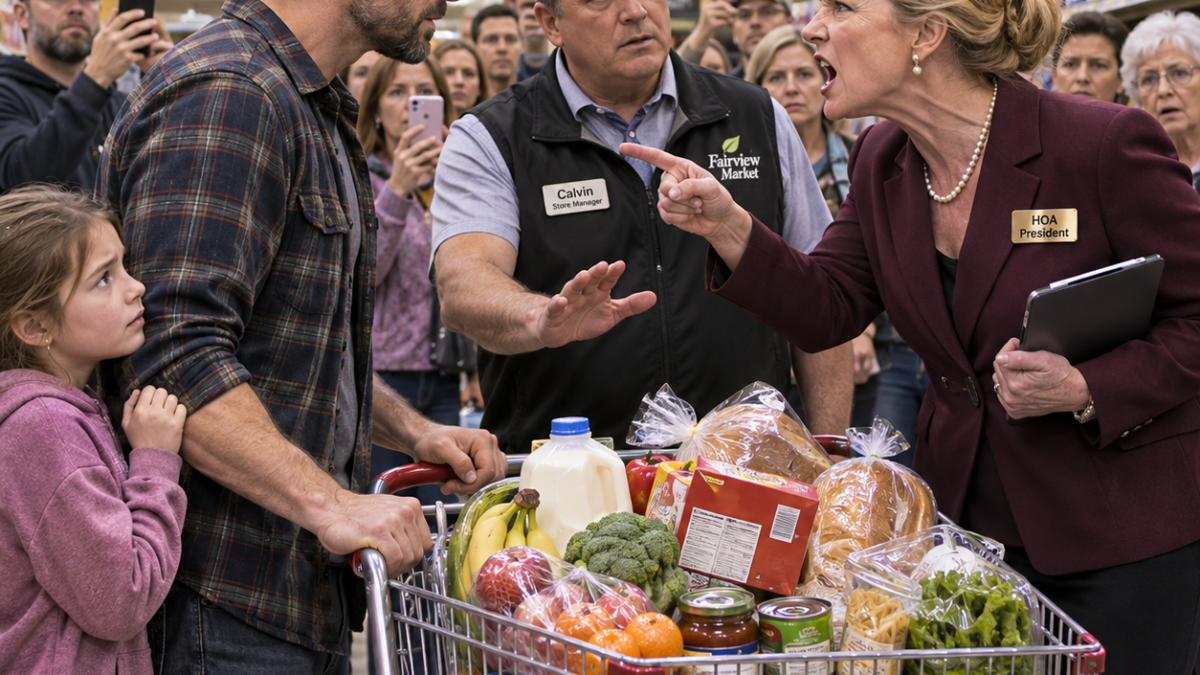
Diane put one hand on it.
“No.”
People nearby began noticing.
An older woman stopped selecting pasta.
A teenage boy lowered his headphones.
I said quietly:
“Take your hand off my cart.”
“You need to return these items.”
“No.”
“Mark.”
“No.”
She pulled.
Hard.
The cart jerked sideways.
A gallon of milk slid from the lower rack.
Hit the floor.
Burst.
White milk spread across tile.
Everybody turned.
Diane shouted:
“You bought too much!”
The entire aisle froze.
Thirty shoppers might be an exaggeration at that exact second.
By the time the argument ended?
At least thirty.
Phones appeared almost immediately.
That’s what happens now.
Public confrontation equals cameras.
Calvin Brooks arrived fast.
“What happened?”
Diane pointed at me.
“This man is refusing to comply with legally authorized community purchase restrictions.”
Calvin stared.
“Community what?”
“HOA emergency limits.”
He looked at me.
I shrugged.
Calvin looked back at her.
“Ma’am, this is Fairview Market.”
“I know.”
“There are no purchase limits on these products.”
“This is not about your store policy.”
“You just grabbed a customer’s cart and dumped milk on my floor.”
“I am enforcing Maple Ridge bylaws.”
Calvin’s expression flattened.
“Not inside my store.”
Diane lifted her chin.
“You don’t understand.”
“No, ma’am.”
“I understand exactly one thing right now.”
He pointed toward the floor.
“You need to stop touching his cart.”
Diane’s hands were shaking.
Anger.
Embarrassment.
Maybe fear.
She pulled out her phone.
“Fine.”
Then:
“I’m calling the police.”
I said:
“Please do.”
That surprised her.
“You think they won’t care?”
“About groceries?”
“Hoarding.”
I blinked.
“Hoarding?”
“And harassment.”
Calvin almost laughed.
“You’ve been confronting him.”
Diane ignored him.
She called.
Then stood ten feet away speaking loudly enough for everyone to hear.
“Yes, I need officers at Fairview Market.”
Pause.
“A man is hoarding essential food and threatening an HOA officer.”
I looked at Calvin.
He mouthed:
HOA officer?
I shrugged.
The crowd grew.
Someone had already begun posting video.
I could feel my embarrassment changing into anger.
Not because of the fine.
Because the groceries weren’t for me.
Twenty-three families had trusted me enough to admit they needed help.
Some had done it privately because they were ashamed.
Now Diane was turning their food into a public spectacle.
I went to move the cart away from the spilled milk.
She stepped close.
Very close.
Then lowered her voice.
“I know what you did.”
Five words.
Everything in me went cold.
“What?”
“The letter.”
I didn’t move.
She smiled.
“The one you sent to the county.”
Three weeks earlier, before the blackout, I had mailed a complaint to the county’s community-association oversight office.
Why?
HOA finances.
Maple Ridge had raised dues twice in eighteen months.
Maintenance services had been cut.
Pool hours reduced.
Playground repairs delayed.
Yet the annual financial summary listed vague “administrative expenditures” that had nearly doubled.
I asked Diane for detailed records.
She delayed.
Then provided partial statements.
So I sent a confidential request asking the county to review whether Maple Ridge was complying with financial-disclosure requirements.
I hadn’t posted it.
Hadn’t discussed it at meetings.
Hadn’t told neighbors.
Only Lily knew because she had watched me address the envelope.
The county had acknowledged receipt.
That’s all.
“How do you know about that?”
Diane smiled.
“People talk.”
“Who?”
“You made a mistake.”
“What mistake?”
“You should have come to me first.”
“I did.”
Her smile disappeared.
“You’re trying to damage Maple Ridge.”
“No.”
“You’re trying to damage me.”
That sentence told me more than she intended.
I said:
“Why would questions about association finances damage you personally?”
Her eyes narrowed.
Then police arrived.
Two officers.
Ramirez and Chen.
Diane ran toward them before they had crossed the produce section.
“Officers.”
She pointed at me.
“This man has been hoarding food, operating an unauthorized distribution business from his home, and threatening me.”
Officer Chen looked at my cart.
Then at Diane.
“What law did he violate?”
Diane held up the tablet.
“Section Fourteen of the Maple Ridge emergency bylaws.”
Officer Ramirez said:
“That’s not a criminal statute.”
“It was voted on by our board.”
I spoke.
“Can she show you the meeting minutes?”
Diane’s face changed.
Officer Chen looked at her.
“Can you?”
“This is an HOA matter.”
“Then why did you call police?”
Silence.
I continued.
“I checked the board minutes yesterday.”
Technically, I’d checked them repeatedly because of my county complaint.
“There is no Section Fourteen grocery restriction.”
Diane snapped:
“You think you’re clever?”
Officer Ramirez raised one hand.
“Ma’am.”
She ignored him.
“I run that neighborhood.”
Phones recorded everything.
Diane pointed at me.
“I decide who pays.”
Then, unbelievably:
“And if people want community assistance, I decide who gets it.”
Silence.
Even Diane seemed to hear herself after the words came out.
Calvin looked at her.
I felt something shift in the crowd.
Then a woman’s voice came from behind us.
“Officer?”
Everyone turned.
Gloria Haynes.
Sixty-eight years old.
Maple Ridge treasurer.
Small woman.
Gray hair.
Usually quiet at meetings.
I hadn’t seen her enter.
She was holding a thick manila envelope against her chest.
Her hands were trembling.
Officer Chen stepped toward her.
“Yes, ma’am?”
Gloria looked at Diane.
Diane’s face lost color.
“Gloria.”
Gloria swallowed.
“I need to say something.”
Diane walked toward her.
“No, you don’t.”
Officer Ramirez stepped between them.
“Ma’am, stay back.”
Gloria’s voice cracked.
“I’ve kept these for months.”
Diane said:
“Those are confidential association records.”
Gloria looked directly at her.
“I know.”
Then at the officer.
“I was scared.”
She handed him the envelope.
Inside were bank statements.
Copies.
Highlighted charges.
Fairview Market.
Again.
Again.
Again.
Tuesday.
Tuesday.
Tuesday.
Thousands of dollars.
Officer Chen flipped pages.
I stepped closer but didn’t touch them.
Gloria said:
“Forty-one thousand eight hundred sixty dollars.”
Calvin frowned.
“What?”
“HOA debit-card purchases here.”
Diane shouted:
“That is association business!”
Calvin turned toward her.
Then something seemed to click.
He looked at the statements.
Dates.
“Every Tuesday?”
Gloria nodded.
Calvin looked at Diane.
“You shop here every Tuesday.”
She stared.
He continued.
“Usually around ten.”
No answer.
Calvin looked at Officer Chen.
“I can pull transaction records.”
Diane said:
“You absolutely will not.”
Calvin didn’t even look at her.
“Wine.”
He began counting from memory.
“Steaks.”
“Imported cheese.”
“Catering trays.”
“Gift cards sometimes.”
Diane’s face went white.
He continued:
“She uses a card that says Maple Ridge Estates.”
The crowd reacted.
A woman behind me said:
“You’re kidding.”
Gloria shook her head.
“I’m not.”
She pulled another page from the envelope.
“Diane called them community hospitality expenses.”
Officer Ramirez asked:
“For what events?”
Gloria gave a bitter little laugh.
“There weren’t events.”
Diane lunged toward the papers.
“Give me that!”
Ramirez blocked her.
“Step back.”
“Those documents were stolen.”
Gloria cried:
“I am the treasurer!”
Everybody went silent again.
Then Gloria said something so quietly I almost missed it.
“She made me sign the reports.”
Diane froze.
Officer Chen looked at her.
“What reports?”
Gloria’s hands shook harder.
“The annual statements.”
“She told me the charges would be reimbursed.”
“They weren’t.”
“How long?”
“Almost two years.”
Diane said:
“She is confused.”
Gloria turned.
For the first time, there was anger in her face.
“No.”
“I’m not.”
Diane opened her mouth.
Gloria kept going.
“You told me if I questioned you, you’d tell the board I had mishandled accounts.”
“You said nobody would believe an old woman who couldn’t even use the accounting software without help.”
Diane looked around.
Thirty phones.
Store cameras.
Police.
Manager.
No friendly room left.
Officer Chen asked Calvin:
“Can you preserve all security footage and transaction records associated with this card?”
“Absolutely.”
Then he looked at me.
“What are these groceries for?”
I explained.
The storm.
Four-day outage.
Spoiled refrigerators.
Eli Turner.
Twenty-three families.
Garage pantry.
Lily’s lunch-money jar.
By the end, Officer Ramirez wasn’t writing anymore.
He was simply listening.
Then he asked:
“Mr. Turner is the veteran on Hawthorne Lane?”
“Yes.”
“I know him.”
He removed his cap.
Rubbed his forehead.
Then looked at my cart.
“That’s all going to neighbors?”
“Yes.”
A woman beside us stepped forward.
She had been standing with a basket.
She reached into her purse.
Pulled out fifty dollars.
Placed it in my cart.
I stared.
“You don’t have to do that.”
“I know.”
Then a young man approached.
Twenty.
Maybe younger.
He added two boxes of cereal from his basket.
An older couple brought canned vegetables.
Someone added diapers.
Another person put in pasta.
A mother gave baby wipes.
Within minutes, strangers were moving between aisles adding groceries.
I didn’t know what to say.
Calvin stood behind the register area watching.
Then:
“First two hundred is Fairview’s.”
I shook my head.
“Calvin—”
“No.”
“Seriously.”
“Mark.”
He pointed at the crowd.
“Take the win.”
Officer Ramirez smiled.
Diane didn’t.
She stood beside Officer Chen.
Not handcuffed.
Not yet.
But no longer in control.
Calvin walked to the office.
Returned with a piece of paper.
Handed it to Diane.
“What is this?”
“Trespass notice.”
Her eyes widened.
“You’re banning me?”
“Yes.”
“You can’t.”
“I own the store.”
That shut her up.
Calvin continued:
“You’re no longer welcome at Fairview Market until further notice.”
Diane looked at me.
“You did this.”
I thought about answering with something dramatic.
Didn’t need to.
“No, Diane.”
I pointed toward the bank statements.
“You did.”
The officers didn’t arrest her in the produce aisle that day.
Reality isn’t always that immediate.
They interviewed Gloria.
Collected initial evidence.
Contacted financial-crimes investigators.
Diane left with an attorney’s number already in her phone.
But the video?
That left faster.
By evening, clips from Fairview Market were everywhere locally.
The part people shared most wasn’t Diane grabbing the cart.
It wasn’t even the fake grocery fine.
It was her shouting:
“I decide who pays.”
And then Gloria stepping forward with the envelope.
Maple Ridge exploded.
Residents started posting questions.
Screenshots.
Old assessments.
Invoices.
One family noticed HOA landscaping charges during months when no landscaping had occurred.
Another homeowner found unexplained “resident-relations” expenses.
Someone posted photographs of Diane hosting private dinners at her house.
Wine bottles.
Catering trays.
Fairview labels.
Tuesday morning purchases.
Two days after the grocery-store confrontation, eighty homeowners filled the Maple Ridge community hall.
Technically, we had 112 households.
Eighty people attending an emergency meeting was enormous.
Diane didn’t preside.
County counsel advised the board that she had a conflict of interest.
Vice President Norman Bell opened the meeting.
He looked terrified.
Gloria sat at the front.
The envelope beside her.
I sat near the back with Lily.
She whispered:
“Is Ms. Whitaker going to jail?”
“Don’t know.”
“Do you want her to?”
I thought.
“I want the truth.”
“That sounds like a parent answer.”
“It is.”
Gloria stood.
The room quieted.
Her hands still shook.
But her voice didn’t.
She read the bank charges.
One by one.
Fairview Market.
$684.
$912.
$1,103.
$477.
Wine merchant.
Restaurant.
Luxury home-goods store.
Online purchases.
Gift cards.
Thousands.
Tens of thousands.
Some had descriptions attached:
Board hospitality.
Community outreach.
Emergency supplies.
No corresponding events.
No distributions.
No receipts proving legitimate use.
Then Gloria read the grocery total.
$41,860.
People gasped even though they’d heard the number online.
Numbers feel different when they’re read aloud in the room where dues are voted.
Norman asked:
“Was any of this authorized?”
Gloria said:
“Not by the full board.”
“Did you approve it?”
Her face fell.
“Some.”
People started shouting.
She raised one hand.
“I signed statements I should not have signed.”
Silence returned.
“Diane told me reimbursements were pending.”
“I believed her.”
“Then I stopped believing her.”
A man shouted:
“Why didn’t you tell us?”
Gloria looked down.
“Because I was afraid she’d make it look like I did it.”
That answer did not excuse her.
But I believed it.
Then I stood.
Not to make a speech.
I had one question.
“Section Fourteen.”
Norman frowned.
“What?”
“The shopping-limit bylaw.”
A few people laughed bitterly.
“Was it ever voted on?”
Norman checked with the association attorney.
The attorney shook his head.
“No.”
“Ever adopted?”
“No.”
“Ever valid?”
“No.”
I looked toward the side of the room.
Diane was present with her lawyer.
She stared at me.
The attorney continued:
“A draft version appears to have been uploaded to the homeowner portal without board authorization.”
The room erupted.
Diane leaned toward her lawyer.
He whispered something.
She stayed seated.
A motion was made to remove her as president.
Seventy-nine votes for removal.
Zero against.
One abstention.
Gloria.
Effective immediately.
The fake shopping-limit document was removed from the website that same night.
It had never legally existed.
The financial investigation lasted four months.
Much longer than social media wanted.
People online kept asking:
“Why isn’t she arrested yet?”
Because financial investigations require records.
Subpoenas.
Bank accounts.
Interviews.
Proof.
That’s what Officer Chen told me when I ran into him later.
“Viral video shows character.”
He said.
“Accounting shows crimes.”
Investigators ultimately documented extensive misuse of HOA funds.
Diane had used association money for personal grocery purchases.
Dining.
Private gatherings.
Gift cards.
Other expenses she had labeled as community business.
Some transactions were legitimate.
Many weren’t.
She was ordered to repay a substantial amount and faced criminal charges tied to misuse and falsified records.
Gloria cooperated.
Her own conduct was reviewed too.
She resigned as treasurer.
Later, the homeowners voted her back onto a temporary financial committee—not because everyone forgave her, but because she had turned over records and helped reconstruct what happened.
Diane sold her home months later.
Tuesday morning.
Quiet.
A moving truck.
No crowd.
No confrontation.
No one stood at the curb cheering.
That’s not how real endings usually work.
She simply left.
Lily and I watched from our driveway for maybe thirty seconds.
Then Lily said:
“Are we supposed to wave?”
“No.”
“Good.”
We went back inside.
The pantry didn’t disappear when the power returned.
That’s the part of the story I care about most.
Fairview Market began donating damaged-but-safe packaged goods and excess produce.
Nothing expired.
Nothing unsafe.
Just food that might otherwise be discarded.
Neighbors built shelves in my garage.
Then the garage became too small.
Maple Ridge offered an unused storage room near the clubhouse.
Someone painted a sign:
MAPLE RIDGE NEIGHBORS PANTRY
No forms.
No income proof.
No embarrassment.
If you need something, take it.
If you have extra, leave it.
Eli Turner volunteers every Saturday.
At first, he refused.
“I don’t take charity.”
I said:
“Then don’t.”
He frowned.
“Volunteer.”
That worked.
Now he organizes canned goods with military precision.
Nobody is allowed to put green beans beside soup.
Apparently wars have been fought over less.
Lily puts stickers on every family bag.
She is older now.
Still does it.
Stars.
Hearts.
Occasional unicorns.
I once asked why.
She said:
“Because needing groceries shouldn’t make the bag sad.”
Hard to argue with that.
Fairview Market keeps a small donation bin near the entrance.
Calvin labeled it:
BUY ONE EXTRA IF YOU CAN.
No guilt.
No speeches.
Just an option.
The strangest thing happened about six months after the blackout.
I was shopping.
Normal groceries.
One cart.
Nothing dramatic.
A woman stopped beside me.
“Are you Mark?”
I said yes.
She looked embarrassed.
“My family used the pantry.”
I smiled.
“Good.”
She said:
“My husband lost work that month.”
“We never told anyone.”
“You didn’t need to.”
She looked into my cart.
Then placed two jars of peanut butter inside.
“For someone else.”
That was the moment I realized the pantry had become what I’d hoped without knowing how to name it.
Not charity moving downward.
Neighbors moving things sideways.
Today you have extra.
Tomorrow I might.
Nobody gets to become queen because they control the groceries.
That’s what Diane never understood.
She thought help was power.
If she controlled access, she controlled people.
Rules.
Fines.
Permissions.
Who qualified.
Who didn’t.
Who was embarrassed.
Who owed gratitude.
But real community isn’t built by controlling need.
It’s built by making need safe to admit.
I think about Eli often.
The first night.
Cold beans.
Dark house.
“Don’t worry about me, son.”
If I’d listened?
Maybe nothing terrible would have happened.
He would’ve survived.
Most people would’ve.
But survival is a low standard for neighbors.
People deserve more than:
You’ll probably make it.
They deserve:
I saw you.
I’ve got some bread.
Take the milk.
Don’t apologize.
That lesson cost me less than the fence I’d planned to replace.
The fence is still old.
One section leans slightly after every storm.
Lily says it’s “historic.”
I say we’re broke.
Both are partially true.
Months after everything, Calvin showed me the store’s security footage.
Not Diane’s confrontation.
The moments after.
People adding things to the cart.
From above, there was no sound.
Just strangers moving.
One woman places cash.
A teenager adds cereal.
An elderly couple puts canned food in.
A man rolls up diapers.
Calvin walks in and points toward the register.
The cart gradually gets fuller.
Diane stands at the edge of the frame.
Still.
Watching.
Calvin paused it.
“You know what’s funny?”
“What?”
“She told me you bought too much.”
He pointed at the screen.
“Then everybody bought more.”
I laughed.
I hadn’t thought of it that way.
That’s probably the most fitting part.
Control met abundance.
Her solution was:
Put it back.
Everyone else’s response became:
Add something.
I kept my original handwritten grocery list.
It’s in the pantry now.
Framed.
Not because I’m sentimental.
Okay.
A little.
Lily’s unicorn is still beside bananas.
At the bottom, in her handwriting:
MR. TURNER — COFFEE!!!!
Four exclamation points.
He had apparently told her coffee was essential nutrition.
The list reminds me how ordinary it started.
No grand plan.
No organization.
No nonprofit.
A dark kitchen.
An older man eating cold beans.
A kid with a lunch-money jar.
A garage.
Then a grocery cart.
People sometimes ask why Diane followed me to Fairview.
I can’t prove every part.
Investigators believed my records complaint had made her nervous.
She knew I was asking questions.
The fake shopping restriction gave her leverage.
Maybe she hoped to fine me.
Discredit me.
Portray me as hoarding supplies during an emergency.
Shut down the garage pantry before neighbors started talking to one another.
People who rely on secrecy tend to dislike neighbors comparing notes.
Because once Maple Ridge started sharing food, people also started sharing information.
Who got fined.
Who didn’t.
What dues had increased.
Which maintenance never happened.
What Diane said privately.
Community can expose corruption almost accidentally.
Maybe that’s what scared her.
The line I remember most isn’t:
“You bought too much.”
It isn’t:
“I decide who eats.”
It isn’t even:
“I know what you did.”
It’s something Gloria said months later.
She came to the pantry.
Brought six bags of rice.
We were alone.
She said:
“I kept waiting for someone braver than me.”
I looked at her.
She continued:
“I had those statements for months.”
“Every meeting, I thought I’d say something.”
“Then Diane would look at me.”
“And I’d think, next time.”
She placed rice on the shelf.
“The grocery store was the first time I realized there might not be a next time.”
I understood.
Because that’s exactly how the pantry started.
Everybody waits for someone else.
Someone richer.
Someone stronger.
Someone officially responsible.
Someone with authority.
But sometimes the person available is just you.
A single dad with an old garage.
An eleven-year-old with twenty dollars.
A frightened treasurer holding an envelope.
A store manager willing to say:
Not in my store.
One woman with fifty dollars.
Then another person.
Then another.
None of us fixed everything.
We did one thing.
Then somebody else did one.
That’s how Maple Ridge recovered.
Not from the blackout.
From something worse.
The belief that community meant obeying whoever had the title.
The new HOA president is Norman Bell.
He hates the job.
Which probably makes him perfect for it.
Meetings are boring now.
Financial statements online.
Every purchase over a set amount requires dual approval.
No new rules appear on the website without recorded votes.
Residents can inspect minutes.
Nobody tracks grocery carts.
Progress.
At the first meeting after the investigation closed, Norman said:
“If I ever tell you I’m deciding how much cereal you’re allowed to buy, remove me immediately.”
People laughed.
I did too.
Then Eli raised his hand.
“Does this apply to coffee?”
Norman said:
“No.”
“Coffee remains under federal protection.”
Eli approved.
The storm happened almost three years ago.
The pantry still opens twice a week.
Not because Maple Ridge is poor.
Because everybody gets hit eventually.
Job loss.
Medical bills.
Divorce.
Car repairs.
A furnace dying in January.
People live comfortable lives until suddenly they don’t.
One bad month can humble almost anyone.
There’s no shame in needing one grocery bag.
There shouldn’t be.
Every Saturday morning, Eli unlocks the pantry.
Lily helps when she’s home.
I’m usually there.
Sometimes I still shop at Fairview for supplies.
The first time I went back with two full carts, Calvin saw me.
He pointed.
“Careful.”
“Why?”
“You bought too much.”
I stared at him.
Then he started laughing.
I told him he wasn’t funny.
He still thinks he is.
We loaded everything into my truck.
As I drove home, I thought about that original confrontation.
Diane’s hand gripping the cart.
Milk exploding on the floor.
Thirty phones.
Her voice:
“Put it back.”
I was embarrassed then.
Angry.
Afraid too, once she mentioned the county letter.
I thought the worst thing that could happen was an $800 HOA fine.
I had no idea the argument was going to expose forty-one thousand dollars in grocery-store charges and a much larger financial investigation.
That’s the strange thing about people trying desperately to control a story.
Sometimes they squeeze so hard they break it open themselves.
If Diane had ignored me?
I would’ve bought the food.
Gone home.
County investigation might still have happened eventually.
Maybe months later.
Maybe not.
Instead, she followed me into a grocery store.
Brought her tablet.
Grabbed my cart.
Called police.
Put thirty cameras on herself.
Then created the exact scene where Gloria finally became brave enough to walk forward.
Diane thought she was stopping groceries.
She created witnesses.
She thought she was exposing me.
She exposed herself.
That’s why I don’t believe I defeated her.
I didn’t.
I asked questions.
Gloria kept records.
Calvin remembered transactions.
Police listened.
Neighbors voted.
Diane supplied the rest.
The pantry has one rule posted by the door now.
Only one.
Lily wrote it.
I wasn’t allowed to improve the wording.
It says:
TAKE WHAT YOU NEED. LEAVE WHAT YOU CAN. NO ONE HAS TO EXPLAIN.
Underneath, someone later added:
EXCEPT ELI. ELI HAS TO EXPLAIN WHY HE TAKES SO MUCH COFFEE.
He blames me.
It wasn’t me.
Probably Calvin.
Some Saturday mornings, I stand in that little pantry and listen.
People talking.
Bags rustling.
Eli arguing about shelf organization.
Kids putting stickers on boxes.
The room isn’t quiet.
That’s what I like.
The blackout made Maple Ridge dark for four days.
But darkness wasn’t what scared me most.
It was realizing how quickly hardship makes people retreat into their own homes.
Close doors.
Protect what they have.
Assume everyone else is okay.
The pantry did the opposite.
It gave us a reason to open doors.
Diane’s mistake was thinking groceries were something she could control.
How much.
Who bought them.
Who received them.
Who paid fines.
But food is basic.
Sharing it is basic too.
Long before HOA bylaws and tablets and maroon blazers, somebody had extra bread and somebody else was hungry.
The rest is paperwork.
I still have the shopping cart photograph someone took that day.
Me on one side.
Diane on the other.
Her hand gripping the handle.
Cart overflowing.
Milk on the floor.
Thirty strangers watching.
Whenever I see it, I don’t remember the shouting first.
I remember why the cart was full.
Eli’s cold beans.
The family with the newborn.
Ms. Alvarez.
Twenty-three names on a handwritten list.
My daughter’s twenty dollars.
That’s what Diane couldn’t understand.
She looked at a full cart and saw excess.
I looked at it and saw twenty-three kitchens.
Twenty-three breakfasts.
Twenty-three moments where somebody wouldn’t need to choose between pride and eating.
Maybe I did buy too much for one household.
Good thing it wasn’t for one.
And maybe that’s the simplest lesson I took from everything that happened afterward.
People who want power usually spend a lot of time deciding what everyone else deserves.
How much help.
How many groceries.
How many questions.
How much truth.
But real neighbors don’t ask who deserves a loaf of bread after four days without power.
They ask how many loaves are left.
Then they make room in the cart.
Diane grabbed mine and screamed:
“You bought too much.”
In the end, she was wrong.
We needed another cart.








