HOA Karen Tore Out My 210-Foot Drainage Wall for 64 Parking Spaces—Then a Judge Ordered Her $3.4M Plaza Demolished
PART2:
As an adult, after watching storms come down from the ridges, he did.
Water remembers every low place.
You can cut roads.
Build houses.
Pour concrete.
Raise curbs.
Install fountains.
Water does not care.
It follows grade.
Pressure.
Gravity.
The drainage wall along Nolan’s northern boundary had existed in one form or another since before Pine Vale Estates was more than farmland.
The modern reinforced section was built after a series of damaging storms in the 1990s.
Two hundred ten feet.
Five feet high through its tallest sections.
Concrete footing.
Diversion channel.
Relief structures.
The system captured runoff coming from higher land and guided it east toward a documented discharge corridor.
It protected Nolan’s lower field.
But not only Nolan’s land.
PART3:
As Pine Vale Estates expanded uphill, the same system kept stormwater from backing toward the neighborhood’s southern roads and lowest houses.
It was not attractive.
No landscaping magazine would photograph it.
It was simply infrastructure doing its job.
For twenty years Nolan had maintained it.
Sealed cracks.
Cleared debris.
Replaced damaged barriers.
Paid engineers when erosion exposed footing.
Once, after a flash flood, he spent nearly $23,000 rebuilding a section that shifted eight inches.
People complained about maintenance costs like that until they saw what water could cost instead.
Storm season was approaching when Nolan took his old Ford down the boundary road that morning.
He planned to walk the wall.
Check the culverts.
Clear brush.
Ordinary work.
Then he rounded the bend.
Luxury cars.
Decorative fencing.
A crowd.
The fountain.
And sixty-four parking spaces where his drainage system should have been.
Nolan hit the brakes.
Gravel sprayed.
He sat behind the wheel.
Did not understand.
He knew the wall’s location so well he could have walked it blind.
For an instant he wondered if Pine Vale had built closer than he remembered.
Impossible.
He opened the truck door.
Walked toward the fence.
Then stopped.
The wall was not hidden behind landscaping.
It was gone.
Not damaged.
Gone.
The old channel had been packed with crushed stone and compacted soil.
A raised parking base covered part of it.
Stone plaza occupied the rest.
Near the southern entrance, fresh asphalt crossed the exact line where stormwater had historically moved.
Nolan stared at the fill.
The kind of stillness that comes before real anger settled over him.
A security guard approached.
“Sir, this is a private event.”
“Who is in charge of construction?”
“Are you a resident?”
“No.”
“I’ll need you to remain outside the event area.”
“I’m asking who removed that drainage wall.”
The guard glanced toward plaza.
Nolan pointed.
“That wall stood right there.”
“I don’t know anything about construction.”
“Then find someone who does.”
A microphone went silent.
Nolan looked up.
Brielle Hargrove stood on a raised platform beside the fountain.
Forty-six.
Pearls.
Cream suit.
Hair arranged perfectly.
President of Pine Vale Estates HOA.
Behind her:
Sponsors.
Residents.
County business association representatives.
A banner.
She had been telling them the plaza would become the most elegant community gathering place in the county.
Now she stared toward Nolan.
Then smiled.
Not warmly.
Recognition.
Brielle handed microphone to assistant.
Walked across plaza.
Several people followed with their eyes.
“Nolan.”
“Brielle.”
“You could have called before coming over.”
“This is my property line.”
“And this is our grand opening.”
He pointed toward asphalt.
“Where’s my wall?”
Brielle gave the kind of small laugh used when an adult wants other adults to understand that someone has asked a ridiculous question.
“We removed that ugly concrete wall.”
Then:
“You’re welcome.”
Several people nearby smiled.
Nolan did not.
“That wall was part of the drainage system.”
“We have new drainage.”
“Where?”
“Integrated beneath the plaza.”
“Show me.”
Brielle crossed her arms.
“This is not an engineering meeting.”
“You removed a two-hundred-ten-foot diversion wall.”
“It was obsolete.”
“Who told you that?”
“Our project professionals.”
“Which engineer?”
Her smile faded slightly.
“Nolan, you do not get to walk into our opening and interrogate contractors.”
“I’m asking because the wall was on my land.”
Brielle turned toward crowd.
There it was.
Performance.
She smiled broadly.
“Mr. Whitaker has never been comfortable with Pine Vale improving the neighborhood.”
A few people shifted.
Nolan heard someone laugh.
Brielle continued:
“Some neighbors would rather look at cracked concrete and weeds than see property values rise.”
Nolan looked around.
Phones were up now.
Recording.
That mattered.
He lowered his voice instead of raising it.
“The wall was not decoration.”
“Stormwater comes off that ridge.”
“Where is it supposed to go now?”
Brielle gestured toward new trench drains.
“There.”
“Those drains connect to what?”
“The new system.”
“Which discharges where?”
Her smile disappeared.
“Nolan, enough.”
He looked past her.
A manhole cover sat near plaza border.
Old storm-drain marking.
But it was almost forty feet from original line.
That was wrong.
He photographed it from outside the event fence.
Brielle noticed.
“Security.”
Two guards approached.
Nolan did not move toward them.
He asked:
“Can I see the construction permit?”
Brielle removed folded paper from her portfolio.
For half a second Nolan thought she might actually hand him one.
Instead:
NOTICE OF TRESPASS AND INTERFERENCE.
Pine Vale letterhead.
His name.
“Stay off association property.”
“You’re also being fined six thousand dollars for disrupting an authorized community event.”
Nolan looked at paper.
Then at her.
“I’m not an HOA member.”
“That doesn’t give you the right to interfere with Pine Vale operations.”
“How does your HOA fine a man who does not belong to it?”
Brielle did not answer.
She turned.
Walked back to stage.
Microphone.
Smile.
Applause.
Nolan stood at fence while people clapped for fountain.
He looked down at fill covering drainage line.
Then whispered:
“You buried the wrong thing.”
He left.
Not because Brielle ordered him to.
Because he knew anger was about to become expensive if he stayed.
The first person he called was not lawyer.
It was Eliza Boone.
Independent hydrology engineer.
Fifty-two.
Nolan had hired her twice before.
She understood Stonebrook watershed better than almost anyone local.
He described wall.
Parking lot.
New manhole.
Filled channel.
Eliza interrupted.
“Did they change grade?”
“Yes.”
“How much?”
“Looks like two to three feet across parts.”
“Did they leave the relief channel?”
“No.”
“Are you sure?”
“I’m staring at compacted base where it was.”
Pause.
Then:
“Do not touch anything.”
“I wasn’t planning to.”
“Do not enter their property.”
“Take photographs only from where you have legal access.”
“Eliza.”
“What?”
“How bad?”
She exhaled.
“If they buried the relief path and raised the grade, their parking lot may be sitting on the wrong side of the water.”
That sentence chilled him more than Brielle’s fine.
His phone buzzed.
Email.
PINE VALE MANAGEMENT.
Subject:
NOTICE OF UNAUTHORIZED INTERFERENCE — $6,000 PENALTY.
He opened.
Most of it was nonsense.
Association rules.
Event disruption.
Reputation.
Then one sentence:
The original adjacent property owner previously authorized removal of existing drainage structures required for the Grand Plaza project.
Nolan read it again.
Original adjacent property owner.
Him.
He had authorized nothing.
The wall was older than Pine Vale.
In 1998, before the subdivision expanded, engineers had recorded a drainage and maintenance easement tied to the Stonebrook corridor.
Nolan’s father signed documents because part of the diversion wall lay on family land while the protected corridor continued through property later incorporated into Pine Vale.
The easement established:
Drainage flow.
Maintenance access.
Restrictions on permanent structures.
Nolan took over responsibilities in 2006.
He had those records.
Somewhere.
Probably in filing cabinets inside equipment barn office.
The wall was never secret.
Never abandoned.
Never disputed.
So where did Brielle get consent?
Nolan drove to Douglas Pritchard’s supply yard.
Douglas was sixty-eight and had known Nolan’s father.
Years earlier, theft from the maintenance road led them to install a camera overlooking the entrance.
Nolan paid half.
Douglas kept system.
“You still have footage from last month?”
“How far back?”
“Thirty days?”
“Maybe forty.”
Douglas brought up recordings.
They searched mornings.
One day.
Two.
Then:
4:18 a.m.
Headlights.
Two trucks.
Excavator.
Portable work lights.
Workers removed boundary barriers.
Excavator bucket struck wall.
Concrete cracked.
Section folded.
Then another.
Nolan watched without speaking.
Wall he had repaired by hand.
Wall his father had paid engineers to redesign.
Reduced to rubble in darkness.
Dump trucks hauled pieces.
A supervisor stood beside channel holding drawings.
Douglas paused.
Zoomed.
Mason Rourke.
General contractor.
Nolan knew him.
Not personally.
Recognized from county construction projects.
Douglas muttered:
“They knew nobody wanted this seen.”
Nolan said:
“Maybe they wanted an early start.”
Douglas looked at clock.
“Four eighteen?”
Nolan nodded.
“Maybe.”
He did not make claims beyond evidence.
Not yet.
He copied footage.
Backed it up.
Then drove to Mason’s office.
Mason came into lobby with irritated expression.
“Nolan, you need to talk to Pine Vale.”
“I’m talking to person whose excavator demolished my wall.”
“We were authorized.”
“By who?”
“Client.”
“Show me.”
“I can’t release contract documents.”
“Then tell me what property owner signed.”
Mason stiffened.
“Nolan—”
“I was fined this morning for interfering with a project built over my drainage line.”
“I have video of your crew removing wall.”
“I am asking what document told you that wall belonged to them.”
Mason’s face changed slightly.
Confidentiality is easy when dispute abstract.
Harder when property owner standing in office with footage.
He closed lobby door.
“Come upstairs.”
Conference room.
Nolan laid:
Deed copy.
1998 easement summary.
Photographs.
Mason read.
Then:
“This is not what we received.”
“What did you receive?”
Mason opened project file.
Found photocopy.
LANDOWNER CONSENT FOR DRAINAGE MODIFICATION.
Signature:
Nolan J. Whitaker.
Nolan stared.
It resembled his signature.
Enough to pass casual glance.
But wrong.
His capital W slanted differently.
Final r curled upward.
This one curled underneath.
Date:
September 14.
Nolan almost laughed.
Not humor.
“That week I was in Kansas.”
Mason stared.
“What?”
“September twelfth through seventeenth.”
“Consulting job.”
“I have hotel receipts.”
“Flight confirmation.”
“Client records.”
“This says meeting occurred here.”
“I was seven hundred miles away.”
Mason sat back.
For first time he looked afraid.
“If that isn’t yours…”
“It isn’t.”
“…then someone lied to every contractor on this site.”
Nolan gathered papers.
At door Mason said:
“Wait.”
Nolan turned.
Mason lowered voice.
“There was another issue.”
“What?”
“Early drainage plan didn’t work.”
“Engineer wanted redesign.”
“Who?”
“Reed Halston.”
“What happened?”
“Client replaced team.”
“Did you tell them wall could not simply disappear?”
“Yes.”
“And?”
Mason looked toward closed door.
“Brielle wanted sixty-four parking spaces.”
“There was an option preserving corridor.”
“Fewer spaces.”
“How many?”
“Thirty-eight.”
Nolan almost did not understand.
Twenty-six parking spaces.
That was the difference.
Mason continued:
“She rejected it.”
“What did final plan say?”
“We were issued revised set showing existing wall removed.”
“Drainage corridor filled.”
“Consent attached.”
Nolan asked:
“Who transmitted consent?”
Mason hesitated.
“Brielle.”
That afternoon, Nolan hired attorney.
Daniel Mercer.
Fifty-five.
Property and construction litigation.
Daniel listened.
Did not interrupt.
Then asked:
“What do you want?”
“My wall restored.”
“Anything else?”
“Drainage system made safe.”
“Money?”
“Not right now.”
“Good.”
Nolan frowned.
“Why good?”
“Because asking for restoration instead of a jackpot tells court what matters.”
Daniel drafted preservation notices.
Association.
Contractor.
Project engineer.
County.
No deletion.
No destruction.
No alteration of records.
Then formal demand:
Stop using new construction affecting drainage corridor.
Produce permits.
As-built drawings.
Landowner consent.
Allow independent inspection.
Preserve evidence.
Provide restoration plan.
No dollar demand.
Brielle treated letter as attack.
Emergency HOA meeting.
Newsletter headline:
NEIGHBOR ATTEMPTS TO SABOTAGE $3.4 MILLION COMMUNITY INVESTMENT.
Nolan’s name.
She told residents he resented Pine Vale success.
She claimed his wall was obsolete.
She said association professionals approved everything.
Then another letter came.
If delays caused losses, Pine Vale might pursue Nolan personally.
Daniel read it.
Smiled.
“What?”
Nolan asked.
“She keeps writing.”
“That’s good?”
“Very.”
“People are generous when they document their own positions.”
Nolan did not find it funny yet.
Eliza began engineering assessment.
She requested:
Original easement.
Historical hydrology.
Grand Plaza grading plans.
As-built drainage.
County filings.
Nolan submitted public-records requests.
At county building department, Patrick Hollis pulled plan sets.
Forties.
Meticulous clerk.
The preliminary drawings showed dashed line.
EXISTING DRAINAGE MAINTENANCE CORRIDOR — KEEP CLEAR.
Patrick found revised set.
Same area shaded gray.
IMPROVED PARKING AND PEDESTRIAN PLAZA.
The dashed line had vanished.
Patrick frowned.
“That’s not a minor revision.”
“No.”
He spread recorded plat.
Steel ruler.
Old corridor.
New plaza footprint.
Then looked at Nolan.
“The wall may not be biggest problem.”
“What?”
“Look.”
The drainage corridor cut directly beneath much of plaza.
Parking.
Entry drive.
Fountain.
Utilities.
Nolan felt his stomach tighten.
“So even if they rebuild wall…”
Patrick shook his head.
“Depends on easement language and engineering.”
“But they built permanent improvements where record says keep open.”
“Yes.”
Nolan hired licensed survey crew.
Fresh monuments.
Boundary reconstruction.
Results:
Old wall entirely on Nolan’s property.
Drainage corridor legally recorded.
Grand Plaza raised grade over corridor.
Permanent structures occupied maintenance zone.
No recorded amendment.
No termination.
No relocation.
Brielle had not accidentally crossed six inches.
She had built a centerpiece over system.
Eliza modeled rainfall.
Design storm.
Moderate heavy storm.
Peak event.
Results were not theatrical.
That made them more alarming.
Water could accumulate beneath raised base.
New trench drains lacked demonstrated capacity.
Buried outlet restricted flow.
Hydraulic pressure could move beneath pavement.
Runoff might redirect toward neighborhood’s lower streets.
Eliza wrote:
Catastrophic failure is not certain.
System performance cannot be demonstrated as safe under required design conditions.
Nolan appreciated sentence.
No exaggeration.
Just enough.
At meeting, he unrolled plat.
Brielle laughed.
“You expect us to demolish a three-point-four-million-dollar plaza because of a line on an old map?”
Nolan answered:
“No.”
“I expect you to explain why the line disappeared from your new plans.”
Silence.
Treasurer Audrey Bellamy looked toward Brielle.
Then:
“Why is there no budget item for relocation of drainage system?”
Brielle closed folder.
“This meeting is becoming unproductive.”
Audrey said:
“That was a question.”
“We’ll have counsel address technical matters.”
Meeting ended.
That night Mason called Nolan privately.
“Part of your wall is underneath plaza.”
Nolan sat straighter.
“What?”
“Crushed concrete reused as fill.”
“You buried it?”
“We were directed to reuse suitable demolition material.”
Nolan closed eyes.
“So restoration requires excavating base.”
“Yes.”
Mason continued:
“I need you to understand something.”
“I proposed alternate channel.”
“Brielle rejected it.”
“Why?”
“Parking.”
“She said sixty-four spaces were nonnegotiable.”
Nolan stood at kitchen window looking toward distant plaza lights.
A $3.4 million development.
Potential flooding.
Trespass.
Possible false signature.
For twenty-six parking spaces.
The weather changed three days later.
Severe thunderstorm warning.
Eliza called before rain.
“If this one tracks over Stonebrook, watch from your side.”
“I will.”
“Do not go near plaza.”
“I know.”
“You say that a lot.”
“Because you tell me obvious things.”
“Because angry landowners do stupid things in storms.”
Nolan smiled despite himself.
Rain arrived hard.
Two hours.
Sheets across pasture.
Nolan stood under equipment-barn overhang.
Phone recording.
For twenty years, runoff hit wall.
Turned.
Moved east.
Now it rushed toward missing line.
Brown water slammed against compacted fill.
Swirled.
Rose.
Changed direction.
He sent video to Eliza.
Across fence, parking lot began failing.
First sign:
Water bubbling upward through paver joints.
Then trench drain reversed.
Instead of swallowing flow, it spit muddy water onto asphalt.
A dark crack formed near south entry.
One parking stall dipped.
Then another.
SUV right-front wheel sank six inches into soft edge.
No injuries.
Tow strap pulled it free.
Residents filmed.
Nolan kept camera on water.
Not people.
Evidence.
Brielle arrived.
Instead of clearing whole plaza, she ordered workers to place planters and rope around damaged area.
Rest remained open.
Eliza called Nolan.
“Tell county.”
“Already doing it.”
Then Brielle called.
“You caused this.”
Nolan almost thought he misheard.
“What?”
“Your land discharged water into our property.”
“That is called rain.”
“You manipulated drainage upstream.”
“I touched nothing.”
“We will investigate.”
“I hope you do.”
Then he sent her video.
Original flow.
Buried outlet.
Water backed.
No need to argue.
Independent site inspection followed.
Subsurface erosion.
Void formation.
Water traveling beneath base.
Eliza explained to board:
“The dangerous part is not the crack you can see.”
“It’s the pavement that still looks perfect.”
“Subgrade can wash away beneath an apparently intact surface.”
Brielle snapped:
“You’re damaging property values with speculation.”
Eliza answered:
“My report will reflect measurements.”
“Not property values.”
Daniel filed emergency motion.
Deed.
Easement.
Survey.
Demolition video.
Engineering report.
Storm footage.
Photographs.
Disputed consent.
Judge scheduled expedited hearing.
Brielle told residents:
“We have permits.”
“We will win.”
Then county sent notice.
Explain inconsistencies between approved plans, revised drawings, and built conditions.
Now every answer became potential evidence.
Audrey Bellamy came to Nolan’s farmhouse that evening.
No makeup.
Tired.
She carried photocopies.
“I owe you an apology.”
Nolan opened door wider.
“What happened?”
Audrey put invoice on table.
Circle.
EMERGENCY DRAINAGE MODIFICATION — $186,000.
“We paid them to tear out your wall.”
“I know.”
“No.”
She tapped invoice.
“We were told this was repair.”
Detailed line items:
Demolition.
Hauling.
Backfill.
Compaction.
Audrey looked sick.
“Board summary said drainage improvements.”
Original contract did not include demolition.
Change order added after engineering conflict.
Brielle had described to board as necessary improvement.
Audrey went through accounts line by line after storm.
Found discrepancy.
Nolan said:
“Why bring this to me?”
“Because I voted for plaza.”
“I still think community deserved gathering space.”
“But I did not vote to destroy somebody’s property.”
“You need give this to your board counsel too.”
“I will.”
“Preserve original.”
She nodded.
Then:
“There’s more.”
Project archive contained email from original engineer.
Reed Halston.
Subject:
DRAINAGE CORRIDOR CONFLICT — DESIGN REVISION REQUIRED.
Explicit:
Existing wall must not be removed.
Drainage corridor must not be filled.
Replacement design required before work.
Nolan stared.
“She knew.”
“Yes.”
Not suspected.
Not should have known.
Knew.
At emergency board session, Brielle arrived with polished slideshow.
Beautiful aerial images.
Economic benefits.
Event bookings.
Property values.
Audrey asked:
“Read full change order.”
Brielle refused.
“It contains technical material irrelevant to board.”
Audrey replied:
“It concerns $186,000 of association money.”
Board members shifted.
Nolan attended only dispute portion.
He placed three documents:
Original drawing showing corridor.
Revised drawing deleting it.
Invoice paying to demolish and backfill.
One question:
“Why were residents told drainage was being improved when contractor was paid to remove the existing system?”
Brielle said:
“Because old wall was obsolete.”
“Then why did first engineer mark it protected?”
No answer.
Audrey produced Reed’s email.
Brielle called it preliminary.
Then threatened whoever leaked internal records.
Audrey interrupted:
“Those are HOA records.”
“Not your private papers.”
For first time, Brielle lost room.
Board froze additional plaza spending.
Independent audit.
Safety review.
Brielle slammed hand on table.
“This project is not being dismantled because one neighbor refuses to accept progress.”
Nolan stood.
“You had a choice.”
“Move parking lot.”
“Or destroy wall.”
“You chose wall.”
She laughed angrily.
“No judge is going to demolish a three-point-four-million-dollar plaza for you.”
Nolan met her eyes.
“Then let judge see what you buried.”
That night Reed Halston called.
He had avoided conflict.
No longer.
Final drawings presented as engineering approval were not his approved set.
Technical appendix missing.
He had withdrawn from certifying revised drainage.
Nolan asked:
“Can plaza stay if they rebuild wall?”
“No.”
“Why?”
“Because they built foundation inside emergency flow corridor.”
Reed explained Plan A.
Preserve wall.
Shift plaza higher.
Thirty-eight spaces.
Plan B.
Sixty-four spaces.
Expanded footprint.
Required drainage redesign and legal resolution.
Brielle chose footprint before solving conditions.
He warned.
She pushed ahead.
Then emails surfaced in discovery.
From Brielle:
Do not show the old drainage wall on presentation drawings. It is already scheduled for removal.
Another:
We cannot afford to lose 26 parking spaces. Find a way around drainage objection.
Daniel read second email twice.
Then put paper down.
“She made parking count design parameter.”
Nolan said nothing.
Eliza and structural engineer tested alternatives.
New pipe under plaza?
Insufficient without full hydraulic redesign and maintenance access.
Partial demolition?
Did not restore corridor.
New wall beside existing plaza?
Wrong flow alignment.
Raised bypass channel?
Still interfered with easement and created new risk.
Could plaza remain?
Not as currently interconnected.
Parking base.
Drive.
Fountain footings.
Utilities.
Pavers.
All occupied zone needed excavation.
Conclusion:
Complete removal of Grand Plaza improvements within restoration area necessary.
Brielle saw report.
Then offered money.
First settlement.
Keep plaza.
Install small drainage pipe.
Pay Nolan.
Confidentiality.
He asked:
“Where is hydrology study?”
“We’ll commission one.”
“County approval?”
“Pending.”
“Maintenance-access design?”
“Can be negotiated.”
“So you’re asking me to release recorded rights in exchange for a pipe nobody has proved works.”
Brielle pushed envelope forward.
“We can increase amount.”
Nolan pushed it back.
“This stopped being about my wall when your parking lot started sinking.”
She stared.
“You enjoy this.”
“No.”
“I wanted you to leave wall alone.”
That answer infuriated her more than any insult.
Because it denied her preferred story.
Brielle needed Nolan to be motivated by revenge.
Then she could negotiate price.
But Nolan wanted drainage restored.
Money could not purchase equivalent result without engineering proof.
Consent document became separate problem.
Transmittal records showed Brielle sent it to contractor.
No original produced.
Nolan denied signature under oath.
Travel records supported absence.
Daniel asked court to find association failed to prove authorization and refer suspected document irregularities to appropriate authorities.
He did not ask judge to declare Brielle forged it.
Evidence did not yet prove who physically made signature.
That discipline mattered.
Brielle’s lawyer attacked Nolan publicly as someone making criminal insinuations.
Daniel answered:
“We asked for investigation.”
“Not conviction.”
The hearing came six weeks after grand opening.
Judge Miriam Sloan.
Sixty-one.
Reading glasses.
Known for impatience with theatrics.
Brielle arrived with glossy photographs of plaza.
Sunset.
Children near fountain.
Community concert.
Wedding setup.
Her attorney argued demolition grossly disproportionate.
Millions spent.
Residents relied on facility.
Events booked.
Daniel stood.
“The question is not what Pine Vale spent.”
“The question is whether Pine Vale had right to build there.”
Patrick Hollis testified first.
Recorded plat.
Deed.
Easement.
Wall location.
Judge asked:
“Does recorded drainage easement expire because land around it was developed?”
“No.”
“Any recorded termination?”
“None found.”
She handed him new construction plan.
“Mark corridor.”
Patrick drew.
Line went through center of plaza.
Judge looked.
Then:
“That is substantial overlap.”
“Yes, Your Honor.”
Eliza testified.
Water flow.
Grade.
Storm.
Backflow.
Subsurface erosion.
Judge asked:
“Can association install new pipe and leave plaza?”
Eliza answered:
“Not based on any design currently before court.”
“Why?”
“No demonstrated equivalent capacity.”
“No confirmed safe outlet.”
“Maintenance access remains blocked.”
“Foundations occupy required corridor.”
Structural engineer followed.
Restoration requires removal of interconnected improvements.
Then Reed Halston.
The room changed.
He was association’s own first engineer.
Confirmed warning.
Confirmed Plan A.
Confirmed Plan B required redesign.
Confirmed he did not certify final drainage arrangement.
Brielle interrupted from counsel table:
“He delayed the project for months.”
Judge looked at her.
“Mrs. Hargrove, you will allow witness to answer.”
She sat.
Daniel asked Reed:
“Did you approve removing Nolan Whitaker’s wall without a functioning replacement drainage system?”
“No.”
“Did you approve filling the existing drainage corridor beneath Grand Plaza?”
“No.”
Brielle’s attorney tried to show engineering judgment differences.
Reed agreed reasonable engineers can disagree.
Then:
“But disagreement does not mean you can remove drainage system first and design replacement afterward.”
That sentence stayed.
Then Brielle testified.
She said she relied on professionals.
Daniel displayed email:
DO NOT SHOW OLD DRAINAGE WALL ON PRESENTATION DRAWINGS.
Brielle read.
Judge asked:
“You knew wall existed?”
“Yes.”
“You knew drainage corridor existed?”
“I knew there were old references.”
“Did you receive Mr. Halston’s warning?”
“Yes.”
“But he was one consultant.”
Judge set pen down.
“You were specifically warned that removing the wall and filling corridor required redesign.”
Brielle said:
“There were competing opinions.”
“Which engineer approved final condition as built?”
Silence.
Her lawyer said others participated.
Judge asked again.
No clear answer.
Then disputed consent.
Nolan testified.
Signature not his.
No permission.
Was in Kansas.
Records.
Hotel.
Work calendar.
Credit card.
Flight.
Association could not produce original.
Judge did not declare forgery.
She did say Pine Vale failed to prove right to enter Nolan’s property and remove structure based on unauthenticated disputed copy.
Then association lawyer made strongest emotional argument.
“Your Honor, complete demolition would destroy a three-point-four-million-dollar investment serving hundreds of residents.”
Judge Sloan looked at him.
Then plans.
Then:
“Spending $3.4 million does not create a right that never existed.”
Courtroom silent.
Brielle’s expression changed.
For first time, confidence disappeared.
Judge recessed.
Returned.
Order.
Association violated Nolan’s property rights.
Obstructed valid recorded drainage corridor.
Money damages alone inadequate because physical obstruction remained.
Pine Vale must restore drainage corridor under approved engineering plan.
Immediate closure.
Fence unsafe area.
Remove parking lot and plaza improvements within restoration zone.
Remove fountain foundation where necessary.
Excavate buried channel.
Restore grade.
Flow capacity.
Maintenance access.
Association pays compliance costs.
Court monitoring.
Deadlines.
Brielle stood.
“Your Honor, you cannot mean the entire plaza.”
Judge looked up.
“Mrs. Hargrove.”
“Sit down.”
Brielle did.
Judge continued.
Because interconnected construction prevented restoration without removal, existing plaza footprint could not remain.
Brielle stood again.
“That plaza cost us three-point-four million dollars.”
Judge Sloan did not raise voice.
“Its price does not make it lawful.”
Brielle asked:
“Why can’t Mr. Whitaker take compensation?”
Judge answered:
“Because a blocked drainage corridor is not repaired by writing him a check.”
That was end.
Not lawsuit.
But plaza.
Outside courthouse, reporters waited.
One asked Nolan:
“Do you feel good knowing community plaza will be destroyed?”
“No.”
“What do you feel?”
“I asked them to leave wall alone.”
“They decided wall was not worth respecting.”
“That is different from wanting plaza demolished.”
Another:
“Do you blame residents?”
“No.”
“They were shown project as legal.”
“Most had no idea.”
“Who do you blame?”
Nolan looked toward courthouse doors.
“I blame decisions.”
That answer frustrated reporter.
Wanted name.
Nolan gave process.
Inside, Brielle’s attorney was explaining order.
Demolition estimate:
$420,000.
Drainage restoration:
$310,000.
Lost plaza investment:
$3.4 million.
Total direct exposure already over $4.1 million before legal fees, financing, event cancellations, and other damages.
That afternoon, plaza gates chained.
Fountain shut off.
Silence.
Sixty-four white parking lines behind fence.
Nolan drove past.
Did not stop.
Audrey called two days later.
Board emergency meeting.
Motion to remove Brielle.
“She’ll fight.”
“Probably.”
“Are you coming?”
“No.”
“Why?”
“Not my HOA.”
That mattered.
Nolan did not want become leader of community he did not belong to.
Residents had to fix their governance themselves.
Audrey did.
At meeting, she presented:
$186,000 change order.
Engineer warning.
Deleted corridor.
Disputed consent.
Court findings.
Project finances.
Residents asked questions.
Who approved wall demolition?
Why board saw summary but not detailed change order?
Why safer design rejected?
Where did Nolan’s supposed consent originate?
Why did Brielle say engineer approved final design when Reed said he did not?
Brielle blamed:
Contractor.
Engineer.
County.
Nolan.
Audrey said:
“Every one of those explanations appears after the documents showing your own instructions.”
Vote followed bylaws.
Notice.
Quorum.
Ballots.
Brielle removed.
No police.
No dramatic arrest.
Just loss of power.
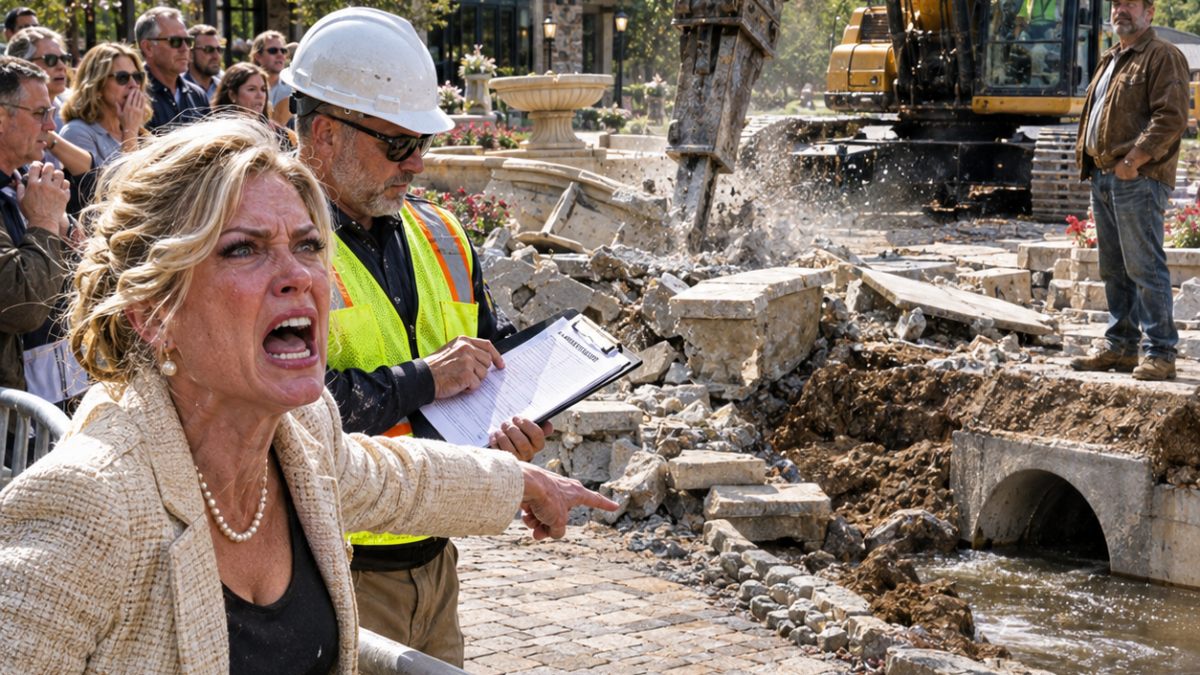
The plaza demolition began gray Monday.
Nolan stood on his own property.
Not across fence.
Not inside project.
On his side.
Machines entered.
Light poles first.
Benches.
Decorative fixtures.
Fountain pumps.
Stone pavers lifted.
Then hydraulic breakers.
Crack.
Crack.
Crack.
The sound carried across valley.
At exact location of grand-opening stage, stone base fractured.
Dump trucks hauled chunks.
Brielle arrived.
Stopped outside fence.
Demanded supervisor.
He handed work plan.
Court compliance.
She pointed at fountain.
“That fountain cost more than most people make in a year.”
Supervisor looked at clipboard.
“That doesn’t change plan, ma’am.”
Then foundation cracked.
Brielle flinched.
Nolan watched from distance.
He did not smile.
Watching $3.4 million become rubble was not satisfying in way people imagined.
It was waste.
Massive.
Unnecessary.
Materials.
Labor.
Money.
All because preserving twenty-six parking spaces became more important than engineering.
Mason Rourke came to stand beside Nolan.
“I should’ve stopped.”
Nolan looked at him.
“You had paperwork.”
“I had warning too.”
“Yes.”
Mason nodded.
“I told myself client had lawyers.”
“Owner consent.”
“Engineers.”
“Not my fight.”
“And?”
“And now I’m watching my work get demolished.”
Nolan said nothing.
Sometimes consequence does teaching.
Mason continued:
“We changed company policy.”
“What?”
“Any owner-consent document tied to off-site property gets independently verified.”
“Good.”
“We should’ve already done that.”
“Yes.”
No absolution.
No cruelty.
Just truth.
Excavators dug deeper.
Then concrete appeared.
Old wall.
Crushed.
Buried as fill.
Nolan recognized aggregate mix.
Mason looked away.
Pieces came out.
Some large enough to show old sealant.
Nolan walked closer to his boundary.
Twenty years of maintenance returning as rubble.
Eliza joined.
“You okay?”
“No.”
“Good answer.”
“They used it as fill.”
“I know.”
“They could’ve moved parking lot.”
“I know.”
He looked toward machines.
“All this for twenty-six spaces.”
Eliza said:
“People rarely destroy systems for big reasons.”
“Usually a thousand small decisions that make sense only if nobody asks what they add up to.”
Restoration plan did not simply rebuild old wall exactly.
Engineering improved it.
Modern capacity.
Better inspection access.
Reinforced diversion section.
Updated channel lining.
Survey monuments.
Clear protected maintenance corridor.
Court did not require nostalgia.
It required function and rights restored.
Nolan liked that.
His wall had history.
But purpose mattered more than replicating every crack.
Brielle found him final week.
No entourage.
No pearls.
Dark jacket.
Fresh concrete visible.
She stood on public side of boundary.
“You destroyed everything I built.”
Nolan turned.
“No.”
“You did.”
“You went to court.”
“You brought experts.”
“You forced demolition.”
Nolan wiped mud from gloves.
“You destroyed my wall.”
“The court removed what you put in its place.”
“You cost this community millions.”
“You were warned before concrete truck came.”
“I was trying to build something residents wanted.”
“You could have built Plan A.”
Brielle’s eyes narrowed.
“You know about that.”
“Thirty-eight spaces.”
“You wanted sixty-four.”
“You’re simplifying.”
“Am I?”
She looked toward restored corridor.
“The smaller plan would have reduced event revenue.”
“Then event revenue had cost.”
“You decided somebody else should pay it.”
Brielle opened mouth.
Nothing.
Nolan continued:
“You kept saying plaza was three-point-four million dollars.”
“As if price changed property line.”
“It didn’t.”
“As if price changed drainage easement.”
“It didn’t.”
“As if once you spent enough money everyone else had to accept what you built.”
“They didn’t.”
She looked tired.
“What was I supposed to do?”
“Move parking lot.”
That simple.
Brielle laughed bitterly.
“You really believe life works that way.”
“No.”
“I believe engineering does.”
“Water definitely does.”
Light rain began.
Nolan looked toward channel.
Water moved cleanly east.
Exactly where designed.
No bubbling pavement.
No reversing drains.
No sinking SUV.
Just runoff.
Brielle watched too.
For perhaps first time she saw what wall was for.
Not obstruction.
Not ugly concrete.
Not obstacle to parking.
System.
She said:
“I never thought it would actually flood.”
Nolan replied:
“That wasn’t standard.”
“You don’t get to destroy drainage because you personally think disaster unlikely.”
“Engineers told you they couldn’t prove it safe.”
“That should have been enough.”
She looked down.
“I trusted wrong people.”
Nolan’s voice hardened.
“Reed told you.”
“Mason offered alternative.”
“Eliza showed data.”
“You didn’t trust wrong people.”
“You rejected people telling you what you didn’t want.”
Brielle looked at him.
Then away.
That ended conversation.
She left.
Nolan never saw her again.
Investigation into signature continued separately.
Important distinction.
Civil court had not convicted Brielle of forgery.
It found HOA failed to establish valid consent.
Authorities reviewed document origin.
Digital transmission.
Metadata.
Who created.
Who signed.
Nolan cooperated.
He refused to speculate publicly.
Some neighbors wanted simple ending:
Karen forged signature.
Caught.
Arrested.
Reality slower.
Evidence had to decide.
That did not affect drainage order.
Property rights did not depend on criminal case.
Even if nobody could prove who wrote signature, Pine Vale had no valid permission.
That was enough.
Insurance fights followed.
Contractor coverage.
Professional liability.
HOA policies.
Exclusions.
Some costs covered.
Some not.
Residents angry about assessments.
Nolan felt bad for them.
Not guilty.
Difference.
One Pine Vale resident approached him at grocery store.
Older man.
“Do you know what our assessment is going to be?”
“No.”
“Thousands.”
“I’m sorry.”
The man looked surprised.
“You are?”
“Yes.”
“You sued us.”
“I stopped a drainage system from remaining blocked.”
“You could have taken settlement.”
“Would settlement move water?”
The man looked away.
Then:
“I voted for plaza.”
“So did a lot of people.”
“We didn’t know.”
“I know.”
That conversation mattered.
Residents were not Brielle.
Many trusted board.
Some cheered when Nolan was humiliated.
That hurt.
But they had been told he was jealous neighbor.
People make bad judgments with bad information.
What matters next is what they do when information changes.
Pine Vale changed.
New board.
Audrey served as interim president.
Independent financial controls.
Project approvals.
Full engineer reports distributed.
Not summaries only.
Recorded easement checks.
External property verification.
No officer could direct work across boundary without documented owner authorization.
Large change orders required board vote.
Residents complained governance became slow.
Audrey said:
“Slow is cheaper than demolition.”
No one argued much.
Mason’s company settled portions of property damage claim.
HOA paid restoration under court order.
Nolan recovered documented costs:
Survey.
Engineering.
Attorney fees where permitted.
Property repair.
No enormous personal windfall.
That disappointed people who heard story.
They expected Nolan became millionaire.
He did not want millions.
He wanted drainage.
He got drainage.
One year after demolition, heavy storm hit.
Comparable to first.
Nolan stood at barn again.
Rain hard.
Water met restored wall.
Turned east.
Channel carried flow.
No plaza.
No fountain.
No sixty-four spaces.
Pine Vale lower road stayed dry.
Eliza drove over after storm.
“Happy?”
Nolan looked at her.
“With wall?”
“With being right.”
“No.”
She smiled.
“Liar.”
“I’m happy system works.”
“That is engineer answer.”
“I’m not engineer.”
“You’re engineer-adjacent.”
They walked corridor.
Water slowing.
No erosion.
Maintenance access clear.
Eliza said:
“Imagine if they built Plan A.”
Nolan did.
Smaller plaza.
Thirty-eight spaces.
Drainage intact.
Community still had event space.
Millions not wasted.
Brielle perhaps still president.
Nobody in court.
That was tragedy.
The safe option existed.
Not hidden.
Not discovered later.
Known before construction.
But safe option asked Brielle to give up visible success.
Twenty-six spaces.
Larger footprint.
Grand entrance.
She could not.
Years later, residents rebuilt a smaller gathering space.
Not called Grand Plaza.
No person’s name on it.
Located uphill.
Outside drainage corridor.
Thirty-six parking spaces.
Native landscaping.
Simple pavilion.
Cost far less.
Before construction, board invited Nolan to review plans.
He declined.
“I’m not your engineer.”
They hired Eliza.
Good choice.
At ribbon cutting, Audrey invited Nolan.
He almost did not go.
Then attended.
No speech.
Stood back.
A little boy ran across grass.
People ate barbecue.
No fountain.
Nolan preferred that.
Audrey came over.
“You hate it?”
“No.”
“That’s high praise.”
He smiled.
She pointed toward drainage corridor below.
“We put interpretive sign.”
“What sign?”
“Come see.”
Small metal plaque beside public path:
STONEBROOK DRAINAGE CORRIDOR
PROTECTED INFRASTRUCTURE — KEEP CLEAR
No mention of lawsuit.
No Brielle.
No Nolan.
Perfect.
Nolan nodded.
“That’ll do.”
The original $6,000 fine?
Formally rescinded early.
Nolan framed it.
Not because sentimental.
Because absurd.
Daniel saw it at farmhouse.
“You kept that?”
“Yes.”
“Why?”
“Reminder.”
“Of what?”
“HOA tried to fine nonmember for asking where his wall went.”
Daniel laughed.
“You should put beneath court order.”
Nolan did.
$6,000 penalty above.
Demolition order below.
No caption needed.
Friends asked whether he hated HOAs.
“No.”
He hated unchecked authority.
Different.
A competent association could maintain roads.
Common spaces.
Services.
Pine Vale’s problem was not existence.
It was culture where one president’s confidence replaced verification.
Brielle said engineer approved.
Board accepted.
Brielle said owner consent existed.
Contractor accepted.
Brielle said wall obsolete.
Residents accepted.
Brielle said Nolan was jealous.
People cheered.
Every false step required somebody else to stop asking.
Once Audrey asked:
Where is full change order?
System changed.
Once Nolan asked:
Show me consent.
System changed.
Once Judge asked:
What right did you have to build there?
Everything collapsed.
Simple questions.
That became Nolan’s lesson.
Not scream louder.
Ask for document.
What easement?
What permit?
What signature?
What engineer?
What approval?
What calculation?
Confidence is not evidence.
A $3.4 million fountain is not evidence.
Sixty-four fresh parking stripes are not evidence.
A crowd clapping is not evidence.
Paper.
Survey.
Data.
Flow.
Those lasted.
At fifty-four, Nolan began teaching occasional workshops for rural landowners through county conservation district.
Not legal advice.
Not dramatic HOA stories.
Drainage basics.
Easements.
Runoff.
Documentation.
Photograph infrastructure.
Keep recorded plats.
Do not assume county file always matches field condition.
Know where water goes before changing grade.
Someone inevitably asked about Pine Vale.
“Is it true judge ordered whole $3.4 million plaza demolished?”
“Yes.”
“Because they tore down your wall?”
“Not only.”
He explained.
Wall on his property.
Recorded corridor.
Unsafe drainage changes.
Permanent encroachment.
No workable partial fix.
Expert evidence.
“That’s why whole thing came out.”
People preferred simpler version.
Wall destroyed.
Judge angry.
Plaza demolished.
Nolan insisted complexity.
Because simplistic stories make people think outcomes automatic.
They are not.
A judge does not demolish millions of dollars because someone feels disrespected.
Court needed proof.
Property right.
Ongoing obstruction.
Safety.
No adequate money remedy.
No viable alternative.
Nolan had all.
Without Eliza?
Different.
Without survey?
Different.
Without recorded easement?
Much harder.
Without Mason’s records?
Still possible but messier.
Without storm evidence?
Engineering still mattered, but visible failure strengthened urgency.
Documentation won.
Not outrage.
One participant asked:
“What if they offer money?”
Nolan answered:
“Depends what problem is.”
“If they accidentally damage fence and can pay to replace, money may solve.”
“If they block drainage corridor creating ongoing risk, check doesn’t make water disappear.”
That was Judge Sloan’s point.
Some harms are continuing conditions.
They must be physically corrected.
Nolan never forgot courtroom silence after:
Spending $3.4 million does not create a right that never existed.
It was not a clever line.
It was property law reduced to plain language.
Cost does not retroactively legalize.
Popularity does not legalize.
Completion does not legalize.
That frightened developers more than fines.
Build first, apologize later works only if later remedy is money.
If later remedy is removal, gamble changes.
Pine Vale became cautionary example among local contractors.
Mason told Nolan years later:
“I show new project managers your case.”
“Why?”
“When client says just build it, we’ll fix paperwork later.”
“What do you tell them?”
“I show demolition photos.”
“Effective?”
“Very.”
Nolan smiled.
“Good.”
Mason had changed.
Not became hero.
He had participated.
But responsibility after failure matters.
He verified property documents.
Gave engineers authority to stop work.
Required direct boundary owner confirmation when work crossed off-site.
One bad project changed company.
Useful outcome.
Reed Halston returned to association work carefully.
His warning had been ignored.
That could make engineer bitter.
Instead, he became more formal.
No verbal caveats.
No “preliminary concerns” buried.
He wrote clearly:
DO NOT PROCEED.
Sometimes tone matters.
Professionals soften language to preserve relationships.
Then decision-makers treat softened warning as optional.
Reed stopped.
Eliza always had.
Nolan respected her for it.
One afternoon, he found her inspecting wall.
“You checking my work?”
“Yours?”
“Fine.”
“Our work.”
She looked at repaired joint.
“Good.”
Nolan asked:
“Would old wall have eventually needed replacement anyway?”
“Yes.”
“How long?”
“Maybe ten years.”
“Maybe twenty.”
“Nothing lasts forever.”
He nodded.
Interesting.
Brielle could have approached him.
Proposed modern shared drainage upgrade.
Maybe Nolan would have agreed.
Wall was not sacred object.
Function was sacred.
Property consent.
Engineering.
Access.
Those were.
Brielle assumed because he defended old wall, he opposed change.
Wrong.
He opposed unilateral destruction.
After restoration, improved wall better than old.
That irony mattered.
Conflict was never old versus new.
It was lawful, safe change versus arrogant shortcut.
Nolan eventually replaced original farmhouse roof with metal.
Installed solar panels.
Upgraded culverts.
He liked progress.
Real progress.
Defined as improvement that does not create hidden catastrophe.
One summer, new Pine Vale resident moved into lower house.
Young couple.
Baby.
They invited Nolan for cookout.
He hesitated.
Went.
Man said:
“We bought after plaza mess.”
“Seller told us drainage is better now.”
“It is.”
“Are we at flood risk?”
“Every low property has some risk.”
Nolan explained.
Not scare.
Pointed flow.
Emergency routes.
Insurance.
Maintenance.
Couple thanked him.
The wife said:
“I heard you hated neighborhood.”
Nolan laughed.
“Who told you?”
“Agent.”
“I don’t hate neighborhood.”
“I hated somebody taking down wall.”
Difference again.
Stories flatten people.
Nolan did not become anti-Pine Vale.
Some residents became friends.
Audrey especially.
She later joked:
“You cost me presidency.”
“How?”
“After Brielle, everyone wanted me to serve.”
“That sounds like your problem.”
“It is.”
She served two years.
Stepped down.
Term limits.
No one named projects after sitting presidents anymore.
Good.
Hargrove Grand Plaza disappeared not only physically.
Name removed from archives.
Board minutes remained.
Financial reports remained.
Historical record accurate.
But new community space called Pine Vale Commons.
Not Audrey Pavilion.
Not Whitaker Park.
No monuments to ego.
Nolan liked that.
Brielle’s later life was mostly outside his knowledge.
Possible civil exposure from acting beyond officer protections.
Document investigation.
Whatever authorities found.
He did not track obsessively.
That surprised Daniel.
“You don’t want know?”
“If something needs my testimony, call me.”
“Otherwise no.”
“Why?”
“Because I already got what I needed.”
Drainage.
He meant it.
Revenge is time-consuming.
Nolan had fences.
Equipment.
Consulting work.
Grandson.
Life.
He refused letting Brielle occupy years after wall restored.
One rainy afternoon he looked at framed fine.
Took it down.
Put in drawer.
Daniel visited months later.
“Where’s trophy?”
“Got tired of looking at it.”
“That sounds healthy.”
“Don’t become therapist.”
“Billing rate higher.”
They laughed.
Nolan still had court order copy.
Filed.
Not wall art.
Healing sometimes means evidence can leave kitchen table.
The $3.4 million demolition became internet story.
Titles exaggerated.
HOA Karen Bulldozed Man’s Wall—Judge DESTROYS Her Plaza.
Some claimed judge ordered Brielle personally to bulldoze it.
No.
HOA complied through professionals.
Some claimed plaza collapsed during storm.
No.
It showed failure signs.
No major collapse.
Nobody hurt.
Some said Brielle forged signature herself.
Not established in civil hearing.
Nolan corrected when he could.
People said:
“Why defend her?”
“I’m defending truth.”
That answer matters.
If you lie about opponent because lie makes story better, you become part of same problem.
Brielle’s actual conduct was enough.
She knew drainage conflict.
Ignored engineer.
Ordered wall hidden from presentation.
Pushed for sixty-four spaces.
Transmitted disputed consent.
Paid demolition as “improvement.”
Threatened neighbor.
Kept plaza open after storm signs.
That was plenty.
No need invent arrest.
Years after, Judge Sloan retired.
Local paper interviewed notable cases.
She did not mention Pine Vale by name.
But one quote sounded familiar.
“A court cannot allow sunk cost to become legal entitlement.”
Nolan clipped article.
Then laughed at himself.
He still liked records.
Old habits.
His grandson Tyler—different from many stories people made up online; Nolan’s actual grandson was Tyler—helped repair equipment barn roof one summer.
Tyler was sixteen.
Asked:
“Is that the famous wall?”
They stood uphill.
“Yes.”
“It looks boring.”
“It is.”
“Three million dollars over that?”
Nolan smiled.
“Four million by time everything finished.”
Tyler stared.
“Why?”
“Parking.”
“That’s dumb.”
“People make expensive decisions.”
Tyler looked at wall.
“Couldn’t they just move parking?”
“Yes.”
He shook head.
Teenager grasped entire case in eight seconds.
Nolan thought about Brielle’s teams of consultants.
Then did not say it.
Too easy.
Adults have incentives children do not.
Deadlines.
Promises.
Ego.
Public commitments.
Once Brielle announced 64-space plaza, shrinking became public failure.
She chose technical risk over visible embarrassment.
That is common.
Nolan taught Tyler something:
“If plan changes because reality changes, that isn’t failure.”
“Pretending reality didn’t change is.”
Tyler said:
“That sounds like Grandpa quote.”
“I am Grandpa.”
“Exactly.”
He rolled eyes.
Perfect.
At sixty, Nolan still walked drainage line before storm season.
Knees slower.
Eliza semi-retired.
New engineer occasionally joined.
Wall developed hairline crack.
They sealed.
Vegetation cleared.
Water did not care about lawsuits being over.
Maintenance continued.
That was another truth.
Winning court does not make infrastructure self-maintaining.
Restoration creates responsibility again.
Nolan welcomed it.
A system doing boring job year after year is success.
He preferred boring.
One spring, Pine Vale Commons held farmers market.
Cars parked uphill.
Thirty-six spaces.
Overflow on designated grass.
Someone complained not enough parking.
Audrey, visiting, heard.
Looked at Nolan.
He raised eyebrow.
She laughed so hard spilled coffee.
“What?”
complainer asked.
“Nothing.”
Sometimes community carries memory through jokes.
Nobody proposed sixty-four.
During tenth anniversary of demolition, local reporter called.
“Would you stand at old plaza site?”
“No.”
“Why?”
“Nothing there.”
“That’s point.”
“Exactly.”
Reporter asked phone interview instead.
“What do you think when you see restored corridor?”
“Water goes where it should.”
“Do you feel vindicated?”
“It’s drainage.”
“Not philosophy.”
She laughed.
“People love story.”
“I know.”
“What do they get wrong?”
“They think judge demolished plaza because Brielle was mean.”
“She could’ve been nicest person in county.”
“If structure blocked easement and unsafe drainage system, problem remained.”
That was Nolan.
Not interested in moral spectacle.
Action.
Right.
Remedy.
Still, privately, there was one emotional moment he never forgot.
Not courtroom.
Not demolition.
Not storm.
The opening morning.
Brielle said:
We removed that ugly concrete wall.
You’re welcome.
Then crowd laughed.
That humiliation stayed longer than he admitted.
To have twenty years of careful maintenance reduced to ugliness.
To have neighbors applaud someone destroying safety system.
To be treated like backward man opposing beauty.
It hurt.
Nolan remained dignified.
But dignity does not mean invulnerable.
At home that night, before he knew about forged consent, he sat alone with coffee until midnight.
Angry.
Embarrassed.
Wondering if he had somehow become the difficult old neighbor everyone believed.
Then he opened old folder.
1998 plans.
His father’s notes.
Engineer letter.
Maintenance invoices.
Reality.
That helped.
When crowd’s opinion becomes loud, documents can stabilize your own memory.
No.
Wall was not random.
No.
He was not imagining.
No.
He had not given consent.
No.
HOA did not own his land.
Evidence defended him before court ever saw it.
That is why he kept records.
Not paranoia.
Memory has pressure.
People repeat confident version and eventually you question yours.
Paper resists.
The source of real courage in story may have been boring filing cabinet.
Years later, Nolan donated copies of drainage plans to county digital archive.
Not originals.
Backups.
Patrick appreciated.
“Most property owners don’t have this much.”
“Most property owners aren’t sued by parking lots.”
Patrick laughed.
He scanned.
Accessible.
Future owner would know.
Nolan would not live forever.
Drainage easement would.
That mattered.
Property rights outlive personalities.
Brielle treated old survey as inconvenience because it came from people no longer in room.
Judge treated it as recorded right.
Institutions are supposed to remember what individuals forget.
Sometimes they do.
Sometimes only if someone produces paper.
The grand plaza’s polished stone was recycled where possible.
Concrete crushed.
Metal salvaged.
Pavers reused in other community areas not inside corridor.
Nolan liked that.
Waste reduced.
One fountain component installed at public park.
Some residents objected because it reminded them of scandal.
Nolan thought that silly.
A pump is not guilty.
Use it.
Again: separate people, objects, actions.
Brielle’s choices made project unlawful.
Stone itself innocent.
That mindset prevented hatred from spreading.
He did not need erase everything associated with plaza.
Only what physically blocked drainage.
Even Hargrove name did not become curse.
Years later, unrelated family with same surname moved nearby.
No connection.
Nolan treated normally.
Obvious.
Yet communities sometimes carry feud like inheritance.
He refused.
One wet October morning, Nolan parked pickup beside restored wall.
Light rain.
Not dramatic.
Water slid cleanly.
He leaned on hood.
Thought back to fountain.
Decorative arcs.
Applause.
Parking.
Now:
Concrete.
Gravel.
Maintenance path.
Engineering sign.
No beauty contest.
But if you know systems, there is beauty in function.
Water moved.
Nothing flooded.
No one noticed.
That was success.
Brielle wanted something people would photograph.
Nolan wanted something they could forget existed because it worked.
Two kinds of legacy.
One loud.
One useful.
The useful one remained.
He climbed into truck.
Before driving, looked at sign:
PROTECTED DRAINAGE CORRIDOR.
KEEP ACCESS CLEAR.
Simple.
No Nolan Whitaker.
No Brielle Hargrove.
No $3.4 million.
No lawsuit.
Just instruction.
That pleased him most.
Infrastructure should not need hero.
It needs respect.
The story began because Brielle saw wall and asked:
Why is this ugly thing in my way?
It ended because judge asked:
What legal and physical function does this thing serve?
Those are different questions.
The first centers appearance.
Second reality.
People get into trouble when they answer first and never ask second.
Nolan had spent lifetime around land.
Fences look arbitrary until cattle loose.
Ditches ugly until rain.
Culverts invisible until clogged.
Retaining walls boring until hillside moves.
Maintenance access seems wasted space until repair crew cannot reach failure.
Good infrastructure often looks like unused space.
That invites ambitious people to “improve” it.
Build.
Park.
Pave.
Decorate.
But empty corridor is not empty.
It is reserved for water.
That is what Brielle never understood until water came back.
Her $3.4 million plaza was built on land that looked available.
But legally and physically, it was already occupied.
By a future storm.
A future maintenance truck.
A flow path.
Rights recorded decades earlier.
You cannot see those things in ribbon-cutting photo.
They still exist.
Judge Sloan understood.
That was why cost argument failed.
Money spent did not erase them.
Popularity did not erase.
Completion did not erase.
Not even beauty erased.
When the court ordered demolition, it was not choosing old concrete over a community.
It was choosing an enforceable system over a structure built as if system did not matter.
That distinction mattered to Nolan.
He did not win because his wall was more valuable than plaza.
He won because the plaza had no right to occupy the corridor and no safe way to remain while restoring it.
That is less dramatic.
More powerful.
Years later, Tyler asked:
“If Brielle had offered you a million dollars before court, would you have taken it?”
Nolan thought.
“If she also had approved safe drainage solution?”
“Maybe.”
“You would?”
“Why not?”
Tyler looked surprised.
“I thought it was principle.”
“Principle was I decide what happens on my property.”
“And drainage must work.”
“If they solved both, money is just negotiation.”
“But she didn’t.”
“No.”
“She offered money to avoid solving problem.”
Different.
Nolan was not anti-settlement.
He was anti-payoff masquerading as solution.
That nuance made his dignity.
He never needed Brielle destroyed.
If she had restored drainage before storm, he might have settled.
If she built safe bypass with legal easement amendment, maybe plaza could remain partially.
Experts found no viable design.
So court removed.
The remedy followed reality.
Not vengeance.
That is why Nolan slept well afterward.
No guilt.
He did not choose demolition because angry.
Engineers said necessary.
Judge agreed.
Brielle’s decision created condition.
Sometimes justice is not satisfying explosion.
It is expensive correction.
Undo.
Dig up.
Regrade.
Rebuild.
Return water where it belongs.
That was this story.
The rubble was only visible part.
The deeper restoration was boundaries.
Land.
Engineering.
Board authority.
Records.
Trust.
Pine Vale residents learned president is not association.
Contractor learned client assurance not substitute for owner verification.
Board learned summaries hide dangerous detail.
Engineers learned warnings must be explicit.
Nolan learned calm does not mean weak.
And Brielle, eventually, learned the hardest lesson:
Once you build over a line you have no right to erase, spending more money does not make the line disappear.
It only makes correction more expensive.
On the last day of original restoration, after rain began, Nolan stood beside Eliza.
Fresh wall.
Open corridor.
Water.
No fountain.
Eliza asked:
“Worth it?”
Nolan looked down channel.
“It was never about winning.”
“What was it?”
He thought of opening-day laughter.
$6,000 fine.
False signature.
Storm water bubbling through pavers.
Judge.
Demolition.
Millions.
Then answered:
“It was about making sure nobody got to decide that because something was in their way, it stopped belonging to someone else.”
Eliza nodded.
Rain increased.
Water deepened slightly.
Still moved cleanly.
Nolan watched.
No drama.
No applause.
Just physics working again.
He smiled.
That was enough.
Brielle Hargrove had spent $3.4 million building a monument to what she believed she could control.
Then hundreds of thousands more were spent removing it.
Nolan Whitaker spent twenty years maintaining an ugly concrete wall most people never noticed.
In the end, the wall’s job mattered more than the plaza’s price.
Because when the storm came, the water did not care who was HOA president.
And when the judge ruled, neither did the law.








