HOA Karen Tore Down My Private Farm Bridge—Then the Plate Under It Exposed Her $400,000 Road Deal
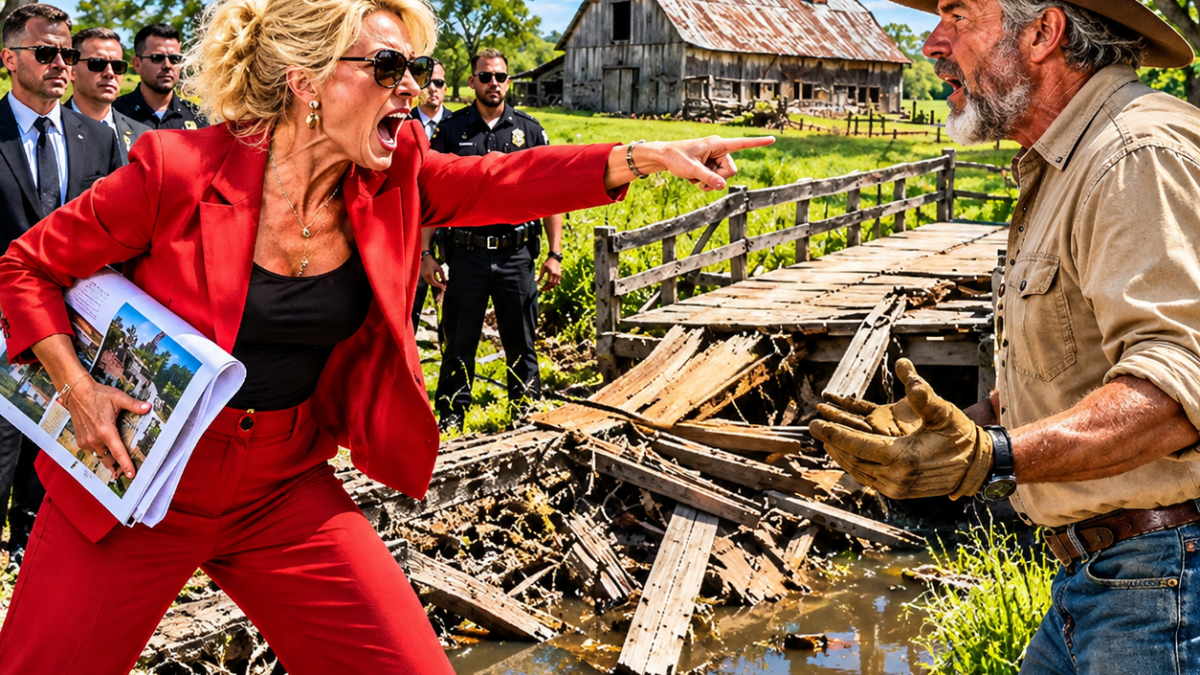
HOA Karen Tore Down My Private Farm Bridge—Then the Plate Under It Exposed Her $400,000 Road Deal
“KEEP CUTTING—THAT BRIDGE IS AN UNSAFE COMMUNITY STRUCTURE, AND PINE VALLEY HAS AUTHORITY TO REMOVE IT TODAY!” Linda Harper shouted as a crane lifted one of my steel beams over the creek.
I wasn’t even an HOA member, yet they had cut my farm gate, driven heavy equipment onto my eighty-one acres, and already torn apart half the bridge my father and I built nearly twenty years earlier.
Then a worker pulled an old metal plate from beneath the deck, read the engraving, and suddenly Linda wanted it out of everyone’s hands.
By the time I reached the creek, half my bridge was already gone.
A crane stood in the hay field with one of the main steel beams hanging from its cable.
Two workers were underneath what remained of the deck, cutting through brackets my father and I had installed when I was nineteen.
A yellow excavator sat on the western approach.
Three work trucks were parked along my gravel lane.
And my northern fence had been cut wide enough for all of them to enter.
Standing beside the crane was Linda Harper.
President of Pine Valley HOA.
Clipboard in one hand.
White SUV parked behind her.
Expression completely calm.
Like tearing apart somebody else’s bridge was a normal Tuesday morning.
I slammed my pickup into park.
“What are you doing?”
The workers stopped.
Linda barely looked surprised to see me.
“This bridge has been declared unsafe.”
“By who?”
“Pine Valley’s safety consultant.”
I stared at the steel beam hanging over the creek.
“This is my property.”
“We’re removing a hazardous community structure.”
That phrase hit me harder than I expected.
Community structure.
I walked toward her.
“Community structure?”
Linda lifted her chin.
“Yes.”
“I’m not even an HOA member.”
I pointed toward the farm.
“This bridge is on my property.”
She looked toward the crane operator.
“Continue.”
He did not.
The crew supervisor, a man named Robert Lewis, stepped between us.
“Ma’am, is he the landowner?”
Linda answered before I could.
“There is a legal access dispute.”
PART2:
“There is no dispute,” I said. “This is Walker Farm.”
Robert looked at the bridge.
Then Linda.
Then me.
“Everybody stop.”
The torches went quiet.
The crane stopped moving.
For the first time that morning, somebody with equipment worth hundreds of thousands of dollars decided maybe property ownership should be checked before anything else disappeared.
Then one of the workers called from beneath the remaining deck.
“Robert?”
Nobody answered.
He shouted louder.
“There’s a plate under here.”
Linda turned immediately.
The worker climbed out carrying a dirty rectangular piece of metal bolted to part of the old bridge framing.
He wiped mud from the surface.
The engraving appeared slowly.
WALKER FARM PRIVATE BRIDGE
BUILT 2007
PROPERTY OF ROBERT WALKER AND FAMILY
NO PUBLIC EASEMENT
Linda moved faster than I had seen her move all morning.
“Give me that.”
The worker stepped backward.
“Ma’am, it’s attached to the structure.”
“Remove it.”
Robert looked at her.
“No.”
That one word changed the air.
I stared at the plate.
I had forgotten Dad installed it.
But seeing his name made the destruction around me feel different.
The bridge was not just steel and wood.
Dad and I had built it together.
My name is Jason Walker.
Walker Farm sits on eighty-one acres in western Virginia.
My grandfather bought the first portion in 1968.
Dad later added thirty acres after the neighboring family retired from farming.
By the time the property came to me, it included pasture, woodland, two barns, a farmhouse, a creek, and a private gravel road crossing the water on the bridge Linda was now trying to remove.
That bridge connected the farm.
Almost forty acres lay west of the creek.
Without the crossing, reaching those fields with tractors or hay equipment meant leaving Walker Farm, driving nearly four miles on county roads, and entering through a smaller western gate.
Dad had spent years saving for the bridge.
The old wooden crossing could no longer safely handle our heavier equipment.
So in 2007, when I was nineteen, we rebuilt it.
Steel beams.
Concrete piers.
Thick timber deck.
Farm-width railings.
Nothing fancy.
Strong enough for tractors.
Strong enough for hay wagons.
Strong enough for cattle when we moved them between pastures.
The day we finished, Dad stood beside the creek with mud covering his boots.
“Take care of this,” he said, “and it’ll take care of the farm.”
He was right.
The bridge became part of the daily rhythm.
Tractor.
Hay.
Feed.
Cattle.
Repairs.
Storm cleanup.
Years passed.
Then Pine Valley appeared north of Walker Farm.
The neighborhood did not exist when Dad and I built the bridge.
A developer bought former farmland and started with about forty homes.
Then more phases.
Eventually more than one hundred twenty houses.
Clubhouse.
Pool.
Playground.
Walking trails.
Most residents were fine.
Some became friends.
George Daniels lived near my north fence.
Retired mechanic.
He helped me pull a trailer from deep mud during a thunderstorm.
After that, we traded favors regularly.
His wife Nancy bought vegetables from me every summer.
Their grandson Tyler loved standing by my fence watching cattle.
I never blamed Pine Valley for being a subdivision.
People needed homes.
They had theirs.
I had my farm.
The problems began after Linda Harper became HOA president.
The first time she visited, I was working on a mower near the machine shed.
She parked outside the gate.
Did not enter.
At that point I actually appreciated her manners.
She introduced herself and said she wanted a “strong cooperative relationship” between Pine Valley and Walker Farm.
“Sounds good.”
Then she asked for access to my bridge.
I thought I had misunderstood.
“Access for what?”
She explained the western section of Pine Valley had only one practical entrance.
At busy times, residents could spend ten or fifteen minutes reaching the main road.
If Pine Valley could use my gravel lane and bridge, residents could reach County Route 16 much faster through my western gate.
I stared at her.
“You want neighborhood traffic going through my farm?”
“Residents only.”
“No.”
Her expression changed.
Not angry.
Surprised.
Like she had expected negotiation.
She offered electronic gates.
“No.”
Pine Valley would maintain the road.
“No.”
Then:
“Five thousand dollars a year.”
“No.”
She increased the offer later.
First twelve thousand annually.
Then fifteen.
Still no.
The issue was not only money.
Cattle crossed my road.
Tractors.
Hay wagons.
Farm equipment.
If residents started using it, delivery drivers would follow.
Visitors.
Teenagers.
Eventually navigation apps.
A private farm lane would become a neighborhood shortcut.
Then Linda suggested I voluntarily join the HOA.
That made less sense than everything else.
Pine Valley regulated fence styles.
Exterior colors.
Vehicle parking.
Outbuildings.
Livestock.
Imagine owning eighty-one acres of working farmland and asking an HOA board whether your tractor could be parked beside your own barn.
No chance.
I told Linda so.
She smiled.
Before leaving she said:
“We’ll find a solution that works for everyone.”
At the time, it sounded harmless.
A month later, my first Pine Valley violation arrived.
Bridge railing did not meet HOA appearance standards.
I laughed.
Then another.
Farm equipment visible from walking trail.
Then my red barn.
Then cattle fence design.
I called management.
Susan Miller checked my address.
“Mr. Walker, your property isn’t listed inside Pine Valley.”
“I know.”
She apologized.
Said the notices would be removed.
The next morning Linda called.
Susan had supposedly made a mistake.
Pine Valley, Linda claimed, possessed “external boundary authority” over structures affecting neighborhood property values.
I asked for the law.
She sent me HOA rules.
Every page applied to HOA members.
I was not one.
That was when I hired Rebecca Collins.
Rebecca had handled farm and property disputes for almost twenty years.
She checked my deed.
County map.
Pine Valley declaration.
Any easement.
Any maintenance agreement.
Nothing.
“This is easy,” she said.
“You sure?”
“Your bridge is entirely on Walker Farm.”
“Yes.”
“No HOA declaration.”
“No.”
“No shared bridge agreement.”
“No.”
“No permanent easement.”
“Nothing.”
“Then their rules stop at their property line.”
Rebecca sent a formal legal notice.
Stop issuing violations.
Stop claiming authority.
Stop interfering with Walker Farm.
For almost six weeks, everything returned to normal.
I cut hay.
Fixed the smaller barn roof.
Helped George repair fence after a storm.
Nancy brought blueberry pie.
Tyler helped brush Daisy, my oldest horse.
That was the life I wanted.
Then George came over one evening looking uncomfortable.
“Linda’s talking about your bridge again.”
“What now?”
“Emergency access.”
At an HOA meeting, Linda had told residents my bridge could become an evacuation route if Pine Valley’s main entrance was blocked by fire, accident, or storm.
I told George the truth.
“If there’s a real emergency and somebody needs to get out, I’ll open the gate.”
He nodded.
“That’s what I thought.”
Dad would have agreed.
Helping during a true emergency was different from handing over permanent road rights.
Linda blurred that difference deliberately.
She sent me an Emergency Community Access Agreement.
Rebecca read it.
Halfway through page two, the language expanded beyond emergencies.
“Safety preparation.”
“Inspection.”
“Maintenance.”
“Transportation planning.”
Reasonable access.
Meaning almost anything.
I refused.
Then survey flags appeared near my north pasture.
I removed them.
Linda called.
“You disturbed HOA planning markers.”
“Why were HOA markers on my farm?”
“Survey mistake.”
Two days later, another set appeared.
Another mistake.
Rebecca sent another warning.
Then Linda changed the argument.
Maybe Pine Valley did not need new rights.
Maybe it already had old ones.
Their attorney sent a pre-development map showing a dirt farm track near the creek decades earlier.
Linda claimed it historically connected surrounding properties.
Rebecca checked county records.
No public road.
No recorded easement.
No permanent neighborhood access.
Just an old farm track.
Then came the bridge safety notices.
Yellow paper attached to my railing.
BRIDGE SAFETY INSPECTION REQUIRED.
Issued by Pine Valley HOA.
I tore them down.
Linda claimed people had reported the bridge might be dangerous.
“Who?”
She refused to say.
So I hired my own licensed structural engineer.
Not because Linda told me to.
Because I used the bridge every day.
The engineer inspected it physically.
Walked the deck.
Checked steel.
Looked at concrete.
Measured.
His conclusion:
Two deck boards should be replaced.
Surface rust on one beam should be cleaned.
No major structural problem.
Rebecca sent Pine Valley the report.
Linda said Pine Valley’s consultant disagreed.
“When did he inspect it?”
“He viewed it from the north bank.”
From nearly a hundred feet away.
The complaints became ridiculous.
Farm trucks crossing the bridge created noise.
Cattle manure near the creek threatened water quality.
The bridge might attract Pine Valley children to trespass.
That one was extraordinary.
My bridge was supposedly dangerous because HOA residents might illegally enter my property to use it.
Then George brought me the piece that made everything click.
Pine Valley was planning a connection to another subdivision.
West Ridge.
Seventy-four proposed homes west of Walker Farm.
I knew the land.
An old cattle ranch had been sold to developers.
George showed me a presentation map.
Pine Valley on one side.
West Ridge on the other.
Walker Farm between them.
And the shortest possible connection?
My gravel road.
My bridge.
Rebecca pulled the planning application.
The route was drawn.
Across my farm.
Over the bridge.
Straight through pasture.
Not approved.
But proposed.
A note beside it read:
PROPOSED CONNECTION SUBJECT TO ACCESS RESOLUTION.
I looked at Rebecca.
“Access resolution means me.”
“Yes.”
Suddenly everything Linda had done made sense.
Membership request.
Violations.
Emergency access.
Historical access.
Bridge safety.
They all pointed toward gaining control of the same crossing.
Rebecca still warned me not to assume Linda had a financial interest.
Maybe she genuinely thought the connection helped Pine Valley.
Facts first.
So we waited.
Three weeks later, I drove into town to pick up a hydraulic pump.
I was gone less than two hours.
When I returned, the front gate chain was cut.
Then I heard machinery near the creek.
I drove down the lane.
Crane.
Excavator.
Three work trucks.
Half the bridge gone.
And Linda Harper telling the crew she had authority to remove it.
After Robert Lewis stopped the work and the old ownership plate appeared, I called the sheriff.
Rebecca arrived first.
Linda handed her an official-looking packet.
EMERGENCY BRIDGE ABATEMENT AND ACCESS PRESERVATION ORDER.
County logo.
Reference number.
Signature.
It claimed the bridge could be removed immediately because it was unsafe and obstructed an established emergency corridor.
For the first time, my confidence dropped.
The document looked real.
Rebecca asked:
“Where did this come from?”
“Pine Valley property services.”
“Which company?”
“Valley Community Solutions.”
Rebecca searched the state registry.
Owner:
Daniel Harper.
Linda’s husband.
Then Deputy James Miller arrived.
He inspected the cut gate.
Bridge.
Equipment.
Papers.
Called the county.
We waited.
Ten minutes.
Fifteen.
The crane still held Dad’s steel beam over the water.
Then James’s radio crackled.
He listened.
Looked at Linda.
“The county has no bridge demolition permit under this reference number.”
Linda said it must be a filing delay.
Rebecca asked him to verify the official’s signature.
While he called again, Robert Lewis brought his work packet.
The job did not describe Walker Farm Bridge.
It called it:
PINE VALLEY WEST ACCESS BRIDGE.
They had renamed my bridge before removing it.
Then Robert turned another page.
His face changed.
“This isn’t demolition only.”
“What?”
“The replacement starts in three days.”
New crossing.
Twenty-six feet wide.
Two lanes.
Rated for residential traffic.
Project:
WEST RIDGE CONNECTOR — PHASE ONE.
I looked at Linda.
“You’re not removing an unsafe bridge.”
She said nothing.
They were removing my private farm crossing to make space for a neighborhood road.
Then Deputy Miller’s radio sounded again.
The signature on the emergency order belonged to a county official who had retired eleven months earlier.
He had signed nothing.
James looked toward the equipment.
“Nobody leaves.”
Then a worker called from the west bank.
“Something’s already been poured over here.”
We crossed the creek.
Beneath fresh soil and hay were two concrete foundations.
Huge.
Much larger than my existing supports.
Sized for the proposed twenty-six-foot replacement bridge.
Nearby under a tarp:
Electrical conduit.
Drainage pipe.
Road-control equipment.
And a finished metal sign.
PINE VALLEY — WEST RIDGE CONNECTOR
PRIVATE RESIDENT ACCESS ONLY
That sign had been fabricated before my bridge came apart.
The foundations had already been poured.
Someone had been preparing the replacement for weeks.
Linda called them preliminary safety supports.
Rebecca pointed at the road sign.
“Preliminary plans usually don’t arrive painted.”
Robert Lewis looked sick.
His company had received a complete construction packet.
Demolition.
New foundations.
Bridge specifications.
Road dimensions.
Schedule.
He had been told Pine Valley already held historical access rights.
Daniel Harper had met Robert personally.
Twice.
One meeting at the clubhouse.
Another from the Pine Valley side of the creek.
Daniel described my bridge as a shared crossing that needed modernization.
He never said it belonged entirely to Walker Farm.
That mattered.
Robert had made a mistake by failing to verify ownership independently.
But the second I objected, he stopped.
Linda had ordered him to continue.
There was a difference.
Deputy Miller had the suspended beam lowered carefully beside the creek.
Every removed piece stayed on my property.
Then Linda produced Pine Valley’s structural report.
The report did not call my bridge unsafe.
It said the bridge should be evaluated before “possible future community use.”
The consultant had never walked on it.
Never inspected underneath.
Never tested the steel.
Never examined the concrete.
Photographs from the neighborhood bank.
That was it.
My engineer had physically inspected the bridge and found only minor maintenance issues.
By afternoon, county inspectors arrived.
Building safety.
Land development.
They documented the cut fence.
Damaged bridge.
Hidden foundations.
Conduit.
Traffic equipment.
Connector sign.
Susan Reynolds from land development asked:
“Who approved concrete placement on this parcel?”
Linda said Valley Community Solutions handled permits.
Susan checked.
Nothing.
Pine Valley?
Nothing.
West Ridge?
Nothing.
Daniel Harper?
Nothing.
No permit.
Robert Lewis’s crew had not poured the concrete.
His project manager had site photographs from three weeks earlier.
The foundations were already there.
That meant somebody had entered my farm earlier.
At night.
With concrete trucks.
An excavator.
Workers.
They had dug beside my creek, poured massive supports, covered them with hay and soil, and left.
I had slept less than half a mile away.
That realization bothered me more than the machinery standing there in daylight.
Someone had studied my farm enough to know when they could work unseen.
By sunset, the creek looked like an evidence scene.
Measurements.
Photographs.
Vehicle plates.
Statements.
Work orders.
Boring details.
Necessary details.
Later nobody could say the bridge had already been damaged.
Or that the new foundations had always existed.
Paper stayed.
Pictures stayed.
Linda received a clear warning.
Nobody connected with Pine Valley was to enter Walker Farm without permission.
Rebecca and I stood beside the bridge after everyone left.
Half deck missing.
Beam lying in grass.
Railing stacked beside the creek.
Dad’s crossing looked gutted.
Rebecca said quietly:
“We can rebuild structures.”
“I know.”
“That doesn’t mean this doesn’t hurt.”
She understood.
People say property can be replaced as though that removes memory.
Dad had tightened those bolts.
Dad had complained about crooked boards.
Dad had put his name beneath the deck.
Steel and wood can be replaced.
Time cannot.
The next morning, George came over furious.
Linda had emailed Pine Valley residents before losing infrastructure authority.
Her message said:
UNSAFE ABANDONED BRIDGE REMOVED AS PART OF EMERGENCY SAFETY PLANNING.
Abandoned.
I had driven my tractor over it four days earlier.
No mention of me owning it.
No mention of the nonexistent permit.
No mention of hidden foundations.
George asked if I wanted him to send my version to every resident.
“Not yet.”
Rebecca agreed.
“Let the documents get uglier first.”
They did.
The county confirmed the emergency order was fake.
The reference number belonged to a drainage inspection somewhere else.
Real county logo.
Real format.
Wrong purpose.
Retired official’s copied signature.
Somebody had assembled a false order from authentic-looking government pieces.
Then investigators checked Valley Community Solutions.
The company was real.
Daniel Harper had registered it two years earlier.
It provided HOA planning, property support, infrastructure coordination, and access consulting.
Pine Valley had paid Daniel’s company more than $110,000 over eighteen months.
Many board members had no idea the total was that high.
Then came the larger conflict.
Daniel was also a minority investor in West Ridge.
If the seventy-four-home development succeeded, he stood to make substantial money.
Linda was HOA president.
Her husband’s company handled the access planning.
Her husband also had financial interest in the development benefiting from the access.
And my bridge sat in the middle.
Still, Rebecca reminded me:
“Conflict isn’t proof he forged the order.”
We needed more.
Pine Valley’s board suspended Linda’s infrastructure authority.
Their attorney Laura Bennett called Rebecca.
Her first sentence:
“We did not authorize this.”
The board had approved studying emergency access options.
Not bridge demolition.
Not construction.
Not entering Walker Farm.
Not cutting my gate.
Laura also confirmed she had told Linda months earlier that Pine Valley had no recorded bridge easement.
Linda knew.
Meanwhile, I had to keep farming without the bridge.
Three-minute tractor trip became twenty-five minutes.
Drive out.
County road.
Around.
Western gate.
Moving hay became miserable.
Checking cattle took longer.
One storm dropped a tree across the western county road.
For nearly an hour, I could not reach six cows.
They were fine.
But the real cost of Linda’s decision became obvious.
She had not simply destroyed a structure.
She had split my farm.
George helped.
Nancy brought dinner.
Tyler asked:
“Can you rebuild it exactly the same?”
“Probably.”
Then I thought about it.
“No.”
He looked worried.
“Better.”
He grinned.
That became something positive to hold onto.
Dad built the first one with me.
Maybe rebuilding would become a way to honor him.
Before work could begin, investigators had to release the damaged pieces.
Then Robert Lewis called.
He had found emails between Daniel and his company.
One message:
EXISTING STRUCTURE MUST BE FULLY REMOVED BEFORE OWNER CHALLENGE CAN STOP REPLACEMENT.
Rebecca read it twice.
Another:
ONCE OLD BRIDGE IS GONE, RESTORATION TO PREVIOUS CONDITION BECOMES IMPRACTICAL. NEW CONNECTOR BECOMES BEST SOLUTION.
That was the plan.
Destroy the private bridge first.
Then tell me returning to the old arrangement was too expensive.
Offer the bigger two-lane community bridge as the practical solution.
Pressure through destruction.
Another email from Robert’s project manager asked:
HAS FARM OWNER SIGNED ACCESS?
Daniel replied:
HOA HAS CONTROLLING DOCUMENTATION. OWNER RESISTANCE ALREADY ACCOUNTED FOR.
They expected me to object.
They planned around my objection.
At the next emergency HOA meeting, Daniel finally appeared.
Dark jacket.
Folder.
Calm.
Pine Valley’s attorney stood first.
“Walker Farm is not part of Pine Valley HOA.”
Then:
“No recorded permanent easement exists over Walker Bridge.”
Residents started whispering.
Linda stared ahead.
Laura said the board had never authorized demolition or construction.
Then she held up the fake emergency order.
“This document did not come from my office.”
The room erupted.
Linda blamed Valley Community Solutions.
Daniel stood.
He said his company had relied on historical records.
Then he produced another document.
Bridge and Farm Access Agreement.
Supposedly signed by my father, Robert Walker.
Permanent rights allowing future Pine Valley development to use, maintain, widen, replace, or remove my bridge.
Dad’s signature looked real.
Witness.
Notary stamp.
My stomach dropped.
For the first time, I did not know.
Dad handled plenty of farm paperwork.
Could he have signed something without telling me?
Maybe.
George leaned toward me.
“Did he?”
“I don’t know.”
Rebecca took a copy.
Showed no reaction.
Daniel looked relieved.
Then George raised his hand.
He had lived in Pine Valley almost from the beginning.
He remembered the developer asking Dad for bridge access in 2009.
Dad refused.
That created a simple problem.
If Dad granted permanent rights in 2008, why would they ask again in 2009?
Rebecca asked Daniel where the original was.
“Valley Community Solutions archives.”
Could we inspect it?
“Yes.”
Then Daniel’s phone buzzed.
He looked.
His face changed.
Minutes later, he excused himself.
The board voted to suspend Linda as president.
Five to one.
She voted for herself.
Valley Community Solutions contracts frozen.
The meeting ended after ten.
I drove home.
Before I reached the farmhouse, my new security camera sent an alert.
Movement near the creek.
A dark truck.
Headlights off.
Two people.
One carried Dad’s bridge ownership plate.
The other was opening the weatherproof storage box near the equipment shed.
I zoomed in.
Daniel.
Linda.
They had left the HOA meeting and come directly to my farm.
Then Linda carried a folder toward a metal barrel.
A fire was already burning.
I could read the handwritten label.
BRIDGE ORIGINAL ACCESS RECORDS.
Then she dropped the first page into the flames.
I called the sheriff.
Deputy Miller told me not to confront them.
I wanted to.
Every instinct wanted to drive straight to the creek.
Instead, I waited near the farmhouse.
Dad always said anger was useful only while you still controlled it.
On camera, Daniel loaded papers into his truck.
Linda fed more pages into the barrel.
Then she pulled out another folder.
Yellow label.
Dad’s handwriting.
BRIDGE MAINTENANCE — 2007 TO 2012.
Those were not Pine Valley records.
They were mine.
Dad’s receipts.
Repair notes.
Inspection records.
The sheriff arrived before they could finish.
Daniel tried walking toward his truck.
Linda grabbed the plate.
Deputies blocked the lane.
Both stopped.
No chase.
No fight.
When I reached the creek after Miller cleared it, pages were smoldering in the dirt.
Some destroyed.
Others blackened.
One receipt half gone.
Dad’s handwriting visible on another.
I touched nothing.
Everything had to be documented.
Linda claimed they were retrieving Valley Community Solutions property.
Miller pointed at Dad’s folder.
“Does that look like company property?”
She stopped talking.
Daniel said the ownership plate needed preservation.
Rebecca arrived and asked the obvious question.
“Then why didn’t your lawyer request it?”
Daniel called the situation urgent.
Rebecca looked toward the burning barrel.
“That appears to be your definition of urgent.”
The surviving documents became devastating.
Invoice showing Dad purchased the steel himself in 2007.
County inspection receipt listing Walker Farm as bridge owner.
Then a letter from the original Pine Valley developer.
March 2008.
It thanked Dad for discussing temporary construction access.
But stated clearly:
NO PERMANENT BRIDGE RIGHT IS GRANTED BY THIS DISCUSSION.
Same year Daniel’s new agreement supposedly gave permanent access.
Then a handwritten note by Dad from 2010.
DANIEL HARPER STOPPED BY ABOUT BRIDGE AGAIN. TOLD HIM NO COMMUNITY ROAD. EMERGENCY USE ONLY IF NEEDED.
Daniel himself had asked Dad again two years after the supposed permanent agreement.
Why?
Because no permanent agreement existed.
Rebecca sent Daniel’s document to Susan Keller, a forensic document examiner.
Her first conclusion scared me.
Dad’s signature was genuine.
Then she continued.
The exact same signature appeared on a temporary utility inspection Dad signed in 2007.
Same ink break.
Same curve.
Same background marks.
Genuine signature.
Wrong document.
Copied.
The notary information had also been lifted from that same utility form.
Real notary.
Real commission number.
But the date style did not match her records.
Investigators found her journal.
She notarized the 2007 utility inspection.
She never notarized a permanent bridge agreement in 2008.
Real pieces.
Fake history.
Then deputies searched Daniel’s truck.
A list:
BRIDGE FILE CLEANUP.
Private ownership plate.
Original maintenance records.
Developer refusal letter.
Temporary utility form.
2009 road request.
2010 emergency-access note.
County inspection receipt.
Every item weakened Daniel’s access claim.
And Linda had been feeding them into a fire.
Pine Valley permanently removed her as president.
Daniel’s Valley Community Solutions contract was terminated.
An independent attorney reviewed everything.
Residents were furious.
Many had believed Linda.
Some believed my bridge truly belonged to Pine Valley.
I understood that.
They had not seen the records.
They did not know about Daniel’s investment in West Ridge.
They saw an HOA president saying a dangerous shared bridge needed replacement.
The truth had been withheld from them too.
That was why I tried not to turn the neighborhood into my enemy.
The county placed a stop-work order on the new bridge foundations.
Then investigators identified who poured them.
Concrete delivery records.
Two trucks.
2:40 in the morning.
Three weeks before the demolition.
Customer:
Valley Community Solutions.
Site:
PINE VALLEY WEST CONNECTOR.
Driver remembered the job because of the hour.
And because Daniel Harper personally met them.
Daniel told the crew the landowner approved nighttime work to avoid disrupting farm operations.
I had approved nothing.
My barn camera captured headlights around 2:18 that morning.
Dark pickup.
Concrete trucks.
Small excavator.
By sunrise, gone.
I had been sleeping nearby.
Daniel had studied my routine well enough to know.
Then investigators searched Valley Community Solutions computers.
Folder:
WEST CONNECTION STRATEGY.
Options:
NEGOTIATE ACCESS.
CLAIM HISTORICAL RIGHTS.
USE EMERGENCY ROUTE ARGUMENT.
CHALLENGE BRIDGE SAFETY.
REMOVE OLD STRUCTURE.
REPLACE WITH COMMUNITY STANDARD CROSSING.
Every step had happened.
Another section said:
ONCE EXISTING PRIVATE STRUCTURE IS REMOVED, RESTORATION BECOMES ECONOMICALLY INEFFICIENT. WIDER REPLACEMENT BECOMES PRACTICAL SETTLEMENT OUTCOME.
There it was.
Not a misunderstanding.
A strategy.
Then the money.
West Ridge’s developer had offered Pine Valley $400,000 if a direct connector opened between the developments.
Daniel’s investment agreement gave him additional profit if road access was secured before financing closed.
Deadline:
Six weeks away.
Now the speed made sense.
Night concrete.
Fake emergency order.
Immediate demolition.
Replacement scheduled three days later.
Destroy first.
Build fast.
Then use the new reality as leverage.
Pine Valley residents had been told the connector was only a possible future option.
Daniel’s files treated Walker Farm as the primary route.
Valley Community Solutions invoices included phrases like:
ACCESS RESOLUTION.
BRIDGE TRANSITION.
OWNER RESISTANCE MANAGEMENT.
WEST CORRIDOR STABILIZATION.
One invoice:
REMOVAL PHASE — PRIVATE STRUCTURE.
They had billed the HOA to destroy my private bridge.
Rebecca filed for immediate civil protection.
Preserve all bridge pieces.
No entry.
No construction.
Restoration planning.
The new Pine Valley board did not fight us.
Their insurer became involved.
Robert Lewis’s contractor insurer did too.
Robert accepted part of responsibility because his company should have verified ownership.
But investigators recognized he stopped the moment I challenged the work and then provided records exposing Daniel.
That distinction mattered.
Eventually, the bridge pieces were released back to me.
An engineer inspected everything.
Good news.
Dad’s original concrete piers remained solid.
The suspended steel beam was not badly damaged.
Several deck sections needed replacement.
Railings needed rebuilding.
But the bridge could return.
Not merely return.
Improve.
I told Rebecca:
“Whoever is responsible can pay restoration. But I choose the design.”
“No connector?”
“No.”
“No HOA gate?”
“No.”
“No two-lane road?”
“No.”
“A farm bridge.”
“Exactly.”
Then Daniel disappeared.
Not a missing-person situation at first.
He stopped answering his lawyer.
Valley Community Solutions office was locked.
Phone off.
Investigators had scheduled an interview about the fake order, copied agreement, hidden foundations, and burned records.
He did not appear.
Then West Ridge’s developer reported boxes of planning files stolen overnight.
Security camera:
Dark pickup matching Daniel’s.
Next morning, my western pasture camera alerted.
His truck.
Entering through the remote gate.
Heading toward the bridge.
Then Linda’s SUV arrived.
She had told investigators she did not know where Daniel was.
Now both were standing beside the illegal concrete foundations.
Daniel opened two metal cases.
Documents in one.
External hard drives in the other.
He began putting them into a hollow section beside the foundation.
Then he took out a small sledgehammer.
I understood immediately.
The unauthorized foundations connected him to the nighttime construction.
He had come to damage or destroy evidence.
But before he swung, Linda pointed toward a black pipe beneath the concrete.
Daniel opened it.
Pulled out a sealed plastic tube.
Inside was a rolled county document.
Linda read it.
Then Daniel shouted:
“If they see this, West Ridge is finished.”
Sheriff’s vehicles entered before they reached the truck.
Daniel stopped.
Linda stopped.
The document went into evidence.
Rebecca arrived.
It was a real county land-access decision.
The original Pine Valley developer had asked whether the old farm track and Walker Bridge could be treated as an existing neighborhood access route.
County answer:
No.
Private route.
No public easement.
No permanent access right established.
Any future residential connection required a new agreement signed by Walker Farm’s owner.
Attached was Dad’s response.
I DO NOT GRANT PERMANENT RESIDENTIAL ACCESS ACROSS WALKER FARM OR WALKER BRIDGE.
I read it twice.
Dad had put the answer in writing.
No ambiguity.
No community road.
No permanent access.
Then investigators opened one of Daniel’s metal cases.
Folder:
WEST RIDGE ACCESS RISK.
Inside:
Another copy of the same county denial.
Daniel already had it.
He knew.
That destroyed his argument that he genuinely believed the bridge was historically shared.
Recovered emails confirmed it.
COUNTY ARCHIVE HAS OLD WALKER DENIAL. KEEP THIS OUT OF GENERAL PROJECT FILE.
Another:
IF OLD DENIAL SURFACES, PERMANENT RIGHT ARGUMENT WEAKENS.
Then:
ONCE EXISTING BRIDGE IS REMOVED AND NEW STRUCTURE BEGINS, PRACTICAL LEVERAGE IMPROVES.
That sentence explained the entire scheme.
They never needed to prove they were right.
They needed to change the physical reality fast enough that restoring my old bridge became expensive and inconvenient.
Then the wider community bridge would look like the sensible compromise.
But they had miscalculated one thing.
Dad built the original bridge well.
The concrete piers survived.
The steel survived.
The old crossing could be restored.
County ordered Daniel’s illegal larger foundations removed.
For the first time, I saw a real path forward.
The criminal investigation continued separately.
Daniel and Linda faced serious consequences connected to unauthorized construction, false records, destruction or attempted destruction of evidence, trespass, and the access scheme.
I stopped following every motion.
For weeks, Linda and Daniel had become the center of my life.
Calls.
Emails.
Lawyers.
Cameras.
Court filings.
Eventually I realized they had already taken enough time.
They were not getting the rest.
Pine Valley’s new leadership requested a civil settlement meeting.
No Linda.
No Daniel.
Just embarrassed board members, attorneys, insurers, and me.
Robert Hayes, temporary board president, began with the sentence I wanted.
“Walker Farm is not part of Pine Valley HOA.”
Then:
“Pine Valley had no authority to remove Walker Bridge.”
Simple.
Clear.
The HOA withdrew every permanent-access claim.
Acknowledged the old farm track did not create an easement.
Acknowledged the emergency demolition order was invalid.
Agreed to restoration costs through insurance and claims against Valley Community Solutions.
Robert Lewis’s insurer contributed too.
Then Robert came to the farm personally.
“I’m sorry.”
“I know.”
“I should have verified the landowner myself.”
“Yes.”
He nodded.
Then:
“I’d like to help rebuild it.”
I stared at him.
“You really want to bring another crew onto this property?”
He laughed nervously.
“Under very different circumstances.”
I smiled.
“Call before you enter.”
That was the first time the bridge story made me laugh.
The rebuild took almost two months.
Every permit real.
Every drawing approved.
Every contractor knew exactly who owned the land.
Dad’s original steel beams were cleaned and tested.
Two could be reused.
New treated timber deck.
Improved railings.
Reinforced supports.
Still a single private farm crossing.
Wide enough for equipment.
Intentionally too narrow to become a normal two-lane neighborhood street.
Rebecca laughed.
“You’re designing future arguments out of the bridge.”
“That’s the idea.”
Then Dad’s old plate went back underneath.
WALKER FARM PRIVATE BRIDGE
BUILT 2007
PROPERTY OF ROBERT WALKER AND FAMILY
NO PUBLIC EASEMENT
Beside it, I added another.
RESTORED 2026
PERMISSION STILL REQUIRED
George saw that one and laughed for nearly a minute.
When the bridge reopened, I did not hold a ceremony.
No ribbon.
No speech.
I drove my tractor across.
Tyler rode beside me.
George and Nancy watched from the bank.
Rebecca stood near the gate.
Robert Lewis came too.
A tractor moving from one pasture to another.
That was all.
But after months of looking at a farm split by somebody else’s decision, crossing the creek again felt enormous.
West Ridge changed.
Without my bridge, the original seventy-four-home plan needed its own legal access road.
More grading.
Drainage.
A separate creek crossing.
More money.
Daniel’s investment group eventually collapsed under the legal and financial pressure.
Another developer later purchased the property.
Their proposal contained fewer homes.
More open space.
Independent entrance.
No Walker Farm connection.
Before filing, their project manager stopped at my gate.
Called me.
Waited.
That detail mattered.
I let him in.
We sat on the porch.
He showed me the map.
Not one line crossed my boundary.
“What concerns do you have?”
“Drainage.”
He took notes.
That was it.
No historical access.
No emergency argument.
No fake permit.
No concrete poured at 2:40 in the morning.
Just two property owners talking.
Pine Valley changed too.
Any future infrastructure touching outside land required independent title review.
Family-connected contracts required disclosure.
No president could approve infrastructure work alone.
Emergency powers could not become permanent construction authority.
Private landowners had to be notified before contractors were hired.
Boring rules.
Excellent rules.
George told me HOA meetings became quieter afterward.
Residents argued about pool hours.
Landscaping.
Clubhouse reservations.
Beautiful.
Linda and Daniel eventually left the neighborhood.
I noticed one day their SUV was gone.
That was it.
I did not drive past celebrating.
Courts, lawyers, insurers, and lenders handled their problems.
My problems returned to things I understood.
Hay.
Fence.
Cattle.
Weather.
Exactly where I wanted them.
Nearly a year later, George called during a storm.
A delivery truck had broken down near Pine Valley’s main entrance.
Traffic backed up.
An emergency vehicle needed to reach an older resident in the western section.
“Could they cross your bridge?”
“Yes.”
Immediately.
I opened the gate.
The emergency vehicle crossed Walker Farm.
Used the bridge.
Reached the resident.
Then left.
Gate closed.
Nobody claimed that one crossing created permanent rights.
Nobody mailed me an agreement.
Nobody installed a road sign.
Nobody said the bridge was now a community structure.
I helped because I chose to.
That was the difference Linda never understood.
Kindness only means something when it is voluntary.
Once somebody decides your generosity belongs to them, it stops being kindness and becomes entitlement.
Pine Valley’s traffic problem had been real.
West Ridge’s connection would have been convenient.
A second emergency route might even have had some public benefit.
None of that turned my property into theirs.
A good purpose does not create ownership.
And it definitely does not authorize an HOA president to tear down a bridge on a farm that is not even inside her association.
I still think about the morning I came around the bend and saw Dad’s steel beam hanging from a crane.
At that moment, I believed something irreplaceable had been taken.
In one sense, that was true.
Some original deck boards were gone.
Some of Dad’s documents burned.
I cannot recover those exact things.
But I learned something rebuilding.
Honoring the past does not always mean freezing it exactly as it was.
Two original beams remain.
Dad’s plate remains.
His concrete piers remain.
His words remain.
And now Tyler has his own memory of riding beside me across the restored bridge.
Life moves forward.
Sometimes rebuilding stronger is part of remembering correctly.
One afternoon, I found one of Linda’s old violation notices in a drawer.
UNAPPROVED EXTERIOR STRUCTURE.
BRIDGE RAILING NON-COMPLIANCE.
I laughed.
The new railing still does not meet Pine Valley rules.
My barn is still red.
My fence still looks like a farm fence.
My tractor is still visible from parts of their walking trail.
My cattle still behave like cattle.
Nothing terrible happened.
Because Pine Valley rules finally operate where Pine Valley rules belong.
Inside Pine Valley.
Not Walker Farm.
That sounds obvious.
It should have been.
But Linda spent months trying to turn convenience into authority.
First she wanted access.
Then emergency rights.
Then historical rights.
Then safety authority.
Then removal authority.
Every time I said no, another explanation appeared.
Until one morning I came home and found the HOA president actually dismantling my private bridge on my private farm even though I had never been part of her HOA.
Even now, saying it aloud sounds ridiculous.
But that is exactly what happened.
And the thing that started exposing the truth was not a dramatic confession.
It was the bridge itself.
Dad’s old metal plate.
Then the maintenance records.
The developer’s refusal letter.
The copied signature.
The fake county order.
The hidden foundations.
The emails.
The $400,000 road deal.
The county file Daniel tried to hide.
Every piece said the same thing.
Walker Bridge was private.
Walker Farm was private.
My father had refused permanent access.
And nobody had the right to change that because a subdivision road would be more profitable.
Today, when I drive my tractor over the creek, I sometimes stop in the middle.
Water beneath me.
Pasture on both sides.
Steel railing catching the afternoon sun.
No Pine Valley traffic.
No community gate.
No West Ridge sign.
Just my farm.
Under the deck are two metal plates most people will never see.
One tells where the bridge came from.
The other tells what happened after somebody forgot the simplest rule of private property.
Permission still required.
That is enough for me.








