HOA Karen Took My Rescue Boat for a Lake Party—Six Deputies Met Her at My Dock
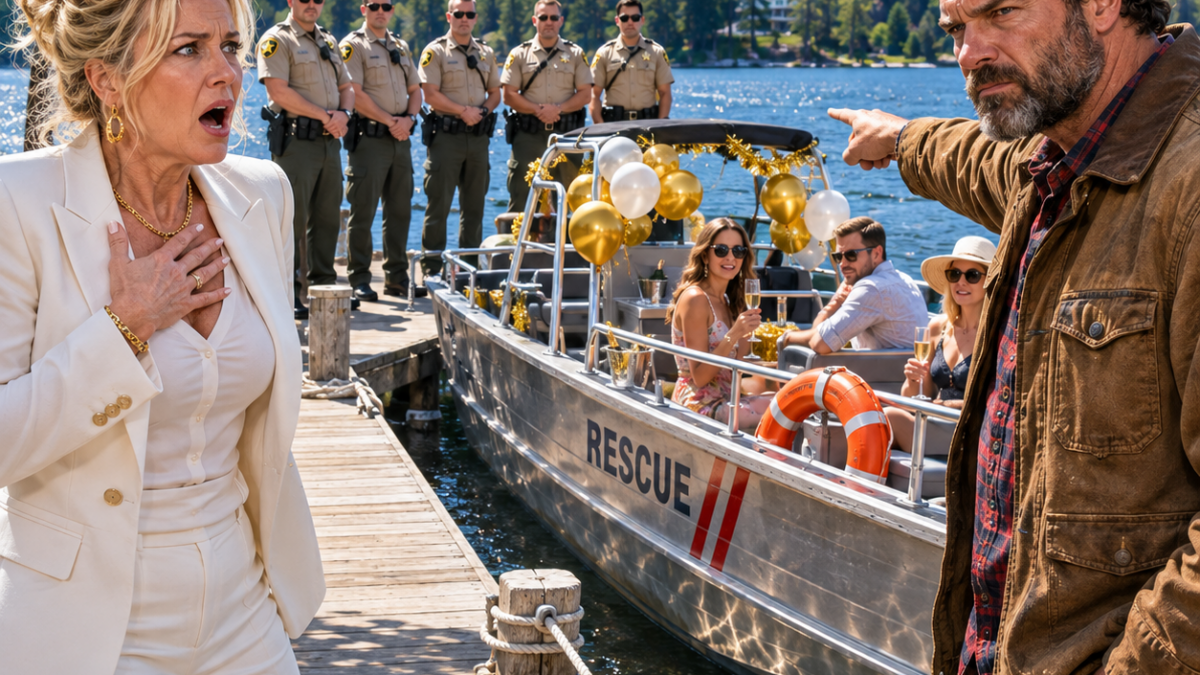
HOA Karen Took My Rescue Boat for a Lake Party—Six Deputies Met Her at My Dock.
Karen Bell came cruising back toward my private dock with gold balloons tied to my rescue boat, a party speaker sitting where my medical bag belonged, and nine guests who had been told I personally approved the whole thing.
She slowed when she saw six sheriff’s deputies waiting on shore, but what made my stomach drop wasn’t the missing rescue equipment or even the duplicate key in her pocket—it was the “permission form” she handed them with my real signature at the bottom of a page I had never signed.
By Wednesday night, we would discover that Karen had paid the HOA to copy my boat key weeks before she ever asked to borrow it, and beneath the reimbursement request she had written five words that turned her “misunderstanding” into something else entirely: Spare for future HOA cruises.
My name is David Mercer.
I live on Cedar Landing Lake.
Not directly inside the HOA-managed section.
My house sits beside it.
Private lot.
Private dock.
Private boat.
That last word became important.
Very important.
The boat was twenty-four feet long.
Aluminum hull.
High rails.
Wide rear opening.
Small steering console.
No carpet.
No polished wood.
No leather seats.
No cup holders glowing blue at night.
It looked more like something a utility crew would use than something you’d rent for a sunset cruise.
That was exactly why I bought it.
Three years earlier, I found it used at a marina two counties away.
The engine needed work.
Navigation lights were unreliable.
Bilge pump was dying.
One railing section had been bent and welded badly.
I bought it anyway.
I’m a small-engine mechanic.
Water pumps.
Generators.
Outboards.
Lawn equipment.
PART2:
If gasoline makes noise and somebody hasn’t completely destroyed it yet, I can usually make it useful again.
The boat took me almost four months.
New wiring.
Pump.
Lights.
Fuel lines.
Steering cable.
Rail repair.
Fresh non-slip deck coating.
By the following summer, it was dependable.
Then I started equipping it.
Life jackets.
Throw bags.
Blankets.
Medical kit.
Boarding ladder.
High-visibility orange equipment bags.
Emergency lights.
Tow line.
Spare rope.
Nothing exotic.
Nothing that made me a firefighter or a deputy.
I was not.
Our volunteer lake response group did not replace the sheriff’s marine patrol.
We didn’t replace fire rescue.
PART3:
We helped when official responders requested it.
Sometimes somebody’s fishing boat died near rocks.
Sometimes a family got stranded after dark.
Sometimes responders needed equipment moved from a shoreline that couldn’t be reached by road.
Two summers before everything happened, we helped bring an injured man from a rocky point on the north side of the lake.
Bad leg injury.
He couldn’t walk.
An ambulance was waiting at the public ramp.
His daughter was maybe seven.
She stood beside my wife, Anna, while we brought him in.
She kept asking:
“Can Daddy still take me fishing?”
Anna held a towel around the girl’s shoulders and kept saying:
“Let’s get him warm first.”
The man recovered.
He did take her fishing again.
I know because they sent me a photograph.
That picture stayed taped above my workbench.
Whenever I thought:
I’ll replace that worn strap next month.
I’ll check that light later.
I’ll reorganize the medical locker tomorrow.
I remembered the little girl asking whether her father would still fish with her.
Keeping the boat ready mattered.
That was why I took Karen Bell’s request seriously the first time she made it.
Nine days before the party, she came down to my dock.
Karen was president of Cedar Landing HOA.
Early fifties.
Blond hair.
Always put together.
Always carrying either a phone or a folder.
She had organized several neighborhood events over the years.
Some good.
Some unnecessarily complicated.
That afternoon, she looked over the boat.
Then said:
“How difficult would it be to move all this?”
I was checking the boarding ladder.
“Move what?”
She pointed.
“The orange bags.”
“Why?”
“And maybe the medical kit.”
I looked at her.
“Why?”
She smiled.
“We need room for a drinks table.”
I stopped working.
“What drinks table?”
“For Saturday.”
“What Saturday?”
“The resident appreciation party.”
That was being held on the HOA picnic lawn, a short walk from my dock.
I knew about it.
I did not know my boat had apparently developed a social calendar.
I said:
“You’re not putting a drinks table on this boat.”
Karen laughed.
I didn’t.
Her smile faded slightly.
“Our rental company canceled.”
“Then find another rental.”
“We only need it for an hour.”
“No.”
She looked across the deck.
“There is plenty of room.”
“Because it carries people and rescue equipment.”
“It’s not like there’s an emergency every hour.”
“That isn’t the point.”
Karen tapped the railing.
“The neighborhood helps support this boat.”
That sentence bothered me.
“No.”
She frowned.
“The HOA donated money.”
“To fuel.”
“Same difference.”
“No.”
Very different.
The month before, Cedar Landing had hosted a lake-safety afternoon.
Kids tried life jackets.
Parents practiced throwing rescue bags.
Mike, our volunteer coordinator, talked about hypothermia.
I showed people how to approach someone in the water without letting them drag you overboard.
The HOA contributed $450 to our volunteer fuel fund.
Four hundred fifty.
Appreciated.
Useful.
I mounted a small plaque near the console afterward.
CEDAR LANDING HOA
FUEL FUND SUPPORTER
That was all.
Karen pointed toward it.
“People should see what their money supports.”
“They can see it from the dock.”
“You took part in the safety event.”
“Yes.”
“So this is part of our partnership.”
“No.”
She stared.
I continued:
“The HOA didn’t buy this boat.”
“I did.”
“The HOA didn’t insure it.”
“I do.”
“You donated $450 for volunteer fuel.”
“And I’m grateful.”
“But that does not buy a weekend cruise.”
Karen’s mouth tightened.
“What if you captain it?”
“No.”
“One hour.”
“No.”
“You don’t even know what time.”
“Still no.”
“Why are you being difficult?”
I looked at the medical bag.
“Because this isn’t a party boat.”
She turned toward the clubhouse.
No goodbye.
That evening, I sent her a message.
Copied the HOA office.
I wanted no misunderstanding.
Karen, confirming our conversation today: my boat is not available for the Cedar Landing party or any private event. No person has permission to board, move rescue equipment from, start, or operate the vessel without my direct approval.
She replied:
Understood.
One word.
Perfect.
I saved it.
Went back to rebuilding a water pump in my garage.
I thought the issue was finished.
Three days later, a delivery truck stopped outside my gate.
Driver climbed out.
“Lake cruise setup?”
I stared.
“What?”
“Folding tables.”
He checked his phone.
“Karen Bell.”
I looked toward the clubhouse.
“Wrong address.”
He pointed toward my dock.
“Order says rescue dock.”
That got my attention.
“What exactly does the work order say?”
He showed me.
LAKE CRUISE SETUP
DELIVER TO RESCUE DOCK
I took a photograph.
Then showed him my written refusal.
He looked uncomfortable.
“I’m just delivery.”
“I know.”
“Not blaming you.”
He called dispatch.
Waited.
Eventually they redirected him to the clubhouse parking lot.
Before he left, I called Karen.
“Why was a table company sent to my dock?”
“Old instructions.”
“Then update them.”
“I already did.”
“You told them lake cruise.”
“The event has several elements.”
“Not on my boat.”
“I said it’s handled.”
The phrase meant nothing.
That evening, I called Mike.
“Karen tried to use the boat for an HOA party.”
He laughed.
Then realized I wasn’t joking.
“You told her no?”
“Yes.”
“In writing?”
“Yes.”
“Good.”
I hesitated.
“Anybody besides me have boat access?”
“Anna.”
“You.”
“Named volunteers.”
Then Mike became quiet.
“What?”
“The key box.”
“What about it?”
“During the safety demonstration.”
I remembered immediately.
Inside the little dock shelter was an emergency key box.
Combination access.
Used only so named responders could direct authorized people to the spare if needed.
During the safety demonstration, Mike had shown Karen where it was.
She had been event coordinator.
At one point, we’d practiced explaining access instructions over the phone.
She had heard the code.
I stood.
“I’m changing it.”
“Today.”
“Yeah.”
I changed the combination.
Tested it twice.
Old code failed.
New code worked.
Then opened the box.
My spare key was still there.
Faded blue plastic tag.
Good.
I closed it.
Locked it.
Felt relieved.
I should not have.
Knowing where one key was did not tell me whether somebody had copied it.
Thursday night, Anna showed me her phone.
“Look.”
Neighborhood Facebook group.
Photo from the safety demonstration.
Karen standing beside my boat holding lemonade.
Above it:
CEDAR LANDING RESIDENT APPRECIATION PARTY — SATURDAY
The post mentioned music.
Food.
Lakefront activities.
“Cruise” was implied but not explicit.
I called the office.
Asked them to remove my boat photograph.
Asked for a written statement that my vessel was not part of the event.
Board member Susan Keller called me.
“David?”
“Yeah.”
“I thought the party was on the lawn.”
“So did I.”
“Karen says everything is resolved.”
“Ask her one question.”
“What?”
“Does she have my permission to use the boat?”
Silence.
“I’ll ask.”
“Not whether the event is handled.”
“Not whether she spoke with me.”
“Ask whether I gave permission.”
Susan did.
Later she forwarded Karen’s response.
The gathering is a shoreline event. David’s concerns have been addressed.
I stared.
Still no yes.
Because there wasn’t one.
I replied:
For clarity: my refusal remains in place. The vessel is privately owned and is not available for this event.
Then I commented the same thing beneath the neighborhood post.
Within an hour, the entire post disappeared.
I had already taken screenshots.
Friday evening, I checked the boat carefully.
Lines.
Battery.
Lights.
Ladder.
Fuel.
Life jackets.
Orange rescue bags under the port bench.
Medical bag sealed inside its dry locker.
Everything where it belonged.
Anna stood beside me.
“You want me to stay tomorrow?”
She was planning to visit her sister.
“No.”
“You sure?”
“Yes.”
“I’ll be at the parts warehouse for an hour.”
“Back before lunch.”
She looked toward the clubhouse.
“People ignore writing.”
“I changed the code.”
“The office knows.”
“Karen wrote ‘understood.’”
Anna gave me the look wives give husbands right before husbands discover their wives were right.
“Okay.”
Saturday morning.
8:03 a.m.
I checked the dock.
Boat tied properly in its berth.
Key box locked.
Path gate latched.
I had also installed a small camera inside the shelter after the table-delivery incident.
It faced:
Dock approach.
Boat.
Shelter entrance.
Not the HOA picnic lawn.
The camera recorded to my phone.
One problem.
Friday, I’d turned off motion alerts while working around the shelter because they kept buzzing every thirty seconds.
I forgot to turn them back on.
That mistake mattered.
The camera recorded everything.
I just wasn’t watching live.
I left.
Parts warehouse.
Needed a pump seal.
There was a line.
Employee disappeared to find a different size.
At 10:17, my phone rang.
Susan.
“David?”
“Yeah?”
“Are you taking the group out?”
My whole body tightened.
“No.”
Pause.
“You’re not on the boat?”
“No.”
“What are you looking at?”
“I’m at the clubhouse.”
“I just saw your boat go past the swim markers.”
I walked away from the counter.
Opened the camera.
Live view.
Empty berth.
For one second, my brain didn’t process it.
The dock lines were lying loose on the boards.
Boat gone.
I opened recordings.
9:31 a.m.
Karen entered frame.
Not alone.
One man carried a cooler.
Two women had gold balloons.
Other guests followed.
Karen walked directly past the key box.
Didn’t touch it.
That was the first thing that chilled me.
Then she reached into her purse.
Something small.
Walked aboard.
Bent beside my console.
Engine started.
I watched my own boat leave the dock.
The warehouse clerk came back holding my seal.
“You okay?”
I said:
“Someone took my boat.”
He stared.
I paid.
Walked outside.
Called Karen.
Music answered before her voice did.
“David.”
“Bring my boat back.”
“We’re just doing a short ride.”
“You do not have permission.”
“We’ll be back before you need it.”
“Bring it back now.”
“You’re making this much bigger than it is.”
“Who’s driving?”
“I am.”
She knew how to operate a boat.
She owned a smaller runabout at another marina.
That wasn’t the issue.
“You’re operating a vessel you were explicitly told not to use.”
“I had access.”
“Access isn’t permission.”
“David—”
“I am reporting the boat taken without authorization.”
She laughed once.
“Don’t be silly.”
Click.
I stood beside my truck.
Heart pounding.
Angry enough to do something stupid.
So I didn’t.
Called the sheriff’s office.
Not 911.
There was no known emergency.
I explained exactly what happened.
Private vessel.
Known operator.
Taken without permission.
Nine days of written refusal.
Current location somewhere on Cedar Landing.
Guests aboard.
Dispatcher asked:
“Is anyone in immediate danger?”
“Not that I know.”
“We have marine patrol available.”
“Okay.”
Then I called Mike.
“Boat’s gone.”
Silence.
“What?”
“Karen took it.”
He said something I won’t repeat.
Then:
“Any rescue calls pending?”
“No.”
“I’ll mark your boat unavailable.”
“If something comes in, normal sheriff/fire channels.”
“Good.”
Then:
“Drive home safely.”
“Don’t race her back.”
That was exactly what I needed to hear.
At the dock, seeing the empty berth in person made me angrier than the video.
The loose lines lay where someone had dropped them.
I photographed everything.
Then noticed orange fabric behind the shelter door.
My rescue bags.
On the concrete.
Beside them:
Medical bag.
Folded blanket.
Boarding ladder.
Karen hadn’t just taken the boat.
She had emptied the things that made it useful.
Made room for:
Coolers.
Speaker.
Party decorations.
I called the sheriff again.
Added that equipment had been removed.
Dispatcher told me not to disturb more than necessary.
Preserve video.
I did.
Susan came running down the path.
Phone in hand.
“One of the guests sent me this.”
Printed invitation.
At the top:
Resident appreciation cruise.
Then a line:
ABOARD OUR COMMUNITY-FUNDED RESCUE BOAT
At the bottom:
Karen has the owner’s spare key.
I stared.
Changed code.
Blue key still in box.
Yet Karen had started the boat.
I rewound the recording.
Zoomed.
Key in her hand.
Fresh white tag.
My spare had faded blue.
“That isn’t mine.”
Susan looked.
“You sure?”
“Absolutely.”
“Could Mike have made one?”
“He would’ve called.”
I called anyway.
Mike answered.
“No.”
“No duplicate.”
“No cruise permission.”
“Leave your key box closed.”
“Let the deputy photograph it.”
I had already started reaching toward the latch.
Stopped.
He was right.
Anger makes you want to prove things immediately.
Evidence sometimes means not touching them.
Susan sat beneath the shelter.
“She told us you were busy.”
I looked at her.
“What?”
“She told the board you were glad the boat was finally being used by residents.”
“Did anyone ask me?”
Susan looked down.
“No.”
That hurt.
She had stood beside me during the safety demonstration.
Had seen the rescue equipment.
She knew this wasn’t a pontoon rental.
“I should have.”
I almost said something sharp.
Instead:
“Help me now.”
She nodded.
Called one of the guests.
Rachel.
Rachel answered from the boat.
Music behind her.
Susan put the call on speaker.
“Rachel, is Karen bringing everybody back?”
“I think so.”
Then I spoke.
“This is David.”
“The boat owner.”
Music lowered.
Rachel moved away from speaker.
“Hi.”
“Rachel, I need you to know something.”
“I did not lend Karen that boat.”
Silence.
“What?”
“I told her no.”
“More than once.”
Another pause.
“Then why did she say you signed the trip?”
I looked at Susan.
“What trip?”
“The clipboard.”
“She said it was for insurance.”
My stomach tightened.
“I signed no trip authorization.”
Rachel became quiet.
“Are we in trouble?”
“Don’t confront anyone.”
“Put your life jacket on.”
“Stay seated.”
“Follow deputies if they contact you.”
“How many aboard?”
“Nine.”
“Children?”
“No.”
“Life jackets?”
“Available.”
“Put yours on.”
“Okay.”
“You didn’t know.”
“Just get back safely.”
We ended the call.
Susan whispered:
“She told us that clipboard was your idea.”
Sheriff’s SUV arrived.
Two deputies.
Deputy Brooks.
Deputy Allen.
Brooks was older.
Calm.
Exactly the kind of person you want around when you’re furious.
He let me explain.
But every time I said something I suspected, he stopped me.
“She copied my key during the demonstration.”
“Do you know that?”
I paused.
“No.”
“What do you know?”
“She used a key that is not the spare in my box.”
“Good.”
“Say that.”
That slowed me down.
Helped.
I knew:
Karen took my boat.
I had refused permission.
Her written response was Understood.
She used a white-tagged key.
My spare should have a blue tag.
Rescue equipment was removed.
Guests had been told I approved the trip.
I did not yet know:
When the duplicate was made.
Who made it.
Whether Karen altered a document.
Whether anyone helped knowingly.
Facts.
Not guesses.
I showed them registration.
Ownership papers.
Messages.
Brooks read my refusal twice.
Then:
“Send this conversation exactly as shown.”
“Dates visible.”
I did.
Allen watched the shelter recording.
Then we opened the emergency key box.
Photographed closed.
Opened.
Photographed inside.
Blue-tagged key.
Still there.
Allen said:
“So she did not use this key today.”
“No.”
Brooks asked:
“What’s the plaque near your console?”
“Thank-you plaque.”
“Why?”
“She told dispatch the neighborhood helped buy the boat.”
Susan closed her eyes.
I went into the house.
Returned with a cheap green folder.
Purchase papers.
Repair invoices.
Fuel receipts.
Letter from Mike.
Copy of HOA check.
Purchase date:
Nearly three years before the fuel donation.
Donation:
$450.
Purpose:
Volunteer lake-response fuel expenses.
Brooks set them beside each other.
“That helps.”
I didn’t feel better.
I looked at the equipment on the concrete.
One rescue call and we’d have had to say:
Sorry.
The medical kit is on a shelter floor because somebody needed room for sangria.
I checked gear with Allen nearby.
Medical seal intact.
Good.
Throw rope dirty but complete.
Blanket damp.
Then ladder.
Mounting bracket missing one safety pin.
Tiny thing.
Few dollars.
Without it, ladder couldn’t be secured correctly.
I wrote it down.
Brooks said:
“When the boat returns, photograph before cleaning.”
“Full inventory.”
My phone rang.
Karen.
I showed Brooks.
Answered.
“David.”
“This has gone far enough.”
“Where are you?”
“Coming back.”
“But I need those deputies off your dock.”
“No.”
“They’re staying.”
“You are making Cedar Landing look ridiculous.”
“No.”
“You did that.”
I heard guests behind her.
Someone asking:
“Deputies?”
I said:
“Tell them the truth.”
“What truth?”
“That they were invited onto a boat you did not have permission to take.”
“I had the key.”
“That is not permission.”
Her voice lowered.
“Please don’t do this in front of everybody.”
There it was.
Fear.
For the first time.
And contrary to what people like to imagine, I didn’t enjoy it.
I wasn’t thinking:
Good.
Now she’s afraid.
I wanted:
My boat back.
My gear back.
Nobody hurt.
Nobody panicking in the middle of the lake.
So I said:
“Bring it in slowly.”
“Do what marine patrol tells you.”
“No arguments.”
She ended the call.
Brooks updated by radio.
Sheriff’s marine unit had already spotted my boat near the point.
Two marine deputies were speaking with Karen.
They would escort her toward the dock.
I called Anna.
Explained.
She said:
“I’m coming home.”
“Not yet.”
“Why?”
“I can handle the deputies.”
“Do one thing at a time.”
Then I told her about the rescue bags.
My voice cracked.
That surprised me.
Those bags weren’t expensive individually.
But Anna and I had built the kit piece by piece.
Sales.
Donations.
My own money.
Her sewing.
She had added wide handles to one blanket bag because cold hands have trouble gripping narrow straps.
Karen had set it on concrete to make room for drinks.
Anna listened.
Then said:
“Photograph the handles.”
“Check whether the bag can be cleaned.”
Practical.
Exactly what I needed.
While I took photos, Susan opened old HOA planning emails.
The reason Karen had pushed so hard became obvious.
The party honored residents who had helped with clubhouse repairs.
Karen had promised a lake cruise.
Rental company canceled.
Invitations already sent.
Decorations purchased.
Rather than cancel one feature, Karen told the board:
“I found a replacement at no cost.”
Susan read the email.
“Did she say my boat?”
“In the meeting.”
“She called it a volunteer partnership.”
“Did you vote on using it?”
“No.”
“Only the event budget.”
Another email.
Karen:
David has supported previous lake events. I will handle the boat paperwork.
Paperwork.
Not permission.
Then an engine echoed from the point.
Marine patrol boat appeared first.
Two deputies.
One stepped onto my dock.
One stayed aboard.
Then another sheriff’s vehicle arrived.
Sergeant.
Trainee deputy.
Two reporting deputies.
Two marine deputies.
Two more from shore.
Six total.
Not lined up dramatically.
No guns.
No shouting.
They positioned themselves so nine guests could disembark safely and give separate statements without crowding.
That calm made it feel more serious.
Susan set a chair beneath the tree.
I opened my side gate so guests could leave without going through the house.
Then my boat rounded the bend.
Gold balloons.
Gold ribbons.
Portable speaker.
People sitting quietly now.
One woman raised her hand to wave.
Saw the uniforms.
Lowered it.
Karen pulled the throttle back too hard.
Bow dipped.
Marine deputy called:
“Slow approach.”
“Bring it alongside.”
She corrected.
I caught the bowline.
Tied it.
Whatever happened next, I wanted the boat secure first.
Rachel stood near the front.
Invitation in her hand.
“We were told this was approved.”
One deputy asked:
“Approved by whom?”
Karen pointed toward the console plaque.
“The HOA helped pay for this vessel.”
I looked.
Something was wrong.
White strip of tape had been placed over part of my plaque.
Black marker.
COMMUNITY RESCUE BOAT
Underneath the tape should have read:
FUEL FUND SUPPORTER
I said:
“Deputy Brooks.”
“Photograph that before anyone touches it.”
He did.
That little strip of tape made me angrier than the balloons.
A $450 thank-you had been converted into fake ownership with a marker.
Brooks told the guests:
“Leave drinks aboard.”
“Exit one at a time.”
Rachel came first.
Shaking.
She almost missed the step.
I held out my hand.
“You’re okay.”
She looked at me.
“I brought you a gift card.”
“What?”
“Karen said this cruise was your way of thanking everyone.”
“She told us we should thank you too.”
Rachel reached into her purse.
Envelope.
DAVID
Little boat drawn beneath my name.
That was when I understood how complete the lie had been.
The guests weren’t told they were stealing a boat.
They were told I was hosting them.
I handed the envelope back.
“Keep it.”
Her eyes filled.
Karen stepped off last.
Canvas tote.
Brooks asked:
“Boat key.”
She hesitated.
“It’s a spare.”
“Please give it to me.”
White-tagged key.
She placed it in his hand.
I asked:
“Where did you get that?”
Brooks raised one palm toward me.
He wanted the same answer.
But he would ask.
Good.
Karen looked around.
Guests talking separately.
Rachel showing invitation.
Susan standing beneath tree.
No audience she controlled.
“David makes everything sound bigger than it is.”
Nobody answered.
Brooks asked:
“Did you understand that Mr. Mercer had told you not to use this boat?”
Karen said:
“I understood he didn’t want to captain the party.”
I stepped forward.
“That is not—”
Brooks looked at me.
I stopped.
He opened my message.
Read aloud:
The boat is not available for private events. No one is to board, move equipment from, or operate it without my direct permission.
Then:
Karen’s reply.
Understood.
Silence.
Only gold ribbon tapping against aluminum.
Karen opened her tote.
“There is other paperwork.”
She removed a clipboard.
Clear plastic sleeve.
Paper inside.
I saw my signature.
My actual signature.
Long tail on the final letter.
I knew it instantly.
Above it:
CEDAR LANDING VOLUNTEER BOAT EVENT
Then language saying:
Owner authorizes community operation of vessel for HOA event.
Karen held it toward Brooks.
“He signed.”
My stomach dropped.
I took one step closer.
“That is my signature.”
Karen folded her arms.
“There.”
I continued:
“That is not the document I signed.”
Brooks studied it.
“Explain.”
A month earlier.
Safety demonstration.
I had signed a completion form.
Confirmed:
Training held.
Donation received.
Fuel fund.
That’s all.
The lower portion looked familiar.
Top did not.
I pulled out my phone.
Photographs from that day.
Kids in life jackets.
Mike holding the donation check.
Throw-rope demonstration.
No clear photo of signed form.
Brooks placed Karen’s version in an evidence sleeve.
“Do you have a copy of the original?”
“I should.”
I called Mike.
“Who kept the paperwork after the safety lesson?”
Pause.
“Karen collected it.”
My stomach dropped again.
“She said the HOA office would scan the packet.”
I looked toward Susan.
The original might exist somewhere Karen hadn’t been able to change.
Email.
I walked up the path.
Susan was still there.
“Did the office email the safety packet after the demonstration?”
“Probably.”
“Search fuel donation.”
She opened her phone.
Scrolled.
One attachment.
DONATION RECEIPT
Loaded.
There.
My signature.
Same.
Ink dot beside the date.
Same.
But above it:
Received $450 donation for volunteer lake-response fuel fund.
Dock safety demonstration completed.
Nothing about boat use.
Nothing about cruises.
Nothing authorizing Karen.
“Send the entire email to Brooks.”
“Not screenshot.”
“Original email.”
She did.
Then called him up.
He compared the two pages.
Bottom half matched.
Signature matched.
Ink mark matched.
Top wording did not.
Brooks said:
“Keep this email preserved.”
Susan nodded.
I wanted him to confront Karen immediately.
Hold pages side by side.
Demand explanation.
He didn’t.
He told me:
“Wait near the house.”
I hated that.
But investigations don’t move at the speed of anger.
Guests came up one by one.
Rachel asked permission to retrieve her bag.
Another woman stopped in front of me.
“I helped move your orange bags.”
I looked at her.
“Did you know what they were?”
“Karen said old training supplies.”
She swallowed.
“She said you wanted the deck cleared.”
I almost said:
They’re bright orange rescue bags.
You should’ve known.
Then stopped.
She came to a neighborhood party.
Trusted the HOA president.
That didn’t make her responsible for inspecting the story.
“Did you move the boarding ladder?”
“Yes.”
“There’s a safety pin missing.”
Her face changed.
Then she opened her purse.
Searched.
Pulled out a small metal pin.
“I put this in here so it wouldn’t fall through the dock.”
I photographed it before taking it.
“Thank you.”
That moment changed how I treated every guest after that.
They weren’t enemies.
They were witnesses.
Most had been lied to.
By the time deputies finished initial interviews, I learned:
Several guests asked where I was.
Karen said I was busy.
They asked whether I approved.
Karen showed them the clipboard.
She said I trusted her with the boat.
She even told people to wave toward my camera when they departed.
That detail almost made me laugh.
Then it made me cold.
She knew the camera existed.
She wasn’t hiding from it.
She believed the altered paperwork would explain whatever it recorded.
Karen was not arrested that afternoon.
I know some people want the dramatic version.
Handcuffs at dock.
Sirens.
Immediate justice.
Didn’t happen.
Deputy Brooks explained:
Boat returned.
Evidence preserved.
Witnesses identified.
Key retained.
Altered form retained.
Investigation open.
He gave me a case number.
Useful.
Less satisfying.
Better.
Karen walked past me toward the road.
“You could have spoken to me privately.”
I stared.
“I did.”
She looked away.
After everyone left, the boat looked wrong.
Sticky drink patch near console.
Damp cups.
Gold ribbon beneath seat hinge.
Speaker had rubbed against painted bench.
One cushion had a small burn mark.
Rescue equipment still off deck.
Anna came home.
Stepped aboard.
Looked around.
“What first?”
“Pictures.”
“Then inventory.”
We worked.
Engine started.
Steering okay.
Hull undamaged.
Thank God.
But the boat wasn’t ready.
Damaged strap.
Dirty rope bag.
Missing ladder hardware now recovered.
Bench scrape.
Cushion burn.
Unknown duplicate-key situation.
That last one mattered most.
If Karen had one duplicate, I couldn’t know whether others existed.
Mike came Sunday.
We cleaned gear according to instructions.
Tested ladder.
Replaced strap.
Then ignition.
“I want a new lock.”
He nodded.
“Even though deputies have Karen’s copy?”
“They have one copy.”
Exactly.
Boat stayed off volunteer availability until the new ignition and inspection were complete.
Nobody needed us during that time.
No emergency call went unanswered because of the party.
I’m grateful for that.
But someone else had to cover our usual area.
I canceled a paid repair appointment to meet the mechanic.
That cost money too.
Monday morning, Cedar Landing HOA sent a neighborhood email.
Susan forwarded it.
The message called Saturday:
a misunderstanding concerning a borrowed boat.
Borrowed.
Then:
The vessel was returned without major incident.
Then the sentence that made me angry all over again:
The association is reviewing future financial support for volunteer lake-response activities.
Translation:
If David keeps complaining, maybe volunteers lose donations.
I called Mike.
He answered:
“I saw it.”
“Does losing the HOA money hurt?”
“Yes.”
Honest.
Then:
“But it doesn’t change what happened.”
Exactly.
I wrote a response.
No insults.
No Karen rant.
Facts.
I had denied permission in writing.
Boat was taken anyway.
Rescue equipment removed.
Vessel temporarily unavailable pending security inspection.
I requested:
Public correction.
Record preservation.
No future representation that HOA had access rights.
Payment of documented repair and security costs.
Attached my refusal.
Karen’s reply:
Understood.
Within an hour, office manager announced special board meeting.
Wednesday.
I prepared eleven pages.
Anna read two.
Put them down.
“What do you need the board to decide?”
“That Karen stole—”
“No.”
“Deputies decide criminal issues.”
“What do you need from the HOA?”
I looked at the stack.
Then crossed things out.
I needed:
Them to stop saying “borrowed.”
Preserve records.
Stop promising my boat.
Pay actual costs.
That’s it.
I made four evidence sets.
Written refusal.
Karen reply.
Camera still.
Key box photo.
White key.
Removed gear.
Invitation.
Altered plaque.
Two versions of signed form.
Repair estimates.
Wednesday evening, clubhouse was packed.
Gold ribbon still sitting on a shelf by coffee machine.
I noticed that before Karen.
She sat at front.
Susan.
Vice President Robert Hale.
Three other board members.
Karen reached toward microphone.
Robert kept it.
“We’re hearing from David first.”
That was new.
I walked up.
Hands shaking.
Annoyed me.
I can tear apart a carburetor in front of an angry customer without blinking.
Forty neighbors?
Dry mouth.
I started with one sentence.
“I told Karen no.”
Then read message.
Exact.
Then her reply.
Understood.
Next photo.
Orange rescue bags on concrete.
“This had to leave the boat so the party could fit.”
Karen interrupted:
“They were under cover.”
I looked at her.
“They belong on the boat.”
Silence.
I explained key.
Duplicate.
Security risk.
Ignition replacement.
Then the two forms.
Original donation receipt.
Altered event authorization.
Robert leaned forward.
“They have the same signature.”
“Yes.”
Karen said:
“I used an existing event form.”
“Office error.”
Susan looked at her.
“You gave that document to law enforcement as proof he authorized the cruise.”
Karen said:
“I believed it reflected our partnership.”
I placed my refusal beside it.
“Then why did you ask me nine days before the event?”
No answer.
Rachel stood in back.
Her voice shook.
“You told us David wanted us to have fun.”
Karen turned.
“Rachel—”
“You told us to thank him.”
Karen said:
“I was trying to keep the event together.”
Rachel answered:
“You could’ve told us the cruise was canceled.”
Silence.
Robert asked:
“Where did the spare key come from?”
Karen looked at me.
Then Susan.
Finally:
“It was copied after the safety demonstration.”
My chest tightened.
Robert:
“Why?”
“For emergencies.”
“Who authorized that?”
“Nobody needed to.”
“I was planning ahead.”
Susan suddenly picked up her phone.
“The expense packet.”
Karen looked sharply at her.
“What?”
Susan searched old email.
Same packet containing my original donation form.
Then found an attached receipt.
Key duplication.
Paid by HOA.
Reimbursement request signed by Karen.
Robert read.
His expression changed.
“Karen.”
“What?”
“This doesn’t say emergency.”
She leaned forward.
“Give me that.”
He moved the phone away.
Then looked at me.
“David.”
He turned screen.
Under the duplicate key expense, Karen had typed:
Spare for future HOA cruises.
Five words.
I read them twice.
Date?
Weeks before she came to ask me for the party.
I looked at Karen.
“You already had a copied key when you asked.”
She said:
“I was planning ahead.”
“For cruises?”
“Community events.”
“On my boat?”
She looked around.
Nobody rescued her.
Robert asked:
“Did the association pay this expense?”
Susan checked.
“Yes.”
“It was approved in the safety-program reimbursement.”
Robert:
“Did you notice the description?”
Susan’s face tightened.
“Yes.”
That surprised everyone.
She continued:
“I thought David had agreed to some future use.”
“I should have verified.”
That mattered.
Not because it excused her.
Because someone finally admitted:
I failed to check.
Karen stood.
“This is turning a small mistake into a public trial.”
I stayed seated.
“You copied my key.”
“You kept it.”
“I told you no.”
“You used the key anyway.”
“You removed rescue equipment.”
“You altered a form containing my signature.”
“I brought the boat back.”
“You were supposed to leave it where it was.”
My voice rose.
Anna touched my arm.
I stopped.
Breathed.
Then looked at Robert.
“I’m not asking this room to decide whether she committed a crime.”
“The sheriff is investigating that.”
“I want this association to stop telling residents I lent her the boat.”
Robert nodded.
“Reasonable.”
“I want every record preserved.”
“Agreed.”
“I want nobody in this HOA promising access to my boat or dock again.”
“Agreed.”
“And when I have the repair bills, I want the actual costs paid.”
Karen picked up her bag.
“If everyone is finished embarrassing me—”
Robert interrupted.
“We still have board business.”
She stopped.
Board members questioned her.
Who approved the cruise?
Nobody specifically.
Who approved using my boat?
Karen said she was handling it.
Why wasn’t my refusal shared?
No clear answer.
Who authorized key duplication?
No board authorization.
Why did an altered form exist?
“Office mistake.”
Then Robert made a motion.
Remove Karen Bell as HOA president.
Not remove her board seat.
Bylaws required a separate membership process for that.
But board could choose officers.
Vote:
4–1.
Karen voted no.
She lost.
Effective immediately.
No authority over events.
Office staff.
HOA communications.
No speaking as president.
She left before the correction email was finished.
Nobody applauded.
I’m glad.
By then, it didn’t feel like victory.
It felt like cleanup.
Robert read the final correction:
The vessel was privately owned by David Mercer.
David had not consented to the Saturday cruise.
The association’s $450 contribution was a fuel donation only.
The contribution created no ownership or usage right.
Records would be preserved.
The board would cooperate with law enforcement.
He looked at me.
“Accurate?”
“Yes.”
One small word.
Felt better than everything else I’d said all week.
Susan found me outside afterward.
“I should’ve read the key expense more carefully.”
“Yes.”
“So should everybody else who approved it.”
“Yes.”
She handed me a copy.
“I already sent the original email packet to Deputy Brooks.”
“Thank you.”
Then:
“Would you ever do another safety lesson for the neighborhood?”
I looked back at clubhouse.
“I don’t know.”
She nodded.
“Fair.”
She didn’t ask me to prove I was still a good neighbor by saying yes immediately.
That mattered.
Next morning, Deputy Brooks called.
Needed further statement.
I brought:
Messages.
Repair estimates.
Photos.
Timeline.
Original donation records.
At station, he asked:
“Did Karen ever receive permission to duplicate a key?”
“No.”
“Any permission for future cruises?”
“No.”
“Any agreement exchanging fuel donation for boat access?”
“No.”
Then I told him what I had done wrong.
Didn’t change key-box code immediately after demonstration.
Forgot to reactivate camera alerts.
Brooks wrote it down.
Then looked at me.
“That gave her opportunity.”
“It didn’t give her permission.”
I needed to hear that.
For days, I’d replayed everything.
If I’d changed the code sooner.
If I’d checked the post harder.
If I’d stayed home.
If I’d turned alerts on.
Those were lessons.
Not consent.
Friday, mechanic replaced ignition lock.
Checked steering.
Controls.
Engine.
New strap.
Bench repair.
Cushion cover.
Cleaning.
Mike and I re-packed every bag exactly where our hands expected it.
Saturday afternoon, test run.
Slow speed first.
Then farther out.
Ladder down.
Ladder up.
Throw bags moved.
Medical locker checked.
Everything ready.
Mike radioed coordinator.
Boat available again.
That mattered more to me than Karen losing the presidency.
The boat could do its job.
Bills:
$1,468.
Lost pay from canceled repair appointment:
$180.
Total requested:
$1,648.
No emotional-damage surcharge.
No price for anger.
No fake giant lawsuit.
I sent the board documented receipts.
They agreed to pay $1,648.
Settlement between us.
Not a court award.
Their letter also confirmed:
HOA held no ownership interest.
No usage right.
No authority over boat.
No access to private dock without permission.
I kept that letter beside registration.
Robert said HOA intended to seek reimbursement from Karen.
That was their problem.
Criminal investigation took months.
Not exciting.
Occasional call.
“Confirm this date.”
“Send clearer screenshot.”
“Do you recognize this receipt?”
“Was this key yours?”
Then silence.
Investigations can move while nothing seems to happen.
Karen resigned from the board before residents completed the process to remove her.
She mailed me a letter.
Several paragraphs about everything she’d done for Cedar Landing.
Pressure of running events.
Canceled boat rental.
Residents’ expectations.
Near the end:
I should have respected your answer.
That was the only sentence I read twice.
I didn’t respond.
Months later, prosecutor’s office contacted me.
Karen agreed to plead guilty to a misdemeanor charge related to taking and using the vessel without permission.
Evidence included:
Written refusal.
Duplicate key receipt.
Altered form.
Witness accounts.
Camera footage.
Invitation.
She received:
Probation.
Fine.
Community service.
My documented losses had already been repaid.
No double recovery.
I attended the hearing.
Judge asked whether I wanted to speak.
I had written a page.
Left it folded in my pocket.
I stood.
Said:
“I keep that boat ready because sometimes people need help getting home.”
“I don’t expect everyone to understand every piece of equipment on it.”
“But I need people to understand the word no.”
That was it.
Outside courthouse, Karen waited.
I thought she wanted another fight.
Instead:
“I thought you’d calm down once it was back.”
I looked at her.
“You kept giving me more things to deal with.”
She lowered her eyes.
“You’re right.”
I didn’t forgive her on courthouse steps.
Didn’t say everything was fine.
I said:
“I hope you understand it now.”
Then left.
That fall, Cedar Landing asked whether we’d hold another safety lesson.
This time:
Written request.
Clear boundaries.
Before any announcement.
Common picnic lawn only.
Boat remains at private dock.
No boarding.
No key access.
No implied partnership beyond volunteer education.
I agreed.
Rachel helped with sign-in.
Susan verified every volunteer before equipment was handled.
Mike brought a plastic bucket for kids to aim at with throw bags.
One little boy missed three times.
Fourth throw landed across the rim.
His sister screamed like he’d won the Olympics.
Anna stood beside me holding towels.
For the first time in months, I attended a neighborhood event without waiting for another problem.
Near the end, Rachel approached.
Envelope.
Little drawing of a boat.
I recognized it.
“Gift card?”
She smiled.
“The old one I kept.”
Then:
“But this one is for today.”
“You actually agreed to today.”
I laughed.
Hardware-store card.
I accepted it.
Bought a new flashlight and spare batteries for the rescue bag.
The original fuel plaque went back on the boat too.
Anna noticed me reinstalling it.
“You sure?”
“Yes.”
“Why?”
“Because the donation was real.”
“People meant to help.”
Karen didn’t get to rewrite that part either.
I peeled away every trace of the white tape.
Underneath:
FUEL FUND SUPPORTER
Exactly what Cedar Landing had been.
A supporter.
Not owner.
Not operator.
Not entitled user.
Supporter.
That evening, I locked the shelter.
Tested new lock.
Spare keys accounted for.
Camera alerts on.
Rescue gear packed.
Dry.
Ready.
Anna sat at edge of dock with her shoes off.
I sat beside her.
For once:
No forms.
No deputies.
No messages.
No repair list.
Just lake.
Console light.
Rope knocking softly against rail.
Anna said:
“You know what bothers me most?”
“What?”
“She asked.”
I nodded.
“Yeah.”
“If she’d never asked, maybe she could pretend she misunderstood.”
“But she asked.”
“Yes.”
“And you said no.”
“Repeatedly.”
“That should’ve been the end.”
Exactly.
People love focusing on the six deputies.
It makes the story sound dramatic.
Six uniforms waiting while Karen returns with balloons.
Good image.
But the six deputies weren’t the important part.
Neither was the guilty plea.
Neither was the key.
Neither was the altered form.
The most important thing happened nine days earlier.
Karen asked:
“Can we use your boat?”
I said:
“No.”
Everything after happened because she decided my answer was an obstacle rather than an answer.
The copied key made that worse.
The expense record made it worse.
The altered form made it worse.
The fake plaque made it worse.
But the original problem was simple.
She thought wanting something badly enough gave her permission to keep rearranging facts until the answer became yes.
People do that with boundaries all the time.
They hear:
No.
Then ask differently.
Offer something.
Apply pressure.
Invoke community.
Invoke money.
Invoke good intentions.
Invoke inconvenience.
Eventually they convince themselves the boundary is unreasonable.
Karen told herself:
The HOA donated fuel money.
I had supported a safety lesson.
The rental had canceled.
Residents expected a cruise.
She already had a key.
The boat would come back.
Nobody would be hurt.
Each sentence made the next one easier.
Until:
Take the boat.
Then:
Remove the rescue equipment.
Then:
Tape over the plaque.
Then:
Show a page with my signature.
That is how bad decisions grow.
Not always with one giant leap.
Often with a series of tiny justifications.
I learned things too.
Change access codes immediately.
Don’t leave emergency access unchanged after demonstrations.
Keep copies of every signed form.
Never assume “understood” means someone respects the boundary.
And keep camera alerts on.
Anna still reminds me about that one.
Every time.
“Alerts?”
“Yes.”
“Sure?”
“Yes.”
She checks anyway.
Fair.
Mike changed our entire volunteer-access policy after the incident.
Every authorized key numbered.
Signed out.
Returned.
No permanent emergency codes shared with event coordinators.
Demonstrations use dummy locks.
Original forms scanned immediately.
Not because we’re paranoid.
Because trust works better when systems don’t require perfect memory.
Cedar Landing changed too.
No officer can authorize use of privately owned property for HOA events without written owner consent attached to event packet.
No “community partnership” language unless there is an actual agreement.
Board members must review reimbursement descriptions before approval.
Susan pushed hardest for that one.
She told residents:
“I approved a duplicate key expense because I assumed somebody else had verified the permission.”
“That’s how this happened.”
I respected her for saying it publicly.
Karen made the central choice.
Other people made smaller failures.
Susan failed to ask.
Board members let Karen “handle it.”
Guests trusted an official-looking clipboard.
I forgot alerts.
Mike shared a code during a demonstration.
None of those things gave Karen permission.
But correcting them made the next failure harder.
That’s what accountability should do.
Not just punish one person.
Improve the system.
My boat still isn’t pretty.
Still aluminum.
Still scarred.
The bench has new paint.
Cushion repaired.
Medical bag sits where it belongs.
Boarding ladder secure.
Orange bags under port bench.
The plaque is back beside console.
Sometimes Cedar Landing residents donate fuel.
Sometimes they don’t.
We help when we’re called either way.
The HOA never bought another cruise.
Good.
Karen eventually moved.
Not immediately.
For months, I still saw her at mailbox cluster.
Grocery store.
Walking near lake.
We didn’t speak.
Then one spring, her house sold.
Moving truck.
Gone.
I didn’t celebrate.
Didn’t wave.
Just noticed.
Rachel stayed.
Susan stayed.
Robert stayed.
The neighborhood went back to being a neighborhood.
Boring is underrated.
A year after everything, we had a rescue call.
Late afternoon.
Fishing boat lost power near western rocks.
Wind pushing them toward shore.
Two adults.
One teenager.
Marine unit was farther south.
Dispatcher asked whether our volunteer boat could assist until patrol arrived.
Mike called me.
“Available?”
I was already moving.
At dock:
Gear where it belonged.
Key where it belonged.
Ladder secured.
Medical kit sealed.
No balloons.
No speaker.
No cooler sitting where rope should be.
Anna handed me jacket.
“Be careful.”
We reached the disabled boat.
Got a line aboard.
Held them away from rocks until marine unit arrived.
Nothing dramatic.
Nobody injured.
Teenager looked seasick.
That’s it.
But on the ride home, I thought about the party.
What if that call had happened while Karen had my boat?
We would have used other resources.
Nobody necessarily would have died.
I’m not going to invent tragedy to make the story bigger.
But the boat would not have been ready.
The equipment had been removed.
My ladder was incomplete.
The vessel was out of our control.
That was enough.
Readiness matters because emergencies don’t schedule themselves around parties.
When I tied up that evening, I looked at the plaque.
Fuel fund supporter.
Then the bowline.
Then the orange bags.
Everything exactly where it should be.
That felt like closure more than court ever did.
Years later, people still tell the story wrong.
“Didn’t some HOA lady steal an ambulance boat?”
No.
Not an ambulance.
Volunteer rescue-capable workboat.
“Didn’t six cops arrest her at the dock?”
No.
They were there to manage the return, gather statements, and preserve evidence.
She left that day.
“Didn’t she forge your signature?”
She used my real signature from another form beneath altered language.
The investigation and court handled the legal characterization.
“Didn’t the HOA own part of it?”
No.
They donated $450 for fuel.
“Didn’t you sue for fifty grand?”
No.
I asked for $1,648 in documented losses.
That’s another lesson.
Truth doesn’t need extra drama.
Karen took my boat after I said no.
Copied a key.
Removed rescue equipment.
Presented altered paperwork.
That is enough.
Making the story bigger would only make the truth smaller.
One summer afternoon, a new family moved into Cedar Landing.
Father and son walked down during a safety event.
Boy maybe eight.
He pointed at my boat.
“Is that the famous boat?”
I laughed.
“I hope not.”
His father said:
“He heard the story.”
Boy looked at the plaque.
“Did the neighborhood buy it?”
“No.”
“They helped buy gas once.”
He thought.
“So that’s why the sign says supporter?”
“Yes.”
He nodded.
“That makes sense.”
Eight years old.
Solved it.
Support isn’t ownership.
Donation isn’t permission.
Access isn’t consent.
A copied key isn’t authority.
A signature beneath different words doesn’t change what someone actually agreed to.
And community doesn’t mean everything belongs to whoever happens to be president.
Simple concepts.
Amazing how complicated adults can make them.
I still volunteer.
Less than I used to.
Getting older.
Knees complain on cold docks.
Mike jokes that I’m becoming management.
I threaten to quit whenever he says it.
Anna still checks the rescue bags before big storms.
She says she doesn’t trust me to fold the blanket correctly.
Probably true.
The boat will eventually need replacing.
Aluminum lasts, but nothing lasts forever.
When that day comes, I may donate this one to a training program.
Or sell it.
Or keep it on blocks behind my garage and annoy Anna for twenty years.
Whatever happens, Cedar Landing won’t decide.
I will.
Because it is mine.
That sounds possessive.
Maybe it is.
Ownership carries responsibility.
I pay.
Repair.
Insure.
Maintain.
Keep it ready.
When responders ask for help, I choose to help.
When neighbors ask for a safety lesson, I may choose yes.
When somebody asks for a private cruise, I may choose no.
Those choices are connected.
You cannot demand the generosity while erasing the owner.
Karen wanted the benefit of my boat without respecting the responsibility behind it.
That was her mistake.
The day six deputies stood on my dock wasn’t really about a boat.
It was about whether the word no still meant anything once somebody with a title decided it was inconvenient.
Karen came home with balloons fluttering from my rail.
Music playing.
Guests believing they were honoring me.
A duplicate key in her pocket.
My signature on a page I had never approved.
For a moment, it probably looked to her like she’d solved every problem.
The rental had canceled.
She found a boat.
She had a key.
She had paperwork.
She had guests.
She had a story.
Then she rounded the bend.
Saw six deputies.
And discovered that every shortcut she had taken had left a record.
The message saying no.
Her reply saying understood.
The delivery instructions.
The camera.
The white-tagged key.
The intact blue spare.
The fuel donation letter.
The invitation.
The altered plaque.
The original emailed form.
And finally the reimbursement request:
Spare for future HOA cruises.
Five words.
Written before she ever asked.
That was what ended the argument.
Not shouting.
Not six deputies.
Not me calling her a thief.
Her own paperwork.
I sometimes think back to what my old instructor told me when I first started fixing engines:
“If something fails, don’t start by guessing.”
“Follow the evidence.”
Fuel.
Spark.
Compression.
One step at a time.
Turns out people aren’t that different.
Karen spent days trying to turn the story into:
Misunderstanding.
Borrowed boat.
Community partnership.
Owner overreacting.
But when everyone followed the evidence, the explanation got simpler.
I said no.
She planned around my no.
Then she took the boat anyway.
Everything else was decoration.
Gold balloons included.
That evening, years later, I still sometimes sit beside Anna at the end of the dock.
The lake gets quiet.
Boat bumps gently against fenders.
One rope taps the rail.
She asks:
“Locked?”
“Yes.”
“Camera?”
“Yes.”
“Alerts?”
“Yes.”
“Keys?”
“Counted.”
She smiles.
Then:
“Good.”
And we leave it alone.
Because that’s what I wanted from the beginning.
Not revenge.
Not fame.
Not six deputies.
Just my boat sitting where I left it.
Ready for the moment someone actually needs it.








