HOA Karen Told Me “Sign It or Leave” and Tried to Annex My 87-Acre Lake Farm—Then the Judge Voided 73 of Her Votes in Court
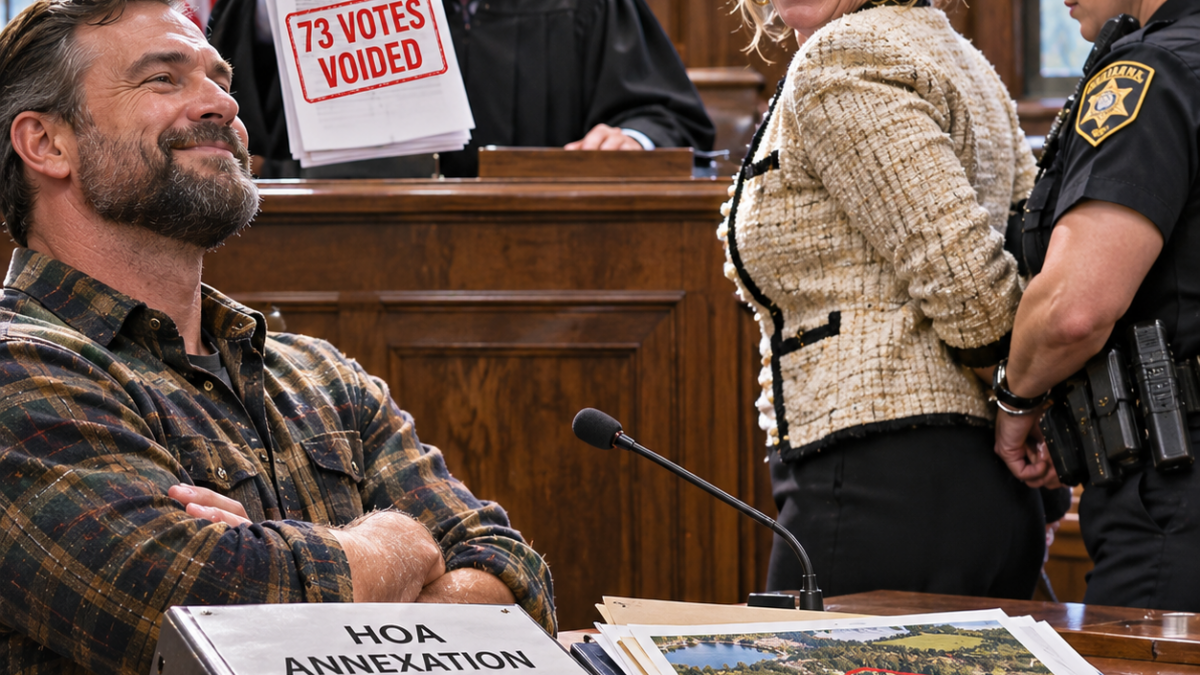
HOA Karen Told Me “Sign It or Leave” and Tried to Annex My 87-Acre Lake Farm—Then the Judge Voided 73 of Her Votes in Court.
Karen Bristow slammed the annexation agreement onto the hood of my truck hard enough to make the apple crates in the bed rattle.
Behind her, seventy-three voting cards were pinned across a white display board like trophies, forty homeowners were watching, two surveyors were waiting beside their tripods, and a notary already had her stamp case open.
Karen smiled as if my eighty-seven-acre Tennessee farm had already become hers.
Then I asked one question.
“If your vote already gave you my land, Karen… why do you still need my signature?”
For the first time that afternoon, she stopped smiling.
My name is Reed Callow.
I was forty-three when Clearwater Ridge tried to annex Lake Farm.
My grandfather bought the first forty acres in the 1960s.
My father added the orchard.
I added the western meadow and restored the shoreline after I came home from college.
By the time Karen Bristow appeared at my gate, Lake Farm covered eighty-seven acres along the western edge of Willow Glass Lake.
Apple trees.
Hay fields.
A processing barn.
A weathered log house on the hill.
And a little more than a mile of shoreline my family had protected for decades.
It was not glamorous land.
It worked for a living.
So did I.
September was harvest season, which meant my days started before sunrise and ended whenever the last crate was stacked.
That afternoon, I was coming back from the orchard with six crates of Honeycrisps in my truck.
The light was turning gold.
Cut hay smelled sweet in the fields.
I was thinking about a broken irrigation line near the eastern row.
Then I rounded the bend toward my gate.
Cars everywhere.
SUVs along the shoulder.
People standing in groups.
Folding tables.
Clipboards.
A large white board on an easel.
Across the top:
CLEARWATER RIDGE — APPROVED EXPANSION.
I slowed.
“What the hell?”
Karen stood in front of the board.
Fifty-one.
Navy blazer.
White blouse.
Perfect hair.
Clipboard tucked against one hip like she was holding court.
I already knew her.
Clearwater Ridge was the 126-home subdivision bordering my eastern property line.
Karen had been HOA president for nearly eight years.
We had clashed twice.
PART2:
Once because she wanted me to stop running tractors before eight in the morning.
I reminded her my farm existed thirty years before her subdivision.
The second time she wanted permission for residents to cross my pasture to reach the lake.
I told her no.
She called me uncooperative.
I called it private property.
We had managed to avoid each other after that.
Until now.
I parked.
Got out.
Karen immediately turned toward the crowd.
“Mr. Callow has arrived.”
That irritated me instantly.
Not “Reed.”
Not “the property owner.”
Like I was the last participant in a meeting everyone else had already attended.
I looked around.
“What’s going on?”
Karen smiled.
“I’m glad you’re here.”
“I didn’t ask if you were glad.”
A few people shifted.
“What is this?”
She gestured toward the board.
“The Clearwater Ridge expansion.”
“Expansion where?”
PART3:
Her smile widened.
“Lake Farm.”
For a second I genuinely thought I had misheard.
“My farm?”
“Yes.”
“Into your HOA?”
“Yes.”
I laughed.
Not because it was funny.
Because sometimes absurdity gets there before anger.
Karen did not laugh.
“The vote has already been completed.”
“What vote?”
“Our membership approved annexation.”
“My property?”
“Seventy-three advance authorizations plus fifteen in-person approvals.”
She pointed proudly toward the display.
“Eighty-eight yes votes.”
I looked at the cards.
Then at her.
“On what authority can 126 people vote to annex land none of them owns?”
Karen did not answer.
Instead, she walked toward me.
Pulled a thick packet from her folder.
Slapped it onto my hood.
“Sign it or leave.”
The phrase was so ridiculous I almost asked her to repeat it.
“Leave what?”
“The process.”
“This is my driveway.”
“You know what I mean.”
“No.”
I picked up the packet.
“Explain it.”
Karen’s voice became louder.
For the audience.
“The community has made its decision. You have until midnight to execute the voluntary annexation agreement.”
“Voluntary?”
“Yes.”
“You’re giving me a deadline.”
“It’s an administrative deadline.”
“And if I don’t sign?”
“The HOA will pursue enforcement under the Willow Glass Scenic Development Plan.”
I stared at her.
“You’ll enforce HOA rules against land outside your HOA?”
“The expansion has already been approved.”
There it was again.
Approved.
As if saying the word often enough changed the deed.
I opened the packet.
Page one brought Lake Farm into Clearwater Ridge.
Page four subjected all eighty-seven acres to HOA land-use restrictions.
Page seven restricted commercial traffic.
Page nine required architectural approval for modifications to agricultural structures.
Page eleven allowed assessment of future lakefront maintenance fees.
Page fourteen granted the HOA authority over shoreline management.
I looked up.
“You want approval power over my barn?”
Karen folded her arms.
“Structures inside the community are subject to community standards.”
“My barn was built before Clearwater Ridge existed.”
“That doesn’t exempt it after annexation.”
“My tractors?”
“Normal agricultural use could continue.”
“Could?”
“We’d establish reasonable hours.”
I laughed again.
She was trying to take regulatory control over a working farm and speaking about it like she was adjusting pool hours.
Then I saw the signature line.
OWNER CONSENT TO VOLUNTARY ANNEXATION.
I looked at Karen.
“If the vote already turned Lake Farm into HOA property…”
I held up the agreement.
“…why do you still need my signature?”
Silence.
One second.
Maybe less.
But I saw it.
Her smile stalled.
Her eyes moved toward the HOA attorney standing near the folding table.
Then back to me.
“Formality.”
“No.”
“Confirmation of the democratic result.”
“No.”
“Reed—”
“This signature is owner consent.”
Karen’s voice hardened.
“The community voted.”
“Then apparently the community voted on something it cannot do.”
Several homeowners looked at each other.
Karen turned toward them.
“You are watching one individual defy the lawful decision of an entire community.”
I placed the papers carefully back on the hood.
“I do not consent.”
The survey crew started moving.
Two men in reflective vests lifted equipment and headed toward my orchard.
I stepped into their path.
“Stop.”
They did.
“You have my permission to survey from the public road.”
I pointed behind them.
“You do not have permission to enter Lake Farm.”
One surveyor looked at Karen.
She said:
“Proceed.”
He looked back at me.
I shook my head.
He lowered the tripod.
“Ma’am, we’re not going onto disputed private land without written authorization.”
Smart man.
Karen’s face reddened.
“You’ve already been retained.”
“Doesn’t matter.”
He and his partner backed away.
Karen faced the crowd again.
“Everyone here should remember this moment.”
I looked at the board.
Seventy-three cards.
That number would become important.
I just didn’t know why yet.
As people started leaving, an older woman drifted near me.
I recognized her vaguely from Clearwater Ridge.
Audrey Fenwick.
“Mr. Callow?”
“Reed.”
She lowered her voice.
“The vote was announced three days ago.”
“What vote?”
“The annexation.”
“I was never told there was a meeting.”
She frowned.
“I assumed you knew.”
“I didn’t.”
Audrey looked toward Karen.
“She said you were negotiating.”
“I wasn’t.”
Her expression changed.
Then someone called her name and she walked away.
When everyone had left, I found an HOA notice tucked under my windshield wiper.
The final line read:
ACQUISITION OF LAKE FARM EFFECTIVE UPON FINAL OWNER ACKNOWLEDGMENT.
Not ownership transfer.
Not annexation complete.
Owner acknowledgment.
My signature.
They still needed me.
That night I opened the oak filing cabinet my grandfather built.
I put every deed on the kitchen table.
Three generations of transfers.
Tax maps.
Surveys.
Boundary descriptions.
Lake Farm existed decades before Clearwater Ridge.
The subdivision plat ended exactly at my eastern boundary.
No covenant.
No declaration.
No HOA authority.
Then I found Clearwater Ridge’s founding declaration online.
Sixty-eight pages.
I made coffee.
Read all of it.
At 12:43 a.m., I found the annexation section.
An expansion required three things.
All three.
First:
Approval by two-thirds of the 126 member owners.
Eighty-four valid votes.
Second:
Voluntary written consent from the owner of the property being annexed.
Third:
Recording of the amended boundary documents.
I read the second requirement again.
VOLUNTARY WRITTEN CONSENT.
Karen had spent an afternoon talking about eighty-eight votes.
She never mentioned the condition she could not manufacture.
Me.
The next morning I drove to county records.
A clerk named Mr. Benson pulled my parcel.
Then Clearwater Ridge filings.
He turned his monitor toward me.
A proposed expansion map had already been recorded.
Not approved.
Recorded.
There was a difference.
But anyone glancing at it could miss that.
The blue boundary line wrapped around my orchard.
Crossed the meadow.
Followed the shoreline.
Included the processing barn.
“What does this do legally?”
I asked.
“Nothing by itself.”
“So they don’t own anything.”
“No.”
“Then why record it?”
He looked uncomfortable.
“Record offices preserve filings. We don’t adjudicate every claim made inside them.”
“So someone can file a map showing my property inside their HOA.”
“They can submit a proposed map.”
“Even if I object?”
“Disputes get resolved through courts.”
I took certified copies.
Before I reached my truck, my phone buzzed.
Audrey.
She had forwarded the latest Clearwater Ridge newsletter.
Headline:
LAKE FARM JOINS WILLOW GLASS SCENIC PROTECTION PLAN.
Beneath it was a photograph of my orchard.
Caption:
FUTURE COMMUNITY LAKEFRONT.
I called Karen.
She answered immediately.
“Reed.”
“Retract the newsletter.”
“Why?”
“Because Lake Farm has not joined anything.”
“We have a valid membership vote.”
“You do not have my consent.”
“Your orchard can remain.”
“My orchard isn’t asking your permission.”
“You’re being emotional.”
I almost laughed.
“No.”
“You can keep farming.”
“Generous.”
“But you cannot expect to control an entire mile of lake shoreline indefinitely when 126 families live beside it.”
There it was.
Not ecology.
Not community planning.
Entitlement.
“You mean I can’t expect to control land I own?”
“You know what I mean.”
“I do.”
I hung up.
Then I started saving everything.
Every newsletter.
Every map.
Every email.
Screenshots.
Dates.
PDF copies.
I downloaded them before anyone could revise history.
Then I called Mallory Dunn.
Real-estate litigator.
Thirty-nine.
Reputation for being terrifyingly calm.
She spent three hours reviewing my documents.
Then she said:
“Your title is safe.”
I exhaled.
“But.”
I looked at her.
“Why does every lawyer have a ‘but’?”
“Because facts matter.”
She tapped the proposed boundary map.
“No HOA vote can convey your property.”
“Good.”
“But if they keep representing publicly that the annexation is complete, they can damage you before we win anything.”
“How?”
“Customers.”
“Lenders.”
“Insurers.”
“Potential buyers.”
“Business partners.”
She leaned back.
“Bad information can cost money even when the underlying claim is legally worthless.”
That happened faster than either of us expected.
The next afternoon I opened my mailbox.
Glossy envelope.
Inside:
CLEARWATER RIDGE — LAKEFRONT EXPANSION INVESTMENT OPPORTUNITY.
My shoreline was on the cover.
My dock.
My willow trees.
Artist renderings showed a boardwalk along the lake.
Event pavilion.
Commercial access points.
Small marina.
A landscaped gathering area where my apple rows currently stood.
Another rendering replaced the hay meadow with parking.
I stared.
At the bottom:
PELL WATERFRONT DEVELOPMENT.
This was not a scenic-protection plan.
It was development.
Three days later Clearwater Ridge held an open meeting.
I went.
Sat in the back.
Karen spoke for twenty minutes about:
Property values.
Community access.
Beautification.
Future revenue.
Reduced dues.
Then a woman asked the obvious question.
“Does Clearwater Ridge actually own the lakefront yet?”
Karen did not hesitate.
“We have the votes.”
She smiled.
“The landowner is stalling final paperwork.”
I stood.
Heads turned.
Karen saw me.
Her face changed.
“Mr. Callow is not a member.”
I walked toward the microphone.
“I have one question.”
“You are not recognized.”
“Show everyone one document giving the HOA legal authority over Lake Farm.”
Murmurs.
Karen looked toward the meeting coordinator.
My microphone went dead.
I stared at it.
Then at her.
I did not shout.
Did not argue.
I walked toward the door.
Before leaving, I turned.
“You can vote on your property.”
The room quieted.
“You cannot vote on mine.”
I left.
The next morning two produce buyers called.
Both had seen the brochure.
“Are you shutting down?”
“No.”
“Are you selling?”
“No.”
“Is your orchard being developed?”
“No.”
A regional grocery distributor put a major order on hold anyway.
Legal uncertainty, they said.
Karen had not taken one acre.
She had already cost me money.
Mallory sent formal cease-and-desist notices to:
Clearwater Ridge HOA.
Karen Bristow.
Pell Waterfront Development.
They demanded:
Correction of false advertising.
Withdrawal of misleading property claims.
Preservation of voting records.
Preservation of communications.
Preservation of development contracts.
Then we filed suit.
Declaratory judgment.
Injunction.
Damages.
Two days later, Gavin Pell called me.
Polished voice.
No apology.
“Mr. Callow.”
“Yes.”
“You understand this project has significant financial commitments attached.”
“Not my problem.”
“It could become your problem.”
“Why?”
“Because Karen committed substantial money based on your shoreline.”
I paused.
“How much?”
Silence.
Then Gavin said:
“If you refuse to sign, she won’t be the only person in trouble.”
That was the first time I realized Karen might not simply be arrogant.
She might be trapped.
We requested the HOA voting records.
Karen refused.
“Internal association records.”
Mallory explained we could obtain relevant documents during discovery.
But I started talking to residents.
Door by door.
I learned the announced numbers.
126 total owners.
88 yes.
22 no.
16 did not participate.
Two-thirds threshold:
Karen supposedly had four votes to spare.
Except seventy-three of those eighty-eight “yes” votes had been cast before the meeting.
Advance authorization proxies.
That was what she called them.
Audrey’s name appeared among them.
I went to see her.
She invited me onto the porch.
“Do you remember voting to annex Lake Farm?”
She frowned.
“I signed something.”
“What?”
“Shoreline survey.”
“What kind?”
“Erosion.”
“Flooding.”
“Tree protection.”
“Did it say annexation?”
She hesitated.
“I don’t remember.”
“Did anyone ask whether you wanted my farm brought into Clearwater Ridge?”
“No.”
Then she looked uncertain.
“But it was several pages.”
I called Mallory.
“She forged votes.”
Mallory immediately said:
“Stop.”
“What?”
“You don’t know that.”
“Audrey never voted.”
“She may have signed a valid proxy without understanding it.”
“That’s different?”
“Legally? Potentially.”
I hated that answer.
Mallory continued.
“Do not accuse Karen publicly of forgery until we know what the signatures are attached to.”
She was right.
I hated that more.
Karen went door-to-door the next day.
Lemon bars.
Smiles.
Warnings.
If my lawsuit killed the lakefront deal, she said, residents could face higher dues because Clearwater Ridge had already invested money.
The neighborhood turned ugly.
Anonymous note in my mailbox:
JUST SIGN.
A truck slowed outside my orchard and someone yelled:
“STOP HOLDING EVERYBODY HOSTAGE!”
I kept working.
Then Audrey called me at 10:11 one night.
“I found the email.”
“What email?”
“The survey.”
She forwarded it.
Subject:
WILLOW GLASS SHORELINE EROSION AND SAFETY SURVEY.
Nothing about annexation.
Nothing about Lake Farm.
Nothing about proxy votes.
Mallory read it the next morning.
Then Gavin Pell’s attorney called.
The developer wanted distance from Karen.
In exchange for avoiding immediate claims over the brochure, they provided relevant portions of the development contract.
Value:
Approximately $3.8 million.
The agreement became effective once Clearwater Ridge obtained legal control over my shoreline.
The HOA’s proof of community support was the supposed 88–22 annexation vote.
Mallory looked at me.
“Now we have motive.”
Clearwater Ridge had financial problems.
Road upgrades.
Drainage.
Clubhouse renovation.
Costs exceeded budget.
Reserve fund depleted.
Karen had campaigned twice on one promise:
NO DUES INCREASE.
The lakefront development was her escape.
Commercial revenue.
Event rentals.
Boardwalk fees.
Developer payments.
She could patch the HOA finances without admitting the association was in trouble.
Except she signed commitments before she controlled the land.
My land.
If I refused, she had to explain the hole.
That was why she could not back down.
People defending pride can be difficult.
People defending their jobs can be dangerous.
People defending hidden financial decisions are worse.
Mallory arranged a meeting.
Gavin Pell.
Karen.
HOA attorney.
Me.
Mallory.
Gavin started talking about deadlines.
I stopped him.
“You can buy an option on property from the person who owns it.”
He looked at me.
“You cannot buy an option on my shoreline from Karen.”
He turned toward her.
Karen said:
“The membership vote authorizes negotiations.”
Mallory slid over the HOA declaration.
The voluntary-owner-consent clause was highlighted.
Gavin read it.
Once.
Again.
Then looked at Karen.
“You told us annexation approval was complete.”
“It is.”
“No.”
Mallory said.
“It isn’t.”
Karen leaned forward.
“The owner cannot indefinitely frustrate a valid community vote.”
I answered:
“The owner doesn’t need to frustrate it.”
I pointed at the clause.
“The owner can say no.”
Two days later Karen asked me to lunch.
Private booth.
No audience.
No clipboard.
She offered $120,000.
“For what?”
“Temporary shoreline access.”
“How temporary?”
“Two years.”
I read the agreement.
Buried deep:
Long-term management rights.
Future development option.
Renewal mechanism.
I pushed it back.
“No.”
Her smile disappeared.
“You’re making a mistake.”
“Maybe.”
“I can drag this through court for years.”
“You already turned it into a lawsuit.”
I stood.
“All I’m doing is refusing to let you write the verdict.”
That evening Mallory received a call.
Della Hurst.
HOA treasurer.
She wanted to meet privately.
At a diner.
Back booth.
Della arrived carrying a manila folder.
Her hands shook.
“Karen can’t prove every vote.”
Inside was the voting spreadsheet.
Fifteen standard yes votes.
Seventy-three:
ADVANCE AUTHORIZATION PROXY.
Twenty-two no.
Sixteen absent.
Those seventy-three were everything.
Without them:
15 yes.
22 no.
Karen’s entire annexation collapsed.
Della said:
“I asked for the paper proxies.”
“And?”
“Karen said the management company digitized them.”
“No originals?”
“Not a complete set.”
Mallory compared Audrey’s survey signature with the proxy signature.
They matched.
Perfectly.
We checked two more residents.
Their signatures matched too.
I sat back.
“So she didn’t forge them.”
Mallory stared at the papers.
Then said:
“Reed.”
“What?”
“You’re still asking the wrong question.”
I looked at her.
“It’s not whether they signed.”
She tapped the pages.
“It’s what they agreed to when they signed.”
That changed everything.
With homeowners’ permission, we gathered original survey emails.
Every one told the same story.
Shoreline erosion.
Trees.
Flooding.
Environmental planning.
Community priorities.
Not annexation.
No question saying:
DO YOU AUTHORIZE CLEARWATER RIDGE TO ANNEX LAKE FARM?
Nothing even close.
Karen’s attorney argued that the survey included broad language allowing the board to take “necessary measures” to protect the lake.
Mallory laughed when she read that.
“Studying erosion is not a proxy vote to annex eighty-seven acres.”
But proving seventy-three invalid votes required more than outrage.
We needed a pattern.
So I invited anyone with concerns to my processing barn.
Not an anti-Karen rally.
No speeches.
Just chairs.
Coffee.
Documents.
Thirty-two residents came.
Apple crates along the walls.
Audrey sat near the front.
I stood before them.
“I’m asking one question.”
Silence.
“Did you knowingly vote to annex Lake Farm?”
Nobody moved.
Then Audrey stood.
“No.”
Another woman lifted her hand.
“No.”
A man in the third row:
“I answered the shoreline survey.”
Another:
“I never saw annexation language.”
Another:
“Neither did I.”
I did not celebrate.
I said:
“Keep your documents.”
“Don’t alter anything.”
“Don’t write on them.”
“Let Mallory explain what the court needs.”
When everyone left, Walter Briggs stayed behind.
Retired machinist.
Seventy.
Quiet.
He said:
“I kept the paper.”
That night he sent a photograph.
His original survey was one sheet.
Front.
Back.
That was it.
The proxy filed by Clearwater Ridge had another page.
A second page created later.
Bold heading:
YES — APPROVE ANNEXATION OF LAKE FARM.
Walter had never seen it.
Mallory filed an emergency preservation motion the next morning.
The judge ordered the HOA and management company to preserve:
Paper originals.
Emails.
PDFs.
Edit history.
Metadata.
Voting systems.
Internal messages.
Then the electronic trail opened.
The environmental surveys were created first.
Homeowners signed them.
After the collection period ended, new PDF packets were assembled.
Annexation pages appeared only later.
Then came Russell Keen.
Management company employee.
He had collected the surveys door-to-door.
Under questioning he said:
“I was told these were shoreline questionnaires.”
“Were you instructed to request annexation approval?”
“No.”
“Did you explain that signing could authorize an annexation vote?”
“No.”
“Did you know Lake Farm was involved?”
“Not specifically.”
Seventy-three genuine signatures.
Attached to a purpose the signers never approved.
That was more dangerous than crude forgery.
It looked legitimate.
Because the signatures were legitimate.
Then Della found the memo.
Karen to the management company.
One sentence:
DO NOT SEPARATE THE SHORELINE AUTHORIZATION PACKAGE FROM THE ENVIRONMENTAL SURVEY RESPONSES.
Mallory read it twice.
Then handed it to me.
I felt my anger become very calm.
“She knew.”
“Yes.”
“This wasn’t clerical.”
“No.”
“She built it.”
“Yes.”
We stopped reacting.
Mallory sought a temporary restraining order.
Granted.
Clearwater Ridge could not:
Enter my property.
Stake boundaries.
Survey without permission.
Begin construction.
Advertise control over Lake Farm.
Karen could hold internal meetings.
She just could not turn those meetings into physical authority on my land.
Then we showed the residents the arithmetic.
Only material legally available.
15 valid yes.
22 valid no.
73 disputed proxies.
16 nonparticipants.
Required:
84 yes.
If the seventy-three disappeared, Karen did not merely lose narrowly.
She was annihilated mathematically.
Fifteen yes.
Sixty-nine short of the threshold.
Audrey stood before the room.
“I supported Karen for years.”
Her hands trembled.
Her voice did not.
“But I will not let her use my signature to take another man’s farm.”
One homeowner stood.
Then another.
Then another.
Original surveys appeared.
People Karen had counted as allies became witnesses.
Residents demanded an audit.
Karen responded with an emergency HOA meeting.
She accused me of bribing homeowners.
Harassing them.
Manipulating elderly residents.
Someone suggested confronting her at her house.
I said no.
No threats.
No scenes.
No revenge.
Everything on paper.
Everything through Mallory.
Karen then announced a supplemental vote.
She wanted the neighborhood to “ratify” the annexation before the judge could invalidate the first one.
Mallory smiled when she heard.
“Can she?”
“She can hold another vote.”
My stomach tightened.
“But?”
“She still needs your voluntary signature.”
I exhaled.
Karen could manufacture a hundred votes.
It did not manufacture ownership.
The day before the hearing, her lawyer sent a message.
They would bring every original ballot.
They would prove all seventy-three signatures were authentic.
I looked at Mallory.
“That worries me.”
She smiled.
“Perfect.”
“Perfect?”
“We’re not challenging the signatures.”
That was when I understood.
Karen still thought she was defending against a forgery accusation.
We were going to prove something worse.
The signatures were real.
The consent was not.
The courtroom was packed.
Judge Lenora Pryor presided.
Fifty-six.
Known for one thing:
Do not waste her time.
Karen sat straight-backed at the defense table.
Her attorney opened confidently.
Clearwater Ridge had authority under its governing documents to expand.
Eighty-eight homeowners approved.
Seventy-three advance proxies bore authentic signatures.
He displayed handwriting comparisons.
Signatures matched.
Karen nodded.
Mallory stood.
“Your Honor, we concede authenticity.”
Karen stopped nodding.
Her attorney looked at her.
Judge Pryor looked at Mallory.
“You concede all seventy-three signatures?”
“Yes.”
Whispers erupted.
Mallory continued.
“This case has never been about who wrote their names.”
She displayed Audrey’s original survey.
Then the HOA proxy packet.
Side by side.
Same signature.
Different document.
One:
WILLOW GLASS SHORELINE EROSION AND SAFETY SURVEY.
The other:
APPROVE ANNEXATION OF LAKE FARM.
Mallory asked:
“What question did the homeowner actually answer?”
Silence.
Audrey testified.
“I wanted the HOA to study erosion.”
“Did you vote to annex Lake Farm?”
“No.”
“Were you told your signature would be counted as an annexation vote?”
“No.”
“Would you have signed if you knew that?”
“No.”
Russell Keen testified next.
His job:
Collect environmental surveys.
Nothing else.
Then came metadata.
Packet-creation dates.
Post-signature PDF assembly.
Inserted annexation pages.
Karen’s memo.
DO NOT SEPARATE.
Judge Pryor turned toward Karen.
“Ms. Bristow.”
Karen’s attorney stood.
“Your Honor—”
“I asked Ms. Bristow.”
Karen swallowed.
“Yes?”
“Why did an environmental questionnaire become an annexation proxy?”
“The board viewed shoreline preservation and annexation as parts of the same management objective.”
Judge Pryor stared.
“A management objective is not a vote.”
Karen’s face tightened.
“The homeowners authorized the board to take necessary steps.”
“Did they authorize annexation?”
“They authorized shoreline protection.”
“That was not my question.”
Silence.
Judge Pryor continued.
“If these seventy-three owners knowingly approved annexation, why were they not shown the page saying they were approving annexation?”
Karen looked at her lawyer.
He started:
“The management company assembled—”
Judge Pryor cut him off.
“The memorandum directing the packet structure is signed by Ms. Bristow.”
Silence.
Then came the ruling.
Seventy-three ballots did not satisfy the association’s requirements for a valid annexation vote.
They were void.
All seventy-three.
Karen’s eighty-eight yes votes became fifteen.
Required:
Eighty-four.
Actual valid yes:
Fifteen.
Short:
Sixty-nine.
But Judge Pryor was not finished.
She turned a page.
“Even if Clearwater Ridge had obtained all one hundred twenty-six member votes…”
Karen looked up.
“…the association could not annex Lake Farm without Mr. Callow’s voluntary written consent under its own governing declaration.”
That was the point Karen had tried to hide from the beginning.
The vote never had the power she claimed.
The judge declared:
No valid annexation occurred.
Lake Farm remained entirely outside Clearwater Ridge.
The HOA had no authority over my orchard.
My barn.
My fields.
My shoreline.
Every misleading county filing had to be corrected.
Every notice representing Lake Farm as HOA-controlled had to be withdrawn.
Every development advertisement using my property had to stop.
Karen stood.
“All of these residents want to protect Willow Glass Lake!”
Judge Pryor’s voice snapped through the courtroom.
“Sit down, Ms. Bristow.”
Karen froze.
“Now.”
She sat.
Judge Pryor looked directly at her.
“This case is not about whether residents care about the lake.”
“It is about who has the legal right to decide what happens on Mr. Callow’s land.”
Nobody moved.
“The answer is Mr. Callow.”
Outside the courthouse, Gavin Pell was waiting.
He handed Karen a letter.
The $3.8 million development agreement was terminated.
The project was dead.
The HOA would have to account for money already spent.
Karen stared at the pages.
I walked past.
She called my name.
“Reed.”
I stopped.
She looked smaller without a crowd.
“You think you won?”
I considered the question.
“No.”
Her expression changed.
“I think my farm is still my farm.”
Then I walked away.
Within a week the lakefront-expansion signs disappeared.
The county map was corrected.
The newsletter was retracted.
The grocery distributor restored my apple order.
A manager called personally.
“Sorry we panicked.”
“I understand.”
“You do?”
“I’d panic too if someone announced my supplier was being converted into an event pavilion.”
He laughed.
Harvest resumed.
That should have been the end.
It wasn’t.
The homeowner audit came back.
Marketing expenses.
Consultants.
Predevelopment costs.
Engineering studies.
Legal retainers.
Money spent on a project before the HOA had any rights to the property supporting it.
Residents demanded answers.
Karen blamed the developer.
The developer produced Karen’s commitments.
She blamed the management company.
The management company produced her memo.
She blamed confusion.
The documents showed intention.
Then came the recall vote.
This time people read everything.
Every page.
Every proxy.
Every line.
Karen Bristow was removed as president.
No police.
No handcuffs.
No screaming arrest.
Her downfall was quieter.
More appropriate.
Votes.
Bylaws.
Records.
The very machinery she had tried to weaponize against me.
The new board began reviewing whether Karen could be held personally responsible for unauthorized commitments.
My legal-cost claim was partially resolved through settlement.
I did not take the clubhouse.
Did not demand anyone’s home.
Did not try to bankrupt Clearwater Ridge.
Most residents had not known what Karen was doing.
Punishing 126 households because one president abused their trust would have made me more like her than I wanted to admit.
Then, one cold October morning, Audrey came to my gate.
Five residents stood behind her.
No lawyers.
No surveys.
No annexation agreement.
She smiled nervously.
“We want to ask something.”
“Okay.”
“A few people would still like to walk near the lake.”
I said nothing.
She continued quickly.
“Not HOA access.”
“Not permanent.”
“No ownership.”
“No development.”
“Just occasional nature walks.”
I looked toward the shoreline.
For months, any request involving Clearwater Ridge had sounded like the first inch of another takeover.
Audrey seemed to understand.
“If the answer is no, it’s no.”
That mattered.
I asked:
“Who organizes it?”
“Independent group.”
“Not the HOA?”
“No.”
“Registration?”
“Yes.”
“Specific dates?”
“Yes.”
“Defined trail?”
“Yes.”
“No construction?”
“None.”
“No implied easement?”
“We’ll sign whatever Mallory says.”
That made me smile.
“She’ll enjoy hearing that.”
I agreed.
Limited written license.
Specific trail.
Specific times.
Revocable under the agreement.
No permanent right.
No HOA control.
No commercial use.
The first nature walk happened three weeks later.
I watched fifteen neighbors follow a marked route along the lake.
Nobody planted a stake.
Nobody held a vote.
Nobody told me community desire outweighed ownership.
They asked.
I said yes.
That was the difference Karen never understood.
Permission.
Voluntary permission.
At the gate, I installed a new sign.
LAKE FARM
PRIVATE PROPERTY
ACCESS BY OWNER’S PERMISSION ONLY
Audrey read it on the first walk.
Then laughed.
“What?”
I asked.
She held up her registration form.
“This time we read every page.”
I laughed too.
The first genuine laugh I’d had about Clearwater Ridge in months.
The seventy-three votes became a cautionary story inside the neighborhood.
Not because they were fake signatures.
They weren’t.
That was what made the lesson important.
People assumed fraud meant somebody secretly copying your name.
Sometimes it was subtler.
Your real signature.
Your real handwriting.
Your real agreement to one thing.
Moved into a context where someone pretended you agreed to something else.
That was what Karen did.
She took trust and converted it into authority.
A shoreline questionnaire became a proxy.
A proxy became eighty-eight votes.
Eighty-eight votes became supposed annexation.
Supposed annexation became a commercial-development agreement.
And a commercial-development agreement became leverage against the one person who had never agreed to any of it.
Me.
The whole thing collapsed because Mallory stopped asking whether the signatures were authentic.
She asked what the signatures meant.
That question saved Lake Farm.
So did another question.
The one I asked Karen at my gate.
“If your vote already gave you my land…”
“…why do you still need my signature?”
Everything was hidden inside that contradiction.
Karen knew the vote was not enough.
She always knew.
That was why she brought a notary.
That was why she gave me a midnight deadline.
That was why she threatened litigation.
That was why she offered $120,000 later.
She did not need my signature because annexation had succeeded.
She needed my signature because annexation had failed before it started.
The vote was pressure.
The crowd was pressure.
The display board was pressure.
The developer contract was pressure.
The newsletter was pressure.
The threats were pressure.
All designed to make one man believe resistance was already pointless.
If I had signed that afternoon, Karen could have spent years telling everyone the vote had forced my hand.
It had not.
I would have surrendered voluntarily.
That distinction still bothers me.
How many people sign things because someone with a title tells them the decision has already been made?
How many people confuse confidence with authority?
A clipboard with ownership?
A vote with consent?
A filing with truth?
Karen stood at my gate surrounded by forty people because she wanted me to feel alone.
Instead, those same homeowners eventually became the witnesses who dismantled her case.
Audrey.
Walter.
Della.
People she assumed belonged to her because she had counted their names.
They did not belong to her.
Neither did their signatures.
Neither did their votes.
Neither did my farm.
A year later, I was repairing fence posts near the orchard when a truck slowed at the gate.
New HOA president.
Not Audrey.
She refused to run.
Smart woman.
The new president got out holding a folder.
I looked at it.
He immediately raised both hands.
“Relax.”
“What’s that?”
“Trail schedule.”
I stared.
“Nothing for you to sign.”
“Good start.”
He laughed.
“We wanted to coordinate two nature walks.”
“Email Mallory.”
“Already did.”
“Then why are you here?”
He looked toward the lake.
“To ask.”
That word.
Ask.
I leaned against the fence.
“Second Saturday is fine.”
“Morning?”
“Before ten.”
“Thank you.”
He started back toward the truck.
Then stopped.
“One more thing.”
I raised an eyebrow.
“The board voted on replacing the drainage culvert near the eastern boundary.”
“Your boundary?”
“Our boundary.”
“Good.”
He smiled.
“We’re learning.”
They were.
So was I.
Karen had made me suspicious of every neighbor.
That was not fair.
Most people in Clearwater Ridge wanted ordinary things.
Clean water.
Stable property values.
Some access to a beautiful lake.
Reasonable dues.
Karen had taken ordinary desires and turned them into a justification for extraordinary control.
After she was gone, the desires remained.
The coercion did not.
That distinction allowed us to become neighbors again.
Not partners.
Not one community.
Neighbors.
Sometimes that is enough.
Lake Farm remained eighty-seven acres.
Every one mine.
The orchard expanded by twelve rows.
I replaced the old processing equipment.
The grocery contract grew.
The hay meadow remained hay.
The pavilion Karen wanted was never built.
No boardwalk crossed my shoreline.
No HOA architectural committee reviewed my barn.
No one told me when I could start my tractor.
And every autumn, when the apples turned red along the western rows, I remembered the afternoon Karen arrived with:
A notary.
Two surveyors.
A lawyer.
Forty homeowners.
Seventy-three cards.
And absolute certainty.
“Sign it or leave.”
She had said it in front of everyone.
I never signed.
The judge voided all seventy-three proxy votes after the evidence showed homeowners had signed environmental surveys—not valid annexation approvals—and ruled that even a valid HOA vote could not place Lake Farm under association control without Reed’s voluntary written consent.
Karen lost the development deal.
Then the presidency.
Then the protection of people who had trusted her without reading the paperwork.
But the ending I remember is not Karen walking out of court.
It is Audrey standing at my gate months later holding a nature-walk agreement.
She read every page.
Signed only what she understood.
Then waited for me to decide.
No crowd.
No deadline.
No threats.
Just a neighbor asking permission.
I said yes.
That was the thing Karen never understood.
Consent loses its meaning the moment someone believes they are entitled to it.
She thought seventy-three signatures could become whatever she needed them to become.
She thought eighty-eight votes could become ownership.
She thought a $3.8 million contract could create rights that did not exist.
She thought enough pressure could turn “no” into paperwork that looked like “yes.”
Judge Pryor reduced all of that to one simple reality.
Fifteen valid yes votes.
Eighty-four required.
No owner consent.
No annexation.
No claim to Lake Farm.
For months, Karen had told everyone democracy was on her side.
But democracy does not mean fifty people can vote to take the fifty-first person’s property.
A majority can decide what happens to what the majority actually controls.
My farm was never theirs to vote on.
And when the court finally stripped away the display boards, the proxy packets, the brochures, the speeches, the threats, and the fake certainty, that was all that remained.
Eighty-seven acres.
One deed.
One owner.
And one signature Karen never got.








