HOA Karen Stripped My 1890 Chapel and Put Every Piece Up for Sale—Then Deputies Walked Into Her Estate Sale With a Warrant
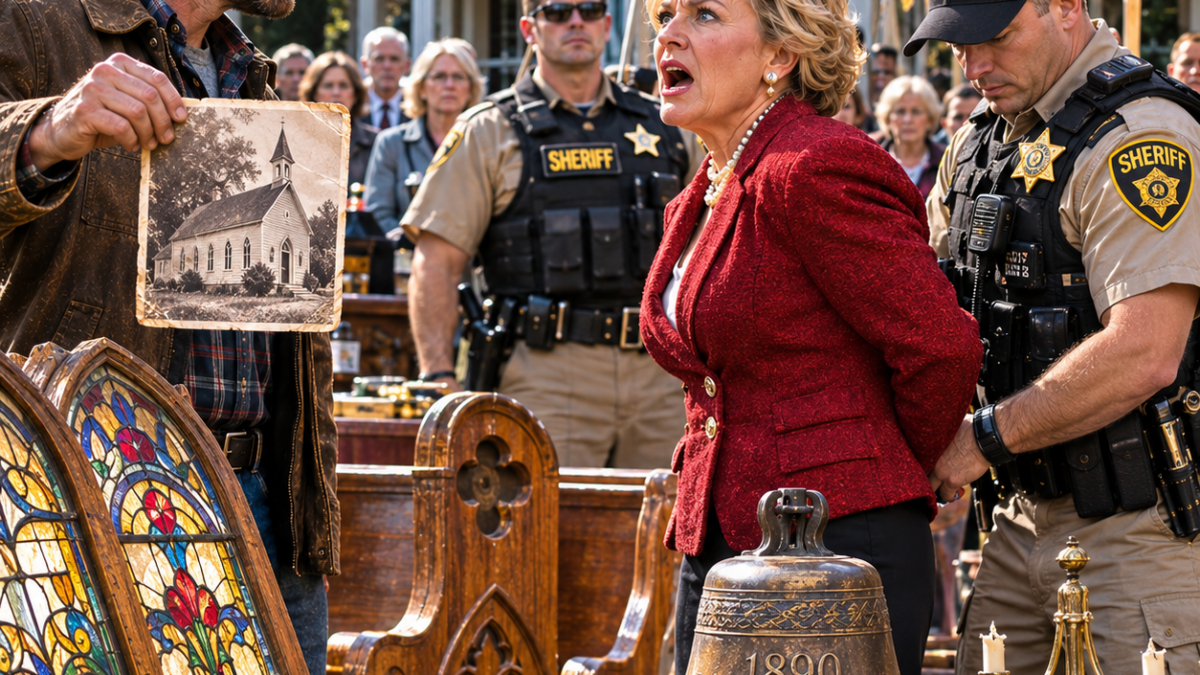
PART2:
Whoever removed the bell had used lifting equipment.
Back downstairs, sawdust covered the floor.
Long scrape marks led from the altar toward the side entrance.
Lead fragments from the stained-glass frames glittered near the wall.
Someone had pried the windows out.
Not carefully.
Fast.
I stood in the center aisle and felt the air leave my chest.
This was not a collection of antiques to me.
One pew had a shallow knife mark under the seat where my grandfather carved his initials at fourteen.
The organ had a stop knob I turned myself on a lathe because the original vanished decades ago.
One stained-glass panel contained an amber piece I drove to Ohio to find after hail damage.
Everywhere I looked, absence had a memory attached to it.
Then I heard gravel outside.
A vehicle stopped.
I walked toward the door.
Karen Whitford climbed the steps.
President of Bell Ridge Estates HOA.
Camel coat.
Pearls.
Leather folder.
Two private security guards behind her.
Karen was fifty-seven, polished, articulate, and always slightly too calm when other people were upset.
Bell Ridge Estates sat beyond my eastern property line.
A gated subdivision built decades after Holloway Chapel.
My land was not inside it.
Never had been.
Karen knew that.
Three years earlier, she had spent months trying to convince me to turn the chapel into a commercial venue.
Weddings.
Holiday dinners.
HOA galas.
Corporate retreats.
Bell Ridge would manage bookings.
I would receive what she called an “owner participation share.”
I had said no.
Then no again.
Then finally:
“Karen, the chapel is not for rent.”
She never forgot it.
Now she stood on my steps looking into an empty sanctuary.
“Graham.”
“What happened here?”
Her expression barely changed.
“The association conducted an emergency heritage-safety removal.”
I stared at her.
“A what?”
“The structure presented a hazard.”
“To who?”
“To the surrounding community.”
“You entered my chapel?”
“Our contractor acted under emergency authority.”
“What authority?”
She opened the folder.
Handed me a notice.
BELL RIDGE ESTATES HOMEOWNERS ASSOCIATION.
EMERGENCY HERITAGE HAZARD REMOVAL.
Below it:
County building department case number.
List of alleged hazards.
Unsecured stained glass.
Deteriorated seating.
Unsafe antique fixtures.
Unstable bell assembly.
Then:
EMERGENCY REMOVAL COSTS DUE FROM OWNER: $18,400.
I read the last line twice.
“You stole everything in my chapel and sent me a bill?”
Karen’s smile thinned.
“The items were removed for safety.”
“Where are they?”
“They’ve been processed.”
“Processed where?”
“That information is not relevant to your compliance obligation.”
I took one step closer.
Both guards shifted.
I stopped.
Not because I was afraid of them.
Because I suddenly understood how badly Karen wanted me to lose my temper.
“Holloway Chapel isn’t part of Bell Ridge.”
“The property affects Bell Ridge.”
“That doesn’t answer the question.”
“Our authority extends to hazards threatening neighboring residents.”
“No.”
“You should consult your deed.”
“I’ve owned this property eleven years.”
“And apparently neglected it for eleven years.”
My hands were shaking now.
I hated that she could see it.
Karen pointed toward the plywood.
“You should be grateful the association acted before somebody was injured.”
“Where are my windows?”
“Processed.”
“My bell?”
“Processed.”
“My pews?”
“Processed.”
She said it as if repeating the word enough times could erase ownership.
I pulled out my phone.
Called the county sheriff.
Karen’s eyes changed.
Only slightly.
But I saw it.
“Graham, there is no reason to turn a civil compliance matter into theater.”
“I’m reporting missing property.”
“It isn’t missing.”
“Then tell me where it is.”
She didn’t.
While we waited for deputies, I photographed everything.
Every gouge.
Every cut.
Every screw.
The replacement hinges.
The plywood.
The empty bell yoke.
Karen kept talking behind me about community safety and liability.
I ignored her.
Near the altar, something white caught my eye beneath fresh sawdust.
I crouched.
A torn paper tag.
Heavy cream stock.
Printed number.
No description.
Just:
LOT 47.
I had spent enough years around restorations and salvage houses to recognize an inventory tag.
I took an evidence envelope from my truck.
Restoration work teaches you to preserve fragments.
I slipped the tag inside.
Then I looked toward the east wall.
And noticed something else.
The donor plaques were gone.
Six brass plates.
Names of the families who helped fund the original chapel.
No structural purpose.
No conceivable safety issue.
Someone had unscrewed them carefully.
I turned toward Karen.
“No safety inspector removes names from a wall.”
She looked at me.
For the first time, she had nothing immediate to say.
Detective Reed Callahan arrived within the hour.
Broad shoulders.
Gray hair starting at the temples.
Notebook in his hand.
An actual paper notebook.
He walked the chapel slowly.
Didn’t talk much.
Photographed the scrape marks.
The new hinges.
Window openings.
Tower.
He examined the lot tag.
Then asked:
“Do you have records showing what was here?”
“Yes.”
“What kind?”
“Everything.”
That was one advantage of being a restoration professional.
I documented obsessively.
Photographs.
Invoices.
Condition reports.
Appraisals.
Repair records.
Measurements.
Reed nodded.
“That helps.”
Karen handed him her emergency notice.
“This work was lawfully authorized.”
Reed read it.
“By the county?”
“Yes.”
He photographed the case number.
Karen said:
“Bell Ridge acted only after the owner failed to correct known hazards.”
Reed looked at me.
I said:
“No county inspector has ever ordered removal of anything from this building.”
Karen smiled.
“Then perhaps the owner was not properly informed.”
Reed closed his notebook.
“Tomorrow morning I’m going to verify the order.”
Karen said:
“Please do.”
She sounded completely confident.
That almost made me doubt myself.
Almost.
My attorney, Fay Kessler, met me at the county building office the next morning.
Fay was fifty-two.
Sharp eyes.
Dark hair cut short.
She read contracts the way other people watched crime shows.
We gave the clerk the address.
Nothing.
No active violation.
No emergency inspection.
No hazard order.
No complaint.
Fay slid Karen’s notice across the counter.
“Can you check this case number?”
The clerk typed.
Paused.
Then frowned.
“That can’t be right.”
“What?”
She turned the monitor.
The number belonged to a collapsed detached garage.
Other side of the county.
Case closed two years earlier.
I stared.
“So this number has nothing to do with Holloway Chapel?”
“Nothing.”
Fay looked at me.
Someone had copied a real county case number onto a fake document.
That changed everything.
We spent the next hour building the first ownership packet.
My deed.
Survey.
Restoration invoices.
Insurance appraisals.
Photographs from the week before I left.
There were eighteen pews clearly visible.
Six windows.
Organ.
Pulpit.
Bell.
Plaques.
Fay sent copies to Reed before lunch.
By evening, Karen had already attacked publicly.
The Bell Ridge Community Newsletter carried a front-page article:
SAFETY CONCERNS AT NEIGHBORING HISTORIC STRUCTURE.
No name.
No direct accusation.
But everyone knew.
It described an owner refusing to address deteriorating conditions.
Said the HOA had taken “responsible preventative action.”
Within two days, neighbors who had waved at me for years started looking away.
A retired couple who attended every Christmas organ recital stopped answering my calls.
Karen had transformed me from the victim into the reckless outsider threatening everyone’s safety.
Then the HOA sent me an offer.
My $18,400 “removal fee” would be waived if I signed a release.
The release said I surrendered all claims relating to items “relocated or disposed of” during the emergency action.
I pushed it across Fay’s desk.
“She wants me to sign away the property.”
“Yes.”
“After taking it.”
“Yes.”
“She calls that a settlement?”
“No.”
Fay’s face hardened.
“She calls that cleaning up the paper trail.”
We refused.
That night, Fay called me at 11:53.
“I found something.”
“What?”
“Read page two of the removal notice.”
“I did.”
“No. Read the property disposition language.”
I found my copy.
She directed me to one sentence.
CONTENTS RELEASED FOR SECONDARY DISPOSITION.
I read it twice.
“Secondary disposition.”
“Yes.”
“If this was hazardous debris, they’d dispose of it.”
“Correct.”
“Secondary disposition means resale.”
“Or transfer.”
I looked at the LOT 47 tag on my desk.
The two pieces connected.
This had been planned.
Someone didn’t clear my chapel.
They inventoried it.
The next morning, I studied the removal like a restoration contractor would.
Eighteen pews.
Each nearly twelve feet.
Pump organ.
Pulpit.
Six windows.
Six-hundred-pound bell.
You need crews.
Crates.
Blankets.
Lifts.
Trucks.
It could not happen invisibly.
There was only one public route from the chapel toward town.
That road passed Dale Pickett’s farm-equipment repair shop.
Dale had exterior cameras.
I drove there.
Explained.
He didn’t hesitate.
“Come inside.”
We reviewed eight days.
Three box trucks appeared on two consecutive mornings.
Headed toward the chapel.
Returned afternoons.
Riding lower.
Same logo on all three:
RIDGEWAY ARCHITECTURAL SALVAGE.
Reed collected a copy directly from Dale.
I drove to Ridgeway.
Forty minutes south.
The yard held old doors.
Mantels.
Church windows.
Columns.
Stone.
Dustin Mallory, the foreman, met me.
Arms folded.
“What can I do for you?”
“You removed property from Holloway Chapel.”
His expression changed.
“We completed an authorized job.”
“Authorized by who?”
“Our client.”
“Karen Whitford?”
“I’m not discussing clients.”
I placed three things on his truck hood.
My deed.
A photograph of the chapel interior nine days earlier.
Sheriff’s case number.
Dustin looked.
Then looked again.
His eyes stayed on the stained-glass windows.
I showed him the empty frames.
“You were there?”
He hesitated.
Then:
“Yes.”
“You watched your crew pry those out?”
“We were told they were being removed permanently.”
“Did it look like hazardous debris?”
His shoulders dropped.
“No.”
“What did it look like?”
“A move.”
That word mattered.
He said a woman from the association walked his crew through the chapel with a clipboard.
Every item tagged.
Wrapped.
Numbered.
Loaded according to an inventory.
“Did you keep a copy?”
“No.”
“Why?”
“Client took them.”
“Where did everything go?”
“I’m not authorized to tell you.”
By the time I got home, an email from Bell Ridge’s lawyer was waiting.
Stop contacting association contractors.
Further interference would result in litigation.
I forwarded it to Fay and Reed.
Didn’t reply.
At 9:40 that night, Dustin called Reed.
He had gone back through his office files.
Found the bill of lading.
And something bothered him.
Every item from my chapel was listed as:
PROPERTY OF WHITFORD FAMILY ESTATE.
I spent the next morning searching regional estate-sale listings.
I didn’t need all morning.
Forty-seven minutes.
WHITFORD ESTATE COLLECTION.
Historic architectural furnishings.
Fine antiques.
Saturday.
Whitford House.
Managed by Hearth & Hollow Estate Liquidators.
I opened the catalog.
Pump organ.
Mine.
Eighteen pews lined through a grand parlor.
Mine.
Stained glass mounted against white walls.
Mine.
The listing described everything as furnishings collected by a distinguished local family over generations.
Then I reached:
LOT 47.
Bronze estate bell.
I stopped breathing.
There it was.
My 1890 chapel bell.
Polished.
Sitting beneath studio lighting.
Description:
ORIGINAL COUNTRY-MANOR ESTATE BELL.
Provenance certified by:
Karen Whitford.
I leaned back.
For three years, I thought Karen hated the chapel because I refused her venue plan.
I had assumed stripping it was punishment.
It wasn’t.
She harvested it.
Everything she could remove and sell.
The torn tag under the altar made perfect sense.
LOT 47.
Not debris.
Merchandise.
I started building a comparison chart.
Catalog image beside archival image.
Pew three:
Hairline armrest crack repaired with walnut butterfly.
Match.
Organ:
Replacement stop knob I turned myself.
Match.
Window two:
Amber pane sourced from Ohio.
Match.
Pulpit:
Reinforcement bracket under base.
Match.
Twenty-nine separate items.
Twenty-nine matches.
Fay reviewed the values.
Estimated sale range:
$312,000 to $460,000.
That was when I stopped thinking of Karen as reckless.
She was organized.
An estate sale could scatter everything in hours.
One pew to Virginia.
A window to New York.
Organ to Maryland.
Bell onto a freight truck headed who knew where.
Recovery could take years.
We sent everything to Reed.
Fay prepared emergency court filings.
I called Hearth & Hollow.
Miriam Slade answered.
Professional.
Fast.
I explained that the featured Whitford collection contained stolen property.
She went quiet.
Then said:
“We have complete consignment documentation.”
“From Karen Whitford?”
“Yes.”
“She doesn’t own my chapel.”
“I cannot cancel a sale because of a phone accusation.”
“Somebody is about to buy my six-hundred-pound bell.”
“We have buyers who have already placed deposits.”
“Then you should want to know whether your seller owns it.”
That afternoon Fay and I met Miriam in person.
Restored brick storefront.
Auction posters.
Furniture polish smell.
I laid out everything.
Deed.
Photographs.
Comparison chart.
Sheriff case number.
Miriam studied the matching marks.
She was no fool.
She could see it.
But she was trapped.
“Mr. Holloway, these comparisons are compelling.”
“Then stop the sale.”
“I need legal authority.”
Fay said:
“You now have notice of a disputed title.”
Miriam’s jaw tightened.
“Canceling this sale could expose us to six figures in claims.”
The door opened.
Karen walked in.
No knock.
She must have been nearby.
She looked at me.
Then Fay.
Then Miriam.
“This is exactly what I warned you about.”
Miriam asked:
“What?”
Karen pointed at me.
“He is trying to sabotage the Whitford estate settlement because of a personal dispute.”
“My chapel furniture is in your catalog.”
“It was lawfully transferred.”
“Show me.”
Karen smiled.
Reached into her handbag.
Pulled out an agreement.
TRANSFER AND RELEASE OF HISTORIC FIXTURES.
Three pages.
At the bottom:
Graham Holloway.
My signature.
Except it wasn’t.
It was close.
Someone had practiced.
But I never closed the loop in the H of Holloway.
This one did.
My G always cut sharply downward.
This one was rounded.
I looked at Miriam.
“I never signed this.”
Karen said:
“You did.”
“No.”
“You may not remember.”
“I remember signing my name.”
Fay immediately asked Miriam to preserve the original.
No copies destroyed.
No items released.
Karen called it harassment.
Miriam locked the document in her safe.
But without a warrant or court order, she still refused to cancel Saturday.
I left angry.
Fay said:
“Good.”
“What?”
“Stay angry.”
“That sounds unhealthy.”
“Use it.”
So I did.
I drove to Emmett Rollins.
Sixty-seven.
Antique specialist.
Five decades working with nineteenth-century church furniture.
He had appraised my organ for insurance eight years earlier.
Emmett laid the catalog photos across his dining table.
Magnifying glass.
Old appraisal file.
Within twenty minutes:
Organ bellows leather matched.
Pulpit reinforcement matched.
Internal builder’s mark matched.
Then the windows.
Late that night, I spotted the repair on window four.
In 2018, after a storm cracked the frame, I redesigned several lead joints.
Distinctive pattern.
Hand drawn.
No other window would carry exactly that repair.
Emmett added it.
Signed a formal expert opinion.
That pushed Reed over the line from cautious property dispute to criminal investigation.
Fake county order.
Forged signature.
Misled contractor.
Identifiable stolen property.
He started preparing a search-and-seizure warrant.
Karen sped up.
Friday morning, the catalog changed.
LOT 47:
PRIVATE OFFER PENDING.
The bronze bell had an out-of-state buyer.
Freight pickup planned.
If that sale closed, it could be on a truck before Saturday morning.
I sent Reed everything.
Foundry mark.
Casting inscription.
Repair history.
2015 shipping invoice from a Pennsylvania bell specialist.
High-resolution photographs.
Reed called Miriam directly.
Formal request:
Hold the bell.
Hold all identified chapel lots.
Do not release pending investigation.
Miriam agreed.
Karen called her three times that day demanding the private sale proceed.
Threatened breach-of-contract litigation.
Lost revenue.
Business interference.
That frightened Miriam.
But not in the way Karen expected.
It made her start reviewing her own file.
Meanwhile, Holloway Chapel was getting worse.
Removing the windows had damaged structural timber around the openings.
Several support members were cut.
Not naturally cracked.
Cut.
The plywood had no proper weather seal.
Rain was coming.
If water entered the old stone walls, the restoration cost could explode.
An engineer estimated damage already above $600,000.
I had two emergencies.
Recover the pieces.
Save the building.
So I did both.
Specialist shoring crew.
Temporary steel supports.
Weatherproof membranes.
Every cut photographed before being covered.
Every fragment bagged and labeled.
I stayed until two in the morning.
The next day, Karen’s newsletter accused me of damaging the chapel myself to inflate an insurance claim.
That accusation lasted less than twenty-four hours.
The engineer documented fresh saw cuts.
Unweathered timber.
Blade marks consistent with professional demolition tools.
Fay sent the report to the HOA board with a defamation warning.
Then Dustin Mallory came to the sheriff’s office with his attorney.
GPS logs.
Crew records.
Written instructions.
Every page carrying Bell Ridge’s logo.
Every work order bearing Karen’s approval.
Reed found something we hadn’t expected.
Other removal orders.
Seven.
All within Bell Ridge.
Previous eighteen months.
Different homes.
Antique doors.
Brass light fixtures.
Cabinetry.
Marble mantel.
Same disposition form.
Same language.
Reed cross-referenced addresses.
Every homeowner had been enrolled in the HOA’s Vacation Property Watch Program.
Karen’s signature initiative.
Residents submitted travel dates.
HOA patrols would monitor the homes.
It sounded helpful.
It also created a database showing exactly which houses were empty.
I remembered Beverly Stroud.
Seventy-four.
Two years earlier, she complained about antique oak entry doors disappearing while she visited family in Arizona.
I knocked on her door.
She listened.
Then told me Karen had claimed the doors were warped and violated maintenance standards.
Cheap replacements were installed.
Beverly protested.
Then eventually accepted it.
Why wouldn’t she?
HOA paperwork looked official.
I showed her the form used at my chapel.
Her face went white.
“Same one.”
Harold Bishop had another story.
While visiting his daughter, antique bronze fixtures and a nineteenth-century walnut cabinet disappeared.
HOA called them code violations.
Reed found the cabinet.
Sold eleven months earlier.
Estate sale.
$9,000.
Suddenly my chapel was not the case.
It was the case that exposed the pattern.
Operations manager Vernon Hale controlled the vacation-watch database.
Police interviewed him.
He lasted less than thirty minutes.
He admitted regularly giving Karen the absence list.
He claimed she told him it was for coordinating patrols.
He said he never knew property was being removed.
Maybe true.
Maybe not.
Investigators would decide.
Then Reed asked:
“How did Karen know Graham was gone?”
My chapel was not in the HOA program.
The answer embarrassed me.
My own restoration business website.
I posted consulting schedules so clients could see when I was unavailable.
The courthouse job dates were public for two months.
Karen didn’t need secret information for me.
I gave it to the internet.
That night, Miriam called.
Her voice had changed completely.
“I found a problem.”
“What?”
“The Whitford estate itself.”
Fay and I met her at probate court the next morning.
Dorothea Whitford owned Whitford House.
Karen’s aunt by marriage.
Ninety-one when she died fourteen months earlier.
No children.
Will properly filed.
House and all contents left to:
BELL RIDGE ARCHITECTURAL PRESERVATION TRUST.
A nonprofit.
Court-appointed executor:
Adeline Pruitt.
Karen’s name appeared once.
She was allowed to watch the house while probate proceeded.
Check the furnace.
Collect mail.
Report roof problems.
That was it.
She didn’t inherit the mansion.
Didn’t own the contents.
Couldn’t hire an estate-sale company.
Fay called Adeline from the courthouse steps.
By noon, Adeline was with Miriam.
Karen’s supposed authority depended on an old power of attorney Dorothea had signed years before during a hospital stay.
That document terminated when Dorothea died.
Attached pages supposedly extended Karen’s right to liquidate estate property.
Adeline examined them.
Wrong paper stock.
Retired notary.
Signature inconsistent with Dorothea’s known writing.
Then the whole plan became clear.
Whitford House was not just where Karen stored stolen property.
It was how she gave stolen property a history.
A grand Victorian mansion.
Respected family name.
Real antiques mixed with stolen ones.
Buyers would assume a pew, window, cabinet, or bell came from generations of Whitford ownership.
The house laundered provenance.
Adeline ordered all transactions stopped.
Karen responded by claiming the chapel pieces were not estate property.
They were her personal property.
She would sell those directly.
At that point, Miriam was done protecting the sale.
She turned over her full file.
Contracts.
Emails.
Consignment forms.
Buyer lists.
Catalog photographs.
Karen was listed as consignor for every chapel item.
By Friday night, Reed had enough to seek the warrant.
I helped with one thing.
Identification.
A mansion packed with antiques is a terrible place to search if deputies don’t know what belongs to whom.
So I made an evidence guide.
One page per chapel item.
Archival photo.
Dimensions.
Repair marks.
Carving details.
Hardware.
Lot number.
Bell foundry mark.
Window lead pattern.
Pew repairs.
Organ maker’s stamp.
Any deputy could look at a piece and identify it in seconds.
Saturday morning, Whitford House opened at eight.
Gold-lettered sign:
WHITFORD ESTATE SALE
EVERYTHING MUST GO.
Cars lined the road.
Dealers from three states.
Collectors.
Restoration firms.
Freight buyers.
At nine, the mansion was full.
Karen stood in the center of it all.
Cream silk blouse.
Pearls.
Perfect smile.
The gracious heiress.
The chapel pieces had pride of place.
Eighteen pews through the ballroom.
Freshly waxed.
Pump organ under a crystal chandelier.
Six stained-glass windows mounted on illuminated easels.
My donor plaques had been removed.
Price tags replaced them.
And at the foot of the staircase:
Lot 47.
The bronze bell.
Spotlight.
Carved pedestal.
Crown jewel.
I walked in at 9:15.
Emmett on one side.
Adeline on the other.
Leather portfolio in my hand.
Miriam met us at registration.
I gave her the identification list.
“Nothing leaves.”
She nodded.
“I understand.”
Karen saw me.
Her smile vanished.
She snapped at two private security guards.
“Remove him.”
They approached.
I didn’t move.
I said loudly enough for nearby buyers:
“I am the documented owner of items in this sale that are part of an active sheriff’s investigation.”
The guards slowed.
Karen raised her voice.
“This man is a disgruntled neighbor attempting to disrupt a lawful family estate.”
Adeline stepped forward.
Calm.
Precise.
“My name is Adeline Pruitt.”
The room began quieting.
“I am the court-appointed executor of Dorothea Whitford’s estate.”
Karen’s face changed.
Adeline continued.
“Karen Whitford does not own this residence.”
Silence.
“She does not own the estate contents.”
More silence.
“And no sale occurring here today has been authorized by the estate.”
You could physically feel the room change.
A Virginia dealer put down a candelabra.
Someone asked about returning deposits.
People stepped away from the pews.
Karen shouted:
“Items marked as my personal property remain available.”
Nobody moved toward them.
Then I saw activity near the staircase.
Two workers had put the bell on a furniture dolly.
They were pushing it toward a side corridor.
Fast.
A van was running outside the service entrance.
I texted Reed:
BELL MOVING TO REAR SERVICE EXIT.
The deputies were already on the property.
Reed had positioned them before the gates opened.
Within seconds, two deputies intercepted the dolly.
The bell stopped.
I heard Karen yell:
“What are you doing?”
Then Reed walked through the main entrance.
Warrant in hand.
Four deputies behind him.
“County sheriff’s office.”
Every conversation stopped.
“We are executing a court-authorized search and seizure warrant for suspected stolen property.”
He went first to the bell.
I opened my guide.
Foundry mark on shoulder.
Matched.
Small chisel scratch near the crown.
Matched.
Dustin Mallory, there with the investigative team, identified it as the same bell his crew removed from Holloway Chapel.
Miriam produced the consignment sheet.
Karen Whitford.
Seller.
Lot 47.
Reed closed the folder.
Then walked toward Karen.
She tried to speak before he reached her.
“This is outrageous.”
“Mrs. Whitford.”
“I am HOA president.”
“I know.”
“These items were removed under association authority.”
Reed looked at her.
“You’re under arrest on suspicion of grand theft, forgery, fraudulent use of documents, and related offenses.”
Karen stopped.
Just stopped.
The room held dozens of buyers.
Auction staff.
Dealers.
Neighbors.
Adeline.
Me.
Her face changed in a way I had never seen before.
Not anger.
Calculation.
Then she turned.
Walked quickly toward the side hall.
Two deputies stepped in front of her.
“No.”
She said:
“Get out of my way.”
They didn’t.
One took her right arm.
The other left.
Handcuffs.
Karen protested the entire time.
“This is private property.”
It wasn’t hers.
“I’m HOA president.”
Not relevant.
“I acted to protect the community.”
The evidence said otherwise.
As they turned her toward the front door, I stepped closer.
Not too close.
I didn’t smile.
Didn’t gloat.
I looked at her.
“You called it a cleanup.”
She stared at me.
“You priced every piece.”
Then I nodded toward Reed.
“Explain the price tags to him.”
The sale shut down.
Deputies began tagging chapel property.
Then Reed told Karen something else.
The warrant and investigation did not stop with Holloway Chapel.
Beverly Stroud.
Harold Bishop.
Five other Bell Ridge homes.
Earlier estate-sale records.
Vacation-watch addresses.
Karen’s expression finally collapsed.
She understood then.
Returning my bell would not end this.
Whitford House was not just a bad sale.
It was the center of something larger.
As deputies led her outside, Adeline touched my arm.
“Graham.”
“What?”
“Come to the library.”
Whitford House library smelled like old leather and wood smoke that had soaked into walls decades earlier.
Adeline opened Dorothea’s will.
“There’s something you should see.”
The Preservation Trust wasn’t supposed simply to inherit the mansion.
Dorothea wanted Whitford House converted into a regional historic-restoration center.
Craft training.
Conservation work.
Historic-building rescue.
A place where damaged architectural pieces could be repaired instead of discarded.
For fourteen months, the trust had lacked a defining first project.
Adeline looked at me.
“I think Dorothea just found one.”
“Holloway Chapel?”
“Yes.”
For the first time since I came home to plywood windows, I didn’t know what to say.
Real justice moved slowly after that.
Crime scenes have to be documented.
Ownership confirmed.
Evidence released properly.
Property returned through process.
Not simply loaded into my truck because everyone agreed it was mine.
The bell survived intact.
Two stained-glass windows had cracked panes.
Several pews were gouged.
Organ bellows damaged.
Pulpit scratched.
Donor plaques recovered from another crate.
The building damage was worse.
Cut framing.
Damaged masonry.
Altered doors.
But nothing was beyond restoration.
Karen was formally charged on the counts prosecutors believed they could support.
Other homeowners filed civil claims.
Beverly.
Harold.
Five more.
Investigators followed money from previous sales.
Vernon Hale was suspended while authorities reviewed his role.
Bell Ridge called an emergency meeting.
Standing room only.
The board removed Karen unanimously.
They hired an independent auditor.
Residents who had avoided me began coming to the chapel.
One by one.
“I’m sorry.”
“I believed the newsletter.”
“I thought the building really was unsafe.”
“I thought you were suing the HOA out of spite.”
I didn’t need speeches.
Most people had been shown official-looking paperwork.
That was Karen’s greatest weapon.
Not security guards.
Not legal threats.
Paper.
People assume a letterhead means someone checked.
A seal means authority.
A case number means government.
A signature means consent.
Unless somebody verifies.
Karen’s attorney later offered a civil settlement.
Substantial cash.
Drop my personal claims.
Move on.
I said no.
Fay asked:
“You sure?”
“Yes.”
“Money may be easier.”
“I don’t want easier.”
“What do you want?”
I looked around the empty chapel.
“Everything identifiable returned.”
“Yes.”
“Every damaged part assessed.”
“Yes.”
“Every beam.”
“Yes.”
“Every window.”
“Yes.”
“Every repair documented.”
Fay nodded.
“Then we keep going.”
The Preservation Trust made its own offer.
Use Whitford House carriage house as a restoration workshop.
No rent.
Independent conservators.
Glass specialists.
Organ builder.
Apprentices.
The same mansion Karen used to sell my history would become the place where we rebuilt it.
I accepted.
That winter, I practically lived in the carriage house.
Window one.
Disassemble.
Document.
Clean.
Replace fractured glass only where necessary.
Preserve original lead wherever possible.
Window two.
Same.
Pews.
Remove wax applied for the sale.
Repair gouges.
Reattach donor plaques.
Organ.
Rebuild bellows.
Replace damaged leather.
Retune reeds.
Emmett came every Thursday.
Coffee in one hand.
Opinions in the other.
“Your shellac is too glossy.”
“It’s not done.”
“Good, because it’s too glossy.”
“Thank you, Emmett.”
“Anytime.”
The trust’s first apprentice group watched.
Asked questions.
Young carpenters.
Glass workers.
Preservation students.
At first, I hated people standing over my shoulder.
Then I realized Dorothea had wanted exactly that.
History saved by teaching people how to save it.
Karen had tried to turn old things into money.
Dorothea had tried to turn them into knowledge.
One of those legacies survived.
The following spring, Holloway Chapel reopened.
Evening concert.
Not large.
No gala.
No VIP tickets.
Neighbors.
Preservation volunteers.
Bell Ridge residents.
The eighteen pews stood where they belonged.
Brass donor plaques back on the walls.
Six windows reinstalled.
Amber.
Blue.
Red.
Late light moving through them across the stone floor.
The pump organ sat at the front.
The bronze bell hung in the tower.
Inspected.
Certified.
Secure.
At exactly seven, I pulled the rope.
The bell rang.
Deep.
Heavy.
Real.
People stopped on the road below.
Inside the chapel, nobody spoke.
The tone moved through the timber.
Through the windows.
Through the stone my great-great-grandfather helped raise.
I looked toward the fourth stained-glass window.
The repaired lead joint was still visible if you knew where to look.
I kept it that way.
Restoration should not erase everything that happened.
Sometimes the scar belongs in the record.
The criminal investigation continued beyond the reopening.
Karen’s case involved more than my property.
The vacation-watch removals made prosecution more complicated and more serious.
Some charges moved forward.
Some civil issues separated.
Several earlier buyers voluntarily returned items once they learned provenance was false.
Others required legal claims.
Insurance companies became involved.
Hearth & Hollow cooperated.
Miriam changed her company policies.
Future consignments involving large historic collections required stronger ownership documentation.
No one wanted another Whitford sale.
Vernon maintained that he had no idea Karen was using travel information to time removals.
Investigators evaluated that.
I stayed out of conclusions I couldn’t prove.
That became important.
People in Bell Ridge wanted simple villains.
Karen was already enough.
They didn’t need me inventing more.
The board audit revealed years of weak oversight.
Karen had accumulated authority because other people found oversight annoying.
She handled security.
Property watch.
Vendor relationships.
Violation notices.
Historic-property concerns.
Board members trusted her because she handled things.
That phrase came up constantly:
Karen handled it.
Karen knew.
Karen took care of it.
Eventually nobody asked what “it” meant.
That is how power grows in small organizations.
Not always because somebody seizes it.
Sometimes because everyone else is relieved not to do the boring work.
Review invoices.
Read contracts.
Check ownership.
Verify county notices.
Ask why a contractor is removing an antique cabinet from an empty house.
Karen filled the vacuum.
Then exploited it.
Bell Ridge changed.
Vacation-watch data became restricted.
Two-person review.
No property entry without documented consent or actual legal authority.
No removals based solely on HOA forms.
Vendor actions logged.
Homeowners notified directly.
Records accessible.
Boring safeguards.
Exactly what had been missing.
Beverly Stroud got her oak doors back.
They had been installed in a restaurant in another county.
The restaurant owner had bought them in good faith.
Once shown evidence, he agreed to return them after compensation was sorted through insurers.
Harold Bishop recovered his walnut cabinet.
His bronze fixtures were harder.
Two had been resold.
One lost.
He eventually received compensation.
When the cabinet came home, he called me.
“Graham.”
“Yes?”
“It smells wrong.”
“What?”
“My cabinet.”
“How can furniture smell wrong?”
“Restaurant candles.”
I laughed.
He didn’t.
Then he did.
People heal strangely.
Some through court orders.
Some through jokes.
Some through putting an old cabinet back in the same corner and refusing to discuss it anymore.
I kept the torn LOT 47 tag.
Reed returned it after the case no longer needed the original.
It sits in a frame in my workshop.
Visitors ask what it means.
I tell them:
“That number found my chapel.”
Sounds dramatic.
But it’s true.
Without it, we still might have found Ridgeway.
Maybe.
Still might have found the estate sale.
Eventually.
But that tag told me immediately:
This was cataloged.
Someone had already given my history a price.
That changed how I searched.
Years later, I spoke to a preservation class at Whitford House.
The trust had become what Dorothea wanted.
Workshops.
Apprenticeships.
Conservation labs.
Small grants for rural historic structures.
Holloway Chapel became its first major case study.
The instructor asked me:
“What was the most important piece of evidence?”
Students expected:
Forged signature.
Fake county notice.
GPS logs.
Estate catalog.
I said:
“The first thing was noticing what didn’t fit.”
They looked disappointed.
So I explained.
A safety cleanup doesn’t remove donor plaques.
A demolition haul doesn’t individually tag pews.
Hazardous debris doesn’t become Lot 47.
A county order doesn’t use a case number from an unrelated garage.
A lawful estate sale doesn’t require fake provenance.
Evidence often appears because something ordinary doesn’t behave the way it should.
That lesson came from restoration work.
Historic buildings tell you when somebody altered them.
Tool marks.
Wrong nails.
Different mortar.
Fresh cuts.
Paperwork does the same.
Different fonts.
Wrong dates.
Inactive notaries.
Signatures that don’t move naturally.
Karen’s scheme looked official from twenty feet away.
Up close, everything was wrong.
One student asked:
“Why didn’t you just take your bell back at the estate sale?”
“Because it was evidence.”
“But it was yours.”
“Yes.”
“So?”
“So ownership doesn’t make every response smart.”
I had learned that too.
I could have stormed Whitford House.
Grabbed something.
Started a fight.
Gotten arrested myself.
Then Karen’s story becomes:
Unstable chapel owner attacks legitimate estate sale.
Instead, we brought records.
Experts.
Executor.
Warrant.
Police.
And when the handcuffs came out, they went on the person whose actions the evidence supported.
That difference mattered.
Fay reminded me frequently.
“You’re welcome.”
“For what?”
“For preventing you from becoming an idiot.”
“I wasn’t going to.”
“You absolutely were.”
Possibly true.
The hardest part came after everything looked fixed.
When the chapel reopened, people assumed I felt whole again.
I didn’t.
For months, I still noticed every repaired scar.
A tiny color mismatch in one glass pane.
A gouge filled in pew seven.
A new splice in the organ bellows.
Replacement timber around one window head.
The bell itself survived, but its mounting bore tool marks from the removal.
Nothing was exactly as it had been.
That bothered me.
Emmett noticed.
One Thursday he said:
“You keep staring at the damage.”
“It’s repaired.”
“Not what I said.”
I looked at him.
He sat in pew three.
“You wanted restoration to erase the event.”
“I wanted my chapel back.”
“You have it.”
“Not exactly.”
“No.”
He ran his hand across the old oak.
“You never do.”
That sounded cruel.
Then he continued:
“Every building we save becomes the record of what happened to it.”
I knew that academically.
Harder when the building is yours.
He pointed toward the stained glass.
“The new repair doesn’t make the old glass less old.”
Then the bell.
“That bell came down.”
“Yes.”
“Almost got sold.”
“Yes.”
“Went back up.”
“Yes.”
“That’s history too.”
I hated that he was right.
Eventually I stopped trying to make every scar invisible.
We preserved records.
Photographs.
Damage maps.
Repairs.
Future conservators would know.
Holloway Chapel was built in 1890.
Altered over generations.
Restored.
Stripped unlawfully.
Recovered.
Restored again.
That became part of the building’s story.
One December evening, about two years later, Bell Ridge invited me to speak at its holiday gathering.
I almost refused.
Then Beverly called.
“You’re going.”
“No.”
“Yes.”
“Why?”
“Because I had to sit through twelve years of Karen’s speeches.”
“That is not my fault.”
“It can become your responsibility.”
I went.
The clubhouse was full.
New board.
Different atmosphere.
They had installed a display about the recovered household antiques.
Not triumphal.
Simple.
Names.
Objects.
Dates.
What happened.
Lessons learned.
No photograph of Karen.
I appreciated that.
This was not about preserving her notoriety.
Beverly spoke.
Harold.
Then me.
I stood at the microphone.
“I don’t have a long speech.”
Someone said:
“Thank God.”
Laughter.
I continued.
“Your HOA did not steal my chapel.”
People quieted.
“Karen did.”
I looked around.
“That distinction matters.”
Some people shifted.
“The association failed to stop her.”
Different issue.
“Board members trusted too much. Residents believed notices without verification. Contractors accepted paperwork that looked official.”
I paused.
“But most people in this room did not know.”
Beverly nodded.
I continued.
“So if you want to prevent it happening again, don’t spend your energy pretending every neighbor was part of the crime.”
I looked at the new board.
“Build systems where one person cannot hide behind the organization.”
That was it.
Afterward, a younger resident approached.
“I’m on the vacation-watch committee now.”
I laughed.
“You kept it?”
“Changed it.”
“How?”
“No one person can access the full schedule.”
“Good.”
“Patrol sees only current assignment.”
“Good.”
“Any maintenance entry requires direct owner confirmation.”
“Better.”
She smiled.
“We learned.”
That mattered.
I never wanted Bell Ridge destroyed.
I wanted Karen stopped.
There’s a difference.
Years later, Whitford House became one of the best preservation training sites in the region.
The carriage house where I repaired my windows gained proper workbenches.
Glass racks.
Ventilation.
Woodworking equipment.
Dorothea’s portrait hangs in the main library.
Under it:
PRESERVE WHAT OTHERS WOULD DISCARD.
I don’t know whether she actually said that.
Maybe the trust wrote it.
Good line anyway.
Every spring, apprentices visit Holloway Chapel.
I show them the donor plaques.
The organ.
The window repairs.
The bell.
Then I show them the replacement steel hinges Karen’s crew installed.
I kept one.
Ugly hardware-store hinge.
Mounted on a board.
Beside it, one original hand-forged hinge after restoration.
The contrast tells the entire story.
One represents somebody treating a historic building like a source of inventory.
The other represents craftsmanship built to last.
Students always ask:
“What happened to Karen?”
I answer carefully.
“She was prosecuted on the charges authorities could prove, removed from the HOA, and faced civil claims from multiple victims.”
They usually want something more dramatic.
“How long did she go to prison?”
“Different proceedings resolved differently.”
“Did she lose everything?”
“Not my business.”
“Do you hate her?”
That one comes often.
No.
I did.
For a while.
Standing in my empty chapel, I hated her.
At the estate sale, watching her try to wheel my bell out a side door, I hated her.
When I learned about Beverly and Harold, I hated what she had done even more.
But hatred is maintenance.
You have to feed it.
Review it.
Polish it.
Keep it alive.
I had a chapel to maintain instead.
So eventually, Karen became a person in the record.
An important one.
A damaging one.
Not the center of my life.
The chapel was.
One October afternoon, exactly five years after I first came home to plywood windows, I drove the gravel road at sunset.
White oaks.
Gold leaves.
Bell tower visible.
All six windows caught the light.
Amber.
Blue.
Red.
I parked.
Walked inside.
The eighteen pews stood quietly.
Pale rectangles on the floor were gone now.
Dust had settled evenly again.
The organ was where it belonged.
Pulpit.
Plaques.
Bell rope.
Everything.
Not untouched.
Recovered.
That word mattered more.
I found an envelope on the altar.
Inside was a photograph from the estate-sale day.
Someone from Hearth & Hollow had taken it before police arrived.
The ballroom.
My pews in rows.
Price tags hanging.
On the back, Miriam had written:
I should have asked more questions sooner. I’m glad the right owner took them home.
I sat in pew three.
Ran my thumb across the walnut butterfly repair.
The same repair that helped prove ownership.
Before the theft, it was simply an old flaw I stabilized.
Afterward, it became evidence.
That happened with almost everything.
The amber pane.
Organ knob.
Bell scratch.
Lead joints.
Tool marks.
History protected itself through details.
Karen tried to erase provenance.
But she couldn’t erase wear.
She couldn’t erase hand repairs.
Couldn’t erase marks made decades earlier.
Couldn’t erase the way real ownership accumulates fingerprints over time.
That may be what I love most about old buildings.
They remember.
Not emotionally.
Physically.
A century of hands leaves evidence.
So does one week of theft.
At seven, I climbed the tower.
Not because a concert was scheduled.
I just wanted to ring the bell.
I checked the mounting.
Rope.
Yoke.
Then pulled.
The bronze bell moved.
The first strike rolled over the chapel roof and into the trees.
Deep.
Clear.
The sound traveled down the same road Karen’s trucks had used to haul it away.
I stood beneath it until the vibration faded.
Then pulled once more.
When the bell came home, people kept telling me justice had been done.
I never completely agreed.
Justice would have been Karen never entering the chapel.
Beverly keeping her doors.
Harold keeping his cabinet.
No forged orders.
No auction tags.
No police.
No apprentices repairing windows that never should have been broken.
Courts and arrests do not undo damage.
What they can do is stop it.
Name it.
Return what can be returned.
Make people answer for what cannot.
That was enough.
I still have the original LOT 47 tag.
Framed in the workshop.
Torn edge.
Dirty corner.
Small black numbers.
Visitors sometimes think it’s a ticket.
I tell them:
“No.”
“It’s a price.”
Then:
“A price somebody put on something that wasn’t theirs.”
That was Karen’s fundamental mistake.
She believed putting a number on an object gave her power over it.
Pews.
Windows.
Bell.
Cabinet.
Doors.
Brass fixtures.
If she could catalogue them, move them, sell them, then ownership became whatever paperwork she created.
But the real history was elsewhere.
In deeds.
Repair marks.
Old photographs.
Families.
Craftsmanship.
Memory.
And eventually, evidence.
Karen Whitford put a price on everything inside Holloway Chapel.
She priced the organ.
The pews.
The windows.
The bell.
She even tried to price my silence by offering to waive the $18,400 bill if I signed away my claims.
But there was one thing she could never sell.
The right to call any of it hers.
And every evening when the last sunlight passes through those six restored windows and the bronze bell sounds over the white oaks again, that truth is still hanging exactly where it belongs.








