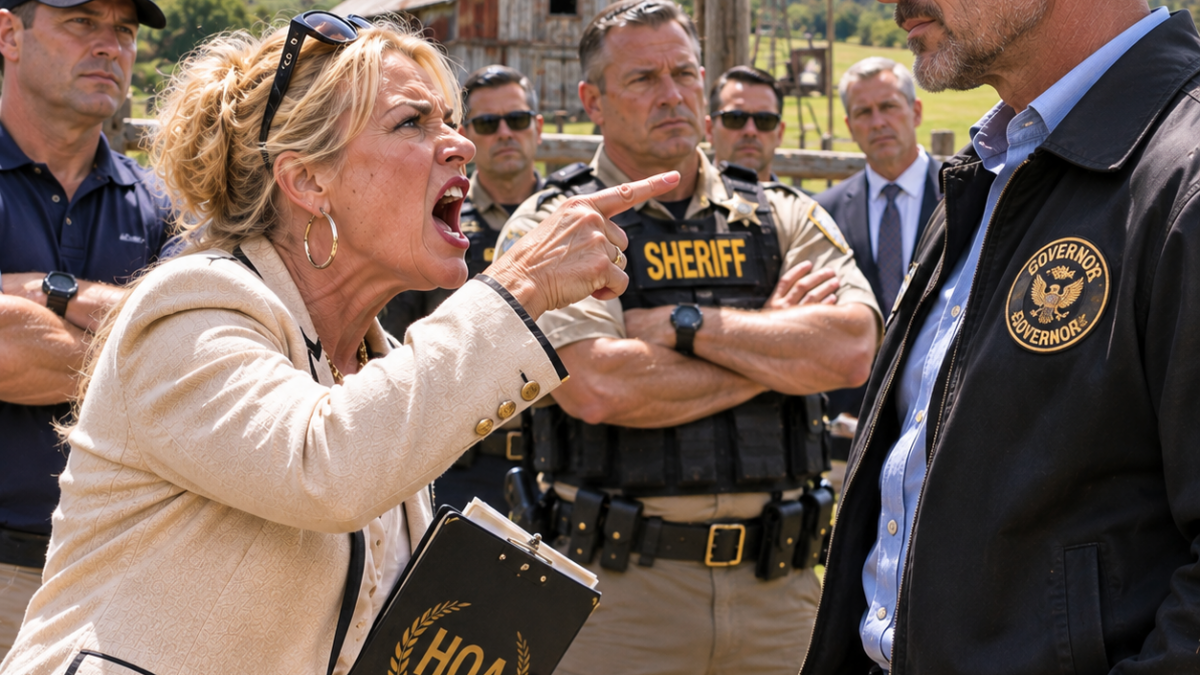
HOA Karen Stormed My 150-Year-Old Ranch With Bolt Cutters—Then State Troopers Stepped Out and She Learned I Was the Governor
PART2:
I traded suits for old Levi’s and a faded Carhartt jacket and drove home.
I needed to settle the estate.
But more than that, I needed a few weeks where nobody needed anything from me.
No legislature.
No cameras.
No microphones.
Just Grandpa’s tools.
His tractors.
His horses.
His papers.
And grief.
Oakridge Estates had appeared five years earlier along Copper Creek’s western boundary.
Before that, the adjoining land had been pasture.
Then developers bought it.
Roads appeared.
Then houses.
Large houses.
Nearly identical houses.
Stone mailboxes.
Perfect lawns.
PART3:
Decorative street lamps.
Oakridge stopped exactly at Grandpa’s fence.
Legally, that should have been the end of it.
Copper Creek was separately deeded.
Agricultural zoning.
No HOA covenants.
No annexation agreement.
No shared amenities.
No common roads.
Nothing.
But Brenda Higgins had never liked that answer.
Grandpa had kept a folder full of her letters.
BARN COLOR NONCOMPLIANCE.
UNAPPROVED LIVESTOCK VISIBILITY.
TRACTOR NOISE COMPLAINT.
UNSCREENED AGRICULTURAL EQUIPMENT.
FENCE AESTHETIC VIOLATION.
Every one addressed to a man who did not belong to her HOA.
Grandpa’s written responses were short.
My favorite was three words.
NOT YOUR PROPERTY.
Brenda apparently considered Grandpa’s death an opportunity to try again.
I was under the John Deere replacing an alternator when I heard heels on gravel.
Not boots.
Heels.
Sharp little clicks getting closer.
“Excuse me!”
I rolled out.
A woman stood ten feet away.
Blond bob.
Designer sunglasses.
White blouse.
Navy cardigan.
Clipboard pressed against her chest.
Beside her stood Todd Chambers, Oakridge’s vice president.
Golf polo.
Khakis.
Expression of a man who had recently been given authority over a landscaping committee and was determined not to waste it.
I sat up.
“Can I help you?”
The woman looked me over.
Grease.
Dust.
Beard.
Old jacket.
Then looked toward the farmhouse.
“You’re the relative?”
“I’m Arthur.”
“Brenda Higgins.”
She lifted the clipboard slightly.
“President of the Oakridge Estates Homeowners Association.”
“Okay.”
“And this is Todd Chambers, our vice president.”
Todd nodded at me as though I should be impressed.
Brenda looked around.
Her mouth tightened.
“This property is in significantly worse condition than expected.”
I stared at her.
“Expected by who?”
“The association.”
“Why does the association have expectations about my ranch?”
She ignored that.
Her eyes settled on Grandpa’s horses.
Two old quarter horses grazing in the south pasture.
“You still have livestock.”
“They live here.”
“Livestock is prohibited.”
“Not here.”
“The barn color also violates community standards.”
I looked at the barn.
Red.
Same basic color it had been since I was a kid.
“So?”
Brenda finally looked directly at me.
“So it has to be repainted.”
“No.”
Todd crossed his arms.
“Desert Sand and Autumn Beige are both approved.”
I actually laughed.
That offended Brenda.
“You find this amusing?”
“Very.”
She pulled several neon-green sheets from her clipboard.
“This parcel has existed under grandfathered treatment for years because of Wallace’s age and history with the area.”
“No.”
She frowned.
“What?”
“No, it hasn’t.”
I stood.
“Copper Creek isn’t grandfathered into your HOA because Copper Creek was never in your HOA.”
Brenda’s lips tightened.
“Circumstances have changed.”
“No.”
“The surrounding development now substantially incorporates this parcel into the Oakridge community.”
“That sentence means nothing.”
Todd stepped in.
“You share a property boundary.”
“Yes.”
“That creates jurisdictional proximity.”
I looked at him.
“What law school did you attend?”
His face reddened.
Brenda continued before he could answer.
“We have begun preparing annexation paperwork.”
That got my attention.
“You’re annexing my ranch?”
“For community consistency.”
“Without the owner’s consent?”
“Your grandfather’s death terminated several informal accommodations.”
I stared at her.
It was difficult to decide which part was more wrong.
Eventually I said:
“Turn around.”
She blinked.
“What?”
“Walk back down my driveway.”
Her expression sharpened.
“Excuse me?”
“This is private property.”
I pointed toward the front gate.
“The gate was closed.”
“The gate itself violates—”
“Brenda.”
My voice changed.
Not loud.
Just the voice I used in meetings when I was done allowing somebody to waste time.
She heard it.
So did Todd.
“I am burying my grandfather.”
Silence.
“I am handling his estate.”
I pointed toward the road.
“You are not welcome on this land. Leave.”
For half a second, something like uncertainty appeared.
Then arrogance covered it.
She marched to Grandpa’s tractor.
Slapped the green papers across the hood.
“Seventy-two violations.”
I looked down.
“What?”
“Accumulated preliminary violations.”
She flipped pages.
“Unapproved livestock.”
Another.
“Fence deterioration.”
Another.
“Visible mechanical equipment.”
Another.
“Commercial-grade agricultural machinery stored outdoors.”
I glanced at the tractor.
“It’s a farm.”
“Not according to Oakridge visual-impact standards.”
“Those standards don’t apply.”
“Five hundred dollars per day after the compliance period.”
I almost admired the confidence.
Almost.
She tapped another sheet.
“Failure to pay will result in collection action.”
“Against property outside your association?”
“Including liens where permitted.”
Todd smiled.
Brenda lowered her voice.
“If you can’t maintain this place, perhaps selling is the more realistic option.”
There it was.
I looked at her.
“Selling to whom?”
She smiled.
“Several parties have expressed interest.”
Now the whole interaction felt different.
Not just aesthetic obsession.
Land pressure.
Copper Creek sat between Oakridge and a future commercial corridor being planned near the highway.
One hundred and fifty undeveloped acres would be valuable to a developer.
Very valuable.
I gathered the green notices.
Brenda smiled.
“Seventy-two hours.”
“Fine.”
“After that, enforcement escalates.”
I looked at her over the papers.
“If only you understood how much I’m looking forward to seeing what that means.”
She misunderstood the sentence completely.
“Tick-tock, farm boy.”
Then she turned.
Todd followed.
I watched the Lexus leave.
After they were gone, I called David Mercer, my chief of staff.
He answered immediately.
“Governor.”
“At the ranch I’m Arthur.”
“That’s never stopped the legislature.”
“I need something.”
“Shoot.”
“Pull Oakridge Estates.”
“What about it?”
“Charter.”
“Okay.”
“Covenants.”
“Okay.”
“Tax filings.”
Pause.
“Why?”
“Vendor contracts if publicly accessible.”
Longer pause.
“Arthur.”
“Yes?”
“What happened?”
“HOA president just threatened to lien Grandpa’s ranch because the barn isn’t beige.”
David laughed.
I didn’t.
He stopped.
“You’re serious.”
“Completely.”
“Want counsel?”
“Eventually.”
“Want state police?”
“No.”
“You already have protection.”
I looked toward the barn.
Two members of my executive protection detail were inside pretending to give me privacy.
They weren’t very good at pretending.
“No intervention unless there’s an actual safety issue.”
“Understood.”
“And David?”
“Yes?”
“Don’t use state resources for my private property dispute.”
He went quiet.
Then:
“I was about to say the same thing.”
“Good.”
“Public records and publicly available corporate filings only.”
“Exactly.”
I wasn’t going to weaponize the governor’s office because an HOA president annoyed me.
That would make me worse than Brenda.
But I was absolutely going to know who was standing at my gate.
Friday morning brought the tow truck.
I was drinking coffee on the porch when a heavy-duty wrecker reversed toward Copper Creek’s entrance.
PRECISION RECOVERY & TOWING.
Todd stood beside it.
Smiling.
The driver got out.
Heavyset man.
Work gloves.
Toothpick.
He began unreeling steel cable.
I walked down.
“Todd.”
“Morning.”
“What are you doing?”
“Enforcement.”
He pointed toward Grandpa’s restored 1952 Farmall tractor twenty yards inside my property.
“You failed to remove abandoned equipment.”
“That tractor runs.”
“Doesn’t matter.”
“Who told the towing company it was abandoned?”
“The HOA.”
The tow driver looked between us.
“You owner?”
“Yes.”
Todd said:
“He’s an occupant.”
I looked at him.
“My name is on the deed.”
Todd shrugged.
“Association has jurisdiction.”
The driver stopped unspooling cable.
“Buddy, I was told this was HOA common property.”
“It isn’t.”
I pointed at the fence.
“If your truck crosses that line without my permission, you are entering private agricultural property.”
Todd said:
“Hook the tractor.”
The driver looked uncomfortable.
“Man, I just have a work order.”
“I understand.”
I pulled out my phone.
“I am not threatening you.”
I made sure the driver could hear every word.
“But I am explicitly denying consent to enter. If you proceed anyway, I will report the trespass and attempted removal of privately owned equipment.”
Todd laughed.
“He’s bluffing.”
I called Sheriff Robert Hawkins.
Not because I was governor.
Because I had known him since high school.
“Bob.”
“Arthur?”
“I’ve got a tow company at Copper Creek being told by Oakridge HOA to remove Grandpa’s Farmall.”
Silence.
Then:
“You’re kidding.”
“No.”
“Anyone crossed the fence?”
“Not yet.”
“Keep it that way. Sending a deputy.”
I hung up.
“Deputy’s coming.”
The driver immediately began rewinding the cable.
Todd snapped:
“The HOA will cover your liability.”
The driver looked at him.
“The HOA ain’t covering me getting arrested.”
He climbed into the cab.
Todd stepped toward him.
“We have a contract!”
“Then sue me.”
The truck left.
Todd remained.
“You think you’re smart.”
“I think I own the tractor.”
“Brenda is going to destroy you.”
“Tell her to bring a deed.”
“You can’t fight our legal fund.”
I looked toward Oakridge.
“Then I suggest your legal fund hire somebody capable of reading a property map.”
He left.
That afternoon, David called.
“You may want to sit down.”
“Go ahead.”
“Oakridge is a nonprofit homeowners association.”
“I know.”
“Four years of state informational filings are inconsistent.”
“How?”
“Fine revenue doesn’t reconcile with disclosed maintenance expenditures.”
That was relevant from a regulatory standpoint, but I stopped him.
“David.”
“I know.”
“No executive investigation because they’re fighting with me.”
“Already separated.”
“How?”
“Revenue department had an unrelated compliance flag from last year.”
I went still.
“So this predates me.”
“Yes.”
“Good.”
“Not good for Brenda.”
“What did they flag?”
“Vendor payments.”
“To whom?”
“Still pulling public corporate registrations.”
“Keep it clean.”
“I will.”
Saturday afternoon, Brenda came back.
This time she brought people.
I heard voices before I saw them.
I walked onto the porch.
Brenda was marching up my driveway.
Todd beside her.
Susan Gable, HOA secretary.
A large man wearing a tactical vest labeled OAKRIDGE PRIVATE SECURITY.
And behind them, six or seven residents.
The residents looked mostly curious.
Greg—the security contractor—carried chain and a padlock.
Brenda carried bolt cutters.
I stood.
“You’re trespassing.”
She held up a document.
“Final enforcement order.”
I did not take it.
“From a court?”
“From Oakridge.”
“Then it’s not an order.”
“It authorizes corrective action.”
“On HOA property.”
“This parcel is subject to enforcement.”
“No.”
She turned toward Greg.
“Secure the barn.”
Greg started walking.
I said:
“Greg.”
He stopped.
“I would strongly recommend you not touch that barn.”
Brenda snapped:
“Keep going.”
He looked at her.
Then me.
She pointed toward the pasture.
“Todd, cut the gate locks.”
Todd lifted the bolt cutters.
I raised one hand.
Not dramatically.
Just enough.
The barn doors opened.
Two men stepped out.
Dark suits.
Earpieces.
Then the farmhouse door opened.
Two more.
All members of the executive protection unit assigned to me while I was away from the capital.
Greg stopped immediately.
Todd stopped too.
The bolt cutters slipped from his hands.
Clang.
Brenda stared.
“What is this?”
Nobody answered.
She pointed at the agents.
“Private armed security is prohibited under Oakridge standards.”
I almost felt sorry for her.
Almost.
One of the agents stepped forward.
“Ma’am, remain where you are.”
Brenda blinked.
“Who are you?”
“State Highway Patrol Executive Protection.”
Silence.
Todd looked at me.
Then at the agents.
Then back at me.
You could see the math happening.
Brenda couldn’t.
“This man hired state police?”
I walked down the porch steps.
“No.”
She looked at me.
“You’re impersonating somebody.”
“I haven’t told you who I am.”
Her expression flickered.
I took my state identification from my wallet.
Held it where she could see.
“My name is Arthur Mitchell.”
She stared at the card.
I continued.
“I am the governor.”
Nothing moved.
Not Brenda.
Not Todd.
Not Susan.
Not the residents behind them.
Even the horses seemed quieter.
Brenda finally laughed.
But it sounded wrong.
“You expect me to believe that?”
Todd whispered:
“Oh, God.”
She turned.
“What?”
He had pulled out his phone.
Search results.
Official portrait.
Same face.
Minus beard.
Minus grease.
Minus Carhartt.
“Brenda.”
His voice barely worked.
“That’s him.”
She looked back at me.
Then at the protection detail.
Color left her face.
I put the identification away.
“Now.”
My voice stayed quiet.
“I told you two days ago that this was private property.”
Nobody spoke.
“I told you to leave.”
I pointed toward Todd’s bolt cutters.
“You have now returned with tools intended to defeat a lock.”
Then toward Greg.
“And instructed a contractor to secure a privately owned barn.”
Brenda suddenly found her voice.
“This is an HOA enforcement action.”
“No.”
“We have community authority.”
“Not here.”
She gripped the clipboard.
“You can’t use your office to intimidate citizens.”
That part was actually important.
“You’re right.”
She looked surprised.
“So I’m not.”
I turned toward the lead protection agent.
“Have local law enforcement been notified?”
“Yes, sir.”
“Good.”
Then to Brenda:
“My protection detail is here because it is assigned to me. They are not your HOA enforcement agency and they are not mine.”
She swallowed.
“The sheriff will handle the trespass complaint the same way he would for anyone else.”
One of the residents whispered:
“She tried to evict the governor.”
Another person shushed him.
Phones appeared.
Of course.
Brenda realized she had an audience.
Her confidence came back in a weaker form.
“Governor or not, the property is a nuisance.”
I stared.
“The barn?”
“Yes.”
“The horses?”
“Yes.”
“The tractors?”
“Yes.”
“This ranch has been here since 1878.”
“That doesn’t mean it gets to drag down everyone else’s property values.”
There it was.
The real Brenda.
I felt something colder than anger.
“You harassed my ninety-two-year-old grandfather over the color of his barn.”
“He refused reasonable standards.”
“He was not in your association.”
“He benefited from proximity.”
“Proximity is not consent.”
Todd took another step backward.
Brenda continued.
“We’ve issued seventy-two lawful violations.”
“No.”
“You owe thousands.”
“No.”
“We can lien—”
“No.”
She stopped.
I pointed toward the road.
“You should leave.”
The local sheriff arrived before she did.
Sheriff Hawkins.
Two deputies.
He parked outside the gate.
Walked in.
Saw Brenda.
Saw the bolt cutters.
Saw Greg’s chain.
Then looked at me.
“You weren’t exaggerating.”
“Rarely.”
Brenda marched toward him.
“Sheriff, arrest this man for obstructing HOA enforcement.”
Bob stared at her.
Then slowly looked at me.
I actually saw him suppress a smile.
“Ma’am.”
“This ranch is in violation.”
“Do you have a court order allowing entry?”
“We have an association order.”
“Court order?”
“No.”
“Deed showing the ranch inside Oakridge?”
“Our counsel—”
“So no.”
She pointed at me.
“He locked us out.”
Bob looked at the gate.
“It’s his gate.”
“He refuses compliance.”
Bob nodded toward the bolt cutters.
“Why’d you bring those?”
Nobody answered.
Greg immediately said:
“I’m a contractor.”
Everyone turned.
“I was told they had authority.”
He set the chain down.
“I haven’t touched anything.”
Bob nodded.
“Smart.”
Greg raised his hands.
“I’m leaving.”
Brenda snapped:
“You work for us.”
“Not anymore.”
He walked toward the road.
Susan followed three steps behind him.
Brenda turned.
“Susan?”
The secretary stopped.
Looked at the governor.
Looked at the sheriff.
Looked at Brenda.
Then kept walking.
Todd said:
“I didn’t know she was bringing the cutters.”
Brenda stared.
“You’re the one holding them!”
He dropped them.
Now everyone was abandoning her.
That might have ended the ranch problem.
But by then the financial problem had arrived.
David called while Sheriff Hawkins was taking statements.
“Arthur.”
“What?”
“We found the LLC.”
I stepped away from the group.
“Which LLC?”
“The one receiving HOA fine payments indirectly.”
“Explain.”
“Oakridge collects violation revenue through the association account.”
“Yes.”
“Then recurring administrative payments go to a compliance vendor.”
“Name?”
“Higgins Community Services LLC.”
I closed my eyes.
“Owner?”
“Brenda Higgins.”
“How much?”
“Approximately eighty thousand over four years based on filings and bank disclosures already available to regulators.”
“Already under review?”
“Yes.”
That mattered.
I could not use my office to punish Brenda because she had picked a fight with me.
But the state could continue a preexisting regulatory investigation where evidence justified it.
“Then keep me out of it.”
“I already told Revenue and the Attorney General’s office the conflict.”
“Good.”
“They’ll handle it independently.”
I returned to the driveway.
Bob was explaining to Brenda that she was being formally trespassed from Copper Creek Ranch.
She looked at me.
“This is retaliation.”
“No.”
“You made calls.”
“I made one call about your association’s public filings after you threatened to annex my ranch.”
“So you admit it.”
“Yes.”
Phones lifted higher.
I continued because truth mattered.
“I asked my chief of staff to identify what entity I was dealing with.”
She smiled.
“Exactly.”
“He discovered a preexisting state compliance issue.”
The smile vanished.
“I have recused myself from any state investigation involving Oakridge.”
Silence.
“Whatever happens next won’t be decided by me.”
Todd looked at Brenda.
“What investigation?”
She didn’t answer.
David’s findings became public three days later through ordinary agency process.
Then the homeowners began asking questions.
Why were fines being routed through a company owned by their HOA president?
Why had the board approved recurring compliance payments without transparent bids?
Why were towing and landscaping vendors connected to people Brenda knew?
Why had fine collections risen every year while reserve maintenance barely moved?
The state investigation expanded.
Not because I ordered it.
Because homeowners started producing records.
Emails.
Invoices.
Statements.
One woman showed investigators twelve separate fines for landscaping violations.
Another had paid $3,000 over two years.
Someone else produced a towing invoice.
Then another.
Then another.
The pattern became harder to dismiss.
Precision Recovery—the company that had tried to remove Grandpa’s tractor—came under review over towing practices connected to Oakridge.
Its licensing problems were handled through the appropriate regulatory process.
Brenda was removed as HOA president before the criminal case was complete.
That part came from the homeowners.
Emergency meeting.
Packed clubhouse.
Todd stood at the front.
Looking miserable.
He had begun cooperating.
Susan too.
Residents demanded an independent audit.
Then someone moved to remove Brenda.
The vote wasn’t close.
What happened after that took months.
The audit found roughly eighty thousand dollars in HOA money had flowed through Brenda’s private company under contracts residents said they had never fully understood.
Additional vendor relationships were scrutinized.
Some conduct became civil claims.
Some became regulatory violations.
Prosecutors reviewed the evidence for criminal charges.
I stayed out of those decisions.
That wasn’t just ethics.
It was self-preservation.
The governor cannot be the complainant in a personal property dispute and then also be perceived as directing prosecution.
So I let professionals do their jobs.
Grandpa would’ve approved of that.
He didn’t trust anyone who wanted two kinds of power at once.
Meanwhile, I dealt with the ranch.
The attention was awful.
News trucks.
Drones.
Reporters at the county road.
Headlines:
HOA PRESIDENT TRIES TO FINE GOVERNOR’S RANCH.
GOVERNOR REVEALS ID AFTER PROPERTY STANDOFF.
TROUBLE IN OAKRIDGE.
The story became funnier online than it had felt in real life.
People edited Brenda’s face onto old western posters.
Someone created a T-shirt:
WRONG BARN, BRENDA.
I refused one from David.
He bought it anyway.
Then came the most important decision.
Protect Copper Creek.
Not from Brenda.
From the next developer.
Or the next board.
Or even from somebody in my own family someday who might be tempted by money.
I met with private counsel.
Historic preservation specialists.
Agricultural conservation experts.
State ethics counsel too, because my public position complicated everything.
We structured an easement through independent legal channels.
No special treatment.
No secret executive shortcut.
Copper Creek qualified because of its age, agricultural history, preserved buildings, and open-space value.
Months later, once the review was complete, I stood beside Grandpa’s cedar fence.
A simple press conference.
No state seal dominating the background.
No political banners.
Just the ranch.
I wore clean jeans.
Boots.
A work jacket.
The director of the historical society stood beside me.
I opened the document.
“Copper Creek Ranch has been placed under a permanent conservation and historic-preservation easement.”
Cameras clicked.
“The ranch will remain agricultural land.”
More cameras.
“The historic core cannot be subdivided for residential development.”
I looked toward the barn.
“And the original farm structures will be preserved.”
One reporter asked:
“Does this mean no HOA can ever annex it?”
I smiled.
“It means nobody gets to turn Grandpa’s barn Autumn Beige.”
People laughed.
That was enough.
I didn’t mention Brenda.
Didn’t need to.
Oakridge residents attended.
That surprised me.
Many applauded.
Afterward an older woman approached.
“I owe you an apology.”
“For what?”
“I supported Brenda.”
“So did a lot of people.”
“She told us your grandfather was ruining our property values.”
I looked toward Copper Creek.
“Did he?”
She smiled.
“No.”
Then she looked embarrassed.
“I used to complain about the tractor noise.”
“I know.”
“You know?”
“Grandpa kept the letters.”
She covered her face.
“Oh, God.”
“He thought they were funny.”
That relieved her.
A little.
Oakridge changed dramatically after Brenda.
Not because the HOA disappeared overnight.
Dissolving an HOA is more complicated than simply voting to stop having one.
There were roads.
Common spaces.
Insurance.
Stormwater systems.
Legal obligations.
The residents eventually restructured the association instead.
Reduced powers.
External accounting.
Transparent contracts.
Clear limits on fines.
No private towing without verified authority.
Board disclosures.
Term limits.
Some residents wanted complete dissolution.
Others didn’t.
That was their decision.
Not mine.
The fence stayed.
Copper Creek on one side.
Oakridge on the other.
And strangely, relations improved.
Without Brenda manufacturing war over barn colors, people behaved like neighbors.
Children from Oakridge came for school tours.
Grandpa’s horses became minor celebrities.
Teachers brought students to see the old barn.
We planted a small heritage garden.
One Saturday morning, I started Grandpa’s 1952 Farmall.
The tractor Brenda had tried to tow.
It coughed.
Smoked.
Then settled into that familiar uneven rumble.
A little boy standing near the fence covered his ears.
His father laughed.
“That’s loud.”
I yelled over the engine:
“HOA violation!”
The father nearly fell over laughing.
For the first time since Grandpa died, the ranch felt alive rather than empty.
That was what mattered.
Not humiliating Brenda.
Not the governor reveal.
Not headlines.
The ranch.
I had gone home because the man who anchored my childhood was gone.
For several weeks, grief made everything feel temporary.
Then Brenda walked onto the property and announced that Grandpa’s death somehow made his land easier to take.
She accidentally reminded me why the place mattered.
Not because it was old.
Because people had defended it.
Grandpa did it for decades by ignoring nonsense.
I had to do it differently.
With lawyers.
Records.
Boundaries.
And one unfortunately memorable identity card.
Years later, people still ask me about the moment Brenda found out.
They always want something dramatic.
Did her mouth fall open?
Yes.
Did Todd nearly drop the bolt cutters?
He actually did drop them.
Did she really accuse the executive protection detail of violating HOA security rules?
Unfortunately, yes.
Did I enjoy it?
That answer is more complicated.
For maybe five seconds?
Absolutely.
I’m human.
Then I looked around.
At my grandfather’s driveway.
At neighbors filming.
At armed officers standing where Grandpa once taught me how to sharpen fence posts.
And I hated the whole scene.
Power is useful.
But it distorts rooms.
The moment people learned I was governor, everyone suddenly treated my property rights as more real.
They weren’t.
Copper Creek belonged to me exactly as much five minutes before the reveal as five minutes after.
That stayed with me.
Brenda shouldn’t have stopped because I was governor.
She should have stopped because the ranch wasn’t hers.
The tow driver shouldn’t have hesitated because I sounded authoritative.
He should have verified ownership before attempting to remove equipment.
The HOA shouldn’t have needed state troopers and sheriffs to understand that a closed gate marked private land.
A deed should have been enough.
That became the lesson I carried back to the capital.
Not some grand political revelation.
Just a reminder.
Laws are supposed to protect ordinary people before anyone knows their title.
If a right only becomes enforceable after somebody important walks into the room, it isn’t functioning properly.
Grandpa would have phrased it better.
Probably something like:
A fence works the same whether a governor stands behind it or not.
The final criminal and civil cases connected to Brenda took time.
Some allegations proved stronger than others.
Financial records had to be authenticated.
Vendor arrangements had to be separated from legitimate HOA expenses.
Defense attorneys did their jobs.
Prosecutors did theirs.
I never celebrated sentencing headlines.
My involvement ended where it should have.
Copper Creek remained private.
The financial case belonged to the homeowners and the justice system.
Years later, I found Brenda’s original seventy-two violation notices inside Grandpa’s old desk.
I had forgotten I’d put them there.
Unapproved livestock.
Barn color.
Farm machinery.
Fence appearance.
Vegetation height.
Dozens of pages.
I sat in his chair reading them.
Then found one of his old violation letters underneath.
Same HOA.
Older board.
On the bottom, Grandpa had written in pencil:
THEY CAN COMPLAIN FROM THEIR SIDE OF THE FENCE.
I laughed so hard I had to put the papers down.
That sentence became the only “HOA rule” I ever posted at Copper Creek.
I had a small wooden sign made.
Nothing fancy.
Mounted inside the ranch gate.
PRIVATE AGRICULTURAL PROPERTY
PLEASE RESPECT THE BOUNDARY
And underneath, smaller:
COMPLAINTS MAY BE MADE FROM YOUR SIDE OF THE FENCE.
David said it was unprofessional.
I reminded him he didn’t live there.
The last years of my term were busy.
Budgets.
Fires.
Floods.
Arguments with legislators.
The normal machinery of government.
Whenever I could, I went back to Copper Creek.
Suit off.
Boots on.
Phone mostly ignored.
One evening I stood inside the barn beside Grandpa’s John Deere.
Same tractor I’d been repairing when Brenda first arrived.
I put my hand on the hood.
The metal was cold.
“Ranch is safe,” I said.
It felt ridiculous talking to an empty barn.
Grandpa would’ve mocked me.
Probably.
Then again, maybe not.
Outside, the oaks moved in the wind.
The two horses were gone by then.
Old age.
Both buried on the north rise.
Oakridge’s houses still stood beyond the cedar fence.
Some red doors now.
Some blue.
One bright yellow.
No one cared.
Children rode bicycles on the streets.
People walked dogs.
Someone waved to me across the fence.
I waved back.
The entire war Brenda had imagined between the ranch and the subdivision had turned out to be unnecessary.
Nobody needed to win.
They simply needed to understand where one person’s authority ended.
Brenda Higgins thought the clipboard extended that boundary.
It didn’t.
Todd thought proximity created jurisdiction.
It didn’t.
A towing work order didn’t.
A fake eviction notice didn’t.
Seventy-two neon-green citations didn’t.
Neither did being HOA president.
The ranch had survived nearly a century and a half before Oakridge existed.
It did not need me to make it legitimate.
It needed me to refuse to surrender it.
And in the end, that was what made Brenda’s mistake so spectacular.
She thought she had stormed the property of a grieving, broke-looking ranch heir who could be frightened by fines, lawyers, towing threats, and bolt cutters.
Instead, she had marched past multiple NO TRESPASSING signs onto land owned by a man whose day job happened to be running the state.
But the title was never the part that defeated her.
The deed did.
The boundary did.
The law did.
I just happened to be standing behind them.








