HOA Karen Stormed My 150-Year-Old Ranch With Bolt Cutters—Then State Troopers Stepped Out and She Learned I Was the Governor
PART2:
Arthur slid out from beneath the tractor.
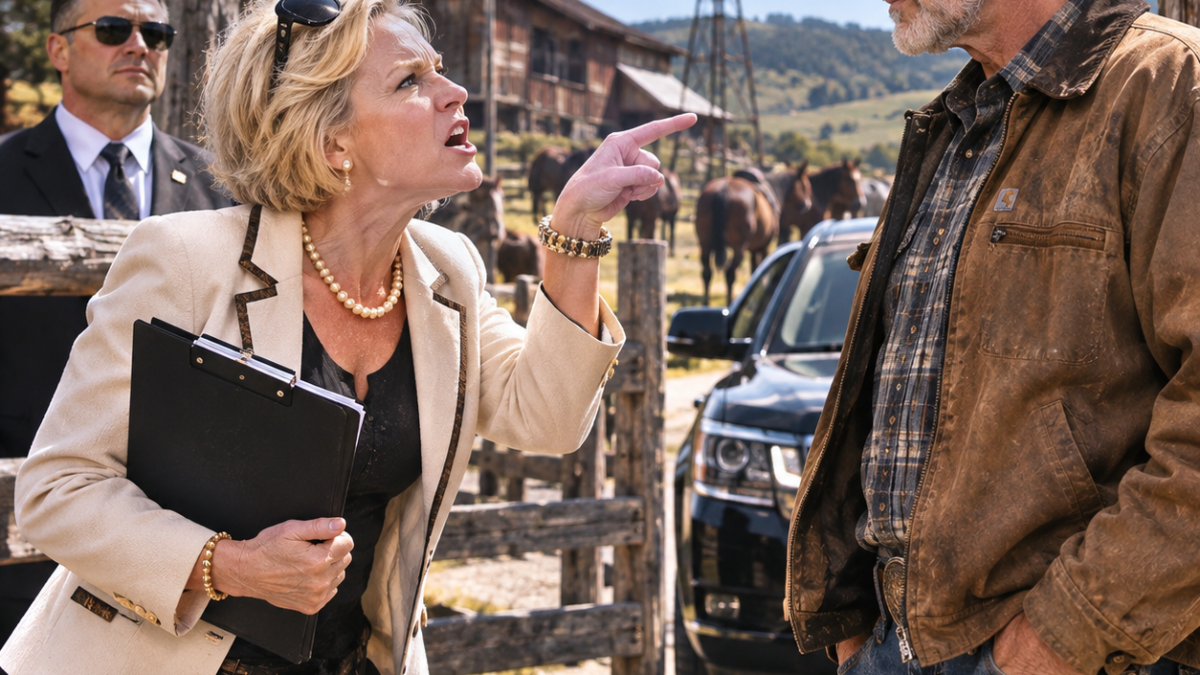
The woman standing ten feet away looked as if she had been assembled specifically for confrontation.
Sharp blond bob.
Oversized black sunglasses.
Cream-colored wool coat despite the mud.
Black leather gloves.
Pearl-white Lexus parked outside the ranch gate.
Clipboard held against her chest like a warrant.
A man stood behind her in khaki pants and a navy golf shirt embroidered with the Oakridge Estates logo.
Arthur sat up.
“Can I help you?”
The woman looked at his dirty clothes.
Then at the tractor.
Then at the farmhouse.
The judgment moved through her face in stages.
Disgust.
Suspicion.
Superiority.
Perfect.
“I certainly hope so,” she said. “I’m Brenda Higgins.”
Arthur waited.
Apparently she had expected recognition.
PART3:
When none came, she added, “President of the Oakridge Estates Homeowners Association.”
Arthur wiped his hands on a rag.
“Congratulations.”
The man behind her smirked, assuming Arthur had been impressed.
Brenda did not.
“And this is Todd Chambers, vice president.”
“Two congratulations.”
Todd’s smirk disappeared.
Arthur stood.
He was six-foot-two.
Brenda’s sunglasses tilted upward.
“Who exactly are you?” she asked.
“Arthur.”
“Arthur what?”
“Mitchell.”
A pause.
He watched recognition flicker.
“You’re related to Wallace?”
“He was my grandfather.”
Brenda’s expression softened for approximately one second.
“I see.”
No condolences.
No apology for trespassing.
Just recalculation.
Arthur had already learned something useful.
“I assume you’re here regarding the estate.”
“No.”
Brenda frowned.
“You inherited?”
“Yes.”
“Then this is actually perfect.”
Arthur looked toward the closed gate behind her.
The NO TRESPASSING sign was impossible to miss.
“How did you get in?”
“The pedestrian latch was open.”
“It was not.”
Todd shifted.
Brenda ignored the question.
“We’ve been attempting to resolve several ongoing compliance issues with this property for nearly two years.”
“Compliance with what?”
“The Oakridge community standards.”
“This isn’t Oakridge.”
“You border Oakridge.”
“That wasn’t my question.”
Brenda opened the clipboard.
Arthur had spent twenty-seven years in law and politics.
Before becoming governor, he had been a prosecutor, state senator, attorney general, and the unfortunate chairman of enough committees to understand that people who carried excessive paperwork frequently hoped volume could substitute for legal authority.
Brenda removed a neon-green sheet.
“The barn color violates Article Four of the architectural standards.”
Arthur looked behind him.
The barn was red.
It had been red since his mother was a child.
The paint had faded.
The cedar beneath showed through in places.
Wallace had once told Arthur repainting it too perfectly would make it look dishonest.
“What color should it be?”
Brenda brightened.
“Desert sand, autumn beige, or heritage cream.”
Arthur stared.
Todd nodded proudly.
“Approved palette.”
“My barn is older than your neighborhood.”
“That is irrelevant.”
“It survived World War I.”
Brenda frowned.
“I don’t see what that has to do with anything.”
“Neither do I. I just wanted to say it out loud before you asked me to paint it beige.”
Todd stepped forward.
“This attitude is exactly the problem Wallace had.”
Arthur’s face changed.
Not much.
Enough.
“What problem did my grandfather have?”
Todd immediately stepped back emotionally, even if his shoes stayed where they were.
Brenda answered.
“He refused to cooperate.”
“My grandfather was ninety-two.”
“He was perfectly capable of answering notices.”
Arthur’s voice went quieter.
“You sent violation notices to a ninety-two-year-old man?”
“Seventy-two.”
Arthur thought he had misheard.
“What?”
“Seventy-two formal citations.”
Brenda flipped pages.
“Over roughly twenty-four months.”
Arthur stared at her.
He felt something cold settle beneath the grief.
For the first week after Wallace’s death, Arthur had moved through the ranch in a haze.
The funeral.
Lawyers.
Probate records.
Livestock paperwork.
Property-tax documents.
The strange administrative work death creates.
He had found stacks of unopened envelopes on Wallace’s desk.
Some medical.
Some agricultural.
Some marked OAKRIDGE ESTATES HOA.
He had assumed junk mail.
Now he knew.
“Why?”
“Your grandfather refused reasonable requests.”
“You harassed him seventy-two times.”
“We enforced standards.”
“On property outside your subdivision.”
“Adjacent property affects values.”
Arthur looked toward Oakridge Estates.
Five years earlier, a national developer had purchased nearly eight hundred acres surrounding Copper Creek.
The result stood beyond Wallace’s cedar fence.
Rows of enormous houses designed to look expensive without looking individual.
Stone veneer.
Gray roofs.
Beige siding.
Perfect shrubs.
Every mailbox identical.
Every lawn an intensely managed green.
Copper Creek looked like something history had forgotten to erase.
One hundred fifty acres of pasture, old oak trees, barns, sheds, tractors, cattle fencing, and a farmhouse built in sections over generations.
Arthur loved the contrast.
Brenda clearly did not.
She removed several pages.
“You currently have two unauthorized livestock animals.”
“Horses.”
“Yes.”
“My grandfather’s horses.”
“They violate the domestic-animal restriction.”
Arthur nearly laughed.
“This is an agricultural property.”
“The smell carries.”
“The horses are two hundred yards from your nearest house.”
“The smell does not recognize property lines.”
“Neither does your confidence.”
Todd stepped forward again.
“You need to understand something.”
Arthur looked at him.
Todd stopped.
Arthur did not raise his voice.
He had learned years earlier that the quieter a powerful person speaks, the more attention nervous people give him.
Todd tried again.
“The subdivision has changed the nature of the area.”
“No.”
“Yes.”
“The zoning map disagrees.”
Brenda snapped the clipboard shut.
“Your grandfather benefited from a grandfather clause.”
Arthur actually laughed.
“What?”
“His ownership predates Oakridge.”
“Correct.”
“Now he’s dead.”
Arthur’s smile disappeared.
Brenda either did not notice or did not care.
“So any exemption tied to his ownership has terminated.”
“You believe agricultural zoning terminated because my grandfather died?”
“We’ve already drafted annexation documents.”
“Annexation.”
“Yes.”
“For my ranch.”
“Yes.”
“Into your HOA.”
“For the benefit of the community.”
Arthur rubbed the bridge of his nose.
He had negotiated with federal agencies.
Legislators.
Union leaders.
Corporate executives.
Foreign trade delegations.
Nothing in public service had prepared him for the confidence of a person who had read half a real-estate blog.
“You cannot annex private land into a homeowners association because you dislike my barn.”
Todd folded his arms.
“Proximity establishes jurisdiction.”
Arthur looked at him.
“Where did you attend law school?”
Todd reddened.
“I don’t need a law degree to understand property rights.”
“That sentence is doing a remarkable amount of work.”
Brenda thrust the neon papers at Arthur.
“Forty-eight hours.”
He did not take them.
She slapped them onto the tractor hood.
“Barn repainting. Livestock removal. Farm equipment storage. Fence replacement. Grass remediation. Signage violations.”
Arthur lifted one sheet.
“Signage?”
“Your NO TRESPASSING signs are hostile.”
“They’re accurate.”
“They create an unwelcoming appearance.”
“They’re working poorly.”
Brenda’s mouth tightened.
“You have forty-eight hours before fines begin.”
“How much?”
“Five hundred dollars per violation per day.”
Arthur nodded slowly.
“And if I don’t pay?”
“We place a lien.”
“On Copper Creek.”
“Yes.”
“And then?”
“If necessary, foreclosure.”
Todd smiled.
Arthur looked at both of them.
He should have revealed himself then.
One sentence.
My name is Arthur Mitchell. I’m the governor.
It would have ended the encounter.
Maybe.
But grief had stripped Arthur of his patience for performative power.
More importantly, a question had formed.
If they behaved this way toward someone they believed was powerless, what had they done to everybody else?
Arthur folded the citation.
“What did Wallace say when you threatened him?”
Brenda smirked.
“Mostly profanity.”
That sounded right.
“Anything specific?”
Todd rolled his eyes.
“He once told Brenda he’d let the cows vote on annexation.”
Arthur turned away because he was suddenly laughing.
He could hear Wallace saying it.
Brenda bristled.
“This is not amusing.”
“No.”
Arthur looked at the barn.
“It actually is.”
Then the grief returned.
Hard.
Fast.
Wallace should have been standing there.
Ninety-two.
Suspenders.
Flannel shirt.
Looking delighted that somebody had arrived to argue.
Instead, there was an empty porch chair.
An unused coffee mug.
Two old horses waiting for a man who would never bring their morning feed again.
Arthur turned back.
“Leave.”
Brenda blinked.
“Excuse me?”
“This is private property.”
“You have been served.”
“You have trespassed.”
“You cannot threaten the HOA president.”
“I didn’t threaten you.”
He pointed toward the gate.
“I told you to leave.”
Brenda stepped closer.
“You’re making a serious mistake.”
Arthur’s expression did not change.
“So are you.”
Something in his voice finally registered.
Todd touched Brenda’s elbow.
“Let’s go.”
She pulled away.
“Forty-eight hours, Mr. Mitchell.”
Arthur picked up the citations.
“Tick-tock.”
Brenda smiled.
“Exactly.”
She turned and walked away.
Todd followed.
Arthur waited until the Lexus disappeared.
Then he carried the papers to Wallace’s office.
He did not burn them.
Not yet.
He spread all seventy-two old citations across the dining-room table.
Wrong barn color.
Unauthorized tractor storage.
Excessive fence weathering.
Improper agricultural odors.
Unapproved exterior lighting.
Oversized mailbox.
Decorative rust.
Arthur stopped at that one.
“Decorative rust?”
He read it twice.
Then he found something that erased the humor.
A demand for $14,800 in accumulated fines.
Dated six months earlier.
Attached was a notice threatening collection action.
Wallace had written across it in black marker:
THEY CAN COLLECT IT FROM MY COWS.
Arthur smiled.
Then noticed another piece of paper.
A letter Wallace had drafted but never mailed.
Arthur sat.
His grandfather’s handwriting had become shaky.
Brenda—
You do not own this valley.
You bought a house in it.
There is a difference.
This ranch was here before you, and God willing it will be here after both of us.
Stop threatening my neighbors.
Arthur read the last sentence again.
Not me.
My neighbors.
He pulled out his phone.
His chief of staff answered on the second ring.
“Governor.”
“David.”
“You sound dirty.”
Arthur looked at his hands.
“Accurate.”
“You still at the ranch?”
“Yes.”
“How’s probate?”
“Annoying.”
“That is the legal definition of probate.”
Arthur looked at the papers.
“I need something.”
David’s tone changed.
“What?”
“Pull everything publicly available on Oakridge Estates HOA.”
“How much?”
“All of it.”
“Why?”
Arthur leaned back.
“Seventy-two fake violations.”
Silence.
“Against who?”
“Wallace.”
David knew better than to joke.
“I’m sorry.”
“Charter. Incorporation. Tax filings. Recorded covenants. Parcel maps. Litigation history. Vendors.”
“Arthur.”
“Yes?”
“Are you starting a war with an HOA?”
“No.”
A pause.
“Are they starting a war with you?”
Arthur looked through the window toward the beige houses.
“Possibly.”
David sighed.
“I’ll call legal.”
“No state resources outside proper channels.”
“Obviously.”
“Public records only for now.”
“Got it.”
“And David?”
“Yes?”
“Do not tell anybody here who I am.”
Another silence.
“Why?”
“I want to see what they do next.”
David groaned.
“That sentence has ruined my week.”
Arthur smiled.
“Goodnight.”
Brenda did not wait forty-eight hours.
By Friday morning, she had escalated.
Arthur was drinking coffee on the porch when he heard a diesel engine.
A heavy-duty tow truck stopped outside the front gate.
PRECISION RECOVERY & TOWING.
A stocky driver climbed out.
Todd emerged from the passenger side.
He wore sunglasses despite the cloudy morning.
Arthur set down his coffee.
“Morning.”
Todd smiled.
“Morning.”
The driver began unspooling steel cable.
Arthur walked to the gate.
“What are you doing?”
Todd held up a paper.
“Remediation order.”
“For?”
“Abandoned vehicle.”
Arthur followed his finger.
Wallace’s 1952 Farmall tractor.
Twenty yards inside the ranch.
Restored.
Painted bright red.
The tractor Wallace had taught Arthur to drive when Arthur was eleven.
The one Wallace had used in the town’s Fourth of July parade every summer.
Arthur’s expression went blank.
Todd misread that as fear.
“HOA regulations allow us to remove noncompliant vehicles from common-view corridors.”
“This isn’t HOA property.”
“We’re not debating this again.”
The tow-truck driver looked toward the gate.
“You own this place?”
“Yes.”
Todd cut in.
“He’s occupying it during probate.”
Arthur looked at him.
“What did you just say?”
“You heard me.”
Todd handed the driver the work order.
“They said it’s community-controlled land.”
The driver frowned.
“Is it?”
“No.”
Todd snapped, “Yes.”
Arthur addressed the driver.
“Before you cross that gate, I suggest you look up the parcel number on your phone.”
Todd rolled his eyes.
“He’s bluffing.”
Arthur continued.
“This land is privately owned, agriculturally zoned, and not subject to Oakridge covenants.”
The driver hesitated.
Todd said, “The HOA assumes liability.”
Arthur almost pitied him.
“No association can indemnify you against knowingly committing trespass and theft.”
The driver stopped unwinding cable.
“You a lawyer?”
“Yes.”
Todd snorted.
“Sure.”
Arthur looked at him.
“I was attorney general too.”
Todd laughed.
The driver did not.
Something in Arthur’s delivery bothered him.
Arthur removed his phone.
“Let’s simplify this.”
He called the sheriff.
Not his state-security detail.
Not the highway patrol.
Local sheriff.
“Hawkins.”
“Arthur.”
A pause.
Then a familiar voice.
“I heard you were back.”
“Wish it were under better circumstances.”
“Wallace was a good man.”
“Thank you.”
Arthur looked at Todd.
“I’ve got an attempted unauthorized tow at the west gate.”
“HOA?”
“You already know?”
Hawkins laughed without humor.
“Everybody knows.”
Arthur’s jaw tightened.
“How many complaints?”
“Enough.”
“Can you send someone?”
“I’m coming myself.”
Arthur hung up.
“Sheriff’s on the way.”
The tow driver immediately began retracting his cable.
Todd’s face reddened.
“What are you doing?”
“Leaving.”
“The HOA is paying you.”
“Not enough.”
“I told you we cover liability.”
The driver climbed into his truck.
Todd grabbed the door.
“You cannot—”
The driver pulled away.
Todd nearly fell.
Arthur opened the gate.
Not inviting him in.
Just enough to stand directly in front of him.
“You tried to steal my grandfather’s tractor.”
“Don’t be dramatic.”
“Grand theft is not dramatic terminology.”
Todd pointed.
“Brenda is going to bury you.”
Arthur almost smiled.
“With what?”
“Lawyers.”
“Please.”
Arthur opened the gate wider.
“Send every one.”
Todd stormed away.
Sheriff Hawkins arrived seven minutes later.
He was sixty.
Broad.
Gray mustache.
He had known Arthur since Arthur was a teenager.
The first thing he did was hug him.
The second was look toward Oakridge.
“Those people bothering you?”
“Apparently.”
Hawkins whistled.
“Wallace never told you?”
“Told me what?”
The sheriff removed his hat.
“Brenda’s been a problem.”
“How much of a problem?”
Hawkins looked uncomfortable.
Arthur knew that expression from witnesses.
“Tell me.”
“Your granddad filed trespass complaints twice.”
Arthur went cold.
“And?”
“He refused prosecution when we got here.”
“Why?”
“Said he didn’t want to ‘waste government money babysitting rich idiots.’”
Arthur laughed once.
Then Hawkins added, “But they’ve done worse to residents.”
“What?”
“Towing. Fines. Threats.”
“Legal?”
“Some.”
“Some.”
Hawkins looked toward the subdivision.
“People are scared of losing their homes.”
Arthur understood.
A $500 fine was an annoyance to him.
To a retired couple on fixed income, it could become groceries.
Medication.
Mortgage.
Fear.
“Anybody challenge them?”
“Lawyers cost money.”
That was the answer.
That night, David called.
“We found problems.”
Arthur sat in Wallace’s kitchen.
“How many?”
“How much time do you have?”
“Enough.”
David began.
Oakridge’s recorded declaration applied only to specific subdivision parcels.
Copper Creek was explicitly outside them.
Brenda’s annexation theory was nonsense.
The HOA had no legal authority over the ranch.
That was expected.
Then came the money.
Four years of inconsistent filings.
Repeated payments to an LLC called Community Compliance Solutions.
Registered agent:
Brenda Higgins.
Arthur sat up.
“How much?”
“Roughly eighty-two thousand over four years.”
“For what?”
“Administrative consulting.”
“Approved by board?”
“Minutes are vague.”
“Anything else?”
“Precision Recovery and Towing pays referral commissions to the same LLC.”
Arthur became very still.
“The tow company.”
“Yes.”
“Landscaping?”
“Checking.”
“Attorneys?”
“Checking.”
David paused.
“There’s more.”
“Of course there is.”
“Several homeowners have recorded lien releases after payments that don’t match the HOA’s reported books.”
Arthur looked at Wallace’s note.
Stop threatening my neighbors.
“Send everything appropriate to the attorney general’s office.”
“You want to call them?”
“No.”
“Why?”
“They shouldn’t investigate because the governor got angry.”
Arthur’s voice hardened.
“They should investigate because residents may have been extorted.”
“Understood.”
“And keep my involvement separate.”
“Already doing it.”
Arthur hung up.
Then he found the broken fence.
Saturday morning.
Eastern pasture.
Three historic cedar rails smashed.
Tire tracks on the grass.
Fresh.
One section of fence dated back more than a century, repaired piece by piece through generations.
Arthur stood beside the damage.
His grief became anger.
Not explosive.
Focused.
Someone had entered during the night.
Destroyed property.
He checked the trail camera Wallace had installed to monitor coyotes.
The memory card captured headlights at 1:13 a.m.
A dark SUV.
Two people.
One figure looked like Todd.
The other stayed mostly out of frame.
Arthur saved the footage.
Then heard engines approaching.
Not one.
Several.
He looked toward the driveway.
Brenda had decided subtlety was over.
She came through the gate carrying bolt cutters.
Todd followed.
Susan Gable, HOA secretary.
A muscular man wearing a black tactical vest labeled OAKRIDGE PRIVATE SECURITY.
Behind them came six residents.
Some curious.
Some nervous.
Several filming.
Arthur was on the porch.
He had known they were coming.
One of the residents had quietly texted the sheriff.
Another had contacted Arthur’s office after recognizing him from television.
Arthur’s executive detail had been notified that morning.
He had spent the previous days with minimal visible protection because Copper Creek was private property and he had requested discretion.
That discretion was now over.
Four state troopers waited inside the barn and farmhouse.
Brenda did not know.
She marched toward the porch.
“Arthur Mitchell!”
Arthur remained seated in Wallace’s rocking chair.
Coffee in hand.
“Brenda.”
“This ends today.”
“Does it?”
She held up several pages.
“We have issued a final administrative eviction order.”
Arthur sipped coffee.
“From my own ranch.”
“You are in unlawful noncompliance.”
“Those words do not mean what you think they mean.”
Todd walked toward the pasture gate.
Bolt cutters.
Arthur noticed.
“Don’t.”
Todd smiled.
“Or what?”
Arthur set down the mug.
Brenda turned toward the private guard.
“Greg, secure the barn.”
Greg carried chain and a padlock.
He looked uncomfortable.
Arthur stood.
“Greg.”
The guard stopped.
“You know my name?”
“It’s on your vest paperwork.”
Greg looked at Brenda.
She snapped, “Ignore him.”
Arthur took one step down.
“If you chain that barn, you’re trespassing and interfering with agricultural operations.”
Brenda laughed.
“We control this neighborhood.”
“No.”
Arthur descended another step.
“You control a voluntary corporate association governing specific parcels.”
She blinked.
“You do not control county roads.”
Another step.
“You do not control agricultural zoning.”
Another.
“You do not control state-recognized historic property.”
Todd reached the gate.
Arthur’s voice sharpened.
“And you do not cut that lock.”
Todd raised the bolt cutters.
Arthur lifted one hand.
The barn doors opened.
Two men stepped out.
Dark suits.
Earpieces.
Visible state-police badges.
Todd froze.
The cutters slipped.
Clanged against the dirt.
Brenda stared.
Before she could speak, the farmhouse door opened.
Two more members of the executive protection unit stepped onto the porch.
One positioned himself between Arthur and the group.
The other scanned the driveway.
Greg’s face changed instantly.
He dropped the chain.
“Ma’am.”
Brenda did not hear him.
She pointed at the agents.
“Who are these people?”
Arthur said nothing.
Brenda’s voice rose.
“You hired armed security?”
Still nothing.
“That violates our private patrol provision.”
The lead agent stepped forward.
“Ma’am.”
“I’m not speaking to you.”
“You will stay where you are.”
Brenda laughed.
“Do you know who I am?”
Arthur almost admired the consistency.
Agent Miller removed his badge.
“Special Agent Daniel Miller, Kentucky State Police, executive protection detail.”
Silence.
Brenda looked at Arthur.
Then Miller.
Then Arthur.
Her mouth opened.
“The what?”
Arthur reached into his jacket.
Todd stepped backward.
Agent Miller’s hand moved instinctively.
Arthur took out his wallet.
Opened it.
State identification.
Governor Arthur James Mitchell.
Brenda stared.
Arthur looked nothing like the man from television.
On television:
Navy suit.
White shirt.
Flag pin.
Hair perfect.
Behind a podium.
At Copper Creek:
Beard.
Grease.
Work boots.
Faded denim.
Grief.
Power does not always wear its uniform.
“My name,” Arthur said quietly, “is Arthur Mitchell.”
Brenda’s face had gone pale.
“I know your name.”
“No.”
He stepped closer.
“I don’t think you did.”
He showed her the identification.
“I am the governor of Kentucky.”
Nobody moved.
Wind rolled across the pasture.
One of Wallace’s quarter horses snorted.
A phone camera zoomed in.
Todd whispered:
“Oh, God.”
Brenda looked around wildly.
“This is fake.”
Arthur almost smiled.
“What?”
“You printed that.”
Susan Gable slowly moved away from Brenda.
Brenda pointed at Arthur.
“This is impersonation.”
Todd whispered, “Brenda.”
She ignored him.
“You can go to federal prison for this.”
Agent Miller spoke.
“Ma’am, I personally accompany Governor Mitchell approximately sixty hours a week.”
Brenda stared at him.
Miller continued.
“I am reasonably confident regarding his identity.”
A resident laughed.
Then covered his mouth.
Greg raised both hands.
“I’m leaving.”
Brenda turned.
“You are under contract.”
“No.”
“Greg.”
“I’m not getting arrested for an HOA.”
He walked backward.
Then faster.
Then turned and nearly jogged toward the subdivision.
Todd remained frozen near the bolt cutters.
Arthur looked at Brenda.
“I told you to leave.”
She said nothing.
“I told you this property was private.”
Nothing.
“I told you the ranch was outside your HOA.”
Her lips moved.
No sound.
“You sent my ninety-two-year-old grandfather seventy-two illegal citations.”
A murmur moved through the residents.
One woman said, “Seventy-two?”
Arthur continued.
“You threatened liens.”
Brenda found her voice.
“He was noncompliant.”
Arthur’s face hardened.
“You attempted to tow his tractor.”
“That was Todd.”
Todd’s head snapped around.
“What?”
Brenda immediately pointed.
“He arranged the towing.”
“You signed the work order!”
Todd shouted.
There it was.
The alliance cracked.
Arthur continued.
“Last night somebody destroyed my eastern fence.”
Todd’s face emptied.
Arthur saw it.
“So you know about that.”
“I don’t know anything.”
Arthur held up his phone.
“Trail camera.”
Todd looked sick.
Brenda whispered, “You idiot.”
Several residents heard.
So did Arthur.
“Interesting.”
Brenda realized too late.
She turned toward the gate.
Agent Miller blocked her path.
“Ma’am, stay where you are until local law enforcement arrives.”
“You cannot detain me.”
“Actually,” Arthur said, “they can.”
Her eyes flashed.
“You’re abusing your office.”
That sentence mattered.
Arthur stepped back.
Calm.
“You’re right about one thing.”
Everyone listened.
“My office does not give me the right to punish you because you irritated me.”
Brenda looked momentarily relieved.
Arthur continued.
“But it also doesn’t prevent law enforcement from responding when you trespass on private land carrying tools intended to damage locks after repeated written notice.”
Relief vanished.
“And,” Arthur added, “my being governor is irrelevant to the property crime.”
He looked toward the residents.
“That’s the point.”
Sheriff Hawkins’ cruiser entered the driveway.
Another followed.
Then another.
Brenda’s voice cracked.
“This is ridiculous.”
Hawkins stepped out.
“Morning, Brenda.”
She stared.
“You know him?”
The sheriff looked at Arthur.
“I knew him when he was dumb enough to jump off the hayloft with a bedsheet.”
Arthur sighed.
“We agreed never to discuss that.”
“Statute of limitations expired.”
Several neighbors laughed.
The humor lasted seconds.
Hawkins approached Todd.
“Step away from the cutters.”
Todd obeyed.
Brenda began talking rapidly.
“This is a civil dispute.”
“No,” Hawkins said. “A civil dispute usually doesn’t involve bolt cutters.”
“We were enforcing a lawful order.”
“Show me.”
She handed him the paper.
He read.
His eyebrows rose.
“Who issued this?”
“The HOA.”
“It says eviction order.”
“Yes.”
“HOAs don’t issue evictions on non-member agricultural property.”
Brenda looked toward Arthur.
“His grandfather’s exemption expired.”
Hawkins lowered the paper.
“Brenda, I barely passed algebra and even I know that isn’t how deeds work.”
A resident laughed again.
Brenda spun.
“Stop recording!”
Every phone lifted higher.
That was when Arthur removed a folded report from his jacket.
“There’s something else.”
Brenda’s eyes fixed on it.
He saw fear.
Real fear.
Not embarrassment.
Not anger.
Fear.
Arthur knew.
“You recognize Community Compliance Solutions?”
Brenda’s face changed.
Todd frowned.
“What’s that?”
Arthur watched her.
“Brenda?”
She said nothing.
“LLC registered in Jefferson County.”
Susan looked confused.
Arthur continued.
“Owned by Brenda Higgins.”
Todd turned.
Brenda snapped, “It’s administrative.”
Arthur nodded.
“Approximately eighty-two thousand dollars in HOA funds have been paid into it over four years.”
The neighbors erupted.
“What?”
“Eighty thousand?”
Susan stepped forward.
“That money was for clubhouse repairs.”
Brenda glared.
“Not now.”
Susan looked at Arthur.
“I sign checks.”
Arthur’s eyes narrowed.
“Do you?”
“Yes.”
“Did you authorize these?”
He handed her a copy.
She read.
Her face drained.
“I’ve never seen these invoices.”
Todd snatched the page.
“Brenda.”
She said, “Administrative costs.”
Todd looked up.
“You told us you weren’t being paid.”
“I’m entitled to reimbursement.”
“For eighty-two thousand dollars?”
“I work constantly for this community.”
A woman behind them shouted:
“You fined me six hundred dollars because my mother’s wheelchair ramp wasn’t approved.”
Brenda turned.
“That was structural compliance.”
Another neighbor:
“You towed my son’s truck while he was deployed.”
Another:
“You put a lien warning on us over Christmas lights.”
Voices grew.
Arthur looked at Hawkins.
The sheriff understood.
The conflict had never really been about the ranch.
Copper Creek had simply been where Brenda finally encountered somebody she could not scare.
Arthur raised his voice.
“Everybody stop.”
They did.
Governor voice.
It existed.
He rarely used it outside press conferences.
“Do not threaten her.”
Brenda looked surprised.
Arthur addressed the residents.
“You may be victims. You may also be witnesses. Don’t turn yourselves into defendants.”
Silence.
Hawkins nodded approvingly.
Arthur looked back at Brenda.
“The attorney general’s office has been notified of possible financial misconduct.”
“You ordered an investigation into me.”
“No.”
She blinked.
“I requested public records. The records raised questions. Those questions were referred through normal channels.”
“You’re doing this because of the barn.”
Arthur almost laughed.
“No.”
He looked at Wallace’s house.
“I started looking because of the barn.”
Then back to her.
“If the records are legitimate, you’ll have every opportunity to prove that.”
Brenda’s confidence returned slightly.
“Yes.”
“But if they aren’t—”
Arthur stopped.
He did not need to finish.
Sheriff Hawkins looked at Todd.
“Turn around.”
Todd panicked.
“Why?”
“Fence damage.”
“I didn’t—”
“Turn around.”
“I was told—”
Brenda screamed:
“Shut up!”
Everyone froze.
Todd looked at her.
His face changed.
Something in him snapped.
“You told me Wallace’s parcel would become HOA property when he died.”
Brenda said nothing.
“You said the developer wanted it.”
Arthur became still.
“What developer?”
Todd looked at him.
Brenda shouted:
“He’s lying.”
Todd laughed wildly.
“Oh, now I’m lying?”
“Todd.”
“You told me Crestline would pay a referral fee if the ranch could be forced into sale.”
The entire driveway went silent.
Arthur felt grief sharpen into something dangerous.
This had not been aesthetic obsession.
Not entirely.
The barn.
The horses.
The citations.
The fines.
Pressure.
Liens.
It had direction.
“Crestline Development?” Arthur asked.
Todd nodded.
Brenda closed her eyes.
That was answer enough.
Crestline had built Oakridge.
Arthur had met their lobbyists in Frankfort.
He had rejected one of their highway-access requests the previous year because the environmental review was incomplete.
Coincidence?
Maybe.
He refused to assume.
But the ranch suddenly looked less like Brenda’s white whale and more like acreage someone wanted cheap.
Arthur’s voice became cold.
“How much?”
Todd swallowed.
“I don’t know.”
“How much were they offering?”
“Twenty-five thousand.”
Brenda hissed:
“You idiot.”
Todd looked at her.
“For what?”
Arthur asked.
Todd answered.
“If the HOA acquired leverage that led to sale.”
Brenda lunged toward him.
Agent Miller intercepted her instantly.
That was the moment the cameras captured.
Brenda Higgins, president of Oakridge Estates, being restrained in the dirt beside the governor’s 150-year-old ranch while shouting at her own vice president not to speak.
The video spread statewide by dinner.
Nationally by Sunday morning.
But Arthur did not know that yet.
At that moment, he only saw Wallace’s letter.
Stop threatening my neighbors.
He wondered how much Wallace had known.
How much he had hidden because he did not want Arthur distracted.
Wallace had always hated using Arthur’s office.
When Arthur first became attorney general, Wallace had refused an invitation to the inauguration until Arthur threatened to send a trooper.
When Arthur became governor, Wallace said:
“Fine job. Don’t become useless.”
That was his entire congratulatory speech.
He never called asking favors.
Never wanted special treatment.
Never once mentioned the HOA harassment during Arthur’s weekly calls.
That hurt more now.
Arthur looked at Brenda.
“You knew who Wallace’s grandson was?”
She shook her head rapidly.
“No.”
Todd spoke.
“She knew you worked in government.”
Brenda spun.
“I did not know he was governor!”
Arthur believed her.
Her behavior proved it.
The important part was not that she had accidentally targeted the governor.
The important part was that she believed targeting an ordinary grieving heir was safe.
Arthur looked toward the phones recording.
Then said the sentence that became the headline the next morning.
“You shouldn’t need to know someone is powerful before deciding not to abuse them.”
Silence.
Even Brenda stopped talking.
Hawkins handcuffed Todd for suspected criminal mischief related to the fence.
Brenda was detained for trespass and questioning.
Susan voluntarily handed over HOA records stored on her laptop.
The private security guard drove away before anyone remembered to ask his last name.
By sunset, reporters had found Oakridge.
Satellite trucks lined the entrance.
Arthur hated every second.
He had come to Copper Creek to mourn.
Now cameras pointed at Wallace’s gate.
A reporter shouted:
“Governor, did you intentionally conceal your identity?”
Arthur stood behind the fence.
“I was wearing jeans, not a witness-protection disguise.”
Another asked:
“Do you believe the HOA targeted you politically?”
“No evidence of that.”
“Will you use state authority to dissolve Oakridge Estates?”
“No.”
“Why not?”
“Because governors do not dissolve private associations because they are annoyed.”
That answer disappointed them.
Facts often do.
“What about the embezzlement allegations?”
“Under investigation.”
“Crestline?”
“Under review by appropriate agencies.”
“Will Brenda Higgins face prison?”
“That’s for prosecutors and courts.”
A reporter shouted:
“Governor, what would you say to homeowners dealing with abusive HOAs?”
Arthur looked toward Oakridge.
Residents stood behind the cameras.
Some watching.
Some frightened.
He thought about Wallace.
“Know what you signed.”
He continued.
“Read your covenants. Challenge unauthorized fines through lawful processes. Document everything. And if you believe crimes are occurring, contact law enforcement or an attorney.”
Not viral.
Not dramatic.
Useful.
Then one reporter asked:
“What about your barn?”
Arthur looked behind him.
Red.
Weathered.
Perfect.
“I’m leaning toward leaving it red.”
That clip went viral.
Monday brought consequences.
Not because Arthur ordered them.
Because sunlight had reached records Brenda had kept in shadow.
The state attorney general opened a financial investigation.
The Department of Revenue reviewed the LLC.
County prosecutors examined the forged eviction document.
The sheriff reopened several homeowner complaints.
Crestline hired lawyers before breakfast.
Precision Recovery and Towing denied wrongdoing.
Then financial investigators found referral payments.
More records surfaced.
Homeowners came forward.
A retired Army nurse named Beverly Lane had paid $4,200 in penalties after installing a wheelchair ramp for her husband without waiting for architectural approval.
A single father had been fined repeatedly because his work truck remained in his driveway overnight.
A teacher had received nineteen violation notices over a vegetable garden hidden behind her fence.
An elderly widower had paid hundreds because the brown stain on his porch had allegedly faded outside the approved spectrum.
The absurdity became less funny as the pattern emerged.
Brenda had learned something dangerous.
Small penalties are easier to collect than big ones.
People fight a $20,000 threat.
They pay $250 to make anxiety disappear.
Then another.
Then another.
Oakridge’s system depended on exhaustion.
Susan Gable called Arthur Tuesday evening.
He nearly did not answer.
“Governor?”
“Arthur.”
She hesitated.
“I wanted to apologize.”
“For?”
“All of it.”
Arthur sat on Wallace’s porch.
“You weren’t at the ranch with bolt cutters.”
“I was there.”
“That matters.”
“I know.”
She was crying.
“I kept telling myself Brenda knew the rules better than I did.”
Arthur waited.
“She always had an answer.”
“Yes.”
“When people complained, she showed us bylaws. When the bylaws didn’t say what she wanted, she said counsel had interpreted them.”
“Was there counsel?”
“Sometimes.”
“Sometimes.”
Susan exhaled.
“I signed things I didn’t read closely.”
“That’s going to matter.”
“I know.”
“I’m not saying that to scare you.”
“I deserve to be scared.”
Arthur looked at the pasture.
“No.”
Susan was silent.
“You deserve to be accountable.”
He continued.
“Fear and accountability are not the same thing.”
She cried harder.
“I don’t know why I went along with her.”
Arthur did.
Most systems of petty power are not built by one tyrant.
They are built by a tyrant plus tired people who decide resistance costs too much.
But he did not say that.
Instead:
“Tell investigators everything.”
“I will.”
“And Susan?”
“Yes?”
“Do not destroy anything.”
“I won’t.”
“Not texts. Not emails. Not meeting notes.”
“Understood.”
She paused.
“Your grandfather scared Brenda.”
Arthur smiled.
“Why?”
“He never reacted.”
That sounded right.
“She’d show up furious and he’d keep fixing something.”
Arthur laughed softly.
“She hated that.”
“I imagine.”
“One time she threatened fines while he was feeding the horses.”
Susan’s voice warmed with memory.
“He handed her a carrot and told her she looked hungry.”
Arthur laughed so suddenly it hurt.
Wallace.
For the first time since the funeral, the memory did not feel like a knife.
It felt like him.
Wednesday night, Oakridge held an emergency meeting.
Arthur was invited.
He declined.
It was not his HOA.
That distinction mattered.
Residents packed the clubhouse.
Susan resigned.
Todd had already retained counsel.
Brenda, released on bond pending the expanding investigation, did not attend.
A motion was introduced to remove the existing board.
Passed overwhelmingly.
Then came the harder question.
Dissolve the HOA entirely?
It was legally complicated.
Some homeowners wanted it gone.
Others worried about maintenance of shared roads, drainage systems, and common property.
Arthur heard about the debate from Hawkins.
“Half of them want to burn the clubhouse,” the sheriff said.
“Discourage that.”
“I did.”
“What are they doing?”
“Replacing the board. Hiring independent counsel. Full audit.”
“Smarter.”
“You sound disappointed.”
“I’m a lawyer. Responsible paperwork excites me.”
“Your granddad would disown you.”
Arthur smiled.
“Probably.”
That outcome was less spectacular than total dissolution.
It was also more realistic.
The HOA survived.
Brenda’s version of it did not.
New bylaws limited discretionary fines.
All vendor relationships required competitive review.
Financial statements became public to members quarterly.
Appeal procedures were strengthened.
The association adopted a hardship process for disability accommodations.
Homeowners who had been wrongly fined filed claims for restitution.
Some money was recoverable.
Some was not.
Justice rarely returns everything stolen.
But the fear changed sides.
That mattered.
The criminal investigation widened.
Community Compliance Solutions had received more than $100,000 once investigators added reimbursements and related transfers.
Several payments appeared tied to towing referrals.
Others to landscaping contracts.
Crestline’s involvement proved more complicated.
One regional manager had exchanged messages with Brenda discussing “future integration opportunities” involving Copper Creek.
The company denied authorizing any illegal pressure campaign.
Investigators found no evidence the corporation’s senior leadership had directed the trespass or forged notices.
But the regional manager lost his job and faced separate scrutiny over kickback arrangements.
Arthur refused to comment publicly beyond confirmed facts.
Privately, he was furious.
David visited the ranch Friday.
He arrived in a black state SUV.
Perfect suit.
Polished shoes.
Arthur looked at him.
“Those won’t survive.”
David looked at the mud.
“I hate this place already.”
“You’re weak.”
“I work in government.”
“Same thing.”
They walked toward the eastern fence.
Arthur had replaced the broken rails.
Not with new lumber.
He found old cedar stored in Wallace’s barn.
Weathered.
Matching.
David touched the post.
“This is the famous fence?”
“Unfortunately.”
“News wants photos.”
“No.”
“Historical society wants assessment.”
“That’s fine.”
“Your reelection people—”
Arthur looked at him.
David stopped.
“Never mind.”
“Good.”
Arthur leaned on the fence.
For a while neither spoke.
Then David said, “You okay?”
Arthur almost gave the standard answer.
Fine.
Governors say fine automatically.
Instead:
“No.”
David nodded.
“Good.”
Arthur glanced over.
“That sounded hostile.”
“I mean good that you answered honestly.”
Arthur looked toward the farmhouse.
“I keep expecting him to come out.”
“Wallace?”
“Yes.”
David waited.
Arthur continued.
“I was gone too much.”
“Arthur.”
“I called.”
“Yes.”
“Visited.”
“Yes.”
“Still.”
“That job is not part-time.”
“That is not comforting.”
David looked toward the barn.
“He knew what you were doing.”
“That doesn’t mean he liked it.”
“Probably not.”
Arthur laughed.
“He thought ceremonial events were a conspiracy.”
“He told me ribbon-cuttings were ‘political birthday parties without cake.’”
Arthur smiled.
Then his eyes filled.
He looked away.
“I didn’t know about Brenda.”
“No.”
“He didn’t tell me.”
“No.”
“Why?”
David considered.
“Maybe because he wanted you to be his grandson here.”
Arthur swallowed.
Not governor.
Not attorney general.
Not useful.
Just Arthur.
That thought hurt differently.
David pointed toward the subdivision.
“You know what the funniest part is?”
“What?”
“She had no idea who you were.”
Arthur nodded.
“And?”
“That’s the scandal everybody likes.”
Arthur’s face hardened.
“It’s the least important part.”
“I know.”
Arthur looked at him.
“She should have stopped when I said the ranch wasn’t in the HOA.”
“Yes.”
“Not when she saw state police.”
“Yes.”
“She should have respected Wallace when he was just an old farmer.”
“Yes.”
“Not because his grandson had power.”
David nodded.
“That’s the speech.”
“I’m not giving a speech.”
“You just did.”
Arthur swore at him.
The historical-society director arrived Saturday.
Dr. Eleanor Price was seventy.
Sharp-eyed.
No patience for political theater.
Arthur liked her immediately.
She spent four hours walking Copper Creek.
Barn.
Farmhouse.
Springhouse.
Cemetery.
Equipment shed.
Stone foundation from an original smokehouse.
The cedar fence.
At the family cemetery, she stopped.
Mitchell gravestones stretched under old oaks.
Arthur’s parents.
Elaine Mitchell.
Robert Mitchell.
And newly:
Wallace James Mitchell
1934–2026
HE KEPT HIS WORD.
Arthur stared.
Eleanor waited.
“He wanted a conservation easement?”
she asked eventually.
Arthur looked at her.
“How did you know?”
“Your grandfather contacted us eighteen months ago.”
Arthur froze.
“What?”
“He was exploring historical preservation options.”
“He never told me.”
“He asked us not to involve you.”
Arthur almost laughed.
“Of course.”
Eleanor removed a folder from her bag.
“He worried developers would eventually pressure the property.”
Arthur’s anger returned.
“He knew.”
“He suspected.”
“Brenda?”
“He did not name anyone.”
Eleanor handed him a photocopy of Wallace’s letter.
I don’t want Arthur using his office to save this place.
If Copper Creek deserves saving, it ought to survive him too.
Arthur had to stop reading.
Eleanor looked away politely.
After a minute, he continued.
The ranch should never become a monument to our family.
Land isn’t important because your name is attached to it.
It’s important because of what it keeps doing after your name is gone.
If preservation makes sense, I want schoolchildren here.
I want them seeing where food comes from.
I want the creek restored.
I want the old barn used.
Don’t pickle the place in history.
Keep it alive.
Arthur closed the folder.
His grandfather had planned the answer before Brenda ever marched through the gate.
Not revenge.
Stewardship.
That afternoon, Arthur made a decision.
Not as governor.
As heir.
He began the process of placing Copper Creek under a permanent agricultural and historical conservation easement.
The legal structure took months.
Not a dramatic Friday signature.
Surveys.
Environmental review.
Tax implications.
Public-access planning.
Historic-resource assessments.
Water rights.
Agricultural protections.
Arthur insisted on one condition.
No political branding.
No “Governor Mitchell Ranch.”
Copper Creek.
That was enough.
When the agreement was finally completed, school access was included.
Agricultural education.
Local 4-H programs.
Historical tours.
Habitat restoration along the creek.
The land could not be subdivided for residential development.
No future HOA could annex it without the easement holders and required legal processes.
No developer could turn it into another row of beige houses.
Wallace’s red barn would remain red.
Not because Arthur was governor.
Because the law now protected what generations had built.
Brenda’s case took longer.
Criminal cases do.
Months.
Motions.
Audits.
Lawyers.
The viral moment faded before the real accountability arrived.
She eventually pleaded guilty to financial crimes involving unauthorized transfers, falsified records, and a kickback scheme tied to HOA vendors.
The trespass and property-damage charges became part of the broader disposition.
Todd cooperated.
Susan avoided prosecution after investigators concluded she had been negligent and complicit in some governance failures but had not knowingly participated in the embezzlement.
She resigned from HOA leadership permanently.
Precision Recovery lost its HOA contract and faced regulatory penalties for improper towing practices.
Nobody received the cinematic punishment social media demanded.
No twenty-year sentence.
No dramatic courtroom screaming.
Arthur preferred reality.
The court ordered restitution.
Residents received portions of recovered funds.
Brenda lost her position.
Her reputation.
Her access to the system she had abused.
And, most importantly to Arthur, procedures changed so the next Brenda would find fewer doors unlocked.
One afternoon the following spring, Beverly Lane came to Copper Creek.
She was the retired nurse who had been fined over her husband’s wheelchair ramp.
Arthur was repairing a gate.
She stood outside.
“Governor?”
“Arthur.”
She smiled.
“Can I come in?”
He appreciated the question.
“Yes.”
She walked toward him.
“I wanted to thank you.”
He shook his head.
“I didn’t fix your HOA.”
“You exposed it.”
“Brenda exposed herself.”
Beverly laughed.
“Fair.”
She looked at the ranch.
“My husband loved places like this.”
“Bring him.”
“He died last winter.”
Arthur stopped.
“I’m sorry.”
She nodded.
“Thank you.”
They stood quietly.
Then Beverly said, “You know, I paid that fine because I was tired.”
Arthur looked at her.
“Everybody kept asking why we didn’t fight.”
She wiped her eye.
“People don’t understand what caregiving does to you. I was working. Lifting him. Fighting insurance. Fighting doctors. Then Brenda sent letters.”
Her voice hardened.
“Three hundred dollars felt cheaper than one more fight.”
Arthur thought about every system built around that calculation.
Make resistance more expensive than surrender.
“You shouldn’t have had to choose.”
“No.”
She looked toward Oakridge.
“The new board refunded most of it.”
“Good.”
“I used the money to put a red front door on my house.”
Arthur smiled.
“Approved?”
“Absolutely not.”
They both laughed.
That summer, children arrived at Copper Creek.
The first school group came in yellow buses.
Forty-three fourth graders.
Arthur happened to be there.
One child asked if he was really governor.
Arthur said yes.
Another asked why he was wearing dirty boots.
Arthur said governors had feet too.
A boy stared at the antique Farmall.
“Can we ride it?”
“No.”
“Why?”
“Because I want to remain governor instead of becoming the man who drove twenty children into a pond.”
The teacher laughed.
They visited the barn.
Fed the horses.
Learned about soil.
Water.
Kentucky agricultural history.
At the cedar fence, Dr. Price explained that some rails had been repaired across generations.
A girl raised her hand.
“So it’s not all the original fence?”
“No.”
“Then how is it the same fence?”
Arthur smiled.
The question was better than most questions reporters asked.
Dr. Price answered.
“Because preserving something doesn’t mean never replacing a broken piece.”
Arthur looked toward Wallace’s grave beyond the oaks.
That sentence stayed with him.
Preservation was not freezing.
It was continuation.
The ranch had changed.
The valley had changed.
Arthur had changed.
The point was not to force history to remain untouched.
The point was to stop people from erasing it merely because something newer could make more money.
By autumn, Oakridge looked different too.
Not radically.
The houses remained.
The lawns remained.
But individuality had escaped.
Red doors.
Blue doors.
Flower beds.
Vegetable gardens.
A basketball hoop Brenda had once cited.
An American flag on a porch where she had objected to mounting hardware.
Beverly’s ramp remained.
Nobody had bothered painting the neighborhood into chaos.
Property values did not collapse.
Civilization survived.
Arthur found that deeply amusing.
One evening, he sat on Wallace’s porch.
The same rocking chair.
Black coffee.
The two old quarter horses grazed beyond the fence.
Sheriff Hawkins pulled up.
He walked onto the porch carrying a paper bag.
“What’s that?”
“Pie.”
“From?”
“My wife.”
“She likes me.”
“She pities you.”
“Same result.”
Hawkins sat.
They ate pie from paper plates.
After a while, the sheriff nodded toward Oakridge.
“Quiet.”
“Suspiciously.”
“You miss it?”
“The HOA invasion?”
“Excitement.”
Arthur laughed.
“No.”
Hawkins looked toward the barn.
“Wallace would’ve loved seeing Brenda’s face.”
Arthur smiled.
“Yes.”
“He also would’ve told you not to waste time gloating.”
“Yes.”
“Then asked whether the governor could fix his tractor.”
Arthur looked toward the John Deere.
“Yes.”
They sat quietly.
Then Hawkins said:
“You know, everybody tells the story wrong.”
Arthur looked at him.
“How?”
“They say Brenda picked a fight with the governor.”
“She did.”
“No.”
Hawkins shook his head.
“She picked a fight with a farmer’s grandson.”
Arthur understood.
“She just didn’t care about respecting him until she found out he was governor.”
Arthur looked across the pasture.
“That’s exactly the problem.”
Winter returned.
One year since Wallace died.
Arthur took two days away from Frankfort.
No press.
No meetings.
No staff except protection parked discreetly beyond the main house.
He worked.
Fence repairs.
Tractor maintenance.
Clearing brush.
At dusk, he entered the barn.
The air smelled of cedar, dust, oil, hay.
The 1968 John Deere sat where it always had.
Arthur wiped his hands.
On the workbench was Wallace’s old coffee thermos.
Arthur had never thrown it away.
Beside it lay the original neon-green HOA citation.
Barn color violation.
Arthur had kept one.
Not as evidence.
As comedy.
He picked it up.
Approved colors:
Desert Sand.
Autumn Beige.
Heritage Cream.
Arthur looked at the red barn wall.
“Sorry, Brenda.”
He folded the paper.
Then his eyes moved to Wallace’s photograph.
Grandpa at eighty-eight.
Standing beside the tractor.
Suspenders.
Hat.
Expression irritated because Arthur had apparently taken too long with the camera.
Arthur touched the frame.
“The ranch is safe.”
Silence.
He waited.
Old habits.
Then laughed at himself.
“I know.”
He looked around.
“Don’t get sentimental.”
The barn did not answer.
Arthur walked outside.
Wind moved through the oaks.
The pasture grass bent.
Lights appeared in Oakridge beyond the fence.
Not enemy lights.
Neighbors.
That distinction mattered too.
A little girl in a red coat stood on the other side of the cedar rails with her father.
They were looking at the horses.
Arthur walked over.
The father immediately straightened.
“Governor.”
“Arthur.”
“Sorry.”
“No problem.”
The girl pointed.
“Is that horse yours?”
“Technically.”
“What’s his name?”
“Buck.”
“That’s not a good name.”
Arthur smiled.
“What would you call him?”
She considered.
“Pancake.”
Arthur looked at Buck.
Buck looked unimpressed.
“Pancake it is.”
The father laughed nervously.
“Please don’t tell my daughter she can rename the governor’s horse.”
“It was my grandfather’s horse.”
“That seems worse.”
The girl reached through the fence with a handful of grass.
Arthur stopped her gently.
“Ask first.”
She pulled back.
“Can I feed him?”
“Yes.”
She offered the grass.
Buck ate.
The girl smiled.
Arthur watched.
This was what Wallace had wanted.
Not isolation.
Not a fortress.
A ranch preserved enough to remain itself and open enough to matter to people who had not inherited it.
Arthur looked at Oakridge.
At the red doors.
The gardens.
Beverly’s ramp.
Children riding bicycles.
No Brenda.
No neon citations.
No threats.
The neighborhood had not needed a tyrant.
It had needed rules constrained by people’s rights instead of powered by their fear.
Copper Creek had not needed the governor.
It had needed the law to mean the same thing whether the man defending it wore a suit or grease-stained jeans.
That was the part Arthur wished people remembered.
Not the armed agents.
Not Brenda’s face.
Not the viral videos.
Not the absurdity of an HOA president accidentally threatening a governor.
The important moment happened earlier.
When Arthur said:
This is private property.
And Brenda decided the words did not matter because she believed the person saying them had no power.
That was her real mistake.
She thought rights belonged most securely to people capable of enforcing them.
Wallace had known better.
Rights that only protect the powerful are not rights.
They are privileges.
Arthur walked back toward the farmhouse.
The evening had gone cold.
He passed Wallace’s rocking chair.
For a second, he imagined the old man sitting there.
Flannel shirt.
Boots.
Coffee.
Watching the ridiculous subdivision beyond his fence.
Arthur could almost hear him.
You finally fix that alternator?
Arthur smiled.
“Working on it.”
The next morning, he slid beneath the John Deere.
Same wrench.
Same stubborn bolt.
Agent Miller stood outside the barn.
“Governor?”
Arthur groaned.
“What?”
“You have a call from the lieutenant governor.”
“Tell her I’m under a tractor.”
“I did.”
“And?”
“She said that sounds safer than the legislature.”
Arthur laughed.
“Put her through.”
He answered with one greasy hand.
Life continued.
Budgets.
Politics.
Legislation.
Press conferences.
Arguments.
The ranch remained.
So did the barn.
Still red.
Still weathered.
Still standing at the edge of a neighborhood that once believed uniformity was the same thing as order.
The ancient cedar fence continued along the pasture.
Some rails original.
Some replaced.
All carrying the same line across the land.
On one side:
Copper Creek Ranch.
On the other:
Oakridge Estates.
Not enemies.
Not one jurisdiction.
Neighbors.
Exactly what Brenda had never understood.
A property line does not mean hatred.
A boundary does not mean hostility.
And saying no does not require power.
It only requires somebody on the other side willing to respect it.
Brenda Higgins had walked onto Copper Creek believing authority came from a title she printed on newsletters, a clipboard under her arm, and neighbors too exhausted to challenge her.
Arthur Mitchell had spent most of that week looking like a man with none.
Dirty denim.
Grease.
Old boots.
A dead grandfather’s tractor.
That was why the story became famous.
But Arthur knew the better lesson.
The state troopers had not made him right.
The governor’s identification had not created the ranch’s property rights.
The attorney general’s investigation had not magically transformed Brenda’s behavior into wrongdoing.
Those things had existed before anyone knew who Arthur was.
The fence had been private before the black SUVs arrived.
The citations had been invalid before reporters cared.
The old man Brenda harassed had deserved respect even when his grandson was not standing behind him.
And the grieving man beneath the tractor had been entitled to say no even if he had been exactly what Brenda assumed—
a broke farmer,
a drifter,
a nobody.
Years later, the viral clips would still circulate.
HOA KAREN TRIES TO EVICT GOVERNOR.
People would laugh.
They would watch Brenda’s face collapse when Arthur opened his wallet.
They would replay Todd dropping the bolt cutters.
They would freeze-frame Greg abandoning the chain and walking away.
Arthur never watched them.
He kept something else instead.
Wallace’s handwritten letter.
You do not own this valley.
You bought a house in it.
There is a difference.
Arthur eventually framed those two sentences.
Not in the governor’s office.
Not in the state capitol.
In Copper Creek’s barn.
Right beside the old John Deere.
Every time he saw them, he understood why his grandfather had never asked him for help.
Wallace had never wanted the governor to save the ranch.
He wanted the law to.
In the end, it did.
And Copper Creek remained what it had been for nearly a century and a half—
weathered,
imperfect,
stubborn,
alive,
and completely beyond the reach of anyone arrogant enough to mistake a clipboard for ownership.








