HOA Karen Stole Power From My Dock for Her $200,000 Christmas Yacht—Then I Cut the Feed and Her Whole Show Went Black on Live TV
PART2:
For most of the years I owned Maddox Point, the relationship was tolerable.
Then Karen Wickham became HOA president.
Karen was fifty-six.
Elegant.
Polished.
Expensive coat even when she was walking through mud.
She had the dangerous combination of confidence and an audience.
She had once told a waterfront paint shop owner to repaint his blue storefront because residents of Crownwater could see it from their balconies.
The paint shop was not inside Crownwater.
She knew that.
Didn’t matter.
Karen believed enough pressure could turn preference into authority.
That December, she announced what she called:
THE CROWNWATER CHRISTMAS YACHT SPECTACULAR.
Nearly one hundred feet of white luxury yacht.
Three decks.
Champagne reception.
Professional lighting.
Projection effects.
Donors.
Local press.
Corporate sponsors.
Her promotional materials called it “the largest private holiday display Grey Haven had ever seen.”
The yacht was named the Winter Sovereign.
PART3:
I first noticed something was wrong because Savannah Pike walked into my office carrying three days of electrical-use reports.
Savannah managed dock operations.
Forty.
Sharp.
Practical.
She had been with me six years and could spot a billing anomaly faster than most accountants.
She put the papers down.
“You running something new overnight?”
“No.”
“Cold storage expansion?”
“No.”
“Maintenance bay?”
“Normal.”
She pointed.
“Then explain that.”
Our electricity usage had jumped.
Not subtly.
A serious increase.
Starting five nights earlier.
Evening hours.
Late-night draw.
Then tapering before dawn.
I looked at the graph.
“When did that start?”
Savannah checked.
“The same night the decorating crew started working on the yacht.”
I looked through the warehouse window toward the harbor.
The Winter Sovereign sat beyond our north pier.
Thousands of lights were already visible in daylight.
“No.”
Savannah nodded.
“That was my thought.”
We walked behind the warehouse.
Wind off the harbor cut through my coat.
Past refrigeration equipment.
Past storage containers.
Then Savannah stopped.
“Look.”
Heavy electrical cable.
Commercial-grade.
Black.
Partly hidden behind plastic garland and event fencing.
It ran from the yacht area toward the rear of my warehouse.
My stomach tightened.
We followed it.
The cable disappeared into a distribution point on my property.
Not through a normal customer connection.
Not through any arrangement I knew about.
Someone had accessed my infrastructure.
Savannah whispered:
“You’ve got to be kidding.”
I didn’t touch it.
That was important.
Commercial dock power is not something you start pulling apart because you are angry.
High loads.
Water nearby.
Multiple systems.
People could get hurt.
“Call Reed.”
Reed Callaway was our licensed marine electrician.
Savannah reached for her phone.
“Police too?”
“Not yet.”
She stared.
“Someone is stealing electricity.”
“I know.”
“You’re calm.”
“No.”
I looked toward the yacht.
A giant illuminated star sat on the top deck.
White rope lights traced the rails.
Projection units were being installed along the dock.
“They built a two-hundred-thousand-dollar show on a cable they hid behind my building.”
Savannah folded her arms.
“So what are you going to do?”
“First, prove exactly what they did.”
That had been my rule in business for years.
Evidence before anger.
The next morning, Karen arrived.
White SUV.
Red wool coat.
Snowflake brooch.
Two event staffers behind her.
She walked into my yard as though she had an appointment.
“Everett.”
“Karen.”
“You wanted to speak?”
“I want to know who authorized your event to use my electrical system.”
She glanced toward the yacht.
Then smiled.
“You’re welcome.”
“For what?”
“Half the harbor looks better because of us.”
“Who authorized the connection?”
She ignored the question.
“Maddox Point is going to receive more visibility in one week than you’ve had in ten years.”
“I didn’t ask for visibility.”
“You should.”
“I asked who authorized the power.”
She sighed.
“Everett, don’t turn this into one of your territorial arguments.”
“My electric meter is not territorial.”
“It’s temporary.”
“Then temporarily disconnect it.”
Her expression sharpened.
“We have contracts.”
“Not with me.”
“We have historic waterfront access.”
“Not power.”
“You don’t know that.”
“I own the property.”
She stepped closer.
“Do you really believe a man who owns a few yards of old pier can stop a two-hundred-thousand-dollar community event?”
There it was.
The number.
She loved that number.
$200,000.
As if cost created rights.
“I don’t care if it’s a two-million-dollar event.”
“You will.”
“Remove the connection.”
“Don’t make yourself the man who ruined Christmas.”
“Karen.”
“The whole town will side with me.”
I looked past her toward the yacht.
“Then the whole town can pay your electric bill somewhere else.”
She left angry.
That afternoon, a catering vendor handed Savannah a flyer.
She brought it to me.
At the bottom, beneath sponsor logos:
WATERFRONT ACCESS & POWER PROVIDED BY MADDOX POINT DOCK.
I read it twice.
My business.
Listed as an official sponsor.
No contract.
No authorization.
No conversation.
Nothing.
I called my attorney.
Then Savannah checked gate logs.
That led us to the first piece of real evidence.
Months earlier, a repair contractor had received temporary technical-gate access.
Limited period.
One-time project.
That credential had been used again.
At 1:47 a.m.
Three nights before our electricity spike.
Security footage showed a woman in a red coat walking through the technical gate beside a man carrying a toolbox.
Karen.
She did not merely know about the connection.
She had personally accompanied someone to the point where it was made.
Savannah stared at the monitor.
“Post it.”
“No.”
“What?”
“Save it.”
“Everett, one video ends this argument.”
“No.”
“Why?”
“Because if there was unlawful access or tampering, this is evidence. I’m not wasting evidence in a Facebook fight.”
That became increasingly difficult.
Karen summoned me to an emergency HOA board meeting.
Crownwater clubhouse.
Eight board members.
Treasurer Sterling Hale.
Donors.
Karen introduced me as:
“The dock owner creating unnecessary obstacles to our Christmas program.”
I almost laughed.
When she finished, I laid my deed and survey on the table.
“I want the unauthorized power connection removed.”
Karen leaned back.
“You are not a Crownwater member.”
“Correct.”
“You have no authority over our event.”
I unfolded the survey.
“That makes this worse for you, not better.”
Silence.
I pointed toward my parcel.
“My dock.”
Then the meter.
“My utility account.”
Then the event area.
“No agreement.”
Karen produced a document.
WATERFRONT ACCESS AGREEMENT — 1996.
Original agreement.
I had seen it before when I purchased Maddox Point.
It allowed Crownwater residents emergency pedestrian access to the shoreline under narrow conditions.
Nothing about electrical infrastructure.
Nothing about commercial events.
Nothing about yacht mooring.
Nothing about utilities.
But Karen had another page.
Addendum.
Newer.
Expanded access language.
Utilities.
Temporary event operations.
That page had not been in my closing file.
I looked at it.
“Recording number?”
Karen smiled.
“The association’s counsel has reviewed it.”
“That wasn’t my question.”
“It’s valid.”
“Original?”
“You don’t need it.”
“I absolutely do.”
“You run a warehouse, Everett.”
“And you run an HOA.”
Her jaw tightened.
I continued.
“Neither of us gets to invent property rights.”
Hours later, the HOA newsletter published an article.
LOCAL DOCK OWNER THREATENS GREY HAVEN CHRISTMAS TRADITION.
No mention of the hidden cable.
No mention of my meter.
No mention of my name printed as a sponsor without permission.
Calls came.
Emails.
One man told my receptionist:
“Stop being a Scrooge.”
Another threatened to boycott the dock.
Savannah said:
“Now can we release the footage?”
“No.”
She shook her head.
“You are incredibly irritating.”
“Thank you.”
I released one statement.
I support lawful community events. Maddox Point Dock has not authorized the use of its electricity, property, or business name for the Crownwater Christmas Yacht Spectacular. We are working through the proper channels to protect safety and commercial operations.
Karen responded with an ultimatum.
She wanted written assurance that I would not interrupt power before Christmas Eve.
Seventeen days.
If I refused, the HOA would challenge my commercial dock operating permits.
That was the first moment I understood she thought she could use bureaucracy as punishment.
What she did not know was that Reed Callaway had already inspected the system.
He arrived with meters, diagrams, and the expression electricians get when someone has done something expensive and stupid.
He traced the feed.
Then stood beside the panel.
“This is feeding the decorations.”
“Anything else?”
“Not vessel safety.”
“Navigation?”
“Separate.”
“Bilge systems?”
“Separate onboard supply.”
“Essential systems?”
“Not through this.”
“So if this decorative feed is isolated properly—”
“The yacht remains safe.”
“Could the show operate?”
He laughed.
“Not like they built it.”
“Why?”
“Load.”
The yacht had onboard generating capability.
Enough for normal systems.
Not enough to run the massive decorative package as designed.
Without my dock supply, Karen’s $200,000 spectacle could not operate at full scale.
I finally understood why she was fighting so hard.
She had designed an event around infrastructure she never secured.
My attorney sent formal notice.
Unauthorized use must stop.
My business name removed.
Alternative licensed power arranged.
If the organizers failed to comply, a qualified electrician would isolate only the unauthorized decorative circuit.
No dramatic shutdown.
No sabotage.
No cutting cables with an axe.
Professional isolation.
Documented.
Safe.
Karen emailed back:
DON’T YOU DARE SHUT ANYTHING OFF AT CHRISTMAS. IF YOU DO, I WILL MAKE YOU PAY FOR EVERY SINGLE BULB.
I printed it.
Evidence folder.
Savannah found the next clue.
An invoice.
Line item:
DOCK POWER ACCESS INCLUDED IN HOLIDAY MANAGEMENT FEE.
Recipient:
WICKHAM SEASONAL CONCEPTS.
My company had received nothing.
Karen’s company had.
I stared.
“How much?”
“Eighteen thousand six hundred.”
“For what?”
“Apparently your electricity.”
I looked at the meter log.
Then the invoice.
Karen was not merely taking power.
Her private company appeared to be billing the HOA for access to electrical infrastructure she did not own.
That changed everything.
A resident named Willa Bear came to see me three days later.
Seventy-two.
Seventeen years in Crownwater.
Never attended political fights.
She brought a folder.
“I think something is wrong.”
“What?”
“My assessment.”
Residents had been billed:
$1,450 each.
Eighty-six households.
Total:
$124,700.
Category:
HOLIDAY AMENITY IMPROVEMENT PROGRAM.
Willa pointed.
“Improvement.”
“Yes.”
“What improvement?”
I looked toward the yacht.
She continued.
“We were told this was investing in waterfront amenities.”
Then another problem.
Crownwater had a reserve fund for a deteriorating seawall.
Karen had directed $80,000 from that reserve toward “tourism promotion.”
No clear vote.
No detailed authorization Willa could find.
That $80,000 matched the initial deposit on the lighting contract.
I leaned back.
“So residents funded the deposit.”
“Looks like it.”
“And paid a special assessment.”
“Yes.”
“And Karen’s company billed for dock power she never bought.”
Willa nodded.
“Now you understand why I’m here.”
I did.
The next revelation came from Landon Price.
He owned the lighting company.
We met at his office.
I asked one question.
“Did Karen tell you Maddox Point authorized power?”
“Yes.”
“Did you see a contract with me?”
“No.”
“Does your company own the display?”
“Of course.”
I paused.
“What?”
“It’s rental equipment.”
“All of it?”
“Everything.”
“Lights?”
“Yes.”
“Projection units?”
“Yes.”
“Star?”
“Yes.”
“Control systems?”
“Yes.”
“And the yacht?”
“Separate charter.”
The HOA owned none of it.
Not the yacht.
Not the lights.
Not the dock.
Not the electrical supply.
Yet Karen was telling residents they were investing in lasting community infrastructure.
They were paying for borrowed glamour.
I confronted nothing publicly.
Documented everything.
Then Karen escalated.
Private security checkpoint at my own dock road.
Two guards told me I could not enter because the event area was “under HOA control.”
I stared at them.
“This is my road.”
One guard showed me a letter signed by Karen.
I called Harbor Police.
Then the security company supervisor.
He arrived.
I showed him my deed.
No lease.
No license.
No HOA ownership.
He looked at his guards.
“Move everything.”
Karen arrived halfway through.
“What are you doing?”
Supervisor:
“We are not blocking a property owner from his own commercial facility without legal authority.”
“I authorized it.”
“With respect, you do not own this road.”
Her face went red.
Second public defeat.
Then someone filed complaints against Maddox Point.
Electrical hazards.
Cargo violations.
Obstruction of community access.
Harbor inspectors arrived.
So did Karen.
With a cameraman.
She expected citations.
Instead, inspectors found one electrical issue requiring explanation:
Unauthorized temporary load serving the Christmas yacht decorations.
Not mine.
Hers.
She went on television anyway.
“Local dock owner holds Christmas hostage.”
I lost two bookings that week.
One seafood client called asking whether deliveries might be blocked.
Then Karen’s logistics trucks blocked my commercial road for nearly two hours.
Refrigerated cargo stuck.
I filmed everything.
Called authorities.
Officers ordered them moved.
Karen arrived furious.
“You can’t put crates of fish ahead of a two-hundred-thousand-dollar community event.”
I looked at her.
“A two-hundred-thousand-dollar event doesn’t buy my road.”
That night, her attorneys sent me a new document.
TEMPORARY DOCK AND UTILITY ACCESS LICENSE.
It appeared to authorize the HOA to use Maddox Point.
My signature was at the bottom.
Except I had never signed it.
I looked at it for a long time.
It resembled my handwriting.
Very closely.
Then I found an older commercial service agreement.
Same distinctive angle on the M.
Same long stroke on the final x.
Copied.
Maybe.
I did not publicly call it forgery.
I called my attorney.
“Preserve it.”
“Already.”
“Demand original.”
“Yes.”
“And metadata.”
“Yes.”
“If that signature is fake—”
“I know.”
Inside Crownwater, Sterling Hale finally stopped cooperating with Karen.
He was HOA treasurer.
He had approved routine payments for years.
Now she wanted him to confirm that every yacht expense had been properly authorized.
He refused.
Asked for meeting records.
Voting logs.
Original invoices.
Karen threatened to blame him if the celebration failed.
Instead of folding, Sterling backed up the financial records he was allowed to access and hired counsel.
The cracks widened.
On December 22, Karen brought donors to the yacht.
I was checking equipment nearby.
She made sure everyone could hear.
“I understand you still want to cut our power.”
“It isn’t yours.”
“Do you know what those lights cost?”
“You’ve mentioned it.”
“Two hundred thousand dollars.”
“Yes.”
“If you interfere, I can make you pay far more.”
I looked at her.
“You should spend less time threatening me and more time reading the contracts you signed.”
She walked away.
That evening Sterling called.
“She doesn’t just need the lights for Christmas.”
“What does she need them for?”
“A deal.”
The next morning, Sterling, Willa, my attorney, and I met.
Karen had been marketing something called:
CROWNWATER PRIVATE MARINA FOUNDERS PROGRAM.
Exclusive yacht club.
Private harbor access.
Priority berth rights.
Luxury events.
Investor memberships.
Christmas Eve was not simply a party.
It was a sales presentation.
The grand illumination would be followed by a “waterfront investment announcement.”
Twelve founding memberships.
$25,000 deposit each.
Potential deposits:
$300,000.
The problem?
The marina being sold did not exist.
Crownwater had no private dock.
No long-term yacht.
No legal utility agreement.
No right to sell berths at Maddox Point.
Karen had been building the illusion of ownership before she had secured any ownership.
That was why darkness terrified her.
If the yacht looked magnificent, investors might keep believing.
If it went black because the dock owner cut unauthorized power, people might ask:
Whose dock?
Whose yacht?
Whose electricity?
Who actually owns any of this?
Karen could have rented generators.
Scaled back the display.
Negotiated a legitimate temporary agreement.
She did none of those things.
Because every solution required admitting she had not secured the basics.
I met with Reed.
Harbor Master.
Captain Miriam Harker of Harbor Police.
We brought everything.
Meter records.
Electrical inspection.
Unauthorized feed.
Cease letters.
Karen’s replies.
Safety separation plan.
The harbor officials did not authorize revenge.
They approved safe handling of an unauthorized electrical connection.
Reed would isolate only the decorative feed.
Required onboard vessel systems stayed operating.
Guest-area lights stayed operating.
Navigation remained safe.
No one would be endangered for the sake of making a point.
That mattered to me.
Karen had used electrical power recklessly.
I would not.
My attorney issued final notice.
She had options.
Proper generators.
Reduced load.
Alternative lawful supply.
She refused.
At 7:45 p.m. on December 23, Karen called me.
“If one light goes dark because of you, I will sue until you don’t own one plank of that dock.”
“You’ve had weeks to fix this.”
“You’re the one running out of chances.”
“We’ll let the paperwork decide.”
She hung up.
Christmas Eve.
8:50 p.m.
Fog over Grey Haven Harbor.
Cold.
Lights reflecting on black water.
Eighty-six guests.
Residents.
Sponsors.
Business owners.
Potential marina investors.
Television crew.
The Winter Sovereign looked incredible.
I will admit that.
Golden lines traced every deck.
Thousands of lights.
Snowflake projections across the mist.
Huge star above the top deck.
Music.
Champagne.
Photographers.
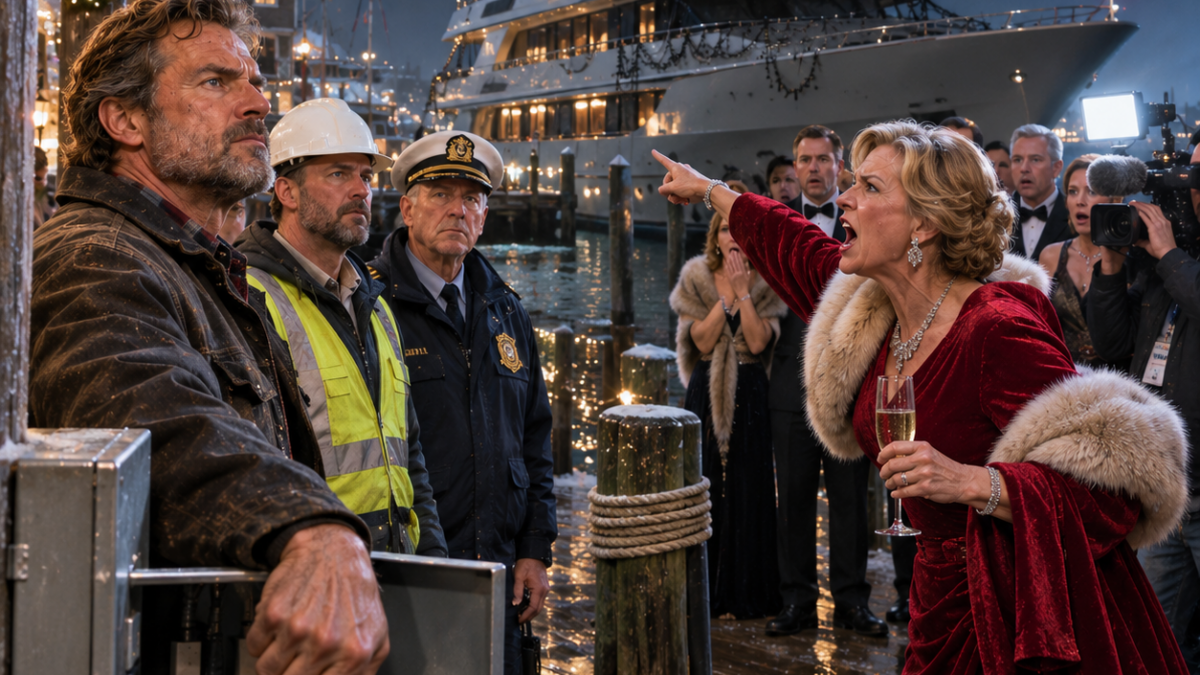
Karen walked onto the stage in a deep red gown.
Behind her, a screen displayed:
THE FUTURE OF CROWNWATER BEGINS TONIGHT.
She spoke about prosperity.
Vision.
Transformation.
Exclusive access.
A private harbor lifestyle.
Then she saw me.
I stood at the approved observation point beside Savannah.
Reed.
Harbor official.
Karen smiled.
She abandoned her prepared remarks.
“Sometimes great achievements face opposition from people who cannot see beyond their own selfish interests.”
People turned toward me.
The television camera turned too.
Karen continued.
“Some people believe owning one old dock gives them the power to block an entire community’s future.”
I remained still.
8:59.
She lifted her champagne glass.
“Crownwater will not let one small man stand in the way of one big dream.”
Then she looked directly at me.
“You have no power here, Everett.”
The camera caught every word.
I looked at the harbor official.
He checked his notes.
Nodded.
Authorized work could proceed.
Nine o’clock.
Reed isolated the decorative feed.
No sparks.
No drama.
One controlled electrical action.
Then the yacht changed.
Golden rail lights vanished.
Deck outlines disappeared.
Snowflake projectors stopped.
The huge star went black.
Thousands of decorative lights went out section by section.
Within seconds, the $200,000 Christmas spectacle became a dark white yacht floating in the harbor.
Navigation lights remained.
Safety lights remained.
Terrace lighting remained.
Nobody was in danger.
Only the show died.
The music continued for several seconds.
Painfully.
Then stopped.
Karen stared.
First at the yacht.
Then at the technicians.
“What happened?”
One staffer whispered:
“The dock feed is gone.”
“Turn it back on.”
“We can’t.”
“Why not?”
“Unauthorized connection.”
Karen turned toward me.
“What did you do?”
I stepped close enough that witnesses could hear.
“I stopped unauthorized use of my electricity.”
“You destroyed my event.”
“No.”
I pointed toward the yacht.
“Your lights are still there.”
Silence.
“The only thing missing is power you never had permission to use.”
One sponsor turned toward the event manager.
“You spent two hundred thousand dollars and didn’t secure electricity?”
No answer.
Karen grabbed the microphone.
“The HOA paid for power.”
I asked:
“Paid whom?”
She stopped.
“My company never received a dime.”
A homeowner shouted:
“Then who did?”
The terrace went quiet.
Captain Miriam Harker walked forward.
Karen pointed at me.
“Arrest him.”
Miriam remained calm.
“For what?”
“Sabotage.”
“Was equipment damaged?”
Karen hesitated.
“Look at it!”
“That wasn’t my question.”
Landon, the lighting contractor, was summoned.
He inspected.
“No damage visible.”
Karen said:
“We have a signed utility license.”
Miriam looked at me.
“Do you acknowledge signing it?”
“No.”
“I disputed it in writing and requested the original.”
Then Sterling stepped through the crowd.
Folder in hand.
“Captain?”
Karen stared.
“Sterling, not now.”
He ignored her.
“I’m the Crownwater treasurer. I have payment records you should see before anybody is accused of sabotage.”
Karen’s expression changed.
That folder was more dangerous than darkness.
Inside:
$18,600 payment.
Description:
DOCK POWER ACCESS & MARITIME UTILITY COORDINATION.
Recipient:
Wickham Seasonal Concepts.
Miriam looked at Sterling.
“Did this company supply dock power?”
“The books say yes.”
Then at me.
“Did you receive payment?”
“Nothing.”
Karen interrupted.
“My company coordinated access.”
Miriam asked:
“Where is the agreement authorizing your company to sell access to his utility infrastructure?”
Karen produced the disputed license.
My questionable signature.
Miriam took a copy.
The investigation did not end that night.
It began.
The yacht went dark at 9:00.
By 9:20, investors were asking about ownership.
One man held up his Founders Program contract.
It promised years of exclusive private berths.
He showed me the property address.
Maddox Point Dock.
My dock.
I stared.
“You signed this?”
“Yes.”
“With whom?”
“Wickham Seasonal Concepts.”
“How much?”
“Twenty-five thousand deposit.”
Another investor had the same.
Then another.
Twelve memberships.
$300,000.
Karen had not only used my power.
She had been selling future access to my property.
That was the real scheme.
The Christmas display was proof of concept.
A hundred-foot yacht glowing beside Maddox Point created the appearance Crownwater already controlled a marina.
Photographs.
Television.
Donors.
Investors.
Then after the lights, she planned to announce the private yacht club.
The illusion needed to feel real long enough for contracts to be signed.
That was why she had risked everything over one electrical cable.
The next morning, investors began demanding refunds.
The charter company refused to extend the Winter Sovereign agreement.
The lighting company scheduled dismantling.
The HOA ordered an independent audit.
The 1996 waterfront agreement was pulled from official records.
Original language:
Emergency pedestrian shoreline access.
Nothing more.
No utility rights.
No commercial marina.
No event operations.
No berth sales.
The expanded addendum Karen had shown at the board meeting?
No matching recorded original.
The temporary utility license with my signature?
Referred for forensic examination.
The financial review found more payments.
Wickham Seasonal Concepts had received approximately $67,000 in various marketing, management, utility-coordination, and event-related fees already under review.
Residents had been billed $124,700 through the special assessment.
$80,000 from the seawall reserve had funded the lighting deposit.
The entire $200,000 light package?
Rented.
Not an asset.
The yacht?
Chartered.
Not an asset.
The dock?
Mine.
The electricity?
Mine.
The marina Karen had marketed?
Didn’t exist.
On December 26, investors came to Crownwater headquarters.
One man laid his membership contract on the table.
“You told me the marina was secured.”
Karen replied:
“We are finalizing documentation.”
“No.”
He pointed.
“You took my money after telling me the facility was already under Crownwater control.”
Others demanded refunds.
Karen had spent years using confidence as evidence.
Now confidence was worthless.
December 27.
Special HOA meeting.
Eighty-six households.
Packed clubhouse.
Karen entered carrying a binder.
No applause.
Willa stood first.
She asked for accounting of:
Special assessment.
Seawall reserve.
Yacht charter.
Lighting contract.
Wickham Seasonal Concepts.
Utility payments.
Founders Program.
Dock agreement.
Karen tried to interrupt.
The meeting chair stopped her.
“For once, follow the procedure.”
That sentence almost made Savannah smile.
Sterling presented records.
Willa presented homeowner documents.
My attorney provided only what directly related to Maddox Point.
No grandstanding.
No speeches.
Facts.
Then the vote.
Remove Karen Wickham as HOA president.
Eighty-two in favor.
Four abstained or did not participate.
More than ninety-five percent of participating households wanted her gone.
Nobody cheered.
That surprised me.
People were angry.
But they were also embarrassed.
Some had trusted her.
Some had defended her publicly.
Some had paid money believing they were investing in something real.
The interim board authorized a complete forensic audit.
Frozen discretionary accounts.
Preserved records.
Notified insurers.
Reviewed vendor conflicts.
Demanded refund accounting.
My civil attorney filed for protection of Maddox Point.
The court issued temporary restrictions preventing the HOA, Karen’s company, or related parties from promoting or representing my dock as an asset of the Crownwater marina program without lawful authorization.
I pursued actual damages.
Stolen electricity.
Repairs.
Inspection costs.
Business interruption.
Lost commercial work.
No fantasy number.
Only what we could prove.
That was enough.
The Winter Sovereign left on schedule.
Crews dismantled the show.
Star came down.
Lights coiled into cases.
Projectors removed.
Decorative structures packed.
The “iconic Crownwater yacht” became what it had always been:
A rented boat returning to its owner.
Landon stood on the pier checking equipment.
Savannah watched.
He said:
“I’ve installed bigger shows than this.”
“Really?”
“Vegas. Miami. Corporate events.”
She looked at the dark yacht.
“Ever seen one remembered because it shut off?”
He laughed.
“No.”
A few days later, Karen came to Maddox Point to collect personal event items.
Pre-arranged.
No entourage.
No camera.
No security.
No donors.
She walked toward me while Savannah and I inspected the sealed electrical panel.
“Are you happy now?”
I looked up.
“What?”
“You turned everybody against me.”
I shook my head.
“You did that.”
“I was trying to build something for this town.”
“With other people’s property.”
“You humiliated me.”
“I disconnected my electricity.”
“You knew what would happen.”
“Yes.”
“You could have waited until after Christmas.”
“You had weeks to fix it.”
She looked toward the harbor.
“All I wanted was to give Grey Haven a Christmas nobody would forget.”
I nodded.
“You did.”
She looked back.
“Just not the way you planned.”
She left.
The legal and financial investigations continued long after the decorations disappeared.
Refund demands from investors.
Questions over self-dealing.
Disputed documents.
Reserve-fund transfers.
Unauthorized utility billing.
Potential personal liability for promises made through Karen’s private company.
I did not need to know the final outcome of every issue to know one thing:
The illusion was over.
Without borrowed lights, borrowed yacht, borrowed dock, and stolen electricity, there was nothing left to photograph.
Months later, the new Crownwater board requested a meeting.
Sterling remained temporarily as treasurer during the transition.
Willa attended as a homeowner representative.
They sat in my office.
New board president said:
“Would you ever consider a legitimate waterfront agreement?”
“Maybe.”
Everyone looked surprised.
I continued.
“Written.”
“Yes.”
“Insured.”
“Yes.”
“Market rate.”
“Yes.”
“No interference with commercial operations.”
“Agreed.”
“No HOA security controlling my road.”
“Absolutely.”
“Electrical use separately metered.”
“Yes.”
“And one more thing.”
The president waited.
“Never call someone else’s property community property because you want to use it.”
Silence.
Then:
“Agreed.”
That was enough.
One evening after they left, I walked down the pier alone.
Cold water.
Lighthouse beam crossing the harbor.
Fishing boat returning late.
Our electrical system had been sealed and re-certified.
Meter back to normal.
Cold storage humming.
Maintenance bay lights on.
Everything working.
The way infrastructure should.
Quietly.
Savannah joined me.
“You know what the funniest part is?”
“What?”
“She told you that you had no power.”
I looked at her.
“Please don’t.”
“At 8:59.”
“Savannah.”
“Then at 9:00—”
“I understand the joke.”
She laughed.
I did too.
But that was not the lesson.
I had not won because I could switch something off.
I won because I knew exactly what I owned and exactly what I did not.
I owned the dock.
The meter.
The electrical infrastructure.
The road.
The right to say no.
I did not own the yacht.
So I did not touch it.
I did not own the lighting equipment.
So I did not damage it.
I did not control Crownwater’s accounts.
So I let the treasurer and auditors investigate them.
I did not run Harbor Police.
So I gave them evidence.
I did not decide whether Karen committed crimes.
That belonged to investigators and courts.
That distinction mattered.
Karen’s entire problem had started because she never respected it.
She treated permission like an inconvenience.
Ownership like a story.
HOA authority like government authority.
Residents’ money like her project fund.
My power like her power.
My dock like her marina.
A rented yacht like a permanent asset.
A temporary light show like a real investment.
Then she stood in front of eighty-six people and declared I had no power.
She was right about one thing.
The power was never hers.
On Christmas Eve, I did not smash a $200,000 display.
Did not sabotage a yacht.
Did not endanger guests.
A licensed electrician safely isolated one unauthorized decorative circuit after repeated warnings and documented review.
The safety systems stayed on.
The equipment stayed intact.
Only the electricity Karen had taken stopped flowing.
And when the lights disappeared, so did the illusion.
Without the glitter, people could finally see the invoices.
The fake access claims.
The undisclosed payments.
The $80,000 reserve transfer.
The $124,700 assessment.
The $300,000 in marina deposits.
The rented yacht.
The rented lights.
The dock she did not own.
Sometimes darkness does not hide the truth.
Sometimes it is the first time anyone can see it clearly.
Karen Wickham thought $200,000 worth of Christmas lights would make Crownwater Heights look powerful.
All they really did was illuminate how much she had been using that belonged to someone else.
At 9:00 p.m., the lights went out.
And that was when everyone finally started looking at the paperwork.








