HOA Karen Stole My Late Wife’s $90,000 Mustang for Her Son—Then He Hit the Brake Pedal and It Went Straight to the Floor
PART2:
But if an ambulance appeared before eight in the morning, thirty front doors opened within five minutes.
I saw Eileen Parrish across the street in slippers and a blue robe, phone already in her hand.
Mr. Whitcomb from number eleven stood by his mailbox.
The Ramirez family watched from their porch.
Three houses down, someone was filming.
Good.
I wanted witnesses.
Not because I knew how bad things were about to become.
Because by then I had learned what Meredith Stanhope did when there were no witnesses.
She rewrote reality.
My name is Jack Dunlap.
I was fifty-four years old that morning.
For twenty-two years, I had lived quietly in Cedar Ridge Estates outside Columbus, Georgia.
Three-bedroom ranch.
Two-car garage.
Half-acre lot.
Nothing fancy.
I fixed engines for a living.
Mostly restoration work.
Muscle cars.
Old trucks.
Farm equipment when someone was desperate.
I had no interest in HOA politics.
No lawn signs.
No neighborhood committees.
No Facebook arguments.
I paid dues.
Mowed my grass.
Kept the trash cans behind the fence.
Waved when people waved first.
PART2:
If you had asked most of my neighbors what they knew about me before that week, they probably would have said:
Quiet guy.
Mechanic.
Wife died.
Works late in the garage.
That was exactly how I wanted it.
Laura had liked people enough for both of us.
She was the one who remembered birthdays.
Joined the Christmas decoration committee.
Brought casseroles when someone had surgery.
Knew which neighbor’s kid got into Auburn and whose mother had Alzheimer’s.
When she died, my world got smaller.
I let it.
Laura and I met when we were twenty-seven.
She worked the service counter at a parts store outside Nashville.
I came in looking for a fuel pump for a 1971 Chevelle.
She told me I had the wrong part number.
I told her I didn’t.
She disappeared into the back room and returned with a box.
Wrong part.
Mine.
Then she handed me the correct one.
“Anything else?”
I asked for her number.
She said:
“That depends. You going to argue about that too?”
I married her sixteen months later.
The Mustang came the year after.
We were twenty-eight when Laura spotted it behind an old barn in Tennessee.
We had been driving to see her aunt.
Laura pointed through the passenger window.
“Stop.”
“What?”
“Stop the truck.”
I thought she’d seen an animal.
Instead she climbed out, walked up a dirt lane, and knocked on a stranger’s door.
Thirty minutes later, she came back grinning.
“What did you do?”
“Bought a Mustang.”
I stared at her.
“We don’t have Mustang money.”
“We have this Mustang money.”
The car had weeds through the wheel wells.
One quarter panel eaten by rust.
No usable interior.
Mice in the trunk.
Engine seized.
Candy-apple red hidden beneath decades of dirt.
I said:
“Laura, that’s not a car.”
She ran one hand across the roof.
“It will be.”
That sentence became our marriage in miniature.
It will be.
House needed work?
It will be.
Money tight?
We’ll figure it out.
Pregnancy loss?
We’ll survive.
My long deployments?
We’ll get through.
Her cancer diagnosis?
At first, even then:
We’ll fight it.
We rebuilt the Mustang slowly.
Not because it required twenty years.
Because life kept interrupting.
Mortgage.
Work.
Family.
Then parts got expensive.
Then I deployed.
Then Laura started helping at a nonprofit and decided every spare dollar should go somewhere more useful.
We joked that the Mustang was our retirement marriage counselor.
Whenever we were irritated with each other, we worked on the car.
Hard to stay angry while one person is holding a flashlight and the other is lying under a transmission.
We rebuilt the engine twice.
Found original trim.
Changed the rear end.
Reupholstered the seats.
Sandblasted.
Primed.
Painted.
Candy-apple red again.
Laura chose the exact shade.
Then she got sick.
Pancreatic cancer.
By the time they found it, there was no heroic treatment plan.
There was treatment.
Hope.
Bad scans.
Better weeks.
Worse ones.
Hospitals teach you how quickly a future can shrink.
First you plan years.
Then months.
Then whether someone will feel well enough next Saturday.
Two days before Laura died, she was barely awake.
I sat beside the hospital bed holding her hand.
She opened her eyes.
“Jack.”
“I’m here.”
“The car.”
I thought medication had confused her.
“What about it?”
“You didn’t finish it.”
I laughed.
She smiled weakly.
“Typical.”
“We’ve got time.”
She knew I was lying.
I knew she knew.
She squeezed my fingers.
“Finish it.”
I couldn’t speak.
“And drive it.”
“Laura—”
“Don’t turn that garage into a museum.”
That was her.
Dying and still issuing maintenance instructions.
“Promise.”
I looked away.
“Jack.”
“I promise.”
She died the next morning.
For almost a year, I couldn’t touch the Mustang.
Then one Sunday, I went into the garage and pulled off the cover.
Dust everywhere.
One of Laura’s old gloves sat on the workbench.
I spent six hours cleaning tools.
The next weekend, twelve.
Slowly, I started again.
By the fall two years after her death, the car was close.
Engine ran beautifully.
Transmission rebuilt.
Interior nearly done.
But the brake system needed complete replacement.
I had removed the master cylinder.
Disconnected lines.
Calipers sat on the bench.
The Mustang could move under engine power.
It could not stop.
That distinction mattered.
So I treated it like a loaded weapon.
Wheel chocks.
Parking brake disabled so nobody would mistake it for functional service braking.
Bright orange warning tag tied directly through the steering wheel:
NO BRAKES
DO NOT DRIVE
BRAKE SYSTEM REMOVED
I also kept the keys hidden in a magnetic box inside my locked tool cabinet.
Or I thought I did.
Monday morning, I opened my front door and found a pink HOA violation notice taped to the glass.
INOPERABLE VEHICLE VISIBLE FROM STREET.
48 HOURS TO REMOVE OR REMEDY.
Fine schedule attached.
Signed:
MEREDITH STANHOPE
PRESIDENT
CEDAR RIDGE ESTATES HOA
I read it twice.
Then looked at the driveway.
The Mustang sat under a fitted gray cover.
You could see four tires.
Maybe two inches of red body at the bottom.
That was enough, apparently.
I had lived there twenty-two years.
Worked on cars nearly all of them.
Nobody had cared.
Then Meredith became HOA president.
Everyone knew her.
Mid-forties.
Perfect blond hair.
White SUV.
Red blazer at board meetings.
A woman who walked the neighborhood carrying a clipboard as if zoning violations might flee if not documented immediately.
She had fined a widow over a wind chime.
Sent three notices to the Ramirezes because their basketball hoop leaned six inches beyond a line only Meredith seemed able to see.
Threatened an elderly man over the color of his mailbox.
Her defenders called her organized.
People who had lived under her longer called her dangerous.
I usually called her nothing.
People like Meredith feed on reaction.
I went to the clubhouse that evening.
Board meeting.
Six residents.
Three board members.
Meredith at the center table.
I waited until public comments.
“Mrs. Stanhope.”
She looked up briefly.
“Jack, right?”
We had lived four streets apart for more than a decade.
“Jack Dunlap.”
“What can we do for you?”
I placed the notice on the table.
“This.”
“Inoperable vehicle.”
“Temporary repair.”
“Our covenants prohibit disabled vehicles visible from common roads.”
“The brakes are out.”
“Then it’s inoperable.”
“Yes.”
She smiled as though I had admitted guilt at trial.
“I need thirty days.”
“You have forty-eight hours.”
“The car has to stay where it is until the brake system is finished.”
“Then put it in your garage.”
I had two bays.
One occupied by a customer’s truck on an engine stand.
The other full of brake parts, tools, and restoration equipment because I’d moved the Mustang outside that morning to create workspace.
“I can’t move it safely.”
“Tow it.”
“To where?”
“Storage.”
“I’m not paying hundreds of dollars to move my wife’s car because you can see tires beneath a cover.”
That got her attention.
“Your wife’s?”
“She died two years ago.”
For half a second, I thought humanity might enter.
Instead Meredith checked her phone.
“Mr. Dunlap, personal circumstances do not override recorded covenants.”
I stared.
The treasurer, Bruce Kimball, looked uncomfortable.
I said:
“Give me thirty days.”
Meredith set her phone down.
“Thirty?”
“Probably less.”
“No.”
“Two weeks.”
“No.”
“Then what exactly do you want?”
“Compliance.”
“That isn’t an answer.”
“It is the only answer you need.”
Then she smiled.
“Don’t worry. If you refuse, the board can handle removal.”
I felt something cold behind my ribs.
“You’re threatening to tow a vehicle from private property?”
“Enforcement authority is in the covenants.”
“Tow it where?”
“Mr. Dunlap, we’re done.”
I left.
At the end of my driveway, someone stood beneath the streetlight.
Tyler Stanhope.
Seventeen.
Tall.
Skinny.
Dark hair.
Meredith’s son.
He stared at the covered Mustang.
“You restoring that?”
I stopped.
“Yeah.”
“What year?”
“Sixty-seven.”
“Fastback?”
“Yeah.”
He grinned.
“That’s sick.”
Teenager language for good, apparently.
“Not finished.”
“Can I see?”
“No.”
He looked disappointed.
Then laughed.
“My mom hates cars in driveways.”
“I noticed.”
“She’ll probably tow it.”
The way he said it bothered me.
Not malicious.
Casual.
As if his mother towing private property was a household habit.
“Nobody’s touching it.”
Tyler shrugged.
“Okay.”
He walked away.
Before bed, I installed two additional cameras.
One over the driveway.
One inside the garage facing outward.
Maybe paranoid.
Laura used to say my version of paranoia was just preparation with worse public relations.
Friday morning, I drove four hours east for the memorial service of an Army friend.
Colonel Michael Reeves.
Cancer.
Sixty-two.
Good man.
We had served together long before anyone in Cedar Ridge knew me.
I planned the trip for weeks.
Eileen Parrish, my neighbor, agreed to keep an eye on the house.
“Anybody touches that Mustang, I’ll shoot them.”
“You don’t own a gun.”
“I’ll buy one.”
“Eileen.”
“Fine. I’ll call you.”
I checked cameras before leaving.
Cover secure.
Orange warning tag in place.
Keys locked.
Everything fine.
Saturday at 2:17 p.m., my phone rang.
Eileen.
I was an hour outside Augusta.
Her voice shook.
“Jack.”
“What happened?”
“They took Laura’s car.”
I pulled onto the shoulder so hard gravel sprayed.
“Who?”
“The HOA.”
“What?”
“A tow truck.”
I opened the camera app.
Playback.
12:43 p.m.
Flatbed enters driveway.
No police.
No posted court order.
No sheriff.
Two men step out.
Then Meredith.
White pants.
Red blouse.
Sunglasses.
Arms crossed.
One tow operator lifted the cover.
The other inspected wheels.
I heard one say:
“Ma’am, this thing looks under repair.”
Meredith answered:
“It’s abandoned property under HOA enforcement.”
“Keys?”
“I have access authorization.”
Then the video showed something that made my stomach turn.
She walked directly to the side door of my garage.
Entered a code.
Door opened.
My code.
I had never given it to her.
Then I remembered.
HOA emergency contact form.
Years ago, Laura and I had listed the garage keypad code for fire-access purposes during long deployments.
I had changed it once.
But apparently the old code still operated the side keypad.
Meredith disappeared inside.
Came back carrying my Mustang keys.
My hands went cold.
The tow operator asked:
“Where’s impound?”
Meredith gave an address I couldn’t hear.
Then she stood beside the car while they winched it.
The orange warning tag remained visible through the windshield.
She saw it.
The camera zoom wasn’t great.
Still enough.
Her hand reached in.
Pulled something from the steering wheel.
Tag gone.
Then her voice:
“Perfect. Tyler’s going to lose his mind.”
I replayed it.
Once.
Twice.
Third time.
Not enforcement.
Not towing.
Theft.
I called county dispatch.
Explained.
They transferred me to Cedar Ridge police liaison because our neighborhood fell under municipal jurisdiction.
Captain Rick Palmer answered.
“Palmer.”
“My name is Jack Dunlap. A vehicle was just removed from my private driveway by my HOA.”
“HOA tow?”
“Unauthorized.”
“Sir, HOA disputes are generally civil.”
“They entered my garage and took my keys.”
Pause.
“Do you have proof?”
“Video.”
“Then preserve it.”
“I need an officer.”
“You’re four hours away?”
“About three now.”
“Return home and file a report.”
“Where was the car taken?”
“How would I know?”
“Because the HOA president’s brother-in-law is a police captain.”
Silence.
That was me taking a shot.
I’d heard Palmer was related to Meredith through marriage.
His wife was her husband’s sister.
Then Palmer said:
“I’d be careful making accusations.”
“I just watched her steal my car.”
“You watched the HOA enforce a covenant.”
“No.”
“Mr. Dunlap, Meredith Stanhope is family to me, but that has nothing to do with this.”
The fact he volunteered it told me everything.
Then:
“Don’t make this harder than it is.”
I hung up.
Sat inside my truck with traffic vibrating beside me.
My hands shook.
Not fear.
Rage.
The dangerous kind.
The kind that makes a man believe movement is action.
I wanted to drive straight home and kick Meredith’s door in.
Instead I called Harold Mitchell.
Chief of Police.
We had not spoken socially in almost a year.
He answered on the third ring.
“Jack?”
“I need help.”
His tone changed instantly.
“What happened?”
I told him.
Not everything.
Car stolen.
Possible police conflict.
Video.
No brakes.
Harold went silent.
“No brakes at all?”
“Master cylinder out. Lines open.”
“Where’s the vehicle?”
“Don’t know.”
“Who took it?”
“Meredith Stanhope.”
Another pause.
“Palmer involved?”
“He brushed me off.”
Harold said:
“Don’t confront anyone.”
“I already know where this is going.”
“No, Jack. Listen to me.”
I heard movement on his end.
“Don’t touch anything. Preserve every video. I’m on my way.”
“Harold—”
“That’s an order.”
“You don’t outrank me anymore.”
“I outrank you in common sense.”
That almost made me smile.
I reached Cedar Ridge at 9:04 p.m.
Empty driveway.
Jack stands knocked sideways.
Cover in the grass.
Orange warning tag near the gutter.
Eileen came across the lawn.
She was crying.
“I’m sorry.”
“You didn’t do anything.”
“I tried to stop them.”
“You shouldn’t have.”
“I told Meredith you’d call police.”
“What did she say?”
Eileen looked down.
“She said she already had the police.”
That phrase stayed.
Already had the police.
“Which way did the truck go?”
“Left.”
“Tow yard is right.”
“Exactly.”
Magnolia Court was left.
Meredith’s street.
I walked.
Five minutes.
Her house sat near the cul-de-sac.
White columns.
Three-car garage.
Landscaping that probably had its own insurance.
I rang.
Meredith opened holding iced tea.
At nine at night.
Some people seem born with props.
“Where’s my car?”
She leaned against the door.
“Impounded.”
“Where?”
“You’ll receive notice.”
“Where?”
“Your outstanding violations total forty-eight hundred dollars.”
“I got one notice Monday.”
“Late fees.”
“In four days?”
“Administrative penalties.”
“Where is my car?”
She smiled.
“Pay the balance.”
I stepped closer.
Her smile faded slightly.
“The car has no brakes.”
“So you’ve claimed.”
“I’m telling you because somebody could die.”
“If it’s unsafe, you shouldn’t have kept it in your driveway.”
“Meredith.”
“Mr. Dunlap.”
“If anyone drives that Mustang, it will not stop.”
“Sounds convenient.”
“What?”
“An excuse now that enforcement finally has consequences.”
I stared at her.
Then heard laughter upstairs.
Teenage voice.
Tyler.
My gut tightened.
“Your son knows where the car is.”
Her eyes changed.
Barely.
“Go home, Jack.”
“Where is Laura’s car?”
She shut the door in my face.
I stood there for a long time.
Then walked away.
At eleven, I found the tow driver.
Eileen had written the company name.
Drosty Recovery.
I drove to their lot.
Closed.
Then saw a tow truck at a gas station.
Same number.
Driver inside buying coffee.
Lenny Drosty.
Orange cap.
Sweat-stained coveralls.
I waited.
When he came out:
“You towed my Mustang.”
He froze.
“No.”
I held up my phone.
Played video.
His face changed.
“Listen, man—”
“Where did you take it?”
“I don’t want trouble.”
“You have it already.”
“HOA paperwork said seizure.”
“You entered private property.”
“She had keys.”
“Where?”
He looked around.
“Fourteen Magnolia.”
Meredith’s house.
“Why?”
Lenny rubbed his face.
“She said HOA took title.”
“When?”
“Same day.”
“How?”
“Lien sale.”
“Show me.”
“I can’t.”
“Lenny.”
I stepped closer.
“I’m not threatening you. But that car has no brakes, and if her kid drives it tonight, you are going to remember this conversation for the rest of your life.”
He went pale.
Then opened the truck cab.
Pulled a folded receipt from behind the visor.
DELIVERY: 14 MAGNOLIA COURT.
SOLD TO: M. STANHOPE.
PRICE: $1,500.
I stared.
The Mustang was worth somewhere between seventy-five and ninety thousand restored.
Maybe more because of the parts and provenance.
Fifteen hundred.
Under it:
LIEN AUCTION.
Auction date listed three days earlier.
Before the tow.
Impossible.
Authorized signature:
BRUCE KIMBALL
TREASURER
I photographed everything.
“Who gave you this?”
“Meredith.”
“Did you see an auction?”
“No.”
“You didn’t think fifteen hundred for that car was odd?”
“She told me title was clouded.”
“Did you get title?”
“No.”
“So you delivered a ninety-thousand-dollar vehicle to her house with no title.”
Lenny looked sick.
“I tow stuff. I don’t—”
“That isn’t going to help you.”
He swallowed.
I called Bruce.
No answer.
Again.
Again.
Fourth call.
“Jack?”
“You signed a lien sale on my Mustang.”
Silence.
“Bruce.”
“I can’t talk.”
“Did you sign it?”
“No.”
“Then whose signature is this?”
“Jack—”
“Did you sign it?”
“No.”
Whispered.
Then:
“Please don’t tell her I called.”
Line dead.
I barely slept.
At 6:30 Sunday morning, Eileen knocked.
“You need to see this.”
She held her phone.
Video from her upstairs window.
Magnolia Court.
The Mustang in Meredith’s driveway.
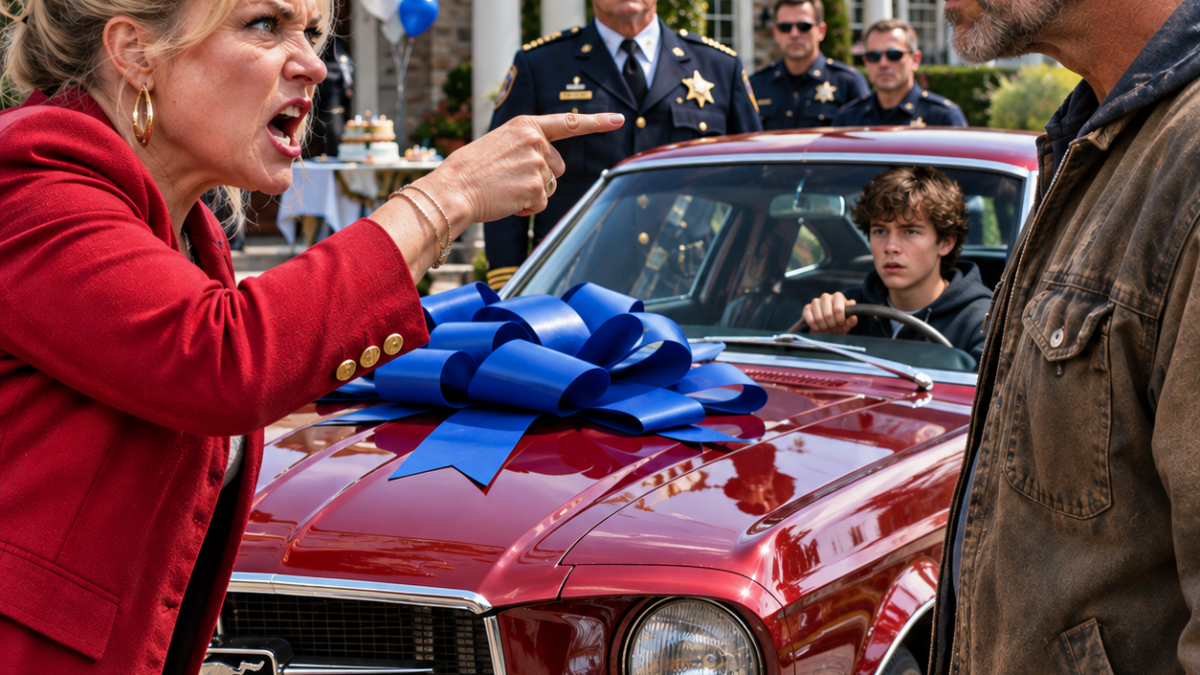
Blue bow across the hood.
Balloons.
A banner:
HAPPY 17TH TYLER.
I stopped breathing.
“She gave it to him.”
Eileen nodded.
I ran.
No jacket.
No truck.
Just ran.
By the time I reached Magnolia, neighbors were outside.
Birthday setup.
Cake table.
Meredith filming.
Tyler beside the Mustang.
Blue bow.
Keys in hand.
I screamed:
“TYLER!”
People turned.
“DO NOT START THAT CAR!”
Meredith looked over.
Her face hardened.
“What are you doing here?”
Tyler grinned nervously.
“Mr. Dunlap, my mom bought it.”
“She stole it.”
Meredith raised her phone.
“Keep going, honey.”
I ran closer.
“It has no brakes!”
Tyler hesitated.
Meredith laughed.
“He told me you’d say that.”
I stopped.
“What?”
She walked toward Tyler.
“He’s trying to ruin your birthday.”
“Check the tag.”
Tyler glanced inside.
There was an orange tag on the passenger floor.
My tag.
Meredith said:
“Throw that stupid thing away.”
“Tyler, listen to me.”
The boy looked between us.
“Brake pedal goes to the floor. Master cylinder is not installed. Do not move that car.”
Meredith snapped:
“Get in.”
“Mom—”
“Tyler.”
That tone.
Children know it.
Obey or pay later.
Tyler climbed behind the wheel.
I started toward him.
Meredith blocked me.
“You touch my son, I’m calling police.”
“Call them.”
The engine turned.
Caught.
The exhaust note rolled across Magnolia Court.
Laura loved that sound.
She used to grin every time.
That morning it terrified me.
Tyler revved once.
Meredith filmed.
“Happy birthday, baby!”
I shouted:
“PUT IT IN PARK!”
Tyler shifted.
The driveway sloped toward the street.
The Mustang rolled.
At first slowly.
Tyler pressed the brake.
His face changed.
The pedal went to the floor.
He pumped it.
Nothing.
“Mom!”
I ran.
“TURN THE WHEEL! KILL THE ENGINE!”
He panicked.
Hit accelerator instead.
The Mustang jumped curb.
Through hedge.
Patio chairs exploded outward.
Tyler tried steering away from people.
That part mattered.
He managed.
The front end hit Meredith’s stone steps.
Metal screamed.
Engine stalled.
Silence.
Then Meredith screamed.
I got there first.
Door jammed.
I pulled.
Opened.
“Tyler.”
He was conscious.
Shaking.
“My wrist.”
“Don’t move.”
“I can’t—”
“Look at me.”
He did.
“Breathe.”
Blood near eyebrow.
No obvious neck injury.
Airbag hadn’t deployed because the Mustang didn’t have one.
Seatbelt had held.
“Keep your head still.”
Neighbors ran.
Someone called 911.
Meredith arrived.
She shoved me.
“Get away from him!”
“He needs to stay still.”
“You did this!”
I looked at her.
“Call an ambulance.”
“I already did!”
“Good.”
She knelt.
“Tyler, baby.”
He stared at her.
Something had changed.
Not only pain.
Fear of her.
Ambulance arrived in four minutes.
Police in less than two.
Captain Rick Palmer first.
Officer Cody Bennett behind him.
That speed told me someone had made a private call before the public one.
Meredith ran.
“Rick! Arrest him!”
Palmer stepped out.
“What happened?”
“He gave Tyler a defective car.”
“No,” I said.
Meredith pointed.
“He sabotaged it.”
I laughed once because the alternative was hitting something.
“My car was stolen from my driveway.”
Palmer ignored me.
“Tyler, can you talk?”
Paramedic said:
“Give us space.”
Meredith kept going.
“He knew Tyler was getting it. He disconnected the brakes.”
“I disconnected the brakes before the car was stolen because I was rebuilding them.”
Palmer turned.
“Jack, turn around.”
“What?”
“You’re under arrest pending investigation for reckless endangerment.”
I stared.
“You haven’t investigated anything.”
“Turn around.”
“Check the vehicle.”
“Jack.”
“Check the brake pedal. Master cylinder. Lines.”
Bennett hesitated.
Palmer snapped:
“Cody.”
The younger officer looked at him.
Then at the car.
Then at me.
“I’m checking the car, Captain.”
Palmer’s jaw tightened.
Bennett knelt beside the wreck.
Flashlight.
Opened hood.
Looked near firewall.
Then under car.
When he stood, his face had gone pale.
“Captain.”
“What?”
“Master cylinder is missing.”
Palmer said nothing.
“Brake lines are open.”
Meredith shouted:
“Exactly! He sabotaged it!”
Bennett looked at her.
“Ma’am, those parts look like they’ve been removed for service.”
I held up my phone.
“Video.”
Palmer ignored it.
I pressed play anyway.
Flatbed.
Driveway.
Meredith.
Keys.
Warning tag.
Her voice:
“Perfect. Tyler’s going to lose his mind.”
The entire street went silent.
Eileen stepped forward.
“I filmed this morning too.”
Meredith turned.
“You need to stay out of this.”
Eileen held up her phone.
“I got you telling Tyler the warning tag was fake.”
Meredith’s face went white.
Then red.
“Those videos can be edited.”
Nobody spoke.
“AI,” she said.
That was apparently where we were in history now.
Every incriminating video could simply be called artificial intelligence.
Then Tyler spoke from the steps.
“Mom.”
Meredith turned.
“Sweetheart, don’t talk.”
“You told me.”
Her face hardened.
“Tyler.”
“There was a warning.”
“You’re medicated.”
The paramedic said:
“He hasn’t received medication yet.”
A neighbor coughed.
Tyler’s eyes filled.
“You told me to rip it off.”
Meredith whispered:
“Stop.”
“You said he was trying to scare us.”
“Tyler.”
“You said the car was ours.”
Palmer stepped forward.
“Son, let the adults handle this.”
Tyler looked at him.
“You knew too.”
That landed.
“What?”
“You told Mom nobody could do anything because HOA took it legally.”
Meredith stood.
“He’s confused.”
I looked at Palmer.
He looked at me.
And I knew.
Whatever happened next was no longer ignorance.
He knew there was evidence.
He knew the vehicle had been stolen.
He knew Meredith had lied.
And he still reached for me.
“Turn around.”
“You’re serious?”
“Now.”
“Rick.”
My voice changed.
He probably heard something in it.
So did I.
The old command tone.
The one I had buried under twenty years of carburetors and invoices.
Palmer grabbed my arm.
Twisted it.
I could have stopped him.
That isn’t bravado.
I had spent most of my adult life learning how to prevent men from controlling my body.
But I was fifty-four.
He was a police captain.
Neighbors were filming.
The worst thing I could do was give him the resistance he wanted.
So I let him cuff one wrist.
Meredith smiled.
Actually smiled.
“Take him in.”
The metal tightened.
Then I heard engines.
Several.
Fast.
At the end of Magnolia Court, three black-and-white SUVs turned in.
Lights flashing.
Another dark state vehicle behind them.
Palmer froze.
I thought:
Finally.
Chief Harold Mitchell stepped from the first SUV.
Sixty.
Tall.
Silver hair.
Dress uniform because he had been at a civic ceremony that morning.
The word “pressed” was probably the correct description, though one of the neighbors later told a reporter he looked “depressed,” which amused Harold for months.
He saw Palmer.
Then me.
Then the cuff.
His jaw tightened.
“Captain.”
Palmer straightened.
“Chief.”
“Take that off him.”
“Sir, we have a reckless-endangerment—”
“Remove. The. Cuff.”
Palmer fumbled with the key.
Metal dropped.
I rubbed my wrist.
Harold walked toward me.
For a moment, he looked like the younger man I remembered from fourteen years earlier.
Then he stopped.
Squared his shoulders.
Raised his right hand.
Saluted.
Crisp.
Every uniformed officer behind him followed.
The neighborhood went silent.
Harold said loudly enough for everyone to hear:
“Master Sergeant Jack Dunlap, sir. On behalf of this department, I apologize for what happened here.”
Meredith’s mouth opened.
Palmer stared.
I hated the attention instantly.
I always had.
“Harold.”
He lowered his hand.
“You didn’t need to do that.”
“Yes, I did.”
Meredith found her voice.
“What is this?”
No one answered.
She looked around.
“Why are they saluting him?”
I could have said nothing.
Probably should have.
But sometimes secrecy becomes a privilege you no longer get to keep when another person has weaponized anonymity against you.
Fourteen years earlier, in Afghanistan, I had been Master Sergeant Jack Dunlap.
Special operations support.
A mission went bad on a mountain I still sometimes saw when I closed my eyes.
Convoy hit.
Ambush.
Comms down.
Eleven men wounded across a ridge.
We spent hours moving them.
Carrying.
Dragging.
Returning.
Again.
Again.
One of those men was Harold Mitchell’s younger brother, David.
Twenty-four years old.
Shrapnel through his leg and abdomen.
I carried him more than half a mile after our extraction position became untenable.
Then went back.
I did not do it alone.
Men who later died helped.
Men whose names nobody in Cedar Ridge would recognize.
The Army awarded me the Medal of Honor.
I accepted because refusing would have insulted the people who never came down that mountain.
Then I put it in a drawer.
Not literally forever.
There were ceremonies.
Obligations.
But I did not build my life around it.
Laura understood.
She once told me:
“The worst day of your life shouldn’t have to become your personality because other people think it makes a good story.”
So Cedar Ridge never knew.
I repaired engines.
That was enough.
Harold knew.
David knew.
A few old friends.
Meredith did not.
She stared at me like I had changed species.
“You?”
I looked at her.
“Yeah.”
Tyler stared too.
Palmer’s face had drained.
Harold turned toward him.
“Captain Palmer, hand me your badge.”
“Chief—”
“Now.”
“This is a misunderstanding.”
“You attempted to arrest a crime victim after evidence showed a family member stole his vehicle.”
“HOA seizure—”
Harold turned to Officer Bennett.
“Did you inspect the vehicle?”
“Yes, sir.”
“Brake system?”
“Disabled for repair. Consistent with Mr. Dunlap’s statement.”
“Warning tag?”
“Recovered from the scene.”
“Video?”
“Shows removal from private property.”
Harold looked at Palmer.
“Badge.”
Palmer removed it.
Slowly.
Then body camera.
Duty weapon remained holstered until another supervisor arrived.
Administrative relief.
Not dramatic arrest.
Procedure.
That mattered.
Harold was not there to stage revenge.
He was there to stop corruption from getting worse.
Meredith began shouting about attorneys.
“This is outrageous.”
A man stepped from the dark state SUV.
Marcus Teller.
Georgia Bureau of Investigation financial-crimes investigator.
He carried a folder.
“Mrs. Stanhope?”
She stopped.
“I’m Investigator Teller.”
“I don’t care who you are.”
“You may in a minute.”
He looked toward me.
“Mr. Dunlap, we spoke with Bruce Kimball this morning.”
I had not called Marcus.
Harold had.
Bruce apparently called too.
Meredith’s eyes changed.
“Bruce has nothing to do with this.”
Marcus opened the folder.
“He disagrees.”
By noon, Cedar Ridge’s HOA office was under evidence hold.
By evening, what looked like theft of one Mustang had become something much larger.
Bruce Kimball confessed.
Not to everything immediately.
People rarely do.
First he denied.
Then blamed Meredith.
Then admitted he had known about irregular fines.
Then admitted there was a private account.
Then forged lien documents.
Then vehicles.
Eleven.
Cars.
Boat trailers.
One fishing boat.
Two motorcycles.
A golf cart.
Each involved the same basic pattern.
HOA violation.
Escalating penalties.
Lien threat.
Fake notice.
Sham auction with minimal or no public notice.
Assets transferred for absurdly low values to Meredith, friends, relatives, or shell buyers.
Then resold.
Homeowners who fought were threatened with larger fines.
Some paid.
Some moved.
One elderly couple lost a restored pickup that had belonged to their son who died in Iraq.
That fact nearly made me lose control.
I asked Marcus for the name.
He wouldn’t give it during investigation.
Later I met them.
Mr. and Mrs. Howard.
Their truck had been “sold” for two thousand dollars.
Market value nearly forty.
Gone.
Meredith had not invented all of it.
That was important.
Bruce participated.
A property-management contractor helped manipulate notices.
A former board secretary signed documents she later claimed she did not understand.
Captain Palmer had intervened in at least four complaints.
Each time labeling them civil matters before meaningful review.
Maybe he did it because Meredith was family.
Maybe because he enjoyed being useful to powerful people.
Maybe money.
Investigators would answer parts of that later.
But the pattern was real.
More than six hundred thousand dollars flowed through accounts tied to HOA assessments, penalties, and unauthorized sales over six years.
Meredith had not stolen from me because I was special.
I was simply the first person she stole from who had cameras, a mechanical warning impossible to explain away, a witness, a tow receipt, a treasurer ready to crack, and a police chief who knew exactly who I was.
That realization mattered.
Because for the first twenty-four hours after the crash, neighbors treated me differently.
Not because of the evidence.
Because of the medal.
People who had barely waved suddenly came to my door with casseroles.
A teenager asked for a photograph.
One man said:
“If we’d known who you were, Meredith never would’ve messed with you.”
That sentence made me angry.
“She shouldn’t have done it if I was nobody.”
He looked embarrassed.
That was the point.
I did not deserve my car back because of Afghanistan.
The Howards deserved theirs too.
So did every quiet person whose résumé Meredith never bothered to investigate.
The Mustang went to a secure restoration facility for evidence photography.
Seeing it loaded onto another flatbed nearly broke me.
Tyler watched from his driveway.
Cast on his wrist.
Cut bandaged.
Meredith had been taken inside for questioning, then released pending formal charges.
He looked alone.
I walked toward him.
Harold said quietly:
“Jack.”
“I’m not going to hurt him.”
“I know.”
Tyler looked down.
“I’m sorry.”
I stopped.
“For what?”
He swallowed.
“The car.”
“You didn’t steal it.”
“I drove it.”
“Your mother told you it was yours.”
“I saw the warning.”
“Yes.”
“I ripped it off.”
“Yes.”
Tears filled his eyes.
“I thought she knew.”
There is a moment when you decide whether a kid becomes the worst thing his parent taught him.
I remembered being seventeen.
Certain adults knew more.
Certain rules were stupid.
Certain warnings existed for people less capable.
Tyler had made a dangerous choice.
But Meredith had put him inside the choice.
“What did she tell you?”
“That you were bitter.”
“About what?”
“She said you tried to hide the car because HOA seized it.”
I almost laughed.
“Anything else?”
“She said the brakes were fine.”
I looked at his cast.
“They weren’t.”
He nodded.
“I’m sorry about your wife.”
That one hit.
“How do you know?”
“Eileen told me.”
Of course she did.
I said:
“Get your wrist healed.”
Then walked away.
Four days later, state agents arrested Meredith Stanhope.
Eight in the morning.
White-columned house.
Handcuffs.
Neighbors watching.
Forty-one initial counts.
Fraud.
Forgery.
Theft by conversion.
False statements.
Financial crimes.
Endangering a minor among the allegations tied to Tyler.
Some counts later changed.
Some consolidated.
Legal proceedings always look less satisfying on paper than headlines.
But she was charged.
Publicly.
The woman who had spent years photographing trash cans three inches beyond fences walked past the same neighbors she had fined and climbed into a state vehicle.
Eileen stood on her porch with coffee.
When Meredith looked over, Eileen raised the cup.
No smile.
Just acknowledgment.
The HOA board collapsed within a week.
Emergency meeting.
Residents packed the clubhouse.
People who had never attended before stood in the hallway.
Anger changes civic participation.
Bruce appeared by video through counsel.
Meredith obviously absent.
The vice president attempted to call order.
Nobody listened.
Then an older woman named Martha Howard stood.
Same woman whose son’s truck had been taken.
She did not yell.
That silenced everyone faster.
“My husband and I were told we were irresponsible.”
She held paperwork.
“We were told we had missed notices.”
Pause.
“We thought we were getting old.”
You could feel the room change.
“We thought maybe we had forgotten.”
Her husband stared at the floor.
“Do you understand what it does to two people in their seventies when someone with a title convinces them they cannot trust their own memory?”
No one moved.
Martha looked toward the remaining board members.
“You didn’t just steal property.”
Then:
“You made us doubt ourselves.”
That became the real accusation.
Not money.
Not cars.
Power.
The board was recalled the next week.
One hundred eleven votes to three.
Interim committee.
Independent audit.
Outside management.
New requirement that no property seizure, lien escalation, or towing from private lots could occur without documented board review and legal verification.
All violations auditable online.
Conflict-of-interest disclosures.
Police complaints routed outside family relationships.
People suddenly discovered transparency was less annoying than losing a Mustang.
Captain Palmer faced internal investigation.
Harold suspended him immediately.
Then the state opened a separate review.
Palmer insisted he believed the HOA documents were legitimate.
Maybe initially.
But body-camera footage from Magnolia Court showed him attempting to arrest me after viewing contrary evidence.
That ended his defense of simple misunderstanding.
He was fired months later.
Criminal charges connected to obstruction followed in a narrower form than neighbors expected.
He took a plea.
Probation.
Loss of certification for a period.
Pension consequences.
I never celebrated.
Harold asked once:
“You disappointed?”
“In what?”
“That he didn’t go to prison.”
I thought.
“No.”
“Really?”
“I wanted the system to stop protecting him.”
Harold nodded.
“Fair.”
The Mustang stayed impounded six weeks.
Evidence.
Insurance appraisal.
Mechanical inspection.
Ownership verification.
I visited twice.
First time, I stood in the warehouse and stared.
Front end destroyed.
Radiator support bent.
Fender.
Hood.
Grille.
Suspension damage.
Laura’s paint scarred.
I put one hand on the roof.
“Sorry.”
Ridiculous.
A car is metal.
Laura wasn’t inside it.
I knew.
Grief does not care.
The insurance adjuster called it potentially repairable but economically questionable.
I laughed.
“Economically?”
“Yes.”
“I’ve spent twenty years making economically questionable decisions on this car.”
He did not know what to say.
I bought the salvage rights from my own claim structure rather than allow total-loss disposal.
Paid the difference.
Brought it home.
The first night, I sat in the garage until midnight.
No work.
Just sat.
Laura’s glove was still on the bench.
Then someone knocked.
Tyler.
Cast.
Gray hoodie.
Hands in pockets.
I opened the door.
“What do you want?”
He looked at the Mustang.
“I want to fix it.”
I said nothing.
“I know I can’t pay.”
“No.”
“I can work.”
“You know anything about cars?”
He hesitated.
“Not really.”
“Then you’re volunteering to make the damage worse.”
A tiny smile.
First one I had seen since crash.
“I can learn.”
I should have said no.
Part of me wanted to.
Laura’s car.
Meredith’s son.
Too complicated.
Then I remembered Laura at the parts counter correcting my fuel-pump number.
She never believed people should remain the dumbest version of themselves.
“Saturday.”
Tyler looked up.
“Seven.”
“In the morning?”
“If you ask that again, don’t come.”
He came at 6:45.
First day, I handed him a broom.
He looked disappointed.
“You said wrench.”
“I said work.”
He swept.
Then sorted hardware.
Then cleaned damaged parts.
By noon, he asked:
“When do I get to do actual mechanic stuff?”
“When I trust you not to kill yourself.”
“Fair.”
Week two, brake lines.
Appropriate.
I showed him flaring tools.
Routing.
Master cylinder.
Hydraulics.
“Brake pedal creates pressure.”
He listened carefully.
“Fluid doesn’t compress like air.”
Nod.
“That’s why air in a line matters.”
He stared.
“You really want to know what went wrong with that car?”
“Yeah.”
“You trusted someone else’s confidence more than mechanical reality.”
He looked down.
I immediately regretted it.
Too sharp.
Then Tyler said:
“That sounds like my whole childhood.”
I stopped.
He was not joking.
We worked quietly.
Over weeks, Tyler told me things.
Meredith controlled everything.
Grades.
Friends.
Clothes.
Sports.
Applications.
She called it standards.
His father, Greg, traveled constantly for commercial real estate and mostly surrendered.
Tyler had crashed Meredith’s SUV into mailboxes because she had made him drive after he said he wasn’t comfortable.
Not an excuse.
Context.
He had become reckless partly because recklessness was the only decision that felt like his.
I understood that more than I wanted.
“Your mother going to prison?” he asked one afternoon.
“Possibly.”
“Do you want her to?”
I tightened a fitting.
“What I want shouldn’t decide it.”
He looked disappointed.
“You don’t hate her?”
“Yes.”
That surprised him.
I continued.
“Hating someone doesn’t mean you should get to choose their sentence.”
He thought.
“My therapist says I can love her and still think she did terrible things.”
“Therapist sounds expensive.”
“He is.”
“Probably right.”
Tyler laughed.
By month three, we had repaired structural damage.
New front sheet metal.
Suspension.
Radiator.
Brakes completely rebuilt.
Not restored to original perfection yet.
But safe.
Paint took longer.
I insisted on the original candy-apple mix.
Tyler sanded until his hands cramped.
One evening he asked:
“What was Laura like?”
I stopped.
No neighbor had asked me that since she died.
People asked how she died.
How long she was sick.
Whether I was doing okay.
Not what she was like.
“She was annoying.”
Tyler laughed.
“I’m serious.”
I told him about the parts store.
Mustang.
Her inability to whisper.
How she sang wrong lyrics with confidence.
How she made friends in grocery lines.
How she once drove three hours to return a stranger’s wallet.
How she hated mushrooms.
How cancer never made her brave every day.
Some days she was terrified.
Some days mean.
Some days funny.
Dying people remain people.
Tyler listened.
Then said:
“My mom would’ve hated her.”
I smiled.
“Laura would’ve survived.”
The criminal case against Meredith took nearly a year.
She ultimately pleaded guilty to multiple felony counts rather than face trial on all forty-one.
Restitution.
Prison time.
Asset forfeiture.
Loss of the house after civil judgments and legal costs.
The six-hundred-thousand-dollar figure investigators initially traced grew after forensic accounting.
Not all recoverable.
Some spent.
Some hidden.
Some transferred.
Victims received partial restitution.
The Howards recovered their truck through a subsequent buyer who cooperated.
Others received money.
Some property was gone forever.
That was another lesson.
Justice rarely restores everything.
It can acknowledge.
Punish.
Prevent.
Sometimes return.
It cannot rewind.
At sentencing, I was asked to give a victim-impact statement.
I almost declined.
Then Tyler asked:
“Are you going?”
“Probably.”
“You should.”
“Why?”
“Because she’s going to think this is about you embarrassing her.”
He understood his mother.
I went.
Meredith sat at the defense table.
No red blazer.
Plain navy suit.
Hair still perfect.
Her attorney had built an argument around stress, distorted judgment, community service, lack of prior convictions, and a culture of lax HOA oversight.
Some true.
Some insulting.
When it was my turn, I stood.
I did not mention my medal.
Not once.
I talked about Laura.
The car.
The warning tag.
Tyler.
Then the Howards.
Then everyone else.
I said:
“I don’t believe Mrs. Stanhope woke up one morning and decided to become a criminal.”
Her attorney looked surprised.
“So I don’t think the lesson here is that communities need to identify monsters earlier.”
I looked toward the judge.
“I think the lesson is smaller and more dangerous.”
The courtroom quieted.
“She discovered that people trusted titles.”
HOA President.
Treasurer.
Police Captain.
Violation Notice.
Lien.
Official-looking paper.
“And every time nobody challenged her, the next thing got easier.”
I looked at Meredith.
“She didn’t steal my Mustang because she hated my wife.”
Pause.
“She stole it because she had practiced taking things from people who believed they couldn’t stop her.”
Meredith looked away.
“I don’t want special justice because of who I used to be.”
Then:
“I want ordinary justice for everyone she counted on being ordinary.”
That was all.
The judge sentenced her.
Longer than her defense requested.
Shorter than some neighbors wanted.
Enough.
Tyler did not attend.
I understood.
His relationship with his mother was not a public punishment to be performed for us.
He moved in with his father temporarily.
Then an aunt.
Finished high school.
Applied to technical college.
Automotive program.
I pretended this was unrelated to me.
Eileen did not let me.
“You turned him into a mechanic.”
“No.”
“He spends every Saturday in your garage.”
“Free labor.”
“Jack.”
“He likes cars.”
“Because of you.”
“Laura.”
Eileen smiled.
“Fine.”
The first Sunday of spring, the Mustang was ready.
Not concours.
Not perfect.
Cars that survive people should be allowed scars.
But red.
Running.
Brakes tested.
Twice.
Then again.
I stood in the driveway holding the keys.
Tyler beside me.
No cast now.
“You’re driving.”
His face changed.
“No.”
“You rebuilt half the braking system.”
“Exactly why I don’t want to.”
“Good sign.”
“Jack.”
I handed him keys.
“Driveway first.”
He sat behind the wheel.
Hands shaking.
I got passenger side.
He pressed brake.
Firm.
“Again.”
Pressed.
“Start it.”
Engine rumbled.
Tyler smiled.
Then almost immediately looked afraid.
“You’re okay.”
“I know.”
“No, you don’t.”
He looked at me.
“That’s fine.”
He put it in gear.
Rolled ten feet.
Stopped.
Perfect.
Again.
Twenty.
Stop.
Then street.
Slow.
We drove Cedar Ridge at fifteen miles an hour.
Neighbors came outside.
Not planned.
Word travels.
Eileen clapped.
The Ramirezes waved.
Mr. Howard stood near his recovered pickup and lifted one hand.
No one filmed at first.
At least I hope not.
I drove after the neighborhood loop.
Tyler rode passenger.
We left Cedar Ridge.
Took the highway north.
Thirty minutes.
Cemetery.
Laura’s grave sat beneath an oak tree.
I parked.
Killed engine.
Tyler looked at headstone.
“Want me to wait here?”
“Yeah.”
I walked alone.
Grass damp.
I stood in front of Laura’s name.
LAURA ELAINE DUNLAP
1969–2020
Below it:
SHE MADE THINGS BETTER.
That was what Claire—her sister, not my daughter—had suggested.
Perfect.
I put one hand in my pocket.
“Finished it.”
Wind through oak leaves.
I laughed.
“Again.”
Nothing.
I looked at the red Mustang.
Tyler inside.
Young man alive because the crash could have been much worse.
Car alive because metal can be repaired.
Me alive because apparently Laura had not approved my application to become a museum caretaker.
“I drove it.”
I could almost hear her.
Took you long enough.
Maybe grief invents voices.
Maybe memory is a kind of hearing.
I didn’t care.
I stood there until my eyes cleared.
Then walked back.
Tyler did not ask if I cried.
Good kid.
We drove home.
He asked:
“Why didn’t you tell anybody about the medal?”
“Didn’t matter.”
“It mattered when Chief Mitchell showed up.”
“No.”
He looked confused.
“The evidence mattered.”
“People cared because of the medal.”
“That’s the problem.”
He waited.
“If I had been Jack the plumber, your mother still stole the car.”
“Yeah.”
“If I had been unemployed, still theft.”
“Yeah.”
“If I had been an asshole—”
“You kind of are.”
I looked at him.
He grinned.
“Careful.”
“Sorry.”
“If I had been an asshole, still theft.”
He nodded.
“Who I was made people listen faster.”
I looked through windshield.
“It shouldn’t have.”
Tyler was quiet for several miles.
Then:
“I think Mom only respected people she thought could hurt her.”
That was a seventeen-year-old’s description of power.
A good one.
“So learn something different.”
“Trying.”
“Good.”
Cedar Ridge changed after Meredith.
Not into paradise.
HOAs remain HOAs.
People still fought over fences.
Mailbox colors.
Pool rules.
Someone once tried to ban inflatable Christmas decorations and nearly started a civil war.
But people attended meetings.
Read financial reports.
Asked questions.
Independent audits became annual.
Board minutes public.
Conflict disclosures.
No one person controlled enforcement.
Harold retired two years later.
At his party, he told the Mustang story after too much bourbon.
He exaggerated.
I corrected him.
He ignored me.
David Mitchell came too.
His younger brother.
The man I carried down that ridge.
Older now.
Walked with a limp.
He hugged me.
“Still hate attention?”
“More.”
“Then why did you let Harold salute you?”
“I didn’t.”
“You stood there.”
“He had me surrounded.”
David laughed.
Then looked serious.
“Laura would’ve liked it.”
“She would’ve made fun of me for six months.”
“Exactly.”
We drank to her.
Palmer eventually moved away.
Meredith served part of her sentence and later entered supervised release under conditions I stopped following.
I did not need updates.
Forgiveness?
People asked.
I don’t know.
I stopped waking angry.
Maybe that is enough.
Tyler finished technical college.
Worked at a performance shop in Atlanta.
Then opened a small garage with a friend.
First sign over the office:
CHECK YOUR BRAKES.
He sent me a photograph.
I replied:
NOT FUNNY.
He wrote:
VERY FUNNY.
He still visits.
Sometimes we take the Mustang out.
Never fast through Cedar Ridge.
That would give Eileen too much pleasure.
I keep the orange warning tag.
The original.
Dirty.
Creased.
One corner torn where Tyler ripped it off.
It hangs on my garage wall.
Not as evidence anymore.
As a reminder.
Warnings only work when people are willing to believe something they don’t want to hear.
Meredith wanted the Mustang to be a birthday gift.
So “no brakes” became an excuse.
Palmer wanted Meredith to be right.
So theft became a civil matter.
I wanted Laura’s death not to change me.
So for a year I called grief privacy.
We all do versions of it.
Reality does not become different because accepting it is inconvenient.
The Mustang sits in my garage now.
Mostly.
HOA rule.
I laugh every time.
The red paint catches afternoon light.
Laura’s old glove remains on the bench.
I still haven’t moved it.
That is one museum exhibit I’m keeping.
Sometimes kids from the neighborhood stop.
Ask about the car.
I show them.
Tell them not to touch.
One asked:
“Is this the car HOA Karen stole?”
I nearly choked.
Internet language had reached Cedar Ridge.
“Her name was Meredith.”
“So yes?”
“Yes.”
“Did it really have no brakes?”
“None.”
“Was her son dumb?”
I looked at Tyler, who happened to be under the hood.
He shouted:
“I can hear you.”
The kid ran.
Tyler came out.
“Little jerk.”
“You would’ve asked the same thing.”
“I would’ve known not to drive it.”
I stared.
He laughed.
“Okay, bad example.”
Life moved.
That’s the part stories usually skip.
After arrests.
After court.
After dramatic reveals.
People still need groceries.
Grass grows.
Cars need oil.
Grief changes shape.
Neighborhoods find new scandals.
The Mustang did not become Laura.
It never had been.
For a long time, I treated finishing it like fulfilling the last thing she asked.
Eventually I understood she had not been asking for a car.
She was asking me to keep moving.
Finish it.
Drive it.
Don’t make the garage a museum.
Don’t make me a museum.
The theft forced something I had avoided.
Other people touched her car.
Damaged it.
Destroyed pieces.
Tyler rebuilt pieces.
I replaced parts Laura and I had installed together.
At first that felt like losing her again.
Then I realized a restored car survives by changing.
So do people.
Original does not always mean untouched.
Sometimes original means the thing that matters stays even after parts are replaced.
The engine Laura and I rebuilt still runs.
The steering wheel her hands held still turns.
The small scratch she made on the glovebox with her wedding ring remains because I refused to repair it.
The driver’s seat was replaced.
Front fenders replaced.
Brakes entirely new.
Still Laura’s Mustang.
Still ours.
Maybe that is why, when someone asks what happened with Meredith, I don’t begin with the salute.
I begin with Laura.
Because without her, the Mustang was just expensive metal.
Without her promise, I might have sold it after the crash.
Without Tyler, I might have restored it alone and stayed angry every time I touched a wrench.
Without Meredith’s arrogance, Cedar Ridge might still have believed official-looking paperwork meant truth.
A lot of damage came from one woman deciding other people were too ordinary to fight back.
A lot of repair came from ordinary people deciding otherwise.
Eileen holding her phone.
Bruce finally talking.
Lenny giving me the receipt.
Officer Bennett checking the brakes when his captain told him not to.
Tyler telling the truth about his mother from the steps.
Martha Howard standing in a clubhouse and explaining what it feels like to be made to doubt your own memory.
None of them had medals.
That was the point.
One evening years later, Tyler and I sat in the garage.
Mustang between us.
He asked:
“Do you ever think about what would’ve happened if Chief Mitchell didn’t know you?”
“Yes.”
“What?”
“Probably would’ve spent a few hours in handcuffs.”
“No, I mean everything.”
I looked at him.
His face had matured.
Not the boy from the driveway.
“What if nobody saluted you?”
I thought.
“The video still existed.”
“Palmer might’ve buried it.”
“Eileen had copies.”
“My mom had connections.”
“Your mother had the illusion of connections.”
He smiled slightly.
“What’s the difference?”
“Connections help you avoid scrutiny.”
I looked at the Mustang.
“Illusions make you think scrutiny will never come.”
Tyler nodded.
Then:
“I wish somebody had stopped her earlier.”
“So do a lot of people.”
“I mean me.”
I waited.
“She was awful before this.”
“I know.”
“I knew things weren’t right.”
“You were a kid.”
“Seventeen.”
“Kid.”
He shook his head.
“I could’ve said something.”
“About what?”
“Cars. Money. People coming to the house. Uncle Rick.”
“Would you have known what it meant?”
“No.”
“Then stop sentencing yourself with evidence you got afterward.”
He looked at me.
“Is that Army wisdom?”
“No.”
“Therapy?”
“No.”
“Laura?”
“Probably.”
He smiled.
We sat.
The garage door open.
Summer evening.
No cameras necessary anymore.
Then Tyler said:
“She would’ve liked the brakes.”
I laughed.
“Laura?”
“Yeah.”
“She’d say the pedal has too much travel.”
He pressed it.
“Does it?”
“No.”
“Then why?”
“Because she liked being right.”
Tyler nodded.
“Sounds familiar.”
“Don’t compare my wife to your mother.”
He laughed so hard he nearly fell out of the seat.
That sound mattered.
For a long time, I remembered Tyler only as the boy behind the wheel when the pedal hit the floor.
His face changing.
Panic.
The crash.
Eventually the memory was replaced by others.
Tyler covered in grease.
Tyler learning to flare a brake line.
Tyler at technical-school graduation.
Tyler laughing in Laura’s garage.
That is what repair does when you’re lucky.
It does not erase the impact.
It gives the impact competition.
The blue bow Meredith put on the hood is gone.
I threw it away.
The orange warning tag remains.
The medal stays in a drawer.
People sometimes ask why.
Because it belongs to one day of my life.
A terrible one.
Laura belonged to thousands.
If you walk through my garage now, you will see photographs.
The Mustang behind the Tennessee barn.
Laura sanding a quarter panel.
Laura asleep in a folding chair with safety glasses still on.
Me younger.
Tyler holding a wrench years later.
One photograph from the first spring drive.
Red Mustang at the cemetery.
No photograph of the salute.
Someone probably has one.
I don’t.
I don’t need it.
For a few minutes on Magnolia Court, Meredith believed she had won because a police captain had put a cuff on the person she wanted blamed.
Then a chief arrived.
Uniforms saluted.
Her face changed.
Everybody remembers that part.
But the real reversal happened earlier.
It happened when Officer Bennett knelt beside the Mustang.
When Tyler said:
“Mom, stop.”
When Eileen raised her phone.
When Bruce decided fear had become heavier than telling the truth.
Authority did not save me that morning.
Evidence did.
People willing to use it did.
The salute only made everyone quiet enough to notice.
Laura would’ve liked that distinction.
She hated people who mistook ceremony for substance.
Sometimes, on Sunday mornings, I take the Mustang out before Cedar Ridge wakes.
Same route.
Back roads.
Nothing aggressive.
The engine settles around two thousand RPM.
Brake pedal firm.
I drive past the old clubhouse.
Past Magnolia Court.
Meredith’s house belongs to another family now.
Different paint.
No white columns.
They removed them.
Apparently even architecture can be rehabilitated.
Then I head toward the highway.
If weather is good, I drive to Laura.
Park.
Talk.
I don’t pretend she answers anymore.
Not exactly.
But memory is conversation if you’ve lived with someone long enough.
One spring morning, I told her:
“Tyler opened his own shop.”
Wind.
Birds.
“He’s still terrible at cleaning tools.”
Nothing.
“Harold retired.”
Leaves moved.
“Eileen still spies on everyone.”
I smiled.
Then:
“I finished the car.”
I had said that before.
This time, it meant something different.
Finished did not mean perfect.
It did not mean nothing else would break.
It meant ready to move.
I rested one hand against her headstone.
“Good job, Laura.”
Then corrected myself.
“Good job, us.”
Back at the Mustang, I opened the passenger door.
For one second, I imagined her there.
Twenty-eight.
Grease on cheek.
Hair tied up.
Saying:
You paid how much for those brakes?
I laughed.
Then got in.
The pedal held.
The engine turned.
And I drove home.








