HOA Karen Stole My Father’s Bronze Statues for Her Museum—Then the Buyer Revealed She’d Sold One Before They Were Even Taken
PART2:
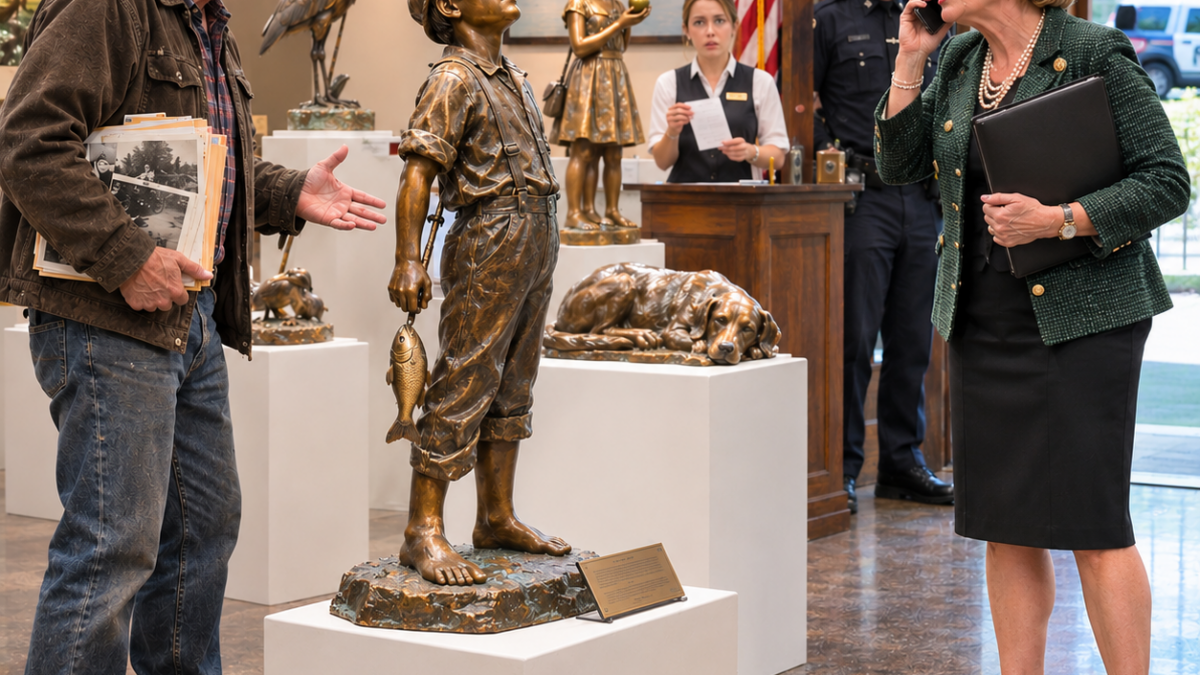
I pointed toward Fishing Boy.
“My father made that statue.”
“I know.”
“He left it to me.”
“That’s disputed.”
“By you.”
“The neighborhood has a history with these sculptures that predates your ownership of the house.”
I stared at her.
“You took six bronze statues out of my fenced garden while I was away.”
“They were removed under association authority.”
“And delivered here.”
“For preservation.”
I looked around the polished room.
White walls.
Track lighting.
Six pedestals.
All six statues.
The sleeping dog.
The bronze girl holding an apple.
The heron.
Fishing Boy.
And two smaller pieces my father had kept beside his workshop.
“You call this preservation?”
“Yes.”
“Then why does your website say they came from your family?”
Her expression changed.
Barely.
But I saw it.
“That description is simplified for visitors.”
“And why is Fishing Boy listed for twelve thousand dollars?”
A few heads turned.
Karen’s mouth tightened.
“You need to leave.”
“I’m not touching anything.”
“You were reaching behind the statue.”
“I was looking for a mark.”
“What mark?”
I nodded toward Fishing Boy.
“Behind his left heel.”
The young museum worker had moved closer.
Her name tag said LEAH.
I looked at her.
“There’s a little crescent cut into the bronze base.”
Karen stepped between us.
“Do not touch the exhibit.”
“I didn’t ask her to touch it.”
Karen pulled out her phone.
“What are you doing?” Leah asked.
Karen did not answer her.
She stared at me while dialing.
“Yes,” she said when someone picked up. “I need police at the Bell Heritage Museum.”
I almost laughed.
Then she continued.
“There’s a man here attempting to take property from our collection.”
I opened both hands.
“Tell them I want an officer here.”
Karen stopped.
That seemed to bother her more than if I had shouted.
“I’m not taking anything,” I said. “I want police here.”
Outside, less than a minute later, I saw a patrol car turn onto the street.
I reached inside my coat for the folder my daughter had helped me prepare.
The theft report.
Estate documents.
Photographs.
My father’s notebook.
Karen was already walking toward the front entrance carrying a folder of her own.
And as I stood beside the statue my father had made fifty years earlier, I thought about the morning I had come home and found nothing but six empty stones.
Nine days earlier, I had returned from my daughter Natalie’s house carrying an overnight bag and a box of leftover roofing screws.
She had suffered a leak during a heavy storm.
I spent three nights helping her move furniture, pull damaged drywall, and get a contractor started.
Before leaving home, I had opened my side gate because a tree crew was scheduled to remove a dead limb from an old maple.
That gate was still open when I returned.
I noticed that first.
Then I noticed the garden.
Something was wrong.
Not obviously wrong.
Empty.
That was the word.
The garden looked empty.
I put my overnight bag on the porch.
Walked down the path.
Then stopped.
Fishing Boy was gone.
The stone base remained.
Four bolts stuck out of it.
Two had been cut.
Two looked twisted.
I turned.
The heron was gone.
So was the bronze girl.
Sleeping dog.
Both smaller figures near the workshop.
Six statues.
Every one.
Gone.
At first my mind refused to accept what my eyes were telling me.
I walked the garden twice.
That sounds stupid now.
As if maybe I had forgotten where a three-foot bronze heron lived for twenty years.
But I walked anyway.
Behind one base, a fern had been crushed flat.
A wheel track ran across the grass.
I went back to Fishing Boy.
For twenty years, he had stood beside that path.
Before that, he had stood in my father’s old yard.
Before that, he had been in Dad’s workshop.
There had never been a time in my adult life when I could not picture exactly where that boy was.
Now there was only pale stone.
My name is Walter Reed.
I was sixty-eight years old.
Before retirement, I repaired commercial kitchen equipment.
Dishwashers.
Steam tables.
Ovens.
Refrigeration units.
Anything restaurants depended on but nobody noticed until it stopped working.
My father, Henry Reed, was a welder by trade.
Bronze sculpture was what he did when nobody was paying him.
He never became famous.
He sold a few pieces.
Sometimes enough to buy his next batch of materials.
But the ones he cared about most stayed home.
Fishing Boy was me.
The bronze girl holding an apple was based loosely on Natalie.
Dad made it when she was eleven.
He exaggerated her ears just enough that she complained for weeks.
Sleeping Dog was our old mutt Charlie.
The heron came from a bird that used to stand near the creek behind Dad’s workshop.
They were family history disguised as yard art.
I called the tree company first.
The owner answered.
“Walter?”
“Your crew was at my place Tuesday?”
“Yes.”
“Did they move anything in my garden?”
“What kind of thing?”
“Six bronze sculptures.”
“No.”
“You’re sure?”
“Absolutely.”
I heard him cover the phone.
Someone spoke in the background.
Then he came back.
“My foreman says they were all there when the crew left.”
“Do you have pictures?”
“We usually photograph cleanup.”
Ten minutes later, he sent them.
The dead branch was gone.
Truck in the driveway.
Chipper near the curb.
And every statue stood exactly where it belonged.
Fishing Boy beside the path.
Heron near the fence.
Sleeping Dog beneath the bush.
Those photographs became the first useful thing I had.
I called the sheriff’s office.
While I waited, I photographed everything.
Cut bolts.
Tracks.
Damaged fern.
Empty bases.
Gate.
Then I noticed something caught beneath the gate.
Yellow paper.
Folded.
Damp along one edge.
I pulled it loose.
LANDSCAPE HAZARD REMOVAL.
Below that:
HOMEOWNERS ASSOCIATION.
I read it twice.
I had not expected the people who stole my father’s work to leave paperwork.
Deputy Nolan arrived that afternoon.
He walked the garden with me.
Asked when I had last seen the sculptures.
Asked approximately how large they were.
How heavy.
Estimated value.
That one stopped me.
“I don’t know.”
“You don’t know their value?”
“They weren’t for sale.”
Nolan nodded.
“I understand.”
“No, I mean I honestly don’t know. My father made them.”
“We can add valuation later.”
He looked around.
“Has the association contacted you about them?”
I almost said no.
Then remembered an envelope beside my toaster.
I went inside.
Found it beneath a grocery receipt.
The HOA letter was dated two weeks earlier.
UNAPPROVED OBJECTS VISIBLE FROM COMMON WALKING PATH.
It said several sculptures needed review due to possible sharp edges, deterioration, and aesthetic concerns.
I had laughed when I first read it.
The heron’s beak had pointed toward the same patch of grass for twenty years.
Nobody had impaled themselves.
So I had ignored the letter.
Standing beside Nolan, I wished I hadn’t.
Not because I thought the HOA had authority to take them.
Because I wanted a written record of me saying they did not.
Nolan read it.
“Are any of the statues on HOA property?”
“No.”
“The walking path?”
“Outside my fence.”
“And the statues?”
“Inside.”
“You have a survey?”
I did.
When I bought the house from Dad’s estate, the boundary plan came with the closing papers.
I showed Nolan.
He photographed it.
Then the yellow removal slip.
He did not announce that the case was solved just because an HOA name appeared on paper.
I appreciated that.
“I’ll contact the association and figure out who performed the removal.”
After he left, I called Karen Bell.
Karen was our HOA president.
She also operated a small private museum downtown.
The Bell Heritage Museum.
Former bank building.
Local history.
Railroad photographs.
Farm tools.
Things families had donated.
The museum had opened earlier that year.
I had never visited.
Karen answered quickly.
“Walter.”
“You knew I’d call?”
“You found the notice.”
“I found six empty stone bases.”
“They were removed for safety review.”
I tightened my hand around the phone.
“By whom?”
“A qualified crew.”
“Where are they?”
“We’re handling that.”
That phrase still irritates me.
We’re handling that.
As though six bronze statues could disappear from my property and the important question was whether I trusted her process.
“Give me the address.”
Her voice became firmer.
“You ignored an association notice.”
“The notice said review.”
“You refused to participate.”
“I didn’t refuse anything. I didn’t answer.”
“Exactly.”
“That doesn’t give you permission to enter my property.”
“Walter—”
“Did you authorize somebody to cut bolts and remove my statues?”
“The association has responsibilities concerning hazards visible from common areas.”
“They are not on common property.”
“You don’t get to decide which neighborhood standards matter.”
I looked through my window toward the empty garden.
“I reported them stolen.”
Silence.
Then:
“You called the police over a maintenance matter?”
“No. I called because six things I own disappeared.”
Karen said the property manager would contact me.
Then she hung up.
I wrote down the time.
Then every sentence I could remember.
I had never been a person who documented ordinary conversations.
That evening taught me why people do.
The property manager emailed around six.
Her name was Paula.
She said the association storage building contained no bronze statues.
She could not find a standard maintenance work order related to them.
She asked me to send the yellow slip.
I did.
Along with the landscaping notice.
She replied:
I’ll review this with the board.
I slept badly.
The following morning, I went into Dad’s workshop.
Most of his papers were still in the gray cabinet.
I had been avoiding sorting them for years.
Every drawer contained something that made him feel present.
A pencil sharpened with a knife.
Measurements scribbled on an envelope.
A welding tip.
A half-finished sketch.
Photographs came first.
Dad beside the heron.
My wife and me behind Sleeping Dog.
Natalie at eleven balancing a real apple on the bronze girl’s head.
Useful.
But photographs alone did not tell a complete ownership story.
I kept digging.
Bottom drawer.
Brown notebook held shut with an old rubber band.
Inside were Dad’s drawings.
Every sculpture.
Dates.
Casting notes.
Repairs.
Marks.
Then Fishing Boy.
Along the bottom:
Small crescent filed behind left heel after casting flaw.
I remembered that.
Dad had found a rough spot.
Filed it down.
Then cut a little crescent into it.
“Now I’ll know him anywhere,” he told me.
I sat on the workshop stool holding that notebook.
For the first time since discovering the theft, I felt like Dad had left me instructions.
I photographed every page.
Natalie came over after work.
She found me trying to scan a torn receipt while holding one corner flat with a butter knife.
“Dad.”
“What?”
“Let me do that.”
She took over.
For the next hour, she scanned while I searched.
Estate papers.
There they were.
The sculptures listed among the personal property left to me.
Casting invoices.
A repair bill for the heron’s leg.
Old photographs.
Natalie stopped at the bronze girl.
“I thought that was supposed to be me.”
“It is.”
“She gave me bigger ears.”
“Your grandfather said they gave you character.”
Natalie laughed.
Then looked through the window toward the empty garden.
Her smile disappeared.
“Let’s get her back.”
The next morning, Paula called.
“I found something.”
“What?”
“A payment request.”
“For what?”
“Removal of unsafe garden fixtures.”
“Who submitted it?”
Pause.
“Karen.”
“Was it approved by the board?”
“Not through the normal system.”
She had arranged the work personally and submitted the bill afterward.
Paula gave me the contractor name.
Hill Moving and Rigging.
I called immediately.
A receptionist transferred me to the owner.
Glenn.
“Yes,” he said after I gave him the address. “Our crew removed six bronze pieces.”
“Who told you they belonged to the association?”
“Mrs. Bell arranged the job.”
“Did she give you anything showing ownership?”
“We have a signed work order.”
“Signed by me?”
“No.”
Silence.
Then Glenn said:
“I need to check the file.”
“Where did your crew take my statues?”
“I’ll call you back.”
That worried me more than almost anything else.
I had assumed finding the mover meant finding the sculptures.
Instead, I waited.
I sent Glenn’s information to Deputy Nolan.
Included Dad’s notebook pages.
Estate list.
Photographs.
Then I went outside and shut the side gate.
My neighbor Arthur was across the street.
Eighty-one.
He had lived there when Dad still owned my house.
Arthur watched me lock the gate.
Then walked over.
“I saw the truck.”
I looked at him.
“What truck?”
“The one that took the bronzes.”
“When?”
“Wednesday morning.”
“You saw them?”
“Sure.”
“Why didn’t you call me?”
Arthur’s face fell.
“I thought you were finally having them cleaned.”
“Why?”
“The woman told me.”
“What woman?”
He hesitated.
“Karen.”
Arthur pulled out his phone.
“I took a picture.”
“Why?”
“They used a little lifting machine to get the heron over the flowers. Thought my grandson would like it.”
The photograph showed the heron hanging from wide straps.
My gate open.
Moving truck backed toward the yard.
And Karen Bell standing just inside my property, pointing toward the truck.
For one ugly second, I was angry at Arthur.
He saw it.
“I should’ve called.”
I looked at him.
This man had watched contractors come to my house for years.
Karen was HOA president.
She had a clipboard.
A professional moving crew.
Nothing about the scene screamed theft.
“Next time call.”
“I will.”
“But this helps.”
Arthur let out a breath.
He helped send me the original photograph.
That afternoon, Glenn called back.
His tone had changed.
“Mr. Reed.”
“Yes.”
“I’ve spoken with my foreman.”
“And?”
“We delivered the statues to Bell Heritage Museum.”
I gripped the phone.
“Karen’s museum.”
“Yes.”
“You were told they were going there for safety inspection?”
“No.”
“What were you told?”
“We were given specific placement positions inside.”
I sat down.
“Send me the delivery record.”
“I need to talk to our insurer before releasing the entire file.”
“Fine.”
“I’ll confirm the delivery address in writing.”
He did.
I sat at the kitchen table looking at the email.
The safety review had apparently lasted exactly as long as the drive downtown.
My first instinct was to get in my truck.
Drive to the museum.
Walk inside.
And bring my father’s work home.
Instead, I called Nolan.
He was out.
I left the information with the desk.
Then I searched the museum website.
Across the home page:
NEW BRONZE GALLERY OPENS SATURDAY.
And there was my heron.
Polished.
Too polished.
Dad always liked bronze with age on it.
Behind it stood Fishing Boy.
Sleeping Dog near the window.
The bronze girl holding her apple.
Caption:
A RARE COLLECTION FROM THE BELL FAMILY.
I read it slowly.
Once.
Twice.
Dad’s name appeared nowhere.
I saved screenshots.
Then clicked:
COLLECTION HISTORY.
The page claimed Karen’s family had owned the sculptures for decades.
Private storage.
Family heritage.
Recently brought out for public enjoyment.
Then the last paragraph.
Two sculptures would be offered for sale during opening weekend to support the museum.
I stopped breathing normally.
Fishing Boy appeared beside a price.
$12,000.
Underneath, red text:
DEPOSIT RECEIVED.
I stared at the screen.
Twelve thousand dollars meant almost nothing to me.
Could have been too high.
Too low.
I had never planned to sell him.
What mattered was that somebody had already paid money for something Karen did not own.
I printed everything.
Saved digital copies.
Sent them to Natalie.
She called instantly.
“Dad.”
“I know.”
“Do not go there angry.”
“I’m at the kitchen table.”
“Stay there.”
“I’m not a child.”
“I know. That’s why I’m asking.”
I looked at Fishing Boy’s photograph.
For ten seconds, I wanted to do something satisfying and stupid.
Instead, I called the sheriff again.
This time I explained that one reported stolen piece had apparently been sold and might leave the museum.
Nolan called later.
“I spoke with Karen.”
“What did she say?”
“She claims there’s an ownership dispute.”
“What ownership dispute?”
“She says the statues were donated to the neighborhood years ago.”
“My father left them to me.”
“I have the estate papers.”
“Can she sell them?”
“I told her there’s an active report and instructed her to keep all six pieces where they are while we look into it.”
“Did she agree?”
“She said she’d cooperate.”
Not the same as reassurance.
But it was something.
I made a list of all six statues.
Their marks.
Damage.
Repairs.
Dad’s notes.
The heron had a repaired left leg.
Sleeping Dog had a flattened spot beneath one ear where Dad had changed its shape.
Fishing Boy had the crescent.
Small details.
Things nobody cared about until ownership became an argument.
Natalie came that evening carrying clear plastic sleeves.
She built me a folder.
Report number on the front.
“Keep this where you can reach it.”
“I will.”
“You’re going to start digging through your pockets when you get upset.”
“I don’t get upset.”
She stared at me.
I sat down.
The next few days moved painfully slowly.
Paula searched HOA records.
No board vote accepting a sculpture donation.
No insurance record for the statues.
No maintenance history.
Karen stopped responding to me.
Glenn confirmed in writing that his crew had removed the six statues at Karen’s direction and delivered them directly to the museum.
By Friday, Fishing Boy was still marked RESERVED.
I emailed Karen one final time.
Six sculptures.
I owned them.
I had never donated them.
Never sold them.
Never authorized their removal.
Do not sell, move, or alter them.
Copied Nolan.
Copied Paula.
Then I decided to attend Saturday’s opening.
Not to take anything.
Not to make a scene.
I wanted to see the pieces myself.
Photograph their condition.
Verify Fishing Boy was still there.
Natalie had to work.
“I can leave early.”
“No.”
“Call me when you come out.”
“I will.”
“Even if nothing happens.”
“Even then.”
Saturday morning, I paid admission like everybody else.
The young woman at the desk was Leah.
She handed me a brochure.
“New bronze room is in the back.”
I walked past railroad tools.
Old photographs.
Glass display cases.
Then through a freshly painted doorway.
All six were there.
For several seconds, the theft report disappeared from my mind.
The museum disappeared.
Karen disappeared.
I saw Dad.
Sleeping Dog.
Bronze Girl.
Heron.
The small pieces.
Fishing Boy.
Then I noticed the damage.
Fresh scrape along Fishing Boy’s base.
I leaned slightly.
“Step away from that.”
Karen.
And minutes later she was calling police on me.
Officer Brooks asked us to move into the front hallway.
Karen talked first.
“He refused to leave.”
Brooks looked at me.
“She asked me to leave after I told her the sculptures were mine.”
“He threatened to take them.”
“I didn’t.”
“You said you were getting them back.”
“I said they belonged to me.”
Brooks turned.
“Do you have documentation?”
I handed him my folder.
“Report number is on the front.”
He checked my license.
Called dispatch.
While he waited, Leah came forward holding my admission receipt.
Brooks asked:
“What did you see?”
She looked at Karen.
Then me.
I said:
“Just tell him what you saw.”
Leah swallowed.
“He bought a ticket.”
“Then?”
“He went into the sculpture room.”
“Did you see him move anything?”
“No.”
“Touch anything?”
“I didn’t see him.”
Karen interrupted.
“He was reaching behind the boy.”
“I was showing them a mark.”
Brooks looked at me.
“What mark?”
“Behind the left heel.”
He opened my folder.
Natalie had labeled the notebook copies.
He found Fishing Boy.
Sketch.
Fishing line.
Date.
Little crescent.
Brooks asked Leah:
“Do you have a flashlight?”
She brought one.
Karen said:
“Nobody handles museum property without authorization.”
Brooks looked at her.
“We don’t have to lift it.”
Back in the gallery, Leah crouched with the flashlight.
Brooks leaned down.
There it was.
A small crescent behind the left heel.
Exactly where Dad had drawn it.
Brooks compared it to the notebook.
Then the date.
Karen folded her arms.
“That doesn’t establish ownership.”
I looked at her.
“Your website says these belonged to your family.”
“It’s visitor language.”
“Visitor language?”
Brooks asked for Karen’s documents.
She handed him the folder.
Typed collection history.
An old neighborhood newsletter.
No bill of sale.
No deed of gift.
No letter from Dad transferring ownership.
Karen pointed to a photograph in the newsletter.
Dad standing beside the heron.
Caption:
Henry Reed shares his garden with the neighborhood.
“That was the donation,” Karen said.
I stared at her.
“No.”
“That is how the association understood it.”
“He opened his garden for a charity walk.”
“That’s your interpretation.”
“I was there.”
Brooks read further.
The article described a one-day garden tour.
Visitors.
Lemonade.
Donations for school library books.
No sculpture donation.
He closed the folder.
“Do you have any document transferring ownership?”
“Our older association records are incomplete.”
“That isn’t what I asked.”
Karen’s jaw tightened.
Brooks looked at both of us.
“I’m not deciding every ownership issue in this hallway.”
Fair.
Then he looked at Karen.
“These pieces have been reported stolen. Do not sell, transfer, move, or dispose of them while this is being investigated.”
Karen nodded.
I wanted more.
I wanted them loaded into a truck.
Taken home.
Bolted back into place.
But an officer had now seen the crescent.
The estate list.
The newsletter.
Karen’s lack of transfer documents.
I was not ruining that by refusing instructions.
Brooks asked me to leave while he finished.
At reception, Leah tried to return my admission fee.
I shook my head.
“Keep the transaction.”
“What?”
“Keep the receipt in your records. It shows why I was here.”
She looked close to tears.
“I put the display cards out.”
“You used what they gave you.”
“I’m sorry.”
“You didn’t remove anything from my yard.”
She looked down.
“Keep whatever instructions you received.”
“Why?”
“Because people forget what they were told.”
Then I walked outside.
My hands began shaking only after I reached my truck.
I called Natalie.
“I’m out.”
“Did they find the mark?”
“Yes.”
“You bringing anything home?”
“No.”
Silence.
Then:
“Come here first.”
“I should organize—”
“Dad.”
I looked down.
The edge of one plastic sleeve had cut my finger because I had been gripping it too tightly.
“I’ll come over.”
At Natalie’s kitchen table, I wrote down everything.
She cleaned the cut.
What bothered me most was not Karen calling police.
It was Dad’s newsletter.
My father had liked people enjoying his garden.
Karen had turned his generosity into an ownership claim.
Natalie found another photo from the charity walk.
Dad standing beside a sign:
PLEASE STAY ON THE PATH.
Fishing Boy visible in the background.
Same location where he stayed for decades afterward.
“We need the whole newsletter,” I said.
“Not just the page Karen has.”
“And whoever wrote it.”
That became Monday’s job.
Before I left, Nolan called.
Brooks had sent his notes.
Nolan asked for the museum website screenshots.
The sales page.
The Bell-family claim.
I sent everything.
Karen calling the police had created something she probably never intended.
A neutral officer had inspected the statue.
Compared the hidden mark.
Asked her for transfer records.
And documented what she could not produce.
Sunday afternoon, somebody knocked on my door.
A man stood outside holding a museum brochure.
“Mr. Reed?”
“Yes.”
“My name’s Daniel Moss.”
He looked embarrassed.
“I think I bought your fishing boy.”
I let him in.
Daniel showed me his invoice.
Bank record.
Deposit.
$3,000.
“I haven’t paid the rest.”
I looked at the date.
“When did you pay this?”
“Last week.”
“Before the museum opening?”
“Yes.”
“Why did you come here?”
“I saw police outside yesterday.”
He opened the brochure.
“And then I started researching the maker.”
Dad’s name was not on the label.
But one online image showed part of an old maker’s mark.
Daniel traced it.
Found Henry Reed.
Then me.
“I wanted to talk to you before I gave them anything else.”
“You did the right thing.”
“I was buying it for my wife.”
He looked at the photograph.
“Her father used to take her fishing.”
That hurt in a way I did not expect.
I told Daniel who Fishing Boy was.
My bad haircut.
Dad’s joke.
The mark.
Daniel slid the invoice across the table.
“Keep a copy.”
I read the description.
Price.
Date.
Then froze.
Daniel’s deposit had been paid four days before the moving crew entered my garden.
Four days.
The invoice said:
Piece currently held in private storage.
Available for delivery following museum opening.
Private storage.
Fishing Boy had still been bolted outside my house.
Karen had not removed the statues and then decided to sell one.
She had accepted money first.
I looked at Daniel.
“Do you know what this means?”
His face changed.
“I think so.”
“You paid for him before she had him.”
Daniel rubbed his forehead.
“I should’ve asked more questions.”
“She showed you a museum.”
“Yes.”
“An invoice.”
“Yes.”
“A professional display.”
“Yes.”
“You weren’t buying bronze out of somebody’s trunk.”
“I still feel stupid.”
“So do I.”
He looked up.
“Why?”
“I left the gate open.”
“That didn’t give her permission.”
I stared at him.
“No.”
Then I said it again.
“No, it didn’t.”
We both needed to hear that.
Daniel forwarded every sales email.
One included photos of Fishing Boy standing in my garden.
My workshop was visible behind him.
Karen had described the setting as:
Our family’s private grounds.
I recognized the angle.
The photograph was taken from the HOA walking path outside my fence.
In one image, my blue wheelbarrow was visible.
She had been marketing my father’s statue while I was still pulling weeds around it.
I sent everything to Nolan.
Then organized the dates.
HOA safety letter.
Daniel’s deposit.
My trip.
Statue removal.
Museum opening.
The order changed everything.
Karen could not claim she discovered a dangerous abandoned object and later decided the museum should care for it.
A buyer had paid her before the removal.
Monday morning, I called a lawyer.
Rebecca Shaw.
I had hoped I wouldn’t need one.
Police report.
Estate documents.
Mover records.
Surely that should have been enough.
But my statues remained inside Karen’s museum.
Every morning I wondered whether they would still be there by evening.
Rebecca read my copies.
Then asked:
“What do you want first?”
“My father’s work home.”
“Before money?”
“Yes.”
“Before damages?”
“Yes.”
“Before anything else?”
“Yes.”
She wrote it down.
Rebecca explained that the criminal investigation and the civil process of getting property returned could move separately.
She could seek a court order preventing sale, movement, or alteration until ownership was decided.
“How much?”
She told me.
I paid $1,200 to start.
That money had been set aside for a new furnace before winter.
Natalie found out later.
“I can help.”
“Your roof isn’t done.”
“Dad.”
“I’m not saying I’ll never ask. I’m saying I can do this part.”
Rebecca sent preservation demands.
Karen.
Museum.
HOA.
Six sculptures individually listed.
Do not sell.
Do not alter.
Do not move.
Preserve emails.
Invoices.
Work orders.
Website records.
She requested a quick hearing.
While she handled court, I went to the library.
The town library had archived neighborhood newsletters.
Carol at the history desk found the correct year.
Karen’s museum folder contained one page.
The full issue had eight.
The next page showed the garden-tour route.
Arthur’s property.
Two more private gardens.
Dad’s garden last.
Fundraiser for the school library.
No transfer.
No donation.
No gift of statues.
Carol pointed to the editor’s name.
Joyce Palmer.
I knew her husband from the hardware store.
Joyce remembered Dad.
“He wouldn’t let us move Fishing Boy closer to the gate.”
“Why?”
“Said the boy belonged by the water.”
“Did he ever say the statues were being donated?”
“No.”
“Would you write down what you remember?”
“I can. But I don’t have ownership papers.”
“I’m not asking you to claim anything you don’t know.”
She sounded relieved.
That became another lesson.
This entire mess had been built from assumptions.
Arthur assumed I had hired the movers.
Glenn assumed Karen had authority.
Daniel assumed Karen owned what she sold.
Leah assumed the museum labels were accurate.
I needed facts.
Not guesses that happened to favor me.
Paula called Tuesday.
She had gone through old HOA meeting minutes.
The garden walk appeared.
Permission to place directional signs along the common path.
Nothing about accepting sculpture donations.
Then she found something recent.
Karen’s reimbursement request for the moving company.
Description:
ABANDONED FIXTURES REMOVED FROM COMMON AREA.
I looked through my window.
My fenced garden.
My workshop.
My porch.
“Common area?”
“That’s what she wrote.”
“Send it to Rebecca.”
“I’ve sent it to our association attorney. I’ll ask that it go to yours.”
“Thank you.”
Paula hesitated.
“Walter?”
“Yes?”
“I approved the original landscaping letter for mailing.”
“Okay.”
“I didn’t know any of this was planned.”
“Did you write the letter?”
“No.”
“Then tell the truth about what you knew.”
“I have.”
Nolan came back that afternoon.
This time he wanted to walk the property.
From common path.
To fence.
Through side gate.
To nearest statue base.
He photographed everything.
“You couldn’t mistake this for common property without ignoring a fence.”
“And a house.”
“And the gate.”
He examined Dad’s original notebook.
Estate papers.
Compared originals with copies.
He asked about the sales photographs.
“That’s my workshop.”
“Wheelbarrow?”
“Mine.”
“When were these photos taken?”
“I don’t know.”
I almost guessed.
Stopped.
“I honestly don’t know.”
Nolan nodded.
Next question.
Before leaving, he told me he had spoken directly to Daniel.
Good.
I did not want the case built on:
Walter says Daniel said.
Daniel could speak for himself.
Wednesday afternoon, Rebecca called.
“We got the order.”
I sat down.
“What order?”
“Temporary preservation order. The sculptures cannot be sold, moved, transferred, repaired, polished, or altered pending the hearing.”
I closed my eyes.
“They’re staying there?”
“For now.”
“But they’re staying.”
“Yes.”
That was the first night I slept properly.
The order did not bring them home.
It stopped things from getting worse.
That evening, Natalie found me measuring the empty bases.
“What are you doing?”
“Bolt spacing.”
“Why?”
“They’ll need repair.”
She crouched beside Fishing Boy’s stone.
The clean patch where his feet had stood was pale against the weathered surface.
She touched the edge.
“He’s going to look different when he’s back.”
“For a while.”
“He’ll still look like he belongs.”
We measured together.
For days, I had been proving the statues were gone.
That evening was the first time I prepared for them to return.
Then Karen filed her written court response.
Her story had changed.
Now she claimed Dad had donated the collection to the neighborhood long ago but allowed the HOA-owned sculptures to remain on his land.
According to Karen, I inherited the house and mistakenly assumed the sculptures came with it.
The museum, she said, was merely caring for community property.
I called Rebecca.
“What about the website saying Bell family?”
“Saved.”
“Daniel’s invoice?”
“Saved.”
“What about the mover being told HOA property?”
“Saved.”
I breathed.
Karen’s problem was becoming consistency.
To Glenn:
Association property.
To Daniel:
Karen’s property to sell.
To museum visitors:
Bell family heirlooms.
To court:
Neighborhood-owned collection temporarily stored on my land.
Rebecca asked me to prepare my own statement.
I wrote three pages about Dad.
She sent it back.
“Try again.”
“What’s wrong with it?”
“Nothing emotionally.”
“Then?”
“I need facts.”
That stung a little.
But she was right.
I started over.
Estate list.
Location.
Maintenance.
Insurance.
Repairs.
Possession.
No donation.
No transfer.
I could miss my father without asking a judge to rule based on grief.
Friday, Glenn came to Rebecca’s office.
Full company file.
Photographs taken before removal showed all six statues inside my fenced garden.
Delivery photographs showed all six inside Bell Heritage Museum.
No inspection facility.
No safety review.
No hazard assessment.
No stop between my yard and Karen’s museum.
Then Glenn produced messages with Karen.
He had asked:
Will homeowner be present?
Karen:
No. He will be away.
He asked:
Do we have written authority to enter?
Karen:
Association authority covers removal. Homeowner approval not required.
He asked who owned the sculptures.
Karen:
Association property. Delivery to Bell Heritage Museum approved.
Glenn’s face looked gray.
“I should have verified.”
Rebecca said:
“Yes.”
He nodded.
“I know.”
“Will you testify to these records?”
“Yes.”
Then he looked at me.
“I’ll move them back for free.”
I appreciated the offer.
But I said:
“Let’s have somebody inspect them before anyone moves anything.”
“That’s fair.”
Feeling guilty did not automatically make him the right person for the return.
Truth first.
Repair plan second.
By the hearing, my folder had become too thick for Natalie’s plastic sleeves.
Rebecca carried the legal exhibits.
I carried Dad’s photographs.
Daniel came voluntarily.
Glenn sat nearby.
Paula attended with the HOA attorney.
Karen arrived wearing the dark green jacket visible in Arthur’s removal photo.
She never looked at me.
Before court started, the museum’s lawyer approached Rebecca.
A few minutes later, Rebecca sat beside me.
“They’re offering a resolution.”
“What?”
“You leave the sculptures at the museum as a long-term loan. They correct the labels, identify your father properly, and cover repairs.”
“No.”
“You want time?”
“No.”
“Walter—”
“I’ve had enough time.”
She nodded.
Then returned to the other lawyer.
In court, Karen’s attorney began with incomplete old neighborhood records.
Community tradition.
The garden walk.
Shared cultural history.
Rebecca began with documents.
Estate list.
Photographs.
Dad’s notebook.
Mover work order.
Museum website.
Then Daniel’s invoice appeared on the courtroom screen.
Rebecca called him.
“When did you pay the deposit?”
Daniel gave the date.
“Were you told the statue belonged to the HOA?”
“No.”
“What were you told?”
“Mrs. Bell represented that she had authority to sell it.”
“How much did you pay?”
“Three thousand dollars.”
“And what was the total agreed price?”
“Twelve thousand.”
Rebecca displayed the removal date beside the deposit date.
Four days apart.
The judge looked at Karen.
“Mrs. Bell.”
She sat straighter.
“I want a clear answer.”
“Yes, Your Honor.”
“Why were you accepting payment for this statue four days before you say it was removed for a safety review?”
Karen looked toward her attorney.
Then answered:
“I knew the association owned the sculpture. Removal was simply the next administrative step.”
The judge’s eyes stayed on her.
“Then show me the document authorizing you to sell association property through your private museum.”
Her lawyer stood.
“If I may explain the history—”
“You will.”
The judge looked back at Karen.
“First, I want the sale authority.”
There wasn’t one.
Karen said the board had discussed using local art to support the museum.
Paula visibly shook her head.
When she testified, she brought meeting records.
The board had discussed lending historical photographs.
Not my sculptures.
Not transferring them.
Not selling them.
Then came Karen’s payment request.
ABANDONED FIXTURES.
COMMON AREA.
Rebecca displayed Arthur’s photograph.
Fence.
Gate.
Workshop.
Karen standing inside my yard directing the rigging crew.
Then Nolan’s photographs.
Survey.
Property markers.
No reasonable person looking at all of it could mistake my garden for common HOA ground.
Karen’s attorney asked me:
“You received a landscaping notice before removal?”
“Yes.”
“And ignored it?”
“Yes.”
“Why?”
“I thought the complaint was foolish.”
“So you chose not to respond?”
“That’s right.”
“Could all of this have been avoided if you answered?”
I looked at the judge.
Then back at him.
“I wish I had answered.”
He waited.
“But ignoring a letter did not give anyone permission to take six bronze statues.”
Rebecca later asked:
“Did that notice say the sculptures would be taken to a museum?”
“No.”
“Offered for sale?”
“No.”
“Did you donate them?”
“No.”
“Did your father leave them to you?”
“Yes.”
Then Glenn testified.
His company took the sculptures straight from my yard to Karen’s museum.
No safety inspection.
He relied on Karen’s authority claim.
He admitted he should have verified ownership.
The complete newsletter came next.
Eight pages.
Garden-tour route.
Private yards.
Charity fundraiser.
Joyce’s statement.
No donation.
Then Dad’s notebook.
Estate papers.
Repair invoices.
Family photographs.
None of those items alone proved everything.
Together, they told one consistent story.
Henry Reed made the sculptures.
Henry kept them.
They stayed in his garden.
His estate left them to me.
I possessed and maintained them for years.
Karen’s versions changed depending on the audience.
The judge finally asked her directly:
“Why does the museum website describe these as Bell family property?”
“Poor wording.”
“Why does your sales invoice suggest you had authority to sell Fishing Boy?”
“Standard form.”
“Why did you tell the mover they belonged to the association?”
“That was the legal understanding at the time.”
“And where is the document transferring ownership from Henry Reed?”
Karen hesitated.
“The records are incomplete.”
The judge placed his pen on the desk.
“A missing document does not allow you to invent the rights that document might have given you.”
I looked at my hands.
I had been holding them together so tightly that my fingers hurt.
Then the judge ordered all six statues returned.
Their condition had to be documented before transport.
Qualified handling required.
No additional polishing.
No alteration.
No sale.
No museum claim of ownership.
Damage and financial issues would be handled separately.
I heard everything.
But one sentence drowned out the rest.
The statues will be returned to Mr. Reed.
They were coming home.
Outside, Daniel stood near a courthouse window.
“What about your deposit?” I asked.
“My lawyer’s handling it.”
“I’m sorry you got dragged into this.”
He smiled faintly.
“You didn’t take my money.”
“No.”
“And I don’t want your statue.”
He nodded toward Natalie.
“Go home with your daughter.”
We stopped at a diner.
Nearly three in the afternoon.
I ordered breakfast.
Natalie watched me eat.
“What?”
“You haven’t looked at your phone.”
I glanced at it.
Turned it face down.
“I can survive thirty minutes.”
For the first time in weeks, we talked about her roof instead of my statues.
The return happened Tuesday.
Rebecca hired a bronze conservation specialist named Martin to inspect everything before transport.
He compared each piece against Dad’s notebook and my photographs.
Fishing Boy:
Scraped base.
Heron:
Strain near the repaired leg.
One smaller sculpture:
Fresh stone chip underneath.
Everything photographed.
Measured.
Recorded.
I went to the museum to identify them.
Karen stood near the front desk.
Workers wrapped Sleeping Dog.
“You could have let people enjoy them,” she said.
I looked at her.
“They did.”
“What?”
“In my garden.”
“This museum could’ve brought attention to your father’s work.”
“You removed his name.”
She looked away.
That was the last private conversation we ever had.
Leah came over holding an envelope.
Inside were the old display cards.
Bell Family Collection.
“I thought you might need these.”
“Thank you.”
“I gave the police the instructions I received.”
“Good.”
“I should’ve checked.”
I looked at her.
“You started asking questions once you knew something was wrong.”
She looked toward the empty gallery.
I did not want Leah spending years feeling guilty for labels someone else handed her.
At home, the statues went into Dad’s workshop temporarily while their stone bases were repaired.
Fishing Boy stood near the door.
After everyone left, I pulled back his protective blanket.
Uneven haircut.
Little fish.
Narrow shoulders.
The boy Dad thought looked exactly like me.
For weeks, I had seen him only through photos.
Website pages.
Museum glass.
A room where somebody told me not to touch him.
I put my hand gently against the top of his bronze head.
“Home.”
The legal work continued.
Repair bills.
Transport.
Conservation.
Attorney fees.
Damage to the bases.
Rebecca asked for documented losses.
I did not put a dollar value on sleepless nights.
Karen’s lawyer offered money if I would sign a statement calling the entire situation a misunderstanding.
I refused.
There had been mistakes.
Glenn failed to verify ownership.
Arthur assumed the movers belonged there.
Leah trusted museum labels.
But Karen had accepted Daniel’s deposit before my statues left my yard.
That difference mattered.
Eventually we reached a written settlement.
The moving company’s insurer covered damage from lifting and transport.
Karen and the museum covered the remaining agreed repair, return, and legal costs.
No duplicate payments.
No fictional million-dollar award.
The judge had ordered the property returned.
The settlement dealt with money.
Daniel got his full $3,000 deposit back.
He called me himself.
“My wife has decided we’re buying a painting instead.”
I laughed.
“Ask who owns it.”
“Believe me, Walter. I will.”
Then the HOA held a properly noticed members’ meeting.
Not a private decision by Karen.
Records were presented.
Mover authorization.
Karen’s work order.
The description calling my sculptures abandoned common-area fixtures.
Arthur’s photograph.
Paula’s records.
No board approval.
The members removed Karen as HOA president.
The association demanded repayment of association funds she had used for the unauthorized move.
Paula sent me a letter.
It stated clearly that the sculptures belonged to me.
The HOA claimed no ownership interest.
The old landscaping notice was withdrawn.
And the association apologized for its role.
I kept that letter.
Not because I liked reading it.
Because I never wanted to rebuild the file again.
Arthur’s photograph.
Daniel’s invoice.
Glenn’s messages.
Full newsletter.
Estate list.
Dad’s notebook.
All of it stayed together.
The criminal investigation did not disappear because the civil case ended.
Nolan and other investigators collected museum records.
Talked with Daniel.
Movers.
HOA employees.
Compared dates.
Karen’s different statements.
Months passed.
Then Rebecca called me one morning.
Karen had entered a guilty plea to theft under an agreement.
Probation.
Community service.
Restitution for any qualifying amount not already paid through the civil settlement.
No double recovery.
No dramatic arrest at a museum opening.
Nobody dragged her through a crowd.
Nobody applauded outside a courthouse.
There was simply a criminal court record.
Her name.
The offense.
A finding that what happened had not been a misunderstanding.
It had been theft.
For me, that was enough.
The museum eventually reopened under different management.
Karen no longer ran daily operations.
The new manager sent me a formal correction.
Henry Reed identified as sculptor.
Walter Reed identified as owner of the removed collection.
Then they asked whether I might consider lending one piece for a future exhibition.
I said no.
Politely.
I did not hate the building.
I did not hate the new staff.
But I did not owe that museum another opportunity to hold something I had fought to bring home.
By early spring, the garden bases were ready.
Martin repaired the heron’s leg.
Treated the damaged bronze carefully.
He did not make the statues look new.
I appreciated that.
Dad never wanted polished perfection.
Bronze lived outside.
Rain.
Sun.
Snow.
Hands.
Leaves.
Age was part of it.
Fishing Boy returned first.
Natalie stood with the original photograph.
The installers lowered him toward his base.
“A little toward the water,” she said.
I smiled.
“That’s what your grandfather always said.”
They shifted him.
Perfect.
Arthur came over while we worked.
He stopped at the gate.
Waited.
I waved him in.
“I still wish I’d called you,” he said.
“I know.”
He stared at Fishing Boy.
“Your father would’ve been furious.”
“With Karen?”
“Probably.”
“The mover?”
“Maybe.”
He smiled.
“Probably with you for leaving that gate open.”
I laughed.
“Definitely.”
Then I put my hand on his shoulder.
“Your photograph helped bring them back.”
Arthur stood a little straighter.
We did not throw a reopening party.
Natalie brought sandwiches.
Arthur stayed.
The crew finished.
Sleeping Dog went beneath the bush.
Bronze Girl beside the workshop.
Heron toward the water.
The two smaller pieces back where Dad had placed them.
Fishing Boy beside the path.
I added one thing.
A small plaque.
HENRY REED
MADE BY HAND
LOVED BY HIS FAMILY
I should have put it there years earlier.
That evening, everyone left.
I closed the side gate.
Locked it.
Then walked the garden alone.
The light was fading.
I stopped beside Fishing Boy.
From the path, you could not see the crescent.
You had to know where to look.
I bent slightly.
There it was.
Small.
Imperfect.
Almost meaningless.
Except it wasn’t.
Dad once told me:
“Now I’ll know him anywhere.”
I finally understood what he had really given me.
Not only bronze.
He had left notes.
Drawings.
Receipts.
Repair marks.
Little imperfections he cared enough to remember.
He had left a habit of paying attention.
And when someone tried to take his work, rename it, sell it, and turn his generosity into ownership, those small details became the trail that brought every piece home.
I stood again.
Brushed a leaf off Fishing Boy’s stone.
Then stepped back onto the path.
The museum lights were miles away.
Karen’s labels were gone.
No police officer stood nearby.
No mover waited at the gate.
No buyer was holding an invoice.
There was only my father’s garden.
The heron facing the water.
The dog sleeping under the bush.
The girl holding her apple.
And the bronze boy wearing the worst haircut I ever had.
Exactly where he belonged.








