HOA Karen Stole 18 Bronze Statues for Her $2M Museum—Then Police Found the Last One Hidden Inside a Statue of Herself
PART2:
For forty years, eighteen bronze figures had stood along its paths.
My aunt Irene Ashford had made every one of them.
Some when she was young.
Some later.
Some after arthritis had begun making the work painful.
They were not simply decorations.
They were her life arranged in bronze.
And now every pedestal was empty.
Eighteen stone bases.
Nothing on top.
They looked like gravestones after someone had removed the names.
I did not run.
That may sound strange.
I walked.
Slowly.
The same way I walk through a damaged collection after a fire or accident.
Anger makes you careless.
Training makes you look.
The first pedestal had four anchor bolts.
All sliced clean.
Not hacksawed.
Not twisted.
Hydraulic cutter.
Second pedestal.
Same.
Third.
Same.
Scuffing along the stone showed where lifting straps or cables had been positioned.
No shattered bronze.
No chips.
No dropped pieces.
Deep tire marks ran beside the garden path toward the service gate.
Heavy truck.
Probably dual axle.
The security lights along the garden wall were dead.
I checked the junction box.
Disconnected deliberately.
Then I noticed the plaques.
Irene had mounted a small bronze nameplate beneath almost every work.
Titles.
Dates.
Her name.
Most had been pried away.
Someone had not simply taken the sculptures.
They had stripped away identification.
That mattered.
Each statue weighed somewhere between one hundred seventy and four hundred pounds.
Two to four feet tall.
Solid enough that removing eighteen of them without damaging the bases required equipment, planning, and people who knew how to handle art.
I walked toward the far end of the garden.
That was where Keeper of the Light had stood.
Irene’s final major work.
A grown woman holding a lantern in her right hand and an open book against her chest with her left.
The face was not modeled on anyone famous.
Irene once told me it was “every woman who learned something too late and carried it forward anyway.”
It was my favorite.
Gone.
I stood there longer than anywhere else.
Then I walked to the house.
A cream envelope had been taped to my front door.
Logo at the top:
FAIR HAVEN CREST HOMEOWNERS ASSOCIATION.
Inside:
NOTICE OF COMMUNITY CULTURAL PRESERVATION ACTION.
The letter claimed that historically significant sculpture located near Fair Haven Crest had been “relocated for preservation and public accessibility.”
At the bottom was a confident blue signature.
Karen Whitam.
HOA President.
I read it twice.
Then once more because I thought rage might be affecting my comprehension.
Two facts were simple.
First, my property was not inside Fair Haven Crest.
Never had been.
The Ashford hilltop parcel predated the subdivision and had never been annexed into the HOA.
Second, no homeowners association could simply decide that private bronze sculptures belonged in a cultural project and haul them away.
I called the HOA office.
A woman answered.
“Fair Haven Crest.”
“This is Grant Ashford.”
Pause.
Long enough to matter.
“I came home and eighteen sculptures are missing from my property.”
Another pause.
“Mrs. Whitam has instructed that all questions concerning the artwork be directed to her private counsel.”
“Artwork?”
“Yes.”
“So you know what I’m talking about.”
“I can’t discuss it.”
“You sent me a notice saying the HOA relocated them.”
“All questions should go through counsel.”
“Where are my statues?”
Click.
She hung up.
I stood in my kitchen holding the phone.
Every instinct I had wanted me to drive straight down the hill.
Instead, I called the police.
That was the first decision Karen apparently had not expected me to make.
I filed a report.
Eighteen sculptures.
Titles.
Approximate dimensions.
Weights.
Photographs.
Insurance values.
I left the garden untouched.
No cleaning.
No moving cut bolts.
No walking through the tire ruts after I realized they might matter.
Then I called my insurer.
By then it was after dark.
I should have slept.
Instead, I went into Irene’s old studio.
Her records were still there.
Casting logs.
Foundry invoices.
Restoration notes.
Photographs.
Drawings.
Material records.
Tiny handwritten comments about flaws almost nobody else would notice.
I spread everything across my workbench.
At seven the next morning, the Hawthorne Ridge Gazette answered the question the HOA would not.
Front page.
Karen Whitam smiling in front of a renovated brick building downtown.
Silver hair swept perfectly back.
White suit.
Microphones.
Behind her stretched a banner.
FAIR HAVEN HERITAGE MUSEUM
$2 MILLION GRAND OPENING
The article announced eighteen bronze sculptures of “deep historic importance to Hawthorne Ridge.”
A generous gift from a local collector.
I stared at the photograph.
Behind Karen, through a gallery window, stood the silhouette of a bronze figure.
I knew the posture.
Or thought I did.
I zoomed in until the pixels broke apart.
Not enough.
I could not prove it from a newspaper photograph.
Karen understood public narrative better than most criminals understand locks.
If I drove to the museum screaming that she had stolen my aunt’s work, she would not need to defeat my evidence.
She would only need to make me look unstable.
So I did something harder.
I stayed quiet.
At least publicly.
That morning I downloaded the museum press materials.
Professional photographs.
Construction timeline.
Mission statement.
Donor information.
One photograph stopped me cold.
It showed one of Irene’s sculptures.
Not inside the museum.
Inside my garden.
The camera position was unmistakable.
Standing near the south hedge.
Looking down the flagstone path.
The image metadata showed it had been created nearly seven months earlier.
Seven months before I left for Baltimore.
Seven months before the statues disappeared.
Karen had not looked at an empty house and suddenly decided to take eighteen bronzes.
Somebody had been planning.
I drove to the HOA office.
Karen was already there.
Of course she was.
She stood beside a scale model of the museum talking to board members and a reporter.
Words like cultural destination.
Legacy.
Tourism.
Educational opportunity.
I walked in.
“Karen.”
She turned.
Not surprised.
Not even slightly.
“Grant.”
“Where are my eighteen statues?”
The room went quiet.
Karen smiled.
“Your collection has been moved somewhere it can finally receive appropriate care.”
“Who authorized you to move it?”
She walked toward a conference table.
Opened a folder.
Slid it across.
ASHFORD SCULPTURE COLLECTION
PERMANENT COMMUNITY DONATION AGREEMENT.
I opened it.
All eighteen works listed.
Transfer to Fair Haven Heritage Foundation.
Permanent.
Irrevocable.
At the bottom:
Grant Ashford.
Electronic signature.
I looked up.
“I never signed this.”
Karen’s expression became almost sympathetic.
“Grant.”
“I never signed it.”
“The signature was independently verified.”
“By whom?”
“Our documentation service.”
“Name?”
“That information is held by the foundation.”
I looked back at the agreement.
She continued.
“You made a generous decision.”
“No.”
“And now that everyone understands the collection’s value, perhaps you’re having second thoughts.”
A board member in a green golf sweater frowned at me.
“You want the donation back?”
“I didn’t donate anything.”
Karen gave him a sad little smile.
Exactly the reaction she wanted.
She had written the story before I entered the room.
Karen:
Visionary museum founder.
Me:
Greedy heir regretting his generosity.
I did not raise my voice.
“Give me a copy.”
Karen shook her head.
“Foundation records.”
“Who verified my signature?”
“Confidential.”
“Who moved the sculptures?”
“Also confidential.”
I stared at her.
“You took eighteen works from private property.”
“We accepted a donation.”
“You cut the bolts.”
“We arranged professional relocation.”
“Give me the transport records.”
“No.”
That was all I needed from the meeting.
Within an hour, an HOA email went out.
It warned residents that a “disgruntled donor” was threatening the museum opening.
No name.
Everybody knew.
By noon, I had calls from people I barely knew.
How could I hurt the town?
Why would I promise art and then take it away?
Did I understand how much money had gone into the museum?
That evening, Karen’s attorney sent me a letter threatening defamation action if I publicly accused the museum of theft.
I read it twice.
Then called Detective Laura Beckett.
Laura handled high-value property crimes for the county.
Forty-four.
Quiet.
Direct.
The kind of investigator who rarely reacted before the evidence finished talking.
I put three stacks on her desk.
Ownership documents.
Physical theft evidence.
Karen’s relocation notice.
She read everything.
“Do you have originals of the artwork records?”
“Yes.”
“Insurance?”
“Yes.”
“Photographs?”
“Thousands.”
She tapped the donation agreement.
“She says you transferred the collection.”
“I didn’t.”
“I believe you believe that.”
“That sounds careful.”
“It is.”
She looked at me.
“Grant, right now I have stolen-property indicators and a disputed transfer document.”
“So arrest her.”
“No.”
I leaned back.
Laura continued.
“If I search a museum full of donors, lenders, and invited dignitaries, I need more than you saying the agreement is forged.”
“She removed them from my garden.”
“Then we prove where they went.”
I did not like it.
She was right.
We agreed I would not attempt to recover anything personally.
My attorney sent a preservation demand for every electronic record connected to the alleged signature.
That night I compared Karen’s agreement against old documents bearing my real signature.
I found the source.
Three years earlier, I had signed a restoration contract.
My pen had slipped at the end.
A tiny tail extended from the last letter.
The electronic signature on Karen’s donation agreement was not merely similar.
It was identical.
Same proportions.
Same slight irregularity.
Same accidental ink tail.
A copied signature.
I sent both to Laura.
Still not enough to prove who created the fraudulent document.
But stronger.
Then something strange happened.
I received a text just before midnight.
Unknown number.
Before you accuse her of stealing your statues, you need to see what she’s actually displaying.
I did not reply.
Friday afternoon, the museum held a private preview.
Donors.
Local officials.
Art professionals.
Press.
I had a legitimate invitation through the Keystone Conservation Guild.
I considered skipping it.
Laura told me to go.
“Observe.”
“No confrontation?”
“Preferably.”
“What if she throws me out?”
“Let her.”
I arrived in a dark suit carrying nothing but my phone and invitation.
The museum looked expensive.
Marble floors.
Gallery lighting.
Restored brick walls.
Glass cases.
Crystal fixtures.
Every surface designed to communicate permanence.
Then I entered the main hall.
Eighteen sculptures.
Every shape familiar.
My breath caught.
For one second, emotion overrode training.
It looked like Irene’s collection.
Then I started actually seeing.
Each placard read:
DONATED TO THE FAIR HAVEN COMMUNITY BY THE ASHFORD COLLECTION.
Irene’s name appeared beneath.
Smaller.
Much smaller than the name of Karen’s foundation.
Karen saw me within minutes.
She crossed the gallery smiling.
“Grant.”
Several donors turned.
“I’m so glad you came.”
I looked at her.
“To see my donation?”
Her smile did not move.
“To see what we’ve done for Irene’s legacy.”
“I want to inspect the works.”
“No.”
That surprised even me.
“No?”
“You transferred them.”
“I’m a conservator.”
“And?”
“I’m asking to inspect sculptures attributed to my aunt.”
Karen’s smile disappeared.
“You no longer have privileged access.”
I stepped toward Keeper of the Light.
A security guard moved beside me.
Karen raised her voice.
Enough for a local news camera to hear.
“Some people would rather keep history locked behind private gates than allow the public to experience it.”
There it was.
The headline.
I ignored her.
Looked at the bronze.
Irene had repaired the right wrist after a studio accident.
Hairline fracture.
Hand brazed.
Even after finishing, a faint ridge remained.
I had cleaned that ridge myself.
This statue’s wrist was perfectly smooth.
Too smooth.
I moved my eyes to another figure.
Patina too even.
No rain streaking.
No subtle mineral staining.
Another.
The base looked right from six feet away.
But the edge thickness was wrong.
A few millimeters.
I started noticing the support blocks.
Lightweight.
The originals would have needed reinforced mounts.
These did not.
Karen said:
“Are you finished?”
I looked at her.
“Have these been materially tested?”
Her face changed.
“Excuse me?”
“XRF. Alloy testing. Density. Internal imaging.”
“This is a reception.”
“Have they?”
She turned to security.
“He’s disrupting the preview.”
Before they moved me, I noticed a woman near the lighting controls.
Hadley Apprentice.
Collections manager.
I had met her once at a regional museum conference.
I approached quietly.
“Hadley.”
She looked nervous.
“Grant.”
“Did you do condition reports on these?”
She glanced toward Karen.
“I received the collection file last week.”
“The museum has been under development for months.”
“I know.”
“Did you inspect them before installation?”
“I—”
“Provenance?”
“Grant.”
“Transport records?”
Her face told me more than her answer.
Karen called from across the hall.
“Hadley.”
Hadley stepped away.
I raised my voice slightly.
“Will the museum publish material-testing results?”
Karen snapped:
“Escort him out.”
Security walked me toward the exit.
On the way, I passed a corner hidden by a heavy red velvet curtain.
Above it:
FOUNDER’S TRIBUTE
GRAND OPENING REVEAL
The curtain moved slightly from the air-conditioning.
I glimpsed the base beneath.
Steel.
Reinforced.
Far heavier than necessary for a typical portrait sculpture.
I remembered it.
That night, Silas Ren called me.
Sixty-one.
Master bronze caster.
Had worked with Irene.
I had sent him photographs from the preview.
“Grant.”
“What?”
“Come tomorrow.”
“Why?”
“Bring Irene’s archive.”
“Silas.”
Pause.
“I don’t think those are her statues.”
I barely slept.
At seven the next morning, I was inside Silas’s foundry.
Soot-dark walls.
Heavy ventilation.
Bronze dust.
Tools older than I was.
He had my photographs enlarged across the workbench.
Irene’s originals beside them.
Silas pointed.
“Seams.”
I leaned closer.
Irene’s sculptures had minute chased joints.
Invisible to most viewers.
Consistent with her methods.
The museum pieces were uniform.
Too uniform.
Then proportions.
Fingertips.
Sleeves.
Base lips.
A few millimeters different.
Then patina.
Silas magnified a photograph.
“Coating.”
“You’re sure?”
“I’m sure enough to say this did not age forty years outside.”
I sat back.
“What are they?”
“Replicas.”
“Bronze?”
“Maybe bronze-finished composite. Maybe thin metal shell. Hard to know without testing.”
I looked at eighteen photographs.
Karen had not simply stolen the originals and put them on display.
She had made substitutes.
That meant one thing.
The originals were somewhere else.
Silas began calling exhibit fabrication shops.
Most told him nothing.
One outside Allentown became nervous when he described the pieces.
They admitted producing eighteen bronze-finished replicas for an event organizer.
Built from scan data supplied by the client.
They would not release the contract voluntarily.
Fair enough.
Laura took it from there.
Preservation order.
Production records.
Dates.
Scan files.
The replicas had been commissioned months before my trip to Baltimore.
Months before the theft.
I remembered something.
Previous spring, Fair Haven Crest had asked permission to survey the shared boundary.
Tripods.
Equipment cases.
Technicians.
They spent an afternoon near my garden.
I had assumed they were surveying land.
They had been scanning Irene’s sculptures.
I called Laura.
“This was planned before I left.”
“I know.”
“Karen knew.”
“We’re getting there.”
“I want to call the Gazette.”
“No.”
“Laura—”
“If she learns we know the gallery pieces are replicas, what happens to the originals?”
I went quiet.
“She moves them.”
“Yes.”
I hated silence.
But I agreed.
Then Silas studied the tire-rut photographs from my garden.
“Fine-art truck.”
“How can you know that?”
“Dual axle. Air ride. Look at tread and spacing.”
That led me to Crowell Fine Art Transport.
I knew the name.
Benton Crowell had moved several Irene pieces years earlier.
I called.
Mentioned eighteen Ashford bronzes.
Silence.
Long enough that I knew.
Finally Benton said:
“Mr. Ashford, I think we need to speak in person.”
His dispatch warehouse sat outside town.
Padded crates.
Climate units.
Forklifts.
Benton was forty-six and looked increasingly pale as I showed him the ownership records.
“I was told they were authorized.”
“By me?”
“We had authorization bearing your signature.”
“Did anybody from your company speak to me?”
He stopped.
“No.”
“Did anybody try?”
“The client specifically instructed us not to contact the owner.”
Benton closed his eyes.
“That should have bothered me more.”
He called his attorney.
Within an hour, he agreed to cooperate with Laura.
Two Crowell trucks had removed eighteen crates from my garden.
Description:
ARTWORKS FOR EXHIBITION.
The client provided a signed authorization.
My forged signature.
The sculptures went first to a packing warehouse.
Then a climate-controlled facility outside Harrisburg.
After that, the labels changed.
BRONZE SCULPTURES became EXHIBITION EQUIPMENT.
Another company name appeared.
Ridgeline Exhibition Services.
Karen called Benton directly after learning police were asking questions.
He later told me she warned him about confidentiality.
Threatened breach-of-contract claims.
Claimed I was only a donor trying to reverse a gift.
Benton was frightened.
Karen’s network included major arts clients.
But he handed over the records anyway.
That changed the investigation.
Saturday afternoon, Crowell’s dispatch system received an update.
The original crates had moved.
From storage.
To the museum loading dock.
A private carrier was scheduled to collect them that night.
Grand opening night.
Of course.
Catering vans.
Florists.
Rental equipment.
Donors.
Limos.
One more truck leaving the back would attract no attention.
Then Laura called me.
“They found sale paperwork.”
“What sale?”
“Your statues.”
My throat tightened.
“They’re selling them?”
“Looks that way.”
“To who?”
“Private buyer through an out-of-state broker.”
“But Karen says they’re permanently donated.”
“I know.”
Then she told me something worse.
The bank wanted to speak with me.
Reed Tilman from Keystone Commonwealth Bank handled risk review.
He looked exhausted before our conversation even started.
“Mr. Ashford, did you donate the collection to the Fair Haven Heritage Foundation?”
“No.”
“Did you authorize the foundation to pledge the collection?”
“No.”
“Use it as collateral?”
“No.”
“Authorize an appraisal for lending purposes?”
“No.”
Reed became very quiet.
The museum cost about two million dollars.
Approximately $1.4 million came through loans and bridge financing.
Another roughly $600,000 came from private donor pledges used to support the project.
Karen’s foundation had represented that it legally owned the Ashford collection.
Appraised value:
approximately $3.4 million.
My aunt’s stolen sculptures had not simply become decorations.
They helped make Karen’s museum look financially credible.
The donation agreement supported the loan application.
The appraisal supported the asset picture.
The collection helped attract donors.
And now the originals were being sold privately while replicas remained on display.
Two schemes layered together.
Public story:
Priceless art donated forever to the community.
Private plan:
Move the real works out, sell them, leave fakes behind, and keep the museum alive on a lie.
That was the moment my goal changed.
Until then, I wanted Irene’s sculptures back.
Now I wanted the entire chain documented.
Every signature.
Every crate.
Every payment.
Every person who knowingly helped.
I assembled everything.
Ownership records.
Insurance certificates.
Casting records.
Restoration histories.
Signature comparison.
Replica production evidence.
Shipping records.
No donation agreement.
I signed a sworn statement.
My attorney coordinated with police, the bank, and my insurer.
Karen learned the bank was reviewing ownership.
Her composure cracked.
Shipping instructions accelerated.
The original bronzes were suddenly being moved earlier than planned.
Saturday evening, hours before the gala, Karen stood on the museum steps holding the supposed donation agreement in front of cameras.
She accused me of bitterness.
Said I was trying to sabotage Hawthorne Ridge’s greatest cultural achievement.
A reporter asked:
“Will you allow Mr. Ashford to independently examine the bronzes?”
Karen smiled.
“The museum has a duty to protect its treasures from individuals whose motives have become unclear.”
Several art professionals looked at each other.
That was not how legitimate collections behave.
Inside, Hadley had reached her limit.
She went to Laura.
Gave a statement.
Provided records she legitimately controlled as collections manager.
One inventory sheet mattered most.
Eighteen original works entered as separate crates.
Seventeen on the final outbound shipment.
Number eighteen:
SPECIAL FOUNDER INSTALLATION.
No destination.
No ordinary inventory location.
I immediately thought about the red curtain.
But a hunch was not enough.
I created a dossier for every statue.
Photographs.
Dimensions.
Weight.
Foundry marks.
Restoration seams.
Garden position.
Unique flaws.
Comparison against the replica.
Silas verified each technical description.
Police combined that with Benton’s records, Hadley’s inventory material, fabrication-shop records, and the financial evidence.
A judge signed the warrant.
Museum storage areas.
Loading dock.
Vehicles identified in the transport records.
I would not participate in the search.
That was important.
This was no longer me taking my property back.
Police were executing a warrant.
My job was identification.
I arranged padded crates.
Climate-controlled transport.
Conservation handling.
If we found the bronzes, I was not letting the recovery itself damage them.
At 8:15 Saturday night, Karen stepped onto the museum stage.
I was sitting among the guests.
Valid invitation.
Keystone Conservation Guild.
Nobody could honestly call me a trespasser.
The museum looked magnificent.
That made everything worse.
Golden facade lighting.
Luxury sedans.
String quartet.
Crystal chandelier.
Wine glasses.
Donors in evening clothes.
A giant screen read:
A $2 MILLION CULTURAL LEGACY.
Karen received warm applause.
She thanked donors.
Town officials.
Foundation board members.
Then her tone changed.
She spoke about “those who would rather destroy a dream than allow it to succeed.”
Half the room looked at me.
Karen raised both hands toward the gallery.
“And tonight, these eighteen bronze masterpieces finally belong where they were meant to belong.”
I stood.
The room shifted.
Karen saw me.
Her smile disappeared.
I spoke clearly.
“Karen.”
Security moved slightly.
I continued.
“Can you tell everyone where the original eighteen statues are?”
Murmurs.
Karen’s face tightened.
“They are right here.”
She pointed.
“Everyone can see them.”
“No.”
A pause.
“The pieces on display do not match Irene Ashford’s technical records.”
That was all I said.
No fabrication shop.
No shipping records.
No bank.
No warrant.
Karen’s voice sharpened.
“Remove him.”
Two guards started toward me.
Then the museum doors opened.
Detective Laura Beckett entered with officers behind her.
She held up paperwork.
“This is a police search warrant.”
The room froze.
At the rear loading dock, another team moved simultaneously.
Karen stepped down from the stage.
“You cannot do this.”
Laura looked at her.
“Ma’am, we have a warrant.”
Five words.
That ended the argument.
Museum security was told not to interfere.
Guests began lifting phones.
The gala changed instantly.
No longer opening night.
Active investigation.
Karen demanded her lawyer.
Fine.
She was entitled to one.
She kept insisting this was only a private ownership dispute.
Then one of her own foundation board members approached Laura.
“Sale?”
He had overheard something.
“What sale?”
Karen turned toward him.
“Not now.”
His face changed.
“You told us the collection was permanent.”
Laura did not discuss evidence casually.
She simply said police were investigating theft, forged documentation, and related financial transactions.
The loading-dock truck never left.
Officers stopped it under the warrant.
Crate numbers matched the transport records.
Specialists opened them one by one.
Filmed.
Photographed.
Logged.
Laura came for me later.
“We need identification.”
Behind the police line, I approached the first crate.
Bronze.
Real bronze.
Weight alone told me.
Then I saw Irene’s casting marks.
A repair seam.
Weathering.
Original patina.
“Number four,” I said.
“Summer Reader.”
Next.
“Number eleven. Orchard Child.”
Next.
Another.
Another.
Seventeen.
Every one genuine.
Seventeen of Irene’s eighteen sculptures sat packed in a truck scheduled to leave the museum that night.
Inside the gallery, investigators examined the display pieces.
Lightweight.
Fabricated replicas.
A museum technician admitted the bases were engineered for exhibition models rather than solid bronzes weighing hundreds of pounds.
The news moved through the gala faster than police could control conversations.
Donors surrounded Karen.
Questions.
Where are the originals?
Why replicas?
Why was there a truck?
What sale?
Why did the bank think the foundation owned the collection?
Karen had answers for none of it.
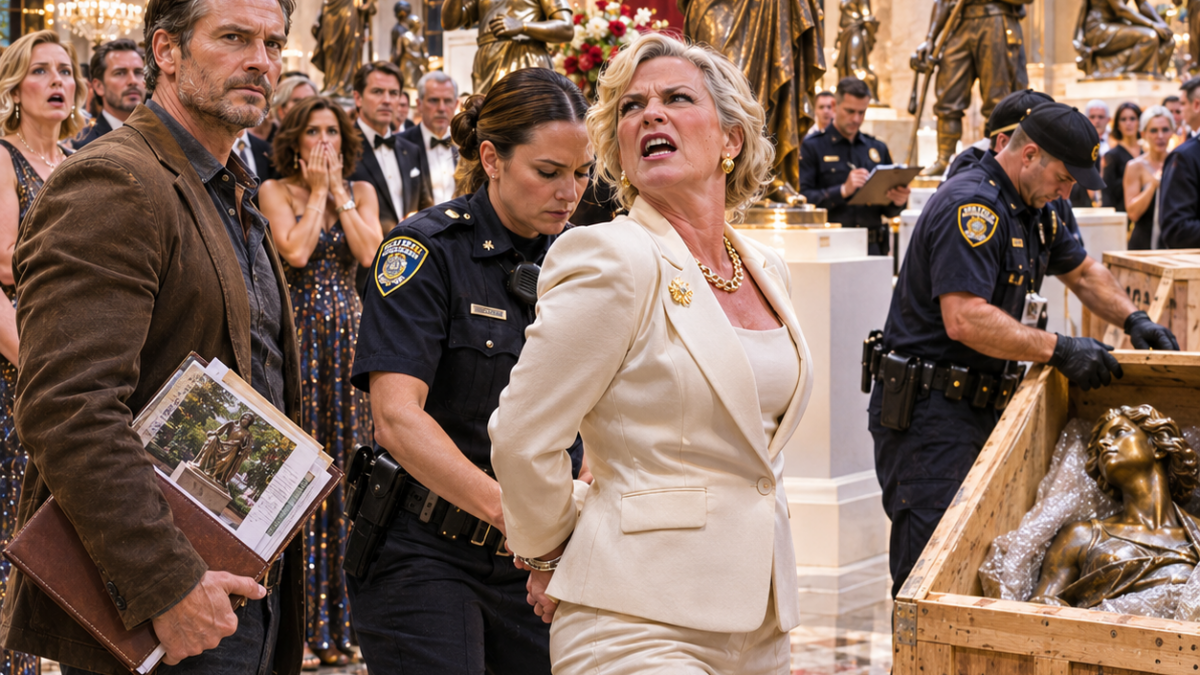
After the evidence already collected before the search was combined with what officers found that night, Laura arrested Karen on charges arising from the theft and forged documentation.
The financial investigation remained separate and ongoing.
Karen shouted as officers escorted her through the lobby.
“The foundation owns them!”
“You’re destroying this museum!”
“This is my life’s work!”
Above her hung the giant banner.
FAIR HAVEN HERITAGE MUSEUM
GRAND OPENING
Television cameras captured everything.
I stood outside the police tape.
Silent.
I did not feel triumphant.
Seventeen.
That number was all I could think about.
Laura eventually found me.
“We have seventeen confirmed.”
“Where’s the eighteenth?”
“No eighteenth crate.”
I immediately thought of Hadley’s sheet.
SPECIAL FOUNDER INSTALLATION.
Then the red velvet curtain.
I looked through the glass doors.
Still there.
Never opened.
“Laura.”
“What?”
“I think she put it in front of everyone.”
Investigators continued the search under the warrant.
The founder’s tribute became part of it.
Officers drew back the curtain.
A statue stood beneath.
Woman.
Upright.
Bright metallic finish.
Karen Whitam’s face.
At the base:
KAREN WHITAM
FOUNDER AND VISIONARY
For a moment, I thought I was wrong.
Then I saw the pose.
Right hand slightly raised.
Left arm across the chest.
Weight resting on one leg.
Keeper of the Light.
I stepped closer but stayed behind the line.
The surface had been altered.
Face changed.
Clothing forms built outward.
Decorative sculpted layers.
But beneath the left elbow—
a seam.
I knew that seam.
Irene had damaged the original arm in her studio.
She reset the angle.
Brazed the repair.
Documented it.
The investigators brought in specialists.
Non-destructive testing.
Imaging.
Material analysis.
The outer sculpted layers did not match the bronze core.
Internal dimensions did.
Karen had not commissioned an eighteenth fake.
She had taken Irene’s most important original and buried it inside a false monument to herself.
Seventeen statues prepared for sale.
The eighteenth transformed into Karen Whitam, Founder and Visionary.
I stood there staring at my aunt’s work trapped beneath another woman’s face.
That was the first moment I became truly angry.
Not when I saw the empty pedestals.
Not when Karen accused me of regretting a donation.
Not even when I learned the collection had been used as collateral.
This.
Irene once told me:
“Art is what we leave behind when we no longer need anyone to remember our names.”
Karen had taken the sculpture that most embodied that idea and turned it into a monument demanding everyone remember hers.
I wanted to tear the shell away.
I did not touch it.
I told Laura:
“Document everything before anyone removes a single layer.”
The statue went to a conservation facility.
Carefully.
Padded.
Supported.
No rushed reveal for television.
No dramatic chiseling.
Months of Irene’s work had survived forty years.
I was not risking it because people wanted a satisfying video.
Documents seized from the museum confirmed Karen had personally approved the founder tribute.
She chose the placement.
Approved restrictions on staff access.
Directed modification of an object whose inventory number matched Keeper of the Light.
That mattered.
Until then, Karen could have tried to blame carriers.
Fabricators.
Foundation staff.
Exhibition contractors.
The founder installation records put her directly inside the handling chain.
The consequences spread quickly.
The bank froze remaining disbursements.
Donors demanded an independent audit.
The foundation board suspended the people connected to the disputed transactions.
Fair Haven Crest homeowners began demanding to know how Karen had used HOA relationships, contacts, and resources to promote a museum that was supposed to be separate.
And the police investigation widened.
The collection had been appraised around $3.4 million.
The museum project cost roughly $2 million.
Those numbers attracted attention from more than local law enforcement.
Bank lawyers.
Insurers.
Donor attorneys.
Financial investigators.
Everybody wanted the same thing.
Records.
Karen lost the HOA presidency.
Residents voted her out.
The foundation removed her circle from control.
The criminal case did not end that night.
There was no magical conviction before the gala guests went home.
Prosecutors had to examine who did what.
Who knew the signature was forged.
Who commissioned the replicas.
Who authorized scanning.
Who changed shipping labels.
Who arranged the sale.
Who believed Karen’s paperwork and who helped create it.
Benton Crowell cooperated.
His company had moved the sculptures under what appeared to be signed authorization.
That did not erase his mistakes.
But his records helped recover the works.
Hadley cooperated.
She had questioned missing provenance records, incomplete inventories, and contradictory instructions.
She did not create the fraud.
Silas became one of the technical experts helping distinguish replicas from originals.
The fabrication company produced its records under legal process.
The bank pursued its own remedies.
Donors filed claims.
My insurer wanted its questions answered too.
Karen faced criminal charges connected to the theft of high-value property and the forged documents.
The financial case took longer.
I was asked constantly whether I wanted the museum closed.
At first, I did not know.
The building made me angry.
Every polished floor seemed built on Irene’s stolen name.
But six hundred thousand dollars in donor pledges had come from people who genuinely believed they were helping Hawthorne Ridge.
The town had a renovated historic building.
Gallery spaces.
Climate systems.
Educational rooms.
Good infrastructure built for a dishonest purpose.
The donors did not want to abandon it.
Once the foundation had been restructured and the worst legal disputes settled enough for operation to resume, an independent board approached me.
They wanted Irene’s collection.
For real this time.
Not ownership.
A loan.
I asked:
“Why would I ever put them back there?”
One donor representative answered:
“Because the building is not Karen.”
I looked at her.
“The museum became possible because she stole them.”
“Yes.”
“And you still want them?”
“We want to tell the truth.”
I set three conditions.
First:
The eighteen original sculptures remained my property.
Fixed-term loan only.
Renewable only if I chose.
Second:
The museum board had to remain independent from Fair Haven Crest HOA and everyone tied to Karen’s scheme.
Third:
Every label told the real history.
Irene Ashford.
Creator.
Dates.
Provenance.
Ownership.
No rewriting.
No “community donation.”
No founder mythology.
They agreed.
Months later, Fair Haven Heritage Museum reopened.
Quietly.
No giant golden scissors.
No Karen.
No banner celebrating a two-million-dollar legacy.
The eighteen originals stood in the main gallery.
Real mounts.
Conservation lighting.
Proper spacing.
Irene’s name large enough that nobody could miss it.
Under each:
Collection of Grant Ashford. On fixed-term loan.
Keeper of the Light took the longest.
The shell Karen added had to be removed gradually.
Conservators documented every layer.
Some materials softened.
Others separated mechanically.
Nothing aggressive.
Eventually, Karen’s false face came away.
Then the added costume.
Then the decorative surface.
Underneath, Irene’s bronze survived.
The old brazing seam near the elbow appeared again.
I stood beside Silas when we saw it.
He smiled.
“There she is.”
I could not speak for a while.
Hadley joined us later.
She stood in front of the restored statue.
“Why did you agree to put them here again?”
I understood the question.
This building had nearly swallowed my family’s history.
I looked around.
Children moving through another gallery.
A conservator explaining casting to a school group.
Visitors reading Irene’s actual biography.
“Karen was right about one thing.”
Hadley raised an eyebrow.
“That sounds dangerous.”
I smiled.
“Art can belong in a museum.”
Then I looked at Keeper of the Light.
“It just doesn’t have to be stolen to get there.”
The second gallery contained something I never expected.
The replicas.
All eighteen.
After prosecutors and investigators released them, the museum asked whether they could be preserved as educational objects.
I agreed.
The exhibit was called:
THE COUNTERFEIT LEGACY
HOW A MUSEUM LOST ITS INTEGRITY BEFORE OPENING NIGHT
Visitors could compare replica construction against authentic bronze.
Learn about provenance.
Forgery.
Documentation.
Donor due diligence.
Museum governance.
Why material testing matters.
Why a beautiful label does not create legal ownership.
One section explained how the replicas had been commissioned months before the originals disappeared.
Another explained the importance of shipping records.
Another used anonymous examples from the financing structure to show why lenders verify collateral ownership.
Karen had wanted her name attached permanently to the museum.
She got that.
Just not the way she intended.
Her name appeared in the history of the fraud.
Nothing more.
I never put the statues back in the garden.
People expected me to.
I considered it.
But Irene’s work had spent forty years on the hill.
Now more people could see it under conditions that actually protected it.
So I changed the garden instead.
Each empty pedestal received a small plaque.
Title.
IRENE ASHFORD.
Date.
And:
Currently displayed on loan at Fair Haven Heritage Museum.
The garden became something else.
Not a collection.
A map.
An origin story.
Visitors could walk through the places where the sculptures had stood.
Then go downtown and see them.
One quiet morning, I stood at the final pedestal.
Keeper of the Light.
Empty stone.
Beyond the hill, I could see Hawthorne Ridge.
The museum roof.
Tiny from that distance.
I thought about Karen.
She had spent years planning how to turn Irene’s work into her own legacy.
Scanning.
Replicas.
Forged authorization.
Transport.
Financing.
Sale paperwork.
A monument wearing Karen’s face.
It was elaborate.
Expensive.
Almost brilliant in its arrogance.
And it failed because details would not cooperate.
A copied signature retained the exact mistake from an older contract.
A forty-year-old repair seam disappeared from a fake.
Patina looked too perfect.
Mounting blocks were too light.
Truck tires left the wrong kind of marks.
Shipping labels changed.
One crate disappeared from a manifest.
A founder statue required too much structural support.
Small things.
Irene believed details mattered.
So do I.
That is probably why Karen never understood what she was stealing.
To her, the sculptures were assets.
Three-point-four million dollars.
Collateral.
Donor bait.
Prestige.
Objects that could make a museum important.
To Irene, every casting seam meant something.
Every repair.
Every imperfect surface.
Every place weather had changed the bronze.
You cannot fake forty years simply by copying a shape.
That was Karen’s mistake.
She thought resemblance was identity.
It is not.
A replica can look convincing from across a gallery.
A forged signature can look convincing on paper.
A museum can look legitimate under perfect lighting.
A story can sound convincing when a confident person repeats it into enough microphones.
Then somebody looks closer.
The legal cases lasted years in various forms.
Criminal proceedings.
Civil claims.
Bank disputes.
Foundation restructuring.
Insurance matters.
Not every person touched by Karen’s scheme was treated as equally responsible.
That was important.
Benton had relied on paperwork but later cooperated.
Hadley had been kept away from critical records and ultimately came forward.
Some foundation board members had been deceived.
Some contractors knew nothing beyond the job they were paid to perform.
Investigators separated those facts.
Karen’s own records were harder to explain away.
Her approval of the founder installation.
Her involvement in the transfer documents.
The forged ownership story.
The attempted commercial sale.
The foundation’s representations surrounding the collection.
Those things followed her.
I never needed to invent consequences.
The evidence created enough.
One reporter asked me after the museum reopened:
“Do you consider this a victory?”
I said:
“I got Irene’s work back.”
“That sounds like yes.”
“It’s not that simple.”
“Why?”
“Because a victory would’ve been coming home and finding the garden exactly as I left it.”
He stopped writing for a second.
That was the truth.
I did not become grateful for the theft because something good eventually came from it.
I would rather Karen had never touched one bolt.
Never scanned one statue.
Never copied my signature.
Never wrapped Keeper of the Light in another face.
But once it happened, I had choices.
I could leave the statues hidden away forever because the museum reminded me of Karen.
Or I could make the institution tell the truth.
I chose the second.
Silas liked that.
“You’re becoming reasonable in middle age.”
“I’ve always been reasonable.”
“No.”
“Thank you.”
“You’re welcome.”
Hadley stayed with the museum under the new independent board.
That surprised some people.
Not me.
She had been one of the first people inside the building to understand something was wrong.
More importantly, she spoke when speaking could cost her job.
She built a new collections system.
Nothing entered the museum without provenance documentation.
Nothing moved without dual authorization.
No object description existed only in a donor brochure.
Every loan agreement had an expiration date, owner, insurance value, and responsible staff member attached.
Boring systems.
Good museums run on boring systems.
The dramatic stories usually begin when somebody decides rules are beneath them.
Fair Haven Crest changed too.
Karen had used the HOA’s name so freely that residents had stopped distinguishing between the association and her personal ambitions.
After she was removed, the board adopted conflict rules.
HOA resources could not be used for independent foundation projects.
No officer could imply association support without an actual vote.
Financial connections had to be disclosed.
Several residents apologized to me.
Some had called after Karen’s email blast.
One woman came to my gate.
She looked embarrassed.
“I told you your aunt would want the sculptures shared.”
“I remember.”
“I didn’t know.”
“I know.”
“I shouldn’t have called.”
“You were given a story.”
“I believed it too quickly.”
I looked down the hill.
“That happens.”
She asked:
“Are you angry at everyone?”
“No.”
“Why not?”
“Because Karen needed people to believe her.”
I shrugged.
“She was good at making disbelief feel unreasonable.”
That was another part of the scheme I came to understand later.
Karen did not rely only on forged paperwork.
She relied on social pressure.
A museum opening.
Donors.
Newspaper stories.
Community pride.
A two-million-dollar building.
The more people invested emotionally and financially, the harder it became for anyone to ask:
What if Grant never donated these statues?
Once a story becomes expensive, people resist questioning it.
Because if the story is false, everyone has to reconsider what they gave.
Money.
Trust.
Reputation.
Karen understood that.
She thought if she reached opening night, momentum would protect her.
She almost did.
Sometimes I still think about those golden scissors.
8:15.
Karen onstage.
Truck idling behind the building.
Seventeen genuine sculptures packed to leave.
The eighteenth hidden twenty yards from her beneath a face modeled after herself.
If police had arrived an hour later, maybe the truck would have been gone.
If Benton had remained silent, maybe investigators would not have known where to look.
If Hadley had ignored the inventory mismatch, maybe Keeper of the Light would have remained hidden much longer.
If I had publicly accused Karen of displaying replicas when Silas first confirmed it, she might have moved everything.
People like dramatic confrontation.
Real recovery depended on patience.
That was the hardest part.
Watching Karen smile for cameras.
Watching people call me selfish.
Sitting inside her gala while she celebrated my aunt’s stolen legacy.
Knowing police were moving behind the building and saying almost nothing.
There is a strange kind of discipline in letting someone keep lying because every lie is creating another piece of evidence.
Laura understood that better than I did.
Months later I asked her:
“When did you know?”
“Know what?”
“That Karen had actually taken them.”
“Suspicion or proof?”
“Proof.”
“Shipping records.”
“Not the forged agreement?”
“Suspicious.”
“Replicas?”
“Very suspicious.”
“Benton?”
“Much better.”
“And the truck?”
She smiled.
“The truck made my evening easier.”
I laughed.
Then asked:
“Did you know about Keeper of the Light before the raid?”
“No.”
“Really?”
“No.”
“You didn’t connect the founder installation?”
“We had eighteen crates leaving your garden. Then seventeen on the final transport. We knew one was unaccounted for.”
“But not where.”
“No.”
“So when I pointed at the curtain—”
“That was useful.”
“Useful?”
“That is police language for ‘you were right.’”
“Good to know.”
Laura looked at me.
“You know what I remember?”
“What?”
“You never touched anything.”
“The statue?”
“Any of it.”
She meant the garden too.
The first night.
Cut bolts.
Tire tracks.
Disconnected lights.
The valve? no, wrong story. Keep coherent.
I had left the scene alone.
Later, investigators told me that mattered.
Photographs could be matched.
Tool marks.
Tire patterns.
Entry routes.
Not enough by itself to solve the case.
Enough to build a chain.
Irene used to say conservation is mostly restraint.
People think restoration means fixing.
Sometimes it means knowing what not to touch.
Apparently that applies outside museums too.
Years after the raid, the museum became successful.
Not spectacularly.
Honestly.
School programs.
Regional exhibitions.
Local history.
Rotating loans.
The Ashford bronzes became its best-known permanent loan.
Permanent in the public sense.
Not legally.
I renewed the agreement every few years.
Always fixed term.
Always mine.
The independent board never complained.
One new trustee once asked:
“Wouldn’t it be easier if you donated them?”
I smiled.
“No.”
He looked embarrassed.
The board chair laughed.
“Never ask Grant that question.”
Fair.
The counterfeit exhibit became unexpectedly popular.
Art students came.
Museum professionals.
Insurance investigators.
Even law students.
People were fascinated by the idea that eighteen convincing statues could stand under professional lighting and fool an entire opening committee.
Silas hated that description.
“They fooled people who didn’t look.”
“Silas.”
“What?”
“That’s rude.”
“It’s accurate.”
He was partly right.
But expertise is not evenly distributed.
That is why institutions need systems.
A donor should not have to recognize a casting seam.
A banker should not have to know patina.
A museum board member should not need to calculate bronze weight from a support platform.
They need independent verification.
Clear provenance.
Qualified staff.
No single founder controlling every answer.
Karen had centralized the story.
That was the vulnerability.
If someone asked ownership:
Karen had the document.
If someone asked transport:
Karen had the authorization.
If Hadley asked provenance:
Karen said later.
If the board asked about financing:
Karen presented the appraisal.
If donors asked whether the bronzes were real:
Karen pointed at a gallery full of replicas.
Every question returned to the same person.
Afterward, the museum changed that.
No single individual could approve acquisition, valuation, transport, and disposition of the same object.
Hadley called it “the Karen rule.”
Not officially.
Privately.
I told her never to put that in writing.
She probably did anyway.
The garden on the hill became quieter after the statues stayed downtown.
At first, the empty pedestals bothered me.
Then they started feeling honest.
Irene had made the sculptures there.
Lived there.
Worked there.
But art does not have to remain in the place where it was born.
The plaque for Keeper of the Light reads:
KEEPER OF THE LIGHT
IRENE ASHFORD
1989
Currently on loan to Fair Haven Heritage Museum.
No mention of Karen.
No mention of the raid.
Just Irene.
That is exactly how I wanted it.
One autumn afternoon, a family came walking up the garden path.
The father recognized me.
“Are you Grant?”
“Yes.”
“My daughter saw the statues at the museum.”
A girl, maybe ten, stood behind him.
She looked at the empty pedestal.
“Why isn’t the statue here?”
“It used to be.”
“Why did you move it?”
That question was more complicated than she knew.
“So more people could see it.”
She nodded.
“Is it yours?”
“Yes.”
“Then why is it in the museum?”
“Because you can own something and still share it.”
She thought about that.
Then said:
“That’s better than giving it away forever.”
I laughed.
“Exactly.”
Her father looked confused.
I did not explain.
After they left, I stood beside the pedestal.
From there, on a clear day, you can see part of downtown.
I could not actually see Keeper of the Light from the hill.
But I knew exactly where it stood.
Main gallery.
Near the tall east windows.
Right wrist turned slightly toward the light.
Open book against the chest.
Old seam beneath the left elbow visible if you know where to look.
Irene’s work.
No shell.
No false face.
No founder plaque.
The real thing.
That is what Karen never understood.
A legacy cannot be created simply by attaching your name to something valuable.
You can put your name on a building.
On a foundation.
On a plaque.
On a fake donation agreement.
You can even put your face over someone else’s sculpture.
None of those things make the work yours.
Irene never needed a two-million-dollar museum to prove she mattered.
She needed bronze.
Time.
Skill.
And enough stubbornness to keep working when her hands began to hurt.
Karen wanted people to remember who founded the building.
Irene wanted people to remember what the work meant.
In the end, the building survived.
The collection survived.
Even Keeper of the Light survived.
Karen’s version of history did not.
The strangest part is that her museum eventually accomplished what she claimed she wanted.
Irene’s art reached thousands more people.
Students learned her name.
Scholars studied the work.
The town developed a real cultural institution.
But none of that required Karen to own the collection.
None of it required a forged signature.
None of it required eighteen replicas.
None of it required stealing the originals in the middle of my absence.
All she ever had to do was ask.
Maybe I would have said no at first.
Maybe I would have negotiated.
Maybe I would have loaned three pieces.
Then six.
Maybe eventually all eighteen.
We will never know.
Karen did not want permission.
Permission would have reminded her that someone else had the right to say no.
She wanted certainty.
Control.
Ownership.
A legacy nobody could withdraw.
So she tried to steal permanence.
Instead, she created evidence.
A copied signature.
A fake provenance chain.
Eighteen replicas.
Transport records.
Sale paperwork.
A reinforced founder platform.
Every effort to make the lie permanent left another record investigators could eventually follow.
The morning after the museum reopened under new management, I went early.
Before the public arrived.
Hadley let me into the main gallery.
No music.
No visitors.
Just the sculptures.
All eighteen.
I walked from one to the next.
Not checking for damage.
Not this time.
Just looking.
Irene’s work had spent forty years outdoors.
Rain.
Snow.
Sun.
Birds.
Children touching bases when they were told not to.
Now gallery lights caught every surface differently.
At Keeper of the Light, I stopped.
The restored wrist seam was visible.
Tiny ridge.
Imperfection.
Proof.
Silas came up beside me.
“You staring at that repair again?”
“Yes.”
“Irene hated that seam.”
“I know.”
“She spent a week trying to hide it.”
“I know.”
“Never could.”
I smiled.
“Good.”
Silas looked at me.
“Why good?”
“Because it brought her home.”
He considered that.
Then nodded.
The museum doors opened downstairs.
Voices.
First visitors.
Silas started walking away.
I stayed another moment.
For most of the year after the theft, I thought about what Karen had taken.
The sculptures.
My signature.
Irene’s name.
The garden.
My reputation.
Eventually, I realized something.
She had managed to move all eighteen statues.
She had managed to create eighteen convincing copies.
She had manipulated donors, lenders, board members, transport companies, and half a town.
She had even hidden Irene’s masterpiece beneath her own face.
But she never managed to change what any of it actually was.
The replicas remained replicas.
The forged signature remained forged.
The stolen bronzes remained Ashford property.
And Keeper of the Light remained Irene’s work beneath every layer Karen added.
Truth can be covered.
Moved.
Renamed.
Repackaged.
Displayed under the wrong plaque.
Sometimes for a long time.
But if enough evidence survives, somebody can still uncover it.
That was what happened to Karen Whitam’s two-million-dollar museum opening.
She thought opening night would make her story permanent.
Instead, police walked through the front doors before she could cut the ribbon.
Seventeen original bronzes were found in a truck behind the building.
The eighteenth was standing under the gala lights the entire time.
Wearing Karen’s face.
And after every false layer was removed, Irene Ashford’s name was the one still underneath.








