HOA Karen Staged a Warehouse Collapse to Seize My $6.8M Property—Then Firefighters Found Her Crew Trapped Inside
PART2:
SILVERBROOK ESTATES HOMEOWNERS ASSOCIATION.
Gideon stared at it.
His warehouse did not belong to Silverbrook.
His property was not even inside Silverbrook.
The legal boundary stopped beyond a chain-link fence and a narrow stormwater easement.
Yet Blythe Rourke had put her HOA’s name on his gate as if she had been waiting for an emergency to make ownership optional.
A woman’s voice carried over the sirens.
“Nobody goes inside!”
Gideon recognized it instantly.
Blythe.
She stood near the gate wearing a long wool coat over what appeared to be pajamas.
Even at four-thirty in the morning, her hair somehow looked arranged.
She pointed toward the warehouse while speaking to two firefighters.
“The east wall failed.”
“The whole building is unstable.”
“My emergency contractors confirmed there is nobody inside.”
Gideon walked toward them.
Blythe saw him.
For half a second, something flashed across her face.
Not surprise that he had arrived.
PART3:
Disappointment that he had arrived so quickly.
Then the expression disappeared.
“Mr. Mercer.”
“Who chained my gate?”
“This property is under emergency control.”
“Whose control?”
“The association is coordinating the scene until authorities determine the building is safe.”
“You don’t own the building.”
“This isn’t about ownership.”
“It usually is with you.”
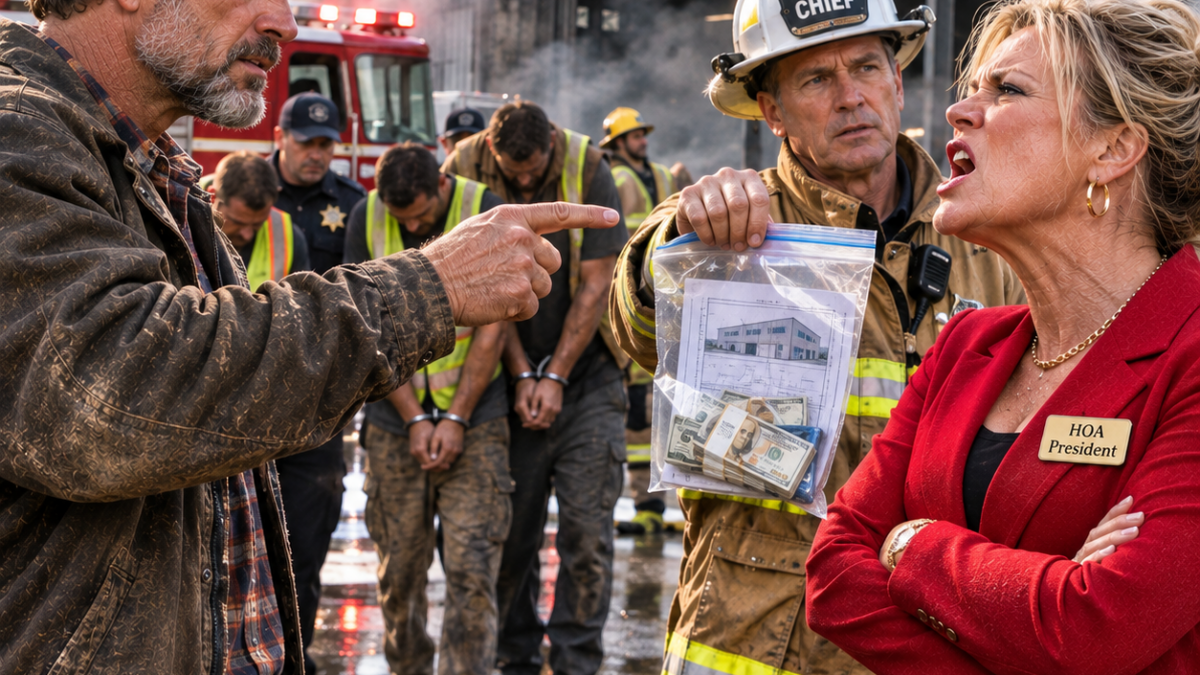
A police officer stepped between them.
“Sir, you’re the property owner?”
“Yes.”
“Identification?”
Gideon handed it over.
Then pointed toward the yellow sign.
“That was not issued by the city.”
Blythe said:
“It’s an association emergency notice.”
The officer looked at her.
“Does your HOA own this parcel?”
“No, but—”
“Then stay here.”
Gideon looked through the fence.
Smoke.
Broken decorative brick along the east exterior wall.
Some debris.
But the structural steel remained exactly where it had been six days earlier when an independent engineer photographed every column, beam, baseplate, connection, and foundation section in the building.
That documentation might now save him.
Because six days earlier, this had still looked like an ordinary property dispute.
Mercer Industrial Storage was thirty-four thousand square feet.
Not glamorous.
No glass lobby.
No fountains.
No polished marble sign.
Just a solid commercial building on the edge of an older industrial district outside town.
Gideon had bought it eight years earlier using almost every dollar he had saved and a commercial loan large enough to make him physically ill the first time he signed the payment schedule.
The building had been neglected.
Old electrical service.
Leaking roof sections.
Bad drainage.
A loading dock that had settled several inches.
Gideon spent two years repairing it.
He replaced wiring.
Strengthened steel connections.
Regraded drainage.
Installed cameras.
Added fire suppression.
Rebuilt office space.
Eventually, eleven small businesses rented space there.
A furniture maker.
A moving company.
A restaurant-supply distributor.
A specialty flooring importer.
A contractor storing tools.
A local event company.
Nothing glamorous.
But those businesses paid employees.
The rent paid Gideon’s mortgage.
And the warehouse gave eleven people something more valuable than square footage.
Stability.
On the opposite side of the fence sat Silverbrook Estates—104 expensive homes, manicured lawns, matching mailboxes, and an HOA run by fifty-two-year-old Blythe Rourke.
Blythe had spent the previous year sending increasingly aggressive letters to nearly every property owner bordering Silverbrook.
Noise.
Truck traffic.
Landscaping.
Lighting.
Exterior appearance.
The strange part was that those properties were not controlled by her HOA.
That did not stop her.
Blythe treated jurisdiction the way some people treat speed limits.
Relevant if somebody enforced it.
One Tuesday morning, six days before the fake collapse, Gideon drove into his yard and found three men in Silverbrook security shirts measuring along his east wall.
One held a tape.
Another photographed the wall.
The third stood beside a white SUV.
Gideon parked.
“What are you doing?”
The man with the tape straightened.
“Safety assessment.”
“On whose authority?”
Then Blythe stepped from behind the SUV.
Navy blazer.
Pearl earrings.
A leather portfolio tucked under one arm.
“Mine.”
Gideon looked at her.
“That is not the answer you think it is.”
She smiled.
“Good morning, Mr. Mercer.”
“You’re trespassing.”
“We’re standing on the drainage easement.”
“You’re six feet inside my survey line.”
Her smile stayed.
“The location is relevant to the safety assessment.”
“What safety assessment?”
“Your warehouse.”
Gideon looked over his shoulder.
Nothing had changed overnight.
“You think the warehouse is dangerous?”
“I think the east wall presents a significant risk to residents.”
“That wall has stood there twenty-six years.”
“Buildings deteriorate.”
“So do people.”
Her smile tightened.
“You may want to take this seriously.”
“I take trespassing seriously.”
Blythe opened her portfolio.
“The association is prepared to acquire the warehouse.”
There it was.
Gideon looked at her.
“How much?”
“Two-point-four million.”
He nearly laughed.
His most recent commercial appraisal:
$6.8 million.
Not counting tenant improvements.
Not counting business interruption value.
Not counting rising land prices in the district.
“You’re about four million short.”
“Market conditions change.”
“Not that much.”
She spoke carefully.
“You have a building beside a premium residential community.”
“I had the building before most of those homes existed.”
“That does not eliminate the present conflict.”
“What conflict?”
“Truck traffic.”
“Commercial activity.”
“Visual impact.”
“Safety.”
“You built houses beside an industrial district.”
“I did not build them.”
“You run the HOA.”
“And I’m trying to protect residents.”
Gideon nodded toward the three men.
“From my brick?”
Blythe’s expression flattened.
“Cooperate today, Mr. Mercer, or you may find this property considerably harder to keep tomorrow.”
Gideon stared.
“You don’t own my warehouse.”
“No.”
Her smile returned.
“Not yet.”
That was the moment Gideon stopped treating her like an annoying HOA president.
Threats matter.
Especially when somebody delivers them calmly.
The same afternoon, an envelope appeared beneath his office door.
Silverbrook letterhead.
FINAL SAFETY WARNING.
48 HOURS.
It alleged structural deterioration along the east wall and warned that the association would seek emergency intervention if Gideon failed to act.
He drove to the county building department the next morning.
The clerk pulled his property file.
Clean inspection history.
No condemnation order.
No active code violation.
No structural complaint approved by an inspector.
Silverbrook had submitted a petition.
That was all.
A petition.
Forty-plus homeowners.
Photos attached.
Concern about collapse.
But a petition did not turn an HOA into a building department.
Gideon left with certified copies.
He thought that would end the intimidation.
Instead, Blythe widened it.
Someone began photographing trucks entering the warehouse.
Noise complaints appeared.
Delivery complaints.
A tenant called Gideon.
“Are we being shut down?”
“No.”
“We got a letter.”
“What letter?”
Silverbrook HOA had warned the furniture company that the warehouse was “under imminent structural review.”
Another tenant received the same thing.
The restaurant-supply company asked whether they should move inventory.
Gideon felt the strategy immediately.
Blythe did not have to legally take the building if she could make the building financially unlivable.
Drive away tenants.
Spook his lender.
Destroy refinance.
Then offer $2.4 million again.
That week, his bank called.
Commercial loan refinancing in forty-five days.
They had received complaints regarding structural instability.
The loan officer requested documentation.
Gideon sent everything.
Still, the damage had started.
One major retailer postponed a delivery.
A tenant asked for written guarantees.
Another wanted to discuss early termination.
For the first time, Blythe’s campaign was costing real money.
Then came the fake structural report.
Email attachment.
STRUCTURAL HAZARD ASSESSMENT.
It claimed severe east-wall deterioration.
Possible collapse within seventy-two hours.
Immediate closure recommended.
Signed:
Everett Sloane, P.E.
Gideon knew the name.
Everett was one of the most respected structural engineers in the county.
Which was exactly why Gideon knew the report was suspicious.
Everett had never visited.
Never requested access.
Never called.
The next morning Gideon drove forty minutes to Everett’s office.
Placed the report on his desk.
Everett read the first page.
Then the second.
Then the signature page.
His face went still.
“I didn’t write this.”
“Sure?”
Everett stared at him.
“I’m an engineer, Gideon.”
“I know what I sign.”
He went to a file cabinet.
Pulled an old project report.
Four years earlier.
Different commercial property.
Different owner.
Different problem.
He placed the old signature beside the new.
Identical.
Even the slight smear at the edge of the engineering seal had been copied.
Somebody had scanned Everett’s legitimate stamp and signature, then pasted them onto a fabricated report.
Everett looked up.
“You need a lawyer.”
“I was hoping you’d say coffee.”
“You need both.”
He inspected the warehouse that afternoon.
Three hours.
Roof.
Steel columns.
Connections.
Anchor bolts.
Slab.
Wall supports.
The brick was facade.
Decorative veneer.
Not load-bearing.
The actual structure was steel.
Healthy.
No evidence supporting catastrophic failure.
The hairline crack Blythe had photographed?
Old.
Cosmetic.
No threat to Silverbrook.
Everett prepared a complete assessment.
Timestamped photographs.
Detailed measurements.
Signed.
Not copied.
He also noticed something else.
The photos from Blythe’s petition were deliberately deceptive.
Low angles.
Tight crop.
No scale reference.
The crack looked huge.
In reality it was narrow enough to disappear beneath the width of a coin.
Everett zoomed in on one image.
A man in a reflective vest stood near the wall.
Gideon recognized him.
The same stranger from Blythe’s first visit.
Security footage gave Gideon more.
White work truck.
One in the morning.
Two nights.
The man walked the fence.
Checked cameras.
Paused near a rarely used side door.
Licensing records identified him.
Colton Briggs.
Thirty-eight.
Demolition and site-clearing contractor.
His company had done work for Strickland Ventures.
Developer:
Nolan Strickland.
Fifty-six.
Known locally for buying distressed commercial properties cheap, clearing them, then repositioning sites for higher-end redevelopment.
Recent HOA minutes showed Nolan had been meeting with Blythe.
Topic:
Commercial transition plan along Silverbrook’s western edge.
Gideon’s warehouse was the western edge.
That afternoon Russ Halbert, Gideon’s warehouse foreman, came into the office.
“Some guy asked me about staffing.”
“What guy?”
“HOA type.”
“What’d he ask?”
“When the east bays are empty.”
“Did you answer?”
“No.”
“Anything else?”
“He wanted to know if overnight security goes inside or only drives the yard.”
Gideon stopped.
“When?”
“Monday.”
This was no longer paperwork pressure.
Someone was studying the building.
Gideon called attorney Delia Voss.
Forty-nine.
Real estate litigator.
Precise.
Relentless.
Her first question:
“Do you have every camera recording?”
“Yes.”
“Copy them.”
“Already did.”
“Off-site?”
“Yes.”
“Good.”
“Do you have tenant access logs?”
“Yes.”
“Alarm reports?”
“Yes.”
“Building plans?”
“Yes.”
“Then preserve everything.”
She sent formal notices that evening.
To Blythe.
Nolan.
Colton.
Silverbrook HOA.
County building department.
No one had permission to enter Mercer Industrial Storage.
No contractor.
No HOA officer.
No security employee.
No developer.
No transfer agreement existed.
Any unauthorized entry would be documented and prosecuted where appropriate.
Blythe answered within an hour.
If anyone is injured when this structure fails, the blood will be on your hands.
Delia read it.
Then:
“Excellent.”
Gideon frowned.
“What is excellent about that?”
“She put her mindset in writing.”
Meanwhile, inside Silverbrook, HOA treasurer Tessa Calder was becoming uneasy.
Forty-three.
Accountant by training.
Careful.
Loyal to the neighborhood.
For years she had trusted Blythe.
Blythe was organized.
Decisive.
Good at resolving resident disputes.
Then she asked Tessa to transfer $120,000 from reserves into an account labeled:
EMERGENCY PROPERTY RISK ASSESSMENT.
Tessa asked:
“Vendor?”
“Confidential.”
“Contract?”
“Board discussion.”
“When?”
“Executive session.”
Tessa could not remember any executive session approving $120,000.
But Blythe spoke with enough confidence that Tessa processed it.
Then wrote herself a note.
CHECK AUTHORIZATION.
That note later mattered.
At the next HOA meeting, Gideon attended.
Carried a folder.
Deed.
Boundary map.
Title documents.
County inspection history.
During open comment, he placed the map on the table.
“My warehouse is not in Silverbrook.”
Some residents leaned forward.
“Your declaration stops at this property line.”
Blythe did not argue the map.
Instead she looked at the room.
“Do you trust a landlord collecting commercial rents to determine whether a dangerous building threatens your children?”
A woman called:
“You’re greedy!”
Another:
“Fix the wall!”
Gideon understood.
Blythe could not beat his deed.
So she made him morally suspect.
If residents feared him enough, legality would feel like obstruction.
He left without arguing.
Everett called that night.
“I’ve been looking at the photo of Colton.”
“What about it?”
“He’s not documenting damage.”
“What’s he doing?”
“Looking for where damage would be easiest to fake.”
Silence.
Gideon sat straighter.
“How sure?”
“He’s photographing veneer connections.”
“Corners.”
“Transitions.”
“Areas that would fail dramatically without affecting the main frame.”
Gideon said:
“So they could make the outside look like the building is coming down.”
“Yes.”
Two nights later, Gideon’s overnight guard called.
“Two guys at the east fence.”
“Now?”
“Gone now.”
“What were they doing?”
“Blueprint.”
“Cases.”
“One went straight to that side door.”
“Which one?”
“Old east personnel door.”
“How’d he know it was there?”
“Exactly.”
Gideon shut down unused access credentials.
Reset alarm codes.
Reinforced part of the east fence.
Doubled patrol.
Then Everett found physical tampering.
Freshly disturbed mortar.
Several loosened veneer anchors.
No structural danger yet.
But enough to create a dramatic exterior failure.
Everett told Gideon:
“Close the east bays.”
Gideon did.
Moved tenant goods toward center storage.
Emptied the bays near the facade.
Taped them off.
It was a precaution.
It also ruined Blythe’s plan.
Because if exterior brick fell beside empty bays, there would be no crushed inventory.
No dramatic financial loss.
No reason to claim tenants were nearly killed.
Whoever entered later would have to go deeper.
At 2:00 a.m., a service truck stopped behind the warehouse.
Four men climbed out.
They cut a section of old west fence.
Waited for patrol to pass.
Forced the little-used side door.
Inside their equipment cases:
Smoke canisters.
Hydraulic jacks.
Pry bars.
Crushed brick.
Debris.
Printed emergency warning signs.
Fake seals.
Colton Briggs led them.
They found the east bays empty.
He cursed.
The plan had changed.
To create something convincing enough to shut the entire building, they moved toward center racking.
Nearly twenty feet high.
Industrial steel.
Loaded.
They began loosening bolts.
One worker asked:
“This safe?”
Colton answered:
“It’s supposed to fold one section.”
“Supposed?”
“Just do the lower braces.”
As bolts came free, the shelving began shifting.
Colton got nervous.
He stepped away.
Called somebody.
“We need to stop.”
The voice on the other end was sharp enough that a worker standing nearby later remembered every word.
No delays.
We need that building condemned today.
Colton hung up.
At 3:58, the final bolt came loose.
The shelving did not fold neatly.
It buckled.
A violent metallic crash tore through the warehouse.
One rack dragged the next.
Pallets shifted.
Boxes fell.
Steel beams twisted.
At almost the same time, compromised brick veneer outside the east wall released and crashed into the yard.
Smoke canisters began releasing gray clouds.
Alarm system triggered.
The fake collapse became a real emergency.
One man was pinned.
Another cut his arm.
Colton realized the west exit was blocked by fallen shelving.
At 4:12, Blythe called 911.
She said the east wall had collapsed.
She said the entire warehouse might fall.
She said she had confirmed nobody was inside.
That statement would later matter enormously.
Because a truck driver at the neighboring freight depot was awake in his cab.
He saw flashlights moving behind warehouse windows.
Then heard somebody yelling.
He called 911 separately.
“People are inside.”
Dispatch asked:
“How many?”
“I don’t know.”
“I saw at least two lights.”
“I heard a man.”
“What time?”
The depot clock read 4:17.
By the time Fire Chief Marla Whitcomb arrived, Blythe was already trying to control the response.
Marla was forty-five.
Sharp-eyed.
Calm.
Zero patience for civilians obstructing fireground operations.
She looked at the exterior.
Brick debris.
Smoke.
Straight steel roofline.
Then asked:
“Who owns this?”
Blythe answered:
“The HOA is administering it under emergency authority.”
“That wasn’t my question.”
Gideon arrived seconds later.
“I own it.”
He handed over ID.
Floor plan.
Keys.
Blythe stepped forward.
“He cannot enter.”
Marla looked at her.
“He isn’t entering.”
“My crews are.”
“There is no one inside.”
Dispatch crackled over Marla’s radio.
Second caller reports possible persons inside structure.
Marla turned.
Blythe stepped between her and the gate.
“The building is settling.”
“Nobody should go inside.”
“My contractors already confirmed it was empty.”
Marla stared.
“Your contractors?”
Blythe hesitated.
“Emergency team.”
“What emergency team?”
“Silverbrook.”
Marla pointed toward the gate.
“Move.”
“This property is under HOA emergency control.”
Marla looked at her as if she had announced ownership of the moon.
“Ma’am.”
“Your HOA does not command a fire scene.”
“Step away.”
A tremendous crash sounded from deep inside.
Then a scream.
Marla did not ask again.
“Cut the chain.”
Firefighters moved.
Bolt cutters.
Gate opened.
Rescue team advanced with full precautions for unstable interior conditions.
Blythe grabbed a firefighter’s sleeve.
“He’s going to get killed!”
Marla turned.
“Let go of my firefighter.”
Police Lieutenant Harlan Pike had been watching Blythe.
Forty-one.
Investigator.
He asked:
“How do you know the building is empty?”
“I was informed.”
“By who?”
“My contractors.”
“Which contractors?”
She looked toward the smoke.
Harlan wrote something down.
“Don’t leave.”
The rescue crew entered.
Visibility poor.
Dust mixed with artificial smoke.
They moved through the east section.
No roof collapse.
No failed columns.
Then center storage.
Collapsed racking.
One man trapped.
Three trying to move him.
Firefighter radio:
“Chief, multiple adult males.”
“Not employees.”
“Send medical.”
“Stabilize the rack before extrication.”
The four men came out one by one.
Gray powder.
Coughing.
One on a stretcher.
Colton emerged third.
He looked toward the firefighters.
Saw the department camera.
Face went white.
“Turn that off!”
Marla heard.
“What?”
“This wasn’t supposed to—”
He stopped.
Marla said:
“Tell police what was supposed to happen.”
Firefighters searched the interior.
They found everything.
Spent smoke canisters.
Hydraulic jacks.
Pry bars.
Bags of brick debris that did not match the warehouse facade.
Removed racking bolts stored neatly in a plastic bin.
Unused warning signs.
A nonexistent “Silverbrook Emergency Structural Response Unit.”
The warehouse had not spontaneously collapsed.
Someone had manufactured the scene.
Officers searched the rescued men according to procedure.
Inside one worker’s jacket:
Thick manila envelope.
Draft possession agreement.
Demolition schedule.
Emergency control documents.
Blythe’s signature.
And one line:
POSSESSION OF MERCER WAREHOUSE PROPERTY TO BE COMPLETED BY 12:00 P.M.
That morning.
Before noon.
Harlan walked the envelope to Gideon.
Placed it on Marla’s vehicle.
Gideon read:
EMERGENCY POSSESSION TRANSFER
SILVERBROOK REDEVELOPMENT PROJECT.
He looked across the yard.
Blythe stood beside a cruiser.
Arms folded.
Face pale.
“She didn’t report an accident.”
Gideon spoke quietly.
“She ordered one.”
At nine that morning, Blythe was still trying to recover control.
Residents gathered near the fence.
Board members arrived.
She told them:
“You see?”
“I warned you.”
“The building failed.”
“This is exactly what we feared.”
Then she produced a document titled:
EMERGENCY PROPERTY ADMINISTRATION NOTICE.
HOA seal.
Her signature.
It claimed Silverbrook temporarily assumed operational control over the warehouse.
Delia arrived.
Read it once.
Handed it back.
“This is a piece of paper your HOA printed.”
Blythe snapped:
“It is an emergency declaration.”
“It is not a court order.”
“Not a county closure.”
“Not a deed.”
“Not a receivership.”
“And not magic.”
A senior county building official arrived.
Confirmed:
If the warehouse required closure, the county could restrict occupancy.
That would not transfer ownership.
It would not give Silverbrook possession.
It would not let Blythe operate the property.
Blythe pointed toward broken brick.
“His building collapsed!”
Gideon looked at the debris.
Then her.
“My building didn’t collapse.”
He pointed toward Colton and the recovered equipment.
“Your story did.”
Residents heard.
Blythe lost control.
She demanded police arrest Gideon for endangering Silverbrook.
Marla stepped forward.
“In your 911 call, you said nobody was inside.”
Blythe stopped.
Marla continued.
“My firefighters removed four men.”
“Your contractors, apparently.”
“You told dispatch the building was empty.”
Blythe said:
“I was given bad information.”
Harlan asked:
“From Colton?”
“Yes.”
“Phone records will tell us.”
Then Blythe made the mistake that finished the morning.
She ordered HOA security:
“Hold this gate.”
“Do not allow county officials past the perimeter unless I approve it.”
Harlan turned toward the guards.
“Step away.”
The youngest did immediately.
The other two followed.
Blythe shouted:
“You work for Silverbrook!”
One said:
“I don’t work for jail.”
Then Harlan walked toward her.
Based on recovered documents, witness statements, contractor evidence, unauthorized entry, property damage, and her own conflicting statements, he informed her she was being detained and arrested on suspicion of conspiracy, trespass-related offenses, property destruction, and fraud pending investigation.
Blythe stared.
“I am president of Silverbrook Estates.”
Harlan placed the cuffs.
“That is not a defense.”
She twisted toward the crowd.
Nolan Strickland stood near the back.
He had arrived quietly.
Blythe looked at him.
“Nolan.”
He turned away.
That moment told Gideon almost everything.
The rest came from Tessa.
She walked across the yard after Blythe’s cruiser left.
Thick folder against her chest.
“You’re Gideon?”
“Yes.”
“My name is Tessa Calder.”
“I know.”
“I’m the HOA treasurer.”
He waited.
She looked toward residents.
Then back.
“You’re going to want to see where the money came from.”
Two days later, she sat in Delia’s conference room.
Bank statements.
Invoices.
Meeting minutes.
Vendor ledgers.
Transfer records.
Tessa had legal access as treasurer.
She walked them through every page.
The $120,000 Emergency Property Risk Assessment?
Paid to Colton’s company.
Split invoices below approval thresholds.
Surveillance payments.
Fake hazard documentation costs.
“Safety consulting.”
Then the $1.6 million escrow deposit.
Connected to a $9.4 million commercial redevelopment project.
Plans showed Mercer Industrial Storage transformed into:
Luxury event venue.
Gallery.
Rooftop terrace.
High-end retail suites.
Landscaped pedestrian connection to Silverbrook.
Nolan had lined up investors.
Financial commitments.
Timeline.
But the project required the warehouse.
Gideon had refused to sell.
A condemned warehouse would solve multiple problems.
Tenants leave.
Refinance fails.
Property income collapses.
Bank pressure rises.
Then Nolan returns with $2.4 million.
Cheap rescue.
Blythe had already promised investors possession.
Then investigators found the consulting agreement.
Rourke Advisory Group.
Success fee:
$380,000.
Payable if warehouse acquisition and redevelopment closed.
Blythe controlled Rourke Advisory Group.
No disclosure to homeowners.
No conflict statement.
No board approval.
She had spent HOA money to create a safety scare against a property she was personally paid to help acquire.
Gideon read the agreement.
Then once more.
“She threatened 104 families with a collapsing warehouse.”
Tessa nodded.
“She used their reserve money to make it look like one.”
“Yes.”
“And if I sold—”
“She got three hundred eighty thousand.”
Delia said:
“Assuming the contract was enforceable after everything else.”
Gideon leaned back.
“What did Nolan get?”
“A $9.4 million redevelopment.”
“What did Silverbrook get?”
Tessa stared at the table.
“That’s the problem.”
Homeowners thought they were protecting themselves.
Instead, their money helped fund a campaign against their neighbor.
Tessa’s shame showed.
“I signed the transfer.”
Gideon looked at her.
“What?”
“The $120,000.”
“You knew?”
“No.”
“I asked.”
“She said the board discussed it.”
“I should’ve checked.”
“Yes.”
Tessa flinched.
Delia looked at Gideon.
He continued:
“But you’re here now.”
Tessa nodded.
“I’m going to fix what I can.”
That mattered.
Because accountability did not require pretending honest people never failed.
It required what they did after learning the truth.
Silverbrook called a special meeting.
Clubhouse packed.
Standing room only.
Attorneys along the wall.
Investigators in back.
Residents who had signed Blythe’s petition now sat quietly.
Gideon was invited to speak.
He considered refusing.
Delia said:
“Go.”
“Why?”
“They need facts.”
“They have the news.”
“They have Blythe’s version collapsing.”
“Give them yours without making them your enemy.”
So Gideon stood at the front.
No dramatic speech.
He placed one document at a time on a table.
County inspection history.
No unsafe structure.
Fake Everett report.
Everett’s real report.
Security footage of Colton studying cameras.
Night entry records.
Photographs of tampered veneer.
Fire department incident photographs.
Smoke canisters.
Hydraulic jacks.
Removed bolts.
Emergency signs.
Possession-transfer schedule.
$120,000 payment.
$1.6 million escrow.
$380,000 Blythe success fee.
Then he looked at the residents.
“She told you I was dangerous.”
No one moved.
“She spent your money creating the danger herself.”
Silence.
A woman near the front began crying.
Not because of Gideon.
Because she had signed the petition.
Tessa stood.
“I move that Silverbrook hire an independent forensic accounting firm to review every payment authorized by Blythe Rourke during her presidency.”
Nobody objected.
Motion passed.
Unanimously.
The investigation moved fast after that.
Delia obtained a temporary court order preventing:
Any interference with Gideon’s property.
Any attempted transfer.
Any action based on fabricated safety documents.
Any destruction or alteration of records.
Blythe’s attorney tried to blame Colton.
Then Nolan.
Then unnamed consultants.
Her messages ruined that strategy.
Faster.
Need this done.
No more delays.
Why is east wall still standing?
Gideon has bank renewal in six weeks.
Pressure has to peak before then.
Then the message Colton had received inside the warehouse.
We need that building condemned today.
Colton cooperated.
Not because he became noble overnight.
Because the fake collapse nearly killed one of his own men.
And because Blythe began pretending he acted alone.
He turned over:
Texts.
Invoices.
Voice messages.
Payment records.
Site photographs.
Nolan communications.
The story became impossible to contain.
Silverbrook homeowners removed Blythe under the bylaws.
A majority of valid votes.
Board members tied directly to her resigned.
Independent audit began.
$9.4 million redevelopment suspended.
Escrow frozen.
Nolan Strickland became a formal subject of investigation.
Then came the warehouse itself.
Gideon had won the immediate fight.
But Blythe’s crew had caused real damage.
Not collapse.
Damage.
Interior racking.
Tenant goods.
Brick facade.
Door.
Fence.
Alarm components.
Business interruption.
The county closed affected sections temporarily.
Everett conducted full structural review.
Steel frame remained sound.
That was the truth Gideon had known from the road at 4:19.
But knowing and certifying are different things.
Engineers checked.
Inspectors reviewed.
Repairs completed.
The center aisle took weeks.
The brick facade took longer.
Tenants were angry.
One threatened to sue Gideon anyway.
Another moved permanently.
Several stayed because Gideon reduced rent during repairs.
That cost him.
Justice did not write checks quickly.
His lender still had questions.
Refinance became harder.
For three months, Gideon worked more than he slept.
Day:
Contractors.
Inspectors.
Tenants.
Lawyers.
Night:
Invoices.
Evidence.
Calls.
He became exhausted enough that Russ finally said:
“You look worse than the building.”
“Thanks.”
“Go home.”
“I am home.”
“Your actual house.”
“Oh.”
Gideon left at seven that evening.
First time before dark in weeks.
He sat on his couch.
No sirens.
No attorneys.
No Blythe.
Then his phone buzzed.
He almost threw it.
It was Marla Whitcomb.
“Everything okay?”
“Yes.”
“Why?”
“County emergency management is looking for warehouse space.”
Gideon laughed.
“Not funny.”
“I’m serious.”
“For what?”
“Disaster equipment.”
“Generators.”
“Portable shelters.”
“Rescue supplies.”
“Near Silverbrook?”
“Yes.”
“I know a place.”
“I thought you might.”
Months later, after all safety certification was complete, Gideon leased part of the warehouse to the county.
Legal lease.
Fair rate.
Written access.
Inspections.
Insurance.
The very building Blythe had labeled a threat to Silverbrook now stored equipment intended to protect Silverbrook and the surrounding district during emergencies.
The irony was so perfect Gideon almost distrusted it.
Marla came on the first morning county equipment arrived.
Generators rolled through bay three.
Emergency pallets.
Water pumps.
Medical shelter kits.
She stood beside Gideon.
“If my crews had listened to her that morning…”
Gideon looked toward the center aisle.
“…those guys might’ve stayed trapped.”
“Yes.”
“Maybe until another rack came down.”
“Yes.”
He nodded.
“Thank you.”
“For what?”
“Going in.”
“That’s the job.”
“Apparently everybody needs reminding what their job is sometimes.”
Marla smiled.
The new sign beside the front gate read:
MERCER INDUSTRIAL STORAGE
PRIVATE PROPERTY
AUTHORIZED COUNTY EMERGENCY STORAGE SITE
Tessa came to see it.
She stood beside Gideon.
Across the drainage easement:
Silverbrook lawns.
Quiet streets.
No Blythe security patrol photographing trucks.
Tessa said:
“She told everybody this place would be gone in a week.”
Gideon looked up at the steel frame.
Straight against the sky.
“She was right about one thing.”
“What?”
“Something collapsed.”
Tessa turned.
“Her entire empire.”
He smiled.
Not because it was funny.
Because for months Blythe had mistaken control for permanence.
The criminal cases took longer.
They always do.
News stories want arrest.
Then conviction.
Real courts want evidence.
Chain of custody.
Witnesses.
Motions.
Discovery.
Expert testimony.
Blythe faced charges tied to conduct prosecutors could prove.
Fraud.
Forgery connected to the engineering report.
Conspiracy to damage property.
Financial misconduct.
Other accusations people made online never became charges.
Gideon refused to repeat them.
“Why protect her?” a reporter asked.
“I’m protecting the truth.”
“She didn’t protect you.”
“That doesn’t change what happened.”
Colton faced responsibility for trespass and damage.
His cooperation reduced some consequences but did not erase them.
The injured worker later sued parties involved.
Nolan faced civil claims and financial investigation.
His redevelopment company lost investors.
The $9.4 million plan died.
The $1.6 million escrow became tied up in litigation and recovery claims.
Silverbrook recovered portions of misused funds.
Homeowners learned something painful.
Their dues had not merely disappeared.
Their money had been used against someone outside the association.
That changed Silverbrook permanently.
The new board rewrote controls.
No large transfers without two signatures.
Vendor disclosures.
Conflict-of-interest policy.
Independent reserve review.
No HOA “safety inspection” of neighboring private property without government involvement and owner permission.
No emergency declarations pretending to create powers the association did not legally have.
Boring rules.
Gideon approved.
Boring is underrated after fraud.
He attended one meeting after the reforms.
Only one.
A resident stood.
The same woman who had called him greedy.
She looked toward Gideon.
“I owe you an apology.”
He nodded.
“I believed Blythe.”
“A lot of people did.”
“She showed us photos.”
“I know.”
“I signed the petition.”
“I know.”
She looked embarrassed.
“Are you angry?”
“Yes.”
Honest.
“But not at you specifically.”
“Why?”
“Because you were told your house might get crushed by my wall.”
“What were you supposed to do?”
She blinked.
“I guess.”
Then Gideon added:
“You should’ve asked who actually inspected it.”
She nodded.
“Yes.”
“That too.”
No dramatic forgiveness.
No hug.
Just two adults adjusting their understanding.
That felt real.
The warehouse reopened fully.
Tenants returned one by one.
Furniture maker.
Moving company.
Restaurant-supply business.
The large retailer rescheduled.
New tenant took the space of the one that left.
Gideon framed the county’s final safety certification.
Hung it behind his office desk.
Russ walked in.
Saw it.
“You’re becoming sentimental.”
“It’s evidence.”
“It’s framed.”
“Protective evidence.”
“Sure.”
The brick facade was repaired.
Gideon deliberately asked Everett whether they should rebuild it exactly as before.
Everett said:
“Structurally irrelevant.”
“Then why keep it?”
“Looks good.”
Gideon thought about removing it completely.
Then decided no.
Not because Blythe won anything.
Because he refused to let her decide what his building became.
They repaired it.
The crack was gone.
The steel remained.
Solid.
One of the most important records in the case came from Fire Chief Whitcomb’s camera.
From the moment firefighters entered.
Smoke.
Debris.
Four men.
Jacks.
Bolts.
Signs.
Everything preserved before anybody could rearrange the scene.
Blythe had counted on narrative arriving before evidence.
The call:
Warehouse collapsed.
The signs:
Dangerous structure.
The chain:
Emergency control.
The paperwork:
Possession transfer.
If firefighters had stayed outside even thirty minutes, Colton’s crew might have escaped.
Equipment might have disappeared.
Smoke canisters removed.
Bolts scattered.
Signs hung.
By daylight, the scene might have looked exactly like Blythe described.
Instead, rescue came first.
Truth came with it.
That haunted Gideon more than he admitted.
How close it had been.
Not to losing the building physically.
To losing the story.
Imagine:
Fire department stands back.
HOA contractors emerge later.
Blythe points to rubble.
Fake engineer report already circulated.
Homeowners already afraid.
Bank already nervous.
Tenants already leaving.
County sees dramatic collapse.
Nolan arrives with $2.4 million rescue offer.
Gideon’s refinance fails.
Maybe he refuses.
Maybe months of closure crush him anyway.
Maybe the redevelopment happens.
Maybe everybody later says:
“Sad about that warehouse.”
Nobody knows it was staged.
A truth can lose if the lie controls the first hour.
That was the lesson Gideon carried.
Documentation matters before crisis.
Everett’s photographs.
Security footage.
Access logs.
County inspection history.
Boundary records.
Delia’s notices.
Without those, Blythe could have claimed the men were legitimate emergency contractors responding after failure.
But the timeline proved otherwise.
They entered at 2:00.
Alarm at 4:00.
Blythe’s call afterward.
They did not respond to the collapse.
They created it.
Tessa’s financial records proved why.
$120,000.
$1.6 million.
$380,000.
Money turned motive into something a jury could understand.
Months after his warehouse reopened, Gideon received a letter.
No return name.
Inside:
Handwritten note.
My husband and I live in Silverbrook.
We signed the petition.
We believed the building was dangerous.
We were afraid because our daughter’s bedroom faces your property.
I am ashamed that our dues helped pay people who could have gotten someone killed.
I do not expect you to forgive us.
I only wanted you to know that some of us are sorry.
Gideon folded it.
Put it in his desk.
Not the evidence drawer.
Different drawer.
People confuse forgiveness with erasing accountability.
Gideon did not.
Blythe still faced consequences.
Silverbrook still had responsibility to repay misused funds.
Colton still caused damage.
Nolan still pursued a deal built on coercion.
But ordinary residents had been manipulated too.
Fear makes people easy to recruit.
Especially fear involving children.
Blythe understood that perfectly.
She never said:
“I want Gideon’s warehouse because I can make money.”
She said:
“The wall could fall on your homes.”
That sentence turned greed into community protection.
Then anyone opposing her became someone willing to risk lives.
It was effective.
Until firefighters found the tools inside.
Years later, Gideon was invited to speak at a local business association meeting.
Topic:
Commercial property risk.
He hated public speaking.
Russ said:
“Go.”
“Why?”
“Because you like complaining about people not documenting things.”
“I can complain from here.”
“No.”
Gideon went.
Someone asked:
“What was the first warning sign?”
He thought.
Not the fake report.
Not the nighttime truck.
Not the $2.4 million offer.
“The first warning?”
“Yes.”
“When Blythe made the issue moral instead of legal.”
People looked confused.
He explained.
“I showed her the boundary.”
“She didn’t argue the line.”
“She said I didn’t care about safety.”
“That’s different.”
“If someone can’t answer whether they have authority, sometimes they’ll make the question about whether you’re a good person for asking.”
A lawyer in the room nodded.
Gideon continued.
“Second warning was urgency.”
“Forty-eight hours.”
“Immediate danger.”
“Take this offer now.”
“Sign before the city gets involved.”
“Everything had to happen fast.”
“Why?”
“Because time lets people verify.”
“Third?”
“Fake expertise.”
“An engineer’s seal.”
“Official-looking reports.”
“Emergency terminology.”
“Uniforms.”
“Signs.”
“People trust things that look procedural.”
“And the final warning?”
“Money.”
Someone laughed.
Gideon did not.
“Always ask where the money goes.”
That became his rule.
Not cynical.
Practical.
After the audit, Silverbrook discovered Blythe had cultivated power slowly.
Nothing criminal at first.
She solved disputes.
Handled contractors.
Remembered deadlines.
People stopped checking because she was competent.
Then she centralized vendor decisions.
Then reserve transfers.
Then executive sessions.
Then outside relationships.
Eventually nobody knew enough to challenge her quickly.
Tessa blamed herself for a long time.
One evening she stopped at Gideon’s office.
“I should have caught it sooner.”
“Probably.”
She stared.
“You could lie.”
“Why?”
“Normal people say it wasn’t your fault.”
“You signed a transfer without seeing a contract.”
She looked down.
“Yes.”
“That was a mistake.”
“Yes.”
“Did you create the fake report?”
“No.”
“Break into my building?”
“No.”
“Hire Colton?”
“No.”
“Then own your mistake.”
“Don’t borrow hers.”
Tessa looked at him.
“That’s annoyingly reasonable.”
“I practice.”
She eventually became Silverbrook board president.
Reluctantly.
Only one term.
Her first policy:
No president could authorize spending beyond a modest threshold alone.
Someone joked:
“You don’t trust yourself?”
She answered:
“That is exactly why rules exist.”
Gideon respected that.
Blythe’s personal assets suffered under restitution and settlements.
Her consulting company disappeared.
She lost the title she once shouted at police as if it were armor.
No HOA presidency.
No redevelopment commission.
No control over Gideon’s gate.
When her criminal case concluded, a reporter called Gideon.
“How do you feel?”
“About what?”
“Blythe’s sentence.”
“Court did its job.”
“Do you feel vindicated?”
“My building is open.”
“That’s my vindication.”
“Do you hate her?”
Gideon paused.
“No.”
The reporter sounded disappointed.
“Why not?”
“Because hate is unpaid overtime.”
That quote ran in the paper.
Russ clipped it.
Taped it over Gideon’s desk.
Gideon tore it down.
Russ put up another copy.
It remained for years.
The county emergency storage lease grew.
Generators.
Flood pumps.
Portable lighting.
Medical supplies.
Emergency blankets.
One section became a staging location during a severe winter storm.
Silverbrook lost power.
County crews used equipment stored in Gideon’s warehouse to support warming centers.
Tessa called him during the outage.
“Remember when Blythe said your warehouse was a danger to the neighborhood?”
“Yes.”
“Your generators are powering our clubhouse.”
“I’m raising the rent.”
She laughed.
“Of course.”
He did not.
The irony was enough.
One afternoon Fire Chief Whitcomb brought a group of new firefighters through the warehouse for a pre-incident tour.
Marla stopped at the center aisle where Colton’s crew had brought down the racking.
Everything repaired.
Reinforced.
She told them:
“This is where four unauthorized workers were rescued.”
One young firefighter asked:
“Arson?”
“No.”
“Fraud.”
He looked confused.
Marla pointed toward the structure.
“They tried to make a sound building look failed.”
“Why?”
“To force a sale.”
The firefighter looked around.
“That actually happens?”
Gideon, standing behind them, answered:
“Apparently.”
Marla continued:
“The important part for us is this.”
“Somebody outside told responders nobody was inside.”
“Another witness said people were.”
“Never let a civilian’s certainty replace your size-up.”
Gideon watched.
His worst morning had become training material.
Strange form of recovery.
The man who had been pinned beneath the rack eventually visited Gideon.
His name was Luis Mendoza.
Thirty-two.
Two children.
Worked contract labor for Colton.
He walked with a slight limp after surgery.
He called first.
Asked permission.
Gideon agreed.
Luis stood in the office doorway.
“I’m sorry.”
Gideon nodded.
Luis continued.
“I thought we were staging safety evidence.”
“That sounds bad enough.”
“I know.”
“I didn’t know they were trying to steal the building.”
“Would that have changed your mind?”
Luis looked ashamed.
“Yes.”
“Would making fake damage have been okay?”
“No.”
“Then don’t make yourself innocent.”
Luis swallowed.
“I’m not.”
Good answer.
“What do you want?”
“To say thank you.”
“For what?”
“Moving inventory out of east bays.”
Gideon frowned.
Luis explained.
If the goods had stayed there, Colton planned to drop veneer and debris near them.
When the bays were empty, he ordered the crew deeper.
That led to the racking.
“That almost killed you.”
“Yes.”
“But if you hadn’t moved things…”
Luis looked toward the warehouse.
“We might have staged it and left.”
No trapped worker.
No second 911 caller.
No firefighters finding them.
No equipment caught inside.
Maybe Blythe’s plan succeeds.
Gideon felt a chill.
Sometimes the action that disrupts a crime also makes it more dangerous before it makes it visible.
Luis handed him something.
A dented bolt.
From the rack.
“I kept one before police collected the rest.”
Gideon stared.
“You probably shouldn’t have.”
“I asked investigator.”
“He said I could after evidence release.”
Gideon took it.
Heavy.
Ordinary.
He did not frame it.
Put it in his desk.
Next to the anonymous Silverbrook apology.
Years later, when Gideon refinanced the warehouse again, the bank ordered a new appraisal.
$7.4 million.
The appraiser walked through.
Looked at tenant roster.
County lease.
Repairs.
Safety certification.
Then:
“Quite a turnaround.”
Gideon smiled.
“You know the history?”
“Everybody does.”
“Try owning it.”
The refinance closed.
Good rate.
No fake safety report.
No frantic offer.
No Nolan.
Gideon paid down debt.
Expanded lighting.
Added another camera system.
Not because he lived in fear.
Because cameras are cheaper than memories in court.
One camera faced the east wall.
The repaired brick.
Silverbrook beyond.
Sometimes, late afternoon, sunlight made the wall glow.
No crack.
No men with measuring tape.
No white truck at one in the morning.
Just brick.
Steel behind it.
Ordinary.
That was the ending Gideon liked most.
Ordinary.
The warehouse became boring again.
Trucks arrived.
Forklifts beeped.
Tenants complained about invoices.
Russ complained about delivery schedules.
A refrigerator-supply customer once blocked bay four for three hours.
Gideon spent an afternoon arguing about pallet dimensions.
He loved it.
Normal problems.
Problems that did not involve conspiracies.
One morning, Tessa walked across the yard carrying coffee.
She pointed toward the repaired wall.
“Blythe really said it would collapse.”
“Yes.”
“She almost convinced everyone.”
“Yes.”
“Ever think about selling now?”
Gideon looked at her.
“For two-point-four?”
She laughed.
“No.”
“Still no.”
“You’d never sell?”
“Everything has a number.”
“Oh?”
“Seven-point-five?”
“No.”
“Eight?”
“No.”
“Nine?”
Gideon looked toward the building.
Then toward the county emergency sign.
“Ask me when I’m eighty.”
Tessa smiled.
“So that’s a maybe.”
“Everything is a maybe when people ask instead of threaten.”
That was the lesson underneath all of it.
Blythe could have approached Gideon.
Nolan could have made a legitimate offer.
They could have negotiated.
Maybe Gideon still says no.
Probably.
But no is part of ownership.
That was what they could not accept.
Instead, they tried to manufacture a condition where no would become too expensive.
Fake safety crisis.
Tenant fear.
Bank pressure.
Illegal entry.
Property damage.
Then possession before noon.
Their plan depended on Gideon becoming desperate.
Instead, four men became trapped in the disaster they created.
Firefighters went in.
Evidence came out.
And the staged collapse exposed everything the fake wall crack had been designed to hide.
Years after, somebody asked Gideon:
“What was the exact moment you knew Blythe was finished?”
He thought.
Her arrest?
No.
$380,000 contract?
No.
Tessa’s ledger?
No.
Colton cooperating?
No.
Then he remembered.
Blythe standing at the gate.
Firefighters preparing to enter.
Her saying:
“Nobody is inside.”
Then the scream from deep in the warehouse.
That was it.
Because every lie she had built depended on nobody seeing behind the scene.
The fake report.
The staged debris.
The emergency signs.
The chain.
The possession paperwork.
She needed the warehouse to become an image.
A dangerous building.
An irresponsible owner.
A heroic HOA.
A developer offering salvation.
Then one trapped man screamed.
A real human voice cut through the narrative.
Firefighters entered.
And reality became physical.
Men.
Tools.
Jacks.
Bolts.
Smoke canisters.
Documents.
Once they carried those things into daylight, Blythe could not put them back into the dark.
That was the real collapse.
Not brick.
Not steel.
Control.
The building still stands.
Thirty-four thousand square feet.
Eleven small-business tenants again.
County emergency equipment in one secured section.
Repaired east facade.
Rebuilt racks.
New west fence.
At the front gate hangs a simple sign.
PRIVATE PROPERTY.
AUTHORIZED ACCESS ONLY.
Nothing about Silverbrook.
Nothing about Blythe.
Nothing dramatic.
Sometimes Silverbrook residents walk along the drainage path.
They wave.
Gideon waves back.
The first year after the case, some avoided looking at him.
Eventually people get tired of carrying other people’s shame.
He never wanted their neighborhood destroyed.
He wanted his property left alone.
One summer evening, he stood outside bay three as the last truck left.
Sunset behind the warehouse.
Steel frame casting long shadows.
Across the fence, children played in a Silverbrook backyard.
Normal.
Safe.
Tessa stopped beside him.
“You know what I still don’t understand?”
“What?”
“Why noon?”
Gideon smiled.
“The deadline?”
“Yes.”
“They were obsessed with possession before noon.”
Gideon looked toward his office.
He had asked Delia the same thing.
They eventually found the answer.
Investor funding.
Nolan’s redevelopment agreement required documented control of the property before a noon financing checkpoint.
Miss it:
Escrow conditions changed.
Investors could withdraw.
Blythe’s $380,000 success fee disappeared.
That was why there could be no delay.
Why the fake collapse had to happen before dawn.
Why the emergency sign was already printed.
Why possession documents were already in the envelope.
Why Blythe called 911 so quickly.
Why she tried to keep firefighters outside.
If authorities stayed back long enough, her contractors could finish the staging.
A safety closure could begin.
Nolan’s attorneys could present emergency possession paperwork.
The owner would be facing business shutdown.
And by noon, they hoped to have control.
Tessa shook her head.
“All that for money.”
Gideon looked toward Silverbrook.
“Usually it’s not only money.”
“What else?”
“Being certain nobody can tell you no.”
That was Blythe’s real addiction.
Authority.
The board title.
The security guards.
The petition.
The ability to label something unsafe and watch people panic.
Money made it profitable.
Power made it possible.
She lost both.
Gideon eventually stopped checking the east cameras every night.
That was one sign he had recovered.
Another:
He stopped keeping the fake engineering report on his desk.
It went into archive storage with the case files.
Delia asked:
“You sure?”
“Case is closed.”
“Keep copies.”
“I have six.”
“Good.”
“Lawyers.”
“Clients.”
He smiled.
Some documents stayed framed.
The county safety certification.
The first county emergency-storage lease.
Not the arrest photo.
Not newspaper headlines.
Not Blythe’s mug shot.
Gideon refused to turn somebody else’s downfall into decor.
Russ disagreed.
“You’re wasting a perfectly good wall.”
“Work.”
That became their normal again.
Years later, when Russ retired, Gideon held a small gathering in the warehouse.
Furniture maker built him a bench.
Restaurant supplier brought food.
Moving company provided folding chairs.
Marla Whitcomb attended.
Tessa.
Everett.
Even Harlan Pike.
Someone raised a toast.
“To the warehouse that wouldn’t fall.”
Gideon shook his head.
Everett corrected:
“The warehouse that was never going to fall.”
Everyone laughed.
Gideon lifted his cup.
“To people who checked.”
That was better.
Because a strong building alone had not saved him.
People did.
An engineer checked the fake report.
A clerk checked county records.
A treasurer checked the money.
A truck driver checked what he saw against what dispatch had been told.
Firefighters checked the building instead of obeying Blythe.
Police checked who owned it.
A lawyer checked every document.
Residents eventually checked the story their own president had sold them.
Fraud survives where nobody checks.
Blythe’s entire scheme depended on authority replacing verification.
Her blazer.
Her title.
Her letterhead.
Her guards.
Her petition.
Her emergency labels.
Her confidence.
Every piece said:
Trust me.
Gideon’s answer, from the beginning, had been simpler.
Show me.
Show me the inspection.
Show me the permit.
Show me the county order.
Show me the contract.
Show me the authority.
Show me the money.
She never could.
So eventually firefighters found what she was trying to hide.
Not just four men.
A whole plan.
By sunrise, the warehouse that supposedly collapsed was still standing.
By noon, the transfer that was supposed to happen was dead.
By evening, Blythe no longer controlled the gate she had chained.
And months later, the building she tried to condemn was being used by the county to store equipment that could save the very neighborhood she claimed she had been protecting.
People like neat endings.
Gideon’s favorite was not the arrest.
Not the court orders.
Not the recovered losses.
Not Blythe losing her position.
It was one quiet morning after everything was repaired.
A delivery truck arrived at 6:10.
The driver rolled down his window.
“Bay five?”
Gideon pointed.
“Straight back.”
The truck passed through his open gate.
No chain.
No yellow emergency sign.
No HOA guard.
Forklifts started.
Lights came on.
Russ yelled about a missing pallet jack.
Someone complained the coffee was terrible.
Gideon stood for a moment and listened.
Ordinary noise.
Business.
His business.
Inside his warehouse.
On his property.
Exactly where it belonged.
Blythe had spent months trying to convince an entire neighborhood that Gideon Mercer’s building was about to collapse.
In the end, the steel frame never did.
The warehouse survived.
The tenants survived.
Even the four men she sent inside survived.
The only structure that truly came down was the one Blythe had built out of fear, fake documents, secret money, and the belief that nobody would ever look behind the wall.
Firefighters looked.
And once they did, there was nothing left for her to hide behind.








