HOA Karen Sold My $285,000 Lake Cabin and Told the Buyer I Was Dead—Then He Found Me Sanding My Wife’s Bench on the Dock
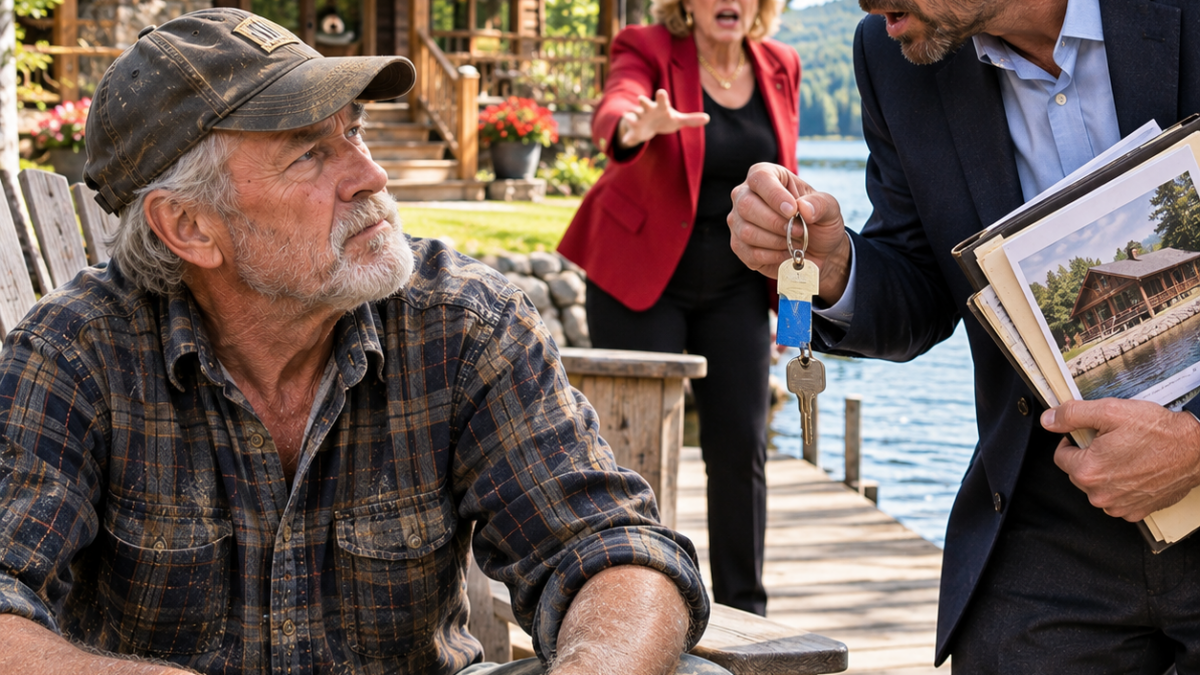
HOA Karen Sold My $285,000 Lake Cabin and Told the Buyer I Was Dead—Then He Found Me Sanding My Wife’s Bench on the Dock.
The man who bought my lake cabin found me sitting on the end of my dock, sanding the wooden bench where my wife used to drink her morning coffee, and the first thing he asked was why a dead man’s truck was parked beside his new house.
He had a brass key wrapped in blue tape, a folder saying SALE COMPLETE, and a message from our HOA president explaining that Frank Miller had died and she was handling the property for my family—but the key in his hand was the spare my late wife had marked years earlier so she could find it without her glasses.
By the end of that afternoon, the buyer and I were sitting together at my kitchen table staring at a $285,000 payment receipt, a forged signature, and an email from the HOA president ordering a removal crew to haul away every piece of furniture in my cabin—including the very bench I had been sanding when the man she lied to walked onto my dock.
My name is Frank Miller.
I was sixty-seven when Linda Shaw sold my house.
Not almost sold it.
Not threatened to sell it.
Not listed it by accident.
She sold it.
Money moved.
A deed was filed.
A buyer arrived with a key.
And according to every document Linda had shown him, there was one very good reason I was not supposed to object.
I was dead.
The morning I met Paul Bennett, I had been awake since six.
My knee hurt.
It usually did when rain was coming.
I made coffee, carried a piece of eighty-grit sandpaper down to the lake, and started working on Ruth’s bench.
Ruth was my wife.
We had been married thirty-eight years.
She had died four years earlier.
Cancer.
People say that word quickly because there is no useful way to say it slowly.
Afterward, the cabin became both easier and harder to live in.
Easier because everything was familiar.
Harder for the same reason.
Her coffee mug was still in the cupboard.
Her garden notes stayed in the kitchen drawer.
There was a mark on the dock rail where she used to hook one foot while reading.
And the bench at the end of the dock still leaned slightly toward the lake because Ruth had insisted I build it there twenty-three years earlier.
“You put it straight,” she told me.
“I want it facing the water.”
“It is facing the water.”
“No. You built it facing where you think water is.”
I had no idea what that meant.
I adjusted it anyway.
That bench outlasted her.
By the time Paul Bennett came walking down the shoreline, I had sanded half the seat.
I heard footsteps on gravel.
Looked up.
A man around sixty was coming toward me.
Khaki pants.
Blue pullover.
Folder tucked under one arm.
A brass key in his right hand.
He stopped ten feet away.
“Excuse me?”
“Morning.”
“Are you the caretaker?”
PART2:
“No.”
He looked toward the cabin.
“Then who are you?”
“Frank Miller.”
He stared.
I went back to sanding.
Sometimes people need a second.
He took three steps closer.
“What did you say?”
“Frank Miller.”
His face lost color.
He opened the folder so fast that papers slid sideways.
“You’re Frank Miller?”
“That’s generally how introductions work.”
He looked behind him.
At my truck.
Then cabin.
Then me.
“Please tell me you’re his brother.”
“I don’t have a brother.”
Paul lowered himself onto one end of Ruth’s bench.
I brushed the sawdust away first.
Habit.
He opened the folder.
PART3:
First page had a photograph of my cabin.
Below it:
SALE COMPLETE.
Buyer:
Paul and Anne Bennett.
Property:
My address.
Closing date:
Yesterday.
Purchase price:
$285,000.
Then Paul showed me an email.
From Linda Shaw.
HOA president.
The owner passed away. I’m handling everything for his family. The property will transfer clear and vacant.
I read it.
Then looked at Paul.
“Who told you I died?”
“Linda.”
“When?”
“Two weeks ago.”
“How?”
“She said you had been sick.”
I stared.
“I had knee tests.”
Paul looked at my leg.
“You were in the hospital?”
“For an afternoon.”
He closed his eyes.
“Oh, God.”
Then I looked at the key.
Square of faded blue tape wrapped around the head.
My stomach tightened.
“Where did you get that?”
Paul looked down.
“Linda.”
“Give it to me.”
He did.
I turned it over.
Ruth had placed that tape there maybe ten years earlier.
She kept spare keys in a kitchen drawer and hated putting on reading glasses.
Blue tape meant back door.
Red tape meant shed.
Yellow tape meant boat lock.
After she died, I moved the spare back-door key to a small metal box under the rear steps.
Only a handful of people knew.
Linda was one.
That story began eleven days earlier.
She stopped me at the mailbox holding a clipboard.
Green plastic.
Form clipped to front.
“Frank.”
“Linda.”
“We need access to your yard.”
“No.”
She laughed.
“I haven’t told you why.”
“That would’ve been the next step.”
She handed me the form.
Lakeside Pines HOA wanted to send a worker through my property to measure shoreline.
The HOA common dock sat east of my fence.
My cabin was inside the association only for road-maintenance purposes.
Our private road was shared.
The lakefront was different.
My deed included:
Cabin.
Yard.
Shed.
Dock.
Shoreline.
The HOA owned its common dock and common strip next door.
Linda had wanted to expand that area for months.
At spring meeting she showed a drawing.
Larger dock.
Picnic shelter.
Boat-trailer parking.
Six spaces.
Three of them sat where my shed existed.
I pointed that out.
Linda said:
“It’s conceptual.”
I said:
“My shed seems fairly actual.”
People laughed.
She didn’t.
Now she wanted access to measure.
I read the form.
It authorized:
HOA employees.
Workers.
Agents.
Contractors.
Representatives.
And “other persons deemed necessary.”
No date.
No time limit.
No named surveyor.
No defined work.
I handed it back.
“Give me a date, a person, and a reason.”
“Frank.”
“I’ll meet whoever comes.”
“You make simple things difficult.”
That was Linda.
A simple thing was anything she wanted.
A difficult thing was anyone asking why.
I had spent forty-two years repairing school buses before retiring.
I understood simple.
Simple is:
This part is broken.
That part fixes it.
Linda’s version of simple was:
Sign first.
Understand later.
I did not sign.
The next morning, my neighbor Bill called.
I was buying wood screws.
“You selling?”
“No.”
“There’s a guy taking pictures at your house.”
I left cart in aisle.
Drove home.
Young photographer stood on porch.
Camera.
Bag.
Confused expression.
He introduced himself as Tyler.
“Linda hired me.”
“For?”
“Listing photos.”
“My house isn’t listed.”
He pulled work order from phone.
My address.
Linda Shaw.
Property photography.
Instructions:
OWNER AWAY.
REAR KEY AVAILABLE.
I felt something cold move through me.
“Did you go inside?”
“No.”
“You sure?”
He looked offended.
“Door was locked. I was waiting for access.”
My porch camera later confirmed he was telling truth.
I showed ID.
Unlocked my own door.
His confidence disappeared.
“Sir, I’m sorry.”
“Send me that work order.”
He hesitated.
“Please.”
He sent it.
Then left.
I went behind cabin.
Metal key box.
Empty.
Blue key gone.
I called Linda.
“Where’s my spare?”
“What spare?”
“The blue key.”
Silence.
Then:
“I don’t know what you’re talking about.”
“Photographer says rear key available.”
“He had wrong address.”
“Work order has my address.”
“Because your driveway is easiest way to reach common dock.”
“It says listing photos.”
“Scheduling error.”
“And the key?”
“Frank, nobody is trying to break into your house.”
I looked at empty box.
“Return my key.”
“I don’t have it.”
“Stay off my property.”
I hung up.
Then emailed same thing.
Written.
Attached work order.
Asked for explanation.
That evening she replied:
There is no listing for your property. This was a scheduling error.
I saved email.
Next morning I changed locks.
Both doors.
Removed key box.
By noon I thought I had stopped whatever stupid idea she had.
Two days later, Susan Walker arrived.
New HOA treasurer.
She carried envelope.
“I was told to put this in your mailbox.”
“Then why didn’t you?”
She looked uncomfortable.
“Because I wanted to hand it to you.”
Inside:
PROPERTY OCCUPANCY CONFIRMATION.
Three boxes:
Vacant.
Rented.
Owner occupied.
I looked up.
“I’m standing here.”
“I know.”
“Why does Linda need this?”
“She says records update.”
I checked:
OWNER OCCUPIED.
Then wrote:
FRANK MILLER.
My phone number.
Large.
Clear.
I photographed it.
Susan watched.
“Something wrong?”
I showed her Tyler’s work order.
She read slowly.
Then asked:
“Changed locks?”
“Yesterday.”
“Good.”
One word.
Good.
That caught me.
“Why?”
Susan looked toward road.
“Linda does things before board votes sometimes.”
“What kind of things?”
“She calls them administrative.”
“Money?”
She hesitated.
“I’ve been asking for complete bank statements.”
“Are funds missing?”
“I don’t know.”
That answer made me trust her more.
People invent conclusions when they want drama.
Susan said she didn’t know.
She just wanted records.
Before leaving she asked me to email photograph of occupancy form so she could prove what I returned.
I did.
Then I went to county office.
Pulled newest recorded deed.
Still my name.
Frank Miller.
Everything looked fine.
I made mistake.
I relaxed.
For three days nothing happened.
I repaired dock board.
Found red fishing float my grandson had left.
Told my daughter:
“HOA mix-up. Handled.”
Then Friday afternoon, Bill arrived with phone.
“You need to see this.”
Property website.
My cabin.
Sold.
Photographs.
Living room.
Kitchen.
Bedroom.
Ruth’s seed table.
Green coat hanging by door.
Package of faucet parts on table.
I remembered package.
Delivered Monday before Linda asked for entry permission.
That meant somebody had been inside before she ever approached me with form.
The listing price:
$285,000.
Contact:
Linda Shaw.
I opened same website on my phone.
Listing vanished.
Bill’s screen still showed cached page.
We photographed everything.
Then I called sheriff.
Reported that my home appeared sold without authorization.
Dispatcher asked:
“Anyone trying to enter now?”
“No.”
Report created.
I wrote number on back of printout.
Then called buyer-contact number from listing.
Voicemail.
I left:
“My name is Frank Miller. I own this property. It is not for sale.”
Then came Saturday.
The dock.
Paul.
Blue key.
When he finished reading my driver’s license, he sat quietly.
“My wife is packing.”
“Where?”
“Rental house.”
“You closed yesterday?”
“Yes.”
“How much?”
“All of it.”
“Two eighty-five?”
“Yes.”
“With Linda?”
“Yes.”
“Who was seller?”
“Your family.”
“I’m my family.”
He rubbed his forehead.
“She said you died.”
We went inside.
Paul stopped in kitchen.
Coffee cup by sink.
Reading glasses on open crossword.
Fresh bread on counter.
My coat.
Tools.
No estate.
No emptied house.
No grieving family.
He whispered:
“She said your family left things because sale was fast.”
I put my deed on table.
He put his.
Same legal description.
His document named Linda as someone authorized to act for me.
My signature appeared on separate authorization.
It was not mine.
Paul said:
“She told us this still applied after you died.”
I stared.
“Even if it were real, that makes no sense.”
“I know that now.”
He looked devastated.
I wanted to ask:
How do you spend $285,000 without meeting seller?
But he was already being punished by that question.
So I asked:
“Who handled closing?”
“A company Linda recommended.”
“Lawyer?”
“No.”
“Title company?”
“She said all included.”
“Did you meet anyone?”
“Linda.”
Only Linda.
Paul’s phone buzzed.
He read.
His face changed.
Message from Linda:
If Frank’s brother is at the property, do not let him delay possession. Removal crew is scheduled Monday morning.
Attached work order.
Property contents removal.
Oak table.
Red tool chest.
Beds.
Dock equipment.
Ruth’s bench.
Beside bench:
HEAVY. BRING TWO MEN.
I read that line three times.
That bench had never been “property contents” to me.
It was where Ruth sat.
Where she read.
Where she complained my coffee was too strong.
Linda had turned it into an item number.
I said:
“Send me everything.”
Paul did.
Then started typing response.
I stopped him.
“Save first.”
“What?”
“Every email.”
“Every attachment.”
“Screenshots.”
“Download files.”
“Then answer.”
He nodded.
The removal company name sat at top.
I called.
Rick answered over engine noise.
“Monday eight.”
“I’m owner.”
Pause.
“I’m alive.”
Longer pause.
“That’s different from what I was told.”
I emailed:
Driver’s license image with number covered.
County deed.
Short statement.
Rick called back.
“We will not touch property until ownership resolved.”
“Keep Linda’s instructions.”
“I keep every job.”
“Especially weird ones.”
For first time since Paul arrived, I breathed.
Then we looked at payment receipt.
$285,000.
Recipient:
LAKESIDE PINES HOMEOWNERS ASSOCIATION.
Not Linda personally.
The association.
I leaned forward.
“You paid HOA?”
“That’s account on instructions.”
Paul opened bank app.
There it was.
Wire Friday.
$285,000.
My problem got wider.
Paul called his bank.
Fraud department.
No promises.
“We’ll attempt recovery.”
Attempt.
That word hollowed him out.
Deputy Harris arrived just after noon.
Broad man.
Reading glasses in shirt pocket.
He sat at table.
Listened.
Then said:
“I need to separate what we can see from what we were told.”
I liked him immediately.
What we could see:
Paul’s payment.
Linda’s death message.
My ID.
My occupied cabin.
The spare key.
The removal order.
The deed documents.
What we could not yet prove:
Who created false authorization.
Who forged signatures.
Where money moved after HOA account.
What had been filed.
Harris copied.
Gave Paul own case number.
Then called Linda from porch.
I heard:
“Yes, ma’am.”
Pause.
“Frank Miller himself.”
Pause.
“No.”
“I checked identification.”
Long pause.
“Send me records you relied on.”
He returned.
“She says family misunderstanding.”
“I don’t have a brother.”
He wrote it down.
Paul’s wife Anne arrived with empty grocery box.
They had planned to bring kitchen things in small trips.
She stood inside my front door.
Looked around.
Then:
“I’m so sorry.”
Paul tried explaining.
Anne stopped him.
“Start with what we do today.”
Good question.
Their rental ended in a week.
They expected my cabin.
I could not offer it.
Not because I disliked them.
Because it was my home.
I called Bill.
He had apartment over garage.
Empty for month.
He offered.
Anne cried.
Paul looked ashamed.
By noon, three people who had begun morning on opposite sides were trying to keep each other from collapsing.
After they left, I called Susan.
“There’s a paper with your name.”
She came immediately.
I showed authorization.
Witness:
Susan Walker.
“Did you sign?”
“No.”
“Look carefully.”
She opened picture of owner-occupied form.
Put beside witness page.
Her real signature had a long trailing line crossing a printed box.
On false page?
Same line.
Same tiny piece of box.
It looked lifted.
Copied.
Pasted.
Susan sat hard.
“Oh my God.”
“Who had original?”
“Linda.”
“She asked for it as soon as I returned.”
I sent both images to Harris.
No accusation.
Just:
Please compare.
Then Susan showed board email.
Subject:
SHORELINE AGREEMENT COMPLETED.
Linda told board:
Owner approved private sale.
HOA receives transaction money.
Board approved plan Wednesday.
Susan shook head.
“We didn’t meet Wednesday.”
“Your name listed?”
“Yes.”
“Vote?”
“Unanimous.”
She forwarded email.
That cost her.
I saw fear.
“I still work with these people.”
“I know.”
“Linda can make things difficult.”
“She already has.”
Susan looked at copied signature.
Then:
“I need bank statements.”
Sunday morning, I made a mistake.
Neighborhood message board.
I posted:
My cabin was sold without permission.
Linda told buyer I was dead.
True.
Then anger added:
Anybody who helped her should start packing.
Bad sentence.
Linda deleted post.
Reposted only that line.
Claimed I threatened board.
Suddenly I was defending temper instead of property.
I stopped.
Saved full post.
Sent Harris before anyone else.
Then emailed correction:
I should not have made the remark about packing. I am not threatening anyone. I am disputing an unauthorized sale of my home.
Embarrassing.
Necessary.
Being right about big thing does not make every small thing you say smart.
Paul arrived with thick folder.
All emails printed.
Timeline.
Linda found him through lake-property inquiry.
Called sale private.
Family wanted discretion.
Another buyer waiting.
Move fast.
No need for extra attorney.
Closing company handled paperwork.
Company logo:
Blue house inside circle.
Phone?
Voicemail with no company name.
Office?
None visited.
Paul had sat at HOA clubhouse while Linda handed documents.
Then final “closing papers” arrived email.
I asked:
“Who verified Linda’s authority?”
Paul pointed at logo.
“I thought they did.”
We added question.
Monday county office.
I expected my name still on record.
Wrong.
New filing Friday.
Paul Bennett listed as owner.
Linda had signed for me using false authorization.
Paul stepped back.
“I don’t want his house.”
Clerk said:
“We record documents.”
“We do not decide whether signatures truthful.”
Important distinction.
We bought certified copies.
Then Susan called.
Bank statement acquired.
Paul’s $285,000 entered HOA account Friday morning.
Most left that afternoon.
$240,000 transferred to another account.
Description:
PROCEEDS OWED TO SELLER — FRANK MILLER.
My stomach dropped.
It looked like I had taken money.
“Who owns account?”
Susan checked.
“Statement only shows last four digits.”
So description was label.
Not proof.
I reminded myself.
Names typed into transfer memo do not establish account owner.
Paul stood beside me.
“She can say you got paid.”
“She can say anything.”
We hired Beth Turner.
Property lawyer.
Office over hardware store.
My knee hated stairs.
Beth explained:
She represented me.
Paul needed separate counsel despite cooperation.
Good ethics.
We were legally on opposite sides of recorded transaction even though neither wanted that.
She read authorization.
“You signed?”
“No.”
“Permission to sell?”
“No.”
Then:
“Even if this authority were genuine, Linda’s story has internal problem.”
“What?”
“She told buyer you were dead while claiming to act under authority granted by you.”
“So?”
“Certain authority relationships terminate at death.”
“The paperwork may contradict the narrative being used to justify sale.”
She cautioned exact legal effect depended on document and law.
But contradiction mattered.
Beth filed for emergency order:
No possession transfer.
No removal.
No further transaction.
Preserve cabin.
Preserve contents.
Retainer:
$3,000.
That money was for truck replacement.
My old pickup smoked blue on cold mornings.
I wrote check.
Folded receipt.
Beth said:
“Keep it.”
“I keep everything.”
She smiled.
“That may save you.”
At home, I studied false signature.
My name.
Loose copy.
Then compared owner-occupied form.
My real signature had a small dot below M where I tested pen.
Same dot on false authorization.
Same upward tail where pen caught clipboard edge.
I held pages against window.
Perfect alignment.
Not hand forgery.
Lifted image.
Likely same source as Susan.
The form proving I lived there had become source document used to pretend I authorized sale.
That detail made me furious.
I sent clean files to Beth and Harris.
No public post.
No accusation.
Please compare.
Paul and Anne returned.
Paul had lawyer.
He would sign statement:
Never met Frank before Saturday.
Bought based on Linda’s representation.
Did not seek possession.
Did not want to fight lawful owner.
Anne brought envelope of cash.
“For your lawyer.”
I pushed back.
“You’ve paid enough.”
“We’re part of this.”
“You’re victims too.”
She insisted.
“No.”
They needed housing.
I did not need to perform generosity by taking their emergency money.
Instead, we made timeline.
Dates.
No adjectives.
Linda asks broad entry permission.
I refuse.
Photographer arrives with listing work order.
Linda denies listing.
Locks changed.
Susan sees me alive and owner-occupied.
Next morning Linda tells Paul I’m dead.
Sale.
Money.
Removal order.
That date sequence mattered.
Linda could not claim outdated mistaken death information.
She received written statement I was alive one day before telling buyer opposite.
Wednesday, Linda emailed community.
She said:
Frank changed his mind about a private agreement.
Legal costs caused by Frank.
Possible special assessment.
Neighbors suddenly cared.
Bill brought printout.
I wanted go door to door.
Beth stopped me.
Instead, we released two-page factual timeline.
Personal banking details removed.
Paul info protected.
Attached:
Linda’s written denial of listing.
Owner-occupied form.
Her message saying I was dead.
Board scheduled emergency meeting Thursday.
Linda opposed.
Other members outvoted.
Thursday morning:
Temporary court order.
No possession.
No removal.
No further transaction during dispute.
Not final ownership yet.
Not Paul’s money back.
But breathing room.
I printed order.
Put front window.
Then finished sanding Ruth’s bench.
The phrase from removal order remained in my head:
HEAVY. BRING TWO MEN.
I sealed wood.
Ran hand over smooth surface.
For ten minutes, problem made sense.
Sand rough.
Seal smooth.
Then clubhouse.
Packed.
Linda dressed like banker.
Dark jacket.
Pearls.
Neat papers.
Susan with bank statement.
Paul and Anne.
Bill.
Me.
Linda began:
“I was trying to create valuable community improvement.”
Shoreline expansion plan displayed.
Large common dock.
Shelter.
Trailer parking.
My shed missing.
Wide path across my yard.
My private dock marked:
SHARED ACCESS.
Tom Reeves, another board member, asked:
“Did you have Frank’s permission?”
Linda said:
“We had discussions.”
I raised hand.
Tom called.
“She asked for access form.”
“I refused.”
“That was discussion.”
Linda tried interrupting.
Tom stopped.
“Money first.”
Susan read bank.
$285,000 incoming.
$240,000 out.
$45,000 remained HOA account.
Paul stood.
“That’s our retirement money.”
Linda said:
“You bought property at fair price.”
“I bought because you said owner was dead.”
He held message.
For first time, Linda lost smooth expression.
Then:
“I relied on information I believed correct.”
I stood.
Held owner-occupied form.
“You received this day before.”
Susan confirmed.
She had watched me check OWNER OCCUPIED.
Handed original directly to Linda.
Date.
Next morning death message.
Linda reached water glass.
Did not drink.
Then changed story.
“Frank had already authorized me to handle property.”
Tom asked:
“Show us.”
Linda produced false authorization.
Susan placed real form beside.
Box fragment.
Her copied signature.
My matching dot.
Copies passed around room.
No shouting.
Worse.
People leaned forward.
Linda said:
“Copied signatures are common on prepared documents.”
Susan answered:
“Not when people never agreed to document.”
Tom asked:
“Where is $240,000?”
Linda said:
“I have solution.”
She put new agreement in front of me.
Page one:
I approve sale.
Page two:
I receive $240,000.
HOA keeps $45,000 for transaction and access.
Signature line.
I looked up.
“You said I already agreed.”
“This settles matter.”
“Why do you need my signature now?”
No answer.
Then Paul noticed.
“You can release $240,000?”
Linda froze.
He stood.
“You said money already went to Frank.”
Silence.
Tom pushed chair back.
“Where is money?”
“Held safely.”
“By who?”
“Part of settlement.”
Paul’s voice changed.
“That is money my wife and I sent for a house you did not own.”
Tom asked Susan to record answer.
Asked again.
Finally Linda:
“Separate account under my control.”
Room erupted.
She claimed she moved money to keep it apart until sale completed.
Susan pointed statement.
“Why memo says paid to Frank?”
“It was meant for him.”
“You told me he received it.”
Linda folded hands.
“I was trying to complete a beneficial community transaction.”
There it was.
Beneficial.
That word had done a lot of damage.
I looked at shoreline drawing.
My shed erased.
My dock shared.
My yard path.
Months earlier I assumed careless design.
Now realized plan depended on taking my property.
I asked:
“Why tell Paul I was dead?”
She looked at table.
Then quietly:
“He wanted to speak to the owner.”
The room became absolutely still.
Paul took one step backward.
“So you made sure I wouldn’t ask again.”
Linda said:
“I was under pressure.”
Project behind schedule.
Neighbors promised improvements.
She thought once I saw money I would agree.
There was no sentence about what I wanted.
I pushed agreement back.
“I’m not selling.”
Tom asked Linda to surrender:
Association checkbook.
Bank credentials.
Office keys.
She objected.
Tom said:
“We’ll follow removal rules.”
“But tonight your access to funds is suspended.”
Board voted.
Susan yes.
Tom yes.
Third member yes.
Linda slowly put checkbook on table.
No handcuffs.
No applause.
She left.
That was not ending.
Real cases don’t end when room gasps.
Bank restricted association account.
Investigators sought to prevent receiving account funds moving.
Paul still waited.
Police interviews.
Statements.
Records.
Photographer work order.
Linda’s denial.
Those two documents mattered greatly.
Before sale, I had directly challenged listing.
She denied it.
Hard to call later misunderstanding.
Investigation found “closing company” was not independent.
Email infrastructure tied back to Linda’s operation.
No neutral closing office had verified authority.
The blue-house logo had been costume.
Just like paperwork.
Paul had paid into a process Linda designed from beginning to end.
Then court.
False deed needed clearing.
Paul cooperated.
Still Beth wanted judicial order.
No quick private swap leaving future cloud on title.
At hearing, Linda’s lawyer called new agreement an attempted settlement.
Beth presented dates.
Linda told I’m alive.
Then tells buyer I’m dead.
Denies listing.
Then completes sale.
Claims money paid to me.
Then offers to release money if I sign.
Judge asked me:
“Did you receive purchase money?”
“No.”
“Did you sign authority?”
“No.”
“Do you wish to approve sale?”
“No, Your Honor.”
“What do you want?”
“To keep my home.”
Judge ruled authorization invalid.
Deed based on it invalid.
County record corrected through order.
My cabin was mine.
Always had been.
But hearing judge say it loosened something inside me.
Outside, Paul shook hand.
“I’m glad.”
He meant it despite money still frozen.
Eventually banks unwound transaction.
$45,000 from HOA account.
$240,000 from account Linda controlled.
Paul and Anne received full $285,000.
Not damages.
Their money returned.
Anne called when transfer cleared.
Started reading amount.
Voice broke.
Paul took phone.
“We can breathe.”
I sat on porch afterward.
No papers.
Just quiet.
Criminal case took longer.
Linda removed properly from presidency.
Audit.
Shoreline project canceled.
Community received correction:
Frank Miller did not agree to sell.
Frank Miller did not receive sale proceeds.
Frank Miller did not create dispute by changing mind.
I kept letter.
Of course.
Some neighbors apologized.
Some waved again.
Enough.
The audit also changed HOA rules.
One person could no longer move large amounts alone.
Major property-related agreements required outside verification.
Board votes documented and circulated.
Bank access split.
Independent closing services for real estate matters.
Basic safeguards.
Should have existed already.
Linda eventually pleaded guilty to fraud-related offenses involving sale and forged documents.
Sentencing took months.
Her attorney described volunteer years.
Community service.
Belief transaction could ultimately become fair.
Judge asked one question:
“Did she ever have Mr. Miller’s authorization to sell his home?”
Her attorney:
“No.”
That cut through everything.
Linda received prison sentence.
Two years.
Restitution for documented losses.
Paul and Anne’s extra housing.
Approved legal costs.
Other proven expenses.
No fantasy fortune.
I never asked.
I wanted:
False deed gone.
My cabin.
Costs covered.
Linda unable to repeat scheme.
That was enough.
At sentencing, Linda spoke.
Said sorry situation “went so far.”
That phrase bothered me.
Situation had not walked itself anywhere.
She had taken steps.
Key.
Photographer.
Listing.
Fake authority.
Buyer.
Money.
Removal crew.
I waited for apology to Paul.
Anne.
Susan.
Not really.
Eventually I stopped needing it.
Truth didn’t depend on Linda understanding truth.
Late summer, Paul and Anne bought another lake place.
Farther down road.
Smaller.
Dock leaned.
This time:
Own lawyer.
Real title company.
Met seller.
Paul called.
“I shook his hand twice.”
“Why twice?”
“To make sure he stayed alive.”
First time he joked.
Good sign.
A few weeks later they came for sandwiches.
Paul carried something.
Brass key.
Blue tape.
“I think this belongs here.”
I held it.
Tape worn.
Ruth’s fingers used to touch that tape.
The key no longer fit new locks.
I put it into kitchen drawer beside Ruth’s garden notes.
Then we went down dock.
My grandson was casting.
Poorly.
Paul helped untangle line.
Anne sat on bench.
I looked back at cabin.
Shed still there.
No parking spaces.
No shared path through yard.
No strangers removing furniture.
My quiet life had survived.
But not because I simply told truth once.
That surprised me most.
I had believed truth was enough.
“I own this.”
Done.
No.
Truth needs records when somebody builds paperwork around a lie.
Copies.
Dates.
Emails.
Bank statements.
Photos.
Clean originals.
People willing to admit uncertainty.
Deputy Harris saying:
Here’s what we know.
Susan saying:
I don’t know if money is missing.
Beth saying:
County record needs court correction.
Rick saying:
We won’t remove belongings while ownership disputed.
Paul saying:
I don’t want his house.
No single dramatic hero.
Just people stopping one step at a time.
Later, Harris told me something.
“Your best evidence wasn’t false deed.”
“What was?”
“The owner-occupied form.”
I laughed.
“The form Linda asked for?”
“Yes.”
“Why?”
“Timeline.”
He explained.
Susan saw me alive.
I wrote name.
Phone.
OWNER OCCUPIED.
Linda received it.
Then next morning told buyer I was dead.
Whatever excuses might exist for outdated records died there.
Pun unintended.
Maybe.
I kept form.
Framed?
No.
I’m not that strange.
Filed.
Cabin folder grew thicker.
Deed.
Court order.
HOA correction.
Receipts.
Photos.
Blue-key story handwritten for children.
My daughter teased:
“Dad, there are more papers for cabin than mortgage company had.”
“Good.”
“What happens when you die?”
I looked at her.
“Apparently, verify it independently.”
She didn’t laugh at first.
Then did.
We updated estate planning.
Proper beneficiary designations.
Clear instructions.
Lawyer contact.
No ambiguity.
If somebody ever tried again, they would meet a wall of records before reaching dock.
The HOA changed too.
Susan became president temporarily.
She did not want job.
Good.
Tom handled finance committee.
No one spoke like Linda.
Meetings became boring.
Road repairs.
Snow plow.
Insurance.
Common dock.
Boring leadership is underrated.
The expansion plan died.
Later they replaced common dock within existing footprint.
Asked neighboring owners first.
Including me.
Susan came to gate.
“Can surveyor step three feet over your line for measurement Thursday at ten?”
I smiled.
“Name?”
“Eric Sandoval.”
“Reason?”
She showed plan.
“Two hours maximum.”
“See?”
“What?”
“That’s how simple things work.”
She laughed.
We approved.
Surveyor came.
Left.
No one died.
Years passed.
Ruth’s bench needed sanding again.
Wood does that.
One morning I sat there with Paul.
He and Anne became friends.
Strange outcome.
The man who bought my house became someone I trusted on my dock.
He asked:
“You ever hate me that first day?”
“No.”
“Not even little?”
“You knocked before trying key.”
He smiled.
“Seemed polite.”
“It was.”
That mattered.
He could have arrived aggressive.
“My house.”
“My deed.”
“Get out.”
Instead he asked.
Then listened.
Victims can collide when fraudster places them on opposite sides.
Linda had designed exactly that.
If Paul tried force possession, I would see him as thief.
If I threatened him, he would see me as scammer.
We might spend months attacking each other while person who caused it disappeared with money.
Instead we sat at kitchen table.
Compared papers.
That broke design.
Same with Susan.
Her name was on fake witness line.
Easy for me to accuse.
I almost did.
Then she showed real signature source.
We compared.
Evidence before anger.
That principle saved all of us time.
One afternoon my grandson, older now, asked about blue key.
He found it in drawer.
“Grandpa, what’s this?”
I told story.
He listened with expression teenagers use when adults describe unbelievable incompetence.
“So she stole key?”
“Appears she used it or caused it to be used.”
“Sold your house?”
“Yes.”
“Said you died?”
“Yes.”
“And buyer just believed her?”
“He had paperwork.”
My grandson frowned.
“That’s stupid.”
I looked at lake.
“Sometimes.”
“But paperwork can look very convincing when it tells you what you hope is true.”
“What did Paul hope?”
“A home on lake.”
“What did Linda hope?”
“That everyone would move fast.”
“What did you hope?”
I thought.
“That changing locks fixed problem.”
He nodded.
“So everybody believed something.”
Exactly.
Fraud doesn’t require one stupid person.
It requires several normal assumptions lining up.
Photographer assumes work order valid.
Buyer assumes closing company real.
Treasurer assumes president follows rules.
Recorder assumes submitted document facially acceptable.
Removal company assumes client owns contents.
Neighbors assume HOA president knows situation.
Every person sees one small piece.
Fraudster controls connections.
Linda controlled the story between pieces.
Until we started comparing.
That was her weakness.
My work order said:
Listing.
Her email said:
No listing.
Susan’s form said:
Owner occupied.
Her message said:
Owner dead.
Bank statement said:
Paid to Frank.
Her settlement said:
Money can be released if Frank signs.
Every lie worked alone.
Together they fought each other.
I had spent career repairing buses.
Electrical problems taught me same thing.
One strange reading means little.
Five inconsistent readings show circuit problem.
Linda created too many inconsistencies.
Eventually system lit up.
Some people later asked why HOA president could sell property at all.
She couldn’t lawfully.
That’s the point.
Recording paper is not same as validating truth.
A forged or unauthorized document can create temporary mess before court clears it.
That was frightening lesson.
County clerk never said:
“Yes, Paul owns your cabin.”
She said:
“New filing exists.”
Then:
“We record papers; courts decide disputes.”
At first that felt unsatisfying.
Now I understood.
Government recorder cannot hold mini trial at counter every time deed presented.
Systems depend on signatures being genuine.
Fraud exploits trust.
When trust breaks, courts repair record.
Slow.
Expensive.
That $3,000 retainer hurt.
My truck coughed blue smoke entire winter.
I kept driving.
Eventually replaced it.
Used one fewer feature package.
Survived.
Beth told me to save receipts.
Legal process recovered documented costs.
Not every hour of stress.
Not sleep.
Not insult of hearing someone called you dead.
But enough.
People love dramatic damages awards.
I wanted none.
Money would not make Ruth’s bench more mine.
Clear title did.
Paul’s refund mattered.
HOA safeguards mattered.
Linda’s inability to do it again mattered.
One fall afternoon, new resident asked me why I had old blue key hanging on small hook in workshop.
I told shorter version.
He said:
“You should put sign on dock.”
“What sign?”
“OWNER NOT DEAD.”
I laughed.
Thought about it.
Decided against.
Ruth would have hated novelty sign.
The bench remained plain.
That was better.
I sometimes wonder when Linda first decided selling my place was possible.
Spring drawing?
When she saw parking spaces could fit if my shed disappeared?
When I refused shore access form?
When she remembered spare key?
When she learned my hospital schedule?
Maybe no single moment.
Bad plans often grow.
First:
We need more shoreline.
Then:
Frank won’t cooperate.
Then:
We can list quietly.
Then:
He’ll take money once he sees it.
Then:
Buyer wants owner.
Then:
Tell buyer owner died.
Then:
Move money.
Then:
Get signature later.
Each step makes next one easier because admitting truth becomes more expensive.
By clubhouse meeting, Linda offered $240,000 not because she finally respected my choice.
She wanted my signature to transform fraud into agreement retroactively.
That was most revealing moment.
She had spent days insisting sale was valid.
Then suddenly needed me to validate it.
I asked:
“Why do you need signature now?”
She never answered.
Because answer was whole case.
Years after, Linda’s old shoreline drawing remained in HOA archive.
Susan offered it to me.
I said no.
“Sure?”
“Yes.”
“Your shed is missing.”
“I noticed.”
She smiled.
The actual shed still stands.
Roof repaired.
Paint faded.
Every time I walk past, I think about drawing.
Paper can erase shed.
Not physically.
That sounds obvious.
But paper had nearly erased me too.
That feels less obvious now.
Ruth’s bench eventually needed one board replaced.
I removed seat plank.
Found underneath, scratched faintly in pencil:
R + F 2003.
I had forgotten.
Ruth must have done it before I sealed original.
I sat there holding board.
For all paperwork in case, that pencil mark hit hardest.
Linda had listed bench:
Heavy. Bring two men.
To her it was furniture.
To me it contained history nobody buying cabin could see.
That is why property has two values.
Market value.
Personal value.
Market says:
$285,000.
Then maybe more.
Lake frontage.
Dock.
Cabin.
Expand common facilities.
Parking.
Personal value says:
Ruth sat here.
Grandson left red float.
Daughter scraped knee on steps.
I fixed roof during storm.
I know which floorboard squeaks.
You cannot negotiate those values as if same number.
Linda believed enough money would make refusal irrational.
Maybe to her.
Not to me.
When Paul eventually sold his second lake place years later, he called.
“Seller wants remote closing.”
“Your problem?”
“No.”
“I’m meeting him anyway.”
“Good.”
“And lawyer.”
“Good.”
“And title office.”
“Good.”
“And I checked pulse.”
I laughed.
He had earned joke.
He and Anne moved closer to grandchildren.
We still exchanged Christmas cards.
On his last visit he sat on Ruth’s bench.
“Can I tell you something?”
“Sure.”
“I hated you for maybe thirty seconds.”
“When?”
“First dock morning.”
“Why?”
“Because I thought you were taking our home.”
I nodded.
“I probably hated you fifteen.”
“Only fifteen?”
“You looked too confused.”
He laughed.
Then:
“Linda almost made us enemies.”
“Yes.”
“That still bothers me.”
“Me too.”
That was perhaps ugliest part.
Fraud doesn’t only take money.
It rearranges trust.
Makes honest people look dishonest to each other.
Paul looked like trespasser.
I looked like impostor.
Susan looked like forged witness.
Board looked complicit.
Even HOA bank transfer made it look as if association acted legitimately.
Linda had placed everyone in roles.
Truth required us refusing roles.
Paul did not insist he owned.
Susan did not hide because embarrassed.
I admitted my angry message was wrong.
Tom admitted board oversight failed.
Ben—our maintenance worker—later admitted he had seen Linda using old access instructions and assumed authority.
Each person surrendered something:
Pride.
Certainty.
Position.
That let facts line up.
After case, HOA adopted rule that any property transaction involving member/private land required direct confirmation with recorded owner through independently verified contact.
No board officer could act as buyer/seller intermediary.
Large transfers required two approvals.
External closing professional mandatory.
Basic.
Boring.
Again:
Boring is good.
I still pay road dues.
People sometimes ask why I stayed HOA member after all that.
Because road is real.
Snow removal is real.
Drainage is real.
Shared infrastructure requires organization.
Linda abusing office did not make every form of cooperation evil.
Same lesson as shoreline case.
Authority isn’t problem.
Unbounded authority is.
I vote now.
Used to skip meetings.
Not anymore.
I read packets.
All of them.
When somebody says:
“Routine.”
I ask:
“Which page?”
Susan once laughed:
“You’ve become worst member.”
“Good.”
“No one can pass anything while Frank is reading footnotes.”
“Excellent.”
One meeting proposed new insurance agreement.
Twenty-seven pages.
Everyone ready vote.
I asked about section seventeen.
Wrong parcel reference.
Small typo.
Corrected.
Vote next month.
A neighbor groaned.
I said:
“Last time we moved fast, I died.”
Nobody complained again.
On anniversary of Ruth’s death, I sit on bench.
Coffee.
No sanding unless necessary.
One year I brought blue key.
Turned in fingers.
Tape nearly gone.
Thought about how one forgotten spare let whole scheme move.
I blamed myself for while.
Should have changed hiding spot.
Should have moved key after plumber.
Should have watched Linda.
Should have known.
Then stopped.
Leaving spare key where trusted neighbor once knew it existed was careless.
It did not authorize theft.
Important difference.
Victims can learn without accepting blame for someone else’s choices.
I changed habits.
That’s enough.
My daughter eventually asked whether I would ever sell cabin.
“Maybe.”
She looked shocked.
“Really?”
“Everything changes.”
“What number?”
“No number today.”
“If you do?”
“I’ll tell buyer personally.”
She laughed.
“And make video proving you’re alive?”
“Possibly.”
My grandson said:
“Grandpa, livestream closing.”
Maybe.
But for now:
Cabin stays.
Dock stays.
Bench stays.
No trailer parking through yard.
No shared dock on my lot.
Common dock next door expanded modestly later.
Proper survey.
Proper vote.
Stayed within HOA parcel.
I supported it.
Linda had told everyone I stood against improvement.
False.
I stood against taking someone else’s land to improve yours.
There is difference.
New dock turned out nice.
Families use it.
I hear them laughing from my bench.
Doesn’t bother me.
It never did.
One Sunday, a boy from common dock called:
“Mr. Miller, can we swim near your dock?”
I said:
“Stay outside boat line.”
“Okay!”
Simple.
No lawsuit.
Permission can exist without surrender.
That might be the lesson Linda never understood.
She assumed a boundary meant hostility.
No.
A boundary tells you where asking begins.
Years later, I found original green clipboard form in evidence copies.
The one Linda wanted me to sign at mailbox.
Broad entry permission.
No end date.
I wondered what she planned if I signed.
Would she use it to photograph inside legally enough to blur lines?
Would buyer still hear I was dead?
Would signature be repurposed?
No idea.
Doesn’t matter.
I refused because it was too broad.
Not because I predicted crime.
Sometimes you don’t need to predict worst-case scenario.
You just need not sign things you don’t understand.
My school-bus years gave me that.
No mechanic signs blank inspection.
No driver accepts bus without knowing which defects fixed.
Paperwork is not nuisance.
It is memory when everyone later disagrees.
In court, nobody asked who seemed nicest.
Documents answered.
Linda’s denial.
My form.
Paul’s messages.
Bank records.
The new agreement.
Dates.
That is why I still tell younger neighbors:
Save boring email.
Take photo of form.
Keep receipt.
Not because live suspicious.
Because memory is terrible and confidence is cheap.
Documentation has patience.
It waits.
When lies start, it doesn’t need shout.
It just needs be there.
The afternoon after everything finally settled, I sat on dock with Ruth’s old mug.
I rarely used it.
Afraid break.
Paul had returned blue key.
County record clean.
Court order filed.
HOA correction mailed.
Linda gone.
For first time, nobody needed anything from me.
No statement.
No signature.
No scanned document.
No call.
I looked at cabin.
It was not spectacular.
One-story wood.
Roof newer.
Porch slightly crooked.
Shed paint needed work.
Real estate listing called it:
Charming rustic lakefront retreat.
Ruth called it:
Home.
Her version better.
I thought about first thing Paul said.
Why is a dead man’s truck parked beside my new home?
At time absurd.
Later I understood it contained whole fraud.
Paul believed home was his.
I knew it was mine.
Both had paper.
Only one title history lawful.
One person had created collision and hoped to profit before either of us compared.
That is why moment on dock ended plan.
Not because dead man came back from grave.
Because two living people stopped accepting story they had been given and put documents side by side.
Fraud hates comparison.
Linda controlled my story separately.
To Paul:
Frank died.
To board:
Frank agreed.
To me:
No listing exists.
To bank:
Seller paid.
To neighbors:
Frank changed mind.
To removal company:
Property vacant.
Each audience got version tailored to need.
The moment audiences spoke to each other, versions collapsed.
Paul showed me messages.
Susan showed bank records.
I showed Linda email.
Tom saw money.
Harris saw timeline.
Beth saw signatures.
No grand detective trick.
Communication.
That almost makes scheme more frightening.
How often do lies survive because people never compare notes?
I don’t know.
Enough.
When my grandson got old enough to help with repairs, I made him sand bench once.
He complained.
“How long?”
“Until smooth.”
“How do I know?”
“Run hand across.”
“That’s subjective.”
I stared.
“You been talking to lawyers?”
He laughed.
We worked.
Then he asked:
“Is this the bench they tried to take?”
“Yes.”
“Why didn’t you just build another?”
I stopped sanding.
“Could have.”
“Then why care?”
I thought.
“Because sometimes replacing an object is easy.”
“And?”
“Replacing what happened around it isn’t.”
He nodded like he understood.
Maybe he did.
Bench was not valuable.
Could build new for $200.
But keeping it mattered because I had choice.
That was what every part of case came back to.
Choice.
Linda wanted dock expansion.
She could ask.
I could say yes or no.
Paul wanted cabin.
He could offer.
I could sell or not.
HOA wanted access.
Could negotiate.
What Linda could not do was manufacture my answer because she disliked real one.
She did anyway.
The law fixed paper afterward.
But human wrong happened first:
She replaced my consent with her preference.
That’s why her “fair price” defense never mattered to me.
Even if $285,000 had been twice market.
Even if $240,000 waited in envelope.
Even if expansion benefited every neighbor.
My home was not available merely because someone calculated a number.
A fair deal requires two people agreeing.
Otherwise it’s just price attached to taking.
I think Ruth would have understood instantly.
She had been much less patient than I was.
If Linda had told Ruth the cabin was being sold for community benefit, Linda might have learned new uses for English language.
I sometimes wish Ruth had been there.
Then I’m glad she wasn’t.
The stress would have hurt her.
Grief creates strange contradictions.
One afternoon, I told her photograph:
“You would’ve hated this.”
No answer.
Probably for best.
I finished sealing bench.
Sunset orange over lake.
Common dock lights came on next door.
Someone waved.
I waved back.
No hostility.
No victory parade.
Just people living.
That is ending I wanted.
The cabin remained mine.
Paul got money back.
Susan helped rebuild board.
Linda faced consequences.
Road got maintained.
Common dock improved without crossing my line.
And blue key rested in kitchen drawer.
Sometimes the strongest ending is not destroying everyone who wronged you.
It is waking up months later and realizing your ordinary life came back.
My coffee.
My dock.
My shed.
My ridiculous old truck.
My grandson losing fishing line.
The same bench.
No one asking me to prove I belonged.
Linda Shaw had sold my cabin and told the buyer I was dead.
For a little while, the paperwork even made her lie look real.
But she forgot something important.
A false document can travel faster than the truth.
It can fool a buyer.
Move money.
Get recorded.
Schedule movers.
Change locks.
Maybe even convince an entire neighborhood.
But eventually somebody asks the wrong question.
Paul’s was:
Why is a dead man sitting on my dock?
And once he asked it directly to me, every story Linda had kept separated finally collided in one place.
I set down the sandpaper.
He handed me the key.
And the sale of my home began falling apart before either of us ever stood up from Ruth’s bench.








