HOA Karen Sold 68 Christmas Cruise Tickets Using My Lakefront Display—Then Her Guests Found My Decorations in Her Dumpster
PART2:
“I bought it from the link in the Cedar Shore newsletter last Sunday.”
“How much?”
“Seventy-five dollars.”
“Per person?”
“Yes.”
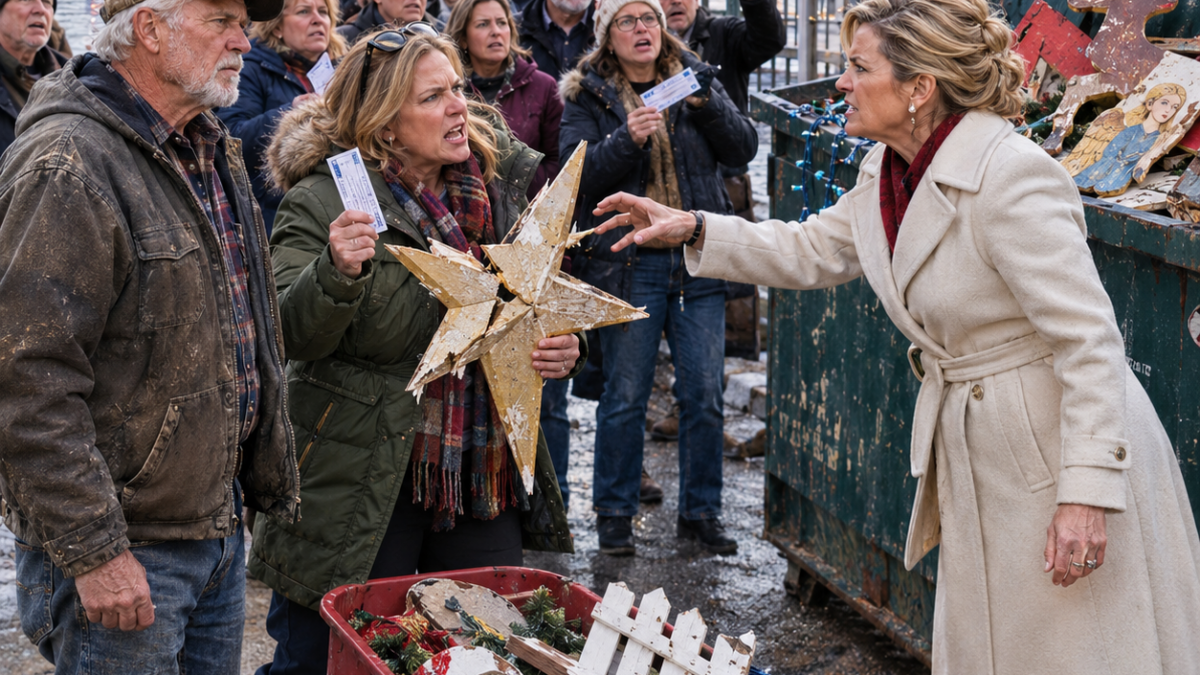
She pointed toward three people behind her.
“My sister and two friends came with me.”
Three hundred dollars.
For a cruise built around a Christmas display I had never agreed to host.
Evelyn folded her arms.
“Everyone received a perfectly enjoyable boat ride.”
The woman looked at the broken star.
Then back toward the dumpster.
“That isn’t what you advertised.”
Eleven days earlier, I had been standing on a ladder above my workshop door fastening a wooden crescent moon into place when Evelyn Price walked into my driveway.
She waited until I climbed down before speaking.
She wore a white winter coat that probably cost more than my first truck and carried a folder tucked against one arm.
My name is Russell Bennett.
I was sixty-seven that December.
My house sat on the west side of a small lake cove on land my father had kept when he sold most of the surrounding acreage to developers decades earlier.
Those developers eventually built Cedar Shore Estates.
Big houses.
Stone entrance.
Private clubhouse.
Community marina.
Homeowners association.
My property was surrounded by HOA homes.
It was not part of the HOA.
That distinction had been established in writing more than once.
Evelyn knew it.
Two years earlier, she had tried to bill me for part of a clubhouse roof replacement.
I had sent her the property records.
The HOA’s own attorney confirmed I wasn’t a member.
The bill disappeared.
That should have settled the matter permanently.
Apparently, Evelyn considered permanent a flexible concept.
She held out a paper.
“This is for you.”
I took it.
At the top were the words:
SEASONAL WATERFRONT DISPLAY REVIEW.
Amount due:
$600.
I read it twice.
“What exactly are you reviewing?”
“The impact your holiday lighting has on the community.”
I looked past her toward the lake.
My dock sat below us.
Around the bend, mostly hidden by trees, was the Cedar Shore marina.
“My lights face the water.”
“The lake is part of the community.”
“So is the moon. You billing that too?”
She didn’t smile.
“The issue is that your seasonal display has become a prominent feature of the lakefront.”
“It’s been there almost twenty years.”
“Which is exactly why we need to formalize it.”
I folded the bill.
“I’m not paying this.”
Her eyes moved toward the wooden moon I had just installed.
“Then you need to keep the display off until we resolve the matter.”
I slid the paper into my shirt pocket.
“No.”
“Russell—”
“My property isn’t in Cedar Shore.”
“The visual impact extends beyond your property.”
“So does my oak tree.”
“This isn’t helpful.”
“I wasn’t aware I was attending a meeting.”
She tightened her grip on the folder.
“We’re trying to find a cooperative solution.”
“To what?”
She didn’t answer directly.
“You’ll receive an invitation to Thursday’s holiday planning meeting.”
I went back toward my ladder.
“Send it if you want.”
I should have asked more questions.
That was my first mistake.
I treated the visit like another minor irritation from a woman who loved rules most when she was the person explaining them.
The Christmas display wasn’t a business.
Never had been.
It was a collection of wooden figures, lights, mechanical pieces, and small scenes I put along the lakefront every December.
A wooden train ran beneath three illuminated arches.
Two reindeer leaned toward the shore.
There were painted sheep.
A shepherd.
An angel.
The wooden moon.
And above the dock stood a tall eight-pointed star that reflected across the water when the lake was still.
I had built most of it after work during the years when I repaired heating and air-conditioning systems.
My wife, June, painted almost everything.
She had an eye for small details.
A shadow beside a sheep’s ear.
A little white highlight in an angel’s eye.
Red trim on the train.
Dots of gold around the wooden star.
June had been gone four years.
Cancer.
Fast at the end.
Every December since, I opened the storage boxes and found her handwriting.
Turn this sheep toward the road.
Russell, fix angel’s nose BEFORE putting her outside this time.
Moon bracket goes LEFT.
The star had another note on the back:
TOP FACES HOUSE WHEN STORED.
She wrote that because I had put it away upside down three years in a row.
Those notes mattered more to me than anything an appraiser could put on paper.
My grandson Owen helped now.
Nine years old.
He believed every mechanical problem could be solved with additional screws.
That afternoon, after Evelyn left, Owen found me at the kitchen table studying the six-hundred-dollar bill.
“Are we in trouble?”
“No.”
He looked at the paper.
“Then why do you look mad?”
“Somebody sent us a bill we don’t owe.”
“Like when Mom got charged for two watermelons?”
“Something like that.”
He considered this.
Then put a wooden shepherd on the table.
He had been repainting one sleeve.
The original blue had faded.
Owen’s version was much brighter.
Blue paint covered his thumb and part of his palm.
“Grandma’s blue was darker.”
I examined it.
“It’ll look right outside.”
“You sure?”
“I’m sure.”
I was not going to spend the afternoon explaining color matching to a nine-year-old who wanted to help repair something his grandmother had painted before he could remember her.
After my daughter Beth picked him up, I photographed the completed pieces.
I did that every year.
Wide shots.
Close-ups.
Connections.
That way I knew where everything belonged when I stored it again.
For reasons I couldn’t explain at the time, I also photographed the backs.
June’s dates.
Her notes.
Old repairs.
Screw placements.
Then I emailed Evelyn.
I stated three things clearly.
My property was not inside the Cedar Shore HOA.
I did not accept the $600 charge.
Nobody from Cedar Shore had permission to enter my property, move my display, modify it, or control when I used it.
I attached the same county property map I had used during the clubhouse-roof dispute.
Evelyn responded the following morning.
We are seeking a cooperative solution.
Please attend Thursday’s holiday planning meeting.
I almost deleted it.
Then something beneath her signature caught my attention.
Cedar Shore Christmas Cruise Committee.
I called the marina.
A man named Caleb Turner answered.
Caleb operated the passenger boat that ran lake tours during spring, summer, and early fall.
I had waved to him plenty of times.
We had never had a real conversation.
“I’m calling about the Christmas cruise.”
“Mr. Bennett?”
“Yes.”
“Great. Are you going to have everything lit?”
That stopped me.
“Why?”
“Your stretch is the best part.”
I looked out the kitchen window toward the shore.
“Has somebody told you I’m involved with this?”
“Involved how?”
“Providing something. Hosting. Running anything.”
Caleb hesitated.
“I just operate the boat, Mr. Bennett. The association handles the event.”
That was another point where I should have dug deeper.
Instead, I imagined what had happened for years anyway.
People in small fishing boats sometimes slowed in the cove to look at the lights.
I never minded.
The display was visible from the lake.
I didn’t own the view.
If the HOA wanted to rent a boat and drive people past my shoreline, that wasn’t something I intended to stop.
I just didn’t understand yet that Evelyn had confused being able to see something with owning the right to sell it.
Thursday evening, I went to the planning meeting.
Five people were there.
Evelyn sat at the head of a folding table.
Next to her was Amelia Grant, the HOA treasurer.
Amelia always looked tired, like somebody handed her an additional responsibility every time she entered a room.
Two other board members, Paul and Denise, were studying a marina diagram.
The fifth person was a contractor named Wade Collins.
On the diagram, the grass above the marina had been relabeled:
HOLIDAY VILLAGE.
Evelyn smiled when I came in.
“Russell. Good.”
I stayed standing.
“You wanted me here.”
“We’d like to make your display an official part of our holiday celebration.”
“What does official mean?”
“Coordinated presentation. Matching signage. Scheduled lighting.”
She paused.
“And a contribution toward promotion.”
“The six hundred dollars?”
“That would be your participation fee.”
“I didn’t ask to participate.”
Wade looked up.
His chair shifted slightly away from the table.
Evelyn turned the marina plan toward me.
“Your figures could be moved here.”
I stared at the paper.
“What?”
“The larger pieces. Professionally. There’s better parking, better pedestrian access, more room for photographs—”
“No.”
“You haven’t heard the full proposal.”
“I don’t need to.”
“Russell—”
“I’m not moving June’s display.”
That stopped Amelia.
Evelyn continued.
“It would still carry your family’s name.”
I put my property map on top of her marina drawing.
“My lights stay on my land.”
I tapped the map.
“You can take your cruise past them the same way anybody else drives a boat past them.”
Then I looked directly at Evelyn.
“That doesn’t give you control over the display.”
Nobody spoke for several seconds.
Then Wade asked:
“So there isn’t an agreement?”
“Not with me.”
He wrote something on the yellow legal pad beside him.
That small movement turned out to matter later.
At the time, I was simply relieved one person had heard the word no.
Amelia looked at Evelyn.
“Should we stop using the Bennett display in the event material until this is settled?”
Evelyn answered immediately.
“The promotional materials represent the general holiday experience.”
I looked at her.
“What promotional materials?”
“They’re still being revised.”
“Can I see them?”
“Once finalized.”
That should have been another warning.
I left.
The following morning, I sent an email memorializing the meeting.
No fee.
No relocation.
No permission to use my name as a participating host, partner, or sponsor.
I copied Amelia.
She replied:
Received. I will preserve this with the meeting record.
For two days, nothing happened.
I replaced a damaged light string.
Fixed the wooden train.
One wheel stuck at the same track joint it had caught on every December for years.
I filed down the edge until it moved smoothly.
Sunday evening, my neighbor Ruth stopped at the fence with her husband Frank.
Frank used a walker.
The slope to the lake was too difficult for him.
I carried a bench onto the flat section of my driveway so he could see the display.
The lights were on.
The train rolled.
The star reflected across the cove.
Ruth offered me twenty dollars.
“For the electricity.”
“No.”
“Russell.”
“Keep it.”
“You run all this every night.”
“I know.”
“Then let us contribute.”
“No.”
June used to say a thing didn’t need to earn money to earn its place.
Watching Frank follow the wooden train with his eyes, I understood what she meant.
As they were leaving, Ruth pointed toward the marina.
“They’re putting you on their flyers.”
“I know they’re taking the boat past.”
“No.”
She shook her head.
“The flyer says you’re part of it.”
I sighed.
“Bring me one if you have it.”
“I will.”
I was tired of papers.
Bills.
Emails.
Meetings.
I wanted one evening where the lights were simply lights.
That was another mistake.
There was urgency.
I just didn’t know it.
Monday morning, I drove into town for a dental appointment.
Before leaving, I shut off the outside circuit at my workshop breaker.
One connection still needed repair.
I did not want anyone plugging it in accidentally.
I returned shortly after noon.
A white work truck was parked inside my driveway.
My gate was open.
A trailer sat beside my Christmas display.
Two men were standing near the wooden train.
One had a drill.
The other was pulling one of the lighted arches from its ground sleeve.
For three or four seconds, I could not understand the scene.
Everything I recognized was in the wrong place.
The reindeer were lying flat.
The star was gone from the dock.
A coil of blue lights dragged through the grass.
The train engine was strapped to a trailer.
I stopped the truck.
Got out.
“Put that down.”
The man holding the arch froze.
“Are you Mr. Bennett?”
“Yes.”
“Put it down carefully.”
He lowered it.
An older worker walked toward me holding a work sheet.
“We were told this was approved for pickup.”
“By who?”
“Mrs. Price.”
I looked at the trailer.
My wooden moon was underneath the train.
One pointed end had snapped.
My throat tightened.
I wanted to shout.
Then I saw the men watching me.
They weren’t Evelyn.
And if I started screaming, they would stop listening.
“Don’t load anything else.”
My voice shook.
“Please.”
The older man introduced himself as Joel.
He called Wade, his boss, and put the phone on speaker.
Wade sounded confused the second he heard my voice.
“Russell?”
“You sent a crew into my yard.”
“Evelyn told us you changed your mind.”
“You were sitting there when I said no.”
“I know.”
“Then why would you believe her?”
A pause.
“She told me you accepted the move after the meeting.”
“Ask her to show you where.”
Joel handed me the work sheet.
Under my address:
OWNER APPROVED HOLIDAY DISPLAY RELOCATION.
Below it:
Russell Bennett.
Typed.
No signature.
I photographed everything.
Work sheet.
Trailer.
Missing ground sleeves.
Broken moon.
Tire tracks.
Then we started unloading what had not yet left.
When Joel and I lifted the wooden train engine, I saw where a strap had crushed part of the thin plywood roof.
He looked away.
“Some of this wood was already pretty brittle.”
“Some of it was.”
I looked at him.
“That’s why it wasn’t supposed to travel.”
He nodded.
No argument.
Then he told me they had already made one trip.
The star.
Two reindeer.
Several smaller figures.
Three boxes of lights.
Metal bases.
All taken to the marina.
I asked them to bring everything back.
Wade said he needed access to the marina storage yard.
It was locked.
He would contact Evelyn.
I asked for a written list of everything his crew had touched or moved.
He agreed.
Then I called Evelyn.
Her opening sentence was:
“I understand there’s been some confusion.”
“There are broken pieces in my yard.”
“The crew was supposed to handle them carefully.”
“You weren’t supposed to send a crew.”
She exhaled.
“Russell, we offered you a reasonable solution that would keep your display involved.”
“Involved in what?”
“The Christmas program.”
“I never joined your Christmas program.”
“You rejected every effort to cooperate.”
I looked at the empty pole above my dock.
“Bring my things back.”
“We need to discuss the costs you’re creating.”
I hung up.
I knew if I stayed on the phone, I would say something I regretted.
For the next hour, I worked slowly.
Broken moon into the workshop.
Loose screws into an old coffee can.
Damaged light cord disconnected.
Then I found Owen’s shepherd.
Face down near a tire track.
His newly painted blue sleeve had been scraped down to bare wood.
My hands started shaking.
That surprised me.
The star mattered.
June had painted it.
The train mattered.
We had spent years repairing it.
But seeing Owen’s fresh blue paint scraped away did something different.
The whole thing stopped being a property dispute.
It felt like somebody had walked into our family’s Christmas and decided the pieces were objects before they were ours.
I sat on the workshop step until my hands settled.
Then I called Beth.
“Don’t bring Owen over after school.”
“Are you hurt?”
“No.”
“What happened?”
I tried to explain.
I got to “the train” and stopped.
Beth did not rush me.
Eventually I told her everything.
She offered to come immediately.
Instead, I asked her for something useful.
“Find the pictures you took Saturday.”
“Of the display?”
“Yes. Original files. Send them.”
“I will.”
“Don’t edit them.”
“Dad, I know.”
It gave both of us something productive to do.
Ruth arrived around four with the flyer.
I almost told her to come back another day.
Then I saw the front.
My dock.
My star.
Photographed the previous Christmas.
Large gold letters:
BENNETT CHRISTMAS COVE CRUISE.
Below:
A SPECIAL WATERFRONT LIGHT SHOW HOSTED BY RUSSELL BENNETT.
Tickets:
$75 per person.
I stared.
Ruth watched me.
“Frank bought ours last week.”
My eyes moved slowly over the page.
Until that moment, I thought Evelyn wanted to take my display and make it part of the marina decorations.
That was bad enough.
But she had already sold tickets based on it.
Used my photograph.
Used my name.
Promised people a show I had never agreed to perform.
“Did you pay the HOA?”
“Yes.”
“Any money come to me?”
Ruth’s expression changed.
“You didn’t get any?”
“No.”
She looked embarrassed.
“I thought buying the ticket helped support your lights.”
“You don’t owe me an apology.”
“We thought—”
“You bought what somebody promised you.”
I photographed both sides.
There was a QR code.
Ruth opened the sales page on her phone.
My name was there again.
SPECIAL LAKEFRONT LIGHT SHOW.
MEET THE MAN BEHIND THE DISPLAY.
I stared at that line.
They had scheduled strangers to meet me.
At my home.
Without asking.
Ruth showed me her receipt.
Two tickets.
$150.
Paid directly to the Cedar Shore Homeowners Association.
Before she left, I helped her email the address on the receipt.
Nothing dramatic.
No threats.
No insults.
The advertised display had been removed.
The owner had not agreed to participate.
She requested a refund.
I assumed that refund would be the easiest problem to solve.
I was wrong.
After Ruth left, I opened the cruise page on my computer.
I saved a full copy.
Screenshots.
PDF.
Images.
I had spent decades repairing mechanical systems.
You learn one thing fast when diagnosing machinery:
Record the condition before anybody changes the settings.
The page listed two Saturday cruises.
The passenger boat would depart from the HOA marina.
Circle the cove.
Slow beside my property.
Then return.
My display was the headline attraction.
Other than some railing lights and clubhouse refreshments, there wasn’t much else being advertised.
I called Caleb.
This time I didn’t ask a vague question.
I read the sales copy to him.
He went silent.
“They told me you were providing the shoreline show.”
“They tore it down today.”
“What?”
I explained.
First thing Caleb asked:
“Anybody hurt?”
“No.”
“Good.”
Then his voice changed.
“I’m calling Evelyn.”
“Before you do, would you send me the instructions they gave you?”
“Sure.”
That evening, his email arrived.
Route sheet.
Slow near Bennett dock.
Hold position ten minutes.
LIGHT SHOW BEGINS ON SIGNAL FROM RUSSELL BENNETT.
My phone number was printed next to my name.
I sat staring at it.
Evelyn hadn’t simply used an old photograph.
She had built event operations around me.
The plan assumed I would stand at my own house and activate the display for paying cruise passengers.
I emailed Caleb.
Then Evelyn.
Then Amelia.
Then Paul and Denise.
I wrote:
I am not a host, partner, sponsor, contractor, or paid participant in the Cedar Shore Christmas cruises.
I did not authorize use of my name.
I did not authorize removal or relocation of my decorations.
The display has now been damaged and will not be operating for Saturday’s cruise.
Then I called the sheriff’s non-emergency number.
A deputy came the following morning.
He inspected the broken moon.
The train.
Photographs.
Work order.
He wrote down Wade’s company information and the location of the missing pieces.
He did not promise an arrest.
Did not tell me the matter would be settled by lunchtime.
He said:
“Make a full inventory.”
“Okay.”
“Keep every damaged item.”
“I will.”
“Save your messages.”
“I have.”
“Don’t repair anything until you document it.”
That made sense.
I asked:
“Can I go into the marina storage yard and take my stuff?”
“Arrange legal access.”
“It’s mine.”
“I understand.”
“Then why can’t I get it?”
“Because I don’t want the next report to be about you forcing your way through somebody else’s locked gate.”
Not the answer I wanted.
But it was the right answer.
At ten, Wade arrived at my workshop.
Alone.
He carried a folder and one wooden antler.
Joel had found it inside the trailer.
Wade set it on the workbench.
“I should’ve called you.”
“Yes.”
“I took her word.”
“Yes.”
No reason to make him say it ten different ways.
He opened the folder.
Inventory:
Tall star.
Two reindeer.
Six small painted figures.
Three boxes of lights.
Metal support bases.
Seeing the list helped.
At least I knew what was missing.
Then he showed me the original work order.
This wasn’t just collection.
Part one:
REMOVE DISPLAY FROM BENNETT PROPERTY.
Part two:
INSTALL DISPLAY AT CEDAR SHORE HOLIDAY VILLAGE.
Evelyn planned to move my Christmas display to the HOA lawn and keep using it.
I asked:
“What did she tell you about the meeting?”
Wade took out his phone.
Message from Evelyn:
Russell has accepted relocation in place of seasonal review payment.
He will be out Monday morning.
Please complete collection before he returns.
I read the message twice.
Before he returns.
That detail mattered.
If she truly believed I had agreed, why did the crew need to finish before I came home?
“Send that to me.”
“I will.”
“Keep everything else.”
“I am.”
Wade looked at the damaged train.
“I told her we won’t install another piece until ownership is resolved.”
“Ownership isn’t unresolved.”
He nodded.
“I know that now.”
He offered to help retrieve everything once the yard opened.
I accepted.
Being furious with Wade wouldn’t bring June’s star home.
Before he left, he gave me his company insurance information.
I filed it.
I wasn’t treating it as a promise.
I wanted repair estimates first.
That afternoon, Amelia called.
Her voice sounded different.
“I saw your pictures.”
“Did you see Wade’s order?”
“No.”
“I’m sending it.”
I emailed it while we were talking.
For several seconds, she said nothing.
Then:
“The board approved the boat rental, refreshments, advertising, and normal holiday setup.”
“Did the board approve entering my property?”
“No.”
“Moving the display?”
“No.”
“Who paid Wade?”
“The association paid a deposit.”
“Authorized by?”
“Evelyn.”
I sat back.
Amelia explained that Cedar Shore needed repairs to the marina’s floating dock.
Evelyn had proposed Christmas cruises as a fundraiser so the HOA wouldn’t have to impose another homeowner assessment.
That explained the money.
It explained why they were pushing ticket sales.
It didn’t excuse anything.
“Stop selling tickets.”
“I’ve asked for an emergency board call.”
“Make my emails part of the record.”
“They will be.”
I could hear tension in her voice.
“You okay?”
She paused.
“I should’ve asked more questions Thursday.”
“You did ask.”
“Not enough.”
That evening, I made a damage list.
Some things were easy.
Bent steel support.
Cracked plywood.
Cut wiring.
Broken mounting hardware.
Others were harder.
How do you price a brushstroke your dead wife made?
You can’t.
So I didn’t try.
I wrote down what could be repaired.
Not what the memories were worth.
Beth brought printed photographs.
Owen stood proudly beside the bright-blue-sleeved shepherd in one.
She saw the damaged figure on my workbench and flipped the photograph face down.
“Don’t.”
She looked at me.
“Leave it up.”
We matched every picture to the inventory.
Numbered them.
Measured cracks.
Recorded missing parts.
By the time she left, the workshop felt less like a room full of loss and more like evidence I could explain.
That mattered.
Amelia called around eight.
“The board told Evelyn to remove your name from advertising.”
“Good.”
“And return your property.”
“Good.”
“They aren’t canceling the cruises.”
“Why?”
“Evelyn says the marina lights and boat ride are enough.”
“People paid for my display.”
“She says they paid for the entire experience.”
“Then tell them the main attraction is gone.”
“I said that.”
“And?”
“They approved an updated event notice.”
I opened the ticket page.
My name had disappeared.
The photograph of my dock remained.
New wording:
HOLIDAY LIGHTS AROUND THE LAKE.
I saved that version too.
Wednesday, Ruth returned with the HOA’s response to her refund request.
TICKETS ARE NONREFUNDABLE.
SEASONAL DECORATIONS ARE SUBJECT TO CHANGE.
EVENT WILL PROCEED AS SCHEDULED.
Frank had read it and decided maybe he had misunderstood the advertisement.
That bothered me.
“Tell him he understood it.”
Ruth looked relieved and sad at the same time.
“He doesn’t want to fight.”
“He doesn’t have to fight.”
I held up the flyer.
“He can ask for what he paid for.”
That afternoon, Amelia arranged access to the marina storage yard.
Chain-link fence.
Locked gate.
Boat shed.
My two reindeer were standing on gravel inside.
One had lost an antler.
The other had an orange inventory tag around its neck.
A maintenance worker named Dennis met me.
He was visibly uncomfortable.
“I need you to sign this.”
The form listed the pieces.
That part was fine.
Near the bottom:
OWNER ACKNOWLEDGES ITEMS RETURNED IN GOOD CONDITION AND ACCEPTS THIS MATTER AS FULLY RESOLVED.
I looked through the fence at the one-antlered reindeer.
“That isn’t in good condition.”
Dennis sighed.
“I didn’t write the form.”
“I know.”
I crossed out the sentence.
Wrote:
Items received subject to inspection. Receipt does not waive damage claims.
Signed beside it.
Dennis called Evelyn.
He moved several feet away.
Her voice was loud enough that I still heard it.
When he returned:
“She says the form can’t be modified.”
“Then don’t open the gate.”
“I’m sorry.”
I photographed the form.
And left.
That afternoon was one of the hardest.
My property was twenty feet away.
June’s painted faces visible through chain link.
And I came home with nothing.
For a few minutes, I considered going back and signing.
Just get them out.
Deal with everything else later.
Beth stopped me.
“Have somebody read it.”
“I know what it says.”
“Then have somebody tell you what signing it does.”
Thursday morning, I paid a local attorney named Grace Miller for one hour.
Grace read the return form.
Emails.
Work order.
My map.
Advertisement.
She drew two separate boxes on a legal pad.
In one:
YOUR PROPERTY.
In the other:
CRUISE CUSTOMERS.
“Keep these separate.”
“What do you mean?”
“The passengers’ refund claims are theirs.”
She pointed to the first box.
“Your issue is unauthorized entry, removal, damage, use of your name, and return of your property.”
That helped more than I expected.
I had started feeling responsible for fixing everything Evelyn touched.
I wasn’t.
I needed to prove what happened to me.
Grace wrote a short demand for unconditional return of my belongings.
No waiver.
No release.
No “good condition” language.
By Friday, Amelia had arranged another pickup.
Saturday afternoon.
Dennis would open the yard.
Wade would help haul the large pieces.
Simple inventory receipt only.
For the first time all week, something sounded straightforward.
Then Wade called.
A repair job had run late.
He couldn’t arrive until after four.
“That’s fine.”
I loaded blankets into my truck.
Then Owen’s little red wagon.
It sat low enough that I could move boxes without lifting everything twice.
Saturday afternoon, when I arrived at Cedar Shore marina, the first cruise passengers were waiting in winter coats.
Caleb stood near the boat checking tickets.
I stayed away from the crowd.
I wasn’t there to argue.
Dennis met me.
His face looked wrong.
“Before we open the storage yard…”
“What?”
“You need to see something.”
He led me around the boat shed.
A large commercial dumpster sat beside the service drive.
I stepped closer.
Above the rim, I saw a wooden point wrapped in blue lights.
My star.
For a second, I forgot to breathe.
I stepped onto the curb.
Inside were painted figures.
Broken boards.
Light strands.
One reindeer jammed sideways against the metal.
“Who did this?”
Dennis held out a work order.
Dated that morning.
CLEAR DAMAGED BENNETT DISPLAY BEFORE GUEST BOARDING.
DISPOSE OF UNUSABLE MATERIAL.
Authorization:
Evelyn Price.
I looked toward the dock.
The first passenger boat was leaving.
People waved from the windows.
Behind me, Dennis said:
“The dumpster service comes at six.”
I set down Owen’s wagon.
“Find me a ladder.”
Dennis looked scared.
“I could lose my job.”
“You don’t have to climb in.”
He didn’t move.
“I’m not asking you to disobey anything.”
I pointed toward the dumpster.
“Just give me a ladder so I can reach my property.”
He stood there another few seconds.
Then went into the shed.
Before touching anything, I photographed the dumpster.
Wide angle.
Location.
Contents.
Close shots.
The star.
Reindeer.
Painted figures.
Then the disposal order.
Dennis returned with gloves and a short ladder.
“I’ll steady it.”
The star was trapped under a folding metal stand.
I moved the stand.
Lifted one side.
The other stayed caught.
A blue light cord was wrapped around the reindeer beneath it.
Dennis loosened the cord through the side opening.
Together we lifted the star out.
I placed it on a blanket.
A crack ran from the center nearly to one point.
June’s gold dots were still around the edges.
I turned it over.
Dirt covered part of the back.
But I could read her handwriting.
TOP FACES HOUSE WHEN STORED.
I wiped the dirt with my thumb.
Then stopped.
Dennis suddenly found the ladder extremely interesting.
I called Amelia.
She answered on my second try.
“My things are in the dumpster.”
“What?”
“Evelyn ordered them disposed of this morning.”
“No.”
“I’m looking at the order.”
“The board instructed her to return them.”
“Well, she gave somebody different instructions.”
“Send me pictures.”
I did.
“Stay there.”
I almost laughed.
“I wasn’t planning to leave.”
I called the dumpster company.
The woman on the phone explained that I wasn’t the account holder, so she couldn’t cancel pickup.
I explained that the container held property placed there without the owner’s consent.
She couldn’t decide ownership over the phone.
Fair enough.
But she flagged the pickup.
The driver would not load until speaking to someone onsite.
Time.
That was all I needed.
Wade arrived shortly after four.
He stepped out.
Saw the star on the blanket.
Stopped.
“We didn’t do that.”
“I know.”
He looked into the dumpster.
“Jesus.”
“Help me get it out.”
He removed his coat.
We opened the dumpster’s side access.
Dennis helped.
One sheep had lost a foot.
Wooden faces were scratched.
Lights tangled around a metal stand.
Instead of yanking them free, Wade cut a cheap plastic tie.
For the first time that week, people were handling the pieces like they mattered.
We checked against Joel’s inventory.
Six small figures.
Both reindeer.
Two boxes of lights.
Third box still in storage.
Metal bases.
Dennis retrieved those.
I signed a plain receipt.
Next to damaged pieces, I wrote:
DAMAGED.
Dennis signed that he returned them.
No waiver.
No pretending.
Amelia arrived while we were loading the first reindeer.
She read the disposal order.
Then looked at Dennis.
“Make me a copy.”
He hesitated.
“I’m asking as treasurer.”
She tapped the paper.
“You followed a written instruction. I need the written instruction.”
He went inside.
Amelia stood beside Owen’s wagon.
“I’m sorry, Russell.”
I nodded toward the road.
“Help me make sure the dumpster truck doesn’t come early.”
She pulled out her phone.
That was an apology I could use.
By the time the first cruise returned, most of my display was on Wade’s trailer.
The star was too wide for the wagon.
We had laid it across the top on a folded moving blanket.
The passenger boat rounded the marina breakwater.
Cabin lights glowed.
People crowded near the windows.
When it docked, a woman in a green coat came through the gate.
She stopped.
Looked at the star.
Then at her ticket.
“Is that from the display?”
“Yes.”
“Why is it here?”
Before I could answer, Evelyn came down the path.
“Please keep the gate area clear.”
The woman lifted the star enough to see the broken point.
I supported the other side.
Behind her, a man said:
“We want our money back.”
Someone else:
“So do we.”
“This isn’t what was advertised.”
Evelyn’s face tightened.
The woman looked toward the dumpster.
“Why were his decorations in there?”
Evelyn reached for the star.
The woman pulled it back.
That was when the confrontation I described at the beginning happened.
Evelyn pointed at me.
“He agreed to provide the display before withdrawing at the last minute.”
The woman turned her ticket over.
My name.
My photograph.
My supposed role.
I asked where she purchased it.
Newsletter link.
Sunday.
Her name was Patricia.
She had driven more than an hour with her sister and two friends.
Evelyn said:
“You received a boat ride.”
Patricia looked at the broken star.
“We paid for the Christmas light cruise.”
“You saw holiday lights.”
“Not these.”
Evelyn gestured toward me.
“We cannot control individual homeowners who refuse to cooperate.”
Patricia looked back at the dumpster.
“You apparently controlled his decorations enough to throw them away.”
I lowered the star onto the blanket.
Then said:
“I told the association in writing I wasn’t part of the event before any crew entered my property.”
Evelyn folded her arms.
“He refused to cooperate with a community fundraiser.”
Patricia answered before I could.
“That’s different from agreeing and then backing out.”
More passengers were approaching.
I could see Caleb trying to get everyone safely off the dock.
“Let’s move toward the clubhouse.”
I pointed.
“Give the boat room.”
Patricia nodded.
She started directing people up the path.
Caleb came ashore after the last passenger.
He looked angry.
He told Evelyn:
“I’m not leaving with the second group unless somebody clearly tells them the Bennett display is unavailable.”
“They received notice that the route might change.”
“The route didn’t change.”
He pointed across the cove.
“The main attraction is dark.”
Evelyn said:
“They’re buying a cruise experience.”
Caleb turned to Amelia.
“Someone needs to explain this to the waiting group.”
Amelia went with him.
Evelyn followed.
For a moment, the service yard went quiet.
Wade tightened a strap.
Then held up the broken wooden antler he had brought earlier that week.
“I kept this in my truck.”
I took it.
“Thought we might need it.”
“We do.”
That was the first moment all afternoon when I thought about repairing the display rather than documenting its destruction.
Patricia came back.
“Can I photograph the disposal order?”
I looked at Dennis.
He nodded.
Patricia took a picture.
Then sent me her original booking email.
My dock.
My star.
My name.
SPECIAL LIGHT SHOW.
A changed website couldn’t erase what people had been promised when they paid.
Then I saw Ruth and Frank.
Second cruise tickets in a clear plastic sleeve.
Frank moved carefully with his walker.
Ruth stopped when she saw the trailer.
“Oh, Russell.”
“We got most of it back.”
Frank studied the cracked star.
He didn’t say:
Christmas is ruined.
He didn’t say:
What a terrible thing.
He asked:
“Can you fix it?”
“I think so.”
He nodded.
“Then I can hold a paintbrush.”
I smiled.
First time that day.
Ruth handed Amelia the written refusal of her earlier refund request.
That became important immediately.
Evelyn had started telling passengers that anyone unhappy with the changed event could have contacted the office.
Ruth had.
Days earlier.
And the office had refused.
Amelia read the message.
“Can I photograph this?”
“Please.”
Then Amelia walked toward the waiting passengers.
She didn’t shout.
Didn’t make a speech.
She simply said:
“The Bennett display is not available tonight.”
People quieted.
“Mr. Bennett did not agree to host this event.”
More silence.
“If you have not boarded, please wait before boarding while we explain your options.”
Evelyn stepped toward her.
“You cannot make that announcement.”
Amelia looked at her.
“I just did.”
The second group began asking questions.
Some wanted full refunds immediately.
Some said they would still take a discounted boat ride.
Families with children wanted to know what lights remained.
Caleb offered to delay departure.
Evelyn kept insisting the ticket included more than the Bennett display.
Refreshments.
Marina decorations.
Boat ride.
A man beside Patricia held up the original flyer.
“Then why is his dock the entire picture?”
Evelyn had no good answer.
Instead, she looked at me.
“You’re doing this because you didn’t get your way.”
I held up Dennis’s return inventory.
“My way was leaving my property in my yard.”
Amelia called Paul and Denise.
Asked them to come to the marina immediately.
I could have left.
Everything we had found was loaded.
My road home was clear.
But Evelyn was still telling people I had broken a promise.
If I left, that story continued without me.
I called Beth.
“Bring the blue folder.”
She didn’t ask which one.
“I know.”
While we waited, Caleb gave Amelia a revised route sheet he had received that morning.
I hadn’t seen it.
It still instructed the boat to slow beside my dock.
I looked at him.
“Why?”
“I questioned it.”
“What were you told?”
He showed Amelia his phone.
Evelyn:
REPLACEMENT SHORELINE LIGHTING WILL BE READY BY DEPARTURE.
Wade heard that.
He walked over.
“I told her Tuesday I wasn’t installing anything.”
“Show them.”
He produced the message.
Piece by piece, the situation stopped being anybody’s opinion.
Evelyn knew the display was damaged.
She knew Wade refused to install it.
She kept selling the light-show cruise.
She told Caleb replacement lights would exist.
Then that morning, she ordered my damaged property thrown away.
There had never been a replacement display.
Only a story she hoped would last long enough to get the boats away from the dock.
Beth arrived with my folder.
She saw the trailer first.
“You got the star.”
“Yes.”
She squeezed my arm once.
Then handed me the papers.
Inside the clubhouse, Evelyn sat at a long table.
Amelia sat opposite her.
Paul and Denise arrived and began reading the refund requests.
Patricia and several passengers waited near the doorway.
I put the blue folder on the table.
Evelyn spoke first.
“Before association funds are used for refunds, everyone needs to understand that Russell withdrew his support.”
Paul looked at me.
“Did you agree to provide the show?”
“No.”
Evelyn slid a printed email across the table.
“He gave permission for our cruise to use the lights.”
I recognized the sentence she had highlighted:
You can take your boat past my lights like anyone else.
Beth opened my copy.
Placed the full email beside it.
Immediately below Evelyn’s highlighted sentence:
I am not joining your event. Do not move anything or use my name as a partner.
Paul read it.
Then reread it.
Wade placed his phone on the table.
“You need this too.”
Evelyn reached toward it.
Wade pulled it away.
“No.”
Then he passed it to Amelia.
Russell has accepted relocation in place of seasonal review payment.
He will be out Monday morning.
Please finish collection before he returns.
Amelia looked at Evelyn.
“You had his written refusal.”
Evelyn didn’t answer.
“You told the contractor he changed his mind.”
“I was trying to keep the event moving.”
“And then you ordered his decorations disposed of?”
“They were damaged.”
“After you ordered them moved,” I said.
Evelyn turned toward me.
Paul raised a hand.
“We’re doing this in order.”
Best sentence I heard all week.
So we did.
First:
$600 Seasonal Waterfront Display Review.
Then my email rejecting it.
Property map.
My no-entry instruction.
Thursday meeting.
Amelia confirmed I said no.
Wade confirmed I said no.
Next:
Wade’s work order.
False owner-approved notation.
Evelyn’s message claiming I later agreed.
Then my photographs of the crew in my yard.
Then damage.
Next:
Ticket advertisement.
My name.
My photograph.
Seventy-five-dollar price.
Meet-the-host promise.
Then Caleb’s route sheet.
My phone number.
My supposed ten-minute show.
Then my written notice withdrawing nothing because I had never joined.
Then the board’s instruction that my property be returned.
Then Evelyn’s disposal order.
Then photographs of the dumpster.
The dates did most of the arguing.
Paul finally asked:
“Do you have any written acceptance from Russell?”
Evelyn pointed to the cruise email.
Paul shook his head.
“That is permission for a boat to pass a visible shoreline.”
He tapped the next sentence.
“This explicitly says not to use his name or move his property.”
“Do you have anything else?”
She didn’t.
The clubhouse heater hummed.
Nobody spoke.
Then Patricia stepped forward.
“I’d like to know when we get our refunds.”
Evelyn immediately began explaining operating costs.
Boat rental.
Crew.
Promotion.
Refreshments.
Patricia let her finish.
Then said:
“I understand you spent money.”
She placed the ticket on the table.
“You spent it after promising something you didn’t have.”
That sentence ended more argument than anything I could have said.
Amelia collected booking information.
She was careful.
She didn’t promise reimbursements she couldn’t personally authorize.
She told passengers the board would vote that evening.
Evelyn said:
“I will not approve full refunds.”
Denise looked up.
“There are three board members here besides you.”
Then she said:
“You don’t decide this alone.”
They opened the association bylaws.
Checked their authority.
That detail mattered to me.
All week I had dealt with someone who acted as though believing something was useful made it legal.
Watching the other board members stop and actually read their rules restored a little faith in the process.
Paul called Caleb inside.
“If we cancel the second cruise, what are we obligated to pay?”
“My crew still gets paid for the time.”
“Fair.”
“But I won’t charge for operating the second trip.”
Amelia nodded.
“Thank you.”
The waiting passengers were told the second cruise was canceled.
The first group was told the board would consider full refunds because the principal advertised display had not been delivered.
Some people were still angry.
One wanted compensation for gas.
Another had dinner reservations.
Amelia didn’t make promises she couldn’t keep.
She took names.
Contact information.
Receipts.
Then the board voted.
Full ticket refunds.
Passed.
Evelyn voted no.
Next motion:
Remove Evelyn’s authority to approve additional Christmas-event spending or direct contractors while the board reviewed her actions.
Passed.
Evelyn gathered her folder.
“You’ll regret turning this into something personal.”
I almost stayed quiet.
Then I looked through the clubhouse window.
My star lay under a blanket on Wade’s trailer.
“It became personal when your contractor entered my yard.”
I held up the papers.
“These are how I’m keeping it fair.”
She left.
I didn’t cheer.
Neither did anybody else.
My property was still damaged.
My grandson had not seen the workshop yet.
The passengers didn’t have their refunds yet.
A vote mattered only if people followed through.
Before leaving, I asked Amelia for something in writing.
That I had never agreed to host the cruise.
That I received no ticket money.
That I had not caused a contracted show to be canceled.
She added the statements to the meeting record.
I also demanded that the HOA remove every photograph of my property from its sales material.
“Tonight,” she said.
Wade followed me home with the trailer.
Beth drove behind us.
We unloaded under the workshop lights.
Reindeer against the wall.
Small figures on benches.
Star flat across padded stands.
When the trailer was empty, Wade remained.
“I’m reporting this to my insurer.”
“Okay.”
“Everything.”
He hesitated.
“Including that I should’ve called you before sending my crew.”
“Thank you.”
“I want to help repair it.”
“First we document the damage.”
Wade nodded.
This time he understood.
After he left, Beth picked up Owen’s shepherd.
The bright-blue sleeve was scratched almost completely off.
“He knows something happened.”
“I figured.”
“I can’t keep telling him Grandpa is busy.”
“You don’t have to.”
She studied my face.
“You ready for him to see it?”
“No.”
Then I sighed.
“But bring him tomorrow.”
Owen arrived carrying his paint box.
Beth must have explained enough beforehand because he didn’t start asking questions at the door.
He walked through the workshop slowly.
Train.
Moon.
Star.
Reindeer.
Then the shepherd.
He picked it up.
“Can I paint it again?”
“Yes.”
He turned it over.
“Will it still count as Grandma’s if we fix it?”
I pulled a stool beside him.
“Your grandma fixed these every year.”
“She did?”
“Constantly.”
“Then why did she make them wrong?”
I laughed.
“She didn’t make them wrong. Wood gets old.”
He examined the bottom of the shepherd.
There were four different types of screws holding it together.
“Why are these different?”
“Because your grandma used whatever was in the coffee can.”
He nodded seriously.
That seemed to answer the larger question.
He repainted the sleeve.
I glued the wooden moon.
We did not try to restore Christmas in one afternoon.
We repaired what was directly in front of us.
Monday, Grace helped me prepare my claim.
Repair or replacement costs.
Transportation and recovery expenses.
Legal costs directly caused by the dispute.
We did not pad it.
I had planned to buy some replacement lights before any of this happened.
Grace asked:
“Were those lights damaged?”
“No.”
She crossed them off.
Two repair businesses inspected everything.
One handled metal frames.
Another specialized in wooden signs and painted display pieces.
The sign shop owner spent a long time studying June’s star.
“We can save the face.”
“You don’t have to replace the whole thing?”
“No.”
He ran one hand lightly near the crack.
“New backing. Reinforce the old face.”
“Write that down.”
He looked at me.
“I will.”
“I don’t want somebody deciding later that cutting a brand-new star is cheaper.”
“I understand.”
Meanwhile, Amelia audited the cruise sales.
Sixty-eight tickets.
Seventy-five dollars each.
Total:
$5,100.
Every one of those sales had been made while people believed my display was part of the experience.
Within a week, Ruth called.
Her refund arrived.
Patricia texted me a screenshot of hers.
Amelia later confirmed every cruise customer had been refunded.
The HOA also issued a written correction.
Russell Bennett had not agreed to host the event.
He had not received ticket revenue.
His display was privately owned.
Its absence was not caused by his withdrawal from an agreement.
I printed the correction.
Put it beside the original flyer.
At the next properly noticed board meeting, Cedar Shore removed Evelyn as president.
She remained entitled to whatever rights the bylaws gave her as an owner, but she no longer controlled association operations.
She could no longer hire contractors.
Approve payments.
Speak unilaterally for the board.
The six-hundred-dollar display review bill was canceled.
In writing.
More importantly, the board formally acknowledged that my property was outside the HOA.
Cedar Shore had no authority to enter it.
Move property from it.
Charge me seasonal review fees.
Or sell events using my name or display without written permission.
Those words mattered more than a forced apology.
Wade’s insurer covered damage caused during the initial removal.
Cedar Shore covered the additional damage from storing and disposing of the pieces, along with reasonable recovery and legal expenses.
The final written settlement totaled $6,240.
Not a judgment.
Not punitive damages.
We settled before a lawsuit.
Documented losses only.
No double recovery.
I didn’t get rich.
The money went to repair shops.
Replacement wiring.
Metal work.
Wood reinforcement.
Legal help.
People fixing damage I had never asked them to create.
The agreement also required Cedar Shore to leave my property alone and stop using my name, photographs, or Christmas display to advertise events unless I gave written permission first.
Grace checked every sentence before I signed.
When the payment cleared, I removed the folder from my kitchen table.
For weeks, every meal had been eaten beside photographs of broken decorations.
Emails.
Work orders.
Refund policies.
Ticket advertisements.
I put everything in a drawer.
Then wiped down the table.
That evening, I ate dinner without opening my laptop once.
We did not get the entire display restored before Christmas.
The train needed too much work.
Two support frames had to be rebuilt.
Some wiring took longer than expected.
At first, that bothered me.
A part of me wanted every single light back on before December 25 just to prove Evelyn hadn’t won.
Then I realized I was still letting her decide what mattered.
So I stopped rushing.
We built a smaller display near the house.
The repaired moon above the workshop.
Owen’s shepherd beside two sheep.
One reindeer near the driveway.
Frank came over when the ground was dry.
I put a small table outside where he could sit beside his walker.
He painted a replacement foot for one of the wooden sheep.
His first coat dripped.
I looked at it.
“June would’ve made me sand that and start again.”
Frank smiled.
“Then don’t tell her.”
Ruth laughed so hard she nearly spilled her coffee.
A few days later, Wade returned to help raise the repaired star.
Before stepping off the path, he stopped.
“Where do you want me walking?”
I pointed.
“Over there is fine.”
He took his time.
Bolted the new backing into the old support.
Checked the base.
Stepped away.
“That right?”
I looked at it.
There was still a faint line across one point.
The crack had been repaired, not erased.
June’s painted gold dots remained.
Her original face remained.
Her handwriting was still safe on the back.
“That’s right.”
Wade had made a costly mistake.
He had trusted Evelyn when he should have verified.
But when he learned the truth, he preserved records.
Admitted what happened.
Helped recover the pieces.
Worked with his insurer.
Didn’t hide.
I could live with a man who made a mistake and then helped repair it.
The final piece we placed outside was a small wooden sign June had painted years ago.
MERRY CHRISTMAS FROM OUR HOME TO YOURS.
No sponsor.
No logo.
No QR code.
No admission price.
Christmas Eve came cold and clear.
Beth and Owen arrived before sunset.
Ruth and Frank joined us on the flat section of the driveway.
I put the bench where Frank could see the entire shoreline without going down the slope.
Owen stood beside the switch box.
“Ready?”
I looked toward the dock.
The repaired star rose above it.
I could still see the faint repair line if I knew exactly where to look.
I thought about hiding it.
Maybe another coat.
More filler.
More paint.
Then I decided against it.
The crack was part of the star now.
Not the whole story.
Just part of it.
“Ready.”
Owen turned the switch.
The shepherd’s bright-blue sleeve glowed beneath the floodlight.
The moon lit above the workshop.
The reindeer shone.
Then the star came on.
Warm yellow light stretched across the dark water.
Nobody cheered.
Nobody needed to.
We stood there watching.
A few minutes later, a small private boat entered the mouth of the cove.
It slowed.
Someone onboard waved.
I raised one hand.
They remained for maybe a minute.
Looking.
Then they continued across the lake.
No one had promised them a show.
No one had charged them seventy-five dollars.
No one had used my name to sell the moment.
They simply saw something warm along the shoreline and stopped long enough to enjoy it.
That was all the display had ever been for.
Owen slipped his hand into mine.
“Next year we fix the train.”
I looked down at him.
“Yes.”
“The whole thing?”
“We’ll see.”
“Grandpa.”
I laughed.
“Yes. We’ll fix the whole thing.”
He seemed satisfied.
Frank pointed toward the star.
“You know people are still going to stop their boats.”
“That’s fine.”
“Could probably charge them.”
Ruth elbowed him.
I smiled.
“Don’t give anybody ideas.”
Beth laughed.
Then we stood quietly again.
Looking across the water.
I thought about Evelyn telling people I had backed out.
That I refused to cooperate.
That I ruined the cruise.
For a while, those accusations bothered me almost as much as the broken decorations.
Maybe because property can be photographed.
A cracked star can be measured.
A bent frame can be priced.
A false story is harder.
It moves from person to person.
Someone hears Russell promised.
Then somebody else says Russell quit.
Then the next person says Russell ruined Christmas.
After a while, nobody remembers to ask whether Russell ever said yes.
That was the part Evelyn never seemed to understand.
I never objected to people seeing the lights.
I never tried to block the cruise boat.
I never demanded money.
I never told Cedar Shore they couldn’t celebrate Christmas.
My answer was simpler.
My home was not their event venue.
My decorations were not their inventory.
My dead wife’s work was not their marketing asset.
My name was not theirs to print beneath the word host.
And “you can drive your boat past my house” was not the same thing as “you may enter my property, dismantle my display, move it to your marina, sell tickets using my name, and throw the damaged pieces away when the plan falls apart.”
Evelyn wanted to turn something meaningful into something marketable.
Then, when I refused, she tried to make my refusal the problem.
But the real problem had always been much smaller.
She heard no.
And decided it meant not yet.
She thought if she created enough momentum—contractor hired, tickets sold, boat booked, advertising sent, guests coming—eventually I would have to go along because stopping her would become too inconvenient.
For a few days, that almost worked.
That kind of pressure works on people all the time.
Nobody wants to ruin an event.
Nobody wants angry neighbors.
Nobody wants legal bills.
Nobody wants to be the old man everyone says “wouldn’t cooperate.”
But there is a difference between cooperation and surrendering a boundary somebody else finds inconvenient.
June understood boundaries.
She also understood generosity.
Those things are not opposites.
She gave away vegetables from our garden every summer.
She baked too much food whenever somebody was sick.
She let neighborhood kids help paint wooden figures even when their work looked terrible.
But she never confused generosity with ownership.
She would have let a hundred boats stop outside the cove to look at the star.
She would have loved that.
She would not have let someone remove it while she was at the dentist because they had already printed tickets.
A week after Christmas, I turned the display off.
Owen helped coil light cords.
We stored the moon.
Shepherd.
Reindeer.
The repaired star came down last.
I climbed the ladder slowly.
My knees complained more than they had the year before.
Owen steadied it from below even though I was pretty sure his thirty pounds weren’t going to save me if I fell.
“Careful.”
“I’m being careful.”
“Mom said I’m supposed to say that.”
“Your mom is bossy.”
“She said you would say that too.”
We lowered the star onto padded sawhorses.
I flipped it over.
June’s handwriting.
TOP FACES HOUSE WHEN STORED.
Owen read it.
“Did you used to put it away wrong?”
“Apparently.”
“How many times?”
“Not relevant.”
He grinned.
“Grandma wrote it because you kept doing it wrong.”
“That is one interpretation.”
“It says it right there.”
I looked at him.
“You’d make a good lawyer.”
He didn’t know whether that was a compliment.
Neither did I.
We carried the star into storage.
This time I placed it correctly.
Top toward the house.
Before closing the door, Owen pointed toward the repaired crack.
“You can still see it.”
“I know.”
“Are you going to paint over it next year?”
I thought about it.
“No.”
“Why?”
“Because it doesn’t need hiding.”
He ran one finger near the edge without touching the paint.
“It still works.”
“Exactly.”
I shut the storage door.
There were things about that December I wished had never happened.
I wished the contractors had never entered my yard.
I wished the train roof had never cracked.
I wished the shepherd’s sleeve had stayed blue.
I wished June’s star had never been inside a dumpster.
I wished Ruth and Frank had never spent money believing it helped me.
I wished sixty-eight people had not been sold a promise built on my name.
But I also knew something I had not known at the beginning.
You do not protect something meaningful by pretending nobody can ever hurt it.
You protect it by knowing what matters when they do.
The wood could be repaired.
The frames could be straightened.
The lights could be rewired.
Even a cracked star could shine again.
What mattered most was that the story attached to those things remained ours.
Not Evelyn’s.
Not Cedar Shore’s.
Not a ticket company’s.
Ours.
The next December, we brought the train back.
Owen fixed the wheel joint before I had the chance.
Frank painted another sheep.
Ruth brought coffee.
Wade stopped by and helped move one of the heavy arches, but he asked before touching anything.
Amelia sent me one email in November.
It said:
The HOA is planning a general holiday boat ride again this year. No Bennett property, name, photographs, or display references will be used. The boat may naturally pass the cove as part of ordinary lake navigation. Please let me know if you have any concerns.
I wrote back:
No concerns. Merry Christmas.
That was all it took.
Permission where permission was needed.
Respect where ownership existed.
No drama.
No six-hundred-dollar “review.”
No contractors sneaking into a yard while the owner was gone.
No promises made in someone else’s name.
On opening night, the full display lit for the first time since the incident.
The train moved beneath all three arches.
Both reindeer stood at the shore.
The sheep were back.
Owen’s shepherd still had the brightest blue sleeve of anything in the scene.
And June’s star rose above the dock.
The repair line was still there.
I could see it from the driveway.
Most people couldn’t.
I liked that.
At around seven, the Cedar Shore passenger boat entered the cove.
It moved slowly.
No announcer called my name.
No one asked me to start a ten-minute show.
No ticket promised access to me.
The passengers simply looked toward the shoreline.
Several waved.
Owen waved back with both hands.
I raised one.
Then the boat continued toward the marina.
No refund demands.
No broken promises.
No confusion about whose display it was.
Just Christmas lights beside a lake.
Exactly the way June and I had intended nineteen years earlier.
Owen stood beside me and looked toward the star.
“Grandpa?”
“Yeah?”
“Next year can we build something new?”
I looked at him.
“What?”
He thought hard.
“Maybe a snowman that moves.”
“Moving parts break.”
“I can use more screws.”
I laughed.
June would have loved that answer.
“Okay.”
His eyes widened.
“Really?”
“Really.”
“But we build it here.”
He nodded.
“Obviously.”
“On our property.”
“Yes.”
“And if an HOA president shows up with a six-hundred-dollar bill?”
He smiled.
“We hide the drill.”
I laughed harder than I had in months.
Then we went back to watching the lights.
For a long time after everything happened, people around the lake told the story as if the cruise passengers had been the ones who defeated Evelyn.
They remembered Patricia standing there with the cracked star.
The passengers demanding refunds.
The board meeting.
The canceled second cruise.
And I understood why.
That was the dramatic part.
But it wasn’t what changed things.
The important moments happened earlier.
The first email where I wrote no.
Wade writing down that there was no agreement.
Amelia preserving the meeting record.
The photos I took before anything was moved again.
Ruth keeping the original flyer.
Caleb saving his route sheet.
Dennis keeping the disposal order.
Everybody preserving one small piece of truth before it could be rewritten.
By the time the passengers stepped off that boat, Evelyn’s story was already collapsing under the weight of documents she could not explain away.
She had bet on momentum.
We answered with records.
She had bet that a polished event would matter more than one homeowner saying no.
She was wrong.
She thought a wooden Christmas star was decoration.
To me, it was nineteen years of family history held together by plywood, paint, wire, screws, and my wife’s handwriting.
She thought my shoreline was scenery.
It was my home.
She thought my name was promotional copy.
It belonged to me too.
And she thought that once customers had paid, everybody else would have to accept whatever she had promised them.
Instead, those customers came back from the cruise, saw my broken star lying beside a dumpster, read the name printed on their own tickets, and asked the question Evelyn had spent eleven days avoiding:
Did Russell Bennett ever agree to any of this?
The answer had always been the same.
No.
And once everyone finally heard it, the rest became much easier to understand.








