HOA Karen Smashed My Security Camera With Her Own Hands—She Didn’t Know a Sheriff’s Deputy Was Watching the Livestream From Two Blocks Away
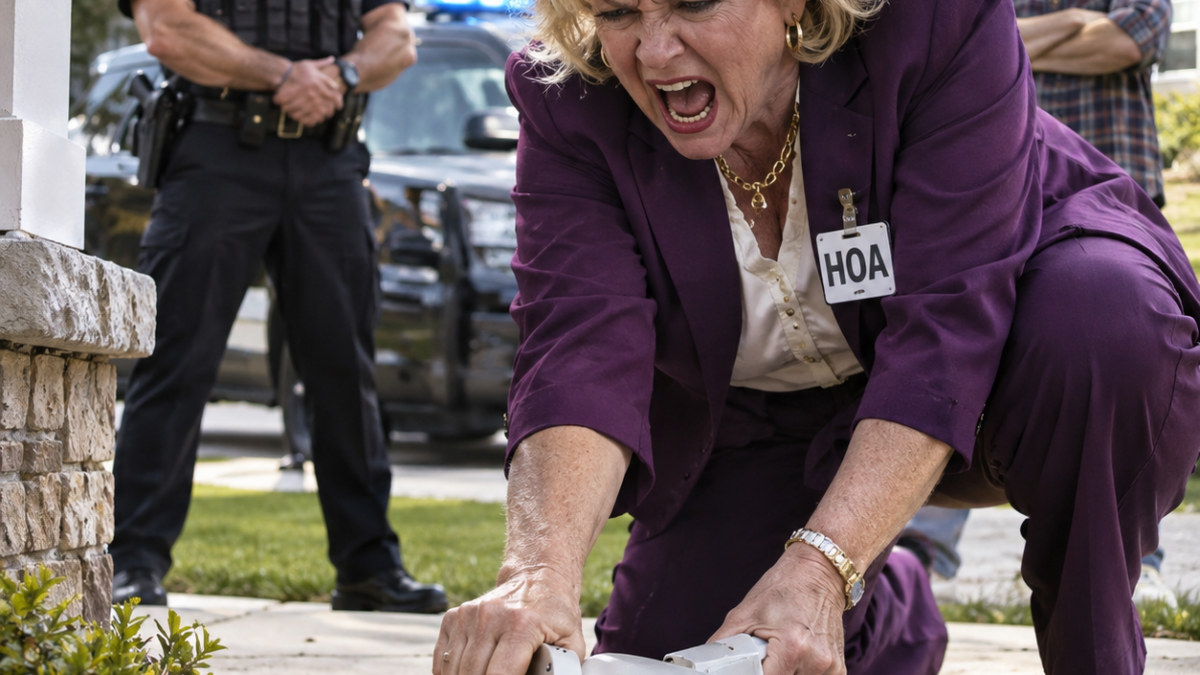
HOA Karen Smashed My Security Camera With Her Own Hands—She Didn’t Know a Sheriff’s Deputy Was Watching the Livestream From Two Blocks Away.
Brenda Callaway walked onto my private driveway, ripped my security camera from its mount, smashed it under her heel, and smiled like the woman who ran our HOA could make evidence disappear simply by breaking it.
What she didn’t know was that Deputy Warren Ostrander was sitting two blocks away watching the entire thing live on a sheriff’s department tablet—and the camera she destroyed had already transmitted every second to the cloud.
But the camera was only the beginning, because six weeks later ninety-one homeowners would discover that the woman fining them over basketballs, flower beds, and Christmas lights had quietly paid $38,000 of their dues to her own company.
My name is Garrett Whitfield.
I’m a licensed electrician, which means I spend most of my life fixing problems nobody notices until something stops working.
Bad neutral connection.
Overloaded panel.
Buried conduit filling with water.
Loose terminal heating behind drywall.
The dangerous problems are rarely the loud ones in the beginning.
They’re the ones people learn to live around.
I should have understood Brenda Callaway sooner.
My wife, Colleen, did.
She usually does.
We bought our house in Pinecrest Estates in the spring of 2019 after saving for six years.
Not casually saving.
I mean delaying vacations.
Driving my work truck until the transmission sounded like gravel in a coffee can.
Colleen sewing wedding dresses and prom gowns at our dining room table after the kids went to sleep.
Packing lunches instead of eating out.
Watching mortgage rates.
Watching listings.
Watching homes we liked disappear before we had enough.
When we finally closed on the house at 418 Holloway Lane, I remember sitting alone in the empty living room after the realtor left.
No furniture.
No curtains.
Just afternoon light coming through the front windows and the sound of Rhett and Delia arguing in the backyard over who got the bigger bedroom.
Colleen came in carrying a cardboard box marked KITCHEN.
She looked around.
“We did it.”
I nodded.
I couldn’t speak.
Pinecrest wasn’t wealthy.
Not really.
It was the kind of Ohio planned community built in phases over twenty-five years.
Two hundred fourteen homes.
A pool.
A beige metal community center.
Walking trail.
Decorative entrance signs.
Several small landscaped islands everybody complained cost too much.
The western section had newer homes, wider lots, three-car garages.
The eastern section, where we lived, had been built in the late 1990s.
Smaller lots.
Mature trees.
PART2:
Families who fixed their own decks.
Retired teachers.
Postal workers.
Nurses.
Tradesmen like me.
People whose garage floors usually contained actual tools.
I loved our lot.
Two sugar maples in the backyard.
Corner location.
Six-minute walk to the elementary school.
A wide concrete driveway where Rhett could shoot baskets.
The HOA dues were $180 a month.
More than I wanted.
Less than some neighborhoods.
I read the basic rules before closing.
No broken-down cars in front yards.
No purple houses.
No six-foot commercial signs.
Fine.
I wasn’t planning any of those things.
For the first year, the HOA barely entered my life.
Then Brenda Callaway became president.
PART3:
Brenda was sixty-two, recently retired from a county permit office, and I think retirement frightened her.
Some people retire and discover hobbies.
Gardening.
Golf.
Travel.
Brenda discovered authority.
She ran for president after the previous board chair moved to Florida.
Her campaign letter promised “renewed standards, fiscal discipline, and restoration of community pride.”
At the time, I thought that sounded harmless.
So did a lot of people.
Brenda won easily because almost nobody else wanted the job.
That was lesson number one.
The people most eager to control an organization are not always the people you should automatically hand it to.
The first time she came to our house, Rhett was fourteen.
He had left his basketball in the driveway overnight.
One basketball.
Orange.
Normal.
Not a rusted refrigerator.
Not an abandoned engine block.
A basketball.
I was loading wire spools into my truck at 6:40 the next morning when Brenda appeared carrying a clipboard.
She wore white sneakers, navy slacks, a coral jacket, and an HOA badge clipped near her shoulder like she worked for Homeland Security.
“Mr. Whitfield?”
“That’s me.”
She pointed with the clipboard.
“Is that your basketball?”
I looked behind me.
“Yes.”
“It was visible from the street overnight.”
I waited for the rest.
There wasn’t any.
“Okay.”
“We have standards concerning unsightly personal property.”
I looked at the basketball again.
Then at her.
“Unsightly?”
“It should be stored when not in active use.”
“My son forgot it.”
“That’s what reminders are for.”
She handed me a yellow notice.
FORMAL COMPLIANCE WARNING.
I actually laughed.
I shouldn’t have.
Her expression changed immediately.
“I’m sorry,” I said. “I thought you were joking.”
“I assure you I am not.”
I read the notice.
“Section fourteen, subsection C, paragraph four?”
“Yes.”
“You know these by memory?”
“Some of us take our responsibilities seriously.”
That sentence told me more about Brenda than the notice did.
I picked up the basketball.
“Problem solved.”
She gave a thin smile.
“Good.”
Then she walked away.
Rhett came outside a minute later.
“Who was that?”
“The basketball police.”
He looked terrified.
“Am I in trouble?”
“No.”
“Can they take it?”
I stared at him.
“No one is confiscating your basketball.”
The warning went into a drawer.
Then came the wind chime.
Colleen had hung it beneath the back porch.
Small brass tubes.
You could barely hear it from the kitchen.
Brenda cited it under the nuisance-noise clause.
Then the Christmas wreath.
“Excessively themed.”
I still don’t know what that means.
Then the raised garden bed I built along the side fence.
Three inches over the permitted height.
I measured.
She was right about the three inches.
That almost made it worse.
I cut it down because I didn’t have the energy for a war over cedar boards.
Over two years we accumulated eleven notices.
Most were warnings.
Some carried fines.
Twenty-five dollars.
Fifty dollars.
A hundred once because I didn’t remove a garden hose quickly enough.
I paid them.
I hated myself for it, but I paid them.
I talked to Dale Huffman, a real estate attorney I’d known since high school.
Dale and I had not been close friends in years, but our kids played in the same youth soccer league, and we occasionally saw each other.
I showed him the notices over coffee.
He flipped through them.
“This is obnoxious.”
“So sue them.”
“No.”
“Why?”
“Because obnoxious isn’t illegal.”
“She’s targeting us.”
“Can you prove it?”
“No.”
“Then right now you have a woman enforcing petty rules she technically has some authority to enforce.”
“So I just keep paying?”
“You can challenge each violation through the board.”
“Which she controls.”
“Yes.”
“That’s useful.”
Dale smiled.
“You hired me for legal advice, not emotional satisfaction.”
“I didn’t hire you.”
“Then you’re getting excellent value.”
He told me something else.
“Garrett, if she’s overreaching, eventually she’ll get careless.”
“How long?”
“I’m a lawyer, not a prophet.”
“She seems very committed to the lifestyle.”
“Then document.”
I didn’t.
Not properly.
Not yet.
That changed after the break-ins.
Fall of 2022.
Three homes on our side of Pinecrest had vehicle burglaries in ten days.
Windows smashed.
Center consoles emptied.
Garage-door remotes stolen.
One family woke up to find someone had used a stolen opener to enter their garage before the homeowner scared him away.
The neighborhood Facebook group went insane.
Lock your cars.
Check your cameras.
Saw a suspicious gray Honda.
No, it was blue.
No, it was a Nissan.
Somebody heard gunshots.
They were fireworks.
Normal community panic.
I’m an electrician.
Security systems are basically electrical work with more software and worse instructions.
I bought a four-camera PoE system.
Not cheap consumer Wi-Fi cameras.
Hardwired.
Local network recorder.
Cloud backup.
Night vision.
Motion detection.
Audio.
One camera on the porch corner covering the front walk and driveway.
One over the garage.
One on the side gate.
One facing the rear alley.
I ran conduit neatly.
Painted it to match the trim.
Sealed every penetration.
The installation looked better than half the cable service drops in the neighborhood.
Brenda’s letter arrived before the silicone around the final conduit hole had fully cured.
Mr. Whitfield,
Exterior surveillance devices violate Section 9, Clause 2 of the Pinecrest Estates governing covenants. You are directed to remove all unauthorized surveillance equipment within fourteen days. Failure to comply will result in fines of $100 per day.
I read it four times.
Then called Dale.
He asked me to read the exact language.
I pulled up the PDF.
“No homeowner may install unapproved surveillance devices, exterior recording apparatus, or similar electronic monitoring equipment on visible exterior surfaces.”
Dale said, “Again.”
I read it again.
He said, “What word matters?”
“Visible?”
“No.”
“Exterior?”
“No.”
“Surveillance?”
“Garrett.”
“Unapproved.”
“There you go.”
I frowned.
“That means they can deny it.”
“Who approves?”
I scrolled upward.
Architectural Control Committee.
Three members.
Appointed annually by the full board.
Dale said, “Find out who they are.”
That took longer than it should have.
I emailed Brenda.
No answer.
Requested committee records.
No answer for six days.
Then I received a PDF containing three years of meeting minutes in no useful order.
I sat at the kitchen table one night searching through them.
Colleen walked through at ten.
“You’re still reading HOA minutes?”
“Yes.”
“You have become everything you hate.”
“Thank you.”
She kissed the top of my head.
At 11:47, I found the appointment.
February 2020.
Three committee members.
One-year terms.
Then nothing.
No reappointment in 2021.
None in 2022.
No replacement.
I called Dale the next morning.
“The committee doesn’t exist.”
“You sure?”
“Term expired twenty-one months ago.”
He whistled.
“So who denied your cameras?”
“Brenda.”
“Does she have independent approval authority?”
“Not according to this.”
“Then your cameras may not be unapproved.”
“They haven’t been approved either.”
“Exactly.”
“That sounds like lawyer nonsense.”
“It is exceptionally useful lawyer nonsense.”
We sent Brenda a certified letter.
Polite.
Detailed.
The cameras were installed for security following neighborhood burglaries.
The relevant committee had not been validly appointed.
No authorized body had denied the installation.
Therefore, enforcement was premature and unsupported.
We also formally requested a hearing.
I thought the letter might slow her down.
Instead, it insulted her.
Two days later I came home from a job site covered in red clay and PVC dust.
There was a bright orange notice taped to our front door.
Not tucked beneath the handle.
Not placed in an envelope.
Blue painter’s tape directly on the door Colleen had spent two weekends sanding and repainting hunter green.
That alone nearly started a separate lawsuit in my head.
The notice said the board had held a special emergency session.
My exterior cameras were declared a continuing architectural violation.
Five hundred dollars per camera.
Two thousand total.
My HOA account was placed on administrative restriction.
No voting.
No clubhouse reservation.
No pool access.
Delia had swim lessons every Tuesday.
She read the notice over my shoulder.
“Can I still go swimming?”
I looked at Colleen.
Colleen looked at me.
“Not this week, honey.”
“Why?”
“Adult nonsense.”
“But I didn’t do anything.”
“No.”
“Did Dad?”
“No.”
“Then why can’t I swim?”
That question stayed with me.
I called Dale.
He asked whether I had received notice of the emergency meeting.
“No.”
“Any email?”
“No.”
“Certified letter?”
“No.”
“Agenda?”
“No.”
He became very quiet.
“What?”
“They just gave us something.”
“What?”
“Procedure.”
He explained that both Ohio law and Pinecrest’s bylaws required advance notice for hearings and enforcement actions affecting a homeowner’s property rights.
“They cannot invent an emergency meeting to fine one homeowner without giving him a meaningful opportunity to appear.”
“So the fines are invalid?”
“Potentially voidable.”
“Potentially?”
“Lawyers stay employed because of that word.”
“What do we do?”
“Nothing.”
I nearly dropped the phone.
“Excuse me?”
“Document it.”
“They took away my daughter’s pool access.”
“I know.”
“They put two thousand dollars on our account.”
“I know.”
“And you want me to do nothing?”
“I want them to keep creating evidence.”
I walked into the garage and shut the door so the kids wouldn’t hear me.
“I don’t want evidence. I want this stopped.”
Dale’s voice softened.
“Garrett, if we challenge this one fine, Brenda will correct the paperwork, appoint the committee, and keep coming.”
“So?”
“If this is a pattern, we prove the pattern.”
“How?”
“Start a log.”
That night I bought a black hardback notebook.
HOA LOG — VOLUME 1.
Date.
Time.
Notice.
Interaction.
Witness.
Document.
I became obsessive.
Maybe that was necessary.
Maybe part of it was anger.
The first week, Brenda walked onto our driveway three separate times.
Not the sidewalk.
My driveway.
She photographed the camera mounts.
Garage trim.
Side gate.
Once I caught her photographing Colleen’s alteration-shop sign inside the front window.
I stepped outside.
“Brenda.”
She turned.
Salmon blazer.
Phone in hand.
“Can I help you?”
“I’m conducting a compliance inspection.”
“On my private driveway?”
“The HOA has inspection authority over common visible surfaces.”
“You’re standing thirty feet onto my property.”
“The governing documents allow reasonable inspection.”
“Which section?”
“Six, clause one.”
I smiled.
“Thank you.”
That unsettled her.
“For what?”
“The citation.”
I went inside.
Section six, clause one applied to common areas and HOA-maintained structures.
Not individual driveways.
Not private yards.
Not porches.
She had either never read it or expected me not to.
I wrote it in the notebook.
October 18, 4:22 p.m. Brenda entered driveway approximately thirty feet without permission. Claimed authority under Sec. 6 Cl. 1. Clause does not contain authority described.
Then I saved the video.
Something changed inside me during those weeks.
I stopped being intimidated by the paperwork.
That is how people like Brenda gain power.
They count on forms looking official enough that ordinary people surrender before reading them.
Letterhead.
Badge.
Signature.
Section number.
Due date.
FINE.
People are busy.
They work.
Raise children.
Care for parents.
They see an official-looking notice and think, Maybe they know something I don’t.
So they pay.
I had done it.
Eleven times.
I began asking neighbors.
Chuck Dolan lived three houses down.
Retired postal worker.
Seventy.
Lab mix named Duke.
He stopped me near the mailbox one Saturday.
“I heard you’re fighting Brenda.”
“I’m challenging camera fines.”
“Same thing.”
He looked around.
“Petrovskys had trouble with her.”
“What kind?”
“Christmas lights.”
“What was wrong with them?”
“Too many.”
“Is there a number?”
“Brenda found one.”
Then Trudy Voss.
Then Walt and Shirley Beaumont.
Then a nurse named Angela Price.
Then Marco Hernandez, who owned a landscaping business.
Patterns emerged.
Thirty-one homes cited during Brenda’s presidency.
Twenty-six were on the eastern side.
Older houses.
Smaller lots.
More working-class families.
Meanwhile I drove through the western half.
Cameras everywhere.
One house had four visible dome cameras.
Another had a massive PTZ unit mounted above a garage.
No violation notices.
I photographed from public streets.
Mapped addresses.
Compared notices.
Dale stared at the map.
“This is interesting.”
“What kind of interesting?”
“The expensive kind.”
“Meaning?”
“Selective enforcement.”
He pointed.
“If standards are being enforced against one section of the development and ignored elsewhere, the board has a problem.”
“Discrimination?”
“Possibly. We need evidence of why. But selective enforcement alone matters.”
The community safety forum happened in November.
Forty residents.
Burnt coffee.
Folding chairs.
Brenda stood in front of a projector and presented approved security options.
She recommended an old Ring doorbell.
One.
Low-resolution.
No side coverage.
No driveway overview.
Someone raised a hand.
“Why not Garrett Whitfield’s cameras?”
Brenda’s jaw tightened.
“Mr. Whitfield’s installation violates community standards.”
Trudy Voss spoke from the back.
“I have a question.”
Brenda forced a smile.
“Yes, Trudy?”
“My sister lives on Cresthaven. I counted six houses with exterior cameras on her street yesterday.”
A murmur moved through the room.
“Were they fined?”
Brenda shuffled papers.
“We do not discuss individual enforcement matters.”
“You discuss Garrett’s.”
“He has made his dispute public.”
I hadn’t.
Not yet.
Trudy said, “His cameras are why we’re talking about cameras.”
Brenda advanced the slide.
“We’re moving on.”
I sat in the back.
Said nothing.
It was the hardest thing I had done all month.
On the way home, Colleen asked, “Why are you smiling?”
“She’s losing them.”
“Don’t get excited.”
“I’m not.”
“You are.”
“She’s overplaying.”
Colleen looked out the window.
“Be careful.”
That brought me back.
We had a lien threat now.
A week later, it became real.
Process server.
Formal notice.
The HOA intended to record a lien against our home for the $2,000 fines plus interest.
Twelve percent.
Colleen sat at the kitchen table reading it.
Her hands shook.
People hear lien and think technical.
Paper.
Legal.
It feels different when the address on the document is the home you spent six years saving to buy.
“This could affect refinancing.”
“I know.”
“What if they foreclose?”
“They’re not going to.”
“How do you know?”
“Dale says the fines are challengeable.”
“Challengeable isn’t the same as gone.”
She was right.
“I know.”
She looked toward the hallway.
Delia was doing homework.
Rhett was upstairs.
“How much is this going to cost us?”
I reached across the table.
“Dale is taking the broader civil case on contingency if we file.”
“If?”
“He thinks we have grounds.”
“What do you think?”
“I think I should have fought two years ago.”
“That doesn’t answer me.”
I looked at her.
“I think we win.”
She watched me a long time.
“Then win.”
That was Colleen.
No speech.
No drama.
Then win.
The camera incident happened December 6.
Tuesday.
2:14 p.m.
I was two miles away on a commercial renovation site.
Standing in a drainage ditch behind a grocery store where my crew was replacing conduit feeding parking-lot lights.
Cold.
Mud to my ankles.
One glove off because I was checking a motion alert on my phone.
Front Porch Motion.
I expected package delivery.
Instead, Brenda appeared.
Pearl-white Cadillac parked partly across my driveway.
She walked toward the porch.
No clipboard this time.
No paperwork.
Just anger.
She looked directly at the camera.
My phone’s speaker picked up her voice.
“I warned you.”
My stomach dropped.
“Mike,” I called to my apprentice.
“What?”
“Give me a second.”
Brenda reached up.
Grabbed the camera housing.
Twisted.
The mounting bracket flexed.
“Come on,” I whispered.
Not because I wanted her to stop.
Because I couldn’t believe she was actually doing it.
She twisted harder.
The external housing broke loose.
Dropped.
She picked it up.
Then slammed it onto the concrete.
Once.
Twice.
Then stepped on it.
Crack.
She ground her heel down.
I was standing in a muddy ditch staring at my phone.
Completely powerless.
Two miles away.
Then Brenda brushed her hands together.
Actually brushed them off.
Looked toward my front door.
And walked back to the Cadillac.
She believed she had destroyed the camera.
She had destroyed part of it.
What she did not know was that I had modified that front installation weeks earlier.
I suspected she might tamper with something.
Not smash it.
But interfere.
So I had installed the actual imaging unit partly recessed inside the porch soffit.
The visible outer housing was replaceable.
The system still recorded.
Still streamed.
Still uploaded.
And because of the burglary problem, Deputy Warren Ostrander had been helping several residents coordinate a voluntary camera-share program with the sheriff’s office.
Three weeks earlier, I had given the department a secure link to my exterior feeds.
That afternoon, Warren was parked two blocks away investigating another report of a suspicious car.
He had my driveway stream open on his department tablet.
He watched Brenda destroy the camera.
Live.
Warren later told me he had been halfway through a gas-station turkey sandwich.
“I saw her walk up.”
“What did you think?”
“I thought she was coming to the door.”
“Then?”
“She grabbed the camera.”
“And?”
“I put down my sandwich.”
I laughed.
“That’s when I knew it was serious.”
“She stomped it, Garrett.”
“I know.”
“I actually said out loud, ‘Ma’am, please don’t do that.’”
“To your tablet?”
“Yes.”
“Helpful.”
“I was emotionally involved.”
By the time Brenda reached her Cadillac, Warren had already radioed the incident.
I did not know that yet.
I called Dale.
He answered.
“Hey.”
“She smashed it.”
Silence.
“What?”
“The front camera.”
“Who?”
“Brenda.”
Another silence.
“Oh my God.”
I could hear his chair move.
“Do not touch anything.”
“I’m at work.”
“Even better. Preserve every recording. Local, cloud, external. Don’t post it.”
“I wasn’t—”
“Garrett.”
“I won’t.”
“Photograph the damage when you get home.”
“Deputy Ostrander might have seen it.”
“What do you mean might?”
“The sheriff has access to the stream.”
Dale went silent again.
“Dale?”
“Please tell me a sheriff’s deputy watched Brenda Callaway smash the camera she claims is illegal.”
“Yes.”
He laughed.
Not a chuckle.
A full lawyer laugh.
“I’m hanging up before I say something unprofessional.”
When I got home, Warren was waiting.
Brenda was gone.
He had photographed the scene.
Collected my statement.
Preserved the department access logs.
The camera footage showed everything.
Timestamp.
Audio.
Brenda’s face.
The destruction.
Her Cadillac.
Her license plate.
No ambiguity.
Warren looked at the broken housing.
“How much?”
“Parts?”
“Yes.”
“Maybe four hundred.”
“Receipts?”
“Every one.”
He smiled.
“Of course you do.”
“I’m an electrician.”
“That explains nothing.”
“It explains everything.”
The final replacement cost was $412.
Brenda was contacted by a deputy the next day.
Her response was denial.
Complete denial.
She said she had visited my property in her official HOA capacity but had not intentionally damaged equipment.
Then she sent an email to all 214 households.
That was her next mistake.
SUBJECT: IMPORTANT COMMUNITY PRIVACY NOTICE.
The email claimed I had installed unlawful surveillance equipment capable of recording HOA representatives “without consent.”
She used the phrase invasion of privacy three times.
She wrote that she had been “confronted by unauthorized recording devices” while carrying out official responsibilities.
She implied I had manipulated footage.
She warned homeowners that unapproved surveillance presented “serious privacy risks.”
The replies started immediately.
Trudy Voss:
Brenda, are you claiming privacy rights while standing on someone else’s private driveway?
Chuck Dolan:
I have outdoor cameras too. Am I next?
Another resident:
My doorbell records the sidewalk. Is that illegal now?
Then western-side homeowners started chiming in.
I have cameras. Never received a notice.
Neither have I.
Mine were installed in 2021.
No approval requested.
The email made my dispute everybody’s problem.
Dale called.
“She just widened the case.”
“How?”
“She’s asserting a community-wide interpretation now.”
“So?”
“So we can show inconsistent application across the entire development.”
He paused.
“And, Garrett?”
“Yes?”
“She sounds scared.”
I didn’t understand why yet.
Three days later, Dale asked me to meet at his office.
He had requested HOA financial records.
We already suspected the emergency meeting had no proper minutes.
It didn’t.
No documented ten-day notice.
No homeowner hearing.
Incomplete quorum record.
The fines were a mess.
But Dale found something else.
He pushed a ledger toward me.
“Read line forty-seven.”
CALLAWAY PROPERTY CONSULTATION SERVICES — $38,000.
I looked up.
“What is that?”
“Good question.”
He slid another page across.
Ohio Secretary of State business registry.
CALLAWAY PROPERTY CONSULTATION SERVICES LLC.
Registered agent:
Brenda L. Callaway.
Address:
Brenda’s home on Cresthaven Drive.
I stared.
“She paid herself?”
“Looks like it.”
“For what?”
“Administrative consulting.”
“She’s the HOA president.”
“Yes.”
“Does she receive salary?”
“No.”
“So she created a company and billed the HOA?”
“That appears to be what happened.”
“Board approved?”
Dale handed me the minutes.
No vote.
No disclosed conflict.
The bylaws required disclosure and supermajority approval for contracts involving board members.
None.
I sat back.
“Thirty-eight thousand.”
“Last fiscal year.”
“Last?”
Dale looked at me.
“I’m checking previous years.”
I felt sick.
Not happy.
People imagine finding corruption feels triumphant.
It doesn’t at first.
It feels like discovering the walls in your house have mold.
Suddenly every strange smell makes sense.
“What about the fines?”
“We don’t know where individual fine revenue was allocated yet.”
“How many people know?”
“You. Me. My paralegal.”
“Colleen?”
“If you tell her.”
“I will.”
“No one else.”
“Why?”
“Because I want records preserved before Brenda knows we have them.”
I looked toward his window.
“What happens?”
“We file.”
“Against the HOA?”
“And potentially Brenda individually.”
“For self-dealing?”
“Breach of fiduciary duty. Improper enforcement. Depending what financial review shows, more.”
“What about the criminal complaint?”
“Separate.”
I rubbed my face.
“Dale.”
“Yes?”
“I just wanted cameras.”
He laughed quietly.
“That’s usually how HOA wars begin.”
We spent six weeks building the case.
Not a trap.
I hate when people call it that.
A trap depends on tricking somebody into doing something they wouldn’t otherwise do.
Brenda needed no help.
We simply stopped interrupting her.
I upgraded the cameras.
Six total now.
Formal camera-share registration with the sheriff.
Every feed timestamped.
NVR.
Cloud.
Status logs.
I remounted an exact duplicate outer housing in the same place Brenda had smashed.
Colleen saw me on the ladder.
“You’re petty.”
“Yes.”
“I support it.”
That dummy housing became my favorite forty-dollar purchase.
The legal work expanded.
Dale challenged the lien in county court.
Improperly noticed meeting.
Lapsed Architectural Control Committee.
Selective enforcement.
He also filed a civil complaint alleging breach of fiduciary duty and self-dealing.
The filing became public.
That brought reporter Gail Thurston from the Licking County Advocate.
She called Dale.
He told her almost nothing.
Then called me.
“She’s good.”
“Meaning?”
“Actual reporter. Checks facts. Reads documents.”
“That sounds exhausting.”
“She may attend the annual meeting.”
The annual HOA meeting.
February.
Thirty-day notice.
Officer elections.
Budget.
Homeowner questions.
Brenda had always controlled it.
Dale saw it differently.
“It’s the one room where homeowners, board, insurer, records, and witnesses can all exist at the same time.”
“You want a showdown.”
“I want transparency.”
“You smiled when you said that.”
“Coincidence.”
I began visiting neighbors.
Not campaigning against Brenda.
Listening.
That distinction mattered.
Walt and Shirley Beaumont lived on Briar Path.
Late seventies.
Their son Daniel had died from leukemia at thirty-one.
After his death, they built a small memorial garden near their front porch.
Flagstones.
Marigolds.
A little bronze marker.
Daniel Beaumont
1985–2016
Always Home
Brenda fined them $150.
Unapproved landscape alteration.
Walt told me the story at his kitchen table.
His hands trembled.
“We paid.”
“Why?”
“Shirley couldn’t stand getting letters with Danny’s name involved.”
Shirley looked down.
“We thought if we fought, they might make us remove it.”
I looked through their front window.
The garden was visible.
Tiny.
Beautiful.
Something inside me hardened.
Not rage.
Commitment.
“What do you want?”
Walt looked at me.
“For people to leave it alone.”
That was all.
Not money.
Not revenge.
A garden.
I wrote everything down.
Another resident had been fined for leaving a work van in his driveway while his garage was being repaired.
A widow received repeated notices about peeling trim during the month she was caring for her dying sister.
Marco Hernandez had been cited for two landscaping trailers parked outside his home for three hours, while board member Clark Beaumont routinely left a recreational trailer on his side drive.
Different rules.
Different streets.
Different people.
February meeting attendance became a quiet movement.
No flyers.
No Facebook campaign.
Just conversations.
Will you come?
Most said yes.
Meanwhile Brenda sensed something.
Ten days before the annual meeting, she announced a new camera policy.
Seventy-five-dollar application fee.
Thirty-day review.
Exterior-camera approval required.
The same non-existent committee still had not been appointed.
Trudy texted me:
She cannot be serious.
I replied:
She is extremely serious. That’s the problem.
Then Brenda filed a complaint against Dale with the bar association claiming he had improperly obtained HOA financial records.
Dale called me laughing.
“You seem happy.”
“I’ve practiced nineteen years. Nobody has ever accused me of misconduct for requesting records my client is statutorily entitled to inspect.”
“Could it hurt you?”
“No.”
“Then why do it?”
“Pressure.”
“Working?”
“Yes. I’m under tremendous pressure not to laugh during formal correspondence.”
A week before the meeting, Clark Beaumont called me.
No relation to Walt.
Board member.
Western section.
He spoke carefully.
“Garrett, some of us think this has gone too far.”
“I agree.”
“We want resolution.”
“Good.”
“The board may be willing to remove your fines and lien.”
I paused.
“In exchange for what?”
“Withdraw the legal challenge.”
“Anything else?”
“Attend the annual meeting without counsel.”
There it was.
“Why without counsel?”
“It would lower the temperature.”
“Clark.”
“Yes?”
“Is this call being recorded?”
Silence.
I said, “Mine is.”
He hung up.
I sent the recording to Dale.
He responded:
Thank you for tonight’s entertainment.
The day before the meeting, a handwritten sign appeared in the community bulletin case.
SOME HOMEOWNERS ARE USING LEGAL TACTICS TO UNDERMINE OUR COMMUNITY.
COME TO THE FEBRUARY MEETING AND PROTECT PINECREST.
I photographed it.
Went home.
Slept eight hours.
That surprised me.
For months I had lain awake replaying notices and conversations.
But by then, we had done everything.
Paper.
Video.
Witnesses.
Financial records.
Law enforcement.
There is peace in preparation.
Before the meeting, Colleen made pot roast.
Rhett wanted to attend.
He was sixteen now.
Delia was thirteen.
We had spent months telling them enough to understand without turning them into participants.
Delia asked one question.
“If Brenda loses, can I use the pool?”
I smiled.
“Yes.”
“Good.”
Rhett said, “That’s your main concern?”
“I like swimming.”
“Democracy in action.”
“Shut up.”
Normal family noise.
I needed it.
Colleen put her hand over mine at dinner.
“You okay?”
“Yes.”
“Really?”
“No.”
She smiled.
“Better answer.”
At the community center, cars overflowed the lot.
Ninety-one homeowners.
Previous record attendance: fifty-four.
Gail Thurston stood near the curb with a notebook.
The HOA insurance carrier sent a representative named Frank Keller.
Gray suit.
Briefcase.
No smile.
Deputy Warren Ostrander was not initially inside.
He had told me he would patrol nearby.
Brenda arrived early.
Navy blazer.
HOA badge.
Printed agendas.
She looked composed.
That almost impressed me.
People whispered as I walked in with Colleen and Dale.
Brenda did not look up.
The meeting began at seven.
Approval of prior minutes.
Treasurer report.
Budget.
The report Brenda distributed did not include Callaway Property Consultation Services.
Dale circled the omission.
I watched his pen.
My pulse quickened.
Then new business.
Brenda stood.
“For the continued safety, privacy, and aesthetic integrity of Pinecrest Estates, the board proposes adoption of a standardized exterior-surveillance policy.”
She spoke for four minutes.
Smooth.
Reasonable.
Community cohesion.
Privacy.
Property values.
Several homeowners nodded.
Then she shifted.
“Before we vote, I believe I need to address the unfortunate legal actions one resident has chosen to initiate against this association.”
Not my name.
Everybody knew.
Dale raised his hand.
Brenda looked at him as if tolerating a child.
“Yes, Mr. Huffman?”
“Before we discuss pending litigation, I’d like clarification of the financial report.”
Brenda’s eyes changed.
Barely.
“Clarification concerning?”
“Is the report distributed tonight complete?”
Treasurer Clark Beaumont looked toward her.
Brenda answered.
“Yes.”
“And does it reflect all contractual expenditures from the last fiscal year?”
A longer pause.
“Yes.”
Dale opened his briefcase.
The room became silent.
He removed one page.
Then ninety-one copies.
He walked forward.
Placed the first in front of Brenda.
“Then perhaps you can explain this discrepancy.”
I stood.
Took half the copies.
Colleen took the rest.
We passed them row by row.
Paper rustling.
Nothing else.
Then people saw the number.
$38,000.
A woman near Trudy whispered, “What?”
Chuck Dolan said louder, “Thirty-eight thousand dollars?”
Brenda stared at the ledger.
Dale remained standing.
“Mrs. Callaway, what services did Callaway Property Consultation Services provide to Pinecrest Estates in exchange for thirty-eight thousand dollars?”
Brenda’s voice changed slightly.
“Administrative consulting.”
“Who owns Callaway Property Consultation Services?”
“It is a private entity.”
“Yes.”
“Why is that relevant?”
Dale produced the state business record.
“Because according to the Ohio Secretary of State, you are the registered owner.”
The murmur became louder.
Brenda looked toward Clark.
He whispered something.
She shook her head.
Dale continued.
“Article seven, section three of your bylaws requires full disclosure and a supermajority board vote before the HOA contracts with a business owned by a board member. Where is that vote recorded?”
Silence.
“Mrs. Callaway?”
“That agreement predates—”
“It began during your presidency.”
“Those administrative services were necessary.”
“Was there competitive bidding?”
“This is becoming inappropriate.”
A man in the audience shouted, “It’s our money.”
Applause.
Brenda slammed her palm lightly against the table.
“Order.”
Dale waited.
He did not need to push.
The room was doing it for him.
Then the back door opened.
Deputy Warren Ostrander entered.
Uniform.
Hat in hand.
Nothing dramatic.
He sat against the wall.
Brenda saw him.
Her face changed.
Dale said, “Since the homeowners have been asked to consider a surveillance policy tonight, it is also appropriate to clarify a related matter.”
He turned toward the room.
“A criminal mischief complaint remains active regarding the destruction of my client’s security equipment.”
Brenda stood.
“That matter has nothing to do with HOA business.”
Dale looked at her.
“The equipment was destroyed while you claimed to be acting in HOA capacity.”
“I deny that allegation.”
Warren looked up.
Dale continued.
“The incident was captured by the camera’s live cloud stream.”
Brenda folded her arms.
“Which Mr. Whitfield manipulated.”
Then Dale said the sentence that finally broke her posture.
“The livestream was also being viewed in real time by Deputy Ostrander through the sheriff’s neighborhood camera-sharing program.”
Every head turned toward Warren.
He did not smile.
Did not nod theatrically.
He simply sat there.
Brenda stared at him.
Warren said, “I witnessed the incident live.”
Four words.
That was enough.
Brenda’s mouth opened.
Nothing came out.
Dale continued.
“The related civil complaint also includes allegations of selective enforcement, improper fines, an invalid lien, and self-dealing.”
Frank Keller, the insurance representative, opened his briefcase.
That sound seemed louder than it should have.
Zipper.
Folders.
Paper.
Brenda looked at him.
“Who are you?”
“Frank Keller. Meridian Mutual. Liability carrier.”
For the first time all night, Brenda looked genuinely frightened.
Not angry.
Not offended.
Afraid.
Because neighbors could be bullied.
Lawyers could be dismissed as adversarial.
But insurance companies understand money.
Dale addressed the room.
“Under Article Five, homeowners may move for removal of an officer for cause at a properly constituted annual meeting.”
Trudy Voss stood.
“I move to remove Brenda Callaway as president.”
Before anyone could speak, Chuck Dolan said, “Second.”
Brenda slammed the gavel.
“You cannot ambush this board.”
Dale opened the bylaws.
“Article Five, subsection six.”
“You are not a homeowner.”
“My client is.”
I stood.
“I adopt the motion.”
The room erupted.
Some angry.
Some cheering.
Brenda pointed at me.
“This is personal.”
I looked at her.
“It became personal when you put a lien on my house.”
She stopped.
I continued.
“But this vote isn’t about me.”
I gestured toward the ledger.
“It’s about everybody who paid dues.”
Toward Walt and Shirley.
“Everybody fined under rules that weren’t applied equally.”
Toward the door.
“And everybody who assumed the person holding the clipboard had actually read the bylaws.”
Brenda’s face turned red.
“You have spent months dividing this neighborhood.”
Walt Beaumont stood.
His voice was quiet.
“No.”
People turned.
Walt held Shirley’s hand.
“You divided it.”
Brenda stared.
Walt continued.
“You fined us for Danny’s garden.”
Silence.
“He was our son.”
Shirley lowered her head.
“You knew that.”
Brenda said, “The rules apply to—”
“Not equally.”
Walt’s voice broke.
“You let people on Cresthaven build whatever they wanted.”
Brenda looked away.
Another homeowner stood.
Then another.
Stories came out.
Holiday-light fines.
Parking.
Flower pots.
Fence paint.
Work vans.
Warnings on one side of Pinecrest ignored on the other.
One woman cried while describing being threatened with fines during the week her husband was in intensive care.
Brenda kept trying to restore order.
The room had moved beyond her.
That is the strange thing about authority.
It looks permanent until everybody simultaneously realizes they were the ones supplying it.
The vote was conducted.
Ballots counted.
Eighty-four for removal.
Seven against.
I remember the numbers because everyone does.
84–7.
Brenda sat at the board table while Clark read the result.
Her hands remained perfectly still.
No explosion.
No screaming.
That surprised me.
She gathered her agendas.
Stacked the pages.
Placed them into a tote bag.
Removed the HOA badge from her blazer.
For a second, she stared at it.
Then dropped it into the bag.
She stood.
Walked toward the side door.
Nobody stopped her.
Nobody insulted her.
Nobody applauded.
The door closed.
Click.
That quiet sound felt more final than anything else that night.
I expected victory.
Instead, I felt tired.
Deeply tired.
Colleen came beside me.
“You okay?”
“I don’t know.”
Chuck Dolan grabbed my shoulder.
Squeezed once.
No words.
Warren walked over.
“Congratulations?”
“Doesn’t feel like that.”
“Usually doesn’t.”
I looked toward the door Brenda had used.
“Did you really watch the whole thing?”
“The camera?”
“Yes.”
“Every second.”
“You never told me exactly what you thought.”
He smiled.
“I thought she was going to come to her senses.”
“And?”
“She did not.”
Outside, Gail Thurston followed Brenda only far enough to observe her.
Later she told me Brenda sat inside the Cadillac eleven minutes before leaving.
Gail did not photograph her.
I respected that.
There is accountability.
Then there is humiliation for entertainment.
They are not the same.
The legal cases took four more months.
Nothing in law moves as fast as stories make it sound.
The lien was vacated.
The $2,000 camera fines dismissed.
The emergency-session action declared procedurally defective.
The HOA’s insurer pushed hard for settlement once it reviewed the financial and enforcement records.
My attorney fees were covered.
Dale sent me a final statement.
BALANCE DUE: $0.00.
I framed it.
It hangs beside my electrician’s license.
Colleen thinks that is ridiculous.
I think it is art.
The $38,000 consulting contract became part of a separate restitution matter.
I was not involved in the details.
I did not need to be.
The criminal mischief case also continued.
Brenda ultimately entered a misdemeanor plea related to the camera destruction.
Fine.
Community service.
Restitution for equipment damage.
No dramatic jail sentence.
No handcuffs at an HOA meeting.
Reality is usually more boring.
But consequences are consequences.
The new HOA board was elected in March.
For the first time in years, both the eastern and western sections had meaningful representation.
Trudy joined.
Chuck refused.
“I spent thirty-two years delivering everybody else’s mail. I am not volunteering to receive everybody’s complaints.”
Fair.
The new board’s first move was lowering dues by thirty dollars.
Not because every increase under Brenda had been fraudulent.
It hadn’t.
Some costs were real.
But the financial review showed they could reduce the monthly amount without harming reserves.
Second move:
Appoint a legitimate Architectural Control Committee.
Three members.
Published terms.
Meeting schedule.
Clear application process.
Third:
Dismiss outstanding fines that had not followed proper notice and hearing procedures.
Walt and Shirley Beaumont’s memorial garden was formally approved.
I attended that meeting.
Clark—the new board secretary, not Brenda’s old ally Clark, who had resigned—read the approval.
“Memorial garden at 219 Briar Path, permanent permitted landscape feature.”
Walt started crying.
Shirley held his arm.
The room applauded.
I looked away because I was close myself.
That mattered more to me than Brenda’s conviction.
The new board also created a security-equipment assistance fund.
Dale suggested it.
Recovered money from settlement and restitution seeded it.
Homeowners who wanted basic exterior cameras but couldn’t afford them could apply for partial reimbursement.
The irony was almost too perfect.
Brenda tried to make cameras symbols of rebellion.
They became community infrastructure.
Chuck Dolan was one of the first applicants.
He bought a PTZ camera.
Called me after installation.
“Garrett.”
“What?”
“I can zoom all the way to the end of the block.”
“Don’t.”
“Why?”
“Because then you become Brenda.”
He went silent.
“Point taken.”
We laughed.
Delia returned to swim lessons.
The first afternoon I watched her after all of it, she swam one full lap without stopping.
Climbed out.
Grabbed her phone.
Texted me even though I was sitting twenty feet away.
DID IT!!! 🌊🌊🌊🌊
I still have the message.
Rhett eventually stopped leaving his basketball in the driveway.
Not because of the HOA.
Because he got a girlfriend and suddenly cared whether the front of the house looked messy.
Parenting is humbling.
Life returned.
That was what I wanted most.
Not revenge.
Ordinary life.
Work.
Dinner.
Colleen sewing in the spare room.
Kids arguing.
Chuck’s dog barking at squirrels.
Neighbors waving.
No orange notices taped to doors.
No one measuring flower beds with a ruler.
Gail’s article ran on the civic page.
She wrote it carefully.
No “HOA FROM HELL” headline.
No caricatures.
She described the bylaws.
The enforcement disparity.
The financial contract.
The camera incident.
The vote.
She contacted Brenda for comment.
Brenda declined.
The article later won a regional journalism award.
Gail called me when she found out.
“Apparently patient document reading is journalism now.”
“Apparently it always was.”
“Don’t ruin my moment.”
A year after the camera incident, Pinecrest went fourteen months without another vehicle break-in on our block.
Could have been coincidence.
Could have been cameras.
Could have been the burglars moving somewhere else.
I don’t make claims I can’t prove anymore.
That is another thing Brenda taught me.
The rebuilt front camera still runs.
Six cameras now.
All legal.
All registered under the HOA’s new security policy.
The approval took four days.
No fee.
No drama.
I keep the broken housing in a box in my garage.
People ask why.
Evidence was returned after the case.
I could throw it away.
I probably should.
But sometimes I take it out.
Cracked plastic.
Scuffed lens cover.
Concrete dust still embedded in one edge.
Not because I enjoy remembering Brenda.
Because it reminds me how close I came to fighting her the wrong way.
The day she smashed it, I wanted to drive home.
I wanted to confront her.
If I had, maybe we would have screamed at each other on the driveway.
Maybe I would have said something stupid.
Maybe she would have claimed I threatened her.
Maybe the story becomes two angry neighbors arguing.
Instead, I stayed in the ditch.
Saved the footage.
Called my attorney.
Let the evidence remain boring.
Boring evidence is powerful.
Timestamps.
Receipts.
Meeting minutes.
Bank ledgers.
State business registrations.
Written notices.
People underestimate boring things.
Brenda loved performance.
The badge.
Clipboard.
Formal language.
Public warnings.
She understood the appearance of authority.
What defeated her was documentation.
No speech could erase the cloud recording.
No smile could erase the $38,000 payment.
No gavel could create a committee that had not legally existed.
No accusation could make selective enforcement disappear from a map.
No email about privacy could change the fact that she had walked onto my driveway and destroyed my property while a sheriff’s deputy watched.
She had spent years teaching Pinecrest residents to fear official-looking paper.
Then paper turned on her.
The block party happened the following fall.
First community-wide block party in six years.
We closed Holloway Lane.
Permits obtained.
Board approval.
Everything annoyingly proper.
Grills.
Folding tables.
Kids on bikes.
Cornhole.
Music.
Someone rented a bounce house that exceeded a temporary-event height guideline by about four feet.
Trudy looked at it.
Looked at me.
“You reporting that?”
“Absolutely.”
She laughed.
People from both sides of Pinecrest showed up.
East.
West.
Older homes.
Newer homes.
People who had barely spoken before the whole mess.
Walt brought a folding chair and sat near the memorial-garden fundraising table Shirley had organized.
Chuck grilled hot dogs badly and insisted they were perfect.
Colleen ran an alterations raffle because she cannot attend an event without accidentally turning it into a small business opportunity.
I stood in our driveway near sunset.
The sugar maples were turning orange.
Kids ran past.
Somebody’s music was too loud.
Nobody cared.
The front camera above me was recording.
I looked up at it.
Colleen appeared beside me.
“What?”
“Nothing.”
“You have the face.”
“What face?”
“The emotional middle-aged-man face.”
“I don’t have one.”
“You absolutely do.”
She leaned against me.
Across the street, Trudy and Chuck were arguing over whether the cornhole boards were regulation distance apart.
I laughed.
“This is what it was supposed to be.”
Colleen nodded.
“A neighborhood?”
“Yeah.”
“Not a government?”
“Exactly.”
She looked toward the house.
“You know, you almost became as obsessed as Brenda.”
I turned.
“That’s offensive.”
“I’m serious.”
“Explain.”
“You had three HOA notebooks.”
“Evidence.”
“You read bylaws at midnight.”
“Legal preparation.”
“You mapped violations.”
“Pattern analysis.”
“You rebuilt a dummy camera housing just so she would see it.”
I paused.
“That one was petty.”
“Yes.”
She smiled.
“The difference is you eventually stopped.”
That stayed with me.
Power does strange things even to people who think they are using it correctly.
I had neighbors asking me to run for HOA president.
I refused.
Immediately.
Trudy asked three times.
“No.”
“You’d win.”
“Exactly why I’m not doing it.”
“Why?”
“Because after all this, the last thing Pinecrest needs is another person who thinks being right qualifies him to control everybody.”
She stared.
“That was suspiciously wise.”
“Colleen said it first.”
“I knew it.”
I served one year on the safety committee.
That was enough.
Cameras.
Lighting.
Neighborhood watch.
Technical things.
No basketball jurisdiction.
Years later, Brenda’s old Cadillac disappeared from Cresthaven.
She sold the house.
Moved somewhere near Dayton, according to gossip.
I never contacted her.
She never contacted me.
For a long time I thought I wanted an apology.
Then I realized I didn’t.
An apology from Brenda would not improve the camera footage.
Would not give Delia back the swim lessons she missed.
Would not erase the fear Colleen felt seeing a lien attached to our home.
Would not undo Walt and Shirley crying because they thought their son’s memorial garden might be removed.
What mattered was that those things stopped.
Sometimes justice is not an apology.
It is changed conditions.
The new board published financials.
Contracts required bids.
Conflicts had to be disclosed.
Meeting agendas went out on time.
Homeowners received notice before enforcement hearings.
Violation letters contained appeal instructions.
Architectural decisions were written and signed by an actual committee.
Boring.
Beautiful.
I began to appreciate boring government.
People joke about rules.
Rules are not the problem.
Hidden rules are.
Selective rules are.
Rules that apply to you but not the person enforcing them.
Procedures matter most when emotions run hot.
They protect annoying people.
They protect people we disagree with.
They protected me.
The year after the case, I saw Deputy Ostrander at a diner.
He was eating another gas-station-quality sandwich despite sitting in a place with an actual menu.
I walked over.
“You know they serve food here.”
He looked at the sandwich.
“I trust this.”
“That is terrible judgment for law enforcement.”
He smiled.
We talked.
I asked something I had wondered for a long time.
“Why were you watching the stream that exact minute?”
He wiped his hands.
“We’d had a suspicious-car call two streets over.”
“I know.”
“I was parked checking the shared feeds to see whether the vehicle crossed Holloway.”
“So Brenda was just coincidence.”
“Completely.”
“She always thought I set that up.”
“I know.”
“How?”
“She told us.”
I laughed.
“What did you say?”
“That if you had enough influence to schedule a deputy’s lunch break at the exact moment she committed a misdemeanor, you had chosen an inefficient career in electrical contracting.”
I nearly choked.
Warren became serious.
“You were lucky, Garrett.”
“I know.”
“No. I mean with the evidence.”
He leaned back.
“People do stupid things every day when nobody is watching.”
“I was watching.”
“I know.”
“But you being two miles away matters too.”
“How?”
“If you’d been home, she might not have done it.”
I thought about that.
The camera had not caused Brenda’s behavior.
My absence had revealed it.
There is a difference.
After he left, I sat in the booth thinking about how many people in Pinecrest had experienced the quieter version.
No camera.
No deputy.
No ledger.
Just a notice.
A threat.
A fine.
A person wondering whether resistance was worth the trouble.
That is how petty abuse survives.
Not because everyone agrees.
Because everyone is isolated.
Walt thinks his garden fine is only his problem.
Trudy thinks her warning is only hers.
Marco thinks his trailer citation is only his.
I thought my cameras were only mine.
Then we compared paper.
Once people compare experiences, power changes.
That is why Brenda hated meetings she didn’t control.
Why she disliked questions.
Why she kept east-side residents dealing individually with warnings.
If thirty-one people had sat in one room two years earlier and placed all their notices on a table, her authority might have collapsed much sooner.
That may be the biggest thing I learned.
Isolation makes unreasonable demands feel personal.
Community reveals patterns.
A few months after the new board took over, Walt asked me to help install low-voltage lighting around Daniel’s memorial garden.
I’m an electrician.
I could have done it in forty minutes.
It took three hours because Walt wanted every light perfect.
We ran small landscape cable.
Four warm-white fixtures.
One pointed toward the bronze marker.
When dusk came, Shirley stepped outside.
The lights turned on.
She covered her mouth.
Walt stood beside her.
Nobody spoke.
Daniel’s name glowed softly.
Walt eventually said, “Brenda called this noncompliant.”
I looked at the garden.
Marigolds.
Flagstone.
A little bench.
“Brenda was wrong.”
He nodded.
Then said, “I wish I’d fought.”
I tightened the final connector.
“You were grieving.”
“That’s not an excuse.”
“It’s not supposed to be.”
He looked at me.
I continued.
“You survived the thing you needed to survive.”
He cried.
So did I.
I don’t tell people that part.
Electricians are supposed to have standards.
The camera story became neighborhood legend.
Kids exaggerated it.
One version had Brenda smashing twelve cameras with a baseball bat.
Another had Warren jumping out from behind a bush and arresting her instantly.
Rhett once told his friends the sheriff was secretly watching through a drone.
I corrected him.
He said, “Dad, your version is less cool.”
“That’s because it happened.”
Stories grow because people want clean moments.
Villain does evil.
Hero has evidence.
Sheriff sees everything.
Villain falls.
Real life was messier.
Brenda did not wake up one morning deciding to steal the HOA.
She started by believing she knew better.
Then people stopped questioning her.
Then she stopped questioning herself.
The board got lazy.
Residents got tired.
She learned she could send notices and most people paid.
She learned she could call a meeting an emergency and nobody checked.
She learned she could interpret rules and homeowners assumed the interpretation was correct.
Then she began paying her own company.
Maybe the first invoice felt risky.
The next probably felt less so.
Thirty-eight thousand dollars later, it was just another line item.
That is how boundaries move.
Not always through one enormous act.
Inches.
Then feet.
Then suddenly you look around and somebody who was elected to organize pool maintenance thinks she has the right to walk onto your porch and destroy your property.
The camera smash was not the beginning of Brenda’s downfall.
It was the moment she became visible.
I think about that whenever I train apprentices.
Electricity teaches you respect for invisible things.
You cannot see current moving through a wire.
That does not make it unreal.
A bad connection can sit hidden for years.
It heats.
Cools.
Heats.
Cools.
No sparks.
No warning anybody notices.
Then one day the receptacle melts.
People say the failure happened suddenly.
It didn’t.
The failure had been developing the whole time.
Pinecrest was like that.
Thirty-one notices.
Improper meetings.
Unequal enforcement.
Undisclosed contracts.
A lien.
A broken camera.
Nothing came from nowhere.
By the time Brenda put her heel through the housing, the system had already been overheating for years.
She just created the spark everybody could finally see.
I still have HOA Log Volume One.
And Two.
And Three.
They’re in a cabinet in my garage.
Colleen has threatened to throw them away.
I won’t let her.
Not because I expect another war.
Because they remind me to read before reacting.
First page:
October 18 — Brenda entered driveway approximately 30 feet without permission.
Last entry in Volume Three:
March 14 — New board formally dismissed camera fines and vacated enforcement notices. Delia’s pool access restored.
I underlined that one.
Twice.
The security system still sends motion alerts.
Most are boring.
Delivery driver.
Squirrel.
Rhett when he visits from college.
Neighbor returning a borrowed ladder.
Sometimes I see Colleen on the porch and use the two-way speaker.
“Ma’am, you are trespassing.”
She flips off the camera.
Twenty-two years of marriage.
Still romantic.
One autumn afternoon, years after Brenda left, I received a motion alert at 2:14 p.m.
The exact time.
I noticed because memory is strange.
A woman walked up my driveway carrying a clipboard.
For one second my heart reacted before my brain did.
Then I recognized Trudy.
She was HOA secretary now.
I opened the door.
“No.”
She laughed.
“I haven’t said anything.”
“You have a clipboard.”
“I need your signature for the block-party street closure.”
“That is acceptable clipboard use.”
She handed me the form.
I signed.
Before leaving, she looked up at the porch camera.
“Still the original?”
“The internal unit, yes.”
“The Brenda camera.”
“Don’t call it that.”
“Everybody calls it that.”
“I don’t.”
“Because you have emotional boundaries.”
“Because I paid for it.”
She smiled.
“Worth every dollar?”
I looked at the camera.
Four hundred twelve dollars in damage.
Months of legal work.
A lien.
Three notebooks.
Ninety-one people in a community center.
Thirty-eight thousand dollars on a ledger.
Eighty-four votes.
I shook my head.
“No.”
Trudy looked surprised.
“No?”
“I wish she had never touched it.”
That was true.
I wish none of it had been necessary.
People sometimes want pain to become worthwhile because something good came afterward.
That is not how I think anymore.
The bad thing can remain bad.
The good outcome does not retroactively justify it.
Walt and Shirley should never have been fined.
Colleen should never have worried about our home.
Delia should never have lost access to swimming lessons because her father installed a security camera after burglaries.
Neighbors should never have paid undisclosed fees into Brenda’s company.
But once those things happened, we had choices.
Ignore them.
Endure them.
Fight badly.
Or document carefully and stand together.
That part was ours.
The annual meeting is different now.
Attendance dropped again.
Maybe thirty people most years.
I consider that healthy.
High turnout often means everyone is furious.
Budgets are posted online.
Contracts listed.
Nobody runs dramatic PowerPoints about surveillance aesthetics.
Last year, the biggest argument was whether the pool should open one week earlier in May.
Twenty-two minutes of debate.
I sat in the back and loved every boring second.
At the end, the president asked for additional comments.
Nobody stood.
Then Walt slowly raised his hand.
He was eighty-one by then.
Everyone waited.
He said, “I just want to thank whoever fixed the light by the mailbox.”
The maintenance chair said, “You’re welcome.”
Meeting adjourned.
That is what functioning power looks like.
Small.
Visible.
Correctable.
No one person owns the room.
I never ran for president.
Never wanted to.
When people ask why, I tell them the truth.
I spent enough time thinking about HOA bylaws for one lifetime.
But there is another reason.
Brenda believed authority made her important.
I learned that sometimes the healthiest relationship with authority is being willing to give it back.
I’m still Garrett Whitfield.
Electrician.
Husband.
Father.
Guy with too many cameras.
My driveway is still mine.
Rhett’s old basketball hoop is still mounted above the garage.
The paint is chipped.
The backboard has a crack in one corner.
Nobody has fined me.
Colleen still keeps a wind chime on the porch.
Some evenings, when the breeze moves through the sugar maples, I hear it from the driveway.
Soft.
Barely noticeable.
Once, I stood there listening and remembered Brenda’s nuisance notice.
I laughed so hard Colleen came outside.
“What?”
“The wind chime.”
She looked at me like I needed medical attention.
Then she understood.
She smiled.
“Too loud?”
“Absolutely.”
“Should we take it down?”
I looked up at the camera.
“No.”
She laughed.
Neither of us had to say anything else.
The camera Brenda tried to destroy still looks over that driveway.
It has captured birthdays.
First-day-of-school pictures.
Package deliveries.
Snowstorms.
Rhett leaving for college.
Delia coming home after getting her driver’s license.
Colleen and me carrying groceries.
Neighbors stopping to talk.
Ordinary life.
That is what I like about it now.
For years, everybody associated that camera with conflict.
Evidence.
Crime.
HOA power.
But cameras mostly record things nobody will ever need in court.
People arriving.
People leaving.
Children growing.
Seasons changing.
Nothing happening.
The most valuable footage is usually the footage you never have to review.
Brenda thought smashing the camera would erase what it saw.
Instead, the camera outlasted her presidency.
The footage went to the sheriff.
The incident went into the court record.
The financial dispute went before the homeowners.
And the neighborhood she had spent years teaching to keep its head down finally looked up.
That was the part she never understood.
You can threaten one homeowner.
Fine one homeowner.
Put a lien on one house.
Make one family feel small.
For a while.
But power built on exhaustion has one weakness.
People eventually compare notes.
And once ninety-one neighbors were sitting in the same room holding the same ledger, Brenda’s badge no longer meant anything.
Her gavel could not save her.
Her blazer could not save her.
Her emails could not save her.
Even smashing the camera could not save her.
Because the one thing she thought she had destroyed was still recording.
And two blocks away, with a half-eaten sandwich beside him, the sheriff’s deputy she never knew was watching had already seen everything.








