HOA Karen Smashed My Best Friend’s Truck—Then Learned the “Plumber” Was the State Attorney General
HOA Karen Smashed My Best Friend’s Truck—Then Learned the “Plumber” Was the State Attorney General
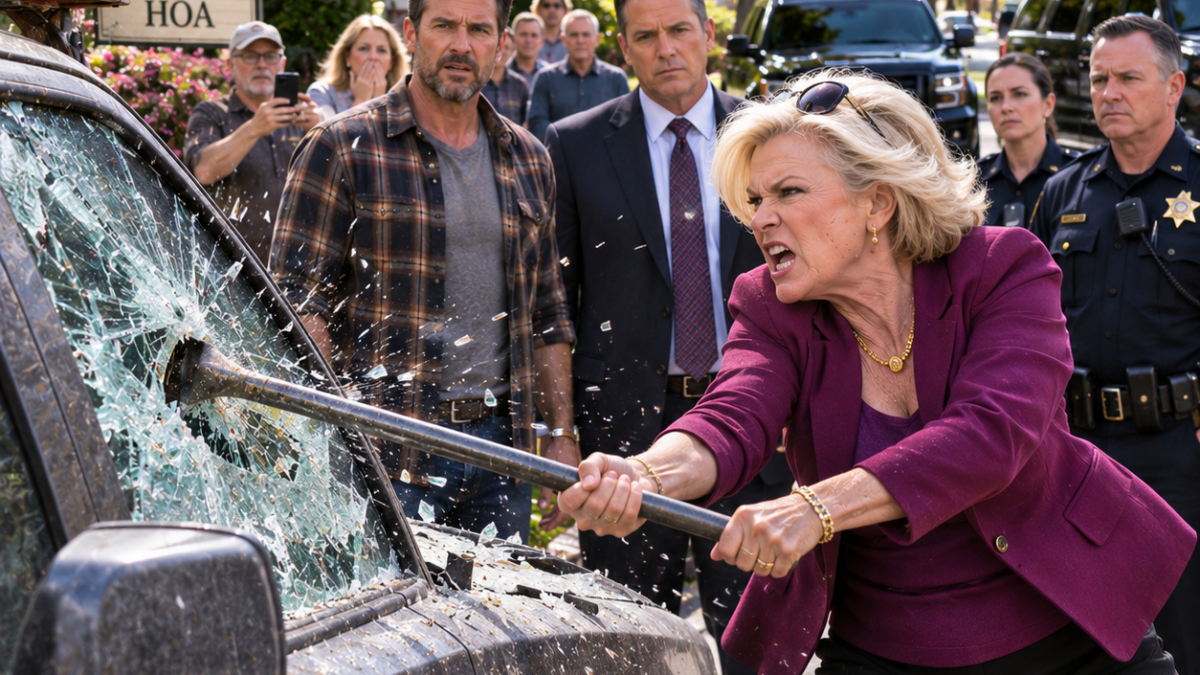
The HOA president stood in the middle of my cul-de-sac swinging a steel tire iron through the windshield of my best friend’s late father’s pickup, screaming that this was what happened to people who ignored her rules.
When police arrived, she immediately claimed the quiet man beside me had threatened her, and one officer seemed ready to believe every word until my friend pointed out the dash camera still blinking behind the shattered glass.
But when three unmarked black SUVs turned into Oakmont Heights and my friend finally opened the credential wallet he had refused to show all morning, Marjorie Kessler realized the man she had tried to humiliate was connected to something much larger than a parking dispute.
My name is Nathan Reyes.
I restore old houses for a living.
Not flip them.
Restore them.
There is a difference.
Flipping is about getting in, changing whatever sells, and getting out.
Restoration is slower.
You learn how something was built.
You pay attention to what can be saved.
You respect the work somebody did before you arrived.
That probably explains why I bought the house in Oakmont Heights.
It was a 1920s Craftsman with tapered porch columns, original oak floors, a brick fireplace somebody had painted white in the 1980s, and enough bad electrical work hidden behind the walls to keep me busy for two years.
My wife Elena thought I had lost my mind.
I thought I had found the perfect house.
The neighborhood looked like something out of an old real-estate brochure.
Maple trees.
Trimmed lawns.
Wide sidewalks.
Flower beds.
Kids riding bikes after dinner.
The kind of place where people waved when you drove past.
We moved in three years before the incident.
What nobody told us was that Oakmont Heights had another feature.
Marjorie Kessler.
Marjorie had been HOA president for nine years.
Nine years is a long time for anybody to sit in a volunteer position and start believing the title belongs to them.
She was in her late fifties, always dressed too formally for neighborhood business, with perfectly styled blond hair and the kind of smile that lasted exactly as long as everyone agreed with her.
At first, her rules sounded petty.
Mailbox paint.
Trash cans.
Holiday lights.
Grass height.
Then the fines started getting stranger.
Our neighbor Walt Dorsey got fined $2,400 because the American flag he flew from his porch was supposedly one inch wider than the architectural standard allowed.
One inch.
Walt had been a high school history teacher for thirty-four years.
He showed me the violation letter.
“I measured the thing after they sent this.”
“And?”
“Half an inch, depending on where you start.”
“You appealed?”
“Twice.”
“What happened?”
“Administrative review fee.”
“How much?”
“Three hundred dollars.”
I stared at him.
“You have to pay to challenge a fine?”
“In Marjorie’s world.”
The thing I noticed on every fine notice was the payment company.
Kessler Property Services.
The name matched Marjorie’s.
I asked Walt once whether she owned it.
He looked toward the street before answering.
“Her brother started it.”
“Still owns it?”
“Depends who you ask.”
“Doesn’t that bother anyone?”
PART2:
Walt gave me a tired smile.
“Nate, most people here just want to get through the week without another certified letter.”
That stayed with me.
Fear does not always look dramatic.
Sometimes fear looks like a homeowner paying three hundred dollars because fighting will cost four hundred.
Saturday morning, all of that was background noise.
My best friend Daniel Brooks was coming to visit.
Danny and I had been college roommates.
We had both been broke.
Really broke.
The kind of broke where dinner becomes whatever can be made from eggs, rice, and ketchup.
After graduation, our lives went in different directions.
I went into construction.
Then preservation work.
Then my own restoration business.
Danny went to law school.
After that, government work.
I knew his career had gone well.
I also knew enough not to ask for details when he was tired of talking about it.
We had not seen each other in almost two years.
Around eight that morning, an old gray pickup rolled into my driveway.
I recognized it before Danny got out.
His father’s truck.
Late 1990s Ford.
Gray paint faded almost silver on the hood.
Ladder rack.
One rust spot near the rear wheel.
His father, Thomas Brooks, had been a farmer.
He drove that truck for twenty years.
Danny inherited it after he died.
I came off the porch.
“Still running?”
Danny shut the door.
“Better than you.”
We hugged.
Then he stepped back.
Suit pants.
Open-collar blue shirt.
Brown jacket.
Nothing about him looked official.
That was deliberate.
He pointed at me.
“One rule today.”
“What?”
“I’m Danny.”
“You’ve always been Danny.”
“No titles.”
“I wasn’t planning on calling you Your Excellency.”
“No politics.”
“Fine.”
“No work.”
“You brought a bag full of paperwork.”
He looked down at the thick leather satchel hanging from his shoulder.
“Habit.”
“Looks suspicious.”
“Breakfast first.”
Inside, Elena had made eggs, potatoes, biscuits, and enough coffee for six people.
Danny ate like he had not seen real food all week.
Halfway through breakfast, his phone buzzed.
He glanced at it.
Turned it face down.
“Work?” I asked.
“No work.”
“Your rule, not mine.”
He pointed his fork at me.
“Exactly.”
I noticed the thick folder inside his bag when he reached for his wallet.
The top corner said:
KESSLER PROPERTY SERVICES.
I knew the name immediately.
“You doing HOA paperwork now?”
Danny closed the bag.
“I said no work.”
“Fair.”
I let it go.
That was the first thing I almost understood.
The second was the dash camera.
Around ten, Danny moved the truck from my driveway to the curb so Elena could leave.
Oakmont Heights allowed guest vehicles on residential streets for seventy-two hours.
I knew because I had looked it up after my brother stayed with us the previous Christmas.
Danny parked directly in front of my house.
Legal.
Not blocking a hydrant.
Not blocking a driveway.
We walked toward the porch.
I noticed a small dash camera mounted inside his windshield.
“You put a dash cam in a twenty-five-year-old truck?”
“Old habit.”
“Government paranoia?”
“Farmer paranoia.”
“Your dad?”
“He had tools stolen twice.”
I shrugged.
Five minutes later, a white Lexus came around the corner.
Slow.
Very slow.
Marjorie.
She passed the truck once.
Stopped.
Backed up.
Looked at it through her window.
Then drove another twenty feet and parked.
I muttered:
“Oh, no.”
Danny looked at me.
“Problem?”
“Maybe.”
Marjorie was already out of the Lexus.
Clipboard.
Sunglasses.
White slacks.
Red jacket.
She walked directly onto my lawn.
“Nathan.”
“Morning, Marjorie.”
She pointed at the pickup.
“That vehicle cannot remain there.”
“Why?”
“Commercial vehicle.”
Danny looked at the truck.
Then at me.
I knew exactly what she meant.
Ladder rack.
Old metal toolbox.
Nothing else.
No logo.
No company name.
No commercial plates.
“It’s a guest vehicle.”
“It is equipped for commercial use.”
I pulled out my phone.
“I checked this before.”
She sighed dramatically.
“Of course you did.”
I opened the HOA rules.
“Section 9.2. Guest vehicles may park on residential streets for up to seventy-two hours.”
Marjorie barely looked.
“Section 14.3 prohibits commercial equipment.”
“The truck isn’t being used commercially.”
“It has a ladder rack.”
“So?”
“That identifies it as a work vehicle.”
Danny finally spoke.
Calmly.
“Ma’am, if it’s causing a problem, I can move it later.”
Marjorie turned.
She looked him over.
Old pickup.
Work-worn boots.
Plain jacket.
Nothing to suggest who he actually was.
“Later?”
“Yes.”
“You have fifteen minutes.”
Danny smiled politely.
“I believe the guest-parking rule allows seventy-two hours.”
Marjorie’s expression hardened.
“I write the interpretations here.”
That sentence made Danny stop smiling.
Not angry.
Interested.
“You personally interpret the rules?”
“I am the HOA president.”
“I understand.”
“You people always think rules are suggestions.”
Danny’s head moved slightly.
“You people?”
I felt the air change.
Marjorie seemed to realize she had gone too far.
Instead of correcting herself, she doubled down.
“Visitors.”
Danny looked at her for another second.
Then nodded.
“I see.”
She pointed at the truck.
“Fifteen minutes.”
Then walked back to her Lexus.
Her heels clicked on the sidewalk.
I waited until she was gone.
“Sorry.”
Danny shrugged.
“You didn’t do anything.”
“She gets like this.”
“How often?”
“Depends who you ask.”
He looked at the houses around us.
“People afraid of her?”
“Some.”
“Why?”
“Fines.”
I told him about Walt’s flag.
The review fees.
Kessler Property Services.
Danny’s face became unreadable.
“Interesting.”
“That sounded like work.”
He smiled.
“Old habit.”
We went inside.
I figured we would finish coffee, move the truck into the driveway, and spend the afternoon arguing about which college football team had disappointed us more.
Danny stood near the kitchen window looking outside.
“That truck meant everything to my dad.”
“I remember.”
“He bought it used.”
“Everything your dad bought was used.”
“He called depreciation a tax on impatience.”
“That sounds exactly like him.”
Danny smiled.
“He taught me to drive in that truck.”
Then his face changed.
“What was that?”
I had heard it too.
CRACK.
Sharp.
Loud.
Like a gunshot.
Then glass.
We ran outside.
Marjorie stood in the street beside Danny’s pickup.
Steel tire iron in both hands.
The windshield had a spiderweb crack from top to bottom.
Before either of us reached her—
CRACK.
She swung again.
Glass collapsed inward.
“Marjorie!”
She turned.
Her face was flushed.
“This is what happens to violators!”
Danny stopped dead.
I kept walking.
“What the hell are you doing?”
She swung again.
The tire iron smashed the passenger headlight.
Plastic exploded onto the asphalt.
Doors opened all along the street.
People stepped onto porches.
Phones appeared.
Walt Dorsey came halfway down his driveway.
“Marjorie!”
She ignored him.
Danny walked forward slowly.
Hands visible.
“Ma’am.”
She raised the tire iron.
“Stay back.”
“Put that down.”
“Or what?”
Danny stopped.
“Put it down.”
She sneered.
“What are you going to do? Call your boss at the plumbing company?”
My stomach turned.
Danny did not react.
But his jaw tightened.
Then he looked at me.
“Nate.”
“What?”
“Don’t tell her.”
“Tell her what?”
“You know what.”
I did.
Not the exact details.
But enough.
Danny’s public job was not a secret.
I just had not expected Marjorie to recognize him because she had obviously never bothered to look beyond his truck.
He whispered:
“Not yet.”
Then Marjorie did something I still cannot believe.
She called 911.
Before us.
She dropped the tire iron into the grass.
Pulled out her phone.
Her entire voice changed.
“Yes. Hello. I’m the HOA president at Oakmont Heights.”
Pause.
“There’s a man threatening me.”
I stared.
Danny said nothing.
“Yes, he became aggressive when I asked him to remove an illegal vehicle.”
Her voice shook.
Perfectly.
She looked at Danny while speaking.
“I’m afraid he may become violent.”
Walt shouted from his driveway:
“You smashed his truck!”
Marjorie turned away.
A patrol car arrived within minutes.
Then another.
Officer Tom Hendry got out of the first car.
Mid-fifties.
Heavy build.
He looked at Marjorie.
“Marjorie, you okay?”
Not ma’am.
Not Mrs. Kessler.
Marjorie.
That immediately bothered me.
She hurried toward him.
“Thank God.”
Danny glanced at me.
I could see he noticed too.
A second officer stepped out.
Officer Alicia Park.
Younger.
Maybe early thirties.
She did not greet anyone by first name.
She looked at the truck.
The glass.
The tire iron.
Then the people filming.
Marjorie spoke first.
“This man parked illegally.”
She pointed at Danny.
“He became aggressive.”
Officer Hendry looked at Danny.
“Sir, identification.”
Danny reached slowly into his wallet.
Handed him his driver’s license.
Nothing else.
No credential wallet.
No badge.
No title.
Hendry looked at it.
“Daniel Brooks.”
“Yes.”
“What do you do for work?”
Danny paused.
“Attorney.”
Marjorie laughed.
“A plumber five minutes ago, now he’s an attorney.”
“I never said I was a plumber.”
“You look like one.”
Danny looked down at his jacket.
Then back at her.
Officer Park walked toward the truck.
She crouched near the broken headlight.
Then looked at the tire iron.
“Whose tool is that?”
Marjorie immediately said:
“His.”
I said:
“No, it’s not.”
Hendry waved me off.
“Sir, stay out of this.”
“I watched her use it.”
“Did I ask?”
Officer Park looked at me.
“You saw the incident?”
“Yes.”
“From where?”
“My porch.”
“Any recording?”
I pointed toward the windshield.
“Dash cam.”
For half a second, Marjorie’s face changed.
Small.
But I saw it.
Then she recovered.
“Video can be edited.”
Officer Park stood.
“I haven’t seen it yet.”
“I want the truck removed.”
Marjorie turned toward Hendry.
“It is in violation.”
“We can address parking after we sort out the damage,” Park said.
Marjorie ignored her.
“I already called a tow company.”
Right on cue, a flatbed turned into the cul-de-sac.
I looked at Walt.
Walt looked at me.
Nobody believed that timing.
The truck had Kessler Towing painted on the door.
I almost laughed.
“Is everybody in her family in business with the HOA?”
Hendry stepped toward me.
“Sir.”
“What?”
“Interfere with the tow and I will detain you.”
“For what?”
“Obstruction.”
“I own the house the truck is parked in front of.”
“The vehicle owner can deal with it.”
Danny remained incredibly calm.
He looked at Hendry.
“Officer, has anyone established that the truck is illegally parked?”
Hendry frowned.
“The HOA president says it violates community rules.”
“That’s not what I asked.”
Hendry’s face hardened.
“Don’t play lawyer with me.”
Danny almost smiled.
“I am a lawyer.”
Before Hendry could answer, Danny’s phone rang.
He looked at the screen.
I was close enough to read it.
GOVERNOR’S OFFICE.
Marjorie saw it too.
She rolled her eyes.
Danny answered.
“Brooks.”
Pause.
“No.”
Another pause.
“Not now. I’m dealing with something personal.”
He listened.
“Push the briefing to two.”
Another pause.
“Yes. I’ll call when this is resolved.”
He hung up.
Marjorie laughed loudly.
“Nice performance.”
Danny put the phone away.
She continued.
“Who calls a plumber from the governor’s office?”
Danny looked at Hendry.
Then at Park.
Then at me.
Something in his face changed.
The relaxed college-roommate version of Danny disappeared.
Not dramatically.
He simply stood straighter.
Reached inside his jacket.
Pulled out a leather credential wallet.
Opened it.
Gold state seal.
Identification.
Officer Park’s eyes widened.
Hendry stopped moving.
Danny spoke evenly.
“My name is Daniel Brooks.”
No one said anything.
“I am the Attorney General of this state.”
The cul-de-sac went silent.
Absolute silence.
Even Marjorie stopped breathing for a second.
The tow driver looked at Danny.
Then at Marjorie.
Then quietly set the chain he had been holding onto the flatbed.
Hendry stammered.
“Sir, I—”
Danny looked at him.
“You didn’t know.”
“No, sir.”
“You didn’t ask.”
Hendry’s face reddened.
“I was trying to control the scene.”
“You assumed who needed controlling.”
Hendry looked down.
Danny turned toward Officer Park.
“Officer.”
“Yes, sir.”
“I would like you to handle the criminal-damage report.”
She nodded.
“Of course.”
Marjorie suddenly moved toward Danny.
“Mr. Brooks.”
He turned.
“I had no idea.”
Danny looked at her for a long moment.
“That is exactly the problem.”
Her mouth opened.
He continued.
“If you had known who I was, you would have behaved differently.”
“I was enforcing rules.”
“You destroyed private property.”
“The vehicle was in violation.”
“That is not a defense to smashing it with a tire iron.”
“I was upset.”
Danny looked toward the broken windshield.
“That truck belonged to my father.”
Marjorie’s expression changed slightly.
“He died five years ago.”
She looked at the ground.
Danny continued quietly.
“The law is supposed to protect people whether or not you recognize their name.”
Nobody on the street moved.
Then Officer Park said:
“Mr. Brooks, the dash-camera card.”
Danny nodded.
“Please preserve it.”
She carefully opened the camera housing.
The device had survived despite the windshield damage.
Park inserted the memory card into a department tablet.
We stood around while she found the relevant file.
Video began.
Truck parked.
Empty street.
Then Marjorie walked into frame.
Tire iron in hand.
Audio clear.
Her voice.
“If these people won’t learn, I’ll teach them.”
First hit.
Windshield.
Second.
Glass.
Then:
“I should fine this entire street for allowing this.”
Another hit.
The headlight.
Nobody needed to interpret anything.
Hendry stared at the ground.
Marjorie said:
“That recording is incomplete.”
Officer Park paused it.
“In what way?”
“She provoked me.”
Danny raised one eyebrow.
“The truck?”
Marjorie said nothing.
Danny walked to his satchel.
Opened it.
Pulled out the thick folder from breakfast.
KESSLER PROPERTY SERVICES.
My stomach tightened.
He held it at his side.
“Mrs. Kessler.”
Marjorie looked at it.
Then at him.
Her face changed again.
“My office has received forty-one complaints involving Kessler Property Services and Oakmont Heights.”
Walt took a step forward.
“What?”
Danny continued.
“Questionable fines.”
“Administrative charges.”
“Vendor conflicts.”
“Collection practices.”
“Payments routed through entities connected to association leadership.”
Marjorie looked around.
“This is absurd.”
Danny nodded toward me.
“I did not come here today as Attorney General.”
His voice stayed calm.
“I came here because Nathan is my friend.”
Then he held up the folder.
“But I brought work because I had planned to review it privately before Monday.”
Marjorie stared.
“You were investigating me?”
“I was reviewing complaints.”
“You set me up.”
“No.”
Danny looked at his destroyed truck.
“You found that part all by yourself.”
The sound of engines came from the entrance to the cul-de-sac.
Three black SUVs.
Unmarked.
They turned in slowly.
The timing was almost too dramatic to be real.
Later, Danny told me Park had quietly contacted supervisors after confirming his identity and the active complaint history.
The SUVs stopped.
Doors opened.
Investigators and state personnel stepped out.
One woman came forward.
Lieutenant Carla Mendez from the sheriff’s office.
She walked directly toward Officer Park.
No first-name greeting for Marjorie.
No familiarity.
No assumptions.
They spoke quietly.
Then Mendez approached Marjorie.
“Mrs. Kessler.”
“This is a neighborhood matter.”
“Right now I’m dealing with the criminal damage.”
Marjorie pointed at Danny.
“He threatened me.”
Park said:
“Dash-cam footage does not show that.”
“He intimidated me.”
“He asked you to put down the tire iron.”
“I want my attorney.”
Mendez nodded.
“That is your right.”
The arrest that day was for the truck damage.
Not for every HOA complaint.
The fraud investigation came later.
That distinction mattered.
People on social media later exaggerated what happened.
They said agents descended on the street and immediately arrested Marjorie for stealing hundreds of thousands of dollars.
That was not what happened.
What happened was simpler.
Police had video of her intentionally destroying Danny’s truck.
Witnesses.
Audio.
A tire iron.
She was taken into custody for criminal mischief and related charges arising from that incident.
The financial investigation continued separately.
When the handcuffs clicked, Walt Dorsey started clapping.
One person.
Then another.
Not a roar.
Not some movie scene.
Just a few people who had spent years being afraid suddenly realizing Marjorie was not untouchable.
Danny did not clap.
Neither did I.
He stood beside his father’s truck.
Broken glass covered the front seat.
The hood was scratched.
Passenger headlight gone.
Windshield destroyed.
He ran one hand along the fender.
I said:
“I’m sorry.”
“For what?”
“She came because of my house.”
Danny shook his head.
“She came because she believed she could.”
That evening, after police left and the tow company was told not to touch the truck, Danny and I sat on my porch.
Two cold beers.
His truck parked under a tarp.
Elena had gone inside because she could tell we needed a minute.
Danny stared at the street.
“My dad drove that thing twenty years.”
“I know.”
“He bought it before I started high school.”
“You learned to drive in it.”
“Stalled it six times.”
“Your dad told me eight.”
“He exaggerated.”
“No, he liked me more.”
Danny smiled.
Then went quiet.
“He used to tell me something.”
“What?”
“That a title only matters if you’re decent to people who can’t do anything for you.”
I looked at him.
“He actually said that?”
“Usually with more profanity.”
“That sounds more believable.”
Danny laughed.
Then wiped at one eye with his thumb.
“Today she kept saying she didn’t know who I was.”
“Yeah.”
“As if that was the mistake.”
I knew what he meant.
If Marjorie had recognized Daniel Brooks immediately, she would never have touched the truck.
She would have smiled.
Probably apologized.
Maybe sent a welcome basket.
The truck got smashed because she believed the man standing beside it had no power.
That was the real problem.
The following Monday, state auditors and investigators began obtaining HOA records through proper legal process.
The investigation moved fast after the truck incident, but it was not built from one dramatic morning.
Forty-one complaints already existed.
Homeowners had sent documents.
Former board members had raised concerns.
Payment records looked strange.
Kessler Property Services appeared everywhere.
Fines were assessed by the HOA.
Payments went through Kessler Property Services.
Appeal fees.
Administrative charges.
Compliance fees.
Late fees.
Vendor costs.
Sometimes even “inspection services.”
The company’s ownership structure was intentionally messy.
Marjorie claimed she had no direct operational role.
Investigators followed the money anyway.
Three weeks later, Walt came to my porch carrying a folder.
He looked exhausted.
“I should have said something years ago.”
I let him in.
“What’s in there?”
“Real ledgers.”
I stared at him.
“There are fake ledgers?”
“Adjusted ones.”
“Adjusted how?”
He sat.
“Fines were inflated after board meetings.”
“By who?”
“Marjorie.”
“Kessler Property Services?”
He nodded.
“Money went through them.”
“How much?”
“I don’t know what investigators have calculated.”
“What do you have?”
“About four hundred twelve thousand dollars that I cannot justify.”
That number became important.
Investigators eventually found approximately $412,000 in improper or inflated fines, fees, and related transfers connected to the scheme.
Not every dollar was directly stolen from one account.
The transactions were spread across years.
Some were improper charges.
Some were inflated services.
Some were diverted through Kessler Property Services.
Some required individual review before refunds could be calculated.
That was why the process took time.
Walt’s $2,400 flag fine was one of the easiest.
There had never been proper support for it.
He got the full amount back.
The day the refund hit his account, he walked over holding his phone.
“You know what this is?”
I looked.
“Bank app.”
“Twenty-four hundred dollars.”
“Congratulations.”
“After nine years.”
He stared toward Marjorie’s house.
“She made me feel stupid for fighting.”
“You weren’t.”
“I started believing I was.”
That was harder to hear.
Money was one thing.
Humiliation sticks longer.
Other households received refunds based on their own records.
Some larger.
Some smaller.
Residents who had thrown away old fine notices had more complicated claims, but the investigators and new board reconstructed what they could.
The HOA also hired an outside accountant.
For the first time, every homeowner could see where money was going.
That alone changed Oakmont Heights.
Marjorie resigned from the board while the financial case moved forward.
Later, she entered a plea agreement resolving charges arising from the property damage and financial misconduct.
She paid restitution.
Lost control of Kessler Property Services.
And faced the criminal consequences ordered by the court.
I did not attend the plea hearing.
Danny did.
Not because he personally prosecuted it.
He deliberately stayed out of operational decisions where his personal involvement in the truck incident could create a conflict.
That impressed me more than anything dramatic he did on my street.
He handed the matter to people who could handle it independently.
When I asked why, he looked at me like the answer was obvious.
“Power has rules too.”
Officer Hendry went through an internal review.
The dash footage and body-camera recordings showed that he had arrived with assumptions.
His first-name familiarity with Marjorie was not itself misconduct.
The problem was the way he discounted witnesses, dismissed physical evidence, threatened me with detention, and accepted Marjorie’s account before doing basic fact-finding.
He received formal discipline and retraining.
Some neighbors wanted him fired.
Danny refused to comment publicly.
When I asked him privately, he said:
“Discipline is supposed to correct behavior, not satisfy an audience.”
Officer Alicia Park was commended.
She had done what should have been ordinary.
Looked at the evidence.
Asked questions.
Preserved the camera.
Did not let familiarity decide who was telling the truth.
It sounds strange to praise someone for basic professionalism.
But basic professionalism had been missing in Oakmont Heights for a long time.
The HOA election happened the next month.
Walt Dorsey somehow ended up president.
He tried desperately to avoid it.
“I’m seventy-one.”
“So?”
“I have hobbies.”
“You argued about a flag for nine years. You clearly don’t.”
He glared at me.
“I hate you.”
“Presidential temperament.”
The residents elected him overwhelmingly.
His first board meeting lasted forty-six minutes.
That alone felt revolutionary.
No gavel.
No dramatic speeches.
No fines issued from the table.
Every financial report was posted online afterward.
Kessler Property Services was terminated.
New vendors had to disclose any connection to board members.
Fine appeals became free.
No more paying the same people who fined you just for the privilege of asking why.
Then came the truck.
Danny had taken it to a body shop.
The estimate was painful.
Windshield.
Headlight.
Trim.
Paint.
Some interior glass damage.
Structurally, though, the old Ford was fine.
Danny planned to pay for the repairs and seek restitution later.
One Saturday morning, I heard voices outside.
I opened my door.
Twenty people stood in my driveway.
Walt.
Mrs. Alvarez from across the street.
The Parkers.
Two teenagers.
A retired mechanic named Ed.
Someone had brought coffee.
Someone else had brought tools.
And Walt was standing beside a brand-new windshield.
“What is this?”
Walt shrugged.
“Neighborhood work day.”
“For what?”
He pointed toward the pickup, which Danny had brought back the night before.
“We figured we owed the truck something.”
“You bought a windshield?”
“Pooled money.”
“Danny won’t accept that.”
“Then don’t tell him until it’s installed.”
“Walt.”
“Nate.”
“You’re already abusing presidential power.”
“First official act.”
Danny arrived thirty minutes later.
Stopped his car.
Looked at the people in my driveway.
Then at the windshield.
He stared at me.
“You did this?”
I raised both hands.
“Absolutely not.”
Walt walked over.
“We did.”
Danny shook his head.
“You don’t owe me a windshield.”
Walt said:
“No.”
Then looked at the truck.
“We owe ourselves a better memory of what happened here.”
Danny did not have an answer for that.
So we worked.
Ed supervised because he was the only one who actually knew what he was doing.
The rest of us mostly carried things and got told to stop touching things.
We replaced the windshield.
Installed the headlight.
Cleaned glass from under the seats.
Buffed what scratches we could.
One of the teenagers found an old photograph online of Danny’s father standing beside the truck.
He printed it.
Danny taped a copy inside the glove box.
Around noon, he stepped back.
The truck still looked old.
Still had faded paint.
Still had the rust spot.
Perfect.
Danny put his hand on the hood.
“Dad would’ve hated all this attention.”
Walt said:
“Your dad never met Marjorie.”
Danny laughed.
“Fair.”
Later that afternoon, Danny and I took the truck around the block.
New windshield clear.
Engine rough but steady.
Dash cam remounted.
“You keeping that?”
I pointed at it.
“Oh, absolutely.”
“Old habit?”
“New evidence policy.”
We laughed.
Oakmont Heights changed slowly after that.
People who had barely spoken began attending meetings.
Not because they suddenly loved HOA governance.
Because they had learned what happens when nobody watches it.
The rules were rewritten.
Guest-vehicle language clarified.
Commercial-vehicle definitions narrowed so somebody’s ladder rack could not magically turn a family pickup into an illegal business operation.
No property damage could ever be treated as “self-help enforcement.”
That rule did not need to exist before Marjorie.
Apparently now it did.
Fines required written citations to the exact covenant.
No vague “presidential interpretation.”
No undisclosed conflicts.
No board member could direct business to a company owned by themselves or immediate family without disclosure and independent approval.
The new board also eliminated several old restrictions that nobody could explain.
Including the flag-size rule.
Walt made a ceremony of that one.
He stood outside his house with the same flag Marjorie had fined him for.
Danny happened to be visiting.
Walt raised it.
“Too big?”
Danny looked.
“I’m not measuring.”
“Good answer.”
The neighborhood laughed.
That evening, we had a cookout.
Nothing official.
Folding chairs.
Burgers.
Kids running around.
People who had lived three houses apart for ten years introduced themselves properly for the first time.
It was strange.
Marjorie had spent nine years claiming tight control preserved community values.
The community became more like a community after she lost control of it.
Danny stayed late.
We sat on my porch again.
His truck parked at the curb.
Same spot.
This time nobody cared.
“You still think about that morning?” I asked.
“Yes.”
“The truck?”
“That too.”
“What then?”
He looked down the street.
“Officer Hendry.”
I waited.
“He saw me and made a decision before asking anything.”
“You think it was the truck?”
“Truck. Clothes. Marjorie already talking. Familiarity.”
He shrugged.
“Could’ve been ten things.”
“Then you showed the badge.”
“Yes.”
“And everything changed.”
Danny stared at the bottle in his hand.
“That part bothers me.”
“Why?”
“Because the facts did not change.”
I understood.
The truck was still legally parked before the badge.
Marjorie had still broken the windshield before the badge.
The tire iron was still in the grass.
Witnesses were still standing on their porches.
Dash camera still existed.
All the badge changed was the amount of attention people paid.
Danny leaned back.
“My dad hated titles.”
“You became Attorney General.”
“He would’ve found that hilarious.”
“What would he say?”
Danny smiled.
“Probably ask whether it came with health insurance.”
I laughed.
Then he became serious.
“He used to tell me you learn who someone is by watching how they treat people who cannot help them.”
“I remember.”
“That’s what bothered me about Marjorie saying she didn’t know who I was.”
He looked at the truck.
“She still thought that mattered.”
It did.
Marjorie’s real mistake was not failing to recognize Daniel Brooks.
It was believing she needed to recognize someone before treating them decently.
That lesson spread farther through Oakmont Heights than any new bylaw.
Months later, I was working on my porch trim when a delivery van parked partially across Walt’s driveway.
The driver jumped out.
Young guy.
Probably nineteen.
Walt stepped outside.
I watched.
Old Walt would have been nervous about making a scene.
New HOA-president Walt walked toward him.
The kid saw him.
“I’m sorry, sir. Two minutes.”
Walt looked at the boxes.
“Need help?”
The driver blinked.
“What?”
“You’re blocking me. If I help carry those, you leave faster.”
The kid smiled.
“Sure.”
They carried the boxes.
Van left.
No fine.
No photograph.
No official interpretation.
Problem solved.
That was Oakmont Heights after Marjorie.
Not perfect.
Still an HOA.
People still argued about landscaping.
One meeting spent forty minutes debating whether artificial grass should be allowed in front yards.
I left halfway through.
But disagreements stopped being weapons.
Walt once fined himself twenty-five dollars because he left his trash cans out two days late.
The board refunded it.
He protested.
They told him the rule required a warning first.
He looked disappointed.
“Rules are rules.”
Mrs. Alvarez said:
“That sentence is how we got into trouble.”
Everybody laughed.
Danny visited several times that year.
Sometimes in the pickup.
Sometimes in a state vehicle with security nearby.
The first time he returned officially, people acted strange.
Standing straighter.
Calling him “General Brooks.”
He hated it.
By dinner, Walt was calling him Danny.
That made him happier.
One afternoon, Mrs. Parker brought her teenage son over.
He was studying government in school.
He asked Danny:
“What’s the most powerful thing an attorney general can do?”
I expected some answer about lawsuits.
Investigations.
State enforcement.
Danny thought for a moment.
Then said:
“Say no when people expect you to say yes.”
The kid looked confused.
Danny continued.
“Power is mostly pressure. People asking you to bend rules because it’s convenient, because they’re important, because they’re angry, because they’re your friend.”
He looked at me.
“The real test is whether the rule stays the same when you know the person.”
That answer stayed with me.
Years later, the damage to Danny’s truck is almost impossible to see.
The replacement windshield has one tiny chip now from a highway rock.
The new headlight is slightly clearer than the old one.
Danny refuses to replace the other side because he says mismatched headlights give the truck character.
His father’s old toolbox still rattles.
Dash cam still sits behind the windshield.
Kessler Property Services no longer collects anything in Oakmont Heights.
The company was dissolved after the financial case and restitution process.
The HOA reserve stabilized.
Residents got documented refunds based on the audit.
Some people received hundreds.
Some thousands.
Walt got his $2,400.
He framed the refund letter.
I told him that was weird.
He said:
“You framed a 1924 building permit.”
“That’s history.”
“So is this.”
Fair.
Marjorie’s house eventually sold.
The day the moving truck came, people watched from windows.
Nobody celebrated.
Nobody confronted her.
Walt went outside because he was HOA president and handed the movers a temporary parking permit.
He came back ten minutes later.
I asked:
“How’d that feel?”
“Strange.”
“You could’ve fined her.”
“She wasn’t violating anything.”
“That is annoyingly mature.”
“I hate this job.”
Marjorie never apologized to me.
I did not expect her to.
According to Danny, she apologized to him as part of the criminal case and restitution process.
He accepted the legal resolution.
Not a friendship.
Not forgiveness on demand.
Just accountability.
The last conversation I ever had with Marjorie happened the morning she moved.
I was walking to my truck.
She stood beside her Lexus.
For a second, I considered walking past.
Then she spoke.
“Nathan.”
I stopped.
“Yes?”
“You brought him here.”
I knew she meant Danny.
“He’s my friend.”
“If he hadn’t been who he was, none of this would have happened.”
That sentence told me she still did not completely understand.
I looked at her.
“No.”
She frowned.
“What?”
“If Danny had been a plumber, you still smashed his truck.”
She said nothing.
“If he had been unemployed, you still smashed his truck.”
I continued.
“If he had been a delivery driver, a carpenter, a teacher, or some guy who couldn’t afford an attorney, you still would’ve been wrong.”
Her face tightened.
“You know what I mean.”
“I do.”
That was the sad part.
I did.
She believed the consequences came from choosing the wrong victim.
Not from what she chose to do.
I looked toward the old pickup parked at my curb.
“The badge didn’t make the truck his.”
Marjorie followed my eyes.
“It didn’t make the windshield more valuable.”
She looked back at me.
“And it didn’t make you wrong.”
I opened my truck door.
“You were already wrong before you knew his name.”
Then I left.
That was the last time we spoke.
The lesson people usually take from this story is:
Be careful who you mess with because they might be powerful.
I think that misses the point.
Danny hated that version.
So do I.
The right lesson is almost the opposite.
Treat the person in front of you fairly even when you believe they have no power at all.
Especially then.
Because a title should not be the thing that earns someone dignity.
A badge should not be the thing that makes evidence matter.
A government position should not be the reason police listen carefully.
A rich homeowner should not deserve different rules from a poor one.
And an HOA president should never believe authority gives her permission to damage something simply because she thinks the owner cannot stop her.
Three years after that Saturday, I finished restoring the last original window on our Craftsman.
Elena came outside.
“You’re finally done?”
“With the windows.”
“What’s next?”
I looked at the porch ceiling.
She pointed at me.
“No.”
I laughed.
Across the street, Walt was putting out his flag.
Same flag.
Still apparently one inch too large.
Danny’s pickup pulled around the corner.
He parked at the curb.
Same place.
Got out.
Looked up at the flag.
Then at me.
“You people still violating regulations?”
Walt shouted:
“Come measure it yourself, General.”
Danny yelled back:
“I’m off duty.”
Mrs. Teague from two houses down—
who had nothing to do with the original story but somehow knew everybody’s business by then—
laughed from her porch.
Danny came up my steps.
No security detail.
No folder.
No briefing.
Just Danny.
He handed me a six-pack.
“Today I’m not working.”
“I’ve heard that before.”
He looked toward the truck.
“Think she’ll survive?”
“Depends.”
“On?”
“Anyone with a tire iron nearby?”
He laughed.
Then we sat on the porch.
The truck rested beneath the maple trees.
Old.
Scratched.
Repaired.
Still carrying the dents his father had put in it long before either of us understood how much those ordinary things would matter.
I looked down the quiet street where Marjorie had once stood with a tire iron believing rules made her untouchable.
No sirens.
No black SUVs.
No neighbors hiding behind curtains.
Just people mowing lawns, walking dogs, arguing about sprinklers, and waving when they passed.
Normal.
Danny lifted his drink.
“What are you smiling at?”
“Nothing.”
“That usually means something.”
I looked at his father’s truck.
Then at Walt’s oversized flag.
Then at the houses full of people who were no longer afraid to ask why.
“I was thinking your dad was right.”
“About what?”
I repeated the line Danny had told me after the windshield shattered.
“A title only matters if you’re decent to people who can’t do anything for you.”
Danny looked down at his bottle.
Then smiled.
“Yeah.”
He leaned back in the chair.
“He usually was.”
And that, more than the arrest, the investigation, the refunds, or the moment a gold seal silenced an entire street, was what stayed with me.
Marjorie thought power meant people had to obey her.
Danny’s father understood something better.
Real power is what you choose not to abuse when you know you could.
And real character is how you treat the person standing in front of you before you know whether they can fight back.








