HOA Karen Skipped a $9,000 Power-Line Repair—Then Investigators Found She’d Secretly Wired Her Clubhouse, Pool, and EV Chargers Into My Farm Meter
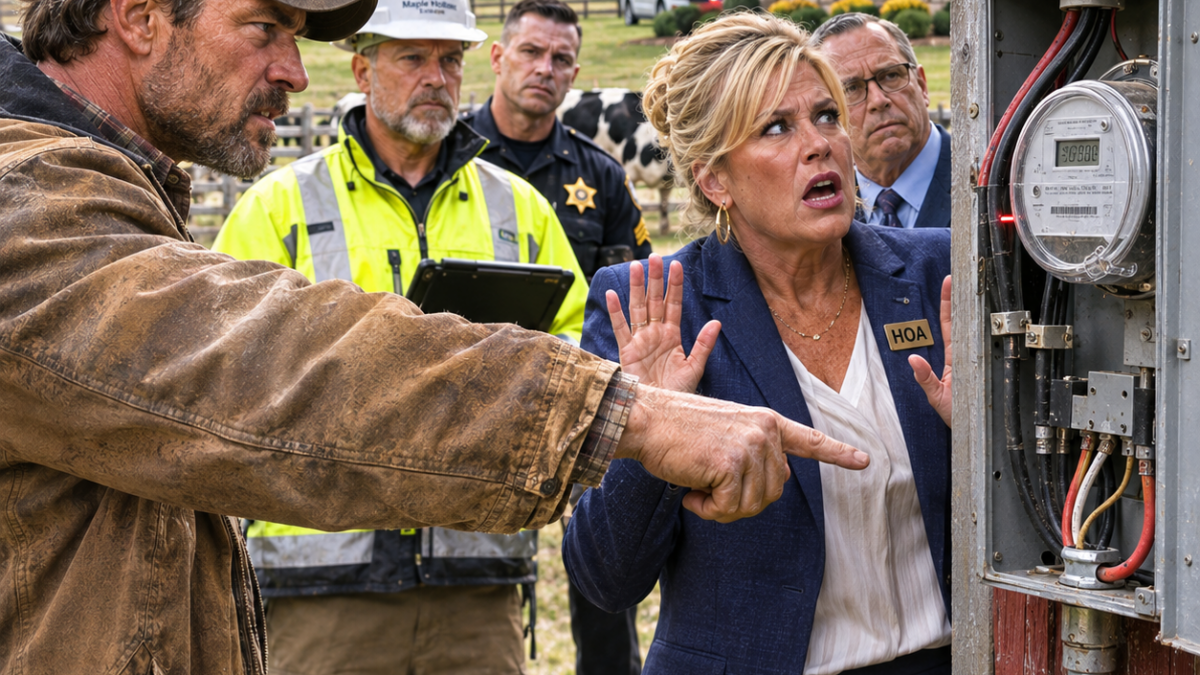
HOA Karen Skipped a $9,000 Power-Line Repair—Then Investigators Found She’d Secretly Wired Her Clubhouse, Pool, and EV Chargers Into My Farm Meter.
At 3:12 in the morning, the alarm on my milk tank started screaming because an ice storm had knocked out the feeder line serving my dairy farm—and the HOA responsible for maintaining that line decided a $9,000 repair was less important than a $42,000 marble fountain.
Five nights later, my barn lights mysteriously came back on even though nobody had repaired the broken pole, and when I checked the meter, it was spinning so fast that more than $11,000 in electricity had already been dumped onto my account.
Then a utility inspector opened my panel, stared at the hidden conduit feeding the HOA clubhouse, swimming pool, fountain, security gates, and twelve EV chargers, and said the one sentence that made the HOA president turn white: “This is an unauthorized connection.”
My name is Eli Garrett.
My family has been milking cows at Garrett Creek Dairy since 1952.
We are not wealthy.
People sometimes hear “family farm” and imagine hundreds of acres, spotless red barns, expensive tractors, and some picturesque life involving sunrises and fresh milk.
There are sunrises.
A lot of them.
Most are seen while standing in manure.
Garrett Creek Dairy sits at the bottom of a narrow valley outside Cedar Falls.
Thirty-eight milk cows.
Twelve calves that belong emotionally to my daughter even though technically they belong to the farm.
Two barns.
One milking parlor.
A milk tank.
Feed shed.
Machine shop.
And a farmhouse my grandfather built after coming home from Korea.
The farm runs because somebody wakes up every morning before they want to.
Usually me.
Sometimes my daughter Lucy.
Lucy was twelve.
She had the kind of confidence only twelve-year-olds and bankruptcy attorneys possess.
Every calf had a name.
Not numbers.
Names.
Mabel.
Rosie.
Pickles.
June.
And one ugly little Holstein named Senator because, according to Lucy, “he makes a lot of noise and doesn’t accomplish anything.”
I told her not to repeat that at school.
She repeated it everywhere.
PART2:
Every morning before the bus came, Lucy helped feed the calves.
Every afternoon, she checked them again.
Garrett Creek wasn’t just my job.
To her, it was the whole universe.
That mattered later.
The trouble started with an agreement my father signed in 1998.
That was when Maple Hollow Estates was built along our eastern fence line.
Before Maple Hollow, there had been woods.
Then a developer arrived.
Roads.
Streetlights.
Clubhouse.
Pool.
Eventually almost two hundred homes.
The problem was electricity.
The local co-op could serve Maple Hollow only by extending a feeder line across the edge of our pasture.
My father didn’t mind.
He wasn’t anti-development.
But Dad had spent his entire life watching people discover that handshake agreements become very flexible once enough money is involved.
So he got everything in writing.
PART3:
The HOA received an easement allowing the feeder line across Garrett land.
In return, the farm received a dedicated connection and certain access protections.
And Section 7 said something very specific.
The association was responsible for maintenance of the feeder infrastructure crossing the Garrett property.
Failure to maintain it after notice could constitute a material breach and allow the easement to be revoked.
Dad had circled Section 7 in blue ink.
Then he gave me the agreement.
“Don’t lose this.”
“I won’t.”
“You will.”
“Thanks for the confidence.”
“Put it somewhere your mother can’t clean.”
That was Dad.
I kept it in a steel file cabinet inside the farmhouse.
For twenty-six years, nobody needed Section 7.
Then February arrived.
The storm came overnight.
Freezing rain first.
Then sleet.
Then heavy wet snow.
At 12:37 a.m., I heard a crack from the eastern pasture.
Not thunder.
Wood.
I pulled on boots.
Grabbed a flashlight.
Walked outside.
One of the feeder poles had split halfway up.
The top section leaned hard toward the ground.
A line lay across frozen grass throwing blue sparks.
I stopped fifty yards away.
Called the co-op.
Then the HOA emergency number because under the agreement the damaged segment was Maple Hollow’s maintenance responsibility.
Voicemail.
I called again.
Voicemail.
Left a message.
“This is Eli Garrett at Garrett Creek Dairy. Feeder pole is down on the farm easement. Line is on the ground. We have a milk cooling emergency. Call immediately.”
The farm’s direct supply failed.
Backup generator kicked in.
Old generator.
Enough for critical systems.
Barely.
The milk tank was the biggest problem.
Milk doesn’t care whose contract says what.
If it warms too far, you dump it.
Thousands of dollars gone.
By sunrise, the pole had stopped sparking.
The co-op isolated the dangerous segment.
But full restoration required repair of the HOA-owned easement equipment.
At 8:20, a white SUV came up my driveway.
Lydia Branson stepped out.
HOA president.
Mid-fifties.
Red scarf.
Expensive boots completely unsuited to a dairy farm.
Behind her came Gordon Pike, the treasurer.
Clipboard.
Nervous expression.
I took them to the pasture.
The broken pole leaned like a snapped bone.
I’d already gotten an emergency estimate from a licensed electrical contractor.
$9,000.
Replacement pole.
Hardware.
Labor.
Testing.
I handed Lydia the quote.
She barely looked.
“Nine thousand?”
“Yes.”
“We don’t have that in the maintenance budget.”
I stared.
“You have a maintenance obligation.”
“We have a board process.”
“The line is down now.”
“We vote next week.”
“My milk tank isn’t voting next week.”
Gordon looked uncomfortable.
Lydia didn’t.
She handed the estimate back.
“The board already has a capital expenditure on the agenda.”
“What expenditure?”
“The clubhouse fountain renovation.”
I thought I’d misheard.
“The fountain?”
“Yes.”
“How much?”
She hesitated.
I already knew from neighborhood gossip.
“Forty-two thousand?”
Her expression tightened.
“It’s a property-value improvement.”
I pointed at the broken pole.
“This is electrical infrastructure.”
“We have priorities.”
“Section 7 makes this your responsibility.”
Lydia smiled.
Not warmly.
“Rent a generator.”
“I already have one.”
“Then you’re covered.”
“Not indefinitely.”
She turned toward the SUV.
“Farms are resilient, Eli.”
Then she gave me the sentence I never forgot.
“Cows don’t need Wi-Fi.”
She got in the vehicle.
Drove away.
For four days, we ran on emergency power.
Generator rental.
Diesel.
Extra labor.
Night checks.
More than $3,000.
Lucy slept on a hay bale one night because she refused to go inside while I was monitoring the tank.
I found her at 1:30 a.m.
Math book open.
Lantern beside her.
Head resting on a folded jacket.
I carried her into the house.
The next morning, the milk failed temperature standards.
One full shipment.
Dumped.
There is something painful about watching milk you produced go down a drain.
Not because milk is sacred.
Because you know exactly what it cost.
Feed.
Veterinary care.
Labor.
Electricity.
Five-in-the-morning cold.
And suddenly it’s waste.
I sent the HOA a certified letter.
Section 7.
Thirty-day demand.
Photographs.
Contractor estimate.
Generator receipts.
Milk loss documentation.
No response.
No call.
No email.
Nothing.
Then the Maple Hollow newsletter arrived Friday.
Front page:
SMART BUDGETING SAVES RESIDENTS THOUSANDS.
Below it:
A rendering of the redesigned clubhouse fountain.
Imported stone.
LED lights.
Three-tier centerpiece.
Estimated cost:
$42,000.
I stood at the mailbox staring at it.
They hadn’t forgotten the repair.
They had chosen not to make it.
Fifth night.
Around 11:00 p.m.
I was in the farmhouse when the refrigerator kicked on.
I stopped.
Then the kitchen lights brightened.
Full power.
I went outside.
Barn lights glowing.
Milk tank compressor humming.
Ventilation fans running.
I actually smiled for about three seconds.
Then I remembered something.
Nobody had called.
No contractor.
No utility truck.
No repair notice.
I walked to the pasture.
Broken pole.
Same position.
Still leaning.
No new hardware.
No fresh tire tracks.
No crew.
Nothing.
So where was my electricity coming from?
I called the co-op.
Night dispatcher checked.
“No service order.”
“Could somebody have repaired it without logging?”
“No.”
“What does your system show?”
He paused.
“Your original feeder issue is still tagged unresolved.”
“My barn is running.”
Another pause.
“That shouldn’t be happening.”
I walked to the meter.
It was spinning like I’d turned the farm into a steel mill.
The digital numbers climbed.
Fast.
Too fast.
I pulled out my phone.
Recorded ten straight minutes.
Date.
Time.
Meter reading.
Narration.
Next morning I logged into the customer portal.
My normal daily usage:
About 300 kilowatt-hours.
Current daily usage:
Over 2,000.
Six days:
Approximately 14,000 kilowatt-hours.
Projected charges and adjustments already climbing toward:
$11,400.
Thirty-eight cows do not use $11,000 of electricity in six days.
I called Lydia.
“Something is connected to my meter.”
She laughed.
“Maybe you’re using more power.”
“Seven times more?”
“I don’t manage dairy equipment.”
“Eleven thousand dollars, Lydia.”
“Maybe your cows are using more power than you think.”
Then she hung up.
That was when irritation became suspicion.
That night I took a flashlight.
Walked the line.
I didn’t touch anything energized.
Dad taught me better than that.
I followed the visible route toward the eastern boundary.
Halfway down the fence, I saw fresh soil.
Not storm disturbance.
Narrow trench.
Recently covered.
I knelt.
Scraped loose dirt aside with a shovel.
Gray electrical conduit.
New.
Running from the HOA side toward my property.
I followed it visually.
Back toward my meter enclosure.
Next morning, from the public road, I tracked the other direction as far as I legally could.
Maple Hollow clubhouse.
Pool mechanical building.
New fountain pump station.
Twelve EV chargers.
Entry gates.
Common-area lighting.
It all connected through new conduit work.
My stomach tightened.
They had not repaired the feeder.
They had rerouted their community load.
Through my farm meter.
I was paying for Maple Hollow.
Clubhouse.
Pool.
Gates.
Fountain.
Electric vehicles.
Every kilowatt.
The $9,000 they refused to spend had become an $11,000 bill with my name on it.
I wanted to drive straight to Lydia’s house.
Instead I heard Dad’s voice.
“Get it on paper before you get angry.”
So I did.
Video.
Photos.
Meter logs.
Utility portal exports.
Fresh conduit.
Broken feeder.
Newsletter.
My certified letter.
The original easement.
Then I called the co-op.
The line inspector’s name was Hector Villanova.
I explained everything.
He asked one question.
“Did you open the panel?”
“No.”
“Touch the conduit?”
“No.”
“Good.”
Pause.
“Don’t.”
“I wasn’t planning to.”
“I’ll be there at ten tomorrow.”
At 9:30 the next morning, Lydia arrived.
Funny how quickly communication improves once somebody important is coming.
She got out of the SUV.
No Gordon.
Just her.
“What exactly did you report?”
I pointed toward the meter.
“Explain that.”
She looked.
“It’s your meter.”
“Yes.”
“Could be faulty.”
“It wasn’t using two thousand kilowatt-hours per day before your line broke.”
“Your equipment—”
“My equipment didn’t multiply overnight.”
Her hand went to her cheek.
Then down.
Then back again.
Nervous gesture.
I’d never seen it before.
“You need to stop making accusations.”
“I haven’t accused you of anything.”
“You called the co-op.”
“Yes.”
“Without talking to the board.”
“I called you first.”
Silence.
Truck tires crunched on gravel.
Co-op vehicle.
Hector got out.
Late forties.
Hard hat.
Safety glasses.
Tool bag.
He introduced himself.
Then pointed.
“Everybody stays back while I open equipment.”
Nobody argued.
He shut down what needed shutting down.
Opened the panel.
Tested.
Photographed.
Followed the new conduit.
His expression changed.
Not dramatically.
Utility inspectors don’t need drama.
He looked at me.
Then Lydia.
“Mr. Garrett, step back another ten feet.”
We did.
He tested again.
Then said:
“This connection is not authorized by the co-op.”
Lydia swallowed.
“What does that mean?”
“It means downstream load has been added behind Mr. Garrett’s meter without authorization.”
She said:
“It was temporary.”
That was the first admission.
Hector looked directly at her.
“You know about it?”
She realized her mistake.
“No—I mean, I assumed maybe a contractor—”
Hector raised one hand.
“Don’t explain it to me yet.”
Then he examined a conductor near the hay-loft feed.
His expression became more serious.
“Eli.”
“What?”
“Look from where you are.”
Insulation.
Warped.
Brown discoloration.
Heat.
“That conductor is overloaded.”
“How bad?”
“More than double what I’d expect for this circuit.”
My throat tightened.
“The barn?”
He nodded.
“If that insulation continued degrading, you could’ve had a fire.”
I looked toward the hay loft.
Dry hay.
Wood framing.
Animals.
Lucy sometimes doing homework in the corner.
“How long?”
“Can’t say.”
“A week?”
“Could be.”
He looked at the wire again.
“I wouldn’t leave it like this another day.”
Lydia whispered:
“Fire?”
Hector turned.
“This isn’t a billing mistake.”
He tagged the connection.
Called his supervisor.
Then contacted the utility-investigation unit.
Depending on the facts and local law, unauthorized diversion of metered electricity could be treated as utility theft.
That phrase changed Lydia.
She moved toward her SUV.
Phone already out.
Talking before the door closed.
I heard enough.
“Emergency board meeting.”
That night, my phone rang.
Unknown number.
“Mr. Garrett?”
“Yes.”
“My name is Sandra Ruiz.”
“Okay.”
“I live in Maple Hollow.”
I waited.
“I think you need to see something.”
We met at a diner twelve miles away.
Not the clubhouse.
Not my farm.
Public place.
Sandra was early forties.
Teacher.
Two kids.
She sat in a corner booth with her phone face down.
“I couldn’t sleep.”
“Why?”
“Board meeting.”
“What happened?”
“They know the co-op found the connection.”
“I assumed.”
She pushed the phone across.
Screenshots.
Private Maple Hollow board group chat.
Gordon Pike:
REPAIR QUOTE IS RIDICULOUS. JUST TAP THE FARM UNTIL WE REBID.
Another member:
CAN WE DO THAT?
Gordon:
TEMPORARY. HE WON’T NOTICE FOR MONTHS.
Then Lydia.
Thumbs-up emoji.
Later:
KEEP IT OFF THE MAINTENANCE LOG.
Another:
WHAT ABOUT BILLING?
Gordon:
FARM METER. WE’LL TRUE IT UP LATER.
Sandra looked sick.
“I moved there because it was quiet.”
I said nothing.
“Not so people could steal electricity from a family with cows.”
“Can you legally give me these?”
“They’re my messages too.”
“Talk to a lawyer.”
“I already did.”
That impressed me.
She forwarded copies.
The next morning Lydia arrived holding a manila envelope.
I stayed on the porch.
She did not enter.
“Goodwill resolution.”
“What?”
She held out the envelope.
Inside:
$2,000 check.
Nondisclosure agreement.
Mutual release.
I laughed.
Actually laughed.
Lydia’s expression hardened.
“What?”
“You charged eleven thousand dollars to my meter.”
“We don’t know that.”
“The co-op knows.”
“This is intended to maintain neighborly relations.”
“You skipped a nine-thousand-dollar repair.”
“That’s disputed.”
“Then somebody connected your clubhouse to my meter.”
“Contractor error.”
“Your board chat says otherwise.”
That landed.
Her face froze.
“What board chat?”
I knew instantly Sandra had not told her.
Good.
I handed the envelope back.
“You didn’t put your hand in my pocket by accident.”
“Eli—”
“You did it because nine thousand dollars was inconvenient.”
Her smile finally broke.
“I suggest you consider your position carefully.”
“I have.”
“What does that mean?”
“I called a lawyer.”
Lydia left.
My attorney was Maya Ellison.
Agricultural-property specialist.
Fifty.
Calm enough to make angry people uncomfortable.
She read the easement.
Then the screenshots.
Then the co-op report.
Then my certified notice.
Finally she looked up.
“Section 7.”
“I know.”
“They failed to maintain.”
“Yes.”
“And someone used the easement infrastructure for an unauthorized connection.”
“Yes.”
“Two separate problems.”
“What happens?”
“You have grounds to seek revocation.”
I sat back.
That mattered more than money.
Maple Hollow’s primary electrical feeder crossed my land.
No easement?
No easy feeder route.
No pool pumps.
No clubhouse.
No gate system.
No fire-pump supply.
No EV chargers.
Potentially no common-area service until they negotiated a replacement route.
“I don’t want two hundred families without power.”
Maya nodded.
“Good.”
“That sounded like a test.”
“It was.”
“What do I want?”
“You tell me.”
“I want the line fixed.”
“Good.”
“My bills corrected.”
“Obviously.”
“My losses paid.”
“Reasonable.”
“And I want them to never be able to do this again.”
“Now we’re negotiating.”
Two days later, they tried something worse.
A bucket truck pulled up to my easement pole.
Contractor.
Lydia in passenger seat.
I walked down.
Foreman got out.
“We have an order to disconnect the farm spur.”
“From who?”
He pointed vaguely toward the truck.
“Property manager.”
“This is private property.”
“We’re working in the utility easement.”
“You may perform authorized feeder maintenance under the easement.”
He nodded.
“Right.”
“You may not cut my dedicated connection.”
His face tightened.
“That’s what the work order says.”
“No.”
I stood in the road.
“Do not touch it.”
He looked toward Lydia.
She got out.
“Move.”
“No.”
“You’re interfering with authorized maintenance.”
“You spent a month refusing maintenance.”
“Move, Eli.”
Blue lights came over the hill.
Sheriff’s cruiser.
Deputy Anna Whitlock.
Hector had warned law enforcement and the co-op that he was concerned somebody might alter evidence or retaliate against the farm connection.
Anna parked.
Walked up.
“What’s going on?”
The foreman answered first.
“We’ve been hired to disconnect this spur.”
“Whose?”
He pointed at me.
“His.”
“Who authorized?”
He slowly pointed toward Lydia.
She stared at her phone.
Anna looked at her.
“Mrs. Branson?”
“This is HOA infrastructure.”
“Inside an easement.”
“Yes.”
“Do you have authorization from the utility?”
Silence.
“The co-op?”
Nothing.
“Court order?”
“No.”
Anna looked at the contractor.
“You touch nothing until the utility sorts this out.”
The foreman nodded immediately.
“I’m fine with that.”
Lydia said:
“This is ridiculous.”
Anna looked at her.
“Ma’am, there is an active utility investigation involving this equipment.”
That ended it.
That evening the co-op disconnected the illegal tap.
The effect was immediate.
Maple Hollow clubhouse went dark.
Fountain stopped.
Pool heaters shut off.
Twelve chargers dead.
Entry gate froze partially open.
Some street-common-area systems dropped depending on their feed.
The private homes still had power through legitimate service.
But the HOA amenities?
Dark.
For the first time, residents saw what their board had done.
People gathered outside the clubhouse.
Lydia stood at the entrance.
“Temporary technical issue.”
Nobody believed her.
Then Sandra stepped forward.
Phone in hand.
“I have the board chat.”
Lydia went white.
Sandra read.
“Just tap the farm.”
Silence.
“He won’t notice for months.”
People stared at Gordon.
He sat on the curb.
Head in hands.
Then Sandra read Lydia’s thumbs-up.
A woman in the crowd shouted:
“You knew?”
Another:
“You put the farm’s meter on our clubhouse?”
A man:
“My daughter charges her car there!”
Lydia tried to leave.
Residents followed with questions.
Not violence.
Just anger.
By midnight, the recall petition had more than 160 signatures.
Within days, Lydia and Gordon were removed from the board.
Gordon cooperated.
He produced a contractor invoice.
$1,800.
Temporary bypass work.
The board had spent $1,800 to avoid an immediate $9,000 repair.
And created an $11,400 farm bill.
Lost milk.
Generator expense.
Legal costs.
Potential criminal exposure.
Fire risk.
And an easement crisis threatening their entire electrical infrastructure.
Dad would’ve called that poor arithmetic.
The investigation lasted three weeks.
Co-op records.
Contractor statements.
Bore logs.
Board messages.
Meter histories.
My bill was reversed.
Every unauthorized kilowatt removed.
The farm’s proper charges recalculated.
The HOA’s insurer denied coverage for intentional unauthorized conduct.
That changed the board’s financial position immediately.
Maya filed notice seeking revocation of the easement under Section 7.
Suddenly everyone understood why Dad insisted on that clause in 1998.
The new Maple Hollow board called within an hour.
Sandra had been elected interim president.
She asked to meet.
My kitchen table.
Not the clubhouse.
Sandra arrived with three board members and their new attorney.
She put a folder down.
“We’re not defending what happened.”
“Good.”
“We want to fix it.”
“Good.”
She opened the offer.
$9,000 pole repair.
Full generator costs.
Lost milk shipment.
Legal expenses.
Additional documented electrical damage.
Then she said:
“We’re asking you not to revoke the easement.”
I looked toward Maya.
She said nothing.
This was my decision.
I looked at Sandra.
“Three conditions.”
“Okay.”
“First: certified co-op inspection of the entire easement system.”
She nodded.
“Second: maintenance escrow.”
“How much?”
“Enough to fund twenty-five years of scheduled maintenance and emergency reserve.”
Their lawyer inhaled.
Sandra said:
“Continue.”
“Third: Maple Hollow gets its own meter.”
She nodded before I finished.
“Separate load.”
“Yes.”
“No community equipment behind my farm meter.”
“Absolutely.”
“Ever.”
“Yes.”
“And any unauthorized alteration triggers immediate breach.”
“Agreed.”
Maya smiled slightly.
Their lawyer did not.
Sandra signed.
The difference between good leadership and bad leadership sometimes looks boring.
No shouting.
No threats.
No newsletters bragging about fountains.
Just adults acknowledging what went wrong and fixing it.
Hector’s crew replaced the pole.
One day.
Nine thousand dollars.
The repair Lydia had treated like an unreasonable luxury.
New hardware.
Certified connection.
Proper meter separation.
Full load test.
At sunset, Hector energized the farm.
Barn lights came on.
Milk compressor started.
Fans.
Freezers.
Everything.
Lucy stood beside me at the meter.
The digits moved slowly.
Steadily.
Honestly.
She watched.
“Is that good?”
“Yes.”
“It’s barely moving.”
“That’s very good.”
She looked at me.
“So we’re not paying for the rich people’s fountain?”
I almost choked.
“Where did you hear that?”
“School.”
“Of course.”
She grinned.
The legal case continued separately.
Lydia and Gordon eventually reached plea agreements related to the unauthorized utility diversion and associated conduct.
Restitution.
Probation.
Community service.
No dramatic prison scene.
No handcuffs at the clubhouse.
Accountability doesn’t always look cinematic.
Sometimes it looks like signing papers in a courthouse and spending years paying money back.
Lydia asked to speak with me once.
Maya was present.
She looked older.
Not physically much.
But something in her confidence was gone.
“I wanted to apologize.”
I said nothing.
She continued.
“I never intended for anyone to be endangered.”
“You overloaded a conductor in a hay barn.”
“That wasn’t supposed to happen.”
“You connected a clubhouse, pool, gates, fountain pumps, and twelve chargers to a dairy meter.”
“It was supposed to be temporary.”
“My daughter slept in that barn.”
Lydia looked down.
I said:
“You didn’t just steal electricity.”
She looked up.
“You stole sleep from my daughter.”
Nothing.
She had no answer.
Neither did I.
That was the end of the conversation.
Spring came.
Maple Hollow did something I didn’t expect.
They asked if they could hold a picnic at Garrett Creek.
I almost said no.
Lucy said yes before I could.
So one Saturday, two hundred people walked through the pasture.
Kids fed calves.
Sandra brought pie.
Hector brought his family.
Somebody from Maple Hollow brought a folding table and a handwritten sign:
HONEST POWER, HONEST NEIGHBORS.
I told them the sign was corny.
They put it beside the barn anyway.
People apologized.
Not all of them needed to.
Most Maple Hollow residents had no idea what Lydia and Gordon were doing.
They believed the board when it said the farm outage was somebody else’s problem.
That was another lesson.
Organizations make terrible decisions when ordinary people stop asking what their leaders are doing in their name.
Sandra understood.
Every Maple Hollow financial report became public to members.
Maintenance escrow balance.
Inspection schedule.
Utility costs.
Vendor invoices.
Boring documents.
Wonderful documents.
The fountain eventually got built.
Not the forty-two-thousand-dollar version.
A smaller one.
One afternoon I drove past and saw children throwing pennies into it.
I laughed.
Nine thousand dollars.
That number stayed with me.
Not because it was enormous.
For Maple Hollow, it wasn’t.
That was the point.
They could have paid it.
They had the money.
They simply decided a repair nobody would admire was less important than an improvement everyone would see.
Infrastructure is rarely glamorous.
Poles.
Wire.
Drainage.
Pumps.
Roofs.
Nobody takes photographs beside a newly replaced feeder pole.
But when those systems fail, suddenly everyone learns what mattered.
My father understood that.
That’s why Section 7 existed.
He wasn’t trying to threaten Maple Hollow.
He was making responsibility symmetrical.
You get access across our land.
You maintain what you put there.
Simple.
For twenty-six years, it worked.
Then one board decided the agreement was inconvenient.
So they treated our farm like a free extension cord.
That was the part that angered me most.
Not even the money.
They assumed I wouldn’t notice.
“Just tap the farm.”
“He won’t notice for months.”
Those words told me everything.
They saw Garrett Creek as background.
Old barn.
Cows.
Pasture.
Something that had always been there and therefore could be taken for granted.
But farms notice things.
You notice water pressure.
Animal behavior.
Motor sounds.
Temperature.
A pump running half a second too long.
Electric meters.
Dad used to say farms speak quietly before they scream.
The milk-tank alarm screamed.
I listened.
Months later, I had the original easement professionally preserved.
Dad’s blue circle around Section 7 was still visible.
Lucy saw it.
“Grandpa wrote that?”
“Yes.”
“Why?”
“Because he was smarter than me.”
She nodded.
“I know.”
Twelve-year-olds are cruel.
I put the agreement back in the safe.
Next to the new one.
The new agreement was thicker.
Lawyers do that.
But the principle stayed exactly the same.
Use our land fairly.
Maintain your infrastructure.
Meter your own power.
Don’t make your emergency my family’s burden.
Years later, the old broken pole still sat behind my machine shed.
I had kept a section after Hector’s crew removed it.
One day Sandra saw it.
“You saved that?”
“Yes.”
“Why?”
“Reminder.”
“Of Lydia?”
“No.”
“Gordon?”
“No.”
“Then what?”
I pointed at the split wood.
“Nine thousand dollars.”
She understood.
Maple Hollow nearly lost its easement because its board thought $9,000 was too much to spend maintaining critical infrastructure.
Instead, they paid for:
The repair.
Generator fuel.
Lost milk.
Legal fees.
Meter correction.
Utility investigation.
New electrical work.
A maintenance escrow.
And years of scrutiny.
All to save nine thousand dollars.
The funny thing is, the title people usually give this story isn’t quite right.
They say:
HOA skipped a repair and I shut off their power.
I didn’t.
The co-op disconnected an unauthorized tap.
They say:
I used Section 7 to blackmail Maple Hollow.
I didn’t.
I used it to force the association to honor an agreement my father had negotiated fairly.
They say:
I wanted the neighborhood dark.
Wrong again.
There were families there.
Children.
Elderly residents.
Fire systems.
People who had done nothing.
What I wanted was something much simpler.
My farm should pay for my farm.
Maple Hollow should pay for Maple Hollow.
And the wire carrying electricity between us should be maintained by the people who agreed to maintain it.
That shouldn’t have required lawyers.
Or deputies.
Or an investigation.
But sometimes simple things become complicated when somebody thinks saving money is the same as avoiding responsibility.
The most important moment didn’t happen when the clubhouse went dark.
It didn’t happen when Sandra read the group chat.
It wasn’t Lydia’s plea agreement.
It happened the morning Hector opened my meter panel.
He saw the splice.
Then the overheated wire.
And said:
“Another week and you could’ve lost this barn.”
I still think about that.
Money comes back.
Bills can be corrected.
Contracts renegotiated.
Milk replaced tomorrow.
A barn full of dry hay?
Thirty-eight cows?
A twelve-year-old girl sleeping on a hay bale?
Different calculation.
That was what Lydia never understood until it was too late.
She thought she was saving $9,000.
She was gambling with something that never appeared on the HOA spreadsheet.
Today, Garrett Creek Dairy still wakes early.
Lucy is older.
Still names calves.
Still argues with me about everything.
Maple Hollow still sits across the fence.
Clubhouse lights come on every evening.
Pool heats.
Gate opens.
EV chargers blink green.
The little fountain runs in summer.
And beside the Maple Hollow electrical panel is a separate meter.
Their meter.
Not mine.
Sometimes I walk past my barn meter after morning milking.
I stop.
Watch the numbers.
Slow.
Steady.
Exactly where they belong.
Dad’s easement lasted because it finally became what he intended.
Not a favor.
Not a loophole.
A promise with consequences.
Lydia thought nobody would notice when the HOA stopped keeping its side.
She was wrong.
The cows didn’t notice.
The meter did.








