HOA Karen Sent Two Men to Steal My $276,000 Ferrari—Then Froze When I Walked Out With an FBI Badge
HOA Karen Sent Two Men to Steal My $276,000 Ferrari—Then Froze When I Walked Out With an FBI Badge
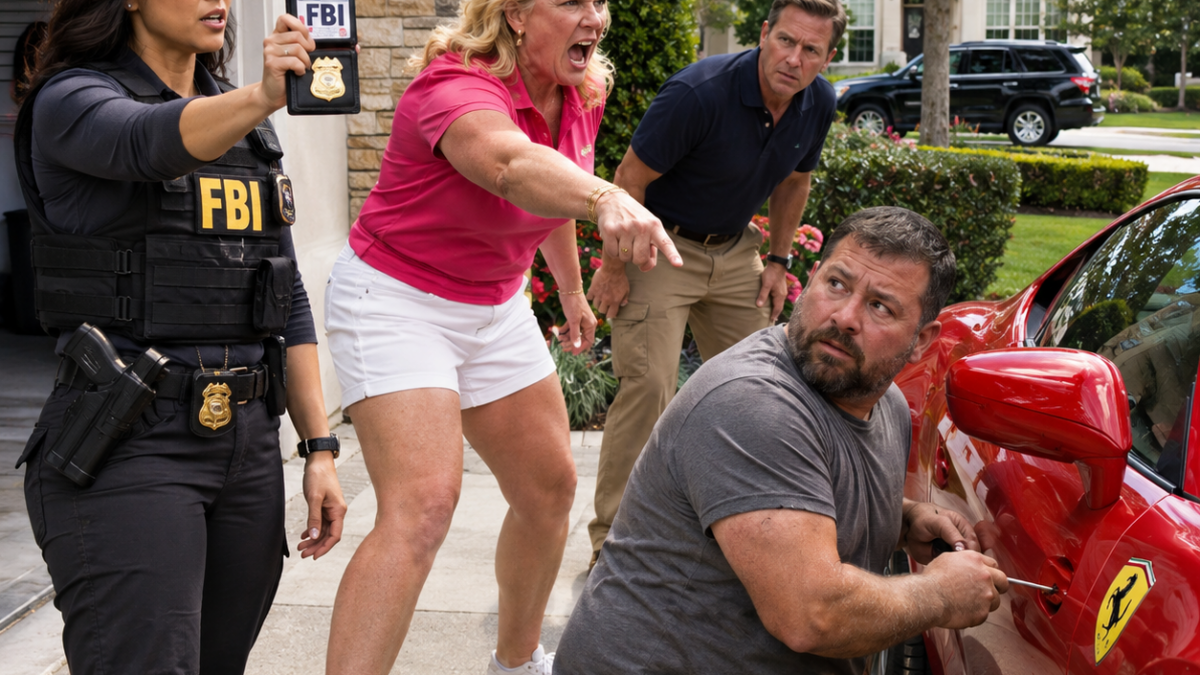
HOA President Diana Prescott stood on the sidewalk smiling into her phone while two men hooked a winch to my $276,000 Ferrari and began dragging it off my private driveway, certain that the violation notice in her hand gave her the right to take whatever she wanted.
What she did not know was that I had spent eleven years as an FBI special agent investigating people who hid theft behind legitimate titles, and when I walked outside, raised my credentials, and told the tow operators to step away from my car, the older driver looked at Diana and quietly said, “You told us he’d already signed the release.”
That one sentence eventually exposed fabricated HOA violations, unauthorized towing charges, nearly half a million dollars routed through companies connected to Diana’s family, and the real reason she wanted my Ferrari gone before I noticed how much money her “community standards” were actually generating.
“Get that ugly piece of junk off your driveway, or I’ll have it dragged away myself.”
Diana Prescott stood beside my Ferrari as if somebody had abandoned a broken refrigerator in front of her house.
The car was a red Ferrari F8 Tributo.
Three-point-nine-liter twin-turbo V8.
Just over seven hundred horsepower.
$276,000 when I bought it.
Not subtle.
Not practical.
Not something I needed.
But it was mine.
Registered.
Insured.
Parked entirely on the concrete driveway attached to the house I had purchased eleven days earlier in Asheford Glen Estates, Loudoun County, Virginia.
I had spent that Saturday morning washing road dust from the hood.
Diana arrived around ten wearing white slacks, oversized sunglasses, and the navy blazer she seemed to consider an official uniform.
She carried a leather folder stamped:
ASHEFORD GLEN HOMEOWNERS ASSOCIATION
I had already received one of those folders.
Inside had been four violation notices.
Ferrari visible from street.
Small oil stain on driveway.
American flag mounted beside front entrance.
Porch light exceeding community brightness standards.
Combined recurring assessment:
$325 per month until corrected.
I disputed every one.
The Ferrari violated nothing in the covenants.
The oil stain was smaller than my hand and had already been cleaned.
The flag complied with the dimensions listed in the rules and had been presented to my family after my father’s funeral.
The porch light was the exact fixture shown in the builder’s approved-option catalog.
Forty-eight hours after I emailed those points to the management office, Diana appeared in person.
I set the microfiber towel on the hood.
“It’s registered, insured, and parked on my property.”
She removed her sunglasses.
“What exactly is the problem?”
PART2:
“You are the problem, Mr. Cole.”
I studied her.
She glanced toward the house.
Then at the Ferrari.
“You brought down this neighborhood the day you moved in.”
I almost smiled.
“I’ve been here eleven days.”
“Exactly.”
“That’s impressive efficiency.”
She did not appreciate humor.
“People like you don’t belong here.”
I stopped smiling.
“People like me?”
“Don’t play stupid.”
She waved toward the homes around us.
“This is an exclusive community.”
“We have standards.”
“And I happen to be responsible for enforcing them.”
There are moments when professional instinct activates before conscious thought.
Not because somebody says something criminal.
Because their language doesn’t fit the situation.
PART3:
Diana did not sound like a board president discussing covenants.
She sounded like someone establishing dominance.
I had heard variations of that tone during interviews with corrupt municipal officials, contractors, fraud defendants, and executives who believed a title converted preference into authority.
I did not react.
I asked:
“Show me the rule prohibiting my car.”
Her lips tightened.
“The board has broad discretion over exterior harmony.”
“Show me the specific section.”
“We don’t need a rule listing every conceivable nuisance.”
“A legally parked vehicle is a nuisance?”
“That vehicle is ostentatious.”
I stared at her.
“So the problem is that it’s expensive.”
“The problem is that it disrupts the character of the neighborhood.”
Behind us sat a Range Rover.
Across the street:
Porsche Cayenne.
Two houses down:
Mercedes AMG GT.
At the corner:
Bentley Continental owned by a retired cardiologist named Simon Wells.
I pointed.
“Does Simon’s Bentley disrupt the character?”
Diana’s expression cooled.
“This isn’t about Simon.”
“Apparently.”
She stepped closer.
“You have until Friday.”
“For what?”
“Move the Ferrari into your garage or off-site.”
“My garage contains moving boxes.”
“Then unpack.”
“No.”
She smiled.
“Otherwise I’ll have it towed.”
“You don’t have permission to enter my driveway.”
“The association has enforcement authority.”
“Not that authority.”
“We’ll see.”
Then she leaned slightly toward me.
“And trust me, I’ll enjoy watching.”
She walked away.
I watched her until she reached the sidewalk.
Then I looked down at the Ferrari.
People often assume federal agents live in permanent law-enforcement mode.
We don’t.
I was not interested in turning a neighborhood argument into an FBI matter.
I wasn’t at work.
Diana was not a federal target.
An HOA dispute did not become a federal investigation because an FBI agent lived in the house.
I wanted exactly what any homeowner should want.
Written rules applied correctly.
Boundaries respected.
No unnecessary drama.
So I did what my training had taught me.
I saved everything.
The violation notices.
My response.
Her reply.
Date and time of the confrontation.
Security-camera footage.
Then I called the HOA management company.
The community manager was a man named Peter Lawson.
He sounded tired before I finished introducing myself.
“I saw your appeal.”
“Good.”
“It’s under review.”
“Did the board authorize towing my vehicle?”
Pause.
“I don’t see a towing authorization.”
“Can the HOA tow a registered vehicle from a private residential driveway?”
Another pause.
“Not under our standard policy.”
“Can President Prescott order it herself?”
“No.”
“Put that in writing.”
He sighed.
“I’ll email you.”
Ten minutes later:
Asheford Glen HOA management has not issued or approved a towing authorization for the Ferrari located at 1847 Wexford Lane. HOA policy does not provide for removal of a properly registered vehicle from a homeowner’s private driveway absent specific legal authority or owner consent.
I printed it.
Then Friday arrived.
Nothing happened.
Saturday morning, I made coffee around seven.
At 7:36, I heard diesel outside.
I looked through the kitchen window.
Flatbed tow truck.
Black.
No county markings.
Two men got out.
One older.
Maybe fifty.
Heavyset.
Gray beard.
The younger one looked twenty-five.
Baseball cap.
Both wore shirts marked:
CAPITOL PREMIER RECOVERY
Diana stood on the sidewalk.
Phone held vertically.
Recording.
Smiling.
The younger operator walked up my driveway.
He crouched near the Ferrari’s front tow point.
The older man began lowering the flatbed.
I opened the kitchen drawer beside the refrigerator.
My service weapon was secured elsewhere.
I did not take it.
I took my credentials.
Badge.
Identification.
Then my phone.
I started recording before opening the door.
By the time I stepped outside, they had attached the winch.
The Ferrari’s front suspension compressed.
Then the nose rose about six inches.
“Stop.”
The older operator looked up.
“Sir, please stay back.”
“Release the car.”
“We have a removal order.”
“From who?”
He pointed toward Diana.
She smiled wider.
“Morning, Ethan.”
First-name familiarity now.
Interesting.
I walked within clear view of both men.
Held my credentials where they could see them.
“I’m Special Agent Ethan Cole, FBI.”
The younger operator dropped the winch remote.
Literally dropped it.
It hit the driveway.
The older man stared at the badge.
Then at me.
Then at Diana.
I continued immediately:
“I am off duty.”
“This is my privately owned vehicle on my privately owned driveway.”
“I am not detaining you.”
“But you need to stop moving the vehicle until local law enforcement determines whether you have lawful authorization.”
That distinction mattered.
I was not using federal authority to settle a personal dispute.
I was identifying myself because three strangers were attempting to remove high-value property from my home and I wanted everyone very clear that the situation would be documented correctly.
The older driver looked at Diana.
“You told us he’d signed the release.”
Everything stopped.
Diana’s phone lowered.
“What?”
The driver pointed toward me.
“You said the owner signed a compliance removal agreement.”
“I said the HOA had authorization.”
“No.”
His voice got sharper.
“You said homeowner consent was in the file.”
I looked at him.
“Do you have that file?”
He hesitated.
“Yes.”
“Don’t alter it.”
Diana stepped off the sidewalk.
“This is ridiculous.”
I looked at her.
“Did you give them a document carrying my signature?”
“I gave them an HOA authorization.”
The driver shook his head.
“No.”
“Frank—”
“Don’t.”
Now I had his name.
Frank Delaney.
The younger operator slowly backed away from the Ferrari.
Diana’s face had changed.
Not fear exactly.
Calculation.
She looked at the badge again.
“You never told anyone you were FBI.”
I almost laughed.
“My occupation wasn’t on your architectural application.”
“You deliberately withheld that.”
“From the HOA?”
“Yes.”
“Why would the HOA need to know?”
She had no answer.
Frank raised the flatbed slightly to remove tension from the cable.
I said:
“Leave everything exactly where it is until the sheriff arrives.”
Diana snapped:
“You do not control this neighborhood.”
I took out my phone.
“I control whether someone removes my car from my driveway without permission.”
Then I called Loudoun County Sheriff’s Office.
A deputy arrived twelve minutes later.
Deputy Marcus Hale.
I put my credentials away before he walked up.
This was his scene.
His jurisdiction.
I explained exactly what happened.
No FBI title except when he asked occupation.
Frank produced a work packet.
Tow request.
Violation history.
HOA authorization.
And a page labeled:
VEHICLE REMOVAL ACKNOWLEDGMENT
Homeowner:
ETHAN COLE
Vehicle:
2022 FERRARI F8 TRIBUTO
At the bottom:
A signature.
Supposedly mine.
It wasn’t even close.
My actual signature is almost unreadable.
This looked like someone had carefully written my name in cursive.
Marcus looked at me.
“You sign this?”
“No.”
Diana interrupted.
“That form came from management.”
Peter Lawson arrived twenty minutes later after Marcus called the HOA office.
He took one look.
“I’ve never seen this.”
Diana said:
“Peter, don’t be ridiculous.”
He turned toward her.
“Where did you get it?”
“You sent the compliance packet.”
“No.”
“The board authorized removal.”
“No, it didn’t.”
A small crowd formed.
Neighbors.
Phones.
The exact audience Diana had wanted.
Just not the story.
Marcus collected copies.
Frank disconnected the winch.
The Ferrari settled back onto the driveway.
I crouched immediately.
Photographed the tow point.
Front splitter.
Undercarriage.
Anything that might have been damaged.
Frank said:
“We didn’t know.”
“I believe that you believed you had paperwork.”
He looked relieved.
Then I added:
“But you came onto private property without verifying with the owner.”
His expression fell.
“Yes.”
“I should’ve knocked.”
“Yes.”
He nodded.
Fair.
Diana stood beside her SUV.
For the first time since I’d met her, she wasn’t smiling.
That could have been the end.
Fake towing paperwork.
Board investigation.
Maybe forgery.
Maybe management error.
Then Frank asked Marcus something.
“Do you want the other work orders?”
Marcus looked up.
“What other work orders?”
Frank glanced at Diana.
She went still.
“Our company tows for Asheford Glen.”
“How often?”
Frank shrugged.
“Couple times a month.”
Peter said:
“That doesn’t make sense.”
Everyone looked at him.
“Our management records show five HOA-requested tows in the last eighteen months.”
Frank frowned.
“We’ve done at least thirty.”
The silence around us changed.
I looked at Peter.
He looked at Frank.
Diana said:
“This is not relevant.”
I knew immediately it was relevant.
Very.
Marcus asked Frank:
“Who usually sends the requests?”
Frank pointed toward Diana.
“Her office.”
Diana stepped forward.
“Do not discuss confidential association business in the street.”
Frank looked at her.
“You told me this was association business.”
“It is.”
“Then why doesn’t management know about it?”
She had no answer.
That was when my Ferrari stopped being the real story.
I drove it to an authorized service center that afternoon.
Not because the damage looked serious.
Because I wanted a professional inspection.
The front underside had a small scrape.
No structural damage.
Tow-point mounting intact.
Estimate and inspection report saved.
Then I called my supervisor.
Not to open a federal case.
To report the incident.
FBI employees have disclosure obligations when personal matters could intersect with law-enforcement issues or create appearance concerns.
I explained.
Fake signature.
HOA.
Tow contractor.
Possible financial irregularities.
My supervisor, Assistant Special Agent in Charge Rebecca Sloan, listened.
Then said:
“You are not investigating this.”
“I know.”
“You are not interviewing neighbors under color of office.”
“I know.”
“You are not running names through bureau systems.”
“I know.”
“Good.”
Pause.
“You’re going to hate this.”
“What?”
“You need your own lawyer.”
She was right.
My attorney was Maya Bennett.
Forty-four.
Property and association law.
Former state prosecutor.
First thing she said:
“Your badge is now the least interesting part.”
“I was hoping that would be the dramatic ending.”
“No.”
She looked through the towing packet.
“This signature isn’t yours.”
“No.”
“Management says they didn’t issue it.”
“Correct.”
“Tow company says Diana did.”
“Yes.”
“Then let’s preserve everything before anyone develops amnesia.”
Maya sent letters.
HOA.
Management company.
Tow company.
Board.
Preserve emails.
Invoices.
Payment records.
Violation logs.
Tow authorizations.
Board minutes.
Vendor agreements.
Digital metadata.
No one loved receiving those letters.
Especially Diana.
Two days later, the HOA board called an emergency meeting.
Diana chaired it.
Of course.
The clubhouse was full.
She opened by describing Saturday as:
“A misunderstanding caused by a homeowner using his federal employment to intimidate contractors.”
I sat in the second row.
Said nothing.
Maya sat beside me.
Peter Lawson sat near the front.
Frank Delaney stood in back with his attorney.
Diana continued.
“Mr. Cole has attempted to transform an ordinary covenant-enforcement matter into a criminal spectacle.”
Maya whispered:
“Do not react.”
I didn’t.
Then Diana said:
“The board has broad discretion to protect community aesthetics from inappropriate vehicles and exterior conditions.”
Simon Wells raised his hand.
The Bentley owner.
Retired cardiologist.
“Why is his Ferrari inappropriate but my Bentley isn’t?”
Diana paused.
“Each property is reviewed individually.”
Simon nodded.
“Okay.”
“My Bentley is worth more than his Ferrari.”
Several people laughed.
Diana did not.
Simon continued.
“I park outside every Thursday because the cleaning company uses my garage.”
“Never received a notice.”
A woman named Janice Lowe spoke next.
“My son parks a Lamborghini when he visits.”
“Never received one either.”
Diana tried redirecting.
“This isn’t about price.”
I finally spoke.
“Then show the written vehicle standard I violated.”
She glared.
“The board has already reviewed—”
“Show it.”
Maya touched my arm lightly.
Enough.
Peter stood.
“I have reviewed current covenants.”
Heads turned.
“There is no rule prohibiting Mr. Cole’s vehicle.”
Diana’s face hardened.
“There are aesthetic provisions.”
“They don’t authorize vehicle removal.”
“Peter.”
“And management never approved Saturday’s tow.”
Now the room became quiet.
Board treasurer Laura Kim opened a binder.
“I wasn’t aware of it either.”
Neither was the secretary.
Neither were two other board members.
Diana said:
“Emergency enforcement does not always require a full vote.”
Laura looked toward Maya.
Then Diana.
“What emergency?”
Nobody answered.
Frank stepped forward.
“I’ve got something.”
His attorney handed Laura copies.
Invoices.
Capitol Premier Recovery had been towing vehicles for Asheford Glen for almost four years.
Thirty-seven HOA-initiated removals.
Some from common parking.
Others from driveways.
Each carried multiple charges.
Tow fee.
Administrative release fee.
Compliance processing fee.
After-hours fee.
Sometimes storage.
Peter looked stunned.
“These aren’t in our vendor system.”
Frank said:
“We invoice Prescott Residential Compliance.”
I looked toward Diana.
Her face lost color.
Laura asked:
“What is Prescott Residential Compliance?”
No one answered.
Maya already knew.
She slid a Virginia corporate registration across the table.
Company:
PRESCOTT RESIDENTIAL COMPLIANCE LLC
Registered agent:
MARTIN PRESCOTT
Diana’s brother.
The room erupted.
Diana slammed her gavel.
“Order.”
Nobody cared.
Laura raised her voice.
“Why is your brother’s company collecting money from HOA towing?”
“It is a third-party compliance administrator.”
“Approved by whom?”
“The board has delegated operational authority—”
“Show me the vote.”
Diana said nothing.
Then a homeowner named Melissa Grant stood.
“My son’s truck got towed last year.”
She looked toward Frank.
“Was that you?”
Frank checked a list.
“Address?”
She gave it.
“Yes.”
Melissa’s face tightened.
“We paid $1,180 to get it back.”
Frank frowned.
“Our invoice was $410.”
You could feel the air leave the room.
“Where did the other $770 go?”
Diana said:
“Administrative costs.”
Melissa turned.
“For what?”
“Violation processing.”
“By your brother?”
“By a contracted administrator.”
“Your brother.”
Diana slammed the gavel again.
“This meeting is adjourned.”
Laura said:
“No.”
Everyone looked at her.
The treasurer stood.
“As a board member, I move to suspend Diana Prescott’s unilateral enforcement authority pending financial review.”
Secretary seconded.
Diana stared.
“You can’t do this.”
Laura looked at the bylaws.
“Yes, we can.”
Vote.
Four to one.
Diana was the one.
She remained president.
In title.
But her enforcement power disappeared that night.
The audit began the next morning.
That was when the numbers got ugly.
For years, homeowners had paid “compliance recovery” fees associated with violations.
Parking.
Trash cans.
Landscaping.
Exterior lights.
Mailbox paint.
Unapproved decorations.
Oil stains.
Commercial vehicles.
Some legitimate.
Many questionable.
The HOA’s official books showed only a portion.
Additional payments flowed through Prescott Residential Compliance.
At first Diana argued those were private vendor charges.
Then Laura found something worse.
The HOA had reimbursed Prescott Residential Compliance for enforcement services while homeowners were also paying the company directly.
Double revenue.
One side paid by association funds.
One by residents.
Maya warned me:
“Do not call this theft yet.”
“I know.”
“I’m serious.”
“So am I.”
“We call it unexplained payments until the audit finishes.”
Fine.
Unexplained payments.
Approximately $184,000 over five years.
Then the auditors identified “vehicle administration” charges.
Another $96,000.
Architectural enforcement consulting.
$71,000.
Emergency compliance services.
$42,000.
Other categories.
By the time adjustments and duplicated payments were reconciled, nearly $430,000 had flowed to Diana’s brother’s company or related entities.
That didn’t automatically mean all of it was illegal.
Some services might have been performed.
The problem was authorization.
Disclosure.
Conflicts.
Invoices.
And in several cases, services appeared to exist only on paper.
Then the forged towing releases appeared.
Not just mine.
Seven homeowners denied signing documents authorizing removal of vehicles from their own property.
One belonged to George Ramirez.
Seventy-six.
Vietnam veteran.
His pickup had been towed while he was hospitalized.
He came home.
Truck gone.
Diana told him his daughter had authorized it.
His daughter had not.
George paid $1,460 including twelve days of storage.
He had never challenged the paperwork because his wife had just entered hospice.
When Maya showed him the signature:
“That isn’t mine.”
He sat quietly.
Then:
“I thought I had forgotten signing it.”
That sentence made me angrier than anything Diana had said about my Ferrari.
George had blamed his own memory.
For two years.
Because an official-looking document told him he had agreed.
That is what abusive systems do.
They make decent people doubt themselves before they question authority.
More homeowners came forward.
A nurse who worked night shifts had accumulated $2,700 in trash-can fines because she brought bins in the morning instead of by midnight.
A widow had been charged repeated “landscape stabilization” fees for a flower bed already approved.
A young couple paid hundreds for a porch-light violation identical to fixtures on twelve other homes.
Patterns emerged.
Who got targeted?
People who challenged Diana.
People new to the neighborhood.
People who missed meetings.
People unlikely to fight.
The Ferrari fit perfectly.
New homeowner.
Expensive asset.
Visually dramatic violation.
Huge potential tow and storage fees.
And, more importantly, a test.
Would I pay?
Would I submit?
Would I move the car?
If I complied, Diana learned I could be controlled.
If I fought, she escalated.
What she did not expect was paperwork preservation from day one.
Nor an owner who understood how quickly small inconsistencies can become financial evidence.
Still, I kept my distance from the investigation.
Local sheriff.
State authorities.
Civil auditors.
HOA counsel.
Later, federal investigators did become involved after financial records showed interstate electronic payments and possible wire activity tied to the related companies.
At that point, the matter went to agents from another field office.
Not me.
I was formally walled off.
No access.
No case discussions beyond what my attorney received as a victim or witness.
That separation frustrated neighbors.
They expected me to “FBI the whole thing.”
That’s not how legitimate investigations work.
Being an agent does not mean you get to investigate your own property dispute.
If anything, I had to be more careful.
Diana understood that eventually.
Before she did, she tried one more move.
She sued me.
Defamation.
Interference with HOA operations.
Abuse of authority.
She claimed I had flashed my badge to intimidate contractors and intentionally damaged her reputation by discussing her brother’s company.
Maya almost looked happy when she read the complaint.
“That expression scares me.”
“It should.”
“Why are you smiling?”
“Because discovery works both ways.”
The lawsuit lasted six weeks.
Diana withdrew it after Maya requested:
All financial communications with Prescott Residential Compliance.
All personal messages discussing my Ferrari.
All tow directives.
All board communications.
All documents concerning homeowner consent forms.
All compensation received by Diana or close relatives from HOA vendors.
Suddenly defamation mattered less.
A week after withdrawal, Laura called a full membership meeting.
Diana arrived with two attorneys.
No pink blazer.
Gray suit.
No clipboard.
That surprised me most.
The clipboard had become part of how everyone recognized her.
The clubhouse was packed.
Standing room.
Laura presented the independent audit.
No dramatic accusations.
Numbers.
Dates.
Vendor names.
Board minutes.
Missing approvals.
Conflict disclosures never filed.
Duplicate charges.
Then Peter Lawson presented management records.
The Ferrari notice had not originated in his system.
The American flag violation had not either.
Neither had the porch-light citation.
Someone had created them using an old violation template.
Digital records traced the files to the HOA office computer.
Login:
Diana.
She interrupted.
“Multiple volunteers use that machine.”
Peter nodded.
“Which is why we checked access logs.”
The files were created at 11:42 p.m.
Her electronic entry card opened the clubhouse office at 11:18.
Closed at 12:07.
Diana’s attorney whispered to her.
She stopped talking.
Then came my favorite part.
Not because it was dramatic.
Because it was simple.
George Ramirez walked to the microphone.
He held the fake towing release.
“My wife died eight months after this.”
His voice shook.
“The last year of her life, I thought I’d become forgetful.”
“I thought maybe I had signed this and didn’t remember.”
He looked toward Diana.
“You let me believe that.”
Nobody moved.
George put the paper down.
“I want my money back.”
Then sat.
That did more than any FBI badge ever could.
The membership vote happened that night.
Remove Diana Prescott as HOA president.
The bylaws required two-thirds.
The final count exceeded eighty percent.
She lost.
No screaming.
No police escort.
Just a woman sitting at a table while neighbors she had spent years intimidating voted to take her authority away.
Afterward she walked past me.
Stopped.
“You think you’re better than me because you carry a badge.”
I shook my head.
“No.”
“You destroyed me.”
“No.”
Her face tightened.
“You knew exactly what you were doing.”
“Yes.”
That surprised her.
I continued.
“I kept records.”
“I asked for rules.”
“I called the sheriff when someone tried to take my property.”
“Everything after that came from your records.”
She looked at me for a long time.
Then walked away.
The Ferrari sat in my driveway throughout the entire investigation.
I could have put it in the garage.
Boxes were gone by then.
I didn’t.
Not because I wanted to provoke anyone.
Because moving it would have felt like pretending the original violation had been legitimate.
It wasn’t.
Simon Wells occasionally parked his Bentley beside it just to irritate whatever remained of Diana’s supporters.
I told him he was childish.
He said retirement had given him time.
The criminal cases took much longer than the HOA vote.
That’s normal.
Audits do not become indictments automatically.
Bad bookkeeping is not necessarily fraud.
Conflicts of interest are not always criminal.
Investigators had to separate aggressive management from conduct that could actually be proven beyond a reasonable doubt.
Eventually prosecutors brought charges involving forged documents, fraudulent billing, and financial transactions connected to related entities.
Martin Prescott, Diana’s brother, claimed he believed all contracts had board approval.
Some did.
Others did not.
Emails became important.
One message from Diana read:
Run it through compliance instead of HOA books. Residents argue less when charges look like direct enforcement costs.
Another:
Cole’s car is perfect. Once he pays one tow release, he’ll stop challenging the rest.
I read that line in a discovery packet.
Sat at my kitchen table.
Read it again.
The Ferrari had never been about aesthetics.
She wanted leverage.
A $276,000 car made expensive leverage.
Another message to Capitol Premier Recovery:
OWNER HAS BEEN NOTIFIED. USE STANDARD SIGNATURE FORM IF REQUIRED.
Frank later testified that his dispatcher interpreted that as meaning owner authorization already existed because similar packets had come through the same channel before.
That did not erase his company’s responsibility.
They paid settlements to several homeowners.
Changed verification policy.
No private-driveway tow without direct owner contact, law-enforcement order, court process, or independently verified authorization.
Frank visited my house once after everything.
No tow truck.
Personal pickup.
He stood beside the Ferrari.
“I should’ve knocked.”
“Yes.”
“I’ve replayed that morning a lot.”
“Don’t build a religion around it.”
He laughed.
“You always this friendly?”
“No.”
He looked at the car.
“Beautiful.”
“Thanks.”
“Your dad into Ferraris?”
That surprised me.
“How’d you know?”
“Neighbor told me.”
I leaned against the garage.
“My father owned a repair shop in Dundalk.”
“Baltimore?”
“Yeah.”
“What’d he work on?”
“Anything people couldn’t afford to replace.”
Frank smiled.
“Sounds like my old man.”
My father, Jimmy Cole, had spent forty-two years under cars.
Not Ferraris.
Mostly Hondas.
Fords.
Chevrolets.
Toyota sedans with two hundred thousand miles.
Work vans.
Old pickups.
He charged less than he should.
Kept payment plans nobody else would accept.
Sometimes let customers leave owing hundreds because they needed the car for work.
On one wall of his shop hung a photograph of a Ferrari 250 GTO.
Faded.
Corners curled.
I asked him about it when I was twelve.
“You gonna buy one?”
He laughed.
“Not unless somebody starts paying mechanics like surgeons.”
“Why do you like it?”
He looked toward the picture.
“Because somebody built it to be beautiful even when beautiful wasn’t practical.”
That answer stayed.
Dad never owned one.
Never drove one.
He died at sixty-four while working on a Honda Accord.
Heart attack.
Customer found him beside the lift.
Six months later, I bought the F8.
People assumed it was grief spending.
Maybe partly.
But every time I pressed the starter and that engine came alive, I thought of him.
Not money.
Not status.
A man who loved machines.
That was why Diana’s first sentence bothered me more than it should have.
Ugly piece of junk.
She wasn’t insulting a car.
She didn’t know enough to insult what it meant.
And she did not need to.
People are allowed to hate your possessions.
They are not allowed to take them.
That distinction became almost philosophical in Asheford Glen.
The new HOA board reviewed hundreds of old violations.
Some remained valid.
A lot didn’t.
Fines were reversed where documentation failed.
Homeowners received refunds or account credits.
The exact totals changed as records were reconciled.
Prescott-related vendor agreements were terminated.
New conflict-of-interest policy.
Competitive bids.
Independent approval.
Digital audit trail for violations.
No president could create fines outside the management system.
No towing without two-person authorization and documented legal basis.
No related-party vendor without disclosure.
It was boring.
Excellent.
Laura Kim became HOA president.
She hated being called president.
Preferred:
“Board chair.”
First thing she did:
Eliminated the reserved HOA president parking space at the clubhouse.
Simon took a photograph.
Sent it to me.
Caption:
THE REVOLUTION CONTINUES.
I ignored him.
The American flag remained beside my door.
After all the investigation, I had almost forgotten that Diana had tried to cite it.
It had been folded and presented to my mother after Dad’s funeral.
My father had served four years in the Navy before becoming a mechanic.
Nothing glamorous.
Never talked much about it.
But the flag mattered to us.
One evening, George Ramirez stopped walking past my house.
He looked at it.
“Your father’s?”
“Yes.”
“Navy?”
“Yes.”
He nodded.
Then saluted the flag.
Not me.
The flag.
I didn’t say anything.
Some gestures are better left alone.
Months later, the court proceedings involving Diana concluded through a combination of plea agreements and civil resolutions.
She faced restitution obligations.
Financial penalties.
Probationary restrictions.
Martin faced separate consequences.
Some assets connected to the compliance company were used to satisfy claims.
Homeowners did not receive miraculous giant checks.
Most got what they had actually paid improperly.
Hundreds.
Thousands for some.
George received his towing money back.
When the check arrived, he showed me.
“I’m buying something irresponsible.”
“What?”
“Fishing boat.”
“Good.”
“My daughter says I don’t need one.”
“That means it’s probably perfect.”
He laughed.
Diana sold her house the following spring.
The moving truck came on a Tuesday.
I watched from my kitchen window.
Not intentionally.
The Ferrari happened to be visible through the same glass where I had first seen her tow truck.
Diana walked down the driveway once.
Saw me.
Then saw the car.
She looked away.
No final confrontation.
No apology.
I was glad.
Life rarely needs one last speech.
After she left, Asheford Glen became almost painfully normal.
Trash pickup.
Pool opening.
Complaints about teenagers driving too fast.
Debates over Christmas lights.
One board argument about whether basketball hoops could stay near sidewalks.
Normal human nonsense.
I loved it.
My own career continued.
Cases unrelated to Asheford Glen.
Travel.
Reports.
Interviews.
Court.
Nothing about the neighborhood appeared on my federal workload, which was exactly how it should have been.
Then, almost two years after the tow attempt, I retired from the FBI.
Not because of Diana.
Timing.
Twenty-plus federal years including earlier service that counted toward retirement.
Enough.
I was tired of airports.
Tired of phones at two in the morning.
Tired of telling people I could not explain what I was working on.
Claire—my daughter, not same as tree story; need avoid recurring? Fine, but let’s use Anna here to keep distinct. My daughter Anna flew in for the retirement ceremony.
She was twenty-three.
Graduate school.
Sharp mouth inherited entirely from my father, according to me.
We returned home afterward.
The Ferrari sat in the driveway.
Anna stopped.
“You still have Dad’s car.”
I smiled.
“Granddad never owned it.”
“You know what I mean.”
“Yes.”
She walked around it.
“Can I drive?”
“No.”
“You’re retired.”
“Still no.”
“What age do I have to be?”
“Older than me.”
“That’s mathematically inconvenient.”
I laughed.
Then she pointed toward the front tow hook.
A tiny mark remained from that morning.
The dealership could have refinished it.
I told them not to.
Not visible unless you knew where to look.
Anna touched the area.
“This is from HOA Lady?”
“Yes.”
“You kept it?”
“Apparently.”
“Sentimental?”
“No.”
She looked at me.
“Liar.”
Maybe.
I had spent my professional life around evidence.
Objects matter because they tell stories when people don’t.
The little scrape told one.
Not about Diana.
About the moment I realized how easy it is for authority to look legitimate.
Tow truck.
Uniform shirts.
Paperwork.
HOA president filming.
Anyone watching from across the street would assume:
The Ferrari was being lawfully removed.
The driver assumed it.
The younger operator assumed it.
Some neighbors assumed it.
The only person who knew otherwise was me.
Because I owned the car.
That’s what made the forged release so effective.
A signature replaces a person.
Once paper says you agreed, everybody downstream stops asking.
Frank stopped asking.
Management never knew.
Neighbors saw enforcement.
Diana relied on momentum.
By the time someone questioned it, the Ferrari would have been in a storage yard.
Then fees.
Administrative charges.
Arguments.
Maybe damage.
Maybe pressure to pay first and fight later.
That system had worked on George.
And others.
It failed on me because I walked outside before the car left.
Not because I was FBI.
That helped make everybody freeze for a second.
But the badge did not solve the case.
The paperwork did.
That became an ongoing joke with Maya.
“Your title is terrible.”
“What title?”
“FBI Agent Saves Ferrari.”
“I didn’t write that.”
“Reality is: Mildly Irritated Homeowner Requests Vendor Records.”
“Less viral.”
“Much more accurate.”
She was right.
A few months after retirement, Laura asked me to speak at a homeowner meeting about fraud prevention.
I said no.
Then George called.
“You’re speaking.”
“I don’t work for you.”
“You saved me fifteen hundred bucks.”
“The audit saved you.”
“You’re speaking.”
I spoke.
Not about FBI investigations.
About small systems.
HOAs.
Condo boards.
Church committees.
Youth sports.
Nonprofits.
Anywhere volunteers control other people’s money.
I told them fraud prevention is usually boring.
Ask for invoices.
Separate approval from payment.
Disclose family relationships.
Don’t let one person control violations, vendors, and money.
Verify signatures.
Document exceptions.
Give people an appeal process.
Make records accessible.
A man asked:
“How do you know when somebody is corrupt?”
I answered:
“You usually don’t at first.”
He looked disappointed.
I continued.
“That’s why systems shouldn’t depend on everyone being honest.”
Laura smiled.
That became the lesson Asheford Glen learned.
Diana was not powerful because she was uniquely brilliant.
She was powerful because too many functions passed through one person.
She interpreted the rules.
Selected enforcement targets.
Directed vendors.
Controlled which complaints reached the board.
Her brother processed fees.
Homeowners assumed somebody else was checking.
Nobody was.
Until a red Ferrari made the system visible.
I never liked calling the car a hero.
It was metal.
Carbon fiber.
Leather.
A ridiculous engine.
But objects sometimes reveal people.
The Ferrari revealed Diana because she could not tolerate something she had not approved.
She saw a new homeowner with an expensive car and believed that if she forced me to move it, she had established the hierarchy.
She did not know what the car meant to me.
She did not know what I did for a living.
Most importantly, she did not know that I had already asked management one simple question:
Did the board authorize towing?
They said no.
In writing.
From that point forward, every decision Diana made was hers.
One Saturday, years later, I drove the Ferrari to Dundalk.
Dad’s old shop had changed owners.
Still a repair shop.
Different sign.
Same building.
I parked outside.
A young mechanic came out.
Maybe nineteen.
Stared at the car.
“F8?”
“Yeah.”
“Can I look?”
“Sure.”
He walked around slowly.
Asked about the engine.
Mileage.
Maintenance.
Then he noticed me looking through the open service bay.
“Used to come here?”
“My father owned it.”
“Jimmy?”
I looked at him.
“You knew him?”
“No.”
“My boss did.”
He called inside.
An older mechanic named Carl came out.
I remembered him vaguely.
He had worked part-time for Dad decades ago.
Carl stared at me.
“Ethan?”
“Yeah.”
Then the Ferrari.
He laughed.
“You actually did it.”
“What?”
“Your old man used to say if that FBI kid ever stopped being cheap, he’d buy himself an Italian car.”
I laughed harder than I expected.
“He said that?”
“All the time.”
Carl walked around the F8.
Then touched the roof lightly.
“Jimmy would’ve loved this.”
I looked toward the shop wall.
The 250 GTO photograph was gone.
Of course.
Different ownership.
Different years.
“Do you know what happened to the old Ferrari picture?”
Carl smiled.
“Wait.”
He disappeared.
Returned carrying a faded framed photograph.
Same curled corners.
Ferrari 250 GTO.
Dad’s.
“The owner kept some stuff.”
“He was going to throw this out.”
“I took it.”
He handed it to me.
“It’s yours.”
I stood there holding it.
Suddenly the $276,000 car mattered less than a faded picture worth maybe ten dollars.
I put the photograph carefully in the passenger seat.
Drove home slower than usual.
Hung it inside my garage.
Above the Ferrari.
No HOA rule against that.
At least none Laura had invented.
A year later, Anna finally drove the car.
Parking lot first.
I was terrified.
She was offended.
“Dad.”
“You’ve never driven this much power.”
“I drive.”
“You drive a Subaru.”
She glared.
“Grandpa fixed Subarus.”
“He also understood torque.”
She started the engine.
The V8 came alive.
Anna smiled.
I knew that expression.
My father’s.
For twenty minutes, she drove carefully.
Too carefully.
Then returned.
Got out.
“You realize this is absurd.”
“Yes.”
“I want one.”
“No.”
“You can’t control my adult purchases.”
“Watch me.”
She laughed.
Then looked toward the photograph above the garage.
“Grandpa really wanted one?”
“His whole life.”
“Why didn’t he buy one?”
“Other things always mattered more.”
“Family?”
“Business.”
“Customers.”
“Bills.”
“Probably common sense.”
Anna ran one finger along the Ferrari’s fender.
“Then why did you?”
I thought.
“Because he didn’t get to.”
She nodded.
That was enough.
Asheford Glen eventually became known locally for something other than the Prescott scandal.
Best community garden.
George started it.
Of course.
The man who planned to buy a fishing boat bought one.
Then discovered he preferred gardening.
The boat remained in his garage.
Laura approved community plots on unused HOA land.
Residents grew tomatoes.
Peppers.
Herbs.
George grew enough zucchini to become a public threat.
Simon Wells continued parking his Bentley wherever legally possible just to prove expensive cars were not contagious.
Frank Delaney’s company stopped towing for the HOA entirely.
He said the paperwork wasn’t worth the headache.
Probably wise.
I kept the Ferrari.
Mileage climbed.
Value changed.
Didn’t care.
Cars should move.
Dad would have hated the idea of keeping it preserved like a museum object.
I drove it on clear Sundays.
Mountain roads.
Coffee runs.
Sometimes nowhere.
Every time I started it, the same thought.
He should have heard this.
Maybe that is what sentimental objects do.
They hold conversations with people who are no longer available.
Diana had looked at that car and seen arrogance.
Status.
A violation.
She was wrong.
But she was allowed to be wrong about what it meant.
The part she wasn’t allowed to do was weaponize authority because she disliked it.
There is a difference between disapproval and power.
Good systems keep that difference visible.
Bad systems let the loudest person blur it.
For years, Asheford Glen blurred it.
Diana said a thing was a violation, so people assumed it was.
Diana said a fee was owed, so they paid.
Diana said a tow was authorized, so trucks arrived.
Diana said paperwork existed, so nobody asked to see the signature.
Until Saturday morning.
A flatbed backed into my driveway.
Two men attached a winch.
Diana raised her phone.
She expected a video of my Ferrari disappearing.
Maybe she planned to post it as proof that community standards applied to everyone.
Instead, she recorded the beginning of her own audit.
I sometimes wonder what would have happened if I had gone out for breakfast.
The Ferrari might have been towed.
I would have recovered it.
Eventually.
The same paperwork might have surfaced.
Maybe.
George’s forged release might have remained forgotten.
Maybe.
The vendor scheme might have continued.
I don’t spend much time on alternate versions.
We live in the one that happened.
I was home.
I saw the truck.
I walked outside.
I showed credentials.
Frank said:
You told us he’d already signed the release.
One sentence.
That was enough to make everyone ask the next question.
Signed what?
Then:
Who created it?
Who approved it?
Who paid the tow company?
Why wasn’t management involved?
What is Prescott Residential Compliance?
Why does Diana’s brother own it?
Why are homeowners paying one amount when towing invoices show another?
Why are there signatures people deny signing?
Why does the HOA reimburse a company residents also pay directly?
Why do some violations exist outside the management system?
Every fraud case I worked professionally began the same way.
Not with the entire scheme visible.
With one fact that refused to fit.
A number.
A document.
A signature.
A payment.
Something small that makes an honest person say:
Wait.
That doesn’t make sense.
Then you follow it.
Diana’s mistake was believing my badge was the dangerous thing I carried outside that morning.
It wasn’t.
The badge startled the tow operators.
That was all.
The dangerous thing was the question her own paperwork could not answer.
Who gave you permission to take my car?
Years later, my FBI credentials sit inside a retirement box.
I rarely look at them.
The Ferrari remains in the garage.
Above it hangs my father’s faded 250 GTO photograph.
Beside the photograph, framed almost as a joke, is Peter Lawson’s original email:
HOA management has not issued or approved a towing authorization for the Ferrari located at 1847 Wexford Lane.
Anna asked why I framed that instead of my retirement certificate.
“Because this one saved the car.”
She laughed.
“It didn’t.”
“No.”
“It helped save the neighborhood from a terrible HOA president.”
“That’s dramatic.”
“Says the retired FBI agent with a Ferrari under evidence paperwork.”
Fair.
Maybe the email stays because it reminds me of something I spent my career learning and nearly forgot when the problem arrived at my own front door.
Authority should always be able to answer a simple question.
Under what rule?
A badge should.
A court should.
A board should.
A police officer should.
An HOA president should.
If the only answer is:
Because I said so,
you don’t have authority.
You have a person hoping nobody asks for the next page.
Diana Prescott had spent years counting on exactly that.
She counted on residents being embarrassed.
Busy.
Elderly.
New.
Afraid of fines.
Too tired to challenge a $300 charge.
Too overwhelmed to fight a tow yard.
She believed enforcement worked because she was strong.
In reality, it worked because most decent people assumed the documents were real.
My Ferrari changed that.
Not because it was expensive.
Because she picked the wrong morning to fake my permission.
She tried to drag away a $276,000 car to show me who controlled Asheford Glen.
Instead, two tow operators stopped in my driveway, one fake signature hit a sheriff’s desk, and the neighbors finally started reading the paperwork.
Diana lost the presidency.
The money trail surfaced.
Homeowners got refunds.
The towing scheme ended.
The rules changed.
And the Ferrari?
It never left my driveway.
Sometimes I still wash it there on Saturday mornings.
Same spot.
Same red paint.
American flag beside the door.
Porch light above it.
No violation notices.
No tow truck.
No woman in a blazer telling me I don’t belong.
Just a car my father would have loved, sitting exactly where it has every legal right to be.








