HOA Karen Sent Lawyers After My Lake Property—Then the Court Made Her HOA Pay Me Rent Every Month
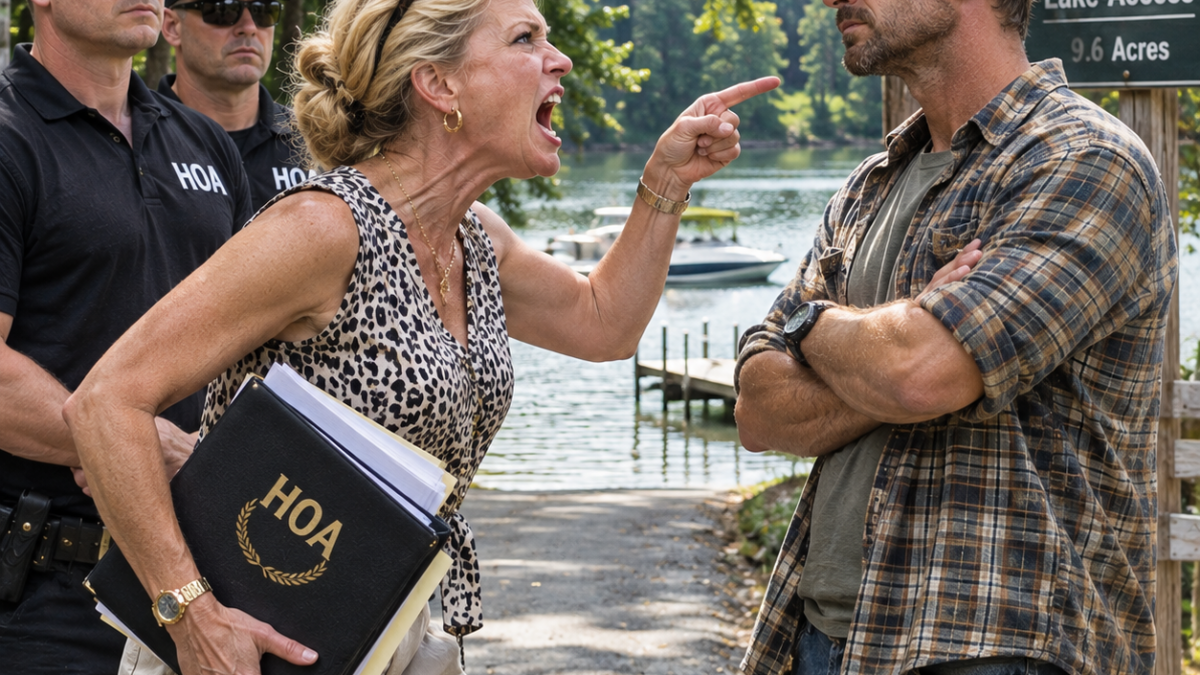
“THIS BOAT RAMP BELONGS TO OUR COMMUNITY, DANIEL! IF YOU BLOCK IT, OUR LAWYERS WILL TAKE YOUR PROPERTY RIGHTS AWAY FROM YOU!” HOA president Brenda Lawson snapped after I asked her for one simple thing—a deed, easement, or agreement proving Lake Briar Estates had any permanent right to use the lake access sitting entirely on my 9.6 acres.
I offered all 200 homeowners continued walking and boat access for one dollar a year, but Brenda rejected it, sued me instead, sent her husband’s construction crews onto my land to widen the road without a court order, and later placed a $286,000 lien against my cabin for “maintenance” they had originally agreed to perform as tenants.
Then my surveyor found a forgotten 1989 agreement showing the HOA’s own developer had paid annual rent for that exact road and boat ramp—and when a second archive file revealed who legally owned the emergency lake-intake system buried underneath it, Brenda’s attorney stopped arguing and quietly asked how much rent I wanted.
My name is Daniel Brooks.
Six months before the president of Lake Briar Estates sat across from me with a lease she did not want to sign, I was not trying to become anyone’s landlord.
I was trying to get away from traffic.
I was forty-three, divorced, living in Knoxville, and working as a commercial electrician.
My life was not bad.
It was just loud.
Apartment parking lot.
Cars.
Neighbors.
Weekend leaf blowers.
Somebody always walking past a window.
Somebody always starting an engine.
I wanted trees.
Water.
A little distance.
I did not want a mansion.
I did not want a gated development.
I definitely did not want a homeowners association.
Then I found 184 Willow Bend Road.
The listing was almost suspiciously ordinary.
9.6 acres.
Two-bedroom cabin.
Old workshop.
Private gravel driveway.
Creek.
Lake access.
No HOA.
Those last two words caught my attention.
NO HOA.
Not because I had some lifelong hatred of HOAs.
I had never belonged to one.
I simply did not want to buy a cabin and then discover somebody could fine me because my fishing trailer sat in the wrong place or my workshop grass was an inch too tall.
The cabin needed work.
The porch leaned.
The kitchen looked like 1987 had refused eviction.
One bedroom smelled like old carpet and cedar.
I loved it.
The best part was the land.
A long narrow strip ran downhill from the cabin through woods toward Lake Briar.
At the bottom sat an old concrete boat ramp and a small gravel parking area.
My realtor, Jennifer Collins, stopped beside the ramp.
“You should know people use this.”
“Who?”
PART2:
She pointed east through the trees.
Lake Briar Estates.
About two hundred homes.
Clubhouse.
Pool.
Tennis court.
Small marina.
Landscaping so perfect I assumed the flowers had their own committee.
The subdivision wrapped around much of the eastern side of the lake.
My property sat outside it.
Very clearly outside.
Jennifer showed me the plat.
The HOA boundary stopped almost six hundred feet away.
The narrow strip from my cabin to the lake belonged to the same parcel I was buying.
“So why are their residents using the ramp?”
Jennifer shrugged.
That question followed us into closing.
The seller was Frank Dalton.
He had inherited the property from his uncle, William Dalton, but never lived there.
Frank said William had allowed neighbors to use the ramp.
“Was there an easement?”
“I don’t think so.”
“Written agreement?”
“Maybe years ago.”
That answer made my attorney slow the entire closing process down.
Rebecca Hayes.
Property lawyer.
Very patient until someone said the phrase “we’ve always done it this way.”
Then her personality changed.
She searched the title.
No permanent easement for Lake Briar Estates.
No HOA ownership interest.
No community-access deed.
No covenant placing my property inside Lake Briar Estates.
Then she found something from 2006.
A license.
William Dalton had allowed HOA residents to use the lane and boat ramp for five years.
The HOA agreed to maintain the gravel.
Carry insurance.
Pay William one dollar every year.
The agreement expired in 2011 unless renewed in writing.
Rebecca found no renewal.
“So they have no agreement?”
“Not one I can find.”
“Can twenty years of use create rights?”
“Sometimes.”
That answer did not comfort me.
Rebecca explained that long use can create complicated property claims.
But permission matters.
If the use began because an owner allowed it, claiming that same use was hostile or adverse becomes much harder.
Still, she would not promise a result.
Before closing, she wrote to Lake Briar Estates.
No response.
Second letter.
No response.
Frank Dalton said his uncle became ill around 2014 and moved into assisted living.
The cabin sat mostly empty.
Nobody blocked the lane.
Nobody asked residents to stop.
They simply kept using it.
That sounded believable.
I asked Rebecca:
“Would you buy the place?”
She considered the question.
“I’m an attorney. I assume every fence is hiding a lawsuit.”
“That is not helpful.”
She smiled.
“I would buy it if I liked it. But I would understand what I was buying.”
I bought it.
My first Saturday morning was exactly what I wanted.
Coffee before sunrise.
Fog over Lake Briar.
Cold air.
No traffic.
Then at 7:15 a pickup truck came down my private lane towing a fishing boat.
The driver waved.
“Morning.”
“Morning.”
He started backing toward the ramp.
I walked over.
“Can I help you?”
He looked confused.
“No. Just launching.”
“This is private property.”
His expression changed.
“Private?”
“Yes.”
“This is the community ramp.”
“No. It’s part of my parcel.”
He laughed.
Not insulting.
He genuinely thought I was confused.
“Buddy, residents have used this ramp forever.”
“I believe you.”
“I’ve launched here twelve years.”
“I believe that too.”
He stared.
I did not want my first morning at the cabin to become a property confrontation.
“Go ahead today. I’m sorting out the access situation.”
He blinked.
“Seriously?”
“Yes.”
“Appreciate it.”
His name was Robert Jenkins.
Robert turned out to be a good man.
Later he brought me fresh crappie because using my ramp saved him a twenty-minute drive to the public launch.
That interaction shaped everything that came later.
Most Lake Briar residents were not thieves.
They believed the access was theirs because it had always been there.
People build beliefs from repetition.
If your family uses the same driveway for fifteen years and nobody says anything, eventually you stop asking who owns the gravel.
The next visitor was Susan Parker.
Golden retriever.
Walking shoes.
She apologized before I said anything.
“I heard someone finally bought the Dalton place.”
“That’s me.”
“I’m Susan.”
Then she pointed toward the lane.
“Are you closing the trail?”
“What trail?”
That was how I learned residents also used a footpath running beside my road.
Walkers.
Teenagers fishing.
Parents with strollers.
Again, nobody had told me.
“Do you think the HOA owns it?”
Susan paused.
“Honestly? I never thought about it.”
Probably the most truthful answer I heard throughout the entire dispute.
I told her I was not closing anything yet.
I wanted facts first.
Then she said:
“You should meet Brenda.”
“Who’s Brenda?”
She made a face.
“Our HOA president.”
Three days later, Brenda Lawson came to my cabin.
White SUV.
Sunglasses.
Binder.
Her husband Richard followed.
She did not introduce him initially.
“I’m Brenda Lawson, president of Lake Briar Estates.”
“Daniel Brooks.”
“I know.”
That bothered me slightly.
Then she looked at lumber stacked beside my porch.
“What are you building?”
“Replacing the railing.”
“You’ll need architectural approval.”
I thought I had misheard her.
“For my porch?”
“Yes.”
“I’m not in your HOA.”
Brenda opened the binder.
“This property is part of the Lake Briar Community Use District.”
“That’s an HOA?”
“It’s different.”
“Then I don’t need HOA architectural approval.”
“Practically, it’s the same.”
“No. Practically, it really isn’t.”
She changed subjects.
“We need to discuss the access road.”
Finally.
I told her Rebecca had found the 2006 license.
For a split second Brenda’s expression changed.
Then it disappeared.
“Our rights existed before that agreement.”
“Good. Send them to Rebecca.”
“We’ve used the road continuously for nearly twenty years.”
“I understand.”
“That creates permanent rights.”
“Maybe. My attorney can discuss that with yours.”
Brenda looked annoyed.
“You don’t need to make this difficult.”
“I’m not.”
“You’re questioning community access.”
“I bought land containing a private road and boat ramp. I’m asking who legally has the right to use them.”
That seemed reasonable.
Apparently not to her.
She pointed downhill.
“That ramp serves two hundred homes.”
“Then the HOA should have excellent documents proving its rights.”
Silence.
Then the younger man introduced himself.
Richard Lawson.
Brenda’s husband.
Local construction-company owner.
Richard said his crews had maintained my gravel road for years.
“Who paid you?”
“The HOA.”
“Under what agreement?”
He looked at Brenda.
Another silence.
That became a pattern.
Very confident until I asked for paper.
I told them nobody was being blocked.
I wanted everything clarified.
Brenda left with one warning.
“Do not install a gate.”
I had never said anything about installing one.
That was interesting.
A week later came my first HOA violation.
UNAPPROVED EXTERIOR MODIFICATION.
My porch railing.
Fine:
$300.
I laughed.
Rebecca did not.
She sent one letter.
Daniel Brooks’s property lies outside Lake Briar Estates.
No architectural covenants apply.
Withdraw the notice.
They did.
No apology.
Then:
Unapproved trailer parking.
Withdrawn.
Then:
Vegetation violation.
Withdrawn.
Apparently my workshop grass had offended the association from six hundred feet away.
I started understanding Susan’s face.
But the access dispute mattered more.
Lake Briar’s law firm finally responded.
Nine pages.
Historic dedication.
Prescriptive easement.
Community necessity.
Three theories for permanent access.
Rebecca read the letter twice.
“What does that mean?”
“It means they are throwing multiple arguments at the wall.”
“Any good?”
“Long use could be arguable.”
That worried me.
But the HOA had a problem.
William Dalton had expressly given permission in 2006.
Before that, Rebecca suspected other agreements might exist.
Permission was poison to the cleanest version of a prescriptive-rights claim.
I asked what she recommended.
“Negotiate.”
Perfect.
I offered Lake Briar Estates almost everything residents already enjoyed.
Pedestrian trail.
Resident boat access.
HOA maintenance.
Liability insurance.
No commercial use.
No road expansion.
No new construction.
Three-year written license.
Rent:
One dollar a year.
Same token amount William Dalton had accepted.
I expected Brenda to say yes immediately.
She rejected it.
Their attorney wrote that accepting a license would “improperly diminish pre-existing perpetual community rights.”
That changed my view of the dispute.
If access was the goal, I had solved access.
They did not want permission.
They wanted me to acknowledge they did not need my permission.
Those are very different things.
Robert called.
“Are you closing the ramp?”
“No.”
“Brenda says you are.”
“I offered continued access for one dollar.”
Silence.
“You’re joking.”
“No.”
“Why would she refuse?”
“Ask her.”
He did.
Then other residents began asking.
The HOA board started asking.
Frank Miller, the treasurer, wanted copies of the old agreements.
Jennifer Collins asked why they were spending legal money when I was offering the same access for practically free.
Brenda said:
“The principle matters.”
Frank later called me.
“I hate that sentence.”
“Why?”
“Usually means money is about to disappear.”
He was right.
Within two months, HOA legal fees were approaching $18,000.
Then my surveyor discovered something else.
The road and ramp were not the only things running through my property.
Buried irrigation pipe.
Electrical conduit.
Drainage.
The irrigation line supplied common landscaping near the clubhouse.
No recorded easement.
No current license.
No disclosure to me.
Rebecca looked at the utility map.
“Daniel, they aren’t fighting over a boat ramp.”
“What are they fighting over?”
“Dependence.”
That was the real issue.
Lake Briar Estates had built decades of convenience around land it did not own.
Deep-water boat ramp.
Walking connection between parts of the neighborhood.
Irrigation.
Path lighting.
Drainage.
Then eventually much more.
William Dalton had been generous.
He got older.
Paperwork expired.
Everyone kept using everything.
Generosity turned into habit.
Habit became expectation.
Expectation became claimed ownership.
I offered one final settlement.
Five years.
Same uses.
$1 per year.
HOA maintains everything.
No ownership claim.
No more fake violation letters.
Ten-day deadline.
Day nine:
Silence.
Day ten:
Process server.
Lake Briar Estates sued me.
They wanted a court declaration of permanent easement rights over my access strip.
They also wanted a temporary order preventing me from installing gates, moving utilities, blocking vehicles, modifying the ramp, or interfering with “historic community use.”
Rebecca called.
“They filed for a temporary restraining order.”
“Did they get one?”
“Not yet.”
Then I heard heavy equipment.
Dump truck.
Skid steer.
Another truck.
Richard Lawson’s company.
The first driver stopped when I stepped into the lane.
“What are you doing?”
“Road work.”
“Who authorized it?”
“Lake Briar HOA.”
“This is private property.”
He showed me a work order.
EMERGENCY ACCESS REPAIR.
There was no washout.
No fallen tree.
No broken road.
Then I saw orange construction stakes twenty feet beyond the existing gravel.
Road widening.
Tree clearing.
Expanded parking.
Concrete turnaround beside the boat ramp.
Not maintenance.
Construction.
Rebecca arrived.
So did a sheriff’s deputy.
Richard drove up holding the lawsuit.
“We’re preserving community access.”
Rebecca stared at him.
“You have no court order.”
“Our lawyer advised existing maintenance can continue.”
“This isn’t maintenance.”
“The road needs to meet emergency standards.”
“Whose?”
No answer.
The deputy asked the important questions.
Deed?
No.
Recorded easement?
No.
Court order?
No.
The crew left.
Then my surveyor, James Reed, called.
He found an older document.
Before Lake Briar Estates existed in its modern form.
A deed mentioned something called the Western Lake Access Tract.
That sounded bad.
Then James read the legal description.
The tract was my strip.
Road.
Ramp.
Lakefront.
But the original recreation company had not transferred ownership to the subdivision developer.
It retained the tract for separate recreational use and future access agreements.
Rebecca stopped walking.
“That supports Daniel.”
Then James found the referenced agreement.
Payment schedule.
Rent.
The original Lake Briar developer had paid Briar Recreation Partners every year to use the road and boat ramp.
The HOA’s predecessor had rented my property.
I looked across the woods toward Lake Briar Estates.
“So they’re suing me for a right their developer used to rent?”
Rebecca nodded.
“That appears to be what they’re doing.”
Then Richard came back.
Not by my cabin.
From the south trail.
By the time Rebecca and I reached the ramp, a skid steer was already beside the water.
Workers were unloading concrete barriers.
My PRIVATE PROPERTY sign lay broken in the gravel.
Richard’s crew was installing:
LAKE BRIAR ESTATES PRIVATE ACCESS — RESIDENTS ONLY.
Planting their flag.
Rebecca reached for her phone.
Frank came running.
“Richard, stop!”
He ignored him.
The skid steer moved.
Its bucket caught the edge of my old concrete ramp.
CRACK.
Part of the ramp shifted.
Then gravel sank.
Something metal appeared beneath it.
Large pipe.
At least twelve inches.
Rebecca stared.
“That isn’t on our survey.”
Frank went pale.
“I know what that is.”
“What?”
“The old community intake.”
Richard froze.
Frank pointed at the exposed pipe.
“That line feeds the Lakeshore Emergency Water System.”
Then the pipe joint broke.
Water exploded sideways.
Everybody moved uphill.
Frank found an old shutoff hidden in weeds.
The valve barely moved.
Then finally:
Water slowed.
Stopped.
County fire department arrived.
Utility staff.
Sheriff.
Nobody seemed to know the entire system.
That was frightening.
The fire chief, Thomas Walker, explained the intake was not the neighborhood’s normal hydrant supply.
The county network handled that.
This was backup.
Years earlier, when municipal pressure was weaker, the developer created a lake-fed reserve system.
Water could be pumped from Lake Briar through my property to a storage basin near the clubhouse.
Emergency fire backup.
Useful.
Potentially important.
Still not ownership.
County technicians inspected the controls.
The emergency basin was almost full.
The pump had been tested three months earlier.
Then technicians discovered the system operated monthly.
Sometimes weekly.
Not just emergency testing.
Why?
Clubhouse irrigation.
Common landscaping.
Then the facilities manager admitted a private golf-course contractor sometimes used the same reserve basin.
Frank frowned.
“We don’t have a golf course.”
Exactly.
Lake Briar Country Club.
Separate private club.
Different ownership.
Not part of the HOA.
Frank pulled budgets.
Annual income:
Approximately $36,000.
WATER SERVICE REIMBURSEMENT.
Paid by the country club.
Suddenly my 9.6-acre property supported:
Boat access.
Walking.
Electrical.
Drainage.
Irrigation.
Emergency water.
And a commercial water arrangement with another private business.
County ordered the damaged intake shut until inspection.
Normal hydrants still worked.
Nobody lost fire protection.
Richard immediately told residents I had disabled their emergency system.
I had touched nothing.
His skid steer broke it.
Robert posted online:
“Daniel offered access for $1. HOA sued instead.”
Susan added:
“Daniel did not break the pipe. Construction equipment did.”
That changed the mood.
Then James found the actual historic agreements.
Western Lake Access Tract lease.
Annual rent:
$12,000.
Resident boat access.
Pedestrian access.
Limited utility construction.
Ten years.
No automatic renewal.
At expiration, continued use required new written agreement.
1999:
Another lease.
Seven years.
Annual payment:
$18,000.
Then 2006:
William Dalton’s five-year license.
One dollar a year.
He did not need the money anymore.
HOA maintains lane.
Carries insurance.
No expansion.
Expired:
No renewal.
The history was painfully clear.
Ownership never transferred.
They rented.
Then they received permission.
Then the paperwork stopped.
The use did not.
The HOA’s attorney, Laura Bennett, called.
Completely different tone.
“We’d like to discuss temporary access.”
Rebecca answered:
“Daniel offered that before you sued.”
“I understand.”
“One dollar.”
“I understand.”
“No expansion.”
“Yes.”
“No ownership admission.”
Silence.
That remained the sticking point.
At the first hearing, Judge Harold Collins examined the leases.
Then looked at Laura.
“If your client believed it had permanent access, why did it pay annual rent for seventeen years?”
Laura tried.
Developer relationships.
Changing expectations.
Continuous use.
Maintenance.
The judge listened.
Rebecca then surprised Brenda.
She did not ask the court to shut the community out.
She offered temporary continuation of normal use while title questions were resolved.
Residents could walk.
Residents could launch boats.
Emergency crews could enter.
Existing utilities could be repaired.
No road widening.
No new utility lines.
No new structures.
No ownership claim.
Judge Collins asked me:
“For how much?”
“One dollar.”
Someone behind me laughed.
The judge did not.
He looked toward Brenda.
“Your president rejected this before litigation?”
Laura carefully replied:
“The association believed accepting a license could prejudice its existing rights.”
Collins looked at the old rent agreements.
“I think history may already have done that.”
Temporary order issued.
Access continued.
No expansion.
No new construction.
Repairs to prior condition only.
HOA pays for ramp damage.
Ownership unresolved.
Fair.
Then Frank found the internal memo.
OWNER HAS NOT REQUESTED RENEWAL. CONTINUE EXISTING USE UNLESS CHALLENGED.
There it was.
They knew the license expired.
They knew nothing replaced it.
They kept using the property because nobody objected.
Then another file.
Outside law firm advised Lake Briar Estates to negotiate a new easement with William Dalton.
Brenda had recently become president.
What happened after that opinion?
Nothing.
The next board minutes simply called the route:
HISTORICALLY ESTABLISHED WESTERN ACCESS.
Permission became history.
History became entitlement.
Rebecca asked the obvious question.
“Why was Brenda so unwilling to sign a one-dollar license?”
Frank finally answered.
“Because she’s promised residents a marina expansion.”
My stomach tightened.
Lake Briar’s existing eastern marina was shallow and crowded.
My western ramp opened into deeper water.
Brenda proposed thirty new slips.
Richard’s road widening?
For construction access.
Concrete turnaround?
Marina support.
Some residents had already paid refundable deposits.
$5,000 each.
Almost twenty people.
Nearly $100,000 collected for boat slips dependent on shoreline the HOA did not own.
Now the resistance to my license made sense.
Accepting my permission meant admitting Lake Briar Estates did not control future access.
No lender would finance the expansion without my signature.
No permit office would accept it.
Brenda did not simply need the existing ramp.
She needed control.
The next month was oddly peaceful.
Independent contractor repaired my ramp.
County supervised the intake.
Richard’s company was not permitted to do the repairs.
Walking continued.
Boats launched.
Nobody died.
Nobody lost the lake.
Then Rebecca called.
“Good news or strange news?”
“Good.”
“The HOA’s outside title expert agrees they probably don’t have a permanent easement.”
“Strange?”
“They’re not dropping the case.”
New theory:
Equitable ownership.
Lake Briar Estates claimed decades of investment and reliance meant fairness required permanent control.
Rebecca was unimpressed.
Then:
“They filed a lien.”
“Against my property?”
“Yes.”
“How much?”
“Two hundred eighty-six thousand dollars.”
For maintenance.
Gravel.
Drainage.
Landscaping.
Utility checks.
Insurance.
Shoreline work.
Work they had often been contractually required to perform in exchange for access.
Rebecca immediately moved to remove it.
But the lien clouded my title.
My planned refinance stopped.
That was real damage.
Rebecca documented everything.
“Remember this.”
“Why?”
“Damages work both ways.”
Then Lake Briar Country Club joined the dispute.
Seven years earlier, Brenda had signed an agreement promising the club permanent lake-water service through the Western system.
Permanent.
Through infrastructure on land the HOA did not own.
The country club had paid:
Installation fees.
Monthly service.
Maintenance.
Now three parties were fighting over gravel, trees and buried pipe.
Then an appraisal explained why.
My narrow access strip controlled:
Deep-water boat launching.
Pedestrian connection.
Utility corridors.
Potential marina expansion.
Commercial water supply.
With those rights, it had substantial annual income potential.
Rebecca put the report down.
“Now you understand why they sent lawyers.”
I did.
This had never been about my porch railing.
At the main easement hearing, the record became overwhelming.
1989 lease.
1999 lease.
2006 license.
2011 expiration.
2011 memo acknowledging no renewal.
2013 legal advice to negotiate.
No deed.
No permanent easement.
No dedication.
No ownership.
Rebecca questioned Brenda.
“You knew about the 2013 opinion?”
“Yes.”
“It recommended negotiating a new easement?”
“Yes.”
“Did you?”
“No.”
“Why?”
“We believed community rights had matured.”
“Did a court tell you that?”
“No.”
“The owner?”
“No.”
“Your own lawyer?”
Long pause.
“No.”
“Did you later promise permanent water service to Lake Briar Country Club?”
“Yes.”
“Did you own the access tract?”
“We believed—”
Rebecca interrupted.
“Did you own it?”
Brenda stared.
“No.”
That word mattered.
Judge Collins took the case under review.
Three days later, Frank called.
“Brenda wants to buy your property.”
“At least she understands ownership now.”
His voice stayed serious.
“She doesn’t want to make an offer.”
“What does she want?”
“Eminent domain.”
I stopped moving.
An HOA cannot condemn private land.
Brenda knew that.
So she approached a local water district.
Her proposal:
Transfer the lake-intake system into public control.
Then the district could potentially condemn whatever land rights were necessary.
Then Lake Briar Estates could lease access back.
At the emergency board meeting, the map revealed the trick.
The proposed “public utility corridor” covered almost my entire access strip.
Road.
Ramp.
Parking.
Trail.
Shoreline where Brenda wanted thirty boat slips.
Rebecca leaned over.
“This isn’t a utility easement.”
“No.”
“This is a land grab wearing a fire helmet.”
Then the water district representative stood.
“We have not approved condemnation.”
Brenda’s face tightened.
“We have not agreed to acquire Mr. Brooks’s property.”
Then he unfolded another map.
“And our engineers found something else.”
The emergency lake-intake system did not belong to the water district.
More importantly:
Lake Briar Estates had never legally acquired the portions on my land from the original developer either.
Another old agreement surfaced.
Utility lease.
The developer leased the intake corridor from the Western Access Tract owner.
Separate annual payment.
Ten-year renewals.
Then the clause.
Upon expiration, fixed improvements installed within the leased Western tract became property of the landowner unless removed within ninety days.
Nobody removed them.
Not the intake.
Not the chamber.
Not the first supply pipe.
Not the conduit.
Not the valves.
Rebecca looked at me.
“Daniel.”
“What?”
“I think you may own considerably more than the dirt.”
Then every phone in the room buzzed.
Emergency alert.
Boat fire.
Black smoke rose across Lake Briar from the eastern marina.
County water main near the highway was being repaired.
Hydrant pressure was temporarily low.
Fire department needed the backup lake intake.
The same system everyone had spent months fighting about.
The fire chief looked toward me.
I did not hesitate.
“Use it.”
Rebecca asked quietly:
“You understand what you’re authorizing?”
“Yes.”
Brenda looked relieved.
I pointed toward the fire chief.
“If it can help, use it. We’ll argue tomorrow.”
That seemed obvious.
Two boats were burning.
Wind pushed fire toward the covered dock.
I was not going to let somebody’s marina burn to protect a legal argument.
The Western Reserve pump activated.
Lake water moved through the line under my property.
Reserve basin filled.
Firefighters gained pressure.
One boat was destroyed.
Second heavily damaged.
Part of the dock roof burned.
Fuel station survived.
Nobody was injured.
The fire chief later shook my hand.
“Thank you.”
“You didn’t need permission during that kind of emergency.”
He said:
“Legally, today I did.”
The next morning Rebecca prepared an emergency-use authorization.
Fire.
Rescue.
Immediate safety situations.
No fee.
No advance permission call.
No permanent easement created.
No ownership waived.
“Kindness needs paperwork too,” she said.
“You’ve told me that.”
“People keep proving me right.”
The fire was accidental.
Electrical fault in an older fishing boat.
Nothing suspicious.
Then the archive research continued.
1991 utility lease.
2001 renewal.
Annual payment:
$8,500.
Then later:
$14,000 per year.
Payments through 2011.
Then stopped.
Board memo:
WESTERN UTILITY ARRANGEMENT EXPIRED. CONTINUE OPERATIONS PENDING RENEGOTIATION.
The HOA knew.
Again.
Not every current homeowner.
Not necessarily every board member.
But the organization knew.
The old lease language meant I might own:
Lake intake head.
Control chamber.
First valves.
Almost six hundred feet of supply pipe.
Buried electrical infrastructure.
I laughed.
“I bought a cabin.”
Rebecca replied:
“You bought a complicated cabin.”
“Can I return it?”
“No.”
“Store credit?”
“No.”
Peace lasted about three weeks.
Then Judge Collins issued the first major ruling.
Lake Briar Estates had not shown a permanent recorded easement.
The historic payment records strongly demonstrated the Western tract remained separately owned.
The HOA’s strongest permanent-rights argument failed.
The $286,000 lien also came off my title.
Most claimed maintenance had been performed while Lake Briar was already obligated to maintain the tract as part of its lease or license.
The bank restarted my refinance.
Not dramatic.
But satisfying.
Then the country club records arrived.
More than $36,000 every year to Lake Briar Estates for lake water.
During summer, their irrigation demand was enormous.
For years, the HOA earned money from a commercial water service dependent on infrastructure sitting on my property.
Part of that revenue covered pumps.
Electricity.
Maintenance.
But nearly half went into general HOA funds.
Frank looked embarrassed.
“I thought it was ours.”
“I believe you.”
“I approved budgets with that money.”
“You weren’t hiding it.”
“No.”
“Then help fix it.”
He did.
Independent utility engineer.
Independent audit.
Brenda opposed both.
She lost.
The final infrastructure map was simple.
My land:
Intake mouth.
First control valve.
Underground chamber.
Roughly six hundred feet of supply pipe.
HOA:
Booster station.
Reserve basin.
Country club:
Large branch farther east.
Nobody could operate the system normally without the others.
Rebecca smiled.
“Perfect.”
“How is this perfect?”
“Everyone now needs a contract.”
That should have ended the fight.
Brenda instead proposed a $1,200 special assessment for every homeowner.
Reason:
WESTERN ACCESS DEFENSE AND EMERGENCY INFRASTRUCTURE PROTECTION.
More litigation money.
The board had not approved it.
Frank stopped the notices.
Emergency vote.
Assessment rejected.
Then Jennifer Collins moved to remove Brenda as president.
One week later:
Five votes to two.
Brenda out.
Frank became temporary president.
“I don’t want this job.”
“That might make you good at it.”
“That sounds like a curse.”
Susan bought him a coffee mug.
WORLD’S MOST RELUCTANT PRESIDENT.
He used it.
The atmosphere changed immediately.
Frank did not agree with me about everything.
He believed homeowners deserved stable lake access.
So did I.
The difference was that he stopped pretending stability required ownership.
Real settlement talks began.
HOA’s first offer:
Ten-year lease.
Boat ramp.
Walking trail.
Emergency utility use.
Irrigation.
Maintenance access.
No marina expansion without separate permission.
Rent:
$5,000 per year.
Rebecca laughed.
“They paid fourteen thousand in 2011.”
I said:
“Apparently inflation reversed.”
We ordered an independent appraisal.
Estimated fair annual value:
$62,000 to $88,000.
I chose the low end.
$62,000.
Frank stared.
“That’s not one dollar.”
“You rejected one dollar.”
He paused.
“Fair point.”
But I did not want to punish ordinary residents for Brenda’s decisions.
So I proposed a stepped structure.
Year one:
$36,000.
Year two:
$42,000.
Year three:
$48,000.
Then scheduled increases and inflation adjustments.
Country club:
Separate commercial agreement.
True emergencies:
Always free.
HOA:
Maintain road.
Carry insurance.
Resident walking and boat access remain.
No new marina.
No commercial users without written approval.
No hidden lines.
No ownership claim.
Frank said:
“That might work.”
Then Brenda organized a petition.
SAVE OUR LAKE ACCESS.
The petition claimed the new board was giving community property to Daniel Brooks.
Fear works faster than paperwork.
Signatures came.
Then she organized a Saturday show of “historic use.”
Dozens of residents arrived at once.
Boats.
Trailers.
Cars.
Walking groups.
The temporary court order allowed normal use, so technically they could.
But the volume created chaos.
Robert stood beside me.
“This is stupid.”
“Yes.”
Then an ambulance tried to enter.
Could not.
Susan had collapsed near the trail.
Dizziness.
Low blood pressure.
Residents called 911.
Their own demonstration blocked emergency access.
A boat trailer had jackknifed at the narrowest section.
Frank shouted at people to move.
Too slow.
So I opened an old rough service path beside my workshop.
Guided the ambulance through my yard.
Paramedics reached Susan.
She was conscious.
Terrified.
They stabilized her.
Hospital.
She recovered.
Thank God.
Two days later, she called.
“I heard you drove the ambulance through your grass.”
“Directed it.”
“You ruined the lawn.”
“I own more.”
Then:
“Don’t punish everyone because Brenda got them angry.”
“I won’t.”
“I mean it.”
“I know.”
That shaped the final lease.
Guaranteed emergency access.
No charge.
No phone call.
Fire.
Ambulance.
Rescue.
Utility emergency threatening health or safety.
Always open.
Then the audit uncovered Richard’s contracts.
His construction company billed Lake Briar Estates about $52,000 per year for Western corridor maintenance.
Invoices included:
Gravel.
Vegetation.
Pump checks.
Security.
Shore stabilization.
Some duplicated work paid to other contractors.
Some grading invoices corresponded to months when county equipment logs showed nothing entered.
Questionable charges over six years:
Nearly $190,000.
Not every dollar proven fraudulent.
Enough to send records to lawyers and insurers.
Richard stopped answering Frank.
Then filed his own ownership claim.
He said his company owned the control chamber, valves, pipes and electrical boxes.
Rebecca almost smiled.
“Interesting.”
“Why?”
“If Richard owns them, Brenda’s old claim that the HOA owns them weakens.”
Too many stories eventually collide.
Richard said contractor property.
HOA had said community property.
Lease said attached improvements could become landowner property.
Judge Collins asked who paid Richard’s equipment invoices.
The HOA had reimbursed most of them.
Richard’s argument weakened.
Then, late one Tuesday, Rebecca called.
“Go check the intake monitor.”
County had installed a temporary gauge after the marina fire.
I walked down.
Lake calm.
No boats.
Gauge:
High flow.
At night.
Clubhouse irrigation off.
Emergency basin full.
Country club nighttime use suspended by court agreement.
I called Frank.
He checked the HOA controls.
“Main pump is off.”
“Then why is water moving?”
Silence.
Rebecca said:
“There’s another pump.”
James Reed joined us with old maps.
We followed the utility route into woods.
Then heard it.
Mechanical hum underground.
Hidden concrete cover.
County opened it.
Old booster pump.
Recently repaired.
New controller.
It bypassed the HOA’s normal controls completely.
Discharge line ran south.
Toward property owned by:
Lawson Development Group.
Richard.
The county shut the pump.
Then checked meter history.
It had operated regularly for almost nine months.
Thousands.
Possibly millions of gallons.
The pipe continued beyond Richard’s property.
To a resort under construction.
Hotel.
Cabins.
Pool.
Artificial pond.
The resort permit listed:
TEMPORARY WATER SOURCE — LAKE SUPPLY AGREEMENT.
Supplier:
Lawson Development Group.
Term:
Twenty years.
Annual payment:
$110,000.
Upfront payment:
$220,000.
Richard had sold twenty years of water access through infrastructure crossing my land while he and Brenda were suing me for control of that same property.
Frank sat on the edge of my ramp.
“This is why they fought you.”
“The marina?”
“The resort.”
Rebecca corrected him.
“It wasn’t one thing. They built a business around Daniel’s land.”
Resident access.
Water.
Country club.
Future boat slips.
Commercial development.
Construction supply.
Every agreement made my ownership inconvenient.
So instead of renting honestly, they tried turning dependence into ownership.
Then everything physically failed.
County shut the southern pump.
Pressure trapped downstream.
Metal banging beneath the shoreline.
Ground split.
Water erupted.
Ramp tilted.
Control chamber began sliding toward Lake Briar.
A pipe snapped.
Lake water entered the broken network.
Then radio traffic:
Rupture at the resort site.
Its artificial pond sat uphill.
After the line broke, gravity reversed the flow.
Water started draining backward toward my shoreline.
Emergency crews evacuated the resort construction workers.
Nobody injured.
That mattered most.
County isolated pumps.
Plugged the southern line.
Cut another section uphill.
Four hours.
By then my ramp looked like earthquake damage.
Lower section cracked.
Control chamber tilted into the lake.
Several feet of bank collapsed.
Mud covered the walking trail.
Hole in the parking area large enough to swallow my truck.
Frank stood beside me behind the safety barrier.
“I’m sorry.”
“You didn’t build the line.”
“I sat on the board while people told us this property was basically ours.”
“That’s different.”
“Doesn’t feel different.”
I understood.
“Being wrong is not the same as being dishonest.”
Frank looked at me.
“That sounds like Rebecca.”
“She charges by the hour. I steal her lines whenever possible.”
He laughed.
County isolated the entire Western system.
No country club water.
No resort branch.
No HOA irrigation.
No backup lake intake temporarily.
Drinking water unaffected.
Normal hydrants had full municipal pressure.
The grass might turn brown.
Nobody was in danger.
The following morning Rebecca put three folders on my kitchen table.
County damage.
Resort contract.
Historic leases.
“This is finally simple.”
I stared at the mountain of paper.
“This is simple?”
“Legally.”
The old documents showed the Western tract was privately owned.
Road and ramp rented.
Utility corridor rented.
Intake equipment installed under a lease.
Lease expired.
Fixed improvements left behind became attached to the land.
HOA continued using them.
Richard later expanded the network commercially without my approval.
His commercial expansion physically damaged my shoreline.
“They spent months accusing you of interfering with their property.”
Rebecca leaned back.
“Now the evidence shows multiple organizations were earning money from yours.”
Judge Collins ordered everyone back to court.
This time Brenda was not at the HOA table.
Frank sat there.
Jennifer beside him.
HOA attorney Laura Bennett.
Richard had separate counsel.
Country club had counsel.
Resort developer had counsel.
Rebecca beside me.
A room full of hourly billing.
County engineer explained the rupture.
The old Western system had become a Frankenstein network.
Emergency fire backup.
Residential irrigation.
Country club.
Resort.
Future marina.
Each new connection made the next failure more complicated.
Then ownership.
Judge Collins asked:
“Who holds recorded title to the Western Access Tract?”
Rebecca:
“Mr. Brooks.”
Laura Bennett did not object.
That was the biggest change of the entire case.
Then Laura stood.
“The association acknowledges Mr. Brooks owns the Western tract.”
I almost looked behind me.
Months earlier, Brenda had fined me for my porch because she claimed the property was practically part of Lake Briar Estates.
Now their lawyer admitted the land was mine.
The judge asked about attached infrastructure.
Laura hesitated.
“Subject to specific equipment questions, the lease language strongly favors ownership running with the land.”
No movie music.
No courtroom gasp.
Just paper finally defeating repetition.
The court ordered a full accounting.
Who used what?
How long?
Who collected revenue?
Who paid maintenance?
What damages resulted from unauthorized expansion?
The numbers became uncomfortable.
Country club payments:
More than $300,000 over the years.
Richard’s resort contract:
$110,000 per year for twenty years.
$220,000 already paid.
Proposed marina deposits:
Nearly $100,000.
HOA residents:
Years of free recreational use.
Questionable contractor charges.
Legal costs.
Shoreline destruction.
Rebecca looked at me afterward.
“You offered five years for one dollar.”
“I remember.”
“They spent more than that on the envelope used to sue you.”
“Probably.”
The court permanently disconnected Richard’s resort line unless I later approved an easement.
I did not.
The resort developer sued Richard separately.
Not my problem.
The resort eventually found another water source.
More expensive.
Legal.
Good.
The country club was different.
They had paid for water honestly under a contract they believed valid.
They needed irrigation.
I did not want to punish them.
So we negotiated directly.
They paid me for access through my intake infrastructure.
They paid Lake Briar Estates separately for booster-station operating costs.
Everyone knew who owned what.
Everyone knew who was being paid for what.
Frank called the new accounting boring.
Then smiled.
“Boring is beautiful.”
Finally:
The HOA.
Frank and Jennifer came to my porch without lawyers first.
Spreadsheet.
Maintenance costs.
Insurance.
Pump electricity.
Road gravel.
Resident use.
Frank looked embarrassed.
“I never thought I’d be sitting here asking to rent our own boat ramp.”
“It isn’t your boat ramp.”
“I know.”
“That’s progress.”
He laughed.
Then:
“We need it.”
“I know.”
“The Eastern Marina cannot handle all our boats.”
“I know.”
“The walking trail matters.”
“I know.”
“The emergency intake matters.”
“I know.”
He stared at me.
“So what do you want?”
That was the question.
The independent appraisal supported more than $60,000 a year.
I could have demanded it immediately.
The HOA had spent far more fighting me.
But I remembered Robert.
Susan.
Families walking because they believed they were allowed.
Those people did not create the problem.
“I want a real lease.”
Frank nodded.
“Fair rent?”
“Yes.”
“Long enough that residents have stability?”
“Yes.”
“Emergency use free?”
“Always.”
“No surprise ownership claim ten years from now?”
“Absolutely.”
Lawyers returned.
Two weeks.
Twelve pages.
Ten-year term.
Renewal options.
Resident walking.
Boat ramp.
Limited parking.
Existing utilities.
Emergency water.
HOA maintenance.
Insurance.
No marina expansion without written permission.
No new buried lines.
No transferring rights to another developer.
No commercial use except specifically approved users.
No prescriptive rights created by continued use.
Every change:
Written.
Rebecca loved that clause.
Then the rent.
I did not start at $62,000.
Year one:
$36,000.
$3,000 each month.
Year two:
$42,000.
Then gradual increases.
Country club paid separately.
True emergency use:
Free.
Always.
HOA continued gravel maintenance and liability insurance.
I took responsibility for major structural repairs because the ramp was unquestionably mine.
The HOA dismissed its lawsuit with prejudice.
Same ownership claim could not be resurrected later.
Frank agreed instantly.
Then came the meeting.
Almost forty residents.
Board.
Lawyers.
Lease.
First month’s check.
Brenda sat near the back as a homeowner.
Laura placed the agreement before Frank.
“Mr. Miller, the association president should sign.”
Frank signed.
Jennifer signed as secretary.
I signed.
Rebecca notarized it.
Then Frank slid a check across the table.
$3,000.
One month’s rent.
I stared at it.
That was the moment the title became true.
I bought a lake-access property outside HOA limits.
They sent lawyers after me.
Now the HOA paid me rent.
Not because I tricked them.
Not because a judge gave me their land.
Because the land had always been mine.
They wanted to keep using it.
That is what rent is.
Then Brenda stood.
“This agreement gives one man too much control.”
Frank turned.
“No. It gives the owner control of his own property.”
“He can raise rent.”
“Under the contract.”
“He can block expansion.”
“Yes.”
“He can stop a marina.”
“Yes.”
“That hurts the community.”
Then Susan Parker spoke.
“You know what hurt the community?”
Everyone looked at her.
“Spending tens of thousands of dollars fighting a man who offered us access for one dollar.”
Nobody laughed.
Too true.
Brenda sat down.
That was the last time she publicly challenged the lease.
The board reviewed her years as president.
There was no secret mansion full of stolen HOA cash.
Reality was less theatrical.
Some bad contracts.
Some questionable invoices.
Conflicts involving Richard’s company.
Insurers and attorneys handled those matters.
But Brenda’s biggest failure was simpler.
She confused control with leadership.
She believed admitting Lake Briar Estates depended on land it did not own would weaken the association.
So she tried converting dependence into ownership.
That cost everyone.
Richard’s problems were worse.
County fines for unauthorized utility work.
Audit of maintenance invoices.
Resort lawsuit over the twenty-year water agreement.
Some money repaid through settlement.
His resort customer found another water source.
Smaller pond.
More expensive infrastructure.
Legal infrastructure.
The country club signed its direct agreement with me.
Commercial rent based on use.
Not outrageous.
Enough to reflect actual value.
Lake Briar Estates stopped collecting profit on water passing through my infrastructure.
They received only their legitimate booster operating costs.
Clean.
Simple.
Then something unexpected happened.
Rent made my property better.
I used part of it on the road.
Ramp inspections.
Lighting near the gravel area.
Trash cans.
Small emergency call box.
A bench along the walking trail.
Susan immediately claimed the bench.
I told her:
“You need a lease.”
She said:
“I’ll send lawyers.”
Fair.
The residents became more respectful too.
When access had been treated as free and permanent, maintenance created arguments.
Now everyone understood the responsibilities.
Parking rules mattered.
Damage was reported.
Hours were respected.
People understood they were guests under a stable agreement, not owners by habit.
Clarity made us better neighbors.
Robert still launched most Saturdays.
One morning he handed me a dollar.
“What’s this?”
“Back rent.”
“For?”
“The first day you let me launch.”
I laughed.
“You owe more now.”
“How much?”
“Three thousand a month.”
He put the dollar back in his pocket.
“Never mind.”
Then we went fishing.
Months later I saw Brenda walking the trail.
Alone.
She stopped.
“The ramp looks good.”
“Thanks.”
She looked toward the water.
“I really believed we owned this.”
“I know.”
“That sounds stupid now.”
“It sounds human.”
That surprised her.
People believe stories built around them.
Especially stories repeated for years.
The HOA paid rent.
Then stopped.
William let access continue.
Paperwork disappeared.
Residents moved in.
Someone called the ramp community property.
Then someone else did.
Eventually the story felt stronger than the deed.
Brenda asked:
“Do you hate me?”
“No.”
“Why not?”
“That sounds exhausting.”
She actually laughed.
We never became friends.
We did not need to.
A boundary is not a demand for friendship.
It is a way to live beside people without constant conflict.
The ten-year lease worked.
Payments arrived automatically.
Frank sent me a screenshot of the first payment each year with one word.
RENT.
I replied:
RECEIVED.
The HOA’s legal budget dropped.
Resident dues stabilized.
Walking continued.
Boaters kept launching.
Country club irrigation continued under a proper contract.
Emergency water remained available.
Nobody lost safety.
Nobody lost the lake.
Nobody lost the community.
The only thing Lake Briar Estates lost was the belief that use creates ownership.
That was a healthy thing to lose.
New residents eventually received a simple disclosure packet.
WESTERN ACCESS: PRIVATE PROPERTY USED UNDER LEASE.
No mythology.
No confusion.
No future HOA president could claim the ramp had “always belonged to the community.”
The agreement sat in every board file.
The metal sign Richard tried to install never returned.
I replaced it with:
LAKE ACCESS BY AGREEMENT
PLEASE RESPECT THE PROPERTY
Enough.
The cabin remains outside HOA limits.
No architectural committee.
No grass-height letters.
No trailer violations.
Lake Briar Estates has never sent me another fine.
Probably wise.
The irony is that I never wanted their money.
My first offer really was one dollar per year.
Five years.
Five dollars total.
Same walking.
Same boats.
Same utility access.
No lawsuit.
No broken ramp.
No $286,000 lien.
No emergency hearings.
No resort rupture.
No collapsed shoreline.
No mountain of legal bills.
Frank once calculated what the HOA eventually spent.
Lawyers.
Engineers.
Surveys.
Emergency repairs.
Insurance deductibles.
Settlements.
Then rent.
I asked for the total.
He refused.
“That bad?”
“Daniel.”
“What?”
“Please never say ‘five dollars’ again.”
So I usually don’t.
The largest lesson was never really about an HOA.
It was about favors.
William Dalton had been kind.
He allowed neighbors onto his property.
Then he stopped needing rent.
Then stopped renewing paperwork.
His kindness kept going after the documents ended.
Kindness became habit.
Habit became expectation.
Expectation became entitlement.
Nobody noticed the exact moment it changed.
That is why I believe generosity needs boundaries.
Not because everyone is dishonest.
Because people forget.
Paperwork reminds both sides what the original favor actually meant.
Lake Briar Estates did not become my enemy.
It became my tenant.
That sounds funnier than it feels.
Most residents are still good people.
Frank is still my friend.
Susan still claims that bench.
Robert still fishes.
The HOA still pays every month.
And every time that automatic deposit appears, I remember Brenda standing outside my cabin with a binder and a violation notice, completely convinced that property outside her HOA somehow already belonged to the community.
It never did.
They had access because someone had been generous.
Now they have access because we finally put that generosity back into writing.
That is the difference between permission and ownership.
And after everything Lake Briar Estates paid to learn it, nobody there forgets anymore.








