HOA Karen Sent an Excavator Through My 136-Year-Old Mill—Then the State Froze Her $8M Housing Deal
PART2:
A century-old timber groaned somewhere above the wheel pit.
Then the great white-oak water wheel shifted.
Only a few inches.
But I saw it.
The axle housing flexed.
My stomach turned.
Across the road stood Darlene Voss.
White wool coat.
Perfect hair.
Phone raised.
Recording.
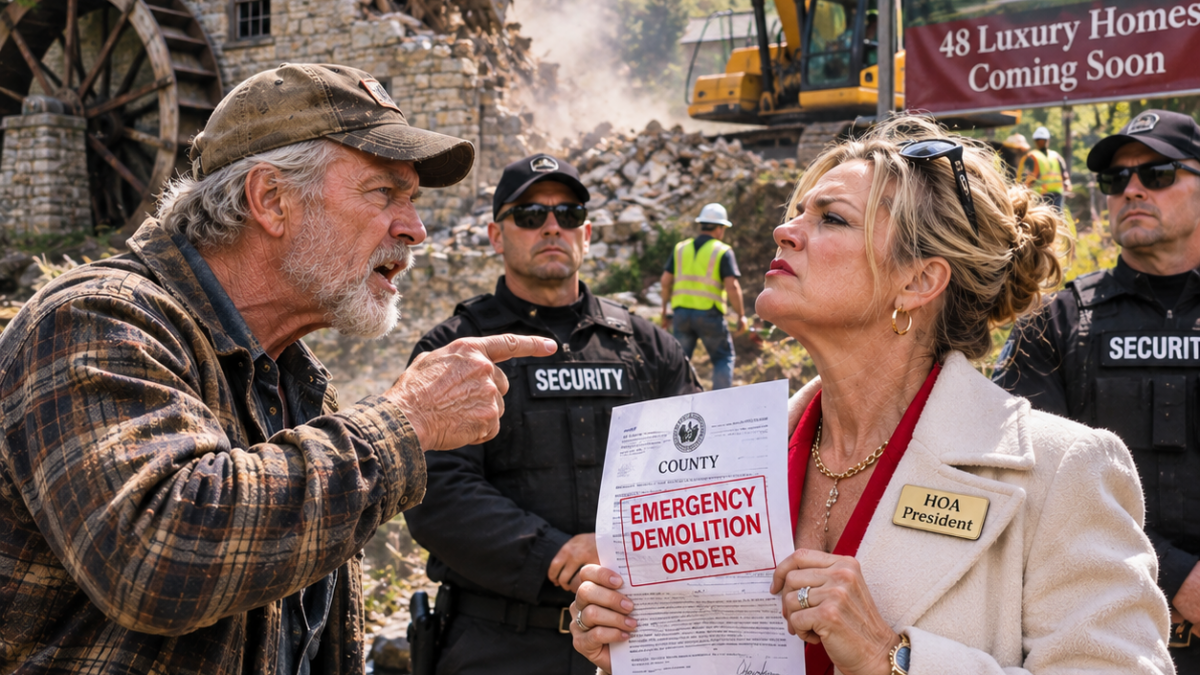
Behind her, attached between two temporary posts beside the entrance to Cedar Veil Estates, hung a glossy banner.
CEDAR VEIL EXPANSION
48 LUXURY HOMES
COMING SOON
Darlene looked at the destruction like somebody watching the first shovel hit dirt at a groundbreaking ceremony.
I walked straight toward her.
One of the guards tried to follow.
“Leave him,” Darlene said.
She lowered her phone.
“Wade.”
“Stop the machine.”
“We have lawful authority.”
“Stop it.”
“The county declared the structure unsafe.”
“You’re demolishing my mill.”
PART3:
She reached into a leather folder.
Pulled out a document.
Held it toward me with two fingers.
Red seal.
County letterhead.
EMERGENCY DEMOLITION ORDER.
My name.
My parcel.
Brier Hollow Mill.
Immediate removal authorized because of structural danger.
Darlene watched me read.
“You had forty-eight hours to vacate.”
“I received a letter from the HOA.”
“You received official notice.”
“No.”
“It had the county’s name on it.”
“Delivered by a man wearing a Cedar Veil jacket.”
“That isn’t relevant.”
“It’s becoming relevant.”
She crossed her arms.
“If you obstruct the contractor, the association will pursue delay damages.”
“How much?”
“Currently estimated at two hundred forty thousand dollars.”
I almost smiled.
Not because it was funny.
Because people become very revealing when they have rehearsed their threats.
“You had that number ready.”
“We have a development schedule.”
“I don’t care.”
“You will.”
I read the demolition order again.
Something felt wrong.
Actually, three things.
The first was the road name.
Miller’s Ford Road.
Nobody called it that anymore.
The township had renamed it Brier Hollow Lane more than twenty years earlier.
The second was the inspector’s signature.
Miles Harland.
I knew Miles.
Not socially.
He had inspected the mill roof after a windstorm the previous spring.
His signed report was in my desk.
The signature on Darlene’s order looked too smooth.
Too clean.
Like an image pasted onto paper.
Third:
No one from the county had contacted me.
No inspector.
No certified notice.
No hearing.
No posted placard.
Nothing.
I pulled out my phone.
Darlene frowned.
“What are you doing?”
“Documenting.”
I photographed the order.
The seal.
The signature.
The excavator.
The broken wall.
The banner.
Every contractor vehicle.
Every license plate.
The guards.
The site foreman.
Darlene.
Then I walked to the man in the reflective vest standing beside the excavator.
“Who are you?”
“Travis Keane.”
“Foreman?”
“Demolition supervisor.”
“Permit.”
He looked toward Darlene.
That glance mattered.
I said:
“Don’t look at her.”
“Show me the permit.”
Travis hesitated.
“We received authorization from the project manager.”
“County permit.”
“I don’t carry the full packet.”
“Then stop.”
Darlene called from behind me:
“Continue.”
I looked at Travis.
“You touch that building again and I’ll name every company involved in the injunction I file this morning.”
Travis studied my face.
He was not stupid.
Then one of the guards took my arm.
“Sir, you need to step back.”
Another grabbed the other side.
Darlene said:
“Escort him off association property.”
I twisted around.
“Association property?”
She pointed toward the lane.
“The boundary has been confirmed.”
“No.”
“You’re mistaken.”
“My family has owned this parcel since before your subdivision existed.”
“The new survey says otherwise.”
That was when a piece of stone rolled away from the base of the broken wall.
Maybe twenty pounds.
It bounced once.
Settled in the dirt.
Underneath it was a flash of green metal.
I stopped fighting the guards.
“Wait.”
Neither understood.
I pulled free.
Crouched.
Brushed dust aside.
A brass disc.
Set deep into the foundation stone.
Green from age.
Stamped letters.
SCP.
Then numbers.
A monument.
Survey marker.
I had spent most of my adult life inside that mill.
I knew every brace.
Every repair.
Every iron strap.
I had never seen that marker.
Darlene’s voice cut across the lane.
“Take down the rest of that wall.”
I stood.
“No.”
Travis did not move.
“Mr. Keane.”
Darlene pointed.
“Continue.”
He looked at me.
I said:
“The sheriff is coming.”
Darlene actually smiled.
“Good.”
She believed law enforcement would remove me.
That confidence told me she had been planning this longer than I knew.
Two days earlier, Cedar Veil Estates had held a special homeowners meeting.
I had almost skipped it.
I was not a member.
My mill parcel sat outside the HOA boundary.
But Harold Pruitt, one of the earliest Cedar Veil residents, had called.
“Wade, you might want to hear this.”
“What?”
“Darlene’s presenting a land sale.”
“Your land.”
“That’s what she says.”
“Why would I care?”
“Because the map runs through your mill.”
I went.
Cedar Veil’s clubhouse looked like every expensive HOA clubhouse ever built.
Stone fireplace nobody used.
Leather chairs.
Decorative beams.
Framed photographs of neighborhood events.
Coffee machine more complicated than my truck.
About eighty people attended.
Darlene stood at the front.
Behind her was a projected rendering.
Halstead Residential.
Forty-eight new luxury homes.
Pool pavilion.
Walking trails.
Creek overlook.
New internal road.
Eight-million-dollar purchase price for thirty-two acres of HOA common land.
That number got attention.
Eight million dollars.
Darlene talked about lower assessments.
Improved reserves.
New amenities.
Property values.
Legacy.
Future.
Applause came easily.
Then the site map appeared.
I stood.
The new road crossed directly over the entrance to Brier Hollow Mill.
Actually, it did more than that.
The map barely showed the mill at all.
I raised my hand.
Darlene ignored it.
I stood anyway.
“That road crosses my property.”
She paused.
Every face turned.
“Mr. Merritt, this is an association meeting.”
“I know.”
“Then please respect the agenda.”
“I’ll respect it when your map respects my deed.”
A few people laughed nervously.
Darlene did not.
“The corridor has been surveyed.”
“By who?”
“Our professionals.”
“I own the mill parcel.”
“Historically.”
“Currently.”
I held up a certified copy of my deed.
Darlene smiled into the microphone.
“Mr. Merritt is relying on outdated boundary descriptions.”
I felt heat rise into my face.
“My deed is recorded.”
“So is the association’s current survey.”
“Then show me the instrument that transferred my land.”
She moved to the next slide.
“Questions will be taken at the end.”
That was when I first noticed the man near the back wall.
Tall.
Charcoal suit.
Silver tie.
Grant Halstead.
Founder of Halstead Residential.
The man preparing to buy the land.
He did not applaud.
He watched.
After the meeting, I saw him pull Darlene aside near the hallway.
Could not hear everything.
Enough.
“Title issue.”
“Closing.”
“Lender.”
“Resolved.”
Darlene said:
“Before Friday.”
Friday.
The $8 million deal was closing Friday.
That explained the urgency.
Not the fraud.
Not yet.
A volunteer handed me the ballot packet for the sale.
I unfolded the development plan.
Looked.
My mill was gone.
Not labeled condemned.
Not shown for future removal.
Gone.
The road ran over it as if no building had ever existed.
I carried the map to Darlene.
“Who authorized this?”
She looked.
Then at me.
“You won’t need to worry about it much longer.”
That sentence kept me awake that night.
At 8:40 p.m., somebody knocked on my cottage door.
A courier.
Envelope bearing county letterhead.
Forty-eight-hour evacuation order.
The courier wore a Cedar Veil jacket.
Return receipt listed the HOA office.
I called the county building department.
Closed.
Left voicemail.
The next night, I walked the property line with a flashlight.
That was when I found the excavator.
Flatbed parked on the back lane.
Machine strapped down.
Work order under the windshield wiper.
I photographed it.
At the bottom:
AUTHORIZED BY DARLENE VOSS.
I barely slept.
Then at 6:12 the next morning, she started tearing down my mill.
Deputy Ray Dunham arrived twenty minutes after I called.
Darlene reached his cruiser before I did.
Of course she did.
She held the demolition order near his open window.
“Deputy, this man is interfering with a lawful county demolition and creating a safety hazard.”
Ray looked at her.
Then at me.
I waited.
No shouting.
No interrupting.
Let people tell their full lie.
It is easier to compare later.
When Darlene finished, I handed Ray my deed.
Timestamped video.
Photographs.
Then Miles Harland’s number.
“The signature on that order is supposed to be his.”
Ray looked at both papers.
“Have you spoken to him?”
“County office wasn’t open when I called last night.”
Ray stepped away.
Made a call.
Darlene started talking about construction delay.
He raised one finger.
Not now.
Forty-five minutes later, Miles Harland drove up.
He took one look at the mill and swore under his breath.
Then Darlene handed him the order.
Miles read it.
His face changed.
“This is not mine.”
Darlene blinked.
“What?”
“This order.”
“It came from your department.”
“No.”
“The seal—”
“Is copied.”
He looked at the case number.
Typed something into his tablet.
“No case.”
Darlene said:
“There must be a filing error.”
Miles held up the signature.
“That’s an image of my signature.”
“How can you know?”
“Because I know my own name.”
Ray looked toward me.
I said nothing.
Miles continued.
“This appears to have been lifted from an older report.”
Darlene’s expression shifted.
Only slightly.
Then she recovered.
“If there is an administrative issue, the underlying safety problem still exists.”
Miles looked at the demolished wall.
“Who authorized the work?”
“Our emergency order.”
“No.”
“Your office—”
“No.”
He turned toward Travis.
“Shut it down.”
The excavator engine went silent.
That sudden quiet was worse than the machine.
Dust settled.
The damage became visible.
Almost one-third of the west wall gone.
Major support timber snapped.
Roof sagging.
Water wheel leaning.
Stone scattered into the edge of the headrace.
Darlene pointed.
“Look at it.”
Everyone did.
“It’s unsafe.”
I turned toward her.
“It’s unsafe because you hit it with an excavator.”
“It was deteriorated.”
“No.”
“You can see the roof.”
“Your crew broke the wall supporting it.”
Miles stepped between us.
“No further demolition.”
Darlene said:
“This is a liability.”
Miles answered:
“Then preserve the site.”
That was the first time her confidence slipped.
Not much.
Enough.
By noon, my attorney Norah Whitam was in the cottage.
Norah handled real estate litigation.
Fifty-seven.
Quiet voice.
No patience for theatrics.
She watched the demolition video twice.
Read the fake order.
Then looked at the brass marker.
“Don’t touch anything else.”
“I wasn’t planning to.”
“Good.”
“We need emergency court protection.”
“Against the HOA?”
“Against everybody.”
She sent preservation letters.
HOA.
Halstead Residential.
Demolition contractor.
Security company.
Project management firm.
Nobody was to delete emails, texts, work orders, site maps, billing records, surveys, or permit files.
Then she told me:
“You need to stabilize the mill.”
“That’s expensive.”
“Less expensive than letting it fall.”
She was right.
If the damaged roof collapsed, Darlene would say:
See?
Unsafe all along.
I hired a structural engineer.
Temporary timber cribbing.
Steel bracing.
Water-wheel support.
Then I returned to the brass marker.
Soft brush.
No scraping.
SCP 1937.
Reference code.
Norah compared the marker with Darlene’s development survey.
It was absent.
Not misplaced.
Not shifted.
Gone.
She laid my old framed county map beside the new drawing.
Her finger moved slowly.
Then stopped.
“Wade.”
“What?”
“This isn’t just access.”
I leaned closer.
The new development boundary absorbed part of my parcel.
Creekside land.
Mill entrance.
Head race.
“They moved the line.”
“On paper.”
Norah nodded.
“Somebody did.”
The next morning we went to Judith Calder.
Retired land surveyor.
Seventy-four.
Had surveyed half the valley at some point in her career.
Her farmhouse contained more measuring equipment than furniture.
Judith studied the photograph of the brass marker.
“SCP.”
“What is it?”
“State control point.”
“From 1937?”
“Likely.”
“Does that prove my boundary?”
“No.”
That was Judith.
Never let a useful fact become bigger than it was.
“One monument proves one monument.”
“But combine it with original field notes, reference monuments, plat maps, bearing trees if they survive, and recorder data…”
She looked at us.
“…then you can reconstruct what the surveyor actually meant.”
We went to the county archive.
Basement.
Flat steel drawers.
Paper maps older than anybody working upstairs.
The person who saved us three days of searching was Alma Fairchild.
Retired county records clerk.
She volunteered twice a week because, in her words:
“These people computerized everything before figuring out what anything meant.”
Alma pulled the original 1999 Cedar Veil subdivision plat.
There it was.
Brier Hollow Mill.
Merritt parcel.
Access lane.
Head race.
Separate ownership.
Clear.
The HOA never owned it.
Then Norah spread Darlene’s 2026 development plan beside it.
The difference was enormous.
Not survey tolerance.
Not old measurement error.
The new map swallowed land.
Then Alma found something worse.
A recorded instrument from 2019.
It claimed the Merritt family granted Cedar Veil an access easement.
And conveyed a strip of creekside land.
I stared at the signature.
ELIAS MERRITT.
My grandfather.
My throat went dry.
“When was this recorded?”
“2019.”
“My grandfather died in 2016.”
Nobody spoke.
Three years dead.
Yet somehow he had signed away property.
Norah requested certified copies.
Notary records.
Index history.
Everything.
Judith kept reading.
“Wade.”
She pointed to the development plan.
“The headrace is labeled unimproved.”
“It’s a water channel.”
“I know.”
“The mill uses it.”
“I know.”
“But someone reviewing this would think there’s nothing here.”
That was when demolition made sense in a way I did not want it to.
If the mill remained standing, anybody walking the ground would see the paperwork was wrong.
If the wall disappeared…
If the marker disappeared…
If the headrace got filled…
Then Darlene could argue old records were inaccurate.
History becomes easier to dispute after you destroy the physical evidence.
That evening Darlene emailed every household in Cedar Veil.
She called me obstructionist.
Warned residents not to assist me.
Said the project represented the financial future of the community.
Hinted that members who interfered with approved association business could face penalties.
That email hurt her more than it hurt me.
People began asking questions.
Why did Wade need to be silenced?
Why demolish a building if the HOA already owned the land?
Why wasn’t the easement shown to everyone?
Why had the demolition order turned out fake?
Then the certified 2019 deed arrived.
Elias Merritt’s signature.
Notary stamp.
Transfer language.
My dead grandfather selling land from the grave.
Norah stared for a long time.
Then:
“This is property fraud territory now.”
Darlene responded by calling an emergency HOA meeting.
She wanted a public show of support.
Ninety-two approval votes.
She projected the number behind her.
“Overwhelming authorization.”
I sat near the back beside Norah.
Darlene showed photographs of the damaged mill.
Not photographs of the excavator hitting it.
Just rubble.
Sagging roof.
Broken wall.
“Mr. Merritt has allowed an obsolete structure to deteriorate into a hazard.”
My jaw clenched.
Norah whispered:
“Let her talk.”
Darlene continued:
“This project will improve safety, stabilize property values, and provide unprecedented financial benefit.”
Then Harold Pruitt stood.
Gray hair.
Lived in Cedar Veil since the first phase.
“I didn’t vote yes.”
Darlene paused.
“Harold, proxy voting—”
“I didn’t give a proxy.”
A woman stood.
“Neither did I.”
Then another.
Lorraine Becker held up her paperwork.
“I signed acknowledgement of receiving notice.”
“Not approval.”
People began pulling out emails.
Forms.
Photos.
The number ninety-two started dissolving in real time.
At least seventeen votes were questionable within twenty minutes.
Outdated proxies.
No signatures.
Mismatched signatures.
Acknowledgment forms counted as votes.
Darlene slammed her palm on the podium.
“This meeting is out of order.”
Then she told security to remove me.
That was a mistake.
Three board members stood.
Then a dozen homeowners.
Harold said:
“They stay.”
The security guards did.
Darlene gathered her laptop.
Left before members could force an audit vote.
Near midnight, my structural engineer texted.
NEW CONTRACTOR SCHEDULED FOR ROOF REMOVAL.
EMERGENCY HAZARD ABATEMENT.
Norah started preparing another motion.
Then headlights swung into my lane.
A pickup.
Travis Keane stepped out.
The demolition foreman.
He looked exhausted.
“I need to talk.”
We sat at my kitchen table.
He put his phone down.
Then a folder.
“I believed the permits were valid.”
“I know.”
“Our contract came through a project management company.”
“They certified ownership.”
“They certified permits.”
“What changed?”
“The wall.”
“What?”
He leaned forward.
“Demolition order said controlled dismantling.”
“Normally on masonry, we reduce roof load before taking structural wall.”
“But Darlene called me personally the night before.”
“What did she say?”
“Start west wall first.”
Norah asked:
“Why?”
Travis looked at her.
“She said survey team was coming next day.”
My stomach tightened.
“She wanted the wall gone before they arrived?”
“Yes.”
“Did she say that exactly?”
Travis unlocked his phone.
“I saved voicemail.”
Darlene’s voice played.
Clear.
Controlled.
The west wall needs to be down first thing. Do not waste the morning on the roof. Survey people may arrive after lunch and I need that side cleared before they begin.
Nobody spoke when it ended.
Travis laid out texts.
Work order.
Then an invoice accidentally included in the project packet.
VOSS PROPERTY STRATEGIES LLC.
$640,000.
Norah looked up.
“What is this?”
“I don’t know.”
She did by morning.
Voss Property Strategies was tied directly to Darlene.
Registered agent.
Ownership records.
Her company.
The fee was contingent.
Paid only if the $8 million sale closed.
Six hundred forty thousand dollars.
Undisclosed.
Darlene stood to personally receive almost two-thirds of a million dollars if the project went through.
The mill was not simply inconvenient.
It was between her and a payday.
Then the land itself started telling us another story.
Judith walked the headrace.
Found another historic benchmark.
Elevation marker.
She compared it with Darlene’s development grading plan.
Numbers did not match.
Not enough for conclusions.
So I hired Dr. Owen Prescott.
Hydrologist.
He modeled creek elevation, storm flow, historic channel behavior, and the proposed fill grades.
His preliminary finding:
Several proposed homes sat lower than the elevation assumptions used in the project’s drainage report.
That did not mean forty-eight homes could never be built.
It meant nobody should be promising they were safe based on current numbers.
Grant Halstead was getting nervous.
His lawyers were getting preservation letters.
Title warnings.
Questions about boundaries.
Questions about forged deeds.
He called Darlene.
She told him I was a bitter landowner trying to extort the project.
Grant wanted to believe her.
Then Judith got the state archive response.
She called me at 7:30 one morning.
“Sit down.”
“I’m standing.”
“Sit.”
I sat.
“Perpetual preservation easement.”
“What?”
“1988.”
My grandfather.
State historic preservation office.
Recorded against the mill property.
Norah, Judith, and I drove to the state capital.
Eliza Hartwell met us.
Senior preservation official.
She opened the file.
Original agreement.
Elias Merritt.
My grandfather’s real signature.
Unlike the 2019 forgery.
The 1988 easement protected:
Stone mill building.
Water wheel.
Head race.
Historic boundary monuments.
Architectural features.
Certain creekside elements.
Perpetually.
Not a simple historic listing.
A legal property interest held by the state.
Binding future owners.
Binding anyone claiming rights.
My grandfather had built a legal shield around the mill thirty-eight years before Darlene tried to destroy it.
He never told me.
Or maybe he had and I had been young enough not to listen.
Then Eliza looked at Darlene’s project packet.
There was a letter.
State Historic Preservation Office letterhead.
It claimed the easement had been released where necessary for development.
Eliza frowned.
“I’ve never seen this.”
She searched.
No release.
No application.
No board review.
No recorded document.
Then she checked the signature.
Deputy director.
Retired more than a year before the supposed letter date.
Another fake.
Darlene had a counterfeit demolition order.
A dead man’s signature on a land transfer.
A forged preservation release.
Questionable homeowner votes.
A hidden $640,000 success fee.
And a demolition instruction targeting the exact wall concealing the monument that could expose the boundary.
That was no longer aggressive HOA behavior.
That was a chain.
Norah organized everything into three sections.
Property.
Documents.
Money.
The property section included my deed.
Historic plat.
Survey monuments.
Head race.
2019 instrument signed by a dead man.
The document section included the fake county order.
Copied inspector signature.
False state preservation release.
The financial section included questionable proxies.
Darlene’s secret fee.
Halstead communications.
Then Dr. Prescott’s drainage concerns.
The weekend before closing, a heavy storm hit.
Brier Creek rose fast.
Brown water.
Branches.
The rubble from the damaged west wall had fallen partly toward the channel.
Water began backing toward the lane.
Some people would have left it.
Let the flood prove the development was dangerous.
I could not.
That would put Cedar Veil residents at risk too.
I called the fire department.
Structural engineer.
Miles.
We spent half the night moving fallen stone carefully enough to preserve evidence while reopening water flow.
Cold rain.
Mud to the knees.
By dawn, creek ran cleanly through the channel again.
Harold Pruitt came down with coffee.
He looked at me.
“You’re saving the neighborhood that’s trying to take your land.”
“No.”
“I’m keeping water where it belongs.”
“Same thing tonight.”
Maybe.
That night mattered later.
It showed I was not trying to destroy Cedar Veil.
I was trying to stop Darlene.
Monday, Norah and Eliza delivered the evidence to the state attorney general’s office.
Senior Deputy Attorney General Caroline Wexler took the file.
The $8 million was already in escrow.
Closing Friday.
10:00 a.m.
Thursday evening Norah called me.
“They wired the money.”
“So?”
“So tomorrow it moves.”
“Can Caroline stop it?”
“She’s trying.”
Friday morning I stayed at the mill.
Could not sit inside a title office waiting for somebody else to decide whether my family’s property existed.
I was resetting temporary cribbing when Darlene walked into the title company in an expensive cream suit.
I learned details later.
Grant Halstead was there.
His attorney.
Escrow officer Janet Kley.
Closing packages stacked.
Darlene brought presentation materials.
Victory lap.
At the same time, Caroline Wexler was at the state courthouse.
She did not ask the judge to declare anybody guilty.
She asked for temporary relief.
Freeze closing.
Preserve evidence.
Prevent transfer of title.
Prevent distribution of funds.
Maintain status quo until ownership, easements, government documents, voting, financial conflicts, and preservation rights could be properly examined.
At 9:58 a.m., Janet Kley’s phone buzzed.
Two minutes before closing.
Court order.
She read it.
Then said:
“This transaction cannot close.”
Darlene’s smile disappeared.
Grant’s attorney read the order.
Then Grant started asking questions.
Real questions.
“Why wasn’t the preservation easement disclosed?”
Darlene said consultants handled it.
“Where did the release come from?”
The state.
“Then why does the state say it’s forged?”
She changed explanation.
“Why was the mill demolished without a valid county order?”
She blamed the contractor.
“Why does your company receive $640,000 if this closes?”
Private consulting arrangement.
Grant stared.
“You’re the HOA president.”
“That does not prohibit outside business.”
“Did homeowners know?”
Darlene did not answer.
Janet confirmed:
$8 million remains in escrow.
No title transfer.
No disbursement.
Closing canceled.
At the mill, Norah called.
“The order is in.”
I stood beside the broken wall.
Looked at the temporary braces.
The leaning wheel.
The pile of stone.
She waited.
“Wade?”
“I’m here.”
“The deal is frozen.”
I did not celebrate.
Nothing had been repaired.
My grandfather’s wall was still rubble.
Stopping more damage is not the same as winning.
That evening, investigators got emails from Halstead Residential’s files.
One made things worse for Grant.
Months earlier, his title consultant had warned:
Mill access unresolved.
Historic rights may affect certification.
Grant had known there was a problem.
Maybe not the fraud.
But enough that he could no longer claim complete surprise.
The investigation widened.
Weeks later, everyone gathered at state court.
Darlene arrived with three attorneys.
New strategy.
She had acted in good faith.
Trusted professionals.
Volunteer trying to help 116 households.
Wade Merritt neglected a dangerous building.
Wade wanted money.
Wade obstructed community progress.
Her attorney introduced an old purchase proposal from the early 2000s.
Merritt family had considered selling development rights.
Norah stood.
“Unsigned letter of interest.”
No contract.
No closing.
No transfer.
No recording.
Then:
“Even if it had been completed, it could not silently extinguish a state-held perpetual easement recorded years earlier.”
Five minutes.
Argument gone.
Witnesses followed.
Miles Harland.
No demolition order.
No case number.
Signature copied.
Eliza Hartwell.
Original 1988 preservation easement.
No release.
Counterfeit letter.
Judith Calder.
Historic plat.
Survey network.
True boundary.
Altered development map.
Travis Keane.
Work order.
Texts.
Voicemail ordering west wall destroyed before survey.
Harold and Lorraine.
Votes they did not cast.
Proxy irregularities.
Dr. Prescott.
Drainage assumptions requiring independent review.
Then me.
Norah asked me to keep emotion out.
I did.
Deed.
Video.
Survey marker.
Structural report.
Requests for proper survey.
Timeline.
Then one photograph.
Darlene.
White coat.
Phone raised.
Smiling.
Luxury-homes banner behind her.
Excavator destroying the wall.
Norah overlaid the new road design with Judith’s historic survey.
The wall Darlene ordered destroyed first sat directly over the monument used to verify boundary.
That was the moment everything aligned.
Money.
Timing.
Document fraud.
Demolition sequence.
Physical evidence.
Then Darlene was asked about $640,000.
She lifted her chin.
“My company was entitled to compensation for consulting work.”
Norah nodded.
“I’m not asking whether you own a company.”
“Did you disclose your contingent financial interest to homeowners before recommending this $8 million transaction?”
Darlene paused.
“I did not believe disclosure was required.”
That was one of the worst answers she could have given.
The judge maintained the injunction.
Sale blocked.
Mill protected.
Records preserved.
Potential forgery, fraud, and property destruction referred for investigation.
The $8 million stayed frozen until lawful disposition.
Nobody handed it to me.
Nobody handed it to the state.
It remained money tied to a transaction that could not proceed.
Outside the courtroom, Darlene tried to leave through a side corridor.
I was there.
Not waiting for her.
Just bad timing.
She stopped.
“You’ve destroyed the future of this neighborhood.”
I looked at her.
“You tried to erase the past to sell a future that wasn’t yours.”
Her face tightened.
Two Cedar Veil board members waited near the exit.
Clipboard.
Petition.
Enough homeowner signatures to force a removal vote.
Darlene pushed past them.
Six months later, the audit finished.
Proxy problems.
Invalid ballots.
Required approval threshold never legitimately reached.
Darlene was removed as HOA president.
State investigation led prosecutors to file charges tied to forged documents and the transaction.
Her $640,000 fee vanished when the sale collapsed.
Halstead Residential terminated the original purchase agreement.
Then entered separate negotiations over civil liability arising from its own knowledge and failures.
The $8 million was returned or distributed according to the court’s orders and lawful agreements.
I did not receive it.
Despite what people later claimed online, I did not “win $8 million.”
I won something else.
My mill.
Settlement money from responsible parties funded restoration.
The demolition company cooperated.
Travis had preserved evidence.
His company participated in repair work as part of resolving its liability.
Some Cedar Veil homeowners donated voluntarily.
That surprised me.
Not because they owed me.
Because they felt used too.
Historic masons came first.
Every fallen stone numbered.
Cleaned.
Inspected.
Reset.
Not approximated.
Reset.
The west wall rose slowly.
The damaged timbers were replaced with white oak.
Traditional joinery where possible.
Modern reinforcements documented where required.
The water wheel was trued.
Axle reset.
Bearings aligned.
Head race repaired.
One mason asked if I wanted the new sections artificially aged.
“No.”
“It’ll stand out.”
“Good.”
He frowned.
“You want it obvious?”
“I want it honest.”
Old building does not need to pretend it was never hurt.
People do that too much.
Scars can stay.
As long as the structure stands.
When Brier Hollow Mill reopened, I refused a ribbon cutting.
No politician.
No speeches.
No giant event.
Just workers.
Preservation staff.
Neighbors.
A few reporters.
Cedar Veil residents who had challenged Darlene.
I announced weekend restoration workshops.
Historic masonry.
Timber repair.
Water-powered machinery.
The grain loft became a small exhibit room.
Old land records.
Photographs.
Survey maps.
A copy of the 1988 preservation easement.
Not because paperwork is exciting.
Because paperwork saved the building after stone failed.
Near the end of reopening day, Judith found me near the wheel.
She held a faded manila folder.
“Found something.”
“More fraud?”
“Better.”
Inside was a letter my grandfather Elias wrote to the preservation office in 1988.
I recognized his handwriting immediately.
He explained why he wanted the easement.
Not nostalgia.
Not simply architecture.
The mill recorded the valley’s water history.
Head race.
Creek elevation.
Flood paths.
Survey monuments.
He warned that future development altering the creek or ignoring historic drainage could put later homes at risk.
I read the line twice.
My grandfather had protected a mill before Cedar Veil existed.
And in doing so, he had also tried to protect people who had not been born yet.
People living in houses he would never see.
Darlene called the mill an obstacle.
Elias saw it as memory.
And warning.
That autumn morning, I opened the head gate.
Water entered the restored race.
Moved down the channel.
Hit the wheel.
For a second, nothing.
Then wood creaked.
The wheel shifted.
One turn.
Another.
Steadier.
Water fell.
Gears engaged.
The old mill came alive.
Not perfectly.
Old machines never sound perfect.
They breathe.
Groan.
Click.
Complain.
Then work.
Above the entrance was a new oak sign.
BRIER HOLLOW MILL
ESTABLISHED 1890
PRESERVED FOR FUTURE GENERATIONS
I stood beneath it listening to the wheel.
People have asked whether I felt sorry for Darlene.
That is complicated.
I do not excuse her.
She had chances.
Many.
When I raised the deed at the clubhouse.
When Grant warned her about title.
When the county order did not exist.
When Travis questioned demolition sequence.
When homeowners questioned ballots.
When the preservation issue surfaced.
At each point, she could have stopped.
Instead she doubled down.
That matters.
But I also learned something unpleasant watching it happen.
Darlene did not begin with a bulldozer.
She began with a goal.
An $8 million development.
Then obstacles appeared.
My deed.
The mill.
Historic protections.
A creek.
Homeowner votes.
Disclosure rules.
Each obstacle became, in her mind, something standing between the community and progress.
Once she decided the outcome was righteous enough, procedure became inconvenience.
Then permission became technicality.
Then documents became tools rather than truth.
Then signatures could be copied.
Boundaries shifted.
Orders fabricated.
History erased.
That is how people cross lines.
Usually not in one leap.
One justification at a time.
The worst part was the mill almost disappeared.
Another hour.
Maybe two.
If the west wall had been completely removed, the roof might have fallen.
If the marker had been buried under hauled rubble, survey work would have become harder.
If the headrace had been filled, the physical evidence would have changed.
If the sale had closed before the state acted, unwinding everything would have become more complicated.
Two minutes.
That is what separated Darlene’s closing from a frozen transaction.
Two minutes.
People like that part.
It sounds cinematic.
A phone buzzing at 9:58.
An escrow officer stopping an $8 million deal.
Darlene’s face changing.
But those two minutes only mattered because of everything that came before.
I photographed the fake order.
Ray called Miles.
Miles checked the case number.
Travis saved his messages.
Judith recognized a brass marker.
Alma knew which drawer contained the 1999 plat.
Norah requested certified copies.
Eliza checked state records.
Dr. Prescott ran the drainage numbers.
Homeowners compared proxy forms.
Caroline Wexler organized evidence into something a court could act on.
No single dramatic move saved Brier Hollow Mill.
A chain of boring, verifiable facts did.
That is the part I care about.
Truth often looks unimpressive at first.
A brass disc.
An old map.
A signature.
A voicemail.
A line in a county index.
A letter written by a dead carpenter decades earlier.
Then you put them together.
And suddenly a person standing beside a bulldozer with an official-looking paper cannot explain why the government supposedly ordered demolition nobody in government knows about.
Today Cedar Veil still exists.
The houses did not disappear.
Neither did the HOA.
People sometimes expect stories like this to end with the entire association collapsing.
It did not.
The neighborhood replaced its leadership.
Changed disclosure rules.
Required independent legal review of major transactions.
Added conflict-of-interest provisions.
Tightened proxy voting.
Opened records.
Boring reforms.
Necessary reforms.
Harold Pruitt once told me:
“We should have asked more questions earlier.”
I said:
“So should the developer.”
He laughed.
“So should everybody.”
He was right.
Grant Halstead never became my friend.
His company had known enough to be more careful.
That evidence mattered.
But the original $8 million deal died.
Any future development near Brier Creek had to begin from actual ownership, actual environmental data, actual preservation rights, and actual votes.
That was enough.
Darlene left Cedar Veil.
I saw her once after the case.
Courthouse steps.
She stopped.
“So this is what you wanted?”
I looked at the mill photographs in the folder under my arm.
“What?”
“To stop everything.”
“No.”
“You destroyed the project.”
“You’re still saying that.”
“What should I say?”
“The project destroyed itself when the paperwork stopped matching reality.”
She laughed bitterly.
“You think your grandfather’s old building matters more than forty-eight homes?”
“No.”
That surprised her.
“I think forty-eight homes matter enough that you shouldn’t build them using fake elevations, false boundaries, forged documents, and a creek study nobody can trust.”
She stared.
Then:
“You hated the project.”
“I hated you destroying my mill.”
“Different thing.”
She looked away.
I continued.
“My grandfather’s 1988 letter worried about downstream homes before any of those families existed.”
“He thought farther ahead than either of us.”
Darlene had no answer.
Neither did I.
Sometimes there is nothing left to say.
I walked away.
Brier Hollow Mill still carries damage.
Look closely at the west wall and you can see the repair line.
New mortar.
Some replacement stone.
A section of timber lighter than the original.
I left the brass 1937 marker visible behind protective glass.
Not hidden in the wall anymore.
School groups come through.
Kids ask what it is.
I tell them:
“That little piece of brass helped stop an $8 million land deal.”
They think I am joking.
Then I show the maps.
The old plat.
The altered plan.
The preservation easement.
The fake release.
That is when they understand something I wish more adults understood.
History is not only stories.
Sometimes history is legal evidence.
A creek remembers where water goes.
A stone wall remembers where land ends.
A recorded easement remembers a promise after everyone who signed it is dead.
That was my grandfather’s gift.
Not the mill itself.
The foresight to understand that someday somebody might see old stone and think:
Unused.
Inconvenient.
Valuable land.
Remove it.
So Elias put his intention into a document that could outlive him.
Darlene tried to erase 136 years with a demolition claw.
My grandfather fought back from 1988 with a recorded easement.
That is still the part that gets me.
He never knew Darlene.
Never knew Halstead Residential.
Never knew Cedar Veil.
Never knew there would be forty-eight luxury homes on a presentation board.
He simply knew development pressure would eventually reach the creek.
So he left a line in the record saying:
Not this.
Not without review.
Not without understanding what you are changing.
Years later, that line held.
One evening after restoration, I sat alone beside the wheel.
Sun going down.
Creek orange with reflected light.
I thought about my grandfather.
He used to tell me:
“Old things don’t survive because they’re strong.”
I always assumed he meant maintenance.
Then I remembered the rest.
“They survive because somebody decides they’re worth the trouble.”
For years, that somebody was him.
Then my father.
Then me.
Then, unexpectedly, a retired surveyor.
A records clerk.
A demolition foreman who saved his messages.
An inspector whose signature got stolen.
Homeowners willing to challenge their own president.
A state official who understood what a thirty-eight-year-old easement meant.
Even people in Cedar Veil who initially wanted the development.
Saving the mill became bigger than one old carpenter refusing to sell.
That mattered.
Because there is a danger in telling stories like mine as if stubbornness alone wins.
It does not.
I was stubborn.
Very.
But if all I had done was stand in front of that excavator screaming, the mill might be gone.
Facts mattered.
Law mattered.
Records mattered.
People willing to speak mattered.
And sometimes the strongest response to somebody waving an official-looking document in your face is not yelling louder.
It is asking:
Who issued this?
Where is it recorded?
Who signed it?
When?
Under what authority?
Show me.
Darlene hated those questions.
Because every answer led backward toward something she wanted buried.
The real property line.
The old survey.
The preservation easement.
The homeowner votes.
Her private company.
Her $640,000 fee.
The copied signatures.
The fake release.
And the west wall she needed gone before somebody looked underneath it.
She got part of her wish.
That wall fell.
The marker appeared.
And the thing she destroyed to hide the truth became the thing that exposed it.
There is some justice in that.
Not poetic justice.
Physical.
A stone rolled away.
A brass disc caught morning light.
I noticed.
That was enough to start pulling on the thread.
Today the mill turns again.
Water comes down the headrace.
The wheel groans into motion.
Children stand on the platform and ask why anybody would want to tear it down.
I usually tell them:
“Because they saw land.”
“What did you see?”
One boy asked me that last spring.
I looked at the wheel.
“Time.”
He did not understand.
Maybe someday.
Land can be sold.
Buildings can be replaced.
Money can move.
Eight million dollars sounds enormous until you compare it to something that cannot be rebuilt once every original piece is gone.
Darlene thought the mill was worth less than forty-eight luxury homes.
I never accepted that comparison.
It was the wrong question.
The question was whether someone had the right to destroy one thing to create another.
She did not.
And no amount of money in escrow could manufacture that right.
The state did not freeze her deal because an old mill was sentimental.
It froze the transaction because property records, public documents, preservation rights, financial disclosures, votes, and technical data no longer supported what she was trying to sell.
That distinction matters.
I did not save Brier Hollow Mill by proving I loved it more.
I saved it by proving the truth.
And when the great wheel finally turned again, I stood beside the wall Darlene had ordered destroyed first.
The new stones looked lighter.
The old stones carried scars.
The brass marker remained visible beneath glass.
I put my hand against one of my grandfather’s stones.
Cold.
Rough.
Still there.
Darlene once promised forty-eight luxury homes would replace everything in front of me.
Instead, the $8 million deal vanished.
Her $640,000 payday vanished.
Her presidency vanished.
Her credibility vanished.
The mill did not.
She tried to turn 136 years of history into a road through forty-eight houses.
In the end, the only future she successfully demolished was her own.








