HOA Karen Sent 7 Trucks Through My Locked Gate and Stole 91 Cedar Logs—Then I Traced Them to Her $6M Resort and Froze Construction
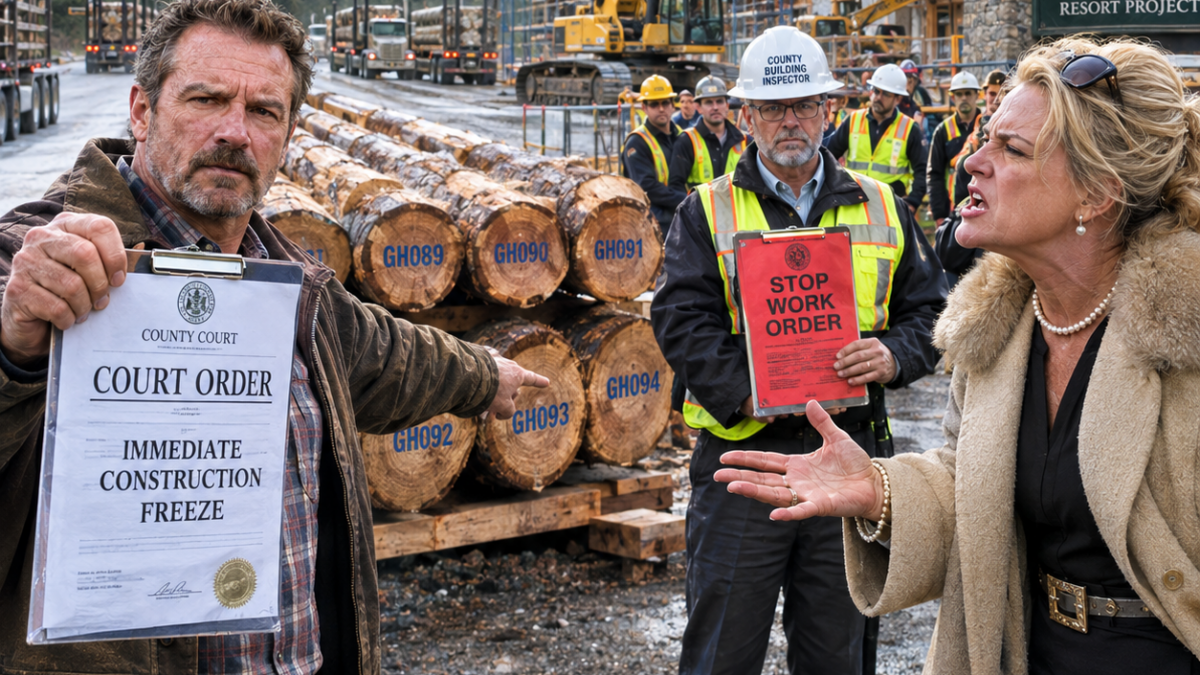
PART2:
My family had owned that ground since the 1950s.
The mill had been there for twenty years.
Darlene knew all of that.
She stood in front of my locked gate anyway.
One of the truck drivers got out.
Another man joined him.
Darlene handed them a paper.
The security camera resolution was good enough that I could see a county seal printed near the top.
One man pointed toward the gate.
Then he pulled out bolt cutters.
I was already out of bed.
On the camera feed, he set the jaws against my padlock.
I grabbed my jeans.
The cutters closed.
My gate opened.
I called the sheriff’s office while pulling on my boots.
“My name is Grant Halverson.”
The dispatcher asked:
“What’s happening?”
“I own Halverson Cedar Mill on Long Ridge Road. Seven logging trucks are entering my locked yard without permission.”
“Anyone armed?”
“Not that I can see.”
“Are you on site?”
“No.”
“Do not confront them alone.”
“I’m headed there.”
PART3:
“Deputies are being notified.”
I shoved my wallet into my pocket.
Phone.
Keys.
Jacket.
Then I looked once more at the camera.
Magnetic signs had been attached to several truck doors.
HOA WILDFIRE MITIGATION OPERATION
I stared at the words.
Then at the stacks behind my fence.
Ninety-one Western red cedar logs.
Twenty-eight to thirty-two feet long.
Premium grade.
Sorted.
Measured.
Numbered.
Blue-branded at both ends.
Worth roughly $477,000.
They were scheduled to leave in two days for a commercial buyer.
That order was not simply another sale.
It was the biggest contract I had ever won.
It secured payroll.
Debt service.
Equipment maintenance.
Winter work.
It told every man and woman who had stayed with me during two lean years that their loyalty had not been wasted.
The trucks were backing toward those logs.
I ran.
The drive to the mill felt twice as long as usual.
Fog folded over the road.
My phone sat in the cup holder with the camera feed open.
Every few seconds I looked down only long enough to see another log lifted onto another trailer.
Loader arms.
Chains.
Cedar swinging through the lights.
My property being removed piece by piece.
I called my foreman, Tommy Kline.
He answered half asleep.
“Grant?”
“Do not come to the mill yet.”
“What?”
“Someone’s taking the cedar.”
Silence.
“All of it?”
“Looks like.”
“I’m coming.”
“No.”
“Grant—”
“Sheriff’s on the way. Stay home until I call.”
A long pause.
Then:
“Who?”
“Darlene Vickery.”
Tommy swore.
I didn’t correct him.
By the time I reached the turnoff, three trucks had already left.
I passed one heading the opposite direction.
Loaded.
Cedar stacked high.
I recognized the blue brand on the first log.
GH044.
My hands tightened on the wheel.
For half a second, instinct told me to turn around.
Follow it.
Block the road.
Do something.
Anything.
Then I remembered the dispatcher.
Do not confront them alone.
So I kept going.
When I reached the mill, only the last truck remained.
It was pulling away.
Darlene stood near the open gate.
She looked toward my security camera.
Then lifted the county-looking paper high enough for the lens to see.
And smiled.
Not a nervous smile.
Not somebody realizing a mistake had been made.
A victorious smile.
I pulled into the yard as her SUV disappeared behind the truck convoy.
My severed padlock lay in the gravel.
I picked it up.
Heavy steel.
Cut cleanly.
Deep tire tracks crossed the staging area.
Cedar bark littered the ground.
Cargo straps had been left near the fence.
My entire premium stack was gone.
Scrap piles remained.
Short pieces.
Offcuts.
Low-grade material.
Firewood.
Everything a genuine wildfire cleanup crew would supposedly care about was still there.
Only the valuable timber had been removed.
I stood in the empty yard and felt something I did not expect.
Not rage.
At least not first.
Hollow fear.
Because I knew what that lumber represented.
I had employees who counted on Friday checks.
A buyer who expected delivery.
A $160,000 performance bond tied to the contract.
If I failed that delivery, I could lose far more than the logs.
Tommy called again.
I answered.
“How bad?”
“All ninety-one.”
He was quiet.
Then:
“Jesus.”
“I need you to call everybody and tell them the mill is closed until noon.”
“What do I tell them?”
“The truth.”
“Which is?”
“I’m still figuring that out.”
The first sheriff’s vehicle arrived twenty minutes later.
Investigator Mason Calder came not long after.
Forty-eight.
Weathered face.
Slow voice.
A man who looked like he had learned long ago that people reveal more when you do not rush to fill silence.
He walked the yard.
Photographed the cut lock.
Tire tracks.
Gate.
Bark.
Camera positions.
Then asked:
“Show me ownership.”
I had expected that.
I kept copies in the office.
Deed.
Parcel map.
State timber harvest documentation.
Buyer contract.
Inventory sheet.
Mason studied the parcel map on his tablet.
“Briar Summit starts here.”
He pointed.
Then moved his finger.
“Your mill is here.”
“Correct.”
“Nearly a mile.”
“Correct.”
“You’re not in the association.”
“No.”
“Ever been?”
“No.”
“Any wildfire easement?”
“No.”
“Emergency access agreement?”
“No.”
“Anything that would authorize the HOA to remove private timber?”
“Nothing.”
He nodded once.
Then:
“Show me the logs.”
“They’re gone.”
“The records.”
I handed him the inventory.
GH041 through GH131.
Every log.
Length.
Diameter.
Grade.
Destination.
The blue end brand.
Mason looked at me.
“You marked both ends?”
“Yes.”
“Why?”
“Chain of custody.”
He raised one eyebrow.
“You expecting someone to steal ninety-one cedar logs?”
“No.”
“Then why?”
“Because good buyers want traceability.”
That was the first time that morning I felt something other than fear.
A small amount of gratitude.
I had spent years being mocked for paperwork.
Every load.
Every permit.
Every mark.
Every ticket.
Now the paperwork was the only part of my property Darlene had not been able to haul away.
My phone rang.
Darlene.
Mason looked at the screen.
“Your choice.”
I answered.
“Grant.”
Her voice was bright.
Almost cheerful.
“I assume you’re at the yard.”
“I am.”
“Then you’ve seen the mitigation work.”
“What mitigation work?”
“Emergency combustible-material removal.”
“You mean my cedar.”
“You were storing dangerous fuel beside residential property.”
“My property is nearly a mile from your HOA.”
“Wildfire doesn’t respect property lines.”
“Who authorized you?”
“The county.”
“Send me the order.”
“You saw it.”
“I saw a piece of paper on a security camera.”
“It’s valid.”
“Send it.”
She paused.
Then:
“The material has already been transferred to our disposal contractor.”
“Where?”
“I’m not required to disclose contractor operations.”
“You took $477,000 worth of my timber.”
“Grant, you should be grateful we didn’t fine you more heavily.”
I stared at Mason.
He was writing.
“What?”
“You left a severe fire hazard adjacent to our community.”
“Where are my logs?”
“The matter is closed.”
She hung up.
An hour later, an email arrived from Briar Summit HOA.
Invoice.
$38,500.
WILDFIRE HAZARD ABATEMENT SERVICES
Mobilization.
Trucking.
Labor.
Timber processing.
Administrative costs.
I read it three times.
Then laughed.
Not because anything was funny.
Because the alternative was putting my fist through a wall.
Mason looked over my shoulder.
“They took your property.”
“Yes.”
“And billed you.”
“Yes.”
“Send me this.”
I forwarded it.
Then called Celia Prescott.
Celia had handled commercial contracts for my mill for years.
Forty-one.
Sharp.
Never dramatic.
She once told me that courtroom anger was usually an expensive substitute for documentation.
She drove out that afternoon.
We spread papers across the hood of my pickup.
The county-looking order was attached to Darlene’s invoice package.
EMERGENCY TIMBER CLEARANCE AUTHORIZATION
Official seal.
Case number.
Contact line.
Celia read.
Then opened her laptop.
County public records.
She typed the case number.
Nothing.
Again.
Nothing.
Then she studied the format.
“That’s wrong.”
“What?”
“County stopped numbering these cases this way years ago.”
She dialed the phone number printed on the order.
A generic voicemail.
No department identification.
She hung up.
“Do not call Darlene.”
“I already did.”
“Then don’t again.”
“What now?”
“Mason verifies directly with county.”
“Then?”
“If this is forged, we preserve everything before somebody decides to clean up the paperwork.”
By evening, Mason called.
“No order.”
I sat at my kitchen table.
“What?”
“No emergency authorization with that number.”
“Any order involving my parcel?”
“No.”
“Any county program authorizing Briar Summit to seize timber?”
“No.”
He paused.
“Grant.”
“Yes?”
“This is no longer a neighborhood dispute.”
“I know.”
“If the documents hold up the way they look right now, seven trucks entered your property under false authority and removed commercial timber.”
I looked through the window.
Mill road in distance.
Fog starting again.
“They knew what to take.”
“What?”
“They left all the scraps.”
Mason was quiet.
I continued.
“They took only the select logs.”
“Why does that matter?”
“No wildfire crew chooses the most valuable material first.”
“Good.”
He wrote something.
“Send me photographs of what they left.”
I did.
Celia sent preservation notices that night.
Darlene.
The trucking company.
Anyone receiving disputed timber.
No cutting.
No resale.
No alteration.
No destruction of records.
Darlene responded by attacking me publicly.
She circulated a letter throughout Briar Summit.
I was a reckless industrial neighbor.
I had ignored fire risks.
I was weaponizing lawyers against a residential community.
If wildfire reached the ridge, responsibility would belong to people like me.
Tommy saw the letter online.
He called.
“You want me to answer this?”
“No.”
“She’s calling us dangerous.”
“No.”
“Grant.”
“No.”
“What are we doing?”
“Finding the trucks.”
That was something I understood.
Logging trucks leave records.
Drivers get paid.
Carriers get paid.
Loads get weighed.
Dispatchers keep tickets.
Even bad operators generate paper because fuel and labor cost money.
I spent half the night reviewing camera footage.
Seven license plates.
Departure times.
Trailer markings.
One had a dented left fender.
Another had a replacement mudflap with a white stripe.
One trailer carried a yellow chain box.
I built a tracking sheet.
At 2:30 a.m., Celia texted:
GO TO SLEEP.
I replied:
NO.
She sent:
That was not legal advice. It was health advice.
I ignored it.
By morning, I identified the hauling company.
Rhett Larkin was the dispatcher.
Fifty-one.
Commercial hauling veteran.
He was cautious when I called.
“You’ll need to speak with our legal department.”
“I’m not asking you to admit anything.”
“You’re asking about a client load.”
“The cargo was mine.”
“I can’t verify that.”
“I understand.”
“I’m not releasing customer information to somebody on the phone.”
“Fair.”
That word mattered.
I respected him immediately.
Celia sent formal notice.
Mason contacted the company through proper channels.
Then Rhett pulled the dispatch file.
The HOA had provided the fake emergency authorization.
It also signed a written certification claiming legal right to enter my yard and collect the timber.
Rhett later told me he sat at his desk staring at that page for several minutes.
Because his drivers had not merely hauled a questionable load.
They had cut my padlock under instructions based on the paper he had accepted.
The company cooperated.
Every delivery slip listed the same destination.
SUMMIT VALE RESORT — MAIN LODGE CONSTRUCTION SITE
Eighteen miles away.
Darlene’s project.
The $6 million resort.
I stared at the address.
Then looked at Celia.
“She stole the cedar for her own resort.”
“Maybe.”
“Celia.”
“We know where the trucks delivered it.”
“She runs the project.”
“We know that.”
“It’s my timber.”
“We know that.”
“So say it.”
She looked at me.
“I say things after I can prove them.”
That was why I kept paying her.
A little before noon, I drove toward Summit Vale.
I did not enter.
Did not cross the construction fence.
Did not touch a gate.
I parked legally on the public shoulder.
From there I could see the staging area.
Long rows of Western red cedar.
My cedar.
Blue marks visible at the ends.
I raised a telephoto lens.
GH041.
Click.
GH067.
Click.
GH083.
Click.
More.
My hands shook for the first time all morning.
Not because I doubted the logs were mine.
Because now I could see exactly what Darlene intended.
A forklift rolled forward.
Forks slid under one log.
Raised it.
Turned toward the main lodge.
Once cut.
Drilled.
Installed.
The fight became harder.
I called Celia.
“I found them.”
“Photograph.”
“I am.”
“Stay on public ground.”
“I am.”
“Do not enter.”
“I know.”
“Grant.”
“I know.”
The site gate opened.
Darlene walked out.
Two security guards behind her.
She stopped inside the property line.
That was smart.
She smiled.
“Did you drive eighteen miles to congratulate me?”
I held up photographs I had just printed from my portable printer in the truck.
“You have GH041.”
Her smile remained.
“And GH067.”
Nothing.
“Those are mine.”
“Those are building materials lawfully acquired by Summit Vale.”
“From who?”
“Our supplier.”
“Name.”
“Confidential.”
“Return them.”
“You no longer own them.”
“Who sold them to you?”
“Grant.”
She said my name like she was explaining something to a child.
“The county removed dangerous material.”
“No county order exists.”
That made the smile smaller.
I continued.
“Mason Calder confirmed it.”
Silence.
“Your trucks cut my lock.”
“Not my trucks.”
“Your HOA hired them.”
“Under emergency authority.”
“Which does not exist.”
She looked toward the forklift.
Then back.
Her voice dropped.
“Once those logs become part of my resort, you’ll never get them back.”
That sentence became important.
At the time it only made me angry.
I said:
“Stolen property does not become yours because you bolt it into an expensive building.”
She laughed loud enough for workers to hear.
“You can hire every lawyer in Oregon. A few blue paint marks won’t stop a six-million-dollar project.”
A man in a hard hat had stopped twenty feet away.
Nolan Sutter.
Construction superintendent.
Thirty-nine.
Commercial builder.
He walked toward us.
“Blue marks?”
Darlene turned.
“Nolan, get back to work.”
He ignored her.
Looked at me.
“What do those numbers mean?”
“Individual timber IDs.”
“From where?”
“My mill.”
Darlene snapped:
“Do not discuss project materials with him.”
Nolan looked at her.
Then back to me.
“You have proof?”
I handed him Celia’s business card and a copy of the evidence-preservation notice.
“All ninety-one logs have inventory records.”
“Harvest permits?”
“Yes.”
“Chain of custody?”
“Yes.”
“Buyer contract?”
“Yes.”
He stared toward the forklift.
Then did something that probably saved most of my timber.
“Shut it down.”
The operator looked at him.
Nolan raised one hand.
“Lower the log.”
The forklift stopped.
Darlene stepped forward.
“You do not have authority to stop my project.”
“I’m superintendent.”
“These materials are approved.”
“By who?”
“Blue Heron.”
“Where are the engineering certifications?”
Darlene’s face changed.
Nolan’s approved structural plans called for engineered timber members with proper documentation.
Raw whole-stem logs were not automatically interchangeable.
If installed into load-bearing positions without engineering review, Nolan knew exactly whose name might appear when people asked who approved it.
He was not protecting me first.
He was protecting the building.
And himself.
That was fine.
Good systems often work because responsible people have their own reasons to say no.
Nolan ordered every disputed log quarantined.
No cutting.
No drilling.
No installation.
Darlene stood furious.
I left.
I had barely reached Cedar Hollow when Nolan received a new instruction.
Darlene told an employee:
“Cut the marked ends off before tomorrow.”
Remove the blue numbers.
That employee told Nolan.
Nolan refused without written instruction.
He made a note.
Date.
Time.
Exact words.
Then he pulled the project’s timber invoice.
Supplier:
BLUE HERON TIMBER SUPPLY
Amount:
$438,000.
Ninety-one cedar logs.
Diameters.
Lengths.
Grades.
The sale date was printed several days before the trucks entered my property.
That single detail transformed the case.
How do you invoice specific timber before you possess it?
The next morning Celia showed me the invoice.
I read it.
Then again.
“They billed the project $438,000.”
“Yes.”
“For my logs.”
“That’s what the descriptions appear to match.”
“Before they stole them.”
“Yes.”
“So the theft was planned.”
“That is a reasonable inference.”
“Thank you.”
“Don’t get used to it.”
We had three tracks now.
Ownership.
The seizure.
The destination.
Celia filed for emergency relief.
Deed.
Harvest permit.
Buyer contract.
Inventory.
Security footage.
Seven truck loads.
Delivery slips.
Blue-brand photographs.
Sworn declaration that I had never sold, gifted, transferred, or authorized removal of any of the ninety-one logs.
We asked the court to freeze the timber.
At the same time, I sent the county building department documentation showing raw logs at Summit Vale did not match the approved engineered structural materials.
That was not revenge.
If someone intended to put my disputed timber into structural use without proper approval, the building department needed to know.
Inspector Bridget Sloan arrived.
Forty-four.
She asked Nolan for:
Approved plans.
Material records.
Engineering certifications.
He gave her what he had.
Blue Heron invoice.
No proper structural certifications matching the intended substitution.
Bridget compared.
Asked questions.
Then issued a stop-work order covering the central structural phase of the main lodge until compliance could be established.
That same afternoon, a judge granted the temporary restraining order.
All ninety-one logs frozen in place.
No cutting.
No moving.
No installation.
No alteration.
Two separate legal mechanisms landed almost together.
Court protected the property.
County stopped the structural work.
Darlene was hosting investors when Bridget entered the presentation tent with the stop-work order.
Behind her, a crane operator got the signal.
Lower the load.
Engine idled down.
Then another.
Then another.
Within minutes, the central construction site became quiet.
I stood on the public road.
Not cheering.
Not smiling.
Watching.
Darlene came toward me.
Fast.
“You did this.”
“No.”
“You called the county.”
“Yes.”
“You sabotaged my investors.”
“I told the county what material was here.”
“I’ll sue you for every dollar this delay costs.”
I held up the court order.
“You took my timber at dawn.”
She stared.
I looked past her at the silent machinery.
“By sunset, you couldn’t move a single log.”
Her face tightened.
“My bank is behind me.”
“Then your bank will be interested in learning what its collateral is being built with.”
For the first time since I met her, she had no answer ready.
That night Celia found Blue Heron.
Or rather, found what Blue Heron was not.
No mill.
No timber yard.
No trucks.
No employees.
Registered only weeks earlier.
Mailing address tied to a consulting operation connected to Darlene.
The deeper we looked through public filings and later lawful discovery, the uglier it became.
The project had recorded a $438,000 payment for cedar supplied by Blue Heron.
The logs matched my inventory.
I had received nothing.
Celia placed the invoice on my desk.
“She didn’t steal your timber because she needed free wood.”
“What?”
“She needed both.”
“Both what?”
“The wood and the invoice.”
I stared.
“She takes your logs without paying you.”
“Yes.”
“Then bills her own project through Blue Heron.”
“That’s what the records appear to show.”
“Meaning investors think they bought the cedar.”
“Yes.”
“And the money goes—”
“To an entity she appears to control through intermediaries.”
I leaned back.
For several seconds I could hear only the mill saw outside.
“So she gets my timber.”
“And potentially the $438,000.”
I laughed once.
Cold.
“She stole twice.”
“That is essentially the allegation we’re building.”
Nolan added more.
Darlene had stopped him from ordering cedar through the normal supplier weeks earlier.
She promised a cheaper source.
Personally took responsibility.
That explained why Blue Heron already knew detailed specifications.
She had the project material list before she took my logs.
Then Rhett provided dispatch records.
Drivers had been told:
Take instructions only from Darlene’s office.
Do not contact property owner.
That was not how legitimate emergency mitigation worked.
Then Iris Bellamy came forward.
Forty-nine.
Project accountant.
She had noticed the $438,000 payment before the theft.
No proper supporting vendor documentation.
She asked.
Darlene told her to stay out of purchasing.
Iris did what good accountants do when someone tells them not to look at a suspicious number.
She remembered it.
And kept lawful copies of records she was responsible for.
She also lived inside Briar Summit.
That connection turned the resort scandal into an HOA scandal.
Iris found the loan file.
Briar Summit HOA listed as guarantor for $1.1 million of the project financing.
She knew that was wrong.
She had attended the meeting.
The proposal to pledge association reserves had been voted down.
She remembered because Darlene had been furious.
But the bank file contained minutes saying the proposal passed.
Iris compared.
Original archived minutes:
Rejected.
Bank version:
Approved.
Two board-member signatures on the bank copy.
Both members denied signing.
The theft of my cedar had opened a door into something far larger.
I called Celia after hearing.
“I wanted ninety-one logs back.”
“I know.”
“Now there’s a forged $1.1 million guarantee?”
“Potentially.”
“How does this keep getting worse?”
“Because people who forge one document rarely develop a sudden commitment to transparency elsewhere.”
That might have been the most cynical thing Celia ever said.
It was also becoming hard to argue with.
Darlene called an emergency HOA meeting.
Ninety-two owners filled the clubhouse.
She blamed me.
Of course.
Grant Halverson was extorting the community.
Grant Halverson had filed a baseless lawsuit.
Grant Halverson threatened the future of Cedar Hollow.
Grant Halverson was putting millions of dollars and homeowner reserves at risk.
What she did not explain was why my logs were at her resort.
Or why the county order she used did not exist.
She proposed a special assessment to protect the project.
Then casually revealed the HOA might be liable for part of the resort loan.
Homeowners exploded.
“You pledged our reserve fund?”
“When did we vote?”
“How much?”
“Who signed?”
Darlene adjourned early.
The next morning, several homeowners contacted Celia.
They invited me to speak.
I said yes on two conditions.
Written invitation.
And I got to present the complete evidence without being cut off every thirty seconds.
They agreed.
I entered the clubhouse carrying one binder.
No lawyer speech.
No insults.
No angry photographs of Darlene.
I started with my deed.
“My land.”
Then map.
“Briar Summit.”
Then distance.
“No overlap.”
Then inventory.
“GH041 through GH131.”
Then security video.
Seven trucks.
Padlock cut.
Darlene visible.
Fake order visible.
Then delivery slips.
Summit Vale.
Then photographs.
Blue brands.
Then court order.
Ninety-one logs preserved.
Someone asked:
“What gives her authority to take timber from your yard?”
I looked at Darlene.
“So far, nothing anyone has produced.”
She stood.
“These materials have been manipulated.”
“Produce the real county order.”
She stared.
“County procedures are complicated.”
“Then produce it.”
“You’re not entitled—”
“Mason Calder says it doesn’t exist.”
People murmured.
Darlene pivoted.
“Blue Heron legally purchased those logs.”
Celia stood.
That was the first time she spoke.
“From whom?”
Darlene refused to answer.
“Does Blue Heron own a mill?”
No answer.
“Timber yard?”
No answer.
“Trucks?”
She called the question irrelevant.
The room changed.
Homeowners who had spent weeks believing they were protecting Darlene began wondering whether they were protecting themselves from her.
Recall signatures started.
Darlene retaliated in court.
Her new motion claimed my timber identification could be fabricated.
Anyone could paint blue marks.
The resort purchased logs legally through Blue Heron.
It was a dangerous argument.
Not because it was strong.
Because civil disputes sometimes become expensive simply from enough uncertainty.
But Celia smiled when she read it.
I knew that smile.
“What?”
“She just made Blue Heron ownership central.”
“So?”
“Now she has to prove Blue Heron possessed the timber.”
Rhett’s sworn statement destroyed that.
All seven trucks loaded directly from my yard.
No Blue Heron facility.
No intermediate delivery.
Nolan confirmed:
Every log arrived directly from the carrier.
No Blue Heron location.
Then came the hearing.
Darlene’s attorney tried making it sound like two competing timber suppliers arguing over title.
Celia walked through the chain.
Grant owns cedar.
Grant inventories cedar.
Grant stores cedar behind locked gate.
HOA presents fake county order.
Seven trucks cut lock.
Seven trucks load Grant’s marked logs.
Seven trucks drive directly to Summit Vale.
Summit Vale books $438,000 purchase from Blue Heron.
Blue Heron had no yard.
No mill.
No trucks.
Then Nolan testified.
Celia asked:
“Were you given any instruction concerning the identification marks on the logs?”
“Yes.”
“What instruction?”
Nolan looked toward Darlene.
Then judge.
“To cut the marked ends off before the next morning.”
The judge lowered her pen.
“Repeat that.”
He did.
Courtroom changed.
There is a difference between disputed ownership and destroying identifying marks after dispute begins.
The judge kept the preservation order fully in place.
No alteration.
No concealment.
No destruction.
Then the bank acted.
Investigators and auditors had raised questions not only about timber but about the $1.1 million HOA guarantee.
The lender froze the next scheduled project draw.
$2.4 million.
That stopped the resort harder than the court order had.
Construction companies can survive material disputes.
They cannot work indefinitely without money.
Suppliers paused deliveries.
Subcontractors stopped mobilizing.
Invoices aged.
Liens appeared.
The main lodge remained skeleton.
Villas unfinished.
Event center incomplete.
Darlene stormed into the bank demanding funding.
The representative reportedly told her:
Before another dollar moved, they needed to know who actually owned project assets and who had authority to sign the guarantee.
That afternoon, I stood on the public road outside Summit Vale.
Nolan came over.
No security.
No Darlene.
He tucked hard hat under one arm.
“You happy?”
I looked at the idle cranes.
“No.”
“Really?”
“I came here to recover ninety-one logs.”
I pointed toward resort.
“She’s the one who put six million dollars at risk.”
That was how I felt.
I did not want contractors unpaid.
I did not want laborers out of work.
I did not want homeowners discovering their reserves had been put behind a resort they never approved.
None of those people had cut my lock.
Consequences spread farther than responsibility.
That is why the next part mattered.
The criminal investigation narrowed.
Who ordered the trucks?
Who created or used fake county authorization?
Who controlled Blue Heron?
Who ordered marks removed?
Who altered HOA records?
Who submitted disputed guarantee?
Phone records.
Emails.
Dispatch records.
File histories.
Signatures.
Eventually enough lined up.
On a cold Tuesday morning, deputies went to Darlene’s home with a warrant.
She was arrested.
Charges related to theft and document forgery moved forward subject to prosecutorial review.
I did not go watch.
Tommy asked:
“You don’t want to see?”
“No.”
“After what she did?”
“I already know what handcuffs look like.”
He shook his head.
“You’re no fun.”
“No.”
“Seriously.”
“I want logs.”
That same week, Briar Summit held its recall vote.
Record turnout.
Darlene removed.
The woman who had once signed HOA letters as if her title extended across the whole mountain no longer had authority to sign anything for the association.
New board’s first major action:
Hire independent counsel.
Protect reserve fund.
Challenge the $1.1 million guarantee.
Separate homeowners from Darlene’s private project as much as law and documents allowed.
That mattered to me.
I never wanted ninety-two families paying for my cedar because one president made illegal decisions.
Some costs still reached the association.
Legal fees.
Audit.
Insurance.
Governance cleanup.
That is unavoidable sometimes.
But accountability needed to follow conduct as closely as possible.
Then came the timber inspection.
Court-supervised.
All ninety-one.
Each number.
Each end.
Each dimension.
Some had been scraped during loading.
Some moved roughly.
A few were partially prepared before Nolan stopped work.
Eighty-two remained recoverable and suitable for the original commercial specifications.
Nine did not.
Their loss entered my damages claim.
So did:
Transport.
Inspection.
Remediation.
Certain proven business losses.
Costs tied to delayed performance.
Everything calculated carefully.
No double recovery.
If I recovered a log, I did not claim full value again as though it had vanished permanently.
Celia insisted.
I agreed.
Darlene’s lawyers did not get to say I was using a theft to become rich.
I wanted my business restored.
Not a jackpot.
My buyer had been furious initially.
Not at me exactly.
At uncertainty.
He needed cedar.
His project could not wait indefinitely.
I called the morning after the theft.
“You saw the news?”
“Yes.”
“I’m working on recovery.”
“How long?”
“I don’t know.”
Silence.
Then:
“Grant, I have a schedule.”
“I know.”
“You have a performance bond.”
“I know.”
“Can you replace?”
“Some.”
“All?”
“Not immediately.”
“What are you asking?”
“Time.”
“How much?”
“I’ll know more in seventy-two hours.”
He gave me seventy-two.
Then more after court order.
Ultimately we renegotiated.
I sourced replacement cedar for damaged logs.
The eighty-two recoverable logs later returned to my mill.
The trucks came before dawn.
Seven again.
That detail felt strange.
Same number.
Different purpose.
This time the gate remained locked until I checked paperwork.
Rhett’s company had cooperated through the investigation and arranged lawful return under proper authorization.
I stood beside the new steel gate.
Fog in valley.
Headlights approaching.
For one second, memory folded over itself.
5:18.
Cut lock.
Darlene.
Then first driver stopped outside.
Rolled window.
“Morning, Mr. Halverson.”
“Morning.”
“Documents.”
He handed them down.
I read every line.
Tommy stood behind me holding coffee.
“You trust them?”
“I trust paperwork I’ve verified.”
He laughed.
“Open the gate.”
One truck at a time.
Logs came home.
GH041.
GH044.
GH067.
GH082.
More.
Workers gathered.
Nobody shouted.
Nobody needed to.
Each log lowered onto my deck felt like something heavier than timber being returned.
Control.
Continuity.
Proof.
Nolan arrived in his pickup.
By then he had left Summit Vale and taken a superintendent job with a reputable commercial builder in Portland.
He watched the unloading.
I walked over.
“You didn’t have to come.”
“I wanted to see them leave that place.”
I held out my hand.
“Thank you.”
“For what?”
“Stopping the forklift.”
He shrugged.
“I did my job.”
“No.”
“Yes.”
“You were told to keep going.”
“By somebody who wasn’t going to stand beside me if the building failed.”
I laughed.
Fair.
Then:
“And the blue ends.”
Nolan looked at GH067.
“If I’d cut those off…”
“We still had records.”
“I know.”
“But harder.”
“Yes.”
He nodded.
“I’m glad I didn’t.”
“Me too.”
We watched final trailer.
GH131.
Blue brand still clear.
The last number in my inventory.
I placed my hand on the cedar.
Rough.
Cold.
Real.
On the morning Darlene took it, that brand had proved what I lost.
Now it proved what came back.
The resort did not recover.
The development company tried to replace frozen financing.
Could not.
Contractors filed claims.
Debt costs accumulated.
The project entered formal financial proceedings.
Assets prepared for resolution and sale.
Darlene lost control.
The six-million-dollar billboard stayed at the entrance for months.
Glossy rendering.
Completed lodge.
Warm windows.
Couples walking beneath cedar beams.
Behind it:
Scaffolding.
Weeds.
Silence.
People said I destroyed the resort.
Darlene said it directly during a civil deposition.
We sat across a conference table.
Lawyers.
Recorder.
Documents.
She leaned forward.
“You destroyed everything over a handful of logs.”
I looked at her.
“Ninety-one.”
She rolled her eyes.
I put my deed on the table.
Then inventory.
“You didn’t lose Summit Vale because I wanted revenge.”
She stared.
“You lost it because you built your business on things you didn’t own.”
She said nothing.
That was the closest thing to a final confrontation we ever had.
No shouting.
No courtroom applause.
No cinematic confession.
Just two stacks of paper.
Ownership.
Inventory.
People often expect victory to feel larger.
Mine felt like payroll.
That Friday, every employee was paid.
The buyer contract survived.
The mill kept running.
That mattered more than the billboard.
I had twenty years in that operation.
My father helped me buy the first loader.
My mother kept books until her eyesight made it hard.
Tommy started with me young enough to still have hair.
We survived recession.
Wildfire seasons.
Equipment failures.
Cheap imported material.
Bad winters.
Darlene nearly damaged all of that in one morning because she saw ninety-one logs as inventory she could appropriate with a forged sheet of paper.
That was the injustice.
Not just $477,000.
She treated twenty years of work as something available to whoever carried the more official-looking document.
The forged wildfire order bothered me more than the bolt cutters eventually.
Bolt cutters are honest in their way.
They say:
I am breaking your lock.
A forged government order says:
You should thank me while I break your lock.
That is more dangerous.
It turns theft into procedure.
Makes truck drivers cooperate.
Makes dispatchers believe paperwork.
Makes witnesses hesitate.
Darlene understood that.
She knew seven trucks arriving with ordinary thieves would attract police immediately.
Seven trucks labeled HOA WILDFIRE MITIGATION OPERATION looked official.
A county seal makes good people pause.
That is why Rhett was so shaken.
His drivers did not wake planning to steal.
They believed a client had lawful authority.
That did not erase every decision they made.
Cutting a private lock should have prompted more verification.
The hauling company acknowledged that.
Cooperated.
Changed procedures afterward.
Any future “emergency removal” from private property required direct verification with the issuing government office.
Not just paper supplied by client.
Rhett told me:
“Your job is in our training now.”
I laughed.
“What do you call it?”
“The $477,000 phone call we should’ve made.”
Fair.
That is what good organizations do with mistakes.
Turn them into procedure.
Briar Summit had more rebuilding to do.
New board discovered years of governance had become centered around Darlene personally.
Vendors called her.
Banks called her.
Lawyers called her.
She controlled flow of information.
The HOA existed almost like an extension of one person.
They changed that.
Dual signatures.
Independent financial review.
Member approval where required.
Board minutes locked after adoption.
Version histories retained.
Reserve pledges prohibited without formal authorization.
Related-party disclosures.
Vendor conflicts.
None of it exciting.
Good.
Excitement is overrated in governance.
One homeowner told me:
“Before this, I thought minutes were just something nobody read.”
“Now?”
“I read them.”
“Good.”
“She made all of us paranoid.”
“Maybe temporarily.”
“Is that healthy?”
“Depends whether you stop once system earns trust.”
He thought.
I did too.
After theft, I became obsessive for a while.
Every motion alert.
Every unfamiliar truck.
I checked.
Night.
Early morning.
Lunch.
My camera system had always been practical.
Suddenly it became emotional.
I would wake at 2:00 a.m., open feed.
Empty yard.
Go back to sleep.
Celia noticed because I complained of being tired.
“Turn alerts down.”
“No.”
“Grant.”
“No.”
“You have upgraded gate.”
“Yes.”
“More cameras.”
“Yes.”
“Police report.”
“Yes.”
“Do you need a notification every time a deer walks near fence?”
“Maybe deer works for Darlene.”
She stared.
I laughed.
Eventually turned sensitivity down.
That was recovery too.
Security that helps you live is useful.
Security that keeps you reliving the crime is another form of loss.
The new gate was heavier.
Better lock.
Camera angles overlapped.
Night vision.
Backup power.
But I stopped watching unless something real happened.
The mill became mill again.
Not crime scene.
Timber became timber.
Not evidence.
GH numbers returned to being inventory.
That mattered.
Nine lost logs were replaced.
I hated that they were lost.
A few had been cut or damaged beyond contract specifications.
They went through appropriate disposition after valuation.
I did not keep splinters.
No shrine.
I had enough records.
One younger employee asked:
“Why not keep one damaged end with blue brand?”
“For what?”
“History.”
“History is in file.”
“That’s boring.”
“Yes.”
He shrugged.
I preferred boring.
Darlene’s prosecution continued.
I only followed what affected my case.
Charges involving theft.
Forgery.
Related documents.
I did not attend every hearing.
People asked why.
“She stole from you.”
“Yes.”
“You don’t want to watch?”
“No.”
“Why?”
“Because my business needs me here.”
That answer was true.
Also, I did not want her becoming my full-time occupation.
She had already taken one morning.
Months.
Sleep.
Money.
Attention.
I was not giving her years.
The resort’s debt process moved separately.
Corporate assets.
Liens.
Bank interests.
Investor claims.
I did not own that fight.
My claim was specific.
My cedar.
My losses.
My property.
My rights.
Everything else belonged to others.
That specificity protected me from turning justified anger into appetite.
Celia once said:
“The easiest way to lose moral clarity is to start enjoying every unrelated bad thing that happens to the person who hurt you.”
I hated that sentence.
Because it was good.
I did not need Darlene penniless.
I needed accountability.
If her own financial decisions caused collapse, that was hers.
I would not cheer somebody else’s unpaid contractor simply because Darlene was involved.
Nolan had coworkers who lost weeks of income.
Suppliers got stuck.
Those people were not villains.
Consequences spread.
That complicated satisfaction.
When the resort finally entered formal debt resolution, local paper ran headline about “Darlene’s Collapse.”
Tommy brought copy into break room.
Slapped it down.
“There.”
“What?”
“Justice.”
I looked at photograph.
Empty lodge.
Then at Tommy.
“Justice is us working.”
He frowned.
“That’s less fun.”
“Most true things are.”
Still, I kept the paper.
Not because headline.
Because photograph included the billboard.
The same billboard I had stood under when she told me a few photographs could never stop six-million-dollar project.
The picture captured no workers.
That irony was difficult to ignore.
Years later, Cedar Hollow changed.
Briar Summit expanded in a different direction under new leadership.
Not onto my land.
New agreements negotiated properly.
The abandoned resort site eventually attracted potential buyers.
One asked whether my mill would supply cedar if redevelopment happened.
Tommy laughed when he heard.
“What did you say?”
“I said send specifications.”
“You’d sell cedar to that place?”
“If they pay.”
He stared.
“After everything?”
“What do you want me to do? Ban lumber?”
“But it’s Summit Vale.”
“Building didn’t steal from me.”
That was how I saw it.
Objects do not inherit guilt.
Land doesn’t.
Steel doesn’t.
Timber doesn’t.
People make decisions.
If someday an honest developer bought the site and completed something lawful, good.
My goal was never a permanent ruin.
It was not mine.
I had no right to decide it should remain empty forever.
That realization surprised me.
For months, the silent construction site felt like justice.
Later, it felt like waste.
I wanted systems repaired, not landscapes punished.
One potential developer did eventually buy part of the assets under formal procedures.
Different name.
Smaller project.
Financing transparent.
No secret HOA guarantee.
Nolan was not involved.
I supplied some cedar trim years later.
Paid in full before delivery.
Tommy called me traitor.
I told him:
“The invoice is real.”
He laughed.
That became mill joke.
Whenever someone forgot purchase order:
“Don’t Blue Heron me.”
If a supplier invoice looked odd:
“Check if Darlene signed it.”
Dark humor.
Useful.
Blue Heron Timber Supply disappeared.
Its existence had been paper.
No mill.
No lumber.
No trucks.
That struck me as symbolic.
A fake company selling real material it did not own.
Entire scheme depended on confusing paper ownership with actual ownership.
My logs did not care what Blue Heron invoice said.
They had physical history.
Stumps.
Harvest permits.
Marks.
Inventory.
Storage.
Camera footage.
Truck route.
If someone says the physical world is less important than their document, inspect the document.
I learned that.
The blue brand became famous locally.
Not intentionally.
Other mill owners started asking about traceability.
Some improved marking.
Digital load records.
End tags.
Photographs before shipment.
I spoke once at a regional forestry association meeting.
They wanted story.
I gave process.
“Mark inventory.”
“Record both ends when possible.”
“Keep permit records accessible.”
“Photograph staging before pickup.”
“Verify emergency orders independently.”
“Preserve dispatch information.”
A man in back said:
“And don’t build next to HOA.”
Everyone laughed.
I said:
“My land was there first.”
More laughter.
Then became serious.
“The issue wasn’t HOA existing.”
“It was one president assuming HOA authority extended beyond its recorded boundaries.”
Important distinction.
Most associations never send seven logging trucks through somebody else’s gate.
I did not want every board member in America compared to Darlene.
That makes real abuse harder to recognize because everything becomes outrage.
Precision matters.
Briar Summit’s new president once visited my mill.
Not with guards.
Alone.
Her name was Elaine.
She parked outside gate and called.
“Can I come in?”
“Yes.”
That question alone earned points.
She brought copies of revised boundary maps.
HOA wanted emergency wildfire planning with county.
They wanted coordinate with neighboring landowners.
Not seize timber.
Actual mitigation.
Clearing defensible space along common ridge.
Emergency contact lists.
She said:
“We’d like to know whom to call at your mill if there’s real fire.”
“Me.”
“Backup?”
“Tommy.”
She wrote.
Then:
“If county ever issues an emergency order affecting your parcel—”
“I’ll verify it myself.”
She smiled awkwardly.
“We assumed.”
“Good.”
We walked yard.
She saw scrap piles.
Asked:
“These were here the morning Darlene took the cedar?”
“Yes.”
“She left all that?”
“Yes.”
She stared.
“That makes no sense if she believed fire hazard.”
“Correct.”
Sometimes the simplest evidence is what a criminal leaves behind.
The kindling.
She took premium timber.
No amount of legal language could make that rational as wildfire mitigation.
Elaine apologized on behalf of association.
I told her:
“You didn’t do it.”
“I know.”
“But title I hold did.”
“That matters.”
I accepted apology.
Then we worked on actual fire planning.
That may have been one of the better outcomes.
The forged safety excuse forced community to learn what real wildfire mitigation looks like.
County forester attended.
Property-specific assessments.
No fake authority.
No seizures.
No premium-log shopping.
Real cooperation.
Darlene had used fear of wildfire as cover.
The correct response was not to dismiss wildfire.
It was to handle real risk honestly.
That distinction matters in every scandal.
When someone abuses legitimate concern, people become tempted to reject concern itself.
Bad idea.
Fire is real.
Fraud was also real.
Both can be true.
I had spent years around wood.
I understood fire danger better than most homeowners on ridge.
My mill had required separation distances.
Access.
Extinguishers.
Water.
Vegetation management.
Darlene could have approached me honestly.
If she saw genuine hazard:
Call.
Inspect with county.
Ask.
She did not.
Because safety was not goal.
Cedar was.
And $438,000 invoice.
That greed made rest obvious once people looked.
Her most arrogant mistake was smiling at camera.
People asked why she did.
I cannot know.
Maybe she believed forged order protected her.
Maybe she wanted me to see.
Maybe power had worked so often she could not imagine consequences.
I never claimed motive I couldn’t prove.
But image stayed.
Darlene holding paper.
Smile.
Every later document contradicted confidence in that frame.
County order false.
Blue Heron hollow.
HOA guarantee disputed.
Payment questionable.
Smile became lesson.
Confidence is not evidence.
Mason Calder said that once at end.
We were standing at yard.
Case had progressed enough that stolen-property portion largely resolved.
He looked at new gate.
“Most people see official-looking document and stop asking.”
“I almost wish drivers had.”
“What?”
“Asked.”
“Yeah.”
He kicked gravel.
“Seven guys probably thought they were doing routine job.”
“Still cut my lock.”
“Yes.”
“Somebody should have called me.”
“Yes.”
He nodded toward gate.
“That’s difference between mistake and crime sometimes.”
“What?”
“The phone call nobody makes.”
I remembered.
Rhett said same.
The $477,000 phone call.
Verification is cheap before disaster.
Expensive after.
One dawn, years after everything, I arrived at mill at 5:18 exactly.
Coincidence.
Phone clock.
Fog.
I parked.
Opened gate.
No alert.
No trucks.
For a moment I stood where severed padlock had landed.
Ground resurfaced.
Ruts gone.
New steel.
Cameras.
The yard looked ordinary.
I realized I could not remember exactly where GH041 had been stacked.
That felt good.
Memory fading from landscape.
Not from records.
Enough.
Tommy arrived.
“You okay?”
“Yeah.”
“You look weird.”
“Thinking.”
“Dangerous.”
We walked toward office.
He asked:
“Do you ever think if Darlene had just bought the cedar, none of this happens?”
“Yes.”
“She had $438,000 in project books.”
“Yes.”
“So she could’ve paid you.”
“Maybe.”
“That’s insane.”
“Yes.”
Greed is not always about lacking money.
Sometimes it is about believing paying other people is optional.
Darlene wanted control.
She wanted project money to circulate through entities she controlled.
She wanted homeowner reserves available without votes.
She wanted county authority without county.
She wanted my timber without purchase.
Everything pointed to same worldview.
Other people’s consent was an obstacle.
That was why her empire collapsed.
Not because I was smarter.
Because systems rely on consent and authority.
Eventually someone checks.
Nolan checked materials.
Bridget checked permit.
Court checked ownership.
Bank checked guarantee.
Iris checked minutes.
Homeowners checked bylaws.
Mason checked county order.
Rhett checked dispatch.
Every check stripped away another layer.
Truth is often just enough independent checks happening before damage becomes permanent.
The logs came home because Nolan stopped cutting.
That still mattered to me most.
If he had obeyed Darlene’s order to remove marks, we still could prove ownership.
But recovery harder.
If he had milled everything.
Bolted into structure.
Altered lengths.
Maybe compensation instead of return.
He did not.
He chose caution.
One decision by an employee in middle can save enormous harm.
That is why I thanked him.
People focus on heroes at ends.
Victim.
Villain.
Lawyer.
Judge.
Often most important person is worker who says:
I need this in writing.
Nolan said it.
That sentence saved cedar.
The same with Iris.
She did not accuse Darlene publicly when first $438,000 payment looked wrong.
She saved authorized records.
When audit came, data existed.
Good institutional behavior is sometimes quiet enough to look like cowardice until exact moment it becomes essential.
I learned not to judge too quickly.
Rhett initially refused to tell me where trucks went.
At first I thought:
He’s covering.
No.
He was protecting client confidentiality appropriately until formal notice showed potential crime.
Then he cooperated.
Again:
Process.
I grew more respectful of boring process through the whole thing.
Even when process frustrated me.
Court took time.
Bank review took time.
Criminal case took time.
Financial resolution took time.
I wanted my logs yesterday.
Systems gave them back months later.
Slow justice is still painful.
But reckless speed was how Darlene acted.
I did not want to become her just because I was right.
Celia never let me.
Once, after a delayed hearing, I said:
“This is ridiculous.”
She said:
“You want judge to move faster than evidence?”
“Yes.”
“No.”
“Why do I pay you?”
“To tell you no.”
Fair.
At final major civil resolution, my losses were covered according to documented values and rulings.
I did not get a magic windfall.
I got:
Recovered cedar.
Compensation for nine logs.
Transport.
Inspection.
Certain business losses.
Related expenses.
My performance relationship with buyer repaired.
Mill survived.
That is what real victory often looks like.
Restoration rather than enrichment.
Darlene’s situation was opposite.
She had tried to enrich herself through things she did not own.
She lost control of project, association position, money, and freedom to operate as before.
I did not need anything extra piled on.
The last time I saw her was deposition.
No apology.
No remorse.
At least none I could see.
People ask if that bothered me.
Early, yes.
Later, no.
An apology does not return logs.
Proof did.
An apology does not protect payroll.
Contract did.
An apology does not correct forged guarantee.
Audit did.
An apology does not stop fake county order.
Investigation did.
Emotional closure is nice.
Institutional correction is better when stakes are high.
The new HOA board officially wrote to county clarifying it had no authority over my property.
Recorded internally.
That mattered.
No future president could easily claim precedent.
The hauling company’s procedure changed.
The bank tightened review.
The construction company strengthened material-origin requirements.
The county circulated advisory about fraudulent-looking emergency documents.
Each correction made same trick harder to repeat.
That is the best use of damage.
Not to call damage good.
To make repeat harder.
I kept one photograph of GH131 after return.
Blue brand.
Close-up.
I printed.
Not framed.
Inside office drawer.
Sometimes young employee asks why numbers matter.
I show.
“This mark once helped stop six-million-dollar project.”
They think I’m exaggerating.
Then Tommy says:
“He’s not.”
I explain.
Mark did not stop project alone.
It linked physical timber to records.
Records linked trucks.
Trucks linked destination.
Destination linked invoice.
Invoice linked shell company.
Shell company linked money.
Money opened financial review.
One small blue brand became first thread.
People underestimate identifiers.
Serial numbers.
Lot numbers.
VINs.
Batch records.
Timber marks.
They seem bureaucratic until somebody disputes ownership.
Then they become memory that objects cannot speak for themselves.
GH131 could not say:
Grant owns me.
The blue brand said enough to start asking.
That is why final log meant so much.
I put hand on it not because cedar had feelings.
Because I did.
I had watched it leave through a gate I did not open.
Months later I watched it return through a gate I opened myself.
That distinction was everything.
Consent.
Again.
A truck entering because I said yes feels completely different from one entering because forged paper says my no does not matter.
Years later, I sold that batch.
Not sentimental.
Cedar is meant to become something.
My buyer used logs according to contract.
They left mill lawfully.
Invoices real.
Transportation authorized.
Money changed hands.
Sometimes people ask:
“You sold GH131 after all that?”
“Yes.”
“Why?”
“It was inventory.”
“But symbolic.”
“Symbols don’t pay employees.”
Also, letting it go proved Darlene had not transformed ordinary business into permanent shrine.
It left because I chose.
I signed shipping papers.
Opened gate.
That was closure.
Not keeping everything.
Choosing again.
Briar Summit’s ridge stayed.
Homes.
Families.
People who once supported Darlene later became some of strongest advocates for transparent governance.
One resident named Michelle came to mill with her teenage son.
He was doing school project on local forestry.
She looked embarrassed.
“I signed Darlene’s fire-safety petition.”
“I know.”
“How?”
“Public record from meeting.”
“Oh.”
She winced.
“I’m sorry.”
“Okay.”
“Can he still see mill?”
“Yes.”
She looked surprised.
I shrugged.
“He didn’t sign anything.”
We toured.
I showed scaling.
Grading.
Moisture.
Chain of custody.
Fire safety.
Her son asked:
“Why did HOA say logs were wildfire hazard?”
“Because that explanation was useful.”
“Were they?”
“Wood burns.”
He laughed.
I continued.
“So does house.”
His mother looked uncomfortable.
“The question isn’t whether cedar can burn.”
“It can.”
“The question is whether somebody had lawful emergency authority to seize it.”
“They didn’t.”
“Exactly.”
We need teach young people distinctions.
Danger does not erase property rights automatically.
Emergency powers, when real, have procedures.
Darlene manufactured emergency because urgency makes people stop asking.
That is a tactic beyond HOA stories.
Whenever somebody says:
No time.
Sign now.
Move now.
Pay now.
Comply now.
Ask what creates urgency.
Sometimes answer real.
Fire.
Medical.
Safety.
Sometimes manufactured because verification is enemy of scam.
At 5:18, drivers believed emergency.
No time to call Grant.
Cut lock.
Move material.
That was exactly how forged order worked.
Urgency converted decent workers into unwitting participants.
The best defense is preplanned verification.
Who can authorize?
What number do we call?
What records?
Who owns property?
Slow down five minutes before spending five years cleaning up.
I learned.
They learned.
One foggy morning near end of my career, I sat with Tommy outside mill.
He had become operations manager.
Maybe future owner.
I was considering selling him business over time.
We looked at yard.
“You really trust me with this place?”
“No.”
He laughed.
“Good start.”
“I trust paperwork.”
“Better.”
I handed him binder.
Emergency contact.
Property records.
Permits.
Camera systems.
Then old Blue Heron file.
He stared.
“You kept all of it?”
“Copies.”
“You’re insane.”
“Learn.”
He flipped.
Fake county order.
“Looks real.”
“Yes.”
“Still.”
“Yes.”
“That’s scary.”
“Exactly.”
Then $38,500 invoice.
He laughed.
“That one still makes me angry.”
“Me too.”
“They robbed you and billed you.”
“Yes.”
“Bold.”
“Stupid.”
“Both.”
I told him if somebody ever appeared with emergency authority:
Do not physically resist if real emergency safety at stake.
But verify through issuing agency as soon as possible.
Call sheriff.
Preserve.
Do not rely solely on paper handed by interested party.
He nodded.
“Anything else?”
“Never let HOA borrow bolt cutters.”
He laughed.
The mill eventually transferred gradually to new leadership.
I kept land interest for a while.
Then changed.
Life.
Nothing permanent.
Darlene once acted like I was selfish for refusing her version of community.
But community is not one person surrendering property to someone else’s ambition.
Community is negotiated boundaries.
Respect.
Contracts.
Rules.
Fire planning.
Road agreements.
Business.
People coexist better when no one pretends collective benefit automatically cancels individual rights.
There are times government can act on private property for genuine public need.
Law provides mechanisms.
Darlene skipped all of them.
Because law would have required facts.
Compensation.
Authority.
Time.
She preferred paper costume.
That was her defining choice.
At final HOA reconciliation meeting I attended, Elaine—the new president—said:
“Briar Summit does not own Cedar Hollow.”
Obvious.
Yet room applauded.
She continued:
“And protecting our homes does not authorize us to take from neighbors.”
Better.
Then:
“Real wildfire mitigation will be coordinated with county and property owners.”
No applause that time.
Because it sounded boring.
Perfect.
I drove home.
Passed ridge.
Saw houses through trees.
No anger.
That surprised me.
For months, ridge had felt hostile.
Then it became neighborhood again.
Darlene was one person.
Association corrected.
People moved on.
That is healthier than permanent war.








