HOA Karen Sent 3 Guards to Search My House With a Fake Warrant—Then the Sheriff Saw the Judge Had Been Dead for 11 Months
PART2:
Another because I replaced damaged porch boards without architectural approval.
The fines eventually totaled more than four thousand dollars.
I paid zero.
Every letter went into a folder.
Every date logged.
Every envelope saved.
That was an old habit.
People who make things up usually rely on the other person getting angry enough to stop documenting.
I did the opposite.
The pounding continued.
I set my mug down.
Opened the security app on my phone.
Four cameras covered the front of the house.
Three men stood on my porch.
Dark blue uniforms.
Heavy belts.
Silver star patches.
The man in front was Tucker Fenn.
I knew him by sight.
His private firm handled security for Ashford Pines.
Behind him were Levi Grady and Dustin Fleet.
Dustin carried a canvas tool bag.
The weight in it pulled one side down.
That detail bothered me.
I walked toward the door.
Did not unlock it.
“Who is it?”
PART3:
Tucker answered loudly.
“Community Enforcement Division. Open the door.”
Community Enforcement Division.
That sounded official.
It wasn’t.
I opened the door about four inches.
Security chain still attached.
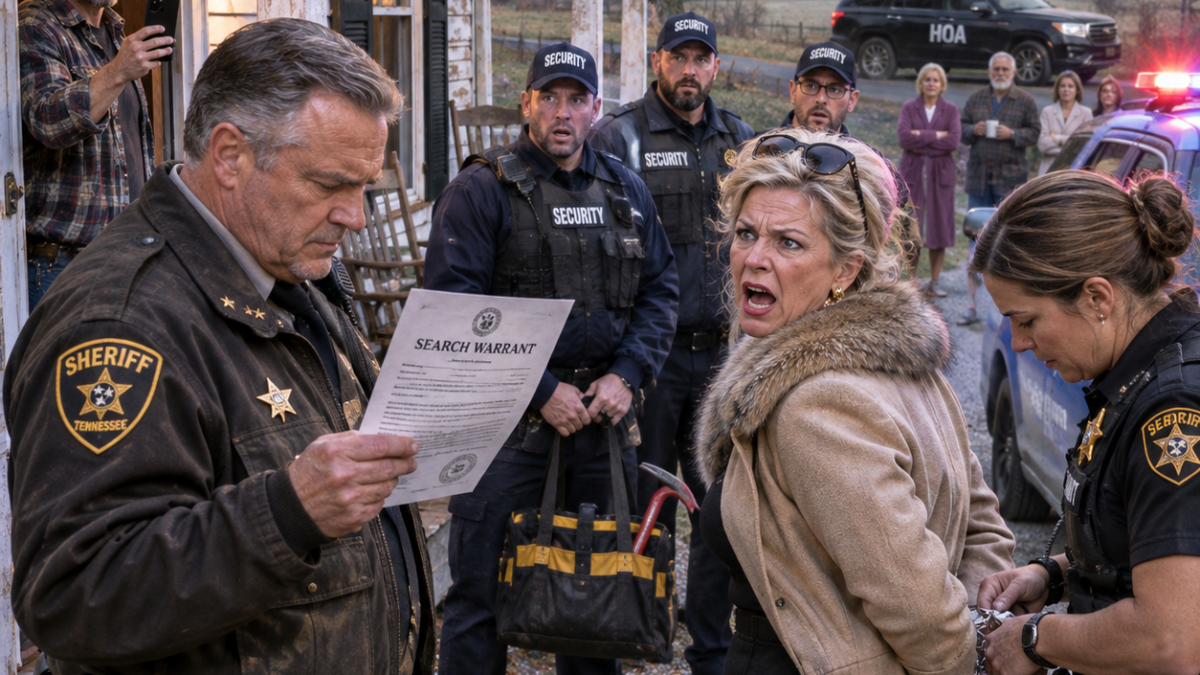
Tucker immediately held up a sheet of paper.
Round blue seal.
Typed case number.
Printed caption.
Large heading:
SEARCH WARRANT.
“County search warrant,” Tucker said. “We’re authorized to enter and inspect the property.”
“Which county agency are you with?”
He ignored that.
“Open the door.”
“Which department?”
“Sir, this is a lawful court order.”
I looked at the paper.
There was enough visible through the gap to see a judge’s signature.
Then Tucker said something that made every muscle in my body tighten.
“We need access to every room, including the study at the end of the hall.”
I stared at him.
Nobody outside the house should have known about that study.
It was not visible from the front.
It wasn’t mentioned in any HOA correspondence.
And the steel filing cabinet inside it was definitely nobody’s business.
I looked past Tucker.
Across the road sat a black SUV.
Engine running.
Driver window down.
Priscilla Thorne watched from behind the wheel.
She was sixty-two, silver-haired, always perfectly dressed, and carried herself with the confidence of someone who had spent years discovering that most people would rather comply than fight.
She saw me looking.
Then got out.
She crossed partway up my gravel drive.
Not onto the porch.
Close enough to hear.
“Bennett,” she called, “this has gone far enough.”
Tucker kept the paper raised.
Priscilla continued.
“You ignored association notices. You refused inspections. You obstructed board authority.”
“My property isn’t in your HOA.”
“That excuse is over.”
“Not an excuse.”
“A judge disagrees.”
Tucker pushed the paper closer to the gap.
Priscilla smiled.
“Resisting a search warrant is not an HOA matter anymore.”
I looked at Tucker.
“Which judge signed it?”
He frowned.
“What?”
“Read the name.”
“Open the door.”
“Read the name.”
Priscilla said:
“Bennett, cooperation is no longer optional.”
I looked at the paper again.
Something inside me had already changed.
Not fear.
Recognition.
There are moments when your brain notices a detail before you understand why it matters.
Tucker shifted the paper toward the light.
“Judge Amos Belridge.”
I stopped.
Then asked:
“When was this issued?”
“Yesterday.”
I almost laughed.
Not because anything was funny.
Because I knew that name.
Anyone in Blackstone Hollow who read local news knew it.
Judge Amos Belridge had died eleven months earlier.
Heart attack.
His photograph had been on the front page.
County courthouse flags lowered.
Public memorial.
I stepped back.
Tucker put his shoulder against the door.
The security chain snapped tight.
“Do not push my door.”
“You have thirty seconds to comply.”
Dustin opened the tool bag.
Steel pry bar.
That confirmed it.
I raised my phone.
“You are being recorded.”
Priscilla called from the driveway:
“He’s obstructing.”
I dialed 911.
The dispatcher answered.
I spoke clearly.
“My name is Bennett Ralston. Three private security guards are threatening to force entry into my home using what they claim is a county search warrant.”
Tucker said:
“You’re wasting everyone’s time.”
I continued giving the address.
Then added:
“The document is signed by Judge Amos Belridge.”
Pause.
The dispatcher knew too.
“Sir, officers are being sent now. Do not open the door.”
“I won’t.”
I switched my security footage to cloud backup.
Multiple copies.
Independent server.
Not connected to the HOA.
Not connected to the house computer.
On camera, Dustin glanced toward Priscilla.
She raised two fingers and pointed toward my door.
Tucker pulled the pry bar out.
Levi looked uncomfortable.
“We should wait,” he said quietly.
Tucker snapped:
“We have orders.”
Priscilla heard him.
“No one leaves.”
She walked directly into view of my porch camera.
That became important later.
She looked toward the lens.
Then toward me.
“Bennett Ralston is refusing a lawful court order.”
She thought she was creating evidence.
She was.
Just not the kind she wanted.
Sirens sounded at the bottom of the hill.
Priscilla smiled.
Actually smiled.
She believed law enforcement was arriving to finish her work.
The first cruiser stopped.
Sheriff Franklin Eddings stepped out.
Sixty.
Broad shoulders.
Gray at his temples.
Thirty years in county law enforcement.
A man known for speaking softly enough that angry people often lowered their own voices just to hear him.
Deputy Eliza Cantrell arrived behind him.
Priscilla hurried forward before either officer reached my porch.
“Sheriff.”
She held out the document.
“I need you to arrest this man for obstructing a lawful search.”
Franklin took the paper.
Said nothing.
Read the header.
Case number.
Address.
Scope.
Then his eyes reached the signature.
He stopped.
Completely.
He read it again.
Priscilla continued talking.
“These men are contracted enforcement for the association. Mr. Ralston has repeatedly—”
Franklin raised one finger.
Silence.
He looked at her.
“Ma’am, where did you get this?”
“Our legal consultant.”
“Name?”
Pause.
“I’d rather have counsel present before—”
Franklin looked toward Eliza.
“Call the clerk.”
Eliza stepped away with her radio.
Tucker shifted.
Dustin looked at the ground.
Levi had already moved two steps away from the door.
Franklin looked at the date.
Then at the signature.
Finally:
“Judge Amos Belridge died eleven months ago.”
Nobody spoke.
Priscilla blinked.
“What?”
Franklin turned the warrant toward her.
“This says he signed it yesterday.”
That was the moment her control vanished.
Not slowly.
Instantly.
Priscilla reached for the paper.
Franklin pulled it back.
“Don’t touch this.”
“I was given that document.”
“By whom?”
“A courthouse contact.”
“Name.”
She said nothing.
Eliza returned.
“No warrant. No case number. Nothing issued for this address.”
Franklin looked at the three guards.
“Move away from the house.”
Tucker started:
“Sheriff, we were told—”
“Step away.”
They did.
Franklin handed the fake warrant to Eliza.
“Evidence bag.”
Then he looked at Priscilla.
“Why would an HOA president possess a search warrant?”
“Our association has enforcement authority.”
“No, ma’am.”
“Our security contract—”
“Private security cannot execute judicial search warrants.”
Her face reddened.
“We were protecting the community.”
“By entering a house outside the HOA?”
She stared at him.
I opened my door fully for the first time.
Franklin looked at me.
“You okay?”
“Yes.”
“Anybody enter?”
“No.”
“Damage?”
“Door frame. Possibly lock.”
He nodded.
“Stay there.”
Then he spoke to Tucker.
“Hand me everything you planned to use inside this house.”
Tucker’s confidence collapsed.
“We didn’t know it was fake.”
“That wasn’t my question.”
Dustin swallowed.
Levi spoke first.
“I told them we should wait.”
Tucker snapped toward him.
“Shut up.”
Franklin said:
“No. Everybody talks. Separately.”
Eliza moved Levi toward one patrol car.
Dustin toward another.
Tucker remained near the porch.
I handed Franklin my phone.
“Video.”
He watched.
First clip.
Tucker claiming authority.
Second.
Steel bar against the door.
Third.
Priscilla ordering them forward.
Fourth.
Priscilla saying I was defying a court order.
Franklin watched everything without expression.
Then came the audio:
Priscilla telling the guards not to wait.
Telling them to proceed.
Franklin handed my phone back.
“Back this up.”
“Already done.”
He nodded.
Priscilla said:
“This is ridiculous.”
Franklin turned.
“You arrived at a private home with a forged judicial document.”
“I didn’t forge it.”
“You used it.”
“I believed it was legitimate.”
“To authorize three private guards to search a house?”
Silence.
“What were they searching for?”
“Association property.”
“What property?”
She did not answer.
That was when Dustin broke.
Not fully.
Not yet.
But enough.
He looked toward Priscilla.
She looked back.
Then hissed:
“Don’t say a word about the office.”
Franklin heard it.
So did Eliza.
So did I.
Franklin looked at his deputy.
“Write that down.”
Dustin’s face went pale.
“I need to tell you something.”
Priscilla said:
“No.”
Franklin stepped between them.
“You don’t speak to him.”
Dustin pointed toward his tool bag.
“There’s something inside.”
Eliza put on gloves.
Opened the bag.
Inside:
Steel pry bar.
Flashlight.
Gloves.
Zip ties.
A sealed envelope.
Eliza removed the envelope.
Inside was a black USB drive.
Franklin held the evidence bag up.
“What is this?”
Dustin stared at the gravel.
“We weren’t just supposed to search.”
Priscilla turned away.
Franklin waited.
Dustin continued.
“If the blue box wasn’t there, I was supposed to leave that inside.”
My stomach tightened.
“Where?”
“Under his desk.”
Franklin’s face changed.
“Why?”
“So police would find it later.”
I looked at Priscilla.
For seven months, she had tried to control my fence.
My door.
My cameras.
My repairs.
Now I understood none of that had been the real fight.
Franklin looked at me.
“Mr. Ralston, I think we need to talk.”
Priscilla was arrested that morning.
Use of a forged judicial document.
Conspiracy related to attempted unlawful entry.
Additional charges pending investigation.
She protested the entire time.
“You cannot arrest me.”
Franklin stared.
“You run a homeowners association.”
Then:
“Not the county.”
Eliza turned Priscilla around.
Handcuffs clicked.
Neighbors had gathered along the road.
Robes.
Sweatpants.
Coffee cups.
Phones.
People who had watched Priscilla preside over meetings for years now watched her enter a patrol car.
She turned toward me.
“You set this up.”
I almost laughed.
“You came to my house with a fake warrant.”
“You stole association records.”
“I called the real sheriff.”
That was all I said.
Tucker was detained.
Levi and Dustin separated.
Following orders would not erase what they had done.
But cooperation would matter later.
The sheriff’s office took statements.
Photographed my door.
Collected the fake warrant.
Tool bag.
Phones.
USB drive.
By ten-thirty that morning, I sat across from Franklin at the sheriff’s office.
I brought a file box.
Franklin looked at it.
“You came prepared.”
“I audit for a living.”
“Used to?”
“Consulting now.”
He smiled slightly.
“Then audit this for me.”
I started at the beginning.
The deed.
No HOA membership.
The registration fee.
Fence fines.
Trash fines.
Porch repair fines.
Demand to remove my road-facing camera.
Then the letters changed.
Three weeks earlier, Priscilla had stopped caring about aesthetics.
Her letters became about access.
Inspection rights.
Association documents.
The study.
Franklin noticed immediately.
“What changed?”
I took a breath.
“Eloise Farrow.”
“Who?”
“Former HOA bookkeeper.”
That story began two months earlier.
Eloise had sold me the farmhouse.
Sixty-eight.
Sharp-eyed.
Quiet.
The kind of woman who remembered dates without checking calendars.
She called one evening after I mentioned Priscilla’s fines.
Then asked:
“Have you renovated the back study?”
Strange question.
“No.”
“The built-ins still there?”
“Yes.”
“Don’t touch them.”
“Why?”
“I need to show you something.”
She arrived forty minutes later.
Walked into the study.
Pressed on the bottom panel of a built-in cabinet.
Hidden hinge released.
Behind the wood was a narrow compartment.
Inside:
Blue metal file box.
I stared.
“What is this?”
Eloise sat down.
“Insurance.”
“For whom?”
“I wasn’t sure.”
She had served as Ashford Pines bookkeeper for nearly ten years.
Then resigned after repeated fights with Priscilla.
Before leaving, Eloise had copied records she believed showed serious financial irregularities.
She did not trust the HOA office.
So she hid them.
In the farmhouse.
Because the previous owner—her brother—had let her use the study for bookkeeping years earlier.
I opened the first folder.
ASHFORD PINES EMERGENCY RETAINING WALL FUND
$1,700,000.
Fourteen months earlier, homeowners had been charged a special assessment.
Emergency retaining walls.
Drainage work.
Slope stabilization.
Residents paid because heavy rain had already pushed soil toward several properties.
According to HOA reports, work was substantially complete.
So I walked the slope.
Nothing.
A few survey stakes.
Old temporary fencing.
No retaining wall.
No major drainage.
No completed stabilization.
Back home, I reviewed invoices.
Construction management.
Materials.
Engineering.
Consultants.
Hundreds of thousands.
Then patterns.
Related mailing addresses.
Repeated invoice formatting.
Round-number bills.
No delivery tickets.
One company:
Thorn Civic Restoration.
Thorn.
Not Thorne.
Close enough to avoid casual attention.
Too close for me.
I searched state business filings.
Ownership connected through another company to Priscilla.
That was when I stopped treating her HOA letters as harassment.
They became pressure.
I contacted Ruthie Bledsoe.
HOA board member.
Former school administrator.
One of the only people who had questioned the retaining-wall spending.
She told me board members never saw complete contracts.
Only summaries.
When she requested originals, Priscilla cited confidentiality.
Homeowners saw glossy progress photographs.
No one verified where the photographs had been taken.
Eloise and I contacted the county auditor.
We prepared the records.
Then word leaked.
Priscilla called an emergency board meeting.
She accused an unnamed outsider of stealing confidential records.
I attended as Ruthie’s guest.
Security removed me.
At the doorway, I said:
“If every dollar was spent properly, an independent audit helps you.”
Several homeowners looked at one another.
Priscilla stared at me.
Then said:
“I will use every legal tool available to recover association property.”
That had been four days before the fake search.
Franklin listened.
Then asked:
“Where’s the blue box now?”
I slid a receipt across his desk.
County Auditor’s Office.
Received 3:40 p.m. previous day.
Original records transferred.
Chain of custody.
Eloise and Bennett Ralston listed as deliverers.
Franklin stared.
“She sent men to steal records that had already left your house.”
“Yes.”
“Does she know?”
“Probably not.”
From the adjoining interview room, voices.
Dustin was talking.
We learned the rest within hours.
Priscilla had given him the USB personally.
Instructions:
Find blue box.
If box gone, tape USB beneath Bennett’s desk.
Then Priscilla would file a complaint accusing me of stealing homeowner financial data.
Police would “discover” the drive.
I would become suspect.
Audit discredited.
Original copies framed as stolen.
Attention diverted.
Simple.
Ugly.
Almost clever.
Except the original documents were already in county custody.
And the planted evidence never entered my house.
Levi confirmed hearing the instruction.
Tucker’s work messages included:
Priority item is blue archive box.
Nothing about fences.
Safety.
Inspections.
HOA violations.
Financial records.
That one sentence destroyed the excuse that this was ordinary community enforcement.
Digital forensics examined the drive.
A folder:
RALSTON EVIDENCE PACKAGE FINAL.
Inside:
Fabricated spreadsheets.
Fake access logs.
Draft statement accusing me of unauthorized system access.
One note:
Deliver after search. Use if original records cannot be recovered.
Franklin read it twice.
Then looked at Eliza.
“She didn’t just want his records.”
Eliza nodded.
“She wanted him framed.”
The financial investigation began immediately.
County auditor.
Sheriff’s financial crimes unit.
District Attorney Dana Larkins.
Subpoenas.
Bank records.
Vendor histories.
HOA computers.
Priscilla posted bond two days later.
Ashford Pines split into camps.
Some residents were furious.
Others defended her.
That is how power survives longer than truth.
People invest emotionally in believing the person who led them was legitimate.
Admitting otherwise means admitting you trusted the wrong person.
Priscilla’s attorney released a statement.
She believed the warrant was lawful.
She had been misled by an outside consultant.
Her actions were intended to protect homeowner records.
Then Priscilla began telling residents I was a bitter outsider.
A thief.
A man who hated the HOA.
Someone exploiting a technical error.
Technical error.
Dead judge.
Fake warrant.
Three guards.
Steel bar.
Planted evidence.
Technical error.
She also requested that the HOA pay her legal defense.
Ruthie asked one question at the next board meeting:
“Where is the board resolution authorizing a search of Bennett Ralston’s house?”
There wasn’t one.
No vote.
No minutes.
No legal opinion.
No authorization.
The board froze her access to association accounts.
Then Ruthie brought investigators another record.
The day before the attempted search, Priscilla had instructed bookkeeping staff to delete an old payment schedule tied to Thorn Civic Restoration.
Investigators recovered it.
Bank records did the rest.
Of the $1.7 million assessment, some money had paid for legitimate preliminaries.
Surveys.
Engineering.
Small drainage work.
But large sums had gone to entities with little or no corresponding work.
Thorn Civic Restoration received major payments.
Then money moved into accounts benefiting Priscilla.
Investment account.
Property expenses.
Personal purchases.
The paper trail sharpened.
Then came the HOA office computers.
Forensic exam found versions of the fabricated USB documents saved under Priscilla’s own user profile.
Creation timestamps:
Hours before the raid.
Drafts.
Edits.
Names.
My name inserted repeatedly.
She had created the evidence herself.
Tucker held out longest.
He claimed he believed the search was legal.
Investigators showed him:
Video of the pry bar.
Messages about the blue box.
No warrant verification.
Levi’s statement.
Dustin’s statement.
Finally he admitted Priscilla had told him to retrieve the financial records before they reached auditors.
“No matter what it takes.”
That phrase went into the report.
Then investigators recovered one spreadsheet that made the financial case explode.
Two columns.
REPORTED SPENDING.
ACTUAL TRANSFERS.
The first matched homeowner presentations.
The second showed where money really went.
Different numbers.
Different recipients.
Different reality.
Construction invoices for walls that did not exist.
Material charges with no deliveries.
Consulting fees to businesses with no employees.
And payments to entities connected to Priscilla.
Dana Larkins looked at the spreadsheet and said:
“Now we know why she needed the warrant.”
Ashford Pines called a special meeting.
This one was full.
People stood along walls.
Homeowners who had never attended a meeting came because they wanted to know where their money had gone.
I was invited.
Could not vote.
Not an HOA member.
That fact became almost funny by then.
The woman had spent months pretending I belonged to her HOA.
Now the HOA was formally acknowledging that I did not.
Priscilla arrived with her attorney.
Perfect suit.
Perfect posture.
But something had changed.
People did not stand to greet her.
Ruthie opened the meeting.
She showed the audit.
No inflammatory language.
No accusations beyond documented findings.
Amount collected.
Amount supported by valid work.
Amount unsupported.
Vendor connections.
Missing construction.
Then photographs of the slope.
No wall.
No drainage.
Just red clay.
Residents started murmuring.
Priscilla stood.
“This entire crisis began because an outsider stole our private records.”
That was my cue.
I walked forward with a thin folder.
Not the blue box.
Three things.
My deed.
Her violation letters.
Sheriff’s report.
First slide:
Property map.
“My house is not part of Ashford Pines.”
Someone laughed nervously.
I continued.
“For seven months, Ms. Thorne used HOA authority against property the HOA did not govern.”
Next slide.
Her letters demanding inspection.
Then:
Security footage.
Tucker at the door.
County search warrant.
Open the door.
Priscilla in my driveway.
Cooperation is no longer optional.
Pry bar.
Thirty seconds.
Then sheriff’s arrival.
Priscilla saying:
Arrest this man.
Finally:
Franklin’s voice.
Judge Amos Belridge died eleven months ago.
The room was silent.
Priscilla stood.
“I acted to protect this community.”
I looked at her.
“No.”
She stared.
“You used this community’s name to frighten people who trusted you.”
That was all.
The removal vote happened under the bylaws.
Overwhelming.
Priscilla lost.
Security contract with Tucker’s firm suspended.
Then terminated.
All financial accounts placed under multiple-signature controls.
Independent audit approved unanimously.
As people left, Priscilla approached me.
Her attorney remained near.
She stopped several feet away.
“You destroyed everything I built.”
Her voice was shaking.
I looked at her.
“No.”
Pause.
“I opened the door so everybody could see what you built it with.”
She left.
The criminal case moved slowly.
Forgery.
Attempted unlawful entry.
Conspiracy.
Evidence fabrication.
Financial fraud.
Theft-related charges.
People asked me constantly:
“Is she going to prison?”
I stopped answering.
Because that question can become a distraction.
The important thing was the evidence being processed properly.
Not revenge.
Not headlines.
At the preliminary hearing, Dana laid out the fake warrant.
The dead judge’s signature.
The security footage.
The USB.
Guard testimony.
The blue-box instructions.
She told the court:
“This was not an HOA dispute. It was an attempt to borrow the appearance of judicial authority to enter a private home and remove or manufacture evidence.”
The judge ordered the case forward.
Priscilla walked out without her title.
Without HOA control.
Still fighting.
My own damage was less dramatic but real.
Front lock destroyed.
Door frame bent.
Consulting work delayed.
One client called and asked whether I was under investigation for stealing HOA data.
That conversation made me furious in a way the broken lock never did.
A damaged door can be repaired.
A lie attached to your name travels.
I hired a civil attorney.
Demanded corrections.
Documented lost income.
But I did not post homeowners’ records.
Did not leak files.
Did not confront Priscilla.
Did not retaliate.
People expected me to.
I refused.
Evidence makes better noise than anger.
Ten months after the fake search, Priscilla’s trial began.
The courtroom was full.
Homeowners.
Reporters.
Former board members.
Eloise sat beside me.
Ruthie behind us.
Franklin testified.
Eliza testified.
Dustin.
Levi.
Tucker eventually too.
The prosecution began with the warrant.
Large image projected.
Judge Amos Belridge.
Date.
Eleven months after his death.
Then courthouse confirmation.
No warrant.
No case number.
No application.
Next:
Security footage.
Three guards.
Uniforms.
Pry bar.
Orders.
Then the USB.
Forensic timeline.
Files created hours before the raid.
Office computer drafts.
My name inserted.
Fake access logs.
Next:
Dustin’s testimony.
“If the blue box wasn’t there, I was told to plant the drive under his desk.”
The defense attacked him.
Cooperation agreement.
Fear of prosecution.
Self-interest.
Fair questions.
Then Levi testified independently.
Same instruction.
Then Tucker’s messages.
Priority item blue archive box.
Then Priscilla’s own computer files.
Harder to explain away.
Finally, money.
$1.7 million.
Reported spending.
Actual transfers.
Thorn Civic Restoration.
Related companies.
Bank accounts.
Assets.
No retaining wall.
Dana’s closing argument was simple.
Priscilla had not forged a warrant because she cared about mailbox colors.
She needed documents.
Those documents threatened her.
She tried to take them.
When she learned they might already be gone, she prepared fake evidence to redirect police toward me.
The forged warrant was not the whole crime.
It was the tool connecting the intimidation to the fraud.
The defense argued poor management.
Bad advice.
Overzealous security.
Financial confusion.
They said Priscilla had trusted consultants.
They said she never personally intended violence.
They said no one actually entered my house.
All technically relevant.
None answered the records.
The jury returned guilty verdicts on the major counts.
Priscilla Thorne was sentenced to seven years in prison. Restitution and recovery orders followed, including collection against assets tied to the stolen association funds.
Tucker faced separate consequences for leading the attempted forced entry.
Dustin and Levi were held accountable according to their roles, with their cooperation considered.
The security company lost its HOA contract and underwent licensing review.
My civil case ended in an $86,000 settlement covering property damage, lost consulting income, and legal expenses. More important to me, the settlement formally recognized that my property sat entirely outside Ashford Pines authority.
Every HOA fine disappeared.
Every inspection demand withdrawn.
No future board could claim control over my house based on Priscilla’s invented authority.
Ashford Pines elected new leadership.
Ruthie joined the reform board.
Independent audits became annual.
Vendor relationships had to be disclosed.
Major payments required multiple approvals.
Financial reports became accessible to homeowners.
And eventually, after years of collected money and excuses, construction began on the retaining wall.
Real crews.
Real concrete.
Real drainage.
I went to watch once.
Only once.
Eloise stood beside me.
She smiled.
“Imagine that.”
“What?”
“A wall.”
I laughed.
“What an innovation.”
The recovered funds did not make every homeowner whole immediately.
Some money was gone.
Some assets had to be sold.
Some restitution took time.
But at least people finally knew where the money had gone.
That mattered.
One crisp autumn morning, almost two years after I bought the farmhouse, I was in the front garden pulling blackberry roots.
The front door had been repaired.
New frame.
New deadbolt.
Stronger hinges.
No HOA notices on the gate.
No security trucks.
No black SUV across the road.
Eloise drove up.
She carried the final audit report.
“People asked me to give you this.”
I wiped dirt from my hands.
“What is it?”
“Final accounting.”
I flipped through.
Then closed it.
“Keep it.”
“You don’t want it?”
“I’ve read enough HOA accounting.”
She laughed.
Then became serious.
“A lot of residents wanted me to tell you thank you.”
“For what?”
“For not dropping it.”
I looked toward Ashford Pines.
Kids riding bicycles.
Someone mowing.
Ordinary life.
“I wanted them to leave me alone.”
“I know.”
“That’s literally all I wanted.”
“Sometimes that’s how these things start.”
A patrol car came slowly up the road.
Franklin.
He rolled down the window.
“Morning.”
“Sheriff.”
“Everything peaceful?”
“Almost suspiciously.”
He nodded toward the front door.
“New lock?”
“Best one I could find.”
“No more search warrants, I hope.”
I smiled.
“Only if a living judge signs one.”
Franklin laughed.
Then drove away.
I stood there for a while.
Looking at the house.
For a long time after the raid, I hated the front door.
Not logically.
Emotionally.
Every heavy knock tightened my shoulders.
Every vehicle slowing near the drive made me look up.
That bothered me.
Priscilla had never entered.
Yet for a while, she had changed how my own house felt.
That was the violation that took longest to repair.
Not wood.
Safety.
Eventually, it came back.
Slowly.
I stopped checking cameras every hour.
Stopped expecting another letter.
Stopped sleeping lightly.
The study became a study again.
The hidden compartment remained empty.
I kept it that way.
Not everything needs to hold evidence.
Some spaces are allowed to be empty.
That winter, the first real rainstorm hit Blackstone Hollow.
I drove past Ashford Pines.
Water ran cleanly through the new drainage channels.
Behind several homes, the completed retaining wall stood exactly where $1.7 million had supposedly put it years earlier.
Concrete does not look dramatic when it works.
Neither does honest accounting.
Neither does a valid court order.
That may be the lesson I carried from the whole thing.
Real authority is usually less theatrical than fake authority.
A real warrant does not need an HOA president standing in your driveway shouting.
Real deputies do not need private guards with fake star patches.
Real evidence does not need to be planted beneath a desk.
Real construction leaves something standing when the invoices say it is complete.
And real law does not become more powerful because somebody waves a blue seal in your face.
Priscilla believed paperwork was power.
In some ways, she was right.
Paper can transfer land.
Move money.
Authorize searches.
Send people to prison.
But only when the paper is real.
She spent years creating documents she expected nobody to examine closely.
Invoices.
Vendor reports.
Violation notices.
Fake records.
Eventually, a warrant.
She assumed the seal would frighten me.
She assumed the uniforms would make me open the door.
She assumed nobody would read the signature carefully enough to notice the dead man’s name.
That was her mistake.
My entire career had taught me to read the line people hoped I would skip.
The morning three guards stood on my porch, I never needed to threaten them.
Never needed to fight them.
Never needed a gun.
Never needed to push anyone off my property.
I needed a camera.
A locked door.
A phone.
And enough patience to let the real sheriff read what she had put on paper.
Priscilla Thorne believed a forged signature could give her authority over my home.
Instead, that dead judge’s signature became the first thread investigators pulled.
Behind it came the fake warrant.
The planted USB.
The blue box.
The false invoices.
The shell companies.
The missing $1.7 million.
And finally the truth.
The house was never hers.
The money was never hers.
The law was never hers.
And neither was the right to decide when my front door opened.








