HOA Karen Seized 144 Bee Hives as “Abandoned”—Then 18 Farmers Sued When Her $20M Luxury Scheme Was Exposed
PART2:
The north block of Wilcox Orchard spread in front of him, forty-six acres inherited through three generations.
The trees were beginning to flower.
White and pink buds opening along the branches.
Every year, that moment made him feel the same combination of pride and fear.
A farmer did not really own spring.
He negotiated with it.
Frost.
Rain.
Wind.
Pollination.
Disease.
One wrong week could rewrite an entire year.
That was why the hives mattered.
Thatcher walked toward the apiary yard.
Then stopped.
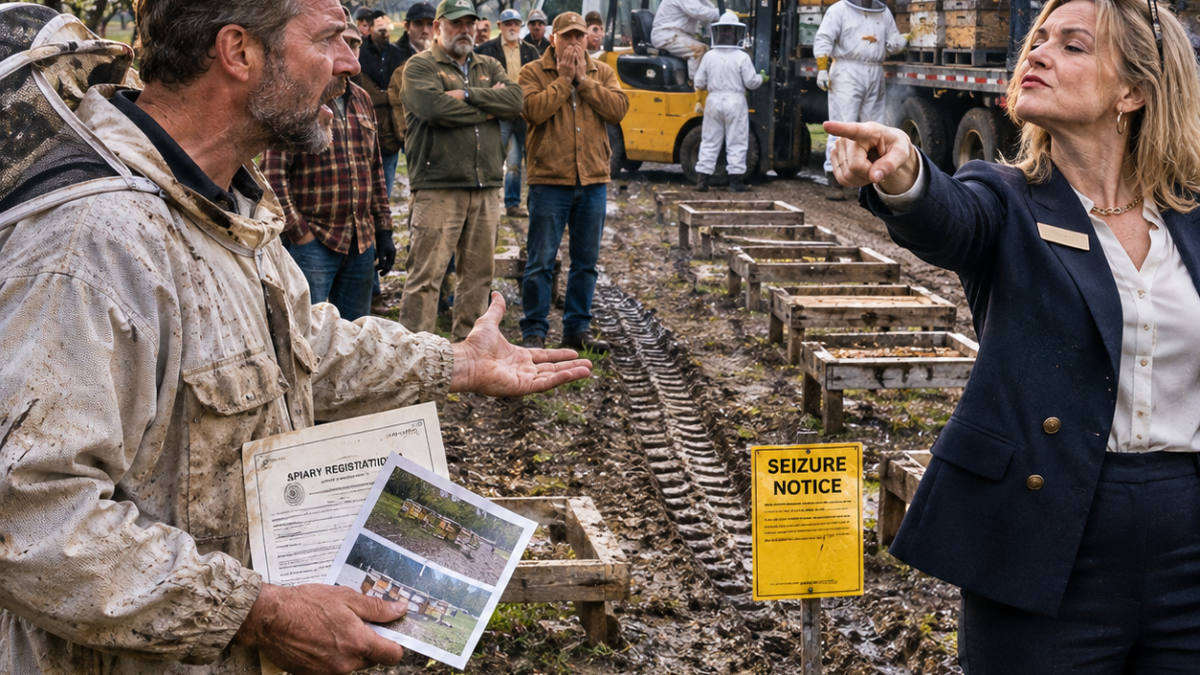
All 144 were gone.
Not knocked over.
Not damaged.
Gone.
The wooden pallets remained.
PART3:
Flattened grass marked where the boxes had stood.
Deep tire tracks curved through the wet orchard floor.
A few dozen confused bees circled above the empty stands.
Lost foragers.
They landed.
Lifted.
Moved from pallet to pallet as if searching for a city that had vanished overnight.
For several seconds Thatcher could not understand what he was looking at.
The number was too large.
One hive stolen was possible.
Five was possible.
Maybe teenagers, maybe vandals, maybe another beekeeper doing something stupid.
One hundred forty-four colonies required trucks.
Equipment.
Planning.
People who knew how to move bees without killing themselves.
Then Thatcher saw the sign.
Bright yellow.
Staked in the center of the lane.
ABANDONED PROPERTY
REMOVED BY ORDER OF SILVER CREST RIDGE HOA
AUTHORIZED BY PRESIDENT YVETTE BRADDOCK
He read it once.
Then again.
His first reaction was not anger.
It was disbelief so complete that anger had nowhere to land.
“Abandoned?”
He said it aloud.
He looked at the empty stands.
Then at the flowering trees.
Then back at the sign.
Those hives had been inspected four weeks earlier.
Fed.
Treated.
Tagged.
Registered.
Scheduled for pollination contracts beginning that morning.
Abandoned was not an inaccurate description.
It was a lie.
His phone buzzed.
Harper Oaks.
Pear grower.
Thatcher stared at the name.
He knew before answering.
“Morning.”
“Where are you?”
“My orchard.”
“My first blocks are opening.”
“I know.”
“Your trucks were supposed to be here by six.”
Thatcher looked at the empty apiary yard.
“They took the bees.”
Silence.
“What?”
“The HOA.”
“What do you mean the HOA took the bees?”
“I don’t know yet.”
Harper’s voice hardened.
“Thatcher.”
“I’m looking at empty pallets.”
“You’re joking.”
“I wish I were.”
Her breathing changed.
“How many?”
“All one forty-four.”
Another silence.
Then:
“My pears are open.”
“I know.”
“I have maybe four days before peak bloom starts sliding.”
“I know.”
“What am I supposed to tell my crew?”
Thatcher closed his eyes.
“I’ll call you within the hour.”
“That’s not an answer.”
“No.”
“It isn’t.”
She hung up.
The phone buzzed again.
Cherry grower.
Then apple cooperative.
Then another pear farm.
Delivery confirmations.
Questions.
Where are the colonies?
Truck schedule?
ETA?
Thatcher ignored the calls for three minutes.
Not because he did not care.
Because he understood something immediately.
If he started arguing before he documented, Yvette would control the story.
She had always been good at that.
So Thatcher did the hardest thing his anger allowed.
Nothing impulsive.
He photographed the scene.
Every empty pallet.
Every tire rut.
Every boot impression he could see.
The yellow sign.
The disturbed grass.
He pulled the hive inventory from his truck.
Serial numbers.
144 boxes.
Each burned into the wood with a metal branding tool.
WILCOX APIARY.
Numbers beneath.
He photographed the ledger too.
Then he walked to the equipment shed and removed the security-camera memory card.
The camera had been installed after someone stole copper wire from the irrigation pump the previous summer.
Thatcher had almost taken it down after harvest.
Now it showed three trucks entering the orchard at 2:17 a.m.
Headlights off.
The first was a flatbed.
Second had a small forklift trailer.
Third carried netting and pallets.
Five workers wore bee suits.
They did not stumble.
They did not improvise.
They moved like people who had done this before.
Smoke.
Clamp.
Lift.
Strap.
Load.
Hive after hive.
The work took more than an hour.
Thatcher paused the footage.
Zoomed.
The third truck had a company name.
ASCEND EXHIBITION & DISPLAY LOGISTICS.
Below it:
MUSEUMS • EVENTS • INSTALLATIONS
Thatcher stared.
“Why the hell would an HOA hire an exhibition company to remove abandoned farm equipment?”
He rewound.
Paused again.
One worker carried paperwork.
Another photographed each load.
This was not trash removal.
It looked like a transfer.
He saved copies of the footage to three devices.
Then called his attorney.
Not a land-use specialist.
His regular business lawyer.
She listened for two minutes.
Then said:
“Thatcher, you need somebody who does agricultural commercial litigation.”
“You’re telling me to find another lawyer?”
“I’m telling you this is bigger than a property dispute.”
“How?”
“Because you don’t only own those hives.”
“You have contracts tied to them.”
“Third-party losses.”
“Potential intentional interference.”
“Possibly fraudulent paperwork if she is calling them abandoned.”
Thatcher looked at the sign.
“Any recommendations?”
“Parker Quinlan.”
“I’ve heard the name.”
“You should call before breakfast.”
Thatcher did.
Parker picked up on the fourth ring.
“Quinlan.”
“My name is Thatcher Wilcox.”
“Beekeeper?”
Thatcher paused.
“You know me?”
“I know your honey.”
Under different circumstances, Thatcher might have laughed.
“My HOA stole 144 hives last night.”
Parker stopped sounding amused.
“Say that again.”
Within twenty minutes, Parker understood enough to give one instruction.
“Do not confront her alone.”
“She took my bees.”
“I heard you.”
“Do not go to her house.”
“I wasn’t planning—”
“Yes, you were.”
Thatcher looked toward his truck.
He had been.
Parker continued.
“Preserve the scene.”
“Done.”
“Copy footage.”
“Done.”
“Inventory.”
“Done.”
“Good.”
“Now we find out where the colonies went.”
That was the beginning.
The fight with Yvette Braddock itself had begun four years earlier.
Silver Crest Ridge had been built along the northern boundary of Wilcox Orchard.
Luxury homes.
Stone gates.
Wide streets.
Views over the valley.
The developer marketed the neighborhood as “country living without country inconvenience.”
Thatcher had always thought that phrase told the entire story.
People wanted orchards in photographs.
Not tractors before dawn.
They wanted views of fields.
Not spraying schedules.
They wanted bees in wildflower brochures.
Not wooden hive boxes visible from walking trails.
Yvette moved into one of the first houses.
Fifty-three.
Former regional executive for a property-management company.
Within months, she became HOA president.
She had the sort of confidence that made requests sound like final decisions.
Her first letter to Thatcher concerned “visual clutter.”
The apiary was visible from several upper lots.
Could he build a screening fence?
Thatcher replied politely.
No.
The hives needed ventilation and morning sun.
Second letter:
Could he move them farther south?
No.
The location had been selected for wind protection, water access, orchard positioning, and truck loading.
Third letter:
The HOA had received concerns about bee safety.
Thatcher requested documented incidents.
None came.
He sent his insurance certificate.
State registration.
Apiary inspection.
Parcel map.
The hives sat hundreds of feet inside his land.
Not HOA property.
No jurisdiction.
Yvette responded:
Your refusal to cooperate is noted.
Thatcher printed it and put it in a folder labeled NONSENSE.
That folder became very thick.
At a county hearing about a walking trail, Yvette once told him:
“No luxury homeowner wants to stare at a bug farm.”
Thatcher answered:
“Then stop selling houses next to orchards.”
She never forgave him for saying it in public.
But the feud remained mostly paper.
Letters.
Complaints.
Occasional threats to contact county officials.
Until Silver Crest Ridge announced its expansion vision.
Crestline.
The project would sit farther up the valley on land connected financially to several investors who had also worked with Silver Crest’s developer.
Glass exhibition hall.
Luxury residences.
Event spaces.
Demonstration gardens.
Eco-tourism.
Pollinator education.
Thatcher barely paid attention.
Yvette sent him purchase offers for part of his orchard.
First:
$1.8 million.
Rejected.
Then:
$2.2 million.
Rejected.
Then:
$2.7 million for a portion plus future participation.
Rejected.
The orchard had belonged to his family since his grandfather planted the first commercial apple block.
Thatcher did not judge farmers who sold.
Land could become a burden.
Children moved away.
Taxes rose.
Margins tightened.
Every family decided for itself.
But he had no intention of selling.
Especially to Yvette.
The calls stopped.
The bee complaints increased.
Now, standing in the empty apiary yard, he understood that may not have been coincidence.
At nine that morning, Silver Crest Ridge held an “emergency community meeting.”
Yvette had scheduled it before Thatcher even knew his hives were missing.
That alone told him something.
He arrived wearing the same work jacket he had worn in the orchard.
Mud on his boots.
Parker had not yet reached the valley.
Thatcher sat in the back.
Yvette stood beside a projector screen.
A long-range photograph of his apiary appeared behind her.
REMOVAL OF ABANDONED HAZARDOUS EQUIPMENT
Yvette spoke calmly.
“Over the past several months, residents have reported swarming activity, aggressive bees, and deteriorating equipment adjacent to Silver Crest Ridge.”
Thatcher almost laughed.
Deteriorating?
Several hive boxes had been replaced that winter.
She continued.
“The association made repeated attempts to obtain cooperation from the neighboring property owner.”
Homeowners nodded.
Some looked worried.
Others looked uncomfortable.
Yvette said:
“The abandoned apiary represented a potential threat to children, pets, and community property values.”
That was enough.
Thatcher stood.
“Abandoned?”
Heads turned.
Yvette saw him.
Her expression tightened only slightly.
“Mr. Wilcox, this meeting is for Silver Crest Ridge members.”
“You removed my property.”
“We exercised rights related to hazardous abandoned equipment near the community.”
“On my land.”
“Property conditions can create external risks.”
Thatcher walked forward.
He placed three documents on the table.
State apiary health certificate.
Commercial insurance policy.
Pollination schedule.
“Those colonies were inspected last month.”
He tapped the schedule.
“They were supposed to begin moving to eighteen farms this morning.”
Yvette did not look down.
Instead:
“Security.”
A uniformed guard approached.
Thatcher smiled without humor.
“You had them taken at two in the morning.”
“Please leave.”
“Where are my bees?”
“Mr. Wilcox.”
“Where?”
Yvette looked directly at him.
“Property removed under the association’s nuisance procedure is no longer your concern until you comply with the resolution.”
Thatcher felt every eye in the room.
“What resolution?”
“The board’s.”
“Show me the vote.”
Yvette’s jaw tightened.
“Remove him.”
Thatcher allowed the guard to escort him out.
He would not give her video of him struggling.
In the parking lot, the community manager caught up.
“Mr. Wilcox.”
He held out papers.
“Official notice.”
Thatcher took them.
The document claimed:
72-hour removal demand.
Failure to comply.
Owner acknowledgment.
Thatcher scanned.
The mailing address was a post office box.
Not his.
Never had been.
Then the signature.
THATCHER WILCOX.
Electronic.
Fake.
He looked up.
“Where did you get this?”
The manager’s face changed.
“Administration sent it.”
“Who?”
“I don’t know.”
“You have an owner acknowledgment with my name.”
“Yes.”
“I never signed this.”
The man looked uncomfortable.
“You’ll need to discuss that with counsel.”
“Oh, I will.”
Thatcher walked toward his truck.
Yvette came onto the clubhouse porch.
“You should take the settlement, Thatcher.”
He turned.
“What settlement?”
“Stop the bees near Silver Crest Ridge.”
“We’ll consider returning what was removed.”
“You mean my property.”
“Call it what you want.”
“I want the location.”
Yvette folded her arms.
“By tomorrow, those bees won’t be your problem anymore.”
Something in her tone changed everything.
Not anger.
Certainty.
She knew what would happen next.
Thatcher got into his truck.
Did not answer.
He called Parker.
“Get here.”
By noon, the packing shed at Wilcox Orchard was full of angry farmers.
Eighteen of them.
Men and women in muddy boots, orchard jackets, work jeans.
Contracts in folders.
Phones ringing.
Spring waited for no lawyer.
Harper Oaks stood nearest the center table.
Fifty-two.
Ran 300 acres of pears with her brother and two adult daughters.
She had hired Thatcher for nine years.
Never missed a payment.
Never had a delivery problem.
Until now.
She laid her contract flat.
“I hired your bees.”
“I know.”
“I didn’t hire your war with that HOA.”
“I know.”
“Then tell me when I get colonies.”
Thatcher looked around.
“I can’t.”
Murmurs.
One farmer swore.
Another demanded his deposit.
Thatcher did not defend himself.
Their contracts were with Wilcox Apiary.
Not Yvette.
Not Silver Crest Ridge.
He was responsible.
Even if someone had stolen the colonies.
A cherry grower said:
“I found emergency bees out of Yakima.”
“Three times the rate.”
“And trucking.”
Another said:
“My bloom will be done before replacements arrive.”
Harper asked:
“How many reserve colonies do you have?”
“Thirty-two strong enough to move.”
“Eighteen farms need one forty-four.”
“I know.”
Someone near the back:
“Then we’re screwed.”
Thatcher looked at all of them.
“We’re not done.”
A grower snapped:
“Spring doesn’t care if you’re done.”
Thatcher nodded.
“No.”
“It doesn’t.”
That evening he drove to his bank.
By the next morning, he had pledged two pieces of farm equipment as collateral and wired a deposit for forty rental colonies from a supplier across the Cascades.
Expensive.
Painfully expensive.
Not enough.
But something.
Harper saw him signing loan documents on his truck hood.
She stopped.
“You’re mortgaging equipment?”
“Temporary line.”
“For us?”
“For my contracts.”
“That’s not what I asked.”
Thatcher signed.
“You want your bees or not?”
She watched him.
Then said:
“I was hard on you yesterday.”
“You were right.”
“That doesn’t mean I enjoyed it.”
“I didn’t enjoy hearing it.”
Harper almost smiled.
“Good.”
Thatcher handed every farmer a daily loss sheet.
Bloom stage.
Replacement cost.
Delivery delay.
Acreage affected.
Extra labor.
Temporary mitigation.
He explained:
“Write it when it happens.”
“Not three months later.”
“If this becomes litigation, memory is garbage.”
“Receipts aren’t.”
Harper flipped through the form.
“You expecting lawsuits?”
“I’m expecting Yvette to deny everything.”
He was right.
That night, Thatcher remembered the tracker.
He had installed a small GPS unit beneath one pallet after hive thefts increased in another county.
He almost never checked it.
The battery lasted months.
He opened the app.
Last signal:
4:08 a.m.
Thirty miles north.
Crestline construction site.
Thatcher stared.
Then laughed once.
No humor.
“Found you.”
At dawn, he drove.
Parker met him near the site.
They parked on the public shoulder.
Chain-link fence.
Construction equipment.
Half-finished glass structure.
New landscaping.
And a giant billboard.
COMING SOON
CRESTLINE POLLINATOR PAVILION
Underneath:
Luxury Living Rooted in Nature
The logo matched Silver Crest Ridge branding.
Thatcher felt sick.
They walked along the public right-of-way.
Then he saw them.
Hives.
Dozens.
Curving rows across freshly landscaped grass.
Soft blue.
White trim.
Decorative signs.
Someone had repainted his boxes.
His boxes.
Parker raised a camera.
“Serials?”
“Look at the ends.”
Fresh paint had not covered every burned number.
WILCOX 73.
WILCOX 81.
WILCOX 119.
Thatcher gripped the fence.
“She called them ugly.”
Parker kept photographing.
“What?”
“For four years.”
“She called them a bug farm.”
“She said they destroyed property values.”
He pointed toward the billboard.
“Now they’re selling luxury houses.”
The Crestline prospectus answered the question.
Pollinator conservation center.
Live demonstration apiary.
Guided tours.
Honey tastings.
Educational programs.
Eco-luxury branding.
The hives Yvette had declared hazardous were now marketing assets.
Parker said:
“This changes motive.”
Thatcher looked beyond the lawn.
Some hives were inside a temporary storage structure.
Doors partly shut.
Poor ventilation.
Bees clustered heavily near entrances.
Thatcher’s anger changed into alarm.
“They’re cooking them.”
“What?”
“Those colonies need airflow.”
“They’ve been moved, repainted, stacked.”
“Queens could be damaged.”
“Comb could overheat.”
He called the state apiary program immediately.
Then Parker called the court.
The freight company led them to Vernon Kaskey.
Forty-four.
Operations manager at Ascend Exhibition & Display Logistics.
He initially refused to discuss the job.
“Confidential contract.”
Parker said:
“We can subpoena it.”
Vernon looked at Thatcher.
Thatcher laid out:
Ownership records.
Serial list.
Health certificates.
Contracts.
Camera image.
Vernon read.
His face changed.
“We were told these were surrendered.”
“By who?”
“I can’t—”
Parker leaned back.
“Mr. Kaskey, someone may have used your company to transport stolen commercial livestock.”
Bees were not livestock in every legal context, but the phrase worked.
Vernon swallowed.
“The order came through Braddock.”
“Yvette?”
“Yes.”
“She said the equipment had been abandoned after notice.”
“Why 2:00 a.m.?”
“She said it had to be completed before daylight for safety.”
“Did that strike you as unusual?”
“Yes.”
“Why did you do it?”
“We move exhibits overnight all the time.”
“Trade shows.”
“Museum installations.”
“Sensitive loads.”
“She gave documentation.”
“Fake documentation.”
Vernon looked at Thatcher.
“I didn’t know.”
Thatcher believed him.
Mostly.
That did not make the damage disappear.
But responsibility had levels.
“Who ordered Crestline delivery?”
“Braddock.”
“Anything leaving there today?”
Vernon looked toward Parker.
“I’d have to check.”
As they left, a flatbed rolled through the gate.
Thirty-five hives.
Thatcher could see serials.
His.
Parker lifted his phone.
“That’s enough.”
Emergency motion filed that afternoon.
Judge Eleanor Halstead reviewed the papers.
Sixty-one.
Known for disliking theatrics.
Parker did not ask her to decide the whole case.
He asked one thing.
Freeze movement.
Preserve colonies.
Inspect health.
Judge Halstead granted a narrow temporary order.
No further transfer.
No sale.
No alteration.
Immediate state inspection.
The following morning, Thatcher arrived at Crestline with Parker, a court officer, and Della Huxley from the state apiary program.
Yvette stood at the gate in a long camel coat.
“You are sabotaging a project that benefits this entire region.”
Thatcher said nothing.
Parker handed the order to site security.
Della entered.
She checked serial numbers.
Brood.
Queens.
Feed stores.
Signs of disease.
Management condition.
Her conclusion was simple.
“These are active commercial colonies.”
“Recently maintained.”
“Not abandoned.”
Then the count.
Thirty-five missing.
Those had gone to a private nursery.
Of the 109 remaining, many were stressed.
Several queens damaged or missing.
Comb in some boxes softened from heat.
Bees clustered heavily.
Della looked furious.
“How long were they in that shed?”
Site staff did not know.
Thatcher opened one hive.
Looked.
His face tightened.
“This colony was strong last month.”
Della said:
“Not moving anywhere today.”
“They need stabilization.”
The victory tasted awful.
He had found them.
But finding bees after mishandling did not restore the pollination season.
That evening Harper called.
“Can you bring anything tomorrow?”
Thatcher stood alone in his kitchen.
He hated the answer.
“No.”
Silence.
“When?”
“I can’t promise.”
“Thatcher.”
“I won’t lie to you.”
Harper exhaled.
“Fine.”
Then softer:
“Don’t.”
Yvette’s lawyer sent an offer the next day.
Return usable hives.
In exchange, Thatcher signs a statement acknowledging the HOA acted in good faith for public safety.
Parker read further.
Release of claims.
All damages.
Known and unknown.
He looked at Thatcher.
“They want you to absolve them.”
Thatcher laughed.
“No.”
Parker smiled.
“Thought so.”
Yvette responded through counsel:
Any additional losses after this offer are Mr. Wilcox’s responsibility.
Parker said:
“She wants the record to show you refused mitigation.”
Thatcher looked at him.
“I’m moving them to recovery.”
“Exactly.”
They arranged a sheltered holding yard.
Experienced beekeepers.
State oversight.
Nutrition.
Ventilation.
Queen assessments.
Every action documented.
Then Parker found the document that changed the case.
AGRICULTURAL CONTRACT EXPOSURE ASSESSMENT.
Date:
Nine days before seizure.
Eighteen farms listed.
All by name.
Pollination dates.
Bloom windows.
Acreage.
Risk if colonies removed.
Potential third-party losses.
Parker read the final paragraph three times.
Then called Thatcher.
“Come here.”
Thatcher arrived at the office after dark.
Parker slid the report across the desk.
Thatcher read.
Harper Oaks.
East Bench Cherries.
Miller Apple Cooperative.
All eighteen.
“How did they get this?”
“Apparently through agricultural trucking correspondence tied to development planning.”
Thatcher looked at Parker.
“They knew.”
“Someone knew.”
“She knew.”
“We need proof she read it.”
Two days later, that proof started walking through Parker’s door.
Madeleine Stover.
Fifty-eight.
Former finance committee member at Silver Crest Ridge.
She carried a canvas bag filled with copies.
“I should have spoken sooner.”
Parker said:
“About what?”
“The meeting.”
“What meeting?”
“Closed session.”
“Yvette called it resolving agricultural obstacles.”
Madeleine looked at Thatcher.
“She talked about your land.”
“How?”
“She said your beekeeping operation made future acquisition difficult.”
Thatcher’s jaw tightened.
“She wanted the orchard?”
“Yes.”
“She said Crestline needed long-term control of the corridor.”
Madeleine pulled out a payment authorization.
Freight contract.
Finance approval.
Her signature.
She tapped it.
“I never signed this.”
Parker leaned forward.
“Are you certain?”
“I sign every committee authorization.”
“That is not mine.”
“Did you vote to seize hives?”
“No.”
“Did the board?”
“Not in any meeting I attended.”
Then emails.
For more than a year, Yvette had communicated with development partners.
Purchase strategy.
Boundary acquisition.
Visual nuisance pressure.
Economic leverage.
One email contained the sentence that made Thatcher sit back.
If Wilcox cannot maintain the pollination operation, he will eventually have to reconsider the land offer.
Another:
Beekeeping must become economically impractical on that parcel.
Thatcher placed both hands on Parker’s desk.
For years, he had believed Yvette hated the hives because they offended her sense of aesthetics.
That was true.
But it was not the whole truth.
The bees stood between Yvette and the orchard.
The contracts made Thatcher profitable.
Profit made him harder to pressure.
Remove the colonies during bloom.
Break the contracts.
Farmers lose trust.
Thatcher borrows money.
Business weakens.
Then the next purchase offer arrives.
It was not nuisance control.
It was economic pressure.
Harper organized the farmers again.
Same packing shed.
Same plywood table.
Different mood.
Nobody demanded refunds this time.
They had seen the documents.
Harper stood.
“We’re not suing Thatcher.”
One grower said:
“We might have to protect our contracts.”
“You protect them against the person who interfered.”
Parker explained carefully.
“Each farm has different damages.”
“Different acreage.”
“Different mitigation.”
“Different yields.”
“We do not invent one giant number.”
“We prove each case.”
Eighteen farms.
Eighteen lawsuits.
Coordinated evidence.
Not one dramatic class action where everyone pretended the losses were identical.
Thatcher built binders.
One for each farm.
Original contract.
Delivery date.
Bloom stage.
Rental cost.
Replacement colonies.
Labor.
Yield comparison.
Historical production.
Agronomist notes.
Appraisal.
Every dollar he borrowed to reduce harm.
Every colony he sourced.
Every truck mile.
Parker sent preservation notices everywhere.
HOA.
Management company.
Freight company.
Crestline developer.
Nursery.
Lender.
No deletions.
No destroyed emails.
No missing records.
Yvette responded publicly.
Press conference.
Clubhouse steps.
Cameras.
She held a folder.
“These bees were diseased.”
Thatcher watched from his kitchen.
He stopped moving.
Yvette continued.
“The association acted to prevent a serious agricultural health threat.”
Thatcher whispered:
“Oh, you idiot.”
Parker, watching beside him, said:
“She just made colony health central.”
“That’s bad.”
“For her if she’s lying.”
Yvette showed photographs.
Discolored brood.
Sunken caps.
Textbook disease.
The story spread.
Homeowners panicked.
Farmers called Thatcher.
Regional television asked:
Were diseased colonies moving through orchards?
If true, the consequences could be serious.
Harper arrived at Thatcher’s house.
No hello.
“Your word isn’t enough anymore.”
“I know.”
“I need independent results.”
“You’ll have them.”
Della Huxley inspected recovered colonies fully.
Samples went to a state lab.
Results did not support Yvette’s disease claims.
The weaknesses were consistent with transport stress, overheating, damaged queens, and improper storage.
Then Della noticed the photographs.
“No serials.”
Parker traced them.
Educational bee-disease guide.
Public images.
Years old.
Not Thatcher’s hives.
That discovery changed the public story.
Thatcher refused to hold a competing press conference.
Instead, he opened the packing shed.
Farmers.
Homeowners.
Agricultural groups.
News invited.
Documents laid out on tables.
Health certificates.
Lab results.
Transport damage.
Contracts.
Photos.
No speech about persecution.
No insults.
Thatcher said:
“Read it.”
That was all.
Harper spoke later.
“These colonies are not decorations.”
“They are infrastructure.”
“My pears do not care who wins an HOA argument.”
“They care whether bees arrive while flowers are open.”
A Silver Crest homeowner raised his hand.
“Were we ever told about these contracts?”
Madeleine answered from the back.
“No.”
Another:
“Did we authorize this seizure?”
“No.”
“Did our dues pay the trucks?”
Madeleine looked at Parker.
“That is part of the audit.”
For the first time, anger inside Silver Crest began pointing inward.
Meanwhile, the missing thirty-five hives were recovered from the nursery.
Under court supervision.
More stress.
Several weak.
Some salvageable.
Not all.
Then Parker discovered another issue.
The Crestline project relied on a twenty-two-acre corridor subject to recorded conservation restrictions.
Yvette had promoted Crestline as environmental stewardship.
But site plans showed parking.
Service road.
Exhibition access.
Construction inside protected areas.
Parker warned Thatcher:
“This is separate.”
“Do not confuse it with your hives.”
“I’m not.”
“But it matters.”
“Yes.”
Especially because Crestline financing depended on clean title and valid land-use disclosures.
Parker sent the recorded restrictions to:
County planning.
Title company.
Lender.
No accusations.
Just:
Please verify before closing.
The lender did.
Closing suspended.
Yvette exploded.
She accused Thatcher of trying to destroy the entire development.
He answered through counsel:
No.
He had asked the lender to read recorded documents.
That was all.
Inside Silver Crest, Madeleine organized an audit petition.
Homeowners signed.
They wanted:
Freight invoices.
Board authorization.
Consulting contracts.
Crestline spending.
Who approved what?
Who signed?
Why were signatures appearing on documents without consent?
Yvette stood before residents.
“You are undermining your own property values.”
A man in the second row stood.
“Show us the vote.”
She continued.
“We need unity.”
Another resident:
“Show us the documents.”
The room changed.
Speeches stopped working when people started reading.
Then came the emergency night.
A farmer living near the twenty-two-acre corridor called Thatcher.
“Equipment just arrived.”
“What equipment?”
“Dozer.”
“Excavator.”
“Mulcher.”
“Where?”
“Right at the conservation tract.”
“When are they starting?”
“Foreman says first light.”
Thatcher called Parker.
“We don’t have until morning.”
Parker was already opening his laptop.
Emergency filing.
Recorded restriction.
Crestline site plan.
Photos of staged equipment.
Affidavit from habitat specialist.
Risk of irreversible clearing.
Judge Halstead held a late hearing.
Narrow ruling.
No construction on disputed protected area pending full review.
Before sunrise, Thatcher arrived with the officer serving the order.
Yvette was already there.
Long wool coat.
Hard hat in one hand.
She was telling the foreman:
“Start.”
The officer stepped between them.
“Ms. Braddock?”
“Yes?”
“You’ve been served.”
The foreman read the order.
Then looked at Yvette.
“Machines stay off.”
She said:
“The board approved this.”
He pointed to the judge’s signature.
“That outranks your board.”
The excavator shut down.
For the first time since Thatcher had walked into a silent orchard, he saw Yvette stopped before damage happened.
Not afterward.
That mattered.
The eighteen lawsuits moved forward.
Parker resisted pressure to make them theatrical.
No absurd billion-dollar claim.
No promise that every lost blossom translated directly into money.
Farm by farm.
Receipts.
Historical yields.
Replacement costs.
Agricultural experts.
Actual mitigation.
Thatcher’s records became important because he had done everything possible to reduce damage.
Forty rented colonies.
Emergency transfers.
Loans.
Scheduling.
He had not sat back hoping losses would grow.
That made his testimony stronger.
Yvette’s defense changed repeatedly.
Property-management advice.
Freight-company error.
Unknown contract exposure.
Bee disease.
Safety concerns.
Miscommunication.
Then discovery produced emails.
Pollination contracts had been included months earlier in planning correspondence.
The risk assessment named all eighteen farms.
Yvette’s acknowledgment appeared on its cover.
Her emails discussed the timing of removal.
One message:
Complete removal before first seasonal delivery.
Another:
Once Wilcox cannot fulfill his contracts, his leverage on the land negotiations will collapse.
Parker printed that email on one sheet.
No highlighting.
Did not need it.
Trial drew reporters.
Farmers.
Homeowners.
Agricultural groups.
Yvette testified.
Parker remained calm.
“Ms. Braddock, did you believe the hives were abandoned?”
“Yes.”
“Did you know Mr. Wilcox had active commercial contracts?”
“Not specific contracts.”
Parker placed the exposure assessment in front of her.
“Eighteen farms are listed here.”
“I did not read every page.”
“Your signature acknowledges receipt.”
“I receive many documents.”
“Did you direct removal before the first seasonal delivery?”
“I directed removal for safety.”
Email displayed.
Complete before first seasonal delivery.
Parker asked:
“Why would the first delivery matter if you did not know the hives were being used?”
Yvette paused.
“Because activity would increase.”
“Activity meaning?”
“Commercial traffic.”
“Or pollination?”
She looked at her lawyer.
“Commercial activity generally.”
Parker shifted.
“Why were the colonies delivered to Crestline?”
“Temporary storage.”
He placed the investor brochure before her.
Photograph.
Blue-and-white hives.
Thatcher’s repainted boxes.
LIVE POLLINATOR EXPERIENCE.
“Temporary?”
“Yes.”
“Why repaint temporary storage?”
No answer for several seconds.
“Brand consistency.”
That answer hurt her.
Parker did not react.
“Why did you tell residents bees were dangerous while using the same colonies to market luxury property?”
“We intended to operate them responsibly.”
“Was Mr. Wilcox operating them irresponsibly?”
“Yes.”
“State inspection says otherwise.”
“Those findings came later.”
“The inspection was dated before removal.”
Silence.
Then disease.
Parker displayed Yvette’s public photos.
“Are these Thatcher Wilcox’s colonies?”
“I was told they represented what was found.”
“By whom?”
“I don’t recall.”
Parker displayed the beekeeping education guide.
Same images.
Same crop.
Same resolution.
“Are these public instructional photographs?”
Yvette stared.
Her lawyer objected.
Foundation established.
Della testified.
Yes.
Public guide.
Not Wilcox hives.
The courtroom changed.
Not dramatically.
No gasps.
Just the subtle shift when people realize one side’s story is no longer holding.
Then Thatcher testified.
He did not describe Yvette as evil.
Did not talk about revenge.
He explained bees.
A queen.
Brood.
Foraging.
Pollination.
Bloom windows.
Why pears need timing.
Why colonies cannot be replaced instantly.
He explained the first morning.
Silence.
Lost foragers circling empty pallets.
He explained borrowing against his equipment.
Emergency rentals.
The weakened colonies.
Twenty-seven that never returned to commercial strength.
Parker asked:
“What did the HOA take?”
Thatcher looked at the defense table.
“Not boxes.”
“Working colonies.”
“One hundred forty-four.”
“Eighteen farms were counting on them.”
“You can return a wooden hive body.”
“You cannot return a bloom day after it closes.”
Harper testified.
So did other growers.
One cherry producer described spending almost three times the expected rate for replacement bees.
Another had reduced yield.
One had buyers cutting orders.
None exaggerated.
That helped.
Their evidence did the emotional work without needing performance.
The court did not magically resolve every dollar in one afternoon.
Judge Halstead kept protective orders in place.
Preserved evidence.
Referred suspicious signatures and HOA financial irregularities for appropriate separate review.
The Crestline project could not proceed as designed.
Land-use restrictions needed resolution.
Financing remained frozen.
Outside the courthouse, homeowners stood with clipboards.
Recall petition.
Remove Yvette.
A reporter asked Thatcher:
“Do you want Silver Crest Ridge dissolved?”
“No.”
“Why not?”
“Because most people who live there didn’t steal my hives.”
“What do you want?”
Thatcher looked toward the valley.
“I want everybody to stop pretending agriculture is scenery.”
Eleven months later, the final settlements and rulings came together.
Each farm’s damages resolved according to proof.
Not equal.
Not symbolic.
Documented.
Combined compensation and related payments exceeded two million dollars.
Insurance covered some parts where policies applied.
Failed project assets contributed.
Certain personal liability attached to Yvette’s conduct.
Forged-document questions proceeded separately.
Homeowners who had not participated were not simply handed one enormous bill for everything.
That mattered to Thatcher.
He had no interest in bankrupting families because they bought houses under an HOA president they trusted.
Yvette was removed by membership vote.
Not one dramatic screaming arrest.
No crowd cheering as police dragged her away.
Something more appropriate.
She lost authority.
Contracts she had championed collapsed.
Crestline financing unraveled.
Her reputation as the person who always knew best disappeared under documents bearing her own instructions.
For years, Yvette had treated control as competence.
The audit showed they were not the same.
Thatcher returned to the bees.
That part was harder than winning court motions.
Twenty-seven colonies never recovered.
Some queens had died.
Some populations remained too weak.
He split strong colonies.
Raised queens.
Bought replacements.
Rebuilt.
Harper’s pear orchard did not regain the fruit that spring had already lost.
Money could compensate part of it.
Not recreate flowers.
That truth kept the victory from feeling simple.
One afternoon, Thatcher stood in the apiary yard installing a new hive cover.
Harper arrived.
“You still owe me.”
He looked up.
“What?”
“A full crop.”
“You got settlement money.”
“I said crop.”
“Take it up with the bees.”
She smiled.
Then became serious.
“You could’ve sold.”
“What?”
“When everything hit.”
“Land offer.”
“Debt.”
“Lawsuits.”
“You could’ve taken a check.”
Thatcher looked down the orchard rows.
“My grandfather planted this north block.”
“I know.”
“That’s not a reason.”
“No.”
“It’s part of one.”
Harper nodded.
Then:
“What happens to the conservation land?”
That question became Thatcher’s next fight.
Not against Silver Crest.
With them.
During final negotiations, some expected him to demand ownership of the twenty-two-acre corridor.
He did not.
Instead, he proposed a permanent conservation agreement.
Silver Crest kept lawful ownership.
The restriction remained enforceable.
Native grasses.
Wildflowers.
Hedgerows.
Pollinator habitat.
Limited maintenance paths.
No luxury pavilion.
No gift shop.
No paved access slicing through protected ground.
The eighteen farms would help.
Seed.
Labor.
Monitoring.
Thatcher would advise on managed hives where appropriate.
Madeleine presented the proposal to homeowners.
Not everybody loved it.
Some wanted Crestline revived in a smaller form.
Some wanted the HOA to sell.
Others worried about maintenance.
Meetings lasted hours.
But something important had changed.
People asked for documents.
Costs.
Maps.
Rules.
No more voting because a president gave a confident speech.
A strong majority approved the conservation plan.
The work began in fall.
Native seed.
Milkweed.
Asters.
Goldenrod.
Clover.
Hedgerows.
Water points.
The growers came with tractors.
Silver Crest residents brought gloves.
Teenagers carried seed bags.
A man who had once signed a petition calling Thatcher’s apiary dangerous spent an afternoon planting pollinator strips beside him.
At one point, he said:
“I owe you an apology.”
Thatcher kept spreading seed.
“For what?”
“I believed her.”
“That’s not illegal.”
“I repeated it.”
“That part you can work on.”
The man nodded.
Fair.
They called the area:
Larch Hollow Pollinator Preserve.
No dramatic dedication.
No champagne.
No developer ribbon.
A simple wooden sign.
The following spring, Thatcher brought colonies near the preserve.
Not 144.
A smaller managed group.
Harper came.
Pear blossoms were open.
Bees moved between them.
This time on schedule.
She handed Thatcher a photograph of her orchard.
White bloom from one end to the other.
“Thought you’d want this.”
He looked.
“Why?”
“Because last year all you saw was what was missing.”
Thatcher put the photograph in his jacket.
The preserve hummed.
That sound.
After everything, that was what hit him hardest.
The first morning of the theft had been silent.
Silence had told him the valley was in danger before any lawyer did.
Now the hum returned.
Children from Silver Crest came with a teacher to learn about pollinators.
Thatcher showed them frames through protective glass.
Explained workers.
Queens.
Drones.
A boy asked:
“Do bees know whose neighborhood they’re in?”
Thatcher laughed.
“No.”
“Do they know property lines?”
“No.”
“Then why did everyone fight about them?”
Thatcher looked toward the orchard.
“Because people do know property lines.”
The teacher smiled.
The boy seemed dissatisfied.
Thatcher added:
“And because sometimes people forget that owning land doesn’t mean everything around you belongs to you too.”
That answer seemed acceptable.
Madeleine had a small history sign installed near the preserve entrance.
No glorification.
No long accusation.
It explained:
The corridor had been protected.
Local growers and residents restored native pollinator habitat after a legal dispute involving agricultural access and pollination.
The final line:
A THRIVING VALLEY BEGINS WITH THOSE WHO PROTECT WHAT MAKES IT GROW.
Yvette’s name did not appear.
Thatcher liked that.
Not every consequence needs a monument.
Her absence from the future was enough.
Years later, people still told the story wrong.
They said:
“An HOA woman stole some beehives and got sued by eighteen farmers.”
That was true.
Too simple.
What Yvette actually took that night was time.
Bloom time.
Bees work inside windows.
A pear flower does not stay receptive because lawyers need another week.
An orchard cannot postpone spring.
She took colonies because she thought they were objects.
Boxes.
Visual clutter.
Marketing props.
Leverage.
Thatcher understood what they were.
Connections.
Between orchards.
Between contracts.
Between workers and harvest.
Between one farmer and eighteen others.
That was why the lawsuits multiplied.
Not because eighteen farmers were looking for an excuse to punish an HOA.
Because one action crossed eighteen separate businesses.
Yvette’s mistake was believing the hives ended at Thatcher’s fence line.
They did not.
Every colony had a destination.
Every destination had acreage.
Every acre had workers.
Every crop had buyers.
Agriculture is a web.
Pull one line hard enough and the whole valley feels it.
That was the lesson Silver Crest learned.
It was also the lesson Thatcher learned in reverse.
He had spent years thinking of his apiary as his business.
His responsibility.
His risk.
After the theft, eighteen farmers stood inside his packing shed and reminded him that his bees were part of their businesses too.
That changed how he worked.
Future contracts included emergency coordination.
Shared backup plans.
More tracking devices.
Clearer transport records.
Farmers built a regional reserve system.
No single beekeeper carried all the risk anymore.
Harper pushed hardest for it.
At the first meeting, Thatcher complained:
“You enjoy paperwork too much.”
She replied:
“You nearly lost my pears because somebody stole your bees.”
“I’m allowed to become difficult.”
“You were difficult before.”
“Now I’m organized.”
The system worked.
A few years later, another beekeeper had a truck breakdown during bloom.
Within hours, three growers coordinated replacement colonies.
No panic.
No lawsuit.
Just planning.
Thatcher thought about Yvette then.
Not with gratitude.
He refused to give her credit for improvements caused by damage she chose.
But consequences can produce useful things without excusing their cause.
That distinction mattered.
Silver Crest Ridge changed too.
New board.
Term limits.
Independent approval thresholds.
No single officer could authorize major contracts.
Financial signatures required verification.
Outside-property disputes required counsel review before action.
Residents sometimes complained bureaucracy had become excessive.
Madeleine, now board president, answered:
“Good.”
She served one term.
Then stepped down voluntarily.
Thatcher respected that more than anything.
One summer evening, she visited the orchard.
They stood near the hives.
“You still hate HOAs?”
Thatcher smiled.
“I hate stupid decisions.”
“That’s bipartisan.”
“Wrong category.”
She laughed.
Then:
“I should’ve spoken sooner.”
He knew what she meant.
The forged payment authorization.
Closed meetings.
Warning signs.
“You spoke.”
“Eventually.”
“That matters.”
“Not as much as sooner.”
“No.”
“It doesn’t.”
Madeleine looked at the hives.
“I keep thinking about the morning after.”
“When?”
“Emergency meeting.”
“I knew something was wrong.”
“But I sat there.”
Thatcher said:
“Most people do.”
“That’s not comforting.”
“It isn’t supposed to be.”
They stood quietly.
Then he pointed toward a hive entrance.
“Watch.”
Workers returned loaded with pollen.
Yellow.
Orange.
Almost red.
Madeleine leaned closer.
“Different flowers?”
“Exactly.”
“That one?”
“Probably clover.”
“And orange?”
“Could be orchard residue.”
She smiled.
“Still learning.”
“So am I.”
That became the quieter legacy.
Not the lawsuits.
Not the two million dollars.
Not Yvette losing office.
People began paying attention.
To documents.
To land.
To agriculture.
To the difference between environmental branding and actual stewardship.
Crestline had tried to sell pollinators as decoration.
The preserve treated them as infrastructure.
No gift shop required.
No blue-and-white paint.
Thatcher repainted the surviving hives eventually.
Not for appearance.
Protection.
White.
Plain.
He left several with traces of the decorative blue beneath the new coat.
One sat near the edge of the apiary.
WILCOX 81.
It had survived the move.
Heat.
Queen loss.
Recovery.
Requeened.
Strong again.
Harper once pointed.
“You should keep that blue.”
“Why?”
“Reminder.”
“I have lawyers for that.”
She laughed.
He painted over it.
Thatcher did not want Yvette’s choices permanently decorating his property.
The orchard itself changed slowly.
His father died several years later.
Peacefully.
Thatcher inherited the last portion of family acreage that had remained in his parents’ names.
Purchase offers continued.
Developers always wanted orchard land with views.
He rejected most.
Accepted one small utility easement when it made sense.
Being stubborn did not mean refusing everything.
It meant deciding for himself.
That was what Yvette had tried to take.
Not only bees.
Decision-making.
She believed enough pressure would make his choices irrelevant.
The law, the farmers, and eventually her own homeowners proved otherwise.
One spring morning, almost five years after the seizure, Thatcher drove into the orchard at 5:12.
Same time.
Habit.
He turned off the engine.
For a second, he did nothing.
Listened.
Hum.
Low.
Steady.
Familiar.
He smiled.
Not because the sound meant everything was perfect.
Farming never is.
Frost could still come.
Rain could still wash bloom.
Markets could collapse.
Queens could fail.
But the bees were where they were supposed to be.
That was enough.
His phone buzzed.
Harper.
He answered.
“What?”
“Good morning to you too.”
“What do you want?”
“My south block is opening early.”
“I know.”
“How?”
“I own a thermometer.”
“Send colonies tomorrow.”
“They’re already scheduled.”
Silence.
Then:
“You’re becoming competent.”
“After all these years.”
She hung up.
Thatcher laughed.
He walked toward the hives.
Foragers were beginning to move.
One landed on his jacket.
He waited.
It lifted away.
Beyond the orchard, on the ridge, Silver Crest houses caught the first light.
They were still there.
So was the preserve.
So were eighteen farms.
So was Wilcox Orchard.
That was the ending Thatcher preferred.
Not destruction.
Continuity.
Yvette had tried to make his business economically impossible because she believed the land would become easier to acquire once the bees stopped paying their way.
Instead, her decision forced eighteen farms to document exactly how valuable those colonies were.
She had called them abandoned.
The contracts proved they were expected.
She had called them dangerous.
The state proved they were healthy.
She had called them ugly.
Her development brochure painted them blue and used them as luxury marketing.
She said removal protected the community.
Her own emails showed she wanted Thatcher weakened enough to sell.
Every new explanation collapsed because the documents were older than the excuses.
That was why Parker always told Thatcher:
“Never argue with a speech when you have a record.”
Thatcher remembered that.
Years later, a younger farmer came to him with a dispute involving a developer.
Not bees.
Access road.
The man was furious.
“I’m going to park my tractor across it.”
Thatcher said:
“No.”
“They’re driving on my land.”
“Document.”
“I have pictures.”
“Survey.”
“I know the line.”
“Prove it.”
“I want them stopped today.”
“Lawyer.”
“They’ll keep doing it.”
“Maybe.”
“That’s not fair.”
“No.”
“Still do it right.”
The younger farmer stared.
“How did you stay calm when they stole one hundred forty-four hives?”
Thatcher laughed.
“I didn’t.”
“You looked calm.”
“That’s different.”
He pointed toward the filing cabinet.
“Inside, I was homicidal.”
The man laughed nervously.
Thatcher continued:
“Being angry doesn’t mean you give the other side evidence against you.”
That advice traveled farther than the bee story.
The valley remembered.
Not because Yvette became some legendary villain.
Most people eventually stopped saying her name.
They remembered the practical part.
Document.
Mitigate.
Coordinate.
Protect the season.
Do not assume a small property dispute stays small when agriculture is interconnected.
The eighteen growers kept meeting every January.
Pollination planning.
Emergency suppliers.
Disease monitoring.
Transport.
The first year, they joked they were the “lawsuit club.”
Harper hated the name.
“Call it something useful.”
So they became the Larch Hollow Pollination Cooperative.
Thatcher never wanted to be president.
Naturally, they elected him.
He resigned after two years.
“Why?”
Harper asked.
“I learned from Madeleine.”
“What?”
“People should leave power voluntarily while they still can.”
Harper laughed.
“Very philosophical.”
“I hate meetings.”
“That’s the real reason.”
“Yes.”
The preserve matured.
Wildflowers returned thicker.
Native bees increased.
Monarchs.
Butterflies.
Songbirds.
Silver Crest residents walked along the maintenance path.
Children learned that orchards were businesses, not decorative greenbelts.
One woman told Thatcher:
“I bought here because of the agricultural view.”
He answered:
“Then support the agriculture.”
She looked surprised.
Then smiled.
“Fair.”
The next year she joined the preserve committee.
That was how communities changed.
Not all at once.
Person by person.
Document by document.
Choice by choice.
The legal files eventually moved from Parker’s active cabinet to archive storage.
One day, Parker called Thatcher.
“I’m closing the matter.”
“You mean completely?”
“Everything resolved.”
“Final releases filed.”
“Outstanding enforcement done.”
Thatcher sat in his truck.
For years, the case had existed somewhere in his life.
Emails.
Calls.
Hearings.
Deadlines.
Now:
Done.
“How do you feel?”
Parker asked.
Thatcher considered.
“Tired.”
“You’ve been tired for five years.”
“Consistent.”
Parker laughed.
Then:
“You know what the strongest evidence was?”
“The email?”
“Which one?”
“Lose leverage.”
“That was strong.”
“Risk assessment?”
“Also strong.”
“Fake signature?”
“Different proceeding.”
“Then what?”
Parker said:
“The first morning.”
Thatcher frowned.
“Your photographs.”
“Your inventory.”
“Camera footage.”
“You did not destroy the sign.”
“You did not drive to Braddock’s house.”
“You preserved everything before anger changed the scene.”
Thatcher looked across the orchard.
“I wanted to rip that sign in half.”
“I know.”
“How?”
“Because you’re human.”
Parker continued:
“Cases are often won or lost before the lawyer arrives.”
That stayed with Thatcher.
Maybe dignity was not feeling less anger.
Maybe it was deciding what anger was allowed to do.
Yvette’s anger had become entitlement.
Thatcher’s became documentation.
The difference changed everything.
The last time Thatcher saw Yvette was not in court.
Not at an HOA meeting.
Not outside a reporter’s camera.
It was at a county agricultural fair.
Years later.
She was walking past the honey booth.
Older.
Quieter.
No entourage.
Thatcher was helping a high-school student explain hive frames.
Their eyes met.
Yvette stopped.
For one second, he expected something.
Apology.
Accusation.
Nothing.
She looked at jars labeled:
WILCOX ORCHARD HONEY.
Then at him.
“Business recovered.”
Not a question.
Thatcher said:
“Yes.”
She nodded.
“I heard.”
He waited.
Yvette looked toward the student.
Then the booth.
“I underestimated how many people depended on those colonies.”
Thatcher did not rescue her from the sentence.
“Yes.”
She looked at him.
“I thought if the bees were gone, you’d sell.”
He already knew.
Still, hearing it aloud felt strange.
“And?”
She exhaled.
“I was wrong.”
Thatcher considered every sharp response available.
There were many.
Instead:
“Yes.”
That was all.
Yvette walked away.
The student beside Thatcher whispered:
“Who was that?”
“Old business dispute.”
“She looked mad.”
“She used to be.”
“Were you?”
“Very.”
The student shrugged.
“Bees are easier.”
Thatcher laughed.
“Usually.”
He never told Harper about the conversation.
She would have wanted details.
Some things did not need another meeting.
The valley had already given Yvette enough space in its memory.
The bees mattered more.
Every spring, the first major movement still began before dawn.
Trucks lined beside the apiary.
Pallets loaded.
Colonies strapped.
Destinations marked.
Harper Oaks.
East Bench.
Miller.
North Fork.
Eighteen names.
Then more as the cooperative grew.
Thatcher checked serial numbers himself.
Old habit.
One morning, a young employee asked:
“Why do you still brand every box?”
Thatcher looked at him.
“Because paint comes off.”
“Labels fall off.”
“People lie.”
The young man laughed.
Thatcher did not.
Then smiled.
“Also because I’m old.”
“You’re fifty-one.”
“Ancient.”
They loaded the final pallet.
The truck left.
Thatcher listened to the remaining colonies.
Hum.
Years earlier, Yvette believed the silence she created would weaken him.
Instead, the silence taught him exactly how many livelihoods were connected to the sound she had removed.
That was the reversal she never anticipated.
She seized the hives as if they were abandoned objects.
The valley proved they were commitments.
She moved them before dawn so nobody could interfere.
The cameras watched anyway.
She created a fake paper trail.
The real records were stronger.
She tried to turn farmers against Thatcher by breaking his contracts.
They became eighteen separate plaintiffs.
She claimed disease.
The state tested the bees.
She copied photographs.
Parker found the source.
She tried to pressure him into selling.
Her emails explained the plan.
She tried to build an environmental showcase on restricted land.
The recorded restrictions froze the financing.
Every time Yvette tried to control the story, another document answered her.
That was why the final outcome never felt like a dramatic defeat delivered by one judge.
It was slower.
More satisfying.
Reality accumulating until there was nowhere left for the lie to stand.
Thatcher’s orchard survived.
The farms survived.
Not without loss.
That mattered too.
Twenty-seven colonies never recovered.
Some fruit never formed.
Some revenue never came back.
Legal compensation did not resurrect queens.
It did not reopen blossoms.
Justice can repair money more easily than seasons.
Thatcher never forgot that.
That is why he refused to call the ending a victory when reporters used the word.
He preferred:
Accountability.
Recovery.
Protection.
Those were more honest.
On the fifth anniversary of the preserve, Madeleine invited Thatcher to speak at a small community event.
He said no.
She asked again.
He said no.
Harper heard.
She called.
“You’re speaking.”
“No.”
“You owe me.”
“For what?”
“Pears.”
“I delivered bees five years straight.”
“You still owe me emotionally.”
“That is not a contract.”
“I’ll make one.”
Thatcher finally agreed.
There were about eighty people.
Homeowners.
Farmers.
Children.
No media except local paper.
Thatcher stood beside the wooden sign.
He had no prepared speech.
So he said:
“Five years ago, I stood in my orchard and heard nothing.”
The crowd quieted.
“I thought the worst thing that morning was losing what belonged to me.”
“It wasn’t.”
“The worst thing was learning how many other people would lose something because of it.”
He looked toward Harper.
“Farmers are independent by nature.”
“Sometimes too independent.”
“We like to think if our fence is strong and our books are good, our problem stays ours.”
“But food doesn’t work that way.”
“Bees cross property lines.”
“Water does.”
“Workers do.”
“Markets do.”
“One farm leans on another more than we admit.”
He looked toward the preserve.
“So does a neighborhood.”
“That is what this place should remind us.”
“Not who won.”
“Who depends on what.”
He stepped down.
Harper whispered:
“That was almost good.”
“Thank you.”
“Needed more pears.”
“Of course.”
The children released no balloons.
No staged bees.
No ridiculous spectacle.
They planted wildflowers.
That was enough.
Later, Thatcher walked alone to the edge of the preserve.
Bees moved through purple asters.
A small wooden hive sat beneath a shade tree.
Not commercial.
Educational observation colony.
He opened the side carefully.
Healthy.
He closed it.
A boy from Silver Crest approached.
“Mr. Wilcox?”
“Yes?”
“My mom says you sued our neighborhood.”
“Your mom simplifies things.”
“Did you?”
“Sort of.”
“Are you mad at us?”
Thatcher crouched slightly.
“No.”
“Why?”
“Did you take my bees?”
The boy shook his head.
“Then we’re fine.”
That answer mattered.
Justice without collective hatred.
Thatcher had fought specific conduct.
Not a zip code.
That was another reason the preserve worked.
If he had treated every Silver Crest resident as an enemy, the fight might have ended with money and resentment.
Instead, enough people learned.
Changed.
Took responsibility.
That was better.
Not cleaner.
Better.
On the drive home, Thatcher passed the ridge where Yvette’s house had once stood.
She had sold years earlier.
Another family lived there.
Children’s bicycles in the driveway.
No reason for them to inherit her story.
Thatcher kept driving.
At the orchard, the evening hum was fading.
Bees returning.
He walked between the hives.
One hundred seventy-two colonies now.
Business larger than before.
Not because he wanted revenge growth.
Because demand grew.
The cooperative stabilized contracts.
Farmers trusted him again.
Maybe more than before.
Trust rebuilt through difficult seasons.
He stopped near the old north apiary.
The exact place where 144 boxes vanished.
No yellow sign.
No truck ruts.
Grass long healed.
If you did not know, nothing looked different.
Thatcher did know.
He could still remember the silence.
That memory never left.
But it no longer belonged only to fear.
It became comparison.
Then:
Nothing.
Now:
Hum.
Then:
Empty pallets.
Now:
Working colonies.
Then:
One man against an HOA president.
Now:
Farmers, homeowners, state inspectors, conservation agreements, documented systems.
Yvette had tried to make bees disappear so the orchard would become easier to acquire.
Instead, the fight made the valley understand the orchard’s value more clearly than ever.
That was the final irony.
The woman who had spent years calling Thatcher’s apiary an eyesore ended up creating the political will that protected pollinator habitat permanently.
The woman who tried to break eighteen farm contracts caused those eighteen farmers to build a cooperative.
The woman who painted stolen hives blue to decorate a luxury development gave the valley a reason to preserve the plain wooden ones that actually did the work.
Thatcher never thanked her for that.
He never would.
Good things that grow after harm do not make the harm necessary.
They simply prove people can build something decent from what remains.
That evening, Thatcher stood still between the rows.
Bees moved around him.
Low hum.
Steady.
The sound his grandfather had trusted.
The sound Yvette once silenced.
The sound eighteen farms had learned not to take for granted.
Thatcher smiled.
Then his phone rang.
Harper.
Of course.
He answered.
“What?”
“My late pears are opening.”
“You already have your delivery schedule.”
“I’m checking.”
“Why?”
“Trust but verify.”
Thatcher looked at the hives.
“You’ve become unbearable.”
“I learned from you.”
“That is defamatory.”
Harper laughed.
“Tomorrow at six?”
“Five forty-five.”
“Better.”
She hung up.
Thatcher slipped the phone into his pocket.
Across the orchard, a line of bees returned carrying pollen.
He watched them disappear one by one into the hive entrances.
Five years earlier, Yvette Braddock had believed she could remove 144 boxes in the dark and make one stubborn farmer easier to defeat.
She had never understood that those boxes were not standing alone.
Eighteen farms were connected to them.
Thousands of acres.
Workers.
Families.
Harvests.
Contracts.
A whole valley.
And when she finally pulled hard enough on that single thread, the entire valley pulled back.








