HOA Karen Screamed “That Gas Is Ours!”—Then a 2014 Pipe Stamp Exposed 12 Years of Stolen Gas
PART2:
Something is wrong and I ran out of time to prove it.
Grandpa
I read it once.
Then again.
Then a third time.
My grandfather was not dramatic.
If a tornado warning came over the radio, he would look outside before deciding whether it was worth getting out of his chair.
If he wrote:
Something is wrong,
something was wrong.
I drove to the ranch that afternoon.
The gate looked smaller than I remembered.
The red barn looked exactly the same.
Paint faded on the south wall.
Old windmill behind the equipment shed.
Porch swing hanging beneath the front awning.
Eddie Salazar met me near the cattle guard.
Eddie had worked for Grandpa for thirty years.
He was sixty-two now.
Lean.
Gray mustache.
Hands permanently stained by grease, dirt, and livestock work.
He walked toward me slowly.
Then hugged me.
That surprised us both.
“Your granddad talked about you every day.”
“That sounds dangerous.”
Eddie laughed.
Then looked toward the house.
“He missed you.”
“I know.”
He nodded.
For a moment, neither of us said anything.
Then his eyes moved east.
Toward the distant tree line.
His expression changed.
I noticed.
“What?”
“Nothing.”
“That wasn’t nothing.”
Eddie rubbed his jaw.
“You just got here.”
“So?”
“Your granddad had been worried about things.”
“What things?”
He looked at me.
“East side.”
My hand went to the folded letter in my pocket.
“What about it?”
Eddie shook his head.
“He never told me everything.”
That evening, I learned who my new neighbor was.
A pink-and-white golf cart rolled up the ranch driveway around six.
Not a pickup.
Not a utility vehicle.
A golf cart.
On an eight-thousand-acre cattle ranch.
I stood on the porch watching it come.
A woman in a magenta blazer stepped out.
Probably late fifties.
Perfect light-brown hair.
Pearl earrings.
Clipboard.
Large smile.
Behind her sat a wicker basket covered with a gingham cloth.
She walked toward me.
“Mr. Merrill?”
“Colt.”
“Ronda Pennington.”
She extended her hand.
“President of Prairie Crest Estates.”
I knew Prairie Crest.
A development east of the ranch.
Four hundred ten homes built in phases over the last fifteen years.
Most of them sat beyond my eastern fence line.
“Welcome.”
She smiled wider.
“We’re practically family.”
“That seems fast.”
She laughed like I had made a wonderful joke.
Then held out the basket.
“Muffins.”
I accepted it.
“That’s generous.”
“Prairie Crest likes good relationships with neighbors.”
“I like good relationships too.”
For almost four minutes, Ronda was charming.
She asked about Grandpa.
Told me everyone respected him.
Said the community appreciated the ranch.
Complimented the property.
Then she opened the clipboard.
“I do have one little formality.”
There it was.
She removed a document.
“Utility access agreement.”
“What utility?”
“Existing east corridor.”
I took the document.
First paragraph.
PERMANENT AND IRREVOCABLE UTILITY ACCESS AND SERVICE AGREEMENT.
The language gave Prairie Crest broad rights to enter the ranch’s eastern corridor, maintain underground utility infrastructure, and continue any historical energy service crossing the property.
I stopped reading.
“When was this drafted?”
“It’s mostly housekeeping.”
“That wasn’t my question.”
“Your grandfather understood the arrangement.”
“Did he sign it?”
“He worked with us for years.”
“That also wasn’t my question.”
Ronda’s smile weakened slightly.
“The subdivision has always had permission to use the corridor.”
“Then there should already be a recorded agreement.”
“This would simply update it.”
I folded the document.
Handed it back.
“I’ll have my lawyer review it.”
For one second, the smile disappeared.
Then returned.
“Of course.”
She tucked the paper away.
“No rush.”
“How long have you lived in Prairie Crest?”
“Thirteen years.”
“President?”
“Eight.”
“Then I’m sure you understand why I read before signing.”
She smiled.
“Absolutely.”
But the golf cart left faster than it arrived.
That night, I went into Grandpa’s study.
Nothing had changed.
Oak desk.
Green-shaded lamp.
Old ranch maps rolled into a basket.
Calendar still hanging on the month he died.
I opened drawers.
Insurance records.
Tax bills.
Gas royalty statements.
Cattle records.
Then found one drawer locked.
The key was taped beneath the desk.
Classic Grandpa.
Inside were field notebooks.
Dozens.
Small black books.
Dates written on the spines.
I spent three hours reading.
Water lines.
Fence repairs.
Well pressures.
Cattle counts.
Valve numbers.
Payments.
Then I reached the final notebook.
Inside was a hand-drawn map of the east pasture.
Well Seven.
Creek.
Fence.
And a line in pencil.
A pipeline.
It ran east.
Past the well.
Toward Prairie Crest.
At the end, Grandpa had written one sentence.
Underlined three times.
THIS TAP IS NOT MINE.
I sat there staring at it.
At sunrise, Eddie and I rode east.
Not because horses were necessary.
Because Grandpa had always used them for that pasture and Eddie seemed to need the familiar routine.
About half a mile from the fence, Eddie’s horse stopped.
Ears forward.
He dismounted.
“What?”
He kicked aside tall grass.
A steel valve box appeared.
Rectangular.
Partially buried.
Fresh tire tracks ran toward it.
Eddie crouched.
“I’ve never seen this on Walt’s maps.”
I looked at Grandpa’s notebook.
The pencil line matched.
We cleared enough grass to see the pipe direction.
Black steel.
Buried shallow at that point.
We followed indications east.
Toward the creek.
Across the property line.
Toward Prairie Crest.
At one access point, a gauge was mounted near a valve assembly.
The dial was moving.
Gas was flowing.
Right then.
At that moment.
Out of my ranch.
Toward four hundred ten homes.
Eddie whispered:
“Colt.”
“I see it.”
“Should we shut it?”
“No.”
“Why?”
“Because I don’t know what it feeds.”
I pulled out my phone.
Photographed everything.
Valve box.
Gauge.
Pipe.
Tracks.
GPS coordinates.
Then backed away.
“Don’t touch anything.”
That decision probably saved the case.
I called Naomi Castillo.
Naomi had handled mineral-rights disputes for Grandpa.
She drove out that afternoon.
We sat at the kitchen table.
She studied the notebook.
Photos.
Inheritance documents.
Ronda’s unsigned access agreement.
“Did you sign anything?”
“No.”
“Good.”
“Why?”
“Because mineral rights are property rights separate from surface access.”
She tapped the proposed agreement.
“This document is broader than a simple maintenance easement.”
“What does it do?”
“If enforceable, it could be used to argue that Prairie Crest has permanent authority to maintain and use whatever line exists in that corridor.”
“Even if the gas comes from my minerals?”
“Potentially they’d still need a lawful supply arrangement.”
“Do they have one?”
“Not that you’ve shown me.”
I leaned back.
“What if they’ve been taking gas without permission?”
Naomi’s voice stayed calm.
“Then depending on the facts, you’re looking at conversion, unpaid royalties, possibly fraud, possibly theft-related issues.”
“Should I confront Ronda?”
“No.”
“Why not?”
“Because right now we don’t know enough.”
She pointed at the photographs.
“Don’t touch the pipe.”
“I wasn’t planning to.”
“Don’t shut anything down.”
“Okay.”
“Don’t warn them about the notebook.”
“Why?”
“If something is wrong, let the existing evidence remain exactly where it is.”
“What do we do?”
“State oil and gas inspector.”
That same evening, Naomi began making calls.
The HOA found out anyway.
The next morning, Ronda’s golf cart was parked sideways across my gate.
This time there were no muffins.
She stood beside a gray-haired attorney.
Behind them was a nervous man with a laptop bag.
Ronda did not smile.
“Mr. Merrill.”
“Ronda.”
“We understand you’ve been interfering with HOA utilities.”
“I took photographs on my property.”
“You were snooping around the east corridor.”
“Snooping?”
She crossed her arms.
“That infrastructure serves Prairie Crest.”
“Who owns it?”
“The community.”
“Who owns the gas?”
Her lawyer stepped in.
“We are not going to litigate ownership at a ranch gate.”
“Fine.”
I looked at Ronda.
“Then stop blocking it.”
Her jaw tightened.
“The utility corridor is protected.”
“Show me the recorded easement.”
“We gave you the agreement.”
“No. You gave me something you wanted me to sign.”
The nervous man with the laptop looked at the ground.
I noticed.
Ronda pointed toward the ranch.
“If you interfere with gas service to four hundred ten families, Prairie Crest will take immediate legal action.”
“I haven’t touched anything.”
“Keep it that way.”
I smiled slightly.
“Funny.”
“What?”
“I don’t want legal action either.”
That night I could not sleep.
Around two in the morning, headlights moved across the east pasture.
No running lights.
Just low beams.
I pulled on boots.
Grabbed my phone.
Eddie was staying in the bunkhouse.
I called him.
“Stay inside unless I call.”
“You going out?”
“Yes.”
“Colt.”
“I’m not confronting anybody unless I have to.”
I took Eddie’s spotlight from the mudroom.
Drove partway.
Then walked.
A heavyset man in an orange safety vest was kneeling beside the valve box.
Wrench in hand.
He had removed part of the cover.
He was scraping at something on the pipe.
Not repairing.
Hiding.
I turned on the spotlight.
“Evening.”
He nearly fell backward.
I recognized him.
Gary Pennington.
Ronda’s husband.
I had seen his photograph on the Prairie Crest website.
He shielded his eyes.
“What the hell?”
“Two in the morning seems late for maintenance.”
He stood.
“This is utility property.”
“You’re standing on my ranch.”
“I’m authorized.”
“By who?”
“Prairie Crest.”
I held up my phone.
Recording.
“What were you doing?”
“Routine inspection.”
“With a wrench?”
He looked at the camera.
Then at me.
“Turn that off.”
“No.”
Gary moved toward his truck.
“What company are you with?”
He opened the door.
“Talk to the HOA.”
“Gary.”
He froze.
I smiled.
“Good night.”
He got in.
Floored it.
Dust hit me in the face.
I recorded the license plate.
The next morning, I sent the video to Naomi.
Her response:
Preserve original. Do not post.
Two days later, someone knocked on the ranch-house door.
An older woman stood outside.
Silver bob.
Lilac cardigan.
Shoebox in both hands.
“Mr. Merrill?”
“Yes.”
“My name is Loretta Haynes.”
She looked behind her before continuing.
“I live in Prairie Crest.”
“Come in.”
At the kitchen table, she opened the shoebox.
Receipts.
Years of them.
Monthly HOA statements.
Utility surcharge.
GAS CO-OP FEE.
$38.
Every month.
“How long?”
“Eleven years.”
“What were you told?”
“That Prairie Crest buys gas through a community cooperative.”
“Who runs it?”
“I don’t know.”
“Do neighbors all pay this?”
“As far as I know.”
I did the math.
Four hundred ten homes.
Thirty-eight dollars.
Monthly.
More than fifteen thousand dollars each month.
Over $186,000 a year.
Eleven years.
And if the gas was being taken directly from my family’s mineral supply without payment—
where was all that money going?
Loretta pointed at the statement.
“Utility Reserve.”
“You asked?”
“Once.”
“What happened?”
“Ronda told me energy contracts were confidential.”
“Why come to me?”
Loretta looked down.
“Your grandfather came to my house last year.”
I froze.
“What?”
“He asked how much we paid for gas.”
“What did you tell him?”
“Thirty-eight.”
“What did he say?”
“Nothing.”
Her eyes filled slightly.
“He just wrote it down.”
Grandpa had been investigating.
Alone.
Loretta pushed the box toward me.
“I think he knew something.”
I photographed every receipt.
Naomi filed a formal complaint that afternoon.
Within forty-eight hours, state oil and gas inspector Raymond Teller scheduled a meter audit and physical inspection of the tap.
Ronda moved first.
The Prairie Crest online page exploded.
NEW LANDOWNER THREATENS GAS SERVICE TO 410 FAMILIES.
My phone started ringing.
Voicemails.
Messages.
A woman told me her elderly mother depended on gas heat.
A man accused me of extortion.
Another said if I shut off the line and someone froze, it would be on me.
I answered the same way every time.
“I have not shut off anything.”
Ronda told a different story.
At the first emergency court hearing, Prairie Crest’s attorney argued that the subdivision had openly and continuously used the gas line since 2018.
Seven years.
He claimed Prairie Crest had acquired a prescriptive right to maintain the utility corridor.
Naomi stood.
“Your Honor, they are asking this court to recognize a property right before establishing who installed the tap, who owns the gas, or whether the use was lawful in the first place.”
Judge Susan Ortley looked at both sides.
Then toward Raymond Teller.
“You’re the state inspector?”
“Yes, Your Honor.”
“Can you identify the tap?”
“If we expose it.”
Judge Ortley nodded.
“Then expose it.”
Ronda went pale.
Dig day arrived two mornings later.
Yellow excavator.
Three workers.
Raymond Teller.
Naomi.
HOA attorney.
Ronda.
Gary.
Me.
Eddie stood near my truck.
The excavator removed red dirt carefully.
No one spoke much.
Then steel appeared.
Raymond climbed down.
Brush.
Rag.
Small scraper.
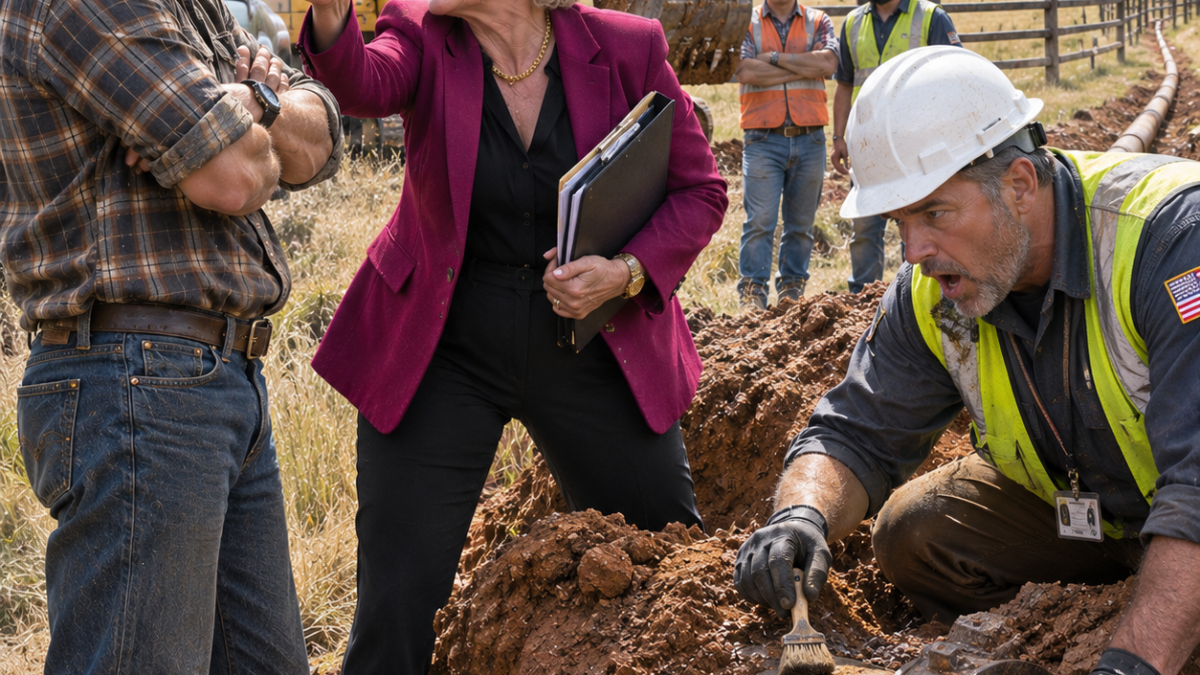
Ronda suddenly marched across the field.
Magenta blazer.
Clipboard.
“This needs to stop.”
Nobody did.
“That gas is ours!”
She pointed directly at me.
“Prairie Crest has been using it for years!”
I crossed my arms.
“Then you won’t mind what he finds.”
The excavator operator stopped.
Raymond brushed soil from an old saddle clamp.
Then froze.
“What?”
He wiped again.
Looked closer.
“Mr. Merrill.”
I stepped near the edge.
“What?”
“This plate has a manufacturer stamp.”
“Date?”
He cleaned it.
“MARCH 2014.”
My stomach dropped.
I looked at Ronda.
Her attorney stepped closer.
Naomi said:
“Not 2018?”
Raymond shook his head.
“No.”
Four years earlier than Prairie Crest claimed its open use began.
Then Raymond wiped another section.
“There’s more.”
“What?”
He read the engraving.
“Draper Land Company.”
Ronda stopped moving.
Draper Land Company had developed the first phase of Prairie Crest.
Naomi immediately pulled the utility agreement Ronda claimed traced back to Grandpa.
County records showed a supposed easement signed by Walter Merrill in June 2014.
Notarized by Bev Tolliver.
The document claimed Grandpa granted Draper Land Company permanent utility rights.
On paper, it looked convincing.
But Grandpa’s notebook from June 2014 said something else.
Hospital.
Surgery.
Rehabilitation.
He had spent nearly the entire month recovering sixty miles away.
Naomi checked the notary.
Bev Tolliver’s commission had not been issued until that fall.
Three months after the supposed notarization.
The document could not be what Ronda claimed.
That discovery changed the case.
Raymond’s meter audit took days.
Well Seven records.
Production logs.
Pressure histories.
Pipeline flow estimates.
Older meter data.
The hidden tap.
His final estimate covered approximately twelve years of unmetered or improperly accounted gas flow.
Estimated value:
roughly $2.3 million.
Naomi read the number in her office.
Nobody spoke.
Finally I said:
“Two point three million?”
“That is the preliminary value estimate.”
“My grandfather never got paid?”
“Not based on the records we have.”
“How does nobody notice that much gas?”
“Because wells fluctuate.”
She tapped the audit.
“And because whoever designed this appears to have understood enough about the system to keep the diversion below levels that immediately screamed theft.”
I stared at the report.
My phone buzzed.
Unknown number.
STOP NOW OR YOU’LL REGRET IT.
I showed Naomi.
She photographed the screen.
“Do not answer.”
“I wasn’t going to.”
“Send it to law enforcement.”
I did.
I thought it was intimidation.
I was wrong.
At one in the morning, Eddie pounded on my bedroom door.
“Colt!”
I sat up.
“What?”
“Gas.”
I smelled it before reaching the porch.
Faint.
Sharp.
Wrong.
East pasture.
We drove fast.
As we approached the valve area, I saw light.
Gary.
Again.
But this time he had a cutting torch.
Open flame equipment.
Near an active gas line.
My blood went cold.
“GARY!”
He turned.
Torch in hand.
“Drop it!”
He moved toward the pipe.
Eddie ran.
Faster than I thought a sixty-two-year-old man could move.
He hit Gary from the side.
The torch fell into dirt away from the line.
A hissing sound rose near the valve.
I grabbed the emergency shutoff.
Turned.
Nothing.
Again.
Both hands.
The valve moved.
Slowly.
Hissing eased.
Then stopped.
For several seconds, nobody moved.
Gary lay on the ground.
Eddie standing over him.
I called 911.
Deputy Travis Ames arrived first.
Fire department followed.
Utility emergency personnel checked the area.
No ignition.
No explosion.
No injuries.
Gary sat beside a patrol vehicle shaking.
Then started talking.
“It was Ronda’s idea.”
Deputy Ames looked at him.
“What was?”
“The tap.”
“Slow down.”
Gary buried his face in his hands.
“She said Walt was old.”
My chest tightened.
“She said he’d never prove it.”
He kept talking.
Maybe fear.
Maybe guilt.
Maybe because the game had finally become bigger than he was.
The next day, another person came forward.
Marcus Dell.
HOA treasurer.
We met in a diner outside town.
Corner booth.
He barely touched his coffee.
“I kept two sets of books.”
“For how long?”
“Six years.”
“Why?”
“Ronda.”
“Explain.”
“She told the board certain utility expenses were confidential.”
“And?”
“I recorded what she told me to record.”
“Which books are real?”
Marcus pulled a flash drive from his pocket.
“This one.”
He slid it across the table.
“What’s on it?”
“Vendor files.”
“Payments.”
“Emails.”
“Contracts.”
He swallowed.
“Everything.”
“Why now?”
His hands shook.
“Because Gary almost blew up half the east side.”
I stared at him.
“You knew?”
“Not about that.”
“About the gas?”
He looked down.
“Yes.”
“How much?”
“I didn’t know where it came from at first.”
“When did you know?”
“Six years ago.”
“And you kept quiet?”
“I was scared.”
“Of Ronda?”
He nodded.
“That doesn’t make it okay.”
“I know.”
I took the drive.
The files explained everything.
Prairie Crest Energy Partners.
A shell company.
Ownership traced to Ronda and Gary Pennington through related entities.
The company supposedly purchased gas wholesale.
Then resold it to Prairie Crest HOA.
Except there was no wholesale supplier.
No legitimate gas purchase.
The “supplier” was effectively the hidden line pulling gas from Merrill Ranch.
Residents paid monthly gas surcharges.
The HOA transferred those funds.
Prairie Crest Energy Partners collected them.
Ronda and Gary benefited.
Gas stolen from my family’s minerals.
Sold back to Ronda’s own neighbors.
The forged easement was in the files.
So were emails.
One made me stop.
Walt’s getting too old to check.
We’re safe.
I sat alone in my truck afterward and read that sentence again.
Grandpa had known.
He had been checking.
The notebooks.
The east fence.
Well Seven.
Loretta’s surcharge.
He had gotten close.
Then age beat him to the final proof.
That hurt more than the money.
Loretta called an emergency HOA meeting.
More than two hundred residents packed the clubhouse.
Ronda walked in carrying her clipboard.
Still smiling.
She had not yet realized Marcus had turned over the records.
Loretta stood at the front.
No fancy speech.
She simply said:
“We’re going to look at the documents.”
Lights dimmed.
Projector came on.
First slide.
Night video.
Gary at the valve box at two in the morning.
Murmurs.
Second slide.
2014 saddle clamp.
Draper Land Company.
Third.
The supposed 2014 easement.
Then Grandpa’s hospitalization record.
Then the notary commission date.
The room changed.
Fourth slide.
Prairie Crest Energy Partners.
Ownership records.
Fifth.
Payments.
Monthly transfers.
Utility Reserve.
Ronda stood.
“This is stolen confidential material.”
Loretta looked at her.
“Is it false?”
Ronda did not answer.
A man near the back shouted:
“Where did our gas money go?”
Another:
“Did we pay you?”
Ronda raised her clipboard.
“Everybody needs to calm down.”
That phrase made the room angrier.
Loretta stayed calm.
“We’ve been paying thirty-eight dollars a month.”
Ronda said:
“For utility service.”
“From whose gas?”
Silence.
Someone shouted:
“Answer her!”
Gary was not there.
He had already retained counsel.
Marcus sat in the back with his attorney.
Ronda looked toward him.
He did not look back.
By the third slide, nobody believed this was a misunderstanding anymore.
Judge Ortley held the final civil hearing weeks later.
She spent nearly forty minutes reading findings into the record.
The hidden tap.
The 2014 installation evidence.
The defective easement document.
The notary problem.
The meter audit.
The accounting records.
The shell company.
The HOA collections.
The Penningtons’ financial interest.
Then she removed her glasses.
“Mrs. Pennington.”
Ronda looked up.
“The evidence before this court supports the conclusion that natural gas originating from the Merrill mineral estate was diverted through an unauthorized tap.”
Ronda’s attorney remained still.
“The purported easement relied upon to justify that use is not supported by credible evidence of lawful execution.”
Judge Ortley continued.
“This court further finds substantial evidence that Prairie Crest residents were charged for gas through entities connected to association leadership.”
Ronda looked down.
“Injunction granted.”
No further gas diversion.
Accounting required.
Independent review.
No destruction or alteration of utility evidence.
Then:
“This record will be referred to the district attorney and appropriate state authorities.”
Outside the courthouse, deputies approached Ronda and Gary based on warrants arising from the separate criminal investigation.
No dramatic speech.
No cheering crowd.
Ronda’s clipboard slipped from her hand.
Hit the pavement.
She looked at it.
Then at the cameras.
For the first time since I had met her, she had nothing to say.
Loretta stood beside me.
She squeezed my arm.
“Your grandfather would be proud.”
I looked toward the sky.
Then at Grandpa’s notebook in my hand.
“I hope so.”
The criminal cases took longer.
Forgery issues.
Fraud.
The attempted destruction of evidence.
Financial records.
Gas diversion.
Gary’s actions at the valve.
Ronda’s role.
Marcus cooperated.
Gary eventually did too.
The HOA removed Ronda from office before the criminal cases concluded.
Loretta Haynes became interim president.
She hated the title.
That made her perfect.
Her first act was not glamorous.
Independent accounting.
Every household received a statement.
What they had paid.
Where records showed the money went.
What remained recoverable.
Residents had collectively paid enormous sums over the years for “gas service.”
Some of that money had gone toward legitimate infrastructure.
Much had not.
Court-ordered accounting and later settlements created a refund process.
Not every household got the exact same amount immediately.
Records had to be reconstructed.
But people began receiving money back.
Loretta showed me her first refund check.
“You know what I’m doing with this?”
“What?”
“Buying a new water heater.”
“That seems disappointingly responsible.”
“I’m seventy-three.”
“You deserve something irresponsible.”
“I might buy the expensive model.”
“Wild.”
The ranch had another problem.
Prairie Crest still needed gas.
Four hundred ten families had not caused the fraud.
Children.
Retirees.
Working families.
They had paid for a service believing it was legitimate.
I could have forced an immediate permanent disconnection after the court ruling.
Legally, I had leverage.
Naomi asked me what I wanted.
I thought about Grandpa.
The letter.
Protect the minerals.
That did not mean punish everybody downstream.
So I made an offer.
New contract.
Legal.
Recorded.
Transparent.
Actual meters.
Actual volume.
Fair market pricing.
No shell company.
No hidden surcharge.
No perpetual rights buried inside vague documents.
Maintenance responsibilities spelled out.
Independent annual audit.
Prairie Crest could buy gas from Merrill Ranch under defined terms if the new board wanted it.
Loretta read the proposal.
Then looked at me.
“You’d still sell to us?”
“Yes.”
“After all this?”
“You paid for gas for eleven years.”
“That didn’t mean you got paid.”
“That wasn’t your fault.”
She sat quietly.
“We blamed you.”
“Ronda told you I was trying to shut off gas.”
“We believed her.”
“You were scared.”
“That doesn’t excuse everything.”
“No.”
I smiled slightly.
“But winter is still coming.”
The new board approved the agreement after independent counsel reviewed it.
No rush.
No golf cart at my gate with a permanent-and-irrevocable form.
Actual negotiation.
Actual signatures.
Actual recording.
Raymond Teller supervised new metering.
The old illegal tap was removed.
The new line connection was built properly.
Everything documented.
For the first time, when gas left Merrill Ranch for Prairie Crest, a meter recorded it.
Then the ranch got paid.
Eddie stood beside the new meter the day it started.
Watched the digits move.
“Well.”
“What?”
“Your granddad would complain about the price.”
“The price is fair.”
“Exactly.”
I laughed.
“He’d still complain.”
“Yes.”
The $2.3 million estimate became part of the damages and accounting proceedings.
Not some giant lottery check handed to me in court.
Naomi warned me early:
“Estimated historical value is not the same as immediate recovery.”
I understood.
There were insurers.
Assets.
Restitution.
Civil claims.
Criminal forfeiture issues.
Some money came back through settlements.
Some through recovered assets.
Some remained tied up for longer.
I did not measure victory by the final number.
The important part was that the theft stopped.
The line became legal.
The records became honest.
And Grandpa’s mineral rights remained exactly what he intended them to be.
Ours.
Ronda eventually entered a plea agreement in the criminal case.
Gary did too.
The details reflected their separate conduct.
The financial fraud.
False documentation.
The utility scheme.
Gary’s attempt to destroy evidence at the valve.
There was no dramatic life sentence.
No hundred-million-dollar award.
There were convictions.
Restitution.
Financial penalties.
Probationary and custodial consequences determined by the court.
And public records that no longer allowed anyone to call the whole thing a “utility misunderstanding.”
Marcus Dell avoided the worst outcome because he cooperated.
But cooperation did not erase six years of keeping two books.
He testified.
Turned over data.
Accepted responsibility.
I did not forgive him instantly.
Neither did the neighbors.
But he stopped lying before it was too late.
That mattered.
The moment I remember most, though, did not happen in court.
It happened months later in Grandpa’s study.
I was sorting the notebooks.
Not throwing them away.
Organizing.
There is a difference.
I reached the final page of the last notebook.
For months, I had focused on the sentence:
THIS TAP IS NOT MINE.
Underneath it, written faintly near the bottom, was another line.
I had missed it the first time because the pencil was so light.
If Colt finds this, tell him not to shut the gas off on the families. They paid somebody. Make the right people pay.
I sat at Grandpa’s desk for a long time.
That was him.
Even near the end.
Even while suspecting somebody had been stealing from him.
He was thinking about people he had never met.
People in houses beyond the east fence.
People paying thirty-eight dollars every month because someone told them that was what gas cost.
He did not want revenge.
He wanted accountability.
I took the notebook outside.
Sat on the porch swing.
Eddie came up from the barn.
“What’s wrong?”
I handed him the page.
He read it.
Then smiled.
“Sounds like Walt.”
“Yes.”
“He tell you what to charge them?”
“No.”
“Then he wasn’t thinking clearly.”
I laughed.
The east pasture looks different now.
Not visually.
The same grass.
Same fence.
Same creek.
But I know what is underneath it.
New meter.
Legal line.
Documented valve.
No secret steel box hidden in tall grass.
Every month, Prairie Crest receives a gas statement.
Volume.
Rate.
Taxes.
Fees.
Nothing called mysterious Utility Reserve.
Nothing routed through a company nobody can explain.
Loretta insists the statement be posted for homeowners.
She once called me.
“Your invoice is boring.”
“Thank you.”
“No, I mean really boring.”
“That’s the goal.”
“I can understand every line.”
“Even better.”
“I hate it.”
“You’re welcome.”
She laughed.
The muffins Ronda brought that first night became a running joke.
Eddie ate two before we knew anything was wrong.
Months later he asked:
“You think she poisoned them?”
“No.”
“You sure?”
“Yes.”
“Shame.”
“Why?”
“Would’ve made the story better.”
“Real life doesn’t need help from you.”
Ronda’s house in Prairie Crest was eventually sold.
Gary’s trucks stopped appearing near the east pasture.
Prairie Crest elected a new permanent board after Loretta refused to run again.
She stayed involved anyway.
Of course she did.
One meeting, the board asked whether they should name the new utility oversight committee after Walt Merrill.
I said no.
They looked surprised.
“Why?”
“He would hate that.”
“What should we call it?”
“The Utility Committee.”
Loretta nodded.
“Walt would approve.”
Probably.
Naomi kept copies of every significant document.
So did I.
Grandpa’s forged signature evidence.
2014 plate photographs.
Meter audit.
Loretta’s receipts.
Marcus’s accounting records.
The legal contract.
The final meter certification.
I bought a fireproof cabinet.
Eddie saw it.
“You turning into your grandfather?”
“Apparently.”
“Next thing you know, you’ll start saving feed receipts from 1997.”
“He did.”
“I know. I helped carry the boxes.”
The first anniversary of Grandpa’s death came quietly.
I drove to the east fence at sunrise.
No ceremony.
No flowers.
Just me and the notebook.
I stood near the place where we first uncovered the illegal valve box.
The old hardware had been removed as evidence.
Ground restored.
New legal line ran nearby.
I read his letter again.
Protect the minerals.
Check the east fence line.
Check the oil meter at Well Seven.
Something is wrong and I ran out of time to prove it.
He had been wrong about one part.
He did not run out of time completely.
He left enough.
The notebook.
The warning.
The habit of writing things down.
Loretta’s memory.
Eddie’s knowledge of the ranch.
The old meter records.
He left a trail.
I just had to follow it.
People always focus on the dramatic moment.
Ronda standing in my field yelling:
“That gas is ours!”
Raymond Teller brushing dirt from the clamp.
MARCH 2014.
The dead silence after he read Draper Land Company.
Those moments mattered.
But the case did not break because of one stamp.
The stamp opened the door.
Everything after that had to line up.
The forged easement.
Grandpa’s hospital records.
The notary date.
Gas-flow history.
Prairie Crest billing.
Shell company ownership.
Gary’s midnight visit.
Marcus’s ledgers.
The email:
Walt’s getting too old to check. We’re safe.
That sentence still bothers me.
Not because they thought Grandpa was old.
He was.
Because they mistook age for weakness.
He had noticed.
He documented.
He kept checking.
Even when he could not finish the fight himself.
There is a kind of arrogance that comes from getting away with something too long.
At first, you hide it carefully.
Then, after years pass, you stop believing anyone will ever look.
That happened to Ronda and Gary.
The illegal gas line became normal to them.
The monthly surcharge became normal.
The shell company became normal.
The fake paperwork became normal.
So when I inherited the ranch, Ronda did not arrive frightened.
She brought muffins.
She expected one signature.
One permanent utility agreement.
Maybe she thought I would sign because I was grieving.
Maybe because I was new.
Maybe because Grandpa had died and she believed the person who had been checking was finally gone.
Instead, I read the first line.
And said:
My lawyer will look at it.
That tiny decision probably changed everything.
Years later, Naomi asked me:
“What if you had signed?”
I thought about it.
“Would it have made the old theft legal?”
“No.”
“But it would’ve complicated things.”
“Enormously.”
“How enormously?”
She smiled.
“Billable-hour enormously.”
“I’m glad I didn’t.”
“So am I.”
The new Prairie Crest gas contract runs for five years at a time.
Renewable.
Auditable.
Either side can terminate under defined conditions.
No permanent irrevocable nonsense.
The mineral rights remain mine.
The line exists because we agreed it should.
That distinction matters.
Permission is not ownership.
Access is not ownership.
Long use is not automatic ownership.
And somebody charging four hundred families for something does not make it theirs.
One winter morning, Loretta called.
“Gas bill came.”
“Okay.”
“It went down.”
“That’s unfortunate.”
“For you.”
“I’ll survive.”
She laughed.
Then became quiet.
“Colt?”
“Yes?”
“Thank you for not shutting us off.”
I looked out toward the east pasture.
“I didn’t want to.”
“You could have.”
“Maybe legally for a while.”
“Still.”
I thought about Grandpa’s final notebook line.
“You were paying somebody.”
“Yes.”
“You deserved service.”
“We were paying the wrong people.”
“That part got corrected.”
She sighed.
“Your grandfather really knew?”
“Enough.”
“I wish I’d talked to him longer.”
“So do I.”
After we hung up, I went to the study.
Opened the last notebook.
Read the final line.
Then closed it.
By then, I finally understood what Grandpa meant when he wrote:
Protect the minerals.
He was not telling me to guard every cubic foot like a miser.
He was telling me to protect ownership.
Protect records.
Protect the truth about where value comes from and who has the right to sell it.
Gas is invisible.
That makes it easy to pretend.
You cannot see it moving through a pipe.
You cannot stand at a fence and watch molecules cross your property line.
You need meters.
Contracts.
Records.
Trust.
Ronda exploited all four.
Then one old steel plate told the truth.
MARCH 2014.
Four simple numbers.
Older than her story.
Older than her claimed seven-year use.
Older than the version she presented to the court.
It was not enough by itself.
But it was enough to make everyone look deeper.
And once people looked deeper, the lies were everywhere.
One evening, Eddie and I sat on the porch.
Sun dropping behind the barn.
Cattle moving slowly toward water.
Prairie Crest lights visible in the distance.
“You staying?” he asked.
“At the ranch?”
“Yes.”
“I think so.”
“You hated it when you were seventeen.”
“I hated everything when I was seventeen.”
“True.”
He rocked back.
“Walt knew you’d come back.”
“He never said that.”
“He didn’t have to.”
I looked toward the east.
A faint line of utility markers showed where the legal pipe now crossed.
“You think he knew I’d find it?”
Eddie shrugged.
“He knew you read before you sign.”
I smiled.
“That sounds like an insult.”
“From Walt, it was praise.”
We sat quietly.
Then Eddie said:
“You know what I still don’t understand?”
“What?”
“Why pink and white?”
“What?”
“Ronda’s golf cart.”
I laughed so hard I nearly spilled my coffee.
That is what life became again.
Small things.
Cattle.
Fence repairs.
Bad jokes.
Gas statements that matched actual meters.
Neighbors who paid for what they received.
A ranch that no longer had a secret buried beneath the eastern pasture.
And Grandpa’s notebook sitting in a fireproof cabinet where nobody could make his handwriting disappear.
The first time I stood over that spinning gauge, I thought the worst thing happening was that somebody was stealing gas.
I was wrong.
The real theft was larger.
They were stealing from both sides.
From my family below the ground.
From their own neighbors above it.
They took something they did not own.
Then charged innocent families for the privilege of receiving it.
And they almost got away with it because everyone believed the paperwork.
Until the paperwork contradicted the metal.
That is why I still think about Raymond Teller kneeling in red dirt.
Brush in one hand.
Old saddle clamp beneath him.
Ronda shouting behind us.
“That gas is ours!”
Then Raymond wiped away one more layer of soil.
Read the stamp.
And said:
“March 2014.”
Everything changed after that.
Not because the pipe suddenly became mine.
It had always been connected to my minerals.
Not because Prairie Crest suddenly became dishonest.
The scheme had already been running for years.
The date simply made the lie visible.
That is what evidence does.
It does not create the truth.
It gives the truth something solid to stand on.
Grandpa knew that.
That is why he kept notebooks.
Why he wrote down meter readings.
Why he marked the pipeline.
Why he left me a letter instead of a suspicion.
And why, on the last page, underneath three underlined words—
THIS TAP IS NOT MINE—
he left one final instruction.
Do not punish the families.
Make the right people pay.
So that is what we did.
The families kept their gas.
The ranch kept its mineral rights.
The hidden tap disappeared.
The lies ended.
And for the first time in more than a decade, every cubic foot crossing that east fence had a meter, a contract, and a name attached to the person who actually owned it.








