HOA Karen “Reserved” My 8 Acres for Her $2.4 Million Clubhouse—Then I Came Home to Excavators Digging Up My Father’s Apple Trees
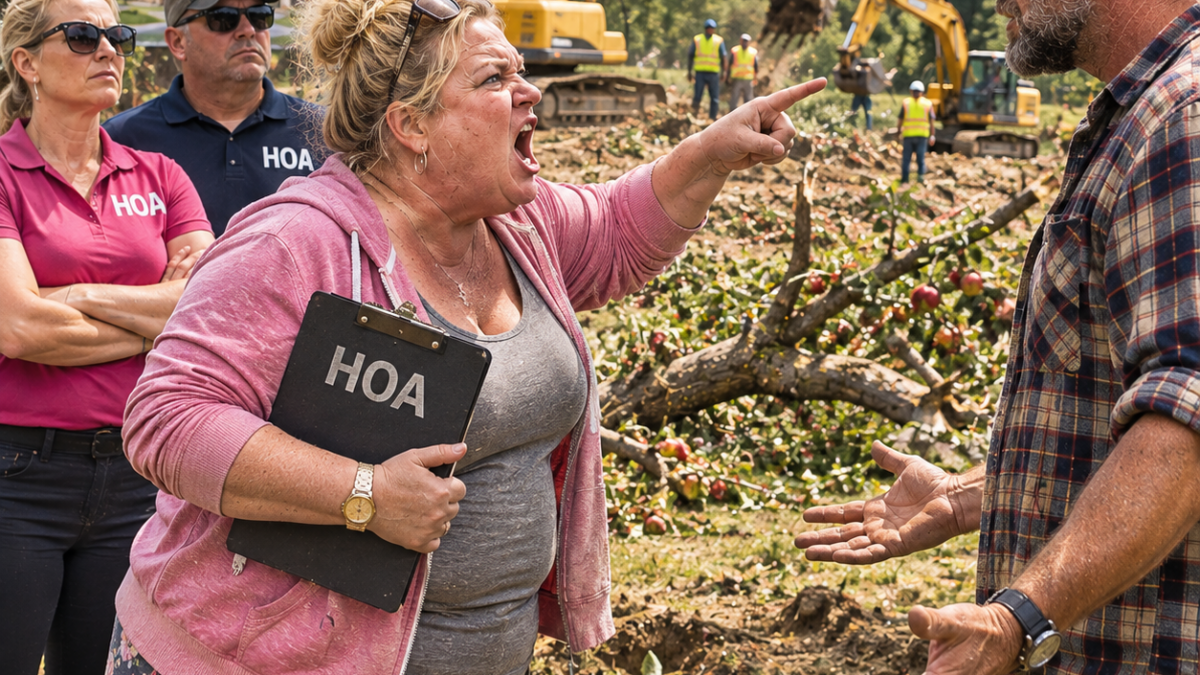
HOA Karen “Reserved” My 8 Acres for Her $2.4 Million Clubhouse—Then I Came Home to Excavators Digging Up My Father’s Apple Trees
I came home one Thursday morning to find an excavator digging a foundation across my field, two of my father’s apple trees already cut down, and a white sign beside the road announcing that my private property was the future home of the Cedar Grove HOA clubhouse.
When I ordered the crew off my land, HOA president Brenda Collins calmly told me the board had “reserved” my eight acres months earlier—and then handed the sheriff paperwork carrying a signature that looked disturbingly like mine.
But when an old survey marker appeared beneath the excavation and the contractor unfolded plans for a second phase that crossed the rest of my property, I realized the clubhouse was only the first thing somebody intended to take.
The first thing I saw when I turned onto my property that Thursday morning was an excavator.
Not parked.
Digging.
Its bucket came up from my field carrying a load of dark Carolina soil and swung toward a growing pile beside what had been grass the night before.
Two concrete trucks waited near the pond.
Orange stakes marked a rectangle wide enough for a substantial building.
A temporary gravel access road had been laid across part of my lower field.
A crew of nearly twenty men moved around equipment, forms, and stacks of drainage pipe.
And beside my driveway stood a white construction sign.
FUTURE HOME OF CEDAR GROVE HOA CLUBHOUSE.
For several seconds, I simply stared.
Then I saw one of the apple trees.
Or what remained of it.
The trunk lay on the ground with its roots exposed.
Another had been cut into sections.
Those trees had been there longer than Cedar Grove.
Longer than the road that led into Cedar Grove.
Longer than some of the people building Cedar Grove had been alive.
My father had planted them when I was nine.
One of them had always leaned slightly because I had insisted on helping dig the hole and had been too stubborn to admit I had done it wrong.
Dad had looked at the crooked little sapling and said, “Every tree deserves its own personality.”
He never straightened it.
I had spent more than forty years looking at that tree.
Now it was lying beside an excavator.
I hit the brakes hard enough to send coffee across the center console.
I got out before the engine had stopped settling.
“STOP!”
The excavator operator saw me immediately.
To his credit, he killed the machine.
Several workers looked up.
I started across the field.
PART2:
Before I reached them, a woman came walking toward me wearing a yellow safety vest over an expensive white blouse.
Brenda Collins.
President of Cedar Grove HOA.
She carried rolled construction plans beneath one arm.
And she looked annoyed.
Not nervous.
Not embarrassed.
Annoyed.
“Jack,” she said. “Please don’t interfere with the workers. We have a schedule to keep.”
I stopped.
Looked at her.
Then looked behind her at the hole.
“Why are you building on my property?”
She sighed.
Actually sighed.
Like I had asked why the sky was blue.
“The board reserved this parcel for the clubhouse months ago.”
I stared at her.
“You reserved my land?”
“Yes.”
“You cannot reserve somebody else’s property.”
“It isn’t that simple.”
“It is exactly that simple.”
She pointed toward the construction sign.
PART3:
“The location was approved through the planning committee. We have contractor deposits, engineering schedules, and foundation work beginning today.”
“I don’t care.”
“Jack—”
“Everybody gets off my property.”
Her expression tightened.
“You had plenty of notice.”
I looked at the tree stump.
“Notice of what? That you were going to steal eight acres?”
“Nobody is stealing anything.”
A man in a hard hat approached us.
His vest read HAYES CONSTRUCTION.
“Sir,” he said carefully. “I’m Robert Hayes. We were told the HOA owns development rights to this parcel.”
“They don’t.”
Brenda spoke over me.
“Jack, don’t create a scene.”
I turned toward her.
“You started construction on eight acres that belong to me.”
I pointed.
“You cut down my trees.”
Another direction.
“You dug a foundation.”
Then toward the concrete trucks.
“You brought twenty workers and concrete onto my field.”
I looked her directly in the eyes.
“The scene already exists.”
Robert looked uncomfortable.
“Mr…”
“Sullivan.”
“Mr. Sullivan, do you have identification?”
Brenda gave a sharp laugh.
“Robert, he lives nearby. That doesn’t mean—”
“My house is right there.”
I pointed toward the hill.
“I have owned this parcel for fourteen years.”
Brenda shook her head.
“Living adjacent to the property does not mean you control its designated community use.”
For a second, I honestly wondered whether I had heard her correctly.
“My what?”
“Designated community use.”
“It is privately owned land.”
“According to one interpretation.”
I stared at her.
“One interpretation?”
Then I heard tires on gravel.
A sheriff’s SUV came down the lane.
I had not called.
Brenda had.
Deputy Laura Mitchell got out.
Brenda moved toward her immediately.
“Officer, thank goodness. This man is interfering with an authorized HOA construction project. I need him removed before he causes additional delays.”
Laura looked at Brenda.
Then me.
Then the excavator.
Then the sign.
“Whose property is this?”
“Mine,” I said.
“Reserved HOA property,” Brenda said at the same time.
Laura looked between us.
“That wasn’t the question.”
I handed her my identification.
Brenda opened her folder.
She had paperwork.
A building permit.
Site plan.
Construction approval.
Then a document titled:
OWNER CONSENT AND TEMPORARY DEVELOPMENT ACCESS.
My name was across the top.
Jack Sullivan.
My address.
Parcel number.
And near the bottom—
My signature.
Or something close enough to my signature that my stomach dropped.
Laura looked at me carefully.
“Mr. Sullivan, did you sign this?”
“No.”
Brenda crossed her arms.
“That’s what he says now.”
I turned toward her.
She did not look surprised.
Not even a little.
Laura examined the document.
“Who notarized this?”
Brenda opened her mouth.
Before she could answer, Robert Hayes called from beside the excavator.
“Deputy?”
We looked.
“You might want to see this.”
He held another set of plans.
We walked over.
Across the bottom of the site plan:
PHASE ONE — CLUBHOUSE / POOL / PARKING.
Then beneath it:
PHASE TWO — COMMUNITY ACCESS ROAD.
The road began at the future clubhouse.
Crossed the rest of my property.
Passed south of my barn.
Then continued toward seventy acres beyond my land.
That was when I stopped thinking about an HOA president who wanted a pretty clubhouse beside my pond.
Someone had planned to use my property as the center of something much larger.
But to understand how Brenda Collins ended up standing beside an excavator telling a sheriff that Cedar Grove had “reserved” my land, you have to go back seven months.
Before the fake signature.
Before the orange stakes.
Before the missing trees.
My name is Jack Sullivan.
I was fifty-two when this happened.
I owned a house and eight acres outside Asheville, North Carolina.
Calling it a farm would be generous.
Calling it an estate would make my father laugh from the grave.
It was land.
Good land.
A little barn.
A pond.
Open field.
Apple trees.
My father, William Sullivan, had bought twenty-six acres in the late seventies.
Over the years, pieces were sold.
One section became houses.
Another became part of a county road.
By the time Dad died, eight acres remained around the original house.
My brother lived in Arizona and wanted nothing to do with managing land across the country.
I bought his share.
Money mattered.
But the land was worth more to me than the appraisal.
Dad taught me to fish at that pond.
Mom grew tomatoes beside the barn.
My brother broke his arm jumping from a hayloft we had been specifically told not to jump from.
The crooked apple tree was still there.
Memory is strange that way.
You can sell acreage.
Move fences.
Build roads.
But there are places where memory stays attached to dirt.
Cedar Grove came later.
Blue Ridge Communities bought nearly a hundred acres east of me and built a planned neighborhood.
One hundred sixty homes.
Walking trails.
Decorative ponds.
Playground.
Clubhouse promised eventually.
During development, Blue Ridge asked Dad to sell the remaining land.
He said no.
When I became owner, they asked me once.
I said no.
Nobody threatened anybody.
No lawsuits.
No arguments.
They built around us.
Cedar Grove ended up touching my eastern and southern boundaries.
Most of the homeowners were good people.
Frank Miller lived near the walking trail.
He occasionally brought his grandson over to fish.
But he asked first.
Susan Parker baked more pies than any household needed and used me as a disposal service.
Robert Jenkins once helped me patch the barn roof after a storm.
I had no problem with the neighborhood.
Then Brenda Collins became HOA president.
Our first conversation was almost pleasant.
She came to my front door carrying a folder.
“Jack Sullivan?”
“Yes.”
“I’m Brenda Collins. New HOA president.”
“Congratulations or condolences?”
She laughed.
I liked her at first.
She looked toward the field.
“You have beautiful property.”
“Thank you.”
“Especially the pond.”
“My father dug it.”
“That makes it better.”
Then she asked whether Cedar Grove could hold a children’s fishing afternoon.
Twenty kids.
Parents present.
No swimming.
Waivers.
Two hours.
I agreed.
Why not?
The day went well.
Kids caught almost nothing.
They had a great time anyway.
Frank helped untangle lines.
Susan brought lemonade.
Nobody damaged anything.
As Brenda was leaving, she looked back across the pond.
“This really feels like it should be part of Cedar Grove.”
I laughed.
She didn’t.
That should have warned me.
A few weeks later she asked to use the field for the HOA summer picnic.
Again, I said yes.
One afternoon.
They cleaned up.
No problem.
I believed being a good neighbor mattered.
Dad used to say owning land did not mean building walls around your heart.
If helping someone cost little and harmed nothing, help.
I still believe that.
But generosity and ownership are different things.
Brenda began confusing them.
First, a Cedar Grove landscaping crew crossed into my field to trim bushes near the walking trail.
I stopped them.
They apologized.
Said they had been told that section was common landscaping.
I called Brenda.
She blamed a misunderstanding.
Then a Cedar Grove security vehicle drove up my gravel lane while checking a complaint about teenagers near the pond.
I told them:
Stay on HOA property unless it is a real emergency.
They agreed.
Then I found a sign beside my pond.
CEDAR GROVE COMMUNITY FISHING AREA.
RESIDENTS ONLY.
That one actually made me laugh before it made me angry.
I removed it.
Called Brenda.
“Did you put a Cedar Grove sign beside my pond?”
Pause.
“I approved signage.”
“Why?”
“Residents have been using the area.”
“Because I invited them.”
“Many people believed access continued.”
“It doesn’t.”
“Jack, you’ve always been generous.”
“I’m still generous.”
“Then—”
“That does not make my pond community property.”
She sighed.
“We need clearer expectations.”
For once, we agreed.
I sent her an email.
Cedar Grove residents welcome only when personally invited.
No permanent access.
No signage.
No HOA maintenance.
No patrols.
No events without written permission.
Brenda replied:
UNDERSTOOD.
For two months, everything stayed quiet.
Then she came back with a real proposal.
Cedar Grove’s temporary community room was being sold by the original developer.
They wanted a permanent clubhouse.
Meeting rooms.
Kitchen.
Bathrooms.
Fitness area.
Pool.
Parking.
Most of the HOA-owned land had problems.
Too steep.
Poor drainage.
Too close to houses.
Expensive grading.
My field had none.
Flat.
Pretty pond.
Good access.
Brenda spread plans across my kitchen table.
Three acres near the pond.
Clubhouse positioned almost exactly where my apple trees stood.
“How much?” I asked.
“Let’s discuss partnership.”
That told me the number would be bad.
Eighty-five thousand dollars.
For three acres.
I almost laughed.
Land prices around Asheville had risen sharply.
But money was not even my main objection.
Clubhouse noise near the house.
Parking lot across the field.
Pool.
Traffic.
Apple trees gone.
“No.”
Brenda raised the offer to one hundred ten thousand.
“No.”
Then she suggested I donate the land in exchange for lifetime HOA amenities.
“I don’t want HOA amenities.”
“Pool membership.”
“No.”
“Clubhouse access.”
“No.”
“Reduced community road fees.”
“I don’t pay community road fees.”
Her face tightened.
“You’re very attached to unused land.”
“It isn’t unused because I’m not building on it.”
That should have ended things.
A month later, a Cedar Grove newsletter arrived in my mailbox.
I normally tossed them.
I was not an HOA member.
But the front page said:
COMING SOON — OUR FUTURE CLUBHOUSE.
Inside was a concept map.
Clubhouse beside my pond.
I called Brenda.
“Why is my land in your newsletter?”
“It’s a concept.”
“Then put the concept on HOA land.”
“The board wants residents to see the preferred site.”
“Your preferred site belongs to me.”
“We’re still negotiating.”
“No.”
Pause.
“Excuse me?”
“We are not negotiating.”
“You said you would think about our offer.”
“I did.”
“And?”
“No.”
Her tone became colder after that.
Then survey flags appeared along my eastern boundary.
Orange.
Yellow.
Wood stakes.
I pulled them.
Two days later, more appeared.
One tag had the survey company name.
I called.
The manager said Cedar Grove HOA hired them to measure “future common area expansion.”
“You entered private property.”
“We were told Cedar Grove controls that field.”
That phrase stayed with me.
Controls the field.
I called Rebecca Hayes.
Rebecca had handled the transfer when I bought out my brother.
She checked the deed.
No HOA membership.
No development easement.
No option.
No sale agreement.
No community-use rights.
Nothing.
She sent Cedar Grove and its management company a formal letter.
The Sullivan parcel was privately owned.
No survey entry.
No construction planning based on assumed control.
Any future offer must go through me or Rebecca.
The HOA attorney, Charles Bennett, responded.
He confirmed the association recognized my ownership and would instruct contractors accordingly.
Good.
Problem solved.
Except it wasn’t.
A month later Frank called.
“Jack, do you know your field is in the HOA capital plan?”
“What?”
He opened the Cedar Grove resident portal for me.
2027 CAPITAL IMPROVEMENT PLAN.
CLUBHOUSE.
POOL.
PARKING.
LAND PREPARATION.
Budget:
$2.4 million.
Location:
SULLIVAN RESERVE SITE.
I stared.
“What does Sullivan Reserve mean?”
Frank shrugged.
“You?”
“No.”
Another map showed my entire eight acres shaded blue.
Legend:
FUTURE HOA AMENITY RESERVE.
“They renamed my property?”
“Looks like it.”
Meeting notes said Brenda had told homeowners the association had “secured” the clubhouse location.
Secured.
Not negotiating.
Not hoping to buy.
Secured.
I called Charles.
He sounded genuinely surprised.
He had not seen the language.
Two days later Brenda called.
“You embarrassed me with our attorney.”
“I asked why your budget says you secured my land.”
“It’s planning terminology.”
“You don’t own it.”
“We know that.”
“Then stop presenting it as if you do.”
“Jack, organizations reserve land in long-term planning.”
“You can reserve your land.”
“You are making too much out of a word.”
Maybe.
Except the word kept changing.
Preferred.
Reserved.
Secured.
Future community property.
Every version treated my ownership like a temporary problem.
Then a real estate agent named Linda Harris called.
“Mr. Sullivan, I wanted to ask whether the clubhouse parcel sale is still expected to close this quarter.”
“What sale?”
Silence.
“The HOA purchase.”
“There is no HOA purchase.”
Another silence.
“I may have been given bad information.”
“By who?”
“I probably shouldn’t—”
“Linda.”
She sighed.
“Brenda Collins.”
That was when I stopped believing this was careless language.
Rebecca sent another letter.
Stronger.
The land was not for sale.
No sale agreement.
No option.
No transfer pending.
No authorization existed for Cedar Grove to represent the property as reserved, secured, under contract, or pending acquisition.
Brenda did not reply.
For six weeks—
Nothing.
No flags.
No signs.
No calls.
I thought Charles had finally stopped her.
I repaired part of the barn.
Pruned the apple trees.
Cleaned around the pond.
Frank brought his grandson fishing one Saturday.
He asked first.
That mattered.
I did not punish neighbors because Brenda irritated me.
Then one Wednesday evening I noticed truck tracks near the lower field.
Large tires.
I followed them toward the apple trees.
No equipment.
No damage.
I installed a trail camera.
The next night it recorded a white pickup at 11:18 p.m.
Cedar Grove maintenance logo.
Two men got out.
Measured distances.
Hammered a wooden stake.
Left.
I called the management office.
Susan Parker answered.
“There shouldn’t be anyone on your property.”
“There was.”
“I’ll check.”
An hour later she called back.
“The work order says pre-construction layout.”
“For what?”
Silence.
“The clubhouse.”
I called Rebecca.
Rebecca called Charles.
Charles said no construction had been legally authorized.
“Then who created the work order?”
Nobody knew.
That was Wednesday.
Thursday at 6:40 a.m., I left to buy feed.
The field was normal.
I came back at 9:12.
Excavator.
Concrete trucks.
Trees down.
Foundation trench.
Brenda in the yellow vest.
Now Deputy Laura Mitchell stood holding a consent form with my forged-looking signature.
The contractor had been told the HOA possessed development rights.
And phase two showed a road across my entire property.
Laura examined the paperwork.
The consent form had not transferred title.
But when she called the county clerk, another problem appeared.
A temporary construction easement had been recorded against my parcel three weeks earlier.
I had never signed one.
Rebecca arrived twenty minutes later.
She read the contractor’s consent form.
Then the recorded easement.
“These aren’t the same document.”
“What does that mean?”
“Two separate versions.”
Both carried my name.
Both signatures looked enough like mine to pass casual inspection.
Neither was mine.
Then Robert Hayes brought over his tablet.
“There’s something you need to see.”
Email.
From the Cedar Grove HOA president’s office.
SUBJECT: SULLIVAN SITE ACCESS CONFIRMED.
OWNER MAY OBJECT VERBALLY DUE TO PERSONAL ATTACHMENT.
LEGAL ACCESS HAS ALREADY BEEN SECURED.
DO NOT STOP WORK UNLESS DIRECTED BY HOA COUNSEL OR LAW ENFORCEMENT.
I read it twice.
Someone expected me to object.
Someone knew my objection was coming.
And contractors had been instructed to keep digging anyway.
Laura looked at Brenda.
“Did you send this?”
Brenda’s face went pale.
“I need to speak with our attorney.”
Finally.
Then a worker shouted from the trench.
The excavator had uncovered a metal survey marker.
Old.
Stamped.
Rebecca opened historic county records on her tablet.
She compared the marker.
Then the site plan.
Then looked at me.
“Jack.”
“What?”
“The clubhouse isn’t three acres inside your property.”
“What does that mean?”
“The project survey moved your property line.”
“How far?”
She measured.
Nearly one hundred eighty feet.
The survey used for construction shifted my eastern boundary west.
Almost two acres of my property disappeared on the plan and became part of Cedar Grove’s common area.
Not physically.
On paper.
Then Laura got another call from the county.
A boundary-adjustment request had been submitted two days earlier.
Not approved.
Submitted.
My name attached.
My signature again.
Had it been accepted without objection, Cedar Grove would have gained nearly two acres on paper before the foundation was finished.
I looked at Brenda.
Then the cut trees.
Then the trench.
The situation had changed.
This was not an HOA president becoming overly enthusiastic about a clubhouse.
Someone was attempting to change the legal boundary while construction was already underway.
Laura froze the site.
Nobody touched anything until county surveyors documented it.
Concrete trucks left.
The excavator stayed.
Stakes stayed.
Materials stayed.
Robert immediately shut his crew down.
Once he understood ownership was disputed, he stopped arguing.
That mattered later.
The county sent senior surveyor Thomas Reed.
He checked the historic marker.
Official plat.
My deed.
Recent filing.
The conclusion was simple.
My deed was right.
The marker was right.
The county map was right.
The clubhouse survey was wrong.
Thomas looked at the shifted line.
“This isn’t how normal survey error looks.”
Rebecca asked:
“How does normal error look?”
“Feet. Sometimes more when old documents conflict.”
He pointed at the plan.
“This is clean, straight, and happens to move exactly enough land to fit the project.”
Convenient.
Then he checked the survey company printed on the plan.
Blue Ridge Land Services.
He frowned.
“They closed three years ago.”
“Closed?”
“License inactive. Owner retired.”
The project survey used the name of a company that no longer operated.
Now we had:
Fake consent.
Fake easement.
False boundary.
Inactive survey stamp.
And a contractor instructed to ignore my verbal objections.
Charles Bennett arrived after noon.
The HOA attorney took one look at the field and became furious.
Not at me.
At Brenda.
“Did I authorize construction?”
“No.”
“Did I approve an easement?”
“No.”
“Did I tell you Cedar Grove owned this parcel?”
“No.”
“Then why are there twenty workers on it?”
Brenda said they had documents from “development coordination.”
“What development coordination?”
The clubhouse project had an outside consultant.
Paul Norton.
Carolina Community Development Services.
Charles closed his eyes.
“Brenda, that is not HOA counsel.”
“I know.”
“They are not a title company.”
“I know.”
“Then why are they producing ownership documents?”
She had no good answer.
Management records showed the construction authorization had been uploaded using Brenda’s administrator account.
But from a laptop identified as Paul Norton’s company device.
The fake owner consent?
Same device.
Temporary easement?
Submitted through an account belonging to Carolina Community Development Services.
Boundary adjustment?
Same source.
Paul suddenly mattered a lot.
Everyone called him.
No answer.
Then the notary became important.
Patricia Nolan.
Real notary.
Worked at a bank forty minutes away.
She denied ever meeting me.
Denied notarizing my signature.
But six months earlier she had notarized a document for Paul Norton’s company.
Which meant Paul had possessed a legitimate sample of her stamp and signature.
The county stopped the boundary filing.
Charles froze all clubhouse spending.
The HOA agreed to preserve every email, document, work order, and project file.
That afternoon I walked the field alone.
Three apple trees damaged.
Two completely gone.
One badly cut.
Foundation trench across the place Dad used to toss baseballs with my brother and me.
Drainage pipe stacked beside the pond.
Orange paint marking future walls.
People talk about land like it is numbers.
Square footage.
Parcel value.
Development rights.
Sometimes land remembers your family.
Frank came before sunset.
He stood near the stump.
“I’m sorry.”
“You didn’t cut it.”
“I voted for the clubhouse budget.”
“You thought Cedar Grove owned the site.”
“Because Brenda told us.”
“Then she lied to you too.”
He nodded.
That distinction mattered.
The homeowners were not my enemies.
Most had approved a clubhouse based on information they believed.
Then Frank told me about the special assessment.
Eight thousand dollars per household.
Clubhouse.
Pool.
Parking.
Road improvements.
Land work.
Brenda had promised residents those costs could eventually fall because future development south of Cedar Grove would contribute money.
Future development.
I remembered the phase two road.
Rebecca requested the clubhouse records.
The public minutes were vague.
Preferred site.
Negotiations ongoing.
Then suddenly:
SITE SECURED.
No explanation.
A private committee folder gave us more.
Potential sites.
A — HOA owned, too steep.
B — HOA owned, drainage problems.
C — my land.
Flat.
Pond view.
Road access.
Cheapest.
Ownership status:
PRIVATE.
CONVERSION REQUIRED.
Rebecca stared.
“Conversion?”
Next page:
SITE C ACQUISITION STRATEGY.
Step one.
Direct purchase.
Failed.
Step two.
Donation incentives.
Failed.
Step three.
Historic community-use claim.
Because I had invited residents to fish twice and allowed one picnic.
Rebecca laughed.
“Two invitations do not transfer land.”
Step four.
Reserve property in capital plan pending conversion.
There was Brenda’s harmless word.
Reserve.
Step five.
Finalize development control.
They were planning around ownership instead of acquiring ownership.
Then we saw the money.
Carolina Community Development Services had received seventy-two thousand dollars.
“Land coordination.”
“Survey preparation.”
“Owner negotiations.”
I had barely been negotiated with.
Another forty-eight thousand.
Site acquisition retainer.
One hundred twenty thousand dollars paid to Paul Norton’s company to secure property Cedar Grove did not own.
The HOA treasurer, Daniel Brooks, had approved invoices.
He looked genuinely sick when Rebecca showed him.
“Did you see a signed purchase contract?”
“No.”
“Did you verify title?”
“No.”
“Why approve an acquisition retainer?”
“Brenda told us legal control was arranged.”
He produced emails.
Brenda:
PAUL CONFIRMED SULLIVAN SITE CAN BE RESERVED UNDER EXISTING COMMUNITY DEVELOPMENT RIGHTS.
PROCEED WITH CLUBHOUSE ACCOUNT.
Another:
OWNER CONTINUES OBJECTING EMOTIONALLY, BUT PROJECT RIGHTS ARE PROTECTED.
Emotionally.
My refusal to surrender property had become an emotional problem.
Paul sent another message:
DO NOT ENGAGE SULLIVAN DIRECTLY UNTIL CONVERSION FILING COMPLETE.
That explained the six weeks of silence.
They had not backed off.
They were working around me.
Brenda claimed Paul told her there was an old boundary error from Cedar Grove’s original development.
That part of my field had supposedly been intended for common amenities but accidentally omitted from the final plat.
False.
Rebecca found the old purchase offer Blue Ridge Communities had sent Dad years earlier.
Why would the original developer offer to buy land it already believed belonged to the neighborhood?
Brenda had no answer.
Then she admitted something.
After I refused to sell, she authorized Paul to “explore every legal method” of bringing the parcel under HOA control.
Rebecca asked:
“Did you authorize forged signatures?”
“No.”
“False easements?”
“No.”
“Moved boundaries?”
“No.”
“Construction before Jack agreed?”
Brenda hesitated.
Too long.
“What did you authorize?”
She said Paul told her the HOA had obtained a “temporary development reservation mechanism” allowing preliminary construction before final transfer.
Rebecca almost laughed.
“There is no magic reservation mechanism that lets an HOA build on somebody’s private land because it hopes to own it later.”
Brenda insisted she had relied on a consultant.
Rebecca reminded her:
“You received two letters from me explicitly saying Jack had not signed anything.”
“I believed Paul found another legal route.”
That was the problem.
She wanted the result badly enough that she stopped testing the explanation.
Then police located Paul.
At home.
Not fleeing.
He spoke through an attorney.
He admitted creating the clubhouse site documents.
Admitted using old survey materials.
Admitted designing the “conversion” strategy.
But denied forging my signature.
According to him—
Brenda supplied signed pages.
Brenda denied it.
Paul claimed Brenda supplied the notary seal.
Brenda denied that too.
Then Paul said Brenda had told him:
“Jack will complain, but he’ll take the money once construction starts.”
Possible.
Not proof.
Digital records helped.
The email instructing Hayes Construction to ignore my objection came from Brenda’s official mailbox.
But the internet address traced to Paul’s office.
Helped Brenda.
The fake owner consent?
Created on Paul’s laptop.
Fake easement?
Paul’s laptop.
Boundary draft?
Paul’s laptop.
Copied notary seal?
Stored on Paul’s laptop.
That hurt Paul.
Then investigators discovered his bigger motive.
Paul’s company had a second contract.
Mountain View Residential Partners.
Seventy acres south of Cedar Grove.
Potentially valuable residential development.
Problem:
Poor public-road access.
Weak utility connection.
The easiest route?
Through my property.
Exactly where phase two ran.
Rebecca spread the maps across her table.
“The clubhouse isn’t the destination.”
It was the anchor.
If Cedar Grove gained control of the central field for the clubhouse, the HOA could create a road south.
Mountain View would pay Cedar Grove approximately two million dollars for infrastructure participation.
Paul’s success fee?
Three hundred fifty thousand.
Now the numbers made sense.
Paul had hundreds of thousands personally tied to turning my property into a road corridor.
Brenda also had motive, though apparently a different one.
Mountain View’s proposal listed her as “community sponsor.”
No obvious payment.
But she had promised residents future development contributions would help offset assessments and dues.
Clubhouse.
Road.
Outside money.
Lower costs.
From her perspective she may have believed she was delivering a huge win.
Good intentions do not create ownership.
Cedar Grove held an emergency meeting.
The clubhouse room was packed.
Some residents shouted at Brenda.
Others defended her.
Frank stood and reminded everyone:
“We do not yet know who forged what.”
Correct.
Susan Parker presented the numbers.
$120,000 to Paul’s company.
Nearly half a million in contractor commitments.
Special assessment notices prepared.
Phase two road discussions never fully disclosed.
Residents became furious.
Not at me.
At the board.
One woman asked:
“Why were we spending construction money on land we hadn’t bought?”
Nobody answered.
Brenda finally spoke.
She said she had genuinely believed Cedar Grove possessed development rights.
Admitted pushing too fast.
Admitted ignoring warning signs because she feared losing the clubhouse site.
Then she looked at me.
“I should have stopped when you said no.”
Yes.
She resigned as president that night.
But she remained on the board temporarily.
Frank asked me afterward:
“Think it’s over?”
“No.”
“Me neither.”
We were right.
The field restoration started slowly.
No concrete had been poured, thank God.
That avoided a nightmare.
The trench was stabilized.
Temporary safety fencing installed.
The insurer opened a property-damage claim.
An arborist evaluated the apple trees.
Then Robert Hayes came to me privately.
“I need to show you something.”
A second construction schedule.
FAST TRACK.
Foundation Thursday.
Utilities Friday.
Concrete Monday.
Framing within ten days.
“Why this fast?”
Robert said Paul had told them the project needed “substantial completion” before any title challenge delayed financing.
Rebecca nearly came out of her chair.
Robert showed another email.
ONCE FOUNDATION IS POURED, OWNERSHIP DISPUTE BECOMES SETTLEMENT ISSUE RATHER THAN SITE ISSUE.
Paul expected a dispute.
He knew the title was vulnerable.
And his strategy was to build fast enough that removing the project would become financially painful.
Create facts on the ground.
Then negotiate from the damage.
That changed everything.
Paul’s attorney contacted investigators again.
This time he wanted to cooperate.
Financial records were closing around him.
He admitted forging my signature.
Admitted copying Patricia Nolan’s notary seal.
Admitted the false easement.
False survey.
Boundary adjustment.
Conversion filing.
One huge question remained.
Brenda.
Did she know?
Paul answered:
“Not at first.”
Those three words mattered.
He had let her believe he discovered a historic development right.
But after Rebecca’s letters made ownership crystal clear, Brenda began asking questions.
Instead of stopping the project, she asked Paul whether the paperwork could survive a challenge.
Paul said yes—if construction happened quickly.
Did she know my signature was forged?
Paul said she never directly asked after a certain point.
He described one exchange.
Brenda:
“Jack didn’t sign anything new.”
Paul:
“Correct.”
Brenda:
“Then what exactly do we have?”
Paul:
“What we need.”
Brenda:
“Fine. Keep moving.”
Not proof she understood every false document.
But evidence she was choosing not to understand.
Then Paul produced recordings.
He recorded project meetings for notes.
One:
Brenda: “Is Sullivan still objecting?”
Paul: “Yes.”
Brenda: “Then why are you telling me we can build?”
Paul: “The access filing is in place.”
Brenda: “Did he sign it?”
Pause.
Paul: “The filing is valid for project purposes.”
Brenda: “That is not what I asked.”
Paul: “If you want the project to move, stop asking questions that create problems.”
Silence.
Then Brenda:
“Just make sure the HOA is protected.”
That recording did not prove she ordered forgery.
But it destroyed the idea that she was completely innocent.
There is a difference between being deceived and refusing to learn the truth because the truth might force you to stop.
Daniel Brooks resigned as treasurer.
Investigators found no evidence he participated in forgery.
He told residents:
“I approved payments because I trusted confident explanations. I stopped asking questions once the answers became inconvenient.”
I respected him for saying it.
Then Mountain View Residential Partners contacted Rebecca directly.
Their senior leadership claimed they had no idea Paul was using forged documents.
They terminated his contract.
Then they did something almost shocking in its normality.
They made an offer.
Not for the clubhouse field.
For a narrow road and utility easement along my southern boundary.
Seven hundred thousand dollars.
They asked.
Through my attorney.
With real maps.
Real engineers.
Real title work.
No fake paperwork.
I did not say yes.
I did not say no.
Rebecca told them we wanted independent appraisal, engineering, drainage studies, and time.
They agreed.
Imagine that.
Adults negotiating.
Meanwhile, Cedar Grove voted to permanently abandon my property as a clubhouse site.
Site B.
The drainage-problem parcel the HOA already owned.
More expensive.
Less pretty.
But theirs.
They agreed to restore my field.
Remove materials.
Fill the trench.
Replace damaged fencing.
Pay tree damages.
Repair pond-edge grass.
For several days, Hayes Construction worked only under written permission from me.
Every entry.
Every vehicle.
Every task.
Robert called before crews arrived.
That should not have felt extraordinary.
But it did.
Then during restoration, Robert called me over.
“We found something.”
I was starting to hate that sentence.
Beneath where the clubhouse kitchen would have been:
A buried PVC tube.
New.
Sealed.
Inside—
Duplicate fake documents.
Easement.
Survey.
Boundary filing.
Then a contract.
Carolina Community Development Services.
Mountain View Residential Partners.
Paul’s success fee.
Three hundred fifty thousand.
We knew that.
Another page.
Second success fee.
One hundred fifty thousand.
Recipient:
BC ADVISORY SERVICES LLC.
BC.
Brenda Collins.
Rebecca searched corporate records.
Company formed four months earlier.
Registered agent:
Brenda Collins.
Address:
A PO box.
That changed the story.
Brenda had told homeowners she had no personal financial interest.
Now her company stood to collect $150,000 if the road connection succeeded.
Then workers found another metal box.
Deeper.
Inside:
Flash drive.
Notebook.
Printed page.
SULLIVAN PROPERTY — FINAL PRESSURE OPTIONS.
First line:
IF OWNER CHALLENGES CONSTRUCTION, MOVE IMMEDIATELY TO CODE ENFORCEMENT, TAX COMPLAINT, AND EMERGENCY ACCESS CLAIM.
Final line:
IF STILL UNSUCCESSFUL, CREATE EVIDENCE OF ABANDONMENT AND PURSUE FORCED ACQUISITION.
Beside it in blue handwriting:
APPROVED — BRENDA.
Laura did not declare victory.
Good investigators do not.
Handwriting can be copied.
Documents can be planted.
Evidence must be tested.
But BC Advisory Services created a separate problem.
Brenda admitted owning it.
Admitted signing the Mountain View consulting agreement.
Her explanation:
She would be compensated for helping coordinate residents and community approval if the road project went forward.
Rebecca asked the obvious question.
“Why did she not disclose that to the HOA?”
Brenda called it personal consulting work.
That did not help.
She was HOA president while advocating the same project that would pay her private company.
Then bank records appeared.
BC Advisory had already received twenty-five thousand dollars.
Project initiation payment.
Ten thousand moved into Brenda’s personal checking account.
Some used toward a credit card.
Now the conflict was real money.
Still did not prove she forged my name.
Paul had admitted that.
But it explained why Brenda had been so unwilling to let the project die.
The handwriting examiner found the words APPROVED — BRENDA strongly consistent with her writing, though not absolutely conclusive.
Then investigators opened the flash drive.
Folder:
SULLIVAN RESISTANCE.
That name made me angrier than almost anything.
I was not “resistance.”
I was a landowner saying no.
Photos of my house.
Barn.
Pond.
Field.
Driveway.
Some taken from HOA land.
Some clearly from inside my property.
Spreadsheet:
PRESSURE TRACKING.
Possible complaints.
Tall grass.
Barn paint.
Old fencing.
Farm equipment.
Pond safety.
Tax classification.
Driveway access.
Fire code.
Environmental complaint.
Most were not actual violations.
That was not the point.
A note explained:
MULTIPLE COMPLAINTS CREATE NEGOTIATION FATIGUE.
Negotiation fatigue.
They did not need to win every complaint.
They needed me tired.
Answer letters.
Meet inspectors.
Pay lawyers.
Lose sleep.
Eventually selling might feel easier.
One audio file began with Paul.
“If Jack keeps saying no, we need enough administrative pressure that selling three acres becomes the easy option.”
Brenda:
“We cannot do anything illegal.”
That helped her.
Paul:
“I didn’t say illegal.”
Brenda:
“Then what are you suggesting?”
“Code review. Tax classification. Access issues. Pond liability. Anything that makes holding the property less comfortable.”
Long silence.
Brenda finally:
“As long as it’s legitimate.”
Again, better for her.
Then Paul said:
“Legitimate is flexible.”
Brenda did not answer.
Later in the recording she said:
“I want the clubhouse site secured before the annual meeting. I don’t care how many letters it takes.”
Not a criminal command.
But by then I was no longer a neighbor.
I was an obstacle with a deadline.
Another recording occurred after Rebecca’s legal letter.
Paul:
“We can still move under temporary development control.”
Brenda:
“Jack will stop us.”
Paul:
“Not if the foundation goes in first.”
“And if he calls the sheriff?”
“We show the access filing.”
Then Brenda said the sentence that mattered most.
“He never signed an access filing.”
Silence.
Paul:
“You hired me to solve the land problem.”
Brenda:
“That is not an answer.”
Paul:
“You want the clubhouse or not?”
Long silence.
Then:
“Just don’t put the association in a position we can’t defend.”
She knew I had signed nothing.
She knew Paul intended to rely on paperwork anyway.
She chose the result.
The HOA removed Brenda from every remaining board position.
Unanimous.
Nobody cheered.
Frank said the room went quiet.
I understood why.
Cedar Grove had lost hundreds of thousands.
Residents’ trust was shattered.
Their former president hid a private financial arrangement.
A field next door had been excavated under false authority.
Nothing to celebrate.
Restoration continued.
The trench was filled and compacted.
Three mature replacement apple trees were selected.
They could never replace Dad’s originals.
I knew that.
But I planted one slightly crooked.
Frank noticed.
“That tree is leaning.”
“I know.”
“You paid extra for a mature tree and then planted it wrong.”
“It’s right.”
He looked at me like I had lost my mind.
I did not explain.
Not every memory needs explanation.
Residents volunteered one Saturday to repair pond-edge grass.
At first, I almost refused.
Insurance could pay contractors.
Then Susan said:
“People want to help because this happened in the name of our HOA.”
So I let them.
Families came.
Kids carried seed.
Frank helped.
Robert Jenkins.
Linda Harris.
Nobody put up a community sign.
Nobody claimed access.
They simply repaired damage.
At lunch I grilled burgers.
Frank looked at me.
“You realize this is exactly how the original problem started.”
“No.”
“You let HOA people onto your property.”
“I invited neighbors to lunch.”
“Dangerous.”
“Eat your burger.”
That Saturday reminded me why I did not want anger controlling the ending.
Most of these people had done nothing wrong.
Punishing all of them would only make my world smaller.
Mountain View returned with a formal easement proposal.
New attorney.
New engineer.
My surveyor.
Rebecca.
We walked the southern boundary.
The road could follow an old fence line.
Avoid pond.
Avoid apple trees.
Avoid barn.
Avoid house.
The clubhouse had never needed to sit in the middle of my property to make that road possible.
Brenda wanted the pond view.
That was all.
Mountain View raised its offer.
Eight hundred forty thousand.
Fence.
Drainage.
Private gate.
Legal costs.
Underground utilities.
No HOA ownership.
No clubhouse rights.
No public parking.
Still, I waited.
I wanted the criminal investigation farther along.
They respected that.
Then Paul formally pleaded guilty to the document fraud.
He admitted:
My forged signature.
Copied notary seal.
Fake survey.
False easement.
Boundary filing.
Pressure strategy.
Investigators asked why the documents had been buried beneath the clubhouse site.
His answer was almost funny.
“Insurance.”
Not property insurance.
Insurance against Brenda.
Paul did not trust her.
He believed if the project collapsed, she would blame him.
So he buried copies under the future foundation.
The clubhouse itself would become his hiding place.
Dishonest people keeping secret evidence against other dishonest people.
Rebecca said:
“People doing unethical things rarely trust each other.”
Fair.
Then another problem appeared.
The pond.
One morning the water level had dropped almost a foot.
No drought.
No visible break.
Thomas Reed walked the bank.
Found disturbed soil near the southern outlet.
Buried pipe.
New.
It ran from my pond toward Cedar Grove’s stormwater system.
Hidden valve.
Open it—
Water drained out of my pond toward their lower retention basin.
No permission.
Planning records contained a note:
LOWER SULLIVAN POND SEASONALLY BEFORE POOL EXCAVATION.
They had assumed control of my water too.
An invoice identified the installer.
Mountain Flow Drainage.
Work description:
TEMPORARY WATER BALANCE CONNECTION.
Authorized by Paul.
Paid from the HOA clubhouse account.
Daniel Brooks had approved it without knowing the pipe crossed my land.
Again:
Ordinary-looking invoice.
Extraordinary assumption underneath.
Cedar Grove immediately ordered the connection removed.
Three days later, a major storm hit.
Six hours of heavy rain.
Cedar Grove’s retention pond rose.
Water crossed the main entrance road.
Fire crews arrived.
Families on the lowest street prepared to leave.
I could have closed my gate.
After everything?
Nobody would have blamed me.
Instead, I called Rebecca.
Then Laura.
Then the fire chief.
“My western farm lane reaches the county road.”
“Can emergency vehicles use it?”
“Yes.”
We opened the gate.
Fire trucks crossed.
Ambulance crossed.
Three families with medical needs were escorted out.
No one discussed HOA membership.
No one discussed lawsuits.
People needed help.
That was enough.
By midnight the rain eased.
No homes lost.
Two garages flooded.
One basement.
Could have been worse.
Next morning Thomas inspected Cedar Grove drainage.
The main outlet had been partly blocked.
Concrete bags.
Compacted gravel.
Fresh.
Not storm debris.
Trail camera footage showed a white pickup arriving at 3:12 a.m. before the storm.
Two people.
One turned enough for identification.
Brenda Collins.
The second—
Paul Norton.
They carried materials toward the drainage channel.
Why would Brenda help block her own neighborhood’s drainage?
Flash-drive records answered.
EMERGENCY FLOODING STRENGTHENS SECONDARY ACCESS NECESSITY.
Another:
TEMPORARY DRAINAGE EVENT MAY SUPPORT IMMEDIATE ACCESS CLAIM ACROSS SULLIVAN PARCEL.
I stared at Laura.
They wanted an emergency.
Not a disaster.
Just enough water across the main entrance to make my western lane look necessary.
Then they could argue Cedar Grove needed permanent emergency access over my property.
Paul talked.
Again.
He claimed they intended only a few inches of water.
A controlled inconvenience.
Enough for county officials to recommend a second exit.
Then six hours of heavy rain turned their controlled problem into real danger.
That was the theme of the entire story.
People believing they could create a small problem and decide exactly how large it became.
Paul said Brenda panicked during the storm.
Wanted to remove the obstruction.
Too late.
Water too high.
Then I voluntarily opened my western gate.
According to Paul, Brenda watched fire trucks cross and said:
“Now everyone will see why we need this.”
That sentence bothered me more than almost anything.
Families were afraid.
Basements flooding.
And she was still thinking about winning.
Then investigators discovered a hidden controller beneath my western lane.
Remote gate control.
One relay connected to my gate motor.
Another tied into barn power.
Somebody had secretly installed a system capable of opening my property and cutting electricity.
Controller log:
SATURDAY — 7:00 P.M.
Same time Cedar Grove planned a special meeting about permanent emergency access.
Thomas explained the sequence.
7:00—
Barn power off.
Thirty seconds later—
Western gate open.
Someone wanted the opening to look like an emergency access system activating automatically.
Proof, supposedly, that Cedar Grove already possessed emergency rights.
Laura did not disconnect it immediately.
Investigators replaced live connections with safe test equipment.
The system could receive commands.
Nothing would actually move.
Maybe whoever still controlled it would reveal themselves.
Saturday came.
Cedar Grove’s temporary community room was packed.
I stayed home.
My property rights did not depend on winning over a room.
At 7:00—
Scheduled command.
Barn power off.
Blocked.
Thirty seconds.
West gate open.
Blocked.
Then the controller tried sending confirmation to an outside device.
Investigators traced it.
Phone.
Registered to Brenda Collins.
Nobody spoke.
Then another command arrived.
Manual override.
OPEN GATE.
Blocked.
Again.
OPEN GATE.
Blocked.
Frank called from the meeting.
“Jack.”
“What?”
“Brenda just stood up.”
“What is she doing?”
“She says she’s giving an emergency-access demonstration.”
Of course.
Laura put Frank on speaker.
Brenda’s voice in the background:
“Tonight you’ll see that the western access system already exists.”
Another command.
Blocked.
Then:
ACCESS FAILURE.
Frank whispered:
“She looks confused.”
Brenda left the room.
Deputies waited outside.
No tackle.
No screaming.
They asked for her phone.
She initially refused.
Her lawyer became involved.
Proper legal process followed.
The device was seized.
Remote-control application installed.
Login history matched the manual attempts.
Now Paul could not be blamed for everything.
Brenda had personally tried to open my gate during an HOA meeting.
She knew I had never granted permanent access.
She knew the controller was unauthorized.
She tried to turn my private gate into evidence for her argument.
That was the moment her story collapsed.
Not because I shouted.
Not because a courtroom delivered instant justice.
Because she created evidence with her own hands.
Mountain View terminated Brenda’s consulting agreement.
Her remaining success fee was frozen.
The twenty-five thousand already paid became part of the financial investigation.
Paul eventually pleaded guilty to offenses connected with forged records, false filings, fraud, and related misconduct.
His cooperation reduced his sentence.
It did not erase his actions.
He lost the consulting business.
Clients.
Money.
Restitution followed.
Brenda’s case was different.
Investigators did not prove she personally forged my signature.
Paul did.
They did prove she knew I had never signed access documents before construction.
They proved she allowed construction anyway.
They proved she hid a private financial deal tied to the road.
They proved she helped obstruct Cedar Grove’s drainage system to manufacture an access crisis.
They proved she knew about the unauthorized gate controller.
And they proved she personally tried to activate it in front of homeowners.
Her eventual resolution included serious financial penalties.
Restitution.
Probation.
Restrictions related to future HOA leadership and property-management activity.
She also faced civil claims tied to flood damage.
Those homeowners deserved compensation.
They were victims too.
Cedar Grove changed.
Frank Miller became president despite loudly insisting he did not want the job.
Residents elected him anyway.
Susan became secretary.
Robert Jenkins joined facilities.
Daniel Brooks did not return as treasurer, but he helped design better financial-review rules.
The first new policy should have existed from day one:
No land project without independent title verification.
Not a president saying land was reserved.
Not a consultant saying rights were secured.
Real title review.
Large contracts required multiple approvals.
Attorney review.
No officer could receive private compensation connected with an HOA project.
No consultant shared administrator credentials.
No construction on property the HOA did not own without a verified signed agreement from the actual owner.
Obvious rules.
Expensive lesson.
The clubhouse moved to Site B.
HOA-owned land.
Bad drainage.
Less attractive view.
More expensive engineering.
But they owned it.
Amazing how many disputes disappear when you build on your own property.
Hayes Construction received the new contract after review.
I supported that.
Robert and his crew had been lied to too.
He stopped the first morning once the ownership dispute became clear.
He preserved emails.
Shared schedules.
Helped expose the fast-track strategy.
Good people should not be punished for somebody else’s fraud.
The new clubhouse took about eighteen months.
Pool.
Meeting room.
Smaller parking area.
No pond view.
Families use it now.
Nobody seems traumatized that it does not sit beside my apple trees.
My field recovered.
Grass grew over the old foundation trench.
Pond water returned after the hidden drainage pipe was removed.
Replacement apple trees survived.
One crooked on purpose.
Frank and I eventually turned Brenda’s favorite word into a joke.
One afternoon he walked over while I was repairing fence.
“I’ve reserved your truck.”
“No.”
“Committee decision.”
“No.”
“I’ve also reserved the barn.”
“No.”
“Pond?”
“No.”
“You’re a very difficult neighbor.”
“Get off my property.”
We laughed.
Being able to laugh mattered.
Then Mountain View came back.
Paul’s fraud had been separated from the company’s legitimate development plan.
Their internal review found poor oversight but no evidence senior leadership had ordered forgery or boundary manipulation.
They made a new road-easement offer.
Eight hundred seventy-five thousand.
Independent appraisal supported roughly that range.
Rebecca negotiated another month.
Final:
Nine hundred ten thousand dollars.
Permanent road and underground utility easement along the far southern edge.
Privacy trees.
Drainage upgrades.
New cattle-style gate.
No public parking.
No clubhouse rights.
No Cedar Grove control.
No ownership beyond the exact corridor.
All survey and legal costs covered.
I signed.
Frank looked like I had betrayed the entire story.
“You sold them access?”
“An easement.”
“After everything?”
“Yes.”
“You’re going to make me ask why, aren’t you?”
“Yes.”
He waited.
“Everything that happened was about people taking the choice away from me.”
Frank became quiet.
“This time you chose.”
“Exactly.”
Defending property does not mean saying no forever.
It means the yes remains yours.
Mountain View asked.
Explained.
Paid fair value.
Waited.
Accepted negotiation.
I chose.
That is completely different from somebody deciding my refusal was an obstacle to route around.
The new road never touched my pond.
Never touched the apple trees.
Never came near my house.
Trees were planted along the easement so headlights would not sweep across the field.
Construction crews called before entering.
Every time.
That became normal.
Then Cedar Grove asked me for something.
Not land.
Not ownership.
Not development rights.
Frank came to the door.
Their new clubhouse opening was scheduled for spring.
He wanted to organize a children’s fishing afternoon at my pond afterward.
“Twenty kids.”
“How long?”
“Two hours.”
“Parents?”
“Yes.”
“Waivers?”
“Yes.”
“No swimming.”
“Obviously.”
I smiled.
“Yes.”
He looked suspicious.
“That easy?”
“That easy.”
“No contract?”
“No.”
“No permanent sign?”
“Definitely not.”
“No claiming the HOA reserved the pond?”
I stared at him.
He laughed.
“No.”
The fishing afternoon looked almost identical to the first one years earlier.
Kids around the water.
Parents talking.
Susan handing out lemonade.
Frank pretending he knew how to fish.
The difference was everyone understood the invitation.
Two hours.
One day.
Permission.
Not ownership.
A little boy pointed toward the crooked apple tree.
“Why does that one lean?”
I told him:
“When I was nine, my father let me plant a tree badly.”
He looked at the replacement.
“Is that the same tree?”
“No.”
“Then why make this one crooked?”
“So I remember.”
He accepted that immediately.
Children understand sentimental things faster than adults sometimes.
Brenda eventually sold her house in Cedar Grove.
Before leaving, she mailed me a letter.
Real paper.
Envelope.
I almost threw it away.
Then read it.
She apologized for treating my refusal as an obstacle instead of an answer.
She wrote that she became obsessed with delivering the clubhouse and road because she wanted to prove she was a successful HOA president.
She liked being the person who solved problems.
When my property did not fit the plan, she stopped questioning the plan.
Instead, she tried to change reality around it.
One sentence stayed with me:
“I confused serving the neighborhood with controlling everything near it.”
I kept the letter.
Not because I needed to remember Brenda.
Because I wanted to remember the warning.
Good goals can become dangerous when somebody decides the goal makes other people’s rights optional.
A clubhouse is not evil.
A road is not evil.
Lower dues are not evil.
Emergency access is not evil.
None of those things gave Cedar Grove ownership of my field.
Years later, the clubhouse is still on Site B.
Kids swim in the pool.
People hold birthday parties.
Board meetings happen there.
The parking lot drains properly.
Nobody sits around grieving that it does not overlook my pond.
Life moved on.
My property looks mostly like it did before all this.
House on the hill.
Barn.
Pond.
Open field.
Apple trees.
One crooked on purpose.
You would never know an excavator once dug a clubhouse foundation there.
Except I kept one thing.
The original construction sign.
FUTURE HOME OF CEDAR GROVE HOA CLUBHOUSE.
Robert found it among the materials when the first project was dismantled.
“Want us to throw this away?”
“No.”
I mounted it inside my barn.
Underneath, I added a small wooden sign.
NOT ANYMORE.
Frank says it is petty.
Maybe.
It makes me laugh.
I earned one harmless joke.
People who hear this story focus on the wild parts.
An HOA president claiming she “reserved” private land.
Excavators arriving without permission.
Fake signatures.
False surveys.
A property boundary shifted nearly two hundred feet.
A buried pressure plan.
A secret consulting payment.
Drainage sabotage.
A remote gate controller.
Those parts are wild.
But they all came from one simple mistake.
My first no was treated as the beginning of a negotiation instead of the end of one.
When Brenda offered to buy three acres, I said no.
The clubhouse plan should have changed.
Instead, the strategy changed.
When I refused again, the land became “reserved.”
When I challenged surveyors, new paperwork appeared.
When Rebecca confirmed ownership, Paul invented conversion rights.
When legal control still would not change, they tried building quickly enough that reversing construction would become expensive.
Every new problem existed because people would not accept the most basic fact:
The land belonged to me.
In the end, almost everybody got something reasonable anyway.
Cedar Grove got its clubhouse.
Mountain View got a road.
The neighborhood gained legitimate emergency access nearby.
I received fair compensation for an easement I voluntarily granted.
My pond stayed private.
My field stayed mine.
Apple trees grew.
Most neighbors went back to being neighbors.
All of that could have happened without fake paperwork, excavators, investigations, flooded garages, or years of legal bills.
They only needed to ask.
And then respect the answer.
I still let Cedar Grove kids fish.
I still helped during the flood.
I still negotiated the road.
Those choices did not make me weak.
They were possible because they were mine.
Kindness without boundaries becomes something people can exploit.
Boundaries without kindness can turn every neighbor into an enemy.
You need both.
The last time Frank came over, we sat beside the pond near sunset.
The new Cedar Grove clubhouse roof was barely visible through the trees.
He pointed toward my field.
“You think the HOA will ever try to reserve this place again?”
“No.”
“How sure?”
“Very.”
“Why?”
I pointed toward the barn.
Inside, the old construction sign still hung over my little NOT ANYMORE board.
Frank laughed.
Then he looked at the pond.
“Can I come fishing Saturday?”
I looked at him.
“Did the HOA reserve the pond?”
“No.”
“Committee approval?”
“No.”
“Fake paperwork?”
“No.”
“Then what are you doing?”
He smiled.
“Asking.”
I nodded.
“Saturday’s fine.”
That was all it ever needed to be.








