HOA Karen Reported My Forest Cabin as Unsafe—Then Inspectors Condemned All 46 of Her Luxury Rental Homes
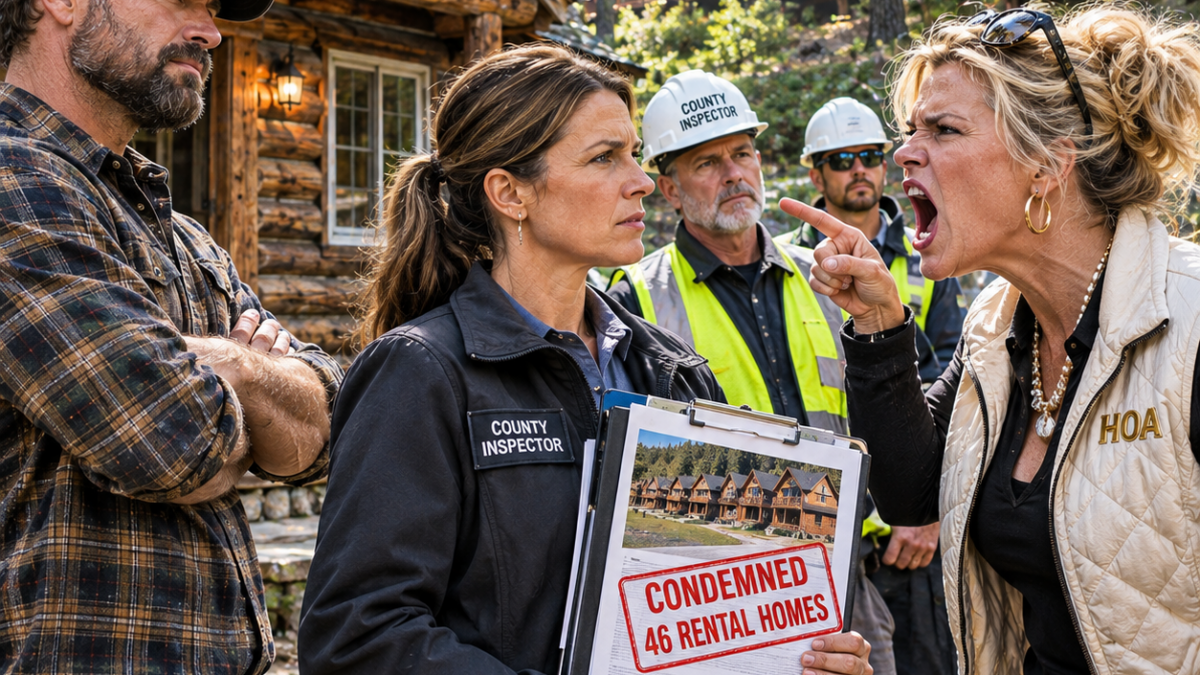
HOA Karen Reported My Forest Cabin as Unsafe—Then Inspectors Condemned All 46 of Her Luxury Rental Homes.
Karen Trafton arrived at Davis Ror’s forest cabin with two HOA witnesses, a camera crew, and a forty-eight-hour notice ordering him out of the home his father had built.
She told everyone his roof was collapsing, his foundation was failing, and his little cabin was too dangerous for a human being to sleep in—but the county inspector took one look at Karen’s photographs and quietly asked why they showed three support posts when Davis’s cabin had five.
Thirty-six hours later, those same photographs led inspectors up the mountain to Karen’s forty-six luxury vacation homes, where they discovered that the “unsafe cabin” in her complaint had never been Davis’s at all—and every multimillion-dollar rental on the ridge was standing on the same hidden problem she had spent years trying to bury.
Davis Ror found the yellow envelope taped to his front door at 4:17 on a Thursday afternoon.
He knew the time because he had just returned from checking three culverts along the old logging road and had looked at his watch while climbing the porch steps.
Late October had settled over Pine Hollow Ridge.
Western Oregon.
Cold rain.
Cedar branches heavy with water.
Low clouds snagging on the mountain.
The kind of afternoon that made Davis appreciate every nail, beam, and stone in the cabin more than usual.
His father had started building the place thirty-one years earlier.
Not from a kit.
Not from a contractor’s catalog.
By hand.
Douglas fir beams milled fifteen miles away.
Cedar siding.
Local stone around the chimney.
The first winter, Davis and his father had slept there before the interior walls were finished because his father wanted to know how the structure sounded in a real storm.
“You learn a building by listening to it,” he used to say.
Davis had been twelve.
He never forgot.
Now he was forty-three.
His father had been gone nine years.
And Davis still knew every sound the cabin made.
The click of the furnace.
The expansion of the south wall when afternoon sunlight heated it.
The tiny metallic ping from the chimney liner during the first hot fire of winter.
The creak in the third stair tread.
The soft vibration of heavy rain on the porch roof.
So when the letter told him his home was in danger of structural collapse, Davis read it twice.
Then a third time.
PINE HOLLOW RIDGE HOMEOWNERS ASSOCIATION.
NOTICE OF IMMEDIATE SAFETY VIOLATIONS.
It listed:
Unstable roof framing.
Compromised floor structure.
Unsafe heating equipment.
Potential foundation failure.
Then, in bold:
PART2:
OCCUPANTS ARE DIRECTED TO VACATE WITHIN 48 HOURS.
Davis looked around his kitchen.
The roof had been rebuilt three years earlier.
County permit.
Final inspection.
New chimney liner.
Furnace replaced eighteen months ago.
Electrical system updated.
Smoke detectors installed.
Floor supports reinforced after one post began settling five years earlier.
He had paperwork for all of it.
More important:
Pine Hollow Ridge HOA had no authority over his property.
His seventeen acres were below the subdivision boundary.
Always had been.
That was why his father bought them.
The HOA could send him a Christmas card.
It could send him a recipe.
It could send him a strongly worded opinion.
It could not order him out of his own home.
Still, Davis had spent twenty years doing road and drainage work for the Forest Service before taking early retirement.
He had learned something during those years.
Confident paperwork could cause real problems even when it was wrong.
So he called the county.
A clerk named Janice answered.
Davis gave her the parcel number.
PART3:
Then the complaint number printed on the HOA notice.
Keyboard clicking.
Pause.
“Yes.”
Janice said.
“There is an open building-safety complaint.”
Davis straightened.
“From the HOA?”
“Filed by Karen Trafton.”
Of course.
“Does the HOA have authority to condemn my house?”
“No.”
“Then why am I being inspected?”
“Anyone can submit a safety complaint if they believe there is an imminent hazard.”
Davis looked at the yellow notice.
“What did she submit?”
“Photographs.”
“Witness statements.”
“A structural complaint form.”
“Any engineer?”
“No.”
“County inspector?”
“Inspection is scheduled tomorrow morning.”
“What time?”
“Seven.”
Davis nodded to himself.
“I’ll be here.”
He hung up.
Then drove down to the gate.
Karen was waiting.
That was the first thing that bothered him.
Not that she was there.
That she had known he would come.
Karen Trafton was fifty-six, though she looked younger from a distance because everything about her was maintained to look expensive.
Hair.
Nails.
Clothes.
SUV.
Her quilted vest probably cost more than Davis’s chainsaw.
Two HOA board members stood behind her.
One was Leonard Pike.
The other, Michelle Gannon.
Neither looked comfortable.
Karen did.
“Davis.”
“What did you file?”
She smiled.
“Safety complaint.”
“My house isn’t inside your HOA.”
“This isn’t about jurisdiction.”
“You sent me an HOA order telling me to leave.”
“For your own protection.”
Davis held up the yellow paper.
“This has no legal authority.”
“The county will decide that tomorrow.”
“No.”
“The county will decide whether my cabin is safe.”
He stepped closer.
“You decided to pretend you could evict me before they got here.”
Karen’s smile thinned.
“You live in a deteriorating structure directly beneath a major residential community.”
“I live in the same cabin I lived in last week.”
“And its condition impacts the ridge.”
“How?”
“Fire risk.”
“Property values.”
“Visual character.”
There it was.
Visual character.
Davis looked past her toward the homes on the ridge.
Pine Hollow Ridge had started as a quiet residential development.
Then Karen arrived.
She became HOA president.
Then she created Ridgerest Retreats.
Forty-six luxury vacation rentals built across the upper hillside.
Huge glass walls.
Black metal roofs.
Hot tubs.
Balconies facing the valley.
Photos online with captions like:
ESCAPE INTO OREGON’S WILDERNESS WITHOUT SACRIFICING LUXURY.
The homes rented for hundreds of dollars a night.
Some much more on holidays.
Karen managed most of them through companies she controlled.
The HOA insisted the rentals were separate from the association.
Davis had never believed the separation was as clean as Karen claimed.
She continued.
“Actually, I came because there may still be a simple solution.”
Davis almost laughed.
“There usually is with you.”
Karen ignored that.
“Forty-three thousand dollars.”
“For what?”
“All seventeen acres.”
Davis stared.
His land had appraised for more than four times that amount two years earlier.
And that was before property values climbed.
“Cabin included?”
“Yes.”
“Timber?”
“Yes.”
“Creek access?”
“Yes.”
“Road frontage?”
“Yes.”
Davis nodded slowly.
“And why would I give you seventeen acres for forty-three thousand dollars?”
“You’d be avoiding expensive repairs on a structure the county may declare unusable.”
“There are no expensive repairs.”
“We’ll know tomorrow.”
Davis folded the notice.
Put it in his jacket.
“My land isn’t for sale.”
Karen’s smile vanished.
Just like that.
“Once the inspector sees the foundation photographs, you may reconsider.”
“What photographs?”
“You’ll see.”
She opened her SUV door.
Then stopped.
“And when the property changes hands, Ridgerest will finally be able to finish the lower drainage route.”
Davis’s expression changed.
“What drainage route?”
Karen realized what she had said.
Small mistake.
Fast recovery.
“General stormwater management.”
“Across my land?”
No answer.
“What project needs drainage through my property?”
Karen got into her SUV.
“Tomorrow, Davis.”
She drove away.
The two board members followed.
Davis remained at the gate.
Drainage route.
He repeated the phrase while walking home.
That evening the rain intensified.
Davis ate soup.
Checked the attic.
Checked the crawlspace.
Checked the furnace.
Not because Karen frightened him.
Because he wanted to know.
Everything looked normal.
Then he remembered the porch camera.
He opened the previous day’s footage.
At 11:08 a.m., while Davis had been miles away checking culverts, a white Ridgerest Retreats pickup stopped near the forest entrance.
Passenger window down.
Someone held a camera outside.
The truck stayed eighteen minutes.
No one entered the cabin.
But somebody photographed the property from the road.
Davis copied the footage to an external drive.
Then another.
At 6:52 the next morning, headlights appeared through the trees.
County truck.
Karen was already there.
So were Leonard and Michelle.
And a cameraman.
Davis stared.
She had brought an audience.
The county inspector stepped out.
Marin Bishop.
Forty-nine.
Dark hair threaded with silver.
Green rain jacket.
Clipboard.
Davis knew her by reputation.
Contractors complained she was slow.
Homeowners complained she asked too many questions.
Davis considered both compliments.
Karen approached before Marin had fully closed the truck door.
“I need the structure posted immediately.”
Marin looked at her.
“I haven’t inspected it.”
“The complaint photographs clearly show—”
“Mrs. Trafton.”
Marin held up one hand.
“I don’t condemn buildings from the driveway.”
Karen stopped.
Marin turned to Davis.
“Mr. Ror?”
“Yes.”
“Permission to inspect?”
“Absolutely.”
They entered.
Davis had already arranged records on the kitchen table.
Roof permit.
Final inspection.
Furnace installation.
Chimney certification.
Electrical inspection.
Foundation reinforcement receipt.
Marin reviewed every page.
Karen tried to come inside.
Marin stopped her.
“Are you the property owner?”
“No.”
“Contractor?”
“No.”
“Then wait outside unless Mr. Ror invites you.”
Karen looked at Davis.
Davis said:
“I don’t.”
The door closed.
Marin inspected the attic.
Used a moisture meter.
Checked rafter joints.
Looked at roof penetrations.
Tested smoke alarms.
Ran the furnace.
Checked the breaker panel.
Measured floor slope.
Then crawled underneath the cabin.
Davis followed.
Five support posts.
All secure.
Minor surface checking in one beam.
Normal.
Concrete footings intact.
Drainage dry.
Marin crawled back out.
“Your roof isn’t collapsing.”
“I know.”
“Floor isn’t failing.”
“I know.”
“Heating system works.”
“Yes.”
She stood.
“So I’d like to see where the complaint photographs came from.”
Karen was waiting on the porch.
Marin opened the county complaint folder.
Three photographs.
Davis leaned closer.
The first showed a cracked concrete support.
The second showed a sagging floor beam.
The third showed a foundation corner with visible movement.
Ugly.
Serious.
And not his.
Davis felt his stomach drop.
“Those aren’t from here.”
Karen said immediately:
“They absolutely are.”
Davis pointed.
“My porch has five posts.”
Photograph:
Three.
“My crawlspace has galvanized support brackets.”
Photograph:
Black steel.
“My drainage pipe runs north-south.”
Photograph:
Pipe angled diagonally.
Karen spoke over him.
“He could have altered the structure.”
Marin turned.
“Overnight?”
“He had advance notice.”
Marin crouched beside one of Davis’s real support posts.
Weathered.
Rust on bolt heads.
Moss near the footing.
Compacted soil.
She scraped lightly around the base.
Then looked at Karen.
“How old do you believe this post is?”
“I’m not an engineer.”
“No.”
Marin stood.
“You’re not.”
Davis almost smiled.
Karen did not.
Davis pulled out his phone.
Old photographs.
Summer barbecue.
Snowstorm.
Roof repair.
His father’s old workbench being moved onto the porch.
Same five posts.
Years apart.
Marin made a note.
COMPLAINT IMAGES DO NOT MATCH SUBJECT PROPERTY.
Karen’s jaw tightened.
“This man lives like a hermit.”
Marin looked at her.
“What does that have to do with structural safety?”
“The property is neglected.”
“I’m inspecting a building.”
“Not his lifestyle.”
Karen crossed her arms.
“This cabin damages the appearance of the entire ridge.”
There it was.
Finally.
Marin closed the folder.
“I found no condition requiring occupancy restriction.”
Karen stared.
“You can’t be serious.”
“I am.”
“The foundation photographs—”
“Are not this foundation.”
“You’re accepting his version.”
“I’m accepting what is physically in front of me.”
Karen raised her voice.
“I’m filing a complaint with your supervisor.”
Marin placed the clipboard beneath her arm.
“My job is to find unsafe buildings, Mrs. Trafton.”
She looked at the cabin.
“Not buildings you want me to dislike.”
The cameraman lowered his lens.
Karen’s face went red.
By noon, Davis had preliminary confirmation.
Cabin safe.
No order to vacate.
He thought the worst was over.
He was wrong.
That evening, red emergency lights flashed on the ridge.
Davis stood on the porch.
Fire-rescue vehicle.
Near Ridgerest.
His phone rang.
Unknown number.
“Mr. Ror?”
“Yes.”
“My name is Willa Prescott.”
She sounded frightened.
“I’m staying in Cabin Twenty-Six at Ridgerest.”
“Okay.”
“I found your number on your property sign.”
“What happened?”
Something cracked underneath her rental the previous night.
Loud enough to wake her.
By morning, the bedroom door would not latch.
That evening another crack.
She called emergency responders.
They found no gas leak or obvious immediate collapse.
Management told her it was normal settling.
Then Willa looked beneath the deck.
Concrete support.
Vertical fracture.
She photographed it.
Management replied:
ORDINARY MATERIAL EXPANSION COMMON IN MOUNTAIN CLIMATES.
Willa asked to move.
Denied.
Refund?
Denied.
Early departure would trigger cancellation penalties.
Davis listened.
Then said carefully:
“I’m not an engineer.”
“I understand.”
“I can’t tell you whether that building is safe.”
“Okay.”
“But if you’re seeing active movement, doors changing alignment, or structural cracks getting worse, document everything.”
“And contact the county directly.”
“Not just management.”
She exhaled.
“Thank you.”
Then she added:
“There’s something else.”
“What?”
“Workers were under the rental next door this afternoon.”
“Doing what?”
“Painting.”
“Painting what?”
“The foundation.”
Davis sat straighter.
“Cracks.”
“Gray paint.”
“They were brushing it into the cracks.”
Davis looked up toward the lights on the ridge.
After the call, he opened Ridgerest’s website.
Forty-six premium homes.
Same general design.
Raised structures.
Large glazing.
Decks facing downhill.
A lot of weight sitting on a steep slope.
Karen appeared in promotional images.
Golden sunset.
Wineglass.
Perfect teeth.
Davis studied every floor plan.
Same structural pattern.
Repeated forty-six times.
The next morning Willa invited him up.
He went only because she registered him as her guest.
He stayed inside her rental and common areas.
No trespassing.
No touching neighboring buildings.
The first thing Davis noticed inside was the floor.
Not visually.
Under his feet.
Slight slope.
He took a marble from a decorative bowl.
Set it down.
It rolled toward the valley.
Steady.
Willa watched.
“That’s bad, right?”
“It means the floor isn’t level.”
“That doesn’t answer me.”
“I’m not going to pretend I know more than I do.”
They checked the back door.
Threshold crack.
Frame out of square.
Beneath the deck, the soil was saturated.
Not surface wet.
Saturated.
Water moving through the slope.
Davis crouched.
He had spent twenty years reading drainage failures.
Water always told a story.
This water was coming from above.
Not gutters.
Not rainfall alone.
Subsurface flow.
Redirected flow.
Then something stirred in his memory.
Forest Service maps.
Old spoil yard.
A dumping location from decades earlier.
Excavated road material.
Broken rock.
Soil.
Debris.
Somewhere on this ridge.
He could not remember exactly where.
Not yet.
Back home, Karen texted.
STAY AWAY FROM MY GUESTS OR I’LL SUE YOU.
Davis ignored it.
Then Willa sent another photograph.
Close-up beneath the rental.
Cracked support.
Blue marking paint.
Black drainage pipe crossing the frame.
Davis stared.
Opened Karen’s complaint photos.
Placed them side by side.
Same blue paint.
Same pipe.
Same crack.
The photo Karen used to condemn Davis’s cabin had been taken beneath her own rental home.
Davis said nothing publicly.
He did not post.
Did not call neighbors.
Did not drive up to Karen’s house.
He emailed Marin Bishop.
Subject:
PHOTO SOURCE COMPARISON.
Attached:
Karen complaint image.
Willa Prescott image.
Matching details circled.
Blue mark.
Pipe angle.
Crack geometry.
Support dimensions.
Marin responded:
“I see the similarities.”
Then:
“One damaged post does not establish a systemic problem.”
Good.
Davis respected that.
Facts first.
Willa filed her own complaint.
Now the county had a real property.
A real guest.
A real photograph.
Karen arrived at Davis’s cabin within hours.
No witnesses this time.
“What did you do?”
Davis stood on the porch.
“I answered a phone.”
“You contacted my guest.”
“She contacted me.”
“You are interfering with my business.”
“Why did you use a photograph from your rental in a complaint against my cabin?”
Karen froze.
Only for a moment.
Then:
“Administrative mix-up.”
“Really?”
“Yes.”
“Why does your written complaint describe the exact crack visible beneath her rental?”
“No idea.”
“You wrote it.”
“My staff prepared it.”
“You signed it.”
Karen’s face flushed.
“You are entering dangerous legal territory.”
“So are the people sleeping in your houses.”
She stepped closer.
“Be careful.”
“If you damage my business with defamatory claims, I will take every acre you own.”
Davis nodded.
“Good thing I haven’t made any claims.”
“What?”
“I sent photographs to the county.”
“That’s it.”
Karen had nothing to say.
Davis closed the door.
The county requested the Ridgerest structural records.
Karen produced a beautiful package.
Foundation certificates.
Engineer signatures.
Completion stamps.
Inspection dates.
Everything clean.
Almost too clean.
Davis requested copies from the public file.
He noticed the dates first.
Some foundation certifications occurred before grading completion.
According to the documents:
Foundation inspected.
Then site grading finished later.
Impossible sequence.
He sent the timeline to Marin.
Meanwhile Karen moved Willa to a hotel.
Closed Cabin Twenty-Six “for maintenance.”
Moved crews.
Then the county requested the original foundation certificate.
Karen’s office replied:
Engineering firm closed.
Original unavailable.
Copies sufficient.
The county disagreed.
Then Karen tried to buy Willa’s silence.
Full refund.
Plus $900.
Confidentiality agreement.
No discussion of structural concerns.
No “unverified allegations.”
Willa replied:
NO THANK YOU.
Then forwarded the offer to the county.
The HOA meeting that night turned ugly.
Karen stood at the front.
Called Davis a saboteur.
A hermit.
A disgruntled neighbor.
She proposed using HOA legal funds to sue him.
A board member raised his hand.
“Why?”
Karen stared.
“What?”
“Ridgerest Retreats is a private company.”
“What does the HOA have to do with your business lawsuit?”
Karen pivoted.
“The tourism operation benefits everyone.”
Then Edith Laramore spoke.
Edith had kept HOA books for fourteen years.
Soft voice.
Rarely challenged anyone.
“Why is the road maintenance fund paying invoices from Ridgerest contractors?”
Silence.
Karen looked at her.
“This isn’t the time for accounting minutiae.”
Edith lowered her eyes.
But kept writing.
Downhill, Davis watched gravel trucks climbing toward the resort.
Then a man approached him.
Grant Vale.
Grading contractor.
Worked on Ridgerest’s original site preparation.
“You’re Davis?”
“Yes.”
Grant looked up the hill.
“I worked that job.”
“I know.”
“I can’t talk about much.”
“Then don’t.”
Grant studied him.
“The ground up there wasn’t simple.”
“What does that mean?”
Grant hesitated.
“Old drainage ditch.”
“Used to run across the slope.”
“Where?”
“Downhill.”
“Toward my place?”
Grant nodded.
“Before the project.”
“What happened to it?”
“Filled.”
Davis stared.
Grant began walking away.
“Grant.”
He stopped.
“Why tell me?”
Grant looked back.
“Because I’ve got kids.”
Then left.
That night the rain intensified.
By midnight, muddy water crossed the Ridgerest parking area.
A section near a retaining wall slumped.
Maintenance crews arrived.
Tarps.
Fencing.
Gravel.
Davis filmed only from his own property.
Karen relocated guests from three houses.
But did not cancel the coming weekend.
By dawn, Davis sent the footage to Marin.
And asked the question he should have asked earlier.
“Has anybody inspected the resort’s drainage system as a single system?”
Silence on the phone.
Then Marin said:
“I’m going to find out.”
Grant called at 8:20.
“I still have drawings.”
They met at a diner fifteen miles away.
Grant brought a worn folder.
Early grading plans.
Drainage plan.
Work handover.
Several zones marked:
DEEP REINFORCEMENT REQUIRED.
UNCOMPACTED FILL.
ADDITIONAL GEOTECHNICAL REVIEW.
The final plan had changed.
Reinforcement reduced.
Drainage rerouted.
Grant’s company had been replaced before completion.
“Who ordered the change?”
Davis asked.
“I can’t prove that.”
“Who complained about the cost?”
Grant looked at him.
“Karen.”
That was not proof.
Davis knew it.
He submitted everything through proper channels.
Then hired his own water-flow consultant.
Only his property.
Nothing outside his authority.
The report documented concentrated discharge entering Davis’s land from upslope.
Karen’s lawyers sent him a cease-and-desist.
Davis’s attorney responded:
Mr. Ror has made no public allegation regarding the safety of Ridgerest Retreats.
He has provided evidence to regulatory authorities.
He will continue doing so.
Then the county brought in Silas Gentry.
Geotechnical engineer.
Fifty-one.
Lean.
Weathered.
Spent more time looking at soil than at people.
Silas reviewed the Ridgerest report.
Then walked the slope.
At an eroded edge, he crouched.
Picked up a handful of exposed material.
Rubbed it between his fingers.
“Fill.”
Marin asked:
“The report says competent rock.”
Silas looked up.
“This isn’t competent rock.”
“Could rock be deeper?”
“Maybe.”
“Need borings.”
The county requested original drilling logs.
The surveying company named in the file checked its archives.
Could not verify borings at all forty-six sites.
Karen called the investigation harassment.
Silas requested expanded testing.
Karen demanded to know what it would cost.
Marin answered:
“Safety isn’t for sale.”
Then Davis found the map.
County archive.
Old Forest Service topographic sheet.
The spoil yard.
He aligned it with current satellite imagery.
Roads.
Contours.
Slope.
His hands went cold.
The old dumping ground sat beneath almost the entire Ridgerest footprint.
Not one house.
Nearly all of them.
He sent it to Marin.
No conclusions.
Just coordinates.
Silas called the next morning.
“We need to stop new check-ins.”
Marin issued the order.
No new guests until emergency assessment.
Karen threatened litigation.
The county proceeded.
Laser levels.
Foundation measurements.
Borings.
Settlement markers.
Water-table tests.
House after house showed the same pattern.
Uneven settlement.
Shallow supports.
Saturated mixed fill.
One corner dropping faster than another.
Drainage pushing water into soil that should have remained stable.
Forty-six buildings.
One design.
One hillside.
One underlying problem.
Then Silas found the worst thing.
The Ridgerest geotechnical report.
Rock classification.
Depths.
Groundwater readings.
Numbers that looked strangely familiar after he compared them with archived files.
He found another report.
Older.
Independent.
Not Ridgerest.
Davis’s cabin.
Commissioned by Davis’s father when he reinforced the foundation decades earlier.
The data matched.
Exactly.
Someone had taken the geotechnical data from the stable rock beneath Davis’s cabin and submitted it beneath a different cover page as if it described the ground under forty-six rentals.
The very cabin Karen had tried to condemn had provided the safety data used to certify her entire resort.
Marin summoned an emergency meeting.
Karen.
Silas.
Grant.
County staff.
Davis attended only because part of the evidence involved his old records.
Marin placed both reports side by side.
“Explain this.”
Karen barely looked.
“Contractor responsibility.”
“Your company submitted the final package.”
“I relied on professionals.”
Grant slid an email across the table.
His hands shook.
Dated before occupancy.
TO: RIDGEREST RETREATS MANAGEMENT.
SITE REQUIRES ADDITIONAL GROUND REINFORCEMENT AND DRAINAGE CORRECTION PRIOR TO OCCUPANCY.
Karen’s reply:
Received. We will address internally.
The room went silent.
Karen’s face changed.
Not guilt.
Calculation.
“How much remediation is actually necessary?”
Silas said:
“We don’t know yet.”
“So you’re shutting down forty-six homes without knowing?”
“We know enough.”
“What?”
“The ground is moving.”
Karen looked at Marin.
“You understand what closing those houses would do?”
“Yes.”
“Hundreds of bookings.”
“Yes.”
“Millions in exposure.”
“Yes.”
“People’s investments.”
“Yes.”
Karen leaned forward.
“You could destroy this entire community.”
Marin looked at her.
“No.”
She said quietly.
“Bad construction might.”
Karen left.
That afternoon she drove to Davis.
No blazer.
No smile.
No audience.
“I need the lower trench.”
Davis stared.
“What?”
“Temporary drainage.”
“Across my land?”
“Yes.”
“You said this had nothing to do with my property.”
“Circumstances changed.”
“No.”
“Davis.”
“No.”
“I’m asking.”
“No engineered plan.”
“We can design later.”
“No permit.”
“We’ll file emergency paperwork.”
“No downstream analysis.”
“It’s temporary.”
Davis shook his head.
“You want to cut an unengineered ditch through my property and dump mountain runoff toward the creek.”
“It would relieve pressure.”
“Maybe.”
“That could save the resort.”
“Maybe.”
Karen’s eyes hardened.
“I offered to buy your land.”
“You offered forty-three thousand dollars for seventeen acres.”
“More than that cabin is worth.”
Davis stared at her.
“There it is.”
“What?”
“This was never about my cabin.”
Karen said nothing.
“You needed the drainage route.”
Silence.
“You wanted me gone.”
Karen stepped closer.
“I am trying to prevent a disaster.”
“No.”
Davis answered.
“You’re trying to prevent people from discovering the disaster already happened.”
She turned away.
Then stopped.
“The excavators will be here whether you agree or not.”
Two days later, they came.
Storm.
Heavy rain.
Diesel engines.
Excavator.
Dump truck.
Karen in the lead vehicle.
Davis walked to his gate.
Rain jacket.
Phone.
Nothing else.
He stood in the road.
The operator stopped.
Davis raised one hand.
“This is private property.”
Karen got out.
“You need to move.”
“No.”
“This is emergency drainage work.”
“Permit?”
“We don’t need—”
“Permit?”
Karen glared.
Davis photographed the equipment.
License plates.
Bucket position.
Fence line.
Then called county code enforcement.
The excavator operator climbed down.
“Ma’am.”
Karen turned.
“What?”
“I’m not crossing without paperwork.”
“Your company is being paid.”
“I’m not losing my license.”
Within an hour, the county ordered the work stopped.
Karen stood in the rain.
Hair plastered to her face.
Mascara beginning to run.
“You are blocking the only thing that might save those houses!”
Davis looked at her.
“I’m blocking you from moving the risk onto someone else’s land.”
At that same moment, Silas completed his emergency findings.
Slope movement.
Footing failures.
Settlement.
Shared unstable fill.
The county ordered full evacuation.
All forty-six homes.
Firefighters moved door to door.
Guests packed.
Families loaded cars.
Luggage rolled through rain.
Rental staff scrambled to find hotels.
Karen drove uphill.
Found Marin beside the command vehicle.
“Close the damaged houses.”
“We are.”
“No.”
Karen pointed.
“Only the visibly damaged ones.”
Marin shook her head.
“The hazard is beneath the whole terrace.”
“Some houses have no cracks.”
“Cracks are symptoms.”
“The ground is the problem.”
“You don’t know all forty-six are unsafe.”
“We know they share the same foundation assumptions and the same compromised soil zone.”
Karen stepped closer.
“You cannot destroy my business because of theoretical risk.”
Then the hillside moved.
Low sound.
Wet.
Deep.
A section beside the internal road dropped.
Not far.
Several feet.
Enough.
People stumbled backward.
Mud slid across pavement.
A retaining edge twisted.
Everyone went silent.
Nobody was hurt.
Silas looked at Marin.
Marin looked at Karen.
Nothing more needed saying.
County staff began posting notices.
Bright red.
UNSAFE FOR OCCUPANCY PENDING STRUCTURAL REMEDIATION.
House One.
House Two.
House Three.
Ten.
Twenty.
Thirty.
Forty.
Forty-six.
Karen stood in the road.
Her entire rental business closing one door at a time.
Then she saw Davis near the property boundary.
She walked toward him.
Fast.
Angry.
“You did this!”
Davis said nothing.
“You destroyed everything!”
Marin stepped between them.
“He didn’t condemn your homes.”
Karen turned.
Marin continued.
“The conditions beneath them did.”
Karen looked around.
Red notices.
Empty homes.
Guests driving away.
Rain.
For the first time Davis saw fear.
Real fear.
Not fear of losing an argument.
Fear of losing control.
That night Edith came to Davis’s cabin.
Headlights after ten.
She carried a thick folder.
Sat at his kitchen table without removing her coat.
“I should have spoken sooner.”
Davis made coffee.
“You’re speaking now.”
She opened the records.
HOA accounts.
Ridgerest contracts.
Management agreements.
Consulting payments.
Maintenance invoices.
Karen had spent years insisting the rentals belonged to independent investors.
The documents showed Karen controlled companies managing most of the operation.
Then Edith showed him a number.
Approximately $640,000.
HOA money.
Transferred over several years through maintenance, consulting, and management arrangements linked to Karen’s businesses.
Davis looked at Edith.
“Did the board approve this?”
“Sometimes.”
“Sometimes?”
“Some expenses were bundled.”
“Others classified as shared infrastructure.”
“I asked for records.”
“And?”
“Karen said I was creating unnecessary suspicion.”
Davis almost smiled.
He knew that technique.
Then Edith produced an estimate.
Geotechnical stabilization.
Drainage reconstruction.
Foundation remediation.
Massive cost.
Karen had received it months earlier.
Before the complaint against Davis.
Then the final pages.
Internal sketches.
Drainage route.
From Ridgerest.
Downslope.
Across Davis’s seventeen acres.
Exactly where his cabin sat.
Everything became simple.
Karen had a failing resort.
The real repair cost threatened the entire business.
A cheaper drainage route required Davis’s property.
Davis refused to sell.
So his cabin suddenly became “unsafe.”
If the county condemned it, Karen believed pressure would increase.
If Davis left, she could acquire the land cheaply.
Run the trench.
Relieve some water.
Hide symptoms.
Keep renting.
Not fix the foundations.
Delay the inevitable.
Davis stared at the sketch.
“She was willing to keep people sleeping up there.”
Edith looked down.
“Yes.”
That was the part he could not forgive.
Not the fake complaint.
Not the lowball offer.
Not the threats.
People had slept inside buildings she knew were sitting on compromised ground.
The next morning Davis and Edith went to his attorney.
Then county authorities.
Every original preserved.
No social-media posts.
No dramatic accusations.
Evidence.
The HOA exploded anyway.
Residents demanded an audit.
Special meeting.
Karen tried to blame the entire community.
“Our shared financial exposure—”
A homeowner interrupted.
“Shared?”
Karen looked up.
He continued.
“My dues paid Ridgerest invoices?”
“Those improvements benefited—”
“Your company?”
Another resident stood.
“Did you know about the soil report?”
Karen raised her voice.
“This meeting is not a trial.”
Edith spoke.
“No.”
Everyone turned.
Her voice did not shake.
“But the books still need to balance.”
Karen stared at her.
Edith opened the ledger.
“Six hundred forty thousand dollars.”
The room erupted.
Karen slammed the microphone.
“Those funds supported infrastructure.”
“Whose infrastructure?”
Someone shouted.
Another:
“Why were we paying for private rentals?”
Another:
“Did you fake the cabin complaint?”
Karen’s composure cracked.
“This community would have collapsed without Ridgerest revenue!”
The room went silent.
She had said too much.
A man in the front row whispered:
“So it was your business.”
Karen immediately tried to recover.
“I mean the broader tourism economy—”
Too late.
The board suspended her executive authority.
Independent audit.
Court protections.
Records frozen.
Business accounts reviewed.
Karen still had one threat left.
At another meeting she announced:
“If those rentals never reopen, every homeowner will pay.”
People stared.
“Millions.”
She continued.
“Every one of you.”
But that threat failed too.
The new board’s counsel reviewed the structure.
Private company liabilities were not automatically HOA liabilities.
Related-party transactions would have to be examined.
Karen could not simply divide her business losses across 126 households because she held a microphone.
For years, she had survived by making confidence sound like law.
Now people were checking.
Everything.
The engineering review continued.
Not all forty-six homes needed demolition.
That mattered.
Davis did not want exaggerated revenge.
Some might be repairable.
Some would need foundation reinforcement.
Some drainage reconstruction.
Some partial removal.
Each house required individual review.
But none could reopen until safety requirements were met.
The hill had to be stabilized.
Water redirected properly.
Foundations corrected.
Inspections passed.
No shortcuts.
No paint over cracks.
No copied geotechnical reports.
No fake safety certificates.
Karen lost the HOA presidency.
Ridgerest lost operational control pending proceedings.
An independent manager was appointed to preserve assets and address guest obligations.
Authorities investigated the financial transfers.
Technical documents.
Related companies.
Whether Karen alone falsified anything or directed someone else would be determined through formal process.
Davis was careful about that.
He had spent months watching Karen declare conclusions before inspections were complete.
He would not become her.
His final cabin report arrived on a Wednesday.
STRUCTURE SAFE FOR OCCUPANCY.
Roof compliant.
Floor structure sound.
Furnace safe.
Foundation stable.
No basis for evacuation.
Davis read it at the kitchen table.
Same place where he had read Karen’s yellow notice.
Forty-eight hours to vacate.
He placed the two documents side by side.
Then made coffee.
No celebration.
No newspaper interview.
No victory post.
He walked outside.
Looked up.
Forty-six luxury houses stood dark on the ridge.
Red notices on every door.
Below them, among cedar and fir, the old cabin his father built sat warm and level on solid ground.
That image traveled around Pine Hollow Ridge without Davis ever posting it.
Neighbors came down.
Some apologized.
Leonard Pike stood on the porch holding his hat.
“I was there when Karen gave you the notice.”
“I remember.”
“I should’ve questioned it.”
“Yes.”
Leonard looked surprised.
Davis was not going to make apologies easy.
“I kept thinking she had the county behind her.”
“She didn’t.”
“I know that now.”
Davis nodded.
“That’s why you ask before you stand behind somebody.”
Leonard swallowed.
“You’re right.”
Michelle came a week later.
She apologized too.
Others did not.
That was fine.
Davis did not need everyone to like him.
He needed them to stay off his property unless invited.
The county asked permission to stage monitoring equipment near Davis’s workshop.
He agreed.
Written agreement.
Specific area.
Specific dates.
No trench.
No excavation.
No implied permanent access.
Karen’s experience had made him more precise.
Not bitter.
Precise.
The new HOA board adopted new rules.
Conflict-of-interest disclosures.
Independent audits.
Board approval for related-party contracts.
Protected reporting procedure.
Structural-safety complaints reviewed without interference from business interests.
Edith read the measures aloud at the final meeting of the year.
Her voice was steady.
Davis attended only because she asked.
Someone suggested naming the whistleblower policy after him.
He refused.
“I didn’t blow a whistle.”
“What did you do?”
Davis thought.
“I kept the paperwork.”
People laughed.
But he meant it.
The whole thing had started with paperwork.
A fake HOA eviction notice.
Photographs from another building.
Copied geological data.
Safety certificates.
Maintenance invoices.
Corporate contracts.
Drainage plans.
Every lie wanted to become real because it had a letterhead.
Davis’s defense was not louder paperwork.
It was better evidence.
Five posts instead of three.
Old photographs.
Permit dates.
Camera footage.
Foundation details.
Water paths.
Maps.
Emails.
Original reports.
The physical world refusing to match Karen’s story.
That was what finally defeated her.
Reality.
The following spring, repair crews returned to the ridge under new engineering oversight.
Real drainage.
Deep reinforcement.
Slope stabilization.
Not cheap.
Not fast.
Some owners sold.
Some houses remained closed for months.
A few were eventually removed because repair costs made no sense.
Others reopened only after passing new inspections.
Davis watched from below.
He never enjoyed it.
People always expected him to.
“You must love seeing that.”
No.
Those homes represented people’s savings.
Families’ investments.
Guests who could have been hurt.
Workers who had built what they were told to build.
Davis did not want forty-six failures.
He wanted forty-six safe buildings.
That distinction mattered.
Karen once appeared at the edge of a court hearing months later.
No quilted vest.
No HOA badge.
No people trailing her.
She saw Davis.
For a moment he thought she might approach.
She did.
“You got what you wanted.”
Davis looked at her.
“No.”
“Don’t pretend.”
“I wanted you to leave my cabin alone.”
“You destroyed my company.”
“I didn’t build your houses.”
“You started the inspection.”
“You started mine.”
That stopped her.
Davis continued.
“You used a picture of your own cracked foundation to call my home dangerous.”
Karen’s face tightened.
“You don’t know everything that happened.”
“You’re right.”
He said.
“That’s why I let inspectors decide.”
She stared.
Then walked away.
That was the last private conversation they ever had.
Two years later, Davis replaced three porch boards.
Nothing structural.
Just weather.
He kept the old boards stacked near the workshop for firewood.
While working, he found one of the original bolts his father installed.
Rusty.
Still solid.
Davis sat on the porch step.
Ran his thumb across it.
His father had worried about this hill too.
Not Ridgerest.
The land.
Water.
Soil.
Drainage.
“Never build until you know where the water wants to go.”
Another thing he used to say.
Davis understood it differently now.
Water had exposed everything.
Karen blocked it.
Redirected it.
Ignored it.
Painted over the cracks it created.
Tried to steal land so she could send it somewhere else.
But water kept moving.
So did truth.
Eventually both found the weakest place.
The old yellow HOA notice stayed in Davis’s filing cabinet.
Not because it mattered legally anymore.
Because it reminded him how easily authority could be manufactured.
The document looked official.
Seal.
Bold print.
Deadline.
Threat.
None of it gave Karen the power she claimed.
Her strength came from the assumption that Davis would panic.
Pack.
Sell.
Leave.
He didn’t.
He checked.
That was all.
Checked jurisdiction.
Checked permits.
Checked photographs.
Checked dates.
Checked drainage.
Checked documents.
People later told the story as if Davis had defeated Karen.
He disagreed.
Marin inspected.
Silas measured.
Willa documented.
Grant preserved plans.
Edith kept financial records.
Operators refused to trespass.
County staff evacuated guests.
Board members finally asked questions.
Davis was one person in a chain.
That mattered too.
Bad systems often depend on people believing they are alone.
Karen had counted on it.
Davis alone against the HOA.
Willa alone against a property manager.
Grant alone against a developer.
Edith alone with the books.
Marin alone under political pressure.
Then they started sharing what they knew.
The story changed.
One photograph was a clerical error.
Two matching photographs became evidence.
One cracked rental might be maintenance.
Forty-six houses on the same fill became a system.
One strange invoice might be accounting.
Hundreds of thousands in related-party payments became a pattern.
One drainage request might be practical.
A lowball land offer followed by a fake condemnation followed by hidden drainage plans became motive.
No single fact exposed Karen.
The connections did.
Years later, guests returned to portions of Pine Hollow Ridge.
Different management.
Different inspectors.
Different board.
Some Ridgerest homes reopened.
Not all.
The ones that did had real engineering beneath them.
Davis could live with that.
His cabin remained unchanged except for a newer roof, better drainage, and the repaired porch boards.
He still checked the culverts before storms.
Still walked the logging road.
Still preferred silence.
People occasionally asked whether he would ever sell the seventeen acres.
His answer never changed.
“No.”
“How much?”
“No.”
“Everything has a price.”
“No.”
Karen thought the cabin was an obstacle.
Davis knew better.
It was home.
One rainy evening, Marin stopped by.
Not officially.
She had been inspecting repaired structures uphill.
Davis poured coffee.
They sat on the porch.
Rain in the cedars.
“You know something?”
Marin said.
“What?”
“That first complaint photo bothered me before I even went under your house.”
“Why?”
“Too clean.”
“What?”
“The story.”
She smiled.
“Three perfect photographs.”
“Three perfect defects.”
“Every defect matched the written complaint.”
“Real inspections are messier.”
Davis nodded.
“You knew?”
“No.”
“I suspected.”
“Difference matters.”
“It does.”
They drank coffee.
After a while, Marin looked up at the ridge.
“You ever think about what would’ve happened if the photo had actually been yours?”
Davis thought.
“If my cabin was unsafe?”
“Yes.”
“I would’ve fixed it.”
Marin smiled.
“That’s why people like you are easier to inspect.”
“What kind of people?”
“People who care whether something is true more than whether it’s convenient.”
Davis laughed.
“That sounds exhausting.”
“It is.”
She finished her coffee.
“Still better than the alternative.”
After she left, Davis stood on the porch.
The ridge lights came on one by one.
Far fewer than before.
Only structures legally reopened.
Safe.
Inspected.
Occupied.
Below them, his cabin windows reflected warm light onto wet cedar trunks.
He thought about Karen’s first offer.
Forty-three thousand dollars.
“Last chance to leave peacefully.”
Then her second warning.
“Once the inspector confirms your cabin is unsafe, you’ll be walking out with nothing but a suitcase.”
She had been so certain.
Not because the cabin was unsafe.
Because she believed control of the paperwork meant control of the outcome.
That had always been her real mistake.
She thought the county inspector would look where she pointed.
She thought guests would believe management.
She thought cracks hidden by gray paint stopped existing.
She thought an HOA seal gave a private notice public authority.
She thought technical reports could be copied.
Invoices buried.
Water redirected.
Neighbors intimidated.
Records fragmented.
And every truth kept separate from every other truth.
For a while, she was right.
That was the uncomfortable part.
Systems like Karen’s rarely survive because everyone is stupid.
They survive because every person sees only one piece.
The guest sees a cracked post.
The treasurer sees an invoice.
The contractor remembers a warning.
The inspector sees a strange photograph.
The neighbor sees trucks.
The landowner sees a drainage problem.
Nobody sees everything.
Until someone starts asking questions.
That was how forty-six luxury rentals became unsafe at once.
Not because the ground suddenly failed on the day inspectors arrived.
The danger had been there.
The inspection only named it.
Karen blamed Davis for the red notices.
But the notices did not create the cracks.
They did not saturate the hillside.
They did not place shallow footings on unstable fill.
They did not copy his father’s geotechnical data.
They did not block an old drainage path.
They did not ignore the contractor warning.
They simply made visible what had already been true.
Davis eventually framed two documents.
Not in the living room.
He was not that dramatic.
He hung them in the workshop.
Left:
HOA NOTICE — VACATE WITHIN 48 HOURS.
Right:
COUNTY FINAL REPORT — STRUCTURE SAFE FOR OCCUPANCY.
Hank, an old Forest Service friend, saw them one afternoon.
“That petty?”
Davis considered.
“A little.”
Hank laughed.
“I approve.”
Above the papers, Davis added one line his father used to say.
Not fancy.
Black marker on scrap cedar.
CHECK THE GROUND BEFORE YOU TRUST THE BUILDING.
That was all.
Because in the end, the story was never really about a cabin.
It was about foundations.
Physical ones.
Legal ones.
Financial ones.
Moral ones.
Davis’s cabin stood because his father had built it on rock and maintained it.
Karen’s resort failed because beautiful structures had been placed over unstable fill and supported by documents that could not survive inspection.
The same thing happened to Karen herself.
Her authority looked impressive from the outside.
HOA president.
Business owner.
Luxury rentals.
Board meetings.
Lawyers.
Contracts.
Cameras.
But beneath it was the same problem as the hillside.
Too much built on material that could not support the weight.
And once the rain came, everything settled unevenly.
Everything cracked.
Everything showed.
The last time Davis looked at the old complaint photographs, he noticed something he had missed.
In the corner of one image, barely visible behind the cracked support, was a streak of sunlight.
Not forest shade.
Open mountain light.
His cabin sat beneath dense fir and cedar.
That photograph could never have been taken there.
The truth had been visible from the beginning.
He simply had not known where to look.
Karen wanted his little cabin condemned before sunset.
Instead, the inspector proved it was sound.
Then that same false complaint led the county directly to the foundation Karen desperately needed nobody to inspect.
Forty-six homes.
Forty-six red notices.
One hillside.
And below them, on seventeen quiet acres of Oregon forest, the old cabin she had called a death trap remained warm, dry, legal, and safe.
Karen had tried to use the county to take Davis’s home.
Instead, she gave the county the photograph that exposed her own.
And in the end, the only building in Karen Trafton’s entire plan that inspectors never stopped trusting was the one she had tried hardest to destroy.








