HOA Karen Reported My Forest Cabin as Unsafe—Then Inspectors Condemned All 46 of Her Luxury Rental Homes
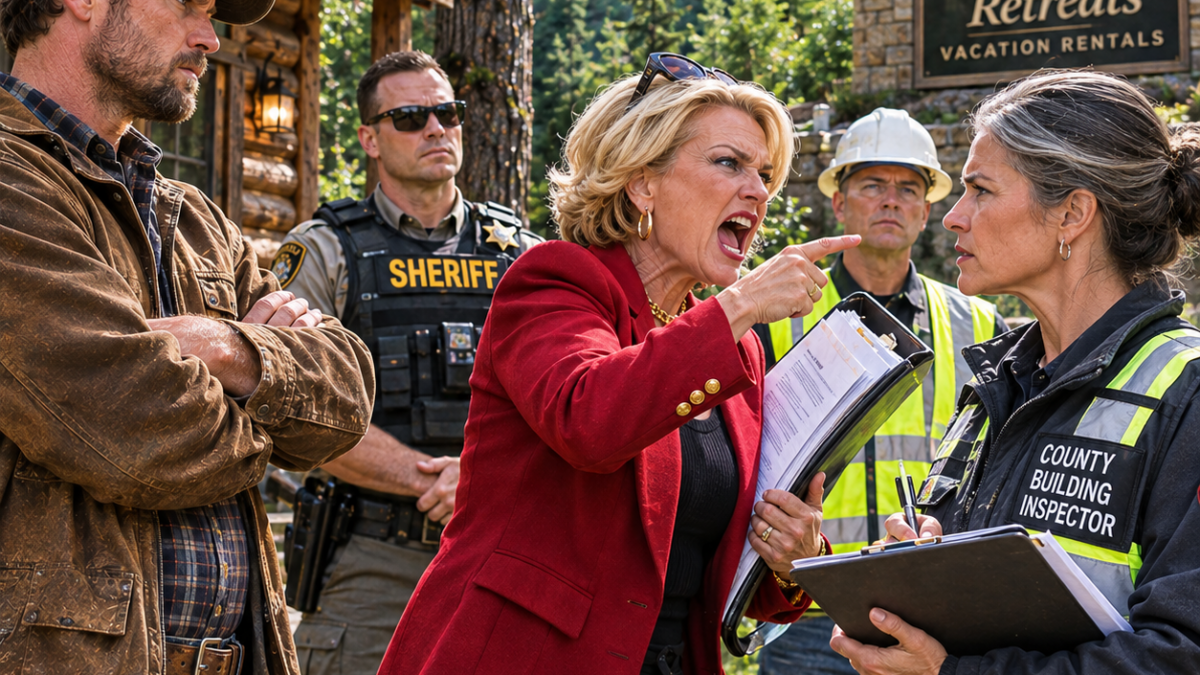
HOA Karen Reported My Forest Cabin as Unsafe—Then Inspectors Condemned All 46 of Her Luxury Rental Homes.
Karen Trafton filed a safety complaint claiming Davis Roark’s little forest cabin was about to collapse, then arrived with two HOA witnesses and a camera to watch county inspectors force him out of the home his father had built.
But when the chief inspector crawled beneath his porch, she found five solid support posts instead of the three cracked ones shown in Karen’s photographs—and one question about where those pictures had really been taken made the HOA president go completely pale.
Thirty-six hours later, investigators were climbing beneath Karen’s own luxury rentals, and by the time the rain stopped, bright red occupancy notices were hanging on all forty-six doors.
Late autumn had settled over Pine Hollow Ridge like a heavy gray blanket.
The Oregon sky hung low above the firs, and the air smelled of cedar bark, wet earth, and rain that had not started yet but soon would.
Davis Roark knew that smell.
For twenty years he had maintained Forest Service roads in country where water could turn a harmless ditch into a washout overnight.
He knew what saturated soil looked like.
He knew what happens when culverts clog.
He knew that gravity never accepted excuses.
At forty-three, Davis had left government work, bought out the last small share of his father’s estate, and settled into seventeen wooded acres at the bottom of Pine Hollow Ridge.
He didn’t call it retirement.
He still repaired roads occasionally.
Cut firewood.
Did small equipment jobs.
Helped neighboring landowners clear drainage.
Mostly, though, he wanted to be left alone.
His cabin sat below the ridge where the forest thickened.
His father had started building it more than thirty years earlier.
Not a grand house.
Not the sort of place that appeared in architectural magazines.
An A-frame-inspired timber cabin with a deep porch, cedar siding, a stone chimney, and windows looking through the firs toward the creek.
His father had framed the first wall himself.
Davis helped with the second when he was thirteen.
They had replaced parts over the years.
A roof section after a windstorm.
The furnace six years earlier.
The chimney liner.
Several joists.
Three years before the trouble began, Davis had hired a licensed contractor to reinforce the porch and replace several aging exterior supports.
Everything permitted.
Everything inspected.
That was why the yellow envelope on his front door made no sense.
He found it at 4:17 on a Thursday afternoon.
The Pine Hollow Ridge HOA seal was printed across the corner.
Davis stood on the porch, mud still on his boots from checking a culvert, and opened it.
The first sentence read:
PART2:
NOTICE OF IMMEDIATE SAFETY VIOLATIONS.
He frowned.
Then kept reading.
The cabin allegedly had:
A compromised roof structure.
Dangerous foundation settlement.
An unsafe heating system.
Inadequate floor support.
Potential fire hazards.
And, according to the letter, a risk of “sudden structural failure.”
Near the bottom, bold lettering ordered the property vacated within forty-eight hours.
Davis read that twice.
Then a third time.
Finally, he laughed.
Not because it was funny.
Because it was ridiculous.
His seventeen acres were not part of Pine Hollow Ridge.
Never had been.
His father had specifically bought land outside the subdivision boundary decades before the modern resort development existed.
The HOA could no more evict Davis from his cabin than the grocery store downtown could.
Still, confident lies bothered him.
Especially when they arrived on official-looking letterhead.
He went inside.
Placed the notice on his kitchen table.
Called the county building department.
A woman answered.
“Pine County Building and Safety.”
PART3:
“My name is Davis Roark. I’m calling about a complaint on parcel 17-442.”
Keyboard clicks.
“One moment.”
Silence.
More typing.
“Yes, Mr. Roark. We have a complaint.”
His smile disappeared.
“From who?”
“I can tell you the complainant listed is Karen Trafton.”
Of course.
“What’s the complaint?”
“Possible dangerous structure. Photographs were submitted.”
“Photographs of my house?”
“According to the complaint.”
“Has anyone inspected it?”
“Not yet.”
“Then why did I receive an order to vacate?”
“From the county?”
“No. HOA.”
The clerk paused.
“You’re outside Pine Hollow Ridge, correct?”
“Entirely.”
“Then an HOA notice isn’t a county evacuation order.”
“That’s what I thought.”
“But because a formal safety complaint was submitted, an inspection has been scheduled.”
“When?”
“Tomorrow morning.”
Davis rubbed his forehead.
“Fine.”
He almost hung up.
Then asked:
“What kind of photographs?”
“I can’t interpret evidence over the phone.”
“Fair.”
“Inspector will have the file.”
Davis thanked her.
Then drove toward the lower gate.
He didn’t need to wonder long where Karen was.
She was waiting beside it.
Karen Trafton was fifty-six, president of the Pine Hollow Ridge HOA, owner of Ridgecrest Retreats, and the sort of woman who never seemed to arrive anywhere accidentally.
She wore dark boots, expensive outdoor clothes, a quilted cream vest, and an expression of practiced sympathy.
Two HOA board members stood beside her.
Neither looked comfortable.
Karen smiled as Davis approached.
“Davis.”
“Karen.”
“I assume you received the notice.”
“I did.”
“Then you understand the seriousness.”
“I understand you sent me a letter you don’t have authority to enforce.”
Her smile thinned.
“This isn’t about HOA authority.”
“Your logo’s on the envelope.”
“We’re protecting the community.”
“My house isn’t in your community.”
“It affects it.”
Davis looked uphill.
Above the trees, the luxury rentals of Ridgecrest Retreats sat along two terraces cut into the slope.
Forty-six houses.
Modern glass.
Huge decks.
Hot tubs.
Metal roofs.
Vacation homes rented by the night and advertised with phrases like wilderness luxury and elevated mountain living.
Karen had spent years turning the ridge into a profitable destination.
The HOA and her rental business overlapped in ways nobody seemed eager to explain.
“What exactly does my cabin affect?”
“The image.”
Davis stared.
Karen continued.
“We have guests paying premium rates. They don’t want to look down into a deteriorating property.”
“You can’t see my cabin from most of those houses.”
“That’s not the point.”
“What is?”
She opened her handbag.
Removed a folder.
“Let’s stop pretending.”
Inside was a purchase offer.
$43,000.
For all seventeen acres.
Cabin included.
Davis actually looked around as though another number might be hiding somewhere.
“Forty-three thousand?”
“Cash.”
“My land appraised at more than four times that.”
“Two years ago.”
“Land didn’t shrink.”
“Your structure has safety issues.”
“According to you.”
“According to evidence.”
Davis folded the offer.
Handed it back.
“No.”
Karen’s voice cooled.
“You should consider what happens after the county condemns it.”
“They won’t.”
“You sound very confident.”
“I know my house.”
“Inspectors know codes.”
“Good.”
He stepped toward his truck.
Karen said:
“This is your last chance to leave peacefully.”
Davis stopped.
Looked back.
“When did this become a fight?”
“You made it one.”
“By owning land?”
“By refusing to recognize reality.”
He almost walked away.
Then Karen made her mistake.
“When the parcel changes hands, Ridgecrest will finally be able to run the drainage line through the lower section and be done with this.”
Davis turned slowly.
“Drainage line?”
Her mouth tightened.
“What drainage line?”
“Nothing that concerns you.”
“You just said it concerns my land.”
Karen looked toward one of the board members.
Then back at Davis.
“Sell while you still have leverage.”
She got into her SUV.
Drove uphill.
The two board members followed.
Davis remained at the gate.
Drainage line.
That phrase bothered him more than the condemnation threat.
Ridgecrest sat above him.
Water flowed downhill.
Whatever Karen wanted to send through his seventeen acres would eventually reach the creek.
That evening the rain began.
Light at first.
Davis sat at his kitchen table with the yellow notice beside him.
Then remembered the porch camera.
He checked the previous day’s recordings.
At 11:42 a.m., while Davis had been miles away checking a road culvert, a white Ridgecrest Retreats pickup stopped near his property entrance.
It sat there almost twenty minutes.
Passenger window open.
Someone inside held what looked like a camera.
Zooming toward the cabin.
Davis saved the clip.
Maybe harmless.
Maybe not.
At 6:52 the next morning, another vehicle arrived.
County seal.
Chief Building Inspector Marin Bishop stepped out.
Forty-nine.
Dark hair threaded with silver.
Work boots.
Rain jacket.
Clipboard.
Karen was already there.
So were the same two board members.
And a young man carrying a professional video camera.
Davis looked at him.
Then at Karen.
“You brought media?”
“Documentation.”
Marin heard.
She turned.
“No filming inside without the owner’s permission.”
Karen smiled.
“Of course.”
Then immediately began talking.
“I appreciate you coming so quickly. We believe there’s an immediate risk of collapse. The roof—”
Marin held up one hand.
“Mrs. Trafton.”
“Yes?”
“I haven’t inspected anything.”
“The photographs clearly show—”
“I’ll review the photographs.”
“We really think it should be condemned before—”
“That’s not how this works.”
Karen stopped.
Marin looked at Davis.
“Mr. Roark?”
“That’s me.”
“Permission to inspect?”
“Absolutely.”
He led her inside.
On the kitchen table he had arranged every relevant document.
Roof permit.
Electrical inspection.
Furnace warranty.
Chimney receipt.
Structural reinforcement invoice.
County sign-offs.
Marin went through them without hurry.
Karen attempted to stand in the doorway.
Davis didn’t object.
Marin didn’t care.
She inspected the furnace.
Checked venting.
Tested alarms.
Examined the electrical panel.
Climbed into the attic.
Used a moisture meter.
Looked at rafters.
Checked fasteners.
Crawled beneath the floor structure.
Returned with mud on one knee.
“The report says the south floor is sagging.”
Karen answered before Davis.
“It is.”
Marin put a small laser level on the floor.
Then another.
Measured.
“Within tolerance.”
Karen scoffed.
“Maybe he repaired it last night.”
Marin didn’t look at her.
“Structural repair overnight would be impressive.”
Davis almost smiled.
The roof was sound.
Furnace functioning.
No dangerous wiring.
No active foundation failure.
Then Marin opened the complaint file.
She removed photographs.
Davis leaned closer.
His stomach tightened.
The first photograph showed a concrete support with a long vertical crack.
The second showed a visibly tilted wooden floor.
The third showed a damaged footing.
The fourth showed three support posts beneath what appeared to be a deck or porch.
Ugly damage.
Real damage.
But not his.
“That’s not my cabin.”
Karen immediately said:
“Of course it is.”
Davis pointed.
“My porch has five supports.”
Karen said:
“You replaced them.”
“When?”
“Recently.”
Davis looked at Marin.
“Come outside.”
They walked around the porch.
Five posts.
Weathered.
Bolts oxidized.
Bases packed into old soil.
No evidence of fresh installation.
Davis pulled out his phone.
Opened a picture taken three summers earlier during a family barbecue.
Same porch.
Same five posts.
Another photograph from winter.
Same.
Marin compared them.
Karen folded her arms.
“He could have altered the photograph.”
Davis looked at her.
“You think I went back three years in time and edited vacation pictures to defeat a complaint you filed yesterday?”
Karen’s face reddened.
Marin said nothing.
She simply wrote.
Then asked:
“Mrs. Trafton, where did the complaint photographs come from?”
Karen hesitated.
“They were provided to the HOA.”
“By whom?”
“Our maintenance staff.”
“Who entered this property?”
“No one entered.”
“Then how were photographs taken beneath the structure?”
Karen’s answer came too quickly.
“Telephoto lens.”
Davis looked at the low crawlspace.
Then at Marin.
Marin made another note.
She didn’t accuse anyone.
Didn’t have to.
At the end of the inspection, she stood on the porch.
“I’ve found no condition requiring an emergency occupancy restriction.”
Karen stepped forward.
“That’s impossible.”
“No.”
“The complaint photographs—”
“Do not appear to depict this structure.”
“You’re taking his side.”
“I’m inspecting a building.”
“This cabin is unsafe.”
“If you have additional evidence, submit it.”
Karen turned toward the cameraman.
“This is unbelievable.”
Marin’s voice remained calm.
“If you interrupt another inspection in this manner, you may be removed from the site.”
Karen went silent.
Before leaving, Marin asked Davis to email his older photographs.
She also told him the source of the complaint images would be reviewed.
By 2:00 p.m., Davis had preliminary written confirmation.
No immediate hazard.
No order to vacate.
He thought that might end it.
He was wrong.
That evening, red emergency lights flickered through the trees above.
A rescue truck had driven into Ridgecrest Retreats.
Davis watched from his porch.
One hour later, his phone rang.
Unknown number.
“Davis Roark?”
“Speaking.”
“My name is Willa Prescott.”
She sounded nervous.
“Okay.”
“I’m staying at Ridgecrest.”
Davis looked uphill.
“How’d you get my number?”
“Your private-property sign.”
“What happened?”
Willa took a breath.
She was thirty-seven.
Accountant from Portland.
Had rented one of Karen’s luxury homes for a long weekend.
The previous night, she woke to a loud crack beneath the bedroom floor.
“In the house?”
“Under it.”
“Like wood?”
“Like something snapping.”
By morning, the bedroom door didn’t latch.
That evening the sound happened again.
Louder.
She called emergency services.
Responders found no gas leak and no visible immediate collapse.
They advised her to contact property management and remain away from visibly damaged areas.
“I did.”
“What did management say?”
“Normal expansion.”
“Did they inspect?”
“Someone came for maybe five minutes.”
“Engineer?”
“I don’t know.”
“What else?”
Willa’s voice lowered.
“I looked under the deck.”
Davis stood.
“What did you see?”
“A support.”
“Wood?”
“Concrete.”
“And?”
“Cracked.”
She sent a photograph.
Davis opened it.
Concrete pier.
Vertical fracture.
Dark wet soil.
“Did you send this to Karen?”
“Management.”
“What did they say?”
“Normal for mountain construction.”
Davis closed his eyes.
He had maintained roads long enough to know one thing.
Cracks have context.
Some harmless.
Some not.
He was not an engineer.
He told Willa exactly that.
“I can’t tell you your house is unsafe.”
“I understand.”
“But if you’re seeing changing floor levels and structural cracking, report it directly to the county.”
“I asked to move.”
“What happened?”
“They said every house is booked.”
“Refund?”
“No.”
Then Willa said:
“There’s something else.”
“What?”
“Before the emergency truck came, I saw a worker at the house next door painting the foundation.”
Davis paused.
“Painting what?”
“Cracks.”
“You’re sure?”
“He had gray coating and a brush. He was filling over lines in the concrete.”
Davis looked uphill again.
Forty-six homes.
One design repeated across the slope.
He opened Ridgecrest’s website.
Luxury photographs.
Glass walls.
Cantilevered decks.
Huge windows.
Raised foundations.
Every rental based on variations of the same structural plan.
The next morning, Willa invited Davis to see her unit.
He was careful.
She was the lawful tenant.
He entered as her guest.
Did not inspect neighboring properties.
Did not touch anything.
Inside, he immediately noticed the floor.
Slight pitch toward the valley.
Willa placed a marble near the kitchen.
Released it.
The marble rolled steadily across the floor.
Davis watched.
“Has it always done that?”
“I don’t know. First stay.”
At the back door, a fresh crack split the threshold finish.
Outside, Davis looked beneath the deck from accessible ground.
Dark soil.
Saturated.
Standing water.
Wrong.
The storm had passed more than a day earlier.
Water should have drained.
Instead it was collecting beneath the house.
Davis followed the slope visually.
Water seeped from higher ground.
Not from roof gutters.
Not a broken downspout.
Hillside flow.
Something in his memory stirred.
Years earlier, while working for the Forest Service, Davis had used old maps showing former road projects.
Spoil areas.
Places where excavated dirt, broken rock, and unsuitable material had been dumped.
He remembered one near Pine Hollow Ridge.
He couldn’t remember exactly where.
Back home, Karen had already texted him.
STAY AWAY FROM MY GUESTS OR I WILL HAVE YOU SUED.
Davis saved it.
Didn’t answer.
Then Willa sent another picture.
Closer angle under the foundation.
Davis enlarged it.
His heart rate changed.
Blue marking paint streaked across the concrete pier.
Black drainage pipe in the upper-right corner.
Jagged vertical crack.
He opened the complaint photograph Marin had provided.
Put both images side by side.
Same blue paint.
Same pipe.
Same crack.
Karen’s photograph of Davis’s supposedly failing foundation had been taken beneath Willa’s rental.
Davis stared for a full minute.
Then wrote Marin Bishop an email.
No accusations.
No social media.
No dramatic language.
He attached both images.
Identified the matching features.
Listed Willa’s rental address with her permission.
Then ended:
I believe the photograph submitted as evidence against my cabin may depict this property instead. Please verify independently.
Marin replied that evening.
The similarities were significant.
The county would examine the source.
But one damaged post did not establish a broader resort problem.
That was fair.
Willa filed her own complaint.
Now Ridgecrest Retreats was officially under inspection.
Karen arrived at Davis’s cabin the same afternoon she learned.
No invitation.
No friendly smile.
“You contacted my guest.”
“She contacted me.”
“You went inside one of my properties.”
“As her guest.”
“You’re trying to ruin me.”
“No.”
“You sent photographs to the county.”
“I sent a photograph you sent first.”
Karen’s expression hardened.
Davis leaned against the doorframe.
“Why did you use a picture from your rental to report my cabin?”
“Clerical error.”
“That’s convenient.”
“An administrative assistant mixed files.”
“The written complaint described the exact cracked post.”
Karen said nothing.
“The sagging floor too.”
Silence.
“Those conditions aren’t in my cabin.”
“I don’t prepare every filing personally.”
“Your name’s on it.”
Karen stepped closer.
“If you continue spreading unverified claims about Ridgecrest, I’ll sue you for defamation.”
“I haven’t spread anything.”
“You contacted inspectors.”
“That’s what inspectors are for.”
“I will take every acre you own.”
Davis opened the door.
“Everything I have is already with the county.”
Her face changed.
He closed the door.
The county requested Ridgecrest’s structural records.
Karen produced an immaculate package.
Foundation approvals.
Completion certificates.
Engineer signatures.
Safety inspections.
At first glance, everything looked clean.
Marin could not condemn a structure merely because paperwork seemed suspicious.
She said so.
But public inspection records became available.
Davis requested copies.
He didn’t know structural engineering.
He did understand dates.
Dates tell stories.
One foundation certificate was dated before the corresponding grading permit had been finalized.
Another inspection supposedly occurred while county records showed site preparation still underway.
Several houses showed foundation sign-offs within implausibly tight windows.
Davis made a simple spreadsheet.
House.
Permit.
Grading.
Foundation inspection.
Certificate.
Occupancy.
He highlighted inconsistencies.
Then sent them to Marin.
No conclusion.
Just dates.
Karen moved Willa to a hotel.
Called the rental closure “scheduled maintenance.”
Then offered her:
Full refund.
$900.
And a confidentiality agreement.
Willa read it.
Declined.
Forwarded it to the county.
At an emergency HOA meeting that evening, Karen blamed Davis publicly.
Said he was sabotaging the community.
Said his obsession threatened tourism income.
Proposed using HOA legal funds against him.
That was when Edith Larimore spoke.
Edith was sixty-one.
HOA treasurer for fourteen years.
Soft voice.
Careful manner.
Normally the kind of board member Karen talked over without noticing.
“Why are HOA road funds paying Ridgecrest maintenance bills?”
The room went quiet.
Karen stared.
“What?”
Edith opened a ledger.
“We paid drainage repair invoices for rental units.”
“Those repairs support community infrastructure.”
“The invoices list individual rental addresses.”
“This is not the time.”
“It’s accounting.”
“It’s trivia.”
Edith stopped talking.
But she kept writing.
Down in the valley, trucks started moving uphill.
Gravel.
A compact grader.
Davis filmed from his property.
One contractor recognized him.
Grant Vail.
Forty-six.
Sun-cracked hands.
Had worked on early Ridgecrest grading.
He walked toward Davis.
“You Roark?”
“Yes.”
Grant looked uphill.
Then toward Davis’s creek.
“Bad weather coming.”
“So I’ve heard.”
Grant hesitated.
“Ground up there has history.”
“What kind?”
“I signed confidentiality agreements.”
“Then don’t violate them.”
Grant seemed surprised.
Davis continued:
“I’m not asking you to break a contract.”
Grant nodded.
Started walking away.
Then stopped.
“Used to be a drainage channel across that slope.”
Davis waited.
“Natural?”
“Old engineered ditch. Forest road era.”
“What happened to it?”
Grant shook his head.
“That’s all I can say.”
Then left.
The rain arrived that night.
Hard.
By midnight, runoff sheeted across the Ridgecrest parking area.
Near one retaining wall, soil slumped.
Not catastrophic.
But enough to expose raw brown fill.
Karen’s crews arrived in darkness.
Temporary fencing.
Tarps.
Gravel.
Three nearby houses quietly evacuated.
Yet reservations for the weekend remained active.
Davis stood inside his gate and filmed water coming down the slope.
Muddy.
Fast.
Discharging toward his land.
He sent the video to Marin.
Requested county review of Ridgecrest drainage.
At 7:20 the next morning, Grant called.
“I’ve been thinking.”
Davis said nothing.
“I have drawings.”
“What drawings?”
“Old drainage plan.”
They met at a diner fifteen miles away.
Grant slid a folder across the booth.
Preliminary grading maps.
Handover notes.
Early drainage design.
Several areas were marked:
DEEP REINFORCEMENT REQUIRED.
UNSUITABLE FILL.
ADDITIONAL COMPACTION / ENGINEER REVIEW.
Davis looked up.
“What happened?”
“Our company left phase one before completion.”
“Why?”
“Contract dispute.”
“Did you reinforce?”
“Not our scope by then.”
“Who changed the plan?”
“I don’t know.”
Grant pointed to revision marks.
“Final version removed several reinforcement notes.”
“Engineer approved?”
“I can’t tell you.”
“Did Karen know?”
Grant hesitated.
“I saw her in meetings.”
“That’s not proof.”
“No.”
Davis closed the folder.
“Will you give this to the county?”
Grant looked scared.
“I’ve got employees.”
“Then talk to a lawyer first.”
Grant nodded.
Davis didn’t treat the documents like proof.
They were a lead.
That’s how he approached everything.
He requested historical topographic maps.
Old grading permits.
Forest Service records.
Drainage plans.
He hired a hydrology consultant to document water entering his property.
The consultant made no claims about Ridgecrest foundations.
Only measured flow.
Discharge patterns.
Sediment.
The county brought in independent geotechnical engineer Silas Gentry.
Fifty-one.
Lean.
Weathered.
The kind of man who picked up soil before introducing himself.
Silas studied Ridgecrest’s report.
Then the exposed slope.
Something didn’t fit.
The official soil document described shallow competent rock.
But the eroded areas showed layered fill.
Clay.
Gravel.
Broken rock.
Construction debris.
Loose heterogeneous material.
“Where’s the rock?” he asked Marin.
“Report says beneath the building terraces.”
Silas looked at the slope.
“Report says a lot.”
He requested original drilling logs.
Raw field data.
Boring locations.
Survey coordinates.
Karen objected.
Called the investigation excessive.
Said forty-six rentals had passed inspections.
Said hundreds of holiday bookings were at risk.
Marin answered:
“Safety isn’t for sale.”
The archive records arrived later that day.
Davis printed an old Forest Service topographic map.
Overlayed it against a current aerial image.
Adjusted scale.
Aligned road junctions.
Creeks.
Ridge contours.
Then stopped.
The old spoil yard covered most of the modern Ridgecrest footprint.
The place where road crews had dumped excavated earth decades earlier had become luxury building terraces.
That did not automatically mean the houses were unsafe.
Properly engineered fill can support buildings.
But improperly prepared fill?
Waterlogged fill?
Different story.
Silas began field testing under county authority.
Laser floor elevations.
Foundation examination.
Soil borings.
Moisture measurements.
The first three homes showed differential settlement.
Then five.
Then eleven.
One corner dropping faster than another.
Doors binding.
Deck lines shifting.
Shallow supports sitting over mixed fill.
The pattern kept repeating.
Not every home showed obvious cracks.
That was the frightening part.
The soil issue existed whether the walls advertised it or not.
Silas called Marin.
“No new guests.”
“Entire resort?”
“At least affected terrace until we finish.”
Marin issued a temporary stop on new occupancy.
Karen erupted.
Called county supervisors.
Called lawyers.
Called board members.
Nothing changed.
Then Silas found the document problem.
He had been staring at the original geotechnical report late one afternoon.
Rock descriptions.
Depths.
Groundwater.
Test values.
Something familiar.
He searched county archives.
Found another report.
Older.
Different property.
Then compared the data.
Exact.
Not similar.
Exact.
The Ridgecrest soil report contained measurements copied from a geotechnical study commissioned years earlier for stable bedrock property lower on the ridge.
Davis Roark’s cabin parcel.
Someone had taken soil data from beneath Davis’s father’s property and attached it to Ridgecrest documentation.
The irony was almost obscene.
Karen had tried to condemn Davis’s cabin using photographs from her rentals.
Now Ridgecrest’s own safety file appeared to rely on soil information from his cabin.
At an emergency county meeting, Marin laid the two reports side by side.
Karen sat across from her.
Silas beside Marin.
Grant Vail had come with counsel.
Davis was not present.
It wasn’t his investigation.
Marin asked:
“Mrs. Trafton, can you explain why these boring logs are identical?”
Karen barely looked.
“Contractors handled technical documents.”
“Your company submitted them.”
“We relied on professionals.”
“Did you know the site required additional reinforcement?”
“No.”
Grant’s attorney nodded.
Grant slid forward an email.
Months before completion.
Subject:
RIDGECREST SLOPE / FOUNDATION CONCERNS.
The email warned that certain terraces required reinforcement and drainage correction before occupancy.
Karen’s business address was on the chain.
Her reply:
Proceed with current schedule. We cannot absorb another delay. Find a workable field solution.
She had acknowledged the concern.
Maybe she did not understand its full technical meaning.
But she had been told.
The county expanded the inspection to all forty-six structures.
Karen finally understood the scale.
If every house needed reinforcement, drainage reconstruction, underpinning, or partial foundation replacement, the cost could destroy Ridgecrest Retreats.
She drove directly to Davis’s cabin.
No red-carpet confidence.
No binder.
Just urgency.
“I need a temporary drainage easement.”
Davis looked at her from the porch.
“For what?”
“We have stormwater backing up.”
“Engineered design?”
“Being prepared.”
“Permit?”
“Emergency work doesn’t require the normal timeline.”
“Approved plan?”
“We don’t have time.”
“Then no.”
Karen stared.
“This could save the houses.”
“Or push your problem into my creek.”
“We’ll trench along your southern edge.”
“No.”
“I’ll pay.”
“No.”
“Name a number.”
“No.”
She stepped closer.
“You understand what you’re doing?”
“Yes.”
“Forty-six properties.”
“Your properties.”
“Hundreds of jobs.”
“Then bring me a stamped design, environmental approval, insurance, and county permit.”
“This is an emergency.”
“Emergencies don’t make bad engineering good.”
Her face changed.
“The excavators will come whether you agree or not.”
Davis nodded once.
“Then they’ll meet code enforcement.”
Two days later, during another storm, they came.
Excavator.
Dump truck.
Karen in the lead vehicle.
Davis stood inside his gate wearing a rain jacket.
No weapon.
No machine blocking the road.
Phone recording.
He told the operators:
“This is private property. I have not authorized excavation. If you cross the gate, I will report trespass and unpermitted work.”
The excavator operator stopped.
Karen climbed out.
“Keep moving.”
The operator looked at Davis.
Then Karen.
“I need permit confirmation.”
“You have my authorization.”
“You’re not the owner.”
Davis called county code enforcement.
Photographed equipment.
License plates.
Bucket position.
Within an hour, officials confirmed no drainage trench had been approved.
Work stopped.
Karen stood in pouring rain.
“You are going to destroy the resort.”
Davis answered:
“No. I’m stopping you from sending your problem downhill.”
At nearly the same time, Silas completed emergency findings.
Several foundation systems showed active settlement.
The slope showed instability.
Saturated fill reduced confidence in bearing capacity.
The drainage system was worsening conditions.
He could not identify which individual structure might fail first.
That meant no responsible inspector could simply condemn the three ugliest houses and leave forty-three occupied.
Marin coordinated with fire and emergency services.
Evacuation began.
Not chaos.
Methodical.
Door to door.
Guests guided out.
People given time to collect medication and essentials where safe.
Children wrapped in rain jackets.
Suitcases carried through mud.
Hotel arrangements in town.
Rental refunds to be handled later.
For now:
Get everyone off the slope.
Karen raced back uphill.
Found Marin beside the command vehicle.
“You cannot close all of them.”
“We can.”
“Three houses have cracks.”
“It’s not three houses.”
“Then close the upper terrace.”
“The hazard is shared.”
“You’re destroying my company.”
“I’m removing occupants from a potential hazard.”
“They passed inspection!”
“That’s under investigation.”
Karen’s voice broke.
“Please.”
For the first time, it sounded genuine.
Marin softened slightly.
“Karen, this is not punishment.”
“You don’t understand.”
“I do.”
“No, you don’t.”
“If I’m wrong, testing proves it and occupancy resumes.”
“And if you’re right?”
Marin didn’t answer.
A wet groan came from the slope.
Everyone turned.
A section of saturated earth beside the internal road dropped.
Not a landslide.
Not enough to swallow a house.
But enough.
Several feet of soil slumped downhill.
A fence twisted.
Mud spilled onto pavement.
Workers stepped backward.
Silence.
Karen stared.
Marin looked at her.
No one needed to argue anymore.
By evening, the county issued occupancy restrictions.
House One.
Red notice.
House Two.
House Three.
Marin’s staff moved methodically.
Ten.
Twenty.
Thirty.
Forty.
Forty-six.
Every Ridgecrest Retreats home.
UNSAFE FOR OCCUPANCY PENDING ENGINEERING CORRECTION AND APPROVAL.
Karen stood in the center of the development.
Rain running down her coat.
The same road where promotional photographers had once captured her smiling in sunset light.
Forty-six dark houses surrounded her.
Davis had walked only as far as the edge of his property to make sure the final guests got out safely.
Karen saw him.
Crossed toward him.
“You did this!”
Davis said nothing.
“You destroyed everything!”
Marin stepped between them.
“Mrs. Trafton.”
Karen pointed at Davis.
“He caused this investigation.”
Marin answered calmly:
“He did not condemn your houses.”
She looked toward the red notices.
“The conditions beneath them did.”
Karen stared at her.
Then at Davis.
For once, there was no answer.
That night, long after county vehicles left, headlights appeared on Davis’s drive.
He stepped onto the porch.
Edith Larimore got out.
HOA treasurer.
Blue coat.
Folder held against her chest.
“Can we talk?”
Davis opened the door.
They sat at his kitchen table.
The same table where the yellow condemnation notice had begun everything.
Edith opened the folder.
“I’ve kept copies.”
“Of what?”
“Accounts.”
“Why bring them to me?”
“Because I don’t trust our board office anymore.”
She looked exhausted.
“Karen told everyone Ridgecrest Retreats was owned by private investors.”
“Isn’t it?”
“Technically, pieces are.”
She opened corporate records.
Management agreements.
Vendor contracts.
Karen controlled companies managing most of the rental operation.
More troubling:
HOA money repeatedly paid costs tied to Ridgecrest.
Drainage.
Road work.
Landscaping.
Emergency repairs.
Consulting.
Approximately $640,000 over several years had moved from association funds into vendors or entities connected directly or indirectly to Karen’s businesses.
“Is it stolen?”
Davis asked.
“I don’t know.”
“Then don’t call it stolen.”
Edith nodded.
“That’s why I kept records.”
She turned another page.
Months earlier, Ridgecrest had obtained a contractor estimate for major reinforcement and drainage correction.
Cost:
Enormous.
Enough to threaten the business.
Instead of moving forward, internal sketches began appearing.
A cheaper drainage route.
Downhill.
Across Davis’s seventeen acres.
He followed the line with his finger.
Straight through the lower section of his property.
Near the cabin.
Then he understood.
Karen’s $43,000 offer.
The false safety complaint.
The photographs.
The condemnation threat.
If she could force him out cheaply, Ridgecrest could acquire the valley route for drainage without paying market price or confronting the deeper foundation problem immediately.
It wouldn’t repair unstable fill.
Wouldn’t magically make forty-six foundations sound.
But it might remove enough water to buy time.
Time meant rental income.
Davis sat back.
“Take this to a lawyer.”
Edith looked frightened.
“Karen will know.”
“Then get a lawyer before anyone else sees it.”
“What about you?”
“I don’t need your financial records.”
“But she came after your home.”
“That doesn’t make me an investigator.”
Edith almost smiled.
“You’re annoyingly reasonable.”
“My attorney says that’s useful.”
The next morning, Davis and Edith met his lawyer.
Copies went to appropriate authorities with requests to preserve original records.
No Facebook post.
No anonymous leaks.
No public revenge.
That mattered later.
The HOA membership called a special meeting.
Karen tried to control it.
For the first fifteen minutes, she still acted like president.
Called the investigation political.
Blamed Davis.
Blamed Willa.
Blamed county inspectors.
Blamed contractors.
Then Edith spoke.
She read from the accounts.
Asked why community funds covered private rental maintenance.
Asked why related-party contracts were not fully disclosed.
Asked why major drainage concerns had not been presented to owners.
Karen shouted that every expenditure benefited Pine Hollow Ridge.
A homeowner stood.
“Did the HOA pay Ridgecrest bills?”
Karen avoided the question.
Another:
“Do you own Ridgecrest management companies?”
“That’s irrelevant.”
Someone else:
“Did you know the houses needed foundation work?”
Chaos.
The board voted to suspend Karen’s executive authority pending independent review.
She walked out before the meeting ended.
Several weeks followed.
Engineering.
Accounting.
Court filings.
Insurance carriers.
Guest claims.
Contract disputes.
The county did not order forty-six homes bulldozed.
Real life isn’t that simple.
Some structures might be repairable with underpinning.
Some might need deep foundation systems.
Drainage required complete redesign.
Sections of slope needed stabilization.
Each terrace required engineering.
Each building would have to pass new inspection before anyone could sleep inside again.
But until then:
No occupancy.
No rentals.
No revenue.
Karen’s empire had gone dark.
At one hearing, her lawyer argued that the HOA as a whole should share Ridgecrest’s losses because the resort contributed to community property values.
The new board rejected that position.
The independent financial review began separating legitimate HOA expenses from costs tied primarily to Karen’s businesses.
Assets and records were protected under court supervision.
An outside manager was brought in for the disputed rental operations.
The copied geotechnical documents became part of a separate investigation.
So did the complaint photographs.
So did the certificates bearing questionable dates.
So did Karen’s emails.
Davis stayed out of it as much as possible.
He had never wanted forty-six houses condemned.
He had wanted his cabin left alone.
One afternoon, Marin returned.
No Karen.
No camera.
Just clipboard.
She handed Davis the final report on his property.
“You’re clear.”
He opened it.
Roof structurally acceptable.
Heating compliant.
Electrical acceptable.
Floor framing stable.
Foundation supports satisfactory.
No occupancy restriction.
No basis for condemnation.
He read it twice.
“You knew already.”
“Preliminary inspection isn’t final documentation.”
“Fair.”
Marin glanced toward the ridge.
“You realize how strange this case is?”
“Unfortunately.”
“The photographs started it.”
“Karen started it.”
Marin corrected him gently.
“Evidence started it.”
Davis nodded.
She was right.
Karen had tried to weaponize inspection.
But inspection itself wasn’t the enemy.
Done properly, it protected Davis.
Protected Willa.
Protected every guest who might have slept above saturated fill.
That distinction mattered.
Davis agreed to let county technical crews use a small corner of his yard as a staging point for monitoring equipment.
In writing.
Clear terms.
No excavation.
No permanent installations.
No access outside defined hours.
No right created beyond temporary use.
Marin smiled when she read his agreement.
“You’ve learned.”
“My father taught me.”
Some Pine Hollow Ridge residents eventually came down to apologize.
Not all.
They weren’t responsible for everything Karen did.
But many admitted they’d believed her because she sounded certain.
One man stood on Davis’s porch holding his cap.
“We thought you were refusing repairs.”
“Nobody asked me for repairs.”
“She said you’d blocked a safety drainage project.”
“She tried to bring an excavator through without a permit.”
The man looked embarrassed.
“I didn’t know.”
“That’s the point.”
Another neighbor asked:
“What should we have done?”
Davis answered:
“Read the reports.”
The man laughed awkwardly.
Davis didn’t.
“Seriously.”
He pointed uphill.
“Brochures don’t hold houses up.”
The last HOA meeting of the season took place without Karen.
Edith sat at the front.
Not because she wanted power.
Because people trusted someone who had kept copies.
New rules passed.
Independent annual audits.
Full disclosure of contracts involving board members or their businesses.
Competitive bids above a defined amount.
Protected reporting process for safety concerns.
No retaliatory action against residents who contacted county inspectors.
Engineering reports made available to property owners when safety issues affected shared land.
Boring rules.
Important rules.
Davis didn’t attend.
He was home.
Rain had finally stopped.
Clouds broke over the ridge.
The wet fir trees reflected evening light.
Inside, two documents sat on his kitchen table.
The yellow HOA notice:
VACATE WITHIN 48 HOURS.
And the county’s final inspection:
NO OCCUPANCY RESTRICTION.
He stared at them.
Then made coffee.
Outside, the forty-six luxury homes stood dark.
No guests.
No porch lights.
No hot tubs steaming.
No rental vans.
Red notices hung on every door.
Below them, Davis’s old cabin glowed warm among the cedars.
The irony wasn’t lost on him.
Karen had spent weeks insisting his home was the danger.
It was the only house in the entire dispute inspectors had actually cleared.
Months passed.
Ridgecrest didn’t disappear.
Repair planning began.
Engineers proposed deep piers beneath some structures.
Drainage galleries.
Slope reinforcement.
Retaining systems.
Instrumentation to monitor movement.
Some houses required more work than others.
Insurance disputes dragged on.
Investors sued.
Contractors blamed engineers.
Engineers blamed incomplete site information.
Karen’s companies faced financial and legal scrutiny.
No single villain could explain every failure.
That mattered too.
Large disasters usually require multiple people to stop asking questions.
An engineer’s warning not pursued.
A drainage issue postponed.
A contractor change.
A strange certificate accepted.
A crack painted.
A complaint dismissed.
A guest pressured.
A board member silenced.
Each decision small enough to rationalize.
Together, dangerous.
Grant Vail eventually gave full testimony through counsel.
He hadn’t designed the foundations.
Hadn’t certified them.
His firm had flagged soil problems during early work.
Then lost the contract after disagreements about cost.
For years, he told himself responsibility belonged to whoever came next.
That was understandable.
But not harmless.
Willa returned to Portland.
She refused several interview requests.
Didn’t want fame.
Davis respected that.
Months later, she mailed him a small package.
Inside:
A bag of marbles.
A note:
FOR FUTURE FLOOR INSPECTIONS.
Davis laughed harder than he had in months.
He kept one marble on his desk.
Marin eventually moved into a county administrative role.
Silas remained an engineer.
Edith reluctantly served as interim HOA president until a proper election.
She hated every minute.
Which probably made her good at it.
One evening she came down to Davis’s cabin.
Carried a bottle of wine.
“Peace offering.”
“I didn’t know we were at war.”
“Karen thought we were.”
“Karen thought many things.”
They sat on the porch.
The ridge above was still mostly dark.
Edith said:
“Do you ever feel guilty?”
“For what?”
“The rentals.”
Davis looked at her.
“No.”
She seemed surprised.
“I feel bad for the guests.”
“Different.”
“Owners too.”
“Different.”
“The workers.”
“Different.”
“But not guilty?”
“I didn’t make the ground unstable.”
Edith nodded.
“Marin said something similar.”
“She’s smarter.”
Edith drank.
“Karen says you destroyed her.”
Davis looked toward the trees.
“Karen filed a false complaint against my home.”
“Yes.”
“She used photographs from a rental.”
“Yes.”
“She threatened to take my land.”
“Yes.”
“Then she tried to dig across it without permits.”
“Yes.”
He shrugged.
“Seems like she stayed busy destroying herself.”
Edith laughed.
Then became serious.
“You could have gone public with everything.”
“Wouldn’t make the soil stronger.”
That became Davis’s way of thinking about the whole fight.
Noise didn’t fix structures.
Facts did.
He never needed thousands of strangers online to hate Karen.
He needed an inspector to compare photographs.
An engineer to test soil.
A county clerk to pull records.
An accountant to follow money.
A guest willing to report a crack.
A contractor willing to preserve old drawings.
Systems worked only if people used them.
Karen’s greatest mistake had been believing those systems were weapons she alone could control.
She filed the first complaint because she believed inspection meant power.
Instead, inspection meant verification.
Once Marin started verifying, Karen couldn’t choose where the questions stopped.
That was the entire story.
One lie opened a door.
Behind it were forty-six foundations.
Years later, the Roark cabin still stands.
Davis replaced the porch stain.
Added a new shed.
Rebuilt the woodshed roof.
Biscuit—no, there was no pig in this story; that belonged to someone else’s ranch and Davis would have hated the noise anyway.
He kept the land quiet.
The lower creek still ran clear.
No emergency drainage trench crossed his property.
Eventually, after engineering review, the county approved a redesigned controlled drainage route entirely within Ridgecrest land and along a permitted easement elsewhere.
Expensive.
Slow.
Proper.
Some Ridgecrest homes reopened after major stabilization.
Others remained closed much longer.
A few investors chose to sell.
The resort never returned to the polished image Karen had advertised.
Maybe that wasn’t a bad thing.
New promotional language stopped calling the ridge “untouched wilderness.”
It wasn’t.
It was engineered land.
And engineered land requires maintenance.
The new owners learned that.
Davis sometimes encountered visitors on the old logging road.
Most had no idea what had happened.
Occasionally someone recognized the cabin.
“Is this the house?”
“What house?”
“The one the HOA tried to condemn.”
Davis usually shrugged.
“It’s a cabin.”
“But inspectors shut the whole resort down because of you.”
“No.”
That correction mattered.
“Because of what?”
“Because inspectors found something unsafe.”
“But you reported it.”
“A guest did first.”
“Then you helped.”
“I sent them evidence.”
“Same thing.”
“No.”
Davis would point uphill.
“Evidence is not the same thing as causing the problem.”
That distinction became almost a personal rule.
If a doctor finds cancer, the doctor didn’t cause cancer.
If an engineer finds a crack, the engineer didn’t cause the crack.
If an inspector identifies unstable foundations, the inspector did not make the hill unstable.
And if someone exposes a lie, they didn’t create the truth hiding underneath it.
Karen never seemed to understand that.
Even after losing the HOA presidency, even after the investigations, even after the rentals were closed, she kept insisting Davis had caused the collapse of her business.
Maybe admitting otherwise required something she didn’t have.
Because if Davis hadn’t caused it, then Karen had to look backward.
At the engineering warnings.
The drainage problems.
The financial decisions.
The complaint.
The photograph.
The $43,000 offer.
The excavator in the rain.
All the moments when she could have stopped.
The final time Davis saw her was almost two years later.
He was buying hardware in town.
Karen stood near the paint section.
She looked older.
Not dramatically.
Just less polished.
They saw each other.
Neither moved at first.
Then Karen walked over.
“Davis.”
“Karen.”
“I heard they’re reopening twelve more houses.”
“So did I.”
“After spending a fortune.”
“That’s what repairs cost.”
She tightened her jaw.
“You still think you were right?”
“About what?”
“All of it.”
Davis thought.
“No.”
That surprised her.
“No?”
“I was wrong about one thing.”
“What?”
“I thought the first inspection would end it.”
Karen looked away.
Then said:
“You could have sold.”
“Yes.”
“Forty-three thousand was an opening offer.”
“That’s not what you called it.”
“You could have negotiated.”
“You could have asked for a drainage easement honestly.”
Silence.
“You would’ve said no.”
“To an unengineered trench? Yes.”
“Then what choice did I have?”
There it was again.
Same logic.
Davis looked at her.
“The expensive one.”
She frowned.
“Fix the houses.”
“It would have ruined us.”
“Then they shouldn’t have been rented.”
“You make everything sound simple.”
“No.”
Davis shook his head.
“Simple isn’t the same as easy.”
Karen said nothing.
He walked away.
That was the last conversation.
At home, he still kept the yellow notice.
Not framed.
Not displayed.
Folded in the kitchen drawer.
Every now and then he came across it looking for batteries or receipts.
He’d read the line:
VACATE WITHIN 48 HOURS.
Then look around.
At the roof Karen said would collapse.
The floor Karen said was unsafe.
The furnace Karen claimed didn’t work.
The five porch posts standing exactly where they’d stood before.
The house survived.
Not because it was magical.
Because it had been maintained.
Inspected.
Repaired.
Documented.
His father had always been obsessive about that.
Keep receipts.
Keep permits.
Take photographs before closing walls.
Write dates on everything.
Davis used to tease him.
“Nobody cares about paperwork.”
His father would say:
“You care the day somebody lies.”
He had been right.
That line stayed with Davis more than anything else.
Because Karen’s plan depended on confidence.
Not truth.
The yellow HOA seal.
The formal language.
The witnesses.
The camera.
The expensive vest.
The threat.
All designed to make Davis feel as though the decision had already been made.
Leave.
Sell.
Accept.
Don’t ask.
A lot of people would have panicked.
Maybe moved out before calling the county.
Maybe taken the low offer.
Maybe assumed an HOA document carried authority it didn’t have.
Davis did something smaller.
He checked.
One call.
Is this yours?
No.
Is there a complaint?
Yes.
Then let the inspector inspect.
That decision protected him.
And doomed Karen’s plan.
Because once Marin looked beneath the cabin, she saw the photographs were wrong.
Once the photographs were questioned, their origin mattered.
Once their origin mattered, Willa’s rental mattered.
Once that rental mattered, the foundation records mattered.
Then the drainage.
The fill.
The copied soil report.
The emails.
The financial records.
Forty-six houses.
It had all been hiding behind one yellow envelope.
The last HOA meeting Davis ever attended happened three years later.
He hadn’t planned to go.
Edith invited him because Pine Hollow Ridge was voting on a permanent independent safety-review policy.
Davis sat in the back.
Same place quiet people always sit.
No Karen.
No cameras.
Edith read the resolution.
Any resident or renter could report a structural concern directly to the county without prior HOA approval.
No retaliation.
No fines for reporting.
No confidentiality requirement tied to safety complaints.
Related-party contracts disclosed.
Engineering documents retained.
The measure passed unanimously.
Afterward, a younger homeowner approached Davis.
“I bought after everything happened.”
“Smart timing.”
The man laughed.
“My wife said we should thank you.”
“For what?”
“Making them change.”
Davis shook his head.
“Didn’t.”
“Sure looks like it.”
“Forty-six red notices changed them.”
The man considered that.
“Still wouldn’t have happened without you.”
Davis looked through the clubhouse windows toward the dark forest below.
His cabin lights were barely visible through the trees.
“Maybe.”
Then he said:
“But don’t build a community that depends on one stubborn guy catching the lie.”
The man smiled.
“Fair.”
Davis drove home.
Rain began halfway down the road.
Soft at first.
By the time he reached the cabin, it was tapping steadily on the roof.
He went inside.
Furnace humming.
Floor level.
Chimney warm.
Nothing dramatic.
Nothing luxurious.
Safe.
He made coffee.
Opened the drawer.
Found Karen’s yellow notice.
Set it on the table.
Then placed the county safety certificate beside it.
Two pieces of paper.
One claimed authority without facts.
The other recorded facts without theater.
Outside, water flowed through the drainage ditch Davis had cleaned that morning.
Downhill.
Exactly where it was supposed to go.
He listened.
For most people, it would have sounded like rain.
To Davis, it sounded like the simplest lesson Karen Trafton had never learned.
You can paint over a crack.
You can bury a report.
You can put an HOA seal on a threat.
You can photograph somebody else’s damage and call it yours.
You can pressure a homeowner.
You can silence a guest.
You can tell a board that numbers are trivia.
You can even convince yourself the danger isn’t real because fixing it costs too much.
But water still follows gravity.
Bad soil still settles.
Forged evidence still fails when compared with the real thing.
And an unsafe building does not become safe because the person collecting rent needs it to be.
Karen had tried to prove Davis Roark’s little forest cabin was the most dangerous home on Pine Hollow Ridge.
In the end, inspectors found forty-six buildings they could not trust.
And the only house left glowing safely beneath the trees was the one she had tried hardest to condemn.








