HOA Karen Reported Me for Hunting on My Own 140 Acres—Then Wildlife Officers Found Her Son’s Tag at a Hidden Poaching Site
PART2:
Report what needs reporting.
Never shoot because you are impatient.
Never lie to a game warden.
And never confuse owning land with being allowed to abuse it.
“Land lasts longer than excuses,” he used to say.
I heard that sentence in my head more often after he died than I ever had while he was alive.
Willow Ridge Estates had been built along my southern boundary twelve years earlier.
At first there were twenty-eight homes.
Then forty.
Then seventy-three.
By the time Dee Hartwell became HOA president, there were 112.
Most of the homeowners were fine.
Some waved when they saw me fixing fence.
A few asked politely whether their kids could fish my pond.
Sometimes I said yes.
One retired couple bought hay from me for their goats.
A woman named Marlene brought me peach preserves every August because I helped pull her car out of a ditch once.
The problem was never Willow Ridge.
The problem was Dee.
Dee Hartwell had the kind of confidence people mistake for authority when they have not yet checked the paperwork.
Fifty-three.
Blond hair always perfect.
White SUV.
Designer sunglasses.
HOA binder tucked beneath one arm.
She spoke in declarations.
Not questions.
The first time she came to my house, she told me my eastern field needed “visual buffering.”
I asked what that meant.
“Evergreens.”
“Why?”
“Our residents can see your equipment.”
I looked behind me at my tractor.
“My tractor?”
“Yes.”
“From their houses?”
“Yes.”
“And?”
“It affects the aesthetic.”
I remember staring at her because I genuinely thought I had missed the joke.
Then I realized there wasn’t one.
“Dee, I’m not in your HOA.”
She gave me a patient smile.
“I understand that.”
“Then my tractor isn’t an HOA issue.”
“Everything affecting Willow Ridge is an HOA issue.”
“No.”
She smiled again.
“Everyone lives under us eventually.”
That line stayed with me.
At the time I thought it was arrogance.
Later I understood it had been a preview.
The problems started two weeks before deer season.
First, my north gate chain was cut.
Not broken by weather.
Cut.
Cleanly.
Bolt cutters.
I replaced it.
Three nights later, fresh tire tracks appeared along the back pasture.
They came through an old access point near the creek.
I followed them until they disappeared into leaves.
Not my truck.
Not any neighbor I recognized.
Then Scout started acting strange.
Scout was an eight-year-old black-and-tan hound mix who had spent his entire life believing every squirrel on my property was a personal insult.
He was friendly with people.
Too friendly, usually.
If somebody came up the driveway, Scout’s first instinct was to see whether they had food.
So when I saw him standing near the north tree line one morning with his body rigid and a low growl in his chest, I paid attention.
“What is it?”
His ears stayed forward.
He did not look at me.
Something had been there.
Maybe still was.
That afternoon I drove into town and bought three trail cameras.
One went near the creek crossing.
One along the old logging road.
One near the north ridge.
I positioned them high enough that a casual trespasser might not notice.
Then I went home and told myself the obvious story.
Teenagers.
Maybe somebody scouting deer without permission.
Maybe a lost hunter.
I should have taken it more seriously.
Opening morning arrived cold and clear.
I was awake at 4:10.
Coffee.
Eggs.
Orange vest.
License in waterproof holder.
Tags checked twice.
Rifle inspected the previous night.
Scout watched me from the kitchen doorway like he resented being left home.
“You’d ruin the entire county.”
His tail moved once.
I drove an ATV only as far as the lower barn, then walked.
The woods were dark enough that every sound felt larger.
Leaves.
Owls.
Creek water.
Somewhere in the distance, a truck door shut.
That made me pause.
Too far to locate.
Could have been the county road.
Could have been Willow Ridge.
Could have been nothing.
I continued.
My stand was near the north ridge.
I had hunted that area for years because the deer moved between an oak flat and the creek at first light.
At 7:26, a mature doe came through.
Clear shot.
Safe background.
Legal.
One round.
She dropped quickly.
I waited.
Approached.
Confirmed.
Tagged her immediately.
By nine, I had field dressed the deer and brought her toward the house.
Everything by the book.
Then I saw the silver SUV.
Parked outside my gate.
Driver’s window open.
Phone pointed directly at me.
I recognized Dee before I saw her face.
Nobody else parked a silver Mercedes SUV on a muddy county shoulder like it was a valet lane.
She stepped out.
Dark coat.
Boots that had never seen real work.
Phone still recording.
“You’re done, Cole.”
I set my rifle safely in the truck rack before answering.
“Morning, Dee.”
She pointed the camera at the deer.
“Illegal discharge of a firearm in a residential zone.”
“No.”
“Hunting beside occupied homes.”
“No.”
“Taking wildlife on protected land.”
I looked at her.
“That one is almost impressive.”
She smiled.
“I already reported you.”
“To who?”
“State wildlife.”
“Good.”
Her smile wavered slightly.
“Good?”
“Yeah.”
I gestured toward the house.
“They can check my license.”
“Tags.”
“Boundary.”
“Conservation file.”
“All of it.”
Dee lowered the phone.
“You think that agreement protects you?”
“It doesn’t protect me.”
“It protects habitat.”
“And it allows lawful hunting.”
She looked toward the deer.
“We’ll see.”
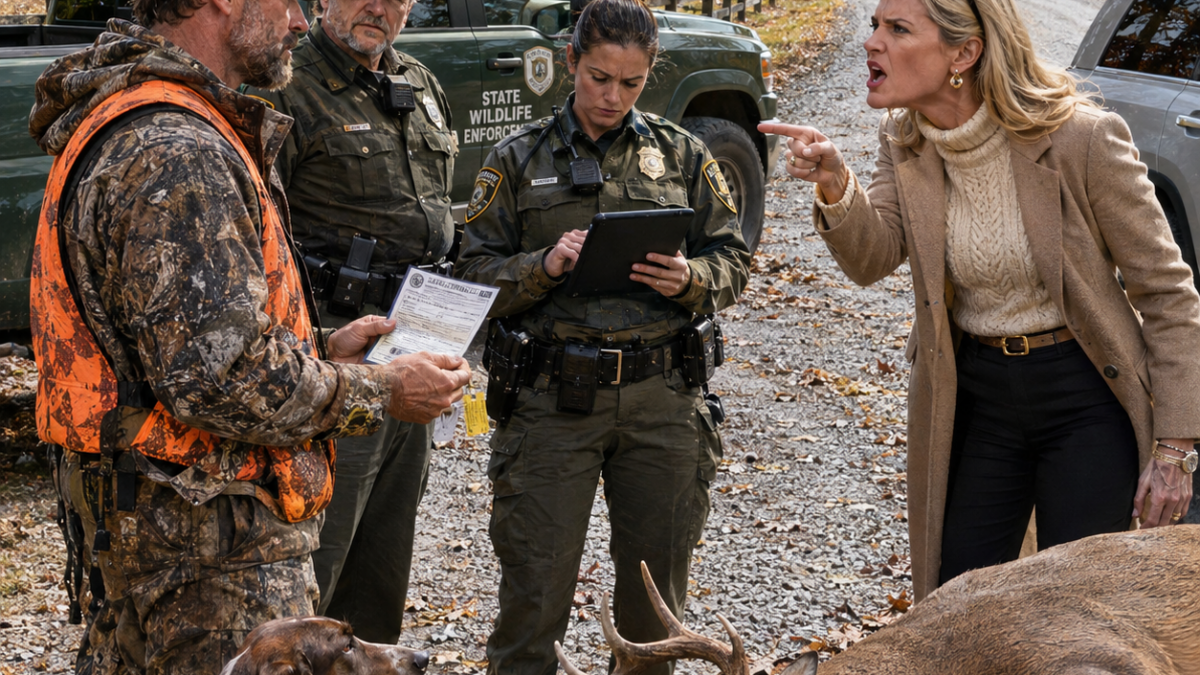
Forty minutes later, the green truck appeared.
Wildlife Enforcement.
Two officers.
The driver stepped out first.
Late fifties.
Broad shoulders.
Gray at his temples.
Name plate:
R. TILLMAN.
The second officer was younger.
Thirty-something.
Dark hair tied back.
M. ORTEGA.
Dee practically jogged toward them.
“Thank God.”
Officer Tillman looked at her.
“Ma’am?”
“I’m Dee Hartwell.”
“I made the call.”
“Okay.”
“He’s been shooting right beside a residential community.”
Tillman looked toward me.
Then the deer.
Then my rifle secured in the truck.
Then back to me.
“Cole?”
I stared.
“Yes.”
His expression changed.
He removed his cap.
“Frank Brennan’s boy.”
That caught me completely off guard.
“You knew Dad?”
Tillman smiled.
“Your father pulled me out of Blackwater Creek in 1998.”
I laughed once.
“What?”
“I was nineteen.”
“Volunteer search unit.”
“Creek flooded during that March storm.”
“Our boat overturned.”
“Your dad found me hanging onto a sycamore root.”
I could see Dad doing it.
Not because he ever told me.
Because he never would have.
Tillman continued.
“He cussed me out for forty minutes after.”
“That sounds more like him.”
Tillman smiled.
“Then fed me chili.”
“That definitely sounds like him.”
Dee stepped closer.
“Officer, with respect, I did not call you here to discuss family history.”
Tillman replaced his cap.
“You called about a wildlife violation.”
“Yes.”
“That’s what we’re investigating.”
“Then arrest him.”
Tillman looked at her.
“For what?”
“Hunting illegally.”
“Have you personally verified that?”
“I saw the dead deer.”
“That isn’t illegal.”
“He fired a rifle.”
“That also isn’t automatically illegal.”
She looked irritated.
“The HOA prohibits gunfire within the residential district.”
I answered before Tillman could.
“My property is not in your residential district.”
Tillman looked at me.
“License?”
I handed it over.
Ortega took my documents.
State hunting license.
Deer tag.
Landowner registration.
Conservation agreement summary.
She scanned the tag.
Checked the harvest time.
Checked my location.
Then her expression changed.
Not alarm.
Focus.
She looked at me.
“Mr. Brennan.”
“Yeah?”
“Were you hunting alone?”
“Yes.”
“Anyone else authorized on your land this morning?”
“No.”
“Family?”
“No.”
“Guests?”
“No.”
She turned her tablet toward me.
“There’s a second deer harvest tag recorded from coordinates inside this property.”
I stared.
“What?”
“5:42 this morning.”
“That’s before legal shooting light.”
“Yes.”
“Who?”
Ortega did not answer immediately.
Dee had stopped talking.
I noticed.
Tillman noticed too.
He turned toward her.
“Mrs. Hartwell?”
She blinked.
“What?”
“You okay?”
“Of course.”
“You got pale.”
“I’m cold.”
It was fifty-three degrees.
Ortega looked at me.
“We need to inspect the location.”
“Absolutely.”
Dee said:
“I should come.”
Tillman looked at her.
“No.”
“I’m the reporting party.”
“You’ve completed your statement.”
“But this concerns the community.”
Tillman’s voice remained polite.
“This concerns an active wildlife investigation on Mr. Brennan’s private property.”
“You can wait on the public road.”
Dee’s jaw tightened.
For the first time that morning, someone had given her a boundary she could not talk through.
Scout came with us.
Tillman smiled when he saw him.
“Your dad always had dogs.”
“Scout isn’t nearly as useful as Dad’s.”
Scout heard his name and walked into a sapling.
Tillman laughed.
“Clearly.”
We followed the north trail.
Halfway up, Scout stopped.
Growled.
Same sound as before.
I unclipped the lead.
He moved toward a brush pile near an old fallen oak.
Ortega raised a hand.
“Everybody hold.”
She approached first.
Moved branches.
Underneath:
Camouflage tarp.
Rechargeable spotlight.
Rifle case.
Plastic bag containing scent-control spray.
Food wrappers.
And a small folding stool.
Tillman crouched.
“Don’t touch anything.”
I stared.
“That isn’t mine.”
“I believe you.”
He looked around.
“This wasn’t put here this morning.”
The ground had been compressed.
Someone had been using the site.
Ortega photographed everything.
Then opened the rifle case with gloves.
Empty.
“Gun’s gone.”
Tillman looked toward the ridge.
“Spotlight setup.”
“Pre-dawn tag.”
“Possible night hunt.”
He turned to me.
“Cole, who knows this property well enough to find this position?”
I thought.
“Me.”
“My father did.”
“Maybe a couple old friends.”
“Anyone from Willow Ridge?”
“No.”
Then Scout moved toward a cedar.
The trail camera.
I had almost forgotten.
“Wait.”
I pointed.
“I have cameras.”
Back at the farmhouse, we pulled all three cards.
Kitchen table.
Laptop.
Coffee nobody drank.
Camera One:
Deer.
Raccoon.
Coyote.
Scout urinating on the same fern four times.
Camera Two:
Nothing useful.
Camera Three:
3:10 a.m.
Figure in black hoodie.
Camo cap.
Carrying a spotlight.
Face mostly hidden.
Next frame.
Second man.
Beard.
Black jacket.
Something clipped at his belt.
Ortega leaned toward the screen.
“Zoom.”
I did.
WILLOW RIDGE ESTATES SECURITY.
Tillman exhaled.
“Know him?”
Ortega nodded.
“Garrett Voss.”
I knew the name.
Private security consultant Dee hired six months earlier.
Former sheriff’s deputy according to HOA newsletters.
Ortega continued.
“We’ve had complaints.”
“What kind?”
“Harassment.”
“Following hunters on public roads.”
“One allegation involving confiscation of a firearm he had no legal authority to take.”
“No probable cause.”
“No charges.”
Tillman looked at me.
“Somebody has been using your property to poach.”
Ortega added:
“And somebody may be trying to make sure it gets associated with you.”
That was when the situation stopped being annoying.
It became dangerous.
My conservation agreement had teeth.
Serious violations could trigger state review.
Repeated illegal activity with owner involvement could create enforcement consequences.
Would I instantly lose the farm because someone trespassed?
No.
But a formal investigation could freeze management grants.
Complicate the agreement.
Create legal costs.
And if somebody manufactured enough evidence suggesting I participated—
I looked toward the window.
Willow Ridge rooftops were visible beyond the southern trees.
Suddenly Dee’s interest in my land looked different.
That night I slept maybe two hours.
At 6:30 the next morning, I walked every gate.
North chain:
Cut before.
Creek access:
Tire marks.
South fence near Willow Ridge:
One section recently lifted.
Not broken.
Lifted from its clips.
Someone knew how to enter without obvious damage.
At noon, a black Mercedes sedan drove up my driveway.
Not Dee’s SUV.
Different Mercedes.
A man stepped out.
Sixties.
Silver hair.
Charcoal suit.
Expensive shoes.
He looked at the farmhouse with the expression of somebody inspecting an asset.
“Mr. Brennan.”
“Who are you?”
“Brock Holloway.”
The name meant nothing initially.
Then it did.
Holloway Development.
Billboards.
Luxury communities.
Mixed-use projects.
They had built two developments outside Nashville and one near the interstate.
He smiled.
“I’d like to discuss your future.”
“My future seems busy.”
“May I?”
He gestured toward the porch.
I did not invite him inside.
We sat outside.
He opened a leather folder.
“Four million dollars.”
I stared.
“For?”
“One hundred forty acres.”
“No.”
“You haven’t read the terms.”
“I don’t need to.”
“Cash closing.”
“No financing contingency.”
“Sixty days.”
“No.”
He leaned back.
“You should think carefully.”
“I did.”
“You have regulatory exposure.”
There it was.
I looked at him.
“What regulatory exposure?”
He smiled.
“The conservation agreement.”
“Wildlife enforcement.”
“Potential violations.”
“Interesting.”
His smile stayed.
“Why?”
“Nobody has told me the state is investigating my conservation status.”
Tiny twitch.
Half a second.
Gone.
“I assume any illegal-hunting complaint would trigger review.”
“You assume a lot about something that happened yesterday.”
Brock closed the folder.
“Four million is generous.”
“Then buy something else.”
“You’re emotionally attached.”
“I’m literally attached.”
“The deed has my name on it.”
His eyes cooled.
“Land changes hands.”
“So do money offers.”
“This one expires Friday.”
I stood.
“Then I guess you’ll save four million dollars.”
He got up.
At the truck, he turned.
“You may regret confusing sentiment with business.”
I looked toward the woods.
“You may regret confusing interest with ownership.”
His smile disappeared.
He left.
I called Tillman before the Mercedes reached the county road.
“Some developer just offered me four million.”
“Who?”
“Brock Holloway.”
Silence.
“Ray?”
“I’m here.”
“He mentioned the investigation.”
More silence.
“Did you contact him?”
“No.”
“Did Ortega?”
“No.”
“Is the investigation public?”
“Not from us.”
My skin went cold.
“Then he knew before he should have.”
“Yes.”
Tillman said.
“He did.”
That afternoon Officer Ortega called.
“We identified the second tag.”
I stopped repairing a fence.
“Who?”
“Tyler Hartwell.”
I closed my eyes.
Dee’s son.
Twenty-four.
Lived in one of the townhomes at Willow Ridge.
Worked irregular construction jobs.
Had been arrested once for DUI according to neighborhood gossip.
“Are you sure?”
“Yes.”
“Tag scan is his.”
“Harvest location inside your north ridge.”
“Time 5:42.”
“Has he admitted anything?”
“We haven’t interviewed him yet.”
“Why?”
“Because we’re building the order correctly.”
I respected that.
Then she added:
“Cole.”
“Yeah?”
“Do not confront Dee.”
“I wasn’t planning to.”
“Good.”
“What about Tyler?”
“Same.”
“Garrett?”
“Especially him.”
That evening Willow Ridge sent an emergency community alert.
SPECIAL HOA SAFETY MEETING.
Topic:
ILLEGAL FIREARMS AND WILDLIFE ACTIVITY ADJACENT TO RESIDENTIAL PROPERTY.
Speaker:
President Dee Hartwell.
Proposed action:
Formal petition for state intervention regarding Brennan property.
I forwarded it to Ortega.
She called five minutes later.
“You going?”
“Yes.”
“Why?”
“Because my name is going to be used.”
Pause.
“We’re coming too.”
The clubhouse was packed.
I arrived alone.
At least I appeared alone.
Tillman and Ortega were thirty seconds behind me.
Dee stood at the front.
Garrett Voss leaned against a side wall.
Tyler sat near the back.
And Brock Holloway was there.
That surprised me most.
He was speaking quietly with two board members.
Dee tapped the microphone.
“Thank you, everyone.”
The room settled.
She began with children.
People like Dee always started with children when they needed fear to do work facts could not.
“Our families deserve safety.”
Applause.
“Our children deserve to play in their yards without hearing gunfire.”
More applause.
“No private landowner has the right to endanger an entire community.”
Then she saw me.
Her expression sharpened.
“Mr. Brennan decided to attend.”
I walked to the back wall.
“Please continue.”
She smiled.
“We have documented illegal wildlife activity.”
“On protected land.”
“Within dangerous proximity to homes.”
“And I have formally requested that state officials review whether Mr. Brennan should continue controlling this property.”
There it was.
Controlling.
Not whether I should hunt.
Whether I should continue controlling the property.
I looked at Brock.
He avoided my eyes.
Dee continued.
“Once land management fails—”
The rear door opened.
Green uniforms.
Tillman.
Ortega.
Two additional wildlife officers.
The room changed.
Garrett straightened.
Tyler looked like somebody had removed the floor beneath his chair.
Dee smiled uncertainly.
“Officer Tillman.”
“Perfect timing.”
He walked forward.
“Mrs. Hartwell.”
“We’re actually discussing your investigation.”
“I know.”
“Then perhaps you can explain—”
“I can.”
He turned toward the room.
“Mr. Brennan’s deer was lawfully harvested.”
Silence.
Dee’s face changed.
“His license was valid.”
“His tag was valid.”
“The location was lawful.”
“The conservation agreement permits regulated hunting.”
Someone behind me whispered:
“Then what was the complaint?”
Tillman continued.
“We did discover evidence of unlawful activity.”
Dee recovered.
“Exactly.”
“On Mr. Brennan’s property.”
“Yes.”
“Not by Mr. Brennan.”
The room went silent again.
Ortega stepped forward.
“We recovered a concealed spotlight setup consistent with suspected illegal night hunting.”
Garrett moved toward the side door.
One of the additional officers stepped in front of it.
“Stay inside, Mr. Voss.”
Heads turned.
Garrett froze.
Dee’s voice became thin.
“Why are you talking to Garrett?”
Ortega held up a tablet.
“We have trail-camera evidence showing Mr. Voss on the property before legal hunting hours.”
Murmurs spread.
Dee looked toward Garrett.
“Garrett?”
He said nothing.
Then Tillman looked at Tyler.
“We also recovered an electronic harvest record issued to Tyler Hartwell.”
Dee stopped breathing.
Or at least looked like it.
“Tyler?”
He stared at the floor.
“Tyler.”
He looked up.
His hands were shaking.
“Mom.”
“What did you do?”
The question sounded genuine.
That mattered.
Tyler swallowed.
“I’m sorry.”
“Sorry for what?”
Garrett said sharply:
“Don’t say anything.”
Tillman turned.
“Mr. Voss.”
“You are not Tyler’s attorney.”
Tyler stood.
“Garrett said it was fine.”
Dee’s face went white.
“What was fine?”
“Hunting Cole’s land.”
“No.”
Dee shook her head.
“No.”
“I never told you—”
Tyler continued.
“He said the boundary didn’t matter because the land was going to get flagged anyway.”
The room erupted.
Tillman raised his voice.
“Quiet.”
Eventually it settled.
Tyler pointed toward Brock.
“Mr. Holloway paid us.”
Every head turned.
Brock’s face changed.
Not panic.
Controlled anger.
“Tyler.”
Brock said.
“You should be careful.”
Tyler laughed nervously.
“You told me it was just evidence.”
Dee covered her mouth.
“What evidence?”
Tyler looked at her.
“They wanted violations on the farm.”
“So the conservation agreement would get reviewed.”
Brock started walking toward the exit.
The officer at the door blocked him.
“You’re not detained.”
The officer said.
“But investigators would like to speak with you.”
Brock stopped.
Tyler kept talking.
Now that he had started, fear seemed to make stopping impossible.
“Garrett showed me where to hunt.”
“He put the spotlight there.”
“I tagged one before sunrise.”
“I know I shouldn’t have.”
“They said if the state found enough violations, Cole could lose the conservation status.”
I stared at Brock.
“What happens then?”
Tyler looked at me.
“Mr. Holloway buys it.”
Somebody in the crowd said:
“Jesus Christ.”
Dee stepped away from the microphone.
She looked at Brock.
“You said you wanted to help us negotiate.”
Brock did not respond.
“You told me if the land became available, Willow Ridge would get priority access.”
Still nothing.
“A board seat?”
Tyler said.
Dee turned.
“What?”
“You were supposed to get a board seat on the new development.”
“No.”
Tyler nodded.
“Garrett told me.”
Dee looked genuinely shattered.
That was when I understood the uncomfortable truth.
Dee had wanted my land.
She had weaponized the HOA.
She had called wildlife enforcement hoping to hurt me.
But she had not known the entire plan.
She thought she was manipulating the system.
Brock had been manipulating her.
Tillman turned toward her.
“Mrs. Hartwell.”
She looked at him.
“You filed the original complaint stating you personally observed illegal hunting.”
“Yes.”
“What exactly did you observe?”
“Cole with a deer.”
“After legal shooting hours?”
“Yes.”
“Proper tag?”
“I didn’t check.”
“Did you see him shoot?”
“No.”
“Cross a boundary?”
“No.”
“Use artificial light?”
“No.”
“Then why did you report illegal hunting?”
Dee’s mouth opened.
Closed.
“I was concerned.”
“That isn’t what your statement says.”
Ortega brought up the report.
“You wrote that Mr. Brennan was ‘knowingly taking wildlife in violation of conservation restrictions.’”
Dee stared.
“How did you know there were alleged conservation violations?”
Silence.
That question landed harder than anything else.
Because Brock had known too.
Before he should have.
Tillman looked at the room.
“This meeting is over as far as our investigation is concerned.”
Then at Dee:
“And I’m asking you to remain available.”
No dramatic handcuffs for Dee.
Not then.
Garrett was taken outside.
Not because of an HOA argument.
Because officers had enough evidence related to suspected poaching, trespass, and the concealed setup to continue formally.
Tyler went separately.
Brock left only after investigators had his information and advised him that they would be contacting him.
He looked at me before getting into his Mercedes.
No smile now.
Just cold attention.
I knew men like him.
They rarely believed consequences applied until someone put them on official letterhead.
Willow Ridge’s board removed Dee as president three days later.
Not because I demanded it.
Residents did.
Marlene called me afterward.
“Vote was ninety-one to eight.”
“What were the other thirteen?”
“Absent.”
I smiled.
“Efficient.”
Then she said:
“Cole.”
“Yeah?”
“I’m sorry.”
“You didn’t file anything.”
“I voted for Dee three times.”
“That isn’t a crime.”
“No.”
“But I kept telling myself she was annoying because she cared.”
I looked toward the south fence.
“That’s how people get away with a lot.”
Marlene was quiet.
“You angry at all of us?”
“No.”
“That sounded like a lie.”
“It was partly a lie.”
She laughed softly.
“Fair.”
The investigation widened.
Tyler cooperated.
His story was ugly but simple.
Garrett approached him six weeks before season.
Offered money.
Cash.
Then more if Tyler helped create “documented violations” on my property.
The idea was to establish unauthorized hunting, night activity, and firearm misuse.
Enough incidents to create a regulatory pattern.
Enough to make the state question whether I was properly controlling conservation land.
Would that automatically strip my rights?
No.
That was the part Brock and Garrett had exaggerated to Tyler.
But it could create review.
Cost.
Delay.
Pressure.
And pressure was the point.
Brock did not need the state to seize my farm.
He needed me scared enough to sell.
The $4 million offer made more sense now.
Not generosity.
Timing.
Before I understood what was happening.
Before I hired counsel.
Before investigators finished connecting people.
Sell while afraid.
Sell while the problem looked bigger than the offer.
Brock’s development plans surfaced through the investigation.
Willow Ridge Phase Two.
Not publicly announced.
My property sat directly between the existing subdivision and a proposed access corridor to the county highway.
Without my land, the new development needed a more expensive road crossing difficult terrain.
With my land:
Straight access.
More lots.
Lake-style amenity area around my pond.
Marketing value from preserved forest.
A private “nature reserve” that would likely have been my father’s woods cut into walking trails for expensive homes.
The internal map made me physically sick.
My farmhouse was labeled:
FUTURE CLUBHOUSE SITE.
The north ridge where I hunted:
PREMIUM ESTATE LOTS.
Dad’s pond:
COMMUNITY WATER FEATURE.
I stared at that phrase for a long time.
Community water feature.
My father had dug that pond after working twelve-hour shifts for a month because my mother wanted somewhere to watch ducks.
He had named it Ruth’s Pond.
Not on any official map.
Just ours.
Brock had reduced it to a sales feature.
That was the first time in the entire process I genuinely wanted revenge.
Not justice.
Revenge.
I wanted to drive to his office.
Throw the development map on his desk.
Tell him exactly what I thought.
Then I heard Dad’s voice.
Land lasts longer than excuses.
So I called my attorney instead.
Elliot Vance.
Old friend.
Property lawyer.
He listened.
Then said:
“You sound angry.”
“I am.”
“Good.”
“What?”
“Anger is information.”
“Don’t let it become strategy.”
I sat down.
“I hate when lawyers say useful things.”
“That’s why we bill by the hour.”
He reviewed my conservation agreement.
The good news:
The state did not treat third-party trespass as an owner violation merely because it occurred on protected land.
My cooperation mattered.
Cameras mattered.
The report mattered.
The fact I immediately allowed officers access mattered.
The better news:
The investigation now clearly treated me as a victim.
Not participant.
The bad news:
My land had been deliberately targeted.
That changed everything about how I managed it.
New gates.
New cameras.
Posted boundaries.
Electronic locks.
No more trusting that people knew better.
I hated that.
Dad had never needed cameras.
But Dad had never lived beside a gated subdivision whose security contractor was being paid to manufacture violations.
A week after the meeting, Dee came to my gate.
Alone.
No SUV camera.
No HOA binder.
She parked on the county shoulder.
Walked to the fence.
I stayed inside.
“Cole.”
“What?”
“I need to talk.”
“You can talk from there.”
Her eyes were red.
No makeup.
I almost did not recognize her.
“I was wrong.”
I said nothing.
She continued.
“I thought Brock wanted the property because it would help Willow Ridge.”
“He wanted it because it would make him money.”
“I know.”
“Now.”
“Yes.”
She gripped the fence.
“I didn’t know about Tyler.”
“I believe that.”
She looked surprised.
“You do?”
“I watched your face at the meeting.”
Tears filled her eyes.
“I would never have told him to poach.”
“I believe that too.”
She almost looked relieved.
Then I continued.
“But you reported me for something you never saw.”
Her relief disappeared.
“You wanted officers on my land.”
“Yes.”
“You wanted my conservation agreement investigated.”
She looked down.
“Yes.”
“You wanted pressure on me.”
Silence.
“Yes.”
“So don’t turn being used into innocence.”
Dee flinched.
I did not enjoy it.
That was important to me.
I did not want to become someone who enjoyed watching people break.
She whispered:
“I’m sorry.”
I nodded.
“That matters.”
“Does it?”
“Not enough to erase it.”
“No.”
“But it matters.”
She wiped her face.
“Can I ask something?”
“What?”
“Is Tyler going to prison?”
“I don’t know.”
“You know the officers.”
“Knowing them doesn’t make me the prosecutor.”
She nodded.
“I keep thinking…”
She stopped.
“What?”
“That if I hadn’t called them—”
“You mean none of this would have happened?”
“Yes.”
I shook my head.
“No.”
She looked up.
“Garrett was already on my land.”
“Tyler already killed a deer illegally.”
“Brock already had plans.”
“The crime existed before your call.”
I paused.
“You just brought the people who could find it.”
She gave a small, broken laugh.
“Worst phone call of my life.”
“Probably.”
She left.
The state reviewed my conservation agreement anyway.
That was proper.
An investigator walked the property.
Checked management records.
Looked at habitat work.
Reviewed the poaching evidence.
Then issued findings.
No owner violation.
No breach.
No evidence I participated in illegal activity.
The agreement remained intact.
Then the state offered something unexpected.
An enhanced permanent conservation designation.
Not because of the HOA dispute.
Because Dad had already protected most of the property and because the updated habitat assessment showed the north ridge and creek corridor had unusual value for whitetail, turkey, migratory birds, and native plant communities.
I spent three weeks thinking.
The new designation would make future development substantially harder.
Including for me.
Permanent restrictions.
No future subdivision.
No commercial project.
Even if one day I needed money.
Elliot asked:
“You sure?”
“No.”
“Good.”
“That’s the correct answer.”
I walked the property alone.
Scout came.
North ridge.
Creek.
Pond.
Dad’s old equipment shed.
The walnut tree where we hung our first tree stand together.
I thought about four million dollars.
Not because I wanted Brock’s money.
Because four million dollars is real.
Anyone pretending otherwise is lying.
It could change a life.
Retirement.
Travel.
Family security.
No worrying about taxes.
No worrying about equipment repairs.
No worrying about whether one bad year could damage everything.
Then I thought about the development map.
Ruth’s Pond.
COMMUNITY WATER FEATURE.
I went home.
Signed the enhanced agreement.
Not because I hated developers.
Not because all change is wrong.
Because Dad had already told me what he wanted this land to be.
Wild.
Working.
Protected.
Mine while I was alive.
Someone else’s responsibility after.
The paperwork was accepted that winter.
Frank Brennan Wildlife Conservation Property.
That was the official recorded name.
I cried when I saw it.
Did not tell anybody.
Scout saw.
Scout had no discretion.
He licked my face.
“Traitor.”
His tail moved.
The criminal cases took longer.
Garrett lost his security license while charges were pending.
The evidence tied him to unauthorized entry, the hidden poaching site, and the effort to create violations.
Tyler took responsibility for the illegal harvest and cooperated extensively.
He faced penalties.
Hunting privileges suspended.
Fines.
Community service.
Additional consequences based on the final case.
I did not ask for maximum punishment.
Did not ask for minimum.
That was not my job.
Brock’s situation became the largest.
Conspiracy.
Payments.
Development communications.
The early knowledge of the wildlife complaint.
Attempts to engineer regulatory pressure against a landowner.
The eventual charges and civil disputes reached farther than Willow Ridge.
Other projects were reviewed.
Investors asked questions.
Partners backed away.
Brock’s company did not disappear overnight.
Men like Brock rarely collapse in one cinematic afternoon.
It happened slowly.
Banks.
Lawyers.
Depositions.
Lost contracts.
News articles.
Investors deciding risk no longer looked attractive.
Consequences in paperwork.
The same medium he had tried to use against me.
Willow Ridge elected a new HOA board.
First thing they did:
Eliminated the private security contract.
Second:
Adopted a rule prohibiting the association from filing regulatory complaints against neighboring properties without documented board review, except in immediate emergencies.
Third:
Sent me a formal letter.
It said:
Willow Ridge Estates recognizes that the Brennan property lies entirely outside the association’s jurisdiction.
I framed that one.
Not because it was beautiful.
Because I appreciated precision.
Marlene came over one afternoon with peach preserves.
“Petty?”
She asked, looking at the frame.
“Educational.”
“Sure.”
She laughed.
Then looked at Dad’s photograph on the mantel.
“He would’ve enjoyed this.”
“No.”
I said.
“He would’ve been furious about the wasted time.”
“That too.”
The next hunting season, I almost did not go.
That surprised me.
I had hunted every legal season I could remember.
But when October came, the north ridge felt contaminated by memory.
Garrett in the camera frame.
Tyler’s tag.
Spotlight beneath branches.
Something I had loved had become evidence.
Tillman called two days before opening morning.
“You going out?”
“Maybe.”
“That means no.”
“Maybe means maybe.”
“Your dad hated that answer.”
“You knew him for one flood rescue.”
“He made an impression.”
I smiled.
Then Tillman said:
“Come outside.”
“What?”
He was at my gate.
Green truck.
Ortega beside him.
And behind them:
Eight teenagers.
Orange hats.
Parents.
Hunter-safety instructors.
I stared.
“What is this?”
Tillman smiled.
“You said last month you wanted to do something with the property.”
“I said I was thinking.”
“Thinking is slow.”
Ortega held up paperwork.
“Free youth hunter-safety field day.”
“Boundary recognition.”
“Ethical shot selection.”
“Conservation management.”
“No live hunting.”
“Unless you approve a supervised demonstration.”
I looked at the teenagers.
One girl held a notebook.
A boy looked at Scout.
Scout had already decided this was his event.
“You organized this without me?”
Tillman said:
“Your name is on the permit request.”
I looked at him.
“Ray.”
“Fine.”
“Draft permit.”
“I may have drafted it.”
Ortega smiled.
“He practiced your signature.”
Tillman looked horrified.
“Do not phrase it like that.”
For the first time in months, I laughed until my side hurt.
We held the first class that Saturday.
I took the kids to the north ridge.
Showed them the old poaching site.
Nothing remained except flattened ground.
I told them exactly what happened.
Not the HOA drama.
Not Brock’s money.
The hunting part.
Why spotlighting deer was illegal.
Why shooting before legal light mattered.
Why tags existed.
Why property lines mattered.
Why the privilege of hunting depended on responsibility.
One boy asked:
“What if nobody sees?”
That question stopped me.
I pointed toward the woods.
“The animal sees.”
He looked confused.
“So?”
“So do you.”
I said.
“That has to be enough.”
Dad had said something similar once.
I had forgotten until that moment.
The youth day became annual.
Not because I planned it that way.
People asked.
Then schools asked.
Then wildlife officers used part of the property for conservation demonstrations.
We never turned it into some huge program.
Twenty kids maximum.
No charge.
Parents welcome.
Lunch at the barn.
Scout accepted payment in hot dog pieces.
Three years later Tyler Hartwell contacted me.
That surprised me more than Dee’s apology.
He had completed his penalties.
Worked for a landscaping company.
Had not hunted since.
The message said:
Mr. Brennan,
I know I have no right to ask, but I was wondering if I could volunteer at your youth safety day. I don’t want to hunt. I thought maybe telling them what I did might stop somebody else from doing something stupid.
I read it three times.
Then called Tillman.
“What do you think?”
“Your property.”
“That isn’t what I asked.”
Tillman paused.
“I think accountability is more useful when somebody has to live after it.”
That sounded like Dad.
I invited Tyler.
Did not tell Dee.
Did not tell the kids beforehand.
Tyler stood beside the old north-ridge site.
Twenty-seven now.
Older in the face.
Nervous.
He told them:
“I shot a deer before legal light.”
“I used a spotlight.”
“I trespassed.”
“I let people convince me it wasn’t a big deal because they said the land would belong to somebody else soon.”
A teenager asked:
“Did you know it was wrong?”
Tyler swallowed.
“Yes.”
That was the most important answer.
No excuses.
Another kid asked:
“Then why do it?”
“Money.”
He said.
“And because somebody older told me it was fine.”
He looked toward me.
“I wanted the older person to be responsible enough that I didn’t have to be.”
Silence.
“That doesn’t work.”
Nobody laughed.
Afterward Tyler approached me.
“Thank you.”
“For what?”
“Letting me come.”
“I didn’t do it for you.”
“I know.”
That made me respect him more.
He looked across the ridge.
“I’m sorry.”
“I know.”
“You forgive me?”
I considered.
“I don’t know if that’s the useful question.”
He frowned.
“What is?”
“Are you different?”
Tyler looked toward the kids walking back to the barn.
“I’m trying.”
I nodded.
“Then keep doing that.”
Dee and I never became friends.
That would have been dishonest.
She moved out of Willow Ridge several years later.
Before she left, she mailed one envelope.
Inside:
The first HOA complaint she had drafted against me.
Not the wildlife report.
An older one.
Visual nuisance.
Tractor noise.
Fence style.
She had kept copies.
On top was a note.
You were right about one thing.
Your land was never ours to manage.
—Dee
I put it in a file.
Did not frame that one.
Brock’s original $4 million contract stayed too.
Sometimes I looked at it.
Not with regret.
With curiosity.
One signature.
That was all.
I could have changed everything.
Maybe financially for the better.
Maybe not.
There are days when equipment breaks and taxes arrive and I understand why people sell.
I will never judge someone simply for deciding land has become too heavy to carry.
The point was never that selling would have been wrong.
The point was that the decision had to be mine.
That was what Brock tried to steal.
Not merely acreage.
Choice.
He wanted pressure to make the decision for me.
Dee tried the same thing with the wildlife complaint.
She believed if enough authorities appeared, enough neighbors complained, enough accusations accumulated, ownership would become exhaustion.
Eventually I would surrender.
Instead, every outside authority she dragged into the situation asked the same boring questions.
Whose land?
Where is the boundary?
What does the law say?
Whose tag?
What time?
What camera?
What payment?
What agreement?
Facts are frustrating to people who depend on momentum.
They slow everything down.
That saved me.
The green wildlife truck that first came up my driveway because Dee wanted me punished became a regular sight.
Not for investigations.
Education days.
Habitat surveys.
Tillman retired eventually.
At his retirement party, I brought him chili.
He tasted it.
“This is terrible.”
“Dad’s recipe.”
“No, it isn’t.”
“You don’t know.”
“Frank could cook.”
I laughed.
Ortega took over much of the local conservation work.
She still called before visiting.
Every time.
“Permission to come through north gate?”
She had access.
She knew the code.
Still asked.
That mattered to me more than she probably knew.
Permission.
Boundaries.
Small words.
Large principles.
Scout died at fourteen.
Old age.
Arthritis.
One summer evening he simply could not get comfortable anymore.
I buried him near the pond.
Under the sycamore.
Dad’s old dog was buried twenty yards away.
That fall was the first hunting season I walked the property without either of them.
Dad gone.
Scout gone.
The woods felt too quiet.
I climbed the north ridge before sunrise.
Sat beneath an oak.
No rifle that morning.
Just coffee.
Mist along the creek.
Whitetail tracks in damp leaves.
Somewhere beyond the southern trees, I could hear Willow Ridge waking.
Garage doors.
A dog barking.
A truck starting.
Normal life.
No enemy.
No war.
Just neighbors.
That was another thing I had learned.
Conflict can make you addicted to categories.
Us.
Them.
My land.
Their HOA.
Good people.
Bad people.
Reality was messier.
Dee had done something wrong and had also been deceived.
Tyler committed a crime and later tried to become better.
Willow Ridge contained people who supported Dee, people who feared her, people who ignored her, and people who helped me.
Tillman knew Dad but still checked every one of my documents.
That was exactly what he should have done.
Even Brock was not wrong for wanting to buy my land.
He became wrong when he tried to manufacture the circumstances that would make me sell.
The line mattered.
Lines usually do.
Property lines.
Legal lines.
Ethical lines.
Shooting-light lines.
The line between persuasion and coercion.
The line between making a mistake and hiding one.
My father taught me boundaries before I knew the word meant anything beyond fences.
One spring, years after everything happened, I found an old notebook in Dad’s workshop.
Most pages were boring.
Fence measurements.
Tractor parts.
Seed orders.
Rainfall.
Then one page:
140 ACRES — KEEP WILD IF WE CAN.
If we can.
Not:
Never sell.
Not:
Cole must keep it forever.
If we can.
That softened something in me.
Dad had not handed me a command.
He had handed me a preference.
A hope.
I chose to make it permanent.
That choice was mine.
The enhanced conservation agreement now protects the property beyond my lifetime.
No Brock Holloway development.
No premium lots.
No community water feature.
Ruth’s Pond stays Ruth’s Pond.
The north ridge stays timber.
The creek stays open wildlife corridor.
Hunting remains allowed only under the conservation rules and state law.
And every October, I still walk the ridge.
Some years I harvest a deer.
Some years I don’t.
I care less about that now.
The ritual matters.
Before sunrise.
License in pocket.
Tags checked.
Boundary walked.
The same steps Dad taught me.
I always pass the place where Garrett hid the spotlight.
The brush has grown back.
No visible trace.
If I had not known, I would never guess anything happened there.
That seems right.
Land is good at healing evidence humans think is permanent.
Leaves fall.
Mud closes tracks.
Grass covers scars.
Trees grow around old wire.
But paper remembers longer.
The trail-camera photographs still exist.
Tyler’s tag record.
Garrett’s payment messages.
Brock’s development plan.
Dee’s complaint.
My conservation agreement.
Documents nearly hurt me.
Documents also protected me.
The difference was whether they described reality.
That is why I still tell every kid at the safety day the same thing.
“Never be afraid of an officer checking you if you’ve done things correctly.”
One kid asked once:
“What if they don’t believe you?”
I thought about Dee standing beside my gate.
“Then stay calm.”
“Show your paperwork.”
“Show your evidence.”
“And don’t lie because you’re scared.”
Another kid asked:
“What if they’re wrong?”
“Then you correct them.”
“What if they won’t listen?”
“Then you keep correcting them through the right channels.”
“That sounds boring.”
“It is.”
They laughed.
“But boring keeps you out of handcuffs.”
That got their attention.
People love the dramatic part of my story.
The HOA president calling wildlife officers.
The hidden spotlight.
Her son’s tag.
The clubhouse confrontation.
Garrett blocked at the door.
Brock’s four-million-dollar contract.
But those were not the parts that saved the land.
The land survived because I followed boring rules before anyone tried to use the rules against me.
The deer was tagged correctly.
The camera timestamps existed.
The conservation paperwork was current.
The boundary was marked.
The officers were allowed access.
The evidence was preserved.
The investigators got the truth before anybody could replace it with a better story.
That is less exciting than revenge.
More useful.
Dee once thought one phone call could destroy my entire life.
She was almost right about the power of a phone call.
Just wrong about whose life it would change.
Her call brought Officer Tillman and Officer Ortega onto my property.
They verified my deer.
Found the hidden hunting site.
Pulled the second tag.
Identified Garrett.
Connected Tyler.
Then eventually reached Brock.
The call intended to create a record against me created the first official record of the conspiracy against me.
I think about that sometimes.
Especially when somebody tells me justice is poetic.
It usually isn’t.
Most of the time justice is slow, expensive, frustrating, and incomplete.
But every once in a while, somebody walks into a trap carrying the flashlight themselves.
Dee did.
Years later, I was sitting on the porch one evening when a car slowed at the gate.
Not familiar.
A young couple got out.
They had recently bought a house in Willow Ridge.
The husband waved.
“Mr. Brennan?”
“Cole.”
“We wanted to ask something.”
That word again.
Ask.
“Our daughter is ten.”
“She’s interested in wildlife.”
“We heard about your safety day.”
“It’s in October.”
“She’s too young?”
“No.”
“Could she come?”
“Sure.”
They smiled.
Started back toward the car.
Then the woman stopped.
“One more question.”
“Okay.”
“Do you ever let people walk the property outside the event?”
“Sometimes.”
“We don’t want to hunt.”
“Just birdwatch.”
I looked toward the south trail.
“Call before you come.”
“Really?”
“Yes.”
“We will.”
“Stay on the marked trail.”
“Absolutely.”
“Don’t open gates you didn’t open.”
“Got it.”
“Leave Scout’s old sycamore alone.”
They looked confused.
“Long story.”
They laughed.
Then left.
I sat there for a while.
That exchange would have been impossible immediately after the investigation.
Back then every stranger near my fence looked like a threat.
Every HOA vehicle made me angry.
Every request sounded like the beginning of another claim.
Time changed that.
Not because I forgot.
Because boundaries work best when they allow good interactions instead of only preventing bad ones.
I never wanted 140 acres so I could sit behind a locked gate hating everyone outside it.
Dad didn’t either.
He wanted the woods protected.
Sometimes protecting something means saying no.
Sometimes it means saying yes carefully.
The trick is making sure the choice remains yours.
One framed photograph hangs in my hallway now.
Dad.
Standing beside a rusted pickup on the day he bought the first forty acres.
He looks ridiculously young.
The land behind him is rough.
Fence leaning.
Field full of weeds.
He is smiling like he owns the world.
Maybe he did.
Not legally.
Not literally.
But emotionally.
That photograph was taken before Willow Ridge.
Before conservation agreements.
Before trail cameras.
Before Karen Hartwell.
Before Brock Holloway ever imagined premium estate lots on the north ridge.
Dad could not know what would happen.
He only knew he wanted somewhere that could remain itself longer than he could.
He got that.
The state certificate protecting the property permanently is mounted beneath his photograph.
FRANK BRENNAN WILDLIFE CONSERVATION PROPERTY.
Every time I pass it, I think about the morning that green truck came up my driveway.
Dee expected Officer Tillman to arrest me.
Instead he recognized my father’s name.
But I want to be clear about something.
Knowing Dad did not save me.
It shouldn’t have.
Tillman still checked my license.
Ortega still scanned my tag.
They still inspected the property.
They still asked hard questions.
I would have been disappointed if they hadn’t.
What saved me was that the facts matched my story.
The deer was legal.
The tag was mine.
The land was mine.
The hidden spotlight wasn’t.
The second tag wasn’t.
The men on the camera weren’t supposed to be there.
That distinction turned everything.
So when people ask what I learned, I don’t say:
Never mess with a landowner.
That’s childish.
Landowners can be wrong.
Hunters can be wrong.
HOAs can be right.
Officers can make mistakes.
I say this:
Know what is yours.
Know what the rules are.
Keep your records.
Respect the boundaries.
And when somebody shows up with a confident lie, do not panic just because they sound certain.
Make them prove it.
Dee Hartwell thought filming me beside a legally harvested deer would prove I was dangerous.
Instead, the wildlife officers she called found her son’s tag at the center of an illegal hunt.
Brock Holloway thought a few planted violations would make 140 acres cheap.
Instead, his own early knowledge of the investigation helped expose why the violations existed.
Garrett Voss thought darkness and camouflage made him invisible.
He forgot trees can hold cameras too.
And Tyler thought an older man’s money could make wrong rules disappear.
Eventually he learned that responsibility begins the moment you admit you knew better.
As for me?
I still live in the same farmhouse.
The same creek runs through the same bottom.
Ruth’s Pond still catches evening light.
Whitetail still cross the north ridge.
Kids still come every autumn to learn how not to repeat the mistake that almost cost Tyler his future and nearly cost me my father’s land.
And Willow Ridge Estates is still next door.
They have a different HOA president now.
The current one sends an email before any community event that might affect the boundary.
The first line always says:
Cole, this is only a courtesy notice. No action is requested from you.
I appreciate that more than he knows.
One autumn morning, years after Dee’s phone call, I harvested another doe from almost the same stand.
Legal light.
Clean shot.
Tag immediately attached.
I stood beside her for a moment before beginning the work.
The woods were completely quiet.
Then I heard Dad’s voice in my head.
Land lasts longer than excuses.
I looked across the ridge.
He was right.
Dee lost the presidency.
Garrett lost the security career he had abused.
Brock lost the development he tried to manufacture.
Tyler lost hunting privileges for a time and had to rebuild his name.
Dad was gone.
Scout was gone.
Tillman was retired.
I was getting older.
But the oaks were still there.
The creek still ran.
The deer still moved through the same saddle in the ridge.
That was the justice I cared about.
Not humiliation.
Not Dee sitting alone at the HOA table after everything fell apart.
Not Brock walking toward a blocked doorway.
Not handcuffs.
The land stayed wild.
The choice stayed mine.
And the morning a woman called the state hoping wildlife officers would remove me from my own property became the morning those officers discovered exactly who had been trespassing there all along.








