HOA Karen Rented Out My Boat Behind My Back—Then Called the Sheriff and Accused Me of Stealing It
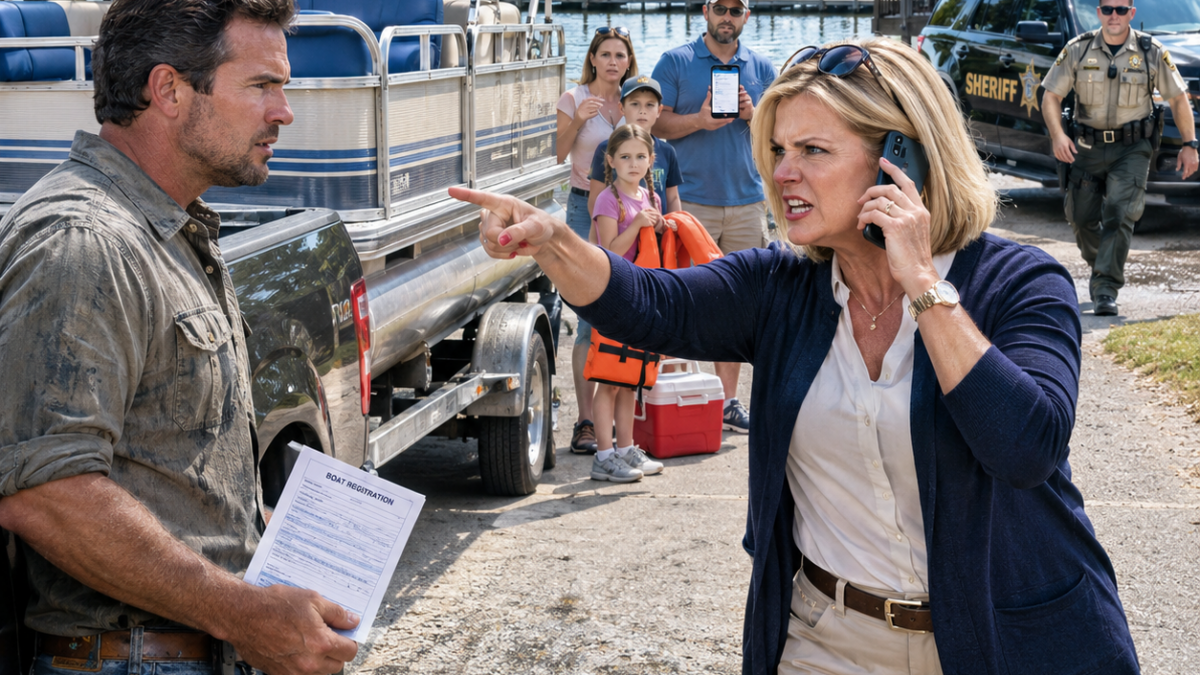
PART2:
“This man is removing a boat that is currently part of a marina rental program.”
Deputy Lewis looked at me.
“Your name?”
“Daniel Reed.”
“Is the boat registered to you?”
“Yes.”
I handed him the registration.
Karen immediately held out her clipboard.
“We have rental records.”
Lewis took both.
He looked at my registration.
Then her sheet.
Then back at me.
He studied the bottom of her form for several seconds.
His eyebrows came together.
“Mr. Reed?”
“Yes?”
“Why does this say you checked these renters out this morning?”
I stared at the paper.
“What?”
He turned it so I could see.
At the bottom, beneath a printed list of safety instructions, were the words:
OWNER SAFETY CHECK COMPLETED.
Next to that were my initials.
DR.
Time:
7:45 A.M.
I looked at Karen.
Then back at the deputy.
“I got here at seven-thirty.”
Lewis frowned.
“The boat was already gone when I arrived.”
That was how my Saturday began.
But the story actually started nine days earlier, when Karen asked me for what sounded like a small favor.
I lived in Cedar Point, a lakeside neighborhood built around a shallow cove and a small private marina.
The HOA owned twelve slips, a launch ramp, a clubhouse, and the docks around the boats.
Owners rented the slips.
The HOA owned the wood under my feet.
It did not own what floated beside it.
I rented Slip 7.
The pontoon had been mine for fourteen years.
It wasn’t fast.
It wasn’t fancy.
It had a faded cream-colored roof and a little four-stroke outboard motor that sounded rough for the first thirty seconds on cold mornings.
My father and I had rebuilt more of that boat than I could remember.
New carpet.
Wiring.
Seats.
A repaired canopy.
A new steering cable.
Dad had always been better with tools than I was.
When I was a kid, he could take apart almost anything in the garage, leave it in fifty pieces for three days, then somehow remember exactly where every screw belonged.
Age took some of that away.
Arthritis stiffened his hands.
His knees became unreliable.
Then his balance got worse.
The pontoon became more important because it was one of the few places he could still move around comfortably.
The wide floor gave him room.
The handrail helped him aboard.
His chair sat near the starboard side where he liked to cast.
Saturday mornings on that boat were one of the few routines age had not stolen from him.
He looked forward to them.
So did I.
Karen was president of the Cedar Point HOA.
She was organized, confident, and good at making ordinary neighborhood decisions sound as though they involved state-level infrastructure.
A week before everything went wrong, she contacted me about a fundraiser for new marina lights.
She wanted short boat rides.
Families could donate and take a ten- or fifteen-minute loop around the cove.
She asked whether I would participate.
I said yes.
But I was specific.
I wrote:
I can drive from 10:00 until noon Saturday. I’m not lending the boat out, and nobody else operates it.
Karen replied with a thumbs-up emoji.
That was it.
Clear.
Simple.
Two hours.
I drive.
Nobody else.
On the day of the fundraiser, Karen sat at a folding table near the clubhouse collecting donations.
I made several short trips.
Dad came on the first ride.
Two kids sat near him.
One pointed toward the bank and asked whether turtles lived there.
Dad leaned forward like he was giving them classified intelligence.
“They climb onto those logs when the sun comes out.”
The kids spent the next five minutes searching.
When one finally spotted a turtle, you would have thought they had discovered buried treasure.
Dad smiled the whole time.
That was why I agreed to help.
Not because I wanted a rental business.
Not because I wanted extra income.
Because it was a neighborhood fundraiser, and for two hours, it was nice.
After the final ride, I tied the pontoon back in Slip 7.
I took the key.
Karen followed me down the dock.
“People loved it.”
“They seemed to.”
“We could do this every weekend.”
I looked at her.
“I work some weekends.”
“We could find another driver.”
“No.”
She laughed.
“Don’t be so protective. It’s a pontoon.”
“It’s my pontoon.”
Her smile weakened slightly.
“I mean, obviously.”
“Then obviously I decide who drives it.”
She changed direction.
“Would you at least leave a spare key in the marina office?”
“For what?”
“If there’s a storm and someone needs to move the boat.”
“No.”
“Daniel, it’s an emergency precaution.”
“The emergency procedure is already posted. Call the owner.”
“What if you don’t answer?”
“The boat can be moved inside the slip with the ropes. Nobody needs to start it.”
She didn’t like the answer.
I could tell.
Karen didn’t like situations where her authority stopped before the problem did.
But she let me pass.
Two days later, I left town for a four-day flooring job.
Before I left, I stopped at the marina.
I checked the cover.
The ropes.
The bumpers.
A young guy in a gray Cedar Point marina shirt was measuring something near the launch ramp.
He introduced himself as Cody.
He looked about twenty-one.
Maybe twenty-two.
“Mrs. Miller says you’re the boat guy.”
I laughed.
“I own that one.”
I pointed toward my pontoon.
He nodded.
“Nice. You helped with the rides.”
“I drove for the fundraiser.”
“Right.”
That was a tiny moment.
At the time, I thought nothing of it.
Later, I remembered the wording.
The boat guy.
As though I was part of something ongoing.
I thought he meant the fundraiser that had already happened.
He thought I was part of a rental operation.
Neither of us asked enough questions.
I drove away.
Friday evening, I finished the job late.
I was driving home when Dad called.
“Are we still going tomorrow?”
“That’s the plan.”
“I bought worms.”
He said it with quiet pride.
That made me smile.
Dad worried about wasting money.
He had reached an age where he would ask me whether he really needed a six-dollar bag of coffee, even though he had spent his entire life working.
But worms meant he had made his own plan.
He had gone somewhere.
Bought something.
Expected tomorrow.
“I’ll get the boat ready early,” I told him. “I’ll pick you up at nine.”
“Good.”
The next morning, I reached the marina at 7:30.
Slip 7 was empty.
For several seconds, my brain refused to process what I was seeing.
I stood at the top of the dock staring.
The boat cover had been folded on the boards.
One rope was lying half in the water.
Dad’s little wooden boarding step had been shoved under a bench.
But the boat was gone.
I walked faster.
Then ran.
I checked the parking area.
Nothing.
I called Karen.
No answer.
I called the marina office.
Cody picked up.
“Cedar Point Marina.”
“Cody?”
“Yes?”
“This is Daniel Reed.”
“Oh. Hey.”
“Where’s my boat?”
Silence.
Not long.
Maybe two seconds.
But long enough.
“It’s on the eight-to-ten rental.”
I stopped breathing.
“The what?”
“The rental.”
“What rental?”
Another pause.
“Mrs. Miller booked it.”
I looked across the lake.
Near the far shoreline, a cream-colored canopy moved slowly past the fishing point.
I knew that roof.
The rear corner was patched with blue fabric because I had refused to spend six hundred dollars replacing the entire canopy for one torn section.
“Who’s driving?”
“A customer.”
“Does he know this boat is privately owned?”
Cody’s voice changed.
“I thought you knew about this.”
“No.”
He went quiet.
“Call them back.”
“What?”
“Call the boat back. Tell them to return to the courtesy dock.”
“I don’t know if—”
“Cody.”
My voice came out harder than I intended.
Then I forced myself to slow down.
“This is not your boat. I did not authorize this rental. Call them back.”
“Okay.”
I called the sheriff’s non-emergency line myself.
I explained that my privately owned boat had been taken from its slip and rented to people without my permission.
The dispatcher took the location.
My name.
My number.
She said a deputy would come when one was available.
I did not get another boat and chase them.
I did not stand on the dock yelling across the water.
I did not threaten anybody.
I called Dad.
“We’ve got a problem at the marina.”
“Engine trouble?”
“No.”
“Then what?”
“Somebody took the boat out.”
Silence.
“Without you?”
“Without me.”
I heard him set something down.
“All right.”
His voice changed.
“Get it back safe.”
That was my father.
Not “Who did it?”
Not “I told you people were crazy.”
Not “Call a lawyer.”
Get it back safe.
My trailer was at home less than a mile away.
I drove back, hooked it up, and returned.
The pontoon came around the marina wall as I pulled into the lot.
A man was at the wheel.
His wife sat near the front.
A little girl sat between her knees.
Cody waited at the courtesy dock holding a rope.
I didn’t step aboard while the engine was running.
I didn’t yell at the driver.
I waited.
The motor shut off.
Cody secured the boat.
Then I introduced myself.
“My name is Daniel Reed.”
The man nodded uncertainly.
“Scott.”
“This is my boat.”
His expression changed.
“What?”
“I own it. I did not agree to rent it.”
His face went red.
“We paid.”
“I believe you.”
He took out his phone.
“Three hundred dollars. Two hundred for two hours. Hundred-dollar deposit.”
He showed me the receipt.
CEDAR POINT PONTOON EXPERIENCE.
Payment destination:
Miller Lake Services.
Karen Miller.
Scott looked almost sick.
“This isn’t your company?”
“No.”
His daughter stood beside him wearing a paper crown under her life jacket.
That detail did something to me.
She had probably been excited all week.
Her father had paid for a birthday boat ride.
She had done nothing wrong.
Neither had he.
Whatever anger I had belonged somewhere else.
I crouched slightly so I wasn’t towering over her.
“Did you have fun?”
She looked at her father first.
Then nodded.
“Did you see the turtles?”
“Three.”
“Then you found the good spot.”
She smiled a little.
Scott helped his family unload.
I waited.
Bags.
Cooler.
Towels.
Everything.
Once they were off, I boarded.
That was when I saw the key.
It was hanging from the ignition.
Not mine.
A small square red tag hung from it.
RENTAL 1.
I took a picture before touching it.
Then I noticed the motor.
A white scratch ran across the cover.
Below the propeller, the corner of the metal plate was bent.
I crouched.
I had washed that motor the previous weekend.
The damage hadn’t been there.
I looked at Scott.
“Did you hit something?”
He shook his head immediately.
“No. We stayed where the guy told us.”
He pointed toward Cody.
“That was already there.”
I looked at Cody.
He nodded.
“I saw it yesterday.”
“Yesterday?”
He swallowed.
“Yes.”
“How many times has this boat gone out?”
He looked toward the clubhouse.
“You need to ask Mrs. Miller.”
I photographed everything.
Then I loaded the pontoon onto my trailer.
That was when Karen arrived.
She came down the marina lane carrying a clipboard and walking fast.
“You cannot remove equipment during operating hours.”
I tightened the rear strap.
“It isn’t your equipment.”
“We have bookings.”
“Cancel them.”
She looked toward Scott.
“I’m sorry. He’s upset over a scheduling misunderstanding.”
Scott held up his phone.
“You told me you owned the boats.”
Karen replied, “I said I managed them.”
Cody spoke quietly.
“There’s only one boat.”
Karen turned.
“Go inside.”
I finished securing the boat.
Then climbed into my truck.
Karen stepped directly in front of it.
And called the sheriff.
That brought us back to Deputy Lewis standing beside the ramp, my registration in one hand and Karen’s paperwork in the other.
He showed me the form.
“Owner safety check completed.”
My initials.
7:45.
“I was here at seven-thirty,” I told him. “The boat was already gone.”
Lewis looked at Scott.
“Who gave you the safety instructions?”
“The young guy.”
“Cody?”
“Yes.”
Karen cut in.
“He works under Daniel’s program.”
“I don’t have a program.”
Lewis raised one hand.
“One at a time.”
He called Cody outside.
Cody looked pale.
“Did Mr. Reed train you?”
“No.”
“Did he tell you to use his initials?”
“No.”
“Who did?”
Cody looked at Karen.
She answered before he could.
“We use the owner’s initials to identify the vessel. It’s just an office system.”
Lewis studied the form again.
“It doesn’t say vessel identifier.”
Karen said nothing.
“It says the owner completed the safety check.”
“It’s a badly designed form.”
I took out my phone.
“Here’s my permission.”
I showed Lewis the fundraiser messages.
I can drive from 10 until noon Saturday.
I’m not lending it out and nobody else operates it.
Karen stared at the screen.
“That was only one part of our discussion.”
Lewis asked, “Where is the rest?”
“There were conversations.”
“In writing?”
“Some were in person.”
“Do you have a rental agreement signed by Mr. Reed?”
Her jaw tightened.
“This arrangement developed informally.”
Lewis looked at my registration again.
He checked the hull number.
Then he told Karen:
“I have documentation that he owns this boat.”
She crossed her arms.
“And we have an operating agreement.”
“With him?”
“With the marina program.”
“That’s not the same thing.”
He looked at me.
“Mr. Reed, you can leave with your boat.”
Karen’s face changed.
“He’s disrupting paid bookings.”
Lewis replied, “Ownership is established. If you have a contract authorizing your company to use the vessel, provide it.”
He gave me a report number.
Asked me to submit photographs.
Messages.
Receipts.
Anything else related to the dispute.
Karen had called the sheriff expecting him to stop me from taking my boat.
Instead, she stood beside the ramp while he told me I could take it home.
I wish I could say that felt like winning.
It didn’t.
Because Scott walked toward Karen.
“What about my deposit?”
“Returns are processed at the end of the business day.”
“And the rental fee?”
“You used the boat.”
Scott stared at her.
“You didn’t have the right to rent it.”
Karen glanced toward me.
“This is why internal matters shouldn’t be discussed in front of customers.”
Scott’s daughter had taken off her paper crown.
She folded it in half.
That image stayed with me longer than Karen’s shouting.
I almost offered Scott the two hundred dollars myself.
Then I stopped.
Paying Karen’s customers out of my pocket would not fix what she had done.
It would make her mistake easier for her.
I gave Scott my phone number.
And the sheriff’s report number.
“You shouldn’t have to fight this without proof.”
He nodded.
“Thank you.”
At home, I parked the trailer behind my locked side gate.
Dad was sitting on my porch with his tackle box.
My sister had dropped him off.
He wanted to see the boat.
He walked slowly around the trailer.
One hand moved along the railing.
Then he saw the red rental tag.
“What’s that?”
“Somebody made another key.”
He turned it carefully without removing it.
There was a white sticker on the back.
Local locksmith.
I photographed it.
Dad looked at the seat covers.
“They didn’t tear them.”
“No.”
He smoothed a wrinkle with his thumb.
“Well.”
He nodded.
“That’s something.”
I helped him aboard while the pontoon was still on the trailer.
He settled into his chair.
Opened the tackle box.
Started sorting hooks.
We weren’t going fishing.
He knew that.
But I let him sort them.
My phone buzzed.
Cody.
I NEED TO TELL YOU SOMETHING BEFORE SHE BLAMES ME FOR IT.
I stepped away from the boat.
“What?”
“She told me you owned the rental company.”
“I don’t.”
“I know that now.”
He sent me a photograph.
Inside the marina office was a sheet taped to a cabinet.
My full name.
My boat registration number.
Heading:
OWNER / OPERATOR.
Underneath was a copy of my insurance card.
The same one I had given the HOA when I rented Slip 7.
Karen had gone into the marina records.
Used my insurance documentation.
Used my name.
Used my boat number.
Cody sent another image.
Damage report.
Thursday.
A customer had hit something near the fishing point.
Amount collected:
$600.
Next to it:
OWNER NOTIFIED.
REPAIR ARRANGED.
I looked back toward the boat.
Bent metal.
Scratched motor.
Nobody had notified me.
Nobody had repaired it.
And that morning, Karen had put another family onto the same boat.
A little girl.
Her parents.
Out on open water.
I enlarged the photograph.
OWNER NOTIFIED.
REPAIR ARRANGED.
“Who wrote this?”
“Mrs. Miller.”
“Did you see her?”
“Yes.”
“Did anyone actually inspect the motor?”
“She said a mechanic came after closing.”
“Who?”
“I don’t know.”
Cody’s voice cracked.
“I only started Monday.”
That sentence pulled me back.
I had spent half the morning angry at everybody near that dock.
But there was a difference between the person who designed the lie and the people who believed it.
“Don’t change those papers.”
“I won’t.”
“Don’t write on them.”
“Okay.”
“Save your messages.”
“I will.”
“I’m not asking you to take my side, Cody.”
He was quiet.
“I’m asking you to tell the truth.”
After we hung up, I put the red rental key inside a clear plastic bag.
Then I called the locksmith.
The man remembered the boat.
He had gone to Cedar Point Tuesday afternoon.
He had been told the original key was lost.
“Who called you?”
“A woman managing the property.”
“Karen Miller?”
“I’d need to check the work order.”
“I understand.”
He became cautious.
“I can’t release customer records over the phone.”
“I’m not asking you to. Please don’t destroy them. A deputy may contact you.”
There was a pause.
“Is something wrong?”
“The person who hired you didn’t own the boat.”
Longer pause.
He took my name.
The report number.
He agreed to preserve the work order.
That mattered.
Karen hadn’t found a forgotten spare key.
She had called a locksmith to my marina slip while I was out of town and had a new key made.
Dad waited until I put down the phone.
“Don’t start that engine again.”
“I wasn’t planning to.”
“If something got bent inside, running it won’t help.”
“I know.”
I had already run it a short distance from the courtesy dock to the trailer ramp.
I wrote that down.
Time.
Distance.
What I had done.
If there was going to be a damage dispute later, I wanted my own actions recorded too.
Then I called a boat repair shop.
They could inspect it Monday.
The woman on the phone told me not to start it.
Bring pictures.
Keep records.
That meant no fishing the following weekend either.
Dad held out the small tub of worms he had bought.
“Put these somewhere cool.”
“Dad, I don’t know when we’ll get out.”
“They’ll keep.”
He wasn’t ready to give up the plan.
Neither was I.
That afternoon, I sent Deputy Lewis the photos Cody had given me.
I included the locksmith information.
The damage pictures.
Then I contacted the other HOA board members.
Susan Price, secretary.
Bill Turner, maintenance.
Roy Adams, treasurer.
I sent all three the same message.
Karen Miller had rented my privately owned pontoon without permission.
My insurance information was being displayed as part of a rental program.
The boat had been damaged.
A customer had paid money for repairs.
I had never been notified.
I asked them to stop using my name and documents immediately.
Susan replied first.
Karen told us you two were working together.
I called her.
“What does that mean?”
“She said you agreed to provide the boat.”
“For one fundraiser.”
“She said it became an ongoing partnership.”
“Based on what?”
“I don’t know.”
Then Susan sent me the neighborhood newsletter.
I had not read it.
I had been working out of town.
Halfway down the page was a photograph.
Me at the wheel.
Dad beside me.
A child pointing toward the water.
Caption:
DANIEL REED BRINGS AFFORDABLE BOAT RENTALS TO CEDAR POINT.
Bookings managed by Miller Lake Services, our new marina partner.
I felt my stomach tighten.
Karen had taken a photograph of me volunteering for a fundraiser and turned it into advertising.
There was a booking link.
I clicked it.
Still active.
Next trip:
Sunday morning.
I called Susan.
“That needs to come down.”
“I don’t control the website.”
“Then send a correction to every homeowner.”
“I need to talk to Karen.”
“Susan, people are paying money right now for a boat that is sitting behind my locked gate.”
Silence.
“I’ll send a notice that rentals are temporarily suspended.”
“Say I never authorized them.”
“The board needs to review that.”
“No. I need you to correct the use of my name.”
“I understand.”
“I don’t think you do.”
I ended the call frustrated.
The boat was physically home.
But my name was still at the marina selling rides.
At 5:30 that evening, Karen emailed me.
The subject line said:
RESOLUTION.
She called the confrontation at the ramp an “unfortunate public disagreement.”
She claimed she had understood my participation in the fundraiser to include continued boat use.
Then she made an offer.
If I returned the pontoon by Sunday morning, she would pay me a percentage of the rental income.
She called it a participation fee.
Attached:
One-page agreement.
Dated the day of the fundraiser.
Not Saturday.
Not the day she emailed it.
Backdated.
It gave Miller Lake Services authority to manage bookings.
It listed me as responsible for the mechanical condition of the boat.
I read that line twice.
If I signed it, Karen’s story changed.
It would no longer be:
Karen rented Daniel’s boat without permission.
It would become:
Daniel participated in a rental program, and Daniel and Karen disagreed over money and management.
I replied:
I will not sign an agreement for rentals I did not authorize.
One sentence.
Then I saved everything.
At seven that night, Scott called.
He had gotten his hundred-dollar deposit back.
Karen kept the two-hundred-dollar rental fee.
“She says we got almost the whole trip.”
I rubbed my forehead.
“Did she send you that in writing?”
He forwarded the message.
The boat owner ended the outing.
Any request for a rental refund should be directed to Daniel Reed.
My phone number appeared underneath.
I apologized.
Scott interrupted me.
“You didn’t send us out there?”
“No.”
“Then stop apologizing for her.”
That caught me off guard.
“She’s making you chase me.”
“I know who took my money.”
He had already filed a payment dispute.
He included the sheriff’s report number.
Then he sent me a written account.
The rental.
Cody’s safety instructions.
Red-tagged key.
Motor damage.
At the bottom, he added something that made me sit quietly for a minute.
His daughter had noticed the little wooden plaque near the steering wheel.
CHANCE.
Dad had carved it.
We had named the boat Chance after getting the old engine running again.
Dad had joked the motor had received “one more chance.”
Scott’s daughter had asked why the boat was called Chance if it was “Rental One.”
Cody apparently told her:
“That’s the owner’s name for it.”
Karen had put a rental tag on my key.
But my father’s little wooden plaque was still screwed beside the wheel.
My life was still sitting there in plain sight.
Sunday morning, I drove to the marina with my brother Mike.
I wanted to collect the cover and Dad’s wooden boarding step.
And I wanted a witness.
A couple was standing outside the locked marina office.
The man held a printed confirmation.
“Are you Daniel?”
“Yes.”
“Our boat rental is at nine.”
I closed my eyes for half a second.
Karen hadn’t canceled it.
I explained the truth.
The woman looked at the paper.
“Your name is on our booking.”
“I know.”
“You own the boat?”
“Yes.”
“And it isn’t available?”
“No.”
She folded the page.
“Then you need to get this fixed.”
She wasn’t rude.
She was right.
Inside Slip 7, my cover was lying in a wet pile.
Someone had dropped a paper cup into it.
Mike picked up Dad’s step.
I shook the water from the fabric.
Then I noticed a new sign on the slip post.
ACCESS UNDER REVIEW.
I photographed it.
My marina fees were paid through October.
I went home and read the rules.
The board could suspend slip privileges for unpaid fees or unsafe behavior.
But the owner had to receive notice.
And an opportunity to respond.
Karen had filed a complaint claiming I caused an unsafe confrontation at the ramp and interfered with marina operations.
Now she had another lever.
If she couldn’t control the boat, she could control where Dad and I kept it.
I filed a written objection.
I asked Susan to preserve the complaint.
Then I asked a different question:
“Send me the board records approving Miller Lake Services.”
That changed the conversation.
Roy called that evening.
“The board approved a ninety-day trial.”
“A trial for what?”
“Boat rentals.”
“Whose boats?”
“Owners who volunteered.”
“Did you see a list?”
“Karen said yours was first.”
“Did you see my permission?”
Silence.
“No.”
“What does the HOA get?”
“Twenty percent.”
“Twenty percent of the rental fees?”
“Yes.”
“Where is it?”
“She hasn’t made the first payment yet.”
I stared at the wall.
So there it was.
The HOA had given Karen access to the marina office.
The newsletter.
The association name.
Karen’s private company took the money.
And I supplied the boat.
Without knowing.
Roy agreed to send me the partnership agreement before Wednesday’s board meeting.
Monday morning, I hauled the pontoon to the repair shop.
The mechanic was named Luis.
He was direct.
“Tell me what you know. Don’t tell me what you think happened.”
I liked that.
I showed him the photographs.
Explained the timeline.
He inspected the propeller.
The lower unit.
The bent metal.
Then he spent nearly an hour underneath the motor.
I tried not to hover.
Finally, he walked toward me.
“The prop took a strike.”
“I figured.”
“The shaft has a bend too.”
My stomach tightened.
“Can you repair it?”
“Yes.”
“How much?”
He wrote down a number.
$1,460.
I stared.
Karen had collected six hundred from the customer who damaged it.
Not enough.
Not even close.
“Was it dangerous?”
Luis shook his head.
“I’m not going to tell you it was about to fail if I can’t prove that.”
I appreciated that.
“But?”
“It should not have gone back into rental service without being inspected.”
He pointed toward the fresh scrape.
“And I see no evidence any repair was done.”
I asked for everything in writing.
Pictures.
Old parts.
Findings.
I paid a three-hundred-dollar deposit.
Then I sat in my truck and called my insurance agent.
I told her the full truth.
Not “someone borrowed it.”
Not “rental accident.”
Someone had rented my boat without permission.
She asked for the sheriff’s report.
The paperwork using my insurance.
Messages.
She could not promise coverage.
Worse, she could not immediately tell me whether Karen’s unauthorized commercial use had affected my policy.
That frightened me more than I expected.
Dad and I had spent years maintaining the boat.
One person’s decision to turn it into a rental could have created consequences I didn’t understand.
Around noon, Cody called.
“Mrs. Miller fired me.”
I pulled into a parking lot.
“For what?”
“She said I gave out private business records.”
“Did she put that in writing?”
“Text.”
“Save it.”
“I did.”
He hesitated.
“But that’s not why I’m calling.”
“What happened?”
“The man who damaged the boat came back yesterday.”
“The Thursday renter?”
“Yes.”
“He wanted a receipt showing the six hundred dollars paid for repairs.”
“What did Karen give him?”
Cody took a breath.
“Your number.”
Minutes later, he sent me the man’s information with permission.
Greg Wilson.
I called him.
He listened while I explained.
Then said:
“That’s not what she told me.”
“What did she tell you?”
“That you inspected the motor Thursday night.”
“I was two counties away.”
“She said you set the repair amount.”
“I didn’t.”
Greg became quiet.
“I paid because she said you might call the sheriff if I didn’t.”
I leaned back in my seat.
Karen had called the sheriff to stop me from taking my own boat.
Before that, she had used the threat of the sheriff to collect money from a customer in my name.
Greg emailed me his receipt.
Then messages.
Then a photograph Karen had sent him as proof the repair had been completed.
The instant I opened it, I knew the picture.
I had taken it.
Fourteen months earlier.
Dad was barely visible in the background holding a paintbrush.
Blue painter’s tape covered part of the motor badge.
Newspaper was spread beneath the engine.
I had submitted the photo with my marina slip application.
Karen had taken an old photograph from the HOA’s owner records.
Sent it to Greg.
And claimed it showed his repair had been completed.
I found the original.
Timestamp.
Fourteen months old.
I called Greg back.
“She told you this picture was taken after Thursday?”
“Yes.”
“What exactly did she say?”
“Your mechanic handled the repair that evening.”
“There was no mechanic.”
Greg sighed.
“I hit something, Daniel.”
“I know.”
“I’m not trying to deny that.”
“I know.”
“I paid six hundred dollars because I thought I was paying to fix it.”
“I know.”
He explained what happened.
Cody had told him where to stay.
There was no navigation map.
Greg went too close to the fishing point.
The motor struck something underwater.
He stopped.
Lifted the engine.
Saw damage.
When he returned, Karen told him the repair would cost six hundred.
Paying immediately would keep the matter from becoming a police issue.
No estimate.
No repair shop.
No invoice.
Just Karen’s number.
I asked Greg to attend the Wednesday meeting.
He hesitated.
“I don’t want everyone blaming me.”
“I’m not asking you to deny what happened.”
“I hit it.”
“Yes.”
“I’ll say that.”
“That’s all I want. Tell them what happened before and after.”
He agreed.
That evening, I called Dad.
“The motor needs parts.”
“How long?”
“Maybe next week.”
“How much?”
“Enough.”
“Daniel.”
I gave him the amount.
Silence.
“I’ll pay half.”
“No.”
“I have it.”
“I know.”
“Then why no?”
“You didn’t rent it to anybody.”
He let that sit.
Then asked:
“What are you doing about Karen?”
“Getting everything in order.”
“Good.”
He paused.
“Angry people skip things.”
I looked around my kitchen.
Paper everywhere.
Screenshots.
Notes.
Receipts.
I realized I had been mentally preparing speeches.
Dad was right.
Speeches weren’t evidence.
I stopped writing arguments.
I made a timeline.
Fundraiser.
My written limit.
Locksmith.
Greg’s rental.
Damage.
Six hundred dollars.
False repair photograph.
Scott’s rental.
Recovery of boat.
Karen calling the sheriff.
After each event, I wrote what proved it.
Text.
Photo.
Witness.
Receipt.
Repair report.
I marked which facts I personally knew and which depended on somebody else’s account.
Then I wrote what I wanted.
Not revenge.
Not arrest.
Not humiliation.
Four things.
My name removed from the rental business.
My boat repaired.
My marina access restored.
The records corrected.
Tuesday morning, Roy sent the agreement between Cedar Point and Miller Lake Services.
Three pages.
The HOA allowed Karen’s company to use the marina office for ninety days.
In exchange, the association received twenty percent of rental fees.
One paragraph mattered more than anything else.
Miller Lake Services was required to obtain written permission from every participating boat owner before taking bookings.
The company also had to provide proof of rental-business insurance.
There were two boxes where the HOA was supposed to record receiving those documents.
Both were blank.
I called Roy.
“Did the board ever receive these?”
“Karen said they were in the office.”
“That isn’t what I asked.”
“No.”
“Did anybody check?”
“No.”
Another quiet answer.
Another person who had trusted her.
“Then why did the newsletter use my name?”
“Karen supplied the wording.”
“Who sent it?”
“Susan.”
“Who approved the partnership?”
“All four board members.”
That mattered.
Karen created the lie.
But she didn’t create the conditions alone.
Other people accepted what she said because verification was inconvenient.
I sent Roy the old motor photo.
Greg’s messages.
The repair report.
Twenty minutes later, he called back.
“Has the sheriff seen this?”
“I’m sending it today.”
“Good.”
I delivered copies to the sheriff’s office.
Deputy Lewis was out.
A clerk logged the envelope.
Stamped a receipt.
No promises.
No dramatic reaction.
Just documentation.
That afternoon, my insurance agent called.
They wanted written confirmation that I had never agreed to commercial rentals.
I sent her the fundraiser messages.
Karen’s later agreement.
The sheriff’s report number.
I asked the question that had been bothering me.
“Is my normal policy still valid?”
“The company is reviewing the circumstances.”
I hated the uncertainty.
But I preferred that to a lie.
Wednesday’s HOA agenda arrived by email.
Item one:
DANIEL REED — MARINA CONDUCT COMPLAINT.
Item two:
SLIP 7 ACCESS REVIEW.
Item three:
MILLER LAKE SERVICES RENTAL PROGRAM.
I called Susan.
“You’re discussing punishing me before discussing why I took my own boat home?”
“The complaint was filed first.”
“My complaint predates Karen calling the sheriff.”
“I meant the board complaint.”
“Then put mine beside it.”
She was quiet.
I sent everything again.
This time I requested written confirmation that every board member received it.
Cody came to my house that evening.
He stood outside the gate holding his gray marina shirt.
“I brought this.”
“You don’t work for me.”
“I know.”
He looked embarrassed.
“I just don’t want to go back there alone.”
I told him I would meet him at the marina before the meeting.
Then he showed me his phone.
Karen had sent him a picture of my boat before his first day.
Message:
Daniel provides the vessel. We manage everything else.
Below it:
Use DR in owner checkbox. It stays the same every trip.
Cody had replied:
Does Daniel sign each one?
Karen:
No. I handled Daniel.
I stared at the screen.
“Send me the whole conversation.”
He did.
Then he sat on my porch step.
“I should have called you.”
“Yes.”
He swallowed.
“You should have.”
His face dropped.
I continued.
“But when you realized something was wrong, you told me.”
He looked up.
“Don’t stop doing that because you were wrong at the beginning.”
He nodded.
Cody was twenty-one.
He had taken the job to save for a welding course.
Karen had told him there could be full-time marina work during the summers.
Now he was fired because he revealed records showing what she told him to do.
“Will you speak tomorrow?”
“Yes.”
“In your own words.”
He nodded.
“Don’t exaggerate anything for me.”
“I won’t.”
“I don’t need it worse.”
He looked confused.
“I need it accurate.”
Wednesday’s meeting began at six.
I arrived early carrying two folders and a flash drive.
Susan agreed to use the projector normally reserved for movie nights.
Cody returned the marina shirt.
And office key.
He asked Susan for a receipt.
Good.
He was learning.
Greg arrived several minutes later.
He looked uncomfortable.
Cody introduced himself.
They spoke quietly near the back.
Karen sat at the board table beside Roy.
She never looked at me when I entered.
About fifteen neighbors attended.
Some had witnessed the ramp confrontation.
Others had booked rides.
Others simply wanted to know why there was suddenly no rental boat.
Bill opened the meeting.
He read Karen’s complaint.
According to Karen, I had interrupted a paid customer outing.
Caused emotional distress.
Created an unsafe scene.
And removed a boat committed to the marina program.
Bill looked at me.
“Daniel?”
I said:
“I waited until the family returned. I waited until the engine was off. I waited until every person and every bag was off the boat. Then I put my boat on my trailer and took it home.”
Karen shook her head.
“You left us with paid reservations we couldn’t fulfill.”
“Reservations I never authorized.”
“You volunteered the boat.”
“For two hours.”
Susan put my message on the screen.
The room went quiet.
I can drive from 10 until noon Saturday.
I’m not lending it out and nobody else operates it.
People read it.
Karen leaned forward.
“That message refers to the first event.”
“Show the next one.”
She looked at me.
“What?”
“Show the message where I authorized the next rental.”
She opened her folder.
Then closed it.
“We discussed continuing in person.”
Roy picked up the partnership agreement.
“This requires written owner consent.”
Karen said, “Daniel was involved from the beginning.”
Roy asked:
“Do you have his written consent?”
She looked annoyed.
“The paperwork can be addressed after we deal with his behavior at the ramp.”
Bill glanced toward the screen.
“I think the paperwork explains his behavior.”
Then he moved Karen’s complaint aside.
That was the first moment I felt the room change.
I explained the new key.
The rental tag.
The checkout forms.
Then Cody stood.
His voice shook.
But he didn’t look at me for help.
He explained how he got the job.
Karen’s instructions.
My boat.
My initials.
Karen interrupted.
“You knew the initials were simply an owner identifier.”
Cody lifted his phone.
“I asked you.”
Susan displayed the messages.
Does Daniel sign each one?
No. I handled Daniel.
A woman in the audience whispered to her husband.
Karen snapped:
“Can we please maintain order?”
Bill said:
“Let Cody finish.”
He described Thursday.
Greg’s trip.
The impact.
The six-hundred-dollar payment.
Karen telling him a mechanic had checked the boat.
Then Greg stood.
“I hit something.”
The room became still.
He continued.
“I’m not blaming Cody for my driving. I went too close to the shore. The motor hit something.”
Karen leaned forward quickly.
“There. He admits causing the damage.”
Greg looked at her.
“Yes.”
Then he paused.
“And I believed you when you told me Daniel had inspected the repair.”
Karen’s expression changed.
I handed Susan the photograph.
She put it on the screen.
Karen’s message to Greg:
Daniel inspected completed repair. Boat cleared for use.
Date:
Friday.
Then I handed Bill Luis’s report.
“The motor was inspected Monday. Propeller damage. Bent shaft. No evidence of repair.”
Karen glanced at the paper.
“A mechanic can always find more work.”
Bill asked:
“Was there another mechanic?”
“I arranged for it to be looked at.”
“By who?”
“I’d have to check my records.”
I nodded toward Susan.
She put up the original photograph beside Karen’s version.
Same picture.
Same painter’s tape.
Same newspaper.
My father in the background.
Date:
Fourteen months earlier.
“That photograph came from my slip application.”
Nobody spoke.
“It wasn’t taken Friday.”
Karen stared at the screen.
Then said:
“It was meant to show the motor.”
Greg answered:
“Your message said it showed the completed repair.”
“The wording could have been clearer.”
Greg sat slowly.
Roy stopped writing.
He looked directly at Karen.
“Where is his six hundred dollars?”
“In the business account.”
“Was Daniel paid?”
“No. The boat was removed before we could settle the financial side.”
I opened my second folder.
Pulled out Karen’s proposed agreement.
Placed it on the table.
“This arrived after the sheriff told her I could take my boat home.”
Karen reached toward it.
Roy put a hand on the paper first.
I pointed to the date.
“She wanted me to sign a document giving Miller Lake Services permission starting from the fundraiser.”
Karen said:
“That would have formalized what we were already doing.”
I looked at her.
“You collected money.”
“Yes.”
“You had a key made.”
“For marina operations.”
“You used my insurance documents.”
“They were already on file.”
“You told customers I inspected repairs.”
“I believed the boat was serviceable.”
“You used an old photo and said it was a completed repair.”
“I already explained—”
My voice started getting louder.
I stopped.
Dad’s words came back.
Angry people skip things.
I breathed.
Then asked the question I had written at the top of my notes.
“If I had already agreed to this business, why did you need me to sign an agreement afterward?”
Silence.
Karen looked at Susan.
Bill.
Roy.
Nobody helped her.
Finally she said:
“Because once Daniel saw the income, I believed he would come around.”
Roy closed the partnership agreement.
“Then he didn’t agree.”
Karen pulled her hand away from the unsigned document.
“I thought he would.”
Greg stood again.
“You told me he had already approved my repair.”
Karen snapped:
“You damaged the motor.”
“I know what I did.”
Greg’s voice stayed calm.
“I’m asking you to admit what you did.”
Bill stood.
He had a quiet voice.
People listened because of it.
“I’m moving that Cedar Point terminate the Miller Lake Services marina agreement effective immediately.”
Karen stared.
“You can’t do that yourself.”
“I’m asking for a vote.”
Susan seconded.
Roy read the requirement again.
Written owner consent.
Proof of rental insurance.
Neither supplied.
Vote.
Three to one.
Karen voted for her own company to continue operating.
That told the room more than another hour of arguing could have.
Next motion:
Remove Karen’s authority to manage marina operations or speak for the HOA regarding rentals.
Approved.
Karen stiffened.
“I’m still president.”
Susan opened the bylaws.
“You’re still an elected board member.”
Then looked up.
“We can appoint a different officer.”
Bill became president that night.
Karen pushed her chair backward.
“This has turned into a public attack.”
Roy said:
“No. It’s a public correction.”
Bill returned to my Slip 7 complaint.
He asked whether anybody had evidence I threatened Scott’s family.
Nobody did.
Evidence I moved the boat while anyone was aboard?
No.
Cody confirmed I waited.
Scott’s written statement confirmed it.
Greg said nothing because he wasn’t present.
I appreciated that.
There was already enough truth in the room.
We didn’t need anybody pretending to know things they hadn’t seen.
The board dismissed Karen’s complaint.
Slip 7 restored.
Susan typed the decision into the minutes.
“I want a copy.”
“You’ll have it tonight.”
Then I asked for one more correction.
“The newsletter.”
Susan nodded.
“I’ll send a notice that the rental program has ended.”
“No.”
She looked at me.
“I want it to say I never agreed to rent my boat.”
Nobody spoke.
“I want it to say I never received rental income.”
I pointed at the screen.
“And I never checked out customers.”
Susan looked at the old photograph of Dad and me.
Then at Karen’s false repair message.
“I’ll write it.”
Karen began collecting her folder.
Greg called out:
“What about the money?”
She stopped.
Roy asked for every booking.
Every payment.
Every deposit.
Every cancellation.
The partnership agreement required Miller Lake Services to provide records.
Karen said:
“I’ll do it tomorrow.”
Bill shook his head.
“Send cancellation notices tonight.”
Karen looked around the room.
Nobody rescued her.
But the board could only do so much.
They could end the program.
Correct their records.
Restore my slip.
They could not pull $1,460 out of Karen’s private business account and hand it to me.
They could not settle my insurance question.
They could not decide what the sheriff did next.
I left with better evidence.
And something more important.
A record.
Outside, Greg caught me near the truck.
“If she won’t pay for the motor, call me.”
I shook my head.
“You already paid her.”
“I was driving.”
“I know.”
“I hit it.”
“I know.”
“I should be responsible for something.”
“Let’s figure out where the six hundred went first.”
He looked relieved.
Cody stood beside my truck.
“Did I do okay?”
“You told them what happened.”
“I thought she was going to say I made it up.”
“She tried.”
He nodded slowly.
Telling the truth hadn’t made the meeting easy.
It only made it possible to leave without carrying somebody else’s lie home.
The next morning, Susan emailed the corrected newsletter.
She also posted it at the marina.
The message was plain.
Daniel Reed had not authorized commercial rentals of his boat.
He had not operated Miller Lake Services.
He had not received rental revenue.
He had not personally approved or checked out rental customers.
My phone finally stopped ringing.
Later that day, Scott called.
Karen refunded his two-hundred-dollar rental fee.
He already had the hundred-dollar deposit back.
“She called it a goodwill refund.”
“Take it.”
“I did.”
He laughed.
First time I had heard him laugh.
“My daughter asked if Chance got fixed.”
“Tell her it’s getting there.”
Roy received the booking records.
He began calling customers himself.
Some had already been refunded.
Some had not.
The HOA had never received its promised twenty percent.
Bill and Roy decided the association would not chase its share until the customers were made whole.
That was one of the first decisions I thought they got exactly right.
The marina had helped create the mess.
It had no business collecting a commission from it.
Four days later, Greg got his six hundred dollars back.
He sent me the refund screenshot.
For the first time, that money was no longer sitting between us.
Karen offered me six hundred too.
She called it a fair contribution toward repairs.
I sent her Luis’s estimate.
$1,460.
Karen replied:
You are using this incident to upgrade an aging motor.
That message made me angrier than I expected.
Not because it was clever.
Because it was familiar.
Every time the facts cornered her, she moved the argument.
The boat wasn’t mine to control.
Then it was a misunderstanding.
Then I was part of the program.
Then the forms were poorly designed.
Then the old photo was only meant as an illustration.
Then the damaged motor was my excuse to improve the boat.
I was done arguing directly.
I hired an attorney.
Anne Porter.
I brought her everything.
Fundraiser message.
Booking sheets.
Locksmith key.
Damage records.
Photos.
Insurance documents.
Karen’s proposed agreement.
Board minutes.
Mechanic’s estimate.
Anne read quietly for nearly half an hour.
Then asked:
“What do you want?”
“The repairs paid.”
“What else?”
“My name removed from anything connected to her company.”
“Anything else?”
“No more claims that I authorized this.”
She nodded.
“What about future use of your documents?”
I hadn’t thought to phrase it that way.
“Yes.”
“My insurance card.”
“Photographs?”
“Yes.”
“Boat registration information?”
“Yes.”
“Your name?”
“Yes.”
“All of it?”
“Yes.”
Anne wrote it down.
Then sent a formal demand to Karen and Miller Lake Services.
Documented repair cost.
Attorney fee.
Written acknowledgment that I never authorized rentals.
No future use of my name, boat, photographs, registration, insurance documents, or other marina records for commercial purposes.
She also asked Karen to identify the mechanic who had supposedly inspected the pontoon after Greg’s accident.
No mechanic was ever identified.
Luis completed the repair the following week.
Final bill:
$1,460.
Exactly what he estimated.
I had already paid three hundred.
I paid another $1,160 to get the boat back.
That hurt.
I wasn’t broke.
But I was a flooring contractor.
Money promised by customers was not the same as money in my checking account.
I postponed buying materials for a project at my own house.
Worked an extra Saturday.
Luis saved the damaged propeller.
Bent shaft.
Put them in a box.
He gave me photographs and a short written explanation.
Nothing dramatic.
That was why it mattered.
Actual damage.
Actual repair.
Actual cost.
No speeches.
Deputy Lewis called while the boat was still in the shop.
He had spoken with the locksmith.
The locksmith’s work order showed Karen had requested the replacement key as the person authorized to manage the vessel.
Lewis had also added Cody’s account.
Greg’s messages.
I asked:
“What about Karen saying I stole the boat?”
“The ownership check is documented.”
“And?”
“The report does not identify you as stealing the vessel.”
I let out a breath I hadn’t realized I was holding.
He did not promise to arrest Karen.
Did not tell me what prosecutors might do.
That wasn’t his decision.
And by then, I understood something.
I didn’t need Karen in handcuffs to prove the boat belonged to me.
I already had the registration.
The report now documented what happened at the marina.
My insurance company eventually confirmed my normal personal coverage would continue after the unauthorized commercial use ended and repairs were complete.
They did not pay my damage claim.
I didn’t love that.
But at least I knew where I stood.
Then Anne called.
“Karen responded.”
“What did she say?”
“She wants to settle.”
The offer:
Full repair reimbursement.
$1,460.
Attorney fee.
$450.
Total:
$1,910.
In exchange, my claim for those documented costs would be settled.
That wasn’t enough by itself.
Anne made sure the written agreement also said:
I had never authorized the rental program.
I had never operated Miller Lake Services.
I had never received rental revenue.
Karen and her company would stop using my name.
My boat information.
Photographs.
Insurance documents.
Any representation that I was a participant.
There was one thing the agreement did not say.
I would not change my statement to the sheriff.
Anne made sure nothing required me to rewrite history in exchange for reimbursement.
Karen signed.
I signed after Anne reviewed the final version.
Three days later, the money cleared.
$1,910.
Not a court judgment.
Not punitive damages.
Not some massive payday.
The costs I documented.
That was what I asked for.
That was what I got.
I filed the settlement beside the repair bill.
Then, for the first time in weeks, I cleared my kitchen table.
The piles disappeared.
Receipts into folders.
Screenshots backed up.
Timeline stored.
Red rental key sealed with the records.
The table became a table again.
Karen resigned from the board before the special owners’ meeting.
Her resignation letter said she wanted to focus on personal matters.
Nobody asked me whether I approved the wording.
I didn’t care.
Bill sent homeowners a separate report.
He did not pretend the HOA was innocent.
The report acknowledged the rental program.
Unauthorized use of an owner’s records.
Failure to verify permission.
Failure to verify required insurance.
The marina changed its procedures.
Owner insurance cards went into a locked file.
Access limited.
Any future commercial program had to provide paperwork before starting.
Written owner approval.
Insurance.
Actual verification.
Not:
Karen says she has it.
Cody received the wages he was still owed.
He did not return to the marina.
One of my flooring customers owned a welding shop.
I called him.
“Hiring helpers?”
“Maybe.”
“I know a kid taking welding classes.”
“Any good?”
“I don’t know.”
That was the truth.
“But he told the truth when it cost him a job.”
The owner paused.
“Send him my number.”
I did.
I didn’t promise Cody work.
Didn’t ask anyone to hire him as a favor.
A month later, he called.
“I got something.”
“What?”
“Three mornings a week at the shop.”
“And class?”
“Still going.”
“Good.”
That news meant more to me than Karen’s resignation.
Because Karen leaving was about stopping something bad.
Cody moving forward was about something good surviving it.
The boat came home with the engine running smoothly.
I kept the red rental tag in a plastic bag.
Bought a lock for the steering cover.
Keys stayed at home.
Was that perfect security?
No.
But I wasn’t going to put everything back exactly the way it had been and call that trust.
Bill removed the ACCESS UNDER REVIEW notice from Slip 7 personally.
He met me at the marina when I brought Chance back.
He stood on the dock while I backed the trailer down.
Then said:
“I should have asked you before we approved any of it.”
“Yes.”
He nodded.
No excuses.
No speech about how difficult volunteer HOA work could be.
No request that I tell him it was okay.
I appreciated that.
He helped me carry Dad’s wooden boarding step back down the dock.
The following Saturday, Dad arrived with his tackle box.
And the tub of worms.
I stared at it.
“You still have those?”
“Most of them lived.”
“That might be the most surprising outcome of this entire story.”
Dad smiled.
He stepped onto the boat carefully.
One hand on the rail we had installed together.
Then lowered himself into his chair.
He pressed his palm against the blue seat cover.
“Still good.”
“Still good.”
I untied the ropes.
Started the engine.
My key.
My ignition.
My boat.
We eased away from Slip 7.
Passed the courtesy dock where Scott’s family had stood.
Passed the launch ramp where Karen had stood in front of my truck calling the sheriff because I had taken my own pontoon home.
Dad watched the shoreline.
He didn’t say anything.
Once we reached open water, he pointed toward the fishing point.
“Slow down there.”
I smiled.
“Yes, sir.”
I stayed well away from the shallow area Greg had described.
Then shut the motor down in deeper water.
Dad cast.
I cast.
For a while, neither of us talked.
Small waves slapped against the pontoons.
A bird called from the shoreline.
Somewhere farther out, another boat started.
Dad reeled in a fish too small to keep.
He held it up anyway.
“Worth the wait?”
I looked at him.
His blue cushion behind his back.
Tackle box open at his feet.
The same chair.
The same handrail.
The same faded canopy above us.
For weeks, Karen had made the boat feel like evidence.
A registration number.
A disputed asset.
A damage claim.
A rental unit.
A line item.
A business opportunity.
Sitting there with Dad, it became Chance again.
“Yeah,” I said.
“It was.”
He released the fish.
I stayed at the wheel for a moment longer.
Dad looked over.
“You going to fish?”
“In a minute.”
I looked at the key.
My key.
Then out across the water.
There had been a point during those weeks when I thought the whole thing was about getting the boat back.
It wasn’t.
I had physically recovered it on the first day.
The real fight was getting my name back.
Karen had used my boat.
But she had also used something easier to steal than a pontoon.
Assumption.
She told Cody I was involved.
He believed her.
She told the board I had volunteered.
They believed her.
She told customers I approved the rentals.
They believed her.
She put my initials on forms.
My insurance card in a cabinet.
My photograph in the newsletter.
My name on the booking system.
Once enough pieces looked official, nobody stopped to ask the simplest question.
Did Daniel Reed actually say yes?
He hadn’t.
That was the whole story.
Not complicated.
Not technical.
No.
I had agreed to two hours.
With me driving.
That should have been enough.
But Karen treated permission like something that could be stretched.
One favor became a program.
One fundraiser became commercial access.
A marina file became business documentation.
A copied insurance card became proof.
A private boat became rental inventory.
A photograph became advertising.
My initials became authorization.
Then when I objected, she tried to make the disagreement about my behavior instead of her decisions.
That was the part I remembered most.
She called the sheriff because she believed the presence of authority would turn her paperwork into ownership.
It didn’t.
Later, she tried to use the HOA complaint process to make my refusal look dangerous.
That didn’t work either.
Then she tried to convert the whole thing into a business disagreement by asking me to sign a retroactive agreement.
That might have worked if I had been tired enough.
Or embarrassed enough.
Or tempted by the money.
I understood why she thought I might sign.
People sign bad agreements all the time because they want the problem to disappear.
I almost understood the temptation.
Take some money.
Get the boat repaired.
Let everybody save face.
Call it a misunderstanding.
Move on.
But once I signed that document, I would have been helping Karen rewrite what happened.
She did not misunderstand my permission.
I had written it plainly.
She decided the limit was inconvenient.
That was different.
Dad reeled his line in.
He looked toward me.
“You’re thinking too hard.”
“I’m sitting.”
“You think loud.”
I laughed.
“Sorry.”
He checked his hook.
Then said:
“You know what the worst part was?”
“The repair bill?”
“No.”
“The sheriff?”
“No.”
“What?”
He looked down at the blue seat beside him.
“She almost made you hate the boat.”
That stopped me.
I looked at him.
Dad continued.
“Every time you talked about it for two weeks, it was forms, damage, police, insurance, Karen.”
He shrugged.
“This thing was supposed to be where we went fishing.”
I looked around.
He was right.
I had spent so much time protecting ownership that I had almost forgotten why ownership mattered.
Not because the registration had my name.
Not because I hated sharing.
Not because I needed control.
The boat mattered because Dad could still climb onto it.
Because on the lake he wasn’t an old man who needed help standing up.
He was the guy telling kids where turtles lived.
The guy who remembered which coves held bass.
The guy who still brought his own worms.
Karen looked at the pontoon and saw something underused.
An asset.
Idle capacity.
An opportunity to make money.
Maybe that was why she convinced herself it was reasonable.
The boat sat empty during the week.
Why shouldn’t someone else use it?
Why shouldn’t the association earn something?
Why shouldn’t a customer pay?
Why shouldn’t she make a spare key?
Why shouldn’t she manage the bookings?
Because it wasn’t hers.
That should have been enough.
Property rights sound abstract until somebody decides your things are more useful to them than they are to you.
Boundaries sound unfriendly until someone crosses one.
Consent sounds obvious until a person with authority starts treating silence as agreement.
I had not said yes.
Karen had built an entire operation on pretending I had.
Dad cast again.
The line landed badly.
Too close to mine.
“You crossed me.”
“I did not.”
“Your line is literally over mine.”
“That fish moved it.”
“There is no fish.”
“You don’t know.”
I laughed.
For the first time in weeks, the boat felt normal.
A few days later, I got one final envelope from Cedar Point.
Bill had sent updated marina policies.
I almost threw it on the counter without opening it.
Then I read them.
Private owner records could not be used for commercial activities without written authorization.
No duplication of vessel keys without owner consent except a documented emergency involving immediate risk.
Any commercial program had to list participating boats individually.
Written signatures.
Insurance confirmation.
Emergency procedures.
The rules were boring.
Exactly what good rules should be.
At the bottom, Bill had written by hand:
We should have done this before.
I filed it.
Months passed.
Summer turned toward fall.
Chance stayed in Slip 7.
Dad and I went out whenever weather allowed.
Sometimes we caught fish.
Sometimes nothing.
Once Dad fell asleep in his chair for forty-five minutes and denied it afterward.
Cody called occasionally.
The welding shop increased his hours.
Greg sent me a picture of his own little fishing boat after buying it used.
He wrote:
I CHECKED THE PROP BEFORE PAYING.
I replied:
GOOD START.
Scott sent one photo.
His daughter holding up a toy turtle.
Caption:
SHE STILL REMEMBERS THE THREE TURTLES.
That one made Dad smile.
Karen?
I saw her twice after she resigned.
Once at the grocery store.
She turned down another aisle.
The second time was near the Cedar Point mailbox station.
We ended up walking toward each other.
Neither of us could pretend we hadn’t seen the other.
She stopped.
“Daniel.”
“Karen.”
She looked tired.
Not defeated.
Not destroyed.
Just tired.
For a few seconds, neither of us spoke.
Then she said:
“I never intended for it to become what it became.”
I thought about that sentence.
“I believe you.”
She looked surprised.
“You do?”
“Yes.”
Her shoulders loosened slightly.
Then I continued.
“I think you intended to rent my boat.”
Her face tightened.
“You know what I mean.”
“I do.”
“I thought you would be okay with it.”
“I told you I wasn’t lending it.”
“You helped with the fundraiser.”
“For two hours.”
“You knew people liked the rides.”
“That doesn’t make the boat yours.”
“I never said it was mine.”
“You told customers they could pay your company to use it.”
She looked away.
“I believed it could benefit everyone.”
“Everyone except the person whose boat it was.”
She sighed.
“You got reimbursed.”
That told me she still didn’t fully understand.
“This was never only about the repair.”
“I know.”
“No.”
I looked at her.
“I don’t think you do.”
She crossed her arms.
Old habit.
“What do you want me to say?”
“Nothing.”
That seemed to frustrate her.
“You already won.”
I shook my head.
“That’s not what happened.”
“You got your money. Your slip. The board removed me.”
“I wanted my boat back.”
“You had it the same day.”
“And my name.”
She became quiet.
“That took longer.”
I looked toward the marina.
“You rented something you didn’t own.”
“Yes.”
“You used my insurance documents.”
She said nothing.
“You told customers I approved things I had never seen.”
Silence.
“You made a key.”
Her eyes dropped.
“And when I came for my boat, you called the sheriff.”
“I thought removing it during active bookings created a legal problem.”
“Karen.”
She looked up.
“You called the sheriff on the owner for taking home his property.”
Her face changed.
Not much.
But enough.
Then she said:
“I was trying to save the program.”
I nodded.
“I know.”
And that was probably the clearest explanation she ever gave me.
She was trying to save the program.
Once that became the goal, every other fact became an obstacle.
My written limit.
My ownership.
The damage.
Scott’s refund.
Greg’s six hundred dollars.
Cody’s questions.
The missing insurance.
The board agreement.
She wasn’t waking up every morning asking:
What is true?
She was asking:
How do I keep this running?
People can justify a lot once they start with the second question.
Karen looked toward the mailbox.
“I’m sorry about your father.”
I frowned.
“What about him?”
“The boat.”
For once, her voice softened.
“I know it means something to him.”
I thought of the newsletter photo.
Dad beside me.
Kid pointing toward the turtles.
“Yes.”
“I should have understood that.”
“You should’ve understood ‘no.’”
She nodded.
“That too.”
I left first.
We never became friends.
I never wanted that.
I also stopped wanting to be angry every time I saw her.
Anger had done its job.
It made me pay attention.
Made me document.
Made me push back.
But Dad was right about something else.
You can spend so much energy defending something that eventually all you see is the fight around it.
I wasn’t going to let Karen be the most important story attached to that boat.
The next spring, Dad’s hands got worse.
His knees too.
Getting down the dock became harder.
I built a wider step.
Added a second handhold.
Bill approved it without making me fill out three forms.
Progress.
One Saturday morning, Dad arrived carrying a coffee and his tackle box.
“No worms?”
“Store was out.”
“Impossible.”
“I think they saw me coming.”
We went out anyway.
Near the fishing point, I slowed.
The repaired motor ran smooth.
Dad looked at the shoreline.
“That where the fellow hit?”
“Somewhere around there.”
“You stay too close to shore, lake teaches you.”
“That’s one way to say it.”
He pointed farther out.
“Stop here.”
I killed the engine.
For a while, we drifted.
Dad eventually said:
“You ever think Karen could’ve made real money with those rentals?”
I laughed.
“Why?”
“Just wondering.”
“Probably.”
“How much?”
“I don’t know.”
“Few hundred every weekend?”
“Maybe.”
He nodded.
“Then she probably thought the numbers made her right.”
I looked at him.
“You been saving that one?”
“No.”
He cast.
Then said:
“People get strange around money.”
He reeled in slowly.
“Especially money they haven’t earned yet.”
I smiled.
That sounded like my father.
The boat rocked gently.
Sunlight hit the faded cream roof.
The little wooden CHANCE plaque was still beside the wheel.
Same screws.
Same lettering.
The red rental key remained at home in my evidence folder.
I had considered throwing it away.
Never did.
Not because I wanted a souvenir from Karen.
Because the whole thing taught me something worth remembering.
Ownership is not just a piece of paper.
Permission is not something another person can infer because they think the arrangement makes sense.
Trust is not a blank check.
And when somebody starts putting your initials on things you have never seen, you do not fix it by being polite enough for them to feel comfortable.
You fix it by being precise.
What did I say?
What did you do?
What document proves it?
Who witnessed it?
Where did the money go?
Those questions saved me.
Not yelling.
Not threatening.
Not trying to out-Karen Karen.
Records.
Dad caught a bluegill.
Small.
He held it up.
“Keep?”
“Too small.”
“Says who?”
“The law.”
He frowned.
“Government interference.”
“Throw it back.”
He did.
We both laughed.
Then he leaned back in his chair.
“Good boat.”
“Yeah.”
“You ever going to sell it?”
“No.”
“Everything has a price.”
“Not to you.”
He smiled.
Then looked toward the bow.
“You know, if you ever wanted to rent it out—”
“Dad.”
He started laughing.
I pointed at him.
“Not funny.”
“It’s a little funny.”
“You’re banned from management decisions.”
“Who made you president?”
“I own the boat.”
He laughed harder.
That was the ending I wanted.
Not Karen losing her title.
Not the settlement.
Not the board meeting.
Not even the sheriff’s report.
Dad laughing on his chair while the boat drifted across the lake.
Because in the end, Karen didn’t get to decide what Chance became.
She tried to turn it into rental inventory.
She put a number on the key.
A price on the trip.
My initials on the form.
Her company name on the payment receipt.
But when everything was finished, the red tag was in a bag.
The fake paperwork was filed away.
The rental website was gone.
And the only key in the ignition belonged to me.
Dad cast another line.
I sat beside him.
The boat rocked beneath us.
No customers.
No clipboard.
No bookings.
No sheriff.
Just two men on a lake in a pontoon we had rebuilt together.
Exactly what it had always been.
Ours.








