HOA Karen Removed My Flood Barrier for Her Lakefront Dinner—Then the Only Road Out Flooded and Her Guests Needed My Boat to Escape
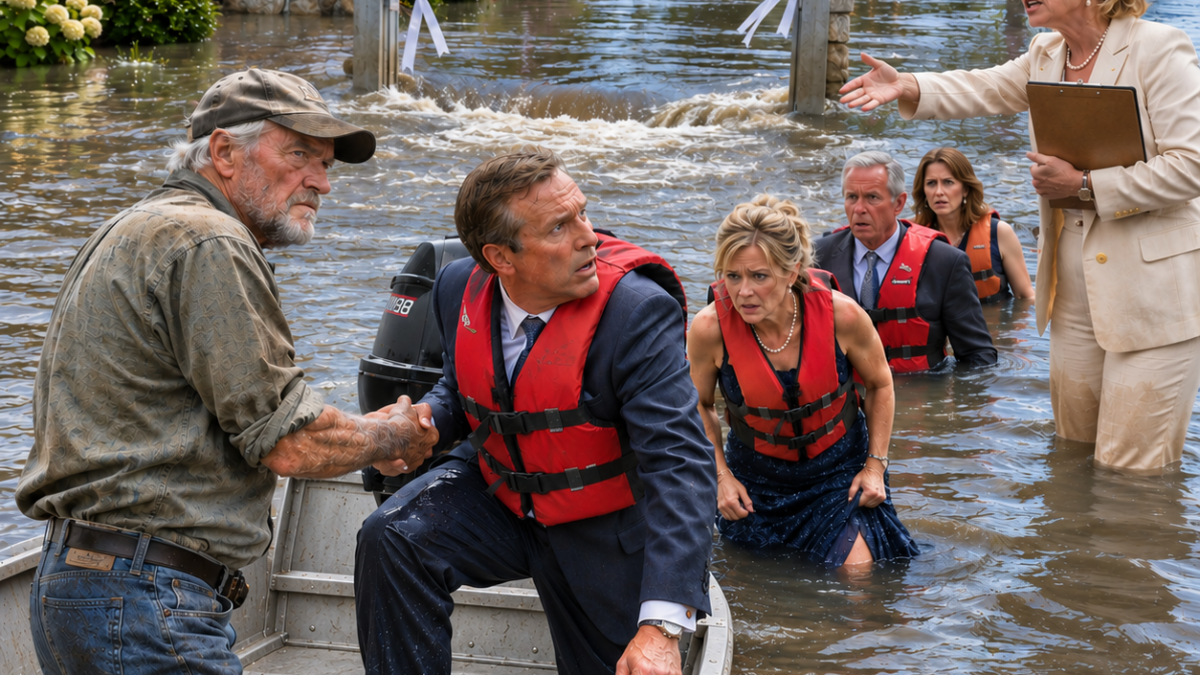
PART2:
“It documents the emergency response.”
“I didn’t remove the barrier.”
“The panels were on your property.”
“That is not what the sentence says.”
“Russell, people are waiting.”
“Yes.”
I handed the clipboard back.
“That’s why I’m taking them across.”
She took it.
“You’re refusing?”
“I am refusing to sign something false.”
Her mouth tightened.
I pushed away from the dock.
The outboard settled into a low hum.
Behind me, Vivian called:
“We’ll discuss this later.”
I did not turn around.
I took four passengers across the cove.
That was the first trip.
There would be three more.
And while I carried Vivian’s guests back toward their cars, I kept looking over my shoulder at the empty place along the shoreline where my flood barrier had stood that morning.
White ribbons from her party decorations were still tied to the posts.
Four days earlier, Vivian had stood in front of that barrier and asked me to remove it because she thought it ruined the view.
It started with a picture.
Vivian came down the gravel lane carrying a printed rendering of the Clubhouse Terrace.
Someone had designed a seating layout for Saturday night’s lake committee dinner.
Round tables.
White cloth.
Candles.
Lake beyond.
At the bottom of the image, my flood barrier had been crossed out with a thick red line.
Vivian held the picture up.
“It cuts directly through the view.”
I looked at her.
“It cuts directly through the water too.”
She smiled as though I had made a joke.
The barrier was not a giant dam.
It was not some massive concrete wall dividing the lake.
It consisted of fitted metal panels installed across a low opening between two raised sections of shoreline.
That low gap had always been the weak point.
When the lake climbed high enough, water naturally pushed through there and spread across the lane behind it.
That lane served my cabin and workshop first.
Then it continued out toward the clubhouse on Clubhouse Point.
Higher ground rose on either side.
My barrier connected those higher banks and closed the low opening when the lake rose.
Simple.
Ugly.
Useful.
I had paid to have it installed after a spring flood came through that gap years earlier and pushed muddy water into the bottom of my workshop.
My wife Nora and I had built that workshop together.
I had been retired from maintaining school buses for several years, but retirement never fit me very well.
I still repaired lawn tractors.
Boat motors.
Generators.
Small engines.
Anything somebody could drag into the yard and ask me to look at.
Nora used to say I had retired from getting paid every Friday but not from finding work.
She had helped paint the workshop pale green when we first fixed it up.
Her knees were already giving her trouble by then, but she sat on a folding stool and painted every shelf edge she could reach.
She labeled the storage bins herself.
CARBURETORS.
ELECTRICAL.
FUEL LINE.
FASTENERS.
ODD THINGS RUSSELL REFUSES TO THROW AWAY.
That last one was real.
I kept it.
The earlier flood had washed mud across some of those labels and ruined the bottom shelves.
I had no desire to watch that happen again.
So I had hired Martin Bell to install the barrier.
County permit.
Approved drawings.
Inspection.
Receipts.
Everything in a folder in my desk.
My name was Russell Hayes.
I was sixty-four years old.
And I had learned long ago that when water wants somewhere to go, arguing with it accomplishes nothing.
Vivian tapped the party rendering.
“We’re hosting the lake committee dinner Saturday.”
“I know.”
“People are paying for a nice evening.”
“Then give them one.”
“With that wall in the way?”
“It isn’t a wall.”
“From the terrace, it is.”
I understood what she meant.
From the lower seating area, the top of the barrier came up roughly chest-high.
If you sat at one of the planned tables, it blocked part of the water.
It did not make a beautiful postcard.
I did not deny that.
But behind that barrier sat a low road, my workshop, my cabin, and the only practical vehicle access to the point.
“The lake is already high,” I said.
“The forecast says sunshine Saturday.”
“It rained upstream for three days.”
Vivian turned toward the lake.
The surface looked calm.
That was part of the problem.
People who did not know that lake saw blue water, sunshine, and trees.
They did not see runoff moving downstream from rain that had already fallen.
They did not understand that a lake could keep rising after the local sky turned blue.
Vivian looked back at the rendering.
“These panels come out for maintenance.”
“Yes.”
“So remove them until dinner is over.”
“No.”
She blinked.
I pointed toward the level post near the shore.
A red mark ran across it.
“When the lake hits that mark, the road starts taking water if those panels aren’t there.”
The water had not reached the mark.
Not yet.
It was close.
Vivian checked her phone.
“The board can discuss it.”
“It’s my barrier.”
She looked at me.
“On a shared shoreline.”
“On my property.”
“It affects the clubhouse view.”
“It also protects the clubhouse road.”
“The answer isn’t just yours.”
“Yes, Vivian.”
I pointed toward the barrier.
“It is.”
Her expression chilled.
I continued.
“The answer is no.”
That evening, I put it in writing.
I emailed Vivian.
Copied Dean, the board secretary.
I attached a photo of the current water level.
I wrote:
Do not remove the flood barrier panels. The lake is elevated and additional runoff is expected. Removing the panels may allow water to enter the low road serving my property and the clubhouse.
Dean replied.
Received. I’ll add this to the event notes.
Vivian did not answer.
The following morning, a rental crew started unloading tables and equipment near the clubhouse.
One worker stopped near my workshop.
“Sir, can I turn this trailer in your gravel yard?”
“Sure. Just stay clear of the boat trailer.”
He thanked me.
Made the turn carefully.
Then he pointed toward the barrier.
“Are those the panels they’re moving?”
I stopped sharpening the mower blade in front of me.
“Who told you they’re moving?”
He frowned.
“It’s on the layout.”
“What layout?”
He pulled out his phone.
Same picture Vivian had shown me.
But this version had labels.
TABLES.
CATERING.
PHOTO LINE.
LAKE SIGHT LINE.
Where my barrier stood:
VIEWING GAP.
I stared at the screen.
“Can you send me that?”
“I don’t own the file. I can have the office contact you.”
“That’s fine.”
I gave him my number.
Then I walked straight to the clubhouse.
Vivian stood inside arranging place cards at a long table.
“Your rental company thinks my barrier is being removed.”
She kept sorting cards.
“They’re working from preliminary plans.”
“Then correct the plan.”
“Russell, you’ve already made your position clear.”
“Have you made it clear to them?”
She finally looked up.
“I said the plan is preliminary.”
“That isn’t an answer.”
Her jaw tightened.
I left before I gave her something she could use to make me sound unreasonable.
Back at the workshop, I photographed the barrier.
Both sides.
Every panel.
Every guide.
Every seal.
Every bolt.
The panels had small painted numbers along their edges because they had to go back in the same order.
I had painted those numbers myself.
Nora came outside while I was checking the last one.
She leaned against the porch rail.
“Why are you photographing everything?”
“Because somebody wants to make something wrong.”
She looked toward the clubhouse.
“Vivian?”
“Who else?”
“Send the permit to the board.”
“I was about to.”
I did.
Full board.
Approved drawing.
Property line.
Barrier location.
County permit.
Then I emailed Martin Bell.
He had installed the system.
I asked one question.
Would you recommend removing these panels with the lake at its current level?
His answer came that afternoon.
Leave them in place.
Then he attached the regional water-level notice he had been monitoring.
Runoff from the upstream rainfall was still moving through the basin.
The lake was expected to rise through the weekend.
I forwarded his message to the full board.
At that point, I thought I had done enough.
That was my mistake.
I believed clear documentation would stop someone who simply did not understand the risk.
Friday afternoon, Dean called.
“The board agreed event equipment will stay off your property.”
“What about the barrier?”
“Vivian says nobody is touching the structure.”
I looked through the workshop window.
“Does she include the removable panels when she says ‘structure’?”
Dean hesitated.
“I assume so.”
“Please don’t assume.”
“I’ll ask her.”
I never received another answer.
Saturday morning, I drove Nora to our daughter’s house in town.
Nora and our daughter planned to visit a nursery and have lunch.
Before I left, I checked the level post.
The lake had risen several inches overnight.
I photographed it.
Sent Vivian one final message.
Do not remove any panels. The water is still coming up.
The read receipt appeared.
She had seen it.
I was gone less than two hours.
When I came back, there was a yellow machine beside the shore.
Three workers stood near my barrier.
And one of my panels was hanging from lifting straps over a flat trailer.
For a few seconds, I could not process it.
The opening was already bare.
Every single panel had been removed.
I parked.
Got out.
“Stop!”
One worker immediately lowered his side of the panel.
The machine operator shut down.
Vivian walked from the clubhouse terrace.
“There’s no need to shout.”
I stared at her.
“You removed it.”
“We opened the view.”
“You removed my flood barrier.”
“The posts are still there.”
I pointed at the empty guides.
“The panels are the part that stops the water.”
“They’ll go back after dinner.”
The lake was already lapping close to the low gravel opening.
A thin line of water had begun creeping through.
I took out my phone.
Called Martin.
While it rang, I turned to the workers.
“Who hired you?”
The foreman came over.
His name was Calvin.
He pulled up a work order.
TEMPORARY REMOVAL OF REMOVABLE SCREENING AT CLUBHOUSE.
I read it.
“Screening?”
He nodded.
“That’s what we were told.”
I pulled up my permit drawing.
“This is flood protection.”
Calvin studied the drawing.
Then looked toward Vivian.
“You said these were decorative.”
“They obstruct the lake view,” she said.
“That’s not what I asked.”
His men stopped loading.
Martin answered.
I sent him photographs.
He called me back immediately.
“Do not try to force anything back in.”
“Why?”
“Look at the guides.”
I crouched.
That was when I saw it.
One metal guide had been hit sideways by the machine.
The upper lip was folded inward.
Calvin saw it too.
His face changed.
Before that, he had probably assumed they could simply put everything back.
Now he knew they could not.
Martin said:
“My crew is on another job. I can come look, but don’t let anyone work from the water side as the lake rises.”
I called the sheriff’s non-emergency line.
Reported that a permitted flood barrier had been removed from my property without consent and damaged.
Then I called the county number on my permit.
Saturday.
Answering service.
I left a message asking for an on-call callback.
None of those calls stopped the lake.
I looked at Vivian.
“Cancel the dinner.”
“The caterer is already setting up.”
“Call them.”
“Guests are already coming.”
“Then stop them.”
“We’ll move tables higher.”
“The tables aren’t the problem.”
I pointed toward the lane.
“The road is.”
Vivian looked past me.
The road was still dry.
That was enough proof for her.
It had not happened yet.
Therefore, in her mind, it would not happen.
I took photographs.
Empty opening.
Damaged guide.
Panels on trailer.
Water level.
Calvin agreed to stack the panels on the high side of my gravel yard.
One of his workers saw me moving boxes from the lower workshop shelves.
Without being asked, he came over.
He took the other end of a box.
“I didn’t know.”
I looked at him.
“I believe you.”
“What can I do?”
“Help me keep this stuff dry.”
By three o’clock, water had started flowing through the opening in a steady sheet.
Martin arrived.
He inspected the damage.
Looked at the water.
Looked at the bent guide.
“No safe reinstall today.”
“What about temporary?”
He studied the opening.
Water was already spreading behind it.
“Nothing I’d trust.”
I hated hearing that.
I trusted him because he said it.
He wrapped orange tape around the damaged guide.
“We need the water lower and proper access before we repair this.”
The county on-call officer returned my message.
After I explained what had happened, he told me to keep vehicles away if the low lane flooded and call emergency services if safe access was lost.
I walked directly to the clubhouse.
Dean was there.
I repeated what the county had said.
This time, Dean came outside.
We stood beside the lane.
Water had started moving across the first strip of gravel.
Dean took out his phone.
“I’m stopping the shuttle.”
Guests had parked on higher ground and ridden down to the clubhouse in a small association shuttle cart.
Those already at the clubhouse were safe.
Their cars were safe.
The road between them was not.
Dean stopped the cart.
Then he contacted the local fire station for guidance.
The water kept rising.
Slowly.
Quietly.
That was what made people underestimate it.
No tree trunks floating past.
No screaming current.
Just water gradually covering gravel.
A man in a suit walked toward it.
“I can probably walk through.”
“Don’t.”
He turned toward me.
“It’s not that deep.”
“You can’t see the ditch.”
He stopped.
The station officer arrived on the higher side.
He talked with Dean by phone.
The clubhouse itself was not threatened.
Guests could remain there while transportation was organized.
My boat was tied at my dock.
Across the sheltered cove sat the north landing.
That landing connected to the same road where their cars were parked.
I offered to move small groups.
The station officer asked about the boat.
Capacity.
Life jackets.
Load.
Weather.
Dock access.
We agreed I would carry fewer than the rated limit.
Someone would help guests board at each end.
Only then did I start.
The first man stepped into my boat.
Dress shoes.
Suit.
Life jacket.
And Vivian came down with the clipboard.
That brings us back to the form.
I refused to sign.
Then I took her guests across.
At the north landing, a woman touched my sleeve.
“Thank you.”
“You’re welcome.”
She looked embarrassed.
“We didn’t know any of this.”
“I know.”
That mattered.
The guests were not my enemies.
They had come to dinner.
That was all.
I returned for the next group.
Dean stood on the dock.
He had the clipboard now.
“Don’t sign this.”
“I wasn’t going to.”
He flipped the page.
Something was stapled behind the emergency form.
The removal company’s work order.
Dean pointed.
Under AUTHORIZATION:
OWNER APPROVAL OBTAINED.
Vivian had checked the box.
Signed her name.
Beside it was the time.
I opened my phone.
Found the message I had sent Saturday morning.
Do not remove any panels. The water is still coming up.
Read receipt.
Then I compared the times.
Vivian had signed the work authorization six minutes after reading my message.
I looked at Dean.
“Photograph both pages.”
He pulled out his phone.
“Front and back.”
He did.
“Send them to me.”
Vivian stood near the clubhouse telling guests that transportation had been arranged.
She said it like the boat, the fuel, the life jackets, and the route across the cove had appeared because she ordered them.
I wanted to walk up there.
Wanted to put the work order in front of her.
Wanted to ask how owner approval existed six minutes after the owner had said no.
Instead, I checked the next passenger’s life jacket.
There were still people waiting.
We made four trips.
I kept the boat lightly loaded.
Moved slowly.
The wind stayed gentle.
Nobody had to climb across rails.
Nobody waded.
Nobody fell.
On the third trip, an older woman sat beside a man holding a cake box.
The bottom had gone soft from dampness.
“Anniversary cake?” I asked.
He nodded.
“My sister made it.”
He looked down.
“Trying to save some of it.”
I found a plastic tray under the seat.
“Put it on this.”
He looked surprised.
“Thanks.”
“It isn’t the cake’s fault.”
He laughed.
At the landing, he gave me his name.
“Peter.”
“Russell.”
“If anybody asks what happened, give them my number.”
He wrote it on the back of his dinner invitation.
I put it in my shirt pocket.
By the time I tied the boat for the night, most guests were gone.
Dean remained with a couple of event workers moving electrical leads and equipment away from wet ground.
Vivian left in a fire-station boat.
She did not ask me for a ride.
That suited me.
I walked back toward my workshop.
The main floor was dry.
Barely.
The lower gravel yard was underwater.
The small lumber shed at the rear had taken water.
Two sheets of plywood sat in brown water.
A box of trim pieces too.
I had been saving those for the porch steps.
Compared with what could have happened, the loss was small.
It was still mine.
The barrier panels sat stacked on the high side of the yard.
I counted them.
All there.
Two were badly scraped.
One seal hung loose like black ribbon.
The guide Martin had marked with orange tape was bent enough that no panel would slide through it.
I photographed everything.
Then I called Nora.
“Are you all right?” she asked.
“Yes.”
“The guests?”
“Everybody who wanted out is off the point.”
“The workshop?”
“Mostly dry.”
Nora paused.
“That means something isn’t.”
“The lumber shed.”
“Then leave it.”
“I can move—”
“Russell.”
I stopped.
“Leave it until you can see what you’re doing.”
I sat at the kitchen table.
The boat keys were still in my hand.
“She gave me a form saying I removed the barrier.”
Nora went quiet.
“You didn’t sign it?”
“No.”
“Good.”
Another pause.
“Eat something.”
“I’m not hungry.”
“Eat something anyway.”
I almost smiled.
“Then send me your pictures.”
Nora had an ability to give simple instructions when my mind was running in six directions.
I heated soup.
Then opened Dean’s photographs.
Vivian’s signature on the work order.
OWNER APPROVAL OBTAINED.
Timestamp.
My warning.
Read receipt.
Six minutes.
I created a folder.
Saved everything.
Emailed copies to myself.
Then I wrote a timeline while the day was still fresh.
I was careful with the wording.
I did not write:
Vivian intentionally flooded the road.
I could not prove that.
I wrote:
Vivian authorized removal after being warned that water was rising.
The panels were removed.
The barrier guide was damaged during removal.
Water subsequently entered through the open low point and spread across the access road.
That was enough.
Sunday morning, the lane remained underwater.
Leaves drifted slowly across the place where my tire tracks had been.
A white plastic fork from the dinner floated near the ditch.
The clubhouse was dry.
My cabin was dry.
The workshop was mostly dry.
The problem was access.
I took the boat to the north landing.
My truck was still at the public lot.
I drove to our daughter’s house.
Nora opened the door holding a bag.
“I’m coming home.”
I looked at the bag.
“By boat?”
“I can manage a dock.”
“Your knees.”
“If somebody gives me an arm, I can step onto a boat.”
I called Dean.
He agreed to meet us at my dock.
We took our time.
Life jacket.
Middle seat.
Nora handed me her bag before standing.
Dean steadied the boat while I helped her out.
Once she reached the porch, she looked toward the open barrier gap.
“That’s a lot more missing than a view.”
“Yes.”
She went inside.
Came back with the notebook we used for house repairs.
She sat at the kitchen table.
Wrote the date.
“What have we spent?”
“Already?”
“Yes.”
“Boat fuel.”
She wrote it.
“Parking at the north landing.”
Wrote that too.
“Martin hasn’t billed me yet.”
“He will.”
She wrote:
MARTIN — PENDING.
She was not trying to turn the flood into a payday.
She wanted us to know what the incident was costing before receipts disappeared and memories blurred.
Dean came up the porch steps holding a paper.
“Vivian sent this to the guests.”
I read it.
The dinner had experienced unexpected lake flooding during an owner-led shoreline adjustment.
Owner-led.
The statement thanked association volunteers for helping provide transportation.
I read it twice.
“You know that isn’t true.”
“I know.”
“Did the board approve this?”
“No.”
“She used the dinner mailing list.”
I handed it back.
“Then correct it.”
“I’ll raise it.”
I was getting tired of that phrase.
Raise it.
Discuss it.
Review it.
My barrier sat in pieces.
My lane was underwater.
Vivian was already writing the version people would remember.
I asked Dean for the board members’ contact information.
Then I sent them:
My warning.
The work authorization.
Photographs.
The county permit.
Pictures of the opening.
I asked them to preserve all event records and correct the claim that I had directed the removal.
Then I called Calvin.
“I’ve been expecting you,” he said.
“Did Vivian tell you I approved removal?”
“Yes.”
“Did you ever speak with me?”
“No.”
“Why not?”
He exhaled.
“She said she was handling access for the board.”
“What exactly did she say?”
“The order said owner approval was obtained.”
I asked him to preserve his complete job file.
“Already done.”
Then he said:
“There’s one more thing.”
“What?”
“She told us the panels had to be out before noon because you’d be back after lunch.”
I stood from the kitchen chair.
“She said that?”
“Yes.”
“Will you put that in your job account?”
“I’ll tell my boss exactly what she said.”
“Thank you.”
When I hung up, Nora looked at me.
“She knew you’d stop them.”
“Yes.”
That did not prove Vivian wanted the road to flood.
It proved something else.
She knew I objected.
She wanted the work finished before I came home.
Monday, Martin returned with another worker.
The water was slowly dropping.
They inspected from dry ground.
Machine marks.
Bent guide.
Damaged seal.
Scraped panels.
Martin photographed everything.
“The panels weren’t lifted straight.”
“What does that mean?”
“They twisted during removal.”
He pointed at the damaged post.
“And this took a lateral hit.”
“Can you fix it?”
“Yes.”
“How soon?”
“When I can inspect the base safely.”
I wanted him to say:
Tomorrow.
Easy.
Cheap.
He refused to give me comfort he could not support.
That was why I trusted him.
Later, a county drainage officer named Leanne arrived at the north landing.
I brought her across by boat.
She carried a site drawing and waterproof notebook.
We walked the higher ground beside the lane.
I showed her the permit.
Level post.
Before photographs.
After photographs.
She studied water marks.
Asked where guests had parked.
Asked how they left.
At the open gap, she compared the actual site with the plan.
“This is the low point the barrier was designed to close?”
“Yes.”
“And you personally observed water entering here after the panels were removed?”
“Yes.”
She wrote it down.
“Can I reinstall as soon as Martin says it’s safe?”
“The existing approved system can be repaired.”
That was the first clean answer I had heard in days.
“If anything changes from the approved design, call us first.”
“I will.”
That evening, Peter called.
The man with the cake.
“I got Vivian’s email.”
“Yeah.”
“That isn’t how I remember things.”
“I’ve asked the board to correct it.”
He paused.
“She talked about your barrier before dinner.”
“What did she say?”
“That you were being stubborn about the lake view.”
“Before the road flooded?”
“Yes.”
“Would you send that to me in your own words?”
“I will.”
His statement did not make him a flooding expert.
It established something simpler.
Vivian knew whose barrier it was.
She knew why it remained in place.
And she talked about my refusal before the emergency ever happened.
Tuesday morning, gravel began reappearing.
I still kept vehicles off.
Floodwater hides damage.
A road can look fine until a truck finds the soft edge.
Nora stood beside me.
“Can Martin work soon?”
“I’m calling him.”
Before I could, Dean arrived by boat with another board member named Claire.
Claire carried a folder.
“We’ve asked Vivian to stop issuing statements about the incident.”
“That’s a start.”
“We also need to discuss the barrier.”
I looked toward the stacked panels.
“What about it?”
She opened the folder.
Vivian had filed a formal complaint with the association lawyer.
It claimed my barrier was an unauthorized structure.
That it interfered with common lake views.
That it might redirect water toward other property.
And it demanded that I not reinstall it until the board reviewed the issue.
I stared at Claire.
“You have the permit?”
“Yes.”
“The county drawing?”
“Yes.”
“Then what exactly are you reviewing?”
Claire shifted.
“The attorney wants to review everything.”
“Your president damaged my flood protection.”
No one answered.
“Now she wants the same board to decide whether I can repair it?”
Dean looked uncomfortable.
Claire said:
“I’m not here to threaten you. I wanted you to see this before it arrived unexpectedly.”
I believed her.
That did not make the document harmless.
I called Martin.
He had an opening Thursday.
After that, his crew would be tied up.
I looked at the weather notice.
More rain upstream.
I called Helen Brooks.
Helen had handled the purchase papers when Nora and I bought our cabin.
I explained the removal.
Flooding.
Damage.
Vivian’s new demand.
Helen asked:
“Has a court ordered you not to repair?”
“No.”
“Has the county?”
“No. County says the approved system can be repaired.”
“Send me both.”
I did.
Helen reviewed the documents.
Then called back.
“The HOA letter is a demand.”
“Meaning?”
“It isn’t a court order.”
“So Martin works Thursday?”
“I’m writing their lawyer now. I’m asking the association to confirm it will not interfere with repair of the existing approved structure.”
“What if they refuse?”
“Then we decide whether to ask the court to stop them from interfering.”
I looked at Claire.
“Will you send Helen the complete complaint?”
“Yes.”
“Dean?”
“I’ll send the board communications.”
Before they left, I gave them Helen’s email and watched the files go out.
Then I called Martin back.
“Hold Thursday.”
“You sure?”
“Yes.”
“I need a seven-hundred-dollar deposit to order the replacement guide and seal.”
I gave him the payment information.
Nora wrote:
$700.
“We shouldn’t have to pay that.”
“I know.”
“But we need the wall.”
“I know that too.”
That was the part of property disputes people rarely talk about.
Someone damages what you own.
You may eventually recover money.
Maybe.
But right now, you still need to pay the electrician.
The contractor.
The lawyer.
The surveyor.
The repair crew.
The sensible move costs money before anybody decides whose fault it was.
Helen called later.
She wanted the removal company’s complete records.
The board instructions.
County documents.
Everything.
Then I made my own mistake.
I opened the neighborhood message page.
Vivian’s statement was still posted.
Comments had multiplied.
One person wrote:
Owners shouldn’t be allowed to change drainage without warning everyone.
Another asked:
Did Russell’s barrier cause the high water?
Someone else:
Why didn’t he simply put the panels back after the event?
I started answering.
The barrier was permitted.
The panels had been removed against my written direction.
The lake was already rising.
The guide was damaged.
Then somebody asked why my boat was tied near the clubhouse if I claimed the shoreline was dangerous.
I answered that.
Another question appeared.
Then another.
Within thirty minutes, I was arguing with people about my boat, my yard, my road, runoff, the clubhouse, and whether I had somehow manufactured a flood.
Nora walked into the kitchen.
“What are you fixing?”
I looked up.
“What?”
“With all that typing.”
She nodded toward the phone.
“What are you fixing?”
I stared at the screen.
“Nothing.”
“Then stop.”
She was right.
I saved screenshots.
Posted one clear correction with the work order.
Then stopped replying.
The next morning, the standing water had mostly drained.
Mud covered the low lane.
Gravel had washed into the grass.
A shallow hollow had formed near one edge.
I put cones around it.
Martin arrived to inspect the barrier base.
He checked bolts.
Concrete.
Post alignment.
I stood behind him.
“Tell me the truth.”
He looked up.
“I was planning to.”
That made me laugh for the first time in days.
The concrete was sound.
The entire post did not need replacement.
The bent guide could come off.
A new guide could be installed.
One seal replaced.
Scraped panel edges dressed smooth.
“How much?”
He gave me the estimate.
$4,800 total.
I read it twice.
It could have been worse.
It was still almost five thousand dollars to fix damage I had warned everyone not to cause.
I signed it.
Then Martin handed me an old photograph.
The original barrier installation.
Bare ground around the posts.
The panels new.
I looked younger.
Nora stood beside me wearing work gloves and holding two paper cups.
“Office found the original file.”
The file included the permit.
Inspection.
Approved drawing.
And an email sent to the HOA office when the installation was completed.
I sat on the porch.
Read it.
The association had known about the barrier for years.
They had been sent the permit.
They had been told its purpose.
This was not some unauthorized wall I had secretly built at night.
I sent everything to Helen.
Then called Dean.
“Search your office archive.”
“For what?”
“Martin’s original barrier permit.”
He called back within an hour.
“I found it.”
“Inspection too?”
“Yes.”
“Anything else?”
Silence.
Then:
“There’s an old board note.”
“What does it say?”
He read it.
The barrier protected the low access lane serving both Clubhouse Point and my property.
Dean sounded tired.
“We should’ve found this before responding to Vivian’s complaint.”
“Yes.”
No reason to soften it.
Then I said:
“Thank you for finding it now.”
Leanne sent her preliminary county report that afternoon.
Careful language.
Exactly what I wanted.
It did not claim the barrier would stop every possible flood.
It did not speculate about things she could not prove.
It stated that the lake level during the event remained below the approved barrier top.
It stated that the low shoreline opening provided a direct water path toward the lane once the panels were removed.
It said the photographs and ground marks were consistent with water entering through that opening.
That was enough.
It also made one fact painfully simple.
The barrier had not caused the flooded road.
The barrier had not been there when the road flooded.
Helen told me the association lawyer was discussing withdrawal of Vivian’s objection.
He asked whether I would delay Thursday’s repair while the board considered it.
“No.”
More runoff was coming.
The water was low enough now for safe repair.
I was not gambling with another rise because the board needed more time to discuss something its own old records already explained.
That afternoon, Calvin returned.
This time he brought the owner of the removal company.
Aaron.
Aaron carried a folder.
“We reported the damage to our insurer.”
I nodded.
“I’m not going to tell you our crew didn’t hit the guide.”
“Good.”
“Calvin documented it.”
“I know.”
“I can’t tell you what insurance will pay yet.”
“I’m not asking you to.”
He opened the folder.
“There’s something else you need.”
Printed messages between his office and Vivian.
The first asked:
Has property owner approved panel removal?
Vivian:
Yes.
Second question:
Do panels serve any flood-control function?
Vivian’s answer:
Removable view screening. Posts remain in place. No material drainage function will be affected.
I looked at Aaron.
“Your office asked her directly.”
“Yes.”
“And she said no flood function.”
“Yes.”
Calvin looked toward the barrier stack.
“The panels were heavier than we expected.”
Aaron nodded.
“We should’ve verified directly with you.”
“Yes.”
“We’re changing our process.”
Then he showed me the job schedule.
REMOVE BEFORE NOON.
STORE OUT OF SIGHT.
REINSTALLATION:
SEPARATE RETURN VISIT TO BE SCHEDULED.
I read that last line aloud.
“Separate visit.”
Calvin nodded.
“Vivian told you we’d put them back after dinner?”
“Yes.”
“That wasn’t what our office had booked.”
I stared toward the lake.
There had never been a crew scheduled to restore the barrier that evening.
Vivian had stood beside the empty opening and told me it would all go back after dinner.
That had not been true.
Aaron sent the records directly to Helen and the association lawyer.
Before leaving, Calvin helped me move the wet plywood onto blocks.
Afterward, he stood beside the shed.
“I wish I’d waited for you.”
“So do I.”
He nodded.
I did not need to punish him with a speech.
He had made a mistake.
He also stopped when confronted.
Helped protect my things.
Preserved evidence.
Told the truth.
Both could be true.
That night, the board met.
Helen joined by video.
I sat beside Dean.
Claire was there.
Tom Harris, another board member.
Vivian sat with the lake-view photograph in front of her.
She opened the meeting.
“This barrier has become unnecessarily divisive.”
Tom looked at her.
“Did you read the old board record?”
“Yes.”
“So you knew the association had recognized the flood-control purpose?”
“I knew Russell claimed that was its purpose.”
Dean placed Leanne’s county report on the table.
“The county says the opening is where the water entered.”
Vivian looked at the lake photograph.
“The event would have been affected by high water regardless.”
Helen spoke from the laptop.
“What engineering record supports that?”
Vivian frowned.
“I’m not an engineer.”
Helen answered:
“Then perhaps we should rely on the people who inspected it.”
Claire moved to withdraw the association’s objection to repair.
Tom seconded.
Vivian objected.
“We need a second opinion.”
I spoke before I could stop myself.
“You didn’t wait for a first opinion before taking it out.”
Silence.
Helen looked at me through the screen.
“Russell, let the board finish.”
I sat back.
The vote passed.
Vivian lost.
The objection was withdrawn.
For the first time in days, I felt my shoulders loosen.
Then Vivian reached into her folder.
“I also filed a complaint with the county.”
I looked at her.
“Of course you did.”
“I asked them to stop repair until the drainage implications are reviewed.”
Helen asked for the response.
Vivian slid it across.
Dean scanned it to Helen.
Helen read.
Then looked at the camera.
“This is not a stop-work order.”
Vivian said nothing.
“It’s an acknowledgment of your complaint.”
Tom leaned back.
“Enough.”
Vivian turned.
“Excuse me?”
“The repair proceeds.”
For one second, I thought we were finally done.
Then Dean’s phone rang.
Gate attendant.
Martin’s supplier was outside with the replacement guide and seal.
The truck was being denied entry.
“Why?”
The attendant answered:
“There’s an instruction in the gate book barring contractors going to Mr. Hayes’s property unless Mrs. Cole approves them.”
Dean put the call on speaker.
Tom looked at Vivian.
“Who entered that instruction?”
The attendant answered:
“Mrs. Cole. This afternoon.”
Vivian opened her mouth.
Claire raised one hand.
On the table sat the board vote authorizing repairs.
On the phone sat evidence that Vivian had already ordered the gate staff to block those repairs.
I looked through the dark window toward the lake.
The replacement parts for my barrier were sitting in a truck outside the neighborhood because the woman who had removed it was still trying to control whether I could put it back.
Tom leaned toward the phone.
“This is Tom Harris. Speaking for the board, the delivery is authorized.”
“I need that in writing.”
“You’ll have it.”
Vivian pushed back her chair.
“You cannot reverse access instructions before reviewing—”
Claire cut her off.
“We just voted.”
Dean typed the authorization.
Attached the decision.
Sent it.
Then asked the attendant to read it back.
A pause.
“Truck is cleared.”
I sat still.
That truck moving felt better than every argument I had won that week.
Helen spoke.
“Dean, preserve the gate instruction and timestamp.”
“I will.”
Vivian closed her folder.
“This board is making a mistake.”
Tom looked at her.
“The mistake is sitting in pieces in Russell’s yard.”
Vivian left.
The meeting continued without her.
The board removed her unilateral authority to issue contractor work orders or access restrictions.
Written instructions went to the gate.
No one was to interfere with the barrier repair.
Dean printed a copy.
I carried it home like something fragile.
The delivery truck was waiting beside my workshop.
I checked the parts.
New guide.
Seal.
Hardware.
Correct labels.
We stored them under the roof.
I sent Martin a photo.
He replied:
See you at 7:00.
I called Nora.
“Parts are here.”
“Good.”
“Board withdrew the objection.”
“Better.”
I looked toward the open gap.
“I’ll sleep when that’s closed.”
“You’ll sleep tonight.”
“I’m not tired.”
“You’re exhausted.”
She was right.
I went to bed.
Martin arrived before sunrise.
Three-man crew.
Proper lifting equipment.
Supports.
Tools.
I showed them the parts.
Then I stayed out of their way.
That was harder than it sounds.
I had spent my whole life working with my hands.
Standing on the porch while someone else repaired something I owned felt unnatural.
But I had promised Nora I would not start carrying panels.
So I made coffee.
Martin checked the concrete again.
Removed the damaged guide.
Once it came off, the impact damage was obvious.
Metal crushed inward.
Finish scraped from the post.
He photographed everything beside a ruler.
Then showed me the replacement.
“This goes back exactly where the original was.”
“No design change?”
“None.”
Good.
Vivian had tried to turn repair into a new construction debate.
Martin was restoring the approved system.
By midmorning, the new guide was installed.
The crew dressed the scraped panel edges.
Replaced the torn seal.
Checked the numbers.
Then lowered the panels one by one.
No forcing.
No hammering.
Lift.
Adjust.
Lower.
The gap shrank.
Section by section.
When the final panel seated, nobody cheered.
Martin walked the entire line.
Checked seals.
Fasteners.
End posts.
Then looked at me.
“Panels are back.”
I let out a breath.
He finished his tests.
Sent photographs and repair records to Leanne.
The road still needed work.
A section of gravel had washed out.
Tom arranged a road contractor.
This time, he brought me the written scope before anybody arrived.
Restore damaged lane edge.
Keep equipment off shoreline.
Do not alter flood barrier.
I read it.
“That’s clear.”
Tom gave a tired smile.
“That shouldn’t feel like an accomplishment.”
“No.”
“But it does.”
“Yes.”
Nora came home that afternoon.
She stood on the porch.
Looked at the restored barrier.
“Looks the same.”
“That was the idea.”
She nodded.
Then went inside.
Put on the kettle.
For the first time in almost a week, ordinary sounds inside our kitchen felt more important than the dispute.
The following evening, the lake rose again.
More upstream runoff.
I did not stand outside all night.
Martin had inspected the work.
The barrier was back as designed.
But before bed, I took a flashlight down.
Water pressed against the lake side.
I walked around.
Looked behind the panels.
The road was dry.
The lake level sat high enough that the open gap would have sent water across it again.
But the gap was not open.
I took a photograph.
Sent it to Martin.
Sent it to Leanne.
Then I went back inside.
Nora was reading.
“Well?”
“Dry road.”
She closed the book.
“Good night, Russell.”
That was the first night I slept without waking up to look through the window.
Repairing the barrier did not end everything.
Helen prepared our damage claim.
$4,800 barrier repair.
Damaged lumber and materials.
Boat fuel.
Parking.
Legal costs.
Reasonable documented expenses.
I did not send Vivian a bill for every hour I spent angry.
I did not charge her guests for boat rides.
The guests had not created the problem.
They needed help.
That was enough.
What I wanted most was simple.
A binding order preventing Vivian or the HOA from ever removing or altering the barrier again without my written permission or lawful authority.
And I wanted the record corrected.
I had not removed it.
I had not caused the road to flood.
The association lawyer eventually agreed the permitted barrier could remain.
He proposed one clause allowing temporary removal for approved events.
I read it once.
“No.”
Helen crossed it out.
I was willing to maintain the system.
Allow inspections.
Follow permits.
I was not going through this every time someone wanted a better photograph.
The civil dispute ended in settlement.
The agreement became part of a court order.
The HOA and Vivian could not remove, alter, or interfere with the permitted barrier without my written consent or lawful authority.
The order did not magically give me freedom from county rules.
I still had to maintain the barrier.
Follow the permit.
Keep it in safe condition.
Those were obligations I already accepted.
The removal company’s insurer paid the agreed portion related to physical damage.
The association and Vivian covered other agreed losses and legal expenses through the settlement.
I was not paid twice for the same repair.
Some minor costs were left out.
I accepted that.
There was no giant courtroom verdict.
No million-dollar check.
No judge screaming at Vivian.
The real ending was quieter.
The barrier was restored.
The record was corrected.
The rules became enforceable.
The association separately reviewed Vivian’s event expenses.
They found she had ordered the panel removal without proper board authorization.
She agreed to repay costs assigned to her under that process.
I did not involve myself in every accounting line.
I cared about one thing.
Nobody was charging me for supposedly removing my own barrier.
Claire sent a formal correction to homeowners and dinner guests.
It stated that Vivian had authorized removal without my consent.
That I had warned against it.
That the road flooded after the barrier was removed.
And that guests had been safely transported from Clubhouse Point.
It thanked the fire crew.
Volunteers.
Dean.
And me.
Peter called after receiving it.
“That sounds more like the night I remember.”
“How’d the cake do?”
He laughed.
“Crooked.”
“Edible?”
“Still edible.”
“Then it survived.”
“My sister wants to replace your tray.”
“Tell her to keep it.”
“You sure?”
“It did its job.”
The sheriff’s office kept my report.
They received contractor records.
Nothing dramatic followed.
No handcuffs.
No squad cars outside Vivian’s house.
No cinematic arrest.
And I was fine with that.
The strongest consequences came from records.
Insurance.
A court order.
Association rules.
Then the homeowners dealt with Vivian.
At a members’ meeting, the board presented:
My written warning.
The removal work order.
The false owner-approval box.
The timestamps.
The messages.
The contractor records.
The gate instruction that had blocked my repair delivery after the board authorized the work.
Nora sat beside me.
When homeowners were invited to speak, I stayed seated.
I had nothing to add.
The documents had already spoken for me.
The members voted.
Vivian lost the presidency.
She also lost her authority over contractors, event planning, and gate-access instructions.
She still lived in the neighborhood.
That meant I would still see her.
Mailbox shelter.
Road.
Clubhouse entrance.
The first time we passed afterward, she looked away.
I let her.
I had no interest in spending retirement trying to extract an apology from somebody who did not want to give one.
The new board changed how events worked.
Private property had to be clearly marked on plans.
Contractors needed written owner permission before entering or altering anything.
Any temporary change involving drainage or flood-control equipment required proper technical review.
No more deciding safety questions based on whether something interfered with photographs.
Gate restrictions also changed.
No single board officer could issue an unusual contractor ban alone.
Two authorized board members had to approve it.
The reason had to be documented.
Dean showed me the new rules.
“Would this have stopped what happened?”
I thought about it.
“It would’ve made somebody else look at what she was doing.”
He nodded.
“That’s the idea.”
Calvin came by after the repair claim was settled.
He carried a small box with damaged fasteners his company had kept for the insurer.
He set it on my workbench.
Then looked through the workshop door toward the barrier.
“I check owner permission myself now.”
“Every job?”
“Every time.”
I shook his hand.
Calvin had participated in damaging my barrier.
He had also stopped when he learned the truth.
Helped save my belongings.
Preserved records.
Admitted what happened.
Both things were true.
I wanted him to remember the lesson.
I did not need him carrying my anger forever.
About a month later, Nora and I had family over for dinner.
We put the table on the porch.
Grandchildren complained that adults talked too much before eating.
Normal things.
Good things.
After dinner, my grandson came up beside me.
“Grandpa, can we take the boat?”
I looked toward the cove.
“Get your life jacket.”
He ran.
I checked the fuel.
Counted jackets.
Looked at the weather.
Those checks had become automatic.
Nora came down the dock with us.
I held her hand while she stepped into the boat.
Her knees still bothered her.
She lowered herself carefully onto the seat.
My grandson climbed in behind her.
I started the motor.
We moved out across the cove.
Halfway out, I looked back.
The workshop stood dry.
The lane was open.
The flood-barrier panels stretched across the low shoreline exactly where they belonged.
From the clubhouse terrace, they still blocked part of the lake.
Vivian had been right about that.
The view was not perfect.
From where I sat, I could see something else.
A dry road.
My workshop.
Our cabin.
The way home.
My grandson pointed.
“Heron!”
A blue-gray bird stood near the reeds.
I eased back on the throttle.
We drifted.
Nora leaned against the seat.
Nobody was stranded.
Nobody was wearing a life jacket over a dinner suit.
Nobody was holding a clipboard asking me to sign away responsibility.
Nobody was waiting for my boat because someone had removed the road’s protection for a better photograph.
We were on the lake because we wanted to be.
That was enough.
And every time I looked back at those metal panels after that, I remembered the lesson Vivian had spent an entire weekend teaching everyone the hard way.
A safety system does not become unnecessary because nothing bad has happened yet.
A property owner does not become unreasonable because the word “no” ruins your plans.
And when someone warns you that the water is rising, the worst possible time to argue about the view is while you are taking down the thing keeping that water out.








