HOA Karen Removed My Flood Barrier for a Better Lake View—Then Her Party Guests Needed My Boat to Escape the Flooded Road
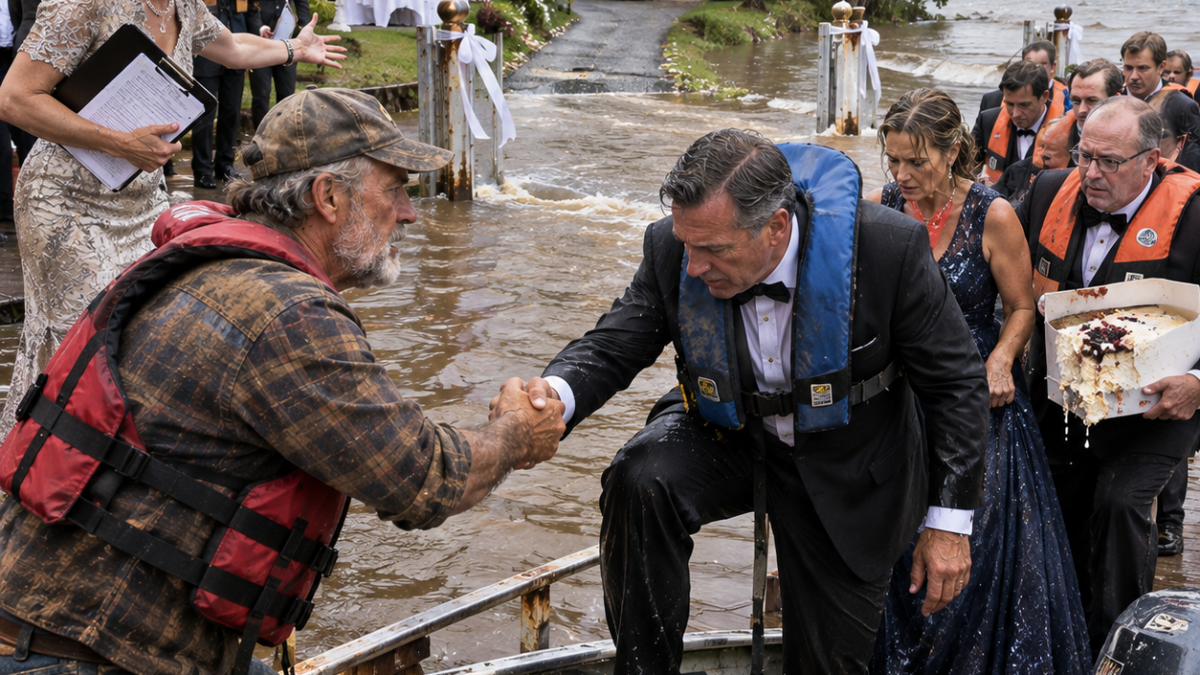
PART2:
I was sixty-four years old, retired from maintaining school buses, and I had spent enough of my life around machines to know that emergencies become worse when people start proving how brave they are.
Then I heard Vivian behind me.
“Russell.”
I looked up.
She stood on the dock above us, one hand holding a clipboard.
Her white dinner jacket had survived the evening better than most of the guests had.
Of course it had.
Vivian somehow moved through mud as though mud had been instructed not to touch her.
“Make sure you bring the boat back immediately,” she said. “There are still several groups waiting.”
I looked past her.
Past the clubhouse.
Toward the low opening in the shore bank.
That morning, my flood barrier had stood there.
Now there were only two metal end posts.
White decorative ribbons had been tied around them for Vivian’s party.
The ribbons moved gently in the breeze.
Everything between those posts was gone.
Those missing panels were the reason the road was underwater.
“I’m helping them,” I said.
“I know.”
PART3:
She stepped closer.
“The board also needs you to sign this.”
She handed me the clipboard.
Across the top:
EMERGENCY USE OF OWNER’S VESSEL
That part did not bother me.
If they wanted a record that I had agreed to use my boat, fine.
Then I read the next paragraph.
I read it twice.
It said I acknowledged having voluntarily removed the shoreline barrier before the event and agreed that emergency transportation had become necessary after unexpected lake conditions.
I looked at Vivian.
She looked back as if we were discussing fuel receipts.
“You want me to sign that I removed the barrier.”
“It’s just documenting the sequence.”
“That isn’t the sequence.”
“The barrier is on your property.”
“That doesn’t mean I removed it.”
“Russell, people are waiting.”
Exactly.
People were waiting.
So I handed the clipboard back.
Unsigned.
Then I pushed away from the dock.
The outboard settled into a low hum.
The first passenger looked at me.
“What was that about?”
“Not tonight.”
He nodded.
We crossed the cove.
Behind us, Vivian’s perfect lake view stretched uninterrupted from the clubhouse terrace to the water.
No metal panels.
No ugly flood barrier.
Nothing blocking the scenery.
Nothing blocking the lake either.
Four days earlier, she had come to my workshop carrying a photograph.
That was how it started.
Not with flooding.
Not with a storm.
A photograph.
Vivian had been HOA president for almost two years.
She was good at events.
I will give her that.
She knew flowers.
Lighting.
Table arrangements.
Which local restaurant would send staff instead of buffet trays.
What kind of music sounded expensive without being loud.
She knew how to make people feel that an association meeting about landscaping was somehow part of a larger vision for the neighborhood.
What she did not understand well was being told no.
My workshop sat below my cabin near the shore.
Nora and I had built it twenty years earlier.
She picked the color.
Pale green.
I wanted gray.
She said gray would make it look like “a box full of dirty tools.”
“That’s what it is.”
“That doesn’t mean it has to look miserable.”
So pale green won.
Nora usually won on color.
Inside, she had written labels along several shelves in black marker.
FILTERS
ELECTRICAL
FASTENERS
THINGS RUSSELL WILL SWEAR HE PUT SOMEWHERE ELSE
That last one stayed.
Her knees had gotten bad in the years since, and she did less work around the shop now, but her handwriting was everywhere.
I liked that.
My name is Russell Hayes.
I spent thirty-eight years maintaining school buses.
Diesel engines.
Hydraulic brakes.
Cooling systems.
Electrical faults.
The occasional heater that stopped working on the coldest morning of the year because machines enjoy timing.
Retirement lasted seven months before I started fixing small engines from home.
Mowers.
Generators.
Boat motors.
Snowblowers.
Pumps.
I did not need the money desperately.
I needed something that required tools.
Sitting still never suited me.
The flood barrier came after a spring storm eight years earlier.
Back then, the lake climbed slowly after three days of rain upstream.
Water pushed through a low opening in the shore bank and spread across the lane.
It entered the bottom of the workshop.
Not much.
Six inches at the deepest point.
Enough.
The lowest shelves soaked.
Some of Nora’s labels peeled off.
I lost boxes of parts.
A portable welder needed repair.
Afterward, I hired Martin Bell.
He designed a removable flood barrier for the low opening.
Not a dam across the lake.
Not a wall enclosing the clubhouse.
A line of fitted metal panels spanning the narrow gap between two naturally higher banks.
When water rose, the panels kept it from washing through the low spot and onto the lane.
The county approved it.
Drawings.
Inspection.
Permit.
Recorded location.
Everything.
The barrier was removable because maintenance sometimes required access.
Each panel slid into vertical guides.
Rubber seals.
Numbered edges.
Bolted end posts.
Simple.
Strong.
Ugly.
From the clubhouse terrace, the top of the barrier did interfere with part of the lake view.
I knew that.
I also knew what happened without it.
Vivian arrived beside the shop on Tuesday afternoon.
I was sharpening a mower blade.
“Russell?”
I switched off the grinder.
“What’s wrong?”
“Nothing.”
“Then you caught me at a good time.”
She smiled in the way she did when she wanted cooperation to feel like a favor you were giving yourself.
“We’re hosting the lake committee dinner Saturday.”
“I heard.”
“Anniversary event.”
“Congratulations.”
“Thank you.”
She unfolded the photograph.
White tables lined the terrace.
Flowers.
String lights.
Lake.
At the bottom of the image, somebody had drawn a red line through my barrier.
“It cuts right through the view,” she said.
“It cuts right through the water too.”
She smiled.
Small.
Patient.
As if I had made a joke.
“The panels are removable.”
“For maintenance.”
“So take them out Saturday.”
“No.”
Her smile faded slightly.
“They could come out after lunch and go back after dinner.”
“No.”
“Russell.”
“The lake’s high.”
“The forecast says sun.”
“It rained upstream for three days.”
She looked toward the water.
The lake appeared calm.
That fooled people.
Lake levels do not care what the sky over your head is doing.
Water arriving from upstream can raise them long after local rain stops.
“The barrier isn’t necessary right now.”
I pointed to the level post near the bank.
Red line.
“When the water reaches that mark, the road starts taking water if those panels aren’t there.”
The lake sat below it.
Not far below.
Vivian looked at her phone.
“The board will discuss it.”
“It’s my barrier.”
“It serves the common road.”
“Part of the road.”
“The point is shared.”
“The barrier is on my land.”
Her face hardened.
“The clubhouse is hosting an association event.”
“That still doesn’t make my property association property.”
“People are paying for a nice evening.”
“Then give them one.”
“I’m trying.”
“Leave the barrier.”
She folded the picture.
“We’ll see.”
“No.”
That was when I should have understood the real problem.
Not water.
Authority.
I sent an email that evening.
Short.
Professional.
I reminded her the barrier was permitted flood protection.
The lake remained elevated.
The road behind it served both my property and the clubhouse.
Do not remove any panels.
I copied Dean, the board secretary.
Attached a photo of the lake-level post.
Dean replied:
Added to event notes.
Vivian did not reply.
Wednesday, a rental crew started unloading tables.
One driver asked whether he could turn his trailer in my gravel yard.
“Yes. Stay clear of my boat trailer.”
“Appreciate it.”
Then he pointed.
“Those the panels they’re moving Saturday?”
I stopped.
“Who told you they were moving?”
“It’s on the event layout.”
He showed me his phone.
Same image.
This version had labels.
Where my barrier stood:
VIEWING GAP
I stared.
“Send me that.”
“I don’t own the file.”
“Can your office?”
“I’ll give them your number.”
Fair answer.
I walked straight to the clubhouse.
Vivian was arranging place cards.
“Your rental crew thinks my barrier is coming out.”
“They work from preliminary plans.”
“Then correct the plan.”
She kept sorting names.
“Russell, you’ve made your position clear.”
“Have you made it clear to them?”
She looked up.
“I said the plan was preliminary.”
“That isn’t what I asked.”
Silence.
I left.
Not because the conversation was over.
Because I could feel my temper moving toward words she would use later to make me look unreasonable.
At home, I photographed the barrier.
Both sides.
Every panel.
Guides.
Seals.
Bolts.
Panel numbers.
Nothing dramatic.
Documentation.
Nora found me near the last post.
“Something wrong?”
“Somebody wants to make something wrong.”
She sighed.
“Vivian?”
“Yes.”
“Send the permit.”
“I sent her the warning.”
“Send the permit too.”
Marriage sometimes becomes a person telling you the obvious thing you should have already done.
I emailed the entire board.
Permit.
Approved drawing.
Property location.
Inspection page.
Then I messaged Martin.
Would you recommend removing the panels Saturday?
His answer arrived an hour later.
Leave them in place.
He attached a lake-level notice.
Upstream runoff still coming.
Expected rise through weekend.
I forwarded everything.
Permit.
Engineer.
Water notice.
I thought that would end it.
That was my mistake.
I believed paperwork corrects misunderstanding.
Sometimes it does.
Paperwork does very little against a person who already understands and wants something anyway.
Friday afternoon, Dean called.
“The board agreed event equipment stays off your property.”
“What about the barrier?”
“Vivian said nobody’s touching the structure.”
“Panels included?”
“I assume.”
“Don’t assume.”
“I’ll ask.”
He never called back.
Saturday morning, I drove Nora to our daughter’s house.
Nursery trip.
Lunch.
Nora’s knees made long afternoons around the lake uncomfortable anyway.
Before leaving, I checked the level.
Several inches higher.
I photographed it.
Sent Vivian one final message.
Do not remove any panels. Water is still coming up.
Read receipt.
She saw it.
I was gone less than two hours.
When I returned, a small yellow lifting machine sat beside the shore.
Three workers were loading one of my panels onto a flat trailer.
For several seconds, my mind refused to make sense of the scene.
Like seeing somebody remove your front door because they disliked the color.
“Stop!”
One worker lowered his side.
The machine shut off.
Vivian walked down from the terrace.
“There’s no reason to shout.”
“You removed it.”
“We opened the view.”
“The panels are the flood barrier.”
“The posts remain.”
“The posts don’t stop water.”
“They’re going back after dinner.”
I looked toward the lake.
A thin trickle had already begun creeping through the exposed gravel.
“Who authorized them?”
“The board.”
“No.”
“The event plan—”
“Who authorized work on my property?”
The foreman stepped forward.
Calvin.
He held up his phone.
Work order.
TEMPORARY REMOVAL OF REMOVABLE SCREENING AT CLUBHOUSE
Screening.
I showed him my permit.
His expression changed.
“These are flood-control panels?”
“Yes.”
He looked toward Vivian.
“You said decorative.”
“They obstruct the view.”
“That wasn’t my question.”
Calvin told his crew to stop.
Thank God.
Then I looked at the nearest guide.
Bent.
The lifting machine had struck the metal lip.
Folded inward enough that I knew a panel would not simply slide back.
I called Martin.
Sent photos.
He said he could come.
Not immediately.
His crew was across town.
“Do not let anyone force those panels into damaged guides.”
“I know.”
“And don’t work from the water side if the level keeps rising.”
“I know.”
I called the sheriff’s non-emergency line.
Reported unauthorized removal and property damage.
Then the county number on my permit.
Saturday.
Answering service.
Message.
None of that stopped the water.
I told Vivian:
“Cancel the dinner.”
“The caterer is already here.”
“Call guests.”
“We’ll move tables higher.”
“The tables aren’t the problem.”
I pointed toward the lane.
“The road is.”
She looked.
Dry.
Still dry.
“There is no water on the road.”
“Yet.”
She folded her arms.
“We are not canceling an event because you’re upset about a removable barrier.”
That sentence stayed with me.
Not because it was cruel.
Because it revealed the problem.
She thought my objection was emotional.
Possessiveness.
Stubbornness.
Not engineering.
I took more photographs.
Then asked Calvin to leave all panels on the high side of my yard.
He agreed.
One worker saw me moving boxes from low workshop shelves.
He stepped over.
“I can help.”
I looked at him.
“I didn’t know what these were.”
“I know.”
“Where?”
“Bottom shelves.”
We worked.
He carried two boxes at a time.
I did not blame him for taking a work order seriously.
Not yet.
By three, water moved through the opening in a steady sheet.
Not raging.
That almost made it worse.
Quiet water convinces people it is harmless.
Martin arrived.
Inspected the guide.
Looked at the level.
“No.”
“What?”
“I can’t put it back safely now.”
“Temporary repair?”
He studied the width.
Water.
Damaged guide.
“No temporary setup I’d trust to keep the lane usable.”
I hated the answer.
I trusted him because he gave it.
County on-call officer called back.
I explained.
He said:
“Keep vehicles off flooded sections.”
“It’s not flooded yet.”
“If safe access is lost, call emergency services.”
“Can I repair?”
“Once contractor says conditions are safe, yes, based on your existing approved system.”
Good.
I walked to the clubhouse.
Guests were arriving.
Men in jackets.
Women in dresses.
Shuttle cart bringing people down from the upper parking area.
I found Vivian and Dean.
“The county says keep vehicles away once the road takes water.”
Vivian looked irritated.
Dean looked concerned.
“We should stop the shuttle,” he said.
“Yes.”
Vivian:
“The road is still open.”
I pointed.
Water had started crossing the first strip of gravel.
Dean pulled out his phone.
“I’m stopping it.”
That was the first board decision that evening based on reality rather than appearance.
Guests already at the clubhouse were safe.
High ground.
Their cars were at upper parking.
The problem was the lane between.
Water rose until gravel disappeared.
A man in a suit stepped toward it.
“I can walk.”
“No.”
“It’s not deep.”
“You can’t see the ditch.”
He stopped.
Local fire station sent an officer to the high side.
He and Dean spoke by phone.
No immediate life threat.
Clubhouse dry.
Guests could shelter while safe transport was arranged.
Then I looked at my dock.
My boat.
North landing across the sheltered cove.
Connected by road to the upper parking area.
“I can take small groups.”
The officer asked questions.
Capacity.
Life jackets.
Wind.
Route.
Dock condition.
Good questions.
We agreed on fewer passengers than the rated maximum.
Helper at both docks.
No overloaded trips.
Slow speed.
That was how I ended up ferrying Vivian’s party guests home after she removed the structure protecting their road.
Four trips.
On the first, Vivian brought the false form.
On the return trip, Dean waited.
He had the clipboard.
“Don’t sign this.”
“I wasn’t going to.”
He turned it over.
Stapled behind:
Removal company work order.
Authorization section.
A checked box.
PROPERTY OWNER APPROVAL OBTAINED
Vivian’s signature.
Time.
I took out my phone.
Opened the message.
Do not remove any panels. Water is still coming up.
Read time.
Six minutes before Vivian signed the contractor authorization.
Dean looked at both.
“Photograph everything.”
He nodded.
“Front and back.”
He did.
Then emailed them to me.
Vivian stood on the terrace telling guests transportation had been arranged.
As though the board had hired boats.
As though the route existed because she planned ahead.
I wanted to walk up there.
Put both documents in her hands.
Ask how she expected to explain six minutes.
Instead, I checked the next passenger’s life jacket.
People first.
Argument later.
Third trip carried an older woman and a man holding a cake box.
Bottom gone soft.
“Anniversary cake?”
“My sister made it.”
He looked miserable.
I found a dry plastic tray beneath the seat.
Helped him slide the cake onto it.
He looked surprised.
“It’s your party.”
“Not my party.”
“You know what I mean.”
“It isn’t your fault.”
At north landing, he asked my name.
“Russell Hayes.”
“I’m Peter.”
He wrote his number on the back of the dinner invitation.
“If anyone asks what happened, call me.”
I put it in my pocket.
By the fourth trip, people had stopped looking angry.
Mostly embarrassed.
Some had learned why the road flooded.
Others had only learned the man whose barrier had supposedly caused problems was the one driving them home.
Humiliation has a way of changing shape when facts arrive.
The clubhouse emptied.
Vivian left by a boat arranged through the fire station.
She did not ask me.
Fine.
At my workshop, water stopped just below the main floor.
The attached lumber shed was not as lucky.
Two plywood sheets soaked.
Trim pieces ruined.
Lower gravel yard underwater.
Barrier panels stacked safely uphill.
Two heavily scraped.
One seal torn.
Guide bent.
I photographed every piece.
Then called Nora.
“You okay?”
“Yes.”
“Guests?”
“Off the point.”
“Workshop?”
“Mostly dry.”
She paused.
“That means something isn’t.”
“Lumber shed.”
“Leave it tonight.”
“I need—”
“You need light.”
I sat at the kitchen table.
Boat keys still in my hand.
“She handed me a form saying I removed the barrier.”
Nora was quiet.
“You didn’t sign.”
“No.”
“Good.”
Then:
“Eat.”
I heated soup.
Opened Dean’s photos.
Work order.
Vivian signature.
False approval box.
My warning.
Read receipt.
Six-minute gap.
I created a folder.
Saved copies locally.
Emailed copies to myself.
Then wrote a timeline while memory was fresh.
Important:
I did not write:
Vivian deliberately flooded the road.
I did not know that.
What I knew:
She wanted barrier removed.
I refused.
I warned her repeatedly.
She read final warning.
She signed work order claiming owner approval.
Barrier removed.
Water entered through opening.
Road flooded.
Those facts were enough.
Sunday morning, the lane remained underwater.
Leaves floated across where tire tracks used to be.
A white plastic fork moved past my driveway.
Clubhouse dry.
Cabin dry.
Workshop mostly dry.
But we were physically cut off from the road system.
I took the boat to north landing.
My truck was already parked near the public lot from the evacuation.
Drove to my daughter’s house.
Nora met me with a bag.
“I’m coming home.”
“By boat?”
“I can manage a dock.”
“You hate docks.”
“I hate being told I can’t go home more.”
Fair.
We took our time.
Life jacket.
Middle seat.
Bag first.
Dean met us at my dock.
He held the boat steady.
Nora stepped onto land.
Looked at the gap.
“That’s more missing than a view.”
“Yes.”
She went inside.
Came back with our house-repair notebook.
Opened a clean page.
Date.
“What have we spent?”
“Fuel.”
She wrote.
“Landing parking.”
Wrote.
“Martin?”
“Bill coming.”
“Put pending.”
She was not building a lawsuit.
She was preventing memory from turning into guesses.
That helped.
Dean brought a statement from Vivian.
Sent to guests.
She called the flooding an unexpected lake condition during an owner-led shoreline adjustment.
Owner-led.
Not:
HOA president ordered removal against written objection.
She thanked association volunteers for arranging transport.
I looked at Dean.
“You know this is false.”
“Yes.”
“Board approve it?”
“No.”
“She sent it herself?”
“Event mailing list.”
I handed it back.
“Correct it.”
“I’ll raise it.”
That phrase irritated me.
Raise it.
Discuss it.
Review it.
My barrier sat in pieces.
The road was a lake.
Vivian was already writing history.
I asked for every board member’s direct email.
Then sent:
Work order.
Warning.
Read receipt.
Photos.
Timeline.
I asked them to preserve all event records.
Correct “owner-led.”
Then I called Calvin.
“I’ve been expecting you.”
“Did Vivian tell you I approved removing the panels?”
“Yes.”
“Did you call me?”
“No.”
“Why?”
“The work order said approval obtained.”
“What else did she say?”
Silence.
Then:
“She said they needed out before noon because you’d be back after lunch.”
I stood.
“What?”
“She wanted work done before you returned.”
“Put that in your job account.”
“I will.”
That mattered.
Still not proof she intended flooding.
But proof she knew I would object.
Proof timing was designed to prevent me stopping the removal.
Monday, Martin returned.
Water still high.
He inspected from dry side.
Machine marks.
Bent guide.
Torn seal.
Scraped panels.
Photographs.
Measurements.
“Repairable?”
“Yes.”
“When?”
“Once the water drops.”
I wanted certainty.
He gave facts.
Later, county drainage officer Leanne met me at north landing.
I ferried her over after she confirmed the boat route.
She carried plans.
Notebook.
We walked the high side.
Permit.
Level post.
Old photographs.
New photographs.
Empty opening.
She asked:
“Water entered here?”
“I watched it.”
“Cars parked where?”
“Upper lot.”
“Guests evacuated?”
“Boat.”
“How many trips?”
“Four.”
She wrote.
Then:
“This is the approved location of the barrier.”
“Yes.”
“The existing permitted system can be repaired.”
I almost hugged her.
I did not.
“Have Martin document damage and restoration.”
“Yes.”
“If the design changes, contact us.”
“It won’t.”
“Good.”
Peter called that evening.
Cake man.
He had received Vivian’s statement.
“That isn’t how I understood what happened.”
“I’ve asked board to correct it.”
“She told our table before dinner that the panels belonged to you and you were being stubborn about the view.”
I stopped.
“Before flooding?”
“Yes.”
“Will you send that to me?”
He did.
Not proof about hydrology.
Proof Vivian knew exactly whose barrier she removed and why she wanted it gone.
Tuesday, water finally receded enough to see gravel.
Mud covered lane.
A shallow washout appeared near one edge.
I coned it.
No trucks.
Water hides damage.
Dean and board member Claire arrived by boat.
Claire carried a folder.
“We asked Vivian to stop issuing statements.”
“Good.”
“We need to discuss the barrier.”
I looked toward the stacked panels.
“What about it?”
She opened the folder.
Complaint.
Filed by Vivian with HOA counsel.
Claim:
Barrier unauthorized.
Spoils common views.
May redirect floodwater onto other property.
Demand:
Do not reinstall pending board review.
I stared.
“You have my permit?”
“Yes.”
“County drawing?”
“Yes.”
“Old inspection?”
“Yes.”
“Then what are we reviewing?”
“Counsel needs—”
“Your president removes my flood protection.”
I pointed toward the water.
“Now she wants her board to decide if I’m allowed to repair it.”
Dean looked ashamed.
Claire said:
“I wanted you to see it before it came as another surprise.”
I believed her.
Still called lawyer.
Helen Brooks.
She had handled our property papers years earlier.
“Has a court ordered you not to repair?”
“No.”
“County?”
“No.”
“County officer?”
“Said existing approved system can be repaired.”
“Send me everything.”
I did.
Martin had Thursday opening.
After that, committed elsewhere.
More upstream rain forecast.
I paid $700 deposit to reserve crew and order replacement guide and seal.
Nora wrote it down.
“We shouldn’t pay that.”
“I know.”
“But we need barrier.”
“I know.”
That is the ugly part of property disputes.
Being right does not repair steel.
Somebody still needs a credit card.
Helen reviewed documents.
“The HOA complaint is a demand.”
“Not an order?”
“No.”
“If they interfere?”
“We seek court relief.”
“Before Thursday?”
“First I’m giving their lawyer a chance to behave sensibly.”
I made my own mistake that night.
Neighborhood message page.
Vivian’s statement remained.
Comments.
“Owners shouldn’t change drainage without telling HOA.”
“Maybe Russell’s wall caused water to rise.”
“Why did he keep a boat near the clubhouse?”
I began replying.
One.
Two.
Seven.
Every explanation created new questions.
Nora walked in.
“What are you fixing?”
“What?”
“All that typing.”
I stared at the screen.
“Nothing.”
Exactly.
I saved the page.
Posted one correction.
Attached work-order photo.
Stopped.
Next morning, most standing water gone.
Martin inspected base.
Concrete sound.
Post repairable.
New guide.
New seal.
Panel edges dressed smooth.
Estimate:
$4,800 total.
Including deposit.
I read twice.
Nearly five thousand dollars to repair damage I had warned them not to create.
Signed anyway.
Then Martin gave me something.
Old installation photograph.
Me younger.
Barrier new.
Nora beside me holding paper cups.
Behind it:
Original job file.
Permit.
Inspection.
Email sent years earlier to HOA office.
The association had received copies when barrier was installed.
I called Dean.
“Search your archive.”
He did.
Called back.
Found everything.
Even an old board note.
Barrier protects low lane serving clubhouse and Hayes property.
I said:
“You should’ve found that before responding to Vivian.”
“Yes.”
No softening.
Then:
“Thank you for finding it now.”
Leanne’s initial report came same afternoon.
Careful.
Good.
It did not claim the barrier could stop every flood.
It said:
Water during event remained below approved barrier top.
Low shore opening provided route for lakewater once panels removed.
Physical marks consistent with entry there.
That was enough.
Helen reached association counsel.
Board would consider withdrawing objection.
Counsel asked if I could delay repairs.
“No.”
More rain upstream.
Open gap.
I was done gambling.
Nora went to our daughter’s for repair day.
Late afternoon, Calvin returned with company owner Aaron.
They brought insurance information.
Work records.
Aaron said:
“Our crew damaged the guide.”
Plain.
No games.
Then printed messages.
Removal company had asked Vivian:
Has property owner approved?
She replied:
Yes.
They asked:
Any flood-control function?
Vivian:
Removable view screening. Metal posts remain. Nothing important changes.
I looked at Calvin.
“You asked.”
“Our office did.”
Aaron said:
“We should still have contacted you directly.”
“Yes.”
Then job plan.
Panels out before noon.
Stored out of sight.
Reinstallation:
Separate visit to be scheduled later.
Not after dinner.
Later.
Vivian had told me they were going back that evening.
There was no crew scheduled.
I asked them to send originals to Helen and HOA lawyer.
They did from my porch.
Board meeting that night.
Helen joined by video.
Dean.
Claire.
Tom.
Vivian.
She placed a photograph of unobstructed lake view in front of herself.
Of course she did.
“This barrier is dividing the neighborhood.”
Tom held old board note.
“You knew it protected the lane?”
“I knew Russell claimed it did.”
Dean placed county report beside it.
“County confirms opening was water path.”
“The lake level might have affected event either way.”
Helen said:
“Identify your technical basis.”
Vivian:
“I’m not an engineer.”
Helen:
“Then let’s rely on those who inspected it.”
Claire moved to withdraw objection.
Tom seconded.
Vivian demanded second opinion.
I spoke before thinking.
“You didn’t wait for a first opinion before taking it out.”
Silence.
Helen told me gently to let board finish.
Fair.
Vote.
Objection withdrawn.
Vivian opposed.
Lost.
Relief.
Then she smiled slightly.
“I also sent a complaint to the county.”
Helen asked for response.
Vivian produced acknowledgment letter.
Not stop-work order.
Not even preliminary finding.
County simply acknowledged receipt and requested documents they already had.
Helen explained that.
Tom leaned back.
“Enough.”
I thought we were done.
Dean’s phone rang.
Neighborhood gate.
Martin’s supplier outside with replacement guide and seal.
Gate attendant refusing entry.
Why?
Standing instruction:
No contractors to Hayes property without Vivian Cole approval.
Issued that afternoon.
After the board had been discussing repair.
Tom put call on speaker.
“Who entered that restriction?”
“Mrs. Cole.”
Vivian started:
“The complaint hasn’t—”
Claire raised her hand.
“We just voted.”
Tom told attendant:
“This is Tom Harris speaking for the board. Delivery authorized.”
The attendant wanted written proof.
Good for him.
Dean typed.
Attached decision.
Sent.
Asked attendant to read back.
He did.
“Truck’s going through.”
I sat still.
Hearing that truck finally move felt better than any speech.
Helen said:
“Preserve gate instruction and timestamp.”
Dean nodded.
Vivian closed folder.
“This board is making a mistake.”
Tom looked at empty chair beside her.
“The mistake is sitting in pieces in Russell’s yard.”
She left.
Board continued.
Written instruction:
No interference with repairs.
No unilateral contractor restriction by president.
Vivian’s independent authority over work orders and gate access suspended.
I carried the paper home.
Replacement parts waited beside workshop.
Correct labels.
Guide.
Seal.
Hardware.
I called Martin.
He replied:
7:00 A.M.
Then Nora.
“Parts here.”
“Good.”
“Board withdrew objection.”
“Better.”
I looked at dark opening.
“I’ll sleep when it’s back.”
“You’ll sleep tonight.”
She was right.
Martin’s crew arrived at seven.
Three workers.
Proper lifting equipment.
Supports.
Tools.
I promised Nora not to “help.”
That was hard.
I spent my life helping with mechanical jobs.
Standing on porch felt unnatural.
Martin removed bent guide.
Damage worse once off.
Machine had crushed one lip inward.
Scraped finish from post.
He photographed beside ruler.
Showed new guide.
“Fits approved design exactly.”
“No changes?”
“None.”
Good.
By midmorning:
Guide installed.
Panel edges dressed.
Torn seal replaced.
Numbered panels checked.
Lift.
Align.
Lower.
One section at a time.
No hammering something because close enough.
Final panel seated.
No cheering.
Martin checked joints.
Seals.
Fasteners.
End posts.
Then:
“Back.”
I stood there longer than necessary.
Barrier looked exactly as it had.
That was point.
The lane edge still needed repair.
Tom arranged road contractor.
This time, he showed me written scope first.
Restore damaged gravel. Keep equipment off shore. Do not alter barrier.
I read.
“That’s clear.”
He looked relieved.
Clear instructions had become an achievement.
Nora came home.
Walked onto porch.
Looked.
“Looks the same.”
“That was the idea.”
Then went inside and made tea.
Ordinary sound of kettle mattered more than it should have.
Lake rose again the following evening.
I went down with flashlight.
Water pressed against lakeside of panels.
Road behind them:
dry.
Water remained below barrier top.
Exactly the condition that had flooded us when opening was bare.
I photographed level post.
Sent Martin.
Leanne.
Then went inside.
Nora was reading.
“Well?”
“Dry road.”
“Good night, Russell.”
First night I slept without checking window.
The repair did not end dispute.
Helen prepared documented losses.
Barrier repair:
$4,800.
Lumber shed materials.
Boat fuel.
Parking.
Legal expenses.
Other costs.
We kept each separate.
Receipts.
Photos.
Estimates.
I did not bill party guests for boat rides.
They had not caused anything.
They needed help.
Vivian’s lawyer later proposed settlement language allowing HOA to request temporary barrier removal for approved events.
I read once.
“No.”
Helen crossed it out.
I would maintain.
Allow inspection.
Follow permit.
But no repeated removal because somebody wanted better photographs.
Civil case ended through settlement and court order.
The order confirmed:
Association and Vivian could not remove, alter, or interfere with permitted barrier without my written consent or lawful authority.
Important distinction:
It did not make me king of the shoreline.
I still had to maintain system.
Follow permit.
Comply with county requirements.
Responsibilities went both ways.
Removal company insurer paid agreed share of physical damage.
Remaining settlement covered other agreed losses and legal costs through payments from association and Vivian.
No double recovery.
No giant verdict.
No dramatic millions.
Some small costs stayed mine.
I accepted it.
I wanted barrier.
Rules.
Record.
Not lifetime litigation over receipts.
Association separately reviewed Vivian’s dinner expenses.
Found removal ordered without proper board approval.
Vivian agreed to repay association for removal work and event charges assigned to her through that resolution.
I did not manage those accounts.
I only made sure none came to me as the supposed person who opened shoreline.
Claire sent correction to guests and homeowners.
Vivian authorized removal without my consent.
I warned against it.
Guests transported safely after lane flooded.
Thanked fire crew.
Volunteers.
Me.
Peter called.
“This sounds more like evening I remember.”
“How was cake?”
He laughed.
“Crooked. Edible.”
His sister wanted replace plastic tray.
“Keep it.”
Tray did its job.
Sheriff kept report.
Contractor records.
No dramatic arrest followed.
That was source of disappointment for people later hearing story.
They wanted handcuffs.
I did not.
The strongest outcome came from documents, insurance, court order, board accountability.
Real life does not need an arrest to prove somebody lost.
Vivian lost presidency.
Members meeting.
Nora came.
I sat beside her.
Board presented:
My written warnings.
Work order.
False owner-approval box.
Contractor messages.
County report.
Old HOA record.
Gate instruction blocking repair delivery.
When owner comments opened, I stayed seated.
Everything was already in file.
People voted.
Vivian removed.
Her authority over contractors and event access ended.
She still lived neighborhood.
I knew we would pass each other.
Fine.
I had no interest spending retirement extracting apology from someone determined not to give one.
New board changed process.
Event plans had to identify private property.
Drainage and flood-control features had to be marked.
Written owner permission required before contractor entry.
Temporary modifications to flood protection required actual technical review.
Not aesthetic vote.
Gate restrictions required more than one person’s approval and documented reason.
Dean showed new policy.
“Would this have prevented it?”
“Would’ve made another person look at what she was doing.”
“That’s what we’re trying.”
Good enough.
Calvin returned after repair claim settled.
He carried damaged fasteners in a small box.
Looked at barrier.
“I check owner permission myself now.”
“Every job?”
“Every job.”
I shook his hand.
He made mistake.
His crew damaged guide.
But he had stopped when confronted.
Helped protect my belongings.
Told truth.
Company provided records.
Paid through insurance.
Both things could be true:
He had done damage.
He had learned.
I preferred he carry lesson rather than my anger.
A month later, Nora and I hosted family dinner.
Porch table.
Grandchildren complained adults talked too long before food.
After dinner, grandson asked for boat ride.
I checked fuel.
Life jackets.
Habit.
Nora came to dock.
Held my hand.
Stepped carefully in.
Bad knees.
Still determined.
We moved into cove.
I looked back.
Workshop dry.
Lane open.
Barrier across low opening.
Exactly where it belonged.
From clubhouse terrace, yes, it still blocked part of lake.
From boat, I saw something else.
It protected the way home.
My grandson pointed toward a heron near reeds.
I eased throttle.
No rush.
Nobody waiting for rescue.
We were on water because we wanted to be.
That should have been the end.
But what stayed with me afterward was how quickly a dispute about appearance became a dispute about reality.
Vivian wanted a lake view.
That is not evil.
I understood it.
If I had paid for expensive dinner, I would rather look at water than metal panels too.
The problem was not wanting view.
The problem was believing wanting something strongly enough made somebody else’s safety equipment negotiable.
Then once consequences arrived, she tried rewriting sequence.
First:
Panels decorative.
Then:
Owner approved.
Then:
Owner-led shoreline adjustment.
Then:
Barrier unauthorized.
Then:
Barrier itself might cause flooding.
Then:
Repair should wait.
Then:
Contractor access blocked.
Every new explanation had same purpose.
Keep control.
That bothered me more than original removal.
People make mistakes.
Sometimes serious ones.
If Vivian had stood beside flooded road and said:
“I was wrong. I ordered removal. We need to fix this.”
Story would still have been bad.
But smaller.
Instead, she treated each fact as something to move around.
Like place cards.
That is the danger of authority without humility.
The person stops asking:
What happened?
Starts asking:
What explanation keeps me in charge?
Dean changed after that.
He had been too willing to assume.
Friday:
“Nobody is touching structure.”
I asked:
“Panels included?”
He assumed.
He never checked.
Afterward, he stopped assuming.
When board discussed contractors, Dean asked:
“Who owns property?”
“Where is written permission?”
“What exactly did owner approve?”
Those questions irritated people sometimes.
Good.
I once told him:
“You got annoying.”
He smiled.
“I learned from you.”
Nora laughed when I told her.
The lane also taught us something.
For years, we called it “the clubhouse road.”
Technically it served my cabin and workshop first, then continued to clubhouse.
Everyone casually treated it as shared.
No problem until access disappeared.
Then ownership, responsibility, and maintenance suddenly mattered.
New board formalized emergency access procedures.
If road unusable:
Guests remain on high ground.
Fire department consulted.
No vehicle enters flooded section.
Alternate transport only after safety review.
Boat option listed, but not mine by default.
Dean showed draft.
“What do you think?”
“Whose boat?”
“It says volunteer vessel if offered.”
“Good.”
“Not owner’s emergency vessel.”
“Better.”
We both smiled.
I kept original clipboard form.
Copy.
Not because I enjoyed being angry.
Because it taught me something.
At top:
EMERGENCY USE OF OWNER’S VESSEL
Reasonable.
Below:
Owner voluntarily removed barrier.
False.
That is how manipulation often works.
Put false statement beside necessary action.
People sign because emergency is happening.
Because others waiting.
Because form looks routine.
Because one sentence seems less important than immediate problem.
If I had signed while rushing to ferry guests, Vivian could have held it up later:
Russell admitted it.
My signature.
My problem.
I did not think of that strategically at dock.
Something simply felt wrong.
I read.
That was enough.
Read before signing.
Simple advice.
Almost insulting.
Still saves people.
Martin kept old damaged guide for insurance inspection.
Later returned it.
I mounted nothing dramatic.
No trophy.
It sat behind workshop for months until Nora asked:
“Why are we keeping that?”
“Evidence.”
“Case is settled.”
“Could be useful.”
“For what?”
I looked at bent metal.
She raised eyebrow.
I took it to recycling.
That felt good.
You can keep evidence too long.
Eventually it stops protecting you and starts decorating your anger.
I did not want Vivian’s mistake becoming permanent object in my yard.
Barrier itself was enough.
Functional.
Repaired.
One winter morning, ice coated lake.
I walked down.
Panels silver with frost.
Someone at clubhouse had tied no ribbons to them.
Good.
I touched one guide.
Solid.
Then remembered white ribbons fluttering around empty posts while guests boarded my boat.
The part that still made me angry was not ferrying people.
I never regretted that.
Not once.
Peter’s cake.
Older guests.
Women carrying shoes.
Men looking foolish in life jackets over suits.
They had not ordered removal.
Most did not even know barrier existed before that day.
Helping them was easy.
What bothered me was Vivian acting as though helping her guests transferred responsibility.
She seemed to believe:
If Russell rescues people, Russell accepts emergency.
If Russell uses boat, Russell owns problem.
That logic is dangerous.
Helping after someone causes harm does not make you responsible for cause.
A firefighter extinguishing fire did not start it.
A neighbor pumping flooded basement did not open pipe.
A boat owner ferrying stranded guests did not remove flood barrier.
That distinction seems obvious until somebody puts a clipboard in your hand.
A year after incident, Peter invited Nora and me to a barbecue.
His sister was there.
Cake maker.
She brought same kind of cake.
Dry this time.
She handed me a new plastic tray.
“I know you said keep old one.”
I laughed.
“You didn’t have to.”
“I wanted to.”
Nora told her:
“He saves everything.”
“Not everything.”
Nora gave me look.
Mostly everything.
We had good evening.
No HOA talk for first hour.
Then Peter asked:
“Did Vivian ever apologize?”
“No.”
“You want her to?”
I thought.
“Not anymore.”
That surprised even me.
An apology would have mattered early.
Later, record mattered more.
Barrier restored.
Order entered.
Correction sent.
Costs addressed.
Governance changed.
People sometimes want emotional confession because it makes story neat.
Life rarely gives neat.
I could live with accurate.
The court order mattered.
People later exaggerated it.
“They ruled HOA could never touch anything on your property.”
No.
They ruled association and Vivian could not remove, alter, or interfere with permitted barrier without written consent or lawful authority.
Specific.
Important.
I still had responsibilities.
If county later required change, I could not wave order.
If barrier failed, I had to maintain it.
If design needed revision, permits.
Rights without obligations become the same kind of nonsense Vivian practiced.
I did not want that.
Five years after flood, Martin retired.
His son took over company.
Before retirement, Martin stopped by.
“Still holding?”
He meant barrier.
“Yes.”
“Any trouble?”
“None.”
He inspected casually.
“Seals due next season.”
“I know.”
“You always say that.”
“Because I know.”
He smiled.
Then:
“You handled that week better than I would’ve.”
“No.”
“I’d have thrown somebody in lake.”
“That’s why I hired you for steel.”
He laughed.
Truth was, I had been furious enough to make stupid decisions.
Nora slowed me.
Helen slowed me.
Dean eventually helped.
Calvin’s honesty helped.
County process helped.
People imagine dignity means not feeling anger.
Wrong.
Dignity means anger does not get steering wheel.
I wanted to confront Vivian at dock.
I did not.
Wanted to drive through flooded lane to prove something.
I did not.
Wanted to reply to every neighborhood comment.
I tried.
Nora stopped me.
Wanted to ignore HOA demand and repair instantly.
I called lawyer first.
Sometimes strongest thing you can do during property fight is create space between feeling and action.
That space is where documentation happens.
Vivian had none.
Every time she felt control slipping, she acted.
New statement.
New complaint.
New gate restriction.
Each created another record.
In the end, one of the most damaging pieces against her was not removal itself.
It was the gate instruction.
Because by then the board had voted repairs could proceed.
Still she independently blocked supplier.
That transformed earlier excuses.
Maybe misunderstanding permit.
Maybe thought decorative.
Maybe believed owner approval.
But after meeting?
After county report?
After board vote?
Blocking parts showed continuing interference.
Tom’s line stayed with me.
“The mistake is sitting in pieces in Russell’s yard.”
Plain.
Hard to argue.
The road contractor eventually repaired washout.
This time, written scope before arrival.
I read.
Restore edge.
Compact gravel.
No shoreline changes.
No barrier work.
I told Tom:
“Good.”
He said:
“Feels ridiculous how proud I am of one-page work order.”
“I know.”
That was another lesson.
Good governance is often painfully boring.
Clear scope.
Second approval.
Written permission.
Known boundary.
Boring prevents dramatic weekends.
New board dinners still happened.
Tables.
Music.
Lake views.
They moved placement.
Guests could see around barrier from higher angle.
Someone planted low shrubs farther back.
No one died because photograph contained metal.
Imagine that.
One evening, years later, I stood on clubhouse terrace during a neighborhood picnic.
Not Vivian’s kind of formal event.
Kids.
Burgers.
Paper plates.
A new resident asked:
“What’s that wall?”
“Flood barrier.”
“Ugly.”
“Yep.”
“Why there?”
I explained.
His expression changed.
“Oh.”
That was all.
Maybe we need fewer fights and more explanations before decisions.
He did not demand removal.
He simply looked past it from another angle.
View still beautiful.
Lake was lake.
A safety structure did not ruin it.
Vivian had treated every obstruction to aesthetic perfection like insult.
I became more suspicious of perfection after that.
Nora’s workshop labels were not perfect.
Dad’s tools, if I had inherited any, would not have been perfect.
Our pale-green paint had chips.
Barrier had scratches even after repair.
Boat seats faded.
All functional.
All ours.
The lake itself was not perfect.
Some mornings algae collected along reeds.
Storms washed branches in.
Water level changed.
Herons left droppings on dock.
Nature did not care about table photography.
Nora once said:
“Vivian wanted to live beside a postcard.”
That was exactly it.
But postcards do not have drainage.
Roads.
Maintenance.
Flood levels.
Mud.
Reality does.
One spring, water rose even higher than the party year.
Barrier held.
County monitored.
Road remained dry until water approached design limit.
Then we followed plan.
No panic.
No clandestine removal.
No argument.
It was not magic wall.
Never claimed.
It did its designed job.
That mattered because after dispute, some Vivian supporters had tried saying:
“What if it doesn’t work during a bigger flood?”
That question made no sense as attack.
Seat belts do not prevent every injury.
You still wear them.
Flood protection does not stop every flood.
You still do not remove it for photographs.
Peter visited that spring.
He looked at high water pressing against panels.
“So that’s what it was supposed to do.”
“Yes.”
He shook his head.
“And we were eating steak twenty feet away.”
“Pretty good steak?”
“Actually yes.”
“Then evening wasn’t total loss.”
He laughed.
That was when I realized I could laugh about it.
Not everything.
Enough.
Vivian remained in neighborhood several years.
We passed at mailboxes.
Road.
Store.
She rarely looked at me.
I did not seek her out.
Some neighbors expected feud.
There wasn’t one.
A feud requires continued participation.
I stopped.
She had no authority over my barrier.
That was what I wanted.
When she eventually moved, Dean mentioned it casually.
“Vivian sold.”
“Okay.”
“That’s it?”
“What do you want?”
“I don’t know. Fireworks?”
“No.”
Nora said later:
“You’re disappointed?”
“About what?”
“You wanted Russell to dance.”
Dean laughed.
I had no dance.
The barrier stayed after she left.
That was enough.
Our grandson grew.
The heron at reeds became favorite.
Every boat ride, he looked for it.
One afternoon he asked:
“Why are those panels there?”
He had been too young during incident to understand.
“Keep road dry when lake rises.”
“Why would anyone take them out?”
I looked at Nora.
She smiled.
“For a better view.”
He stared at me.
“That’s dumb.”
Children can summarize entire lawsuits in two words.
Years passed.
Nora’s knees worsened.
We added handrail at dock.
I slowed boat more.
Life jackets every time.
The flood night had made safety rituals automatic.
Not fearful.
Automatic.
When I checked fuel, Nora would say:
“You’ve checked it twice.”
“I know.”
“Life jackets?”
“Counted.”
“Barrier?”
“Not going anywhere.”
“Good.”
The workshop remained pale green.
Her labels faded.
I traced one with marker.
She caught me.
“You’re ruining original.”
“I’m preserving it.”
“That’s not preserving.”
“Mechanic preservation.”
She rolled eyes.
I thought about spring flood years earlier washing away labels.
Then Vivian’s removal nearly doing it again.
We spend lives protecting strange things.
Handwriting on shelves.
Road access.
Old tools.
A view.
Not all protection deserves equal weight.
That was really the conflict.
Vivian protected an experience.
A picture.
A dinner.
I protected infrastructure.
Access.
Property.
Safety.
The tragedy was those goals were never inherently incompatible.
Move tables slightly.
Photograph from higher angle.
Decorate barrier.
Use another terrace.
Dozens of options.
But compromise requires accepting other person has legitimate interest.
Vivian never got there.
She saw my no as obstacle.
So she bypassed me.
That is why court order mattered.
It converted my no from something she could negotiate around into boundary backed by law.
Written consent or lawful authority.
Simple.
A person should not need court order to preserve meaning of no on his own permitted flood barrier.
Sometimes apparently we do.
I kept Nora’s repair notebook.
The page from that weekend.
Fuel.
Parking.
Martin deposit.
Pending.
Later:
$4,800 repair.
Legal.
Materials.
Nothing dramatic.
Numbers.
Every time someone told story as if I had “won big,” I could open notebook.
No.
I got paid documented losses.
Not lottery.
Justice is often reimbursement plus rule.
People prefer revenge because it feels cinematic.
I preferred dry workshop.
The removal company changed its policy.
Aaron sent copy months later.
Any work involving flood protection, structural elements, gates, utility access, drainage, or property-boundary equipment required direct owner confirmation unless legal authority documented.
Calvin called.
“Your barrier is in training manual now.”
“What?”
“Not picture. Scenario.”
“Good.”
“Guy with lake view.”
“I’m a case study?”
“You’re the grumpy owner who was right.”
“Accurate.”
We laughed.
That mattered too.
Mistakes can become procedures.
Procedures can stop repeat.
If nobody learns, damage is wasted.
At one board meeting, Dean asked whether they should pay for permanent flood-level camera.
I said:
“Ask county.”
They did.
County recommended gauge improvements instead.
Installed.
Useful.
No politics.
Imagine that.
One high-water weekend, board emailed residents:
Lake levels elevated. Barrier functioning as designed. Low lane remains open.
I read twice.
Nora:
“What?”
“Nothing.”
“You’re smiling.”
“Good email.”
She looked.
“Very boring.”
“Exactly.”
Boring was success.
The first guest in my boat that night eventually became somebody I saw occasionally.
His name was Thomas.
The man in charcoal suit.
Months later, he stopped by with small engine.
Leaf blower.
“Won’t start.”
I repaired.
When he came to collect, he looked at barrier.
“I owe you a thank-you.”
“You already said it.”
“No. That night I thought HOA had organized boat.”
I smiled.
“Most people did.”
“Vivian made it sound that way.”
“She was good at sounding.”
Thomas hesitated.
“I voted for her.”
“Okay.”
“I feel stupid.”
“Don’t.”
“Why not?”
“You voted based on what you knew then.”
“I also ignored things I didn’t like hearing.”
“That part you can fix.”
He nodded.
Paid invoice.
Left.
No lecture.
People do not need humiliation to learn.
That was another difference between authority and revenge.
I had no need to recreate what Vivian did to me by making everyone who supported her feel small.
My fight was with conduct.
Not tribe.
Some board members had failed.
Then corrected.
Some residents believed false story.
Then read correction.
Some contractors relied on false approval.
Then changed procedure.
Accountability does not require permanent enemies.
Nora liked that idea better than I did at first.
I was slower to let go.
One evening she said:
“You know you’re still arguing with Vivian.”
“She hasn’t been here in months.”
“I know.”
“What do you mean?”
“You rehearse what you’d say.”
I did.
Driving.
Workshop.
Shower.
Imaginary perfect speeches.
She had no idea how many versions.
I asked:
“How do I stop?”
“Decide she doesn’t get more hours.”
That was all.
Not forgive.
Not forget.
Stop donating time.
I tried.
Gradually worked.
The lake became lake again.
Not evidence.
The barrier became barrier.
Not betrayal.
The boat became boat.
Not rescue vessel.
Workshop became work.
Not damaged property exhibit.
That was healing.
Returning nouns to normal.
Years after Vivian moved, Nora and I sat on porch watching sunset.
Barrier visible from angle.
She said:
“You know she was right.”
“About what?”
“It does block the view.”
I stared.
“Nora.”
She laughed.
“It does.”
“Would you like me to remove it?”
“Absolutely not.”
We sat.
Lake glowed orange above panels.
Still beautiful.
That might be entire lesson.
Safety and beauty can coexist.
You just may have to accept beauty is not unobstructed.
Life rarely is.
When reporters—well, not real reporters, mostly local blog people—later asked about story, I corrected them.
“Vivian removed flood wall and trapped hundreds?”
“No.”
“Guests nearly drowned?”
“No.”
“Boat rescue during dangerous storm?”
“No.”
“HOA police blocked you?”
“No.”
Facts were strong enough.
Barrier removed against written objection.
Lane flooded as lake rose.
Guests stranded on high clubhouse point.
Fire officer consulted.
I voluntarily transported some in four safe boat trips.
False forms attempted.
Repair temporarily obstructed.
Court order entered.
Money settled.
President removed.
No one needed to drown for conduct to be wrong.
Exaggeration weakens real story.
Vivian’s power depended partly on exaggerated certainty.
I did not want to inherit her habit.
The most serious thing that could have happened never did.
No guest walked into hidden roadside ditch.
No vehicle entered water.
No one fell boarding boat.
Workshop main floor stayed dry.
Nora was away when access disappeared.
Emergency services were available.
We were lucky.
That did not reduce responsibility.
Near misses are warnings, not absolution.
The low lane flooded slowly.
That meant there was time.
Time to stop shuttle.
Time to call fire station.
Time to organize boat.
Had water risen faster, outcome could have been different.
That is why barrier existed.
Risk management often looks pointless until exact risk arrives.
Then people ask why protection was missing.
Vivian had removed answer.
Years later, new board wanted replace barrier with newer system.
They came to me first.
Dean no longer board member, but policy remained.
County engineer.
Martin’s successor.
Written proposal.
Better seals.
Easier deployment.
Same protection.
They asked if I would consider cost-sharing because road served clubhouse too.
I did.
We reviewed.
Signed.
Permits.
Installed.
Imagine.
Same neighborhood.
Same low opening.
Same lake view.
No war.
Difference:
Ask.
Explain.
Document.
Consent.
The new barrier had lower-profile upper rails while maintaining required protection.
Ironically, view improved slightly.
Nora looked.
“Vivian would’ve liked that.”
“Don’t ruin it.”
She laughed.
Maybe Vivian could have gotten most of what she wanted if she had respected process.
That was final irony.
Cooperation can produce better solutions.
Coercion produced flood.
I kept one old numbered panel.
County allowed disposal after upgrade.
Panel number 4.
Scratched from removal.
I considered hanging it in workshop.
Nora asked:
“Evidence?”
“No.”
“Then why?”
I looked.
Old steel.
Damage.
Years.
“History.”
She nodded.
“History can go behind shed.”
Compromise.
Behind shed.
No shrine.
When Nora died years later—quietly, after illness that had nothing to do with lake—the workshop became harder to enter for a while.
Her labels.
Pale green walls.
Repair notebook.
Dock handrail.
Everything contained her.
I almost sold.
My daughter said:
“Don’t decide yet.”
Good advice.
I stayed.
Eventually returned to small repairs.
The barrier mattered differently then.
Vivian once thought it was ugly because it interrupted view.
After Nora died, I sometimes sat where barrier cut lake into pieces.
I found that comforting.
Not everything had to be wide open.
Protection can be a form of love.
Nora helped build life behind that barrier.
Workshop.
Cabin.
Family dinners.
Boat rides.
The structure existed because a previous flood had damaged things she cared about.
I was glad I had refused to remove it permanently.
Glad we had court order.
Glad future owners would understand its purpose.
I updated property folder.
Permit.
Court order.
New barrier records.
Maintenance.
Wrote note for daughter.
Do not remove flood protection without qualified review, even if somebody says lake is calm.
She read.
“Dad.”
“What?”
“I know.”
“Good.”
“Want me to put it on fridge?”
“Wouldn’t hurt.”
She laughed.
I was serious.
One summer evening, grandson—now old enough to drive—asked for boat.
I made him show me life jackets.
He rolled eyes.
“Grandpa.”
“Count.”
“Six.”
“Fuel?”
“Three-quarter.”
“Weather?”
“Clear.”
“Lake level?”
He stared.
“Below red.”
“Good.”
He had learned.
We crossed cove.
North landing.
Same route I had used with party guests.
He asked:
“Is this where you took them?”
“Yes.”
“All four trips?”
“Yes.”
“Was Vivian really standing there trying to make you sign something?”
“Yes.”
He laughed.
“Why would you sign that?”
“People sign things when rushed.”
“I wouldn’t.”
“You will someday if you don’t read.”
He stopped laughing.
Good.
At north landing, I pointed to road.
“Cars parked there.”
“Then why didn’t guests just drive across before flood?”
“Because road flooded after they arrived.”
“Because panels gone.”
“Yes.”
“Did Vivian know lake rising?”
“Yes.”
“Did she know it would definitely flood?”
“No.”
Important.
He looked surprised.
“You don’t think she did?”
“I know she knew risk.”
“Same thing?”
“No.”
“Why not?”
“Because facts matter.”
She knew:
Water elevated.
Runoff coming.
Barrier protected low spot.
I objected.
Contractor warned later.
What she intended beyond view removal was different question.
I never claimed she wanted to strand guests.
She wanted barrier gone.
Ignored risk.
Then lied.
That was enough.
My grandson nodded slowly.
“Sounds worse when you say it like that.”
“How?”
“Like she didn’t need to plan flood. She just didn’t care enough if it happened.”
I looked at him.
Maybe.
Still, I did not put motive beyond evidence.
“Write lawyer someday.”
“No thanks.”
Good choice.
The original event photo still existed in board archives.
White tables.
Red line through barrier.
I saw it during later records update.
For first time in years, I laughed.
A red line.
That had been entire beginning.
Somebody looked at a safety system and drew line through it because it obstructed a view.
So simple.
Most disasters begin simpler than later explanations.
A shortcut.
An assumption.
A refusal to ask.
A person believing authority is same as ownership.
Then consequences multiply.
Vivian could not accept:
Russell said no.
So she converted no into yes on work order.
She could not accept:
Barrier removal flooded lane.
So she called it owner-led.
She could not accept:
Barrier permitted.
So she called it unauthorized.
She could not accept:
Board approved repair.
So she blocked contractor at gate.
Each false step required another.
That pattern taught me more than flood itself.
When somebody’s explanation keeps changing but conclusion always gives them power, pay attention.
My explanation never changed.
Barrier stays.
Water high.
I did not consent.
Repair it.
That consistency helped.
Not because I’m brilliant.
Because reality is easier to remember than invention.
The final court order is in desk.
Not displayed.
I take it out only when property paperwork needed.
The sentence I care about remains:
No removal, alteration, or interference without written consent or lawful authority.
It is not poetic.
Perfect.
Courts are useful because their best sentences are not poetic.
They create edges.
Vivian hated edges.
Property edge.
Authority edge.
Board vote.
County jurisdiction.
My no.
The lake had edges too.
She tried opening one for a photograph.
Water reminded everybody why edge existed.
Toward the end of my working years, I repaired fewer engines.
Hands stiff.
Eyes slower.
A young mechanic rented half the workshop.
I explained shelves.
Nora’s labels.
Drainage.
Barrier.
He asked:
“Why do you still have the old panel behind shed?”
“My wife made me put it there.”
He laughed.
“Fair.”
Then:
“HOA ever bother you anymore?”
“No.”
“Why?”
I looked toward lake.
“They learned paperwork.”
He thought I was joking.
Mostly.
On the final anniversary of that event I ever noticed, rain fell in afternoon.
Light.
I stood under workshop roof.
Water level normal.
Barrier in place.
Clubhouse hosting another dinner.
Guests drove lane.
Parked.
A few looked toward lake.
Nobody complained about panels.
Rain stopped.
Road remained dry.
Event ended.
Cars left.
No boats.
No forms.
No lawyers.
No emergency calls.
Nothing happened.
Perfect.
That is what I wish people understood about safety.
Success is often invisible.
The barrier doing its job does not create story.
No stranded guests.
No soaked road.
No damaged shop.
No angry HOA emails.
Nothing.
Vivian removed it because she saw nothing happening and mistook that for uselessness.
A protection system often looks unnecessary precisely because it is working.
Seat belt sits unused until crash.
Fire extinguisher hangs untouched.
Drain remains boring until storm.
Flood barrier blocks a nice view.
Then water comes.
That Saturday, lake did not care about her dinner.
It did not care I owned barrier.
It did not care Vivian had read receipt.
It followed grade.
Through low opening.
Across lane.
Toward my workshop.
Physics did not take sides.
People did.
The board eventually chose documents.
County chose measurements.
Contractors chose records.
Court chose agreement.
Guests chose what they had seen.
That was enough.
I never needed lake to punish Vivian.
Nature is not justice.
Floodwater could just as easily have hurt somebody innocent.
The fact nobody was hurt is something I remain grateful for.
What mattered afterward was people built human accountability around physical consequences.
Repair.
Settlement.
Rules.
Removal from office.
Order.
That is justice as I understand it now.
Not revenge.
Responsibility attached to decisions.
One evening, long after everything, I found the old dinner invitation Peter had written his number on.
Tucked inside a boat manual.
His handwriting:
Peter — call if anyone asks what happened.
I smiled.
Kept it.
Not as evidence anymore.
As reminder.
People will tell truth if given chance.
Vivian had built story quickly.
Owner-led.
Unexpected flooding.
Association transport.
But witnesses existed.
Peter.
Dean.
Calvin.
Aaron.
Martin.
Leanne.
Each knew piece.
Truth assembled slower.
That is frustrating.
A lie can fit one sentence.
Truth may require folder.
Still stronger.
The last boat ride Nora and I took together before her health declined stays clearer than rescue night.
Warm evening.
No guests.
Grandson on bow.
Heron near reeds.
Barrier behind.
She looked back.
“Still blocks the view.”
I smiled.
“You really like that joke.”
“I do.”
“What do you see?”
She thought.
“Home.”
That answer nearly got me.
Barrier was never beautiful.
But from boat, it marked the point where our lane stayed dry.
Workshop.
Cabin.
Porch.
Place she painted pale green.
Protection is not always pretty.
Sometimes love isn’t either.
It may look like metal panels across scenic lake.
A handrail on dock.
A life jacket over nice clothes.
A husband insisting wife stay with daughter during repair because road may close.
A wife writing every expense so anger does not replace memory.
A board member photographing both sides of a work order.
A contractor admitting he damaged something.
An attorney telling you not to answer every online comment.
A grandson counting life jackets even when he thinks he knows.
All practical.
All care.
If I could return to the Tuesday when Vivian first stood beside barrier with photograph, I would not give a better speech.
I would say same thing.
No.
Maybe I would send permit sooner.
Call contractor sooner.
Ask board for explicit written acknowledgment sooner.
But answer remains.
No.
Not because I hated her dinner.
Not because I wanted to ruin lake view.
Not because I was stubborn old mechanic.
Because water level was high and barrier was there for reason.
Sometimes the strongest boundary is also simplest sentence.
No.
People who respect you ask what would make yes possible later.
People who do not respect you start looking for way around it.
Vivian chose around.
By the time she understood cost, her guests were wearing life jackets over formal clothes and climbing into my boat.
That image became the part everyone repeated.
But it was not the most important.
The most important image came hours earlier.
A contractor holding my flood panel.
Vivian standing beside empty guides.
Thin line of lake water beginning to trickle through.
There was still time.
She could have stopped.
Called Martin.
Canceled dinner.
Admitted mistake.
Instead she looked at dry road and decided dry meant safe.
That is how preventable disasters happen.
Not because no warning.
Because warning has not become consequence yet.
By sunset, consequence arrived.
Quietly.
Water over gravel.
Then lane gone.
Then boat.
Afterward came paperwork.
The work order she signed six minutes after reading my warning.
The message calling panels decorative.
The schedule showing no reinstall crew that night.
The gate restriction after board vote.
Each document told same story without needing me to raise my voice.
That is why I always tell people:
If something matters, write it down.
Especially when someone powerful tells you not to worry.
Years later, my daughter asked whether I wanted barrier story mentioned when property eventually passed to family.
“Yes.”
“How much?”
“Not whole drama.”
“What then?”
“Why barrier exists.”
She wrote note.
Spring flood.
Permitted installation.
HOA removal incident.
Court order.
Maintenance requirement.
I read.
“Good.”
“That’s it?”
“Yes.”
“No Vivian story?”
“Not necessary.”
That felt like real ending.
Vivian no longer needed to be center.
Barrier existed before her mistake.
It continued after.
Property history should teach function, not preserve feud.
When I finally closed the workshop for good, I removed several things.
Old parts.
Broken mower deck.
Three coffee cans of bolts I had apparently believed future civilization might need.
Nora’s labels stayed.
Old numbered flood panel behind shed stayed until daughter decided.
Barrier stayed.
I stood at workshop door.
Pale green faded.
Lane dry.
Lake beyond.
A family walked near clubhouse.
One child pointed at panels.
Parent said something I could not hear.
Maybe:
“That keeps water out.”
Maybe:
“That’s ugly.”
Both could be true.
I locked workshop.
Put key in pocket.
Walked to dock.
The boat had been sold by then to a younger neighbor.
No more emergency rescue vessel.
Fine.
I sat.
The low shore barrier crossed view exactly as Vivian complained.
I could see lake above it.
Clouds reflected.
Heron.
Enough.
A perfect view had almost cost us road.
An imperfect one protected home.
I know which one I choose.
And if anybody ever asks what happened the night HOA president removed my flood barrier for a better lake view, I do not say I got revenge.
I say her guests needed my boat.
I say I helped them.
I say I refused to sign a lie.
I say one board member turned over a clipboard and found the document showing she had falsely claimed my approval.
I say we repaired what was damaged.
We documented what happened.
We made rules harder to ignore.
We settled losses without inventing a fortune.
We got a binding order that kept anybody from doing it again.
Vivian lost presidency because the people who gave her authority finally saw how she used it.
And afterward, the barrier went back exactly where it had always belonged.
That is the ending I prefer.
Not somebody losing.
Something being restored.
The road.
The workshop.
The rules.
The meaning of consent.
And one summer evening years later, my grandson and I stood on the porch during another high-water weekend.
Lake pressed against barrier.
Lane behind it dry.
He pointed.
“Grandpa.”
“What?”
“Good view.”
I looked at the panels.
Then the water beyond.
“Yeah.”
He smiled.
“Even with the wall?”
I thought of Vivian’s photograph.
The red line crossing out the thing protecting us.
Then looked at the workshop Nora painted.
The dry lane.
The way home.
“Especially with the wall.”








