HOA Karen Refused an $8,140 Water Repair on My 74-Acre Farm—Then Her Own Fire Hydrants Started Running Off My Meter
HOA Karen Refused an $8,140 Water Repair on My 74-Acre Farm—Then Her Own Fire Hydrants Started Running Off My Meter
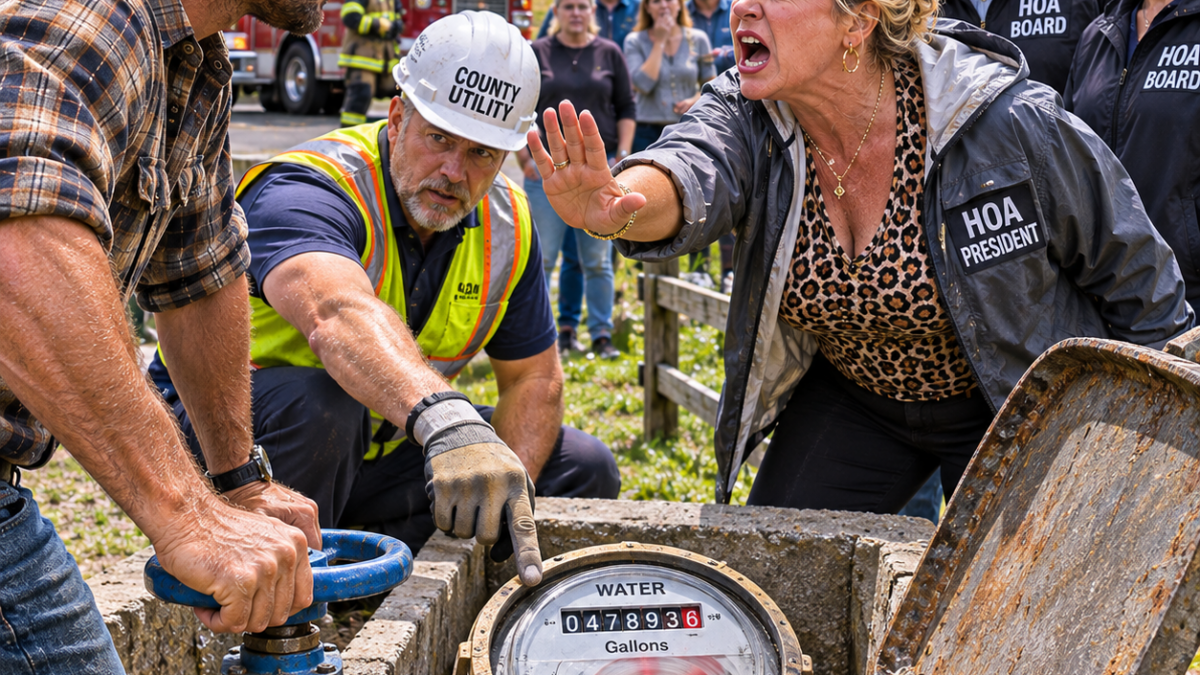
**“YOU CAN’T SHUT THAT VALVE, DANIEL—SIXTY HOMES AND OUR FIRE HYDRANTS ARE DEPENDING ON IT!” HOA president Brenda Collins screamed as she ran down my gravel driveway in slippers and a raincoat, waving both hands at the water meter sitting on my private seventy-four-acre farm.**
I stared at her, then at the little red wheel inside my meter spinning so fast it looked like a fan, because every faucet in my farmhouse was off, every cattle trough was full, and my irrigation system had been shut down for winter.
Then the county engineer opened the old concrete valve box, found the $8,140 repair Brenda had repeatedly called “non-essential,” and before anyone could argue again, the buried pipe beneath my pasture cracked open while a real house fire inside Pine Ridge sent its hydrant system demanding water through my farm.
The first thing that scared me was not the water spraying across my pasture.
It was the meter.
I had seen that little red wheel turn thousands of times.
Slowly when a cattle trough filled.
Faster when I washed equipment.
Steady when the house was using water.
That night it was spinning so fast I could hear it clicking.
My farmhouse faucets were off.
The barn wash line was off.
No irrigation.
No broken trough.
Still, water was leaving my service line at a rate that made no sense.
Then headlights appeared at the end of my gravel drive.
A golf cart.
Fast.
Three Pine Ridge board members jumped out before it fully stopped.
Brenda Collins ran toward me.
“Do not close that valve.”
I stared at her.
“This is my meter.”
“I know.”
“Then why are you telling me what I can shut off?”
Behind her, Pine Ridge looked wrong.
Emergency lights.
People standing in driveways.
Buckets.
Flashlights.
A fire engine near the entrance.
Somewhere farther inside the neighborhood, an alarm was sounding.
Brenda stepped closer.
“Daniel, if you close that valve, the whole west side loses water.”
For a second, I thought I had misunderstood.
“My farm meter is feeding Pine Ridge?”
She did not answer.
County utility engineer Thomas Reed did.
He looked at Brenda.
PART2:
“You told us this connection had been abandoned twenty years ago.”
Her face changed.
Then Frank Wilson, the HOA treasurer, came running toward us holding a folder.
He opened it with shaking hands.
Inside was an invoice.
$8,140.
EMERGENCY CROSS-CONNECTION VALVE REPLACEMENT.
RECOMMENDED SIX MONTHS EARLIER.
DECLINED BY HOA BOARD.
I looked at Brenda.
“You skipped an eight-thousand-dollar repair.”
She looked toward the neighborhood.
Then toward my meter.
Thomas said:
“This line isn’t just supplying houses.”
“What else?”
He pointed toward the fire engine.
“The hydrant loop.”
Nobody spoke.
Then the meter began clicking even faster.
Thomas dropped to his knees beside the valve box.
“Back up.”
“What?”
“Pressure is rising.”
The pipe beneath my boots started vibrating.
Then somewhere under the pasture—
something cracked.
My name is Daniel Brooks.
Six months before that night, I thought the biggest problem on my seventy-four-acre farm was replacing a tractor belt before hay season.
The land sat in western North Carolina.
It had belonged to my uncle William.
Cattle.
Corn.
Hay.
Two barns.
Equipment shed.
Old farmhouse.
Creek.
Small well behind the barn that smelled like iron.
William complained about taxes almost until the day he died.
He never married.
No children.
I had worked beside him for years.
So when he passed, the farm came to me.
I knew the fences.
Knew where the east pasture stayed wet after heavy rain.
Knew which barn door jammed when humidity rose.
Knew exactly how far I could drive the tractor into the lower field before the ground turned soft.
What I did not know was that the farm had once been connected to a much larger water system.
Pine Ridge Estates sat along my eastern boundary.
About 160 houses.
Clubhouse.
Pool.
Walking path.
Playground.
Two entrances.
Nice neighborhood.
Most residents were normal people.
Susan Parker bought eggs from me.
Robert Jenkins once helped pull a cow out of a drainage ditch.
Frank Wilson returned tools cleaner than when he borrowed them.
Then there was Brenda Collins.
HOA president for four years.
Brenda liked rules.
Not just following them.
Creating them.
Mailbox colors.
Trash cans.
Parking.
Fences.
Holiday lights.
Lawn height.
None of that mattered to me.
My farm was not inside Pine Ridge.
Separate deed.
Separate parcel.
No membership.
No dues.
No covenants.
Brenda sometimes forgot.
The first notice I received involved my mailbox.
UNAPPROVED COLOR.
Mine was black.
Pine Ridge apparently required dark green.
I called her.
“My farm isn’t part of your HOA.”
Long pause.
“Your mailbox is visible from our entrance.”
“So?”
“It affects community appearance.”
“It delivers my mail.”
She did not appreciate that.
Notice disappeared.
Then tractor visibility.
Then hay bales.
Then cattle trailer.
Each time:
“My farm is not Pine Ridge.”
Eventually the notices stopped.
I assumed Brenda had finally learned where her authority ended.
I was wrong.
The real issue started with water pressure.
Pine Ridge’s western section had been experiencing low pressure for almost a year.
Morning showers weakened.
Sprinklers struggled.
Some houses had barely any pressure during evenings.
The HOA blamed the county.
County blamed internal neighborhood equipment.
Residents blamed whichever answer annoyed them least.
Then Frank came to my barn one Saturday.
“Can I ask you something strange?”
“Those are usually more interesting.”
“Do you know anything about an old water valve near your east pasture?”
Sort of.
Concrete box beside the fence.
Two large pipes.
Rusty valves.
Uncle William always told me not to touch it.
I assumed abandoned irrigation.
Frank unfolded an old Pine Ridge development map.
A pipe crossed my property.
Then connected to the Pine Ridge water loop.
“What is this?”
“That’s what I’m trying to figure out.”
The map dated to 1998.
When Pine Ridge’s first phase was under construction, the developer had struggled to maintain pressure.
Uncle William allowed a temporary emergency connection from his farm water service.
Temporary.
Two years.
Then Pine Ridge was supposed to complete its own pressure system and disconnect.
“Pipe’s still there,” Frank said.
“That doesn’t mean it’s active.”
“I hope not.”
“Why?”
He hesitated.
“Our engineer mentioned it.”
“What engineer?”
Thomas Reed.
Utility engineer hired after homeowner complaints.
Thomas had inspected Pine Ridge’s booster station.
Pressure regulators.
Emergency valves.
Several problems.
Most routine.
One not.
The old farm interconnect had never been fully removed.
A backflow assembly sat between Pine Ridge and my service line.
And it was failing.
Thomas recommended immediate replacement.
Cost:
$8,140.
I stared at Frank.
“The board approved it?”
He looked uncomfortable.
“No.”
“Why?”
“Brenda thinks Thomas is upselling us.”
I almost laughed.
“Upselling a backflow valve?”
“She hired another contractor.”
“Licensed water engineer?”
“No.”
“Who?”
Pine Ridge Maintenance Services.
Rebecca Hayes, my attorney, searched the company.
Owner:
Stephen Collins.
Brenda’s brother-in-law.
Landscaping.
Pool maintenance.
Small repairs.
General contracting.
Not utility engineering.
Thomas was furious.
“This is not optional maintenance.”
The HOA minutes described it differently.
NON-ESSENTIAL LEGACY VALVE UPGRADE.
Words matter.
A failing safety component became a “legacy upgrade.”
The board postponed it.
Then approved $11,500 for clubhouse landscaping.
I did not care about flowers.
I cared that a failing valve connected my private farm to an entire neighborhood.
Rebecca found the original 1998 agreement.
Temporary emergency interconnection.
Developer responsible for disconnecting after Pine Ridge’s permanent system came online.
No permanent easement.
No transfer of ownership.
No lifetime right to use my water.
Rebecca asked:
“Did they disconnect?”
“I don’t know.”
“Find out.”
Thomas met me at the valve box.
He opened it.
Pointed to one pipe.
“Farm service.”
Another.
“Pine Ridge emergency interconnect.”
Then the brass assembly between them.
“Backflow protection.”
“It still works?”
He made a face.
“That depends what you mean by works.”
Never comforting.
Normally Pine Ridge’s pressure was slightly higher.
Water stayed on its side.
But if Pine Ridge pressure dropped far enough and the check valve failed, water could move backward.
From my farm.
Into Pine Ridge.
“Would my meter count that?”
“Yes.”
“How much?”
“Depends on demand.”
“One house?”
“No.”
“How many?”
“Potentially the connected pressure zone.”
“Meaning?”
“About sixty homes.”
I laughed.
Thomas did not.
Then he pointed toward the hydrant map.
“And the western emergency fire loop.”
Now I stopped laughing.
“Can you close it?”
“The interconnect valve belongs to Pine Ridge. Your farm-side valve belongs to you.”
“So I can shut mine.”
“Yes.”
I reached toward it.
Thomas stopped me.
“I wouldn’t do that without warning everybody.”
“Why?”
“If Pine Ridge is unknowingly relying on this connection, shutting it could expose another system failure.”
That was not what I wanted to hear.
We tested instead.
Pressure gauges.
Flow logging.
Three days.
Nothing obvious.
Then overnight water use appeared.
A few hundred unexplained gallons.
Could have been a trough.
Could have been a leak.
I checked.
Nothing.
Then another spike.
Then several quiet nights.
Thomas suspected the pattern followed Pine Ridge pressure drops.
He formally recommended replacement again.
Same number.
$8,140.
Board refused again.
Frank called me after the vote.
“Three to two.”
“Brenda?”
“Against.”
“Reason?”
“She says the connection is abandoned.”
I stared at my phone.
“If it’s abandoned, why not remove it?”
Frank did not answer.
Rebecca asked the same question in writing.
Pine Ridge denied using my line.
Rebecca replied:
Then disconnect it.
They refused.
Needed “further study.”
That contradiction bothered me.
Then my water bill rose.
Normal farm use:
Around 18,000 gallons monthly depending on weather.
Next bill:
31,000.
Then 27,000.
Then 42,000.
I checked everything.
Nothing leaking.
Thomas installed a data logger.
That changed everything.
Flow spikes:
6 to 8 a.m.
Then 6 to 9 p.m.
Morning showers.
Evening dishes.
Laundry.
Sprinklers.
Peak neighborhood demand.
Thomas overlaid Pine Ridge pressure graphs.
Every time Pine Ridge pressure dropped, my meter flow increased.
Rebecca looked at the lines.
“They’re using your water.”
“Maybe without knowing.”
“Still needs to stop.”
Most residents had no idea.
Susan certainly didn’t.
I mentioned it casually.
She looked shocked.
“Brenda told us the county fixed the pressure problem.”
They had not.
County supplied Pine Ridge’s main system.
But internal booster equipment belonged to the neighborhood.
Thomas suspected the farm line had been masking a failing west booster.
A failing backup can make another failure look smaller.
Everything feels fine until both fail at once.
Then Frank found an older inspection.
Four years earlier.
FARM INTERCONNECT — FAILED TEST.
REPLACE IMMEDIATELY.
Estimated cost then:
$5,900.
Brenda postponed it.
Another inspection two years later.
Same recommendation.
Postponed.
Now:
$8,140.
Frank showed me an email from Brenda.
REPLACING FARM INTERCONNECT MAY RAISE OWNERSHIP QUESTIONS. BEST NOT TO DISTURB EXISTING ARRANGEMENT.
There it was.
Ownership questions.
Brenda knew the connection crossed private land under temporary authority.
Repairing it properly meant talking to me.
New easement.
Maybe compensation.
Maybe admission that the old right expired decades earlier.
So she left it alone.
She wanted the benefit without the conversation.
Rebecca sent a final notice.
Ten days.
Either replace the valve under a written temporary agreement or disconnect Pine Ridge.
Day ten passed.
Nothing.
Winter came early.
Cold rain.
No irrigation.
Livestock use predictable.
One night my meter showed nearly 9,000 gallons while I slept.
That was impossible inside my house without flooding every room.
Thomas arrived.
The backflow assembly was leaking badly.
Not into the soil.
Through the line.
Water from my side was entering Pine Ridge.
He called Brenda.
No answer.
Called HOA manager.
Nothing.
Called Frank.
Frank came.
Thomas said:
“This needs immediate isolation.”
Then Brenda arrived.
Furious.
“You cannot shut down neighborhood infrastructure without board approval.”
Thomas looked at her.
“This is Daniel’s private service.”
“The interconnect serves Pine Ridge.”
He paused.
“Then why have you repeatedly called it abandoned?”
Silence.
That was the first time Brenda admitted the truth without saying anything.
Pine Ridge relied on the connection.
Maybe not every day.
Maybe not intentionally.
But enough that she feared losing it.
Thomas proposed emergency replacement.
$8,140.
Licensed crew.
Two days.
Brenda refused.
“The quarter’s budget is closed.”
Frank stared.
“We have sixty thousand in contingency.”
“That is for actual emergencies.”
Thomas pointed at the valve.
“This is an actual emergency.”
She disagreed.
I had enough.
“Forty-eight hours.”
Brenda turned.
“What?”
“Repair it or I close my farm valve.”
“You can’t.”
“It’s on my property.”
“You’d leave families without water.”
“If your neighborhood depends on my water, fix the connection.”
Rebecca was on speaker.
“You already have liability, Brenda.”
She left.
No repair.
Next evening, Pine Ridge pressure dropped sharply.
Residents complained online.
County.
Frozen pipes.
Anything except the truth.
At 7:15, I walked to my meter.
Red wheel spinning.
Thirty gallons a minute.
Then forty.
I called Thomas.
He went quiet.
“Do not close anything.”
“I’m at fifty.”
“I’m coming.”
Then sixty.
Ground over the interconnect felt wet.
Pine Ridge lights flickered.
Siren.
I called Frank.
“What happened?”
“West booster station failed.”
There it was.
The hidden problem.
Pine Ridge’s own pressure system had finally gone down.
Now the only remaining path was my farm.
Thomas arrived ten minutes later.
Farm pressure collapsing.
Neighborhood pressure collapsing.
Then Brenda and two board members came racing down my driveway.
“DO NOT CLOSE THAT VALVE!”
The old backflow assembly was vibrating.
Thomas opened the box.
“This cannot carry this flow.”
“What happens?”
“Best case, it shuts.”
“Worst?”
He looked toward the buried line.
“Something else breaks first.”
Then Pine Ridge’s fire alarm sounded.
Real alarm.
Garage fire.
Maple Court.
Frank’s phone rang.
He listened.
His face changed.
“Fire department needs hydrants.”
Thomas looked at the gauge.
Water demand surged again.
My pipe knocked.
Once.
Twice.
Three times.
“Back up!”
We moved.
Then the east pasture exploded.
Mud and water shot almost twenty feet into the air.
Farm service ruptured.
Meter stopped.
And inside Pine Ridge, every west-side hydrant lost pressure just as firefighters arrived at a burning house.
We reached Maple Court fast.
Smoke rolling from an attached garage.
Family already outside.
Father holding a little girl wrapped in a blanket.
Firefighter opened the nearest hydrant.
Hose stiffened.
Then sagged.
Not enough pressure.
The fire captain did not panic.
Tanker shuttle.
Second hydrant farther east.
Mutual-aid department.
That preparation saved the house.
Garage burned badly.
One car destroyed.
Roof partially collapsed.
Bedrooms saved.
Nobody injured.
That was the important part.
Nobody injured.
David Parker, the homeowner, watched crews work.
When Thomas explained the pressure failure, David looked at me.
“Your farm line was supplying our hydrant?”
Brenda started:
“That’s not exactly—”
Thomas cut her off.
“Tonight, yes.”
Questions spread.
Why was Pine Ridge connected to my meter?
Why had residents been told the county fixed everything?
Why had the valve replacement been refused?
Why did the booster fail?
Frank did what Brenda had avoided.
He told the truth.
“The board received an engineering recommendation to replace the farm interconnect valve for $8,140.”
People listened.
“We declined it.”
Brenda defended herself.
The repair would not have prevented the booster failure.
Thomas nodded.
“She is correct.”
That quieted everyone.
Then:
“But replacing the valve would have prevented uncontrolled flow from Daniel’s farm when the booster failed.”
Different problem.
Same night.
The neglected connection turned one failure into two.
County shut my main service to stop the rupture.
That meant no water for my farmhouse.
No cattle troughs.
No barn line.
I did not complain.
People were fighting a house fire.
Before midnight, county brought temporary tanks.
Household water.
Livestock water.
Frank helped connect hoses.
Susan brought coffee.
Robert brought buckets.
People from Pine Ridge were helping repair the damage created partly by their own system.
Most of them had nothing to do with Brenda’s decisions.
That mattered.
The next morning, my east pasture looked destroyed.
Long trench.
Mud.
Broken fence.
Split service pipe.
Thomas estimated more than $20,000 just to repair my side.
Suddenly the $8,140 repair looked very cheap.
Rebecca arrived.
Boots.
Legal pad.
She looked at the rupture.
“Who pays?”
Thomas hesitated.
“Technically Daniel’s service pipe failed.”
“That’s not what I asked.”
He nodded.
“Abnormal demand through the Pine Ridge connection caused the failure.”
Insurance arguments began immediately.
County pipe.
My pipe.
Pine Ridge interconnect.
Booster failure.
Neglected valve.
Rebecca looked at me.
“This is going to be annoying.”
“I assumed.”
Emergency HOA meeting that evening.
Clubhouse packed.
Thomas drew the whole system on a whiteboard.
County main.
My meter.
Farm service.
Old interconnect.
Pine Ridge west zone.
Booster.
Hydrants.
He explained it like a classroom.
Pine Ridge should have supplied itself.
The farm connection should have been isolated decades earlier.
Instead, the failing valve leaked whenever neighborhood pressure fell.
That leakage helped.
So nobody realized how badly the booster system was deteriorating.
Then it failed completely.
My farm line became an accidental emergency supply.
Until it ruptured.
A woman raised her hand.
“So Daniel has been paying for some of our water?”
Thomas answered:
“Yes.”
The room changed.
Frank showed meter logs.
Morning spikes.
Evening spikes.
Old inspections.
The $8,140 invoice.
Brenda said the repair was preventive.
Nobody predicted the booster would fail the same night.
True.
Then Frank asked:
“If you thought the line was abandoned, why did you tell Stephen Collins to keep the farm backup available until the west-pressure issue was resolved?”
Silence.
He held up an email.
KEEP FARM BACKUP AVAILABLE UNTIL WEST PRESSURE ISSUE IS RESOLVED.
Brenda had sent it.
Residents gasped.
She knew.
The board approved emergency repairs four to one.
Brenda voted no.
Then suspended her from utility decisions.
Three to two.
Not removed.
Not yet.
Investigation first.
I respected that.
Crews removed the old assembly.
Badly worn.
One internal check valve nearly gone.
Cracked seals.
Rust.
Then Thomas noticed something unexpected.
The Pine Ridge-side pipe was too large.
Original plan:
Three-inch.
Current:
Six-inch.
“This isn’t original.”
“When was it changed?”
Nobody knew.
The larger pipe explained how so much water had moved through my meter.
Why would anyone enlarge an abandoned connection?
Frank searched records.
Nothing.
Thomas checked the coupling.
Small stamped tag.
PRMS.
PINE RIDGE MAINTENANCE SERVICES.
Stephen Collins’ company.
Dated six years earlier.
Stephen happened to be standing nearby.
Rebecca asked:
“Did your company replace this pipe?”
“No.”
Thomas pointed to the tag.
Stephen stared.
“We may have repaired a damaged section.”
“A repair from three inches to six?”
“Whatever material was available.”
Nobody believed that.
The accountant found the invoice.
$14,700.
Description:
EAST LANDSCAPE DRAINAGE IMPROVEMENT.
Not water service.
Drainage.
Brenda approved it.
Then Thomas found booster logs from the same period.
Six years earlier, Pine Ridge’s west booster failed for nine days.
Pressure remained strangely stable.
Why?
We checked my uncle’s old water records.
His farm usage tripled during those exact nine days.
Inside William’s files:
WATER BILL HIGH AGAIN.
COUNTY SAYS NO LEAK.
PINE RIDGE WORKING ON PUMPS.
Another note:
TALK TO BRENDA. SAYS NO CONNECTION.
My uncle had noticed.
He just never knew why.
Then county records produced the missing permit.
Six years earlier, Stephen requested emergency permission to increase the temporary interconnect capacity during a booster repair.
Approved:
Forty-eight hours.
Afterward, the larger pipe had to be removed.
It never was.
Worse—
the completion certification said it had been removed.
Signed:
Stephen Collins.
Inspector acknowledgment:
Brenda Collins, HOA representative.
They had certified removal of something still sitting under my pasture.
That was not just poor maintenance.
County opened a formal investigation.
Stephen hired a lawyer.
Brenda did too.
Pine Ridge’s attorney separated the HOA from both of them.
The repaired system finally came online.
My farm pressure returned.
Meter slowed.
HOA reimbursed recent excess water charges.
About $3,700.
Frank delivered the check personally.
“It doesn’t fix everything.”
“It fixes the bill.”
He nodded.
Sometimes doing the practical right thing matters more than a dramatic apology.
Then Thomas called again.
“We found another pipe.”
Of course.
Beneath the six-inch interconnect sat a smaller unmarked line.
Pressurized.
Flow direction—
from Pine Ridge toward my farm.
Opposite direction.
Thomas tested the water.
Chlorinated.
It ran toward an old concrete cistern behind my equipment barn.
I thought the cistern was empty.
Thomas opened it.
Nearly full.
Fresh treated water.
“Pine Ridge is filling this?”
“Looks like it.”
Why?
Old invoice.
$26,400.
FIRE RESERVE STORAGE IMPROVEMENT.
Pine Ridge did not have an HOA fire-reserve tank.
Thomas pointed at my cistern.
“Maybe it does.”
Capacity:
Nearly 120,000 gallons.
Then we found an outlet leaving the other side.
Toward property south of Pine Ridge.
Owner:
Stephen Collins.
The water level started dropping while we watched.
Remote actuator open.
No fire.
No emergency.
Thomas tried shutting it.
No response.
Then my farm meter started spinning again.
The cistern was being drained south.
And as the level dropped, the old farm system began automatically refilling it.
Through my meter.
Again.
Only now Pine Ridge homeowners were not using the water.
Stephen’s land was.
Flow:
About eighty gallons a minute.
We followed the line.
Construction site.
Excavators.
Gravel.
Concrete forms.
Large tanker.
One truck filling.
Then another.
Then a third.
A worker walked toward us.
“You here for the next load?”
Thomas showed county identification.
“What load?”
“Farm water.”
He pointed toward my property.
“From the Brooks Reserve.”
I stared.
“There is no Brooks Reserve.”
He showed us paperwork.
Source:
BROOKS AGRICULTURAL RESERVE.
Supplier:
COLLINS WATER SERVICES.
Owner:
Stephen Collins.
Price per thousand gallons.
My property had become a commercial water source on paper.
Without me knowing it.
The worker stopped filling immediately.
Again—
contractor was not the main problem.
He had official-looking delivery tickets.
Quality records.
Invoices.
A logo.
That is how a lie survives.
It looks boring.
The county shut the tanker connection pending investigation.
Collins Water Services existed legally.
Licensed to haul non-potable water.
But my farm was not an approved source.
Then Stephen produced the document he claimed gave him authority.
AGRICULTURAL RESERVE WATER ACCESS LICENSE.
Owner:
William Brooks.
Operator:
Collins Water Services.
Ten years.
$12,000 annually.
My uncle’s signature.
I felt sick.
Estate records showed no payments.
No tax income.
Nothing.
Rebecca compared the signature.
Then found the original.
Farm equipment sale agreement from eight years earlier.
Same signature.
Exactly.
Copied image.
Witness:
Brenda Collins.
Notary:
Karen Douglas.
Sheriff opened another fraud investigation.
At that point, I stopped being surprised.
You can only be shocked so many times before you start making organized folders.
Thomas mapped the whole hidden system.
My cistern was not the only storage.
Another buried tank near the southern fence.
Forty thousand gallons.
Another line under Pine Ridge’s entrance.
One branch to the HOA fire loop.
One to Stephen’s property.
One to an old maintenance building.
Some pieces legitimate.
Some undocumented.
Some clearly private.
Thomas called it “utility archaeology.”
Rebecca called it “a lawsuit underground.”
I preferred hers.
Frank found an old board memo.
WESTERN FIRE RESILIENCE PROJECT.
Brenda requested money to rehabilitate existing agricultural reserve infrastructure.
No owner named.
No map.
Nothing saying the reserve sat on Uncle William’s property.
The board approved it.
Frank had voted yes.
“I thought this was HOA infrastructure.”
“You voted based on what you were shown.”
“I should have checked.”
“Yes.”
He looked surprised.
“But checking now matters.”
He nodded.
Then accountants found Pine Ridge had received money from Collins Water Services.
About $18,000 annually.
Labeled:
FIRE RESERVE OFFSET.
That made the operation look like an HOA benefit.
But tanker records told a larger story.
Collins Water Services earned more than $430,000 over five years.
Only around $90,000 reached Pine Ridge.
Nothing reached William.
Nothing reached me.
Most of the infrastructure sat on my property.
Rebecca looked at the numbers.
“This stopped being about eight thousand dollars a long time ago.”
Exactly.
Then we found the email that explained why the repair had been postponed.
Three months before Thomas’s $8,140 recommendation was rejected—
STEPHEN: DO NOT REPLACE FARM VALVE UNTIL RESERVE CONTRACT RENEWED. NEW ASSEMBLY MAY TRIGGER SOURCE REVIEW.
BRENDA: UNDERSTOOD. WE CAN DEFER AS LEGACY EQUIPMENT.
Legacy equipment.
Same phrase she used in the board minutes.
They had not delayed because the repair was expensive.
They delayed because opening the system might expose what was hidden behind it.
Pine Ridge removed Brenda as president pending the investigation.
Unanimous.
Frank became acting president.
Every Stephen-related contract suspended.
Independent vendors hired.
More expensive.
Transparent.
Local media wanted me to stand beside the meter and tell an angry story.
I refused.
Most Pine Ridge residents were victims too.
Their embarrassment was not entertainment.
That weekend, residents helped repair my pasture.
Frank brought fence posts.
Robert brought a skid steer.
Susan brought food.
David Parker showed up even while contractors were rebuilding his fire-damaged garage.
I told him:
“Go home.”
“Insurance crew has it.”
Then he spent six hours setting fence.
That meant more to me than any press conference.
The farm service was repaired properly.
New legal emergency cross-connection.
Written agreement.
Backflow protection.
County review.
Metering.
Clear ownership.
Pine Ridge could use my connection only during defined emergencies.
Every gallon measured.
Every gallon reimbursed.
I signed it.
Some people expected me to cut the neighborhood off permanently.
Why?
One hundred sixty families had not created this scheme.
I wanted boundaries.
Not revenge.
Then we had to decide what to do with the cistern.
My structure.
HOA had paid to rehabilitate part of it.
Stephen used it commercially.
Legally messy.
Thomas proposed:
Make it legitimate emergency fire storage.
County controlled.
Pine Ridge contributes to maintenance.
No tanker sales.
No private outlet.
No hidden company.
Useful infrastructure without abuse.
I agreed.
Then the contractor audit got worse.
“Landscape drainage” jobs that were really water distribution.
“Irrigation upgrades” that expanded hidden reserve piping.
“Pond support” where no pond existed.
Every strange invoice lined up with another hidden piece.
Then a private account appeared.
COLLINS RESERVE OPERATIONS.
Customers:
Construction firms.
Landscapers.
Developments.
One major customer:
Blue Ridge Commerce Park.
Water deliveries in the millions of gallons.
Source:
BROOKS AGRICULTURAL RESERVE.
More than twelve million gallons over three years.
I stared.
“I would’ve noticed twelve million gallons on my meter.”
Rebecca nodded.
“So it came from somewhere else.”
Thomas found it.
The old iron-smelling well behind my equipment barn.
I thought William abandoned it years ago.
Someone installed a modern submersible pump.
No permit in my name.
No meter.
It fed the cistern.
The control panel was inside my barn.
I had assumed it was old irrigation equipment.
Stephen’s company upgraded it five years earlier.
Without permission.
The well’s electrical feed came from my barn panel.
I had been paying electricity to pump water Stephen sold.
I told Rebecca:
“That is almost impressive.”
“Do not admire efficient theft.”
Fair.
Then Stephen’s attorney produced one document nobody expected.
A real one.
Signed by Uncle William.
Seven years earlier.
It allowed Pine Ridge limited use of the cistern for emergency fire storage.
Real signature.
Real permission.
No commercial sales.
No private tanker outlet.
No well pumping.
No Stephen development.
William had helped his neighbors.
That sounded exactly like him.
The problem was not the original kindness.
The problem was what happened after.
People stretched emergency permission into permanent control.
The legitimate agreement required Pine Ridge to maintain backflow protection.
Which meant Brenda had even more reason to approve Thomas’s $8,140 repair.
She knew the exact limits.
Stephen knew too.
Original board vote proved it.
Both were present.
No ambiguity.
Then investigators found Stephen’s five-year commercial contract with a regional landscaping company.
Guaranteed minimum water supply.
Heavy penalties if service stopped.
Now his motive became obvious.
He needed the hidden farm system active.
Inspection threatened the contract.
That explained:
The oversized pipe.
The secret well.
The cistern.
The tanker connection.
The fake William agreement.
And the refusal to replace a simple valve.
Then dry weather arrived.
Brush fire south of Pine Ridge.
The cistern still held nearly 100,000 gallons.
Commercial line shut.
Legal emergency connection remained.
Fire captain asked to use it.
I said yes.
Exactly what William intended.
Water flowed.
Fire engines filled.
Then Thomas noticed the cistern level falling too quickly.
The hidden south outlet was open again.
We had closed it.
Thomas checked the control program.
Automatic schedule.
Every Friday at 4 p.m.
The system had opened itself.
While firefighters were using the water.
The remote actuator failed.
Manual shutoff sat near Stephen’s tanker site.
Directly toward the advancing fire.
I grabbed my truck keys.
Fire captain stopped me.
“It’s my farm.”
“And that makes it worth protecting, not dying over.”
I hated how correct he was.
Thomas and two firefighters went instead.
For ten minutes we watched the cistern level drop.
Smoke over the trees.
Radio crackled.
“Valve wheel frozen.”
Of course.
Everything ignored for years seemed determined to become important during emergencies.
They disconnected the actuator.
Used a large wrench.
“Half turn.”
Flow dropped.
Then:
“Closed.”
The south outlet stopped.
All remaining water stayed in the fire reserve.
Engines filled.
Crews pushed along the tree line.
Bulldozer cut firebreak.
Helicopter dropped water.
By midnight, contained.
No homes.
No barns.
No serious injuries.
I lost eight acres of grass and some fence.
Stephen’s tanker site lost one shed.
That was all.
Next morning, I stood beside the cistern.
Low.
Not empty.
William’s real agreement had finally done exactly what he intended.
Protect people.
Not sell water.
Not create a hidden business.
Not create control.
Just help neighbors during a fire.
Frank brought coffee.
“I keep thinking about that repair.”
“Which one?”
“The eight-thousand-dollar valve.”
I laughed.
There had been so much trouble I almost forgot.
“$8,140.”
“If Brenda approved it, Thomas would’ve opened the system months earlier.”
“Yes.”
“He’d have found the six-inch pipe.”
“Probably.”
“The cistern.”
“Yes.”
“The commercial outlet.”
“Yes.”
Frank shook his head.
“So she didn’t skip the repair because it cost eight thousand.”
“Not really.”
“She skipped it because inspection threatened something worth much more.”
That was what the records showed.
County’s final report clarified everything.
1998 interconnection:
Temporary.
William’s later fire-storage agreement:
Legitimate but limited.
Commercial tanker sales:
Not allowed.
Permanent six-inch connection:
Not allowed.
Operation of my old well:
Not allowed.
Use of my electricity:
Not allowed.
Ignoring backflow maintenance:
Definitely not allowed.
The six-inch pipe had been permitted for only forty-eight hours.
Stephen falsely certified its removal.
The commercial agreement bearing William’s signature was confirmed fake.
Exact copied image.
Investigators did not need a dramatic confession.
Documents were enough.
Pine Ridge sued Brenda and Stephen to recover money.
Not for a victory party.
To replenish reserves.
County shut Collins Water Services’ unauthorized source.
The tanker hydrant was removed.
South line cut at my boundary.
Remote actuator removed.
No automatic Friday transfers.
No hidden pumping.
Then we made the cistern legal.
County-managed fire reserve.
I kept ownership of the structure and land.
Pine Ridge contributed to maintenance.
County controlled testing, valves and emergency use.
Every public gallon metered.
No commercial withdrawal.
No mystery.
The old well became limited emergency backup after proper testing and permits.
County installed a new control box.
Bright label:
COUNTY EMERGENCY FIRE RESERVE.
Frank looked at it.
“Hard to misunderstand that.”
“Give an HOA enough time.”
He laughed.
Then apologized.
I told him it was funny.
Civil settlement came later.
Rebecca asked whether I wanted maximum litigation.
“We can chase every dollar for years.”
“Or?”
“Settle for enough to make you whole.”
I chose enough.
Damaged farm service.
Pasture restoration.
Excess water charges.
Electricity.
Legal costs.
Unauthorized well use.
Commercial water value.
Large settlement.
Not life-changing.
Enough.
More important:
Collins Water Services permanently surrendered every claimed right to infrastructure on my property.
Pine Ridge received separate recovery for false invoices and hidden contractor payments.
Money went into HOA reserves.
Residents avoided a huge special assessment.
That mattered.
They had already paid once.
They did not need to pay again for Brenda and Stephen’s decisions.
Criminal cases moved slowly.
Brenda faced allegations involving false certification, undisclosed related-party dealings, and concealment of the water system’s real use.
Stephen faced more serious allegations involving fake agreements, unauthorized utility work, water sales and financial records.
Some charges changed.
Some reduced.
Others survived.
Eventually both cases ended through negotiated pleas, court restrictions and financial consequences.
Stephen lost licenses needed for parts of his water business.
Brenda was barred from Pine Ridge utility and financial leadership.
I did not attend sentencing.
Frank called.
“You want to know?”
“Does anything affect my farm?”
“No.”
“Tell me another day.”
That surprised both of us.
For months Brenda and Stephen had occupied too much space in my head.
Every meter click.
Every bill.
Every meeting.
Every valve.
Eventually justice needed to become somebody else’s job.
My job was cattle.
Hay.
Fence.
Water.
Home.
Pine Ridge changed.
Independent engineering review for major utility work.
Family-related contracts required disclosure.
Emergency systems mapped.
Cross-connections tested annually.
No hidden accounts.
No vague “landscape improvement” invoices when work involved buried water lines.
Frank became permanent president.
Tried to refuse.
Residents elected him anyway.
His first speech lasted less than five minutes.
“We’ll show you the documents before we spend your money.”
That was basically it.
He was good at authority because he did not enjoy having it.
The west booster station was replaced completely.
No more relying on accidental farm pressure.
No more morning drops.
No unexplained evening water flow.
Pine Ridge supplied itself.
My connection became emergency only.
Six months later, Thomas performed the first official test.
County crew.
Frank.
Me.
Valve opened.
Water flowed.
Separate meter recorded it.
Cistern filled.
Valve closed.
Everything worked.
Thomas looked at me.
“Boring.”
“Perfect.”
He handed me the signed test sheet.
Recorded.
Dated.
Clear.
I almost framed it.
Rebecca told me I was becoming ridiculous.
I framed something else instead.
The original $8,140 repair estimate.
At the bottom, in Brenda’s handwriting:
DEFER. NON-ESSENTIAL.
It hangs in my barn office.
Not because I enjoy being right.
Because it reminds me how expensive the word later can become.
If a licensed engineer says a failing valve connects a private farm to sixty homes and a fire loop, maybe buy fewer flowers that year.
Pine Ridge spent more on legal fees in the first month after the rupture than the original repair cost.
Pasture restoration cost more.
Emergency tankers cost more.
Booster replacement cost more.
Insurance investigation cost more.
Every shortcut eventually sent a larger bill.
My relationship with Pine Ridge improved.
I never joined.
Farm stayed outside.
No dues.
No mailbox rules.
No tractor rules.
Susan once asked whether I planned to paint my tractor dark green so Pine Ridge would approve.
“I’m thinking bright orange.”
“That will destroy our property values.”
We both laughed.
That was different.
The HOA no longer felt like Brenda.
It felt like Frank.
Susan.
David.
Robert.
Families who carried buckets during the outage.
Teenagers who repaired my fence.
People who brought coffee while my pasture was flooded.
Brenda made serious choices.
Stephen made worse ones.
They were not every resident.
That mattered.
Anger wants groups to become one thing.
Life rarely works that way.
I keep Uncle William’s real fire agreement too.
His actual signature.
His actual intention.
Help the neighbors if they need water during a fire.
Simple.
Good.
Someone later stretched that kindness far beyond its limits.
That did not make William foolish.
It meant kindness needed clearer boundaries.
The new agreement says exactly what help means.
Emergency?
Yes.
Firefighters?
Always.
Measured backup water?
Yes.
Private tanker business?
No.
Commercial water sales?
No.
Hidden pipes?
No.
Two summers later, a small brush fire started north of the neighborhood.
Fire department requested reserve water.
Thomas called.
“Can we open the cistern?”
“You don’t have to ask me informally anymore.”
“I know.”
“County agreement already covers it.”
“I know.”
“Then why are you calling?”
Pause.
“Habit.”
I laughed.
“Use the water.”
Trucks filled.
Metered.
Recorded.
No surprise.
No mystery.
Afterward, Thomas closed the valve and sent me the usage report.
That may have been the biggest change.
Not the pipes.
Transparency.
My farm meter still sits in the same concrete box.
Most days the red wheel barely moves.
House water.
Cattle.
Equipment wash.
Normal things.
During an official emergency test, I once watched it spin fast again.
For half a second, my stomach tightened.
Then I saw Thomas beside the county panel holding a clipboard.
Legal.
Expected.
Measured.
I relaxed.
Funny how the same sound can mean panic one year and safety the next.
People around Pine Ridge tell the story differently.
Some say the HOA almost burned down a house because Brenda skipped an $8,000 repair.
Not exactly.
The firefighters saved the house.
The booster failure was separate.
The neglected interconnect made it much worse.
Others say my farm secretly supplied the whole neighborhood for years.
Not exactly either.
The line supported the west pressure zone during drops and emergencies.
Details matter.
But the core story is true.
Pine Ridge refused an $8,140 repair.
Then my private farm meter began spinning faster and faster.
The old connection they kept calling abandoned suddenly became the only thing keeping part of their neighborhood and hydrant system alive.
And once that meter started moving, every hidden decision began surfacing.
Failed valve.
Oversized pipe.
False removal certificate.
Hidden cistern.
Secret well.
Commercial tanker line.
Copied signature.
Water sales.
All because one small repair threatened to make somebody look closely.
I used to think the lesson was simply:
Maintain your equipment.
That is part of it.
The deeper lesson is this:
Do not hide a useful truth because admitting it creates an uncomfortable conversation.
Brenda did not want to discuss the farm connection because ownership questions would follow.
Stephen did not want anyone inspecting the system because inspection threatened his business.
So they delayed.
And delayed.
And delayed.
Until the system forced the conversation itself.
At full pressure.
During a fire.
Today, Pine Ridge has better water pressure than it ever had.
My pasture is green again.
Fence repaired.
Cistern legal.
Private tanker outlet capped.
Old well under county lock.
Emergency connection has modern backflow protection.
And my farm meter belongs to exactly one customer again.
Me.
Unless there is a real emergency.
Then I am still willing to help.
Because boundaries and kindness are not enemies.
A clear boundary lets you help somebody without giving them permission to use you.
Uncle William understood that better than any of us.
Help your neighbor.
But write down exactly what the help means.
And every time I pass that framed repair estimate—
$8,140.
DEFER. NON-ESSENTIAL.
—I remember what Pine Ridge eventually paid.
They paid for the valve.
Then they paid for the booster.
They paid for my pasture.
They paid for emergency tankers.
Engineers.
Accountants.
Lawyers.
Investigations.
Every shortcut that came before.
And after all of that—
the actual valve still cost about eight thousand dollars.








