HOA Karen Put a “SOLD” Sign on My Ranch Before Christmas—She Didn’t Expect Me to Show Up at the Closing.
PART2:
How to recognize weather coming over the ridge.
How to check a horse’s gums.
How to keep records.
How to apologize without turning the apology into an excuse.
And how to understand that land ownership is not about standing somewhere and saying, “This is mine.”
It is about knowing exactly why it is yours.
Survey.
Deed.
Taxes.
Boundary.
Easements.
Access.
Walt kept everything.
Receipts.
Plat maps.
County correspondence.
Old photographs.
He once made me drive forty minutes back to a hardware store because the cashier forgot to print a receipt for a gate hinge.
“You planning to deduct a four-dollar hinge?” I asked.
“No.”
“Then why?”
PART3:
“Because someday somebody might ask when the gate was fixed.”
“Who?”
“I don’t know.”
“That makes no sense.”
He looked at me over the steering wheel.
“Good records don’t need to know the question in advance.”
I laughed at him then.
I stopped laughing after Christmas 2026.
When Walt died eleven years earlier, he left the ranch to me.
No mortgage.
No hidden partner.
No development agreement.
No HOA membership.
That last point became increasingly important as Elk Ridge grew around us.
The Elk Ridge subdivision began with fourteen houses in 2009.
Then thirty.
Then eighty.
By the time Karen Whitlock became HOA president, there were almost two hundred homes wrapping around the eastern and southern edges of my ranch.
The houses were beautiful.
Stone fronts.
Tall windows.
Heated garages.
Views of the ridge.
Some sold for more than a million dollars.
I had no problem with them.
My problem was with the people who slowly began acting as though paying more for their house meant they had purchased opinions about everybody else’s property.
Most residents were decent.
A few bought hay from me.
Kids came to see the horses.
One retired teacher named Frank Delaney helped me repair fence after a windstorm.
The HOA itself had once been harmless.
They organized snowplowing.
Maintained the entry gate.
Managed road repairs.
Then Karen became president.
Everything changed.
Karen Whitlock was forty-nine.
Blonde.
Polished.
Always perfectly dressed.
She had worked in residential real estate for years before moving into Elk Ridge and winning a board seat.
Within eighteen months she controlled the board.
Within three years, residents were being fined for basketball hoops, wind chimes, garden sheds, unauthorized flower beds, pickup trucks parked overnight, garbage cans visible before six in the evening, and holiday lights left up after January 10.
Karen called it maintaining standards.
Frank called it building North Korea with decorative ponds.
I stayed out of it.
Then Karen decided the ranch offended her.
She visited my house during her first year as president carrying a blue binder.
“Gideon, we’d love for you to formally join Elk Ridge.”
“No.”
She smiled.
“I don’t think you understand the benefits.”
“I do.”
“Road maintenance.”
“I maintain my road.”
“Security.”
“I have locks.”
“Community standards.”
“I have cows.”
Her smile tightened.
“You’re surrounded by us now.”
“That doesn’t make me part of you.”
Technically, part of the main Elk Ridge access road crossed the northeastern corner of my property.
Walt granted the easement when the subdivision was formed.
But he had been smart.
The document was narrow.
Residential access only.
No commercial expansion.
No widened roadway.
No transfer of control.
And one clause in particular mattered.
If Elk Ridge ever formally asserted ownership or regulatory control over the underlying Mercer Ranch parcel, the landowner reserved the right to challenge or revoke the easement subject to county access requirements.
Karen had read it.
I know because she referenced it during a board meeting years later.
She simply behaved as though refusing to acknowledge a document would eventually make it disappear.
When I rejected HOA membership, she stopped visiting politely.
Letters began.
First:
UNAPPROVED FENCE CONDITION
Then:
VISIBLE AGRICULTURAL EQUIPMENT
Then:
NONCONFORMING DETACHED STRUCTURE
That one referred to my chicken coop.
Then:
IMPROPER COMMERCIAL ACTIVITY
That referred to selling hay.
I wrote back exactly once.
The ranch was not an HOA property.
The association possessed no enforcement authority.
Future notices would be retained for documentation but not paid.
Karen responded with fines.
I responded with nothing.
The fines climbed.
Fifty dollars.
One hundred.
Two hundred fifty.
Five hundred.
Eventually the HOA claimed I owed more than $40,000 in dues, penalties, and accumulated assessments dating to 2009.
A creative number considering I had never joined.
My attorney, Marlo Pierce, sent them a formal letter.
The fines stopped for six months.
Then resumed.
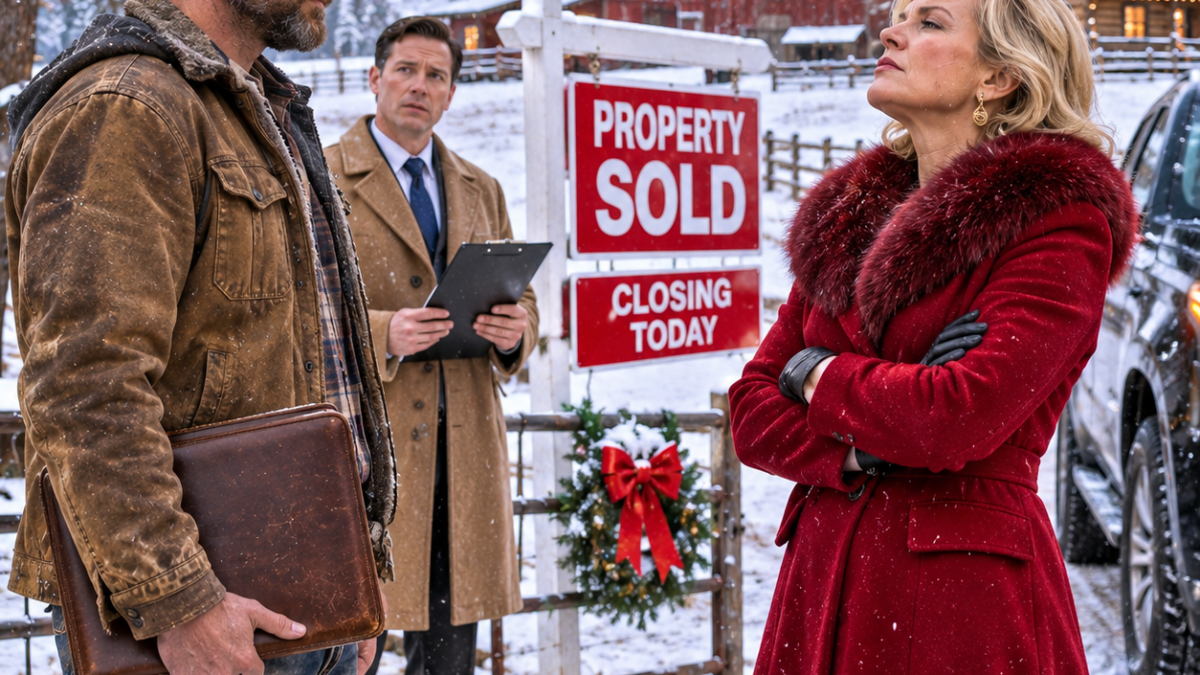
That was how things stood on December 20 when my headlights swept across the gate and illuminated a white sign I had never seen.
I stopped the truck.
The top line read:
PROPERTY SOLD
Below it:
SUMMIT PEAK REALTY
Then a phone number.
A red rider beneath the main sign announced:
CLOSING DECEMBER 24
For several seconds, I thought somebody was joking.
A bad Christmas prank.
Then I saw the man standing beside it.
Camel-colored overcoat.
Black trousers.
Dress shoes completely wrong for six inches of snow.
Clipboard.
He smiled when I stepped out.
“Evening.”
I walked closer.
“You put this here?”
“Yes, sir.”
“Why?”
He looked confused.
“Property transaction.”
“What property?”
He pointed.
“This one.”
I looked behind me at 286 acres.
Then back.
“You’re sure?”
He laughed uncertainly.
“You’re the caretaker?”
“No.”
“Tenant?”
“No.”
His smile weakened.
“Blake Rohr. Summit Peak Realty.”
He offered his hand.
I shook it.
“Gideon Mercer.”
He froze.
Not dramatically.
Just enough.
“Mercer.”
“Yes.”
“Gideon Mercer?”
“Yes.”
His eyes went to the clipboard.
Then back.
“You’re the owner?”
“That depends on what’s written on your clipboard.”
He stared.
I almost felt bad for him.
Almost.
Blake removed a packet.
“Mr. Mercer, I was told you had authorized the sale through your representative.”
“What representative?”
He handed me the papers.
The first page described the ranch correctly.
Parcel number.
Acreage.
Legal description.
Access easements.
Even the irrigation rights were listed.
The buyer was Northstar Development Group of Denver.
Price: $6.85 million.
I stared at the number.
That was much more than the ranch was worth as working agricultural land.
Then I saw the seller authorization.
AUTHORIZED REPRESENTATIVE FOR OWNER: KAREN WHITLOCK
I read it twice.
My pulse slowed.
That is something fear occasionally does to me.
When trouble becomes serious enough, everything gets quieter.
“When is closing?”
“Christmas Eve.”
“Where?”
Blake hesitated.
“Harland Creek Title and Escrow.”
“Who told you I authorized Karen?”
“We have power-of-attorney documentation.”
I looked at him.
“You have what?”
Headlights appeared behind my truck.
Black SUV.
Of course.
Karen parked beside us.
She stepped into the snow wearing a red wool coat trimmed at the collar.
Leather gloves.
Hair perfect.
Perfume somehow surviving Montana winter.
“Gideon.”
I turned.
“Karen.”
Her eyes moved to the papers in my hand.
“You’ve seen the offer.”
“I’ve seen something.”
“I suppose this saves us a conversation.”
“Does it?”
She walked to the sign.
Touched the post lightly.
“You should think of this as an opportunity.”
“Somebody sold my land.”
“The transaction is legitimate.”
“You signed as my representative.”
“Yes.”
“You’re not.”
Her smile changed.
Not gone.
Harder.
“You may want to review your documents.”
“I have.”
“Apparently not recently.”
Blake looked between us.
“I think I should call my office.”
Karen ignored him.
“This ranch has been creating legal and financial problems for years.”
“For you.”
“For the entire community.”
“No.”
“The fines alone—”
“Are imaginary.”
“They have been legally assessed.”
“Against property outside your association.”
“We disagree.”
“Land records don’t.”
She stepped closer.
“The county record now reflects my authority to negotiate disposition.”
“Disposition.”
“Yes.”
“You mean sale.”
“Yes.”
I looked toward the ranch.
Snow covered the fields.
The red barn leaned slightly east, as it had since I was fourteen.
A dim porch light glowed at the house.
Two horses moved behind the stable fence.
Nothing looked different.
Yet somebody had reduced all of it to a transaction packet.
“What happens if I refuse?”
Karen smiled.
“Closing is already scheduled.”
“I asked what happens if I refuse.”
“You’ve already authorized representation.”
“No.”
“Your signature says otherwise.”
I stared at her.
She enjoyed the moment.
That was the first real mistake she made.
People who believe they have won become theatrical.
“You should prepare yourself,” she said. “This ranch doesn’t belong to you anymore.”
Blake visibly flinched.
I did not argue.
That disappointed her.
She expected rage.
Threats.
Maybe police.
Instead I folded the papers.
Handed them back to Blake.
Then got into my truck.
Karen called after me.
“Gideon?”
I closed the door.
Turned the truck around.
Drove toward the house.
I left the SOLD sign exactly where it stood.
That confused Karen more than anything I could have shouted.
Inside, I did not remove my boots.
I went directly to the back bedroom.
Walt’s steel lockbox sat beneath the bed.
Heavy.
Gray.
Dented at one corner.
I dragged it into the kitchen.
Combination.
Click.
Inside were documents most people would have scanned and thrown away decades earlier.
Original deed.
Property tax receipts.
Survey.
Walt’s will.
Probate transfer.
The 2009 easement.
Letters from Marlo.
A county parcel history.
The original exemption acknowledging that the Mercer Ranch was not included in Elk Ridge’s declaration.
I spread them across the kitchen table.
Then I opened the drawer where I had been throwing Karen’s letters.
Nineteen notices.
I arranged them by date.
August.
September.
October.
November.
December.
Several went to an old P.O. box.
One claimed the HOA had attempted service.
Another said failure to respond constituted acceptance of enforcement.
Another claimed unpaid dues could lead to lien proceedings.
Then I saw something I had ignored.
A sentence near the bottom of a November notice.
Failure to dispute within thirty days may be deemed acquiescence to the Association’s asserted management authority over the subject parcel.
Nonsense.
But sophisticated nonsense.
A paper trail.
Not designed to be legally correct.
Designed to look plausible to somebody who did not know the history.
I called Marlo.
9:18 p.m.
He answered sounding half asleep.
“Somebody dead?”
“No.”
“Then call tomorrow.”
“Karen sold my ranch.”
Pause.
“What?”
“She sold it.”
“Gideon.”
“I’m serious.”
His voice became alert.
“Start over.”
I told him.
The sign.
Broker.
Northstar.
Karen.
Power of attorney.
When I finished, he said nothing for almost ten seconds.
“Did you sign anything?”
“No.”
“Ever?”
“No.”
“Blank paper?”
“No.”
“Digital authorization?”
“No.”
“Anything notarized involving Karen?”
“Never.”
“Good.”
“What do I do?”
“Nothing.”
I looked at the phone.
“Nothing.”
“Do not call Karen.”
“Okay.”
“Do not call Northstar.”
“Okay.”
“Do not remove that sign.”
“Why?”
“Evidence.”
I looked through the window toward the gate.
“Marlo.”
“Yes?”
“They’re closing in four days.”
“I heard you.”
“So?”
His voice changed.
Calmer.
Almost interested.
“Let them keep believing that.”
“Why?”
“Because if somebody has forged a power of attorney, they’ve moved past HOA stupidity into serious fraud.”
I sat down.
“Forged.”
“You didn’t sign it.”
“No.”
“Then what other word would you use?”
That landed.
Forgery.
Not harassment.
Not overreach.
Forgery.
“What if the county accepted it?”
“Recording a document doesn’t make it authentic.”
“Buyer might think it is.”
“Exactly.”
He paused.
“And people who think their forged document worked tend to create more evidence.”
I understood.
“Tomorrow?”
“My office. Seven.”
“You open at eight.”
“I own the office.”
I smiled.
“Fine.”
“Bring the lockbox.”
“Walt would haunt me.”
“Bring copies.”
“That sounds safer.”
“Gideon?”
“Yes?”
“Don’t confront her.”
“I won’t.”
“I know you.”
“I said I won’t.”
“That’s why I repeated it.”
We hung up.
I fed the horses.
Checked the heater.
Made coffee I did not need.
Then stood at the kitchen window.
The SOLD sign was barely visible beneath the yard light.
I should have been furious.
I was.
But underneath the anger was another feeling.
Violation.
Somebody had entered the story of my life and rewritten it without permission.
Owner became seller.
Home became parcel.
Barn became demolition.
Pasture became development phase.
My name had been transformed into a forged signature.
At seven the next morning, Marlo Pierce sat in his office above Harland Creek Hardware wearing a Christmas sweater beneath a sport coat.
The sweater had tiny reindeer.
I stared.
“Your wife?”
“My granddaughter.”
“That doesn’t make it better.”
“She made me promise.”
He pointed at the chair.
“Sit.”
Marlo was fifty-six.
Thin.
Gray hair.
Reading glasses.
He had handled Walt’s estate.
He knew the ranch.
More importantly, he understood land law the way some people understand family gossip.
He logged into the county records system.
Searched my parcel.
Then stopped.
“Found it.”
He turned the screen.
DURABLE POWER OF ATTORNEY
Recorded November 29.
Grantor: Gideon Mercer.
Agent: Karen Whitlock.
Authority:
sale,
transfer,
conveyance,
encumbrance,
negotiation,
execution of real estate instruments.
My stomach tightened.
“Open the signature page.”
Marlo did.
There was my name.
Almost.
Whoever forged it had practiced.
The overall shape was right.
But the G curved inward.
Mine went outward.
The r ended too sharply.
And the date made me stare.
November 22.
“Where was this notarized?”
“Red Butte County.”
“Two hundred miles away.”
“Roughly.”
“I wasn’t there.”
“Where were you?”
“Billings.”
“What were you doing?”
“Cattle auction.”
“Proof?”
I laughed.
“Eighty people.”
“Receipts?”
“Yes.”
“Credit card?”
“Probably.”
“Phone location?”
“Yes.”
“Security cameras?”
“Almost certainly.”
Marlo leaned back.
“Merry Christmas.”
I stared.
“That’s your reaction?”
“That forgery is sloppy.”
“Looks good to me.”
“Forgery doesn’t fail because handwriting looks bad. It fails because reality doesn’t cooperate.”
He checked the notary.
His expression changed.
“What?”
“This notary surrendered his commission in March.”
“So?”
“This stamp is dated November.”
I leaned closer.
“That seems problematic.”
Marlo smiled.
“Extremely.”
Then he became serious.
“Gideon, listen to me.”
I did.
“If Karen personally created this document, she has serious problems.”
“Good.”
“If somebody created it for her, more people have serious problems.”
“Also good.”
“Don’t get excited.”
“I’m not.”
“You have the face.”
“What face?”
“Walt had it too.”
“What face?”
“The one where Mercers think justice and revenge are cousins.”
“I want my ranch.”
“Then focus on that.”
He filed a notice with the county challenging the power of attorney.
Quietly.
No public accusations yet.
Then we started researching Northstar.
The company existed.
That surprised me.
I expected some paper LLC.
Northstar Development Group was substantial.
Denver headquarters.
Resorts in Colorado, Wyoming, Utah.
They had money.
Real architects.
Real attorneys.
Real investors.
Their planned Montana project already had a name.
Northstar Christmas Estate.
I found the rendering online that afternoon.
That was the moment everything became personal in a different way.
The image showed my valley.
There was the northern ridge.
Miller Creek.
Cottonwoods.
Except my house was gone.
My barn was gone.
The stable was gone.
The hayfields were gone.
In their place stood a massive timber lodge.
Two hundred cabins.
Ice skating rink.
Decorative bridge.
Artificial pond.
Sleigh route.
Christmas village.
People in expensive coats carrying shopping bags.
I enlarged the rendering.
My bedroom was approximately where the lodge bar would be.
I stared a long time.
Somebody in Denver had spent months designing a future in which my home did not exist.
The project value was listed at more than $180 million.
Suddenly $6.85 million for my ranch made sense.
They were not buying agricultural land.
They were buying access.
Karen hosted Northstar executives at the Elk Ridge clubhouse on December 22.
Marlo learned through a title contact.
I could have stayed home.
Instead, I drove to a service road behind the subdivision.
Parked.
Walked through knee-deep snow.
The clubhouse glowed against the hillside.
Christmas tree in the window.
Music.
Cars.
Catering truck.
I stood behind a spruce near the rear patio.
One sliding door was open an inch.
Enough.
Karen’s voice carried.
“The landowner has agreed.”
I closed my eyes.
Someone asked, “Mr. Mercer is fully on board?”
Male.
Older.
Smooth.
Karen answered immediately.
“Yes.”
Another voice.
“Has he executed final sale documents?”
“I hold full authority.”
“How confident are you there won’t be a challenge?”
“Completely.”
I felt something cold settle in my chest.
A man said, “The access road remains the critical piece.”
Karen lowered her voice.
I moved closer.
“Elk Ridge controls the road.”
That was a lie.
The man corrected her.
“The association controls maintenance.”
Silence.
He continued.
“The underlying easement crosses Mercer land.”
Karen responded.
“Once the parcel transfers, that issue disappears.”
Now I understood.
Not everything.
Enough.
Northstar needed the ranch.
Not merely for acreage.
For the road.
I walked back through the snow.
Sat in my truck.
Called Marlo.
“I heard her.”
“What did she say?”
“Northstar needs the access easement.”
Marlo went quiet.
“Come over.”
“It’s almost ten.”
“I don’t care.”
“No.”
“Gideon—”
“I need you to prepare for closing.”
Pause.
“For stopping it beforehand?”
“No.”
Another pause.
Then Marlo understood.
“You want to let them sit down.”
“Yes.”
“Why?”
“I want everybody who relied on Karen in one room.”
The lawyer in him liked that.
I heard it.
“That is not unreasonable.”
“Was that almost praise?”
“Don’t get used to it.”
I shifted the truck into gear.
“Christmas Eve.”
“Yes.”
“They think county offices will be closed.”
“Mostly.”
“They think I don’t have a lawyer.”
“Yes.”
“They think I don’t know.”
“Yes.”
“Let’s keep it that way.”
Marlo smiled through the phone.
“Now you’re thinking like Walt.”
The next morning, December 23, a courier delivered an envelope.
Elk Ridge letterhead.
FINAL NOTICE TO VACATE
Forty-eight hours.
The HOA claimed continued occupation interfered with a pending transaction.
It threatened:
court action,
access suspension,
additional penalties,
litigation costs.
Karen had finally become arrogant enough to threaten my right to use the road over an easement crossing my own land.
I called Marlo.
“She sent a vacate notice.”
He laughed.
Hard.
I held the phone away.
“You okay?”
“Read the road paragraph.”
I did.
He laughed again.
“Why is this funny?”
“Because she just documented knowledge of the easement.”
“How?”
“She’s threatening to suspend a right the HOA only holds because Walt granted it.”
I looked at the paper.
“So?”
“So her argument that she believed the association owned the ranch just became harder.”
I smiled.
“Keep it?”
“Frame it.”
That night, Karen threw an HOA Christmas party.
Frank Delaney told me about it later.
The clubhouse was full.
Karen raised a champagne glass.
“I have an early Christmas present.”
People clapped.
“Tomorrow the last uncontrolled parcel in our valley will finally become part of the community’s future.”
Not everyone applauded.
Frank raised his hand.
“Does Gideon know?”
Karen smiled.
“Gideon is a reasonable man.”
Frank said, “That wasn’t my question.”
Ruth Ellison joined him.
“The Mercer Ranch was never HOA land.”
Karen’s smile hardened.
“That issue has been resolved.”
“How?”
“Legally.”
“By who?”
“Counsel.”
“What counsel?”
Karen apparently ended the discussion with:
“Trust me.”
That same night, I walked the north fence.
Clear sky.
Stars.
Cold enough that snow squeaked beneath my boots.
I touched a corner post Walt and I had installed when I was fifteen.
Still leaning.
He swore it was straight.
I always thought he was lying.
Now I wondered if his eyes simply went bad sooner than he admitted.
I walked to the house.
Opened the steel safe.
The original deed rested inside a clear sleeve.
Beneath it was a yellow envelope.
ORIGINAL SURVEY — 1987
I had not opened it in years.
Marlo came within the hour.
We spread the linen survey across my kitchen table.
He stared.
Then reached for the 2009 easement.
Then the Elk Ridge founding plat.
He layered copies.
Aligned creek.
Road.
Boundary.
His expression changed.
“What?”
“Karen is in worse trouble than I thought.”
“That sounds encouraging.”
He pointed.
“Your ranch isn’t merely excluded from Elk Ridge.”
“I know.”
“No.”
He tapped the survey.
“It sits completely outside the association plat.”
“I know that too.”
“Look at this.”
He traced the main road.
Elk Ridge Road entered from Highway 18.
Crossed my northeastern acreage.
Then narrowed between Miller Creek and the ridge.
Without that half-mile corridor, there was no practical vehicular access large enough for commercial resort traffic.
Marlo read Walt’s easement aloud.
“Residential ingress and egress associated with Elk Ridge residential subdivision only.”
He continued.
“No expansion, commercial traffic use, roadway widening, or assignment for commercial development without written consent of servient landowner.”
I stared.
“They can’t use the road for Northstar.”
“Not without you.”
“So buying the ranch solves it.”
“Yes.”
“Which is why Karen needs my land.”
“Yes.”
Then he produced another document.
“I found this in the planning file.”
Consulting agreement.
Northstar Development Group.
Red Pine Advisory LLC.
Owner: Karen Whitlock.
Service:
Access Facilitation and Community Coordination.
Fee:
$850,000 upon successful acquisition and entitlement.
I read it twice.
“Eight hundred fifty thousand?”
“Yes.”
“Plus her real estate commission?”
“Possibly.”
“So she’s getting paid to sell my ranch and paid to solve the road problem.”
“Yes.”
I sat back.
“This was never about fences.”
“No.”
“Or dues.”
“No.”
“Or property values.”
“Those probably helped her justify it to herself.”
I looked through the dark window.
“Tomorrow.”
Marlo gathered the documents.
“Tomorrow.”
Christmas Eve began at the county recorder’s office.
Skeleton staff.
One deputy recorder.
One clerk.
Marlo had called ahead.
We requested certified copies of:
my recorded deed,
Walt’s transfer,
1987 survey,
2009 easement,
Elk Ridge declaration,
the forged power of attorney,
notary records.
We also obtained written acknowledgment that the power of attorney had been formally disputed.
I gathered proof I had been in Billings on November 22.
Livestock auction receipt.
Bank transaction.
Fuel receipt.
Photograph taken by another rancher that happened to show me in the sale ring.
Auction sign-in sheet.
Security footage available under preservation request.
At 2:46 p.m., Marlo closed the file.
“That’s enough.”
“Enough for what?”
“To stop title insurance.”
“That stops the closing?”
“No reputable title officer will insure disputed ownership with possible forged authority.”
“What if Northstar pays cash?”
“They’re wiring funds through escrow.”
“Could they bypass it?”
“Not today.”
He looked at me.
“Go home.”
“What?”
“Karen will be there.”
“How do you know?”
“She wants to see whether you understand what’s happening.”
“That seems risky.”
“Arrogance usually is.”
I drove home.
Snow fell heavily.
At the gate stood the sign.
PROPERTY SOLD.
Karen’s SUV idled beside it.
She had added a red rider.
CLOSING TODAY
She stepped out when I stopped.
“You’re late.”
I rolled down the window.
“For what?”
“The closing.”
“I wasn’t invited.”
“That shouldn’t surprise you.”
I looked at the sign.
Then at her.
“The ranch is sold?”
“Yes.”
“You’re sure?”
Her smile returned.
“Completely.”
I nodded once.
Then rolled up the window.
Reversed.
Turned around.
Drove toward town.
In the mirror, I saw Karen laugh.
That was important to me later.
She genuinely believed she had watched me surrender.
The closing was set for 4:00 p.m. at Harland Creek Title and Escrow.
I arrived at 4:17.
On purpose.
Marlo waited in the hallway.
“Ready?”
“No.”
“Good.”
“That’s good?”
“Only idiots enjoy litigation.”
“This isn’t litigation yet.”
“Give it an hour.”
I carried Walt’s old leather briefcase.
Inside:
original deed.
Original survey.
Easement.
Certified records.
Forgery evidence.
Northstar contract.
Everything.
We opened the conference-room door.
Conversation stopped.
Karen sat at the head of the table wearing the red coat.
Blake Rohr sat near her.
Across from them was a man I recognized from company materials.
Preston Hale.
Northstar vice president of acquisitions.
Silver hair.
Charcoal suit.
A fountain pen in front of him.
Beside Preston sat Laura Brandt, Northstar counsel.
Two junior attorneys.
At the center sat Dana Kessler, senior title officer.
Gray-haired.
Calm.
Stacks of tabbed documents surrounded her.
Karen looked at me.
For one second, I saw real fear.
Then it vanished.
“Gideon.”
I took the empty chair.
Mine, apparently.
The one reserved for the landowner nobody expected.
I sat.
Placed the briefcase on the polished table.
Two brass latches.
Click.
Click.
Nobody spoke.
I removed one document.
The deed.
Original.
Embossed county seal.
Walt’s signature.
Notary.
Recording information.
I slid it toward Dana.
“Merry Christmas.”
Karen laughed.
It sounded forced.
“That proves nothing.”
Dana did not respond.
She put on reading glasses.
Examined the deed.
Seal.
Book.
Page.
Recording number.
Legal description.
Then checked the county database.
“Original instrument appears authentic.”
Karen folded her hands.
“Nobody disputes that Mr. Mercer previously held title.”
Previously.
I looked at her.
She continued.
“He granted me durable authority.”
“No.”
The room became still.
Karen stared.
I said it again.
“No.”
Laura Brandt leaned forward.
“Mr. Mercer, are you denying execution of the power of attorney?”
“Yes.”
“Entirely?”
“Yes.”
“Did you authorize anyone else to sign it?”
“No.”
“Did you appear before the listed notary?”
“No.”
“Were you in Red Butte County November twenty-second?”
“No.”
“Where were you?”
“Billings.”
Karen interrupted.
“This is ridiculous.”
Laura held up a hand.
“Karen.”
Something in her voice stopped the room.
She turned to me.
“Can you prove it?”
Marlo opened his folder.
“That’s why we’re here.”
One document.
Auction receipt.
Another.
Bank transaction.
Another.
Witness affidavit.
Another.
Photographic evidence.
Then Marlo placed the notary commission record on top.
Laura read it.
Her face went cold.
She looked at Karen.
“The notary commission had expired.”
Karen said, “That’s administrative.”
“Eight months before the document.”
“It could have been renewed.”
“It wasn’t.”
“Then the county made an error.”
Dana spoke.
“The county records show surrender of commission.”
Karen turned toward her.
“But the power is recorded.”
Dana said, “Recording does not independently establish authenticity.”
“Gideon signed it.”
“No,” I said.
Karen looked at me.
“You know you did.”
That was a fascinating moment.
Until then, Karen had lied mostly about documents.
Now she lied directly to my face about something only the two of us could know.
I almost admired the nerve.
“Describe the signing.”
She hesitated.
Laura noticed.
“So did Dana.”
Karen said, “We met privately.”
“Where?”
“My office.”
“When?”
“November twenty-second.”
“I was in Billings.”
“You could have returned.”
“The auction ended at six.”
Silence.
“Billings is three hours away.”
Karen’s jaw tightened.
“You signed earlier.”
“Morning?”
“Yes.”
“I checked cattle into the auction at 7:18 a.m.”
Preston Hale slowly capped his pen.
Karen heard it.
She turned.
“Preston, this is exactly what I warned you about.”
He raised an eyebrow.
“What did you warn me about?”
“Gideon changes his mind constantly.”
I laughed.
Couldn’t help it.
Karen snapped.
“This isn’t funny.”
“No.”
I leaned back.
“It’s just the first time I’ve heard what my fake personality is supposed to be.”
Laura said, “Enough.”
Marlo unrolled the 1987 survey.
Then the Elk Ridge founding declaration.
Then the 2009 easement.
Dana read each.
Preston came around the table.
He stood over the maps.
“This road.”
“Yes,” Marlo said.
“Northstar planning relied on expanded access here.”
“I know.”
“Karen represented that Elk Ridge controlled it.”
Marlo looked at her.
“Karen represented a lot of things.”
Karen’s face reddened.
“The association controls the road.”
“Maintenance,” I said.
She turned.
“Not ownership.”
Preston looked at the easement.
Laura read the commercial restriction.
Then the revocation clause.
The entire room changed.
This was no longer a buyer discovering a difficult seller.
This was a corporation discovering somebody had sold it rights she did not possess.
Preston looked at Karen.
“You knew about this.”
She said nothing.
“You knew the road easement required Mercer consent.”
“We had a legal theory.”
Laura’s head snapped up.
“What legal theory?”
Karen hesitated.
“The HOA’s regulatory authority—”
Laura interrupted.
“Over property expressly excluded from the HOA declaration?”
Karen’s hands tightened.
“Over community infrastructure.”
“The road is community infrastructure.”
“Yes.”
“The land beneath it isn’t.”
Silence.
Dana removed her glasses.
“I’m stopping the closing.”
Karen stared.
“What?”
“I cannot issue title insurance.”
“This is a cash acquisition.”
“I still cannot certify clean title through escrow.”
“You don’t need to.”
“Actually, she does,” Laura said.
Karen turned.
“Preston.”
He was still staring at the easement.
She leaned toward him.
“This is fixable.”
He did not answer.
“We can amend.”
“No,” I said.
Everyone looked at me.
“You can’t amend my easement without me.”
Karen’s voice rose.
“You are one man.”
“Yes.”
“You are holding an entire valley hostage because you refuse to adapt.”
“No.”
I put one hand on Walt’s deed.
“I’m stopping you from selling something you don’t own.”
Karen stood.
The chair rolled backward.
Her red coat slid from the back and fell.
She didn’t notice.
“Name a number.”
The room became absolutely quiet.
I looked at her.
“What?”
“Name a number.”
“For what?”
“The ranch.”
“Not for sale.”
“Everything is for sale.”
“No.”
“Eight million.”
Preston said, “Karen.”
She ignored him.
“Nine.”
I shook my head.
“Ten.”
Laura stood.
“Stop.”
Karen’s voice cracked.
“Ten million dollars, Gideon. For land you use to grow hay.”
“Not for sale.”
“You would never earn that much in ten lifetimes.”
“Probably not.”
“You live alone.”
“Yes.”
“You have no children.”
I felt something inside me harden.
“So?”
“What are you protecting it for?”
That question hurt more than she intended.
Maybe because part of me had asked it before.
Walt dead.
Parents dead.
No wife.
No children.
What was legacy without somebody after you?
Then I remembered something Walt told me near the end of his life.
You don’t have to know who comes next to take care of what’s yours now.
I looked at Karen.
“For me.”
She stared.
“That’s enough.”
Preston Hale stood.
“We’re done.”
Karen turned.
“What?”
“Northstar is terminating the transaction pending investigation.”
“You can’t.”
“We can.”
“The purchase agreement—”
“Was based on seller representations regarding authority.”
“I have authority.”
“No.”
I spoke quietly.
“You have a title.”
She turned.
I continued.
“HOA president.”
I tapped the deed.
“That title doesn’t appear anywhere on this.”
Dana began typing.
“I’m entering a formal title exception and fraud referral.”
Karen’s face drained.
“Fraud?”
Marlo spoke.
“Someone filed a forged power of attorney.”
“I didn’t forge anything.”
Interesting wording.
Not:
The document is real.
Not:
Gideon signed it.
Instead:
I didn’t forge it.
Laura heard it too.
“Who prepared the document?”
Karen froze.
Marlo leaned forward.
“Who prepared it?”
“No comment.”
Preston stared at her.
“Northstar paid you for access facilitation.”
“That was consulting.”
“You represented you had secured landowner cooperation.”
“I believed I had.”
I laughed again.
This time bitterly.
“You sent me a notice to vacate yesterday.”
Her eyes flashed.
“Because you were interfering.”
“With the sale of my own ranch.”
Nobody spoke.
Dana clicked something on her screen.
“The file is being referred to the county recorder and county attorney.”
Karen looked at me.
“What do you want?”
“I told you.”
“Money?”
“No.”
“An apology?”
“No.”
“Then what?”
“The record corrected.”
“That’s it?”
“And the truth.”
“What truth?”
“That this ranch was never yours to sell.”
She looked around the table.
No ally.
Not Blake.
Not Northstar.
Not title company.
Not even her own paperwork anymore.
At 5:04 p.m., the closing officially died.
Northstar withdrew.
The million-dollar escrow wire was canceled.
The title company froze the file.
Laura handed Karen a letter demanding preservation of all communications and documents related to the transaction.
County recorder Hollis Grady was called at home.
He did not appreciate forgery.
By 7:00 that evening, the disputed power of attorney was flagged.
By 8:00, investigators had confirmed the notary stamp could not lawfully have been used on the execution date.
By 9:00, Elk Ridge residents knew.
News travels fast in a gated subdivision.
Faster when the HOA president spends a year telling everybody she has delivered a $180 million resort project and then loses it in one afternoon.
An emergency meeting was called at the clubhouse.
Marlo told me I did not need to attend.
I went anyway.
The Christmas tree was still lit.
Half-empty wine glasses remained from the previous night’s party.
Frank Delaney stood near the fireplace.
Ruth Ellison sat in front.
Karen was behind the board table.
No red coat now.
Gray sweater.
Pale face.
People were shouting.
“Did you forge his signature?”
“Whose money paid for the lawyers?”
“Was the ranch ever HOA property?”
“What happens to the road?”
“Did Northstar pay you?”
“Why did you say Gideon agreed?”
Karen tried to speak.
Nobody listened.
Then I entered.
The room quieted.
I hated that.
I do not enjoy attention.
But some things are easier when everyone hears them once.
I walked to the front.
Put my hat on the table.
Opened the briefcase.
Laid out:
deed,
survey,
HOA declaration,
easement,
county notice.
“That’s the ranch.”
I pointed.
“My uncle bought it in 1987.”
Another paper.
“Elk Ridge formed in 2009.”
Another.
“The ranch was excluded.”
Another.
“The road crosses my property under a residential access easement.”
I looked around.
“That road belongs to all of you to use under the terms Walt agreed to.”
Several residents shifted.
I continued.
“I’m not revoking it.”
Relief moved through the room.
A contractor named Wes Holloway stood.
“You could?”
“I could challenge commercial expansion.”
“What about residential?”
“No interest in touching it.”
Frank asked, “Are you suing the HOA?”
“No.”
Karen looked up.
That surprised her.
I said, “I don’t want your houses.”
I looked at the residents.
“I don’t want your money.”
Then at Karen.
“I want this association to stop claiming ownership over property it does not own.”
Ruth asked, “Were all those fines invalid?”
“Yes.”
Someone swore.
Another resident said, “We spent association money enforcing them.”
Karen finally spoke.
“The board acted based on counsel.”
Frank turned.
“What counsel?”
Silence.
“That’s what I thought.”
Before midnight, Karen resigned.
Unanimous vote.
The board rescinded every fine against my ranch.
They formally acknowledged that Mercer Ranch had never been included in Elk Ridge.
An independent audit was ordered.
Karen gathered her coat.
At the door, she stopped beside me.
“You destroyed everything.”
I looked at her.
“No.”
She laughed bitterly.
“You did.”
“Karen.”
She looked up.
“You sold something that wasn’t yours.”
She said nothing.
I continued.
“You thought power meant if you controlled enough paperwork, eventually the land would follow.”
I tapped the briefcase.
“Paper matters.”
Her mouth tightened.
“But it matters because of what’s true underneath it.”
She walked outside.
I never saw her as HOA president again.
Christmas morning was clear.
The storm had passed.
A foot of snow covered the ranch.
I stood on the porch with coffee.
For the first time in five days, nobody was trying to sell anything.
The SOLD sign remained at the gate.
I took a crowbar.
Walked down.
Pulled the steel posts from frozen ground.
Removed the red CLOSING TODAY rider.
Carried everything behind the barn.
I considered keeping it as evidence.
Marlo had photographs.
The sheriff had photographs.
The title company had copies.
So I burned the sign.
Not dramatically.
No speech.
No whiskey.
Just cardboard, paint, and plastic curling black in a rusted barrel.
PROPERTY SOLD
The word SOLD folded inward.
Then disappeared.
My phone rang.
Marlo.
“Merry Christmas.”
I could hear children behind him.
“Merry Christmas.”
“Northstar sent notice overnight.”
“What notice?”
“They’re abandoning the entire project.”
I stopped.
“Not just my ranch?”
“Whole valley plan.”
“Why?”
“Access uncertainty. Fraud exposure. Political risk. Pick one.”
I looked toward Elk Ridge.
“And Karen?”
“County attorney opened an investigation.”
“For forgery?”
“Forgery, fraudulent recording, possibly attempted real estate fraud.”
“Will she be charged?”
“Probably.”
“Prison?”
“Gideon.”
“What?”
“It’s Christmas.”
“So?”
“I’m not giving sentencing estimates before breakfast.”
I smiled.
“Fair.”
“There’s more.”
“What?”
“Northstar is suing Red Pine Advisory.”
I laughed.
“Also not my problem.”
“Correct.”
We hung up.
I spent Christmas replacing a gate hinge.
People think endings should be more dramatic.
Champagne.
Family arriving.
A courtroom victory.
Something.
My victory was a hinge.
It had squeaked for three winters.
I finally fixed it.
Then I cut a pine plank.
Sanded it.
Burned letters into the wood.
MERCER RANCH
EST. 1987
I hung it above the gate.
Two small chains.
Nothing fancy.
I stepped back.
The sign moved slightly in the wind.
My name.
My gate.
My land.
The investigation lasted months.
Karen was eventually charged with multiple fraud-related offenses connected to the transaction.
She denied personally forging my signature.
Investigators traced preparation of the power of attorney through a private document service working with Red Pine.
Electronic records showed Karen had supplied my personal information.
Old copies of my signature came from HOA correspondence.
The fake notary stamp had been scanned from an older document.
Karen’s attorney argued she believed the authorization had been legitimately obtained through an intermediary.
That explanation did not survive the emails.
One message from Karen read:
He will never sign voluntarily. We need usable authority before Northstar sees resistance.
Another:
Christmas timing minimizes response options.
Another:
Once title transfers, his objections become litigation instead of obstruction.
That last line bothered me.
The plan had never depended on making the forged document impossible to challenge.
It only needed to survive long enough to close.
After closing, I would be the one trying to undo a completed transaction against a corporation with lawyers, money, and an apparently recorded power of attorney.
Karen expected me to spend years proving what she hoped to accomplish in one afternoon.
The county attorney used those messages heavily.
Karen eventually entered a plea agreement.
Probation.
Restitution.
Financial penalties.
A felony fraud conviction.
Loss of her real estate license.
Ban from serving in fiduciary HOA positions during probation.
People asked whether I thought she deserved prison.
I never had a satisfying answer.
Part of me did.
Another part simply wanted her out of my life.
The most important outcome had already happened.
The deed remained unchanged.
Northstar withdrew.
The ranch remained mine.
Elk Ridge changed too.
Frank Delaney became interim president.
He hated it.
Which made him perfect.
His first board meeting lasted thirty-two minutes.
No new rules.
Two old rules repealed.
Karen’s eleven approved shades of beige became:
“Exterior paint should be maintained in reasonable condition.”
Frank told me proudly.
“I reduced six pages to nine words.”
“Government efficiency.”
“Don’t insult me.”
Ruth became treasurer.
Independent counsel reviewed every governing document.
Residents voted to prohibit board presidents from independently authorizing legal action above a set amount.
Complaint procedures became transparent.
Meeting minutes went online.
The HOA stopped contacting me.
Mostly.
Frank once mailed a notice.
I opened it suspiciously.
Inside:
YOUR NORTH FENCE HAS A BROKEN RAIL.
Underneath, handwritten:
Not an HOA violation. Just thought you’d want to know. — Frank
I drove over and called him an idiot.
He helped me fix it.
Northstar’s collapse exposed something else.
Karen had not merely been chasing commission.
The road was everything.
Without my commercial-use consent, Northstar’s 200-cabin resort could not meet traffic requirements.
They had explored alternative access.
Too steep.
Too environmentally sensitive.
Too expensive.
My half-mile corridor was the only practical route.
That made my ranch worth far more than the land itself.
It also explained the $6.85 million offer.
Northstar had assumed Karen could deliver road rights with the property.
She could not.
I could have negotiated afterward.
Maybe made a fortune.
I didn’t.
People thought that was foolish.
A Denver reporter called months later.
“You walked away from potentially tens of millions in development rights.”
“I didn’t walk away.”
“You declined.”
“Yes.”
“Why?”
“I didn’t want the resort.”
“But the money—”
“Was attached to something I didn’t want.”
“That seems unusual.”
“It shouldn’t.”
He tried again.
“Do you oppose development?”
“No.”
“You live beside a luxury subdivision.”
“Yes.”
“You resent the HOA?”
“Sometimes.”
“Then what is the principle?”
I thought about Walt.
“Consent.”
Silence.
“That’s it?”
“That’s enough.”
The article used another quote.
Something about David versus Goliath.
I hated it.
I wasn’t David.
Karen wasn’t Goliath.
Northstar was not evil.
They were a company buying land based on bad representations.
When they learned the transaction was fraudulent, their attorney sided with the title company.
They even helped the investigation.
Reality is usually less satisfying than a story with one villain.
Karen committed the central wrong.
But she was able to do it because many small assumptions aligned.
A broker assumed recorded authority was real.
A buyer assumed the broker had verified.
An HOA board assumed the president understood legal boundaries.
Residents assumed fines meant jurisdiction.
A document service assumed a client asking for forms had legitimate authority.
Nobody asked the owner.
That was the strangest part.
Everybody involved in selling my ranch had spoken to everybody except me.
Six months after Christmas, Preston Hale visited.
No lawyers.
No Northstar entourage.
Just him.
He parked beside the barn.
I met him outside.
“Coffee?”
“Yes.”
We sat on the porch.
He looked toward the fields.
“I understand the appeal.”
“What?”
“The ranch.”
“Thought you wanted to bulldoze it.”
“That’s development.”
“Comforting distinction.”
He smiled.
“For what it’s worth, Northstar genuinely believed you agreed.”
“I know.”
“Our internal process failed.”
“Yes.”
“We changed it.”
“How?”
“Any acquisition through power of attorney now requires direct confirmation with principal unless medically or legally impossible.”
“That sounds obvious.”
“It does now.”
We drank coffee.
Then Preston asked, “Would you ever sell?”
I looked at him.
“No project.”
“No offer.”
“Just asking.”
“Maybe.”
He seemed surprised.
“I thought never.”
“I don’t know what I’ll want at seventy.”
“Fair.”
“But if I sell, I’ll be sitting at the table.”
He nodded.
“That seems fair too.”
After he left, I thought about it.
Karen’s deepest mistake was assuming my answer had to be no forever.
It did not.
My answer merely had to be mine.
If someday I sell the Mercer Ranch, nobody will have stolen my legacy.
Walt bought land.
He did not command me from the grave.
He taught me how to protect a choice.
That included the choice to let go someday.
The difference mattered.
A year after the closing, Christmas Eve returned.
I drove into Harland Creek for groceries.
Same road.
Same mountains.
Same wet snow.
At the hardware store, Marlo stood near the register buying batteries.
“You preparing a legal case?”
“Grandchildren’s toys.”
“More dangerous.”
He laughed.
“You doing anything tomorrow?”
“Fixing fence.”
“That’s depressing.”
“It’s Christmas.”
“Exactly.”
“Fence celebrates too.”
He shook his head.
“My wife told me to invite you.”
“Tell her thank you.”
“That means no?”
“Yes.”
“She’ll send food.”
“Good.”
“That was your plan.”
“Yes.”
He sighed.
“You Mercers.”
On the drive home, I passed the spot where the SOLD sign had stood.
My wooden sign hung over the gate.
MERCER RANCH.
EST. 1987.
Snow rested along the top.
I stopped.
Not because anything was wrong.
Just because I wanted to look.
The house lights were on.
The barn.
Fences.
Cottonwoods.
Creek.
All ordinary.
I remembered Karen beside the SUV.
“This ranch doesn’t belong to you anymore.”
At the time, that sentence had frightened me more than I let anyone see.
Not because I believed her.
Because she had made the lie look official.
That is the danger of paper.
People think documents are truth.
They are not.
Documents are claims.
Records are claims.
Contracts are claims.
Deeds are claims.
Their power comes from the truth, law, history, signatures, and authority beneath them.
Karen built a tower of paper.
I brought one older sheet into the room.
Mine was true.
The second Christmas after the attempted sale, Leah visited with her husband and two kids.
My niece Avery was thirteen.
She found the old forged power-of-attorney copy inside a folder.
“Is this your fake signature?”
“Yes.”
She examined it.
“It looks like yours.”
“Thanks.”
“No, I mean really.”
“That’s why it almost worked.”
She looked at my actual signature on another document.
Then the fake.
“The G is wrong.”
I smiled.
“You noticed.”
“It curls inward.”
“Exactly.”
“Did the police notice?”
“Eventually.”
She stared at the fake again.
“Were you scared?”
I considered giving the adult answer.
“No.”
Instead:
“Yes.”
“Of Karen?”
“Not exactly.”
“Then what?”
“That nobody would believe me quickly enough.”
Avery nodded slowly.
That was the real fear.
Not losing in court eventually.
Time.
What if the money moved?
What if the title changed?
What if construction began?
What if documents multiplied?
What if every step made the next harder to reverse?
Being right is comforting.
Being right late can still destroy you.
“That’s why Uncle Walt kept the original deed?” she asked.
“Partly.”
“Do people still need originals?”
“Usually certified records are enough.”
“So why?”
I looked at the steel lockbox.
“Because Walt trusted redundancy.”
Avery rolled her eyes.
“That sounds boring.”
“It is.”
“Did it save the ranch?”
“Yes.”
She thought.
“Maybe boring is good.”
“Never tell a teenager that.”
By the third year, the story became local folklore.
People exaggerated.
One version said I walked into the closing and slammed a deed onto the table.
I didn’t.
I slid it.
Another claimed Karen fainted.
She didn’t.
Another claimed Northstar executives were arrested.
They weren’t.
One version had me secretly owning the HOA road and locking every resident inside after the meeting.
Completely false.
Frank loved that version.
“Can you imagine?”
“No.”
“I would’ve brought snacks.”
“You’d starve before I opened the gate.”
People want dramatic justice.
Reality gave me something better.
Quiet.
Karen moved to Arizona after completing the initial stages of her sentence.
I heard she worked in property management, though not licensed brokerage.
Frank said she sent one letter to a former neighbor.
I never asked what it said.
I did not need an apology.
People sometimes confuse closure with receiving the correct final sentence from the person who hurt you.
I had closure in the county records.
Owner:
Gideon Mercer.
That was enough.
Years later, the ranch still stood.
The barn leaned slightly more.
I replaced the tin roof on the house.
Sold the old tractor.
Bought another.
Lost one horse to age.
Adopted a stubborn gelding nobody else wanted.
Leah’s kids grew.
Avery started spending summers on the ranch.
At nineteen, she announced she wanted to study agricultural economics.
I tried not to look pleased.
“Why?”
“So somebody in this family understands money.”
“Insulting.”
“Accurate.”
She learned Walt’s filing system.
Improved it.
Scanned everything.
Created backups.
Then put originals back in the steel box.
One evening she asked:
“Would you ever leave me the ranch?”
I looked at her.
“Do you want it?”
“I don’t know.”
“Good answer.”
“What does that mean?”
“It means I won’t make you promise.”
She frowned.
“Why?”
“Land can be a gift.”
I looked across the fields.
“It can also be a weight if somebody decides your whole life for you.”
She was quiet.
I continued.
“If I leave it to you someday, you choose.”
“Keep it?”
“Yes.”
“Sell?”
“Yes.”
“Even after everything?”
“Especially after everything.”
She looked shocked.
“Karen tried to steal it.”
“Exactly.”
“So?”
“I fought for my right to decide.”
I smiled.
“Would be strange to deny you yours.”
That was the lesson I had been slowest to understand.
I did not save the ranch because land is sacred.
I saved it because consent is.
Ownership is a bundle of choices.
Use.
Keep.
Lease.
Sell.
Give.
Refuse.
Karen tried to take the choice before taking the land.
That was the real theft.
The forged signature was simply the physical version.
Every Christmas Eve, I still drive into Harland Creek.
Sometimes for feed.
Sometimes groceries.
Sometimes because old men need routines.
I pass Harland Creek Title and Escrow.
Dana Kessler retired.
Marlo eventually did too, although nobody believed him because he still answered legal questions at the hardware store.
Summit Peak Realty survived.
Blake became an obsessive verifier of every power of attorney he encountered.
He once told me:
“You ruined proxies for me.”
“Good.”
Northstar built another resort two counties west.
They found land people actually wanted to sell.
Apparently it is successful.
I have never visited.
Elk Ridge still surrounds the ranch.
The houses are worth more than ever.
Without a Christmas resort.
Without my ranch.
Without commercial traffic.
Turns out the presence of hay fields did not collapse civilization.
Some residents even like the view.
Funny how that works.
And the road?
Still residential.
Still crossing the same strip of Mercer ground.
Every few years, the HOA sends me an easement maintenance notice.
I sign acknowledgment.
They plow.
I maintain drainage.
Nobody threatens anybody.
A revolutionary arrangement.
The old black SUV Karen drove disappeared long ago.
But sometimes, on snowy evenings, headlights turning at the gate make me remember.
The sign.
The red coat.
Her smile.
“You’re late.”
“This ranch has been sold.”
Then I remember the closing room.
Karen’s pen.
Preston’s fountain pen.
Dana’s glasses.
Marlo laying documents across the table.
And the sound of my briefcase opening.
Click.
Click.
People always focus on the deed.
The original paper.
They ask whether it really mattered.
Legally, certified county records mattered more.
But emotionally?
The deed mattered.
Walt’s signature was on it.
The original notary stamp.
The recording marks.
That sheet had spent decades inside a steel box while developers built roads and houses around us.
Then one Christmas Eve I carried it into a room where somebody else had signed my name.
I did not bring it because the deed was magical.
I brought it because everybody in that room needed to see the difference between ownership and performance.
Karen had the title.
HOA president.
She had the red coat.
The board.
The broker.
The investor.
The forged authority.
She had spent years making people believe her confidence was evidence.
I had an old piece of paper.
And the truth underneath it.
There is something satisfying about that.
Not because paperwork always protects people.
Sometimes it doesn’t.
Not because the system always catches fraud.
Sometimes it doesn’t.
We got lucky.
Marlo was available.
The county office was still open.
Dana was cautious.
Northstar’s attorney cared about title integrity.
I kept records.
Everything lined up.
Another person might not have been so fortunate.
That thought changed how I viewed the story over time.
At first, I thought it was about beating Karen.
Then I thought it was about defending Walt’s ranch.
Eventually I understood it differently.
It was about how easily institutions can accept a confident lie when the person being spoken for is absent.
Karen did not physically steal my ranch.
She created enough paperwork that other people began behaving as though I had already consented.
That is more dangerous.
Because everybody thought they were doing legitimate business.
Blake believed he had a seller.
Northstar believed it had a deal.
Title initially believed the public record.
Residents believed the HOA controlled my land.
All because somebody put my name on a line.
After the case, Marlo once asked me:
“What would you have done if the closing had actually gone through?”
“Sued.”
“For how long?”
“As long as necessary.”
“You might have spent years.”
“I know.”
“Would you have won?”
“Probably.”
He shook his head.
“Not the question.”
I looked at him.
He continued.
“What would those years have cost you?”
I understood.
Money.
Sleep.
Health.
Time.
Maybe the ranch itself.
Truth eventually winning does not refund everything a lie consumes first.
That is why timing mattered.
That is why Dana’s hand rising over that closing table mattered.
Stop.
One word.
Before the transfer.
Before the wire.
Before the title policy.
Before we crossed from attempted fraud into a legal nightmare spread across years.
Stop.
I think about that whenever somebody tells me my story proves the system works.
It did work.
Eventually.
But it worked because individuals stopped moving long enough to question what was in front of them.
Marlo.
Dana.
Laura.
Frank.
Ruth.
Even Blake.
Systems are just people making decisions inside rules.
Good rules matter.
So do people willing to ask:
Who actually owns this?
Who signed?
Who benefits?
Where is the original?
Does this authority exist?
And perhaps most importantly:
Has anybody asked the person whose life is being rearranged?
One Christmas morning many years later, I woke before sunrise.
Avery was staying at the ranch during winter break.
She was asleep in the guest room.
Snow had fallen overnight.
I made coffee.
Put on Walt’s old coat.
Walked to the gate.
The wooden sign had weathered.
The letters were still readable.
MERCER RANCH.
EST. 1987.
I brushed snow from the top.
Behind me, boots crunched.
Avery.
“You always come out here Christmas morning?”
“Usually.”
“Why?”
“Check things.”
“It’s six-thirty.”
“Things break early.”
She stood beside me.
We looked down the road.
After a while she asked:
“Do you ever think about that Christmas?”
“Yes.”
“Every year?”
“Less than before.”
“What do you remember most?”
I expected the answer to be the closing.
It wasn’t.
“The sign.”
“The sold sign?”
“Yes.”
“Why?”
“Because for a few seconds, I stood there wondering if something could become true just because enough other people had agreed it was.”
Avery looked at me.
“That’s scary.”
“Yes.”
“What did Walt tell you?”
“About what?”
“Stuff like that.”
I smiled.
“Good records don’t need to know the question in advance.”
She laughed.
“That is the most boring wisdom ever.”
“Saved your inheritance.”
“Fair.”
We stood quietly.
Sunlight began touching the ridge.
Snow turned pale gold.
Smoke rose from the chimney.
The barn cast a long shadow.
Everything exactly where it belonged.
Avery eventually walked back toward the house.
I stayed another minute.
Put my hand on the gate.
Same land.
Same road.
Same creek.
The world around it had changed continuously.
Walt gone.
Karen gone.
Marlo retired.
Elk Ridge larger.
Avery grown.
Me older.
Land does not stop time.
It just gives time somewhere to happen.
That, I think, was what I had been defending.
Not dirt.
Not money.
Not stubbornness.
A place where my own life had happened on terms I understood.
And the right to decide when those terms changed.
Karen believed Christmas Eve was the perfect moment to take that right because offices were closing, people were distracted, and an unmarried rancher living alone would be easier to corner.
She was almost right.
What she did not understand was that being alone is not the same as being helpless.
She had lawyers.
I had Marlo.
She had a broker.
I had county records.
She had Northstar.
I had an easement.
She had a forged power of attorney.
I had the original deed.
Most importantly, she had assumptions.
I had time to check them.
So whenever somebody tells the story as:
“HOA Karen tried to steal a ranch and the rancher walked into closing with the deed,”
I usually let them.
It is close enough.
But when Avery asked me years later what I actually said after the deal collapsed, I told her the truth.
I did not give a speech.
I did not slam my hand on the table.
I did not tell Karen she had messed with the wrong rancher.
I just sat there while Dana closed the file.
Karen demanded to know what I wanted.
And I told her:
“The truth in the record.”
That was it.
Because once the truth was in the record, everything else followed.
The forged authority collapsed.
The sale collapsed.
The road deal collapsed.
Karen’s position collapsed.
The resort collapsed.
And the ranch?
It never needed to be returned.
That is the part people get wrong.
I did not win the Mercer Ranch back that Christmas.
I did not rescue it from Karen.
I did not buy it from Northstar.
I did not defeat an HOA and earn the right to stay.
I walked into that closing room carrying a deed because a room full of people needed reminding of something that had been true before any of them arrived.
The ranch was already mine.
It had been mine all along.








