HOA Karen Put a Checkpoint on My Private Lane—Then 214 Families Woke Up to Find the Entire Road Gone
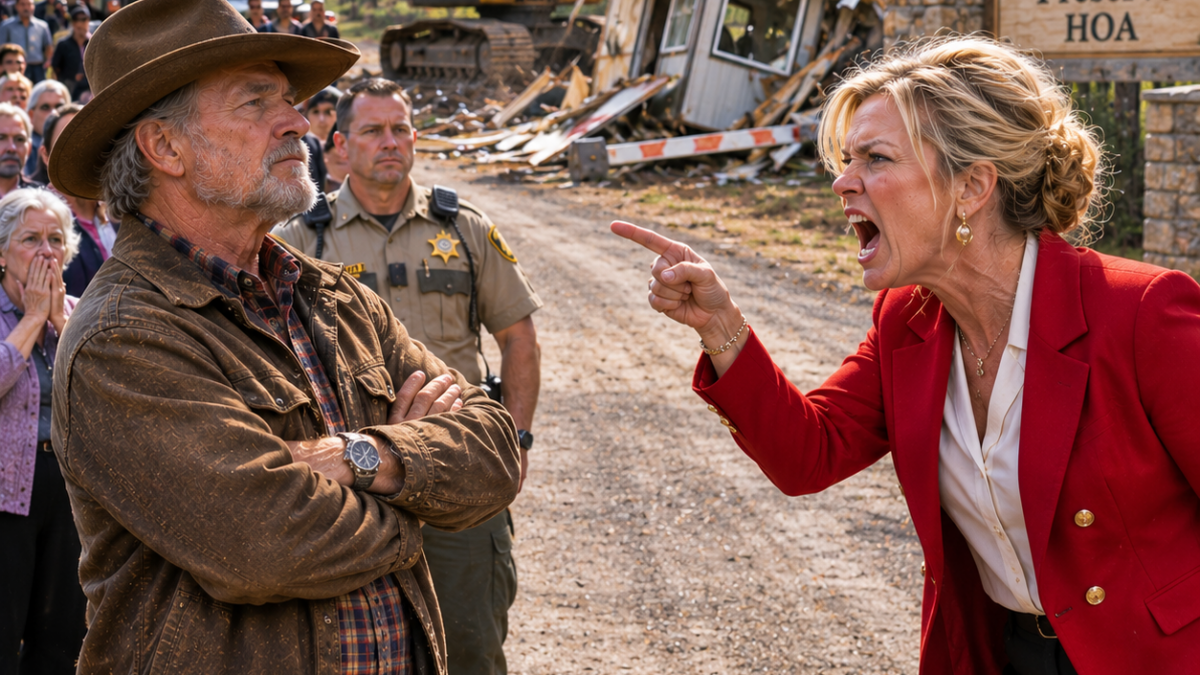
HOA Karen Put a Checkpoint on My Private Lane—Then 214 Families Woke Up to Find the Entire Road Gone.
The HOA built a guard booth, camera system, and steel checkpoint across the private lane my father and I had laid with our own hands, then fined me $350 a day because I refused to register for permission to drive to my own house.
Thirty days after I served them written notice to remove it, I brought in a bulldozer at midnight and stripped away the booth, barrier, asphalt, and gravel until 1,100 feet of what they called “their road” was nothing but raw earth again.
What the 214 families standing at that dead end the next morning didn’t know was that their HOA had been collecting money for a second entrance for nearly twenty years—and the records of where that money went were about to become much more important than the missing road.
At 7:12 the next morning, my phone showed eighty-three missed calls.
By 7:30, cars were backed up nearly half a mile.
People stood in bathrobes beside SUVs.
Parents were calling schools.
Delivery trucks were turning around.
A man in slippers was filming the empty strip where Tate Lane had been the night before.
And Gwen Aldrich came running across the dirt in high heels, waving papers above her head.
“WHERE IS OUR ROAD?”
I stood beside my pickup with my arms folded.
She stopped five feet from me.
Her red face matched the sunrise.
“Where is it?”
I looked behind her.
Then at the raw red earth stretching toward the county highway.
“Gone.”
“You destroyed it.”
“I removed it.”
“That is HOA property.”
“No.”
She shoved a packet toward my chest.
“You cannot remove the only entrance to Ridgemont Preserve.”
“I gave you thirty days.”
“You had no authority to give us thirty minutes.”
“I own the ground.”
“You destroyed an easement.”
“There is no easement.”
“Two hundred fourteen families depend on that road.”
“I know.”
Her mouth opened.
Then closed.
I pointed toward the ten-foot strip of packed gravel I had left running beside the former road.
“Fire and ambulance access is still open.”
She stared at it.
“That doesn’t help residents get to work.”
“No.”
I looked back at her.
“That’s why your board had thirty days.”
My name is Hollis Tate.
PART2:
I was sixty-six years old when I removed Tate Lane.
People around Ridgemont later told the story like I woke up angry one night, climbed onto a bulldozer, and decided to strand an entire neighborhood before breakfast.
That version was easier.
Cleaner.
Made better gossip.
The truth took nineteen years.
And it started with my father.
Tate Lane was 1,100 feet long.
Part gravel.
Part old asphalt.
Nothing beautiful.
But it meant more to me than any paved boulevard ever could.
Dad and I built the original road in 1987.
He was sixty then.
I was twenty-five.
We needed a dependable way to get ranch trucks from the house and barns to the county highway.
Before that, the route turned to mud every spring.
We hauled stone ourselves.
Set drainage.
Graded the crown.
Poured sections of asphalt near the highway where heavy trucks tore up the gravel.
Dad spent three days arguing with me about the ditch depth.
He was right.
I still hated admitting it.
My wife Ruth planted oak saplings along the lane several years later.
She said the road looked too much like a work site.
I told her ranch roads were work sites.
She planted them anyway.
By the time she died, those trees were tall enough to shade the shoulders.
Cancer took her nine years before the checkpoint appeared.
After she was gone, Tate Lane became one of the last places where I could still feel her presence without trying.
Every oak.
PART3:
Every bend.
The little patch where she had made me stop the tractor because she found a nest in the grass.
It was just a road.
And it wasn’t.
In 2004, land behind the ranch was sold to a developer named Grayson Holt.
He wanted to build Ridgemont Preserve.
At the time there was no direct road from that tract to the county highway.
The permanent entrance was supposed to come from the east.
But construction would be easier if his equipment could reach the site through Tate Lane.
Grayson came to my porch.
No lawyer.
No binder.
Just a rolled site map.
“Hollis, I need a favor.”
That already made me suspicious.
“What kind?”
“Temporary access.”
“For?”
“Construction equipment.”
“How temporary?”
“Couple years.”
I looked at the map.
His project sat behind my land.
“Why not build your entrance first?”
“Because we have grading, utilities, foundations, all of that before the final road work.”
“So you want my road.”
“For trucks.”
“Only trucks?”
He hesitated.
“Eventually homeowners may use it while the east entrance is being finished.”
I looked at him.
“Then we put everything in writing.”
He agreed.
That was how the 2004 license was created.
Not an easement.
Not ownership.
A license.
The distinction mattered.
The document allowed Grayson’s construction traffic and, once houses were occupied, residents and legitimate visitors to use Tate Lane.
The ownership of the lane remained mine.
Maintenance responsibilities were divided.
The HOA, once created, would contribute to wear caused by subdivision traffic.
I retained the right to use and control the land.
And Section 6 contained the provision that eventually brought the whole arrangement down.
At the time, it seemed almost unnecessary.
It said the license was permissive and revocable.
More specifically:
If Ridgemont Preserve or any successor HOA installed a gate, barrier, checkpoint, access-control system, or other restriction that interfered with my unrestricted use of Tate Lane, I could terminate the license after thirty days’ written notice unless the restriction was removed.
Dad read that paragraph.
He was still alive then.
He looked at Grayson.
“Why would they ever gate Hollis out of Hollis’s road?”
Grayson laughed.
“They won’t.”
Dad said:
“Then you won’t mind the clause.”
Grayson didn’t.
We signed.
For nineteen years, the arrangement worked.
Not perfectly.
But well enough.
People waved.
Kids rode bicycles.
Delivery trucks slowed near the cattle crossing.
Residents sometimes stopped to buy eggs from Hank Miller down the road.
Ida Mae Crowley lived in Ridgemont almost from the beginning.
Seventy-eight when everything happened.
She brought me peach pie every summer.
Never called first.
Just appeared.
“Hollis, I made too much.”
“You always make too much.”
“I know.”
She liked Ruth.
After Ruth died, Ida Mae kept bringing the pies.
For nineteen years nobody called Tate Lane HOA property.
Nobody asked me to register my truck.
Nobody stopped my ranch hands.
Then Ridgemont elected Gwen Aldrich.
I met her in April.
She came onto my porch carrying a clipboard.
Late forties.
Perfect blond hair.
Expensive sunglasses.
The kind of smile people practice before meetings.
“Mr. Tate?”
“Yes.”
“I’m Gwen Aldrich. New Ridgemont HOA president.”
“Congratulations.”
“Thank you.”
She glanced toward Tate Lane.
“The board is reviewing access procedures.”
“What procedures?”
“Just standard security.”
“Security for what?”
“We’ve had concerns about unauthorized traffic.”
I leaned against the porch post.
“On the subdivision roads?”
“And the entrance.”
“Tate Lane?”
“Yes.”
“That’s my road.”
Her smile remained.
“Of course.”
I should have heard the warning in the way she said of course.
She looked at her clipboard.
“We’re considering vehicle identification.”
“For Ridgemont residents?”
“And anyone using the entrance.”
“My employees?”
“Possibly.”
“No.”
Her smile finally slipped.
“It’s preliminary.”
“Good.”
“Mr. Tate, security benefits everyone.”
“Maybe.”
I pointed down the lane.
“But nobody checks whether I’m allowed to use my own road.”
She made a note.
“Understood.”
Then left.
Three weeks later, I came home from the feed store and hit my brakes.
A guard booth stood in the middle of Tate Lane.
Brand new.
Gray metal siding.
Windows.
Air-conditioning unit.
Beside it:
Steel barrier arm.
Camera pole.
License-plate reader.
Card reader.
Concrete bollards.
Sign:
RIDGEMONT PRESERVE
RESIDENTS ONLY
ALL VISITORS MUST REGISTER
For several seconds I thought I had turned onto the wrong road.
Then one of Ruth’s oak trees passed my passenger window.
No mistake.
A security guard stepped out.
He held up one hand.
I lowered my window.
“Sir, name and purpose of visit?”
I looked at him.
“What?”
“Name and destination.”
“Hollis Tate.”
He checked a tablet.
Frowned.
“You’re not on the resident access list.”
“I’m not a resident.”
“Then I need the name of the resident you’re visiting.”
“I’m visiting me.”
He looked confused.
“This road goes to my ranch.”
“I’m sorry, sir. You need authorization from the HOA.”
I stared at the booth.
“Who told you this road belongs to Ridgemont?”
He shifted.
“I just handle access.”
“Lift the arm.”
“I can’t.”
“Call your supervisor.”
“I can call the property management office.”
“Do that.”
I called the HOA myself.
Gwen answered before the guard finished dialing.
“Hollis.”
Like she had been expecting the call.
“Take your booth off my road.”
She sighed.
“Mr. Tate, the board approved a security checkpoint.”
“On my land.”
“Tate Lane has functioned as common access for nearly twenty years.”
“Functioned.”
“Yes.”
“That doesn’t make it common property.”
“Our counsel reviewed the history.”
“Did counsel read the 2004 license?”
A pause.
“I’m sure all relevant documents were reviewed.”
“That wasn’t what I asked.”
“The road serves Ridgemont.”
“And my ranch.”
“Nobody is preventing you from using it.”
“I’m sitting at a barrier while one of your guards tells me I need permission to go home.”
“We can add you to the authorized list.”
I almost laughed.
“Gwen.”
“Yes?”
“Move the gate.”
“No.”
One word.
Calm.
Confident.
That told me more than a ten-minute argument would have.
I looked at the guard.
“Raise it.”
He did after Gwen apparently gave him permission.
I drove home.
The next morning, a notice was stapled to my ranch gate.
RIDGEMONT PRESERVE HOMEOWNERS ASSOCIATION.
NOTICE OF VIOLATION.
UNREGISTERED VEHICLE USE.
FAILURE TO COMPLY WITH SECURITY ACCESS PROCEDURES.
FINE:
$350 PER DAY.
I read it twice.
Then laughed once.
Not because it was funny.
Because the alternative was throwing something.
They were fining me for driving on my own land.
But the fine wasn’t the part that bothered me most.
At the bottom was Gwen’s signature.
Blue ink.
And the board approval date.
Three weeks before the booth appeared.
Which meant this had not been an impulsive security decision.
They planned it before Gwen came to my porch pretending they were “reviewing procedures.”
I went inside.
Dad’s old steel cabinet stood in the room off the kitchen.
It smelled like oil, paper, and metal.
I found the 2004 file.
LICENSE AGREEMENT — TATE LANE ACCESS.
I sat at the table.
Read the entire document.
Then again.
Section 6.
I read it three times.
If the licensee or successor association installs, maintains, or enforces any gate, checkpoint, barrier, controlled-access mechanism, or other restriction interfering with the licensor’s unrestricted passage over Tate Lane, the licensor may revoke this license upon thirty days’ written notice unless such restriction is removed within the notice period.
I leaned back.
For the first time in weeks, I smiled.
They hadn’t taken my road.
They had activated the exact clause designed to prevent them from taking it.
The following morning, I met Tamara Quinn.
Real-estate attorney.
Fifty-seven.
Small office.
Stacks of property books.
Voice quieter than mine and twice as dangerous.
She read the license once.
Then again.
Then asked:
“Is the booth on your deeded property?”
“Yes.”
“You have a current survey?”
“Old one.”
“We’ll update it.”
She tapped Section 6.
“This is strong.”
“Meaning?”
“Meaning the license gives you a specific revocation mechanism.”
“So I can close the road?”
“After notice.”
“Thirty days.”
“Yes.”
“What happens if they ignore it?”
“They’ll probably sue.”
“Good.”
Tamara looked up.
“That is not the normal response.”
“I’m tired.”
She almost smiled.
“Mr. Tate, if we serve this, you need to behave perfectly.”
“I’m sixty-six. Perfect is ambitious.”
“No threats.”
“Fine.”
“No equipment blocking traffic during the notice period.”
“Fine.”
“No removing the checkpoint early.”
“That one hurts.”
“Document everything.”
“I already like you less.”
“Good.”
We prepared the notice that day.
It quoted Section 6.
Described the booth.
Barrier arm.
Camera.
Registration requirement.
Fine.
Demand:
Remove all access-control equipment.
Restore open unrestricted passage for me and my ranch operations.
Thirty days.
Failure would terminate the license.
Certified mail.
Hand delivery.
Copy recorded with the county land records so nobody could later claim they never knew.
Gwen signed for the certified copy.
That evening, she held an HOA meeting.
Ida Mae called me afterward.
“She laughed.”
“At what?”
“Your letter.”
“Good.”
“No, Hollis.”
“What did she say?”
“That you’re bluffing.”
I looked toward Tate Lane.
The red light on the checkpoint camera blinked in the darkness.
“Then she has thirty days to keep believing that.”
The next three weeks were ridiculous.
First came additional fines.
$350.
Then $700.
Then $1,050.
I put every notice in a folder.
Never paid one.
Then a letter from HOA counsel.
It called Tate Lane “historically dedicated community access.”
Tamara replied:
“Please provide the recorded dedication.”
They did not.
Then a safety petition.
Residents were told uncontrolled access created risk to children.
Twenty-three signatures.
Tamara asked whether any accident data supported it.
No answer.
Then Gwen posted on the Ridgemont website:
HOSTILE ADJACENT LANDOWNER THREATENS COMMUNITY ACCESS.
I was described as “uncooperative.”
That hurt more than I expected.
Because I had allowed those people across my land for nineteen years.
No toll.
No gate.
No badge.
One woman had used Tate Lane to reach the hospital when her husband had a stroke.
Ambulances used it.
School buses.
Moving vans.
Visitors.
I had never once tried to turn the road into leverage.
Now Gwen was telling two hundred fourteen families I was trying to steal something from them.
Then Ida Mae knocked on my door after midnight.
I opened it and nearly had a heart attack.
She stood there in a housecoat beneath a winter coat.
“Hollis.”
“Ida Mae, what happened?”
“I need to show you something.”
“You drove here?”
“My grandson drove me.”
A young man sat in a pickup near the porch.
Ida Mae carried a large envelope.
“Come inside.”
At the kitchen table, she removed bank records.
“How did you get these?”
“They were put in my HOA mailbox.”
“By mistake?”
“I think they were meant for Gwen.”
I didn’t touch them at first.
“Ida Mae, we need to be careful.”
“I know.”
She pushed them closer.
“There’s a road fund.”
I looked.
RIDGEMONT PRESERVE SECONDARY ACCESS RESERVE.
Established:
Homeowners had been paying into it nearly since the neighborhood began.
Separate assessment component.
Purpose:
Construct permanent secondary entrance connecting Ridgemont east boundary to County Road 17.
I looked up.
“Secondary entrance?”
Ida Mae nodded.
“We always heard one would be built someday.”
“What happened to the money?”
She turned pages.
Deposits.
Assessments.
Withdrawals.
Contractor payments.
Security modernization.
Camera equipment.
Road safety consulting.
Administration.
Then:
Aldrich Security Solutions.
I frowned.
“Related?”
“Gwen’s brother-in-law.”
Another statement.
Guard booth construction.
Barrier system.
License plate cameras.
Then landscaping.
Management fees.
Consulting.
The fund should have held hundreds of thousands.
Balance:
Almost nothing.
I sat back.
“This was collected for a second road?”
“For years.”
“How much total?”
“I don’t know.”
She pointed to older board references.
One figure appeared:
$412,000.
Another showed $112,000 remaining at one point before recent withdrawals.
I looked toward the checkpoint.
It clicked.
The HOA did not simply prefer Tate Lane.
It depended on Tate Lane because the alternate entrance residents had been paying to build had never been completed.
And Gwen had spent part of the reserve on the very checkpoint that triggered my revocation clause.
I called Tamara the next morning.
She listened.
Then said:
“Do not use records you are not entitled to possess.”
“They were misdelivered.”
“Give me copies only if Ida Mae can lawfully provide them.”
“She’s a member.”
“Then she should request the official HOA financial records through the proper process.”
I sighed.
“You ruin everything fun.”
“That is why you pay me.”
Ida Mae submitted a member records request.
So did two other residents after she quietly told them what she found.
Gwen delayed.
Then produced partial statements.
Enough to confirm the secondary access reserve existed.
Enough to show large withdrawals.
Not enough to explain all of them.
That problem would matter later.
My immediate problem was day thirty.
On day twenty-nine, surveyor Les Farrell came out.
He was seventy himself and somehow walked faster than I did.
We spent the day setting the boundaries.
He measured the guard booth.
Barrier.
Camera pole.
Roadbed.
Ditches.
Everything.
At one point he drove a stake.
Then stepped back.
“Hollis.”
“Yes?”
“Six feet.”
“What?”
“You own roughly six feet beyond the road edge on this side.”
“And the other?”
“More.”
He checked the instrument.
“The entire roadway, drainage, booth, camera base, barrier system—everything is inside your parcel.”
“No encroachment from theirs?”
“Not at this section.”
He walked farther.
By sunset, his answer was unchanged.
All 1,100 feet.
Mine.
Every inch beneath the lane.
I stood beside Ruth’s oaks.
“Then tomorrow it’s mine again.”
Les looked at me.
“It was always yours.”
Good correction.
That evening, the thirty-day period expired.
The booth remained.
Barrier remained.
Camera remained.
Gwen drove through around six.
She stopped beside me.
Rolled down the window.
“Still waiting?”
“Deadline ends tonight.”
She smiled.
“Enjoy your little patch of land, Mr. Tate.”
I touched the brim of my hat.
“Good night, ma’am.”
She drove away.
At 11:45 p.m., I heard diesel.
Buddy Rollins arrived with a Caterpillar dozer on a flatbed.
Two dump trucks followed.
Skid steer.
Excavator.
Four workers.
All insured.
All experienced.
All briefed by Tamara.
Buddy climbed down.
“You sure?”
I handed him the license.
Recorded notice.
Survey.
Written attorney instruction confirming the license had terminated.
He read the first page.
“I meant emotionally.”
“Oh.”
I looked at Tate Lane.
Ruth’s trees were dark silhouettes against the moon.
“Yeah.”
He nodded.
“What stays?”
“The oaks.”
“Obviously.”
“Emergency strip stays.”
“How wide?”
“Ten feet, packed gravel.”
“And asphalt?”
“Everything else comes up.”
Buddy stared down the lane.
“You built this?”
“Dad and me.”
“Hell of a way to spend a night.”
“Start at midnight.”
At exactly 12:00, the blade dropped.
The first thing removed was the checkpoint.
Not smashed recklessly.
Disconnected.
Unbolted where possible.
Booth lifted.
Barrier equipment removed.
Camera pole taken down.
We placed all HOA equipment intact on my pasture.
Photographed it.
Tagged it.
Tamara had insisted.
“You do not destroy their movable property just because it is on your land.”
So we didn’t.
The road itself was different.
My material.
My improvements.
My ground.
Buddy’s dozer bit into the gravel.
The old asphalt cracked.
Chunks rolled.
Dump trucks carried reusable stone to a stockpile on my side.
We peeled away the lane section by section.
It felt wrong.
That is the part nobody believes when they hear the story.
They expect me to say it felt glorious.
It didn’t.
I remembered Dad driving the roller in 1987.
Ruth standing in the ditch with oak saplings.
My old cattle truck.
Christmas mornings.
Neighbors waving.
Nineteen peaceful years.
I wasn’t destroying an enemy.
I was dismantling something my family built because somebody else had decided our generosity was ownership.
By 2:00 a.m., half the lane was gone.
By 3:15, the county-highway connection had been removed except for the emergency strip.
By 4:00, Tate Lane was raw earth.
Red dirt.
Drainage.
Oak trees.
No public road.
Buddy climbed down.
“That enough?”
I looked at the ten-foot emergency route.
Packed gravel.
Clearly marked.
Capable of carrying fire apparatus.
County code required emergency access.
I had confirmed dimensions before we started.
“Good.”
He wiped his forehead.
“You’re going to make the news.”
“Probably.”
“You want coffee?”
“Yes.”
At 4:30, I drove to the sheriff’s office.
Night deputy at the desk looked at the folder.
Then at me.
“You removed a road?”
“Yes.”
“All of it?”
“Regular traffic surface.”
He stared.
I handed over:
Deed.
Survey.
2004 license.
Thirty-day notice.
Delivery confirmation.
County recording receipt.
Photographs before removal.
Emergency access plan.
Location of HOA property removed from the checkpoint.
Tamara’s contact details.
“I’m filing this before anyone calls.”
The deputy looked at the clock.
“Smart.”
“Experience.”
“Have you done this before?”
“No.”
“Then what experience?”
“Being old.”
He laughed.
I went home.
Slept forty-three minutes.
Then the phone started.
By 7:12:
Eighty-three missed calls.
And that brought me back to Gwen screaming:
“WHERE IS OUR ROAD?”
Deputy Carlos Medina arrived around eight.
Two cruisers.
He knew enough from my pre-filing not to arrive assuming I had committed some overnight act of insanity.
Gwen ran to him.
“Officer, arrest him.”
Medina looked at me.
Then the empty road.
“For?”
“Destruction of HOA property.”
Medina asked:
“What property?”
“Our access road!”
I handed him the folder.
Gwen pushed papers at him too.
He moved to the hood of his cruiser.
Read.
The crowd got louder.
A resident shouted:
“My wife has to get to work!”
Another:
“My kids are stranded!”
Ida Mae stood near the front.
She said nothing.
Medina finally looked at me.
“You removed the road surface after the notice expired?”
“Yes.”
“Checkpoint equipment?”
“Stored intact in my pasture.”
“You damaged it?”
“No.”
“Emergency access?”
I pointed.
He inspected the ten-foot strip.
Then returned.
Gwen said:
“Well?”
Medina looked at her.
“Ma’am, based on these documents, the roadbed is on Mr. Tate’s property.”
“We have an easement.”
“Where?”
She handed him a plat.
He looked at it.
“This says access.”
“Exactly.”
He flipped through my license.
“Mr. Tate’s attorney says the access was a revocable license.”
“Our attorney says otherwise.”
“Then a judge can decide.”
Gwen pointed toward me.
“He destroyed HOA property.”
Medina glanced toward the empty booth location.
“Did the HOA have permission to install the booth?”
“We control the road.”
He looked at Section 6.
Then at the survey.
Then back at Gwen.
“I’m not making a final civil title ruling standing here.”
Her face softened slightly.
Then he added:
“But if this survey and license are accurate, I’d be more concerned about the HOA placing structures on his property after being told not to.”
Her face went white.
“You’re taking his side?”
“I’m reading documents.”
That shut her up for maybe five seconds.
Then she announced:
“We are filing an emergency lawsuit.”
Tamara’s phone rang before Gwen finished the sentence.
Three days later, we were in court.
Judge Elaine Radcliff.
Gwen wanted an emergency injunction ordering me to rebuild Tate Lane immediately and restore full HOA access.
Her attorney called the road an easement.
Tamara objected.
“Recorded where?”
Counsel argued continuous use.
Subdivision reliance.
Plat references.
Nineteen years of access.
Tamara stood.
“Your Honor, everyone agrees Ridgemont residents used Tate Lane for nineteen years.”
She held up the 2004 license.
“The question is why.”
She walked the court through it.
Permission.
License.
Not conveyance.
Not recorded easement.
Not ownership.
Then Section 6.
Gate.
Checkpoint.
Controlled access.
Thirty days.
Notice.
No cure.
Revocation.
Judge Radcliff read the clause herself.
Gwen’s attorney argued that the checkpoint improved safety and never intended to exclude me.
Tamara replied:
“The guard denied Mr. Tate passage until HOA authorization was obtained.”
She submitted the violation notice.
The $350 daily fines.
Judge Radcliff raised an eyebrow.
“They fined the landowner?”
“Yes.”
“For failing to register to use his own lane?”
“Yes.”
That was a good moment.
Then Gwen’s attorney produced an old subdivision plat note.
It referenced “permanent access via Tate Lane.”
Tamara asked:
“Recorded easement?”
Counsel said the plat established intent.
Tamara answered:
“A developer cannot convey someone else’s land by writing a sentence on his own subdivision drawing.”
Then she called Grayson Holt.
I had not spoken to him in years.
He walked slowly to the witness stand.
Older.
Gray.
Still sharp.
Tamara showed him the 2004 license.
“Did Hollis Tate grant Ridgemont a permanent easement?”
“No.”
“What did he grant?”
“A license.”
“Revocable?”
“Yes.”
“Why?”
“Because Hollis owned the road.”
“Was a permanent easement ever executed?”
“Not by me.”
Gwen’s lawyer showed him the plat note.
“What does this mean?”
Grayson sighed.
“It was a planning notation.”
“Why does it say permanent access?”
“Because the permanent access plan was still being finalized.”
“Did you intend Tate Lane to become permanent?”
“We hoped to negotiate it later.”
“Did you?”
“No.”
Then Tamara asked:
“Did Mrs. Aldrich contact you recently about that notation?”
Gwen moved.
Her attorney objected.
Judge allowed limited questioning.
Grayson looked toward Gwen.
“Yes.”
“When?”
“About six weeks ago.”
“What did she ask?”
“She wanted me to sign a clarification saying the 2004 agreement had always been intended as permanent.”
The courtroom went silent.
“Did you sign?”
“No.”
“Why?”
“Because that wasn’t true.”
Tamara waited.
Then:
“Did she ask you to date that clarification to an earlier period?”
Grayson’s voice lowered.
“Yes.”
Gwen’s attorney stood.
“Objection.”
Judge Radcliff looked over her glasses.
“On what basis?”
The attorney hesitated.
That was enough.
The emergency hearing had stopped being about my bulldozer.
Judge Radcliff did not raise her voice.
She didn’t need to.
“The court finds the 2004 instrument is, on its face, a revocable license.”
She continued:
“The association implemented an access-control mechanism expressly addressed by the termination clause.”
Gwen stared straight ahead.
“The association received written notice and did not cure within thirty days.”
Then:
“Plaintiff has not demonstrated a recorded permanent easement sufficient to support the emergency relief requested.”
Tamara didn’t move.
Neither did I.
“The request to compel Mr. Tate to reconstruct the former roadway is denied.”
Gwen’s face changed.
Then Judge Radcliff addressed something else.
The financial documents.
By then, Ida Mae and several residents had made formal requests for HOA records.
The secondary-access fund showed hundreds of thousands in assessments over many years.
Payments had gone to security upgrades.
Management.
Contractors.
Including Gwen’s brother-in-law.
Judge Radcliff did not rule from the bench that Gwen had stolen money.
There wasn’t enough evidence for that.
But she ordered the HOA to preserve all financial records relevant to the secondary-access fund and directed that disputed transactions be produced as part of the case.
The board had its own attorney by then.
Not Gwen’s personal ally.
That attorney immediately recommended an independent audit.
Within a week, Gwen resigned.
She said she wanted to spare the neighborhood further division.
Residents later told me a recall petition already had enough signatures to remove her anyway.
I didn’t celebrate.
The road was still gone.
Two hundred fourteen families still needed a permanent solution.
Their anger had shifted.
First toward me.
Then toward Gwen.
But anger didn’t build roads.
That required money.
Engineering.
Permits.
And agreements.
The independent audit showed something more complicated than the rumors.
The secondary-access reserve had existed.
Residents had contributed to it.
But the fund had been repeatedly redirected.
Some expenditures were arguably allowed under broad budget language.
Others were questionable.
Some had paid for security improvements.
Some for consultants.
Some for the checkpoint.
Some went to companies with relationships that should have been disclosed more clearly.
One contractor was connected to Gwen’s brother-in-law.
That triggered further review.
I stayed out of the criminal accusations.
Tamara insisted.
“Do not call it theft unless investigators call it theft.”
“Fine.”
“Do not say she stole $412,000.”
“I didn’t.”
“Your neighbors are.”
“They’re angry.”
“That doesn’t make it evidence.”
She was right.
The state eventually opened an investigation into financial practices and contracting disclosures.
The HOA hired forensic accountants.
I focused on my property.
The new board came to my porch.
Four people.
Ida Mae among them.
She was not the president.
She refused.
“Sensible,” I told her.
“Exactly.”
The new president was a retired engineer named Marcus Bell.
He removed his hat before stepping onto my porch.
Good start.
“Mr. Tate.”
“Hollis.”
“Hollis.”
He looked toward the former lane.
“We need to fix this.”
“Yes.”
“I want to begin by saying the board recognizes Tate Lane is on your property.”
I waited.
“And we recognize the prior access existed under a license.”
Better.
“We would like to negotiate a recorded easement.”
That was the sentence I had been waiting nineteen years to hear.
Not:
We own it.
Not:
You owe us.
Not:
Families depend on it, therefore surrender.
Negotiate.
I invited them inside.
Tamara joined by phone.
We spent three weeks working out terms.
Permanent recorded easement.
Defined width.
No gate.
No checkpoint.
No access-control booth.
No cameras mounted on my land without written consent.
Residents and normal guests could pass.
Commercial traffic subject to weight rules.
HOA responsible for maintenance proportional to use.
Speed limit.
Drainage standards.
Emergency access protected.
My ranch vehicles always had unrestricted passage.
No expansion beyond the defined corridor.
No claim to adjacent land.
Fair payment.
Not extortionate.
Appraised.
The HOA also agreed to restore the road at its expense.
I contributed one thing voluntarily.
Oak trees.
The old ones had survived the removal because Buddy and his crew worked around them.
We planted new oaks in gaps.
Ruth’s trees beside the young ones.
The road came back.
Fresh gravel base.
New asphalt near the county connection.
Better drainage than Dad and I had built in 1987.
I hated admitting that.
Buddy told me:
“Your dad didn’t have laser grading.”
“He had a level.”
“Laser wins.”
“Get off my road.”
He laughed.
The new road reopened six weeks after the lawsuit.
No guard booth.
No barrier arm.
No Residents Only sign.
At the entrance was a simple marker:
TATE LANE
PRIVATE ROAD
ACCESS BY RECORDED EASEMENT
PLEASE DRIVE SLOWLY
That was all.
Nobody needed humiliation.
Nobody needed to be reminded I had won.
Because that wasn’t what had happened.
The property line was clarified.
The legal relationship was fixed.
The neighborhood got lawful access.
I got ownership acknowledged.
That was a better ending than two hundred fourteen families driving around furious because I had proved a point.
The first morning the new Tate Lane opened, I sat on my porch with coffee.
Cars passed.
Slowly.
Most people waved.
Some didn’t.
Fair enough.
One truck stopped.
Ida Mae climbed out carrying peach pie.
I looked at her.
“You’re early.”
“I know.”
“Too much again?”
“Always.”
She put it on the porch rail.
Then looked down the lane.
“You know what Gwen never understood?”
“What?”
“You never wanted to close it.”
“No.”
“You wanted her to stop claiming it.”
I nodded.
“That’s different.”
“Yes.”
We sat.
After a while she said:
“I was angry with you that first morning.”
“I know.”
“I thought you’d gone crazy.”
“Reasonable.”
“No.”
She shook her head.
“I should have read the agreement before deciding.”
“You weren’t on the board in 2004.”
“No.”
“But I had believed for nineteen years it was our road.”
“That’s understandable.”
She looked at the oak trees.
“Possession makes people confident.”
“Habit makes them more confident.”
Ida Mae smiled.
“You sound like your lawyer.”
“Worst thing anyone has said to me all week.”
The audit continued.
Several financial policies changed.
The HOA required conflict disclosures.
Competitive bids.
Restricted reserves could no longer be redirected without member approval.
Secondary access planning resumed.
This time, residents could actually see the numbers.
They eventually decided against building the full second road immediately.
Too expensive.
Instead, they secured a separate emergency connection on the east side and funded it properly.
I supported that.
Not because I had to.
Because one road serving hundreds of people is bad planning.
The whole fight had proved it.
Gwen disappeared from HOA life.
Her house stayed.
Her name stopped appearing on meeting notices.
I saw her only twice after the lawsuit.
The second time was almost a year later.
Grocery store parking lot.
She saw me.
I saw her.
I expected us to walk past.
Instead, she stopped.
“Hollis.”
“Gwen.”
She looked thinner.
No clipboard.
No red blazer.
“You got your road back.”
“It was always my road.”
She looked irritated.
Then caught herself.
“I suppose that sentence is part of why we ended up where we did.”
“Yes.”
She looked toward her car.
“The checkpoint seemed reasonable.”
“To you.”
“Residents wanted security.”
“I believe that.”
“There had been thefts.”
“Then put a checkpoint on property you own.”
She nodded slightly.
“I thought the road had become part of Ridgemont.”
“Why?”
“Nineteen years.”
“That isn’t a deed.”
“I know that now.”
We stood quietly.
Then she said:
“I did not steal that road fund.”
“I never said you did.”
“People think I did.”
“I know.”
“Some expenditures were authorized.”
“I know.”
“Some were badly documented.”
“I know.”
She looked at me.
“You really stayed out of it.”
“I had my own problem.”
She seemed almost surprised.
“I thought you hated me.”
“I didn’t know you well enough.”
That made her laugh once.
Then she looked serious again.
“I should not have fined you.”
“No.”
“I should not have told the guard to stop you.”
“No.”
“I thought if we treated the road like ours, it would settle the question.”
There it was.
The whole thing.
I looked at her.
“That was the question.”
She nodded.
“I know.”
Then she walked away.
I never saw her again.
A year later, Ruth’s oldest oak lost a limb in a storm.
It fell across the ditch but missed traffic.
I cut it into boards.
Kept several pieces.
One went into a bench near the porch.
Another I gave to Ida Mae’s grandson.
The rest stayed in the barn.
People sometimes asked why I tore up the whole lane instead of simply removing the checkpoint.
Fair question.
I could have.
The revocation clause ended their license.
Legally, I could have closed access while leaving the physical road.
But leaving it would have created a different problem.
Two hundred fourteen households looking at an intact road they had used every day and being told not to cross it.
There would have been constant pressure.
Trespassing.
Arguments.
Maybe people moving barriers.
Maybe someone deciding necessity gave them the right to ignore the revocation.
Removing the ordinary roadway made the legal change visible.
No confusion.
Emergency strip only.
Was it drastic?
Yes.
Did I enjoy doing it?
No.
Would I do it again under the same circumstances?
Yes.
Because I gave thirty days.
The solution during those thirty days was simple.
Remove the booth.
Lift the barrier.
Stop fining me.
Restore unrestricted use.
The license could have continued.
Gwen chose not to.
That mattered.
People later said:
You destroyed the road because of one guard booth.
No.
I removed the road because the booth proved something deeper.
The HOA had stopped thinking of itself as a guest on my land.
It thought I was the guest.
Once a guard can ask the owner:
Name and purpose of visit?
The relationship has already changed.
Section 6 existed for exactly that reason.
Dad saw the possibility nineteen years before I needed it.
I think about that sometimes.
He read the language.
Asked:
“Why would they ever gate Hollis out of Hollis’s road?”
Then laughed.
He thought it was unlikely.
But he still insisted the clause stay.
That was Dad.
Hope people behave well.
Write the contract for when they don’t.
Tamara eventually framed Section 6 and gave it to me for Christmas.
I opened the package.
“What is this?”
“Art.”
“It’s a contract paragraph.”
“Exactly.”
“You charged me enough to do better.”
She smiled.
“Read the bottom.”
Beneath the framed clause she had added a small brass plate:
READ YOUR PAPERWORK.
I hung it in Dad’s old office.
Hank saw it.
“Ugly.”
“Yes.”
“Accurate.”
“Yes.”
“Your lawyer?”
“Yes.”
“Figures.”
Years passed.
Tate Lane settled into normal life again.
School buses.
Ranch trucks.
Residents.
Emergency vehicles.
Visitors.
Nobody registered.
No camera recording plates.
No guard asking where people were going.
The HOA installed its security system at the actual entrance to Ridgemont, on Ridgemont land.
Problem solved.
Amazing how easily private property rights coexist when people put their equipment on their own property.
The emergency east connection was eventually completed.
Not a full public road.
But enough for fire and evacuation.
Residents voted for it.
Money was restricted.
Monthly reports published.
Ida Mae attended every meeting even after she stopped driving at night.
“You trust them now?” I asked.
“No.”
She smiled.
“That’s why I read the reports.”
Smart woman.
One summer, the HOA invited me to its twentieth-anniversary picnic.
I almost declined.
Then Ida Mae threatened to bring peach pie to my house every day until I accepted.
I went.
Kids played on the lawn.
People grilled.
Marcus Bell introduced me to a new family.
“This is Hollis Tate.”
The man shook my hand.
“We live near Tate Lane.”
“Sorry to hear that.”
He laughed.
Then:
“We were told you own it.”
Progress.
His wife asked:
“Does the HOA maintain it?”
“Under the easement.”
She nodded.
No confusion.
No myth.
No “common area.”
No argument.
A boy nearby overheard us.
“You’re the man who stole the road.”
His mother nearly dropped her drink.
“Ethan!”
I laughed.
“Who told you that?”
“My friend.”
“I didn’t steal it.”
“You made it disappear.”
“That part is true.”
“Did you use dynamite?”
“No.”
His face fell.
“Bulldozer.”
Better.
“Cool.”
His mother apologized.
I told her not to.
Kids prefer the dramatic version too.
Later, Marcus stood beside me.
“Would you ever serve on the road committee?”
“No.”
“I knew that was coming.”
“I’m retired.”
“You’ve been saying that for ten years.”
“And yet nobody listens.”
We watched people.
Then Marcus said:
“You know, the easement is boring.”
“Good.”
“No one talks about it.”
“Better.”
“No controversy.”
“Perfect.”
That was the goal.
Good property agreements are boring.
Nobody makes videos about a correctly recorded easement with fair maintenance terms.
Nobody gathers at sunrise.
No deputies.
No screaming HOA president.
No bulldozer at midnight.
Just people using land under rules they all understand.
That is trust.
Not a handshake alone.
Not a promise alone.
Not nineteen years of habit.
Trust backed by clarity.
When Ida Mae died three years later, she was eighty-one.
Her family asked whether I would say something at the service.
I hate speaking at funerals.
But I agreed.
I told people about the pies.
Her midnight visit.
The mistaken bank envelope.
How she picked up information nobody else wanted to look at.
How she had the courage to say:
Something is wrong.
Afterward, her grandson gave me an envelope.
Inside was a short note in Ida Mae’s handwriting.
Hollis — keep the road open unless they get stupid again.
I laughed so hard I had to sit down.
I framed that too.
Put it beside Section 6.
Dad’s legal warning on one side.
Ida Mae’s simpler version on the other.
Both said roughly the same thing.
Years after the checkpoint fight, I still walk Tate Lane most mornings.
Slower now.
The old oaks Ruth planted are huge.
The new ones are catching up.
Cars pass.
Some residents wave.
Others are too busy.
That’s fine.
A road doesn’t need gratitude.
It needs respect.
Near the old checkpoint location, there is no marker.
No plaque.
Nothing commemorating the booth.
I wanted it that way.
The land healed.
The asphalt is new.
The drainage improved.
You would never know a bulldozer stripped the entire road down to earth one night unless someone told you.
Sometimes I stop there.
I remember the guard.
“Name and purpose of visit?”
I remember how absurd it felt.
Then the $350 fine.
Gwen telling me Tate Lane was common area.
Her smile at day thirty.
Buddy asking if I was sure.
The first blade touching gravel at midnight.
The eighty-three calls.
Gwen standing in raw dirt screaming:
“Where’s our road?”
And my answer:
“It was never our road.”
That line became the part everyone remembers.
But it wasn’t quite right either.
The road was mine.
The use had been shared.
That was the important distinction.
For nineteen years, shared use worked because everybody remembered the arrangement.
The day one side tried to turn permission into control, trust collapsed.
That is what the fight was really about.
Not gravel.
Not asphalt.
Not a booth.
Control.
Who gets to decide what happens on land?
A deed answers part of that.
A contract answers another.
Habit answers almost nothing.
Gwen thought nineteen years of traffic had transformed permission into ownership.
It hadn’t.
I thought ownership meant I never needed to explain myself.
That wasn’t entirely true either.
Two hundred fourteen families had structured their lives around access I had allowed.
That did not give them my land.
But it did mean my decisions affected real people.
That is why I left emergency access.
Why I followed the thirty days.
Why I recorded the notice.
Why I went to the sheriff before sunrise.
Why, after winning in court, I negotiated instead of leaving the neighborhood landlocked forever.
Rights matter.
So does how you use them.
Dad knew that.
Ruth knew it.
Ida Mae knew it.
Even Gwen eventually understood part of it.
A few months ago, I replaced the mailbox at the end of Tate Lane.
The old post was rotten.
I dug the hole myself.
Bad idea at my age.
A Ridgemont resident named Aaron stopped.
“You need help?”
“No.”
He looked at me leaning on a shovel.
“You absolutely need help.”
“I absolutely don’t.”
He parked anyway.
We set the post together.
His teenage son mixed concrete.
Nobody asked for permission because I was already there inviting them to help.
When we finished, Aaron looked down the lane.
“Hard to believe you removed the whole thing.”
“People exaggerate.”
“Did you?”
“Yes.”
“All 1,100 feet?”
“Pretty much.”
“In one night?”
“Yes.”
He whistled.
“My wife says you were crazy.”
“Your wife sounds intelligent.”
He laughed.
Then asked:
“What would have happened if Gwen had just removed the checkpoint?”
I looked toward the oaks.
“Nothing.”
“Seriously?”
“Road would have stayed.”
“No lawsuit?”
“No.”
“No bulldozer?”
“No.”
“No audit?”
“That probably would have happened eventually for other reasons.”
He shook his head.
“All that because she wouldn’t lift one gate.”
“No.”
I looked at him.
“All that because she forgot she was standing on somebody else’s ground.”
That was the real lesson.
Not:
Never anger an old rancher.
Not:
HOAs are evil.
Not even:
Read Section 6.
It was simpler.
Permission is not ownership.
Access is not control.
Generosity is not surrender.
And if someone lets you cross their land for nineteen years, the worst possible way to thank them is to build a checkpoint and demand identification when they come home.
That evening, I sat on the porch.
Ruth’s oaks moved in the wind.
A Ridgemont family drove past.
The children waved.
I waved back.
No guard booth.
No barrier.
No camera.
No one asking who they were.
Farther down, the lane disappeared between the trees before meeting the county highway.
Fresh gravel.
Old oaks.
New oaks.
Same ground.
Dad built the first version.
Ruth made it beautiful.
I tore it apart.
Then we built it back under rules everybody understood.
That might sound like a strange legacy for a road.
But roads are strange things.
They connect people.
They divide property.
They invite movement.
They create expectations.
And if nobody is careful, expectations start pretending to be rights.
Tate Lane taught us otherwise.
The families have access today.
Recorded.
Permanent.
Fair.
I still own the soil under their tires.
Nobody is confused about that.
And every time I walk beneath Ruth’s trees, I think the same thing.
A road is not just gravel.
It is an agreement about trust.
The moment somebody forgets that, all the asphalt in the world cannot hold it together.








