HOA Karen Put 18 Rental Houseboats on My Private Lake—Then County Officers Evicted All 43 Paying Guests in Front of Her
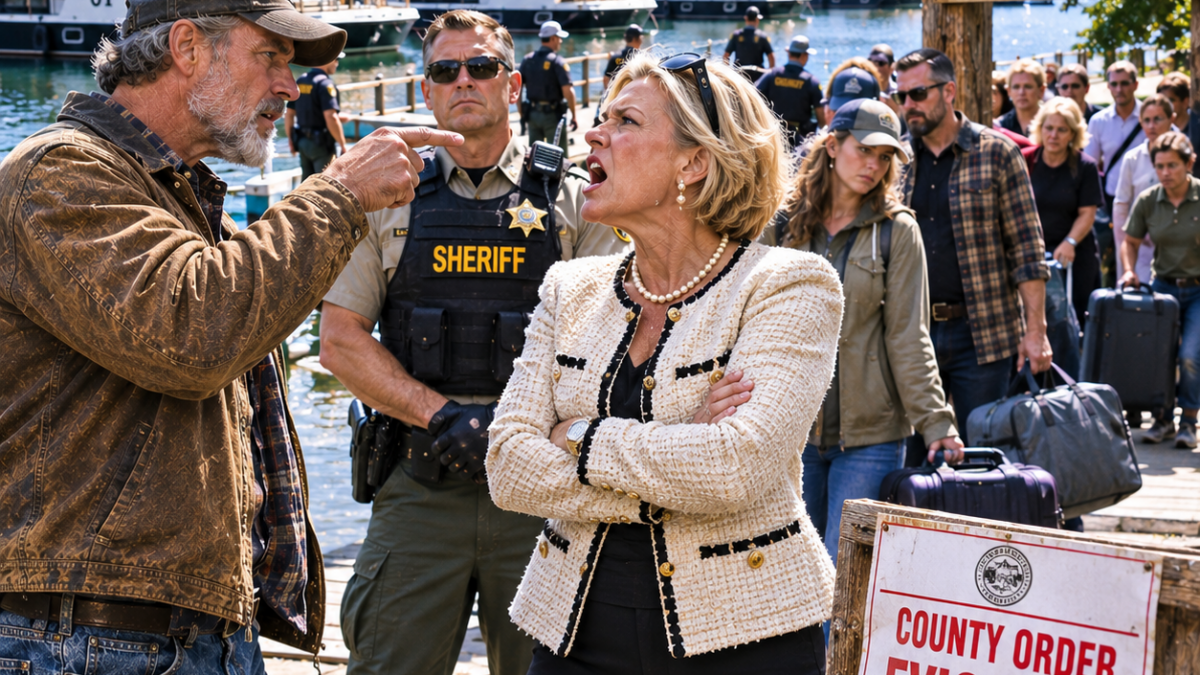
PART3:
They could not swim without permission.
They could not build docks.
They could not moor boats.
They could not operate businesses.
And they certainly could not turn Holden’s lake into a floating hotel.
Yet that was exactly what had happened.
Two weeks earlier, Darlene Vickery had described the construction as a “design exhibition.”
Holden had believed the phrase because it sounded temporary and ridiculous enough to be harmless.
He had been wrong.
He pulled on boots and walked down the hill.
By the time he reached the eastern bank, a line had formed beside a portable check-in desk.
A young couple was receiving keycards.
A staffer in a white polo explained breakfast hours.
Another employee loaded suitcases onto a cart.
And behind the desk stood Darlene Vickery.
President of the Willow Crest Homeowners Association.
Darlene wore a spotless white coat despite the wet shoreline.
Her blond hair was tied back.
A leather folder rested beside a metal cashbox.
She was sorting envelopes.
Holden stopped several feet away.
“Darlene.”
She did not look up.
“Our guests paid for peace and quiet.”
Her voice was loud enough for everyone nearby.
“If you have HOA business, please contact the office Monday.”
Holden almost laughed.
“HOA business?”
Now she looked.
“What would you call eighteen houseboats on my lake?”
Several guests turned.
Darlene smiled.
Not at Holden.
At the audience.
“Mr. Price has been having difficulty adjusting to the community improvements.”
Holden kept his voice level.
“This lake belongs to me.”
Darlene laughed.
A bright, practiced sound.
“Not this again.”
“Yes.”
“This again.”
She reached into the leather folder.
Pulled out a document.
Raised county seal.
Approval stamp.
Signature.
“Briarfield County has reviewed and approved the project.”
She held it where the guests could see.
“Any attempt to interfere with a permitted commercial operation will be addressed through counsel.”
Holden studied the first page.
The seal looked real.
That was the first thing that bothered him.
He had expected bluff.
Instead, Darlene had paper.
Official paper.
“What permit is that?”
“County-issued.”
“For what?”
“You can read.”
“Not while you’re waving it.”
She slid it back into the folder.
A man waiting to check in frowned.
“Is there a problem?”
Darlene smiled at him.
“None.”
Then she looked directly at Holden.
“Unless someone creates one.”
Holden was about to answer when a woman in a gray rain jacket stepped away from the desk.
“Actually, I have a question.”
Darlene’s expression tightened.
The woman held a coffee cup.
Forties.
Dark hair.
Tired face.
“My name is Claire Donnelly.”
She pointed toward the floating bridges.
“Why is the shore gate chained?”
A young employee looked at Darlene.
Darlene said:
“Security.”
Claire frowned.
“It’s the only gate.”
“There are multiple routes.”
“Where?”
The employee opened his mouth.
Nothing came out.
Claire continued.
“I walked down there last night.”
“The floating walkway loops back here.”
“The maintenance gate is locked.”
“What if there’s a fire?”
Darlene’s smile slipped.
Just for a second.
Then returned.
“Our safety procedures have been fully reviewed.”
“By who?”
“The county.”
Claire looked at Holden.
Then Darlene.
“I’d still like to know where the second exit is.”
Darlene pulled a small voucher from the desk.
“I’m sorry your arrival experience has been confusing.”
She handed it over.
“Complimentary breakfast for two.”
Claire did not take it.
Holden noticed.
So did Darlene.
That was the first crack.
Small.
Almost invisible.
Holden stopped arguing.
That surprised Darlene.
She had expected anger.
Possibly hoped for it.
He could see it.
If he shouted, she became the calm professional dealing with the irrational landowner.
If he touched the boats, she became the victim.
If he cut mooring lines, any damage became his.
So Holden did what thirty years around reservoirs and maintenance contracts had taught him to do.
He documented.
He walked the shoreline on his own land.
Photographed each rental number.
License plates.
The sign.
The check-in desk.
The parking area.
The chained gate.
The floating bridges.
Catering.
Suitcases.
Guests.
From dry land.
No confrontation.
By 8:15, he was back in his kitchen.
He enlarged the photograph of Darlene’s permit.
The seal was genuine.
Filing number looked legitimate.
That made everything harder.
Holden spent the first half of his career managing maintenance systems for municipal and private reservoirs.
He had learned something important about permits.
A permit is never just the first page.
The first page is what politicians photograph.
The conditions are where the truth lives.
He called his lawyer.
Michael Grant.
Land-use attorney.
Old friend.
Holden explained.
Michael’s first question was:
“Did you touch anything?”
“No.”
“Good.”
“Can I have them removed?”
“Eventually, probably.”
“Eventually?”
“If she has a real permit, we need to know what it says.”
“She’s on my lake.”
“That’s one issue.”
“One issue?”
“Yes.”
“Ownership is one issue.”
“Commercial operation another.”
“Building code another.”
“Fire safety another.”
“Sanitation another.”
“Insurance another.”
“Maybe navigation and reservoir safety depending on the structures.”
Holden rubbed his forehead.
“So eighteen illegal boats are complicated.”
“Everything becomes complicated when somebody spends enough money before asking permission.”
Holden looked toward the cove.
“What do I do?”
“Get me the permit.”
Seventeen days earlier, Holden had watched the first flatbed arrive.
Steel pontoons.
Decking.
Preassembled wall panels.
Willow Crest had posted a notice at its mailboxes:
SCENIC WALKWAY RENOVATION AND FLOATING DESIGN EXHIBITION
Holden had shrugged.
The overlook belonged to the HOA.
The walking path needed work.
Not his problem.
Three days later, a crane lowered the first floating platform onto Alder Hollow Lake.
That became his problem.
Holden drove down.
Found the construction foreman.
Martin Sutter.
Fifty-eight.
Weathered face.
Hands like old lumber.
Martin had built docks around the county for decades.
“Who authorized this?”
Holden asked.
Martin looked toward the water.
“Client says permits are handled.”
“Client being?”
“Willow Crest.”
“Who gave you permission to occupy the lake?”
Martin hesitated.
“That’s between you and them.”
“No.”
“It’s between whoever signed your contract and me.”
Martin sighed.
“I build what I’m hired to build.”
“Then you’re building on private water.”
“Take it up with Darlene.”
Holden sent a formal stop notice that same afternoon.
No response.
Next morning:
Two more barges.
He hired a surveyor.
Pulled title records.
The old Willow Crest easement was exactly as he remembered.
Pedestrian path.
Scenic overlook.
Limited maintenance access.
No docking rights.
No commercial rights.
No water occupancy.
Holden sent the document to every HOA board member.
Darlene responded with a neighborhood email.
Not to him.
To everyone else.
It described Holden as:
“A neighboring property owner attempting to restrict longstanding community lake access.”
Longstanding.
There had never been community lake access.
Only an overlook.
But the phrase worked.
Soon residents glared when he drove through the public road.
Comments appeared online.
One said:
HE BOUGHT A LAKE AND NOW THINKS HE OWNS THE VIEW TOO.
Another:
WHY SHOULD ONE MAN CONTROL WHAT 100 FAMILIES CAN ENJOY?
Holden did not respond.
Darlene escalated.
Emergency HOA meeting.
She projected renderings of the floating retreat.
Eighteen suites.
Private decks.
Sunset packages.
Weekend rentals.
Yoga mornings.
Wine tastings.
Projected first-season revenue:
$600,000.
Then came the line that won the room.
“Successful operation could reduce monthly HOA dues next year.”
Applause.
People who hated assessments heard free money.
Only Fiona Bramwell did not clap.
HOA treasurer.
CPA.
Fifty-two.
She raised her hand.
“Who owns the boats?”
Darlene smiled.
“The project is being managed by an operating partner.”
“What company?”
“Details are being finalized.”
“Who financed construction?”
“The partner structure handles financing.”
“Is HOA money involved?”
Darlene’s smile remained.
“Our legal team has reviewed all expenditures.”
“That wasn’t my question.”
A few heads turned.
Fiona continued.
“What insurance covers overnight guests?”
“We have comprehensive coverage.”
“Carrier?”
“Fiona.”
Darlene’s voice softened in warning.
“This presentation is about opportunity.”
Fiona closed her notebook.
Then wrote something.
Underlined it twice.
Holden knew none of that yet.
What he did know was that Darlene accelerated construction after his stop notice.
He went to Martin Sutter’s yard.
Martin refused to provide plans.
Confidentiality.
Contract terms.
Holden understood.
Then Martin accidentally gave him something better.
While loading equipment, Martin muttered:
“That permit was signed in March.”
Holden stopped.
“March?”
Martin realized his mistake.
Said nothing.
Construction had started in June.
The HOA had publicly called it a recent design exhibition.
Darlene had been planning for months.
That Monday, Holden entered the Briarfield County permitting office with photographs and the permit number.
Elise Whitlock met him.
Head of lodging and building-code enforcement.
Small woman.
Reading glasses on a cord.
Precise voice.
No patience for outrage without documentation.
Holden showed her the photograph.
“This real?”
She entered the number.
“Yes.”
His stomach dropped.
“What did you approve?”
She retrieved the file.
Placed it on the counter.
“Read.”
Application:
WILLOW CREST FLOATING ARCHITECTURE EXHIBITION.
Purpose:
Daytime demonstration of modular floating-home design.
Operating hours:
9:00 a.m.–7:00 p.m.
Then page three.
CONDITIONS.
No overnight occupancy.
No lodging.
No paid stays.
No commercial accommodation.
No cooking except demonstration appliances disconnected from fuel systems.
Temporary public access only.
No permanent moorings without separate approval.
No interference with lake-management or safety infrastructure.
Holden read it twice.
Then looked at Elise.
“They’re renting these.”
“I need evidence.”
“There are people sleeping there.”
“I believe you.”
“Then shut it down.”
She did not react.
“Mr. Price.”
“Holden.”
“Holden, the county cannot issue an enforcement order because a landowner tells us something is happening.”
He exhaled.
“What do you need?”
“Listings.”
“Receipts.”
“Overnight schedules.”
“Booking records we can lawfully obtain.”
“Evidence of actual use.”
“And if there are safety violations, document those separately.”
“The property dispute?”
“Civil.”
“So you won’t decide who owns the water.”
“No.”
She pointed at the permit.
“But this?”
“We enforce this.”
Holden finally understood.
Darlene had never forged a permit.
She didn’t need to.
She had acquired a real one for something small.
Then built something entirely different.
When challenged, she showed the first page.
Official seal.
Approval.
Most people stopped reading there.
It was a sophisticated kind of lie.
Nothing on the page she displayed was false.
The lie lived in everything she refused to show.
By the time Holden got home, Darlene already knew he had gone to the county.
Someone called her.
Maybe a staff member.
Maybe public-record monitoring.
It didn’t matter.
At 4:00 that afternoon, she held a press event at the shore.
One local television camera.
Dozens of residents.
Permit in hand.
“The county has fully approved our project.”
Holden stood at the back.
Darlene pointed toward him without naming him.
“Certain individuals are attempting to sabotage economic opportunity and community improvement.”
Applause.
Holden said nothing.
That irritated her more than arguing would have.
He had changed strategy.
Stop fighting the permit.
Use it.
That night, he opened the retreat’s public booking website.
There it was.
Suite 1:
$450/night.
Suite 2:
$525.
Premium sunset suite:
$750.
Cleaning fee.
Reservation fee.
Three-night minimum on holiday weekends.
Check-in 4:00 p.m.
Check-out 11:00 a.m.
Every unit sold out for three consecutive weekends.
He took screenshots.
Printed them.
Saved archived copies.
Then he found social-media advertisements.
“Wake up on the water.”
“Private bedrooms.”
“Luxury overnight lake retreat.”
“Weekend escape.”
Not an exhibition.
A hotel.
The next afternoon, Holden found Claire Donnelly at the public overlook.
She was alone.
“Claire?”
She looked suspicious.
“Yes?”
“I’m Holden Price.”
“I know.”
“Can I show you something?”
“If this is about leaving, I paid almost two thousand dollars for four nights.”
“I’m not asking you to leave.”
“That’s what Darlene says.”
Holden handed her page three.
Claire read.
Her expression changed.
“No overnight occupancy.”
“Yes.”
She looked again.
“No paid lodging.”
“Yes.”
“I paid $1,850.”
“I know.”
Claire’s anger shifted toward him.
“How was I supposed to know this?”
“You weren’t.”
That surprised her.
Holden continued.
“You booked a professional listing.”
“County permit displayed.”
“HOA branding.”
“Staff.”
“Payment system.”
“You had every reason to believe it was legal.”
Claire lowered the paper.
“So what happens to us?”
“I don’t know yet.”
“That’s comforting.”
“I’m not trying to punish you.”
“Darlene says you want everyone evicted because you hate the neighborhood.”
“I want eighteen commercial rentals off my private lake.”
Claire stared.
“Is it really yours?”
“Yes.”
“You have proof?”
“Yes.”
“Then why doesn’t the county care?”
“They care about what they have authority over.”
“Ownership goes to court.”
“Lodging permit goes to county.”
Claire exhaled.
“That’s insane.”
“Welcome to land-use law.”
She almost smiled.
Then Darlene appeared.
Two security guards.
“Claire.”
Her tone was sharp.
“You don’t need to speak with him.”
Claire turned.
“I’m capable of choosing who I speak with.”
Darlene looked at Holden.
“This is harassment.”
“It’s a public overlook.”
“Not for commercial interference.”
Claire held up the permit page.
“Why does this say no overnight occupancy?”
Darlene’s face barely moved.
“That condition was superseded.”
“Where?”
“Our legal team has updated approvals.”
“Can I see them?”
“You are a guest.”
“Exactly.”
Claire folded the page.
“If there’s an emergency, who insures these boats?”
“We carry complete coverage.”
“With who?”
“That information is confidential.”
Claire laughed.
“Insurance isn’t a nuclear launch code.”
Darlene turned to the guards.
“We’re done.”
Claire did not move.
Neither did Holden.
Finally Darlene walked away.
Claire watched her.
Then looked at Holden.
“That was weird.”
“Yes.”
That evening, things got worse.
Café lights along the floating bridges flickered.
One section went dark.
A guest returning after dinner slipped on wet decking.
Did not fall.
Nearly.
The maintenance gate remained chained.
A man carrying his sleeping son asked an employee to unlock it.
The employee refused.
“Guest security policy.”
The man said:
“My kid is asleep.”
“You need to use the main bridge.”
“That’s five hundred feet the other way.”
“Sorry.”
Claire watched.
The next morning, she emailed Holden her booking receipt.
It showed everything Elise needed.
Four nights.
Suite number.
Lodging charges.
Cleaning fee.
Service fee.
Check-in.
Check-out.
Nonrefundable terms.
Holden forwarded it to Elise with Claire’s permission.
He did not ask Claire to become part of his fight.
She was becoming part of it on her own.
Holden then sent a preservation letter to the operating company identified on the receipt.
Willow Crest Lakeside Ventures.
The name bothered him.
Too similar to the HOA.
He copied Michael and Elise.
Preserve:
Booking logs.
Payment records.
Guest lists.
Advertising.
Insurance.
Vendor agreements.
Darlene reacted by putting Holden’s photograph on the HOA bulletin board.
UNAUTHORIZED INDIVIDUAL APPROACHING GUESTS.
Residents began avoiding him.
Someone shouted “creep” from a passing car.
He ignored it.
Thursday morning brought orange VIP AREA signs.
Then white buoys.
A line of them stretched across the cove.
Right through the channel Holden used from his dock to reach the north-shore maintenance station.
He motored his small skiff toward them.
Private guards stood on shore.
“Who authorized this?”
A guard pointed toward the HOA.
“Security plan.”
“You’re blocking my lake.”
“Sir, we were told this is a private guest area.”
“It is private.”
The guard nodded.
“Exactly.”
Holden almost laughed.
“My private area.”
The guard looked confused.
Holden did not cross the buoys.
He recorded them.
Badge names.
Time.
Position.
Turned around.
Darlene wanted a confrontation.
She kept creating opportunities.
Holden kept refusing.
Friday, her attorney filed an emergency court motion accusing Holden of interfering with the retreat.
Lost bookings.
Harassment.
Threatened property damage.
The judge refused to decide lake ownership on an emergency record.
Set a hearing.
Darlene announced victory.
She was getting very good at treating “not yet” as “yes.”
That Saturday night, she held a celebration.
Band.
White tent.
String lights.
Wine.
Residents gathered.
Guests danced.
Darlene stood on a floating stage.
“This retreat proves what happens when a community refuses to let one person stand in the way of progress.”
Applause carried across the lake.
Holden sat in his kitchen.
Not listening.
He was looking at data.
Alder Hollow’s outlet monitoring system.
He had spent years maintaining it.
The lake was privately owned, but the reservoir’s safety obligations were still real.
The outlet structure regulated emergency water release.
It had redundant monitoring.
Routine test cycles.
For almost two weeks, one set of equipment had reported intermittent faults.
Holden had assumed age.
Sensor issue.
Coincidence.
Now he looked at dates.
Faults began the same week the floating bridges were installed.
He looked toward the north shore.
Then at the chained maintenance gate.
At sunrise, Holden walked there.
The corridor was obstructed.
A floating bridge crossed directly over part of the maintenance approach.
Heavy mooring lines disappeared into the water near the outlet works.
Holden crouched.
Followed their angles.
His stomach tightened.
Nobody competent anchored a recreational structure to reservoir-control infrastructure.
He called Martin Sutter.
“I need your mooring layout.”
“No.”
“Martin.”
“I told you, my contract—”
“Are your boats tied to my outlet structure?”
Silence.
“Martin.”
“I’m not discussing engineering by phone.”
“That’s an answer.”
Martin exhaled.
“I designed independent anchor clusters.”
“Did they build them?”
“I’m done, Holden.”
“Martin.”
Click.
He knew.
That afternoon, Darlene drove to Holden’s house.
No security.
No audience.
She placed a contract on the hood of his truck.
“Ten years.”
Holden looked.
“What?”
“License agreement.”
“Willow Crest pays you $150,000.”
“For?”
“Water access.”
“Commercial operation.”
“Everybody wins.”
Holden stared.
Three weeks earlier she claimed she already had rights.
Now she was offering to buy them.
Interesting.
“You know you don’t own the water.”
Her jaw tightened.
“This is a practical solution.”
“No.”
“Read the agreement.”
“No.”
“Holden.”
She stepped closer.
“You’re fighting one hundred homeowners.”
“No.”
“You are.”
“I’m fighting you.”
“They support me.”
“They support lower dues.”
“Same thing.”
“No.”
Darlene’s expression hardened.
“You can take the money and live in peace.”
“Or?”
“You can spend years in court.”
Holden slid the contract back.
“No.”
She stared.
“Why?”
“Because I don’t want a hotel.”
“It’s not your decision.”
“It is on my lake.”
For once, Darlene had nothing clever to say.
She drove away.
Holden watched her.
Then looked toward the north shore.
He called Silas Pemberton.
Independent reservoir engineer.
Old colleague.
“I need an underwater inspection.”
“How bad?”
“I don’t know.”
“That means bad.”
Monday morning, Silas arrived with a survey skiff, underwater camera, locator equipment, and the original outlet drawings Holden provided.
They remained in sections of water clearly under Holden’s undisputed control.
Camera down.
Monitor.
Silas said almost nothing.
Again.
Again.
Then he froze the image.
“Holden.”
“What?”
“Look.”
Steel cable.
Wrapped around a structural fitting adjacent to the outlet assembly.
Not designed as an anchor.
Another cable.
Another.
Several houseboat clusters transmitted wind loads directly into maintenance infrastructure.
Silas shook his head.
“Who designed this?”
“Martin says he designed independent anchors.”
“This isn’t that.”
“Dangerous?”
“Not in the movie sense.”
“The dam isn’t exploding.”
“But?”
“But these components were not engineered for lateral loading from eighteen floating structures.”
Wind.
Wave action.
Occupant movement.
All transferred.
Worse, the lines restricted access.
Silas moved the camera.
“What’s that?”
Temporary pipe.
Flexible connection.
Another.
They ran beneath the houseboat cluster.
“Wastewater?”
“Maybe.”
“Approved?”
“Not on your drawings.”
“Could be freshwater?”
“Could be.”
“But if eighteen units have bathrooms…”
Silas looked at him.
“Somebody needs to know where eighteen toilets are going.”
That sentence was enough.
Silas prepared a technical report.
Holden confronted Martin with the footage.
Martin finally broke.
“My design didn’t do that.”
“Then whose?”
“Darlene changed it.”
“Why?”
“Cost.”
Independent anchors required drilling, specialized mooring hardware, engineering review.
Expensive.
Darlene rejected the change order.
Martin refused to certify the cheaper layout.
She hired another crew to finish the mooring.
“Did you warn her?”
“Yes.”
“Writing?”
Martin nodded.
“Emails.”
“I need them.”
“No.”
“Martin.”
“I’ll give them to county engineers.”
“Not you.”
Fair.
He had no desire to become Holden’s private witness.
He wanted authorities.
Good.
The file went to Russell Keene.
Briarfield County reservoir-safety engineer.
Sixty-four.
Nearly retired.
Not impressed by HOA politics.
He watched Silas’s footage.
Read Martin’s emails.
Then called Darlene.
She reportedly shouted for six minutes.
Russell waited.
Then said:
“I’ll inspect Thursday.”
She told him Alder Hollow was private.
He answered:
“Private water doesn’t authorize unsafe public lodging.”
That ended the debate.
Holden turned his kitchen into an evidence room.
Three binders.
Binder One:
Ownership.
Deed.
Survey.
Scenic easement.
Historical agreements.
Binder Two:
Commercial lodging.
Advertisements.
Rates.
Booking pages.
Receipts.
Guest confirmations.
Check-in times.
Photographs.
Binder Three:
Safety.
Silas report.
Underwater images.
Outlet drawings.
Martin emails.
Chained gate photographs.
Temporary sanitation lines.
Holden removed anything speculative.
No theories.
No insults.
No screenshots from angry neighborhood posts.
Evidence only.
Elise reviewed them.
“This.”
She tapped the binders.
“This is what enforcement needs.”
Claire became an unexpected ally.
She quietly spoke with guests.
Not telling them Holden was right.
Telling them to read their own receipts.
Read the permit.
Ask about insurance.
Ask where wastewater went.
Ask why the emergency gate was locked.
One by one, people forwarded confirmations.
Darlene noticed.
Overnight, terminology changed.
The website stopped saying rental.
Now:
IMMERSIVE PRODUCT EXPERIENCE.
Guests became:
PARTICIPANTS.
Houseboats became:
DEMONSTRATION SUITES.
Claire laughed when she saw it.
“I paid a cleaning fee to participate in product research?”
Holden smiled.
“Apparently.”
The paperwork already existed.
Changing names did not change four-night stays.
Darlene’s attempt to rewrite language became evidence she understood the original problem.
Thursday, Fiona Bramwell arrived at Holden’s house.
The HOA treasurer looked exhausted.
“I need to tell you something.”
Holden let her in.
“I can’t find contracts.”
“For?”
“The retreat.”
“How much HOA money?”
“I don’t know.”
“That’s not encouraging.”
“Neither is this.”
She placed accounting reports down.
Transfers out of reserve.
Multiple descriptions:
Shoreline stabilization.
Landscape improvement.
Amenity modernization.
Emergency walkway work.
Amounts scattered.
None large enough alone to trigger homeowner attention.
Together?
Hundreds of thousands.
“Have you asked Darlene?”
“She says our operating partner owes reimbursement.”
“Who is the operating partner?”
Fiona looked embarrassed.
“Willow Crest Lakeside Ventures.”
“Who owns it?”
“I don’t know.”
Holden did not push.
“Hire an auditor.”
“I was thinking that.”
“Preserve everything.”
“Emails.”
“Bank statements.”
“Original files.”
“Yes.”
She looked toward the lake.
“Did she really have no right to build there?”
“No.”
Fiona closed her eyes.
“Oh, God.”
Saturday morning, county vehicles arrived.
Building enforcement.
Environmental health.
Reservoir safety.
Sheriff’s deputies.
Darlene met them at the check-in desk.
“This is private property.”
Elise said:
“We have inspection authority under the permit you applied for.”
Darlene refused access through the guest area.
Holden opened his own gate.
“Use my bank.”
That changed everything.
They reached the north shore legally from Holden’s property.
Russell inspected the maintenance corridor.
Moorings.
Access.
Outlet structure.
Environmental health traced sanitation.
Building staff inspected fire safety.
By late afternoon, the list was ugly.
No approved overnight lodging license.
Blocked emergency route.
Inadequate fire-safety equipment on several units.
Uninspected sanitation connections.
Unauthorized modifications.
Emergency outlet access obstructed.
Mooring loads attached to infrastructure not approved for that purpose.
Elise signed the suspension order.
NO OVERNIGHT OCCUPANCY.
Darlene read it.
Crumpled it.
“Meaningless.”
Elise stared.
“No.”
“I have sold-out reservations.”
“Then you need to notify them.”
“I’m not canceling.”
Elise’s expression hardened.
“Then county staff will enforce the order.”
Darlene laughed.
She truly believed they would not.
Forty-three paying adults were sleeping on those boats Saturday night.
Some with children.
Anniversary couples.
Friends.
Vacationers.
People who had spent hundreds or thousands.
Darlene assumed their presence would protect her.
Exactly as Holden had begun to suspect.
She turned innocent customers into human leverage.
At 8:00 Sunday morning, county vehicles rolled down the road.
Two sheriff’s cruisers.
Code enforcement.
Environmental health.
Safety.
No SWAT team.
No theatrical raid.
That almost made it more devastating.
Guests stepped onto decks wearing bathrobes.
Coffee cups.
Confused faces.
Elise stood beside the check-in desk.
“Good morning.”
Darlene came outside.
“What is this?”
“Enforcement of yesterday’s suspension order.”
“You are not removing my guests.”
Elise looked toward the occupied units.
“That is exactly what we are doing.”
Darlene’s face reddened.
“I have forty-three paying customers.”
“Yes.”
“They have contracts.”
“Yes.”
“They have nowhere else to go.”
“We’ve coordinated transportation assistance.”
Darlene pointed at Holden.
“He orchestrated this!”
Holden stood behind the county team.
Said nothing.
“This man is trying to steal our business.”
Elise answered:
“Your lodging operation does not meet county requirements.”
“This is a civil property dispute!”
“The suspension is not based on lake ownership.”
That sentence cut Darlene off.
Elise continued.
“It is based on permit violations and documented safety conditions.”
Darlene looked around.
Her favorite weapon—the permit—was useless.
The county was enforcing the permit.
Claire stepped onto her deck.
“Are we getting refunds?”
Darlene shouted:
“Everyone stay where you are!”
That was a mistake.
Russell looked at the chained maintenance gate.
“Open that.”
Darlene said:
“No.”
“It needs to be available for the relocation route.”
“That gate is restricted.”
“Not today.”
Darlene signaled an employee.
The employee hurried to the gate.
Instead of opening it, he snapped the padlock shut.
Holden watched.
Could not believe it.
A deputy approached.
“Ma’am.”
Darlene raised her chin.
“That path is controlled by Willow Crest.”
Holden said quietly:
“No.”
Everyone looked.
“It crosses my maintenance corridor.”
Russell added:
“And it must remain accessible under the safety order.”
The deputy gave Darlene one final instruction.
“Unlock it.”
“No.”
He cut the chain.
One snap.
The gate opened.
Something changed in the guests’ faces.
Until then, some still believed Darlene.
The chain did what arguments had not.
A legitimate resort does not need law enforcement to cut open its emergency exit.
County staff moved unit by unit.
Guest list.
Names checked.
Instructions.
Pack essential belongings.
Take medication.
Secure valuables.
Transportation arranged.
No one was treated like a criminal.
That mattered to Holden.
He asked Elise to say it publicly.
She did.
“You are not being accused of knowingly trespassing.”
“Your payment and refund rights are preserved.”
“Please cooperate with staff so everyone can leave safely.”
Families packed.
A child carried a pillow nearly as large as his body.
One anniversary couple rolled matching suitcases up the bank.
A man in workout clothes swore quietly into his phone.
Another guest demanded his money back immediately.
Holden opened his private maintenance dock as a staging area.
Provided bottled water.
Helped arrange vans into town.
The man Darlene had portrayed as a dangerous recluse spent the morning carrying luggage.
Claire noticed.
She stood near the check-in desk holding her receipt.
Darlene was on the phone.
“Whoever you’re calling,” Claire said, “ask them why you sold me four nights under a permit that says nobody can stay overnight.”
Darlene lowered the phone.
“Holden has confused you.”
“No.”
Claire held up the receipt.
“You charged me.”
Darlene looked toward cameras.
A local reporter was recording.
“This was an immersive—”
“Don’t.”
Claire’s voice hardened.
“I have the original booking.”
“Bedroom.”
“Kitchenette.”
“Four nights.”
“Cleaning fee.”
“What exactly was I demonstrating?”
Several guests laughed bitterly.
Elise stepped forward.
She read the violations.
Permit condition.
Fire equipment.
Sanitation.
Blocked access.
Outlet obstruction.
Every one independent.
Every one documented.
Darlene’s face changed.
The audience she had always used was now watching the paperwork turn against her.
County staff placed bright orange notices on all eighteen doors.
OCCUPANCY SUSPENDED.
By 11:40, all forty-three paying adults had left.
No one would sleep there that night.
The houseboats sat empty.
Lights still strung between them.
Breakfast trays abandoned.
Doors closed.
Darlene stood on the floating bridge.
Alone.
Phone to ear.
“No answer?”
Holden asked.
She turned.
“You think you won?”
Holden looked across the lake.
“No.”
“I still own eighteen houseboats.”
He looked at her.
“Then you should start figuring out how you’re getting them off my lake.”
A man in a gray suit walked down the bank.
Leather portfolio.
Darlene looked relieved.
For about five seconds.
He introduced himself.
“Patrick Weller.”
Commercial lending representative.
“I need to speak with Ms. Vickery regarding Willow Crest Lakeside Ventures.”
Fiona, who had arrived to watch the inspection, turned.
“Willow Crest what?”
Patrick opened his portfolio.
“Lakeside Ventures.”
Darlene said:
“Not here.”
Fiona stepped closer.
“What is that company?”
Patrick looked between them.
“You’re HOA treasurer?”
“Yes.”
He hesitated.
That was enough.
Fiona looked at Darlene.
“Who owns Lakeside Ventures?”
Darlene said nothing.
Patrick answered only what he was permitted to.
“The borrower is a privately controlled company.”
“Not the HOA?”
“No.”
Fiona’s face went pale.
“Who controls it?”
Patrick looked at Darlene.
Holden knew before anyone said the words.
Darlene.
The houseboats had not been purchased by the HOA.
They were owned through a private company Darlene controlled.
Willow Crest Lakeside Ventures.
Name deliberately close enough to the association that vendors and residents assumed they were connected.
The lender had financed the fleet.
The agreement contained default provisions.
Suspension of the operating permit was one of them.
Eighteen orange notices had triggered a problem Darlene never expected.
She had built a business model around uninterrupted rental income.
Now revenue went to zero.
Loan payments remained.
Fiona hired an outside auditor that afternoon.
What she found over the next week was worse.
$360,000.
Removed from Willow Crest HOA reserves.
Not through one giant transfer.
That would have been obvious.
Smaller amounts.
$42,000—shoreline improvement.
$68,500—landscape stabilization.
$31,000—pedestrian-access modernization.
$54,000—community amenity infrastructure.
Again.
Again.
Again.
Money that homeowners believed was protecting roads, roofs, drainage systems, and emergencies had funded:
Barge transport.
Decking.
Furniture.
Utilities.
Contractor deposits.
Part of Darlene’s private resort.
Fiona found no valid vote authorizing the full spending.
The bylaws required a supermajority for capital projects above a certain threshold.
That vote never happened.
Darlene had signed internal resolutions as president.
Sometimes with one other board member.
Sometimes alone.
The bigger shock came from the financing file.
Personal guarantee.
Darlene Vickery.
Collateral:
Her own waterfront mansion overlooking Alder Hollow Lake.
She had pledged it to secure part of the houseboat debt.
The structure suddenly made sense.
Darlene believed the rental operation would generate money quickly.
She planned to use revenue to reimburse the HOA reserve account before the annual audit.
Then pay down the private loan.
Then release the lien on her house.
Residents would enjoy lower dues.
Darlene’s company would own profitable houseboats.
Everyone would applaud.
If it worked.
It did not.
The shutdown killed the revenue before the first full month ended.
Darlene’s solution?
Special assessment.
She proposed charging every Willow Crest household several thousand dollars to “stabilize the amenity project.”
Fiona called an emergency meeting.
The clubhouse was full.
Darlene took the front.
“This project was designed for the benefit of all homeowners.”
Boos.
She lifted one hand.
“Please.”
Nobody stopped.
“You approved this.”
A man shouted:
“We approved an exhibition!”
Another:
“You told us the partner carried the cost!”
Fiona stood.
Placed the personal guarantee on the table.
“If this belongs to the HOA, why is your house securing the debt?”
Silence.
Darlene’s face went white.
Fiona continued.
“And why does your private company own the boats?”
“We structured it that way for liability.”
“Who approved that structure?”
“Counsel.”
“Name them.”
Darlene hesitated.
Residents shouted.
Fiona had another document.
“Why did $360,000 leave our reserve fund without the required vote?”
Darlene’s voice rose.
“Because somebody had to make decisions.”
That sentence ended her presidency.
Not immediately.
But emotionally.
Everybody heard it.
Somebody had to make decisions.
Meaning:
Me.
The board voted.
Darlene removed.
Authority suspended.
Access to HOA accounts revoked.
Independent counsel retained.
Civil claims prepared.
Fiona became acting president.
She did not look happy.
That was reassuring.
Holden did not attend the meeting.
He watched the lake.
The houseboats still floated there.
Empty.
The fight was not over.
His ownership claim continued through court.
Darlene’s company insisted the scenic easement implied reasonable water access.
Michael destroyed that argument with the recorded language.
Walk.
Overlook.
View.
Nothing about commercial occupation.
The county’s suspension helped but did not decide title.
So Holden kept building the boring case.
Deed.
Survey.
Easement.
Maintenance records.
Historical use.
No prior docking.
No marina rights.
No commercial agreement.
Darlene’s $150,000 offer became useful too.
Why offer to purchase a ten-year license if you believed you already possessed the right?
The court-supervised resolution came months later.
All eighteen houseboats had to be removed.
Fixed deadline.
Temporary hauling rights granted only for removal.
Insured contractor.
Safety supervision.
Damage restoration.
Mooring cables disconnected from the outlet structure.
Temporary sanitation infrastructure removed.
Russell Keene personally inspected the corridor afterward.
Clear.
Functional.
Accessible.
One by one, the boats left.
Cranes lifted them.
Flatbeds carried them away.
The expensive floating hotel disappeared in pieces.
Holden watched from the porch.
Not celebrating.
Mostly exhausted.
Claire returned on removal day.
She stood beside him.
“Feels weird.”
“What?”
“I was supposed to be staying out there.”
Holden looked toward an empty patch of water.
“Sorry your vacation got destroyed.”
Claire laughed.
“You didn’t sell me an illegal hotel.”
“No.”
“I got most of the money back.”
“Most?”
“Payment processor refunded lodging.”
“Still fighting one fee.”
“Good.”
Claire had organized the guests.
Shared information.
Helped people preserve receipts.
One couple had almost given up.
Claire helped them file.
The man who had carried his sleeping child through the dark walkway received a full refund.
She was proudest of that one.
The HOA recovered part of its reserve money through legal claims and insurance.
Not all.
Again.
Fraud never reverses perfectly.
Residents still paid a price.
Delayed road projects.
Reduced landscaping.
Clubhouse repairs postponed.
People were angry.
Fairly.
But something important happened.
They stopped blaming Holden.
One afternoon, Fiona came to his cabin.
“New board wants to discuss the overlook.”
Holden sighed.
“What now?”
“We want to keep it.”
“You already have the easement.”
“We know.”
“We want a written acknowledgment.”
“That the easement is exactly what it says?”
“Yes.”
“Pedestrian use.”
“Yes.”
“No commercial water access.”
“Yes.”
“No docks.”
“Yes.”
“No boats.”
“Yes.”
Holden smiled.
“Sounds reasonable.”
Fiona almost laughed.
“That word has been expensive around here.”
They signed.
Simple.
Two pages.
No tricks.
Darlene’s financial problems became personal.
The lender demanded cure.
She could not.
The houseboats generated no money.
Some were sold or transferred under lender rights.
Her company collapsed.
The mansion remained pledged.
Months later, foreclosure notice appeared in her front yard.
Neighbors expected Holden to enjoy it.
He didn’t.
Someone even suggested he buy the house cheaply.
Lake view.
Poetic justice.
He refused.
“I already have a house.”
“You could rent it.”
“No.”
“Why not?”
Holden looked at the lake.
“Because I’m not building a business out of her collapse.”
That answer disappointed people who wanted revenge.
Holden had never wanted revenge.
He wanted ownership to mean ownership.
He wanted the outlet safe.
He wanted strangers off his water.
He wanted his peace back.
That was enough.
He used settlement money to repair shoreline damage.
Replant trees.
Restore the maintenance road.
Upgrade the outlet monitoring system.
And install a boundary fence beside the scenic path.
Not hostile.
Clear.
At the entrance:
PRIVATE LAKE
SCENIC OVERLOOK ACCESS ONLY
NO COMMERCIAL WATER ACCESS
The new Willow Crest board installed the final sign itself.
That mattered.
Alder Hollow returned to quiet slowly.
For months, Holden still woke expecting music.
Still checked the eastern cove.
Still watched unfamiliar vehicles.
Then habit faded.
Herons returned to the shallows.
Wood ducks nested near the reeds.
The lake looked like water again instead of inventory.
One autumn afternoon, Claire came back.
Not as a customer.
Guest.
She brought coffee.
They sat on Holden’s porch.
The cove was empty.
“You know what’s funny?” she asked.
“What?”
“If she had asked you properly at the beginning, would you ever have allowed some kind of business?”
Holden thought.
“No.”
Claire laughed.
“That fast?”
“I bought this place because I wanted quiet.”
“What about ten boats?”
“No.”
“Five?”
“No.”
“One luxury honeymoon cabin?”
“No.”
“You’re difficult.”
“Yes.”
She smiled.
Then looked across the water.
“Why keep something this large private?”
Holden considered.
People had asked that before.
Usually accusingly.
Why should one man have eighty-four acres of water?
Why not monetize it?
Why not share?
Why not develop?
Holden finally said:
“I spent the first half of my career maintaining public reservoirs.”
“Big ones.”
“People everywhere.”
“Boats.”
“Sirens.”
“Maintenance.”
“Emergencies.”
“Budgets.”
“When I bought Alder Hollow, I wanted one place that didn’t need to earn anything.”
Claire looked at him.
He continued.
“I didn’t keep this lake so I could figure out how to sell access to it.”
“I kept it because I wanted one place where nobody could sell my peace and quiet.”
Claire nodded.
“That’s a good line.”
“It’s not a line.”
“Still good.”
The story people told afterward focused on the eviction.
Forty-three guests.
County vehicles.
Orange notices.
Darlene screaming.
Deputies cutting a chain.
It was dramatic.
Video spread.
News headlines loved it.
HOA RESORT SHUT DOWN ON PRIVATE LAKE.
FLOATING HOTEL EVICTED.
HOMEOWNERS ASSOCIATION PRESIDENT LOSES WATERFRONT MANSION.
But Holden remembered something else.
Claire’s first question.
Why is the only gate chained?
That simple question bothered Darlene more than his ownership claim had.
Because property arguments could be blurred.
Deeds.
Easements.
Lawyers.
Competing interpretations.
A locked emergency exit was understandable to anyone.
You did not need legal training.
You only needed common sense.
Why lock the route people might need in an emergency?
Because Darlene had begun viewing every safeguard as an obstacle.
Permit conditions?
Obstacle.
Lake ownership?
Obstacle.
Independent mooring design?
Expense.
Emergency access?
Security inconvenience.
Board voting rules?
Delay.
Reserve restrictions?
Accounting technicality.
Insurance questions?
Confidential.
Every rule that slowed her became something to explain away.
That is how large failures are built.
Rarely in one dramatic decision.
Usually through dozens of small decisions where somebody says:
We’ll fix that later.
Nobody will check.
It’s probably fine.
We need to move fast.
Everyone benefits.
Then one morning forty-three paying guests are standing in bathrobes while county inspectors tape orange notices to eighteen doors.
Darlene had believed the houseboats themselves created legitimacy.
Once built, too expensive to remove.
Once rented, too disruptive to shut down.
Once homeowners expected profits, too politically difficult to challenge.
That was the strategy.
Create dependence.
Then use dependence as permission.
Holden had seen similar thinking in infrastructure work.
Build first.
Ask forgiveness later.
Works surprisingly often.
Until it meets a system that still cares how you got there.
Elise Whitlock cared.
Russell Keene cared.
Fiona Bramwell cared.
Claire cared.
Martin eventually cared enough to hand over his emails.
Holden cared enough not to lose his temper.
That last part mattered more than he liked to admit.
He had imagined cutting those mooring lines.
More than once.
One knife.
One night.
Problem solved.
Except it would not have solved anything.
A boat might drift.
Someone might fall.
Property damaged.
Darlene would become victim.
Holden aggressor.
All because anger wanted a shortcut.
Instead, he documented.
Slow.
Frustrating.
Boring.
Effective.
Years later, Michael told him:
“You won because you kept giving her room to make her own decisions.”
Holden frowned.
“That sounds philosophical.”
“It’s litigation.”
“Same difference.”
Michael smiled.
“Every time she escalated, you documented.”
“She changed signs.”
“Blocked routes.”
“Refused inspections.”
“Moved money.”
“Offered you a license.”
“Locked the gate.”
“Each time, she solved one short-term problem by creating a larger evidentiary one.”
Holden thought about it.
“That sounds exhausting.”
“For her?”
“For everyone.”
Willow Crest changed too.
Not dramatically.
Still expensive houses.
Still HOA meetings.
Still residents complaining about landscaping.
Human nature survived.
But the association amended its bylaws.
No commercial project outside association-owned property.
No related private entity using the Willow Crest name without board disclosure.
Supermajority vote for large capital expenditures.
Independent review for loans.
Treasurer access to all contracts.
Quarterly reserve statements.
Conflict-of-interest disclosures.
And one rule Fiona insisted on personally:
No board officer may represent that a government permit authorizes anything beyond the conditions written in that permit.
People laughed when it passed.
Fiona did not.
The new board also repaired the scenic overlook.
Legitimately.
New boards.
New railing.
Small bench.
No floating bridge.
Holden let them complete the work.
One morning he walked there.
A family from Willow Crest sat on the bench.
Two parents.
Young girl.
They looked embarrassed when they recognized him.
“Mr. Price?”
“Holden.”
“We can leave.”
“Why?”
The father looked toward the sign.
“I know this is your land.”
“The path is allowed.”
“Oh.”
Holden nodded toward the lake.
“Enjoy the view.”
The little girl asked:
“Can we feed the ducks?”
“No.”
“Why?”
“Because ducks become criminals when you feed them.”
She laughed.
Her parents relaxed.
That mattered.
Boundaries did not require hostility.
The easement remained.
People could enjoy the view.
They simply could not convert enjoyment into ownership.
That was the distinction Darlene never respected.
One day Fiona brought Holden a copy of the final audit.
He almost refused.
“Why would I want that?”
“Because your lake is why we found it.”
He took it.
$360,000.
There in black ink.
Transfers.
False labels.
Unauthorized expenditures.
Some recovered.
Some still under litigation.
Fiona looked toward the water.
“I was treasurer.”
“You asked questions.”
“Not soon enough.”
“Probably.”
She looked at him.
“You’re not very comforting.”
“I’m not a therapist.”
She smiled.
Then became serious.
“I should’ve pushed harder.”
Holden thought about Howard-style guilt, though he didn’t know any Howard. He knew the pattern.
“Then push harder next time.”
“That’s it?”
“That’s what next time is for.”
Fiona eventually finished her term.
Did not run again.
Good.
People who leave power voluntarily deserve more credit than they get.
Darlene disappeared from neighborhood life.
Her mansion went through foreclosure.
Another family bought it.
Holden met them once.
They apologized for something they had not done.
He stopped them.
“You didn’t build the boats.”
“We know.”
“Then don’t inherit somebody else’s feud.”
They became quiet neighbors.
That was all Holden wanted.
Three years after the houseboats were removed, he still occasionally found remnants.
A bolt.
Old section of cable.
A piece of plastic decking washed into reeds.
Each one irritated him.
Then less.
Time dulls evidence into debris.
The lake repaired itself.
Vegetation returned along the disturbed bank.
The maintenance corridor stayed clear.
New steel bollards protected the outlet structure.
Holden installed cameras.
Not because he expected Darlene back.
Because experience teaches upgrades.
At the old check-in area, Willow Crest removed the resort sign.
In its place:
PRIVATE LAKE
NO COMMERCIAL WATER ACCESS
Plain.
Almost ugly.
Holden liked it.
Claire joked that he should frame one of the old booking advertisements.
“Why?”
“Historical artifact.”
“No.”
“$750 a night for a suite you never authorized.”
“Absolutely not.”
“You could sell copies.”
He stared.
She laughed.
“You really hate monetization.”
“Yes.”
Claire became a friend.
Not close enough to invade his peace.
Close enough to visit occasionally.
She once asked:
“Did you ever feel bad when the guests were removed?”
“Yes.”
“Even though they were on your lake?”
“They didn’t know.”
That distinction guided almost everything Holden did.
Darlene knew.
Guests did not.
Homeowners mostly did not.
Contractors knew pieces.
Martin knew enough to be uncomfortable.
Fiona suspected.
Responsibility varied.
Outrage tends to flatten everyone into sides.
Holden learned to resist that.
The homeowners had applauded Darlene.
True.
Because she lied to them.
The guests had occupied his lake.
True.
Because they bought what looked like legitimate lodging.
Martin had built structures.
True.
Then objected to unsafe changes and eventually documented them.
Even Darlene’s employees had different levels of knowledge.
Justice works better when it distinguishes.
Darlene hated distinctions.
Everyone was either with her or against her.
Holden was selfish.
Claire was confused.
Fiona was disloyal.
Martin was difficult.
County officials were manipulated.
Anyone questioning her became the problem.
That mindset eventually leaves a person alone.
The image Holden remembered from the shutdown was not Darlene screaming.
It was after the last guest left.
The floating bridges were empty.
Orange notices on doors.
Darlene stood in the middle.
Phone pressed to her ear.
Calling the operating partner.
Her own company.
Her own problem.
Nobody answered.
For weeks she had used crowds as armor.
Homeowners.
Guests.
Contractors.
Security.
Lawyers.
When the facts finally reached the surface, the crowd stepped away.
And Darlene was just one woman standing on eighteen expensive boats she had no right to keep where they were.
That was the real collapse.
Not foreclosure.
Isolation.
A few months after the final removal, Holden sat at the north-shore outlet with Russell Keene.
Inspection complete.
Everything clear.
Russell looked at the quiet water.
“Hell of a project.”
“Not mine.”
“That was the problem.”
Holden smiled.
Russell tapped the railing.
“You know what scares me?”
“What?”
“Not that somebody made a mistake.”
“People make mistakes.”
“It’s when somebody decides every safety objection is political.”
Holden nodded.
Russell continued.
“Engineer says anchors are wrong?”
“He’s obstructing progress.”
“Inspector asks about exit?”
“Overregulation.”
“Landowner asks who gave permission?”
“Selfish.”
“Guest asks about insurance?”
“Confidential.”
He looked at Holden.
“You can talk yourself around anything if your goal matters more than the process.”
Holden remembered the locked gate.
“Yes.”
Russell retired the next year.
Holden sent him a bottle of bourbon.
Russell returned a note:
KEEP THE OUTLET CLEAR.
Holden framed it in the maintenance shed.
Years passed.
Alder Hollow remained private.
Willow Crest remained next door.
No dramatic wall.
No revenge fence.
Just the old path.
Overlook.
Written limits.
People learned.
One spring morning, Holden walked down with coffee.
Same time.
Same light.
A heron stood in the shallows.
Wood ducks near reeds.
No houseboats.
No music.
No breakfast vans.
He stopped where Darlene’s check-in desk had once stood.
Grass had grown back.
You could barely tell.
He thought about the first morning.
Eighteen boats.
String lights.
White hulls.
People acting like they belonged there because someone had taken their money.
Darlene holding the permit.
Confident.
That confidence had done almost as much damage as fraud.
She believed a document could mean whatever she needed it to mean.
She believed spending enough money created rights.
She believed success would retroactively legalize everything.
And she believed Holden would surrender because fighting one hundred homeowners seemed harder than accepting $150,000.
She was wrong on every point.
But Holden did not think the lesson was that stubbornness always wins.
Sometimes stubborn people are simply stubborn.
His case worked because the documents were clear.
The permit was clear.
The safety violations were real.
The money trail existed.
Had the facts been different, he would have needed to accept that too.
Rights matter because evidence can establish them.
Not because the angriest person insists.
Holden took another drink.
Cold now.
He smiled.
Coffee always went cold near the lake.
Claire had once asked him:
“Would you do anything differently?”
He said no.
Then changed his answer.
“I’d read the permit sooner.”
She laughed.
“That’s it?”
“Yes.”
“Not stop construction earlier?”
“Would have tried.”
“Not sue sooner?”
“Maybe.”
“Not punch Darlene?”
“I never punched Darlene.”
“I said not punch her.”
“Oh.”
He smiled.
“No.”
Claire shook her head.
“You’re impossible.”
Perhaps.
But the county had taught Holden the lesson in the most literal way possible.
Page one says approved.
Page three says no.
Most disasters occur somewhere between those pages.
The final artifact of Darlene’s project did not sit on Holden’s land.
It sat on the hillside.
Her former mansion.
New owners now.
Lights in the windows.
No foreclosure sign anymore.
Life had moved on.
Holden felt nothing when he looked at it.
That surprised him.
For months, he had thought seeing Darlene lose the house would feel like justice.
It didn’t.
Justice had happened elsewhere.
When the first guest was told she had done nothing wrong.
When the gate was cut open so people could leave safely.
When Russell cleared the outlet.
When Fiona put the reserve records on the table.
When the board accepted the limits of its easement.
When the last mooring cable came off Holden’s infrastructure.
When the lake became quiet.
That was enough.
He turned toward home.
His cabin sat above the western shore.
Sunrise across the water.
Nothing but wind.
Exactly what he had paid for.
Exactly what Darlene had tried to package and sell without asking.
People often thought property disputes were about greed.
Sometimes they were.
Holden’s wasn’t.
He did not want Darlene’s money.
Did not want her house.
Did not want an HOA position.
Did not want to operate his own retreat.
He wanted a lake that remained a lake.
A place that did not need occupancy rates.
Revenue projections.
Guest packages.
Premium weekends.
He wanted herons.
Cattails.
Outlet inspections.
Cold coffee.
Silence.
Darlene never understood why somebody would own something valuable and refuse to maximize it.
That may have been why she assumed Holden could eventually be bought.
But value and price are different things.
His peace had value.
It did not have a nightly rate.
At the shoreline, Holden stopped beside the plain sign the new HOA had installed.
PRIVATE LAKE.
NO COMMERCIAL WATER ACCESS.
He ran one hand over the post.
Simple.
Clear.
No legal drama.
No county seal.
No glossy renderings.
The association understood now.
So did the residents.
A view was not ownership.
An easement was not possession.
A permit was not permission to ignore its conditions.
A paying customer was not a shield against enforcement.
And building something expensive on another person’s property did not make surrender inevitable.
Darlene had believed all eighteen houseboats would make her too big to stop.
Instead, they made her violations easier to count.
Eighteen units.
Eighteen orange notices.
Forty-three guests.
$360,000 missing.
One chained exit.
One obstructed emergency structure.
And one private lake that had never belonged to her at all.
Holden picked up his coffee and walked back toward the cabin.
Behind him, the lake stayed quiet.
No music.
No engines.
No guests.
Only wind through the cattails and the soft movement of water against his dock.
The sound he had been trying to protect from the beginning.








