HOA Karen Poured a 140-Foot Concrete Wall on My Dead Father’s Land—Then My Jackhammer Exposed the $292,000 Lie Hidden Inside.
HOA Karen Poured a 140-Foot Concrete Wall on My Dead Father’s Land—Then My Jackhammer Exposed the $292,000 Lie Hidden Inside.
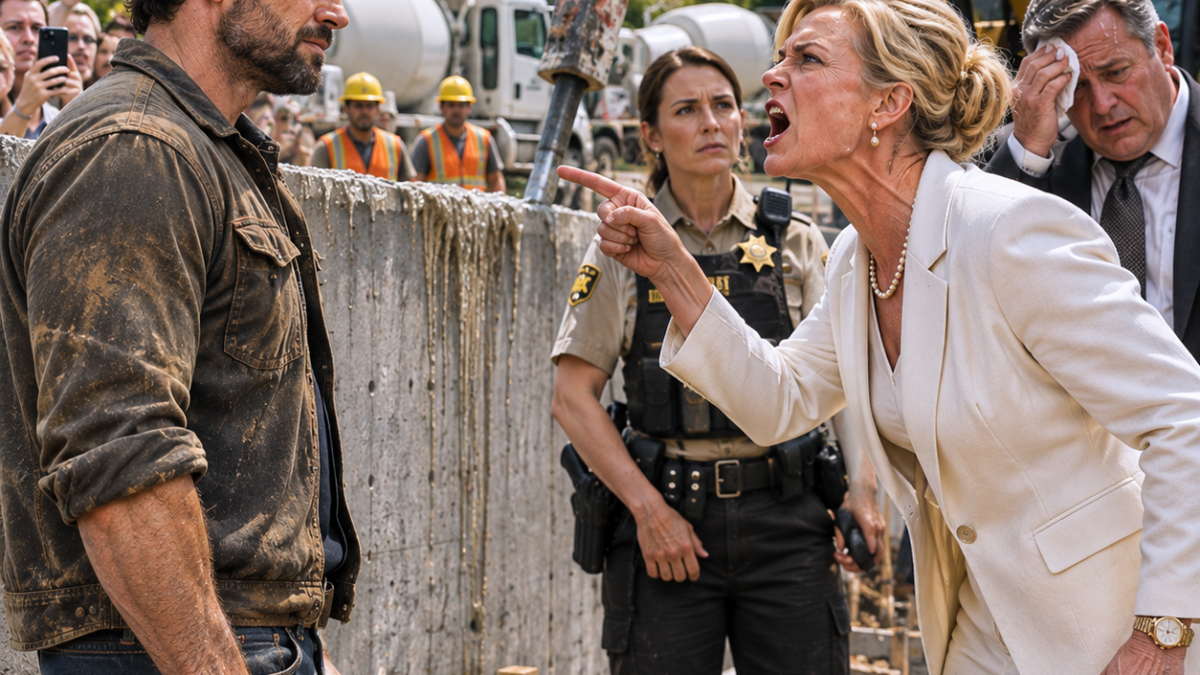
Two concrete trucks were still idling beside my dead father’s property when the HOA president pointed at the six-foot wall she had poured across his land and smiled. “We already poured it, Rhett. It’s too late.”
She even produced a “boundary agreement” carrying my father’s signature—until I noticed the document was dated four months after the day we buried him.
The next morning, a judge authorized me to remove every inch of that wall, and when my hydraulic breaker split the first section open in front of 128 furious homeowners, everybody finally saw why a $410,000 project had barely enough steel inside to stand.
My name is Rhett Danner.
I was fifty-one years old when Kristen Ballard poured 140 feet of concrete eleven feet inside my property and told me I should accept it because concrete was permanent.
She had clearly never met an excavation contractor.
Concrete is many things.
Permanent is not one of them.
I had spent thirty years breaking concrete.
Foundations.
Parking decks.
Bridge abutments.
Industrial slabs.
Retaining walls.
I owned Danner Excavation & Sitework, a company my father helped me start when I was twenty-three with one used backhoe, a borrowed dump truck, and the kind of optimism only young men with no money seem capable of having.
By fifty-one, I owned excavators large enough to pick up a pickup truck.
Hydraulic breakers.
Dozers.
Crushers.
Loaders.
Crews who could remove a bad foundation before most homeowners finished arguing with their insurance company.
So when Kristen smiled at me beside that wall and said:
“We already poured it.”
What she meant was:
I think you’re powerless now.
What I heard was:
I hope you brought the right attachment.
But I’m getting ahead of myself.
Six months earlier, my father died.
Vernon Danner.
Seventy-nine.
Cancer.
Quick at the end.
Slow before that.
My mother had died years earlier, so Dad left everything equally between my sister and me except one strange piece of land.
A strip behind Maple Ridge Estates.
Thirty-four feet wide at the narrow end.
Fifty-two at the widest.
Almost eight hundred feet long.
Not enough to build a house on.
Not enough to farm.
Not particularly valuable by itself.
But Dad cared about that strip more than properties worth twenty times as much.
He had bought it in 1998 when the old farmland behind Maple Ridge was subdivided.
The developer wanted the strip.
Dad refused.
Why?
Drainage.
Access.
And stubbornness.
Mostly stubbornness.
PART2:
The strip followed an old survey line behind sixteen homes and touched a drainage easement near the south end.
Dad used it to reach a small timber parcel he owned beyond the subdivision.
Every Sunday morning, weather permitting, he walked that boundary.
Same route.
Same old walking stick.
Sometimes I joined him.
When I was younger, I thought it was pointless.
“Dad, the dirt isn’t going anywhere.”
He would tap one brass survey cap with his boot.
“Dirt doesn’t.”
Then point toward the houses.
“People do.”
I laughed.
He didn’t.
“Son, never let anybody move this line.”
That sentence became family folklore.
My sister would tease him.
“Dad thinks the HOA is going to steal Tennessee one foot at a time.”
He would answer:
“They only need eleven inches if nobody checks.”
Turns out he was off by ten feet and one inch.
After he died, the strip came to me.
My sister got his lake cabin.
PART3:
I got the weird grass.
Fair trade.
Six weeks after probate cleared, Kristen Ballard called.
President of Maple Ridge Estates HOA.
I already knew her.
Everybody around Maple Ridge did.
Fifty-eight.
White Mercedes.
White suits.
Dark hair cut sharp at the jaw.
She spoke like every sentence was already approved by a committee.
“Mr. Danner.”
“Rhett.”
“I’d like to discuss the rear boundary.”
“What about it?”
“The association is planning a privacy and storm-control wall.”
“Okay.”
“We’d like to acquire your strip.”
“No.”
Silence.
I think she expected negotiation.
She tried again.
“You haven’t heard the offer.”
“Doesn’t matter.”
“Nine thousand dollars.”
“No.”
“For land you’re not using.”
“I use it.”
“For what?”
“Being mine.”
That answer irritated her.
I could hear it.
“Rhett, the strip has very little independent market value.”
“Then you won’t miss it.”
Another pause.
“The board has already approved the wall concept.”
“Build it on your side.”
“That would reduce common-area width.”
“Sounds like a design problem.”
She became colder.
“Everyone sells eventually.”
I remember that exactly.
Not because it sounded threatening.
Because it sounded rehearsed.
Like she had used the sentence before.
I replied:
“My father didn’t.”
Then hung up.
Three weeks later, I received a formal purchase offer.
$9,000.
I declined in writing.
A week after that:
$14,500.
Declined.
Then a letter from the HOA attorney suggesting there might be “historic uncertainty regarding the true boundary location.”
That got my attention.
I called my attorney.
Daniel Whitaker.
Daniel had represented my company for twelve years.
Dry sense of humor.
Excellent memory.
Terrible ties.
I emailed him the letter.
He called.
“Do you have your father’s survey?”
“Probably.”
“Probably is not a legal category.”
“He had everything.”
“Find it.”
I drove to Dad’s workshop.
His paperwork system was chaotic but strangely complete.
Metal file box.
Deeds.
Tax receipts.
Old surveys.
Equipment manuals for machines he had sold twenty years earlier.
I found the 1998 survey.
Stamped.
Recorded.
Brass pins noted.
Coordinates.
Clear line.
I sent Daniel a scan.
He replied:
Looks straightforward. Don’t sign anything.
I didn’t.
Then work got busy.
Danner Excavation won a three-day emergency drainage job near Knoxville, almost four hours away.
Culvert failure.
Commercial property flooding.
I left Tuesday morning.
Second night, 10:47 p.m., my phone rang.
Lena Hartwell.
She lived in the last house backing up to Dad’s strip.
Sixty-four.
Retired school librarian.
Dad had known her twenty years.
I answered:
“Lena?”
“Rhett.”
Her voice shook.
“What happened?”
“They’re pouring concrete.”
I sat upright in the motel bed.
“Where?”
“Your father’s land.”
I was already reaching for my jeans.
“Who?”
“HOA crew.”
“What are they pouring?”
“The wall.”
Silence.
“They started this afternoon.”
“Why didn’t you call?”
“I thought you knew.”
“I don’t.”
“Rhett.”
“Yes?”
“It’s huge.”
I looked at the clock.
“Take pictures.”
“I already have.”
“Don’t confront anyone.”
“Kristen is here.”
“Especially her.”
I called my foreman.
Handed the drainage project to him.
Then drove through the night.
Four hours.
Coffee.
Gas station sandwich I never ate.
Anger keeps you awake better than caffeine.
I reached Maple Ridge shortly after sunrise.
Lena had not exaggerated.
Two mixer trucks.
Pump equipment.
Concrete crew.
Forms.
And a wall.
Six feet tall.
Approximately 140 feet long.
Fresh gray concrete.
Still dark with moisture.
Running exactly where Dad’s grass strip had been.
For several seconds, I did not get out of the truck.
I just stared.
That land was not beautiful.
No sentimental farmhouse.
No family cemetery.
No giant oak planted by ancestors.
Grass.
Survey pins.
Drainage swale.
Yet I felt something almost physical seeing that wall.
Because I could hear Dad.
Never let anybody move this line.
I stepped out.
Neighbors were already gathering.
Phones out.
Workers paused.
Then Kristen came around the end of the wall.
White suit.
Sunglasses.
No hard hat.
Naturally.
“Rhett.”
I looked at her.
She smiled.
“We already poured it.”
I said nothing.
“It’s done.”
Still nothing.
She tilted her head.
“It’s too late.”
Behind her, HOA treasurer Doug Hensley stood near a pickup.
Late fifties.
Heavyset.
Khaki pants.
Polo shirt.
He kept wiping his forehead even though the morning was cool.
That registered.
Not yet important.
Just strange.
I walked toward the wall.
Kristen followed.
“You need to stay outside the construction zone.”
“This is my land.”
“That’s disputed.”
“No.”
“It has been resolved.”
I stopped.
“By who?”
“The board.”
I laughed once.
“You don’t resolve private boundaries with a board vote.”
She opened a leather folder.
Pulled out one page.
“Boundary agreement.”
I looked.
Typed legal description.
Transfer language.
Consent to HOA use.
At the bottom:
Vernon Danner.
My father’s signature.
My stomach dropped.
It looked right.
Not vaguely right.
Right.
Dad’s V leaned forward.
The last r in Danner curved upward.
He had signed thousands of checks the same way.
Kristen saw my face.
Her smile grew.
“Your father settled this years ago.”
I took the page.
She pulled it back.
“Copy only.”
“When?”
“It’s dated.”
I looked at the date.
Didn’t register fully at first.
Too much adrenaline.
March 14, 2021.
I kept staring.
Something bothered me.
But Dad’s death, paperwork, dates—they blurred for a second.
Kristen said:
“The association relied on that agreement.”
“Recorded?”
“Our counsel has the file.”
“That’s not what I asked.”
She crossed her arms.
“We acted legally.”
I called the sheriff.
Deputy Lacey Burns arrived thirty minutes later.
Lacey was younger than me.
Professional.
Calm.
She listened to both sides.
Viewed my deed.
Viewed Kristen’s document.
Walked the property.
Then said what I expected.
“Rhett, right now this is a civil boundary dispute.”
Kristen smiled.
Lacey continued:
“I can keep the peace.”
“But I can’t decide title here on the roadside.”
I nodded.
Fair.
Kristen said:
“Thank you, Deputy.”
Lacey looked at her.
“That was not a ruling in your favor.”
Kristen’s smile tightened.
“I understand.”
No, she didn’t.
Lacey left.
Workers resumed cleanup.
Kristen walked toward her Mercedes.
Doug remained.
Sweating.
I watched him.
Then I walked the wall.
Slowly.
Dad taught me something else.
When angry, inspect.
Physical evidence does not care how you feel.
Fresh wall.
Form lines.
Drainage cut.
Compacted fill.
Then near the south end, something glinted beneath wet concrete splatter.
Brass.
I crouched.
Scraped mud away with my fingers.
Bent brass survey cap.
Dad’s original boundary marker.
Not where it belonged.
Crushed.
Half buried beside the wall footing.
I photographed it.
Then looked along the expected line.
Small disturbed hole.
Fresh dirt.
Someone had removed the pin.
Survey monuments do not climb out of the ground by themselves.
My anger became much colder.
That evening, I went to Dad’s workshop.
Metal file box on the bench.
I pulled everything.
1998 survey.
Closing documents.
Tax maps.
Old photographs.
Then I opened the photo I had taken of Kristen’s boundary agreement.
Zoomed in.
March 14, 2021.
I stared.
Dad died November 22, 2020.
Four months earlier.
I checked again.
Death certificate.
November 22, 2020.
Agreement:
March 14, 2021.
I sat down.
Read both dates again.
Then again.
My father had apparently signed a boundary agreement after he was dead.
I did not sleep.
At 6:01 a.m., I called Daniel.
He answered on the fourth ring.
“Someone better be arrested.”
“Not yet.”
“What happened?”
“They forged Dad.”
Silence.
“What?”
I explained.
Wall.
Agreement.
Date.
Survey pin.
Daniel became completely awake.
“Send everything.”
I did.
Five minutes later:
“Rhett.”
“Yes?”
“We need three things.”
I grabbed a pen.
“Original recorded plat.”
“Okay.”
“Professional survey proving current encroachment.”
“Okay.”
“And evidence establishing that agreement is forged or invalid.”
“I have Dad’s death certificate.”
“That helps enormously.”
Then:
“And we need all of it before they pour anything else.”
County recorder opened at eight.
I was waiting at 7:42.
Frances Nolan had worked there thirty years.
Red-framed glasses.
Gray hair.
Zero patience for paperwork nonsense.
Daniel joined me.
We requested the 1998 plat.
Frances found it.
Clear.
Dad’s strip.
Recorded survey.
No transfer to Maple Ridge.
Then Daniel handed her the HOA boundary agreement copy.
“Can you find this?”
She searched.
Nothing.
Different indexing.
Nothing.
Owner name.
Nothing.
Not recorded.
Frances leaned closer.
Looked at the notary stamp.
Her eyes narrowed.
“Wait.”
She opened another database.
Typed the notary name.
Then looked at us.
“This commission expired in 2019.”
Daniel asked:
“Agreement is dated 2021.”
“Yes.”
“Could it still be valid somehow?”
“Not with that stamp.”
She looked at Dad’s signature.
Then the date.
“When did Mr. Danner die?”
“November 2020.”
Frances lowered the paper.
“This is not a clerical mistake.”
No.
It wasn’t.
By noon, licensed surveyor Marisol Ruiz was on site.
I had worked with her on commercial projects.
Precise.
Serious.
She set the total station.
Shot monuments.
Compared recorded bearings.
Located surviving markers.
Then shot the wall.
Once.
Again.
Third time.
She walked toward me.
“How bad?”
“Eleven feet.”
I stared.
“Consistent?”
“Almost the full 140 feet.”
“Inside me?”
“Yes.”
She showed the screen.
Wall line.
Recorded property line.
Eleven-foot encroachment.
Then she took me to two missing pin locations.
Fresh disturbance.
Tool marks.
One shallow excavation.
“These were pulled recently.”
“How recently?”
“Can’t date precisely.”
She pointed toward the soil.
“But this isn’t old disturbance.”
Lena called that afternoon.
“Come over.”
I walked to her house.
She had coffee.
Laptop open.
“I remembered something.”
“What?”
“My doorbell camera points toward the rear walkway.”
She pulled footage.
Timestamp.
5:12 a.m.
Two days before the concrete pour.
Dark.
Infrared.
A figure walked behind her fence.
Doug Hensley.
HOA treasurer.
He carried a pry bar.
He knelt where one survey marker had been.
Worked.
Rocked.
Pulled.
Then stood holding something.
Brass pin.
My chest tightened.
Lena whispered:
“Watch the corner.”
I did.
Another figure.
Kristen.
Standing ten feet away.
Arms folded.
Watching.
Doug removed the pin.
Kristen pointed toward the next location.
No audio.
Didn’t need it.
I called Daniel.
His response:
Save original file. Make three copies. Do not send it around the neighborhood.
Good advice.
That evening Kristen came to my house.
No white suit this time.
Casual sweater.
Smile.
“Can we talk like adults?”
“Depends.”
She stepped onto the porch.
“I think this has become unnecessarily emotional.”
“You forged my dead father’s signature.”
Her smile tightened.
“That’s an accusation.”
“It’s a date.”
Silence.
Then she pulled out an envelope.
“Twenty thousand dollars.”
“For?”
“You sign a release.”
“No.”
“Rhett.”
“No.”
“The wall stays.”
“No.”
“You receive twenty thousand.”
“No.”
“We avoid litigation.”
“No.”
Her face changed.
“What do you want?”
“My land.”
“It’s eleven feet.”
“My eleven feet.”
She exhaled.
“You’re being unreasonable.”
I looked at her.
“My father’s name is on your fake paper.”
She stopped breathing for half a second.
I continued:
“You can’t afford what that costs.”
Then closed the door.
Daniel filed for emergency injunctive relief the next morning.
Trespass.
Encroachment.
Preservation of evidence.
Temporary restraining order preventing additional construction.
The hearing happened quickly because concrete trucks were scheduled again.
Judge Thomas Ellison.
Late sixties.
Quiet voice.
The kind of judge who rarely needed to repeat himself.
Kristen appeared with HOA counsel.
Doug appeared too.
Looked sick.
Daniel presented:
1998 recorded plat.
Dad’s deed.
Death certificate.
Unrecorded boundary agreement dated four months after his death.
Expired notary commission.
Ruiz survey.
Photographs of removed brass pins.
Doorbell footage.
The judge watched Doug pull the marker.
Then paused the video.
“Mr. Hensley.”
Doug looked up.
“That is you?”
His attorney whispered.
Doug answered:
“Yes.”
“Who directed you to remove that survey monument?”
Kristen’s attorney stood.
“Objection—”
Judge:
“I am not conducting the criminal trial counsel apparently imagines may soon exist.”
Silence.
He looked at the boundary agreement.
Then at Kristen.
“Ms. Ballard, your position is that the association relied on this document?”
“Yes, Your Honor.”
“Signed by Vernon Danner?”
“Yes.”
“On March 14, 2021?”
“Yes.”
Judge Ellison looked at Dad’s death certificate.
“Mr. Danner died November 22, 2020.”
Kristen shifted.
“We were told the agreement had been executed previously and dated later for board records.”
Daniel stood.
“No evidence supports that.”
Judge looked at Kristen.
“Do you have an earlier executed original?”
“No.”
“Recorded version?”
“No.”
“Valid acknowledgment?”
Her attorney answered:
“No, Your Honor.”
Kristen tried:
“Possession matters.”
Judge Ellison looked over his glasses.
“So does a calendar.”
Even Daniel smiled.
The order came fifteen minutes later.
The wall was an unlawful encroachment based on the evidence before the court.
No additional concrete.
No alteration of property markers.
No interference with removal.
I was authorized to remove the encroaching wall, with costs preserved for later allocation.
The HOA was ordered to maintain all financial and project records.
Judge Ellison specifically referred the apparent forged document and survey-monument interference to law enforcement.
Kristen’s face went white.
Outside the courthouse, she said:
“You won’t actually tear it down.”
I said:
“Watch me.”
Next morning, I loaded my excavator.
Not the largest.
Didn’t need it.
Forty-thousand-pound machine.
Hydraulic breaker attachment.
I drove the lowboy to Maple Ridge.
Neighbors were waiting.
News had traveled.
Phones.
Coffee.
Folding chairs.
I swear one man brought a lawn chair.
Lena stood near her driveway holding lemonade.
Deputy Burns was there because the court order permitted removal and everybody expected trouble.
I unloaded.
Then two white mixer trucks turned onto the street.
I stopped.
Kristen stood near the construction entrance waving them forward.
“Pour it all.”
Deputy Burns stepped out.
“Stop.”
Truck one stopped.
Truck two stopped.
Kristen shouted:
“Thicken the footing.”
Lacey walked directly toward the lead driver.
Held up the court order.
“You have been ordered not to pour.”
Driver leaned out.
“I was told order was cleared.”
“It was not.”
He shut down.
Second driver did too.
Kristen marched over.
“You cannot block an HOA contractor.”
Lacey replied:
“I’m enforcing a court order.”
“The wall is already cured.”
“Not relevant.”
“It’s concrete.”
Lacey stared.
“Yes.”
Kristen pointed toward me.
“He cannot undo this.”
I climbed into the excavator cab.
Opened the window.
Kristen shouted:
“It’s too late.”
I looked at her.
“No.”
Then:
“It’s never too late.”
I closed the window.
Started the machine.
Hydraulic breaker rose.
The street went quiet.
First strike.
BOOM.
The sound traveled through the neighborhood.
Concrete dust jumped from the top edge.
Phones rose.
Second strike.
BOOM.
Hairline crack.
Third.
Chunk broke loose.
Dropped.
Kristen screamed:
“Stop him!”
I kept working.
Lacey stepped between her and the machine.
“Stay back.”
“He’s destroying HOA property!”
“No.”
“He’s destroying evidence!”
That was almost funny.
Daniel had already documented everything.
Samples too.
Dimensions.
Rebar scans.
Invoices preserved.
Nothing important was being lost.
Then the breaker opened the wall.
And we saw inside.
I stopped.
Even from the cab, something looked wrong.
I climbed down.
Marisol Ruiz was nearby.
So was one contractor.
We examined the broken section.
Rebar.
Too little.
Spacing far wider than plans typically required for the claimed structure.
Large voids.
Poor consolidation.
Thin sections.
Then the footing.
Barely six inches deep in places.
I stared.
This wall had supposedly cost:
$410,000.
I knew concrete.
Labor.
Reinforcement.
Pump costs.
Equipment.
Even with inflated pricing?
This was nowhere close.
A man walked through the crowd.
Cap in both hands.
Mike Talbert.
Contractor.
I recognized him from the trucks.
He walked to Deputy Burns.
“I need to talk.”
Kristen shouted:
“Mike, go home.”
He ignored her.
Lacey said:
“About what?”
“The wall.”
Kristen:
“Mike.”
He looked at her.
Then at the broken concrete.
“I’m done.”
Silence.
“What do you mean?”
Lacey asked.
Mike swallowed.
“The invoice says four-ten.”
“Yes.”
“Real build cost was around one-eighteen.”
People started murmuring.
Kristen pushed forward.
“He’s lying.”
Mike continued.
“Doug told me to pour before any survey came out.”
Doug, standing near the clubhouse path, went pale.
Mike said:
“They wanted thin reinforcement.”
Kristen screamed:
“Stop talking.”
Mike looked directly at Lacey.
“They paid me additional cash.”
“How much?”
“Forty thousand.”
“For?”
“Keep quiet.”
Silence swallowed the street.
Then someone behind me said:
“We paid thirty-two hundred dollars each.”
Another:
“All of us.”
128 homes.
$3,200.
That equals $409,600.
Almost exactly the invoiced amount.
The wall was the special assessment.
Every family had paid.
And now the wall was cracking open physically and financially at the same time.
Doug broke.
Not dramatically.
He just sat on the curb.
Put his face in his hands.
Then said:
“She told me nobody would ever check.”
Kristen spun.
“Doug, shut up.”
He looked up.
Tears.
“She said Rhett would eventually sell.”
“Stop.”
“She said if we poured first, possession would force settlement.”
“Doug.”
“She told me to move the pins.”
The neighbors went from quiet to furious.
One man shouted:
“You charged us four hundred thousand dollars!”
A woman:
“Where’s the rest?”
Another:
“Where’s our money?”
Kristen backed away.
Then a dark sedan arrived.
Detective Carla Dunn.
County financial crimes.
Folder under one arm.
She had been notified after Judge Ellison’s referral.
Carla walked toward Kristen.
“Ms. Ballard?”
Kristen stared.
“I’m busy.”
“I need to speak with you regarding a property document submitted in connection with this construction.”
Kristen said nothing.
Carla continued:
“And a notary seal.”
That was the first time I saw Kristen completely speechless.
No clipboard.
No quote.
No rule.
Nothing.
I climbed back into the excavator.
Started the breaker.
And finished the wall.
Section by section.
Boom.
Crack.
Collapse.
Boom.
Crack.
Collapse.
Concrete dust drifted across what had been Dad’s grass.
Neighbors watched.
Some cheered.
I didn’t.
Not really.
This wasn’t revenge.
It felt more like correction.
When the last section dropped, I shut the machine down.
Silence.
Then breeze moved the dust.
And there it was.
Dad’s strip.
Open.
Ugly.
Torn up.
But visible again.
The line.
Marisol reset the brass markers that afternoon.
Correct coordinates.
New witness stakes.
Documented.
Photographed.
Recorded.
I stood over the south marker.
Remembered Dad tapping the old one with his boot.
Never let anyone move this line.
Lena stood beside me.
“You okay?”
“Yeah.”
“You don’t look okay.”
“I’m tired.”
She smiled.
“Your father would’ve loved the jackhammer.”
I laughed.
“Yes.”
“He absolutely would.”
The HOA emergency meeting happened four days later.
Packed clubhouse.
People lined walls.
Independent attorney present.
Forensic accountant.
Temporary board chair.
Kristen did not preside.
She had been suspended.
Doug had resigned.
The audit was still preliminary, but enough was known.
128 households.
$3,200 special assessment each.
$409,600 collected.
Wall contractor invoice:
$410,000.
Documented actual construction costs:
approximately $118,000.
Cash disbursements.
Unexplained consulting fees.
Payments to intermediaries.
Several transactions linked to entities connected to Kristen and Doug.
The exact amount of fraud took months to establish.
That matters.
Neighbors wanted instant answers.
Real accounting does not work instantly.
But the scheme was clear enough.
The wall had not been primarily about privacy.
It had been a billing vehicle.
An expensive project with poor oversight.
Inflated invoices.
Cheap construction.
Difference moved elsewhere.
And my strip had made the project cheaper.
Instead of buying land legitimately, Kristen decided the HOA would simply claim it.
Create paper.
Move markers.
Pour fast.
Then tell me:
Too late.
That phrase was not arrogance alone.
It was strategy.
Once concrete existed, they expected me to negotiate rather than destroy it.
They were almost right.
Most people would.
Litigation is expensive.
Removal is disruptive.
Once something large exists physically, people tend to accept it.
That is why they poured before the survey.
Physical facts create psychological pressure.
Except I owned a hydraulic breaker.
And a very good attorney.
The homeowners voted 118 to 6 to remove the remaining board members who had approved or failed to scrutinize the project.
Six votes against.
One came from Kristen’s husband.
Fair enough.
Refunds could not happen immediately because the money had to be recovered.
Again, reality.
Insurance.
Restitution.
Asset recovery.
Civil claims.
Contractor settlements.
Months.
Some residents eventually received full recovery through multiple sources.
Others in installments.
But the association rebuilt its reserves over time.
At the final civil hearing, Judge Ellison awarded me removal costs, survey expenses, restoration costs, attorney fees where permitted, and trespass-related damages.
Combined exposure attributed to the HOA and responsible parties reached $186,400 under the final orders and settlements.
The number sounds satisfying.
It wasn’t.
Money cannot erase seeing your father’s name forged.
That was the part I cared about.
Criminal proceedings took longer.
Kristen faced charges involving forgery, fraud-related conduct, and false instruments.
Doug cooperated.
Mike Talbert cooperated.
The notary stamp turned out to have been copied from an old real estate document Kristen already possessed.
The notary herself had retired years earlier.
She had nothing to do with it.
Dad’s signature?
Investigators found a scanned copy on an old easement agreement.
They had digitally lifted it.
Dropped it onto the fake boundary agreement.
That made me angrier than the land.
My father had signed that original paper trusting the signature would mean what he intended it to mean.
Someone turned it into a tool after his death.
Kristen eventually accepted a plea agreement.
Restitution.
Criminal penalties.
No dramatic lifetime prison sentence.
No Hollywood ending.
But enough.
Doug received reduced consequences for cooperation and restitution assistance.
Mike lost money, reputation, and faced contracting penalties.
He testified.
I did not forgive him quickly.
He knew the work was substandard.
He knew something was wrong.
Cash helped him stop asking.
That matters.
Months later, he came to my office.
No lawyer.
No cap this time.
“Rhett.”
“What?”
“I’m sorry.”
I waited.
“I should’ve walked.”
“Yes.”
“I knew the numbers were wrong.”
“Yes.”
“I told myself it was HOA politics.”
“That concrete was on my land.”
“I know.”
“You poured it.”
“I know.”
He looked down.
“I’m not asking you to make me feel better.”
Good answer.
I said:
“Then don’t do it again.”
He nodded.
That was all.
People sometimes expect stories like this to end with everybody becoming friends.
No.
Life is not required to provide emotional symmetry.
Sometimes accountability is enough.
I rebuilt the strip.
First, removed concrete debris.
Then bad fill.
Regraded.
Restored drainage.
Topsoil.
Seed.
Dad would have complained about the seed mix.
He had opinions.
Lena organized neighbors.
At first I resisted.
“This is my land.”
She said:
“Yes.”
“So why are thirty people carrying shovels?”
“Because they want to help.”
“I have employees.”
“Your employees are paid to tolerate you.”
Fair.
We planted three young oak trees.
Not because Dad had asked.
Because Lena said the strip needed something living after all that concrete.
We also installed one bench.
Simple.
Cedar.
No plaque initially.
I refused.
Then someone anonymously added a small brass plate.
CHECK THE DATE.
I knew immediately who.
Lena denied it badly.
I left it.
Weeks later, I went back into Dad’s workshop.
I had avoided it.
Too many papers.
Too many memories.
I started organizing the metal file box properly.
Deeds.
Receipts.
Tax documents.
Then found one sheet folded beneath a 1998 survey envelope.
Dad’s handwriting.
Short note.
Probably written years earlier.
It said:
Rhett—
Land disputes make people stupid.
Never trust a fence because it’s standing.
Never trust a pin because somebody points at it.
Never trust paper because it looks official.
Check the survey.
Check the recording.
Check the date.
If somebody says it’s too late, check again.
—Dad
I sat on the workshop stool.
Read it twice.
Then laughed.
Because somehow the old man had managed to leave instructions for a fight he never knew would happen.
I framed that page.
Not the court order.
Not Kristen’s fake agreement.
Dad’s note.
The neighborhood changed after the wall.
Maple Ridge had spent years afraid of Kristen.
Not physically.
Socially.
She controlled meetings.
Committees.
Violations.
Favors.
Contractors.
People learned that questioning her created trouble.
So they stopped.
That silence made the wall possible.
Not because every board member was corrupt.
Most weren’t.
Some were lazy.
Some intimidated.
Some trusted her.
Some assumed somebody else had checked.
That phrase again.
Somebody else checked.
Doug assumed Kristen checked.
Contractor assumed HOA checked.
Board assumed counsel checked.
Neighbors assumed survey checked.
Nobody did.
Until concrete was standing.
The new board changed procedures.
Major capital projects required independent bids.
Recorded land verification before construction.
Conflict disclosures.
No single officer could approve property agreements.
Survey monument interference required immediate legal review.
Special assessments needed itemized project budgets.
Independent inspection before final payment.
Boring safeguards.
The best kind.
Boring systems prevent exciting disasters.
The new board president was Lena Hartwell.
She hated the idea.
Everybody voted for her anyway.
At her first meeting, she said:
“I have one policy.”
People waited.
“If someone says ‘trust me,’ we ask for paperwork.”
I laughed from the back row.
She pointed at me.
“This is his fault.”
Probably.
The strip behind Maple Ridge became nicer than it had ever been.
Grass.
Oaks.
Bench.
No wall.
Residents used a legal walkway on their side.
I occasionally saw people sitting on the bench.
Technically mine.
I never cared.
Dad’s lesson was not:
Keep everyone off your land.
It was:
Know where your land ends.
There is a difference.
Property rights are not about hostility.
Boundaries make cooperation possible.
If both people know where the line is, they can decide when crossing is okay.
The problem begins when one side decides the line is optional.
Kristen believed concrete could create ownership.
That if she built fast enough, large enough, expensive enough, reality would follow.
But concrete does not move a deed.
A wall does not relocate a survey.
An HOA vote does not revive a dead man and make him sign paperwork.
Physical control is not legal ownership.
That should be obvious.
Yet history is full of people betting nobody will challenge what is already standing.
One afternoon, about a year later, I was at the strip replacing one bench board.
A new Maple Ridge resident stopped.
Young guy.
Maybe thirty.
He had heard the story.
“This is where the wall was?”
“Yes.”
“All 140 feet?”
“Yes.”
“Six feet high?”
“Yes.”
“And you demolished it yourself?”
“Company equipment.”
He pointed toward the brass cap.
“That the property marker?”
“Yes.”
He crouched.
Looked.
Then said:
“Crazy.”
“What?”
“That something that small decided where a wall that big could go.”
I looked at the survey cap.
He was right.
Two inches of brass.
Six-foot concrete wall.
The small thing mattered more.
Because size does not determine legitimacy.
Documentation does.
That became my favorite part of the story.
Not the breaker.
Everyone loves the breaker.
Videos of the demolition circulated for months.
The first hit.
Concrete exploding.
Kristen screaming.
Dust.
People online loved it.
Of course they did.
Machines destroying expensive things are satisfying.
But the breaker did not win.
The survey did.
The death certificate did.
The expired notary stamp did.
The doorbell camera did.
The recorded plat did.
The breaker only removed what those things proved did not belong there.
That distinction matters.
Otherwise the lesson becomes:
Get a bigger machine.
The real lesson is:
Get better evidence.
Years later, people still occasionally send me the video.
“Is this you?”
Unfortunately.
“You really said ‘It’s never too late’?”
Yes.
“That line was badass.”
I cringe.
It sounded better in the moment.
My daughter says I should put it on company shirts.
Absolutely not.
Danner Excavation already gets enough jokes.
Although one employee had a sticker made:
TOO LATE?
CALL DANNER.
I fired him.
Not really.
Promoted him later.
Kristen sold her house after the case ended.
I never spoke to her again.
Once, I saw her at the courthouse.
She looked older.
No white suit.
She looked toward me.
I nodded.
She looked away.
That was enough.
I did not need her apology.
Did not need revenge.
Did not need some final speech where she admitted Dad was right.
The line was restored.
The record was corrected.
The fraud was exposed.
That was enough.
Doug wrote me once.
Short letter.
He apologized for removing the markers.
Said Kristen convinced him that if they reset them after construction, nobody would be harmed.
That sentence disturbed me.
Nobody would be harmed.
People say that before doing a lot of harmful things.
They narrow harm to something immediate.
Nobody got punched.
Nobody got injured.
Therefore no harm.
But property fraud harms.
Financial deception harms.
Using a dead man’s signature harms.
Making 128 families pay for fake value harms.
Fear harms.
Trust destroyed inside a neighborhood harms.
Doug eventually understood that.
His letter ended:
I thought moving the pins changed the line.
It only showed everyone what kind of man I had become.
I kept the letter.
Not because I enjoyed his shame.
Because it was true.
Survey pins do not create the boundary by themselves.
They mark something already legally defined.
Pulling them does not move the land.
It only hides the evidence temporarily.
That could describe the entire scheme.
Kristen removed evidence.
Created substitute paper.
Poured substitute reality.
Then hoped permanence would defeat truth.
It didn’t.
Truth was sitting at the county recorder’s office the whole time.
Stamped in 1998.
Waiting.
Dad knew that.
He had spent his life around land.
Farmers.
Surveyors.
Contractors.
He knew fences move.
Creeks change.
Trees die.
Neighbors forget.
Paper matters.
Dates matter.
Records matter.
He was not sentimental about dirt.
He was disciplined about boundaries.
I finally understood why.
Three years after the case, the first oak we planted survived a windstorm that took down several mature trees nearby.
Lena called me.
“Your tree made it.”
“Not my tree.”
“Your land.”
“Fine.”
I walked out.
Branches bent.
Leaves missing.
Still standing.
The bench was wet.
Brass plate:
CHECK THE DATE.
I sat.
Looked down the old line.
No concrete.
No wall.
Just grass.
The subdivision behind it.
My timber access beyond.
Two properties existing side by side.
Exactly as they should.
I thought about Dad walking there every Sunday.
For twenty years.
Maybe he looked paranoid.
Maybe he was.
But vigilance often looks unnecessary until the day it becomes necessary.
That is the uncomfortable thing about boundaries.
Most days, they do nothing.
Then one day someone tests them.
After the wall case, Danner Excavation started offering one unusual service for certain property jobs.
Before major demolition involving disputed boundaries, we require independent survey verification.
Even if customer says:
“I know where the line is.”
We say:
“Show us.”
Some get annoyed.
Good.
I have seen what confidence costs.
One client once said:
“My neighbor knows this fence is wrong.”
I replied:
“Fence isn’t survey.”
He said:
“Everybody agrees.”
“Great. Survey anyway.”
He did.
Fence was right.
His memory was wrong.
Saved him a lawsuit.
Dad would have enjoyed that.
Maybe that is what his strip ultimately meant.
Not inheritance.
Instruction.
He left me land nobody else thought mattered.
Then somebody tried to take it because they assumed I would agree it didn’t matter either.
But value does not always come from what land can be sold for.
Sometimes value is the fact that someone you loved protected it, walked it, understood it, then trusted you to do the same.
Kristen offered $9,000.
Then $20,000.
Neither number mattered.
She thought every refusal was negotiation.
It wasn’t.
Sometimes no means no.
Sometimes eleven feet is eleven feet.
Sometimes a signature belongs to a dead man and cannot magically appear on paper four months later.
And sometimes a six-foot concrete wall that looks permanent is only three minutes away from meeting a hydraulic breaker.
That morning, Kristen stood beside the mixers believing the physical world had already settled the argument.
“We already poured it.”
She thought those four words ended everything.
But the deed existed before the wall.
The survey existed before the wall.
Dad’s death certificate existed before the wall.
The truth existed before the wall.
Concrete was simply covering it.
So I broke the concrete.
And underneath all the dust, noise, inflated invoices, forged signatures, missing reserve money, and people who had been too afraid to ask questions, the line was still exactly where my father left it.
It had never moved.
Only the people had.








