HOA Karen Parked Her Lexus Across My Farm Gate—Then My Bulldozer Took Down the $380,000 Plaza She Built 40 Feet Inside My Land.
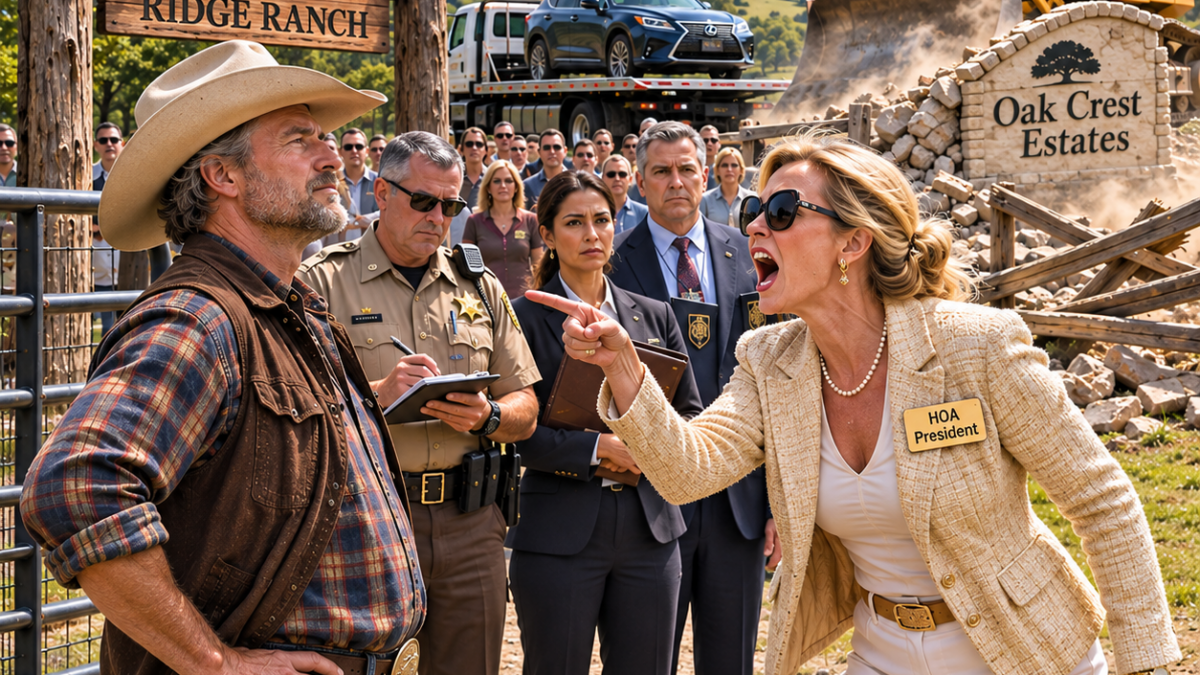
PART2:
Three years before everything happened, Oak Crest Estates appeared.
First roads.
Then curbs.
Then rows of beige and cream houses.
Perfect lawns.
Decorative stone mailboxes.
Clubhouse.
Pool.
Walking paths.
And an HOA rulebook thick enough to stop a small-caliber bullet.
Oak Crest bordered my ranch.
It did not include it.
That’s important.
My property was never annexed.
Never signed into the association.
Never subjected to their declarations.
No dues.
No architectural committee.
No covenants.
Nothing.
I didn’t dislike the neighborhood.
Most people living there were decent.
Families.
Retirees.
PART3:
People who wanted a quiet place.
Some waved when they drove past.
A few bought beef from me.
One guy named Samuel brought his son over to see the calves every spring.
No problem.
Then Vivian Sterling became HOA president.
I first met her on a Tuesday morning.
Cream jacket.
White jeans.
Large sunglasses.
Clipboard.
She stood outside my gate as if she were inspecting a failed military position.
I was repairing a hinge.
She called:
“Mr. Harlan?”
I looked up.
“Yes?”
“Vivian Sterling.”
“Okay.”
“President of Oak Crest Estates.”
I wiped grease from my hands.
“What can I do for you?”
She pointed at the gate.
“This entrance structure doesn’t meet Oak Crest aesthetic standards.”
I stared.
Then looked at the gate.
Then back at her.
“What?”
“The exposed steel.”
“Rust.”
“Commercial agricultural appearance.”
I laughed.
She didn’t.
“You’re serious?”
“Completely.”
“This gate was here before Oak Crest existed.”
“That doesn’t change visibility standards.”
“I don’t have your visibility standards.”
“You border the community.”
“So does the creek.”
She tightened her grip on the clipboard.
“Adjacent properties affect neighborhood values.”
“I own a cattle ranch.”
“Yes.”
“And?”
“We’re trying to maintain a consistent visual environment.”
I leaned against the gate.
“You want me to replace my grandfather’s gate because your residents can see it?”
“I want you to submit a compliance plan.”
“No.”
She blinked.
Not angry yet.
Surprised.
People like Vivian usually hear disagreement as a temporary malfunction.
She said:
“I’m not sure you understand.”
“I understand perfectly.”
I pointed toward Oak Crest.
“Your HOA starts over there.”
Then at my boots.
“My land starts here.”
She smiled.
But the smile had changed.
“You may find the distinction is less clear than you think.”
That was the first warning.
The letters started that week.
Certified mail.
Oak Crest letterhead.
Red text.
NOTICE OF EXTERIOR NONCOMPLIANCE
$200 PER DAY AFTER CURE PERIOD
Gate.
Fence.
Barn color.
Trailer visibility.
Livestock equipment.
One letter accused me of storing “commercial agricultural machinery” in a visible location.
It was a tractor.
On a ranch.
I pinned every letter to the wall of the feed room.
Hector Alvarez, my ranch hand, noticed after the sixth one.
“Boss.”
“Yeah?”
“You planning to wallpaper with those?”
“Maybe.”
He pulled one down.
“Two hundred a day?”
“Apparently.”
“You gonna answer?”
“No.”
“Why keep them?”
I took the letter.
Pinned it back.
“Paper trails go both ways.”
Hector nodded slowly.
“That’s ranch wisdom?”
“No.”
“Lawyer wisdom?”
“Soon.”
At that point, the letters were irritating.
Nothing more.
Then the survey ribbons appeared.
Bright pink.
My side of the creek.
At first I thought utility work.
I walked the line.
Ribbons ran from near the county road toward the northwest pasture.
They cut across ground I knew belonged to us.
I pulled one marker.
Then stopped.
Granddad’s voice in my head:
Never trust a fence more than a marker.
So I left them.
Took photographs.
Coordinates.
Dates.
Two weeks later, construction equipment appeared.
Not on Oak Crest property.
On mine.
A crew started setting posts.
I drove down in my truck.
Foreman waved.
I said:
“Who authorized this?”
“Oak Crest.”
“Who surveyed it?”
He looked at his paperwork.
“Development plat.”
“This is Harlan Ridge.”
He shrugged.
“I’m building where they marked.”
I asked him to stop.
He called someone.
Five minutes later, Vivian arrived.
Same sunglasses.
Different white outfit.
“Mr. Harlan.”
“You’re building on my land.”
“No.”
“Yes.”
She held out a map.
“This is Oak Crest common property.”
I looked.
Recorded plat.
It showed my gate road extending into an area labeled:
OAK CREST HERITAGE CORRIDOR
My stomach tightened.
I had never seen that designation in my life.
The map carried signatures.
County recording information.
Notary block.
At first glance, legitimate.
Vivian tapped it.
“See?”
I said:
“Give me a copy.”
She smiled.
“Public record.”
“Then I will.”
“Good.”
The crew kept working.
I didn’t stop them physically.
That surprised Hector.
“Boss.”
“I know.”
“They’re putting posts in our ground.”
“I know.”
“You want me to pull them?”
“No.”
“Why?”
“Because if I’m right, every dollar they spend makes the evidence better.”
He stared.
“You’re scary when you’re calm.”
“Good.”
Within a month, Oak Crest had built what they called the Heritage Entrance Plaza.
Wooden decorative fence.
Stone columns.
Landscaping.
Benches.
A paved overlook.
Brass plaque.
Native plants.
It looked expensive.
It also looked ridiculous sitting in my pasture.
Worse:
It sat deep inside my boundary.
I walked from Granddad’s brass marker near the creek.
Measured.
Forty feet.
Then farther.
The plaza extended even deeper.
That was enough.
I called the county.
They told me:
“Boundary dispute. Get a licensed survey.”
So I called Nora Quinn.
Best surveyor in three counties.
Expensive.
Worth every dollar.
Nora spent two full days on the ranch.
GPS rod.
Tablet.
Historic plats.
Deeds.
County records.
Old monument calls.
She walked sections I hadn’t seen anyone measure since my father was alive.
Late the second afternoon, she came back to the house.
Set her equipment down.
Didn’t speak for almost a minute.
That concerned me.
“Nora?”
She looked toward Oak Crest.
“Gideon.”
“What?”
“They didn’t miss by a few feet.”
“How bad?”
She turned the tablet.
Outlined area.
Two point three acres.
“The fence is yours.”
“The stone plaza is yours.”
“Most of that landscaping is yours.”
“The paved section crosses your line.”
I stared.
“Two point three?”
“Yes.”
“What about their plat?”
Her expression changed.
“That’s the other problem.”
We drove to county records.
Pulled everything.
The plat Vivian showed me was recorded.
That was true.
But when Nora compared it to older documents, something didn’t fit.
A property transfer.
Supposedly signed by a prior Harlan representative.
The signature looked convincing.
Notary stamp less so.
Wrong commission formatting.
Date mismatch.
Serial information inconsistent with the county’s records.
Nora said:
“I don’t certify fraud.”
“I certify boundaries.”
“But this needs an attorney.”
I knew exactly who to call.
Marissa Dell.
Land-use attorney in Fredericksburg.
Smart.
Fast.
Not impressed by titles.
She read the deed history.
Survey.
Plat.
Letters.
Photos.
HOA fines.
Then the notary issue.
Ten minutes.
No expression.
Finally, she closed the folder.
“We don’t argue with them.”
“Good.”
“We serve them twice.”
“Then?”
She looked at me.
“We let paper do the talking.”
The first notice went certified.
Demand to cease trespass.
Remove encroachments.
Correct false property claim.
Preserve all records.
Vivian signed for it.
Personally.
Ignored it.
Second notice was hand-delivered.
Deputy present.
She signed again.
Still nothing.
Marissa sought emergency relief.
The court issued an order.
Ten days.
Oak Crest had ten days to remove the encroachments from my property or allow me to remove them under specified conditions.
Everything documented.
No improvisation.
No revenge.
No touching structures before deadline.
Marissa told me:
“You follow this exactly.”
“I will.”
“No cowboy stuff.”
“I own cows.”
“You know what I mean.”
I did.
Day one.
Nothing.
Day three.
Nothing.
Day six.
Vivian sent an email claiming the court had “misunderstood community property rights.”
Marissa replied with one sentence:
The order remains in effect.
Day nine.
Nothing.
Day ten.
Nothing.
The deadline expired at midnight.
I had scheduled the dozer for nine the following morning.
Not because I wanted spectacle.
Because I had ranch work.
Also because I wanted witnesses.
Deputy Rutledge knew.
Marissa knew.
Survey stakes clearly marked.
Removal zone flagged.
Everything legal.
At four that morning, another problem arrived.
My best heifer, Daisy, was struggling.
First calf.
Labor had started early.
Hector found her separated from the herd.
Restless.
Not progressing.
I called Dr. Rachel Wood.
Large-animal veterinarian.
She said:
“I’ll head out.”
Daisy mattered.
Good bloodline.
Calm temperament.
But more importantly, an animal in distress isn’t a financial equation while you’re standing beside it.
By eight-thirty, Dr. Wood was close.
At 8:40, a navy Lexus turned onto my gravel lane.
Vivian.
She drove all the way to the main gate.
Then turned sideways.
Stopped directly across it.
Not near.
Across.
Blocking the entrance.
She stepped out.
Cream blouse.
White jeans.
Sunglasses.
Clipboard.
Of course.
I walked over.
“What are you doing?”
“Inspection.”
“Of what?”
“Unauthorized demolition preparations.”
I looked toward the dozer.
Engine warming near the barn.
Hector checking hydraulic lines.
“You received the court order.”
“I dispute it.”
“The judge didn’t ask.”
She smiled.
“You have ten minutes to clear your machinery from the heritage corridor.”
That phrase almost made me laugh.
“My machinery is on my ranch.”
“Not all of it.”
Right then, Dr. Wood’s white vet truck pulled up behind the Lexus.
Horn.
Once.
Then again.
Window rolled down.
“Gideon!”
I walked toward her.
She pointed at Vivian’s car.
“I can’t get through.”
Vivian didn’t even turn.
I said:
“Move the Lexus.”
“No.”
“Veterinarian needs access.”
“She can wait.”
I stared at her.
“Cow’s in labor.”
Vivian shrugged.
“Then perhaps you shouldn’t have such a narrow gate.”
Something in me went very still.
I asked once more.
“Move the car.”
She smiled.
Then held up the keys.
“You have ten minutes, Mr. Harlan.”
She turned.
Walked away.
Not toward her car.
Toward Oak Crest.
With the keys.
Dr. Wood shouted:
“Seriously?”
I called:
“Take the south service road.”
She grimaced.
“That adds twenty-five minutes.”
“I know.”
“Keep Daisy standing if you can.”
“I will.”
She reversed.
Drove away.
Hector looked at me.
“Boss.”
“Yeah?”
“What do we do?”
I reached into my shirt pocket.
Folded document.
Court order.
“Nothing illegal.”
He waited.
I looked toward the Lexus.
“I just stopped waiting.”
I had already called Deputy Rutledge at eight as a courtesy.
He arrived in under five minutes.
Pulled behind the Lexus.
Got out.
Looked at:
Private drive sign.
Blocked gate.
My deeded access.
Then me.
“She leave the keys?”
“No.”
“Tell you not to move it?”
“She told me I had ten minutes.”
Rutledge almost smiled.
“That’s generous.”
He photographed the vehicle.
Plate.
Position.
Gate.
Private-property sign.
Timestamp.
Then said:
“It’s blocking private access.”
“Tow.”
I nodded.
He called Ferris Towing.
Flatbed arrived twenty-five minutes later.
Driver winched the Lexus carefully.
No damage.
No scratches.
No theatrical pushing.
No bulldozer touching her car.
That’s important.
People later told the story like I shoved the Lexus with heavy equipment.
I didn’t.
I’m not stupid.
We moved it legally.
Cleanly.
By 8:52, according to Rutledge’s report, the Lexus was secured.
Headed to Ferris Towing.
I walked toward the dozer.
At the same time, residents started appearing along the Oak Crest side.
Phones.
Whispers.
Some had seen the tow truck.
Others knew about the court fight.
Hector opened my iron gate.
Wide.
Then removed the temporary safety chain along the marked demolition zone.
Across the creek, Oak Crest’s clubhouse was filling.
Vivian had apparently walked back there after blocking my gate.
Later, I learned she was telling board members:
“Gideon is threatening community assets.”
“We’ll have him arrested.”
Treasurer Roland Pettis sat at the table.
Sixty-three.
Former insurance adjuster.
Usually quiet.
His phone buzzed.
Message.
Deputy Rutledge.
Court order enforcement beginning at nine.
Roland read it.
Then looked at Vivian.
“Vivian.”
“What?”
“The plat.”
“What about it?”
“We can’t let this go to court.”
She snapped:
“It already went to court.”
“That’s what I’m saying.”
“Stop him.”
Roland didn’t move.
“Vivian.”
“Stop him.”
“I can’t.”
“Why?”
He looked at the other board members.
Because Roland knew more than he had ever admitted.
Nine o’clock.
I climbed into the dozer.
Engine low.
Diesel vibration through the seat.
Hands steady.
Marissa stood near the survey marker with a folder.
Deputy Rutledge stood far enough back to stay safe.
Nora’s boundary stakes were visible.
Everything inside the authorized removal zone.
I looked once toward the brass marker Granddad had shown me as a boy.
Then lowered the blade.
First wooden post.
Crack.
Loud.
Sharp.
Almost like a rifle shot.
The Heritage Fence leaned.
Second push.
It folded.
Dust rose.
Neighbors went silent.
I continued.
Post by post.
Section by section.
No rush.
No anger.
Just removal.
Illegal structure.
My land.
Court order.
For three weeks, I’d been waiting for that moment.
Not because destroying things feels good.
Because every day the fence stood was another day someone else’s sign told people my land belonged to them.
Then we heard screaming.
“STOP!”
I shut the dozer down.
Vivian came running.
White jeans already streaked with dust.
Boots slipping on gravel.
Hair loose.
Hands waving.
“STOP!”
She reached the gate.
Stared at the broken fence.
Then at me.
“You can’t do this!”
I climbed down.
Slowly.
“Morning, Vivian.”
“That’s community property!”
“No.”
“You’re destroying HOA assets!”
“No.”
She spun around.
Saw Deputy Rutledge.
“Arrest him.”
Rutledge didn’t move.
“Ma’am.”
“Where’s my car?”
He answered calmly:
“Towed.”
Her eyes widened.
“What?”
“Ferris Towing.”
“You had my Lexus stolen?”
“No.”
“You parked it blocking private access.”
“It was on HOA-controlled roadway.”
Rutledge pointed down.
“This is Mr. Harlan’s deeded driveway.”
She looked at me.
“You touched my car?”
I said:
“No.”
“Tow operator did.”
“Under deputy supervision.”
“No damage.”
Her face turned red.
Then she pointed toward the dozer.
“Arrest him for destruction of property.”
Rutledge opened his folder.
Court order.
He read the operative section aloud.
Oak Crest had failed to remove encroachments within ten-day deadline.
Property owner authorized to remove structures within surveyed boundary.
Costs subject to later allocation.
Vivian said:
“I never received that.”
Marissa stepped forward.
“Twice.”
Vivian froze.
Marissa held up the certified receipt.
Vivian Sterling signature.
Then the service acknowledgment.
Also signed.
“Certified mail.”
Marissa tapped one.
“Hand delivery.”
Tapped the other.
“Twice.”
Vivian’s mouth opened.
Nothing came out.
That’s when Roland appeared.
He walked from the Oak Crest side.
Face gray.
Hands shaking.
“Vivian.”
She turned.
“Not now.”
“Yes.”
“Roland.”
“We need to tell them.”
Her expression changed.
Tell them.
Not argue.
Not explain.
Tell them.
“What?”
he began.
“I signed what you gave me.”
Vivian stepped closer.
“Stop.”
Roland looked at the crowd.
Then me.
“She told us the plaza was on HOA land.”
No one spoke.
“She told us the plat had been cleared.”
Vivian said:
“It was.”
Roland shook his head.
“She told us the project cost three hundred eighty thousand dollars.”
A neighbor shouted:
“It did!”
Another:
“We paid the assessment!”
Roland closed his eyes.
Then:
“Every homeowner.”
Special assessment.
That was the first time I understood the full scale.
Oak Crest residents had paid a special assessment for the Heritage Plaza.
$380,000 total project cost.
Built largely on my land.
Using a plat whose notary documentation was now under question.
Roland continued:
“I signed payment authorization.”
“I trusted the documents.”
Vivian snapped:
“You approved everything.”
“Yes.”
“Then you’re responsible too.”
His face crumpled.
“Maybe.”
That answer quieted her.
Roland looked at me.
“I’m sorry.”
I didn’t answer.
Not yet.
My phone rang.
Dr. Wood.
For one second, all of Oak Crest disappeared.
“Rachel?”
“She got through it.”
I closed my eyes.
“Calf?”
“Healthy.”
“Daisy?”
“Exhausted.”
“Both fine.”
I exhaled.
Didn’t realize how tightly I’d been holding my breath.
“Thank you.”
“You owe me for the extra twenty-five minutes.”
“Send the bill.”
“Oh, I will.”
I hung up.
Hector looked at me.
I nodded.
“Both good.”
He smiled.
The crowd relaxed slightly.
Then another vehicle entered.
Black sedan.
State plates.
A man got out.
Navy blazer.
Leather folder.
He approached Marissa first.
She shook his hand.
Then he turned to me.
“Mr. Harlan?”
“Yes.”
“Owen Vickers.”
“State Attorney General’s Office.”
Vivian stopped moving.
Marissa had filed a complaint two weeks earlier.
Quietly.
Not because a state office resolves ordinary property disputes.
Because of the recorded plat.
Notary irregularities.
Assessment money.
Developer payments.
Possible forged documentation.
Vickers opened the folder.
He did not announce arrests.
Didn’t create a movie scene.
He identified himself.
Confirmed an investigation.
Requested preservation of Oak Crest records.
Then explained that his office was coordinating with county authorities regarding the questioned filing.
He mentioned developer Wesley Train.
Oak Crest’s original developer.
Vivian’s face changed again.
Roland whispered:
“Oh God.”
Vickers looked at him.
“You know Mr. Train?”
Roland nodded.
“Payments.”
“What payments?”
Vivian said:
“Do not answer without counsel.”
Vickers calmly replied:
“That’s your right.”
Then looked back at Roland.
Roland swallowed.
“The Heritage project.”
“Contractor?”
“Developer consulting.”
“How much?”
Roland looked at Vivian.
She stared at him.
Then away.
That told me enough.
Vivian finally said:
“I did it for property values.”
Nobody responded.
Not even her supporters.
Because by then the issue wasn’t aesthetics.
It wasn’t property values.
It was land.
Documents.
Money.
And a court order she’d ignored.
The bulldozer sat behind me.
Fence on the ground.
Stone plaza still standing.
Vickers looked toward it.
“How much of that is on Harlan property?”
Nora answered.
“Approximately 2.3 acres of encroachment overall.”
He nodded.
Wrote it down.
Then asked for the survey.
That morning became the beginning of a much bigger investigation.
I didn’t finish all demolition immediately.
Marissa advised stopping after removal of the boundary fence sections needed to secure my property because state investigators wanted the rest documented before anything changed.
Fine by me.
I wasn’t there to erase evidence.
I wanted my land back.
The stone plaza stayed temporarily.
Photographed.
Measured.
Mapped.
Every footing documented.
Every invoice requested.
Every payment traced.
Oak Crest called an emergency meeting.
Packed clubhouse.
People angry.
Not at me.
At first some had been.
Then they saw the survey.
The court order.
The plat.
The assessment.
Three hundred eighty thousand dollars.
Residents wanted answers.
Roland stood in front.
No Vivian beside him.
She had retained counsel.
He read the expenditures.
Some were legitimate.
Construction.
Stone.
Labor.
Landscaping.
But other payments raised questions.
Consulting.
Administrative fees.
Developer coordination.
Companies connected to Wesley Train.
The disputed plat had made the whole project possible.
Without it, the HOA could never have claimed the acreage.
Residents asked:
“Who created it?”
Roland didn’t know.
“Who submitted it?”
Investigation ongoing.
“Who approved the special assessment?”
Board vote based on Vivian’s presentation.
“Who verified ownership?”
No one.
That last answer produced the loudest reaction.
No one.
Three hundred eighty thousand dollars.
And nobody independently verified the land.
The board had relied on a president holding a recorded-looking map.
That’s how authority fails.
Not always because everybody is corrupt.
Sometimes because one confident person says:
“I checked.”
And nobody wants to be the difficult person asking:
“Show me.”
Within weeks, Vivian was removed as president pending investigation.
The vote wasn’t unanimous.
Nothing ever is.
But it was overwhelming.
Roland resigned as treasurer.
Not because investigators had concluded he forged anything.
Because he admitted signing documents and approving payments he had not independently verified.
That mattered.
He later cooperated.
Turned over emails.
Text messages.
Payment records.
One message from Vivian became infamous in Oak Crest.
She had written:
Harlan will eventually accept the new boundary once the improvements are established.
Established.
That word.
As if concrete could become ownership if it dried long enough.
Another email to Wesley Train:
We need the entrance corridor completed before Harlan begins making noise.
Too late.
I had already begun.
The notary issue grew worse.
The stamp on the plat did not match the notary’s official commission information for the date shown.
The named notary denied notarizing the Harlan signature.
The supposed signature tied to my family traced back to older recorded material.
I won’t pretend I understood every forensic detail.
Marissa did.
So did investigators.
What mattered was that the document Vivian had waved at my gate was no longer simply “disputed.”
Authorities treated it as potentially falsified evidence in a property filing.
That shifted everything.
Wesley Train hired counsel.
Vivian hired separate counsel.
Oak Crest’s insurer sent its own investigators.
Residents hired an independent forensic accountant.
Meanwhile, my land sat there.
Quiet.
The plaza fenced off.
No one touched it.
Daisy recovered.
Her calf became the healthiest thing involved in the entire mess.
Hector named him before I could.
“Ten-Minute.”
I stared.
“No.”
“Already told everybody.”
“No.”
He pointed toward the calf.
“Ten-Minute.”
“That’s terrible.”
“Vivian gave us ten minutes.”
“She didn’t give the calf anything.”
“Exactly.”
Name stuck.
Ten-Minute.
He grew fast.
Ran like an idiot.
Chased birds.
Once got his head stuck between two rails and acted offended when we freed him.
Good calf.
Months passed.
The legal case wasn’t as dramatic as people wanted online.
No one was dragged away in handcuffs at the gate.
Investigations take time.
Documents.
Interviews.
Bank records.
County filings.
Insurance claims.
Civil proceedings.
But consequences came.
The disputed plat was corrected through court action.
My title reaffirmed.
The encroachment declared unlawful.
Oak Crest was ordered to restore the affected portion of my property.
The remaining plaza structures were removed professionally.
Not by my bulldozer.
I watched.
Didn’t touch the controls.
Marissa said:
“Growth.”
I said:
“Disappointing.”
She smiled.
The HOA had to account for the assessment.
Some project money was recovered through insurance and claims.
Some had been legitimately spent on physical construction, which was a brutal irony.
Residents had paid real money to build very real improvements on land the HOA didn’t own.
The new board pursued claims against responsible parties.
Wesley Train’s role remained part of that fight.
Vivian faced separate legal consequences tied to the documents and financial decisions involved.
I won’t rewrite court records into something more dramatic than they were.
There were hearings.
Lawyers.
Settlements.
Investigations.
Enough.
What mattered to me was simpler.
The fake boundary disappeared.
My markers didn’t.
The new HOA president came to see me about six months later.
Her name was Claire Bennett.
Accountant.
No blazer.
No clipboard.
Jeans.
Boots.
She stopped outside the gate.
Didn’t enter.
That got my attention immediately.
“Mr. Harlan?”
“Gideon.”
“Can we talk?”
“You’re already doing better than Vivian.”
She smiled nervously.
“I’d like to settle the boundary maintenance issue.”
“What issue?”
“Oak Crest still needs a visual buffer along its side.”
“Then build one on your side.”
“That’s what I’m proposing.”
Good.
We walked the line.
Nora’s markers.
Granddad’s brass cap.
Creek.
Claire asked questions.
No assumptions.
Eventually we agreed Oak Crest could build a simple split-rail fence entirely within its deeded land.
No plaza.
No stone monument.
No heritage corridor.
No claim to my gate road.
They paid for a licensed survey before construction.
I insisted.
Claire laughed.
“I assumed you would.”
The new fence went up exactly where it belonged.
I walked the entire line.
Measured.
Hector watched.
“Boss.”
“Yeah?”
“You trust Nora?”
“Yes.”
“Then why are you measuring?”
“Because I’m traumatized.”
Fair.
The old iron gate stayed.
No aesthetic upgrade.
No HOA paint color.
I did sand and repaint one section because it needed maintenance.
Black.
Granddad would’ve approved.
One afternoon, Roland Pettis came to the ranch.
Parked outside.
Waited at the gate.
I walked down.
“Roland.”
“Gideon.”
He looked older.
“Can I come in?”
That question mattered.
I opened the gate.
We sat on the porch.
He brought a folder.
“I don’t need more paper.”
“This isn’t for you.”
He placed it on the table.
“It’s for me.”
I waited.
“I knew something was wrong with the assessment.”
“How much?”
“Not the boundary.”
“The cost.”
“Three hundred eighty thousand?”
“Yes.”
“I thought it was high.”
“Then?”
“Vivian said property values would absorb it.”
“That doesn’t mean anything.”
“I know.”
“She said Wesley had already handled the land issue.”
“And you believed her?”
Roland stared at his hands.
“I wanted to.”
That was more honest than saying yes.
“Why?”
“Because questioning her meant stopping the project.”
“Stopping meant admitting we’d voted too quickly.”
“Then residents would ask why.”
“Then we’d have to answer.”
He looked at me.
“One bad decision made the next one easier.”
I had heard versions of that before.
Maybe that’s how most big messes grow.
People imagine corruption begins with a dramatic choice.
Sometimes it begins with embarrassment.
Nobody wants to admit they didn’t check.
So they keep going.
I asked:
“Why are you telling me?”
He looked toward the pasture.
“Because I watched your dozer break that fence.”
“That scared you?”
“No.”
He shook his head.
“It embarrassed me.”
“Why?”
“Because I realized the fence had always been more real to me than the deed.”
That was good.
Painfully good.
He continued:
“We spent money.”
“We held meetings.”
“We installed a plaque.”
“So I started thinking the plaza must belong to us.”
“Because we’d acted like it did.”
I nodded.
“Concrete isn’t title.”
“I know now.”
We sat quietly.
Then Ten-Minute trotted near the fence.
Roland pointed.
“That’s the calf?”
“Yes.”
“The one from that morning?”
“Yes.”
“Why is he called Ten-Minute?”
I stared.
He laughed.
First time I’d seen him laugh.
Word spread.
Of course.
Vivian’s Lexus became part of the neighborhood legend too.
People exaggerated.
One version said I crushed it with the bulldozer.
False.
Another said I pushed it into the creek.
Very false.
One claimed Dr. Wood drove over the median and delivered the calf in the driveway.
Also false.
Reality was enough.
Vivian parked on private property.
Blocked emergency veterinary access.
Took the keys.
Walked away.
A deputy documented it.
Tow company removed it.
Legal.
Boring.
Effective.
Her car being untouched mattered to me.
Because if I’d shoved that Lexus with the dozer?
Everything changes.
Suddenly the story becomes:
Angry rancher damages HOA president’s vehicle.
She becomes the victim.
Court order gets buried beneath my bad decision.
Land dispute turns into retaliation.
Marissa knew that.
That’s why she kept saying:
“No cowboy stuff.”
Restraint is underrated.
Especially when machinery is available.
The bulldozer became famous anyway.
A local photographer got a picture at 9:02.
Me in the cab.
Fence falling.
Dust.
Vivian not yet back.
That photograph circulated through Oak Crest.
Some people loved it.
Some hated it.
I saved one copy.
Hector wanted to frame it in the feed room.
I refused.
He framed it anyway.
Hung it next to the old HOA violation letters.
Underneath, he wrote:
PAPER TRAILS GO BOTH WAYS.
I left it.
The most important document, though, isn’t the photograph.
It’s Nora’s survey.
Still in my office.
Thick paper.
Coordinates.
Boundary descriptions.
2.3-acre encroachment shown in red.
Whenever somebody talks about the “battle,” I point to that.
That’s what won.
Not the dozer.
Not yelling.
Not the tow truck.
Survey.
Deed.
Court order.
Receipts showing service.
Documentation.
Everything after was enforcement.
People like Vivian rely on making you emotional.
If I had yelled the first day?
She would’ve called me unstable.
If I pulled posts before verifying the line?
She would’ve called it vandalism.
If I blocked Oak Crest residents?
Harassment.
If I damaged her Lexus?
Property destruction.
So I did the thing she never expected.
I waited.
Three weeks after the survey.
Two notices.
Ten court-ordered days.
Deputy notified.
Tow documented.
Then exactly nine o’clock.
Blade down.
That’s why the first fence post cracking felt so loud.
It wasn’t anger.
It was the sound of waiting ending.
My grandfather would’ve understood.
He didn’t trust people who rushed boundary disputes.
He once spent six months arguing with a neighboring rancher over twenty-two inches of fence placement.
At the end, they moved it.
Then drank beer together.
I remember asking:
“If you knew you were right, why didn’t you just move it yourself?”
Granddad said:
“Because being right doesn’t make every action right.”
I hated that answer at fifteen.
Now I quote it.
The rebuilt boundary between Harlan Ridge and Oak Crest is quiet now.
Split rail on their side.
My old ranch fencing on mine.
Creek between sections.
No plaza.
No brass plaque.
No fake Heritage Corridor.
The first winter after everything settled, Oak Crest asked whether they could plant native trees near their fence.
Claire came personally.
Map.
Species list.
Survey.
I said yes.
Hector looked shocked.
“You’re letting the HOA plant trees?”
“On their land.”
“Still.”
“They asked.”
That’s the difference.
They asked.
I said yes.
Simple.
People sometimes assume the ending should be me hating Oak Crest forever.
Why?
Vivian was one person.
A few board members failed badly.
Residents had paid because they believed their leaders.
Many were victims too.
One woman named Tracy knocked on my gate months later.
She had two children.
“I owe you an apology.”
“For what?”
“I called you selfish at the meeting.”
I didn’t remember.
She did.
“I thought you were trying to take community land.”
“I understand.”
“No.”
She shook her head.
“I didn’t check.”
“I just believed the email.”
There it was again.
Check.
That’s the entire story.
She said:
“We paid $3,200 for that assessment.”
I winced.
“For the plaza?”
“Yes.”
“My husband worked overtime.”
That changed how I saw residents’ anger.
They weren’t only embarrassed.
They had sacrificed too.
They believed they were investing in their community.
Then learned their money helped build an illegal project.
I opened the gate.
We talked.
Her kids eventually came to see Ten-Minute.
That’s how normal returned.
Slowly.
Not through a meeting.
Through people talking across the correct property line.
Dr. Wood still reminds me about the twenty-five-minute detour.
Every invoice she sends includes a joke line:
Emergency Lexus Diversion Fee: $0.00
She thinks this is hilarious.
Daisy had another calf the following year.
Easy delivery.
Dr. Wood arrived through the main gate.
No Lexus.
No drama.
She stepped out.
Looked around.
“Disappointing.”
“What?”
“Nobody blocking me.”
“Give it time.”
She laughed.
Ten-Minute grew into a big steer.
Hector still claims he responds to the name.
He doesn’t.
He responds to feed.
People like stories with symbols.
The gate is one.
The bulldozer.
The Lexus.
The calf.
But for me, the object that matters most is Granddad’s brass marker.
Still in the dirt.
Small.
Easy to miss.
The plaza was enormous.
Stone.
Landscaping.
Plaque.
Hundreds of thousands of dollars.
The marker was smaller than my fist.
Yet when the argument reached court, guess which one mattered.
Not the expensive thing.
The accurate thing.
That’s a lesson bigger than property.
Confidence is loud.
Truth can be a brass disk in dirt.
Vivian’s greatest mistake wasn’t the Lexus.
That was simply memorable.
Her greatest mistake was thinking repetition could turn a claim into ownership.
She told residents it was HOA land.
Told contractors.
Told the board.
Put it on a plat.
Built a fence.
Installed a plaque.
Collected money.
Then eventually everyone started repeating it.
Community land.
Heritage corridor.
Common area.
Words.
None of them moved Granddad’s marker.
The bulldozer didn’t change ownership either.
It simply removed the thing built in the wrong place.
Years later, I occasionally see Vivian’s name online in old Oak Crest posts.
People still argue about her intentions.
Some say she genuinely thought she was improving property values.
Maybe.
Intent matters.
But it doesn’t erase boundaries.
If somebody builds a beautiful patio in your living room without permission, beauty doesn’t make it theirs.
Same principle.
She once said:
“I did it for property values.”
Maybe she believed that.
But the moment she received Nora’s survey?
Then the attorney notice?
Then court order?
Whatever misunderstanding existed was over.
After that, every day the structures remained became a choice.
Ten choices.
Then the Lexus.
Another choice.
That morning she could’ve moved it.
She didn’t.
She could’ve returned when the tow warning came.
She didn’t.
She could’ve stood at the legal boundary and watched.
Instead she ran toward a demolition the court had authorized and demanded my arrest.
Her problem wasn’t ignorance anymore.
It was inability to accept no.
Some people can negotiate.
Some people can lose.
Some people can be corrected.
Others interpret every limit as an insult.
Those people eventually meet a limit that doesn’t care about their feelings.
For Vivian, it was a property line.
For years, I didn’t understand Granddad’s gate saying.
“A gate tells people where asking starts.”
Now I do.
A boundary isn’t automatically hostile.
A gate isn’t automatically exclusion.
It tells you:
This belongs to someone.
Ask.
Most people do.
The new Oak Crest board asks.
Dr. Wood doesn’t need to.
She’s always welcome.
Hector forgets to close it half the time.
Ten-Minute once escaped through it and caused thirty minutes of language I won’t repeat.
But it still means something.
That morning, Vivian treated it as an obstacle.
Parked across it.
Blocked the veterinarian.
Told me I had ten minutes.
The irony is that ten minutes was the only timeline she cared about.
She had already been given ten days.
Signed twice.
Court order.
Survey.
Everything.
She ignored all of it.
Then demanded immediate obedience from me.
That’s why Hector named the calf Ten-Minute.
At first, I hated it.
Now I like it.
Every spring, he runs near that same gate.
Healthy.
Strong.
Reminder.
Vivian’s ten minutes passed.
The calf survived.
The Lexus was fine.
The illegal fence disappeared.
The property line remained.
A new split-rail fence sits where Oak Crest’s actual survey says it should.
My grandfather’s gate still swings on the same posts.
And sometimes, early in the morning, I stand beside it with coffee and look toward the place where that huge stone plaza once stood.
You can barely tell anymore.
Grass came back.
Texas is good at reclaiming things.
No plaque.
No decorative shrubs.
No false boundary.
Just pasture.
That’s how I wanted it.
People tell me the most satisfying moment must have been watching the first fence post break beneath the dozer.
It wasn’t.
Close.
The best moment came minutes later.
My phone rang.
Dr. Wood.
“She got through it.”
Healthy calf.
Healthy Daisy.
Both fine.
Everything else was paper, money, ego, property.
That mattered.
Of course.
But life mattered more.
Vivian had blocked the gate because she thought her inspection was more important than whatever happened on the other side.
She didn’t know Daisy.
Didn’t care.
She saw ranch business as inconvenience.
That day taught me exactly what kind of person I never wanted to become.
Property rights aren’t an excuse to forget people.
Rules aren’t permission to ignore emergencies.
Winning isn’t worth becoming cruel.
That’s why I didn’t crush her Lexus.
That’s why I stopped demolition when investigators wanted evidence preserved.
That’s why I later worked with Oak Crest’s new board instead of treating every resident as an enemy.
Being right isn’t the same as having permission to do anything you want.
Granddad knew that.
Marissa knew it.
Took me years.
These days, Oak Crest families sometimes buy beef from us.
Kids visit during calving season.
Claire sends over notice before any work near the boundary.
Nora resurveys if there’s doubt.
Nobody uses the phrase Heritage Corridor.
Probably wise.
The old HOA letters are still pinned inside the feed room.
Faded now.
$200-a-day threats.
Gate violations.
Barn complaints.
Hector asked once:
“Why don’t you throw these away?”
I said:
“History.”
He pointed at the framed bulldozer photograph.
“We have history.”
“Paper trails go both ways.”
He grinned.
“That’s my line now.”
“Absolutely not.”
It probably is.
If there is one thing I learned from the whole mess, it’s that loud authority and real authority are not the same.
Vivian had:
A title.
Clipboard.
HOA emails.
Special assessments.
Contractors.
A recorded-looking plat.
A $380,000 plaza.
I had:
A deed.
A survey.
Two signed service receipts.
A court order.
A deputy who knew where the property line actually was.
And one bulldozer waiting for nine o’clock.
For weeks, she looked more powerful.
Then the moment came when paper had to meet dirt.
Dirt won.
Or more accurately:
Truth did.
The last line of Granddad’s old boundary notes is handwritten.
I found it years later in a ranch ledger.
It says:
Check the markers before you argue the fence.
That’s the whole story in one sentence.
Vivian argued the fence.
I checked the markers.
She gave me ten minutes.
The court had already given her ten days.
At 8:52, her Lexus left on a tow truck.
At 9:00, I lowered the blade.
And when that first illegal fence post cracked across the pasture, everyone finally learned what my grandfather had known since 1961:
You can build a fence wherever you want.
But that doesn’t make the dirt underneath it yours.








